PART II.
Reading edition
The next morning Mr. Hastings had an interview with the doctor, who told him that Mrs. Wilson's recovery depended to a great extent upon her having absolute quiet, and freedom from all anxiety or annoyance. He advised that the nurse, in whom he had perfect confidence, should have the entire responsibility of the sick room, but as it was clear that she could not be always on duty, he hoped it could be arranged for Ella to remain and take the management of the house, and at the same time relieve the nurse occasionally by taking her place in the sick room.
It was absolutely necessary, he said, for Mrs. Wilson's sake, that there should be a mistress in the house, for already the nurse had complained to him that her patient had been very much disturbed by the loud talking and banging of doors; and that she herself had found considerable difficulty in getting her wants attended to, and her meals provided with comfort.
The doctor's opinion settled the matter; Ella must stay, and in order to make everything as easy for her as possible, Mr. Hastings called in the servants, and explained to them that he left his daughter in charge of the house, and that until Mrs. Wilson was well enough to attend to business herself, they were to take all orders from, and refer everything to, Ella.
At first all went smoothly enough; the servants were frightened at Mrs. Wilson's illness, and were ready to help and obey. Contrary to her expectations, too, Ella found her time pass very quickly; instead of days seeming dull, there was only too much to do and think of.
Directly after breakfast each morning, she had an interview with nurse to get her report, and consult as to the invalid cookery for the day. Then Bertha, the cook, had to be talked to, and arrangements made for the day's meals; then there were the fowls and ducks to feed, the one-eyed pony to visit, and talk to while he nibbled his daily apple, and the peace to keep between the seagull and jackdaw, whose habitual friendship could hardly stand the test of breakfast-time. And if she lingered too long with these and the dogs, Sir Paul, the parrot, was screaming loudly, threatening to "tell the missus," while the whole cageful of little birds were twittering and scolding that they had not been attended to first of all.
"The mistress always did them herself," the cook said; and Ella supposed it was her duty to do the same. These various duties occupied most of the morning, and the afternoon was spent in her aunt's room, while the nurse rested, and prepared for the night's watch.
The arranging of meals was Ella's greatest difficulty at first, but she managed it more easily than she expected, for Bertha generally had something to suggest for her own and the kitchen meals, and the nurse always knew what to advise for her patient. Some of the dishes she ordered seemed to Ella anything but appetising; one especially, suet and milk, she thought sounded absolutely nasty, though the nurse assured her it was very light and wonderfully nourishing; and, indeed, when at last Ella was persuaded to taste it, she had to acknowledge that if she had not known what it was she really would not have disliked it. The nurse generally prepared this herself, as she said all depended on the care in making. She put a ¼lb. of suet in a pint of milk, and simmered it gently, stirring frequently, till the milk was as thick as good cream. She then strained it carefully, and flavoured it with almond or lemon, which so effectually disguised the taste of the suet in it, that it became a favourite dish with Mrs. Wilson.
Coffee jelly was another dish which nurse introduced to vary the too constant beef-tea, and which had the advantage of being very quickly and easily prepared. She made a cup full of strong coffee, strained out the grounds very carefully, and added as much sugar and milk as though for drinking hot, and enough isinglass to stiffen it, and either left it in the cup or poured it into a mould, and when cold it was ready to turn out and serve as a jelly. This was only given occasionally, as it was not considered very strengthening; but nurse found it useful to make a variety.
Ella expected a great quantity of arrowroot would be used; indeed, that was her one idea in regard to invalid diet, but the doctor did not care for it, and never ordered it.
"It is no use," he said, when she once suggested it, "unless you add nourishing things to it; it is nearly all starch, and there is nothing in it that could sustain life by itself. Common wheaten flour is far more valuable, and either that or corn flour should always be used in preference to arrowroot when it is important to get as much nourishment as possible."
The nurse was a kind-hearted woman, as well as an efficient attendant, and was as ready to teach the duties of a sick room as Ella was to learn them.
"It is a cold day, Miss Ella, you must keep the fire up," she said one day before retiring for her afternoon rest. "Do not wait till the fire has gone down, but put more coal on when this seems nearly burnt through. Many nurses will tell you that you should have some coal wrapped in paper, ready to lift on to the fire without making any noise, but I do not like that way myself, the paper makes such a dirty fire. So look here, miss, I take care to have plenty of pieces of coal of a nice size in the scuttle, and then I keep this old pair of gloves by the side of the fire (I will leave them there for you to use), and I slip them on and lift the pieces of coal up with my fingers; I don't make noise enough to wake a baby that way, and can lay each piece just where I want it too."
Ella felt very nervous at first, when she was left alone in charge of the sick room, but gradually she became accustomed to the darksome silent room, and rejoiced in finding herself less awkward and stupid than she had imagined herself to be. At home it was Kate who was always at hand when anyone was ill, Kate who entertained callers, and Kate who always knew the right thing to do or say; while Ella believed herself to be by nature awkward and devoid of tact. She was finding out now, however, that it was only the opportunity to make herself useful, not the ability, that had been lacking, and though her want of experience caused her some difficulties which might have been avoided, she soon found that prayerful patience and careful thought enabled her to undertake duties which astonished herself.
The first disturbance of the general peace was occasioned after she had been only a few days at Hapsleigh, by the nurse's objection to take her meals in the kitchen with the servants. She had never been expected to do so before, she said, and she really must ask to have her meals prepared comfortably. The servants were offended at this slight upon their kitchen and their company, and retorted that "they had had enough of her stuck-up ways," that "they were every bit as good as she was, only they did not give themselves such airs," and so on; all of which greatly dismayed poor Ella, when the disturbance reached her ears. She thought the matter over, and had decided that nurse should have her meals in the dining-room, so that the servants could not complain of extra trouble, as they would only have to lay another place at the table; but Mrs. Mobberly, who came in very opportunely in the midst of her deliberations, dissuaded her from it.
"It is all very well now," she said, "while your aunt is so very ill that you must of necessity be in her room whenever the nurse is away having her meals, but we hope she will soon be so much better that there will be no need for that, and you will sometimes find it awkward then to keep nurse waiting till you have finished. No, you had much better insist at once upon her meals being comfortably prepared for her upstairs."
"But where can she have them? There is not even the tiniest sitting-room upstairs, only the small bedroom which nurse uses for herself, and the large one where I sleep."
"Then I think, if I were you, as yours is such a large, airy room, I would have one of these small tables moved into it, and let nurse have all her meals there. You will find she will prefer it to coming downstairs, as it is near enough to the sick room to hear every sound, and if you make a rule that your bedroom shall be put straight directly you leave it in the morning, and the windows thrown wide open, it will be quite fresh by the time she wants it."
Ella thanked Mrs. Mobberly warmly for her advice, which she promised to follow, and as she walked down the garden with her to the gate, she told her of her mother's parting advice, that when it was necessary to speak to the servants, she should first of all make quite sure she was in the right herself, and then assert her authority decisively, so that there might be no doubt about her intention of being obeyed.
In spite of her brave words, however, Ella felt her courage ebbing away as Mrs. Mobberly disappeared in the distance, and she had to summon up all her resolution and give her orders at once, before it all evaporated.
The servants listened to what she had to say in perfect silence, and after waiting in vain for a reply, she had to leave them, feeling very much discomfited, but no sooner was she safely within the shelter of the breakfast-room than their tongues were loosed, and she heard their loud, rude voices angrily discussing what she had said, and declaring they would not put up with such interference, and adding, to Ella's dismay, in almost the very words she herself had used before leaving home, that "she was a fine one to come ordering them about, for they did not believe she even knew how to boil a potato." Poor Ella felt very much hurt, for she had tried to speak kindly though firmly, and she had flattered herself that they had not discovered her ignorance. That evening's entry in her diary was—
"My first attempt at asserting myself a failure. Decided that managing a house is not my vocation."
In spite of all these difficulties, however, the time passed very quickly, and Ella had the happiness of feeling that she was really useful. As Christmastide approached, a fierce struggle went on in her mind; she had never thought of being away from home on Christmas Day, and it would be very lonely and dull at Hapsleigh, so different from the merry party who always met at home on that day; but her mother had written that she must judge for herself if it would be right to leave, and when she thought of her aunt, who was beginning to look to her for entertainment and company, and of the quarrels certain to arise between the other members of the household, her mind was soon made up, and, although with a very heavy heart, she wrote that she thought she must stay.
The answer came promptly, and was full of praise and warm encouragement, which comforted and helped her.
"If your happiness cannot be with us, my child," her mother wrote, "remember that we celebrate the season when our Lord left His Father and His home to bring happiness to mankind, and you are treading closely in His footsteps just now. Let your Christmas joy this year be in making joy for others, and you will find a depth of happiness you never imagined before."
A short time before Christmas Ella was sitting in her aunt's room, putting the finishing touches to sundry little presents she was making to send home, when her aunt interrupted her: "I shall want you to go into town for me to-morrow, Ella," she said; "you had better write the things down as I tell you them. You will find a pencil and half sheets of paper in that little drawer in the table."
Mrs. Wilson loved to make unexpected presents, and her circle of charities was wider than anyone guessed. She had that spirit of thoughtful generosity which is as rare as it is valuable, and she was never tired of finding out and relieving those who, from poverty or friendlessness, were likely to be overlooked in the general rejoicings at Christmas. This year her illness made her private gifts difficult to manage, and Ella had to be taken into a good many secrets which surprised and touched her.
"Well, first I want you to buy an interesting book, the sort that a boy would like, to cost about six or seven shillings, and have it sent to this address; you can put in my card and say I hope the boy will like it. Are they poor, did you say? No, not very, but this boy is the 'ugly duckling' of the family, and everybody snubs him, they say he is so dull and stupid, and I think a little kindness will help him to assert himself. Then go to the poulterer's, and have a turkey or goose sent to these addresses."
"Oh, Aunt Mary," exclaimed Ella, aghast, "I daren't choose turkeys, I don't know anything about them."
"Stuff and nonsense, my dear!" replied her aunt, who had little pity on ignorance; "it is high time you learnt, then. You had better get a basket of nice hothouse fruit for the Miss Duquenes; they are as proud as princesses and as poor as church mice. I don't believe they get half enough to eat; you must manage to give them some money, somehow."
"Would postal orders do? I could post them in the town, and there is no need to put any name on them."
"Very well; they are nasty new-fangled things, but I suppose you must use them; there were no such things when I was young. And do not forget to go to Miss Alexander's as soon as you can. Dear me! I had no idea Christmas was so near; she ought to have had her order long ago."
"Is that the queer-looking little lady with blue spectacles?"
"Yes; she used to be a governess, but people think no one can teach children unless they have certificates and degrees now-a-days, and her eyesight failed too, so she has to live on a small annuity, but she can see to knit, and she likes to make a few things to sell when she can. You had better ask her to make a nice warm shawl for your mamma, and one of those nice little garments, boot-socks and overalls in one, for the Jenkins' baby; ten to one its mother is sending it out with hardly anything on its poor little legs, and its head and shoulders wrapped up like an Eskimo. You can look round and see if she seems to have anything else made ready, and buy a few little things."
Ella did not much like these vague and general orders; she would much rather have been told exactly how much to pay for each article, but she promised to do her best.
Mrs. Wilson's last commission was to call on an old gentleman, in feeble health, who had lost his money through the failure of a bank, and was now unable to procure any of the comforts which his failing health required; his only son had lately died, and the old man was now alone. The one relic of his past wealth was a store of beautiful old china, which it had been the happiness of his life to collect.
"You must go and call on him, Ella, and say that I want a piece of fine old china for a present, but I cannot go out myself to buy it, and cannot trust you, and I thought he might know of some one who is breaking up a collection. If so, will he kindly choose a piece and send me? Then you see, my dear, if he needs the money he can send me some of his own china."
Ella did not know old Mr. Dudley, and felt rather shy and embarrassed when she went to pay this call, and afraid of betraying her aunt's real intention; but he put her so much at her ease at once, that instead of running away directly she had delivered her message, she spent a long time with him admiring his treasures. His old-fashioned courtesy pleased Ella, and she readily promised to come again and tell him if her aunt was satisfied with his choice of china, for he had undertaken the commission, and Ella felt sure, from his manner, that he had understood Mrs. Wilson's real intention, and intended to avail himself of it.
Ella had to pay several visits to the town before all her shopping was finished; for there were presents to buy for the servants and nurse, and decorations for the kitchen, and the parcel of gifts for her own family to pack and send home; and all these matters took up so much time that Christmas Day dawned before she had time for any regrets.
(To be continued.)
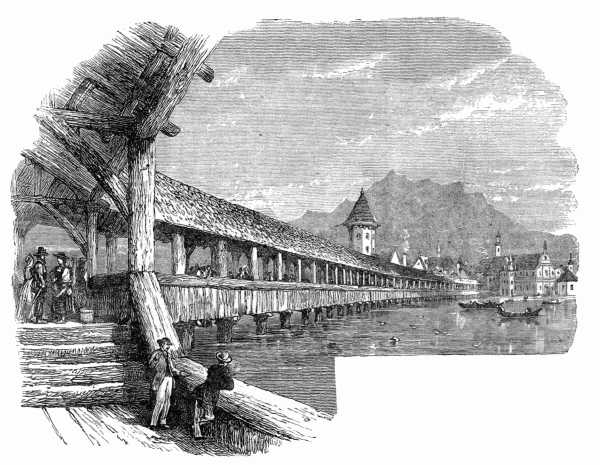
THE OLD BRIDGE, LUCERNE.