Part 2 — CHAPTER II.
Reading edition
ust then the little hunting party came in sight, and some half dozen of them, seeing the queen crying, ran forward to learn what had happened.
"What is the matter?" cried Alphonse, running up breathless.
"What's the matter?" repeated the king, petulantly; "I daresay you care very much what's the matter; a pretty fellow you are to run off in that style. Here's Pepitia—the queen, I mean—fallen down and hurt herself."
"Oh, poor thing!" said Amanda to Sophia; "she has hurt her nose, I think."
"No, she hasn't hurt her nose, miss," said the queen, looking up from her velvet train, for she had lost her handkerchief, and was wiping her eyes on its satin lining; "and don't you call me 'thing' again, you saucy puss."
"Lor, you needn't be so cross, Missis Queen," rejoined Amanda, making a mock curtsey.
This retort produced a sharp altercation, in which several others readily joined, and a dozen young voices were to be heard all speaking at once. Their dispute, however, was not a very serious one, nor very difficult to arrange; so when they had all become good friends, and when the queen had left off crying, which she did on finding that her wounds extended no further than a grazed elbow, the king inquired what sport his companions had had.
"Oh, capital; look here!" replied Alphonse, showing a small ivory cage containing about a score of butterflies. "Aren't they beauties?"
The butterflies were unanimously pronounced to be fine ones, and the queen was expressing her admiration of them by a variety of exclamations, when a little boy pushed his way into the crowd, and said, "Oh! please queen, here's your crown; I found it among the bramble bushes."
"Dear me," said Pepitia, "I quite forgot my crown!"
"Why, I've lost mine too!" cried the king, clapping his hand to his head to feel for the crown, which ought to have been there but was not.
"I've got the king's crown! I've got the king's crown!" cried another little fellow, running up from the other side of the dell.
"What a bother the crowns are," said Philip.
"Well, suppose we don't wear them any more to-day," suggested the queen.
"No more we will," replied he; "and we had better take off our trains, for there is no running or doing anything in them, and then you won't go tumbling over yours, Pepitia; we will lay them down here, and we can put them on again when we are going home."
So the trains, crowns, ball, and sceptre were put together in the corner of the dell, and then the king and the queen were ready for a good game of play with the rest of the troop.
"Well, now, what shall we play at next? I'm tired of hunting butterflies," said Alphonse.
A little voice suggested "Hunt the slipper."
"Oh, yes! that's right; let's play at hunt the slipper," cried all the youngest, clapping their hands and jumping up and down.
"I don't care for hunt the slipper," objected Amanda.
"Besides, we have not got a slipper," said the queen, "and I'm sure none of you shall take your shoes off, or you will catch cold."
"I wish we had a slipper," whimpered a little voice.
At that moment there popped down amongst them, as if it had been thrown from some high tree, a high-heeled silver slipper, studded with rubies and emeralds.
"Oh!" screamed all of them, starting back and forming a circle around it, "where did that come from?"
"Isn't it a beauty!" said one.
"How it sparkles!" said another.
"Why don't you pick it up?" said Edmund, nudging the little Teresa, who stood next to him.
"I'm afraid," said she. "It's alive, isn't it?"
"No; it won't hurt you," replied he. "Pick it up."
Half afraid, Teresa crept cautiously forward, and, stooping down, reached out her hand to take up the treasure; but before she could touch it, it bounded up with such a spring as caused her to scream and run hastily back.
Then it jumped over Amanda's head, just tapped her on the shoulder, as much as to say, "Come, catch me," and was lying some dozen yards off on the other side of the group before any of them could have said "Peter Piper."
"I know what it is," cried Alphonse; "it's a fairy slipper. The fairy has sent it for us to play with."
"It's a fairy slipper! It's a fairy slipper!" they all cried. "Let's hunt the fairy slipper!"
Off they started, the king and queen joining in the chase this time, and enjoying it, being without their crowns and trains. Master Edmund was foremost, but he overbalanced himself and lay sprawling on the ground, whilst the slipper jumped up into a tree. Philip and Alphonse, being the biggest boys, began immediately to climb up after it. But no sooner had Alphonse reached the bough where it was perched than it sprang off, rapped him on the nose, and slid down the opposite side of the tree, giving the king's leg a sharp kick as it passed by.
"Where has it gone?" cried the two, rapidly descending the tree.
"I don't know," was the general rejoinder, uttered in chorus.
"There it is!" cried Ernest, "hopping across the meadow."
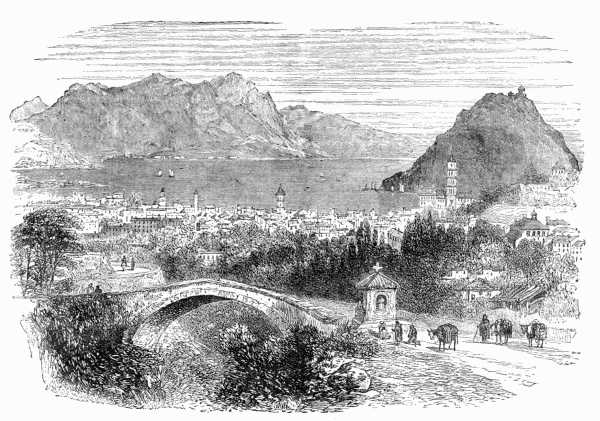
LUGANO. (See page 90.)
The whole troop raised a loud shout, and scampered off after it, the biggest first, and the little ones running in the rear as fast as their short legs would carry them, and hallooing with the loudest. The slipper stood still till the foremost was within grasping, length of it, when it gave a spring and got some yards in advance of the party, and then kept on hop, hop, hopping before them; yet, although it did not seem to hop very quickly, and although the young folks ran at the top of their speed, it always managed to keep at a tantalising distance, so that none of them could catch it, leading them a fine dance, up hill and down dale, through hedges and across the stepping-stones of a little brook, where many a wet shoe and sock were the result of its pranks. At last, just as Edmund was about to lay hold of it—as he made sure to do—it bounded to the top of a high, steep bank, and commenced doing the toe and heel shuffle.
Well, it was a droll sight, certainly, to see that fairy slipper, with all its sparkling jewels, dancing such a merry jig. I suppose because it was so droll was the reason why the little folks laughed so loud, and clapped their hands and jumped about as if they were mad.
Some of the bigger boys began to climb the bank in pursuit of the shoe, whilst the little ones fancied they did a vast deal towards capturing it by shouting with all their might; the louder they shouted the quicker the shoe danced, and the quicker the shoe danced the more they clapped their hands and laughed.
Alphonse climbed up a break in the bank, and so got to the top of it, a little to one side of where the shoe was cutting its merry capers. He crept softly along until he got within arm's length of it, then he made a bold grasp and seized it by the heel; but he soon let it go again, for a sharp, tingling pain ran up his arm to his shoulder, making him roar out pretty loudly.
The slipper, as soon as it was released, spun round two or three times, then, planting its heel on the ground and pointing its toe in the air, it gave a spring and was out of sight in a moment.
"Where has it gone to?" was the cry of them all. They looked everywhere for it, but did not find it. They shouted in chorus, "Come back, fairy slipper, come back!" but no slipper came, and they were forced to go home to their pretty houses without having found it, much to the regret of little Teresa, who was near crying with vexation at having lost the sparkling plaything.
They were all tired by when they reached their homes, and some of the younger ones were very cross also, for their little legs were tired from chasing the slipper, and they began crying for their mammas, so that the poor Nomen had work enough to get them all to bed and soothe them to sleep.
Now I cannot tell you whether these little folks would have continued happy and contented on Child Island, and never have wished to leave it for any other place, if they had had their mothers and fathers with them. But not having them, there was something wanting, and by the end of three weeks, or thereabouts, they were all heartily tired of being away from home. Yet how to get back there was a difficulty that not even wise Master Alphonse could solve. They had no boat to take them from the island, and even if they had had one they would not have known how to manage it, nor in which direction to guide it, as they were quite ignorant of the whereabouts of Noviland.
So matters grew from worse to worse on the island, the elder children getting more discontented and the younger ones more fretful, when one day they were altogether on the lawn in front of the palace. The big ones were moodily walking about, plucking the flowers and listlessly pulling them to pieces, or throwing them away as soon as plucked; the little ones, cross as two sticks, as nurses sometimes say, were getting into all sorts of mischief. One had lost her shoe, and was whimpering because she could not find it; a little boy had had his finger stung by a bee, and was roaring lustily in consequence; Teresa had fallen full length, with arms all bare, into a bramble bush, where she lay moaning piteously.
"What are the children making that row for?" cried Philip, as cross as the crossest himself; "for half a pin I'd box all their ears. Now then, what's the matter with you, you little sniveller?" said he, catching hold of a fair-haired little fellow, who was blubbering his loudest, and who seemed bent on rubbing his eyes out by the way in which he was screwing his little fists into them.
"I—I—want my—ma—a, let—me—go—o—to—my—ma," said he, with a sob between each word.
"You can't go home to your ma, then," said Philip, sharply, giving the child a shake; but this, instead of quieting, only made him roar louder, and his example was soon followed by all the rest of his age, and then there was a dismal chorus, the burden of which was, "Ma, ma, ma."
"Oh! dear, dear me," cried Pepitia, in real distress, "what shall we do with these children? They'll drive me mad. I shall begin to cry myself if they don't leave off. I wish the good fairy would come and take us all home again!"
"Air balloon, air balloon!" shouted Alphonse, starting up from the grass, where he had been lying on his back during all this confusion, listlessly staring up to the sky.
This caused a sudden stop to the uproar, and the attention of all was directed towards the sky. The bigger children waved their handkerchiefs and shouted "Air balloon!" Some of the little ones joined in the cry, and so forgot their sorrows, but others resumed their sobbing, and would not care for balloons or anything else, but only wanted to go home to their mothers.
The balloon came sailing onwards, seeming to grow larger and larger the nearer it approached. Within its car sat the fairy Corianda. It slowly descended in front of the palace, and whilst it rested on the ground the fairy stepped out; then it re-ascended and floated about in the air.
"Well, now! what is the matter with you all?" said the fairy, going among the children and soothing the afflicted ones. "Why are you all so sad and unhappy? Are you tired of being in this pretty island? and do you really want to go back to Noviland?"
"Yes, yes; please take us home again," they all cried. "We have been very happy here, but now we want to go home to our dear mammas and papas. Please do take us home!"
"Very well," said the fairy; "as you wish it you shall all be back in your own old homes to-morrow morning. So bid good-bye to Child Island, and don't cry any more."
Then the fairy waved her hand, and immediately a silvery mist surrounded them; the palace and the pretty houses became less and less distinct, until there was only a faint and shadowy outline of them; then the mist grew thicker, and each child became alarmed at finding itself separated from all its companions, and on striving to call out it could not. Thicker and thicker grew the mist until it was quite dark, and the children, parted from each other, were bewildered and knew not where they were.
Presently the mist gradually cleared away, and then, instead of Child Island and the pretty houses, each child found itself in its own bed at Noviland.
Eagerly that morning did they tell their fond parents of the good fairy and Child Island, of the beautiful palace and pretty houses, of the tiny musicians, the fairy slipper, and the strange Nomen. And as each little tongue prattled its pretty tale, the parents smiled and said to each other, "Truly our dear child has had a pleasant dream!"
But the children knew better; they knew there was a good fairy Corianda, and that she had taken them to her magic isle, called Child Island.
E. Hunter.
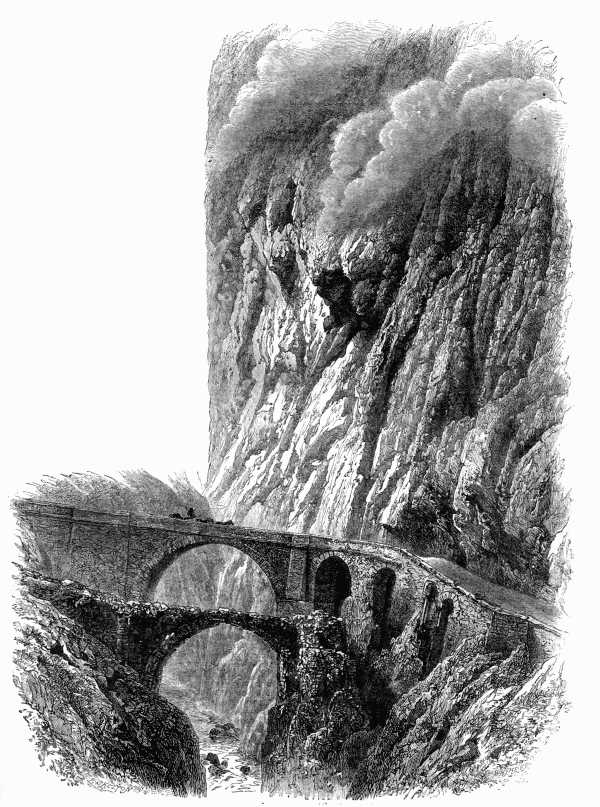
THE DEVIL'S BRIDGE. (See page 90.)