Front matter (continued 3)
Reading edition
"A—a paid informer?"
"I don't know whether the Government pays Monsieur Wildresse."
"But he doesn't do such things for the pleasure of doing them."
"Pleasure? It is an abominable profession! It is unclean."
"Then why do you do it?" he demanded, amazed.
"I am not perfectly sure why. I know that the Patron is afraid of the Government. That, I suppose, is why we have been obliged to take orders from them."
"Afraid? Why?"
"It's partly on Jacques' account—his son's. If we do what they ask of us they say that they won't send him to New Caledonia. But I believe it is all blague." She looked up at Warner out of her troubled grey eyes. "Espionage—that has been my metier since I was taken out of school—to listen in the cabaret, to learn to keep my eyes open, to relate to the Patron whatever I saw or heard concerning any client the Government desired him to watch.... Do you think that is a very pleasant life for a young girl?"
His face became expressionless.
"Not very," he said. "Go on."
She said thoughtfully:
"It is a horrible profession, Mr. Warner. Why should I continue it? Are there no police? Why should I, Philippa Wildresse, do their dirty work? Can you explain? Alors, I have asked myself that many, many times. Today, at last, I have answered my own question: I shall never again play the spy for anybody! C'est fini! Voilà!"
Warner remained silent.
"Why, it is revolting!" she exclaimed. "Figurez-vous, Monsieur! I was even signaled to spy upon you! Can you conceive such a thing?"
"On me?" he repeated, bewildered and angry.
"Certainly. That is why I danced with you. I am permitted to dance only with clients under observation."
Her unflattering candor sent a flush to his face. His latent vanity had been rather rudely surprised.
"Afterward," she continued, "I knew you could not be the man they wanted——"
"What man did they want?"
"Somebody who had stolen documents in America, I believe. But I was sure that you were honest."
"Why?"
Philippa lifted her grey eyes:
"Because you were honest with me."
"How, honest?"
"You did not make love to me. Dishonest men always regard women as a pastime. To make advances is the first thing I expect from them. I am never disappointed. All men are more or less dishonest—excepting you."
"This is a sorry school you have been brought up in," he said grimly.
"Do you mean that I have had my schooling by observing life?"
"Yes—a life in a cabaret full of rastaoqueres and cocottes—a rather limited and sordid outlook, Philippa. The world lies outside."
"Still—it is life. Even a cocotte is part of life."
"So is disease. But it isn't all there is in life."
"Nor is life in a cabaret all corruption. A cabaret is merely the world in miniature; all types pass in and out; they come and go as souls are born and go: the door opens and closes; one sees a new face, one loses it. It is much like birth and death."
She made an unconsciously graceful gesture toward the white clouds overhead.
"A cabaret," she went on seriously, "is a republic governed by the patron, audited by the caissière, policed by waiters. Everybody goes there—even you, Monsieur. All languages are spoken there, all questions discussed, all theories aired, all passions ventilated. Every trait of human nature is to be observed there; the germ of every comedy; the motive of every tragedy.... Yet, as you say, it is a saddening school.... Wisdom is too early acquired there. One learns too quickly and too completely in such a school. Such an education means precocity. It foreshadows the early death of youth, Monsieur.... If I remain there, all that is still young in me will die, now, very quickly."
"You poor child!"
She shrugged her shoulders.
"Therefore," she said, "I am leaving. Now do you understand?"
He sat looking at her, wondering uneasily at her intelligence and her ability to express herself. Here was a maturity of mind unexpected in this girl. So far it had not visibly altered the youth of her, nor impaired her sweetness and honesty.
In spite of the appalling surroundings amid which she had matured, her mind and heart still remained young.
Biting a tasselled grass stem reflectively, she sat thinking for a few moments, then she reverted to the subject of Wildresse and his son.
"I am convinced that it is all blague," she repeated, "—this threat of Noumea. Unless Jacques misbehaves very seriously in Biribi, nobody can send him to La Nouvelle. Besides, if his father chooses to oblige the Government, what does it matter about me? No; I have had enough of degradation. An hour on the river with you was enough to settle it."
"But what do you intend to do, Philippa?" he inquired.
She looked up at him with her winning smile:
"I came to ask you that. Please tell me what I am to do."
"You must not ask me——"
"Of course. You are the first man who ever pleased me. You please me more and more. Why should I not come to you in my perplexity and say, 'What am I to do, my friend?'"
He reddened at that; found nothing to answer. The sudden and grotesque responsibility which this young girl was so lightly placing upon his shoulders might have amused if it had not disconcerted him. But it did not disconcert her.
"What am I to do, Mr. Warner?" she repeated with a smile of perfect confidence.
"Why, I don't know, Philippa. What can you do down here at Saïs?"
"Tell me!" she insisted with undisturbed serenity.
"You couldn't very well remain here. You will have to go back to Ausone and consider this matter more seriously——"
"Ah, ça—non! I shall not go back!"
"What do you propose to do?"
She bit her grass stem:
"I don't know. I have my trunk in the punt——"
"What!"
"Certainly, I brought my effects! I have some money—not very much. I shall go to the inn and remain there until you have decided what it is best for me to do."
The situation began to strike him as sufficiently ludicrous—the tragic mask is always on the verge of a grin—but he did not feel like smiling.
For a few minutes he occupied himself with collecting, strapping, and slinging his kit; and when he was ready to go, he looked down at the girl Philippa, where she was seated watching him out of her trustful grey eyes.
"I can employ you as a model," he said, "until Monsieur Wildresse sends for you. What do you think of the idea?"
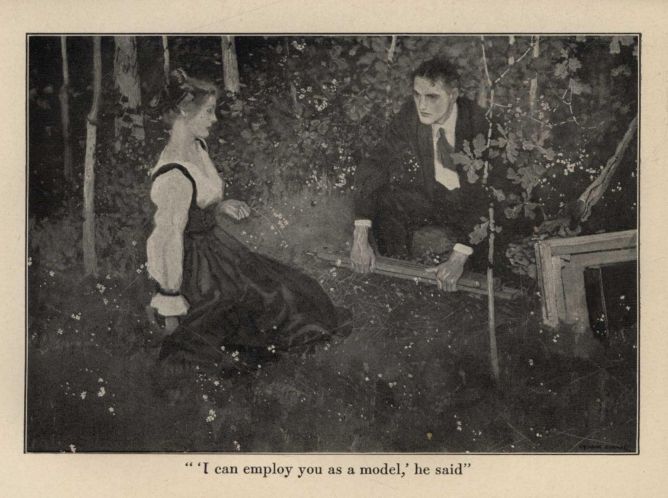
"'I can employ you as a model,' he said"
"As a—a model, Monsieur?" she stammered.
"Yes. You could pose for me, if you like."
A delicate scarlet flush slowly mounted to her hair.
Perplexed, he watched her.
"Don't you like the idea?" And suddenly he divined what was troubling her. "Not that sort of model," he said, amused. "You shall wear your clothes, Philippa."
"Oh.... Yes, I should like it, I think."
"It's about the only excuse which would enable you to remain at the inn until you have come to some conclusion regarding your future," he explained.
"A painter may always have his models? It is expected, is it not?"
"Oh, yes, that is always understood. But nobody would understand your coming to live at the Golden Peach merely because you and I happened to be good friends," he added laughingly.
"I understand," she said in a grave voice. "I am to be your model, not your friend."
He nodded carelessly, looking away from her. After a moment, he lighted a cigarette. It relieved him considerably to recollect that the Harem had gone to Ausone.
"Now," he said, "if you are ready to walk back to the inn with me, I'll explain you to Madame Arlon, the patronne."
"And my punt?" she inquired, rising from the grass.
"Oh, Lord! I forgot."
"My trunk is in it."
"Where is your punt?"
She pointed across the meadow to where the river sparkled:
"It is my own punt; the Lys. I took nothing from Monsieur Wildresse that did not belong to me. It will be agreeable for us to have a punt here, will it not?"
"Very," he said uneasily.
They turned eastward across the blossoming meadow, over which already the swallows were soaring in their late afternoon flight. A vanneau or two rose from moist spots, protesting, and flapping away on greenish-bronze wings; a bécassine went off like a badly-balanced arrow, and his flat, raucous, "squack! squack!" rang through the sunny silence. Higher, higher his twisting flight carried him toward the sky, where he dwindled to a speck and vanished; but out of the intense blue zenith his distant cry still rang long after he had disappeared from the range of human vision.
CHAPTER XI
When Warner and the girl Philippa arrived at the Golden Peach, they found that Madame Arlon, profiting by the prospective temporary absence of the Harem, had gone to visit relatives near Nancy for a day or two. But Linette smilingly took charge of Philippa and her luggage.
Warner, entering the southern end of the walled garden, discovered Halkett at the other extremity, still seated under the latticed arbor. A letter lay spread upon the table beside his elbow. Over this letter, with pencil and paper, he pored as though he were working out a problem in hieroglyphics.
But when Warner appeared, the Englishman leisurely folded and pocketed the papers on which he had been working, nodded pleasantly, and handed to Warner a copy of the Petit Journal d'Ausone.
"It came after you left," he said. "There's nothing really new in it—Germany's ultimatum to Russia, that's about all.... I am feeling rather anxious about a friend of mine, Reginald Gray. He was to have arrived here last night or early this morning on his motor cycle. No word has come from him personally, and it is now nearly night again."
Warner seated himself, glanced over the inky little provincial newspaper, then laid it aside. There was in its columns nothing definite concerning the threatened rupture of the peace of Europe.
"Halkett," he said almost solemnly, "this crime with which they say our civilization is menaced can never be consummated. There will be no World War, because the world dares not acquiesce in such an outrage. The eleventh hour has struck, I know; but salvation exists only because there is a twelfth hour on the dial; otherwise the preordained end of everything would be hell."
Halkett smiled slightly.
"I've just had another letter," he said. "I'm likely to remain here for a few days more.... Which means only one thing."
"What does it mean?"
"War."
Warner smiled incredulously.
"Anyway, there will be one compensation for the general smash if you remain here," he said gayly.
"You're very good to take it that way.... You and I—and to hell with the Deluge!" But his face sobered while the jest was spoken; he leaned rather wearily on the iron table and rested his forehead in one hand. "I wish I knew what has happened to Reginald Gray," he repeated.
"What is it that worries you about your friend Gray?"
"His cap was picked up on the highway five miles southeast of Saïs."
"How could you know that?"
"I have just learned it by telephone, through a certain source of information."
"Did you learn anything more?"
"There was a little blood on the road."
Warner remained silent.
"Also," continued Halkett thoughtfully, "a motor cycle had skidded up the bank.... But no signs of a serious accident could be discovered—merely the ragged swathe cut through soft earth and rank vegetation.... If Gray met with an accident, he must have mended his machine, remounted, and continued his course—wherever he was going—unless somebody picked up him and his wheel and took them away.... I can't understand this affair. It bothers me."
"The chances are that your friend Gray had a rather bad spill," suggested Warner, "and no doubt you'll hear from him, or about him, before morning."
"I ought to, certainly." He filled and lighted his pipe; Warner rose and began to pace the garden path rather nervously. Presently he came back to where the Englishman sat brooding over his pipe and nursing Ariadne.
"Halkett," he said abruptly, "you remember that girl Philippa in the Café Biribi?"
The Englishman looked up inquiringly.
"Well, she is here."
"At the inn?"
"Yes. I met her down in the big river meadow this afternoon, and she calmly informed me that she had left home for good."
"Run away?"
"Run away. Taken the key of the fields. Beat it for keeps. How does that strike you?"
"Any particular reason?" inquired Halkett indifferently.
"Why, yes. The child has been used by the secret police to spy on people in the Café Biribi."
Halkett's eyes opened at that.
Warner went on:
"That old rascal, Wildresse, it seems, is nothing but a paid informer. He forced this girl Philippa to engage in the same filthy business. She even admitted that old Wildresse had set her on me! No doubt he had decided to watch you himself. And do you know what I think?"
Halkett was very wide-awake now. He said:
"I believe I do know what you are thinking. And I believe you are pretty nearly right."
"That the assault on you was merely a local matter instigated by Wildresse?"
"It wouldn't surprise me."
"I think it was, too. Some of his thugs did it. He had made up his mind about you. But somebody must have tipped him off to watch you."
"Probably."
"I am sure of it. The three German-appearing men who tried to pick a quarrel with you over the Archduke's murder were not the men who tried to frisk you for your papers. They were 'provocative agents' in the pay of a foreign government—hired opportunists who were expected to pick something of value out of any confusion attending a general row fomented by themselves."
"Who told you that?"
"Philippa."
Halkett, now thoroughly interested, looked keenly at Warner through the thin haze of his pipe.
"These three agents," continued Warner, "were certainly in close communication with the men who have been following you. And at least one of those men was seated at the table directly behind you when Wildresse's thugs tried to frisk you for documents. So you see that Wildresse, prodded by the French secret police, and these provocative agents, prodded by the people who are following you, who, in turn, are spurred by the German Government, were all playing at cross purposes, but with you as a common objective. A fine nest of intrigue I led you into when I took you to the Cabaret de Biribi! I'm terribly sorry, Halkett. But I believe that some good has come out of that mess—a fragment of a letter, written in German, which Philippa gave me in the meadow this afternoon.
"She found it under the wrecked table behind you. Nobody has seen it except myself and Philippa; and the child cannot read much German. But, studying it and seeing your name in the letter, she was clever enough to bring it to me. Here it is." He laid it on the table under the Englishman's eyes.
While Halkett remained absorbed in his translation, Warner paced the garden, deeply occupied with his own uneasy cogitations. After a little while Halkett spoke to him in an altered voice, and he turned and came swiftly back to the arbor.
The Englishman, looking up, said gravely:
"Concerning myself, there seems to remain now nothing worth concealing from you.... Perhaps you had better know the truth. I happen to be an officer temporarily serving with the Intelligence Department; I had just been assigned to duty in New York when the Harkness shell was stolen. The general alarm went out. Gray, a brother officer, and I chanced to stumble on evidence which sent us aboard an Antwerp steamer. Our birds were aboard. We pulled every string available, and, passing over the details of the affair, he and I managed to recover the drawings, specifications, and formula which had been stolen. Some of these papers are in that envelope.
"Every German agent in Europe knows we have them. My Government, for some reason or other, instructs me to remain here for the present. As Gray and I are known, doubtless somebody will appear and take the drawings out of our hands, because the chances are that I'd be murdered before I reached Calais. That is the situation, Warner."
"Has Gray any of the drawings?"
"He has."
"I understand."
"And that is why I am worrying about Gray. They'd not hesitate to kill him if they thought there was a chance that he had any of the papers."
Warner said:
"They couldn't have killed him. A crime on the public highway cannot remain undiscovered very long."
Halkett sat thoughtfully stroking Ariadne. Presently he looked up with a slight smile.
"Well, what are you going to do with the girl Philippa?" he inquired.
"Now, what do you think of a situation like this?" demanded Warner, half laughing, half vexed. "I told her to go home. She positively refuses. You can't blame the child. The dirty business there has disgusted her. This seems to be a final revolt. But—what would you do if a young girl wished herself on you?"
"I haven't the faintest idea," said Halkett, intensely amused.
Warner reddened.
"I haven't either," he said. "All I can think of is to use her as a model—give her a small salary until she finds something to do."
"Are you going to use her for a model?"
"I suppose so, until somebody comes after her to take her back."
"Suppose nobody comes?" suggested Halkett mischievously.
"Well, I'm not going to adopt her, that's certain," insisted the other. "Poor little thing!" he added. "—Her instincts seem to be decent. Who could blame a young girl for sickening of such a life and cutting away on her own hook? That's a rotten joint, that Cabaret de Biribi. And as for that old villain, Wildresse, it wouldn't surprise me at all if he were playing the dirty game from both ends—German and French. Informers are often traitors."
"Very frequently."
"Spies also have that reputation, I believe—except in romantic fiction," said Warner.
"They usually deserve it," returned Halkett. "Generally speaking, they are a scum recruited from low pubs and brothels. Rarely does any reputable person enter that profession except in line of military duty or in time of war.
"Servants, waiters, chauffeurs, those are the most respectable classes of secret agents. But the demi-monde and their hangers-on furnish the majority of those popularly supposed to represent people of position who play the rôle of international spy. They are a rummy lot, Warner.
"It is very, very seldom in Occidental drawing-rooms that such practices prevail. A woman of position very rarely becomes a paid agent of that sort. Diplomats and attachés who are pumped and victimized are usually the dupes of socially disreputable people. Society in England and in Western Europe rarely entertains such a favorite of fiction as a paid Government spy; nor are such people very often recruited from its ranks. East of the Danube it is different."
They sat for a while smoking, Halkett lavishing endearments upon Ariadne who never failed to respond, Warner musing on what Halkett had said and wondering exactly what duties the Military Intelligence Department of any Government might include.
No doubt, like the Government, it employs spies, and, like the Government, never admits the fact.
For among all outcasts so vitally necessary to autocracy and militarism, the spy is the most pitiable: in time of peace no authority admits employing him; in time of war, his fate, if taken, is as certain as that his own Government will disown him. Eternally repudiated, whether of respectable or disreputable antecedents, honest or otherwise, patriotic or mercenary, the world has only one opinion to express concerning spies, although it often cackles over their adventures and snivels over their fate.
Perhaps Halkett was musing on these things, for presently he took his pipe from his mouth and said:
"To my knowledge, we British never employ spies in America. Your Government, I know, never employs them anywhere in time of peace. All other Governments do. Europe swarms with them. If I were in Germany today, I'd be considered a spy. They'd follow me about and lock me up on the first excuse—or without any excuse at all. And if we chanced to be at war with Germany, and I were caught, they'd certainly shoot me because I have recovered stolen property."
"They'd execute you because you are not in uniform?"
"Certainly. I'd not stand a ghost of a chance. So I shall be rather glad that I'm in France when war comes."
"You are so certain it is coming?"
"Absolutely, my dear fellow. Probably it will be declared tomorrow."
"I cannot believe it, Halkett."
"I can scarcely believe it myself. But—I know it is coming. And it is coming from the north."
"Through Belgium?"
"Exactly."
"And the treaty?"
"I have already told you how Germany regards such agreements. She'll kill that treaty with just as much emotion as she'd experience in assassinating a fly. It's a rotten outlook, Warner. The eleventh hour has passed."
They smoked for a while in silence, then:
"Where is your little protégée?" asked Halkett, making an effort to shake off his depression.
"Linette is making her comfortable. When Madame Arlon returns from Nancy I shall tell her to look out for the child. She's in her room, unpacking, I suppose."
"Did she even bring her boxes?" asked the Englishman, greatly amused.
"Yes, she did. And I don't know what on earth she intends to do for a living when I go back to Paris. I'm sorry for her, but she can't expect me to travel about France with her——"
He checked himself abruptly; Halkett also looked up.
The girl Philippa had entered the further end of the garden.
She came slowly forward through the rosy evening light, straight and slim in her girlish gown of white, unrelieved except by a touch or two of black, and by the coppery splendor of her hair.
She halted in the path a little way from the arbor, evidently aware that somebody was within.
"Are you there, Monsieur Warner?" she asked in her sweet, childish voice.
He got up with a glance of resignation at Halkett, and went to meet her. Halkett, from the arbor, noticed the expression of her face when Warner appeared, and he continued to observe the girl with curious attention.
She had instinctively laid her hands in Warner's, detaining him naïvely, and looking up into his face with an honesty too transparent to mistake.
"I miss you very much," she said, "even for a few minutes. I hastened my toilet to rejoin you."
"That is very sweet of you, Philippa——" He didn't know what else to say; felt the embarrassment warm on his face—chagrin, shyness, something of both, perhaps—and a rather helpless feeling that he was acquiescing in an understanding which already was making him very uneasy.
"Come in to the arbor," he said. "Mr. Halkett is there."
She slipped her arm through his. Halkett saw both their faces as they approached, and, watching Warner for a moment, he felt inclined to laugh. But in this young girl's eyes there was something that checked his amusement. A man does not laugh at the happy and serious eyes of childhood.
So he rose and paid his respects to Philippa with pleasant formality; she seated herself between the two men.
The last pink rays of the sun fell across the little iron table, flooding the garden with an enchanted light: already the evening perfume of clove pinks had become exquisitely apparent; a belated bumblebee blundered out of the reseda and, rising high in the calm air, steered his bullet flight into the west. Ariadne, on the table, stretched herself, yawned, and looked about her, now thoroughly awake for the rest of the night.
"Minette!" murmured Philippa, caressing her and laying her cheek against the soft fur.
"You are sunburned," remarked Halkett.
"And badly freckled, Monsieur——" She looked mischievously at Warner, laughed at their secret agreement concerning cosmetics, then turned again to Halkett:
"You have heard, I suppose, of the happy understanding between Mr. Warner and me?"
"I think so," said Halkett, subduing an inclination to laugh.
"The future, for me, is entirely secure," continued Philippa happily. "I am permitted to assist Mr. Warner in his art. It is a very wonderful future, Mr. Halkett, destined for me without doubt by God." She added, half to herself: "And a lifetime on my knees would be too short a time to thank Him in."
Both men became silent and constrained, Warner feeling more helpless than ever in the face of such tranquil confidence; Halkett remembering what Warner had once said about the soul of Philippa—but still pleasantly and gently inclined to skepticism concerning this fille de cabaret.
Philippa, leaning forward on the table between them, joined her slender hands and looked at Warner.
"It is pleasant to be accepted as a friend by such men as you are," she said thoughtfully.... "I have met other gentlemen of your station in life, now and then. But their attitude toward me has been different from yours.... I once supposed that, in a cabaret, all men resembled each other where women were concerned. I have been very happily mistaken."
Warner said:
"A man scarcely expects to see more than one sort of woman in a cabaret."
"Yet, you were not astonished to see me, were you?"
"Yes," he said, "I was astonished."
"You did not seem to be."
Warner glanced at Halkett:
"Do you remember what I once said about Philippa's soul?"
The Englishman smiled at Philippa:
"As soon as Mr. Warner saw you he said to me that your soul was as clean as a flame.... I was slower to understand you."
The girl turned swiftly to Warner:
"What a heavenly thing for a man to say about a woman! And my lips painted scarlet—and I a caissière de cabaret——" Her voice broke childishly; she sprang to her feet and stood looking through the starting tears at the last level rays of the sun.
Standing so, unstirring till the tears dried, she presently turned and resumed her chair; and, after a few moments' silence, she dropped her elbows on the table again and clasped her hands under her chin.
She said, not looking at either of the men:
"I have thought of becoming a nun. But it is too late. Cloisters make awkward inquiries and search records; no Sisterhood of any order I ever heard of would admit to a novitiate any girl who has served five years where I have served.... And so—until I saw you—I did not know what was to become of me——"
She lifted her grey eyes to Warner. They were starry with recent tears. Her chin rested on her clasped hands, her enchanted gaze on him.
Halkett was first to move and make an effort:
"Yes, it was perhaps time to cut away," he muttered. "Anything we can do—very glad, I'm sure."
"Certainly," said Warner. "There are a lot of agreeable young women in my class who will be interested to know you when they return from Ausone day after tomorrow——"
Philippa turned swiftly toward him:
"I do not wish any woman to know what I have been! You wouldn't tell them, would you?"
"No, of course not—if you feel that way," he said. "Only I—it occurred to me—some protection—some countenance—understanding—from other women——"
"I desire none. I want only your friendship."
"But how am I going to explain you——"
"You are a painter. I am your model. Is not that sufficient explanation?"
"Yes—if you desire to be so regarded—permanently——"
"I do. My privacy will then remain my own. I permit nobody to invade it—excepting you."
"Very well, if you feel that way.... Only, you are—attractive, Philippa—and I am rather afraid you might not be understood——"
She shrugged her shoulders:
"For five years I have not been understood. Do you know that men have even thrown dice for me, so certain were they that they understood me? I am accustomed to it. But I am not accustomed to women—I mean to your kind. I distrust them; possibly I am afraid of them. Anyway, their interest in me would be unwelcome. It is your friendship I want. Nothing else matters."
"You are wrong, Philippa. Other things do matter. No woman can go it alone, disdainful of other women's opinions."
"I have always been alone."
Warner said patiently:
"I should not do anything without first consulting you."
"I feel very sure that you would not." She smiled at him trustfully, her cheek on her linked fingers; then her gaze grew absent. The last sun ray lingered on her hair, turning it to fiery bronze. Under it her grey eyes gazed absently into the future, filled now, for her, with iridescent castles and peopled with vaguely splendid images—magic scenes that young and lonely hearts evoke out of the very emptiness of their isolation.
And in the center of the phantom pageant always appeared Warner, her friend, endowed with all the mystery and omniscience with which a young girl's heart invests the man who first awakens it to irregularity—who first interferes with the long monotony of its virgin rhythm.
Halkett, a little keener of the two—a little more sensitive, if more reticent—said pleasantly:
"Perhaps you might prefer to dine out here with us, Philippa. The Ha—the class, I mean—banquets and carouses in the dining-room, when it is here."
"Of course I wish to dine with you! I said so to Linette before I came out here. It is all arranged."
Halkett laughed. At the same moment, Linette came out with the tray.
A bright afterglow still lingered in the zenith when their leisurely dinner had ended; and in the garden the mellow light was beginning to make objects exquisitely indistinct.
Halkett, smoking in silence, was evidently thinking about his friend Gray, for, when Linette came to remove the cloth and coffee cups, and to say that some gentlemen on motor cycles were at the garden gate inquiring for Mr. Halkett, the young Englishman rose with a quick sigh of relief and walked swiftly to the heavy, green door under the arch in the garden wall.
As he laid his hand on the latch, he turned toward Warner:
"I'll bring Gray in directly," he called back; and opened the door and stepped out into the dusk.
At the same instant Warner rose to his feet, listening; then he ran for the green door. As he reached it, the heavy little door burst open; Halkett sprang inside, slid the big iron bolt into place, turned and warned the American aside with upflung hand.
"Keep Philippa out of range of the door!" he called across the garden, drawing his automatic at the same time and springing backward. "Don't stand in a line with that green door——"
A volley of pistol shots cut him short.
CHAPTER XII
The green door in the garden wall had been perforated by a dozen bullets from outside before the first heavy crash came, almost shaking it from its hinges.
Warner had already whipped out his own automatic; Halkett pushed him aside across a flower bed.
"Keep out of this!" he said. "It's my affair——"
"I'm damned if it is!" retorted Warner. "I'll settle that question once for all!" And he leveled his automatic and sent a stream of lead through the green door in the wall.
No more blows fell on it, but all over it, from top to bottom, white splinters flew while bullets poured through it from outside.
"You are wrong to involve yourself," insisted Halkett, raising his voice to dominate the racket of the automatics. "They want only me."
"So do I, Halkett. And I've got you and mean to keep you. Blood is the thicker, you know."
Philippa came from the arbor, carrying the badly frightened cat with difficulty.
"Is it really war?" she asked calmly, while Ariadne alternately cowered and struggled.
"Just a little private war," said Halkett. "And you had better go into the house at once——"
"You and I should go, also," added Warner, "if there are more than two men out there."
"I saw at least half a dozen beyond the wall. You are quite right, Warner; we couldn't hope to hold this garden. But I dislike to go into a strange house and invite assault on other people's property—just to save my own hide——"
"Keep out of range!" interrupted Warner sharply, taking him by the arm and following Philippa around the garden toward the rear of the house.
The back door was iron, armed with thick steel bolts; the neighborhood of the quarry rendering such defenses advisable. Warner shot all three bolts, then passed rapidly through the kitchen to the front door and secured it, while Halkett went to the telephone. The nearest gendarmes were at Ausone.
Linette, the chambermaid and waitress, and Magda, the cook, had followed Halkett and Philippa from the pantry through the kitchen to the front hallway. They had heard the noisy fusillade in the garden. Curiosity seemed to be their ruling emotion, but even that was under control.
"Is it the Prussians, Messieurs?" asked Linette calmly. "Has the war really begun?" Her face, and Magda's too, seemed a trifle colorless in the failing evening light, but her voice was steady.
"Magda," said Warner, "the men outside our garden who fired at Mr. Halkett are certainly Germans. He and I mean to keep them out of this house if they attempt to enter it. So you and Linette had better go very quietly to the cellar and remain there, because there may be some more firing——"
"I? The cellar! When Prussians are outside!" exclaimed Magda. "Ma foi! I think Linette and I can be of better use than hiding in the cellar. Linette! Set water to boil in both kettles! I have my dishes to wash. The Prussians had better not interfere with me when I have dishes to wash!"
"Keep away from the windows," added Warner to Linette. "There are iron bars on all the lower windows, aren't there?"
"Yes, Monsieur Warner. If the front door holds, they cannot get in."
Halkett, at the telephone, called back through the dim hallway to Warner:
"Somebody has cut the telephone wire. I can't do anything with the instrument!"
Philippa, still clasping Ariadne, had betrayed no sign of fear or excitement.
"If somebody would tell me what to do," she began—but Warner quickly drew her into the office of the inn, which was really the inner café and bar.
"Stay here," he said. "Those men outside might open fire on us at any moment. Don't go near a window. Do you promise?"
The girl seated herself obediently and began to stroke the cat, her eyes serenely fixed on Warner.
Halkett had gone to the floor above to lurk by one of the windows giving on the garden. When Warner came up with a box of cartridge clips, the Englishman, filling his pockets, remarked quietly:
"They're over the wall already, and dodging about among the fruit trees—four of them. There were two others. Perhaps you had better keep an eye on the front door, if you really insist on being mixed up with this mess I'm in."
"Do you suppose those fellows will be silly enough to attack the house?" asked the American incredulously.
Halkett nodded:
"They are desperate, you see. I can understand why. They know that war is likely to be declared within the next few hours. If they don't get me now they won't stand much chance later. That's why I'm prepared for anything on their part."
Warner walked swiftly back toward the front, cutting the cords of the latticed window blinds in every room, so that they fell full length.
"No lights in the house!" he called down over the banisters; "and keep away from the windows, everybody! Philippa, do you hear me?"
"I understand; I shall tell them to light no candles," came the untroubled voice of Philippa.
"Are you all right down there?"
"Yes, I am. But the cat is still quite frightened, poor darling."
In spite of his anxiety, Warner laughed as he reloaded.
Outdoors there still remained sufficient light to see by. Flat against the wall, pistol in hand, he cautiously reconnoitered the dusky roadway in front of the house, then, leaning further out, he ventured to look down between lattice and sill at the doorstep below. A mound of dry hay had been piled against the door.
"Get out of there!" he shouted, catching a glimpse of two shadowy figures skulking toward the doorway arch.
His reply was a red flash which split the dusk, another, and another; the window glass above him flew into splinters under the shower of bullets; the persiennes jerked and danced.
But the men who stood pouring bullets in his direction had been obliged to drop double armfuls of faggots. One of these men, still firing as he ran, took cover behind a poplar tree across the road; the other man flattened himself against the wall of the house, so far under the door arch that no shot could reach him from an upper window unless the marksman exposed himself.
Standing so, he lighted a chemical match and tossed it, flaring, on the heap of hay piled high against the door; and almost at the same instant a boilerful of hot water splashed through the bars of the lower window beside him, scalding and soaking him; and he bounded out into the road with a yell of astonishment and pain.
The hay, instantly on fire, sent a cloud of white thick smoke billowing along the façade of the house, then burst into flame; but Linette and Magda dashed water on it from the lower windows, and the red blaze leaped and died.
Then, from the rear of the house, the dry rattle of Halkett's automatic broke out, and the pattering racket of pistol shots redoubled when other automatics crackled from the garden. Thick as hailstones pelting a tin roof the bullets clanged on the iron rear door, filling the house with deafening dissonance.
Halkett, peering out through his lattice into the dusk, ceased firing. A few moments longer the door reëchoed the bullets' impact; then all sound ceased, the silence still vibrating metallic undertones.
Prowling from window to window, Warner, pistol lifted, peered warily from the shelter of the lowered lattice blinds.
One man still crouched behind the poplar tree; the other, he thought, was lying in the long grass of the roadside ditch.
"Are you all right, Halkett?" he called back through the stinging fumes of the smokeless powder which filled the hallway.
"Quite fit, thanks. How is it with you?"
"Still gayly on the job. I didn't hit anybody. I didn't try to."
"Nor I. Did you ever see such obstinacy and determination? Very German, isn't it?"
"Perfectly.... They're keeping rather too quiet to suit me. What do you suppose they're up to?"
But neither he nor the Englishman could discover any movement or hear any sound around the house. And it had now become too dark to see anything very clearly.
Philippa appeared mounting the stairs, looking for Ariadne who had scrambled out of her arms during the fusillade.
Warner nodded to her from where he was standing guard. She came up quietly behind him, stood for a moment with both hands around his left arm—a silent figure in the dusk, friendly as a well-bred dog, and as winningly unconscious of self. Her cheek, resting lightly against her hands, where they clasped his arm, pressed a trifle closer before she went away.
And while he stood there, perplexedly conscious of this youthful affection, and listening to every slightest sound, suddenly he heard her voice, startled, calling out to him from a bedroom on the east side of the house.
As he entered the room, running, a man outside on a garden ladder kicked in the window panes, drew back his heavy foot, sent it crashing again through the wooden frame, and lurched forward across the sill, only to be held there, fighting, in the grasp of Philippa.
Behind them another man on the ladder was already struggling to fling his leg over the sill; the head and shoulders of a third appeared just behind him, menacing with uplifted pistol any interference.
Already Philippa had been dragged headlong half-way through the shattered window, and the man whom she had seized was endeavoring to fling her down in the flower bed below, when Warner, leaping forward, hit him heavily in the face and caught the girl's shoulders, jerking her back into the room as her assailant's grasp on her waist relaxed.
The man with the pistol had not been able to use it; he staggered, his weapon fell, and he clung with both hands to the rungs as Philippa's assaulter went tumbling down the ladder, carrying with him the man directly behind him. And the next moment Warner had upset the ladder, sprung back, and pulled Philippa with him down on the floor.
A hurricane of bullets swept through the shattered window above them; Halkett, from his latticed vantage, was firing, too.
The girl lay panting beside him, silent, her head across his arm.
"Are you hurt?" he whispered.
"Are you?"
"No; answer me!" he repeated impatiently.
"He was—very rough. I don't think I am hurt," she breathed.
"You plucky little thing!"
She pressed her cheek against his arm.
"Are you contented with me?" she whispered.
The shots had ceased. After a long interval of quiet, Warner ventured to creep to the window and look through a corner of the ragged lattice blind. Little by little he raised himself to his knees, peered out and finally over.
The ladder lay there just below in the garden path; the men were gone. And, even as he looked, the staccato noise of departing motor cycles broke out like a startling volley of rifle fire in the night.
For an hour he stood on guard there, with the girl Philippa crouching beside him on the floor. From time to time he called cautiously:
"All well here!"
And the Englishman from the front windows always answered:
"All well here!"
Finally:
"Halkett!" he called. "I believe they've cut away for good!"
Halkett presently appeared in the hallway, coming from the front of the house, as Philippa rose to her knees and stood up, a trifle dazed.
"Warner," he whispered, "a dozen horsemen have just ridden up in front of our house. They look like French gendarmes to me, but it's so dark outside that I am not quite certain. Will you take a look at them?"
Warner ran to the front and gazed out. The road below was filled with mounted gendarmes, their white aiguillettes plainly visible in the dark.
Two had already descended from their horses, and while one held an electric torch the other was busily nailing a big placard to the front door of the inn. His hammer strokes rang out sharply in the darkness.
It took only a moment for him to complete his business; the electric torch shifted, flashed upward, was extinguished.
"Mount!" came the quick order from the shadowy peloton of horsemen; up on their high saddles popped the two troopers; there came a trample of hoofs, the dull clank of sabres, and away they galloped into the darkness.
Warner turned slowly, looked hard at Halkett, who merely nodded in reply to the silent question.
Philippa slipped downstairs in front of them and began to unlatch the door, as Linette and Magda appeared from the kitchen carrying lighted candles.
Then, when the front door had swung open, the little group gathered in front of it and read on the placard, by flickering candlelight, the decree of the Government of Republican France.
It was the order for general mobilization.
The nation was already at war.
CHAPTER XIII
A pale streak of daybreak along the eastern hills, a blackbird piping, then that intense stillness which heralds the sun.
In mid-heaven the last star-drops melted, washed out in the grey silver of the sky; a light breeze sighed through the trees, and, sighing, died.
Then, above earth, a sudden misty glory of gold and rose; and through it, as through a veil, the sword-edge of the celestial scimitar curved up, glittering.
Thus dawned the year of war on Saïs.
But the awakening world of summer did not seem to comprehend; the yellow-haired lad who drove his cows to pasture halted to read the placard on the door of the inn, then, whistling his dog to heel, ran forward after his slowly moving herd.
The miller of Saïs drove by on his way to the mill, drew rein to read the placard, looked up at the bullet-shattered window above, then jogged on, his furrowed features unaltered, his aged eyes fixed on his horse's ears.
One or two washerwomen on the way to the meadow pool stood gracefully regarding the poster, flat baskets of clothes balanced on their heads; then moved on through the golden sunrise, still graceful, unhurried, exchanging leisurely comments on life and death as they walked.
In the kitchen of the Golden Peach, Magda was astir, and presently Linette appeared, very sleepy. As they went about the routine business to which they had been bred, they too exchanged tranquil views concerning emperors and kings and the mortality of all flesh. Also they took counsel together regarding the return of Madame Arlon, the ultimate necessity of summoning a glazier from Ausone, the damage done in the garden by the ladder.
The door of Philippa's bedroom remained closed; Warner's door also. But Halkett, his hands in his pockets, was out at sunrise, pacing the road in front of the inn, sometimes looking up at the shot-riddled windows, or at the placard on the front door, or along the road at the telephone wires which appeared to be intact as far as he could see.
But somewhere they had been cut, and communication still remained interrupted.
Deeply worried over the non-appearance of Gray, the cutting of the telephone wires now became a matter of serious concern to him. He scarcely knew how to act in his sudden isolation, and, though his instructions held him at Saïs until further orders, the decree for general mobilization would have started him off for Paris except for one thing. That was the continued absence of Gray and the possibility that something alarming had happened to him.
He could not take his envelope and start for England until he had met Gray or some authorized messenger from Gray. He had not explained this to Warner.
But the truth was that what plans he carried were useless without the interlocking plans carried by Gray. All the eggs had not been trusted to a single basket. And, vice versa, the information carried by Gray was of no practical account until supplemented by the contents of the long, thin envelope.
Gray's papers and his, taken together, were of vital importance to England or to any enemy of England; separate they could be of no use to anybody, enemy or ally.
The determined attack on him the night before proved that others besides himself understood this. And it also made him realize the more clearly that since he had parted from Gray in Antwerp, the latter had been as open to such attacks as had he. The question now was: had they caught Gray? If so, it must have occurred within the last thirty-six hours, because he had talked over the telephone to Gray the evening of his own arrival at Saïs.
But since that conversation, which ended with the understanding that Gray should set out on his motor cycle for Saïs, not a word had he heard concerning his colleague, except that his cap had been found on the road south of Saïs, and that the condition of the roadside bank, and a few drops of blood, gave evidence of an accident—if, indeed, it had been an accident.
Nor had Halkett any idea who it was that had called him up on the telephone to tell him this.
As he stood there, looking down the road, terribly perplexed and filled with keenest apprehensions concerning his colleague, far away through the vista of poplars and telephone poles something white glimmered in the sunlit road.
It was the white cornette of a Sister of Charity; after a few minutes Halkett recognized the advancing figure and walked forward to meet her.
The color of early morning freshened her youthful cheeks, framed by the snowy wimple. She extended a friendly hand to him in salutation, as he came up and uncovered.
"At such an hour, Monsieur, only birds and Sisters of Charity are supposed to be on the wing. Is it curiosity that has awakened you to see how the sun really looks when it rises?"
But as she spoke she detected the deep anxiety which his smile masked, and her own face became responsively serious.
"Have you had bad news?" she asked gently.
"Worse—I have had no news at all. Are you going to the inn?"
"Yes."
"May I help you gather your flowers?" he asked.
"Thank you—if you care to."
They walked on in silence, skirted the garden wall westward, then north to the bullet-splintered green door.
Immediately she noticed the scars of the fusillade, gazed at them curiously for a moment, then laid a questioning forefinger across a bullet hole.
And while she stood so, he told her in a few words what had occurred the night before—told her everything, including the posting of the notice ordering a general mobilization.
She listened, her finger still resting over the shot hole, her calm face raised to his. And, when he ended:
"Then it is war already," she said quietly.
"War has not been declared.... Yes, it is virtually war. Why not say so?"
She nodded; he pushed open the heavy little door, and Sister Eila bent her white-coiffed head and stepped lightly into the garden.
For a while she moved slowly along the flower-bordered paths, as though uncertain what to choose from among the perfumed thickets, then, setting her ozier basket on the edge of the walk, she knelt down before the white clove pinks; and Halkett dropped on his knees beside her.
They worked there together, exchanging scarcely a word, slowly filling the basket which lay between them.
Ariadne came up with a cheery mew of greeting, and after marching around and rubbing herself against Halkett, mounted to his shoulders and settled down, purring like a teakettle beside his ear.
When the basket was filled, Sister Eila stood up and straightened her shoulders, and Halkett rose too, the cat still perched on his shoulder.
He lifted the flower-heaped basket and set it in the shade of the arbor; Sister Eila seated herself and Halkett sat down on the stone steps at her feet.
After a silence, made resonant with Ariadne's loudly cadenced purring, Sister Eila clasped her hands in her lap and looked steadily down at the heap of flowers in the green ozier basket.
"What is going to happen?" she asked in a low voice. "If there is to be a war, it will come here, I suppose."
"I am afraid so."
"Yes; Saïs cannot escape."
"The Vosges are too near," he nodded. "So is Ausone. So is the Rhine, for that matter." He glanced up at her from where he sat caressing Ariadne. "Belgium also is too near, Sister Eila."
"You believe they will arrive that way?"
"I feel very certain of it. And this means that England moves."
"Where?"
"To the firing line."
"With France?"
"Yes, Sister."
She said quietly:
"That is as it should be, Mr. Halkett. The two great wardens of European liberty should stand together in its defense."
"They've got to stand for each other," he said, "—whatever else they stand for."
"Alsace—Lorraine—I think this is to be a very holy war—for France," she murmured to herself.
He said nothing. He was not very clear concerning the exact amount of holiness involved, but he knew that war had now become a necessity to England, if she meant to retain the autocracy of the seas.
"We're bound to go in," he remarked, stroking Ariadne; "there's nothing else left for us to do. And if they don't give us an excuse by invading Belgium, we'll go in anyway. That's the meaning of all this! It has only one real meaning. The 'Day' they've been drinking to so long is—Today! This entire matter has got to be settled once and for all. And that's the truth, Sister Eila."
He sat for a while silent, gazing out across the quiet garden. Then, again:
"As for Saïs, if there is an invasion of France, it must pass this way: if the Vosges are to be defended, Saïs will see war."
"That will be very sad for us," she said. "It seems as though there were already enough violence and misery in the quarries—enough of wretchedness and poverty. If the quarrymen are called to the colors with their classes, and if the quarries and cement works close, I don't know what is to become of our school."
"You said that it is a free school."
"Yes, but the children live elsewhere, and are clothed and fed elsewhere. Except at noontime, we do not feed them. If we had money to provide beds and food, the school is large enough to shelter the children. However, I suppose we shall hear from the rue de Bac—the mother house, you know?"
She rose, picked up her basket of flowers, and Halkett also stood up.
"Good-by," she said. "Thank you for helping.... I—I suppose you do not remain very long in Saïs?"
"I don't know how long."
She inclined her young head gravely.
They walked together to the green door in the wall, and again her eyes became riveted on the bullet marks.
"Perhaps," she said, "you will have time to—to come to the school again before you leave Saïs? ... Unless you think it dangerous——"
He looked up, then away from her.
"I'll come—to the school."
"Then—it is au revoir, I hope."
He stood uncovered, holding open the door, and, as she passed in front of him, he took from her basket a white clove pink. She saw what he did, and halted instinctively to give him his choice. Suddenly, without any reason, her cheeks flushed brightly; she bent her head and stepped quickly through the archway, leaving him standing there with the dull color deepening in his sun-tanned face.
Warner discovered him still standing where she had left him, the white blossom hanging from his clenched fist.
"Well," he said, "how did you sleep after that villainous business of last night?"
"Thanks, I slept," replied Halkett, rousing himself.
They went into the arbor together, and presently Linette came out of the house carrying their coffee.
"Where is your little friend Philippa?" inquired the Englishman with an effort.
"In bed, I fancy. Linette has just taken up her café-au-lait. I think the child is feeling the reaction."
"No wonder. Plucky little thing!"
"Yes. But what on earth am I going to do with her, Halkett? Ought I to wait until that old scoundrel Wildresse comes here or telephones? Ought I to try to persuade her to go back to that cabaret? Ought I to telephone that she is safe here?"
"The wires are cut."
"I know. Somebody will fix them, though. Do you think I'd better try to persuade Philippa to let me drive her over to Ausone in the trap? If I'm to keep her, I ought to have an interview with Wildresse, or she and I will get into trouble."
"Oh, Lord!" said Halkett. "That's your affair. Listen, Warner, I'm so worried about Gray I can't think of anything else. Something serious certainly has happened to him. And until those wires are repaired, I shan't know what to do. Is there any other way we can communicate with Ausone?"
"None that I know of, unless somebody goes over to Ausone. I can do that if you like. I can drive over in the trap. Of course the telephone people already know that there's a break on the line, and no doubt they're out now looking for it. We'll be in communication with Ausone by noon, I expect."
For a little while they exchanged views concerning the attack of the previous night, and Halkett was of the opinion that the order for mobilization would now restrain any further violence on the part of those who had been following him, if, indeed, it did not entirely clear them out of France. And he expressed a desire for the envelope.
So Warner went into the house, lifted the partly hardened skin of white lead from the canvas, disinterred the envelope, wiped it clean, and brought it out to Halkett. The Englishman put it into his breast pocket.
"It was perfectly safe where it was," remarked the other. "It's an invitation to murder where it is now."
"Yes, but it's no good to anybody unless Gray turns up. I wish I knew what had become of that man. I think I'll try the telephone again——"
He rose and walked swiftly toward the house, Ariadne trotting at his heels. Even as he approached, he heard the telephone bell ringing, and hastened his steps toward the house.
But as he entered, the girl Philippa stepped into the hallway, and he caught a glimpse of a slim, barefooted figure, holding with one hand the folds of a shabby chamber robe around her, and with the other the receiver.
"What?" she cried in answer to a question. "Yes, I am Philippa.... Oh! It's you. I thought so.... What do you desire of me?"
What Wildresse desired of the girl Philippa intimately concerned Halkett. He coolly remained to listen.
"No!" she said in her clear, emotionless voice. "I shall not come back! ... Very well; if the Government agents want me, they can find me here.... You may threaten me with arrest by the Government if you choose, but I know that you are more afraid of the Government than I am.... Why shouldn't I say it! Yes, I know quite well that we are going to have war.... You say that the Germans are already across the Duchy? Skirmishing before Longwy? Very well; why don't you inform one of your Governments? ... No, I won't keep quiet! No, no, no! ... What you say does not frighten me.... I refuse to return! ... Because I am now in an honest business for myself.... Yes, it is an honest business. I am permitted to pose for an artist of great distinction.... What you say does not frighten me; but what you are does cause me some apprehension. And knowing as much as I do know about you, I seriously advise you to leave France.... No, I haven't said such a thing to anybody else, but I am likely to, so you had better hasten to leave for America. Yes, I will tell you why, if you wish. It is because there are always two millstones when anything is to be crushed. War is now beginning to bring those two stones together. The mill wheel already is turning! When the two millstones meet, the little meal worm that has remained between them so long in safety is going to be crushed.... Oh, yes, you do know what I mean! You also know whom I mean. Very well, then, if you don't I'll tell you this much: double wages never are paid by a single master. I learned that yesterday when you gave me the wrong paper to forward to Paris with the others. Fortunately for you, I read it. I then burnt it to ashes and took my clothes and my punt and my departure! I might have continued to endure what you had accustomed me to. But two masters! Faugh! The horror of it! ... Fear? If you really think that of me, then you have never really known me. It was disgust and shame that drove me toward liberty.... Yes, this that I say is final.... You dare not interfere! ... Then I'll say this: if you do not leave France now, at once, in this moment of her peril, I will tell what I know to the first soldier of France who crosses my path! ... I am not afraid of you, I tell you.... Believe me, you are well rid of me.... I warn you, in God's name, to let me alone!"
She hung up the receiver, turned, and mounted the stairs with flying feet, but at the top landing Halkett's quiet voice halted her.
"I was listening, Philippa. What that man says or does may cost me dear. What did he want of you?"
"Mr. Halkett," leaning swiftly toward him over the handrail above—"he is the most ignoble of creatures! And after five years I learned only yesterday that he sells his filthy secrets in two markets!—Three, perhaps; I don't know how many! And I no longer care! It ceases to interest me!"
"Wait! It interests me!"
"But I can't say any more to you than I have——"
"Why not?"
"I don't know. Can I? You know better than I. But I don't wish to betray anybody, even such a man as—as——"
"Wildresse?"
"Yes."
"Is he also betraying France?"
"I—I don't know. I suppose it is that. I haven't yet tried to comprehend it——"
"What was the paper you started to forward, then read, and finally burned?"
"It was a letter directed to a Mr. Esser. He is a German."
"The head of the Esser Cement Works?"
"Yes."
"What was in the letter?"
"A list of the guns in the Ausone Fort and a plan of the emplacements on tissue paper.... Perhaps I am stupid, but I could guess what a German wanted with a plan of a French fort! It was enough for me! I took my punt and my effects and I departed!"
"You burnt the letter?"
"In my candle. Also, I wrote on a piece of paper, 'You damned traitor!' and I pinned it on his door. Then I went out by the garden door with my leather trunk on my head!"
"Come down when you are dressed," said Halkett, and walked back through the hallway to the garden.
"Warner," he said, "this old spider, Wildresse, is certainly a bad lot. I'd have him arrested by French gendarmes if I were certain that England is going in. But I dare not chance it until I'm sure. Perhaps I dare not chance it at all, because if he has had anything to do with Gray's disappearance, as I am beginning to suspect, it would not do to have the French authorities examine my papers."
"Why?"
"Because—if they have already seized Gray's papers, they will secure military information which perhaps my Government might not care to have even an ally possess. I don't know whether Gray is living or dead; I don't know who has Gray's papers at this instant. That's the trouble. And I'm hanged if I know what to do! I'm stumped, and that's the devilish truth!"
He took a few quick, uncertain steps along the flower beds, turned, came back to the arbor where Warner was seated:
"It's a mess!" he said. "Even if agents employed by Wildresse have robbed Gray—murdered him, perhaps, to do it—I don't know what Wildresse means to do with Gray's papers."
"What!"
Halkett nodded:
"Yes, he's that kind! Pleasant, isn't it? If he has Gray's papers, it may be France that will pay him for them; it may be that Germany has already bought and paid for them. In either case, carrying the papers I carry, I hesitate to ask for his arrest. Do you understand?"
"Very clearly. If there is any way you can think of to get hold of this scoundrel, I'll be glad to help. Shall we drive over to Ausone and try?"
"You're very kind, Warner. I don't know; I want to think it over——" He turned and walked back to the house, entered the hallway, unhooked the telephone, and finally was given a connection—not the one he had asked for.
A voice said curtly:
"During mobilization no private messages are transmitted." Click! And the connection was severed. Again and again he made the attempt; no further attention was paid to his ringing. Finally he hung up the receiver and started to go out through the front doorway.
As he crossed the threshold, a young man in tweeds rode up on a bicycle, stepped off, and, lifting his cap to Halkett, said politely:
"Monsieur Halkett, if you please? Is he still residing here at the Golden Peach?"
Halkett's right hand dropped carelessly into the side pocket of his coat. When he had cocked his automatic, he said pleasantly:
"I am Mr. Halkett."
The young man said smilingly, in perfect English:
"Do you expect a friend, Mr. Halkett?"
"Perhaps."
"Possibly you expect a Mr. Reginald Gray?"
"Possibly."
"He has been injured."
"Really?"
"Yes, rather seriously. He lost control of his motor cycle two nights ago. He was on his way to join you here."
"Indeed?"
"So he told me before he became unconscious."
"Is he still unconscious?"
"No, but he is too weak to move."
"Where is he?"
"At my house, in Bois d'Avril. I was motoring that evening, and I found him in the road, insensible. So I lifted him into my car, slung his motor cycle on behind, and went top speed for home. He's in my own house in Bois d'Avril. The physician thinks he will recover."
"What is your telephone number?" asked Halkett bluntly.
The young man gave it, adding that the transmission of private messages had, unfortunately, been suspended during mobilization. Which Halkett knew to be true.
"Very well," he said, "I shall go to Bois d'Avril at once——"
"It is not necessary; I have a message for you, and some papers from Mr. Gray."
"Really?"
The young man smiled, drew from his inner pocket a long, thin envelope, and handed it to Halkett. The latter held it in his hand, looking steadily into the stranger's pleasant face for a full minute, then he coolly opened the envelope.
Inside were the missing papers concerning the Harkness shell, complete.
There could be no doubt concerning their identity; he recognized them at a glance. A deep sigh of relief escaped him.
He said:
"There's no use trying to thank you——"
"It's quite all right," interrupted the young man smilingly. "If you don't mind offering me a drink—the road over was rather dusty——"
"Leave your wheel there and come in!" exclaimed Halkett cordially, stepping aside in the doorway.
The young man laid his bicycle against the steps, turned with a smile, and entered the doorway.
As he passed, he turned like lightning and struck Halkett full between the eyes with his clenched fist.
CHAPTER XIV
The terrific impact of the blow sent Halkett reeling across the threshold. Partly stunned, he caught at the banisters, groping instinctively for the pistol. And already he had contrived to drag it clear of his side pocket when another blow sent him staggering back against the stair rail; the pistol flew out of his hand and went spinning down the hallway over the polished floor.
As Halkett crashed into the banisters and fell full length, Philippa, in her red skirt and bodice, appeared on the stairs above.
The young man, who had dropped on his knees beside Halkett, and who had already torn open his coat, caught sight of the girl as she flew past him down the stairs; and he leaped to his feet to intercept her.
On the newel-post stood a tall, wrought-iron lamp. As he blocked her way she hesitated an instant, then threw all her weight against the heavy metal standard, pushing with both hands; and the iron lamp swayed forward and fell.
As the young man leaped clear of the falling fixture, Philippa vaulted the stair rail into the hallway below. He saw instantly what she was after; both sprang forward to snatch the pistol.
As she stooped for it and seized it, he caught her arm; and she twisted around on him, beating his head and breast with her free hand while he strove desperately to master the outstretched arm which still clutched Halkett's pistol.
To and fro they swayed over the slippery floor of the hallway, until he forced back her arm to the breaking point. Then the pistol clattered to the floor.
Instantly she kicked it under a tall secretary, where the register was kept. Holding her at arm's length with one hand, he managed to drag the heavy piece of furniture on its casters away from the wall far enough to uncover the pistol.
As he stooped for the weapon, she tore herself free, kicked it away from beneath his fingers, which already touched it, and, wrenching a framed engraving from the wall behind her, hurled it at him with both hands.
He leaped nimbly aside to avoid it, but another picture followed, and then a mantel clock and two vases went smashing against the secretary behind which he had taken shelter. And suddenly she seized the secretary itself, and with one supreme effort tipped it over toward him, driving him again from cover and from the vicinity of the weapon they both were fighting to secure.
As the big oak secretary fell, and the glass doors crashed into splinters, she stooped, snatched Halkett's pistol from the floor, and crept forward along the base of the staircase. But the young man had whipped out a revolver of his own, and was now standing astride of Halkett's body, panting, speechless, but menacing her with gesture and weapon.
She shrank aside and crouched low under the staircase, resting there, disheveled, bleeding, half naked, struggling for breath, but watching his every movement out of brilliant, implacable eyes.
Every time he ventured to bend down over Halkett, or make the slightest motion toward the fallen man's breast pockets, Philippa stopped his operations with leveled pistol, forcing him to spring to his feet again.
Suddenly, behind him in the doorway, appeared Magda and Linette, coming from the meadow across the road, carrying between them a basket of freshly washed linen. Like a flash he turned on them and drove them back and out of doors at the point of his weapon, then whirled about, aimed full at Philippa, slammed and bolted the front door behind him, and, covering her with his revolver, ran forward to the foot of the stairs, where his victim still lay unconscious. Catching the senseless man by the sleeve, he strove desperately to rip the coat from the inert body, while keeping his revolver pointed at Philippa's hiding place under the stairs.
As he stood there, tugging furiously at the fallen man's coat, into the rear of the hallway ran Warner, his automatic lifted. Both men fired at the same instant, and the intruder dropped Halkett's arm. Then he ran for the stairway. Up the stairs he leaped, shooting back at Warner as he mounted to the landing above; and the American sped after him, followed by Philippa, as far as the foot of the stairway.
Here Warner hesitated for a few moments, then he began cautiously to negotiate the stairway, creeping step by step with infinite precaution.
When at last he had disappeared on the landing above, Philippa, listening breathlessly below, heard Halkett stir and then groan.
As she turned, the Englishman lifted himself on one elbow, fumbled instinctively in his breast pockets, and drew out two envelopes.
"Take them to Sister Eila!—Hurry, Philippa——" He passed a shaking hand across his eyes, swayed to a sitting posture, caught at the stair rail, and dragged himself to his feet.
"Give me that pistol," he muttered. She handed it to him; he groped in his pockets for a few moments, found a clip, reloaded, and, reeling slightly, walked with her aid as far as the front door. Philippa opened it for him.
"Where is this man?" he asked vaguely.
"Mr. Warner followed him upstairs."
He pressed his hand over his battered head, nodded, extended the two envelopes to her.
"Sister Eila," he repeated.
Philippa took the papers; he straightened his shoulders with a visible effort; then, steadying himself by the handrail, he started to ascend the stairs.
The girl watched him mount slowly to the landing above, saw him disappear, stood listening a moment longer.
Magda and Linette came stealing into the hallway; Philippa pointed to the telephone.
"Call the gendarmes at Ausone!" she whispered. "I must go to——"
A shot from above cut her short. All three women stood gazing up at the landing in startled silence.
"Quick—the telephone! The gendarmerie!" cried Philippa.
Magda ran to the box; and at the same instant a man climbed over the stair well, dropped to the hallway below, swung around on Magda, pushed her violently from the telephone, and, seizing the receiver, ripped it out by the roots.
Philippa had already turned and slipped through the doorway, both envelopes tightly clutched in her hand. Directly in her path stood the intruder's bicycle; and she seized the handles, righted it, and leaped into the saddle before he could reach the front door.
He ran up the road behind her for a little distance, but she had already found her balance and was increasing her speed over the smooth, white highway. Then the young man halted, carefully leveled his revolver, steadied his aim with his left elbow, and, standing in mid-road, he deliberately directed a stream of lead after the crouching fugitive.
The last bullet from his magazine sent her veering widely from her path; the machine sheered in a half-circle, staggered, slid down into the grassy ditch, flinging the girl off sideways among the weeds.
Philippa got up slowly, as though dazed or hurt. The young man hurried forward, reloading his weapon as he ran, but a shot from behind warned him away from the trail of the limping girl, who was now trying to escape on foot.
Whirling in his tracks, he stood for a second glaring at Halkett and Warner, who were advancing, shooting as they came on; then, with a savage glance at Philippa, he fired at her once more, turned, mounted the roadside bank in a single leap, and ran swiftly along the hedge, evidently looking for an opening into the field beyond.
When he found one, he wriggled through and was off like a hare, across the fields and headed for the river, before Halkett and Warner could discover his avenue of escape. Checked for a few moments, they ranged the thorny hedge up and down, like baffled beagles. They had overrun the trail.
Warner was already within speaking distance of Philippa when the girl hailed him.
"Are you hurt?" he called across to her, where she stood knee-deep among the roadside weeds, trying to draw together the points of her torn bodice, to cover her throat and shoulders.
"The tire burst. I have a few scratches!"
"Did he get the papers?" shouted Halkett.
She drew both envelopes from her bosom, and shook them high with a gesture of defiance. Then, replacing them, she made a funnel of her hands and called out to them:
"He crawled under the hedge by that third telephone pole behind you! You have come too far this way! No—the other pole! Wait a moment, Mr. Warner——"
Still calling out her directions in her clear, calm voice, she started to limp down the road toward them; and Warner glanced back at her for a moment; then he suddenly flung up his arm and shouted:
"Philippa! Look out for that car behind you!"
The girl turned, saw the automobile coming, stepped aside into the ditch as a cloud of white dust obscured her.
Before she realized that the car had stopped, three men had jumped out into the ditch and caught hold of her.
Warner heard her cry out; started to run toward her; saw her flung struggling into the car; saw Wildresse rise and strike her with his great fist and knock her headlong across the back seat, where she lay, her disheveled head hanging down over the rear of the tonneau. Then the car started. As she hung there, blood dripping from her mouth, she reached blindly toward her breast, drew out the envelopes, and dropped them in the wake of the moving car.
They fluttered along behind it for a moment, drawn into the dusty suction, then they were whirled away right and left into the roadside ditches.
Evidently nobody in the car except Philippa knew what she had done, for the car, at top speed, dashed on toward the north.
Halkett ran up and found Warner gazing vacantly after the receding machine, pistol leveled, but not daring to shoot. Then they both saw Wildresse jerk the half senseless girl upright, saw him strike her again with the flat of his huge hand so heavily that she crumpled and dropped back into the corner of the seat.
"God!" whispered Halkett at Warner's elbow. "Did you see that?"
Warner, as white as death, made no reply. The ear had vanished, but he still stood there staring at the distant cloud of dust settling slowly in the highway. Presently Halkett walked forward, picked up the two envelopes, pocketed them, and returned swiftly to where the American still stood, his grim features set, the red stain from his bitten lip streaking his chin.
"Warner?"
"Yes?" he answered steadily.
"We'd better start after that man at once."
"Certainly."
Halkett said:
"Have your horse hooked up as soon as you can.... I think——" His voice trembled, but he controlled it. "I am horribly afraid for that child.... He would cut her throat if he dared."
Warner turned a ghastly visage to his companion:
"Why do you say that?"
"Because she knows enough about him to send him before a firing squad," said Halkett. "That's the trouble, Warner."
They turned and walked rapidly toward the inn.
Warner spoke presently in an altered voice, but with the mechanical precision of a man afraid of emotion and any wavering of self-control.
"I'm going to Ausone at once to find her.... Wherever I find her I shall take her.... It makes no difference to me who objects. She is going to have her chance in life.... I shall see to that."
Halkett drew a deep breath:
"Did you ever hear of such a plucky battle as she gave that rascal after he got me? I never shall forget what she has done."
They entered the front door of the inn, almost running; Warner continued on toward the garden and the stable beyond; Halkett halted at the telephone, gazed grimly at the ruined instrument, realized that he was again isolated, and called impatiently to Linette who, with Magda, was gathering up and sweeping aside the debris of the wrecked furniture.
"Linette," he said, "would you do something to help me?"
"Willingly, Monsieur."
"Go to the school; say to Sister Eila that I am in real need of her. Ask her if she could come here at once, because I cannot go to her."
The girl nodded, turned, and went out rapidly by the front way. Halkett hastened upstairs to his room.
When again he returned, the dogcart had just driven up, and Warner sat waiting in silence, reins and whip in hand.
But Halkett had a letter to write before he could start; and it was slow work, because the letter must be written in a cipher, the key to which was the solar spectrum and the three metallic symbols.
He had scarcely completed his letter when Sister Eila and Linette entered the hallway together.
The Sister of Charity caught sight of him through the doorway as he rose from his seat in the empty dining-room; and she instantly went to him.
He thanked Linette, closed the door, and turned to Sister Eila.
"There's nobody else I can trust," he said. "Will you help me?"
"You know I will."
He drew the two envelopes from his breast pocket and handed them to her in silence. Then he laid on the table the letter which he had just, written.
"I am obliged to go to Ausone," he said. "It will take me several hours, I suppose, to go, attend to my business, and return. Could you remain here at the inn until I can get back?"
"Yes. Sister Félicité is with the children."
"Then this is what you must know and prepare for. If, while I am away, a man should come here and ask for me, you will show him this letter lying on the table, and you will say to him that I left it here for a man whom I have been expecting. You will stand here and watch him while he is reading this letter. If he really can read it, then he will ask for pen and ink, and he will change the punctuation of what I have written on the envelope: 'Ibis, redibis non, morieris in bello.' As I have punctuated it, it means: 'Thou shalt go, thou shalt not return, thou shalt die in battle.'
"So if he can read what is inside the envelope, he will erase the comma after the word non, and insert a comma after the word redibis. And the translation will then read: 'Thou shalt go, thou shalt return, thou shalt not die in battle.' Is all this quite clear to you, Sister?"
"Perfectly."
"Then, if a man comes here and asks for me, and if you see that he really has understood the letter which is written in cipher, then, after he has repunctuated what I have written, give him the other two envelopes which I have entrusted to you.
"Will you do this for—France, Sister Eila?"
"Yes"—she lifted her grave young eyes—"for France."
Through the open dining-room window Sister Eila watched his departure, smiling her adieux as the two men turned toward her and uncovered.
Then she seated herself by the window sill and rested her cheek on her palm, gazing out at the blue sky with vague, enraptured eyes that saw a vision of beatitude perhaps, perhaps the glimmering aura of an earthly martyrdom, in the summer sunshine.
And possibly a vision less holy invaded her tranquil trance, for she suddenly straightened her young shoulders, picked up the crucifix at her girdle, and gazed upon it rather fixedly.
The color slowly cooled in her cheeks till they were as white as the spotless wimple that framed them in its snowy oval.
After a while rosary and crucifix fell between her relaxing hands, and she looked up at the blue foothills of the Vosges with bluer eyes.
The next moment she sprang to her feet, startled. Over the sparkling hills came sailing through the summer sky a gigantic bird—the most enormous winged creature she had ever beheld. A moment later the high clatter of the aëroplane became audible.
CHAPTER XV
Wheeling in spirals now above the river meadow, the great, man-made bird of prey turned and turned, hanging aloft in the sky like a giant hawk, sweeping in vast circles through the blinding blue, as though searching every clump and tussock in the fields below for some hidden enemy or victim.
Louder and louder came the rattling clatter from the sky, nearer swooped the great plane on wide-stretched wings, until, close to the earth, it seemed to sheer the very grass blades in the meadow, and the deafening racket of its engines echoed and reëchoed, filling the world with outrageous and earsplitting noise.
Sister Eila had gone to the front door; Magda and Linette stood behind her. And they saw the aëroplane alight in the meadow and a hooded figure, masked in glass and leather, step out, turn its goblin head toward the inn, then start rapidly toward them across the fields.
He was a tall thin man, and as he crossed the highroad and came toward them, he lifted the glass and leather mask and drew it back above his closely-fitting hood.
When he saluted Sister Eila's habit, he came to a full halt and his heels clicked together. Then he spoke in French, pleasantly, perfectly:
"Mr. Halkett, if you please, Sister. Is he still residing here?"
"Monsieur Halkett has left."
"Oh, I am sorry. Was not Monsieur Halkett expecting a messenger?"
"Have you a message for Monsieur Halkett?"
The airman twisted his pointed, blond mustache:
"I expected that Monsieur Halkett would have a packet for me. Did he leave none?"
"He left a letter," said Sister Eila.
He bowed ceremoniously:
"Would you be kind enough?"
"Will you not enter?"
"I thank you. If I may be permitted to remain here——" He had kept continually glancing up and down the road while speaking; and it was evident that he preferred to remain where he could watch the highway both ways.
So Sister Eila brought the letter to him, and he bowed again with tight-waisted ceremony, pocketed it, and asked again for the packet.
"Wait, if you please," she said. "The letter was to be read in my presence."
"A thousand pardons! I had not understood——"
He drew the sheets of paper from the unsealed envelope, glanced sharply up and down the highroad, then unfolded the letter.
Sister Eila's eyes were fixed on his face, but his features exhibited no emotion whatever.
Every few moments he looked up and down the road, then bent his pleasantly expressionless face again over the sheets in his gloved hands.
Presently he looked up with a smile:
"I have read it and I understand it. Would you be kind enough to give me the packet which Monsieur Halkett writes that he has left for me?"
"Please read first what is written on the envelope of this letter," said Sister Eila very calmly.
He turned over the envelope, read the inscription in Latin, smiled as he read it.
"Rather an ominous message, is it not, Sister?"
"Do you think so?"
He glanced sharply to right and left, then, still smiling, he read aloud:
"Thou shalt go, thou shalt not return, thou shalt die in battle——"
He turned his head with a jerk and gazed down the road as though suddenly startled; at the same instant Sister Eila snatched the letter from his fingers, sprang inside the house, and slammed the door.
As she bolted it, he threw his weight against it for a moment, then turned and ran for the meadow where the aëroplane stood.
From a window Sister Eila saw him climb aboard; saw the machine move, run over the ground like a great beetle, and rise from the grass, pointing upward and eastward as it took wing and soared low over the river.
And down the highway, pell-mell, galloped a dozen gendarmes in a storm of dust and flying pebbles, wheeled in front of the inn, put their superb horses to the ditch and the cattle gate beyond, and, clearing both, went tearing away across the fields after the rising aëroplane.
Over the river bank they galloped, straight into the water, their big, powerful horses wading, thrashing, swimming across; then they were up the opposite bank and over and away, racing after the ascending aëroplane.
From it was coming a redoubled rattle now; machine and machine gun were both spitting fiercely as the winged thing fought upward toward the blue zone of safety.
The gendarmes drew bridle now and began to shoot upward from their saddles, then spurred on across the fields, taking ditches and hedges as they came, until the strange chase was hidden by a distant rise of ground and the quarry alone remained visible, high winging, still rising, still pointed eastward toward the Rhine.
Then, far away across the hills, a heavier shot set the August air vibrating—another, another, others following.
Faster and faster cracked the high-angle guns on the Barrier Forts, strewing the sky with shrapnel; the aëroplane soared and soared, leaving behind it a wake dotted with clots of fleece which hung for a while quite motionless against the intense blue, then slowly dissolved and vanished in mid-air.
From the Ausone Fort the gunners could hear, far to the southeast, the sky-cannon banging away on the Barrier Forts; and the telescopes on their signal towers swung toward the sky line above the foothills of the Vosges.
But in the town below the fortressed hill no echo of the cannonade penetrated. Ausone, except in the neighborhood of the railroad and the office of the Petit Journal d'Ausone, lay still and almost deserted in the August sunshine: a few children played under the trees by the bridge; a few women sat knitting along the river quay; one or two old men nodded, half asleep, fishing the deeper pools below the bridge; the market square remained empty except for a stray dog, tongue lolling, padding stolidly up the street about his business.
But before the office of the Petit Journal d'Ausone a crowd stood, covering the sidewalks and overflowing beyond the middle of the street. Young men and old, women and young girls, were clustered there quietly watching the bulletin boards.
There was no excitement apparent, no loud talking, no gesticulation: voices were calm, tones were low; there was almost no movement in the crowd except when people joined the throng or silently departed.
On one of these bulletin boards was nailed the order for general mobilization; on the other a terse paragraph announced that on Sunday, August 2, German soldiers had entered the city of Luxembourg, crossed the Grand Duchy, and were already skirmishing with Belgian cavalry around Liége and with French troops before Longwy. In other terms, the Teutonic invasion had begun; German troops were already on French soil; for Longwy is the most northern of the Republic's fortifications.
Another paragraph reported that King Albert of Belgium had appealed to England, and that Sir Edward Grey, in the House of Commons, had prepared his country for an immediate ultimatum to Germany.
Still a third paragraph informed the populace of Ausone that the British battle fleet had mobilized and sailed, and that the Empire's land forces were already preparing to cross the Channel.
And Germany had not yet declared war on either France or Belgium, nor had England declared war on Germany, nor had Austria, as yet, formally declared war on Russia, although Germany had.
But there seemed to be no doubt, no confusion in the minds of the inhabitants of Ausone, concerning what was happening, what had already happened, and what Fate still concealed behind a veil already growing transparent enough to see through—already lighted by the infernal flashes of German rifle fire before Longwy.
Everybody in Ausone knew; everybody in France understood. A great stillness settled over the Republic, as though the entire land had paused to kneel a moment before the long day of work began.
There was no effervescence, no voice raised, no raucous shout from boulevard orators of the psychological moment, no attitudes, no complaints.
Only, amid the vast silence, as the nation rose serenely from its knees, millions of flashing eyes were turned toward Alsace and Lorraine—eyes dimmed for an instant, then instantly clear again—clear and steady as the sound and logical minds controlling them.
There was no sonnerie from the portcullis, no salvo from parapet or bastion, no fanfare blared at midday in square or stony street. No bands of voyous went yelling through boulevards, no seething crowds choked the cafés or formed a sinister maelstrom around embassies or government offices.
Down at the Gare de Chalons another crowd had gathered to watch the young men of Ausone depart. They came alone, or two by two, or in groups—sticks, bundles, suitcases, valises swinging—with serious, unruffled features intent upon the business of the long, long business day that was beginning for them at last.
Some were accompanied by parents, some by wives and children, some by sweethearts: many had said good-by at home and were walking to the station with brother or friend, saluting acquaintances en route.
But the mobilizing youths were undemonstrative, chary of gesture—shy, serious young fellows preoccupied with the business on hand, conscious that their term of service had equipped them for it—and in their bearing was that modesty and self-respect which discounts self-consciousness and self-assertion.
For there was no longer any excuse for France to be either noisy or dramatic when she went about her business—no reason for posturing, for epigrams, for attitudes, or for the loud laugh and the louder boast to bolster faith with mutual and riotous reassurance in the face of an unknown business venture concerning the conduct of which the entire nation was excited, ignorant, and unprepared.
The Republic had been both instructed and prepared for the matter of the business on hand. And was going quietly about it.
In Ausone itself there were few signs of war visible; the exodus of the young men, the crowd before the bulletins, and the throng at the station, and perhaps more mounted officers and gendarmes than usual riding faster than is customary in the peaceful streets of a provincial town.
But on the roads around the fortified hill dominating the rolling green landscape in the heart of which Ausone nestled, cavalry patrols were riding, infantry details tramped through the white dust, military wagons and motor vans passed under dragoon escort; bridges over the Récollette were guarded by line soldiers and gendarmes, while sappers and miners and engineers were busy at every bridge, culvert, and railway cut.
Above the fort slim tentacles of wireless apparatus spread a tracery against the sky, and a signal tower swam high against the blue. From it sparkled blinding flashes in code. Officers up there were talking business to the Barrier Forts, and the heliographs along the Vosges brilliantly discussed the new business deal with other forts far to the south and east, relaying reports, rumors, and quotations as far as Paris, where the directors' meeting was being held; and even as far as London, where stockholders and directors were gathered to add up profit and loss, and balance policy against ethics, and reconcile both with necessity.
In London a King, a Prime Minister, and a First Lord of the Admiralty were listening to a Sirdar who was laying down the law by wireless to a President and his Premier.
In St. Petersburg an Emperor was whispering to a priest while the priest consulted the stars. Signs being favorable, they changed the city's name to Petrograd, which imperial inspiration dealt a violent slap on the Kaiser's wrist.
Led westward by a Grand Duke, marching Russia bent several million reverent heads, awed by this stroke of autocratic genius, and somebody named a brand of caviar after the Czar of all the Russias. Which holy tribute, however, built no strategic railroads in the West.
Meanwhile, the spinning world swung on around its orbit; tides rose and ebbed; the twin sentinels of the skies relieved each other as usual, and a few billion stars waited patiently for eternity.
Ausone, lying in the sun, was waiting, too, amid its still trees and ripening fields.