Front matter (continued 2)
Reading edition
Another shot from Halkett brought the running men to a halt. Warner drove on immediately; three of the men started to follow on a run, but half a dozen rapid shots brought them to a dead stop again. And again the dogcart jolted slowly forward.
One of the men made a furious gesture, turned, and ran back to the mud-stalled car; two of the others followed to aid him to extricate the machine; the fourth man, skulking along the stream, continued to advance as the dogcart drove on.
Warner, driving carefully, shoved with his foot a box of clips toward the dashboard; Halkett reloaded both automatics. Presently the cart turned east, descending the hard slope toward the stream again; and the man who had followed them along the swampy brook immediately opened fire.
Halkett and Warner sprang out; the former shouldered the planks and ran forward; the latter, holding his nervous horse by the head, fired at the man among the reeds as he advanced toward the stream.
It seemed odd that so many bullets could fly and hit nothing; Halkett heard them whining over his head; the horse heard them too and threatened to become unmanageable. Far up the stream the three other men were laboring frantically to disengage the grey automobile; the man across the creek, routed out of the reeds by the stream of bullets directed at him, was running now to get out of range. Evidently his automatic was empty, for it merely swung in his hand as he ran.
But what occupied Warner was the course the man was taking, straight for the lower gate in the hedge.
"Jump in!" he called to Halkett. "We can't wait for the other planks!" The Englishman swung up beside him; the whip whistled and the horse, now thoroughly frightened, bounded forward down the slope and took the improvised bridge at a single leap. For one moment it looked like a general smash, but the cart stood it, and, after a perilous second, righted itself.
Straight at the closed gate drove Warner, whipping his horse into a dead run; crashed through the flimsy pickets, slashed mercilessly with his whip at the man who pluckily stripped off his coat and strove to make the horse swerve into the hedge, as a toreador waves his cloak at a charging bull.
Halkett could have shot the man; but he merely turned his weapon on him as they dashed out into the highroad once more, and tore away due south through the rose and golden glory of the sunset.
The horse ran a flat mile before Warner chose to ease him down; the summer wind whistled in their ears; the last glow faded from the purpling zenith; the crimson streak on the river surface, which had run parallel on their left like level and jagged lightning, glimmered to a pallid ochre tint; and the flying mist of trees and bushes which had fled past like an endless rush of phantoms now took shape and substance once more above the rising veil of river mist.
Warner's tense features were flushed with excitement. As he gradually eased in his horse he was smiling.
"Well, what do you know about this performance of ours, Halkett?" he inquired rather breathlessly. "Can you beat it in the movies?"
"I'm wondering what I've let you in for," said the Englishman very seriously.
"I'll tell you," laughed Warner; "you've let me in for a last glimpse of my youth—the days when everything went and every chance for mischief was gratefully seized—the days when I was a subject of the only real democracy on earth—the Latin Quarter—the days that dawn no more, Halkett. This is the last gleam from their afterglow. Nosce tempus! But the sun has set at last, Halkett, and the last haymaker is going home."
"It would not have been very amusing if one of those bullets had knocked you off your seat," remarked Halkett.
"But they didn't, old chap!" returned Warner heartily. "It was a good mix-up—exciting, harmless, and beneficial. I feel years younger. Respectability is a good, warm coat for the winter of life; but one feels its weight in Indian summer."
Halkett smiled but shook his head:
"No good hunting trouble. You've only to turn around any time to find it sniffing in your tracks."
"You don't understand. For years I've worked very steadily, very seriously. I've painted, studied, read; I've made a living by selling some pictures, by royalties on the reproduction of pictures, by teaching a summer class of girls. After a while, you know, one goes stale with respectability. I went out to the East and saw the Balkan fighting. It helped some. I made some sketches last year in Mexico. That helped.
"But there's an exhilaration about lawbreaking—or in aiding and abetting a lawbreaker—that has the rest beaten to a batter. Today's misdeeds mean a new lease of life to me, Halkett."
The Englishman laughed. He was still cradling the two automatics on his knees; now, with a careless glance behind him, he leaned forward and replaced them in their respective holsters.
"For a rather celebrated and weighty member of the social structure," he remarked, "there is a good deal of the boy left in you."
"When that dies in a man," returned Warner lightly, "creative and constructive work end. The child who built with blocks, the youth who built airier castles, is truly dead. And so is the man he has become."
"Do you think so?"
"I know it. The same intellectual and physical restlessness drives one to create and construct, which, as a boy, drove one into active and constructive mischief. When the day dawns wherein creating no longer appeals to me, then I am old indeed, Halkett, and the overcoat of respectability will suit me the year round.... I'm very glad that I have found it oppressive this July day. By the way, what day does it happen to be?"
Halkett said:
"It happens to be the last day of July. I have an idea that several billion other people are destined to remember these last few days of July, 1914, as long as they live."
"Why?" inquired the American curiously.
"Because, within these last few days, Austria has declared war on Servia, Russia has already ordered partial mobilization, Germany has sent her an ultimatum, and will back it up tomorrow."
"What! How do you know?"
"You don't mean to ask me that, do you?" said Halkett pleasantly.
"No, of course not——" Warner gazed straight ahead of him as he drove; his altered features had become gravely expressionless. After a moment he said:
"I can't comprehend it. Servia had agreed to everything demanded—except that one item which she offered to arbitrate. I can't understand it."
Halkett said calmly:
"It is not difficult to understand. A telegram has been suppressed—the only telegram which could now prevent war." He removed his straw hat, took from the lining a strip of semi-transparent paper, and read aloud the minute handwriting:
"The German government has published several telegrams which the Emperor of Russia exchanged with Emperor William. Among these telegrams, nevertheless, is one which was not published—a dispatch from His Russian Majesty, dated July 29, 1914, containing a proposition to submit the Austro-Servian conflict to The Hague Tribunal.
"This has an appearance of a desire in Germany to pass over in silence the attempt to prevent the approaching collision. In view of this, the Minister of Foreign Affairs is authorized to publish the telegram mentioned, of which this is the text:
"'Thanks for your conciliatory and friendly telegram. Inasmuch as the official message presented today by your ambassador to my minister was conveyed in a very different tone, I beg you to explain this divergency. It would be right to give over the Austro-Servian problem to The Hague Conference. I trust in your wisdom and friendship.'"
"Where did you get that?" asked Warner bluntly.
"This morning at the Boule d'Argent. A friend was kind enough to leave it for me in a note," he added blandly.
"Do you believe it to be authentic?"
"Unfortunately, I can not question its truth."
"You think that the German government——"
"Without any doubt at all, Warner. For her The Day is about to dawn at last. Her Joshua has halted the course of the sun long enough to suit himself. It is scheduled to rise tomorrow."
"Do you mean war?"
"I do."
"Where?"
"Well, here, in France—to mention one place."
"In France!"
"Surely, surely!"
"Invasion?"
"Exactly."
"From which way?"
Halkett shrugged:
"Does anybody now believe it will come by way of the Barrier Forts? The human race never has been partial to cross-country traveling; only ants prefer it."
"You think it will come by the flank—through Belgium?"
"Ask yourself, Warner. Is there an easier way for it to come?"
"But the treaties?"
"Nulla salus bello; necessitas no habet legem."
"Nothing dishonorable is ever necessary."
"Ah! If nations could only agree upon the definition of that word 'honor'! There'd be fewer wars, my friend."
"You think, if France follows Russia's example and mobilizes, that Germany will strike through Belgium?"
"I'm sure of it."
"What about England, then?" asked Warner bluntly.
But Halkett remained silent; and he did not repeat the question.
"After all," he said, presently, "this entire business is incredible. Diplomacy will find a way out of it." And, after a moment's silence: "You don't think so?"
"No."
Presently Halkett turned and looked back through the gathering dusk.
"I wonder," he said, "whether they'll get their car out tonight?"
"They'll have to go back to Ausone for aid," said Warner.
"Do you still mean to put me up at Saïs?"
"Certainly. You don't expect your friends back there to assault the inn, do you?"
"No," said Halkett, laughing. "They don't do things that way just yet."
Warner snapped his whip, caught the curling lash, let it free, twirled it, and, snapped it again, whistling cheerfully a gay air from his student days—a tune he had not thought of before in years.
"I believe," he said, frankly hopeful, "that you and I are going to have another little party with those fellows before this matter is ended."
"I'm sure of it," said Halkett quietly.
A few moments later Warner, still whistling his joyous air, pointed toward a cluster of tiny lights far ahead in the dark valley.
"Saïs," he said; and resumed his song blithely:
"Gai, gai, mariez-vous!
C'est un usage
Fort sage.
Gai, gai, mariez-vous,
Le mariage est si doux!—"
"Like a bird it is!" he added ironically.
"By the way, you're not married, are you?" inquired Halkett uneasily.
"Oh, Lord! No! Why the unmerited suspicion?"
"Nothing much. I just thought that after getting you into this scrape I shouldn't dare face your wife."
Then they both laughed heartily. They were already on excellent terms. Already acquaintance was becoming an unembarrassed friendship.
Warner flourished his whip and continued to laugh:
"I have no serious use for women. To me the normal and healthy woman is as naïve as the domestic and blameless cat, whose first ambition is for a mate, whose second is to be permanently and agreeably protected, and whose ultimate aim is to acquire a warm basket by the fireside and fill it full of kittens! ... No; I'm not married. Don't worry, Halkett."
He whistled another bar of his lively song:
"Women? Ha! By the way, I've a bunch of them here in Saïs, all painting away like the devil and all, no doubt laying plans for that fireside basket. It's the only thing a woman ever really thinks about, no matter what else she pretends to be busy with. I suppose it's natural; also, it's natural for some men to shy wide of such things. I'm one of those men. So, Halkett, as long as you live, you need never be afraid of offending any wife of mine!"
"Your sentiments," said Halkett, mockingly serious, "merely reveal another bond between us. I thank God frequently that I am a bachelor."
"Good," said Warner with emphasis. And he chanted gayly, as he drove, "Gai, gai, marions-nous—" in a very agreeable baritone voice, while the lights of Saïs grew nearer and brighter among the trees below.
"I never saw a girl worth the loss of my liberty," he remarked. "Did you, Halkett? And," he continued, "to be tied up to a mentally deficient appendage with only inferior intellectual resources, and no business or professional occupation—to be tied fast to something that sits about to be entertained, and that does nothing except nourish itself and clothe itself, and have babies!—It's unthinkable, isn't it?"
"It's pretty awful.... Of course if a woman came along who combined looks and intellect and professional self-sufficiency——"
"You don't find them combined. Take a slant at my class. That's the only sort who even pretend to anything except vacuous idleness. There are no Portias, Halkett. There never were. If there were, I'd take a chance myself, I think. But a man who marries the young girl of today has on his hands an utterly useless incubus. No wonder he sometimes makes experiments elsewhere. No wonder he becomes a rainbow chaser. But he's like a caged squirrel in a wheel; the more he runs around looking for consolation the less progress he makes.
"No, Halkett, this whole marriage business is a pitiable fizzle. Until both parties to a marriage contract are financially independent, intellectually self-sufficient, and properly equipped to earn their own livings by a business or a trade or a profession—and until, if a mistake has been made, escape from an ignoble partnership is made legally easy—marriage will remain the sickly, sentimental, pious fraud which a combination of ignorance, superstition, custom, and orthodoxy have made it.
"I'm rather eloquent on marriage, don't you think so?"
"Superbly!" said Halkett, laughing. "But, do you know, Warner, your very eloquence betrays the fact that you have thought as much about it as the unfortunate sex you have so eloquently indicted."
"What's that?" demanded Warner wrathfully.
"I'm sorry to say it, but you are exactly the sort of man to fall with a tremendous flop."
"If ever I fall——"
"You fell temporarily this afternoon."
"With that painted, grey-eyed——"
"Certainly, with the girl Philippa. Come, old chap, you were out with her a long while! What did you two talk about? Love?"
"No, you idiot——"
"You didn't even mention the word 'love'? Be honest, old chap!"
Warner began to speak, checked himself.
"Didn't you or she even mention the subject?" persisted Halkett with malicious delight.
But Warner was too angry to speak, and the Englishman's laughter rang out boyishly under the stars. To look at them one would scarcely believe they had been a target for bullets within the hour.
"You don't suppose," began Warner, "that——"
"No, no!" cried Halkett. "—Not with that girl. I'm merely proving my point. You're too eloquent concerning women not to have spent a good deal of time in speculating about them. You even speculated concerning Philippa. The man who mourns the scarcity of Portias wouldn't be likely to care for one if he met her. You're just the man to fall in love with everything you denounce in a girl. And I have no doubt I shall live to witness that sorrowful spectacle."
Warner had to laugh.
"You are rather a terrifying psychologist," he said. "You almost make me believe I have a streak of romance in me."
"Oh, we all have that, Warner. We call it by other names—cleverness, logic, astuteness, intelligence—but we all have it in us, and it is revealed in every man who marries a woman for love.... Believe me, no normal man ever lived who was not, at some brief moment in his life, in love with some woman. Maybe he ignored it and it never came again; maybe he strangled it and went on about more serious business; maybe it died a natural but early death. But once, before he died, he must have had a faint, brief glimpse of it. And that was the naissance of the latent germ of romance in him—ephemeral, perhaps, but inevitably to be born before it died."
Warner waved his whip and snapped it maliciously:
"So you have been in love, have you?"
"Why? Because I, also, am suspiciously eloquent?"
"That's the reason—according to you."
Halkett smiled slightly.
"Perhaps I have been," he said.... "Hello! Is this your inn?" as they drew up before the lighted windows of a two-story building standing close to the left-hand edge of the highway, under the stars.
"Here we are at the Golden Peach," nodded Warner, as the door opened and a smiling peasant lad came out with a: "Bon soir, Monsieur Warner! Bon soir, messieurs!" And he took the horse's head while they descended.
That night, lying awake on his bed in the Inn of the Golden Peach, Halkett heard the heavy rush of a southbound automobile passing under his window with the speed of an express train.
And he wondered whether the spongy morass by the little brook still held the long, grey touring car imprisoned.
He got up, went to his window and leaned out. Far away down the road the tail lamps of the machine twinkled, dwindled to sparks, and were engulfed in the invisible.
"More trouble south of me," he thought. But he returned to his bed and lay there, tranquil in the knowledge that when he started south alone on the morrow the envelope would not be on his person.
After a while he rose again, walked to the door connecting his room with Warner's, and opened it cautiously.
"I'm awake," said Warner in a low voice.
"Did you hear that car?"
"Yes. Was it the one that chased us?"
"I only guess so. Listen, Warner! When I go south tomorrow, what are you going to do with that envelope until I send a man back for it?"
"I've thought it all out, old chap. I shall take one of my new canvases, lay the envelope on it, cover envelope and canvas with a quarter of an inch of Chinese White, and when the enamel is dry I shall paint on it. By the way, did you do your telephoning to your satisfaction?"
"Entirely, thank you."
"You got your man?"
"I did," said Halkett. "He's on his way here now. Good night. I'll sleep like a fox, old chap!"
"Good night," said Warner cheerily, enamored with his invention for the safety of the envelope, as well as with the entire adventure.
That night, while they both slept, far away southward, on a lonely road in the Vosges, the car which had rushed by under their windows was now drawn up on the edge of the road.
Four men sat in it, waiting.
Just as dawn broke, what they awaited came up out of the south—a far, faint rattle announced it, growing rapidly louder; and a motor cyclist, riding without lights, shot out of the grey obscurity, trailing a comet's tail of dust.
Head-on he came, like a streak, caught sight suddenly of the motionless car and of four men standing up in it, ducked and flattened out over his handlebars as four revolvers poured forth streams of fire.
Motor cycle and rider swerved into the ditch with a crash; the latter, swaying wide in his saddle, was hurled a hundred feet further through the air, landing among the wild flowers on the bank above.
He was the man to whom Halkett had telephoned.
He seemed to be very young—an Englishman—with blood on his fair hair, and his blue eyes partly open.
They searched him thoroughly; and when they could find nothing more they lifted him between two of them; two others carried the wrecked motor cycle out across the fields toward the slope of a wooded mountain.
After ten minutes or so, two of the men returned to the car, drew a couple of short, intrenching spades from the tool box, and went away again across the fields toward the misty woods.
A throstle in a thorn bush had been singing all the while.
CHAPTER V
Halkett had not slept well; all night long in the garden under his window the nightingales had been very noisy. When he slept, sinister dreams had assailed him; cocks crowed at sunrise, cowbells tinkled, outside his drawn blinds a refreshed and garrulous world was awakening; and the happy tumult awoke him, too.
He was bathed, shaved, and dressed, and downstairs before Warner awoke at all; and he began to rove about the place which, by daylight, did not look at all like what he had imagined it to be the night before.
The Inn of the Golden Peach was one of those cream-tinted stucco houses built into and around a series of haphazard garden walls which inclosed flower and fruit gardens, cow-barns and stables. Its roof and wall copings were covered with red tiles, weather-faded to a salmon tint; two incredible climbing rosebushes nearly covered the front with delicate, salmon-pink blossoms, and, in the rear, flowers bloomed along stone-edged borders—masses of white clove pinks, rockets, poppies, heliotrope, reseda, portulaca, and pansies—a careless riot of color, apparently, yet set with that instinctive good taste which seldom fails in France and is common alike to aristocrat and peasant.
Beyond the strawberry beds were fruit trees, peach, cherry, plum, and apricot—the cherries hanging ripe and deeply crimson among dark green leaves, the apricots already golden, peaches and plums delicately painted with a bloom which promised approaching maturity.
Everywhere the grass grew thick and intensely green, though it was not very neatly kept; water ran out of a stone trough and made a dancing little rivulet over a bed of artificially set stones among which grew ferns. Beyond stood a trellised summerhouse, with iron tables and chairs painted green.
On the edge of the watering trough, Halkett seated himself in the sun. An immaculate tiger cat sat on the garden walk a few paces away, polishing her countenance with the velvet side of one forepaw, and occasionally polishing the paw with a delicate pink tongue.
Once or twice she looked at Halkett without any apparent interest; now and then she glanced up with more interest at the side of the house where, under the kitchen door, in a big basket-cage, a jay hopped about, making a scuffling noise among his cracked maize and rye straw.
However, the cat proved entirely susceptible to flattery, responded graciously to polite advances, and presently relapsed into a purring doze on his knee.
It was very still in the garden, too early even for butterflies to be abroad. The kitchen door remained closed; smoke had just begun to rise from one chimney.
In the peaceful silence nothing stirred; there was no breeze, no sound save the trickle of water among fern fronds.
Then, from nowhere apparently, into this golden tranquillity came a nun—no, not a nun, but one of those Grey Daughters of St. Vincent de Paul, who have "for their monastery the houses of the sick, for a cell a hired room, for a cloister the city streets, for a veil modesty."
In her white cornette, or pointed coiffe, with its starched wings, her snowy collarette, wide sleeves, grey apron, and grey-blue habit, she became instantly the medieval incarnation which vitalized the old garden and the ancient wall, so that the centuries they had witnessed were born again there where their spirit had returned, clothed in the costume which they had known so well.
The soeur de charité had not seen Halkett; she passed lightly, swiftly, along the flowering borders with scissors and ozier basket, bending here to gather the white clove pinks, kneeling there to snip off pansies.
And it was only when the grey cat leaped from Halkett's knees and advanced toward the Sister of Charity with a little mew of recognition that she turned, still kneeling, caught sight of Halkett, and remained looking at him, one delicate white hand resting on the purring cat.
Halkett was on his feet, his hat under his arm, now, and he bade her good-morning with that pleasant deference which marks such men immediately for what they are.
She smiled faintly from the transparent shadow of her white cornette.
"Flowers are all so lovely," she said, "it is never easy for me to choose. They are for my school, you know?"—with a slight rising inflection. But evidently this young man did not know, so she added, "I am Sister Eila," and smiled again, when it was apparent that he had never heard of Sister Eila.
"I am English," he said, "—traveling through France on business. I arrived last night to visit my friend, Mr. Warner. My name is Halkett."
She nodded and snipped a few more pansies.
"May I help you, Sister? If you don't mind telling me what flowers you desire——"
"Merci, Monsieur. Pansies, if you please. The children see odd little faces in their petals, and it amuses them."
Down on his knees beside the border, the grey cat seated between them, Halkett picked pansies and laid them in rows in her ozier basket.
"Of course," he said, "your school is a charity school."
"For the poor, of course. My children are those of the quarrymen."
"You do not teach them alone?"
"Oh, no. Sister Félicité teaches with me. And then, of course, we are together when, during the vacation, hospital service is required of us."
"Is there a quarry hospital?"
"Yes, Monsieur. It is more like an ambulance where first aid is given. The hospital at Ausone takes our sick." Still kneeling, she looked up at the slender fruit trees beyond, and the sunlight fell full on the most exquisite young face that Halkett had ever seen. Whether it was her unexpected beauty that gave him a little shock, or the sudden idea that in her features there was a haunting resemblance to somebody he had seen, perhaps met, he did not know.
Sometimes in the first glimpse of a face we recognize the living substance of her to whom we have aspired, and of whom we have dreamed. But she has never existed except in the heart which created her until we unconsciously endow another with all we dreamed she was.
He went on gathering flowers to fill her basket.
"I wonder," she said musingly, "whether any of those apricots are ripe. One of my children is convalescent, and she really needs a little fresh fruit."
So Halkett rose, threaded his way through the flowers, and looked carefully among the branches for a ripe apricot. He found two, and Sister Eila laid them together in the corner of her basket, which was now full.
He walked with her to the garden door, which was set solidly under an arch in the wall. There she looked up, smiling, as she said in English:
"Is not our country of Saïs very lovely, Mr. Halkett?"
"Yes, indeed, it is," he replied, also smiling in his surprise. "But, Sister Eila, you are English, are you not?"
"Irish—but brought up in France." ... Her face grew graver; she said very quietly: "Is it true there is any danger of war? The children are talking; it is evident that the quarrymen must be discussing such things among themselves. I thought I'd ask you——"
"I'm afraid," he said, "that there is some slight chance of war, Sister."
"Here in France?"
"Yes—here."
"It is Germany, of course?"
"Yes, the menace comes from—" he cast a quick glance toward the east, "—from over there.... Perhaps diplomacy may regulate the affair. It is always best to hope."
"Yes, it is best always—to hope," she said serenely.... "Thank you, Mr. Halkett. Mr. Warner is a friend of mine. Perhaps you may have time to visit our school with him."
"I'll come," said Halkett.
She smiled and nodded; he opened the heavy green door for her, and Sister Eila went out of the golden world of legend, leaving the flowers and young trees very still behind her.
CHAPTER VI
Warner discovered him there in the garden, seated once more on the stone trough, the grey cat dozing on his knees.
"Hello, old chap!" he said cheerfully. "Did you sleep?"
Halkett gave him a pleasant, absent-minded glance:
"Not very well, thanks."
"Nor I. Those damn nightingales kept me awake. Has your man arrived?"
"Not yet. I don't quite understand why."
Warner sauntered up and caressed the cat.
"Well, Ariadne, how goes it with you?" he inquired, gently rubbing her dainty ears, an attention enthusiastically appreciated, judging by the increased purring.
"Ariadne, eh?" inquired Halkett.
"Yes—her lover forsook her—although she doesn't seem to mind as much as the original lady did. No doubt she knows there's a Bacchus somewhere on his way to console her."
The other nodded in his pleasant, absent-minded fashion. After a moment he said:
"I've been talking to a Sister of Charity here in the garden."
"Sister Félicité?"
"No; Sister Eila."
"Isn't she the prettiest thing!" exclaimed Warner. "And she's as good as she is beautiful. We're excellent friends, Sister Eila and I. I'll take you over to her school after breakfast."
"It's the Grey Sisterhood, isn't it?"
"St. Vincent de Paul's Filles de la Charité; not the Grey Nuns, you know."
"I supposed not. Of course these nuns are not cloistered."
"They are not even nuns. They don't take perpetual vows."
Halkett looked up quickly.
"What!" he demanded.
"No. The vows of these Sisters of Charity are simple vows. They renew them annually. Still, it is a strict order. Their novitiate is five years' probation."
"Oh! I supposed——" He remained silent, his thoughtful gaze fixed on space.
"Yes, our brave gentle Sisters of Charity remain probationers for five years, and then every year they renew their vows of chastity, poverty, and obedience. The annual vows are taken some time in March, I believe. They have no cloister, you know, other than a room in some poor street near the school or hospital where they work. Did you ever hear the wonderful story of their Order?"
"No."
So Warner sketched for him the stainless history of a true saint, and of the Filles de St. Vincent de Paul through the centuries of their existence; and Halkett listened unstirring, his handsome head bent, his hand resting motionless on Ariadne's head.
A few minutes later a fresh-faced peasant girl, in scarlet bodice and velvet-slashed black skirts, came out into the garden bearing a tray with newly baked rolls, new butter, and café-au-lait for two. She placed it on the iron table in the little summerhouse, curtseyed to the two young men, exchanged a gay greeting with Warner, and trotted off again in her chaussons—the feminine, wholesome, and admirable symbol of all that is fascinating in the daughters of France.
Halkett placed Ariadne on the grass, rose, and followed Warner to the arbor; Ariadne tagged after them, making gentle but pleased remarks. There was an extra saucer, which Warner filled with milk and set before the cat.
"You know," he said to Halkett, "I like to eat by myself—or with some man. So I have my meals served out here, or in the tap room when it rains. The Harem feeds itself in the dining-room——"
"The what?"
"My class, I mean. An irreverent friend of mine in Paris dubbed it 'the Harem,' and the title stuck—partly, I suppose, because of its outrageous absurdity, partly because it's a terse and convenient title."
"They don't call it that, do they?"
"I should say not! And I hope they don't know that others do. Anyway, the Harem dawdles over its meals and talks art talk at the long table where Madame Arlon—the Patronne—presides. You'll have to meet them."
"Do you criticise your—Harem—this morning?" inquired Halkett, laughing.
"Yes; I give them their daily pabulum. Do you want to come about with me and see how it's done? After the distribution of pap I usually pitch my own umbrella somewhere away from their vicinity and make an hour's sketch. After that I paint seriously for the remainder of the day. But I'll take you over to Sister Eila's school this morning if you like." He fished out a black caporal cigarette and scratched a match.
Halkett, his cigarette already lighted, lounged sideways on the green iron chair, his preoccupied gaze fixed on Ariadne.
"Annual vows," he said, "mean, of course, that a Sister renews such vows voluntarily every year; does it not, Warner?"
"Yes."
"They usually do renew their vows, I suppose."
"Almost always, I believe."
"But—a Sister of Charity could return to the—the world, if she so desired?"
"It could be done, but it seldom is, I understand. The order is an admirable one; a very wonderful order, Halkett. They are careful about admitting their novices, but what they regard as qualifications might not be so considered in a cloistered order like the Ursalines. The novitiate is five years, I believe; except for the head of the order in Paris, no grades and no ranks exist; all Sisters are alike and on the same level." He smiled. "If anything could ever convert me to Catholicism, I think it might be this order and the man who founded it, Saint Vincent de Paul, wisest and best of all who have ever tried to follow Christ."
Ariadne had evidently centered her gentle affections upon the new Englishman; she trotted at his heels as he sauntered about in the garden; she showed off for his benefit, playfully patting a grasshopper into flight, frisking up trees only to cling for a moment, ears flattened, and slide back to earth again; leaping high after lazy white butterflies which hovered over the heliotrope, but always returning to tag after Halkett where he roamed about, a burnt-out cigarette between his fingers, his eyes dreaming, lost in speculations beyond the ken of any cat.
The Harem came trooping into the garden, presently, shepherded by Warner. They all carried full field kit—folding easels, stools, and umbrellas slung upon their several and feminine backs; a pair of clamped canvases in one hand, color-box in the other.
Halkett was presented to them all. There was Miss Alameda Golden, from California, large, brightly colored, and breezy; there was Miss Mary Davis, mouse-tinted, low-voiced, who originated in Brooklyn; there was Miss Jane Post, of Chicago, restlessly intense and intellectually curious concerning all mundane phenomena, from the origin of café-au-lait to the origin of species; and there was Miss Nancy Lane, of New York, a dark-eyed opportunist and an observer of man—sometimes individually, always collectively. And there was Miss Peggy Brooks, cosmopolitan, sister of Madame de Moidrey who lived in a big house among the hills across the meadows—the Château des Oiseaux, prettily named because the protection and encouragement of little birds had been the immemorial custom of its lordly proprietors.
And so the Harem, fully equipped to wrestle with the giant, Art, filed out of the quiet garden and across the meadows by the little river Récollette, where were haystacks, freshly erected and fragrant, which very unusual subject they had unanimously chosen for their morning's crime.
To perpetrate it upon canvas they pitched their white umbrellas, tripod easels, and sketching stools; then each maiden, taking a determined grip upon her charcoal, squinted, so to speak, in chorus at the hapless haystacks. And the giant, Art, trembled in the seclusion of the ewigkeit.
Warner regarded them gloomily; Halkett, who had disinterred a pipe from his pockets, stood silently beside him, loading it.
"They'll paint this morning, and after luncheon," said Warner. "After dinner they all get into an omnibus and drive to Ausone to remain overnight, and spend tomorrow in street sketching. I insist on their doing this once every month. When they return with their sketches, I give them a general criticism."
"Will these young ladies ever really amount to anything?" inquired Halkett.
"Probably never. Europe, the British Isles, and the United States are dotted all over with similar and feminine groups attempting haystacks. The sum-total of physical energy thus expended must be enormous—like the horsepower represented by Niagara. But it creates no ripple upon the intellectual serenity of the thinking world. God alone knows why women paint haystacks. I do my best to switch them toward other phenomena."
The rural postman on his bicycle, wearing képi and blue blouse, came pedaling along the highway. When he saw Warner he saluted and got off his wheel.
"Letters, Grandin?"
"Two, Monsieur Warner."
Warner took them.
"Eh, bien?" he inquired, lowering his voice; "et la guerre?"
"Monsieur Warner, the affair is becoming very serious."
"What is the talk in Ausone?"
"People are calm—too calm. A little noise, now, a little gesticulation, and the affair would seem less ominous to me—like the Algeciras matter and the Schnaeble incident before that—Monsieur may remember?"
"I know. It is like the hush before a tempest. The world is too still, the sunlight too perfect."
"There seems to me," said the little postman, "a curious unreality about yesterday and today—something in the cloudless peace overhead that troubles men."
Being no more and no less poet than are all French peasants, this analysis sufficed him. He touched his képi; the young men lifted their hats, and the postman pedaled away down the spotless military road.
Warner glanced at the envelope in his hand; Halkett looked at it, too. It was addressed in red ink.
"It's for me, old chap," said the Englishman.
The other glanced up, surprised.
"Are you sure?"
"Quite—if you don't mind trusting me."
Warner laughed and handed him the letter.
"It's addressed very plainly to me," he said. "You've got your nerve with you, Halkett."
"I have to keep it about me, old chap."
"No doubt. And still I don't see——"
"It's very simple. I sent two telephone messages last night. One letter should have arrived. It has not! The man who wrote this letter must have gone miles last night on a motor cycle to mail it so that your little postman should hand it to me this morning——"
"Intriguer!" interrupted Warner, still laughing. "He handed it to me! I see you're going to get me in Dutch before I'm rid of you."
"I don't comprehend your Yankee slang," retorted Halkett with a slight grin, "so if you don't mind I'll sit here on the grass and read my letter. Go on and criticize your Harem. But before you go, lend me a pencil. They stole even my pencil in the Cabaret de Biribi."
Warner, amused, handed him a pencil and a pad, and strolled away toward the industrious Harem to see what they might be perpetrating.
Halkett seated himself on the grass where, if he chose to glance up, he had a clear view all about him. Then he opened his letter.
It was rather an odd sort of letter. It began:
DEAR GREEN:
A red wagon, red seat, orange rumble, red mudguards, blue steering-wheel, red bumpers, blue wheels, red engines, red varnish, red open body, red machinery, red all over, in fact, except where it isn't—is for sale.
So much of this somewhat extraordinary letter Halkett very carefully and slowly perused; then, still studying this first paragraph intently, he wrote down on his pad the following letters in the following sequence, numbering each letter underneath:
R O Y G B I V S W A 1 2 3 4 5 6 7 8 9 0
The letters represented, up to and including the letter V, the colors of the solar spectrum in their proper sequence: red, orange, yellow, green, blue, indigo, and violet. The letter S, which followed the letter V, stood for schwarz, which in German means black. The letter W stood for weiss, white; the letter A for argent. Every letter, therefore, represented some color or metallic luster; and these, in turn, represented numbers.
And now Halkett took the opening salutation in the first paragraph of his letter—"Dear Green." The color green being numbered 4, he found that the fourth letter in the word "dear" was the letter R. This he wrote down on his pad.
Then he took the next few words: "A red wagon, red seat, orange rumble, red——" etc.
The first and only letter in the word "A" he wrote down. The next word after "wagon" was "red." The color red indicated the figure 1. So he next wrote down the first letter of the word "wagon," which is W.
Then came the word "seat." The word "orange" followed it. The color orange indicated number 2 in the spectrum sequence. So he found that in the word "seat" the letter E was the second letter. This he wrote.
Very carefully and methodically he proceeded in this manner with the first paragraph of the letter, as far as the words "all over," but not including them or any of the words in the first paragraph which followed them.
He had, therefore, for his first paragraph, this sequence of letters:
RAWERUSEWEVOM.
Beginning with the last letter, M, he wrote the letters again, reversing their sequence; and he had:
MOVEWESUREWAR.
These, with commas, he easily separated into four words: "Move," "we," "sure," and "war." Then, again reversing the sequence of the words, he had two distinct sentences of two words each before him:
WAR SURE! WE MOVE!
Always working with the numbered color key before him, taking his letter paragraph by paragraph, he had as a final remainder the following series of letters:
EDIHUOYERADELIARTTIAWDROWOTDEECORPSIALAC.
Reversing these, checking off the separate words, and then reversing the entire sequence of words, he had as the complete translation of his letter, including the first paragraph, the following information and admonition:
"War sure. We move. Hide. You are trailed. Wait word to proceed Calais."
"War sure!" That was easily understood. "We move." That meant England was already mobilizing on land and sea. And the remainder became plain enough; he must stay very quietly where he was until further instructions arrived.
He read through his notes and his letter once more, then twisted letter, envelope, and penciled memoranda into a paper spiral, set fire to it with a match, and leisurely lighted his pipe with it.
When the flame of the burning paper scorched his fingers, he laid it carefully on the grass, where it was presently consumed. The charred remnants he ground to dust under his heel as he got up and brushed a spear or two of hay from his clothing.
Then he looked at the Harem, all busily committing felony with brush and colors; and, as he gazed upon them, he politely stifled a yawn.
CHAPTER VII
Warner, conscientious but not hopeful, circulated among the easels of the Harem. Halkett strolled at his heels.
Stopping in front of Alameda Golden's large canvas, which was all splashed with primary and aggressive colors, he gazed, uncomforted, upon what she had wrought there. After a few moments he said very patiently:
"You should not use a larger canvas than I have recommended to the class. Mere size is not necessarily a synonym for distinction, nor does artistic strength depend upon the muscular application of crude paint. A considerable majority of our countrymen comprehend only what is large, gaudy, and garrulous. Bulk and noise only can command their attention. On the other hand, only what is weak, vague, and incoherent appeals to the precious—the incapables and eccentrics among us. But there is a sane and healthy majority: enroll yourself there, Miss Golden!
"Be honest, reticent, and modest. If you have anything to say in paint, say it without self-consciousness, frankly, but not aggressively. Behave on canvas as you would bear yourself in the world at large, with freedom but with dignity, with sincerity governed by that intelligent consideration for truth which permits realism and idealism, both of which are founded upon fact."
Miss Golden pouted:
"But I see haystacks this way!" she insisted. "I see them in large and brilliant impressions. To me nothing looks like what it is. Haystacks appear this way to my eyes!"
"My dear child, then paint them that way. But the popular impression will persist that you have painted the battle of Trafalgar."
Miss Golden wriggled on her camp chair.
"Everything," she explained, "is one monstrous, gaudy, and brutal impression to me. I see a million colors in everything and very little shape to anything. I see only cosmic vigor; and I paint it with a punch. Can't you see all those colors in those haystacks? To me they resemble gigantic explosions of glorious color. And really, Mr. Warner, if I am to be true to myself, I must paint them as I see them."
Warner, horribly discouraged, talked sanely to her for a while, then with a pleasant nod he passed to the next easel, remarking to Halkett under his breath:
"It's a case for a pathologist, not for a painter."
And so for an hour he prowled about among the Harem, ministering to neurotics, inspiring the sluggish, calming despair, gently discouraging self-complacency.
"Always," he said, "we must remain students, because there is no such thing as mastery in any art. If ever we believe we have attained mastery, then our progress ceases; and we do not even remain where we are; we retrograde—and swiftly, too.
"The life work of the so-called 'master' is passed only in solving newer problems. There is no end to the problems, there is an end only to our lives.
"Look at the matter in that way, not as a race toward an attainable goal, nor as an eternally hopeless effort in a treadmill; but as a sane and sure and intelligent progress from one wonder-chamber to a chamber still more wonderful—locked rooms which contain miracles, and which open only when we find the various keys which fit their locks....
"That is all for this morning, young ladies."
He lifted his hat, turned, and strolled away across the meadow, Halkett at his side.
"Some lecture!" he commented with a faint grin.
"It's sound," said Halkett.
"I do the best I can with them. One might suppose I know how to paint, by the way I pitch into those poor girls. Yet, I myself never pick up a brush and face my canvas but terror seizes me, and my own ignorance of all I ought to know scares me almost to death. It's not modesty; I can paint as well as many, better than many. But, oh, the long, long way there is to travel! The stars are very far away, Halkett."
He pitched his easel, secured a canvas, took a freshly-set palette and brushes from his color-box, and, still standing, went rapidly about his business, which was to sketch in an impression of what lay before him.
Halkett, watching him over his shoulder, saw the little river begin to glimmer on the canvas, saw a tender golden light grow and spread, bathing distant hills; saw the pale azure of an arching sky faintly tinting with reflections the delicate green of herbage still powdered with the morning dew.
"This is merely a note," remarked Warner, painting away leisurely but steadily. "Some day I may pose my models somewhere outdoors under similar weather conditions; and you may see dragoons in their saddles, carbines poised, the sunlight enveloping horses and men—or perhaps a line of infantry advancing in open order with shrapnel exploding in their faces.... Death in the summer sunshine is the most terrifying of tragedies.... I remember once after Lule Burgas—— Never mind, I shan't spoil the peaceful beauty of such a morning.
"War? War here!—In this still meadow, bathed in the heavenly fragrance of midsummer! ... Well, Halkett, the government of any nation which attacks another nation is criminal, and all the arguments of church and state and diplomacy cannot change that hellish fact.
"There is only one right in any combat, only one side in any war. And no reasoning under the sun can invest an aggressor with that right.
"He who first draws and strikes forestalls God's verdict."
Halkett said:
"How about your own wars?"
"Halkett, the United States is the only nation which ever entered a war from purely sentimental reasons. It was so in the Revolution; it was so in 1812, in the War of Secession, in Mexico, in the Cuban War.
"All our wars have been undertaken in response to armed aggression; all were begun and carried on in defense of purely sentimental principles. I do not say it because I am a Yankee, but our record is pretty clean, so far, in a world which, since our birth, has accused us of ruthless materialism."
He continued to paint for a while in silence; and when his color notes were sufficiently complete for his purpose, and when the Harem had filed before the canvas and had adoringly inspected it, Warner packed up his kit, and, taking the wet canvas, walked with Halkett back to the Golden Peach.
There Halkett was made acquainted with Madame Arlon, the stout, smiling proprietress of the inn, who sturdily refused to believe that war was possible, and who explained why to Halkett with animation while Warner went indoors to deposit his sketches in his studio.
He returned presently, saying that he would take Halkett to Sister Eila's school across the fields; so the two young men lighted their pipes and strolled away together through the sunshine.
Eastward, far afield, the gay aprons and sunbonnets of the Harem still dotted the distance with flecks of color; beyond, the Récollette glimmered, and beyond that hazy hills rolled away southward toward the Vosges country.
Halkett looked soberly into the misty east.
"It won't come from that direction," he said, half to himself.
Warner glanced up, understood, and sauntered on in silence.
"By the way," remarked the Englishman, "I shall stay here tonight."
"I'm very glad," returned Warner cordially.
"So am I, Warner. Ours is an agreeable—acquaintance."
"It amounts to a little more than that, doesn't it?"
"Yes. It's a friendship, I hope."
"I hope so."
After a moment he added laughingly:
"I've fixed up your bally envelope for you."
"How?"
"Covered it with a thick, glossy layer of Chinese white. I put in a dryer. In a day or two I shall make a pretty little picture on it. And nobody on earth could suspect that embedded under the paint and varnish of my canvas your celebrated document reposes."
They took a highway to the left, narrow and tree-shaded.
"When do you get the newspapers here?" inquired Halkett.
"After lunch, usually. The Petit Journal d'Ausone arrives then. Nobody bothers with any Paris papers. But I think I shall subscribe, now.... There's the school, just ahead."
It was a modern and very plain two-storied building of stone and white stucco, covered with new red tiles. A few youthful vines were beginning to climb gratefully toward the lower window sills; young linden trees shaded it. A hum, like the low, incessant murmur of a hive, warned them as they approached that the children were reciting in unison; and they halted at the open door.
Inside the big, clean room, the furniture of which was a stove and a score or more of desks, two dozen little girls, neatly but very poorly dressed, stood beside their desks reciting. On a larger desk stood a glass full of flowers which Halkett recognized; and beside this desk, slenderly erect, he saw Sister Eila, facing the children, her white hands linked behind her back.
Seated behind the same desk was another Sister—a buxom one with the bright, clear coloring of a healthy peasant—more brilliant, even, for the white wimple, collarette, and wide-winged headdress which seemed to accent the almost riotous tint of physical health.
The childish singsong presently ceased; Sister Eila turned pensively, took a step or two, lifted her eyes, and beheld Halkett and Warner at the doorway.
"Oh!" she exclaimed. "Please come in, Messieurs. I have been wondering whether Mr. Warner would bring you before luncheon.... Sister Félicité, this is Monsieur Halkett, who so amiably aided me to gather my bouquet this morning."
Sister Félicité became all animation and vigor; she was cordial to Halkett, greeted Warner with the smiling confidence of long acquaintance.
It lacked only a few minutes to noon, and so lessons were suspended, and the children put through one or two drills for Halkett's benefit.
Out in the kitchen a good, nourishing broth was simmering for them, and Sister Eila slipped away during the brief exhibition to prepare twenty-four bowls and spoons and tartines for these ever-hungry little children of the poor, orphaned for the most part, or deserted, or having parents too poor to feed them.
At noon Sister Félicité dismissed the school; and the little girls formed in line very demurely and filed off to the kitchen.
"What a delicious odor!" exclaimed Halkett, nose in the air.
Sister Félicité sniffed the soup.
"We do our best," she said. "The poor little things fatten here, God be praised." And, to Warner, in her vigorous, alert manner: "What is all this talk concerning war? The children prattle about it. They must have heard such gossip among the quarry people."
Warner said:
"It begins to look rather serious, Sister."
"Is it Germany again?"
"I fear so."
Sister Félicité's pink cheeks flushed:
"Is it the noisy boaster who rules those Germans who would bring the sword upon us again? Is there not enough of barbaric glory in his Empire for him and his that he should invade the civilized world to seek for more? It is a vile thing for any man, be he ruler or subject, to add one featherweight to the crushing burden of the world's misery!"
"To declare war is the heaviest of all responsibilities," admitted Warner.
"Is it already declared?"
"No. That is to say, Austria has declared war against Servia, Russia is mobilizing, and Germany has warned her."
"Is that an excuse for anybody to attack France?"
"Russia is mobilizing, Sister," he repeated meaningly.
"What then?"
"France must follow."
"And then?"
Warner shrugged his shoulders.
Sister Eila came out, nodding to Sister Félicité, who usually presided at the lunch hour: and the latter went away with Warner toward the kitchen, still plying the American with questions. Sister Eila bent her head, inhaled the perfume of the flowers on her desk, and then looked up at Halkett.
"Don't you ever lunch?" he asked.
"Yes; I tasted the soup. You lunch at one at the inn."
"I suppose so. What a charming country this is—this little hamlet of Saïs! Such exquisite peace and stillness I have seldom known."
Sister Eila's eyes grew vague; she looked out through the sunny doorway across the fields towards a range of low hills. The quarries were there.
"It is a tranquil country," she said pensively, "but there is misery, too. Life in the quarries is hard, and wages are not high."
"Mr. Warner tells me they are a hard lot, these quarrymen."
"There is intemperance among the quarrymen, and among the cement workers, too: and there is roughness and violence—and crime, sometimes. But it is a very hard métier, Mr. Halkett, and the lime dust blinds and sears and incites a raging thirst. God knows there is some excuse for the drunkenness there. We who are untempted must remain gentle in our judgments."
"I could not imagine Sister Eila judging anybody harshly."
Sister Eila looked up and laughed:
"Oh, Mr. Halkett, I have confessed to impatience too many times to believe that I could ever acquire patience. Only today I scolded our children because they tore down a poster which had been pasted on the public wall at the crossroad. I said to them very severely, 'It is a sin to destroy what others have paid for to advertise their merchandise.'"
"That was a terrible scolding," admitted Halkett, laughing.
"I'll show you the poster," volunteered Sister Eila, going over to her desk. Raising the lid, she picked up and displayed an advertisement.
CHAPTER VIII
Halkett looked curiously at this specimen of a poster which was already very familiar to him. The dead walls of northern and eastern France and Belgium had been plastered with such advertisements for the last year or two, extolling the Savon de Calypso. But what had recently interested Halkett in these soap advertisements was that posters, apparently exactly similar, appeared to differ considerably in detail when examined minutely.
The picture in this advertisement represented, as always, the nymph, Calypso, seated upon the grass, looking out over the sea where the sun shone in a cloudless sky upon a fleet of Grecian ships which were sailing away across the blue waves of the Ægean.
Where details varied was in the number of ships in the fleet, the number and grouping of sails, sea birds flying, of waves, and of clouds—when there were any of the latter—the number of little white or blue or pink blossoms in the grass, the height of the sun above the horizon line and the number and size of its rays.
There was always at least one ship—never more than a dozen; he had counted twenty white blossoms on some posters; varying numbers on others, of white, of blue, or of pink, but never less than three of any one color. Sometimes there were no sea birds.
As for the sun, sometimes it hung well above the ocean, often its yellow circle dipped into it, and then again only the rays spread fanlike above the horizon line.
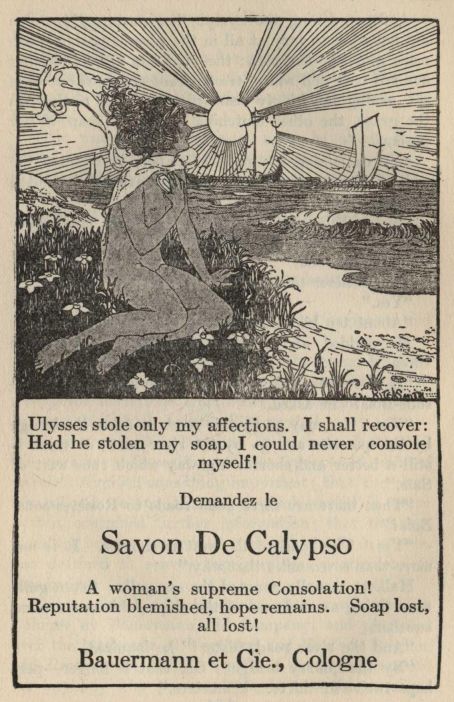
Savon de Calypso poster
And concerning the nymph, her pose and costume did not seem to vary at all in the various poster specimens which he had seen; the wind was always blowing her red hair and white, transparent scarf; she always sat gazing laughingly seaward, one hand resting on the grass, the other clutching a cake of soap to her bosom.
Still examining the sheet of paper, he counted the white flowers scattered over the grass around the seated nymph. There were ten of them.
"Sister Eila," he said carelessly, "how many kilometers is it to the next town south of us? I mean by the military road."
"To Rosières-sous-Bois?"
"Yes."
"About ten kilometers by the military road."
He nodded and counted the ships. There were three.
"Is there more than one road which runs to Rosières-sous-Bois?" he asked.
"Yes. One may go by this road, or cross the bridge by the quarries and go by the river road, or there is still a better and shorter highway which runs west of Saïs."
"Then there are three main roads to Rosières-sous-Bois?"
"Yes. The road to the west is shorter. It is not more than seven miles that way."
Halkett casually counted the sea gulls. Seven gulls were flying around one of the ships; thirteen around another.
"And the river road, Sister?" he inquired.
"By the quarry bridge? Oh, that is longer—perhaps twelve or thirteen kilometers."
"I see.... Rosières-sous-Bois is not a garrison town?"
"No. There are only a few gendarmes there."
Halkett examined the picture attentively. The sun appeared to be about three hours high above the horizon.
"The nearest military post must be about three hours' journey from here," he ventured.
Sister Eila thought a moment, then nodded:
"Yes, about three hours. You mean the fort above the Pass of the Falcons? That is the nearest."
He counted the rays of the sun. There were three long ones and two short ones.
"I suppose there are three or four battalions garrisoned there," he remarked.
"Three, I think. And a company of engineers and one company of Alpine chasseurs."
All the time, with a detached air, the young Englishman was examining the colored poster, searching it minutely for variations from other posters of the same sort which he had recently investigated.
There remained in his mind little or no doubt that the number and position of the groups of pointed wavelets signified something important; that the number of sails set on the ships, which varied in every poster, contained further information; that the sky, cloudless in some posters, dotted with clouds in others, was destined to convey topographical particulars to somebody.
These colored advertisements of a soap made in Cologne by Bauermann and Company, and plastered over the landscape of Northern and Eastern Belgium and France, concealed a wealth of secret information for anybody who possessed the key to the messages so clearly and craftily expressed in pictograph and cipher code.
The sinister significance of the sheet in his hand was becoming more apparent every minute. He had made a study of these posters—was just beginning to find them interesting, when he had been ordered to America. Now, all his interest in them returned.
Sister Eila had seated herself at her desk, and, while he was still examining the poster, she continued serenely to correct the pile of inky copybooks.
He watched her for a while, where she bent above the scrawled pages, her pen poised, her lovely face framed in the snowy wimple under the pale shadow of her wide-winged coiffe.
"Sister Eila?"
She turned her head tranquilly.
"You are English, you tell me?"
"Irish." She smiled.
"It's the same. Tell me, have you had enough experience in your world of duty and of unhappiness to know an honest man when you encounter him?"
Sister Eila laid aside her pen and turned toward him.
"I don't think I understand," she said.
"I mean, could you make up your mind about—well—about such a man as I am—merely by inspecting me and hearing me speak?"
Sister Eila laughed:
"I think I could very easily."
"Have you already done so?"
"Why, yes, I suppose so."
"Do you think I am honest enough to be trusted?"
Sister Eila laughed again, deliciously.
"Yes, I think so," she said.
He remained silent and his face, already grave, grew more serious. Sister Eila's smile faded as she watched him. It was becoming very plain to her that here was a man in trouble.
Silent there together in the cool stillness of the schoolroom, they heard the distant clatter of little feet, the vigorous voice of command from Sister Félicité; and a moment later a double file of chattering children passed in the sunshine outside the window, led toward their noonday playground by Sister Félicité accompanied by Warner.
"What is on your mind, Mr. Halkett?" asked Sister Eila, still watching him.
"If I tell you," he said, "will you ask me no more than I offer to tell you?"
She flushed:
"Naturally, Monsieur——"
"You don't quite understand, Sister. What I have to say I wish you to write down for me in the form of a letter of information to the French Government."
"You wish me to write it?"
"Please. And that is what I mean. Naturally, you might ask me why I do not write it myself.... Don't ask me, Sister.... If you really do trust me."
He turned, met her gaze, saw two clear, sweet eyes unspoiled and unsaddened by the wisdom she had learned in dark and wretched places; saw in them only a little wonder, a faintly questioning surprise.
"What is your answer, Sister?" he asked.
"My answer is—I—I do trust you.... What am I to write?"
She took a few loose leaves of paper from the desk, and sat looking at him, pen lifted.
He said:
"Write to the chief of the general staff at the Ministry of War in Paris."
And when she had properly addressed the personage in question, he dictated his letter very slowly in English; and Sister Eila, her expressionless young face bent above the letter paper, translated into French as he dictated, and wrote down the exact meaning of every word he uttered:
"Information has come to me that the advertisements of Bauermann and Company, of Cologne, Prussia, which are posted everywhere throughout Belgium and Northern and Eastern France, conceal military and topographical details concerning the vicinity where these advertisements are displayed.
"Such information could be of use only to a prowling spy or an invading enemy.
"Therefore, acting upon the incomplete information offered me, I deem it my duty to bring this matter to the notice of the Government.
"It would appear that:
"1st. Secret information is contained in the details of the picture which embellishes this advertisement, a sample of which I inclose herewith.
"2nd. These details vary in every poster. Presumably their number, color, groupings, and general distribution constitute a secret code which is calculated to convey information to the enemies of France.
"3rd. In the sample which is inclosed with this letter, the number of ships probably represents the number of highways leading from Saïs to Rosières-sous-Bois; the sea gulls flying above two of the ships give the distance in kilometers; the ten white flowers give the distance by the military road.
"The sun, in the picture, appears to be about three hours high above the horizon; and it is three hours' journey from here to the nearest French fortified post, the Pass of the Falcons in the Vosges.
"The rays of the sun are five in number, three long ones and two short ones; and there are three battalions of the line guarding the fort at the pass, and two companies, one of engineers, one of Alpine infantry.
"My informant, who desires to remain anonymous, further declares it to be his belief that an exhaustive study of this and similar posters would reveal perfectly clear messages in every detail of color, drawing, and letter-press; and that it is his firm conviction that these posters, representing a German firm which manufactures soap, have been placed throughout Belgium and France for the convenience of an invading army.
"Immediate removal of these advertisements seems advisable in the opinion of my informant.
"(Signed), SISTER EILA,
"Of the Daughters of St. Vincent de Paul at Saïs."
When she had finished the letter and had unhesitatingly signed it, she lifted her clear eyes to him in silence. Her breath came a trifle unevenly; the tint of excitement grew and waned in her cheeks.
"At least," he said, "you will understand that I am a friend to France."
"Yes, that is evident."
"Will you direct and seal the packet and give it to the postman?"
"Yes."
"And, Sister Eila, if they send gendarmes or other officials to question you?"
She looked straight into his eyes, deeply, so that her gaze seemed to plunge into the depths of his very soul.
Then, lifting the cross from the rosary at her girdle, she slipped out of her chair and knelt down beside her desk, her young head bent low over the crucifix which she held between the palms of her joined hands.
Halkett, head also lowered, stood motionless.
After a few moments she rose lightly from her knees.
"It is a vow, now," she said. "I have bound myself to silence concerning the source of my information—" her untroubled eyes rested again on his—"because I believe in you, Monsieur."
He started to speak, but seemed to find no word to utter. A bright color mounted to his brow; he turned abruptly from the desk and stepped toward the open door.
And the instant he appeared there, framed by the doorway, a shot rang out, knocking a cloud of stucco and plaster from the wall beside him.
CHAPTER IX
He shrank back flat against the wall, edged along it, and slipped swiftly inside the house. A thick veil of lime dust hung across the open doorway, gilded by the sunlight. Crumbs of plaster and mortar still fell to the schoolroom floor.
Through the heated silence of early afternoon he could hear the distant cries of the children from their playground; there was no other sound; nothing stirred; nobody came.
If Warner had noticed the shot at all, no doubt he supposed it to be the premature report of some piece. To the gaunt, furtive Vosges poacher no close season exists. If it did exist, he would cease to.
Halkett slowly turned his head and saw Sister Eila behind him. She had risen from her chair at the desk; now she came slowly forward, her deep, grey eyes fixed on him. But before she could take another step he laid his hand firmly on her wide, blue sleeve and forced her back into the room.
"Keep away from that door," he said quietly.
"Did somebody try to kill you?" she asked. Her voice was curious, but perfectly calm.
"I think so.... Don't show yourself near that door. They might not be able to distinguish their target at such a range."
"They? Who are 'they'?"
"Whoever fired.... I must ask you again to please keep out of range of that doorway——"
"The shot came from the river willows across the fields, did it not?" she interrupted.
"I'm very sure of it. You need not feel any anxiety for the children, Sister; I am going. There'll be no more shots."
"There is a door at the back by the kitchen yard, Mr. Halkett. They will not see you if you leave that way."
He stood thinking for a while; then:
"On your account, and on the children's, I'll have to show myself again when I leave the house, so that there'll be no mistake about my identity. Don't move until after I have gone some distance along the road. And please say to Mr. Warner that I've returned to the inn for luncheon——"
"There is a door in the rear! You must not show yourself——"
"Indeed, I must. Otherwise, they might mistake you or Sister Félicité or one of the children for me——"
"Mr. Halkett!" He had already started.
"Yes?" he replied, halting and glancing back; and found her already at his elbow.
"Why were you shot at?" she asked. "I desire to know."
He looked her straight in the eyes:
"I can't tell you why, Sister."
"You say you are English, and that you are a friend to France. If that is true, then tell me who shot at you! Do you know?"
"In a general way, I suppose I do know."
"Do you not trust a French Sister of Charity sufficiently to tell her?"
"What man would not trust a daughter of St. Vincent de Paul?" he said pleasantly.
"Then tell me. Perhaps I already guess. Has it to do with your knowledge of German advertisements?"
He was silent.
"You are evidently a British agent." Her deep, grey eyes grew more earnest. "You are more!" she said, clasping her hands with sudden conviction. "I suspected it the first time I saw you——"
"Please do not say to anybody what it is that you suspect——"
"You are a British officer!" she exclaimed.
"Sister Eila; you could do me much harm by mentioning to others this belief of yours, or anything concerning this affair. And—do you remember that you once said you trusted me?"
"I said it—yes."
"Do you still have confidence in me?"
Their eyes met steadily.
"Yes," she said. "I believe you to be a friend to France, and to me." A slight flush edged the snowy wimple which framed the lovely oval of her face.
"I am your friend; and I am a friend to France—I say as much as that to you. I say it because of what you are, and because—you are you. But ask me no more, Sister. For men of my profession there are confessionals as secret and as absolute in authority as those which shrive the soul."
He hesitated, his eyes shifted from her to the fresh flowers on the desk, which they had both gathered; he reached over and drew a white blossom from the glass.
"May I take it with me?"
She bent her head in silence.
Then he turned to go through the deadly doorway, carrying his flower in his hand; but, as he walked out into the sunshine, Sister Eila stepped swiftly in front of him, turned on the doorstep, screening him with extended arms.
"This is the best way," she said. "They ought to see quite clearly that I am a Sister of Charity, and they won't fire at me——"
But he tried to push her aside and spring past her:
"Stand clear of me, for God's sake!" he said.
"Wait——"
"Sister! Are you insane?"
"You must be, Mr. Halkett——"
"Keep away, I tell you——"
"Please don't be rough with me——"
He tried to avoid her, but her strong, young hands had caught both his wrists.
"They won't shoot at a Sister of Charity!" she repeated. "—And I shall not permit them to murder you! Be reasonable! I am not afraid."
She held on to his wrists, keeping always between him and the distant glimmer of the river:
"I shall walk to the road with you this way; don't try to shake me off; I am strong, I warn you!" She was even laughing now. "Please do not wriggle! Only schoolboys wriggle. Do you suppose I am afraid? Since when, Monsieur, have Sisters of Charity taken cover from the enemies of France?"
"This is shameful for me——"
"You behave, as I have said, like a very bad schoolboy, Mr. Halkett——"
He tried vainly to place himself between her and the river, but could not disengage her grasp without hurting her. Then, over his shoulder, he saw three men come out of the river willows.
"You shall not take this risk——" he insisted.
"Please listen——"
"I take no risk worth mentioning. It was you who would have walked out to face their fire—with that smile on your lips and a flower in your hand! Did you think that a Grey Sister would permit that? Soyez convenable, Monsieur. They will not fire while I am walking beside you." She looked over her shoulder. One of the men by the willows was raising a rifle.
They reached the highway at the same moment, and the roadside bank sheltered them. Here she released his arm.
"I beg you to be a little reasonable," she said. "You must leave Saïs at once. Promise me, Mr. Halkett——"
"I cannot."
"Why?"
"Sister, if I am really a soldier, as you suppose me to be, perhaps I have—orders—to remain at Saïs."
"Have you?" she asked frankly.
He turned and looked at her:
"Yes, little comrade."
"That is really serious."
"It must not cause you any anxiety. I shall 'wriggle'—as you say—out of this mess when the time comes. I may start tonight."
"For London? Do you wriggle as far as that?"
He said gravely:
"You know more about me now from my own lips than I would admit, even prompted by a firing squad. I trusted you even before you faced death for me on that doorstep a moment ago. Did you see that man come out of the willows and level his rifle at us?"
She said tranquilly:
"We daughters of St. Vincent de Paul never heed such things."
"I know you don't; I know what are your traditions. Many a Sister of your Order has fallen under rifle and shell fire on the battlefields of the world; many have died of the pest in hospitals; many have succumbed to exposure. The history of modern war is the history of the Grey Sisters. What you have just done, as a matter of course, is already part of that history. And so—" he looked down at her crucifix and rosary—"and so, Sister, and comrade, I shall tell you what it would not be possible for me to admit to any other living soul in France. Yes; I am a British officer on special and secret duty. I left the United States two weeks ago. Trouble began in Holland. I am now on my way to London. Orders came today halting me at Saïs. Enemies of France are annoying me—people who are becoming more desperate and more determined as the hours pass and the moment approaches swiftly when they can no longer hope to interfere with me. That moment will come when war is declared. It will be declared. I shall be very glad to arrive in England. Now I have told you almost everything, Sister Eila. My honor is in your keeping; my devotion is for my own country, for France—and for you."
"I have made one vow of silence," she said simply. "I shall make another—never to breathe one word of this."
"You need not. Just say to me that you will not speak."
Her lovely face became as solemn as a child's:
"I shall not speak, Mr. Halkett."
"That settles it," he said. "If it lay with me, I'd trust you with every secret in our War Office!" He checked himself, hesitated, then: "Sister Eila, if anything happens to me, go to Mr. Warner and ask him for that envelope. There are sure to be British soldiers in France before very long. Give that envelope to some British officer."
After a moment she laughed:
"Englishmen are odd—odd! They are just boys. They are delightful. I shall do what you ask.... And there is your inn.... Am I tired? I? Vous plaisantez, Monsieur! But, Mr. Halkett, what would be the object in your walking back with me? I should only have to walk back here again with you! It would continue ad infinitum."
They both laughed.
"When trouble finally comes, and if I am hit, I pray I may lie in your ward," he said gayly.
Her smile faded:
"I shall pray so, too," she said.
"I'd feel like a little boy safe in his own nursery," he added, still smiling.
"I am—happy—to have you think of me in that way." Her smile glimmered anew in her eyes. "I should be a devoted nurse." She made him a friendly little signal of adieu and turned away.
Hat in hand, he stood looking after the grey-blue figure under the snowy headdress.
At the turn of the road she looked back, saw him, still standing there; and again, from the distance, she made him a pretty gesture of caution and of farewell. Then the grassy bank hid her from view.
At the Inn of the Golden Peach, Warner's Harem was already lunching. Through the open windows of the dining-room came a discreet clatter of tableware and crockery, and a breezy, cheery tumult like the chatter in an aviary.
Halkett, not fancying it, went around the house to the quiet garden. Here he wandered to and fro among the trees or stood about aimlessly, looking down at the flower beds where, kneeling beside Sister Eila, he had aided her to fill her ozier basket.
Later Warner found him seated under the arbor with Ariadne on his knee; and a few moments afterward the maid, Linette, served their luncheon.
Neither of the young men was very communicative, but after the dishes and cloth had been removed, and when Halkett, musing over his cigarette and coffee, still exhibited no initiative toward conversation, Warner broke the silence:
"What about that shot?" he asked bluntly.
"What shot?"
"Don't you want to talk about it?"
Halkett glanced up, amused:
"Well, I suppose there was no hiding that bullet hole and the plaster dust from Sister Félicité."
"Of course not. The bullet ripped out the lathing. Who was it fired at the school? Or was it at you they let go?"
"Didn't you ask Sister Eila?"
"I did. She absolutely refused to discuss it, and referred us both to you. It was no accident, was it?"
"No."
"Somebody tried to get you?"
"It rather looked that way."
"Our friends in the grey car, of course!" concluded Warner.
"Not necessarily. They have other friends who might be equally attentive to me. I don't know who shot at me. There were three of them over by the river."
"Well, Halkett, don't you think you had better remain indoors for a while?"
"I'd better, I suppose." He laughed. "Honestly, I'm sick of being shot at. One of these days they'll hit me, if they're not very careful."
But Warner did not smile.
"Do you promise to stay indoors?" he insisted.
"I'll see. Perhaps."
"Don't you think it advisable for you to carry some sort of a firearm—one of my automatics, for example?"
"Thanks, old fellow. I think I'll do that, if you can spare a section of your artillery for a day or two."
Warner promptly fished an automatic out of his hip pocket, and Halkett took it and examined it.
"So I'm to do the Wild West business after all," he said gayly. "Right you are, old chap. I know how it's done; I've read about it in your novels. You wait till your enemy takes a drop, then you get the drop!" He laughed at his British joke. And, having no hip pocket, he stowed away the lumpy bluish weapon in a side pocket of his coat.
"Now, don't let me interfere with your daily routine," he continued. "I shall do very well here in the arbor while you lead your Harem toward the Olympian heights."
"Sometimes I feel like pushing 'em off those cliffs," muttered Warner. "All right; I fancy you'll be snug enough in the garden, here with Ariadne, till I return. We shall have the whole house to ourselves after dinner. The Harem migrates to Ausone for overnight to do street sketches tomorrow, and returns the next morning for a general criticism. So if you'll amuse yourself——"
"I shall be quite comfortable, thanks. If anybody climbs the wall to pot me, we'll turn loose on 'em, this time—won't we, old girl?"—caressing Ariadne, who had returned to his knee.
Half an hour afterward Warner went away in the wake of the Harem; and at the end of the second hour he gave them a final criticism before they started for Ausone.
Much good it did them; but they adored it; they even adored his sarcasms. For the Harem truly worshiped this young man—a fact of which he remained uncomfortably conscious, timidly aware that warier men than he had been landed by maidens less adept than they.
So it was with his usual sense of deep relief that he saluted the Harem, picked up his own kit and canvases, and wandered at hazard through a little poplar grove and out of it on the other edge.
A wild meadow, deep with tasseled grasses and field flowers, stretched away before him, where swallows sailed and soared and skimmed—where blue lupin, bouton d'or, meadowsweet, and slender, silvery stems crowned with queen's lace grew tall, and the heliotrope perfume of hidden hawkweed scented every fitful little wind.
But what immediately fixed his attention was a distant figure wading waist-deep amid the grasses—a slim, brilliant shape, which became oddly familiar as it drew nearer, moving forward with light and boyish grace, stirring within him vaguely agreeable recollections.
Then, in spite of her peasant's dress, he recognized her; and he walked swiftly forward to meet her. The figure out there in the sunshine saw him coming and lifted one arm in distant recognition and salute.
They met in mid-meadow, Warner and the girl Philippa.
Her short skirt and low peasant bodice had faded to a rose-geranium tint; her white chemisette, laced with black, was open wide below the throat. Black velvet straps crossed it on the shoulders and around the cuffs. Her hair was tied with a big black silk bow.
"How in the world did you come to be here?" he asked, not yet releasing the eager, warm little hands so frankly clasped between both of his.
Philippa laughed with sheerest happiness:
"Figurez-vous, Monsieur. I have been punting since early morning; and when I found myself so near to Saïs I was ready to drop with heat and fatigue: 'Mais, n'importe! Allons!' I said to myself. 'Courage, little one! Very soon you shall see Mr. Warner painting a noble picture by the river!' Et puis——" She tightened her clasp on his hands with an adorable laugh, "Nous voici enfin ensemble—tous les deux—vous et moi! Et je suis bien content et bien fatiguée."
"But, Philippa—how in the world do you propose to get back to Ausone tonight?"
She shrugged, looked up as though protesting to the very skies:
"I have this instant arrived, and his first inquiry is concerning my departure! That is not a very friendly welcome."
"Philippa, I am glad to see you——"
"It is time you said so——"
"I thought you understood——"
The girl laughed:
"I understand how glad I am to see you!" She looked about her in the sunshine, and touched a tall blossom of queen's lace with outstretched fingers.
"How heavenly beautiful is this world of God!" she said with that charming lack of self-consciousness which the skies of France seem to germinate even in aliens. "I am very glad to see you," she repeated abruptly, "and I am awaiting the expression of your sentiments."
"Of course I am glad to see you, Philippa——"
"That makes me quite happy." She smiled on him and then looked curiously at his painting kit. "If you will choose your picture," she added, "I shall sit beside you and watch you at your painting. It will be agreeable. We can converse."
So he chose a ferny spot at the wood's edge, pitched his field easel and camp stool, and opened his color box; and Philippa seated herself cross-legged on the short grass beside him, gathering both slim ankles into her hands.
While he was fussing with his canvas, she sang to herself blithely, radiantly contented, rocking herself to and fro to the rhythm of her song:
"'Hussar en vedette,
What do you see?
The sun has set
And a voice is calling me
Across the Récollette,
Where the scented rushes fret
In the May wind's breath—
Et garde à vous, Hussar!
'Tis the voice of Death!
'Hussar en vedette,
What do you see?
The moon has set
And a white shape beckons me
Across the Récollette,
Where the scented rushes fret
In the night wind's breath—
Et garde à vous, Hussar!
'Tis the shape of Death!'"
Singing away with the serene unconsciousness of a bird, rocking her lithe young body, and watching his every movement out of wide grey eyes, Philippa assisted at the artistic preparations with great content, missing nothing.
"To squeeze color from tubes must be amusing," she remarked. "I like to squeeze out tooth paste."
"I am very sure," said Warner, "that you accomplish more charming results with your tooth paste than I do with my colors."
The girl laughed, showing her snowy teeth:
"Do you find them pretty, Monsieur?"
"Quite perfect, and therefore in keeping with the remainder of you, Philippa."
"He really seems to mean it," she said, addressing a grasshopper which had alighted on her knee. And to Warner: "Is my face sufficiently scrubbed to suit you?"
He glanced down at her:
"You have kept your word, haven't you?"
"Ma foi! My word is my word.... Listen; I came to Saïs to see you; and partly because I have something to show you. It concerns your friend, I think."
"Mr. Halkett?"
"Yes. After the fight in our cabaret there was much excitement, but when you had disappeared, and before the agents de police and the gendarmes arrived, I found on the floor under the overturned table a portfolio. In that portfolio was part of an unfinished letter. It is written in German. I could not read it; but, studying it, I recognized Mr. Halkett's name written several times. So I said nothing to anybody, but I have brought it. Here it is."
She drew from her bosom a small leather pocketbook.
"Before you examine it," she continued, "I ought to tell you what really happened at the cabaret. Those men who attacked Mr. Halkett were in the employment of Monsieur Wildresse."
"What!" exclaimed Warner.
"It is true. I was furious when I noticed them creeping up behind him. I realized instantly what they meant to do, and I cried out—too late. You ought to be told about this. Therefore, I came here to tell you.
"And I desire to tell you more. The three men who were seated across the hall, and who attempted to pick a quarrel with Mr. Halkett, were 'provocative agents'—Germans.
"The patron knew them and interfered. Besides, he had his own ideas and his own ends to serve just then.
"But I saw those three German agents whisper to a fourth—a stranger. And that man came and seated himself with three other men directly behind Mr. Halkett, where he stood while you were talking to me——"
"Philippa," he interrupted with blunt impatience, "I don't understand all this that you are saying to me. Give me that letter if it concerns Mr. Halkett."
The girl colored painfully.
"Please don't speak rudely to me," she said. "I am trying to behave honestly——"
"I'm sorry. I didn't mean to speak roughly. Please continue."
"Yes; it is better you should know what happened before you read this letter. Well, then, the men who attacked Mr. Halkett naturally got away; the patron attended to that. Naturally, also, he desired to have people believe that the German agents were responsible for the fight, and they were, therefore, detained by Monsieur Wildresse and were asked for an explanation. Then they declared that Mr. Halkett was a British spy, and that they were Belgian police agents with full authority to arrest him in France. Which was a lie, of course, but it served its purpose by increasing the tumult."
"Did they say that they were Belgians?"
"Yes. I heard them. They lied. There was much confusion and shouting—everybody crowding around and disputing. The three Germans pushed their way toward the door; nobody knew whether or not to stop them." She shrugged. "They were gone before people could make up their minds. And, as usual, the police came in too late. Now you know all there is to tell about what happened after you left the cabaret."
Warner laid aside his brushes, looked curiously at the portfolio which she held out to him, hesitated, then opened it and drew out three pages of a letter in German, but written in English script. Evidently it was an unfinished fragment of a letter. He translated it rather freely and without any great difficulty:
—were followed from New York by this man, Halkett, and a companion of his named Gray. Disembarking at Antwerp and going immediately to room No. 23 in the Hôtel St. Antoine, according to instructions, we walked directly into a trap, prepared for us, no doubt, by a wireless message sent from the steamer by the individual, Halkett. Schmidt was knocked flat on his back and lay unconscious; me they hurled violently on the bed; my face was covered with a pillow, my legs and arms held as in a vise, while they ripped my clothing from me and then literally tore it to shreds in their search for the papers I carried.
In the lining of my vest they found the information and drawings which we had been at such pains and danger to secure from the Yankee War Department. And now the Yankee Government will find out who has been robbing it.
Unless we can overtake these individuals, Halkett and Gray, the loss to us must be irreparable, as we dared not study the plans and formula on board ship, nor even venture to trust in the security of our stateroom, believing that British agents might be on board and watching. God knows they were.
I regret deeply that we did not suspect Halkett and Gray.
Also, the ship's officers, crew, stewards, wireless operator—all evidently were our enemies and in willing collusion with these two Englishmen.
Gray, on his motor cycle, left Antwerp for Brussels. We shall watch him and prevent his meeting Halkett in France. We fear they have divided the papers between them.
Our orders are to use our own discretion. Therefore, I repeat that Gray shall not live to meet Halkett.
As for Halkett, he undoubtedly has some of the papers on his person. We missed him in Holland by accident; we unfortunately failed in the city of Luxembourg, because he was too crafty to cross the viaduct, but slept that night in a water mill under the walls in the lower city.
We traced him to Diekirch, but missed him again, twice, although Schmidt, who was posted further along on the narrow-gauge line, fired at him as a last resort. For, as you point out, it is better that France should come into possession of the Harkness shell than that the British Admiralty should control it. The very existence of our fleet is now at stake. France is slow to accept foreign inventions; but England is quick as lightning.
So, if necessary, we shall take extreme measures in regard to Halkett and Gray, and stand the chances that we may secure their papers and get back to Berlin before the French police interfere.
And if we fail to get away, well, at least England shall not profit by the Harkness shell.
Meier and Hoffman are following Gray; we are now leaving for Ausone, and hope to find Halkett somewhere in that vicinity.
I am writing this with difficulty, as the road is not what it ought to be, and the wind is disconcerting. Esser is acting as chauffeur——
And there the letter ended.
CHAPTER X
Philippa was plaiting grass stems when he finished his examination of the letter. And while she deftly braided boutons d'or among the green blades, she continued under her breath the song of the Vidette, casting an occasional side glance upward at him, where he sat on his camp stool studying the written fragments.
At length, seeing that he had finished, she tossed aside the flowering rope of grass, set her elbows on her knees, her rounded chin on her hands, and regarded him inquiringly, as though, for the moment, she had done with childish things.
"It is a letter which urgently concerns Mr. Halkett," he nodded coolly. "Shall I give it to him?"
"Please."
He pocketed the portfolio, hesitated, glanced at his watch, then, with an absent-minded air, began to pack up his painting kit. As he unhooked his toile he looked around at her.
"Philippa," he said, "if you are going to punt back to Ausone, isn't it nearly time you started?"
"Aren't you going to paint any more?" she asked, smiling.
"No. I think I had better find Mr. Halkett and show him this letter."
"But—I have come all the way from Ausone to pay you a visit!" explained the girl in hurt surprise. "Didn't you want to see me?"
"Certainly I want to see you," he replied smilingly. "But to punt up stream to Ausone this afternoon is going to take you quite a long while——"
"As for that," she remarked, "it need not concern us. I am not going back to Ausone."
"Not going back!"
"Listen, please. Monsieur Wildresse and I have had a disagreement——"
"Nonsense!"
"No, a serious disagreement. I am not going back to Ausone. Shall I tell you all about it?"
"Yes, but listen to me, Philippa. You can't run away from your home merely because you have had a disagreement with your Patron and guardian."
"Shall I tell you why we disagreed?"
"If you choose. But that doesn't justify you in running away from your home."
The girl shook her head:
"You don't yet understand. In our café the French Government compels us to spy on certain strangers and to report whatever we can discover. Always it disgusted me to do such a thing. Now I shall not be obliged to do it any more, because I am never going back to the Cabaret de Biribi."
"Do you mean to say that you and Monsieur Wildresse are in the secret service of your Government?" he asked, astonished.
"That is too dignified an explanation. I have been an informer since I was seventeen."