Front matter (continued 5)
Reading edition
He remarks that these plants, while including species now very widely scattered, present no appreciable change of characters.
Above this bed are glacial clays, which hold other species indicating an extremely cold climate. They are few in number, only Salix polaris, a thoroughly arctic species, and its ally, S. cinerea, L., and a moss, Hypnum turgescens, Schimp., no longer found in Britain, but an Alpine and arctic species. This bed belongs to the beginning of the Glacial period, the deposits of which have as yet afforded no plants in England. But plants occur in post-glacial and upper-glacial beds in different parts of England, to which Carruthers thus refers:
"The period of great cold, during which arctic ice extended far into temperate regions, was not favorable to vegetable life. But in some localities we have stratified clays with plant-remains later than the Glacial epoch, yet indicating that the great cold had not then entirely disappeared. In the lacustrine beds at Holderness is found a small birch (Betula nana, L.), now limited in Great Britain to some of the mountains of Scotland, but found in the arctic regions of the Old and New World and on Alpine districts in Europe, and with it Prunus padus, L., Quercus robur, L., Corylus avellana, L., Alnus glutinosa, L., and Pinus sylvestris, L. In the white clay-beds at Bovey Tracey of the same age there occur the leaves of Arctostaphylos uva-ursi, L., three species of willow, viz., Salix cinerea, L., S. myrtilloides, L., and S. polaris, Wahl., and in addition to our Alpine Betula nana, L., the more familiar B. alba, L. Two of these plants have been lost to our flora from the change of climate that has taken place, viz., Salix myrtilloides, L., and S. polaris, Wahl.; and Betula nana, L., has retreated to the mountains of Scotland. Three others (Dryas octopetala, L., Arctostaphylos uva-ursi, L., and Salix herbacea, L.) have withdrawn to the mountains of northern England, Wales, and Scotland, while the remainder are still found scattered over the country. Notwithstanding the diverse physical conditions to which these plants have been subjected, the remains preserved in these beds present no characters by which they can be distinguished from the living representatives of the species."
One of the instances referred to is very striking. At Bovey Tracey the arctic beds rest directly on those holding the rich, warm temperate flora of the Eocene; so that here we have the evidence of fossil plants to show the change from the climate of the Eocene to that of arctic lands, and the modern vegetation to indicate the return of a warm temperature.
In Canada, in the Pleistocene beds known as the Leda clays, intervening between the lower boulder clay and the Saxicava sand, which also holds boulders, there are beds holding fossil plants, in some places intermixed with sea-shells and bones of marine fishes, showing that they were drifted into the sea at a time of submergence. These remains are boreal rather than arctic in character, and with the remains of drift-wood often found in the boulder deposits serve to indicate that there were at all times oases of hardy life in the glacial deserts, just as we find these in polar lands at the present day. I condense from a paper on these plants[EA] the following facts, with a few additional notes:
The importance of all information bearing on the temperature of the Post-pliocene period invests with much interest the study of the land-plants preserved in deposits of this age. Unfortunately, these are few in number, and often not well preserved. In Canada, though fragments of the woody parts of plants occasionally occur in the marine clays and sands, there is only one locality which has afforded any considerable quantity of remains of their more perishable parts. This is the well-known deposit of Leda clay at Green’s Creek, on the Ottawa, celebrated for the perfection in which the skeletons of the capelin and other fishes are preserved in the calcareous nodules imbedded in the clay. In similar nodules, contained apparently in a layer somewhat lower than that holding the ichthyolites, remains of land-plants are somewhat abundant, and, from their association with shells of Leda glacialis, seem to have been washed down from the land into deep water. The circumstances would seem to have been not dissimilar from those at present existing in the northeast arm of Gaspé Basin, where I have dredged from mud now being deposited in deep water, living specimens of Leda limatula, mixed with remains of land-plants.
The following are the species of plants recognised in these nodules:
1. Drosera rotundifolia, Linn. In a calcareous nodule from Green’s Creek, the leaf only preserved. This plant is common in bogs in Canada, Nova Scotia, and Newfoundland, and thence, according to Hooker, to the Arctic circle. It is also European.
2. Acer spicatum, Lamx. (Acer montanum, Aiton.) Leaf in a nodule from Green’s Creek. Found in Nova Scotia and Canada, also at Lake Winnipeg, according to Richardson.
3. Potentilla Canadensis, Linn. In nodules from Green’s Creek; leaves only preserved. I have had some difficulty in determining these, but believe they must be referred to the species above named, or to P. simplex, Michx., supposed by Hooker and Gray to be a variety. It occurs in Canada and New England, but I have no information as to its range northward.
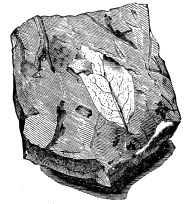
4. Gaylussaccia resinosa, Torrey and Gray. Leaf in nodule at Green’s Creek. Abundant in New England and in Canada, also on Lake Huron and the Saskatchewan, according to Richardson (Fig. 77).
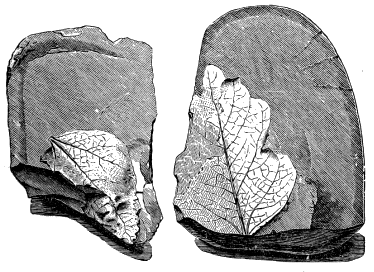
5. Populus balsamifera, Linn. Leaves and branches in nodules at Green’s Creek. This is by much the most common species, and its leaves are of small size, as if from trees growing in cold and exposed situations. The species is North American and Asiatic, and abounds in New England and Canada. It extends to the Arctic circle, and is abundant on the shores of the Great Slave Lake and on the McKenzie River, and according to Richardson constitutes much of the drift timber of the Arctic coast (Fig. 78).
Fig. 77.—Gaylussaccia resinosa. Pleistocene, Canada. Fig. 78.—Populus balsamifera. Pleistocene, Canada.
6. Thuja occidentalism Linn. Trunks and branches in the Leda clay at Montreal. This tree occurs in New England and Canada, and extends northward into the Hudson Bay territories. It is a northern though not arctic species in its geographical range. According to Lyell it occurs associated with the bones of Mastodon in New Jersey. From the great durability of its wood, it is one of the trees most likely to be preserved in aqueous deposits.
7. Potamogeton perfoliatus, Linn. Leaves and seeds in nodules at Green’s Creek. Inhabits streams of the Northern States and Canada, and according to Richardson extends to Great Slave Lake.
8. Potamogeton pusillus. Quantities of fragments which I refer to this species occur in nodules at Green’s Creek. They may possibly belong to a variety of P. hybridus which, together with P. natans, now grows in the river Ottawa, where it flows over the beds containing these fossils.
9. Cariceæ and Gramineæ. Fragments in nodules from Green’s Creek appear to belong to plants of these groups, but I cannot venture to determine their species.
10. Equisetum scirpoides, Michx. Fragments in nodules, Green’s Creek. This is a widely distributed species, occurring in the Northern States and Canada.
11. Fontinalis. In nodules at Green’s Creek there occur, somewhat plentifully, branches of a moss apparently of the genus Fontinalis.
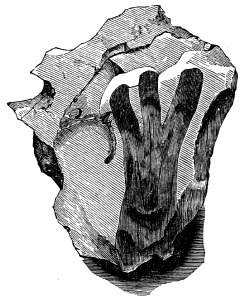
Fig. 79.—Frond of Fucus. Pleistocene, Canada.
12. Algæ. With the plants above mentioned, both at Green’s Creek and at Montreal, there occur remains of sea-weeds (Fig. 79). They seem to belong to the genera Fucus and Ulva, but I cannot determine the species. A thick stem in one of the nodules would seem to indicate a large Laminaria. With the above there are found at Green’s Creek a number of fragments of leaves, stems, and fruits, which I have not been able to refer to their species, principally on account of their defective state of preservation.
None of the plants above mentioned is properly arctic in its distribution, and the assemblage may be characterised as a selection from the present Canadian flora of some of the more hardy species having the most northern range. Green’s Creek is in the central part of Canada, near to the parallel of 46°, and an accidental selection from its present flora, though it might contain the same species found in the nodules, would certainly include with these, or instead of some of them, more southern forms. More especially the balsam poplar, though that tree occurs plentifully on the Ottawa, would not be so predominant. But such an assemblage of drift-plants might be furnished by any American stream flowing in the latitude of 50° to 55° north. If a stream flowing to the north, it might deposit these plants in still more northern latitudes, as the McKenzie River does now. If flowing to the south, it might deposit them to the south of 50°. In the case of the Ottawa, the plants could not have been derived from a more southern locality, nor probably from one very far to the north. We may therefore safely assume that the refrigeration indicated by these plants would place the region bordering the Ottawa in nearly the same position with that of the south coast of Labrador fronting on the Gulf of St. Lawrence at present. The absence of all the more arctic species occurring in Labrador should perhaps induce us to infer a somewhat milder climate than this.
The moderate amount of refrigeration thus required would in my opinion accord very well with the probable conditions of climate deducible from the circumstances in which the fossil plants in question occur. At the time when they were deposited the sea flowed up the Ottawa valley to a height of 200 to 400 feet above its present level, and the valley of the St. Lawrence was a wide arm of the sea, open to the arctic current. Under these conditions the immense quantities of drift-ice from the northward, and the removal of the great heating surface now presented by the low lands of Canada and New England, must have given for the Ottawa coast of that period a summer temperature very similar to that at present experienced on the Labrador coast, and with this conclusion the marine remains of the Leda clay, as well as the few land molluscs whose shells have been found in the beds containing the plants, and which are species still occurring in Canada, perfectly coincide.
The climate of that portion of Canada above water at the time when these plants were imbedded may safely be assumed to have been colder in summer than at present, to an extent equal to about 5° of latitude, and this refrigeration may be assumed to correspond with the requirements of the actual geographical changes implied. In other words, if Canada was submerged until the Ottawa valley was converted into an estuary inhabited by species of Leda, and frequented by capelin, the diminution of the summer heat consequent on such depression would be precisely suitable to the plants occurring in these deposits, without assuming any other cause of change of climate.
I have arranged elsewhere the Post-pliocene deposits of the central part of Canada, as consisting of, in ascending order: (1) The boulder clay; (2) a deep-water deposit, the Leda clay; and (3) a shallow-water deposit, the Saxicava sand. But, although I have placed the boulder clay in the lowest position, it must be observed that I do not regard this as a continuous layer of equal age in all places. On the contrary, though locally, as at Montreal, under the Leda clay, it is in other places and at other levels contemporaneous with or newer than that deposit, which itself also locally contains boulders.
At Green’s Creek the plant-bearing nodules occur in the lower part of the Leda clay, which contains a few boulders, and is apparently in places overlaid by large boulders, while no distinct boulder clay underlies it. The circumstances which accumulated the thick bed of boulder clay near Montreal were probably absent in the Ottawa valley. In any case we must regard the deposits of Green’s Creek as coeval with the Leda clay of Montreal, and with the period of the greatest abundance of Leda glacialis, the most exclusively arctic shell of these deposits. In other words, I regard the plants above mentioned as probably belonging to the period of greatest refrigeration of which we have any evidence, of course not including that mythical period of universal incasement in ice, of which, as I have elsewhere endeavoured to show, in so far as Canada is concerned, there is no evidence whatever.[EB]
The facts above stated in reference to Post-pliocene plants concur, with all the other evidence I have been able to obtain, in the conclusion that the refrigeration of Canada in the Post-pliocene period consisted of a diminution of the summer heat, and was of no greater amount than that fairly attributable to the great depression of the land and the different distribution of the ice-bearing arctic current.
In connection with the plants above noticed, it is interesting to observe that at Green’s Creek, at Pakenham Mills, at Montreal, and at Clarenceville on Lake Champlain, species of Canadian Pulmonata have been found in deposits of the same age with those containing the plants. The species which have been noticed belong to the genera Lymnea and Planorbis.
The Glacial age was, fortunately, not of very long duration, though its length has been much exaggerated by certain schools of geologists,[EC] It passed away, and a returning cosmic spring gladdened the earth, and was ushered in by a time of great rainfall and consequent denudation and deposit, which has been styled the “Pluvial Period” The remains of the Pliocene forests then returned—with somewhat diminished numbers of species—from the south and again occupied the land, though they have not been able, in their decimated condition, to restore the exuberance of the flora of the earlier Tertiary. In point of fact, as we shall see in the next chapter, it is the floras originating within the polar circle and coming down from the north that are rich and copious. Those that, after periods of cold or submergence, return from the south, are comparatively poor. Hence the modern flora is far inferior to that of the Middle Kainozoic. In America, however, and in eastern Asia, for reasons already stated, the return was more abundant than in Europe.
Simultaneously with the return of the old temperate flora, the arctic plants that had overspread the land retreated to mountain-tops, now bared of ice and snow, and back to the polar lands whence they came; and so it happens that, on the White Mountains, the Alps, and the Himalayas, we have insular patches of the same groups of plants that exist around the pole.
These changes need not have required a very long time, for the multiplication and migration of plants are very rapid, especially when aided by the agency of migratory animals. Many parts of the land must, indeed, have been stocked with plants from various sources, and by agencies—as that of the sea—which might at first sight seem adverse to their distribution. The British Islands, for example, have no indigenous plants. Their flora consists mainly of Germanic plants, which must have migrated to Britain in that very late period of the Post-glacial when the space now occupied by the North Sea was mostly dry land. Other portions of it are Scandinavian plants, perhaps survivors of the Glacial age, or carried by migratory birds; and still another element consists of Spanish plants, brought north by spring migrants, and establishing themselves in warm and sheltered spots, just as the arctic plants do on the bleak hill-tops. The Bermudas, altogether recent islands, have one hundred and fifty species of native plants, all of which are West Indian and American, and must have been introduced by the sea-currents or by migratory birds.
And so the earth became fitted for the residence of modern man. Yet it is not so good or Edenic a world as it once was, or as it may yet become, were another revolution to restore a mild climate to the arctic regions, and to send down a new swarm of migratory species to renew the face of the earth and restore it to its pristine fertility of vegetable life.
Thus closes this long history of the succession of plants, reaching from the far back Laurentian to the present day. It has, no doubt, many breaks, and much remains to be discovered. Yet it may lead us to some positive conclusions regarding the laws of the introduction of plants.
One of these, and perhaps the most remarkable of all, is that certain principles were settled very far back, and have remained ever since. We have seen that in the earliest geological periods all that pertains to the structure, powers, and laws of the vegetable cell was already fixed and settled. When we consider how much this implies of mechanical structure and chemical and vital property, the profound significance of this statement becomes apparent. The relations in these respects between the living cell and the soil, the atmosphere and the sunshine, were apparently as perfect in the early Palæozoic as in any subsequent time. The same may be said of the structures of the leaf and of the stem. In such old forms as Nematophyton these were, it is true, peculiar and rudimentary, but in the Devonian and Carboniferous the structure of leaves and stems embodied all the parts and principles that we find at present. In regard to fructification there has been more progress, for, so far as we know, the highest and most complex forms of flowery, fruits, and seeds belong to the more recent periods, and simpler forms were at least dominant in the older times. Yet even in this respect the great leading laws and structures of bisexual reproduction were perfected in the early Palæozoic, and the improvements introduced in the gymnosperm and the angiosperm of later periods have consisted mainly in additions of accessory parts, and in modifications and refinements suited to the wants of the higher and more complex types.
CHAPTER VIII.
GENERAL LAWS OF ORIGIN AND MIGRATIONS OF PLANTS.—RELATIONS OF RECENT AND FOSSIL FLORAS.
The origination of the successive floras which have occupied the northern hemisphere in geological time, not, as one might at first sight suppose, in the sunny climes of the south, but under the arctic skies, is a fact long known or suspected. It is proved by the occurrence of fossil plants in Greenland, in Spitzbergen, and in Grinnell Land, under circumstances which show that these were their primal homes. The fact bristles with physical difficulties, yet is fertile of the most interesting theoretical deductions, to reach which we may well be content to wade through some intricate questions. Though not at all a new fact, its full significance seems only recently to have dawned on the minds of geologists, and within the last few years it has produced a number of memoirs and addresses to learned societies, besides many less formal notices.[ED]
The earliest suggestion on the subject known to the writer is that of Prof. Asa Gray, in 1867, with reference to the probable northern source of the related floras of North America and eastern Asia. With the aid of the new facts disclosed by Heer and Lesquereux, Gray returned to the subject in 1872, and more fully developed this conclusion with reference to the Tertiary floras,[EE] and he has recently still further discussed these questions in an able lecture on “Forest Geography and Archæology.”[EF] In this he puts the case so well and tersely that we may quote the following sentences as a text for what follows:
“I can only say, at large, that the same species (of Tertiary fossil plants) have been found all round the world; that the richest and most extensive finds are in Greenland; that they comprise most of the sorts which I have spoken of, as American trees which once lived in Europe—magnolias, sassafras, hickories, gum-trees, our identical southern cypress (for all we can see of difference), and especially Sequoias, not only the two which obviously answer to the two big-trees now peculiar to California, but several others; that they equally comprise trees now peculiar to Japan and China, three kinds of gingko-trees, for instance, one of them not evidently distinguishable from the Japan species which alone survives; that we have evidence, not merely of pines and maples, poplars, birches, lindens, and whatever else characterise the temperate zone forests of our era, but also of particular species of these, so like those of our own time and country that we may fairly reckon them as the ancestors of several of ours. Long genealogies always deal more or less in conjecture; but we appear to be within the limits of scientific inference when we announce that our existing temperate trees came from the north, and within the bounds of nigh probability when we claim not a few of them as the originals of present species. Remains of the same plants have been found fossil in our temperate region as well as in Europe.”
Between 1860 and 1870 the writer was engaged in working out all that could be learned of the Devonian plants of eastern America, the oldest known flora of any richness, and which consists almost exclusively of gigantic, and to us grotesque, representatives of the club-mosses, ferns, and mares'-tails, with some trees allied to the cycads and pines. In this pursuit nearly all the more important localities were visited, and access was had to the large collections of Prof. Hall and Prof. Newberry, in New York and Ohio, and to those made in the remarkable plant-bearing beds of New Brunswick by Messrs. Matthew and Hartt. In the progress of these researches, which developed an unexpectedly rich assemblage of species, the northern origin of this old flora seemed to be established by its earlier culmination in the northeast, in connection with the growth of the American land to the southward, which took place after the great Upper Silurian subsidence, by elevations beginning in the north while those portions of the continent to the southwest still remained under the sea. The same result was indicated by the persistence in the Carboniferous of the south and west of old Erian forms, like Megalopteris.
When, in 1870, the labours of those ten years were brought before the Royal Society of London, in the Bakerian lecture of that year, and in a memoir illustrating no less than one hundred and twenty-five species of plants older than the great Carboniferous system, these deductions were stated in connection with the conclusions of Hall, Logan, and Dana, as to the distribution of sediment along the northeast side of the American continent, and the anticipation was hazarded that the oldest Palæozoic floras would be discovered to the north of Newfoundland. Mention was also made of the apparent earlier and more copious birth of the Devonian flora in America than in Europe, a fact which is itself connected with the greater northward extension of this continent.
The memoir containing these results was not published by the Royal Society, but its publication was secured in a less complete form in the reports of the “Geological Survey of Canada.” The part of the memoir relating to Canadian fossil plants, with a portion of the theoretical deductions, was published in a report issued in 1871.[EG] In this report the following language was used:
"In eastern America, from the Carboniferous period onward, the centre of plant distribution has been the Appalachian chain. From this the plants and sediments extended westward in times of elevation, and to this they receded in times of depression. But this centre was nonexistent before the Devonian period, and the centre for this must have been to the northeast, whence the great mass of older Appalachian sediment was derived. In the Carboniferous period there was also an eastward distribution from the Appalachians, and links of connection in the Atlantic bed between the floras of Europe and America. In the Devonian such connection can have been only far to the northeast. It is therefore in Newfoundland, Labrador, and Greenland that we are to look for the oldest American flora, and in like manner on the border of the old Scandinavian nucleus for that of Europe.
"Again, it must have been the wide extension of the sea of the corniferous limestone that gave the last blow to the remaining flora of the Lower Devonian; and the re-elevation in the middle of that epoch brought in the Appalachian ridges as a new centre, and established a connection with Europe which introduced the Upper Devonian and Carboniferous floras. Lastly, from the comparative richness of the later Erian[EH] flora in eastern America, especially in the St. John beds, it might be a fair inference that the northeastern end of the Appalachian ridge was the original birthplace or centre of creation of what we may call the later Palæozoic flora, or of a large part of that flora."
When my paper was written I had not seen the account published by the able Swiss palæobotanist Heer, of the remarkable Devonian flora of Bear Island, near Spitzbergen.[EI] From want of acquaintance with the older floras of America and western Europe, Heer fell into the unfortunate error of regarding the whole of Bear Island plants as Lower Carboniferous, a mistake which his great authority has tended to perpetuate, and which has even led to the still graver error of some European geologists, who do not hesitate to regard as Carboniferous the fossil plants of the American deposits from the Hamilton to the Chemung groups inclusive, though these belong to formations underlying the oldest Carboniferous, and characterised by animal remains of unquestioned Devonian age. In 1872 I addressed a note to the Geological Society of London on the subject of the so-called “Ursa stage” of Heer, showing that, though it contained some forms not known at so early a date in temperate Europe, it was clearly, in part at least, Devonian when tested by North American standards; but that in this high latitude, in which, for reasons stated in the report above referred to, I believed the Devonian plants to have originated, there might be an intermixture of the two floras. But such a mixed group should in that latitude be referred to a lower horizon than if found in temperate regions. Dr. Nathorst, as already stated, has recently obtained new facts which go to show that plants of two distinct horizons may have been intermixed in the collections submitted to Heer.
Between 1870 and 1873 my attention was turned to the two sub-floras intermediate between those of the Devonian and the coal-formation, the floras of the Lower Carboniferous (Subcarboniferous of some American geologists) and the Millstone Grit, and in a report upon these[EJ] similar deductions were expressed. It was stated that in Newfoundland the coal-beds seem to belong to the Millstone Grit series, and as we proceed southward they belong to progressively newer portions of the Carboniferous system. The same fact is observed in the coal-beds of Scotland, as compared with those of England, and it indicates that the coal-formation flora, like that of the Devonian, spread itself from the north, and this accords with the somewhat extensive occurrence of Lower Carboniferous rocks and fossils in the Parry Islands and elsewhere in the arctic regions.
Passing over the comparatively poor flora of the earlier Mesozoic, consisting largely of cycads, pines, and ferns, and as yet little known in the arctic, and which may have originated in the south, though represented, according to Heer, by the supposed Jurassic flora of Siberia, we find, especially at Komé and Atané in Greenland, an interesting occurrence of those earliest precursors of the truly modern forms of plants which appear in the Cretaceous, the period of the English chalk and of the New Jersey greensands. There are two plant-groups of this age in Greenland; one, that of Komé, consists almost entirely of ferns, cycads, and pines, and is of decidedly Mesozoic aspect. This is called Lower Cretaceous. The other, that of Atané, holds remains of many modern temperate genera, as Populus, Myrica, Ficus, Sassafras, and Magnolia. This is regarded as Upper Cretaceous. Resting upon these Upper Cretaceous beds, without the intervention of any other formation,[EK] are beds rich in plants of much more modern appearance, and referred by Heer to the Miocene period, a reference, as we have seen, not warranted by comparison with the Tertiary plants of Europe or of America. Still farther north this so-called Miocene assemblage of plants appears in Spitzbergen and Grinnell Land; but there, owing to the predominance of trees allied to the spruces, it has a decidedly more boreal character than in Greenland, as might be anticipated from its nearer approach to the pole.[EL]
If now we turn to the Cretaceous and Tertiary floras of western America, as described by Lesquereux, Newberry, and others, we find in the lowest Cretaceous rocks there known—those of the Dakota group—which may be in the lower part of the Middle Cretaceous, a series of plants[EM] essentially similar to those of the so-called Upper Cretaceous of Greenland. They occur in beds indicating land and fresh-water conditions as prevalent at the time over great areas of the interior of America. But overlying this plant-bearing formation we have an oceanic limestone (the Niobrara), corresponding in many respects to the European chalk, and extending far north into the British territory,[EN] indicating that the land of the Lower Cretaceous was replaced by a vast Mediterranean Sea, filled with warm water from the equatorial currents, and not invaded by cold waters from the north. This is succeeded by thick Upper Cretaceous deposits of clay and sandstone, with marine remains, though very sparsely distributed; and these show that further subsidence or denudation in the north had opened a way for the arctic currents, killing out the warm-water animals of the Niobrara group, and rilling up the Mediterranean of that period. Of the flora of these Upper Cretaceous periods, which must have been very long, we know something in the interior regions, from the discovery of a somewhat rich flora in the Dunvegan beds of the Peace River district, on the northern shore of the great Cretaceous Mediterranean;[EO] and on the coast of British Columbia we have the remarkable Cretaceous coal-field of Vancouver Island, which holds the remains of plants of modern genera, and, indeed, of almost as modern aspect as those of the so-called Miocene of Greenland. They indicate, however, a warmer climate as then prevalent on the Pacific coast, and in this respect correspond with a peculiar transition flora, intermediate between the Cretaceous and Eocene or earliest Tertiary of the interior regions, and which is described by Lesquereux as the Lower Lignitic.
Immediately above these Upper Cretaceous beds we have the great Lignite Tertiary of the West—the Laramie group of recent American reports—abounding in fossil plants, at one time regarded as Miocene, but now known to be Lower Eocene, though farther south extending upward toward the Miocene age.[EP] These beds, with their characteristic plants, have been traced into the British territory north of the forty-ninth parallel, and it has been shown that their fossils are identical with those of the McKenzie River valley, described by Heer as Miocene, and probably also with those of Alaska, referred to the same age.[EQ] Now this truly Eocene flora of the temperate and northern parts of America has so many species in common with that called Miocene in Greenland that its identity can scarcely be doubted. These facts have led to scepticism as to the Miocene age of the upper plant-bearing beds of Greenland, and more especially Mr. J. Starkie Gardner has ably argued, from comparison with the Eocene flora of England and other considerations, that they are really of that earlier date.[ER]
In looking at this question, we may fairly assume that no climate, however equable, could permit the vegetation of the neighbourhood of Disco in Greenland to be exactly identical with that of Colorado and Missouri, at a time when little difference of level existed in the two regions. Either the southern flora migrated north in consequence of a greater amelioration of climate, or the northern flora moved southward as the climate became colder. The same argument, as Gardner has ably shown, applies to the similarity of the Tertiary plants of temperate Europe to those of Greenland. If Greenland required a temperature of about 50°, as Heer calculates, to maintain its Eocene flora, the temperature of England and that of the Southwestern States must have been higher, though probably more equable, than at present.
We cannot certainly affirm anything respecting the migrations of these floras, but there are some probabilities which deserve attention. The ferns and cycads of the so-called Lower Cretaceous of Greenland are nothing but a continuation of the previous Jurassic flora. Now this was established at an equally early date in the Queen Charlotte Islands,[ES] and still earlier in Virginia,[ET] The presumption is, therefore, that it came from the south. It has, indeed, the facies of a southern hemisphere and insular flora, and probably spread itself northward as far as Greenland, at a time when our northern continents were groups of islands, and when the ocean currents were carrying warm water far toward the arctic regions. The flora which succeeds this in the sections at Atané has no special affinities with the southern hemisphere, and is of a more temperate and continental character.[EU] It is not necessarily Upper Cretaceous, since it is similar to that of the Dakota group farther south, and this is at least Middle Cretaceous. This flora must have originated either somewhere in temperate America or within the Arctic circle, and it must have replaced the older one by virtue of increasing coolness and continental character of climate. It must, therefore, have been connected with that elevation of the land which took place at the beginning of the Cretaceous. During this elevation it spread over all western America at one time or another, and, as the land again subsided under the sea of the Niobrara chalk, it assumed an aspect more suited to a warm climate, but still held its place on such islands as remained above water along the Pacific coast and in the north, and it continued to exist on these islands till the colder seas of the Upper Cretaceous had again given place to the warm plains and land-locked brackish seas or fresh-water lakes of the Laramie period (Eocene). Thus the true Upper Cretaceous marks a cool period intervening between the so-called Upper Cretaceous (really Middle Cretaceous) and the so-called Miocene (really Lower Eocene) floras of Greenland.
This latter established itself in Greenland, and probably all around the Arctic circle, in the warm period of the earliest Eocene, and, as the climate of the northern hemisphere became gradually reduced from that time till the end of the Pliocene, it marched on over both continents to the southward, chased behind by the modern arctic flora, and eventually by the frost and snow of the Glacial age. This history may admit of correction in details; but, so far as present knowledge extends, it is in the main not far from the truth.
Perhaps the first great question which it raises is that as to the causes of the alternations of warm and cold climates in the north, apparently demanded by the vicissitudes of the vegetable kingdom. Here we may set aside the idea that in former times plants were suited to endure greater cold than at present. It is true that some of the fossil Greenland plants are of unknown genera, and many are species new to us; but we are on the whole safe in affirming that they must have required conditions similar to those necessary to their modern representatives, except within such limits as we now find to hold in similar cases among existing plants. Still we know that at the present time many species found in the equable climate of England will not live in Canada, though species to all appearance similar in structure are native here. There is also some reason to suppose that species when new may have greater hardiness and adaptability than when in old age and verging toward extinction. In any case these facts can account for but a small part of the phenomena, which require to be explained by physical changes affecting the earth as a whole, or at least the northern hemisphere. Many theoretical views have been suggested on this subject, and perhaps the most practical way of disposing of these will be first to set aside a number which are either precluded by the known facts, incapable of producing the effects, or altogether uncertain as to their possible occurrence.
1. In this class we may place the theory that the poles of the earth have changed their position. Independently of astronomical objections, there is good geological evidence that the poles of the earth must have been nearly in their present places from the dawn of life until now. From the Laurentian upward, those organic limestones which mark the areas where warm and shallow equatorial water was spreading over submerged continents are so disposed as to prove the permanence of the poles. In like manner all the great foldings of the crust of the earth have followed lines which are parts of great circles tangent to the existing polar circles. So, also, from the Cambrian age the great drift of sediment from the north has followed the line of the existing Arctic currents from the northeast to the southwest, throwing itself, for example, along the line of the Appalachian uplifts in eastern America, and against the ridge of the Cordilleras in the west.
2. Some of the above considerations, along with astronomical evidence, prevent us from assuming any considerable change in the obliquity of the axis of the earth during geological time.
3. That the earth and the sun have diminished in heat during geological time seems probable; but physical and geological facts alike render it certain that this influence could have produced no appreciable effect, even in the times of the earliest floras, and certainly not in the case of Tertiary vegetation.
4. It has been supposed that the earth may have at different times traversed more or less heated zones of space, giving alternations of warm and cold temperature. No such differences in space are, however, known, nor does there seem any good ground for imagining their existence.
5. The heat of the sun is known to be variable, and the eleven years' period of sun-spots has recently attracted much attention as producing appreciable effects on the seasons. There may possibly be longer cycles of solar energy, or the sun may be liable, like some variable stars, to paroxysms of increased energy. Such changes are possible, and may fairly be taken into the account, provided that we fail to find known causes sufficient to account for the phenomena.
Of well-known causes there seem to be but three. These are: First, that urged by Lyell—viz., the varying distribution of land and water along with that of marine currents; secondly, the varying eccentricity of the earth’s orbit, along with the precession of the equinoxes, and the effects of this on oceanic circulation, as illustrated by Croll; thirdly, the different conditions of the earth’s atmosphere with reference to radiation, as argued by Tyndall and Hunt. As these causes are all founded on known facts, and not exclusive of each other, we may consider them together. I shall take the Lyellian theory first, regarding it as the most important, and the best supported by geological facts.
We know that the present distribution of land and water greatly influences climate, more especially by affecting that of the ocean currents and of the winds, and by the different action of land as compared with water in the reception and radiation of heat. The present distribution of land gives a large predominance to the arctic and sub-arctic regions, as compared with the equatorial and with the antarctic; and we might readily imagine other distributions that would give very different results. But this is not an imaginary case. We know that, while the forms and positions of the great continents have been fixed from a very early date, they have experienced many great submergences and re-elevations, and that these have occurred in somewhat regular sequence, as evidenced by the cyclical alternations of organic limestones and earthy sediments in successive geological formations.
An example bearing on our present subject may serve to illustrate this. In the latter part of the Upper Silurian period (the Lower Helderberg age), vast areas of the American continent[EV] were covered with an ocean in which were deposited organic limestones whose fossils show that this great interior sea was pervaded by equatorial waters bringing food and warmth, while the incipient ranges of the Appalachians on the east, and the Cordilleras on the west, and the Laurentian axis on the north, fenced off from it the colder arctic waters. How different must the climate of America and of the region north of it have been in these circumstances from that which prevails at present, or from that which prevailed in certain other periods, when it was open to the incursions of the arctic ice-laden currents, bearing loads of fine sediment![EW] It was in these circumstances, and in the similar circumstances in which the great Corniferous limestone of the Devonian was deposited—a limestone showing in its rich coral fauna even warmer waters than those of the Lower Helderberg—that the Devonian flora took its origin in the north and advanced southward over new lands in process of emergence from the sea. The somewhat similar condition evidenced by the Lower Carboniferous limestone preceded the advent of the great and rich flora of the coal-formation.
Lyell’s theory on this subject has, I think, in some recent publications, been somewhat misapprehended. It is true that he stated hypothetically two contrasted conditions of distribution, in one of which all the land was equatorial, in another all polar; but he did not suppose that these conditions had actually occurred; and even in his earlier editions, before the recent discoveries and discussions as to ocean currents, he was always careful to attach due value to these in connection with subsidences and elevations.[EX] In his later editions he introduced more full references to current action, and also stated Croll’s theory, but still maintained the validity of his original conclusions.
The sufficiency of this Lyellian theory to account for the facts, in so far as plants are concerned, may, I think, be inferred from the course of the isothermal lines at present. The south end of Greenland is on the latitude of Christiania in Norway on the one hand, and of Fort Liard in the Peace River region on the other; and while Greenland is clad in ice and snow, wheat and other grains, and the ordinary trees of temperate climates, grow at the latter places,[EY] It is evident, therefore, that only exceptionally unfavourable circumstances prevent the Greenland area from still possessing a temperate flora, and these unfavourable circumstances possibly tell even on the localities with which we have compared it. Further, the mouth of the McKenzie River is in the same latitude with Disco, near which are some of the most celebrated localities of fossil Cretaceous and Tertiary plants. Yet the mouth of the McKenzie River enjoys a much more favourable climate and has a much more abundant flora than Disco. If north Greenland were submerged, and low land reaching to the south terminated at Disco, and if from any cause either the cold currents of Baffin’s Bay were arrested, or additional warm water thrown into the North Atlantic by the Gulf Stream, there is nothing to prevent a mean temperature of 45° Fahr. from prevailing at Disco; and the estimate ordinarily formed of the requirements of its extinct floras is 50°,[EZ] which is probably above rather than below the actual temperature required.
Since, then, geological facts assure us of mutations of the continents much greater than those apparently required to account for the changes of climate implied in the existence of the ancient arctic floras, it does not seem absolutely necessary to invoke any others.[FA] If, however, there are other true causes which might either aid or counteract those above referred to, it may be well to consider them.
Mr. Croll has, in his valuable work “Climate and Time” and in various memoirs, brought forward an ingenious astronomical theory to account for changes of climate. This theory, as stated by himself in a recent paper,[FB] is that when the eccentricity of the earth’s orbit is at a high value, and the northern winter solstice is in perihelion, agencies are brought into operation which make the southeast trade-winds stronger than the northeast, and compel them to blow over upon the northern hemisphere as far as the Tropic of Cancer. The result is that all the great equatorial currents of the ocean are impelled into the northern hemisphere, which thus, in consequence of the immense accumulation of warm water, has its temperature raised, so that ice and snow must to a great extent disappear from the arctic regions. In the prevalence of the converse conditions, the arctic zone becomes clad in ice, and the southern has its temperature raised.
At the same time, according to Croll’s calculations, the accumulation of ice on either pole would tend, by shifting the earth’s centre of gravity, to raise the level of the ocean and submerge the land on the colder hemisphere. Thus a submergence of land would coincide with a cold condition, and emergence with increasing warmth. Facts already referred to, however, show that this has not always been the case, but that in many cases submergence was accompanied with the influx of warm equatorial waters and a raised temperature, this apparently depending on the question of local distribution of land and water; and this in its turn being regulated not always by mere shifting of the centre of gravity, but by foldings occasioned by contraction, by equatorial subsidences resulting from the retardation of the earth’s rotation, and by the excess of material abstracted by ice and frost from the arctic regions, and drifted southward along the lines of arctic currents. This drifting must in all geological times have greatly exceeded, as it certainly does at present, the denudation caused by atmospheric action at the equator, and must have tended to increase the disposition to equatorial collapse occasioned by retardation of rotation.[FC]
While such considerations as those above referred to tend to reduce the practical importance of Mr. Croll’s theory., on the other hand they tend to remove one of the greatest objections against it—namely, that founded on the necessity of supposing that glacial periods recur with astronomical regularity in geological time. They cannot do so if dependent on other causes inherent in the earth itself, and producing important movements of its crust.
The third great cause of warmer climates in the past is the larger proportion of carbon dioxide, or carbonic-acid gas, in the atmosphere in early geological times, as proved by the immense amount of carbon now sealed up in limestone and coal, and which must at one time have been in the air. It has been shown that a very small additional quantity of this substance would so obstruct radiation of heat from the earth as to act almost like a glass roof. If, however, the quantity of carbonic acid, great at first, was slowly and regularly removed, even if, as suggested by Hunt, small additional supplies were gradually added from space, this cause could have affected only the very oldest floras. But it is known that some comets and meteorites contain carbonaceous matter, and this allows us to suppose that accessions of carbon may have been communicated at irregular intervals. If so, there may have been cycles of greater and less abundance of this substance, and an atmosphere rich in carbon dioxide might at one and the same time afford warmth and abundance of food to plants.
It thus appears that the causes of ancient vicissitudes of climate are somewhat complex, and when two or more of them happened to coincide very extreme changes might result, having most important bearings on the distribution of plants.
This may help us to deal with the peculiarities of the great Glacial age, which may have been rendered exceptionally severe by the combination of several of the causes of refrigeration. We must not suppose, however, that the views of those extreme glacialists who suppose continental ice-caps reaching half way to the equator are borne out by facts. In truth, the ice accumulating round the pole must have been surrounded by water, and there must have been tree-clad islands in the midst of the icy seas, even in the time of greatest refrigeration. This is proved by the fact that, in the Leda clay of eastern Canada, which belongs to the time of greatest submergence, and whose fossil shells show sea-water almost at the freezing-point, there are leaves of poplars and other plants which must have been drifted from neighbouring shores. Similar remains occur in clays of like origin in the basin of the great lakes and in the West. These have been called “interglacial,” but there is no evidence to prove that they are not truly glacial. Thus, while we need not suppose that plants existed within the Arctic circle in the Glacial age, we have evidence that those of the cold temperate and sub-arctic zones continued to exist pretty far north. At the same time the warm temperate flora would be driven to the south, except where sustained in insular spots warmed by the equatorial currents. It would return northward on the re-elevation of the land and the renewal of warmth.
If, however, our modern flora is thus one that has returned from the south, this would account for its poverty in species as compared with those of the early Tertiary. Groups of plants descending from the north have been rich and varied. Returning from the south they are like the shattered remains of a beaten army. This, at least, has been the case with such retreating floras as those of the Lower Carboniferous, the Permian, and the Jurassic, and possibly that of the Lower Eocene of Europe.
The question of the supply of light to an arctic flora is much less difficult than some have imagined. The long summer day is in this respect a good substitute for a longer season of growth, while a copious covering of winter snow not only protects evergreen plants from those sudden alternations of temperature which are more destructive than intense frost, and prevents the frost from penetrating to their roots, but, by the ammonia which it absorbs, preserves their greenness. According to Dr. Brown, the Danish ladies of Disco long ago solved this problem.[FD] He informs us that they cultivate in their houses most of our garden flowers—as roses, fuchsias, and geraniums—showing that it is merely warmth and not light that is required to enable a sub-tropical flora to thrive in Greenland. Even in Canada, which has a flora richer in some respects than that of temperate Europe, growth is effectually arrested by cold for nearly six months, and though there is ample sunlight there is no vegetation. It is, indeed, not impossible that in the plans of the Creator the continuous summer sun of the arctic regions may have been made the means for the introduction, or at least for the rapid growth and multiplication, of new and more varied types of plants.
Much, of course, remains to be known of the history of the old floras, whose fortunes I have endeavoured to sketch, and which seem to have been driven like shuttle-cocks from north to south, and from south to north, especially on the American continent, whose meridional extension seems to have given a field specially suited for such operations.
This great stretch of the western continent, from north to south, is also connected with the interesting fact that, when new floras are entering from the arctic regions, they appear earlier in America than in Europe, and that in times when old floras are retreating from the south old genera and species linger longer in America. Thus, in the Devonian and Cretaceous new forms of those periods appear in America long before they are recognized in Europe, and in the modern epoch forms that would be regarded in Europe as Miocene still exist. Much confusion in reasoning as to the geological ages of the fossil floras has arisen from want of attention to this circumstance.
What we have learned respecting this wonderful history has served strangely to change some of our preconceived ideas. We must now be prepared to admit that an Eden can be planted even in Spitzbergen, that there are possibilities in this old earth of ours which its present condition does not reveal to us; that the present state of the world is by no means the best possible in relation to climate and vegetation; that there have been and might be again conditions which could convert the ice-clad arctic regions into blooming paradises, and which at the same time would moderate the fervent heat of the tropics. We are accustomed to say that nothing is impossible with God; but how little have we known of the gigantic possibilities which lie hidden under some of the most common of his natural laws!
These facts have naturally been made the occasion of speculations as to the spontaneous development of plants by processes of varietal derivation. It would, from this point of view, be a nice question to calculate how many revolutions of climate would suffice to evolve the first land-plant; what are the chances that such plant would be so dealt with by physical changes as to be preserved and nursed into a meagre flora like that of the Upper Silurian or the Jurassic; how many transportations to Greenland would suffice to promote such meagre flora into the rich and abundant forests of the Upper Cretaceous, and to people the earth with the exuberant vegetation of the early Tertiary. Such problems we may never be able to solve. Probably they admit of no solution, unless we invoke the action of an Almighty mind, operating through long ages, and correlating with boundless power and wisdom all the energies inherent in inorganic and organic nature. Even then we shall perhaps be able to comprehend only the means by which, after specific types have been created, they may, by the culture of their Maker, be “sported” into new varieties or subspecies, and thus fitted to exist under different conditions or to occupy higher places in the economy of nature.
Before venturing on such extreme speculations as some now current on questions of this kind, we would require to know the successive extinct floras as perfectly as those of the modern world, and to be able to ascertain to what extent each species can change either spontaneously or under the influence of struggle for existence or expansion under favourable conditions, and under arctic semi-annual days and nights, or the shorter days of the tropics. Such knowledge, if ever acquired, it may take ages of investigation to accumulate.
As to the origin and mode of introduction of successive floras, I am, for the reasons above stated, not disposed to dogmatise, or to adopt as final any existing theory of the development of the vegetable kingdom. Still, some laws regulating the progress of vegetable life may be recognised, and I propose to state these in connection with the Palæozoic floras, to which my own studies have chiefly related.
Fossil plants are almost proverbially uncertain with reference to their accurate determination, and have been regarded as of comparatively little utility in the decision of general questions of palæontology. This results principally from the fragmentary condition in which they have been studied, and from the fact that fragments of animal structures are more definite and instructive than corresponding portions of plants.
It is to be observed, however, that our knowledge of fossil plants becomes accurate in proportion to the extent to which we can carry the study of specimens in the beds in which they are preserved, so as to examine more perfect examples than those usually to be found in museums. When structures are taken into the account, as well as external forms, we can also depend more confidently on our results. Further, the abundance of specimens to be obtained in particular beds often goes far to make up for their individual imperfection. The writer of these pages has been enabled to avail himself very fully of these advantages; and on this account, if on no other, feels entitled to speak with some authority on theoretical questions.
It is an additional encouragement to pursue the subject, that, when we can obtain definite information as to the successive floras of any region, we thereby learn much as to climate and vicissitudes in regard to the extent of land and water; and that, with reference to such points, the evidence of fossil plants, when properly studied, is, from the close relation of plants to those stations and climates, even more valuable than that of animal fossils.
It is necessary, however, that in pursuing such inquiries we should have some definite views as to the nature and permanence of specific forms, whether with reference to a single geological period or to successive periods; and I may be excused for stating here some general principles, which I think important for our guidance.
1. Botanists proceed on the assumption, vindicated by experience, that, within the period of human observation, species have not materially varied or passed into each other. We may make, for practical purposes, the same assumption with regard to any given geological period, and may hold that for each such period there are specific types which, for the time at least, are invariable.
2. When we inquire what constitutes a good species for any given period, we have reason to believe that many names in our lists represent merely varietal forms or erroneous determinations. This is the case even in the modern flora; and in fossil floras, through the poverty of specimens, their fragmentary condition, and various states of preservation, it is still more likely to occur. Every revision of any group of fossils detects numerous synonyms, and of these many are incapable of detection without the comparison of large suites of specimens.
3. We may select from the flora of any geological period certain forms, which I shall call specific types, which may for such period be regarded as unchanging. Having settled such types, we may compare them with similar forms in other periods, and such comparisons will not be vitiated by the uncertainty which arises from the comparison of so-called species which may, in many cases, be mere varietal forms, as distinguished from specific types. Our types may be founded on mere fragments, provided that these are of such a nature as to prove that they belong to distinct forms which cannot pass into each other, at least within the limits of one geological period.
4. When we compare the specific types of one period with those of another immediately precedent or subsequent, we shall find that some continue unchanged through long intervals of geological time, that others are represented by allied forms regarded either as varietal or specific, and as derived or otherwise, according to the view which we may entertain as to the permanence of species. On the other hand, we also find new types not rationally deducible on any theory of derivation from those known in other periods. Further, in comparing the types of a poor period with those of one rich in species, we may account for the appearance of new types in the latter by the deficiency of information as to the former; where many new types appear in the poorer period this conclusion seems less probable. For example, new types appearing in poor formations, like the Lower Erian and Lower Carboniferous, have greater significance than if they appeared in the Middle Erian or in the Coal Measures.
5. When specific types disappear without any known successors, under circumstances in which it seems unlikely that we should have failed to discover their continuance, we may fairly assume that they have become extinct, at least locally; and where the field of observation is very extensive, as in the great coal-fields of Europe and America, we may esteem such extinction as practically general, at least for the northern hemisphere. When many specific types become extinct together, or in close succession, we may suppose that such extinction resulted from physical changes; but where single types disappear, under circumstances in which others of similar habit continue, we may not unreasonably conjecture that, as Pictet has argued in the case of animals, such types may have been in their own nature limited in duration, and may have died out without any external cause.
6. With regard to the introduction of specific types we have not as yet a sufficient amount of information. Even if we freely admit that ordinary specific forms, as well as mere varieties, may result from derivation, this by no means excludes the idea of primitive specific types originating in some other way. Just as the chemist, after analysing all compounds and ascertaining all allotropic forms, arrives at length at certain elements not mutually transmutable or derivable, so the botanist and zoölogist must expect sooner or later to arrive at elementary specific types, which, if to be accounted for at all, must be explained on some principle distinct from that of derivation. The position of many modern biologists, in presence of this question, may be logically the same with that of the ancient alchemists with reference to the chemical elements, though the fallacy in the case of fossils may be of more difficult detection. Our business at present, in the prosecution of palæobotany, is to discover, if possible, what are elementary or original types, and, having found these, to enquire as to the law of their creation.
7. In prosecuting such questions geographical relations must be carefully considered. When the floras of two successive periods have existed in the same region, and under circumstances that render it probable that plants have continued to grow on the same or adjoining areas throughout these periods, the comparison becomes direct, and this is the case with the Erian and Carboniferous floras in northeastern America. But, when the areas of the two formations are widely separated in space as well as in time, any resemblances of facies that we may observe may have no connection whatever with an unbroken continuity of specific types.
I desire, however, under this head, to affirm my conviction that, with reference to the Erian and Carboniferous floras of North America and of Europe, the doctrine of “homotaxis,” as distinct from actual contemporaneity, has no place. The succession of formations in the Palæozoic period evidences a similar series of physical phenomena on the grandest scale throughout the northern hemisphere. The succession of marine animals implies the continuity of the sea-bottoms on which they lived. The headquarters of the Erian flora in America and Europe must have been in connected or adjoining areas in the North Atlantic. The similarity of the Carboniferous flora on the two sides of the Atlantic, and the great number of identical species, proves a still closer connection in that period. These coincidences are too extensive and too frequently repeated to be the result of any accident of similar sequence at different times, and this more especially as they extend to the more minute differences in the features of each period, as, for instance, the floras of the Lower and Upper Devonian, and of the Lower, Middle, and Upper Carboniferous.
8. Another geographical question is that which relates to centres of dispersion. In times of slow subsidence of extensive areas, the plants inhabiting such areas must be narrowed in their range and often separated from one another in detached spots, while, at the same time, important climatal changes must also occur. On the re-emergence of the land such of these species as remained would again extend themselves over their former areas of distribution, in so far as the new climatal and other conditions would permit. We would naturally suppose that the first of the above processes would tend to the elimination of varieties, the second, to their increase; but, on the other I hand, the breaking up of a continental flora into that of distinct islets, and the crowding together of many forms, might be a process fertile in the production of some varieties if fatal to others.
Further, it is possible that these changes of subsidence may have some connection with the introduction, as well as with the extinction, even of specific types. It is certain, at least, in the case of land-plants, that such types come in most plentifully immediately after elevation, though they are most abundantly preserved in periods of slow subsidence. I do not mean, however, that this connection is one of cause and effect; there are, indeed, indications that it is not so. One of these is, that in some cases the enlargement of the area of the land seems to be as injurious to terrestrial species as its diminution.
9. Another point on which I have already insisted, and which has been found to apply to the Tertiary as well as to the Palæozoic floras, is the appearance of new types within the arctic and boreal areas, and their migration southward. Periods in which the existence of northern land coincided with a general warm temperature of the northern hemisphere seem to have been those most favourable to the introduction of new forms of land-plants. Hence, there has been throughout geological time a general movement of new floras from the Palæarctic and Nearctic regions to the southward.
Applying the above considerations to the Erian and Carboniferous floras of North America, we obtain some data which may guide us in arriving at general conclusions. The Erian flora is comparatively poor, and its types are in the main similar to those of the Carboniferous. Of these types a few only reappear in the middle coal-formation under identical forms; a great number appear under allied forms; some altogether disappear. The Erian flora of New Brunswick and Maine occurs side by side with the Carboniferous of the same region; so does the Erian of New York and Pennsylvania with the Carboniferous of those States. Thus we have data for the comparison of successive floras in the same region. In the Canadian region we have, indeed, in direct sequence, the floras of the Upper Silurian, the Lower, Middle, and Upper Erian, and the Lower, Middle, and Upper Carboniferous, all more or less distinct from each other, and affording an admirable series for comparison in a region whose geographical features are very broadly marked. All these floras are composed in great part of similar types, and probably do not indicate very dissimilar general physical conditions, but they are separated from each other by the great subsidences of the Corniferous limestone and the Lower Carboniferous limestone, and by the local but intense subterranean action which has altered and disturbed the Erian beds toward the close of that period. Still, these changes were not universal. The Corniferous limestone is absent in Gaspé, and probably in New Brunswick, where, consequently, the Erian flora could continue undisturbed during that long period. The Carboniferous limestone is absent from the slopes of the Appalachians in Pennsylvania, where a retreat may have been afforded to the Upper Erian and Lower Carboniferous floras. The disturbances at the close of the Erian were limited to those eastern regions where the great limestone-producing subsidences were unfelt, and, on the other hand, are absent in Ohio, where the subsidences and marine conditions were almost at a maximum.
Bearing in mind these peculiarities of the area in question, we may now group in a tabular form the distinct specific types recognised in the Erian system, indicating, at the same time, those which are represented by identical species in the Carboniferous, those represented by similar species of the same general type, and those not represented at all. For example, Calamites cannæformis extends as a species into the Carboniferous; Asterophyllites latifolia does not so extend, but is represented by closely allied species of the same type; Nematophyton disappears altogether before we reach the Carboniferous.
Table of Erian and Carboniferous Specific Types.
Erian types. Represented in Carboniferous— By identical types. By related forms. 1. Syringoxylon mirabile ? 2. Nematoxylon 3. Nematophyton 4. Aporoxylon 5. Ormoxylon 6. Dadoxylon * 7. Sigillaria Vanuxemii * 8. S. palpebra * 9. Didymophyllum 10. Calamodendron * 11. Calamites transitionis * 12. C. cannæformis * 13. Asterophyllites scutigera 14. A. latifolia * 15. Annularia laxa 16. Sphenophyllum antiquum * 17. Cyclostigma 18. Arthrostigma 19. Lepidodendron Gaspianum * 20. L. corrugatum * 21. Lycopodites Matthewi * 22. L. Richardsoni 23. Ptilophyton Vanuxemii 24. Lepidophloios antiquus * 25. Psilophyton princeps 26. P. robustius Erian types. Represented in Carboniferous— By identical types. By related forms. 27. Cordaites Robbii * 28. C. angustifolia 29. Archæopteris Jacksoni 30. Aneimites obtusa * 31. Platyphyllum Brownii 32. Cyclopteris varia * 33. C. obtusa 34. Neuropteris polymorpha * 35. N. serrulata * 36. N. retorquata * 37. N. resecta 38. Megalopteris Dawsoni 39. Sphenopteris Hœninghausi * 40. S. Harttii * 41. Hymenophyllites curtilobus 42. H. obtusilobus * 43. Alethopteris discrepans * 44. Pecopteris serrulata * 45. P. preciosa 46. Trichomanites * 47. Callipteris * 48. Cardiocarpum * 49. C. Crampii 50. Antholithes * 51. Trigonocarpum *
Of the above forms, fifty-one in all, found in the Erian of eastern America, all, except the last four, are certainly distinct specific types. Of these only four reappear in the Carboniferous under identical species, but no less than twenty-six reappear under representative or allied forms, some at least of which a derivationist might claim as modified descendants. On the other hand, nearly one half of the Devonian types are unknown in the Carboniferous, while there remain a very large number of Carboniferous types not accounted for by anything known in the Devonian. Further, a very poor flora, including only two or three types, is the predecessor of the Erian flora in the Upper Silurian, and the flora again becomes poor in the Upper Devonian and Lower Carboniferous. Every new species discovered must more or less modify the above statements, and the whole Erian flora of America, as well as the Carboniferous, requires a thorough comparison with that of Europe before general conclusions can be safely drawn. In the mean time I may indicate the direction in which the facts seem to point by the following general statements:
1. Some of the forms reckoned as specific in the Devonian and Carboniferous may be really derivative races. There are indications that such races may have originated in one or more of the following ways: (1) By a natural tendency in synthetic types to become specialised in the direction of one or other of their constituent elements. In this way such plants as Arthrostigma and Psilophyton may have assumed new varietal forms. (2) By embryonic retardation or acceleration,[FE] whereby certain species may have had their maturity advanced or postponed, thus giving them various grades of perfection in reproduction and complexity of structure. The fact that so many Erian and Carboniferous plants seem to be on the confines of the groups of Acrogens and Gymnosperms may be supposed favourable to such exchanges. (3) The contraction and breaking up of floras, as occurred in the Middle Erian and Lower Carboniferous, may have been eminently favourable to the production of such varietal forms as would result from what has been called the “struggle for existence.” (4) The elevation of a great expanse of new land at the close of the Middle Erian and the beginning of the coal period would, by permitting the extension of species over wide areas and fertile soils, and by removing the pressure previously existing, be eminently favourable to the production of new, and especially of improved, varieties.
2. Whatever importance we may attach to the above supposed causes of change, we still require to account for the origin of our specific types. This may forever elude our observation, but we may at least hope to ascertain the external conditions favourable to their production. In order to attain even to this it will be necessary to inquire critically, with reference to every acknowledged species, what its claims to distinctness are, so that we may be enabled to distinguish specific types from mere varieties. Having attained to some certainty in this, we may be prepared to inquire whether the conditions favourable to the appearance of new varieties were also those favourable to the creation of new types, or the reverse—whether these conditions were those of compression or expansion, or to what extent the appearance of new types may be independent of any external conditions, other than those absolutely necessary for their existence. I am not without hope that the further study of fossil plants may enable us thus to approach to a comprehension of the laws of the creation, as distinguished from those of the continued existence of species.
3. In the present state of our knowledge we have no good ground either to limit the number of specific types beyond what a fair study of our material may warrant, or to infer that such primitive types must necessarily have been of low grade, or that progress in varietal forms has always been upward. The occurrence of such an advanced and specialised type as that of Dadoxylon in the Middle Devonian should guard us against these errors. The creative process may have been applicable to the highest as well as to the lowest forms, and subsequent deviations must have included degradation as well as elevation. I can conceive nothing more unreasonable than the statement sometimes made that it is illogical or even absurd to suppose that highly organised beings could have been produced except by derivation from previously existing organisms. This is begging the whole question at issue, depriving science of a noble department of inquiry on which it has as yet barely entered, and anticipating by unwarranted assertions conclusions which may perhaps suddenly dawn upon us through the inspiration of some great intellect, or may for generations to come baffle the united exertions of all the earnest promoters of natural science. Our present attitude should not be that of dogmatists, but that of patient workers content to labour for a harvest of grand generalisations which may not come till we have passed away, but which, if we are earnest and true to Nature and its Creator, may reward even some of us.
Within the human period great changes of distribution of plants have occurred, chiefly through the agency of man himself, and we have had ample evidence that plants are able to establish themselves and prosper in climates and conditions to which unaided they could not have transported themselves, as, for instance, in the case of European weeds naturalised in Australia and New Zealand. There is, however, no reason to believe that any specific change has occurred to any plant within the Pleistocene or modern period.
In a recent address, delivered to the biological section of the British Association, Mr. Carruthers has discussed this question, and has shown that the earliest vegetable specimens described by Dr. Schweinfurth from the Egyptian tombs present no appearance of change. This fact appears also in the leaves and other organs of plants preserved in the nodules in the Pleistocene clays of the Ottawa, and in specimens of similar age found in various places in Britain and the continent of Europe.[FF]
The difficulties attending the ordinary theories of evolution as applied to plants have been well set forth by the same able botanist in his “Presidential Address to the Geological Association in 1877,” a paper which deserves careful study. One of his illustrations is that ancient willow, Salix polaris, referred to in a previous chapter, which now lives in the arctic regions, and is found fossil in the Pleistocene beds at Cromer and at Bovey Tracey.
He notes the fact that the genus Salix is a very variable one, including 19 subgeneric groups and 160 species, with no less than 222 varieties and 70 hybrids. Salix polaris belongs to a subgeneric group containing 29 species, which are arranged in four sections, that to which S. polaris belongs containing six species. Now it is easy to construct a theoretical phylogeny of the derivation of the willows from a supposed ancestral source, but when we take our little S. polaris we find that this one twig of our ancestral tree takes us back without change to the Glacial period. The six species would take us still farther, and the sections, sub-genera, and genus at the same rate would require an incalculable amount of past time. He concludes the inquiry in the following terms:
"But when we have reached the branch representing the generic form we have made but little progress in the phylogenesis of Salix. With Populus this genus forms a small order, Salicineæ, The two genera are closely allied, yet separated by well-marked characters; it is not, however, difficult to conceive of both having sprung from a generalised form. But there is no record of such a form. The two genera appear together among the earliest known dicotyledons, the willows being represented by six and the poplars by nine species. The ordinal form, if it ever existed, must necessarily be much older than the period of the Upper Cretaceous rocks, that is, than the period to which the earliest known dicotyledons belong.
“The Salicineæ are related to five other natural orders, in all of which the apetalous flowers are arranged in catkins. These different though allied orders must be led up by small modifications to a generalised amentiferous type, and thereafter the various groups of apetalous plants by innumerable eliminations of differentiating characters until the primitive form of the apetalous plant is reached. Beyond this the uncurbed imagination will have more active work in bridging over the gap between Angiosperms and Gymnosperms, in finding the intermediate forms that led up to the vascular cryptogams, and on through the cellular plants to the primordial germ. Every step in this phylogenetic tree must be imagined. The earliest dicotyledon takes us not a step farther back in the phylogenetic history of Salix than that supplied by existing vegetation. All beyond the testimony of our living willows is pure imagination, unsupported by a single fact. So that here, also, the evidence is against evolution, and there is none in favour of it.”
It is easy to see that similar difficulties beset every attempt to trace the development of plants on the principle of slow and gradual evolution, and we are driven back on the theory of periods of rapid origin, as we have already seen suggested by Saporta in the case of the Cretaceous dicotyledons. Such abrupt and plentiful introduction of species over large areas at the same time, by whatever cause effected—and we are at present quite ignorant of any secondary causes—becomes in effect something not unlike the old and familiar idea of creation. Science must indeed always be baffled by questions of ultimate origin, and, however far it may be able to trace the chain of secondary causation and development, must at length find itself in the presence of the great Creative Mind, who is “before all things and in whom all things consist.”
APPENDIX.
I.—COMPARATIVE VIEW OF THE SUCCESSIVE PALÆOZOIC FLORAS OF NORTHEASTERN AMERICA AND GREAT BRITAIN.
In eastern Canada there is a very complete series of fossil plants, extending from the Silurian to the Permian, and intermediate in its species between the floras of interior America and of Europe. I may use this succession, mainly worked out by myself,[FG] to summarise the various Palæozoic floras and sub-floras, in order to give a condensed view of this portion of the history of the vegetable kingdom, and to direct attention to the important fact, too often overlooked, that there is a definite succession of fossil plants as well as of animals, and that this is important as a means of determining geological horizons. A British list for comparison has been kindly prepared for me by Mr. R. Kidston, F. Gr. S. For lists referring to the western and southern portions of America, I may refer to the reports of Lesquereux and Fontaine and White.[FH]
In this connection I am reminded, by an excellent little paper of M. Zeiller,[FI] on Carboniferous plants from the region of the Zambesi, in Africa, that the flora which in the Carboniferous period extended over the temperate portions of the northern hemisphere and far into the arctic, also passed across the equator and prevailed in the southern hemisphere. Of eleven species brought from the Zambesi by M. Lapierre and examined by M. Zeiller, all were identical with European species of the upper coal-formation, and the same fact has been observed in the coal flora of the Cape Colony.[FJ] These facts bear testimony to the remarkable uniformity of climate and vegetation in the coal period, and I perfectly agree with Zeiller that they show, when taken in connection with other parallelisms in fossils, an actual contemporaneousness of the coal flora over the whole world.
1. Carboniferous Flora.
(1) Permo-Carboniferous Sub-Flora:
This occurs in the upper member of the Carboniferous system of Nova Scotia and Prince Edward Island, originally named by the writer the Newer Coal-formation, and more recently the Permo-Carboniferous, and the upper beds of which may not improbably be contemporaneous with the Lower Permian or Lower Dyas of Europe. In this formation there is a predominance of red sandstones and shales, and it contains no productive beds of coal. Its fossil plants are for the most part of species found in the Middle or Productive Coal-formation, but are less numerous, and there are a few new forms akin to those of the European Permian. The most characteristic species of the upper portion of the formation, which has the most decidedly Permian aspect, are the following:
Dadoxylon materiarium, Dawson.
* Walchia (Araucarites) robusta, Dn.
* W. (A.) gracilis, Dn.
* W. imbricatula, Dn.
Calamites Suckovii, Brongt.
C. Cistii, Brongt.
* C. gigas, Brongt.
Neuropteris rarinervis, Bunbury.
Alethopteris nervosa, Brongt.
Pecopteris arborescens, Brongt.
* P. rigida, Dn.
P. oreopteroides, Brongt.
* Cordaites simplex, Dn.
Of these species, those marked with an asterisk have not yet been found in the middle or lower members of the Carboniferous system. They will be found described, and several of them figured, in my “Report on the Geology of Prince Edward Island.”[FK] The others are common and widely diffused Carboniferous species, some of which have extended to the Permian period in Europe as well. From the upper beds, characterised by these and a few other species, there is a gradual passage downward into the productive coal-measures, and a gradually increasing number of true coal-formation species.
It is worthy of remark here that the association in the Permo-Carboniferous of numerous trunks of Dadoxylon with the branches of Walchia and with fruits of the character of Trigonocarpa, seems to show that these were parts of one and the same plant.
This formation represents the Upper Barren Measures of West Virginia, which are well described by Fontaine and White,[FL] and the reasons which these authors adduce for considering the latter equivalent to the European Permian will apply to the more northern and eastern deposits as well, though these have afforded fewer species of plants, and are apparently less fully developed.
(2) Coal-formation Sub-Flora:
The Middle or Productive Coal-formation, containing all the beds of coal which are mined in Nova Scotia and Cape Breton, is the headquarters of the Carboniferous flora. From this formation I have catalogued[FM] one hundred and thirty-five species of plants; but, as several of these are founded on imperfect specimens, the number of actual species may be estimated at one hundred and twenty. Of these more than one half are species common to Europe and America. No less than nineteen species are Sigillariæ, and about the same number are Lepidodendra. About fifty are ferns and thirteen are Calamites, Asterophyllites, and Sphenophylla. The great abundance and number of species of Sigillariæ, Lepidodendra, and ferns are characteristic of this sub-flora; and among the ferns certain species of Neuropteris, Pecopteris, Alethopteris, and Sphenopteris greatly preponderate.
These beds are the equivalents of the Middle Coal-measures, or Productive Coal-measures of Pennsylvania, Ohio, &c., and of the coal-formation proper of various European countries. Very many of the species are common to Nova Scotia and Pennsylvania; but in proceeding westward the number of identical species seems to diminish.
(3) The Millstone Grit Sub-Flora:
In this formation the abundance of plants and the number of species are greatly diminished.[FN] Trunks of coniferous trees of the species Dadoxylon Acadianum, having wide wood-cells with three or more series of discs and complex medullary rays, become characteristic. Calamites undulatum is abundant and seems to replace C. Suckovii, though C. cannæformis and C. cistii continue. Sigillariæ become very rare, and the species of Lepidodendron are few, and mostly those with large leaf-bases. Lepidophloios still continues, and Cordaites abounds in some beds. The ferns are greatly reduced, though a few characteristic coal-formation species occur, and the genus Cardiopteris appears. Beds of coal are rare in this formation; but where they occur there is in connection with them a remarkable anticipation of the rich coal-formation flora, which would thus seem to have existed locally in the Millstone Grit period, but to have found itself limited by generally unfavorable conditions. In America, as in Europe, it is in the north that this earlier development of the coal-flora occurs, while in the south there is a lingering of old forms in the newer beds. In Newfoundland and Cape Breton, for instance, as well as in Scotland, productive coal-beds and a greater variety of species of plants occur in this formation.
The following would appear to be the equivalents of this formation, in flora and geological position:
1. The Seral Conglomerate of Rogers in Pennsylvania, &c.
2. The Lower Coal-formation Conglomerate and Chester groups of Illinois (Worthen).
3. The Lower Carboniferous Sandstone of Kentucky, Alabama, and Virginia.
4. The Millstone Grit and Yoredale rocks of northern England, and the Culmiferous of Devonshire.
5. The Moor rock and Lower Coal-measures of Scotland.
6. Flagstones and Lower Shales of the south of Ireland, and Millstone Grit of the north of Ireland.
7. The Jüngste Grauwacke of the Hartz, Saxony, and Silesia.
(4) The Carboniferous Limestone Series:
This affords few fossil plants in eastern America, and in so far as known they are similar to those of the next group. In Scotland it is richer in plants, but, according to Mr. Kidston, these are largely similar to those of the underlying beds, though with some species which extend upward into the Millstone Grit. In Scotland the alga named Spirophyton and Archæocalamites radiatus—which in America are Erian—appear in this formation.
(5) The Lower Carboniferous Sub-Flora:
This group of plants is best seen in the shales of the Horton series, under the Lower Carboniferous marine limestones. It is small and peculiar. The most characteristic species are the following:
Dadoxylon (Palæoxylon) antiquius, Dn.—A species with large medullary rays of three or more series of cells.
Lepidodendron corrugatum, Dn.—A species closely allied to L. Veltheimianum of Europe, and which is its American representative. This is perhaps the most characteristic plant of the formation. It is very abundant, and presents very protean appearances, in its old stems, branches, twigs, and Knorria forms. It had well-characterised stigmaria roots, and constitutes the oldest erect forest known in Nova Scotia.
Lepidodendron tetragonum, Sternberg.
L. obovatum, Sternb.
L. aculeatum, Sternb.
L. dichotomum, Sternb.
The four species last mentioned are comparatively rare, and the specimens are usually too imperfect to render their identification certain, but Lepidodendra are especially characteristic trees of this horizon.
Cyclopteris (Aneimites) Acadica, Dn.—A very characteristic fern, allied in the form of its fronds to C. tenuifolia of Goeppert, to C. nana of Eichwald, and to Adiantites antiquus of Stur. Its fructification, however, is nearer to that of Aneimia than to that of Adiantum.
Ferns of the genera Cardiopteris and Hymenophyllites also occur, though rarely.
Ptilophyton plumula, Dn.—This is the latest appearance of this Erian genus, which also occurs in the Lower Carboniferous of Europe and of the United States.
Cordaites borassifolia, Brongt.
On the whole, this small flora is markedly distinct from that of the Millstone Grit and true coal-formation, from which it is separated by the great length of time required for the deposition of the marine limestones and their associated beds, in which no land-plants have been found; nor is this gap filled up by the conglomerates and coarse arenaceous beds which, as I have explained in “Acadian Geology,” in some localities take the place of the limestones, as they do also in the Appalachian region farther south.
The palæobotanical and stratigraphical equivalents of this series abroad would seem to be the following:
1. The Vespertine group of Rogers in Pennsylvania.
2. The Kinderhook group of Worthen in Illinois.
3. The Marshall group of Winchell in Michigan.
4. The Waverley sandstone (in part) of Ohio.
5. The Lower or False Coal-measures of Virginia.
6. The Calciferous sandstones of McLaren, or Tweedian group of Tate in Scotland.
7. The Lower Carboniferous slate and Coomhala grits of Jukes in Ireland.
8. The Culm and Culm Grauwacke of Germany.
9. The Graywacke or Lower Coal-measures of the Vosges, as described by Schimper.
10. The Older Coal-formation of the Ural, as described by Eichwald.
11. The so-called “Ursa Stage” of Heer includes this, but he has united it with Devonian beds, so that the name cannot be used except for the local development of these beds at Bear Island, Spitsbergen. The Carboniferous plants of arctic America, Melville Island, &c., as well as those of Spitzbergen, appear all to be Lower Carboniferous.[FO]
All of the above groups of rocks are characterised by the prevalence of Lepidodendra of the type of L. corrugatum, L. Veltheimianum, and L. Glincanum; pines of the sub-genus Pitus of Witham, Palæoxylon of Brongniart, and peculiar ferns of the genera Cyclopteris, Cardiopteris, Triphyllopteris, and Sphenopteris. In all the regions above referred to they form the natural base of the great Carboniferous system.
In Virginia, according to Fontaine and White, types, such as Archæopteris, which in the north are Upper Erian, occur in this group. Unless there have been some errors in fixing the lower limit of the Vespertine, this would indicate a longer continuance of old forms in the south.
2. Erian Flora.
(1) Upper Erian Sub-Flora:
This corresponds to the Catskill and Chemung of the New York series, and to the Upper Devonian of Europe.
The flora of this formation, which consists mostly of sandstones, is not rich. Its most distinctive species on both sides of the Atlantic seem to be the ferns of the genus Archæopteris, along with species referred to the genus Cyclopteris, but which, in so far as their barren fronds are concerned, for the most part resemble Archæopteris.
The characteristic American species are Archæopteris Jacksoni, A. Rogersi, and A. Gaspiensis. Cyclopteris obtusa and C. (Platyphyllum) Brownii are also very characteristic species. In Europe, Archæopteris Hibernica is a prevalent species.
Leptophleum rhombicum and fragments of Psilophyton are also found in the Upper Erian. There is evidence of the existence of vast numbers of Rhizocarps in this period, in the deposits of spore-cases (Sporangites Huronensis) in the shales of Kettle Point, Lake Huron; and in deposits of similar character in Ohio and elsewhere in the West.
The Upper Erian flora is thus very distinct from that of the Lower Carboniferous, and the unconformable relation of the beds in the Northeast may perhaps indicate a considerable lapse of time. Still, even in localities where there appears to be a transition from the Carboniferous into the Devonian, as in the Western States and in Ireland, the characteristic flora of each formation may be distinguished, though, as already stated, there is apparently some mixture in the South.
(2) Middle Erian Sub-Flora:
Both in Canada and the United States that part of the great Erian system which may be regarded as its middle division, the Hamilton and Marcellus shales of New York, the Cordaites shales of St. John, New Brunswick, and the middle shales and sandstones of the Gaspé series, presents conditions more favourable to the abundant growth of land-plants than either the upper or lower member. In the St. John beds, in particular, there is a rich fern flora, comparable with that of the coal-formation, and numerous stipes of ferns and trunks of tree-ferns have been found in the Hamilton and Corniferous series in the West, as well as trunks of Dadoxylon. It is, however, distinguished by a prevalence of small and delicate species, and by such forms as Hymenophyllites and the smaller Sphenopterids, and also by some peculiar ferns, as Archæopteris and Megalopteris. In addition to ferns, it has small Lepidodendra, of which L. Gaspianum is the chief. Calamiteæ occur, Archæocalamites radiatus being the dominant species. This plant, which in Europe appears to reach up into the Lower Carboniferous, is so far strictly Erian in northeast America. Sigillariæ scarcely appear, but Cordaites is abundant, and the earliest known species of Dadoxylon appear, while the Psilophyton, so characteristic of the Lower Erian, still continues, and the remarkable aquatic plants of the genus Ptilophyton are locally abundant.
(3) Lower Erian Sub-Flora:
This belongs to the Lower Devonian sandstones and shales, and is best seen in that formation at Gaspé and the Bay des Chaleurs. It is equivalent to the Oriskany sandstone, so far as its animal fossils and mineral character are concerned. It is characterised by the absence of true ferns, Calamites and Sigillariæ, and by the presence of such forms as Psilophyton, Arthrostigma, Leptophleum, and Nematophyton. Lepidodendron Gaspianum and Leptophleum already occur, though not nearly so abundant as Psilophyton.
The Lower Erian plants have an antique and generalised aspect which would lead us to infer that they are near the beginning of the land-flora, or perhaps in part belong to the close of an earlier flora still in great part unknown and few indications of land-plants have been found earlier.
At Campbellton and Scaumenac Bay, on the Bay des Chaleurs, fossil fishes of genera characteristic of the Lower and Upper Devonian horizons respectively, occur in association with fossil plants of these horizons, and have been described by Mr. Whiteaves.[FP]
It is interesting to note that, as Fontaine and White have observed, certain forms which are Erian in the northeast are found in the Lower members of the Carboniferous in West Virginia, indicating the southward march of species in these periods.
3. The Silurian Flora and still Earlier Indications of Plants.
In the upper beds of the Silurian, those of the Helderberg series, we still find Psilophyton and Nematophyton; but below these we know no land-plants in Canada. In the United States, Lesquereux and Claypole have described remains which may indicate the existence of lycopodiaceous and annularian types as far back as the beginning of the Upper Silurian, or even as low as the Hudson River group, and Hicks has found Nematophyton and Psilophyton in beds about as old in Wales, along with the uncertain stems named Berwynia. In the Lower Silurian the Protannularia of the Skiddaw series in England may represent a land-plant, but this is uncertain, and no similar species has been found in Canada.