Front matter (continued 4)
Reading edition
The rhizomata are slender, being from one to two inches in diameter, and perfectly flattened. They are beautifully covered with a cellular reticulation on the thin bark, and show occasional round areoles marking the points of exit of the rootlets. I have long been familiar with irregular flattened stems thus reticulate, but have only recently been able to connect them with this species of Calamite.
The main stems present a very thin carbonaceous bark reticulated like the rhizomes. They have flat, broad ribs separated by deep and narrow furrows, and undulated in a remarkable manner even when the stems are flattened. This undulation is, however, perhaps an indication of vertical pressure while the plant was living, as it seems to have had an unusually thin and feeble cortical layer, and the undulations are apparently best developed in the lower part of the stem. At the nodes the ribs are often narrowed and gathered together, especially in the vicinity of the rounded radiating marks which appear to indicate the points of insertion of the branches. At the top of each rib we have the usual rounded areole, probably marking the insertion of a primary branchlet.
The branches have slender ribs and distant nodes, from which spring secondary branchlet s in whorls, these bearing in turn small whorls of acicular leaflets much curved upward, and which are apparently round in cross section and delicately striate. They are much shorter than the leaves of Calamites Suckovii, and are less dense and less curved than those of C. nodosus, which I believe to be the two most closely allied species.
Lesquereux notices this species as characteristic of the lower part of the Carboniferous in Arkansas.
It will be observed that I regard the striated and ribbed stems not as internal axes, but as representing the outer surface of the plants. This was certainly the case with the present species and with C. Suckovii and C. nodosus. Other species, and especially those which belonged to Calamodendron, no doubt had a smooth or irregularly wrinkled external bark; but this gives no good ground for the manner in which some writers on this subject confound Calamites with Calamodendra, and both with Asterophyllites and Sphenophyllum. With this no one who has studied these plants, rooted in their native soils, and with their appendages still attached, can for a moment sympathise. One of the earliest geological studies of the writer was a bed of these erect Calamites, which he showed to Sir C. Lyell in 1844, and described in the “Proceedings of the Geological Society” in 1851, illustrating the habit of growth as actually seen well exposed in a sandstone cliff. Abundant opportunities of verifying the conclusions formed at that time have since occurred, the results of which have been summed up in the figures in Acadian Geology, which, though they have been treated by some botanists as merely restorations, are in reality representations of facts actually observed.
On these subjects, without entering into details, and referring for these to the elaborate discussions of Schimper, Williamson, and McNab, and to my paper on the subject, “Journal of the Geological Society,” vol. xxvii, p. 54, I may remark:
1. That the aërial stems of ordinary Calamites had a thin cortical layer, with lacunæ and fibrous bundles and multiporous vessels—the whole not differing much from the structure of modern Equiseta.
2. Certain arborescent forms, perhaps allied to the true Calamites, as well as possibly the old underground stems of ordinary species[DC] assumed a thick-walled character in which the tissues resembled the wedges of an exogen, and abundance of pseudo-scalariform fibres were developed, while the ribbing of the external surface became obsolete or was replaced by a mere irregular wrinkling.
3. Sufficient discrimination has not been exercised in separating casts of the internal cavities of Calamites and Calamodendron from those representing other surfaces and the proper external surface.
4. There is no excuse for attributing to Calamites the foliage of Annularia, Asterophyllites, and Sphenophyllum, since these leaves have not been found attached to true Calamite stems, and since the structure of the stems of Asterophyllites as described by Williamson, and that of Sphenophyllum as described by the writer,[DD] are essentially different from those of Calamites.
5. As the species above described indicates, good external characters can be found for establishing species of this genus, and these species are of value as marks of geological age.
Genus Archæocalamites, Sternberg.
This genus has been established to include certain Calamites of the Devonian and Lower Carboniferous, in which the furrows on the stem do not alternate at the nodes or joints, and the leaves in one species at least bifurcate. C. radiatus, Brongniart, is the typical species. In North America it occurs in the Erian, probably as low as the Middle Erian. In Europe it has so far been recognised in the Lower Carboniferous only. I have, however, seen stems from alleged Devonian beds in Devonshire which may have belonged to this species.
Family Asterophylliteæ; Genus Asterophyllites, Brongniart.
Stems ribbed and jointed like the Calamites, but with inflated nodes and a stout internal woody cylinder, which has been described by Williamson. From the joints proceeded whorls of leaves or of branchlets, bearing leaves which differed from those of Calamites in their having a distinct middle rib or vein. The fructification consisted of long slender cones or spikes, having whorls of scales bearing the spore-cases. Some authors speak of Asterophyllites as only branches and leaves of Calamites; but though at first sight the resemblance is great, a close inspection shows that the leaves of Asterophyllites have a true midrib, which is wanting in Calamites.
Genus Annularia.—It is perhaps questionable whether these plants should be separated from Asterophyllites, The distinction is that they produce branches in pairs, and that their whorls of leaves are one-sided and usually broader than those of Asterophyllites, and united into a ring at their insertion on the stem. One little species, A. sphenophylloides, is very widely distributed.
Pinnularia—a provisional genus—-includes slender roots or stems branching in a pinnate manner, and somewhat irregularly. They are very abundant in the coal shales, and were probably not independent plants, but aquatic roots belonging to some of the plants last mentioned. The probability of this is farther increased by their resemblance in miniature to the roots of Calamites. They are always flattened, but seem originally to have been round, with a slender thread-like axis of scalariform vessels, enclosed in a soft, smooth, cellular bark.
Family Rhizocarpeæ; Genus Sphenophyllum.
Leaves in whorls, wedge-shaped, with forking veins. Fructification on spikes, with verticils of sporocarps. These plants are by some regarded as allied to the Calamiteæ and Asterophylliteæ, by others as a high grade of Rhizocarps of the type of Marsilia. The stem had a star-shaped central bundle of scalariform or reticulato-scalariform vessels.
Genus Sporangites. (Sporocarpon, Williamson.)
Under this name we may provisionally include those rounded spherical bodies found in the coal and its accompanying beds, and also in the Erian, which may be regarded as Macrospores or Sporocarps of Protosalvinia, or other Rhizocarpean plants akin to those described above in Chapter III, which see for description.
Genus Protosalvinia.—Under this we include sporocarps allied to those of Salvinia, as described in Chapter III.
Family Filices.
Under this head I shall merely refer to a few groups of special interest, and to the provisional arrangement adopted for the fronds of ferns when destitute of fructification.
The external appearances of trunks of tree-ferns have been already referred to.
With respect to tree ferns, the oldest known examples are those from the Middle Devonian of New York and Ohio, which I have described in the “Journal of the Geological Society,” 1871 and 1881. As these are of some interest, I have reproduced their descriptions in a note appended to Chapter III, which see.
The other forms most frequently occurring in the Carboniferous are Caulopteris, Palæopteris, and Megaphyton[DE] Stems showing merely masses of aërial roots are known by the name Psaronius.
With reference to the classification of Palæozoic ferns, this has hitherto been quite arbitrary, being based on mere form and venation of fronds, but much advance has recently been made in the knowledge of their fructification, warranting a more definite attempt at classification. The following are provisional genera usually adopted:
1. Cyclopteris, Brongniart.—Leaflets more or less rounded or wedge-shaped, without midrib, the nerves spreading from the point of attachment. This group includes a great variety of fronds evidently of different genera, were their fructification known; and some of them probably portions of fronds, the other parts of which may be in the next genus.
2. Neuropteris, Brongniart.—Fronds pinnate, and with the leaflets narrowed at the base; midrib often not distinct, and disappearing toward the apex. Nervures equal, and rising at an acute angle. Ferns of this type are among the most abundant in the coal-formation.
3. Odontopteris, Brongniart.—In these the frond is pinnate, and the leaflets are attached by their whole base, with the nerves either proceeding wholly from the base, or in part from an indistinct midrib, which soon divides into nervures.
4. Dictyopteris, Gutbier.—This is a beautiful style of fern, with leaflets resembling those of Neuropteris, but the veins arranged in a network of oval spaces. Only a few species are known in the coal-formation.
5. Lonchopteris, Brongniart.—Ferns with netted veins like the above, but with a distinct midrib, and the leaflets attached by the whole base. Of this, also, we can boast but few species.
6. Sphenopteris, Brongniart.—These are elegant ferns, very numerous in species, and most difficult to discriminate. Their most distinctive characters are leaflets narrowed at the base, often lobed, and with nervures dividing in a pinnate manner from the base.
7. Phyllopteris, Brongniart.—These are pinnate, with long lanceolate pinnules, having a strong and well-defined midrib, and nerves proceeding from it very obliquely, and dividing as they proceed toward the margin. The ferns of this genus are for the most part found in formations more recent than the Carboniferous; but I have referred to it, with some doubt, one of our species.
8. Alethopteris, Brongniart.—This genus includes many of the most common coal-formation ferns, especially the ubiquitous A. lonchitica, which seems to have been the common brake of the coal-formation, corresponding to Pteris aquilina in modern Europe and America. These are brake-like ferns, pinnate, with leaflets often long and narrow, decurrent on the petiole, adherent by their whole base, and united at base to each other. The midrib is continuous to the point, and the nervures run off from it nearly at right angles. In some of these ferns the fructification is known to have been marginal, as in Pteris.
9. Pecopteris, Brongniart.—This genus is intermediate between the last and Neuropteris. The leaflets are attached by the whole base, but not usually attached to each other; the midrib, though slender, attains to the summit; the nervures are given off less obliquely than in Neuropteris. This genus includes a large number of our most common fossil ferns.
10. Beinertia, Goeppert.—A genus established by Goeppert for a curious Pecopteris-like fern, with flexuous branching oblique nervures becoming parallel to the edge of the frond.
11. Hymenophyllites, Goeppert.—These are ferns similar to Sphenopteris, but divided at the margin into one-nerved lobes, in the manner of the modern genus Hymenophyllum.
12. Palæopteris, Geinitz.—This is a genus formed to include certain trunks of tree-ferns with oval transverse scars of leaves.
13. Caulopteris, Lindley and Hutton.—Is another genus of fossil trunks of tree-ferns, but with elongate scars of leaves.
14. Psaronius, Cotta.—Includes other trunks of tree-ferns with alternate scars or thick scales, and ordinarily with many aërial roots grouped round them, as in some modern tree-ferns.
15. Megaphyton, Artis.—Includes trunks of tree-ferns which bore their fronds, which were of great size, in two rows, one on each side of the stem. These were very peculiar trees, less like modern ferns than any of the others. My reasons for regarding them as ferns are stated in the following extract from a recent paper:
“Their thick stems, marked with linear scars and having two rows of large depressed areoles on the sides, suggest no affinities to any known plants. They are usually ranked with Lepidodendron and Ulodendron, but sometimes, and probably with greater reason, are regarded as allied to tree-ferns. At the Joggins a very fine species (M. magnificum) has been found, and at Sydney a smaller species (M. humile); but both are rare and not well preserved. If the large scars bore cones and the smaller bore leaves, then, as Brongniart remarks, the plant would much resemble Lepidophloios, in which the cone-scars are thus sometimes distichous. But the scars are not round and marked with radiating scales as in Lepidophloios; they are reniform or oval, and resemble those of tree-ferns, for which reason they may be regarded as more probably leaf-scars; and in that case the smaller linear scars would indicate ramenta, or small aërial roots. Further, the plant described by Corda as Zippea disticha is evidently a Megaphyton, and the structure of that species is plainly that of a tree-fern of somewhat peculiar type. On these grounds I incline to the opinion of Geinitz that these curious trees were allied to ferns, and bore two rows of large fronds, the trunks being covered with coarse hairs or small aërial roots. At one time I was disposed to suspect that they may have crept along the ground; but a specimen from Sydney shows the leaf-stalks proceeding from the stem at an angle so acute that the stem must, I think, have been erect. From the appearance of the scars it is probable that only a pair of fronds were borne at one time at the top of the stem; and, if these were broad and spreading, it would be a very graceful plant. To what extent plants of this type contributed to the accumulation of coal I have no means of ascertaining, their tissues in the state of coal not being distinguishable from those of ferns and Lycopodiaceæ.”
16. For descriptions of the genus Archæopteris and other Erian ferns, see Chapter III.
CHAPTER V.
THE FLORA OF THE EARLY MESOZOIC.
Great physical changes occurred at the close of the Carboniferous age. The thick beds of sediment that had been accumulating in long lines along the primitive continents had weighed down the earth’s crust. Slow subsidence had been proceeding from this cause in the coal-formation period, and at its close vast wrinklings occurred, only surpassed by those of the old Laurentian time. Hence in the Appalachian region of America we have the Carboniferous beds thrown into abrupt folds, their shales converted into hard slates, their sandstones into quartzite and their coals into anthracite, and all this before the deposition of the Triassic Red Sandstones which constitute the earliest deposit of the great succeeding Mesozoic period. In like manner the coal-fields of Wales and elsewhere in western Europe have suffered similar treatment, and apparently at the same time.
This folding is, however, on both sides of the Atlantic limited to a band on the margin of the continents, and to certain interior lines of pressure, while in the middle, as in Ohio and Illinois in America, and in the great interior plains of Europe, the coal-beds are undisturbed and unaltered. In connection with this we have an entire change in the physical character of the deposits, a great elevation of the borders of the continents, and probably a considerable deepening of the seas, leading to the establishment of general geographical conditions which still remain, though they have been temporarily modified by subsequent subsidences and re-elevations.
Along with this a great change was in progress in vegetable and animal life. The flora and fauna of the Palæozoic gradually die out in the Permian and are replaced in the succeeding Trias by those of the Mesozoic time. Throughout the Permian, however, the remains of the coal-formation flora continue to exist, and some forms, as the Calamites, even seem to gain in importance, as do also certain types of coniferous trees. The Triassic, as well as the Permian, was marked by physical disturbances, more especially by great volcanic eruptions discharging vast beds and dykes of lava and layers of volcanic ash and agglomerate. This was the case more especially along the margins of the Atlantic, and probably also on those of the Pacific. The volcanic sheets and dykes associated with the Red Sandstones of Nova Scotia, Connecticut, and New Jersey are evidences of this.
At the close of the Permian and beginning of the Trias, in the midst of this transition time of physical disturbance, appear the great reptilian forms characteristic of the age of reptiles, and the earliest precursors of the mammals, and at this time the old Carboniferous forms of plants finally pass away, to be replaced by a flora scarcely more advanced, though different, and consisting of pines, cycads, and ferns, with gigantic equiseta, which are the successors of the genus Calamites, a genus which still survives in the early Trias. Of these groups the conifers, the ferns, and the equiseta are already familiar to us, and, in so far as they are concerned, a botanist who had studied the flora of the Carboniferous would have found himself at home in the succeeding period. The cycads are a new introduction. The whole, however, come within the limits of the cryptogams and the gymnosperms, so that here we have no advance.[DF]
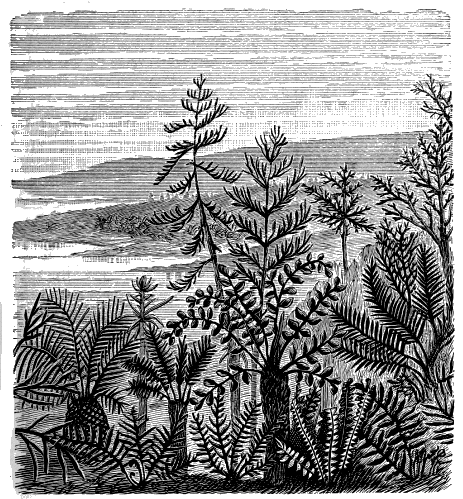
Fig. 64.—Jurassic vegetation. Cycads and pines. (After Saporta.)
As we ascend, however, in the Mesozoic, we find new and higher types. Even within the Jurassic epoch, the next in succession to the Trias, there are clear indications of the presence of the endogens, in species allied to the screw-pines and grasses; and the palms appear a little later, while a few exogenous trees have left their remains in the Lower Cretaceous, and in the Middle and Upper Cretaceous these higher plants come in abundantly and in generic forms still extant, so that the dawn of the modern flora belongs to the Middle and Upper Cretaceous. It will thus be convenient to confine ourselves in this chapter to the flora of the earlier Mesozoic.
Passing over for the present the cryptogamous plants already familiar in older deposits, we may notice the new features of gymnospermous and phænogamous life, as they present themselves in this earlier part of the great reptilian age, and as they extended themselves with remarkable uniformity in this period over all parts of the world. For it is a remarkable fact that, if we place together in our collections fossil plants of this period from Australia, India, China, Siberia, Europe, or even from Greenland, we find wonderfully little difference in their aspect. This uniformity we have already seen prevailed in the Palæozoic flora; and it is perhaps equally marked in that of the Mesozoic. Still we must bear in mind that some of the plants of these periods, as the ferns and pines, for example, are still world-wide in their distribution; but this does not apply to others, more especially the cycads (Fig. 65).
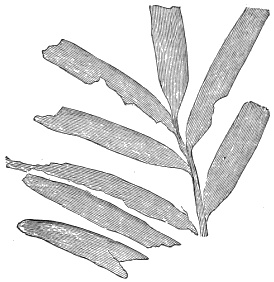
Fig. 65.—Podozamites lanceolatus, Sternb. L. Cretaceous.
The cycads constitute a singular and exceptional type in the modern world, and are limited at present to the warmer climates, though very generally distributed in these, as they occur in Africa, India, Japan, Australia, Mexico, Florida, and the West Indies. In the Mesozoic age, however, they were world-wide in their distribution, and are found as far north as Greenland, though most of the species found in the Cretaceous of that country are of small size/ and may have been of low growth, so that they may have been protected by the snows of winter. The cycads have usually simple or unbranching stems, pinnate leaves borne in a crown at top, and fruits which, though somewhat various in structure and arrangement, are all of the simpler form of gymnospermous type. The stems are exogenous in structure, but with slender wood and thick bark, and barred tissue, or properly as tissue intermediate between this and the disc-bearing fibres of the pines.
Though the cycads have a considerable range of organisation and of fructification, and though some points in reference to the latter might assign them a higher place, on the whole they seem to occupy a lower position than the conifers or the cordaiteæ of the Carboniferous. In the Carboniferous some of the fern-like leaves assigned to the genus Noeggerathia have been shown by Stur and Weiss to have been gymnosperms, probably allied to cycads, of which they may be regarded at least as precursors. Thus the cycadean type does not really constitute an advance in grade of organisation in the Mesozoic, any further than that, in the period now in question, it becomes much more developed in number and variety of forms. But the conifers would seem to have had precedence of it for a long time in the Palæozoic, and it replaces in the Mesozoic the Cordaites, which in many respects excelled it in complexity.
The greater part of the cycads of the Mesozoic age would seem to have had short stems and to have constituted the undergrowth of woods in which conifers attained to greater height. An interesting case of this is the celebrated dirt-bed of the quarries of the Isle of Portland, long ago described by Dean Buckland. In this fossil soil trunks of pines, which must have attained to great height, are interspersed with the short, thick stems of cycads, of the genus named Cycadoidea by Buckland, and which from their appearance are called “fossil birds' nests” by the quarrymen. Some, however, must have attained a considerable height so as to resemble palms.
The cycads, with their simple, thick trunks, usually marked with rhombic scars, and bearing broad spreading crowns of large, elegantly formed pinnate leaves, must have formed a prominent part of the vegetation of the northern hemisphere during the whole of the Mesozoic period. A botanist, had there been such a person at the time, would have found this to be the case everywhere from the equator to Spitzbergen, and probably in the southern hemisphere as well, and this throughout all the long periods from the Early Trias to the Middle Cretaceous. In a paper published in the “Linnæan Transactions” for 1868, Dr. Carruthers enumerates twenty species of British Mesozoic cycads, and the number might now be considerably increased.
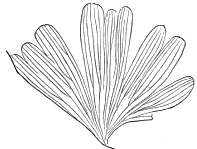
Fig. 66.—Salisburia (Gingko) Sibirica, Heer. L. Cretaceous, Siberia and North America.
The pines present some features of interest. We have already seen their connection with the broad-leaved Cordaites, and in the Permian there are some additional types of broad-leaved coniferæ. In the Mesozoic we have great numbers of beautiful trees, with those elegant fan-shaped leaves characteristic of but one living species, the Salisburia, or gingko-tree of China. It is curious that this tree, though now limited to eastern Asia, will grow, though it rarely fruits, in most parts of temperate Europe, and in America as far north as Montreal, and that in the Mesozoic period it occupied all these regions, and even Siberia and Greenland, and with many and diversified species (Fig. 66).
Salisburia belongs to the yews, but an equally curious fact applies to the cypresses. The genus Sequoia, limited at present to two species, both Californian, and one of them the so-called “big tree,” celebrated for the gigantic size to which it attains, is represented by species found as far back at least as the Lower Cretaceous, and in every part of the northern hemisphere.[DG] It seems to have thriven in all these regions throughout the Mesozoic and early Kainozoic, and then to have disappeared, leaving only a small remnant to represent it in modern days. A number of species have been described from the Mesozoic and Tertiary, all of them closely related to those now existing (Fig. 67).
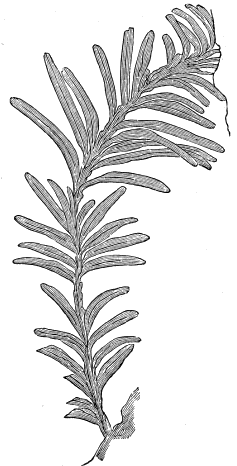
Fig. 67.—Sequoia Smithiana, Heer. L. Cretaceous.
The following notice of these trees is for the most part translated, with some modifications and abridgment, from a paper read by the late Prof. Heer before the Botanical Section of the Swiss Natural History Society:
The name itself deserves consideration. It is that of an Indian of the Cherokee tribe, Sequo Yah, who invented an alphabet without any aid from the outside world of culture, and taught it to his tribe by writing it upon leaves. This came into general use among the Cherokees, before the white man had any knowledge of it; and afterward, in 1828, a periodical was published in this character by the missionaries. Sequo Yah was banished from his home in Alabama, with the rest of his tribe, and settled in New Mexico, where he died in 1843.
When Endlicher was preparing his synopsis of the conifers, in 1846, and had established a number of new genera, Dr. Jacbon Tschudi, then living with Endlicher, brought before his notice this remarkable man, and asked him to dedicate this red-wooded tree to the memory of a literary genius so conspicuous among the red men of America. Endlicher consented to do so, and only endeavored to make the name pronounceable by changing two of its letters.
Endlicher founded the genus on the redwood of the Americans, Taxodium sempervirens of Lamb; and named the species Sequoia sempervirens. These trees form large forests in California, which extend along the coast as far as Oregon. Trees are there met with of 300 feet in height and 20 feet in diameter. The seeds have been brought to Europe a number of years ago, and we already see in upper Italy and around the Lake of Geneva, and in England, high trees; but, on the other hand, they have not proved successful around Zurich.
In 1852, a second species of Sequoia was discovered in California, which, under the name of big tree, soon attained a considerable celebrity. Lindley described it, in 1853, as Wellingtonia gigantea; and, in the following year, Decaisne and Torrey proved that it belonged to Sequoia, and that it accordingly should be called Sequoia gigantea.
While the Sequoia sempervirens, in spite of the destructiveness of the American lumbermen, still forms large forests along the coast, the Sequoia gigantea is confined to the isolated clumps which are met with inland at a height of 5,000 to 7,000 feet above sea-level, and are much sought after by tourists as one of the wonders of the country. Reports came to Europe concerning the largest of them which were quite fabulous, but we have received accurate accounts of them from Prof. Whitney. The tallest tree measured by him has a height of 325 feet, and in the case of one of the trees the number of the rings of growth indicated an age of about 1,300 years. It had a girth of 50 to 60 feet.
We know only two living species of Sequoia, both of which are confined to California. The one (S. sempervirens) is clothed with erect leaves, arranged in two rows, very much like our yew-tree, and bears small, round cones; the other (S. gigantea) has smaller leaves, set closely against the branches, giving the tree more the appearance of the cypress. The cones are egg-shaped, and much larger. These two types are therefore sharply defined.
Both of these trees have an interesting history. If we go back into the Tertiary, this same genus meets us with a long array of species. Two of these species correspond to those living at present: the S. Langsdorfii to the S. sempervirens, and the S. Couttsiæ to the S. gigantea.[DH] But, while the living species are confined to California, in the Tertiary they are spread over several quarters of the globe.
Let us first consider the Sequoia Langsdorfii. This was first discovered in the lignite of Wetterau, and was described as Taxites langsdorfii. Heer found it in the upper Rhone district, and there lay beside the twigs the remains of a cone, which showed that the Taxites Langsdorfii of Brongniart belonged to the Californian genus Sequoia established by Endlicher. He afterward found much better preserved cones, together with seeds, along with the plants of east Greenland, which fully confirmed the determination. At Atanekerdluk in Greenland (about 70° north latitude) this tree is very common. The leaves, and also the flowers and numerous cones, leave no doubt that it stands very near to the modern redwood. It differs from it, however, in having a much larger number of scales in the cone. The tree is also found in Spitzbergen at nearly 78° north latitude, where Nordenskiöld has collected, at Cape Lyell, wonderfully preserved branches. From this high latitude the species can be followed down through the whole of Europe as far as the middle of Italy (at Senegaglia, Gulf of Spezia). In Asia, also,, we can follow it to the steppes of Kirghisen, to Possiet, and to the coast of the Sea of Japan, and across to Alaska and Sitka. It is recognized by Mr. Starkie Gardner as one of the species found in the Eocene of Mull in the Hebrides.[DI] It is thus known in Europe, Asia, and America, from 43° to 78° north latitude, while its most nearly related living species, perhaps even descended from it, is now confined to California.
With this S. Langsdorfii, three other Tertiary species are nearly related (S. brevifolia, Hr., S. disticha, Hr., and S. Nordenskiöldi, Hr.). These have been met with in Greenland and Spitzbergen, and one of them has lately been found in the United States. Three other species, in addition to these, have been described by Lesquereux, which appear to belong to the group of the S. Langsdorfii, viz., S. longifolia, Lesq., S. angustifolia, and S. acuminata, Lesq. Several species also occur in the Cretaceous and Eocene of Canada.
These species thus answer to the living Sequoia sempervirens; but we can also point to Tertiary representatives of the S. gigantea. Their leases are stiff and sharp-pointed, are thinly set round the branches, and lie forward in the same way: the egg-shaped cones are in some cases similar.
There are, however, in the early Tertiary six species, which fill up the gap between S. sempervirens and S. gigantea. They are the S. Couttsiæ, S. affinis, Lesq., S. imbricata, Hr., S. sibirica, Hr., S. Heerii, Lesq., and S. biformis, Lesq. Of these, S. Couttsiæ, Hr., is the most common and most important species. It has short leaves, lying along the branch, like S. gigantea, and small, round cones, like S. Langsdorfii and sempervirens. Bovey Tracey in Devonshire has afforded splendid specimens of cones, seeds, and twigs, which have been described in the “Philosophical Transactions.” More lately, Count Saporta has described specimens of cones and twigs from Armissan. Specimens of this species have also been found in the older Tertiary of Greenland, so that it must have had a wide range. It is very like to the American S. affinis, Lesq.
In the Tertiary there have been already found fourteen well-marked species, which thus include representatives of the two living types, S. sempervirens and S. gigantea.
We can follow this genus still further back. If we go back to the Cretaceous age, we find ten species, of which five occur in the Urgon of the Lower Cretaceous, two in the Middle, and three in the Upper Cretaceous. Among these, the Lower Cretaceous exhibits the two types of the Sequoia sempervirens and S. gigantea. To the former the S. Smithiana answers, and to the latter, the Reichenbachii, Gein. The S. Smithiana stands indeed uncommonly near the S. Langsdorfii, both in the appearance of the leaves on the twigs and in the shape of the cones. These are, however, smaller, and the leaves do not become narrower toward the base. The S. pectina, Hr., of the Upper Cretaceous, has its leaves arranged in two rows, and presents a similar appearance. The S. Reichenbachii is a type more distinct from those now living and those in the Tertiary. It has indeed stiff, pointed leaves, lying forward, but they are arcuate, and the cones are smaller. This tree has been known for a long time, and it serves in the Cretaceous as a guiding star, which we can follow from the Urgonian of the Lower Cretaceous up to the Cenomanian. It is known in France, Belgium, Bohemia, Saxony, Greenland, and Spitzbergen (also in Canada and the United States). It has been placed in another genus—Geinitzia—but we can recognise, by the help of the cones, that it belongs to Sequoia.
Below this, there is found in Greenland a nearly related species, the S. ambigua, Hr., of which the leaves are shorter and broader, and the cones round and somewhat smaller.
The connecting link between S. Smithiana and Reichenbachii is formed by S. subulata, Hr., and S. rigida, Hr., and three species (S. gracilis, Hr., S. fastigiata and S. Gardneriana, Carr.), with leaves lying closely along the branch, and which come very near to the Tertiary species S. Couttsiæ. We have therefore in the Cretaceous quite an array of species, which fill up the gap between the S. sempervirens and gigantea, and show us that the genus Sequoia had already attained a great development in the Cretaceous. This was still greater in the Tertiary, in which it also reached its maximum of geographical distribution. Into the present world the two extremes of the genus have alone continued; the numerous species forming its main body have fallen out in the Tertiary.
If we look still further back, we find in the Jura a great number of conifers, and, among them, we meet in the genus Pinus with a type which is highly developed, and which still survives; but for Sequoia we have till now looked in vain, so that for the present we can not place the rise of the genus lower than the Urgonian of the Cretaceous, however remarkable we may think it that in that period it should have developed into so many species; and it is still more surprising that two species already make their appearance which approach so near to the living Sequoia sempervirens and S. gigantea.
Altogether, we have become acquainted, up to the present time, with twenty-six species of Sequoia. Fourteen of these species are found in the Arctic zone, and have been described and figured in the “Fossil Flora of the Arctic Regions.” Sequoia has been recognised by Ettingshausen even in Australia, but there in the Eocene.
This is, perhaps, the most remarkable record in the whole history of vegetation. The Sequoias are the giants of the conifers, the grandest representatives of the family, and the fact that, after spreading over the whole northern hemisphere and attaining to more than twenty specific forms, their decaying remnant should now be confined to one limited region in western America and to two species constitutes a sad memento of departed greatness.[DJ] The small remnant of S. gigantea still, however, towers above all competitors, as eminently the “big trees ”; but, had they and the allied species failed to escape the Tertiary continental submergences and the disasters of the glacial period, this grand genus would have been to us an extinct type. In like manner the survival of the single gingko of eastern Asia alone enables us to understand that great series of taxine trees with fern-like leaves of which it is the sole representative.
Besides these peculiar and now rare forms, we have in the Mesozoic many others related closely to existing yews, cypresses, pines, and spruces, so that the conifers were probably in greater abundance and variety than they are at this day.
In this period, also, we find the earliest representatives of the endogenous plants. It is true that some plants found in the coal-formation have been doubtfully referred to these, but the earliest certain examples would seem to be some bamboo-like and screw-pine-like plants occurring in the Jurassic rocks. Some of these are, it is true, doubtful forms, but of others there seems to be no question. The modern Pandanus or screw-pine of the tropical regions, which is not a pine, however, but a humble relation of the palms, is a stiffly branching tree, of a candelabra-like form, and with tufts of long leaves on its branches, and nuts or great hard berries for fruit, borne sometimes in large masses, and so protected as to admit of their drifting uninjured on the sea. The stems are supported by masses of aërial roots like those which strengthen the stems of tree-ferns. These structures and habits of growth fit the Pandanus for its especial habitat on the shores of tropical islands, to which its masses of nuts are drifted by the winds and currents, and on whose shores it can establish itself by the aid of its aërial roots.
Some plants referred to the cycads have proved veritable botanical puzzles. One of these, the Williamsonia gigas of the English oölite, originally discovered by my friend Dr. Williamson, and named by him Zamia gigas, a very tall and beautiful species, found in rocks of this age in various parts of Europe, has been claimed by Saporta for the Endogens, as a plant allied to Pandanus. Some other botanists have supposed the flowers and fruits to be parasites on other plants, like the modern Rafflesia of Sumatra, but it is possible that after all it may prove to have been an aberrant cycad.
The tree-palms are not found earlier than the Middle Cretaceous, where we shall notice them in the next chapter. In like manner, though a few Angiosperms occur in rocks believed to be Lower or Lower Middle Cretaceous in Greenland and the northwest territory of Canada, and in Virginia, these are merely precursors of those of the Upper Cretaceous, and are not sufficient to redeem the earlier Cretaceous from being a period of pines and cycads.
On the whole, this early Mesozoic flora, so far as known to us, has a monotonous and mean appearance. It no doubt formed vast forests of tall pines, perhaps resembling the giant Sequoias of California; but they must for the most part have been dark and dismal woods, probably tenanted by few forms of life, for the great reptiles of this age must have preferred the open and sunny coasts, and many of them dwelt in the waters. Still we must not be too sure of this. The berries and nuts of the numerous yews and cycads were capable of affording much food. We know that in this age there were many great herbivorous reptiles, like Iguanodon and Hadrosaurus, some of them fitted by their structure to feed upon the leaves and fruits of trees. There were also several kinds of small herbivorous mammals, and much insect life, and it is likely that few of the inhabitants of the Mesozoic woods have been preserved as fossils. We may yet have much to learn of the inhabitants of these forests of ferns, cycads, and pines. We must not forget in this connection that in the present day there are large islands, like New Zealand, destitute of mammalia, and having a flora comparable with that of the Mesozoic in the northern hemisphere, though more varied. We have also the remarkable example of Australia, with a much richer flora than that of the early Mesozoic, yet inhabited only by non-placental mammals, like those of the Mesozoic.
The principal legacy that the Mesozoic woods have handed down to our time is in some beds of coal, locally important, but of far less extent than those of the Carboniferous period. Still, in America, the Richmond coal-field in Virginia is of this age, and so are the anthracite beds of the Queen Charlotte Islands, on the west coast of Canada, and the coal of Brora in Sutherlandshire. Valuable beds of coal, probably of this age, also exist in China, India, and South Africa; and jet, which is so extensively used for ornament, is principally derived from the carbonised remains of the old Mesozoic pines.
In the next chapter we have to study a revolution in vegetable life most striking and unique, in the advent of the forest-trees of strictly modern types.
NOTE TO CHAPTER V.
I append to this chapter a table showing the plant-bearing series of the Cretaceous and Laramie of North America, from a paper in “Trans. R. S. C,” 1885, which see for further details:
(In Descending Order.)
Periods. Floras and sub-floras. References.
Transition Eocene to Cretaceous. Upper Laramie or Porcupine Hill. Fort Union group, U. S. territory. Platanus beds of Souris River and Calgary. Report of Geol. Survey of Canada for 1879, and Memoir of 1885.

Upper Cretaceous (Danian and Senonian). Middle Laramie or Willow Creek beds.
Lower Laramie or St. Mary River. Lemna and Pistia beds of bad lands of 49th parallel, Red Deer River, &c., with lignites. Report 49th Parallel and Memoir of 1885.
Fox Hill series Marine.
Fort Pierre series Marine.
Belly River Sequoia and Brasenia beds of S. Saskatchewan, Belly River, &c. with lignites. Memoir of 1885.
Coal measures of Nanaimo, B.C., probably here. Memoir of 1883. Many dicotyledons, palms, &c.
Middle Cretaceous (Turonian and Cenomanian). Dunvegan series of Peace River. Dakota group, U. S. Amboy clays, U. S. Memoir of 1883. Many dicotyledons, cycads, &c.
Mill Creek beds of Rocky Mountains. Dicotyledonous leaves, similar to Dakota group of the U. S. Memoir of 1885.
Lower Cretaceous (Neocomian.&c). Suskwa River beds and Queen Charlotte Island coal series. Intermediate beds of Rocky Mountains. Potomac series of Virginia. Cycads, pines, a few dicotyledons. Report Geol.Survey. Memoir of 1885.
Kootanie series of Rocky Mountains. Cycads, pines, and ferns. Memoir of 1885.
CHAPTER VI.
THE REIGN OF ANGIOSPERMS IN THE LATER CRETACEOUS AND KAINOZOIC.
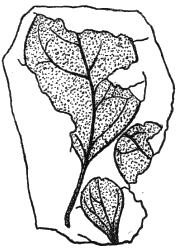
Fig. 68.—Populus primæva, Heer. Cretaceous, of Greenland. One of the oldest known Angiosperms.
It is a remarkable fact in geological chronology that the culmination of the vegetable kingdom antedates that of the animal. The placental mammals, the highest group of the animal kingdom, are not known till the beginning of the Eocene Tertiary. The dicotyledonous Angiosperms, which correspond to them in the vegetable kingdom, occur far earlier—in the beginning of the Upper Cretaceous or close of the Lower Cretaceous. The reign of cycads and pines holds throughout the Lower Cretaceous, but at the close of that age there is a sudden incoming of the higher plants, and a proportionate decrease, more especially of the cycads.
I have already referred to the angiospermous wood supposed to be Devonian, but I fear to rest any conclusion on this isolated fact. Beyond this, the earliest indications of plants of this class have been found in the Lower Cretaceous. Many years ago Heer described and figured the leaves of a poplar (Populus primæva) from the supposed Lower Cretaceous of Komé, in Greenland (Fig. 68). Two species, a Sterculia and a Laurus or Salix, occur among fossils described by me in the upper part of the Kootanie series of the Rocky Mountains, and Fontaine has recently found in the Potomac group of Virginia—believed to be of Neocomian age—several angiospermous species (Sassafras, Menispermites, Sapindus, Aralia, Populus, &c.) mixed with a rich flora of cycads and pines. These are the early forerunners of the modern angiospermous flora; but so far as known they do not occur below the Cretaceous, and in its lower portions only very rarely. When, however, we ascend into the Upper Cretaceous, whether of Europe or America, there is a remarkable incoming of the higher plants, under generic forms similar to those now existing. This is, in truth, the advent of the modern flora of the temperate regions of the earth. A very interesting tabular view of its early distribution is given by Ward, in the “American Journal of Science” for 1884, of which the following is a synopsis, with slight emendations. I may add that the new discoveries made since 1884 would probably tend to increase the proportionate number of dicotyledons in the newer groups.
Dicotyledonous Trees in the Cretaceous.
Upper Senonian (Fox Hill group of America.) 179 species.
Lower Senonian Upper white chalk of Europe; Fort Pierre group of America; coal-measures of Nanaimo? 81 species.
Turonian Lower white chalk; New Jersey marls; Belly R. group. 20 species.
Cenomanian. (Chalk-marl, greensand, and Gault, Niobrara and Dakota groups of America); Dunvegan group of Canada; Amboy clays of New Jersey. 357 species.
Neocomian (Lower greensand and Speeton clay, Wealden and Hastings sands, Kootanie and Queen Charlotte groups of Canada.) 20 species.[DK]
Thus we have a great and sudden inswarming of the higher plants of modern types at the close of the Lower Cretaceous. In relation to this, Saporta, one of the most enthusiastic of evolutionists, is struck by this phenomenon of the sudden appearance of so many forms, and some of them the most highly differentiated of dicotyledonous plants. The early stages of their evolution may, he thinks, have been obscure and as yet unobserved, or they may have taken place in some separate region, or mother country as yet undiscovered, or they may have been produced by a rapid and unusual multiplication of flower-haunting insects! Or it is even conceivable that the apparently sudden elevation of plants may have been due to causes still unknown. This last seems, indeed, the only certain inference in the case, since, as Saporta proceeds to say in conclusion: “Whatever hypothesis one may prefer, the fact of the rapid multiplication of dicotyledons, and of their simultaneous appearance in a great number of places in the northern hemisphere at the beginning of the Cenomanian epoch, cannot be disputed.”[DL]
The leaves described by Heer, from the Middle Cretaceous of Greenland, are those of a poplar (P. primæva). Those which I have described from a corresponding horizon in the Rocky Mountains are a Sterculites (S. vetustula), probably allied to the mallows, and an elongated leaf, Laurophyllum (L. crassinerve) (Fig. 69), which may, however, have belonged to a willow rather than a laurel. These are certainly older than the Dakota group of the United States and the corresponding formations in Canada. On the eastern side of the American continent, in Virginia, the Potomac series is supposed to be of Lower Cretaceous age, and here Fontaine, as already stated, has found an abundant flora of cycads, conifers, and ferns, with a few angiospermous leaves, which have not yet been described.
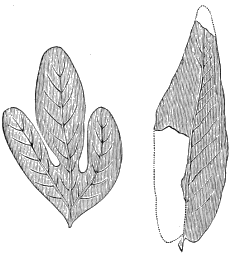
Fig. 69.—Stercalia and Laurophyllum or Salix, the oldest Angiosperms Known in the Cretaceous of Canada.
In the Canadian Rocky Mountains, a few hundreds of feet above the beds holding the beforementioned species, are the shales of the Mill Creek series, rich in many species of dicotyledonous leaves, and corresponding in age with the Dakota group, whose fossils have been so well described, first by Heer and Capellini, and afterward by Lesquereux. We may take this Dakota group and the quader-sand stone of Germany as types of the plant-bearing Cenomanian, and may notice the forms occurring in them.
In the first place, we recognise here the successors of our old friends, the ferns and the pines, the latter represented by such genera as Taxites, Sequoia, Glyptostrobus, Gingko, and even Pinus itself. We also have a few cycads, but not so dominant as in the previous ages. The fan-palms are well represented, both in America and in the corresponding series in Europe, especially by the genus Sabal, which is the characteristic American type of fan-palm, and there is one genus which Saporta regards as intermediate between the fan-palms and the pinnately leaved species. There are also many fragments of stems and leaves of carices and grasses, so that these plants, now so important to the nourishment of man and his companion animals, were already represented.
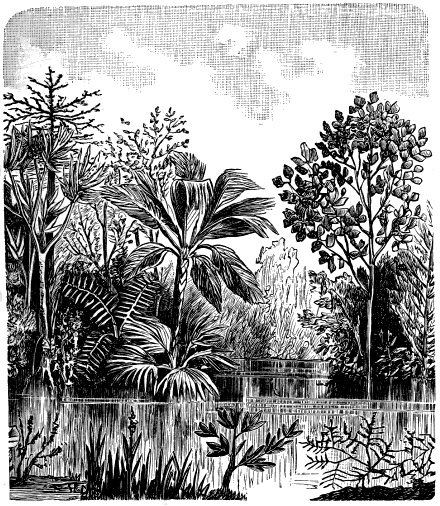
Fig. 70.—Vegetation of Later Cretaceous. Exogens and palms. (After Saporta.)
But the great feature of the time was its dicotyledonous forests, and I have only to enumerate the genera supposed to be represented in order to show the richness of the time in plants of this type. It may be necessary to explain here that the generic names used are mostly based on leaves, and consequently cannot be held as being absolutely certain, since we know that at present one genus may have considerable variety in its leaves, and, on the other hand, that plants of different genera may be very much alike in their foliage. There is, however, undoubtedly a likeness in plan or type of structure in leaves of closely allied plants, and, therefore, if judiciously studied, they can be determined with at least approximate certainty.[DM] More especially we can attain to much certainty when the fruits as well as the leaves are found, and when we can obtain specimens of the wood, showing its structure. Such corroboration is not wanting, though unfortunately the leaves of trees are generally found drifted away from the other organs once connected with them. In my own experience, however, I have often found determinations of the leaves of trees confirmed by the discovery of their fruits or of the structure of their stems. Thus, in the rich cretaceous plant-beds of the Dunvegan series we have beech-nuts associated in the same beds with leaves referred to Fagus. In the Laramie beds I determined many years ago nuts of the Trapa or water-chestnut, and subsequently Lesquereux found, in beds in the United States, leaves which he referred to the same genus. Later, I found in collections made on the Red Deer River of Canada my fruits and Lesquereux’s leaves on the same slab. The presence of trees of the genera Carya and Juglans in the same formation was inferred from their leaves, and specimens have since been obtained of silicified wood, with the microscopic structure of the modern butternut. Still we are willing to admit that determinations from leaves alone are liable to doubt.
In the matter of names of fossil leaves, I sympathise very strongly with Dr. Nathorst, of Stockholm, in his objection to the use of modern generic names for mere leaves, and would be quite content to adopt some non-committal termination, as that of “phyllum” or “ites” suggested by him. I feel, however, that almost as much is taken for granted if a plant is called Corylophyllum or Corylites, as if called Corylus. In either case a judgment is expressed as to its affinities, which if wrong under the one term is wrong under the other; and after so much has been done by so many eminent botanists, it seems inexpedient to change the whole nomenclature for so small and questionable an advantage. I wish it, however, to be distinctly understood that plants catalogued on the evidence of leaves alone are for the most part referred to certain genera on grounds necessarily imperfect, and their names are therefore subject to correction, as new facts may be obtained.
The more noteworthy modern genera included in the Dakota flora, as catalogued by Lesquereux, are the following: Liquidambar, the sweet-gum, is represented both in America and Europe, the leaves resembling those of the modern species, but with entire edges, which seems to be a common peculiarity of Cretaceous foliage.[DN] Populus (poplar), as already stated, appears very early in Greenland, and continues with increasing number of species throughout the Cretaceous and Tertiary. Salix (willow) appears only a little later and continues. Of the family Cupuliferæ we have Fagus (beech), Quercus (oak), and Castanea (chestnut), which appear together in the Dakota group and its equivalents. Fruits of some of the species are known, and also wood showing structure. Betula (birch) is represented by a few species, and specimens of its peculiar bark are also common. Alnus (alder) appears in one species at least. The genus Plat anus (Fig. 71), that of the plane-trees, represented at present by one European and one American species, has several species in the Cretaceous, though the plane-trees seem to culminate in the early part of the succeeding Eocene, where there are several species with immense leaves. The large leaves, known as Credneria, found in the Cenomanian of Europe, and those called Protophyllum (Fig. 72) in America, appear to be nearer to the plane-trees than to any others, though representing an extinct type. The laurels are represented in this age, and the American genus Sassafras, which has now only one species, has not one merely but several species in the Cretaceous. Diospyros, the persimmon-tree, was also a Cretaceous genus.
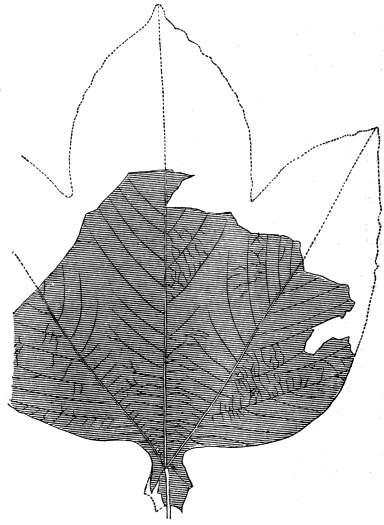
Fig. 71.—Platanus nobilis, Newberry, variety basilobata. Laramie. Much reduced.
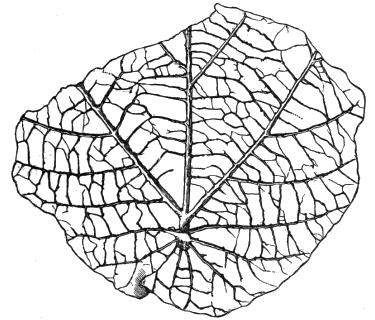
Fig. 72.—Protophyllum boreale, Dawson, reduced. Upper Cretaceous, Canada.
The single species of the beautiful Liriodendron, or tulip-tree, is a remnant of a genus which had several Cretaceous species (Figs. 74, 75). The magnolias, still well represented in the American flora, were equally plentiful in the Cretaceous (Fig. 73). The walnut family were well represented by species of Juglans (butternut) and Carya, or hickory. In all, no less than forty-eight genera are present belonging to at least twenty-five families, running through the whole range of the dicotyledonous exogens. This is a remarkable result, indicating a sudden profusion of forms of these plants of a very striking character. It is further to be observed that some of the genera have many species in the Cretaceous and dwindle toward the modern. In others the reverse is the case—they have expanded in modern times. In a number there seems to have been little change.
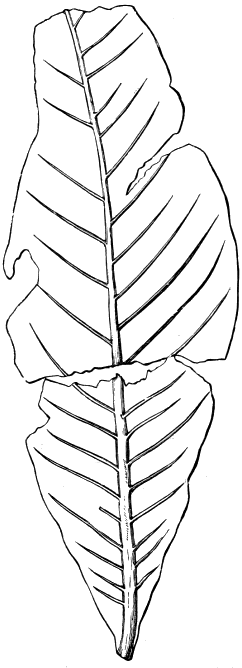
Fig. 73.—Magnolia magnifica, Dawson, reduced. Upper Cretaceous, Canada.
Dr. Newberry has given, in the “Bulletin of the Torrey Botanical Club” an interesting résumé of the history of the beautiful Liriodendron, or tulip-tree, which may be taken as an example of a genus which has gone down in importance in the course of its geological history.
"The genus Liriodendron, as all botanists know, is represented in the present flora by a single species, ‘the tulip-tree’ which is confined to eastern America, but grows over all the area lying between the Lakes and the Gulf, the Mississippi and the Atlantic. It is a magnificent tree, on the whole, the finest in our forests. Its cylindrical trunk, sometimes ten feet in diameter, carries it beyond all its associates in size, while the beauty of its glossy, lyre-shaped leaves and tulip-like flowers is only surpassed by the flowers and foliage of its first cousin, Magnolia grandiflora. That a plant so splendid should stand quite alone in the vegetation of the present day excited the wonder of the earlier botanists, but the sassafras, the sweet-gum, and the great Sequoias of the far West afford similar examples of isolation, and the latter are still more striking illustrations of solitary grandeur." (Figs. 74 and 75.)
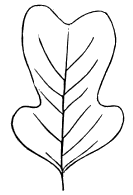
Fig. 74.—Liriodendron Meekii, Heer. (After Lesquereux.)
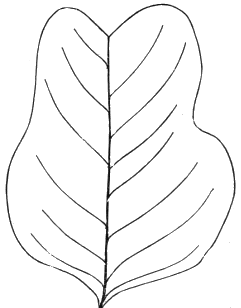
Fig. 75.—Liriodendron primævum, Newberry. (After Newberry.)
"Three species of Liriodendron are indicated by leaves found in the Amboy clays—Middle Cretaceous—of New Jersey, and others have been obtained from the Dakota group in the West, and from the Upper Cretaceous strata of Greenland. Though differing considerably among themselves in size and form, all these have the deep sinus of the upper extremity so characteristic of the genus, and the nervation is also essentially the same. Hence, we must conclude that the genus Liriodendron, now represented by a single species, was in the Cretaceous age much more largely developed, having many species, and those scattered throughout many lands. In the Tertiary age the genus continued to exist, but the species seem to have been reduced to one, which is hardly to be distinguished from that now living. In many parts of Europe leaves of the tulip-tree have been found, and it extended as far south as Italy. Its presence there was first made known by Unger, in his ‘Synopsis,’ page 232, and in his ‘Genera et Species,’ page 443, where he describes it under the name of Liriodendron procaccinii. The genus has also been noticed in Europe by Massalongo, Heer, and Ettingshausen, and three species have been distinguished. All these are, however, so much like the living species that they should probably be united with it. We here have a striking illustration of the wide distribution of a species which has retained its characters both of fruit and leaf quite unchanged through long migrations and an enormous lapse of time.
“In Europe the tulip-tree, like many of its American associates, seems to have been destroyed by the cold of the Ice period, the Mediterranean cutting off its retreat, but in America it migrated southward over the southern extension of the continent and returned northward again with the amelioration of the climate.”
Leaves of Liriodendron have been recognised in the Cretaceous of Greenland, though it is now a tree of the warm temperate region, and Lesquereux describes several species from the Dakota group. But the genus has not yet been recognised in the Laramie or in the Upper Cretaceous of British Columbia. In the paper above quoted, Newberry describes three new species from the Amboy clays, one of which he considers identical with a Greenland form referred by Heer to L. Meekii of the Dakota group. Thus, if all Lesquereux’s species are to be accepted, the genus begins in the Middle Cretaceous with at least nine American species.
In New Jersey the Amboy clays are referred to the same age with the Dakota beds of the West. In these Dr. Newberry has found a rich flora, including many angiosperms. The following is condensed from a preliminary notice in the “Bulletin of the Torrey Botanical Club”:[DO]
"The flora of the Amboy clays is closely related to that of the Dakota group—most of the genera and some of the species being identical—so that we may conclude they were nearly contemporaneous, though the absence in New Jersey of the Fort Benton and Niobrara groups of the upper Missouri and the apparent synchronism of the New Jersey marls and the Pierre group indicate that the Dakota is a little the older.
“At least one-third of the species of the Amboy clays seem to be identical with leaves found in the Upper Cretaceous clays of Greenland and Aachen (Aix la Chapelle), which not only indicates a chronological parallelism, but shows a remarkable and unexpected similarity in the vegetation of these widely separated countries in the middle and last half of the Cretaceous age. The botanical character of the flora of the Amboy clays will be seen from the following brief synopsis:
“Algæ.—A small and delicate form, allied to Chondrites.
“Ferns.—Twelve species, generally similar and in part identical with those described by Heer from the Cretaceous beds of Greenland, and referred to the genera Dicksonia, Gleichenia, and Aspidium.
“Cycads.—Two species, probably identical with the forms from Greenland described by Heer under the names of Podozamites marginatus and P. tenuinervis.
“Conifers.—Fourteen species, belonging to the genera Moriconia, Brachyphyllum, Cunninghamites, Pinus, Sequoia, and others referred by Heer to Juniperus, Libocedrus, Frenelopsis, Thuya, and Dammara. Of these, the most abundant and most interesting are Moriconia cyclotoxon—the most beautiful of conifers—and Cunninghamites elegans, both of which occur in the Cretaceous clays of Aachen, Prussia, and Patoot, Greenland. The Brachyphyllum was a large and strong species, with imbricated cones, eight inches in length.
“The angiosperms form about seventy species, which include three of Magnolia, four of Liriodendron, three or four of Salix, three of Celastrophyllum (of which one is identical with a Greenland species), one Celastrus (also found in Greenland), four or five Aralias, two Sassafras, one Cinnamomum, one Hedera; with leaves that are apparently identical with those described by Heer as belonging to Andromeda, Cissites, Cornus, Dewalquea, Diospyros, Eucalyptus, Ficus, Ilex, Juglans, Laurus, Menispermites, Myrica, Myrsine, Prunus, Rhamnus, and others not yet determined.
“Some of the Aralias had palmately-lobed leaves, nearly a foot in diameter, and two of the tulip-trees (Liriodendron) had leaves quite as large as those of the living species. One of these had deeply lobed leaves, like those of the white oak. Of the other, the leaves resembled those of the recent tulip-tree, but were larger. Both had the peculiar emargination and the nervation of Liriodendron.
“Among the most interesting plants of the collection are fine species of Bauhinia and Hymenæa. Of these, the first is represented by a large number of leaves, some of which are six or seven inches in diameter. They are deeply bilobed, and have the peculiar and characteristic form and nervation of the leaves of this genus. Bauhinia is a leguminous genus allied to Cercis, and now inhabits tropical and warm temperate climates in both hemispheres. Only one species occurs in the United States, Bauhinia lunarioides, Gray, found by Dr. Bigelow on the Rio Grande.
“Hymenæa is another of the leguminosæ, and inhabits tropical America. A species of this genus has been found in the Upper Cretaceous of France, but quite different from the one before us, in which the leaves are much larger, and the leaflets are united in a common petiole, which is winged; this is a modification not found in the living species, and one which brings it nearer to Bauhinia.
“But the most surprising discovery yet made is that of a number of quite large helianthoid flowers, which I have called Palæanthus. These are three to four inches in diameter, and exhibit a scaly involucre, enclosing what much resembles a fleshy receptacle with achenia. From the border of this radiate a number of ray florets, one to two inches in length, which are persistent and must have been scarious, like those of Helichrysum. Though these flowers so much resemble those of the compositæ, we are not yet warranted in asserting that such is certainly their character. In the Jurassic rocks of Europe and India some flowers not very unlike these have been found, which have been named Williamsonia, and referred to cycads by Carruthers. A similar fossil has been found in the Cretaceous rocks of Greenland, and named by Heer Williamsonia cretacea, but he questions the reference of the genus to the Cycadeæ, and agrees with Nathorst in considering all the species of Williamsonia as parasitic flowers, allied to Brugmansia or Rafflesia. The Marquis of Saporta regards them as monocotyledons, similar to Pandanus. More specimens of the flowers now exhibited will perhaps prove—what we can now only regard as probable—that the Compositæ, like the Leguminosæ, Magnoliaceæ, Celastraceæ, and other highly organised plants, formed part of the Cretaceous flora. No composite flowers have before been found in the fossil state, and, as these are among the most complex and specialised forms of florescence, it has been supposed that they belonged only to the recent epoch, where they were the result of a long series of formative changes.”
The above presents some interesting new types not heretofore found in the Middle Cretaceous. More especially the occurrence of large flowers of the composite type presents a startling illustration of the early appearance of a very elevated and complex form. Great interest also attaches to these Amboy beds, as serving, with those of Aix and Greenland, to show that the margins of the Atlantic were occupied with a flora similar to that occurring at the same time in the interior plateau of North America and on the Pacific slope.
The beds at Aix-la-Chapelle are, however, probably somewhat newer than the Dakota or Amboy beds, and correspond more nearly in age with those of the Cretaceous coal-field of Vancouver Island, where there is a very rich Upper Cretaceous flora, which I have noticed in detail in the “Transactions of the Royal Society of Canada.”[DP] In these Upper Cretaceous beds there are fan-palms as far north at least as the latitude of 49°, indicating a very mild climate at this period. This inference is corroborated by the Upper Cretaceous flora of Atané and Patoot in Greenland, as described by Heer.
The dicotyledonous plants above referred to are trees and shrubs. Of the herbaceous exogens of the period we know less. Obviously their leaves are less likely to find their way into aqueous deposits than the leaves of trees. They are, besides, more perishable, and in densely wooded countries there are comparatively few herbaceous plants. I have examined the beds of mud deposited at the mouth of a woodland streamlet, and have found them stored with the fallen leaves of trees, but it was in vain to search for the leaves of herbaceous plants.
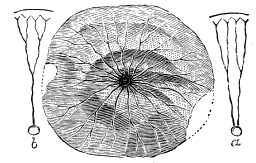
Fig. 76.—Brasenia antiqua. Upper Cretaceous, South Saskatchewan River. Natural size, a, b, Diagrams of venation, slightly enlarged.
The climate of North America and Europe, represented by the Cenomanian vegetation, is not tropical but warm temperate; but the flora was more uniform than at present, indicating a very equable climate and the possibility of temperate genera existing within the Arctic circle, and it would seem to have become warmer toward the close of the period.
The flora of the Cenomanian is separated in most countries from that of the Senonian, or uppermost Cretaceous, by a marine formation holding few plants. This depends on great movements of elevation and depression, to which we must refer in the sequel. In a few regions, however, as in the vicinity of the Peace River in Canada, there are plant-bearing beds which serve to bridge over the interval between the Early Cenomanian and the later Cretaceous.[DQ]
To this interval also would seem to belong the Belly River series of western Canada, which contains important beds of Coal, but is Closely associated with the marine Fort Pierre series. A very curious herbaceous plant of this group, which I have named Brasenia antiqua, occurs in the beds associated with one of the coals. It is a close ally of the modern B. peltata, an aquatic plant which occurs in British Columbia and in eastern America, and is also said to be found in Japan, Australia, and India, a width of distribution appropriate to so old a type (Fig. 76).
In so far as vegetable life is concerned, the transition from the Upper Cretaceous to the Tertiary or Kainozoic is easy, though in many parts of the world, and more especially in western Europe, there is a great gap in the deposits between the upper Chalk and the lowest Eocene. With reference to fossil plants, Schimper recognises in the Kainozoic, beginning with the oldest, five formations—Palæocene, Eocene, Oligocene, Miocene, and Pliocene. Throughout these a flora, similar to that of the Cretaceous on the one hand and the modern on the other, though with important local peculiarities, extends. There is evidence, however, of a gradual refrigeration, so that in the Pliocene the climates of the northern hemisphere were not markedly different from their present character.
In the first instance an important error was committed by palæobotanists, in referring to the Miocene many deposits really belonging to the Eocene. This arose from the early study of the rich plant-bearing Miocene beds of Switzerland, and from the similarity of the flora all the way from the Middle Cretaceous to the later Tertiary. The differences are now being worked out, and we owe to Mr. Starkie Gardner the credit of pointing these out in England, and to the Geological Survey of Canada that of collecting the material for exhibiting them in the more northern part of America.
In the great interior plain of America there rests on the Cretaceous a series of clays and sandstones with beds of lignite, some of them eighteen feet in thickness. This was formerly known as the lignitic or lignite Tertiary, but more recently as the Laramie series. These beds were deposited in fresh or brackish water, in an internal sea or group of lakes and swamps, when the continent was lower than at present. They have been studied both in the United States[DR] and Canada; and, though their flora was originally referred by mistake to the Miocene, it is now known to be Eocene or Palæocene, or even in part a transition group between the latter and the Cretaceous. The following remarks, taken chiefly from recent papers by the author,[DS] will serve to illustrate this:
On the geological map of Canada the Laramie series, formerly known as the lignitic or lignite Tertiary, occurs, with the exception of a few outliers, in two large areas west of the 100th meridian, and separated from each other by a tract of older Cretaceous rocks, over which the Laramie beds may have extended, before the later denudation of the region.
The most eastern of these areas, that of the Souris River and Wood Mountain, extends for some distance along the United States boundary, between the 102d and 109th meridians, and reaches northward to about thirty miles south of the “elbow” of the South Saskatchewan River, which is on the parallel of 51° north. In this area the lowest beds of the Laramie are seen to rest on those of the Fox Hill group of the Upper Cretaceous, and at one point on the west they are overlaid by beds of Miocene Tertiary age, observed by Mr. McConnell, of the Geological Survey, in the Cypress Hills, and referred by Cope, on the evidence of mammalian remains, to the White River division of the United States geologists, which is regarded by them as Lower Miocene.[DT] The age of the Laramie beds is thus stratigraphically determined to be between the Fox Hill Cretaceous and the Lower Miocene. They are also undoubtedly continuous with the Fort Union group of the United States geologists on the other side of the international boundary, and they contain similar fossil plants. They are divisible into two groups—a lower, mostly argillaceous, and to which the name of “Bad Lands beds” may be given, from the “bad lands” of Wood Mountain, where they are well exposed, and an upper, partly arenaceous member, which may be named the Souris River or Porcupine Creek division. In the lower division are found reptilian remains of Upper Cretaceous type, with some fish remains more nearly akin to those of the Eocene.[DU] Neither division has as yet afforded mammalian remains.
The western area is of still larger dimensions, and extends along the eastern base of the Rocky Mountains from the United States boundary to about the 55th parallel of latitude, and stretches eastward to the 111th meridian. In this area, and more especially in its southern part, the officers of the Geological Survey of Canada have recognised three divisions, as follows: (1) The Lower Laramie or St. Mary River series, corresponding in its character and fossils to the Lower or Bad Lands division of the other area. (2) A middle division, the Willow Creek beds, consisting of clays, mostly reddish, and not recognised in the other area. (3) The Upper Laramie or Porcupine Hills division, corresponding in fossils, and to some extent in mineral character, to the Souris River beds of the eastern area.
The fossil plants collected by Dr. G. M. Dawson in the eastern area were noticed by the author in an appendix to Dr. Dawson’s report on the 49th parallel, in 1875, and a collection subsequently made by Dr. Selwyn was described in the “Report of the Geological Survey of Canada” for 1879-'80. Those of the western area, and especially collections made by myself near Calgary in 1883, and by officers of the Geological Survey in 1884, have been described in the “Transactions of the Royal Society of Canada” vols. iii. and iv.
In studying these fossil plants, I have found that there is a close correspondence between those of the Lower and Upper Laramie in the two areas above referred to respectively, and that the flora of the Lower Laramie is somewhat distinct from that of the Upper, the former being especially rich in certain aquatic plants, and the latter much more copious on the whole, and much more rich in remains of forest-trees. This is, however, possibly an effect rather of local conditions than of any considerable change in the flora, since some Upper Laramie forms recur as low as the Belly River series of the Cretaceous, which is believed on stratigraphical grounds to be considerably older than the Lower Laramie.
With reference to the correlation of these beds with those of the United States, some difficulty has arisen from the tendency of palæobotanists to refer the plants of the Upper Laramie to the Miocene age, although in the reports of Mr. Clarence King, the late director of the United States Geological Survey, these beds are classed, on the evidence of stratigraphy and animal fossils, as Upper Cretaceous. More recently, however, and partly perhaps in consequence of the views maintained by the writer since 1875, some change of opinion has occurred, and Dr. Newberry and Mr. Lesquereux seem now inclined to admit that what in Canada we recognise as Upper Laramie is really Eocene, and the Lower Laramie either Cretaceous or a transition group between this and the Eocene. In a recent paper [DV] Dr. Newberry gives a comparative table, in which he correlates the Lower Laramie with the Upper Cretaceous of Vancouver Island and the Faxoe and Maestricht beds of Europe, while he regards the Upper Laramie as equivalent to European Eocene. Except in so far as the equivalence of the Lower Laramie and Vancouver Island beds is concerned, this corresponds very nearly with the conclusions of the writer in a paper published last year[DW]—namely, that we must either regard the Laramie as a transition Cretaceo-Eocene group, or must institute our line of separation in the Willow Creek or Middle Laramie division, which has, however, as yet afforded no fossil plants. I doubt, however, the equivalence of the Vancouver beds and the Lower Laramie, except perhaps in so far as the upper member of the former is concerned. I have also to observe that in the latest report of Mr. Lesquereux he still seems to retain in the Miocene certain formations in the West, which from their fossil plants I should be inclined to regard as Eocene.[DX]
Two ferns occurring in these beds are remarkable as evidence of the persistence of species, and of the peculiarities of their ancient and modern distribution. Onoclea sensibilis, the very common sensitive fern of eastern America, is extremely abundant in the Laramie beds over a great area in the West. Mr. Starkie Gardner and Dr. Newberry have also shown that it is identical with the Filicites Hebridicus of Forbes, from the early Eocene beds of the Island of Mull, in Scotland. Thus we have a species once common to Europe and America, but now restricted to the latter, and which has continued to exist over all the vast ages between the Cretaceous and the present day. In the Laramie beds I have found associated with this species another and more delicate fern, the modern Davallia (Stenloma) tenuifolia, but this, unlike its companion, no longer occurs in America, but is found in the mountains of Asia. This is a curious illustration of the fact that frail and delicate plants may be more ancient than the mountains or plains on which they live.
There are also some very interesting and curious facts in connection with the conifers of the Laramie. One of the most common of these is a Thuja or arbor vitæ (the so-called “cedar” of Canada). The Laramie species has been named T. interrupta by Newberry, but it approaches very closely in its foliage to T. occidentalis, of eastern Canada, while its fruit resembles that of the western species, T. gigantea.
Still more remarkable are the Sequoias to which we have already referred, but which in the Laramie age seem to have been spread over nearly all North America. The fossil species are of two types, representing respectively the modern S. gigantea and S. sempervirens, and their wood, as well as that of Thuja, is found in great abundance in the lignites, and also in the form of silicified trunks, and corresponds with that of the recent species. The Laramie contains also conifers of the genera Glyptostrobus, Taxodium, and Taxus; and the genus Salisburia or gingko—so characteristic of the Jurassic and Cretaceous—is still represented in America as well as in Europe in the early Eocene.
We have no palms in the Canadian or Scottish Palæocene, though I believe they are found further south. The dicotyledonous trees are richly represented. Perhaps the most conspicuous were three species of Platanus, the leaves of which sometimes fill the sandstones, and one of which, P. nobilis, Newberry, sometimes attains the gigantic size of a foot or more in diameter of its blade. The hazels are represented by a large-leaved species, C. Macquarrii, and by leaves not distinguishable from those of the modern American species, C. Americana and C. rostrata. There are also chestnuts and oaks. But the poplars and willows are specially abundant, being represented by no less than six species, and it would seem that all the modern types of poplar, as indicated by the forms and venation of the leaves, existed already in the Laramie, and most of them even in the Upper Cretaceous. Sassafras is represented by two species, and the beautiful group of Viburnum,, to which the modern tree-cranberry belongs, has several fine species, of some of which both leaves and berries have been found. The hickories and butternuts are also present, the horse-chestnut, the Catalpa and Sapindus, and some curious leaves which seem to indicate the presence of the modern genus Symphorocarpus, the snow-berry tribe.
The above may suffice to give an idea of the flora of the older Eocene in North America, and I may refer for details to the works of Newberry, Lesquereux, and Ward, already cited. I must now add that the so-called Miocene of Atanekerdluk, Greenland, is really of the same age, as also the “Miocene” of Mull, in Scotland, of Antrim, in Ireland, and of Bovey Tracey, in the south of England, and the Gelinden, or “Heersian” beds, of Belgium, described by Saporta. In comparing the American specimens with the descriptions given by Gardner of the leaf-beds at Ardtown, in Mull, we find, as already stated, Onoclea sensibilis, common to both. The species of Sequoia, Gingko, Taxus, and Glyptostrobus are also identical or closely allied, and so are many of the dicotyledonous leaves. For example, Platanoides Hebridicus is very near to P. nobilis, and Corylus Macquarrii is common to both formations, as well as Populus Arctica and P. Richardsoni. I may add that ever since 1875-'76, when I first studied the Laramie plants, I have maintained their identity with those of the Fort Union group of the United States, and of the so-called Miocene of McKenzie River and Greenland, and that the whole are Paleocene; and this conclusion has now been confirmed by the researches of Gardner in England, and by the discovery of true Lower Miocene beds in the Canadian northwest, overlying the Laramie or lignite series.
In a bulletin of the United States Geological Survey (1886), Dr. White has established in the West the continuous stratigraphical succession of the Laramie and the Wahsatch Eocene, thus placing the Laramie conformably below the Lower Eocene of that region. Cope has also described as the Puerta group a series of beds holding vertebrate fossils, and forming a transition from the Laramie to the Wahsatch. White also testifies that a number of fresh-water mollusks are common to the Wahsatch and the Laramie. This finally settles the position of the Laramie so far as the United States geologists are concerned, and shows that the flora is to be regarded as Eocene if not Upper Cretaceous, in harmony with what has been all along maintained in Canada. An important résumé of the flora has just been issued by Ward in the bulletins of the United States Geological Survey (1887).
Before leaving this part of the subject, I would deprecate the remark, which I see occasionally made, that fossil plants are of little value in determining geological horizons in the Cretaceous and Tertiary. I admit that in these periods some allowance must be made for local differences of station, and also that there is a generic sameness in the flora of the northern hemisphere, from the Cenomanian to the modern, yet these local differences and general similarity are not of a nature to invalidate inferences as to age. No doubt, so long as palæobotanists seemed obliged, in deference to authority, and to the results of investigations limited to a few European localities, to group together, without distinction, all the floras of the later Cretaceous and earlier Tertiary, irrespective of stratigraphical considerations, the subject lost its geological importance. But, when a good series has been obtained in any one region of some extent, the case becomes different. Though there is still much imperfection in our knowledge of the Cretaceous and Tertiary floras of Canada, I think the work already done is sufficient to enable any competent observer to distinguish by their fossil plants the Lower, Middle, and Upper Cretaceous, and the latter from the Tertiary; and, with the aid of the work already done by Lesquereux and Newberry in the United States, to refer approximately to its true geological position any group of plants from beds of unknown age in the West.
An important consequence arising from the above statements is that the period of warm climate which enabled a temperate flora to exist in Greenland was that of the later Cretaceous and early Eocene rather than, as usually stated, the Miocene. It is also a question admitting of discussion whether the Eocene flora of latitudes so different as those of Greenland, Mackenzie River, northwest Canada, and the United States, were strictly contemporaneous, or successive within a long geological period in which climatal changes were gradually proceeding. The latter statement must apply at least to the beginning and close of the period; but the plants themselves have something to say in favour of contemporaneity. The flora of the Laramie is not a tropical but a temperate flora, showing no doubt that a much more equable climate prevailed in the more northern parts of America than at present. But this equability of climate implies the possibility of a great geographical range on the part of plants. Thus it is quite possible and indeed highly probable that in the Laramie age a somewhat uniform flora extended from the Arctic seas through the great central plateau of America far to the south, and in like manner along the western coast of Europe. It is also to be observed that, as Gardner points out, there are some differences indicating a diversity of climate between Greenland and England, and even between Scotland and Ireland and the south of England, and we have similar differences, though not strongly-marked, between the Laramie of northern Canada and that of the United States. When all our beds of this age from the Arctic sea to the 49th parallel have been ransacked for plants, and when the palæobotanists of the United States shall have succeeded in unravelling the confusion which now exists between their Laramie and the Middle Tertiary, the geologist of the future will be able to restore with much certainty the distribution of the vast forests which in the early Eocene covered the now bare plains of interior America. Further, since the break which in western Europe separates the flora of the Cretaceous from that of the Eocene does not exist in America, it will then be possible to trace the succession from the Mesozoic flora of the Trias and of the Queen Charlotte Islands and Kootanie series of the Lower Cretaceous up to the close of the Eocene; and to determine, for America at least, the manner and conditions under which the angiospermous flora of the later Cretaceous succeeded to the pines and cycads which characterised the beginning of the Cretaceous period. In so far as Europe is concerned, this may be more difficult, since the want of continuity of land from north to south seems there to have been fatal to the continuance of some plants during changes of climate, and there were also apparently in the Kainozoic period invasions at certain times of species from the south and east, which did not occur to the same extent in America.
In recent reports on the Tertiary floras of Australia and New Zealand,[DY] Ettingshausen holds that the flora of the Tertiary, as a whole, was of a generalised character; forms now confined to the southern and northern hemispheres respectively being then common to both. It would thus seem that the present geographical diversities must have largely arisen from the great changes in climate and distribution of land and water in the later Tertiary.
The length of our discussion of the early angiospermous flora does not permit us to trace it in detail through the Miocene and Pliocene, but we may notice the connection through these in the next chapter, and may refer to the magnificent publications of Heer and Lesquereux on the Tertiary floras of Europe and America respectively.
CHAPTER VII.
PLANTS FROM THE TERTIARY TO THE MODERN PERIOD.
It may be well to begin this chapter with a sketch of the general physical and geological conditions of the period which was characterised by the advent and culmination of the dicotyledonous trees.
In the Jurassic and earliest Cretaceous periods the prevalence, over the whole of the northern hemisphere and for a long time, of a monotonous assemblage of gymnospermous and acrogenous plants, implies a uniform and mild climate, and facility for intercommunication in the north. Toward the end of the Jurassic and beginning of the Cretaceous, the land of the northern hemisphere was assuming greater dimensions, and the climate probably becoming a little less uniform. Before the close of the Lower Cretaceous period the dicotyledonous flora seems to have been introduced, under geographical conditions which permitted a warm temperate climate to extend as far north as Greenland.
In the Cenomanian or Middle Cretaceous age we find the northern hemisphere tenanted with dicotyledonous trees closely allied to those of modern times, though still indicating a climate much warmer than that which at present prevails. In this age, extensive but gradual submergence of land is indicated by the prevalence of chalk and marine limestones over the surface of both continents; but a circumpolar belt seems to have been maintained, protecting the Atlantic and Pacific basins from floating ice, and permitting a temperate flora of great richness to prevail far to the north, and especially along the southern margins and extensions of the circumpolar land. These seem to have been the physical conditions which terminated the existence of the old Mesozoic flora and introduced that of the Middle Cretaceous.
As time advanced the quantity of land gradually increased, and the extension of new plains along the older ridges of land was coincident with the deposition of the great Laramie series, and with the origination of its peculiar flora, which indicates a mild climate and considerable variety of station in mountain, plain, and swamp, as well as in great sheets of shallow and weedy fresh water.
In the Eocene and Miocene periods, the continents gradually assumed their present form, and the vegetation became still more modern in aspect. In that period of the Eocene, however, in which the great nummulitic limestones were deposited, a submergence of land occurred on the eastern continent which must have assimilated its physical conditions to those of the Middle Cretaceous. This great change, affecting materially the flora of Europe, was not equally great in America, which also by the north and south extension of its mountain-chains permitted movements of migration not possible in the Old World. From the Eocene downward, the remains of land-animals and plants are found chiefly in lake-basins occupying the existing depressions of the land, though more extensive than those now remaining. It must also be borne in mind that the great foldings and fractures of the crust of the earth which occurred at the close of the Eocene, and to which the final elevation of such ranges as the Alps and the Rocky Mountains belongs, permanently modified and moulded the forms of the continents.
These statements raise, however, questions as to the precise equivalence in time of similar floras found in different latitudes. However equable the climate, there must have been some appreciable difference in proceeding from north to south. If, therefore, as seems in every way probable, the new species of plants originated on the Arctic land and spread themselves southward, this latter process would occur most naturally in times of gradual refrigeration or of the access of a more extreme climate—that is, in times of the elevation of land in the temperate latitudes, or, conversely, of local depression of land in the Arctic, leading to invasions of northern ice. Hence, the times of the prevalence of particular types of plants in the far north would precede those of their extension to the south, and a flora found fossil in Greenland might be supposed to be somewhat older than a similar flora when found farther south. It would seem, however, that the time required for the extension of a new flora to its extreme geographical limit is so small, in comparison with the duration of an entire geological period, that, practically, this difference is of little moment, or at least does not amount to antedating the Arctic flora of a particular type by a whole period, but only by a fraction of such period.
It does not appear that, during the whole of the Cretaceous and Eocene periods, there is any evidence of such refrigeration as seriously to interfere with the flora, but perhaps the times of most considerable warmth are those of the Dunvegan group in the Middle Cretaceous, and those of the later Laramie and oldest Eocene.
It would appear that no cause for the mild temperature of the Cretaceous needs to be invoked, other than those mutations of land and water which the geological deposits themselves indicate. A condition, for example, of the Atlantic basin in which the high land of Greenland should be reduced in elevation, and at the same time the northern inlets of the Atlantic closed against the invasion of Arctic ice, would at once restore climatic conditions allowing of the growth of a temperate flora in Greenland. As Dr. Brown has shown,[DZ] and as I have elsewhere argued, the absence of light in the Arctic winter is no disadvantage, since, during the winter, the growth of deciduous trees is in any case suspended; while the constant continuance of light in the summer is, on the contrary, a very great stimulus and advantage.
It is a remarkable phenomenon in the history of genera of plants in the later Mesozoic and Tertiary, that the older genera appear at once in a great number of specific types, which become reduced as well as limited in range down to the modern. This is, no doubt, connected with the greater differentiation of local conditions in the modern; but it indicates also a law of rapid multiplication of species in the early life of genera. The distribution of the species of Salisburia, Sequoia, Platanus, Sassafras, Liriodendron, Magnolia, and many other genera, affords remarkable proofs of this.
Gray, Saporta, Heer, Newberry, Lesquereux, and Starkie Gardner have all ably discussed these points; but the continual increase of our knowledge of the several floras, and the removal of error as to the dates of their appearance, must greatly conduce to clearer and more definite ideas. In particular, the prevailing opinion that the Miocene was the period of the greatest extension of warmth and of a temperate flora into the Arctic, must be abandoned in favour of the later Cretaceous and Eocene; and, if I mistake not, this will be found to accord better with the evidence of general geology and of animal fossils.
In these various revolutions of the later Cretaceous and Kainozoic periods, America, as Dr. Gray has well pointed out, has had the advantage of a continuous stretch of high land from north to south, affording a more sure refuge to plants in times of submergence, and means of escape to the south in times of refrigeration. Hence, the greater continuity of American vegetation and the survival of genera like Sequoia and Liriodendron, which have perished in the Old World. Still, there are some exceptions to this, for the gingko-tree is a case of survival in Asia of a type once plentiful in America, but now extinct there. Eastern Asia has had, however, some considerable share of the same advantage possessed by America, with the addition, referred to by Gray, of a better and more insular climate.
But our survey of these physical conditions can not be considered complete till we shall have considered the great Glacial age of the Pleistocene. It is certain that throughout the later Miocene and Pliocene the area of land in the northern hemisphere was increasing, and the large and varied continents were tenanted by the noblest vegetation and the grandest forms of mammalian life that the earth has ever witnessed. As the Pliocene drew to a close, a gradual diminution of warmth came on, and more especially a less equable climate, and this was accompanied with a subsidence of the land in the temperate regions and with changes of the warm ocean-currents. Thus gradually the summers became cooler and the winters longer and more severe, the hill-tops became covered with permanent snows, glaciers ploughed their way downward into the plains, and masses and fields of floating ice cooled the seas. In these circumstances the richer and more delicate forms of vegetation must have been chilled to death or obliged to remove farther south, and in many extensive regions, hemmed in by the advance of the sea on the one hand and land-ice on the other, they must have altogether perished.
Yet even in this time vegetation was not altogether extinct. Along the Gulf of Mexico in America, and in the Mediterranean basin in Europe, there were still some remains of a moderate climate and certain boreal and arctic forms moving southward continued to exist here and there in somewhat high latitudes, just as similar plants now thrive in Grinnell Land within sight of the snows of the Greenland mountains. A remarkable summary of some of these facts as they relate to England was given by an eminent English botanist, Mr. Carruthers, in his address as President of the Biological Section of the British Association at Birmingham in 1886. At Cromer, on the coast of Norfolk, the celebrated forest-bed of newer Pliocene age, and containing the remains of a copious mammalian fauna, holds also remains of plants in a state admitting of determination. These have been collected by Mr. Reid, of the Geological Survey, and were reported on by Carruthers, who states that they represent a somewhat colder temperature than that of the present day. I quote the following details from the address.
With reference to the plants of the forest-bed or newer Pliocene he remarks as follows:
"Only one species (Trapa natans, Willd.) has disappeared from our islands. Its fruits, which Mr. Reid found abundantly in one locality, agree with those of the plants found until recently in the lakes of Sweden. Four species (Prunus speciosa, L., Œnanthe Tichenalii, Sm., Potamogeton pterophyllus, Sch., and Pinus abies, L.) are found at present only in Europe, and a fifth (Potamogeton trichoides, Cham.) extends also to North America; two species (Peucedanum palustre, Moench, and Pinus sylvestris, L.) are found also in Siberia, while six more (Sanguisorba officinalis, L., Rubus fruticosus, L., 5 Cornus sanguinea, L., Euphorbia amygdaloides, L., Quercus robur, L., and Potamogeton crispus, L.) extend into western Asia, and two (Fagus sylvatica, L., and Alnus glutinosa, L.) are included in the Japanese flora. Seven species, while found with the others, enter also into the Mediterranean flora, extending to North Africa: these are Thalictrum minus, L., Thalictrum flavum, L., Ranunculus repens, L., Stellaria aquatica, Scop., Corylus avellana, L., Yannichellia palustris, L., and Cladium mariscus, Br. With a similar distribution in the Old World, eight species (Bidens tripartita, L., Myosotis cæspitosa, Schultz, Suæda maritima, Dum., Ceratophyllum demersum,, L., Sparganium ramosum, Huds., Potamogeton pectinatus, L., Carex paludosa, Good., and Osmunda regalis, L.) are found also in North America. Of the remainder, ten species (Nuphar luteum, Sm., Menyanthes trifoliata, L., Stachys palustris, L., Rumex maritimus, L., Rumex acetosella, L., Betula alba, L., Scirpus pauciflorus, Lightf., Taxus baccata, L., and Isoetes lacustris, L.) extend round the north temperate zone, while three (Lycopus europæus, L., Alisma plantago, L., and Phragmites communis, Trim), having the same distribution in the north, are found also in Australia, and one (Hippuris vulgaris, L.) in the south of South America. The list is completed by Ranunculus aquatilis, L., distributed over all the temperate regions of the globe, and Scirpus lacustris, L., which is found in many tropical regions as well."