Volume 2 — CHAPTER XIV. (continued 2)
Reading edition
Islands of the South Temperate Sub-region.
These are few, and of not much zoological interest. Tierra del Fuego, although really an island, is divided from the mainland by so narrow a channel that it may be considered as forming part of the continent. The guanaco (Auchenia huanaco) ranges over it, and even to small islands further south.
The Falkland Islands.—These are more important, being situated about 350 miles to the east of Southern Patagonia; but the intervening sea is shallow, the 100 fathom line of soundings passing outside the islands. We have therefore reason to believe that they have been connected with South America at a not distant epoch; and in agreement with this view we find most of their productions identical, while the few that are peculiar are closely allied to the forms of the mainland.
The only indigenous Mammals are a wolf-like fox (Pseudalopex antarcticus) said to be found nowhere else, but allied to two other species inhabiting Southern Patagonia; and a species of mouse, probably one of the American genera Hesperomys or Reithrodon.
Sixty-seven species of Birds have been obtained in these islands, but only 18 are land-birds; and even of these 7 are birds of prey, leaving only 11 Passeres. The former are all common South American forms, but one species, Milvago australis, seems peculiar. The 11 Passeres belong to 9 genera, all found on the adjacent mainland. Three, or perhaps four, of the species are however peculiar. These are Phrygilus melanoderus, P. xanthogrammus, Cinclodes antarcticus, and Muscisaxicola macloviana. The wading and swimming birds are of little interest, except the penguins, which are greatly developed; no less than eight species being found, five as residents and three as accidental visitors.
No reptiles are known to inhabit these islands.
Juan Fernandez.—This island is situated in the Pacific Ocean, about 400 miles west of Valparaiso in Chili. It is only a few miles in extent, yet it possesses four land-birds, excluding the powerful Accipitres. These are Turdus falklandicus; Anæretes fernandensis, one of the Tyrannidæ; and two humming-birds, Eustephanus fernandensis and E. galeritus. The first is a widespread South Temperate species, the two next are peculiar to the island, while the last is a Chilian species which ranges south to Tierra del Fuego. But ninety miles beyond this island lies another, called "Mas-a-fuero," very much smaller; yet this, too, contains four species of similar birds; one, Oxyurus mas-a-fueræ, allied to the wide-spread South Temperate O. spinicauda, and Cinclodes fusus, a South Temperate species—both Dendrocolaptidæ; with a humming-bird, Eustephanus leyboldi, allied to the species in the larger island. The preceding facts are taken from papers by Mr. Sclater in the Ibis for 1871, and a later one in the same journal by Mr. Salvin (1875). The former author has some interesting remarks on the three species of humming-birds of the genus Eustephanus, above referred to. The Chilian species, E. galeritus, is green in both sexes. E. fernandensis has the male of a fine red colour and the female green, though differently marked from the female of E. galeritus. E. leyboldi (of Mas-a-fuera) has the male also red and the female green, but the female is more like that of E. galeritus, than it is like the female of its nearer ally in Juan Fernandez. Mr. Sclater supposes, that the ancient parent form of these three birds had the sexes alike, as in the present Chilian bird; that a pair (or a female having fertilised ova) reached Juan Fernandez and colonised it. Under the action of sexual selection (unchecked by some conditions which had impaired its efficacy on the continent) the male gradually assumed a brilliant plumage, and the female also slightly changed its markings. Before this change was completed the bird had established an isolated colony on Mas-a-fuera; and here the process of change was continued in the male, but from some unknown cause checked in the female, which thus remains nearer the parent form. Lastly the slightly modified Chilian bird again reached Juan Fernandez and exists there side by side with its strangely altered cousin.
All the phenomena can thus be accounted for by known laws, on the theory of very rare accidental immigrations from the mainland. The species are here so very few, that the greatest advocate for continental extensions would hardly call such vast causes into action, to account for the presence of these three birds on so small and so remote an island, especially as the union must have continued down to the time of existing species. But if accidental immigration has sufficed here, it will also assuredly have sufficed where the islands are larger, and the chances of reaching them proportionately greater; and it is because an important principle is here illustrated on so small a scale, and in so simple a manner as to be almost undeniable, that we have devoted a paragraph to its elucidation.
A few Coleoptera from Juan Fernandez present analogous phenomena. All belong to Chilian genera, while a portion of them constitute peculiar species.
Land-shells are rather plentiful, there being about twenty species belonging to seven genera, all found in the adjacent parts of South America; but all the species are peculiar, as well as four others found on the island of Mas-a-fuera.
III. Tropical North America, or the Mexican Sub-region.
This sub-region is of comparatively small extent, consisting of the irregular neck of land, about 1,800 miles long, which connects the North and South American continents. Almost the whole of its area is mountainous, being in fact a continuation of the great range of the Rocky Mountains. In Mexico it forms an extensive table-land, from 6,000 to 9,000 feet above the sea, with numerous volcanic peaks from 12,000 to 18,000 feet high; but in Yucatan and Honduras, the country is less elevated, though still mountainous. On the shores of the Caribbean Sea and Gulf of Mexico, there is a margin of low land from 50 to 100 miles wide, beyond which the mountains rise abruptly; but on the Pacific side this is almost entirely wanting, the mountains rising almost immediately from the sea shore. With the exception of the elevated plateaus of Mexico and Guatemala, and the extremity of the peninsula of Yucatan, the whole of Central America is clothed with forests; and as its surface is much broken up into hill and valley, and the volcanic soil of a large portion of it is very fertile, it is altogether well adapted to support a varied fauna, as it does a most luxuriant vegetation. Although many peculiar Neotropical types are absent, it yet possesses an ample supply of generic and specific forms; and, as far as concerns birds and insects, is not perhaps inferior to the richest portions of South America in the number of species to be found in equal areas.
Owing to the fact that the former Republic of Mexico comprised much territory that belongs to the Nearctic region, and that many Nearctic groups extend along the high-lands to the capital city of Mexico itself, and even considerably further south, there is much difficulty in determining what animals really belong to this sub-region. On the low-lands, tropical forms predominate as far as 28° N. latitude; while on the cordilleras, temperate forms prevail down to 20°, and are found even much farther within the tropics.
Mammalia.—Very few peculiar forms of Mammalia are restricted to tropical North America; which is not to be wondered at when we consider the small extent of the country, and the facility of communication with adjacent sub-regions. A peculiar form of tapir (Elasmognathus bairdi) inhabits Central America, from Panama to Guatemala, and, with Myxomys, a genus of Muridæ, are all at present discovered. Bassaris, a remarkable form of Procyonidæ, has been included in the Nearctic region, but it extends to the high-lands of Guatemala. Heteromys, a peculiar genus of Saccomyidæ or pouched rats, inhabits Mexico, Honduras, Costa Rica, and Trinidad. Five genera of monkeys extend here,—Ateles, Mycetes, Cebus, Nyctipithecus, and Saimiris; the two former alone reaching Mexico, the last only going as far as Costa Rica. Other typical Neotropical forms are Galera, the tayra, belonging to the weasel family; Nasua, the coatimundi; Dicotyles, the peccary; Cercolabes, the tree porcupine; Dasyprocta, the agouti; Cælogenys, the paca; Cholœpus, and Arctopithecus, sloths; Cyclothurus, an ant-eater; Tatusia, an armadillo; and Didelphys, oppossum. Of Northern forms, Sorex, Vulpes, Lepus, and Pteromys reach Guatemala.
Birds.—The productiveness of this district in bird life, may be estimated from the fact, that Messrs. Salvin and Sclater have catalogued more than 600 species from the comparatively small territory of Guatemala, or the portion of Central America between Mexico and Honduras. The great mass of the birds of this sub-region are of Neotropical families and genera, but these are intermingled with a number of migrants from temperate North America, which pass the winter here; with some northern forms on the high-lands; and with a considerable number of peculiar genera, mostly of Neotropical affinities.
The genera of birds peculiar to this sub-region belong to the following families:—Turdidæ (2 genera); Troglodytidæ (1 gen.); Vireonidæ (1 gen.); Corvidæ (2 gen.); Ampelidæ (1 gen.); Tanagridæ (1 gen.); Fringillidæ (2 gen.); Icteridæ (1 gen.); Formicariidæ (2 gen.); Tyrannidæ (2 gen.); Cotingidæ (1 gen.); Momotidæ (1 gen.); Trogonidæ (1 gen.); Trochilidæ (14 gen.); Conuridæ (1 gen.); Cracidæ (2 gen.); Strigidæ (1 gen.); in all 37 genera of land-birds. The Neotropical families that do not extend into this sub-region are, Pteroptochidæ; the sub-family Furnariinæ of the Dendrocolaptidæ; the sub-family Conophaginæ of the Tyrannidæ; the sub-family Rupicolinæ of the Cotingidæ; Phytotomidæ; Todidæ; Opisthocomidæ; Chionididæ; Thinocoridæ; Cariamidæ; Psophiidæ; Eurypygidæ; Palamedeidæ; and Struthionidæ. On the other hand Paridæ, Certhiidæ, Ampelidæ, and Phasianidæ, are northern families represented here, but which do not reach South America; and there are also several northern genera and species, of Turdidæ, Troglodytidæ, Mniotiltidæ, Vireonidæ, Fringillidæ, Corvidæ, Tetraonidæ, and Strigidæ, which are similarly restricted. Some of the most remarkable of the Neotropical genera only extend as far as Costa Rica and Veragua,—countries which possess a rich and remarkable fauna. Here only are found an umbrella bird, (Cephalopterus glabricollis); a bell bird (Chasmorhynchus tricarunculatus); and species of Dacnis (Cerœbidæ), Buthraupis, Eucometis, Tachyphonus (Tanagridæ), Xiphorhynchus (Dendrocolaptidæ); Hypocnemis (Formicariidæ); Euscarthmus (Tyrannidæ); Attila (Cotingidæ); Piprites (Pipridæ); Capito, Tetragonops (Megalæmidæ); Selenidera (Rhamphastidæ); Neomorphus (Cuculidæ); Monasa (Bucconidæ); many genera of Trochilidæ; and Nothocercus (Tinamidæ); none of which extend further north. A considerable number of the peculiar genera noted above, are also found in this restricted area, which is probably one of the richest ornithological districts on the globe.
Reptiles.—These are much less known than the preceding classes, but they afford several peculiar and interesting forms. Snakes are perhaps the least remarkable; yet there are recorded 4 peculiar genera of Calamariidæ, 1 of Colubridæ, 1 of Homalopsidæ, 3 of Dipsadidæ; while Boa and Elaps are in common with South America. Lizards are much more specially developed. Chirotes, one of the Amphisbænians, is confined to Mexico and the southern part of the Nearctic region; Heloderma forming a peculiar family, Helodermidæ, is Mexican only; Abronia and Barissia (Zonuridæ) are also Mexican, as is Siderolampus belonging to the Scincidæ, while Blepharactitis (same family) inhabits Nicaragua; Brachydactylus, one of the geckoes, is from Costa Rica; while Phymatolepis, Lamanctus, Corytheolus, Cachrix, Corythophanes and Chamæleopsis, all belonging to the Iguanidæ, are confined to various parts of the sub-region. In the same family we have also the Antillean, Cyclura, and the Nearctic Phrynosoma and Tropidolepis, as well as the wide-spread American genus Anolius.
Among the tortoises, Staurotypus, allied to Chelydra, is found in Mexico and Guatemala; and another genus, Claudius, has been lately described from Mexico.
Amphibia.—These are chiefly Batrachians; Rhinophryna (forming a peculiar family) being confined to Mexico; Triprion, a genus of Hylidæ, inhabiting Yucatan, with Leyla and Strabomantis (Polypedatidæ) found only in Costa Rica and Veragua, are peculiar genera. The Salamandridæ, so abundant in the Nearctic region, are represented by a few species of Amblystoma and Spelerpes.
Fresh-water fish.—Since the British Museum catalogue was published, a valuable paper by Dr. Günther, in the Transactions of the Zoological Society for 1868, furnishes much additional information on the fishes of Central America. In that part of the region south of Mexico, 106 species of fresh-water fishes are enumerated; and 17 of these are found in streams flowing into both the Atlantic and Pacific Oceans. On the whole, 11 families are represented among the fresh-water fish, and about 38 genera. Of these, 14 are specially Nearctic,—Amiurus (Siluridæ); Fundulus (Cyprinodontidæ); Sclerognathus (Cyprinidæ); and Lepidosteus (Ganoidei). A much larger number are Neotropical; and several Neotropical genera, as Heros and Pœcilia, are more largely developed here than in any other part of the region. There are also a considerable number of peculiar genera;—Petenia, Theraps, and Neotrophus (Chromides); Ælurichthys (Siluridæ); Chalcinopsis (Characniidæ); Characodon, Belonesox, Pseudoxiphophorus, Platypœcilus, Mollienesia, and Xiphophorus (Cyprinodontidæ). A few peculiar Antillean forms are also present; as Agonostoma (Mugilidæ); Gambusia and Girardinuus (Cyprinodontidæ). The other families represented are Percidæ (1 genus); Pristopomatidæ (2 gen.); Gobiidæ (1 gen.); Clupeidæ (2 gen.); and Gymnotidæ (1 genus).
On the whole the fish-fauna is typically Neotropical, but with a small infusion of Nearctic forms. There are a considerable proportion of peculiar genera, and almost all the species are distinct from those of other countries. The predominant family is that of the Cyprinodontidæ, represented by 12 genera; and the genus Heros (Chromidæ) has here its maximum development, containing between thirty and forty species. Dr. Günther considers that a number of sub-faunas can be distinguished, corresponding to some extent, with the islands into which the country would be divided by a subsidence of about 2,000 feet. The most important of these divisions is that separating Honduras from Costa Rica, and as it also divides a very marked ornithological fauna we have every reason to believe that such a division must have existed during the latter portion of the tertiary epoch. We shall find some farther evidence of this division in the next class.
Insects.—The butterflies of various parts of Central America and Mexico, having been largely collected, offer us some valuable evidence as to the relations of this sub-region. Their general character is wholly Neotropical, about one half of the South American genera being found here. There are also a few peculiar genera, as, Drucina (Satyridæ); Microtia (Nymphalidæ); Eumæus (Lycænidæ); and Eucheira (Pieridæ). Clothilda (Nymphalidæ) is confined to this sub-region and the Antilles. The majority of the genera range over the whole sub-region from Panama to Mexico, but there are a considerable number, comprising many of the most characteristic South American forms, which do not pass north of Costa Rica or Nicaragua. Such are Lycorea, Ituna, Thyridia, Callithomia, Oleria and Ceratina,—all characteristic South American groups of Danaidæ; Pronophila and Dynastor (Satyridæ); Protogonius, Pycina, Prepona, Nica, Ectima and Colænis (Nymphalidæ); Eurybia and Methonella (Nemeobiidæ); Hades, and Panthemos (Erycinidæ).
Coleoptera.—These present some interesting features, but owing to their vast number only a few of the more important families can be noticed.
Cicindelidæ.—The only specially Neotropical genera recorded as occurring in this sub-region, are Ctenostoma and Hiresia, both reaching Mexico.
Carabidæ.—Several genera are peculiar. Molobrus is found in all parts of the sub-region, while Onychopterygia, Phymatocephalus, and Anisotarsus are Mexican only. There are about 20 South American genera, most of which extend to Mexico, and include such characteristic Neotropical forms as Agra, Callida, Coptodera, Pachyteles, Ardistomus, Aspidoglossa, Stenocrepis, and Pelecium.
Lucanidæ.—Of this important family there is, strange to say, not a single species recorded in Gemminger and Harold's catalogue up to 1868! It is almost impossible that they can be really absent; yet their place seems to he, to some extent, supplied by an unusual development of the allied Passalidæ, of which there are five South American and six peculiar genera.
Cetoniidæ.—All the larger South American genera extend to Mexico, which country possesses 3 peculiar forms, Ischnoscelis, Psilocnemis, and Dialithus; while Trigonopeltastes is characteristic, having 4 Mexican, 1 Brazilian, and 1 North American species.
Buprestidæ.—In this family there are no peculiar genera. All the large South American groups are absent, the only important and characteristic genus being Stenogaster.
Longicorns.—This important group is largely developed, the country being well adapted to them; and their distribution presents some features of interest.
In the Prionidæ there are 6 peculiar genera, the largest being Holonotus with 3 species; two others, Derotrachus and Mallaspis, are characteristic; 3 more are common to South America, and 1 to Cuba. The Cerambycidæ are much more numerous, and there are 24 peculiar genera, the most important being Sphenothecus, Entomosterna, and Cyphosterna; while Crioprosopus and Metaleptus are characteristic of the sub-region, although extending into South America; about 12 Neotropical genera extend to Mexico or Guatemala, while 12 more stop short, as far as yet known, at Nicaragua. Lamiidæ have a very similar distribution; 13 genera are peculiar, the most important being Monilema, Hamatoderus, and Carneades, while Phæa and Lagochirus are characteristic. About sixteen typical Neotropical genera extend to Mexico, and 15 more only reach Nicaragua, among which are such important genera as Anisopus, Lepturgus, and Callia.
The land-shells are not sufficiently known to furnish any corresponding results. They are however mostly of South American genera, and have comparatively little affinity for those of the Antilles.
Relations of the Mexican sub-region to the North and South American Continents.—The sudden appearance of numerous South American forms of Edentata in temperate North America, in Post-Tertiary times, as narrated in Chapter VII., together with such facts as the occurrence of a considerable number of identical species of sea fish on the two sides of the Central American isthmus, render it almost certain that the union of North and South America is comparatively a recent occurrance, and that during the Miocene and Pliocene periods, they were separated by a wide arm of the sea. The low country of Nicaragua was probably the part submerged, leaving the highlands of Mexico and Guatemala still united with the North American continent, and forming part of the Tertiary "Nearctic region." This is clearly indicated both by the many Nearctic forms which do not pass south of Nicaragua, of which the turkeys (Meleagris) are a striking example, and by the comparative poverty of this area in typical Neotropical groups. During the Miocene period there was not that marked diversity of climate between North and South America that now prevails; for when a luxuriant vegetation covered what are now the shores of the Arctic Ocean, the country south of the great lakes must have been almost or quite tropical. At an early Tertiary period, the zoological differences of the Nearctic and Neotropical regions were probably more radical than they are now, South America being a huge island, or group of islands—a kind of Australia of the New World, chiefly inhabited by the imperfectly organized Edentata; while North America abounded in Ungulata and Carnivora, and perhaps formed a part of the great Old World continent. There were also one or more very ancient unions (in Eocene or Miocene times) of the two continents, admitting of the entrance of the ancestral types of Quadrumana into South America, and, somewhat later, of the Camelidæ; while the isthmus south of Nicaragua was at one time united to the southern continent, at another made insular by subsidence near Panama, and thus obtained that rich variety of Neotropical types that still characterises it. When the final union of the two continents took place, the tropical climate of the lower portions of Guatemala and Mexico would invite rapid immigration from the south; while some northern forms would extend their range into and beyond the newly elevated territory. The Mexican sub-region has therefore a composite character, and we must not endeavour too rigidly to determine its northern limits, nor claim as exclusively Neotropical, forms which are perhaps comparatively recent immigrants; and it would perhaps be a more accurate representation of the facts, if we were to consider all the highlands of Mexico and Guatemala above the limits of the tropical forests, as still belonging to the Nearctic region, of which the whole country so recently formed a part.
The long-continued separation of North and South America by one or more arms of the sea, as above indicated, is further rendered necessary by the character of the molluscan fauna of the Pacific shores of tropical America, which is much more closely allied to that of the Caribbean sea, and even of West Africa, than to that of the Pacific islands. The families and many of the genera are the same, and a certain proportion of very closely allied or identical species, shows that the union of the two oceans continued into late Tertiary times. When the evidence of both land and sea animals support each other as they do here, the conclusions arrived at are almost as certain as if we had (as we no doubt some day shall have) geological proof of these successive subsidences.
Islands of the Mexican Sub-region.—The only islands of interest belonging to this sub-region, are Tres Marias and Socorro, recently investigated by Col. Grayson for some of the American Natural History societies.
Tres Marias consist of four small islands lying off the coast of north-western Mexico, about 70 miles from San Blas. The largest is about 15 miles long by 10 wide. They are of horizontally stratified deposits, of moderate height and flat-topped, and everywhere covered with luxuriant virgin forests. They appear to lie within the 100 fathom line of soundings. Fifty-two species of birds, of which 45 were land-birds, were collected on these islands. They consisted of 19 Passeres; 11 Picariæ (7 being humming-birds); 10 Accipitres; 2 parrots, and 3 pigeons. All were Mexican species except 4, which were new, and presumably peculiar to the islands, and one tolerably marked variety. The new species belong to the following genera;—Parula and Granatellus (Mniotiltidæ); Icterus (Icteridæ); and Amazilia (Trochilidæ). A small Psittacula differs somewhat from the same species on the mainland.
There are a few mammalia on the islands; a rabbit (Lepus) supposed to be new; a very small opossum (Didelphys), and a racoon (Procyon). There are also several tree-snakes, a Boa, and many lizards. The occurrence of so many mammalia and snakes is a proof that these islands have been once joined to the mainland; but the fact that some of the species of both birds and mammals are peculiar, indicates that the separation is not a very recent one. At the same time, as all the species are very closely allied to those of the opposite coasts when not identical, we may be sure that the subsidence which isolated them is not geologically remote.
Socorro, the largest of the Revillagigedo Islands, is altogether different from the Tres Marias. It is situated a little further south (19 S. Latitude), and about 300 miles from the coast, in deep water. It is about 2,000 feet high, very rugged and bare, and wholly volcanic. No mammalia were observed, and no reptiles but a small lizard, a new species of a genus (Uta) characteristic of the deserts of N.-Western Mexico. The only observed land-shell (Orthalicus undatus) also inhabits N.-W. Mexico. Only 14 species of birds were obtained, of which 9 were land-birds; but of these 4 were new species, one a peculiar variety, and another (Parula insularis) a species first found in the Tres Marias. With the exception of this bird and a Buteo, all the land-birds belonged to different genera from any found on the Tres Marias, though all were Mexican forms. The peculiar species belonged to the genera Harporhynchus (Turdidæ); Troglodytes (Troglodytidæ); Pipilo (Fringillidæ); Zenaidura (Columbidæ); and a variety of Conurus holochrous (Psittacidæ).
The absence of mammals and snakes, the large proportion of peculiar species, the wholly volcanic nature of these islands, and their situation in deep water 300 miles from land,—all indicate that they have not formed part of the continent, but have been raised in the ocean; and the close relation of their peculiar species to those living in N.-Western Mexico, renders it probable that their antiquity is not geologically great.
The Cocos Islands, about 300 miles S.-W. of the Isthmus of Panama, are known to possess one peculiar bird, a cuckoo of the Coccyzus type, which is considered by some ornithologists to constitute a peculiar genus, Nesococcyx.
IV. The West Indian Islands, or Antillean Sub-region.
The West Indian islands are, in many respects, one of the most interesting of zoological sub-regions. In position they form an unbroken chain uniting North and South America, in a line parallel to the great Central American isthmus; yet instead of exhibiting an intermixture of the productions of Florida and Venezuela, they differ widely from both these countries, possessing in some groups a degree of speciality only to be found elsewhere in islands far removed from any continent. They consist of two very large islands, Cuba and Hayti;[3] two of moderate size, Jamaica and Portorico; and a chain of much smaller islands, St. Croix, Anguilla, Barbuda, Antigua, Guadeloupe, Dominica, Martinique, St. Lucia, St. Vincent, Barbadoes, and Grenada, with a host of intervening islets. Tobago, Trinidad, Margarita, and Curaçao, are situated in shallow water near the coast of South America, of which they form part zoologically. To the north of Cuba and Hayti are the Bahamas, an extensive group of coral reefs and islands, 700 miles long, and although very poor in animal life, belonging zoologically to the Antilles. All the larger islands, and most of the smaller ones (except those of coral formation) are very mountainous and rocky, the chains rising to about 8,000 feet in Hayti and Jamaica, and to nearly the same height in Cuba. All, except where they have been cleared by man, are covered with a luxuriant forest vegetation; the temperature is high and uniform; the rains ample; the soil, derived from granitic and limestone rocks, exceedingly fertile; and as the four larger islands together are larger than Great Britain, we might expect an ample and luxuriant fauna. The reverse is however the case; and there are probably no land areas on the globe, so highly favoured by nature in all the essentials for supporting animal life, and at the same time so poor in all the more highly organised groups of animals. Before entering upon our sketch of the main features of this peculiar but limited fauna, it will be well to note a few peculiarities in the physical structure of the islands, which have an important bearing on their past history, and will enable us to account for much that is peculiar in the general character of their natural productions.
If we draw a line immediately south of St. Croix and St. Bartholomew, we shall divide the Archipelago into two very different groups. The southern range of islands, or the Lesser Antilles, are, almost without exception, volcanic; beginning with the small detached volcanoes of Saba and St. Eustatius, and ending with the old volcano of Grenada. Barbuda and Antigua are low islands of Tertiary or recent formation, connected with the volcanic islands by a submerged bank at no great depth. The islands to the north and west are none of them volcanic; many are very large, and these have all a central nucleus of ancient or granitic rocks. We must also note, that the channels between these islands are not of excessive depth, and that their outlines, as well as the direction of their mountain ranges, point to a former union. Thus, the northern range of Hayti is continued westward in Cuba, and eastward in Portorico; while the south-western peninsula extends in a direct line towards Jamaica, the depth between them being 600 fathoms. Between Portorico and Hayti there is only 250 fathoms; while close to the south of all these islands the sea is enormously deep, from more than 1,000 fathoms south of Cuba and Jamaica, to 2,000 south of Hayti, and 2,600 fathoms near the south-east extremity of Portorico. The importance of the division here pointed out will be seen, when we state, that indigenous mammalia of peculiar genera are found on the western group of islands only; and it is on these that all the chief peculiarities of Antillian zoology are developed.
Mammalia.—The mammals of the West Indian Islands are exceedingly few, but very interesting. Almost all the orders most characteristic of South America are absent. There are no monkeys, no carnivora, no edentata. Besides bats, which are abundant, only two orders are represented; rodents, by peculiar forms of a South American family; and insectivora (an order entirely wanting in South America) by a genus belonging to a family largely developed in Madagascar and found nowhere else. The early voyagers mention "Coatis" and "Agoutis" as being found in Hayti and the other large islands, and it is not improbable that species allied to Nasua and Dasyprocta did exist, and have been destroyed by the dogs of the invaders; though, on the other hand, these names may have been applied to the existing species, which do bear some general resemblance to these two forms.
The Chiroptera, or bats, are represented by a large number of species and by several peculiar genera. The American family of Phyllostomidæ or vampires, has six genera in the Antilles, of which three, Lonchorina, Brachyphylla, and Phyllonycteris, are peculiar, the latter being found only in Cuba. The Vespertilionidæ have four genera, of which one, Nycticellus, is confined to Cuba. There are six genera of Noctilionidæ, of which one, Phyllodia, is confined to Jamaica.
The Insectivora are represented by the genus Solenodon, of which two species are known, one inhabiting Cuba the other Hayti. These are small animals about the size of a cat, with long shrew-like snout, bare rat-like tail, and long claws. Their peculiar dentition and other points of their anatomy shows that they belong to the family Centetidæ, of which five different genera inhabit Madagascar; while there is nothing closely allied to them in any other part of the world but in these two islands.
Seals are said to be found on the shores of some of the islands, but they are very imperfectly known.
The rodents belong to the family Octodontidæ, or, according to some authors, to the Echimyidæ, both characteristic South American groups. They consist of two genera, Capromys, containing three or four species inhabiting Cuba and Jamaica; while Plagiodontia (very closely allied) is confined to Hayti. A peculiar mouse, a species of the American genus Hesperomys, is said to inhabit Hayti and Martinique, and probably other islands. A Dasyprocta or agouti, closely allied to, if not identical with, a South American species, inhabits St. Vincent, St. Lucia, and Grenada, and perhaps St. Thomas, and is the only mammal of any size indigenous to the Lesser Antilles. All the islands in which sugar is cultivated are, however, overrun with European rats and mice, and it is not improbable that these may have starved out and exterminated some of the smaller native rodents.
Birds.—The birds of the Antilles, although very inferior in number and variety to those of the mainland, are yet sufficiently abundant and remarkable, to offer us good materials for elucidating the past history of the country, when aided by such indications as geology and physical geography can afford.
The total number of land-birds which are permanent residents in the West India islands is, as nearly as can be ascertained from existing materials, 203. There are, in addition to this number, according to Prof. Baird, 88 migrants from North America, which either spend the winter in some of the islands or pass on to Central or South America. These migrants belong to 55 genera, and it is an interesting fact that so many as 40 of these genera have no resident representatives in the islands. This is important, as showing that this northern migration is probably a recent and superficial phenomenon, and has not produced any (or a very slight) permanent effect on the fauna. The migratory genera which have permanent residents, and almost always representative species, in the islands, are in most cases characteristic rather of the Neotropical than of the Nearctic fauna, as the following list will show; Turdus, Dendrœca, Vireo, Polioptila, Agelæus, Icterus, Contopus, Myiarchus, Tyrannus, Antrostomus, Chordeiles, Coccyzus, Columba. By far the larger part of these birds visit Cuba only; 81 species being recorded as occurring in that island, while only 31 have been found in Jamacia, 12 in Porto Rico and St. Croix, and 2 in Tobago and Trinidad. Setting aside these migratory birds, as having no bearing on the origin of the true Antillean fauna, we will discuss the residents somewhat in detail.
The resident land-birds (203 in number) belong to 95 genera and 26 families. Of these families 15 are cosmopolitan or nearly so—Turdidæ, Sylviidæ, Corvidæ, Hirundinidæ, Fringillidæ, Picidæ, Cuculidæ, Caprimulgidæ, Cypselidæ, Trogonidæ, Psittacidæ, Columbidæ, Tetraonidæ, Falconidæ, and Strigidæ; 5 are American only—Vireonidæ, Mniotiltidæ, Icteridæ, Tyrannidæ, Trochilidæ; 4 are Netropical only or almost exclusively—Cœrebidæ, Tanagridæ, Cotingidæ, Conuridæ; 1 is Antillean only—Todidæ; while 1—Ampelidæ—is confined (in the western hemisphere) to North America, and almost to the Nearctic region. Of the 95 genera, no less than 31, or almost exactly one-third, are peculiar; while of the 203 resident species, 177 are peculiar, the other 26 being all inhabitants of South or Central America. Considering how closely the islands approach the continent in several places—Florida, Yucatan, and Venezuela—this amount of speciality in such locomotive creatures as birds, is probably unexampled in any other part of the globe. The most interesting of these peculiar genera are the following: 4 of Turdidæ, or thrushes—1 confined to the large islands, 1 to the whole archipelago, while 2 are limited to the Lesser Antilles; 2 genera of Tanagridæ, confined to the larger islands; 2 of Trogonidæ, also confined to the larger islands; 5 of hummingbirds, 3 confined to the Greater, 1 to the Lesser Antilles; 2 of cuckoos, one represented in all the large islands, the other in Jamaica only; 2 of owls, one peculiar to Jamaica, the other represented in St. Croix, St. Thomas, Portorico, and Cuba; and lastly, Todus, constituting a peculiar family, and having representative species in each of the larger islands, is especially interesting because it belongs to a group of families which are wholly Neotropical—the Momotidæ, Galbulidæ, and Todidæ. The presence of this peculiar form, with 2 trogons; 10 species of parrots, all but one peculiar; 16 peculiar humming-birds belonging to 8 genera; a genus of Cotingidæ; 10 peculiar tanagers belonging to 3 genera; 9 Cœrebidæ of 3 genera; together with species of such exclusively Netropical genera as Cœreba, Certhiola, Sycalis, Phonipara, Elainea, Pitangus, Campephilus, Chloronerpes, Nyctibius, Stenopsis, Lampornis, Calypte, Ara, Chrysotis, Zenaida, Leptoptila, and Geotrygon, sufficiently demonstrate the predominant affinities of this fauna; although there are many cases in which it is difficult to say, whether the ancestors of the peculiar genera or species may not have been derived from the Nearctic rather than from the Neotropical region.
The several islands differ considerably in their apparent productiveness, but this is, no doubt, partly due to our knowledge of Cuba and Jamaica being much more complete than of Hayti. The species of resident land-birds at present known are as follows:—
Cuba 68 species of which 40 are peculiar to it.
Hayti 40 " " 17 " "
Jamaica 67 " " 41 " "
Portorico 40 " " 15 " "
Lesser Antilles 45 " " 24 " "
If we count the peculiar genera of each island, and reckon as (½) when a genus is common to two islands only, the numbers are as follows:—Cuba 7½, Hayti 3½, Jamaica 8½, Portorico 1, Lesser Antilles 3½. These figures show us, that although Jamaica is one of the smaller and the most isolated of the four chief islands, it yet stands in the first rank, both for the number of its species and of its peculiar forms of birds,—and although this superiority may be in part due to its having been more investigated, it is probably not wholly so, since Cuba has also been well explored. This fact indicates, that the West Indian islands have undergone great changes, and that they were not peopled by immigration from surrounding countries while in the condition we now see them; for in that case the smaller and more remote islands would be very much poorer, while Cuba, which is not only the largest, but nearest to the mainland in two directions, would be immensely richer, just as it really is in migratory birds.
The number of birds common to the four larger islands is very small—probably not more than half a dozen; between 20 and 30 are common to some two of the islands (counting the Lesser Antilles as one island) and a few to three; but the great mass of the species (at least 140) are confined each to some one of the five islands or groups we have indicated. This is an amount of isolation and speciality, probably not to be equalled elsewhere, and which must have required a remarkable series of physical changes to bring about. What those changes probably were, we shall be in a better position to consider when we have completed our survey of the various classes of land animals.
Plate XVII.
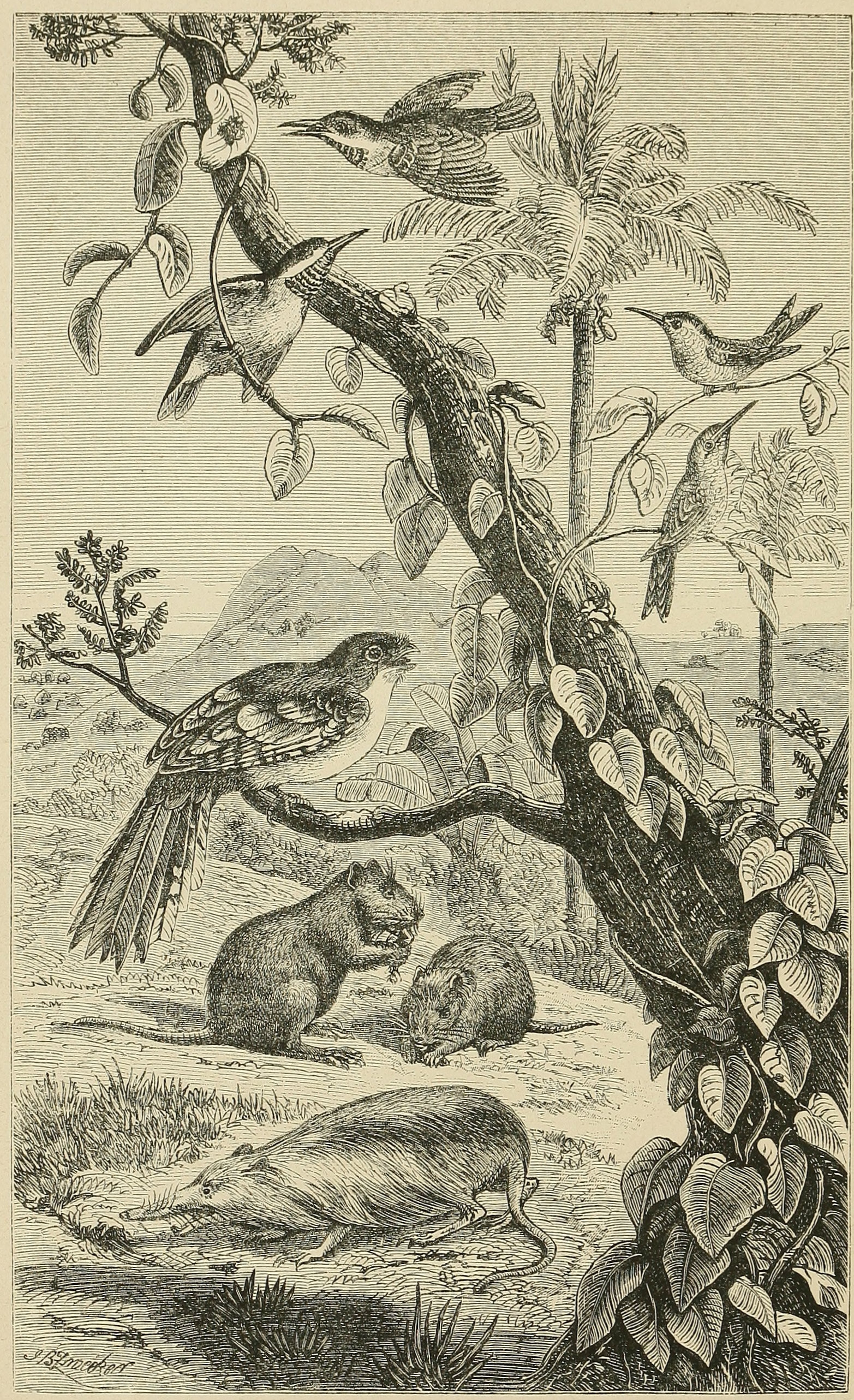
A SCENE IN CUBA, WITH CHARACTERISTIC ANIMALS.
In the preceding enumeration the Bahamas have been included with Cuba, as regards the birds they have in common; but they possess some half dozen species not found elsewhere, and even one central American genus of humming-birds (Doricha) not found in any other part of the Antilles. We have thus given Cuba rather more peculiar species than it really possesses, so that the proportionate richness of Jamaica is rather greater than shown by our figures.
The destruction of the forests and the increase of population, with, perhaps, the use of firearms, seem to have led to the extermination of some species of birds in the smaller islands. Professor Newton has called attention to the work of M. Ledru, who, in 1796, described the birds of St. Thomas. He mentions a parrot and a parroquet in the island, the latter only being now known, and very scarce; also a green pigeon and a tody, both now unknown. No less than six species of parrots are said to have been formerly found in Guadeloupe and Martinique, which are now extinct.
Plate XVII. Illustrating the peculiar Mammalia and Birds of the Antilles.—The scene of this illustration is Cuba, the largest of the West Indian islands, and one in which all its peculiar zoological features are well developed. In the foreground is the agouta (Solenodon cubanus), a remarkable insectivorous animal which, with another species inhabiting Hayti, has no allies on the American continent; nor anywhere in the world but in Madagascar, where a group of animals are found constituting the family Centetidæ, to which Solenodon is said undoubtedly to belong. Above it are a pair of hutias (Capromys fournieri), rat-like animals belonging to the South American family Octodontidæ. They live in the forests, and climb trees readily, eating all kinds of vegetable food. Three species of the genus are known, which are found only in Cuba and Jamaica. Just above these animals is a white-breasted trogon (Prionoteles temnurus), confined to Cuba, and the only species of the genus. Near the top of the picture are a pair of todies (Todus multicolor), singular little insectivorous birds allied to the motmots, but forming a very distinct family which is confined to the islands of the Greater Antilles. They are beautifully-coloured birds,—green above, red and white beneath, and are exceedingly active in their movements. To the right are a pair of small humming-birds (Sporadinus ricordi), not very remarkable in this beautiful family, but introduced here because they belong to a genus which is confined to the Greater Antilles.
Table of distribution of West-Indian Birds.—As the birds of the West Indian islands are particularly interesting and their peculiarities comparatively little known, we give here a table of the genera of land-birds, compiled from all available sources of information. Owing to the numerous independent observations on which it is founded, the discrepancies of nomenclature, and uncertainty in some cases as to the locality of species, it can only be looked upon as an approximative summary of the existing materials on Antillean ornithology.
TABLE OF THE RESIDENT LAND-BIRDS OF THE ANTILLES.
Note.—Genera confined to the West Indies are in Italics. An (a) after (1) indicates a species common to two islands: but where there are two or more species in an island, or the localities are doubtful, this indication cannot be given. All species not otherwise noted are peculiar to the Antilles.
Key to columns: Column 1 Cuba. Col"mn 2 Bahamas. Col"mn 3 Hayti. Col"mn 4 Jamaica. Col"mn 5 Portorico & St. Croix. Col"mn 6 Lesser Antilles. Col"mn 7 Total resident species.
Family and Genus. Number of Species in each Island. 7 Remarks.
1 2 3 4 5 6
Turdidæ.
Turdus — — — 1 — — 1 Five species migrate to Cuba
Mimocichla 2 1 1 1 — — 5
Margarops — — 1a — 1a 3 4 Martinique, St. Lucia, Guada.
Rhamphocinclus — — — — — 1 1 Martinique and St. Lucia
Cinclocerthia — — — — — 3 3 Nevis to St. Lucia
Mimus 1 1 — 1 (?) — 3 Another species migrates to the Antilles
Sylviidæ.
Myiadestes 1 — — 1 — 1 3 St. Lucia
Polioptila 1 — — — — — 1
Vireonidæ.
Vireosylvia 1 — 1 1 1 1 2 One S. American species
Vireo 1 1 — 1 1 — 4 Five species migrate to Cuba
Laletes — — — 1 — — 1
Phœnicomanes — — — 1 — — 1
Corvidæ.
Corvus 1 — 1a 1 1a — 3
Cyanocorax — — — 1 — — 1 S. American species
Mniotiltidæ.
Perissoglossa 1 — 1 — 1 — 1 N. American species
Dendrœca 2 2 1 3 1 1 7 Twelve sp. migrate to W. I.
Teretristis 2 — — — — — 2
Cœrebidæ.
Certhiola — 1 1 1 2 2 7 Dominica and Martinique
Glossiptila — — — 1 — — 1
Cœreba 1 — — — — — 1 S. American species
Ampelidæ.
Dulus (?) — 1 (?) (?) (?) 2 One species locality unknown
Hirundinidæ.
Progne — — 1 1 1 — 1
Pterochelidon 1 — — 1 1 — 1
Hirundo 1 — 1a 1a — — 2 One S. American species
Tanagridæ.
Euphonia 1a — 1a 1 1 1 4 St. Bartholom. & Martinique
Spindalis 2 1 1 1 1 — 5
Phænicophilus — — 1 — — — 1
Saltator — — — — — 1 1 Guadeloupe and St. Lucia
Fringillidæ.
Loxigilla — — 1 1 — 1 3 Martinique and Dominica
Melopyrrha 1 — — — — — 1
Sycalis — — — 1 — — 1 S. American species
Phonipara 3 — 3 3 2 — 4 One S. American species
Chrysomitris — — 1 — — — 1
Icteridæ.
Icterus 1 — 1 1 2 2 6
Agelæus 2 — — — 1 — 3
Sturnella 1 — — — — — 1 Mexican species
Nesopsar — — — 1 — — 1
Scolecophagus 1 — — — — — 1
Quiscalus — — 1 1 2 2 4 St. Lucia, Martinique and Barbadoes
Tyrannidæ.
Elainea — — — 2 — 1 3
Pitangus 1a — — 1a 1 — 2
Contopus — — — 1 — 1 2 St. Lucia
Myiarchus 2 — 1 3 1 1b 7 One S. American species (b)
Blacicus 1a — 1a 1 — — 2
Tyrannus 2 — — 1b 1b 2b 3 One sp. in Cen. America (b)
Cotingidæ.
Hadrostomus — — — 1 — — 1
Picidæ.
Campephilus 1 — — — — — 1
Xiphidiopicus 1 — — — — — 1
Melanerpes — — — — 1 — 1
Chloronerpes — — 1 — — — 1
Centurus 1 — 1 1 — — 3
Colaptes 2 — — — — — 2
Nesoceleus 1 — — — — — 1
Picumnus — — ?1 — — — 1
Cuculidæ.
Saurothera 1 — 1 1 1 — 4
Hyetornis — — 1 1 — — 2
Coccygus 1 — 2 1 1 1 3 Dominica, St. Lucia, all Neotropical species
Crotophaga 1 — — 1 1 1 2 N. & Cen. American species
Todidæ.
Todus 1 — 1 2 1 — 5
Trogonidæ.
Prionoteles 1 — — — — — 1
Temnotrogon — — 1 — — — 1
Caprimulgidæ.
Nyctibius — — — 1 — — 1 Neotropical species
Chordeiles — — — 1 — — 1
Antrostomus 2 — — 1 — 1 2 One Neotropical species
Siphonorhis — — — 1 — — 1
Stenopsis — — — — — 1 1 Martinique (S. America sp.)
Cypselidæ.
Cypselus 1 — — 1 — — 1
Panyptila — — 1 — — — 1 S. American species
Hemiprocne — — 1 1 — — 1 Mexican species
Cypseloides — — — 1 — — 1
Trochilidæ.
Lampornis — — 1a 1 2a 1a 3
Doricha — 2 — — — — 2
Eulampis — — — — 1 2 2 St. Croix, Dominica, St. Lucia, Martinique
Aithurus — — — 1 — — 1
Mellisuga — — 1 1 — — 1
Calypte 1 — — — — — 1
Orthorhynchus — — — — 1 2 3 Domin., Martini., St. Lucia
Sporadinus 1 — 1 — 1 — 3
Conuridæ.
Ara 1 — — — — — 1 S. American species
Conurus 1 — — 1 1 1 1 St. Thomas
Psittacidæ.
Chrysotis 1 — 1 2 1 3 8
Columbidæ.
Columba 1 — 1 2 2 1 3 One in Honduras
Chamæpelia — — — 1 1 1 1
Zenaida 1 — 1 1 1 2 2
Leptoptila — — — 1 — — 1
Geotrygon 2 — 1 2 1 2 5 St. Lucia, Martinique, one species Mexican
Starnœnas 1 — — — — — 1
Tetraonidæ.
Ortyx 1 — — — — — 1
Falconidæ.
Accipiter 2 — — — — — 2
Hypotriorchis — — — 1 — — 1 Mexican species
Cerchneis 2 — 1 — — 1 2
Cymindis 1 — — — — — 1
Polyborus 1 — — — — — 1 Mexican species
Strigidæ.
Nyctalops 1 — — — — — 1 S. American species
Pseudoscops — — — 1 — — 1
Gymnoglaux 1 — — — 1 — 2 St. Croix and St. Thomas
Glaucidium 1 — — — — — 1
Totals Number of families of resident land-birds in the Antilles 26

" " genera " " " 95
" " species " " " 203
Reptiles and Amphibia.—These classes not having been systematically collected, and the numerous described genera not having undergone careful revision, little trustworthy information can be derived from them. The following enumeration of the chief groups hitherto noticed or described, will, however, show very similar features to those presented by the birds—a general relation to Neotropical forms, a more special relation to those of Central America and Mexico, and a considerable number of peculiar types.
Snakes.—Arrhyton (Calamariidæ) from Cuba, Hypsirhynchus from Barbadoes, Cryptodacus from Cuba, Ialtris from Hayti, and Coloragia from Cuba (all Colubridæ), have been described as genera peculiar to the Antilles. Phylodryas and Dromicus (Colubridæ) are Antillean and Neotropical; Ahætulla, (Dendrophidæ) has the same distribution but extends to tropical Africa; Epicrates and Corallus (Pythonidæ) are Neotropical and Antillean; while Chilabothrus from Jamaica and Ungalia from Cuba and Jamaica (both Pythonidæ) are found elsewhere only in Central America and Mexico. There appear to be no Crotalidæ except an introduced species of Craspedocephalus in St. Lucia.
Lizards are more numerous. Ameiva (Teidæ) is found all over America, Gerrhonotus (Zonuridæ) is Neotropical and occurs in Cuba; Gymnopthalmus is South American and Antillean. Of Scincidæ seven genera are noted. Celestus (with 9 species) is peculiar to the Antilles; Camilia (1 species) to Jamaica, Panoplus (1 species) and Embryopus (1 species) to Hayti; Diplogossus is Antillean and South American; while Plestiodon and Mabouya are cosmopolite. Of Geckotidæ there are four genera; Phyllodactylus and Hemidactylus which are cosmopolite; Sphærodactylus which is wholly American; and Cubina found only in Martinique and Brazil. Of Iguanidæ there are six genera; Anolis, which ranges all over America; Polychrus, which is Neotropical; Iguana and Liocephalus which are South American; Tropedurus found in Cuba and Brazil; and Cyclura only known from Jamaica, Cuba, and Central America.
Amphibia.—The genus Trachycephalus, belonging to the Hylidæ or tropical tree-frogs, is almost peculiar to the Antilles; Cuba, Hayti, and Jamaica possessing seven species, while only one is recorded from South America. Other genera are, Peltaphryne (Bufonidæ) from Portorico; Phyllobates (Polypedatidæ) from Cuba; Leiuperus (Ranidæ) from Hayti,—all Neotropical. Of the Urodela, or tailed batrachians, no representative occurs, although they are so characteristic a feature of the Nearctic region.
Fresh-water fish.—The same general remarks apply to these as to the reptiles. Only one peculiar genus is noted—Lebistes, a form of Cyprinodontidæ from Barbadoes; other genera of the same family being, Haplochilus, Rivulus, and Girardinus, widely spread in the Neotropical region; while Gambusia is confined to Central America, Mexico, and the Antilles. Four other families are represented; Siluridæ by Chætostomus, found in Portorico and South America; Chromidæ by the South American Acara; Mugillidæ by the Central American Agonostoma; and Percidæ by the North American Centrarchus, of which a species is recorded from Cuba.
Insects.—The various West Indian islands have not been well explored entomologically; one reason no doubt being, that their comparative poverty renders them little attractive to the professional collector, while the abounding riches of Central and South America lie so near at hand. We can, therefore, hardly tell whether the comparative poverty, or even total absence of some families while others seem fairly represented, is a real phenomenon of distribution, or only dependent on imperfect knowledge. Bearing this in mind, we proceed to give a sketch of what is known of the chief groups of Lepidoptera and Coleoptera.
Lepidoptera.—The Neotropical butterfly-fauna is but poorly represented, the majority of the most remarkable types being entirely wanting; yet there are a few peculiar and very characteristic forms which show great isolation, while the majority of the species are peculiar. Four genera are exclusively or characteristically Antillean,—Calisto belonging to the Satyridæ, with four species, of which one ranges to South Carolina; Clothilda (Nymphalidæ) a fine genus which has 4 Antillean species and 2 in Central America; Lucinia (Nymphalidæ) 2 species, confined to Jamaica and Hayti; and Kricogonia belonging to the Pieridæ, which has 2 West Indian species, while 1 inhabits Mexico and Florida. Genera which show a special relation to Central America are Euptoieta, Eumæus, and Nathalis. Almost all the other genera are South American, the total number recorded in each family as occurring in the West Indian islands, being, 3 of Danaidæ; 1 of Heliconiidæ; 2 of Satyridæ; 18 of Nymphalidæ; 1 of Erycinidæ; 4 of Lycænidæ; 6 of Pieridæ; 1 of Papilionidæ, and 10 of Hesperidæ. The genus Papilio is represented by about 20 species, 2 of which are North American, 4 South American, while the rest form little characteristic groups allied to those of Central America. The most marked feature seems to be the scarcity of Satyridæ and the almost total absence of Erycinidæ, with a great deficiency in characteristic Neotropical forms of Danaidæ and Nymphalidæ.
Coleoptera.—Cicindelidæ and Carabidæ are very poorly represented, by a few species of wide-spread groups, and hardly any peculiar genera. No Lucanidæ are recorded. Of Cetoniidæ, Gymnetis only appears to be represented. Buprestidæ seem to be more numerous; 15 genera being recorded, but almost all of wide distribution. One only is peculiar—Tetragonoschoma, found in Hayti; Halecia is the only exclusively South American genus; Chalcophora is widely scattered over the tropical regions but is absent from South America, yet it occurs in the Nearctic region and extends to Jamaica and Guadeloupe. We now come to the Longicorns, the only group of Coleoptera which seems to be well represented, or which has been carefully collected. No less than 40 genera are known from the West Indian islands, and 15 of these are peculiar. Prionidæ are proportionately very numerous, there being 10 genera, 2 of which are widely distributed in both South and North America, 1 is North American, and 1 South American, while the following are peculiar,—Stenodontes (Hayti and Cuba); Dendroblaptus (Cuba); Monodesmus (Cuba and Jamaica); Prosternodes (Cuba); Solenoptera and Elateropsis, the two largest genera found in most of the islands. Of Cerambycidæ there are 16 genera, 2 of which range all over America, 4 are Neotropical, 1 South American only, while the following are confined to the islands,—Merostenus, Pentomacrus, and Eburiola (Jamaica); Bromiades (Cuba); Trichrous, Heterops, and Pæciloderma (Antilles). One genus, Smodicum, is widely spread, having a species in Carolina, 1 in South America, 1 in Hayti, and 1 in West Africa. Of Lamiidæ there are 14 genera, 8 of which are Neotropical, 1 common to Central America and Mexico, 1 to the United States and Cuba, while 2, Proecha and Phidola, are confined to Cuba. Several of the genera are curiously distributed;—Spalacopsis is South American, with 4 species in Cuba and Tropical Africa; Lagocheirus is Neotropical, with a species in Australia; while Leptostilus is characteristic of the Antilles and North America, with a few species in South America, and one in New Zealand. These cases of erratic distribution, so opposed to the general series of phenomena among which they occur, must be held to be sufficiently explained by the great antiquity of these groups and their former wide distribution. They may be supposed to be the remnants of types, now dying out, which were once, like Callichroma, Clytus, and many others, almost universally distributed.
All the peculiar Antillean genera of Cerambycidæ and Lamiidæ are allied to Neotropical forms. The peculiar Prionidæ, however, are mostly allied to Mexican and North American groups, and one, Monodesmus, belongs to a group all the other genera of which inhabit the East Indies and South Africa.
Land-shells.—This subject has already been generally treated under the Region, of which, in this class of animals, the Antilles form so important a part. We must therefore now confine ourselves mainly to the internal distribution of the genera, and to a few remarks on the general bearing of the facts.
The excessive and altogether unexampled productiveness of the West Indian islands in land-shells, may be traced to two main sets of causes. The first and least known, consist of the peculiar influences and conditions which render islands always more productive than continents. Whatever these conditions are, they will be more effective where the islands have been long separated from the mainland, as is here undoubtedly the case. It seems most probable that the great development of land-shells in islands, is due to the absence or deficiency of the vertebrata, which on continents supply a variety of species adapted to prey upon these molluscs. This view is supported by the fact, that in such islands as have been united to a continent at no very distant epoch, and still maintain a continental variety of vertebrata, no such special development of land-shells has taken place. If we compare the Philippine islands with the Sunda group, we find the development of vertebrata and land-molluscs in inverse ratio to each other. The same thing occurs if we compare New Zealand and Tasmania; and we have a still more striking example in the Antillean group itself, continental Trinidad having only 20 genera and 38 species, while the highly insular Jamaica has about 30 genera and more than 500 species.
The other causes favourable to the increase and development of land-shells are of a physical nature. A great extent of limestone-rock is one; and in the larger West Indian islands we have a considerable proportion of the surface consisting of this rock. But perhaps equally or more important, is the character of the land surface, and the texture of the exposed rock itself. A much broken surface, with numerous deep ravines, cutting up the whole country into isolated valleys and ridges, seems very favourable to the specialization of forms in this very sedentary class of animals. Equally favourable is a honeycombed and highly-fissured rock-surface, affording everywhere cracks and crannies for concealment. Now, taking Jamaica as an example of the archipelago, we find all these conditions in a wonderful degree. Over a large part of this island, a yard of level ground can hardly be found; but ridges, precipices, ravines, and rock-bound valleys, succeed each other over the whole country. At least five-sixths of the entire surface is limestone, and under the influence of tropical rains this rock is worn, fissured, and honeycombed, so as to afford ample shelter and concealment for land-shells.
It is probable that the three chief islands, Cuba, Jamaica and Hayti, are nearly equally rich in land-shells; but the last is very much less known, and therefore, perhaps, appears to be much poorer. Cuba has rather more species than Jamaica; but while the former has only 1 peculiar genus (Diplopoma), the latter has 3 (Geomelania, Chittya, and Jamaicea), as well as two others only represented in the other islands by single species. From Hayti, only about one-third as many species are known as from the two former islands. It has no peculiar genera, but it has some forms in common with Cuba and others with Jamaica, which show that those islands have more connection with it, than with each other; just as we found to be the case in birds. Portorico and the Virgin islands have still fewer species than Hayti; and, as many of the genera common to the other three islands are wanting, there is, no doubt, here a real deficiency. In the islands farther south (Barbuda to Martinique) more Antillean genera disappear or become very rare, while some continental forms take their place. The islands from St. Lucia to Trinidad have a still more continental character; the genus Bulimus, so largely developed on the continent, only reaching St. Lucia. The Bahamas contain about 80 species of land-shells, of which 25 are Antillean, the rest peculiar; all the genera being Antillean. The affinity is chiefly with Hayti and Cuba, but closest with the latter island.
In the West Indian islands as a whole, there are 11 peculiar genera; 9 operculate (Geomelania, Chittya, Jamaicea, Licina, Choanopoma, Ctenopoma, Diplopoma, Stoastoma, Lucidella); and 2 inoperculate (Sagda and Stenopus), besides Cyclostomus, which belongs to the Old World and is not found on the American continent. Mr. Bland considers, that many of the Antillean land-shells exhibit decided African and Asiatic, rather than South American affinities. A species of the Asiatic genus Diplommatina has been found in Trinidad, and an Indian species of Ennea occurs in Grenada and St. Thomas; a clear indication that land-shells are liable to be accidentally imported, and to become established in the less productive islands.
Although these islands are so wonderfully rich even now, there is good reason to believe that many species have become extinct since the European occupation of them. When small islands are much cultivated, many of these molluscs which can only live under the shade of forests, are soon extirpated. In St. Croix many species have become extinct at a comparatively recent period, from the burning of forests; and as we know that in all the islands many of the species are excessively local, being often confined to single valleys or ridges, we may be sure that wherever the native forests have disappeared before the hand of man, numbers of land shells have disappeared with them. As some of the smaller islands have been almost denuded of their wood, and in the larger ones extensive tracts have been cleared for sugar cultivation, a very considerable number of species have almost certainly been exterminated.
General Conclusions as to the Past History of the West Indian Islands.—The preceding sketch of the peculiarities of the animal life of these islands, enables us to state, that it represents the remains of an ancient fauna of decided Neotropical type, having on the whole most resemblance to that which now inhabits the Mexican sub-region. The number of peculiar genera in all classes of animals is so great in proportion to those in common with the adjacent mainland, as to lead us to conclude that, subsequent to the original separation from the Mexican area, a very large tract of land existed, calculated to support a rich and varied fauna, and, by the interaction of competing types, give rise to peculiar and specially modified organisms. We have already shown that the outline of the present islands and the depths of the surrounding seas, give indications of the position and extent of this ancient land; which not improbably occupied the space enclosed by uniting Western Cuba with Yucatan, and Jamaica with the Mosquito Coast. This land must have stretched eastward to include Anguilla, and probably northward to include the whole of the Bahamas. At one time it perhaps extended southward so as to unite Hayti with northern Venezuela, while Panama and Costa Pica were sunk beneath the Pacific. At this time the Lesser Antilles had no existence.
The only large island of whose geology we have any detailed account, is Jamaica; and taking this as a type of what will probably be found in Cuba and Hayti, we must place the continental period as having occurred after the close of the Miocene, or during some part of the Pliocene epoch, since a large portion of the surface of the former island consists of beds of marine limestone from 2,000 to 3,000 thick, believed to be of Pliocene age. After some time, the land between Hayti and South America subsided, and still later that between Central America and Cuba with Jamaica; but a large tract of land remained insulated, and no doubt supported a very much richer and more varied fauna than now. We have evidence of this in extinct Mammalia of large size, belonging to the peculiar South American family of the chinchillas, which have been found in caves in the small islands of Anguilla, and which, from the character of the land-shells associated with them, are believed to be of Pliocene or Post-pliocene age. This discovery is most interesting, and gives promise of very valuable results from the exploration of the numerous caverns that undoubtedly exist in the abundant limestone strata of the larger islands. This extensive Antillean land, after long continuing undivided, was at length broken up by subsidence into several islands; but as this alone would not account for the almost complete annihilation of the mammalian fauna, it seems probable that the subsidence was continued much farther, so as greatly to reduce the size and increase the number of the islands. This is indicated, by the extensive alluvial plains in Cuba and Hayti, and to a less extent in Jamaica; and by elevated beds of Post-pliocene marls in the latter island.
The series of changes now suggested, will account for all the main features of the Antillean fauna in its relations to that of the American continent. There remains the affinity with Madagascar, indicated by Solenodon, and a few cases of African and Asiatic affinity in insects and land-shells; but these are far too scanty to call for any attempt at special explanation. Such cases of remote affinity and discontinuous distribution, occur in all the regions, and in almost every group of animals; and we look upon them almost all, as cases of survival, under favourable conditions, of once wide-spread groups. If no wild species of the genus Equus were now to be found, except in South Africa (where they are still most abundant), and in South Temperate America, where their fossil remains show us they did exist not very long ago, what a strong fact it would have appeared for the advocates of continental extensions! Yet it would have been due to no former union of the great southern continents, but to the former extensive range of the family or the genus to which the two isolated remnants belonged. And if such an explanation will apply to the higher vertebrata, it is still more likely to be applicable to similar cases occurring among insects or mollusca, the genera of which we have every reason to believe to be usually much older than those of vertebrates. It is in these classes that examples of widely scattered allied species most frequently occur; and the facility with which they are diffused under favourable conditions, renders any other explanation than that here given altogether superfluous.
The Solenodon is a member of an order of Mammalia of low type (Insectivora) once very extensive and wide-spread, but which has begun to die out, and which has left a number of curious and isolated forms thinly scattered over three-fourths of the globe. The occurrence, therefore, of an isolated remnant of this order in the Antilles is not in itself remarkable; and the fact that the remainder of the family to which the Antillean species belong has found a refuge in Madagascar, where it has developed into several distinct types, does not afford the least shred of argument on which to found a supposed independent land connection between these two sets of islands.
Summary of the Past History of the Neotropical Region.
We have already discussed this subject, both in our account of extinct animals, and in various parts of the present chapter. It is therefore only necessary here, briefly to review and summarise the conclusions we have arrived at.
The whole character of Neotropical zoology, whether as regards its deficiencies or its specialities, points to a long continuance of isolation from the rest of the world, with a few very distant periods of union with the northern continent. The latest important separation took place by the submergence of parts of Nicaragua and Honduras, and this separation probably continued throughout much of the Miocene and Pliocene periods; but some time previous to the coming on of the glacial epoch, the union between the two continents took place which has continued to our day. Earlier submergences of the isthmus of Panama probably occurred, isolating Costa Rica and Veragua, which then may have had a greater extension, and have thus been able to develope their rich and peculiar fauna.
The isthmus of Tehuantepec, at the south of Mexico, may, probably, also have been submerged; thus isolating Guatemala and Yucatan, and leading to the specialization of some of the peculiar forms that now characterise those countries and Mexico.
The West Indian Islands have been long isolated and have varied much in extent. Originally, they probably formed part of Central America, and may have been united with Yucatan and Honduras in one extensive tropical land. But their separation from the continent took place at a remote period, and they have since been broken up into numerous islands, which have probably undergone much submergence in recent times. This has led to that poverty of the higher forms of life, combined with the remarkable speciality, which now characterises them; while their fauna still preserves a sufficient resemblance to that of Central America to indicate its origin.
The great continent of South America, as far as we can judge from the remarkable characteristics of its fauna and the vast depths of the oceans east and west of it, has not during Tertiary, and probably not even during Secondary times, been united with any other continent, except through the intervention of North America. During some part of the Secondary epoch it probably received the ancestral forms of its Edentates and Rodents, at a time when these were among the highest types of Mammalia on the globe. It appears to have remained long isolated, and to have already greatly developed these groups of animals, before it received, in early Tertiary times, the ancestors of its marmosets and monkeys, and, perhaps also, some of its peculiar forms of Carnivora. Later, it received its Camelidæ, peccaries, mastodons, and large Carnivora; and later still, just before the Glacial epoch, its deer, tapir, opossums, antelopes, and horses, the two latter having since become extinct. All this time its surface was undergoing important physical changes. What its earlier condition was we cannot conjecture, but there are clear indications that it has been broken up into at least three large masses, and probably a number of smaller ones; and these have no doubt undergone successive elevations and subsidences, so as at one time to reduce their area and separate them still more widely from each other, and at another period to unite them into continental masses. The richness and varied development of the old fauna of South America, as still existing, proves, however, that the country has always maintained an extensive area; and there is reason to believe that the last great change has been a long continued and steady increase of its surface, resulting in the formation of the vast alluvial plains of the Amazon, Orinoko, and La Plata, and thus greatly favouring the production of that wealth of specific forms, which distinguishes South America above all other parts of our globe.
The southern temperate portion of the continent, has probably had a considerable southward extension in late Tertiary times; and this, as well as the comparatively recent elevation of the Andes, has given rise to some degree of intermixture of two distinct faunas, with that proper to South Temperate America itself. The most important of these, is the considerable Australian element that appears in the insects, and even in the reptiles and fresh-water fishes, of South Temperate America. These may be traced to several causes. Icebergs and icefloes, and even solid fields of ice, may, during the Glacial epoch, have afforded many opportunities for the passage of the more cold-enduring groups; while the greater extension of southern lands and islands during the warm periods—which there is reason to believe prevailed in the southern as well as in the northern regions in Miocene times—would afford facilities for the passage of the reptiles and insects of more temperate zones. That no actual land-connection occurred, is proved by the total absence of interchange of the mammals or land-birds of the two countries, no less than by the very fragmentary nature of the resemblances that do exist. The northern element consists almost wholly of insects; and is evidently due to the migration of arctic and north temperate forms along the ridges and plateaus of the Andes; and most likely occurred when these organisms were driven southward at successive cold or Glacial periods.
A curious parallel exists between the past history and actual zoological condition of South America and Africa. In both we see a very ancient land-area extending into the South Temperate zone, isolated at a very early period, and developing only a low grade of Mammalian life; chiefly Edentates and Rodents on the one, Lemurs and Insectivora in the other. Later we find an irruption into both of higher forms, including Quadrumana, which soon acquired a large and special development in the tropical portions of each country. Still later we have an irruption into both of northern forms, which spread widely over the two regions, and having become extinct in the land from whence they came, have been long held to be the original denizens of their adopted country. Such are the various forms of antelopes, the giraffe, the elephant, rhinoceros, and lion in Africa; while in America we have deer and peccaries, the tapir, opossums, and the puma.
On the whole, we cannot but consider that the broad outlines of the zoological history of the Neotropical region can be traced with some degree of certainty; but, owing to the absence of information as to the most important of the geological periods—the Miocene and Eocene—we have no clue to the character of its early fauna, or to the land connections with other countries, which may possibly have occurred in early Tertiary times.
TABLES OF DISTRIBUTION.
In drawing up these tables, showing the distribution of the various classes of animals in the Neotropical region, the following sources of information have been relied on, in addition to the general treatises, monographs, and catalogues used in the compilation of the Fourth Part of this work.
Mammalia.—D'Orbigny, and Burmeister, for Brazil and La Plata; Darwin, and Cunningham, for Temperate S. America; Tschudi, for Peru; Frazer, for Ecuador; Salvin, for Guatemala; Frantzius, for Costa Rica; Sclater, for Quadrumana N. of Panama; Gundlach, for Cuba; and papers by Dr. J. E. Gray, and Mr. Tomes.
Birds.—Sclater and Salvin's Nomenclator; Notes by Darwin, and Cunningham; Gundlach, March, Bryant, Baird, Elliot, Newton, Semper, and Sundevall, for various islands of the Antilles; and papers by Hudson, Lawrence, Grayson, Abbott, Sclater, and Salvin.
TABLE I.
FAMILIES OF ANIMALS INHABITING THE NEOTROPICAL REGION.
Explanation.
Names in italics show the families which are peculiar to the region.
Names enclosed thus (......) indicate families which barely enter the region, and are not considered properly to belong to it.
Numbers correspond with those of the series of families in Part IV.
Order and Family Sub-regions Range beyond the Region.
Chili. Brazil. Mexico. Antilles.
MAMMALIA.
Primates.
4. Cebidæ — —
5. Hapalidæ — (?)
Chiroptera.
10. Phyllostomidæ — — — — California
12. Vespertilionidæ — — — — Cosmopolite
13. Noctilionidæ — — — — All tropical regions
Insectivora.
18. Centetidæ — Madagascar
Carnivora.
23. Felidæ — — — All regions but Australian
28. Canidæ — — — All regions but Australian
29. Mustelidæ — — — All regions but Australian
30. Procyonidæ — — — N. America
32. Ursidæ — All regions but Ethiopian and Australian
33. Otariidæ — S. temperate zone
35. Phocidæ — (?) N. and S. temperate zones
Cetacea.
36 to 41 — Oceanic
Sirenia.
42. Manatidæ — — — Tropical shores
Ungulata.
44. Tapiridæ — — Indo-Malaya
47. Suidæ — — Cosmopolite, excl. Australia
48. Camelidæ — Palæarctic
50. Cervidæ — — — All regions but Ethiopian and Australian
Rodentia.
55. Muridæ — — — — Cosmopolite
59. Saccomyidæ — Nearctic
61. Sciuridæ — — All regions but Australian
63. Chinchillidæ —
64. Octodontidæ — — — Africa
65. Echimyidæ — — Ethiopian
66. Cercolabidæ — — Nearctic
68. Caviidæ — — — —
70. Leporidæ — — All regions but Australian
Edentata.
71. Bradypodidæ — —
73. Dasypodidæ — — —
75. Myrmecophagidæ — —
Marsupialia.
76. Didelphyidæ — — — Temperate N. America
BIRDS.
Passeres.
1. Turdidæ — — — — Almost cosmopolite
2. Sylviidæ — — — Almost cosmopolite
5. Cinclidæ — — Nearctic, Palæarctic, Oriental
6. Troglodytidæ — — — — Nearctic, Palæarctic, Oriental
8. Certhiidæ — Nearctic, Palæarctic, Oriental
9. Sittidæ — All regions, excl. Africa
10. Paridæ — Nearctic, Palæarctic, Oriental
20. Corvidæ — — — — Cosmopolite
26. Cœrebidæ — — —
27. Mniotiltidæ — — — Nearctic
28. Vireonidæ — — — Nearctic
29. Ampelidæ — — Nearctic, Palæarctic
30. Hirundinidæ — — — — Cosmopolite
31. Icteridæ — — — — Nearctic
32. Tanagridæ — — — — Nearctic
33. Fringillidæ — — — — All regions but Australian
38. Motacillidæ — — — — Cosmopolite
38a. Oxyrhamphidæ — —
39. Tyrannidæ — — — — Nearctic
40. Pipridæ — —
41. Cotingidæ — — — —
42. Phytotomidæ —
44. Dendrocolaptidæ — — —
45. Formicariidæ — —
46. Pteroptochidæ — —
Picariæ.
51. Picidæ — — — — All regions but Australian
54. Megalæmidæ — — Ethiopian, Oriental
55. Rhamphastidæ — —
58. Cuculidæ — — — — Cosmopolite
60. Bucconidæ — —
61. Galbulidæ — —
64. Todidæ —
65. Momotidæ — —
66. Trogonidæ — — — Ethiopian, Oriental
67. Alcedinidæ — — — — Cosmopolite
72. Steatornithidæ —
73. Caprimulgidæ — — — — Cosmopolite
74. Cypselidæ — — — — Almost cosmopolite
75. Trochilidæ — — — — Nearctic
Psittaci.
80. Conuridæ — — — — S. United States
81. Psittacidæ — — — Ethiopian
Columbæ.
84. Columbidæ — — — — Cosmopolite
Gallinæ.
87. Tetraonidæ — — — Almost cosmopolite
88. Phasianidæ — All regions but Australian
91. Cracidæ — —
92. Tinamidæ — — —
Opisthocomi.
93. Opisthocomidæ —
Accipitres.
94. Vulturidæ — — — — All regions but Australian
96. Falconidæ — — — — Cosmopolite
97. Pandionidæ — — — Cosmopolite
98. Strigidæ — — — — Cosmopolite
Grallæ.
99. Rallidæ — — — — Cosmopolite
100. Scolopacidæ — — — — Cosmopolite
101. Chionididæ —
102. Thinocoridæ —
103. Parridæ — — Tropical regions
105. Charadriidæ — — — — Cosmopolite
108. Cariamidæ — —
109. Aramidæ — —
110. Psophiidæ —
111. Eurypygidæ — —
113. Ardeidæ — — — — Cosmopolite
114. Plataleidæ — — — — Almost cosmopolite
115. Ciconiidæ — — — Nearly cosmopolite
116. Palamedeidæ — —
117. Phœnicopteridæ — — — Ethiopian, Indian
Anseres.
118. Anatidæ — — — — Cosmopolite
119. Laridæ — — — — Cosmopolite
120. Procellariidæ — — — — Cosmopolite
121. Pelecanidæ — — — — Cosmopolite
122. Spheniscidæ — S. temperate zone
124. Podicipidæ — — — — Cosmopolite
Struthiones.
126. Struthionidæ — Ethiopian
REPTILIA.
Ophidia.
1. Typhlopidæ — — — Tropical regions and S. Palæarctic
2. Tortricidæ — Oriental, N.-W. America
5. Calamariidæ — — — — All warm countries
6. Oligodontidæ — Oriental, Japan
7. Colubridæ — — — — Almost cosmopolite
8. Homalopsidæ — — All the regions
11. Dendrophidæ — — — — All tropical regions
12. Dryiophidæ — — Oriental, Ethiopian
13. Dipsadidæ — — All tropical regions
14. Scytalidæ — — Philippine Islands
16. Amblycephalidæ — — Oriental
17. Pythonidæ — — — — All tropical regions, California
20. Elapidæ — — — Tropical regions, Japan, S. Carolina
23. Hydrophidæ — Oriental, Australian, Madagascar
24. Crotalidæ — — — — Nearctic, Palæarctic, Oriental
Lacertilia.
27. Chirotidæ — Missouri
28. Amphisbænidæ — — — Ethiopian, S. Palæarctic
29. Lepidosternidæ — — Ethiopian
31. Helodermidæ —
32. Teidæ — — — — Nearctic
34. Zonuridæ — — — Nearctic, Ethiopian, S. Europe, and N. India
35. Chalcidæ — — — Nearctic
36. Anadiadæ —
37. Chirocolidæ —
38. Iphisadæ —
39. Cercosauridæ —
41. Gymnopthalmidæ — — Australian, Ethiopian, Palæarctic
45. Scincidæ — — — — Almost cosmopolite
49. Geckotidæ — — — — Almost cosmopolite
50. Iguanidæ — — — — Nearctic
Crocodilia.
55. Crocodilidæ — — — Ethiopian, Oriental, N. Australian
56. Alligatoridæ — — Nearctic
Chelonia.
57. Testudinidæ — — — — All continents but Australian
58. Chelydidæ — Ethiopian, Australian
60. Cheloniidæ Marine
AMPHIBIA.
Pseudophidia.
1. Ceciliadæ — — Oriental, Ethiopian
Urodela.
6. (Salamandridæ) — — Nearctic, Palæarctic
Anoura.
7. Rhinophrynidæ —
8. Phryniscidæ — — — Ethiopian, Australian, Java
9. Hylaplesidæ — — —
10. Bufonidæ — — — — All continents but Australia
12. Engystomidæ — — — All regions but Palæarctic
13. Bombinatoridæ — — Palæarctic, New Zealand
14. Plectromantidæ —
15. Alytidæ — All regions but Oriental
16. Pelodryadæ — — Australia
17. Hylidæ — — — — All regions but Ethiopian
18. Polypedatidæ — — — — All the regions
19. Ranidæ — — — — Almost cosmopolite
20. Discoglossidæ — — All regions but Nearctic
21. Pipidæ —
FISHES (FRESH-WATER).
Acanthopterygii.
3. Percidæ — — — All regions but Australian
11. (Trachinidæ) — Australia
12. Scienidæ (?) — — (?) All regions but Australian
33. Nandidæ — Oriental
34. Polycentridæ — —
38. Mugillidæ (?) — — Australian, Ethiopian
52. Chromidæ — — — — Ethiopian, Oriental
Physostomi.
59. Siluridæ — — — — All warm regions
60. Characinidæ — — — — Ethiopian
61. Haplochitonidæ — S. Australia
67. Galaxidæ — Tasmania and New Zealand
73. Cyprinodontidæ — — — — Absent from Australia
78. Osteoglossidæ — All tropical regions
84. Gymnotidæ —
85. Symbranchidæ — Oriental, Australian, (? marine)
Dipnoi.
92. Sirenoidei — Ethiopian, Australian
Plagiostomata.
112. Trygonidæ —
INSECTS. LEPIDOPTERA (PART).
Durini (Butterflies).
1. Danaidæ — — — — All warm regions, and to Canada
2. Satyridæ — — — — Cosmopolite
4. Morphidæ — — Australian, Oriental
5. Brassolidæ — —
6. Acræidæ — — All tropical regions
7. Heliconiidæ — — —
8. Nymphalidæ — — — — Cosmopolite
9. Libytheidæ — — Absent from Australia
10. Nemeobiidæ — — Not in Australia or Nearctic regions
11. Eurygonidæ — —
12. Erycinidæ — — — Nearctic
13. Lycænidæ — — — — Cosmopolite
14. Pieridæ — — — — Cosmopolite
15. Papilionidæ — — — — Cosmopolite
16. Hesperidæ — — — — Cosmopolite
Sphingidea.
17. Zygænidæ — — — — Cosmopolite
18. Castniidæ — — — Australian
20. Uraniidæ — — — All tropical regions
21. Stygiidæ — Palæarctic
22. Ægeriidæ — — — — Not in Australia
23. Sphingidæ — — — — Cosmopolite
TABLE II.
GENERA OF TERRESTRIAL MAMMALIA AND BIRDS INHABITING THE NEOTROPICAL REGION.
Explanation.
Names in italics show the genera peculiar to the region.
Names enclosed thus (......) indicate genera which barely enter the region, and are not considered properly to belong to it.
Genera undoubtedly belonging to the region are numbered consecutively.
MAMMALIA.
Order, Family, and Genus. No. of Species. Range within the Region. Range beyond the Region.
PRIMATES.
Cebidæ.
1. Cebus 18 Costa Rica to Paraguay
2. Lagothrix 5 Upper Amazon and E. Andes
3. Eriodes 3 East Brazil, S. of Equator
4. Ateles 14 Almost all tropical America
5. Mycetes 10 E. Guatemala to Paraguay
6. Pithecia 7 Equatorial Forests
7. Brachiurus 5 Equatorial Forests
8. Nyctipithecus 5 Nicaragua to Amazonia
9. Saimiris 3 Costa Rica to Brazil and Bolivia
10. Callithrix 11 Panama to Paraguay
Hapalidæ.
11. Hapale 9 Brazil and Upper Amazon
12. Midas 24 Equatorial America to Panama
CHIROPTERA.
Phyllostomidæ.
13. Lonchorina 1 West Indian Islands
14. Macrophyllum 1 Brazil
15. Vampyrus

16. Lophostoma 25 Tropical America and Chili
17. Phyllostoma
18. Macrotus 1 Antilles and Mexico California
19. Schizostoma 5 South America
20. Brachyphylla 1 Antilles
21. Glossophaga 8 Tropical America
22. Phyllonycteris 2 Cuba
23. Artibeus 4 S. America & Antilles, Costa Rica
24. Stenoderma 7 The whole region
25. Sturnira 3 Chili to Guatemala
26. Desmodus 3 Chili to Mexico
27. Saccopteryx 1 Ecuador
28. Diphylla 1 Brazil
29. Centurio 3 Brazil to Mexico
Vespertilionidæ.
30. Lasiurus 2 Tropical America Nearctic
31. Scotophilus 7 Antilles, Mexico to S. America Nearc., Austral., Orien.
32. Vespertilio 12 The whole region Cosmopolite
33. Nycticejus 3 S. Temperate America Nearctic, India, Tropical Africa
34. Natalus 1 S. America and Antilles
35. Furipterus 2 S. America
36. Thyroptera 2 S. America
37. Nycticellus 1 Cuba
38. Taphozous 5 S. America Ethiopian, Oriental, Austro-Malayan
39. Diclidurus 1 Brazil
Noctilionidæ.
40. Noctilio 2 Paraguay to W. Indies
41. Mormops 1 Antilles and Mexico
42. Phyllodia 1 Jamaica
43. Chilonycteris 5 Brazil and West Indies
44. Pteronotus 1 Trinidad
45. Nyctinomus 2 La Plata to Antilles & Costa Rica S. Nearc., Orien., Madag.
46. Molossus 16 Paraguay and Chili to Antilles Ethiopian, S. Palæarc., Australian
INSECTIVORA.
Centetidæ.
47. Solenodon 2 Cuba and Hayti
Soricidæ.
(Sorex 1 Guatemala and Costa Rica) All other reg. but Austrl.
CARNIVORA.
Felidæ.
48. Felis 13 The whole region, excl. Antilles All regions but Austral.
Canidæ.
49. Icticyon 1 Brazil
50. Chrysocyon 1 S. America
(Lupus 2 Mexico to Costa Rica) Northern genus
51. Lycalopex 2 S. America
52. Pseudalopex 5 S. America, Falkland Islands, & Tierra del Fuego
53. Thous 2 S. America to Chili
Mustelidæ.
54. Mustela 2 Andes of Peru All other reg. but Austrl.
55. Galictis 2 S. America to Chili & Patagonia
56. Lontra 3 Central and S. America to Chonos Archipelago
57. Nutria 1 W. coast of America to Chiloe W. coast of N. America
58. Pteronura 1 Surinam and Brazil
59. Mephitis 3 Mexico to Sts. of Magellan Nearctic to Canada
Procyonidæ.
60. Procyon 1 Tropical America Nearctic to Canada
61. Nasua 5 Mexico to Paraguay & La Plata
62. Cercoleptes 1 Mexico to Peru and N. Brazil
63. Bassaris 2 Mexico and Guatemala California and Texas
Ursidæ.
64. Tremarctos 1 Andes of Peru and Chili
Otariidæ.
65. Otaria 1 Chili, La Plata, and Patagonia
66. Arctocephalus 1 Falkland Islands & Cape Horn New Zealand
Phocidæ.
67. Stenorhynchus 1 Falkland Islands New Zealand
68. Lobodon 1 Antarctic shores
69. Leptonyx 1 Antarctic shores, E. Patagonia S. Australia
70. Ommatophoca 1 Antarctic shores
71. Morunga 1 Falkland Islands California, S. temp. zone
72. Cystophora 1 Antilles N. Atlantic
CETACEA.
Delphinidæ.
73. Inia 1 Upper Amazon
SIRENIA.
Manatidæ.
74. Manatus 1 Gulf of Mexico to N. Brazil, Amazon R. W. Africa
UNGULATA.
Tapiridæ.
75. Tapirus 2 Equatorial S. America Indo-Malaya
76. Elasmognathus 1 Panama to Guatemala
Suidæ.
77. Dicotyles 2 Mexico to Paraguay Texas
Camelidæ.
78. Auchenia 4 Temp. S. America, from Cape Horn to Andes of Peru
Cervidæ.
79. Cervus 12 Mexico to Patagonia and Tierra del Fuego All regions but Ethiopian and Australian
RODENTIA.
Muridæ.
80. Reithrodon 4 South Temp. America to Tierra del Fuego United States
81. Acodon 1 Peru, 14,000 ft. elevation
82. Myxomys 1 Guatemala
83. Hesperomys 76 The whole region Nearctic
84. Holochilus 4 S. America
85. Oxymycterus 3 Brazil and La Plata
86. Drymomys 1 Peru
87. Neotomys 2 S. America
(Fiber 1 Mexico) Nearctic genus
Saccomyidæ.
88. Heteromys 6 Mexico, Honduras, Costa Rica & Trinidad
Sciuridæ.
89. Sciurus 30 Mexico to Paraguay All reg. but Australian
Chinchillidæ.
90. Chinchilla 2 Andes of Chili and Peru
91. Lagidium 3 Chili to Ecuador (11,000 to 16,000 ft.)
92. Lagostomus 1 Uruguay to Rio Negro of Patagonia
Octodontidæ.
93. Habrocomus 2 Chili
94. Capromys 3 Cuba and Jamaica
95. Plagiodontia 1 Hayti
96. Spalacopus 2 Chili and E. of Andes
97. Octodon 3 Chili, Peru, and Bolivia
98. Ctenomys 6 S. Brazil to Tierra del Fuego
Echimyidæ.
99. Dactylomys 2 Guiana and Brazil
100. Cercomys 1 Central Brazil
101. Lasiuromys 1 St. Paulo, Brazil
102. Myopotamus 1 S. half of tropical S. America
103. Carterodon 1 Central Brazil
104. Mesomys 1 Upper Amazon
105. Echimys 11 Equatorial America to Paraguay
106. Loncheres 10 New Granada to Brazil
Cercolabidæ.
107. Cercolabes 12 Mexico to Paraguay
108. Chætomys 1 N. Brazil
Caviidæ.
109. Dasyprocta 9 Paraguay to Mexico and Lesser Antilles
110. Cœlogenys 2 Guatemala to Paraguay
111. Hydrochœrus 1 Guiana to La Plata
112. Cavia 9 Brazil and Peru to Magellan Sts.
113. Kerodon 6 Brazil and Peru to Magellan Sts.
114. Dolichotis 1 The Pampas and Patagonia
Leporidæ.
115. Lepus 1 Central Brazil and Andes, Costa Rica to Mexico All regions but Austral.
EDENTATA.
Bradypodidæ.
116. Cholœpus 2 Costa Rica to Brazil
117. Bradypus 2 Amazon to Rio de Janeiro
118. Arctopithecus 8 Costa Rica to Brazil and Bolivia
Dasypodidæ.
119. Tatusia 5 Rio Grande, Texas, to Patagonia
120. Prionodontes 1 Surinam to Paraguay
121. Dasypus 4 Brazil to Chili and La Plata, Costa Rica?
122. Xenurus 3 Guiana to Paraguay, Costa Rica?
123. Tolypeutes 2 Bolivia and La Plata
124. Chlamydophorus 2 La Plata and Bolivia
Myrmecophagidæ.
125. Myrmecophaga 1 Costa Rica?, & N. Braz., to Parag.
126. Tamandua 2 Guatemala to Paraguay
127. Cyclothurus 2 Honduras and Costa Rica to Paraguay
MARSUPIALIA.
Didelphyidæ.
128. Didelphys 20 Mexico to Uruguay and S. Chili Temperate N. America
129. Chironectes 1 Guiana and Brazil, Costa Rica
130. Hyracodon 1 Ecuador
BIRDS.
PASSERES.
Turdidæ.
1. Turdus 32 The whole reg. to Tierra del Fuego Almost cosmopolite
2. Rhodinocichla 1 Mexico to Venezuela
3. Melanoptila 1 Honduras
4. Catharus 10 Mexico to Ecuador and Columbia
5. Margarops 4 Hayti and Lesser Antilles
6. Mimus 16 Nearly the whole region Nearctic
7. Melanotis 2 Mexico and Guatemala
8. Galeoscoptes 1 Mexico to Panama Nearctic
9. Mimocichla 4 Cuba to Porto Rico
(Harporhynchus 3 Mexico) Nearctic genus
10. Cinclocerthia 3 Lesser Antilles
11. Ramphocinclus 1 Martinique and St. Lucia
Sylviidæ.
12. Myiadestes 8 Mexico and Antilles to Peru and Bolivia N. & W. of N. America
13. Cichlopsis 1 Brazil
(Sialia 2 Mexico and Guatemala) United States & Canada
14. Regulus 2 Mexico and Guatemala Nearctic, Palæarctic
15. Polioptila 6 Mexico and Cuba to Bolivia and La Plata Cen. and S. U. States
Cinclidæ.
16. Cinclus 4 Mexico to Venezuela and Peru Nearctic, Palæarctic
Troglodytidæ.
17. Troglodytes 5 Mexico to Straits of Magellan Nearctic, Palæarctic
18. Thryophilus 13 Mexico to Central Brazil N.-W. America
19. Thryothorus 12 Mexico to S. Brazil N. America
20. Cistothorus 3 Mexico to Chili and Patagonia N. America
21. Donacobius 2 Columbia to Brazil and Bolivia
22. Campylorhynchus 18 Mexico to Brazil and Bolivia New Mexico
23. Cyphorhinus 5 Costa Rica to Peru
24. Microcerculus 5 Mexico to Peru
25. Henicorhina 2 Mexico to Peru
(Salpinctes 1 Mexico and Guatemala) Nearctic genus
(Catherpes 1 Mexico) Gila and Colorado
26. Cinnicerthia 2 Columbia and Ecuador
27. Uropsila 1 Mexico
Certhiidæ.
(Certhia 1 Mexico and Guatemala) North temperate genus
Sittidæ.
(Sitta 2 Mexico) North temperate genus
Paridæ.
(Parus 1 Mexico) Nearc., Palæarc., Orient.
(Lophophanes 2 Mexico) North temperate genus
(Psaltriparus 1 Mexico and Guatemala) Nearctic
Corvidæ.
28. Cyanocitta 16 Mexico to Peru and Bolivia Nearctic
29. Cyanocorax 12 Mexico to Paraguay, Jamaica
30. Calocitta 2 Mexico to Guatemala
31. Psilorhinus 3 Mexico to Costa Rica
32. Corvus 4 Mexico to Guatemala, Cuba to Porto Rico Cosmop., excl. S. Amer.
Cœrebidæ.
33. Diglossa 14 Mexico to Guiana, Peru, and Bolivia
34. Diglossopis 1 Venezuela to Ecuador
35. Oreomanes 1 Ecuador
36. Conirostrum 6 Columbia to Bolivia
37. Hemidacnis 1 Columbia and Upper Amazon
38. Dacnis 13 Costa Rica to Guiana & S. Brazil
39. Certhidea 2 Galapagos Islands
40. Chlorophanes 2 Brazil to Central America, Cuba
41. Cœreba 4 Mexico and Cuba to Guiana and Brazil
42. Certhiola 10 Antilles to Ecuador and Brazil Florida
43. Glossiptila 1 Jamaica
Mniotiltidæ.
44. Siurus 3 Mexico to Columbia, Antilles S. & E. States & Canada
45. Mniotilta 1 Columbia to Mexico and Antilles Eastern United States
46. Parula 5 Brazil and Ecuador to Mexico Eastern U. S. & Canada
47. Protonotaria 1 Venezuela to Central America and W. India Florida to Ohio
48. Helminthophaga 5 Mexico to Columbia North America
49. Helmintherus 1 Mexico to Veragua U. States to Canada
50. Perissoglossa 1 Cuba, Hayti, and Porto Rico E. United States
51. Dendrœca 25 Mexico & W. Indies to Ecuador and Chili All N. America
52. Oporornis 1 Guatemala to Panama
53. Geothlypis 10 Brazil to Mexico All N. America
54. Setophaga 12 Mexico to Brazil E. U. States & Canada
55. Cardellina 1 Gautemala and Mexico
56. Ergaticus 2 Guatemala and Mexico
57. Myioodioctes 3 Columbia to Mexico U. States and Canada
58. Basileuterus 22 Mexico to Brazil
59. Icteria 1 Costa Rica to Mexico E. and Central United States to Canada
60. Granatellus 3 Amazon to Mexico
61. Teretristis 2 Cuba
Vireonidæ.
62. Vireosylvia 9 Venezuela to Mexico & Antilles All N. America
63. Vireo 10 Mexico to Costa Rica & Antilles All United States
64. Neochloe 1 Mexico
65. Hylophilus 16 Brazil to Mexico
66. Laletes 1 Jamaica
67. Phœnicomanes 1 Jamaica
68. Vireolanius 4 Mexico to Amazon
69. Cychloris 9 Mexico to Paraguay
Ampelidæ.
70. Dulus 2 Hayti
(Ampelis 1 Mexico and Guatemala) N. temperate genus
71. Ptilogonys 2 Mexico to Costa Rica
(Phainopepla 1 Mexico) Gila and Lower Colorado
Hirundinidæ.
72. Hirundo 9 Mexico and Antilles to Chili and La Plata Almost cosmopolite
73. Petrochelidon 3 Mexico and Antilles to Paraguay Nearctic
74. Atticora 6 Guatemala to Peru and Brazil
75. Cotyle 2 Central America to La Plata All regions but Austral.
76. Stelgidopteryx 4 Mexico to Brazil S. United States
77. Progne 4 The whole region Nearctic
Icteridæ.
78. Clypeicterus 1 Upper Amazon
79. Ostinops 8 Mexico to Guiana, Brazil, and Bolivia
80. Cassiculus 1 Mexico
81. Cassicus 10 Mexico to S. Brazil and Bolivia
82. Icterus 33 Mexico to Antilles and La Plata All U. States & Canada
83. Dolichonyx 1 Mexico to Paraguay, Galapagos E. U. States and Canada
84. Molothrus 8 Mexico to La Plata and Bolivia All U. States & Canada
85. Agelæus 6 Mexico to Paraguay, Cuba, Porto Rico All U. States & Canada
(Xanthocephalus 1 Mexico) Nearctic genus
86. Xanthosomus 4 Venezuela to La Plata
87. Amblyrhamphus 1 Bolivia and La Plata
88. Gymnomystax 1 Guiana and Amazonia
89. Pseudoleistes 2 Brazil and La Plata
90. Leistes 3 Venezuela to Paraguay & Bolivia
91. Sturnella 4 Cuba and Mexico to Chili, Falkland Islands & Tierra del Fuego All U. States & Canada
92. Curœus 1 Chili to Magellan Straits
93. Nesopsar 1 Jamaica
(Scolecophagus 1 Mexico, Cuba ?) Nearctic genus
94. Lampropsar 4 Guatemala to Peru and Guiana
95. Quiscalus 9 Mexico to Antilles & Venezuela S. and E. United States to Labrador
96. Hypopyrrhus 1 Columbia
97. Aphobus 1 Brazil Paraguay and Bolivia
98. Cassidix 1 Mexico to Brazil and Guiana
Tanagridæ.
99. Procnias 2 Brazil and Peru to Columbia
100. Chlorophonia 7 Brazil to Mexico
101. Euphonia 32 Mexico and W. Indies to Brazil and Bolivia
102. Tanagrella 4 Columbia to Guiana and Brazil
103. Chlorochrysa 2 Columbia to Peru
104. Pipridea 2 Venezuela to Brazil and Bolivia
105. Diva 1 Columbia and Ecuador
106. Calliste 56 Guatemala to Bolivia & Paraguay
107. Iridornis 4 Columbia to Peru
108. Pœcilothraupis 4 Columbia to Bolivia
109. Stephanophorus 1 Brazil and La Plata
110. Buthraupis 5 Veragua to Bolivia
111. Compsocoma 5 Columbia to Bolivia
112. Dubusia 2 Columbia and Ecuador
113. Tanagra 12 Mexico to Bolivia and La Plata
114. Spindalis 5 Porto Rico to Bahamas
115. Rhamphocœlus 11 Guatemala to Brazil and Bolivia
116. Phlogothraupis 1 Mexico to Costa Rica
117. Euchætes 1 Eastern Ecuador
118. Pyranga 11 Mexico to Bolivia and Paraguay U. States and Canada
119. Orthogonys 2 Brazil and Guiana
120. Lamprotes 2 Brazil and Columbia
121. Phænicothraupis 7 Mexico to Paraguay and Bolivia
122. Lanio 4 Mexico to Bolivia
123. Eucometis 5 Costa Rica to Bolivia
124. Trichothraupis 1 S. Brazil and Paraguay
125. Creurgops 1 West Ecuador
126. Tachyphonus 11 Nicaragua to Paraguay
127. Cypsnagra 1 S. Brazil and Bolivia
128. Nemosia 11 Venezuela, W. Ecuador, to Brazil and Bolivia
129. Pyrrhocoma 1 S. Brazil and Paraguay
130. Chlorospingus 18 Mexico to Peru and Bolivia
131. Buarremon 20 Mexico to S. Brazil and Bolivia
132. Phænicophilus 1 Hayti
133. Arremon 12 Mexico to S. Brazil
134. Oreothraupis 1 East Ecuador
135. Cissopis 3 Columbia to Peru and Bolivia
136. Lamprospiza 1 Guiana
137. Psittospiza 2 Columbia to Peru
138. Saltator 17 Mexico to La Plata and Bolivia
139. Diucopis 2 Upper Amazon and S. Brazil
140. Orchesticus 3 Tropical S. America
141. Pitylus 8 Mexico to Brazil and Ecuador
Fringillidæ.
142. Chrysomitris 12 Mexico to Brazil, Chili and Patagonia Nearctic, Palæarctic
143. Sycalis 9 Mexico to Chili and La Plata, Jamaica
144. Coccothraustes 2 Mexico and Guatemala Nearctic, Palæarctic
145. Geospiza 7 Galapagos Islands
146. Camarhynchus 5 Galapagos Islands
147. Cactornis 4 Galapagos Islands
148. Phrygilus 10 Columbia to Fuegia and Falkland Islands
149. Xenospingus 1 Peru
150. Diuca 3 Peru, Chili, and Patagonia
151. Emberizoides 3 Venezuela to Paraguay
152. Doncacospiza 1 S. Brazil and La Plata
153. Chamæospiza 1 Mexico
154. Embernagra 9 Mexico to La Plata Rocky Mountains
155. Hæmophila 6 Mexico to Costa Rica
156. Atlapetes 1 Mexico Nearctic?
157. Pyrgisoma 5 Mexico to Costa Rica
158. Pipilo 4 Mexico to Guatemala All Nearctic region
159. Junco 2 Mexico and Guatemala United States
160. Zonotrichia 5 Mexico to Straits of Magellan Nearctic
(Melospiza 2 Mexico and Guatemala) Nearctic genus
(Spizella 3 Mexico and Guatemala) Nearctic genus
(Passerculus 1 Mexico and Guatemala) Nearctic genus
(Poœcetes 1 Mexico) Nearctic genus
161. Ammodramus 1 Guatemala Nearctic
162. Coturniculus 4 Mexico to Bolivia, Jamaica E. & N. of N. America
163. Peucæa 4 Mexico S. E. States & California
164. Tiaris 1 Brazil
165. Volatinia 1 Mexico to Brazil
(Cyanospiza 4 Mexico and Central America) Nearctic
166. Paroaria 6 Trop. S. America, E. of Andes
167. Coryphospingus 4 Tropical S. America
168. Porphyrospiza 1 Brazil