Volume 1 — PRELIMINARY DISCOURSE.
Francis Adams translation
SECTION I
ON THE ORIGIN OF GRECIAN MEDICINE, WITH A SKETCH OF THE LIFE OF HIPPOCRATES.
It is well known that the oldest documents which we possess relative to the practice of Medicine, are the various treatises contained in the Collection which bears the name of Hippocrates. Their great excellence has been acknowledged in all ages, and it has always been a question which has naturally excited literary curiosity, by what steps the art had attained to such perfection at so early a period. This investigation, however, is attended with peculiar difficulties, and has never been marked by any very satisfactory results. At one time, indeed, it was usual to solve the question by supposing that Greece had derived all the arts and sciences, in a state of considerable advancement, from the oriental nations, who are admitted to have possessed a considerable degree of civilization before the Hellenic race became distinguished for intellectual development.[2] The question with regard to the origin of Medicine was thus supposed to have met with a satisfactory solution. For, it being generally admitted that the Hippocratic Medicine had emerged from the schools of philosophy, and it having been assumed as incontrovertible that the early philosophy of the Greeks had been derived from the East, the inference appeared to be quite legitimate that medicine, in a state of considerable advancement, had been imported from the same quarter. Recent research, however, has cast great doubts on the supposed descent of Grecian philosophy from a foreign source, and it is now pretty generally admitted that the Orientals, in early times, had never made any considerable progress in mental science.[3] Instead, then, of looking upon philosophy as having been an exotic production in the land of Hellas, we have every reason to believe that it was, what its inhabitants, in the noble pride of political freedom and intellectual superiority, boasted that their forefathers had been, namely, “the offspring of their own soil.”[4] Since the philosophy of the Greeks was indigenous, there is every reason to suppose that their medicine was so in like manner. How long the union between medicine and philosophy had subsisted before the time of Hippocrates, has not been determined upon any contemporary evidence, but the disciples of Pythagoras, in after ages, did not hesitate to ascribe to him the honor of effecting this alliance.[5] However this may be, it appears to me very doubtful whether these philosophers ever practised medicine as a craft. Indeed, it is much more likely that they merely speculated upon the phenomena of disease. Thus we shall see afterwards, that Plato himself did not discard speculative medicine from his system of philosophy, although we are quite sure that he never practised it as an art. But this connection between medicine and philosophy was by no means regarded, in after times, as having been favorable to the advancement of the former, for we find Hippocrates complimented by Celsus for having brought about a separation between them.[6]
It is clearly established that, long before the birth of philosophy, medicine had been zealously and successfully cultivated by the Asclepiadæ, an order of priest-physicians that traced its origin to a mythical personage bearing the distinguished name of Æsculapius. Two of his sons, Podalirius and Machaon, figure in the Homeric poems, not however as priests, but as warriors possessed of surgical skill in the treatment of wounds, for which they are highly complimented by the poet. It was probably some generations after this time (if one may venture a conjecture on a matter partaking very much of the legendary character) that Æsculapius was deified, and that Temples of Health, called Asclepia, presided over by the Asclepiadæ, were erected in various parts of Greece, as receptacles for the sick, to which invalids resorted in those days for the cure of diseases, under the same circumstances as they go to hospitals and spas at the present time. What remedial measures were adopted in these temples we have no means of ascertaining so fully as could be wished, but the following facts, collected from a variety of sources, may be pretty confidently relied upon for their accuracy. In the first place, then, it is well ascertained that a large proportion of these temples were built in the vicinity of thermæ, or medicinal springs, the virtues of which would no doubt contribute greatly to the cure of the sick.[7] At his entrance into the temple, the devotee was subjected to purifications, and made to go through a regular course of bathing, accompanied with methodical frictions, resembling the oriental system now well known by the name of shampooing. Fomentations with decoctions of odoriferous herbs were also not forgotten. A total abstinence from food was at first prescribed,[8] but afterwards the patient would no doubt be permitted to partake of the flesh of the animals which were brought to the temples as sacrifices. Every means that could be thought of was used for working upon the imagination of the sick, such as religious ceremonies of an imposing nature, accompanied by music, and whatever else could arouse their senses, conciliate their confidence, and in certain cases, contribute to their amusement.[9] In addition to these means, it is believed by many intelligent Mesmerists of the present day, that the aid of Animal magnetism was called in to contribute to the cure;[10] but on this point the proof is not so complete as could be wished. Certain it is, however, that as the Mesmerists administer medicines which are suggested to the imagination of patients during the state of clairvoyance, the Asclepiadæ prescribed drugs as indicated in dreams. These, indeed, were generally of a very inert description; but sometimes medicines of a more dangerous nature, such as hemlock and gypsum, were used in this way,[11] and regular reports of the effects which they produced were kept by the priests in the temples. It is also well known that the Asclepiadæ noted down with great care the symptoms and issue of every case, and that, from such observations, they became in time great adepts in the art of prognosis. When we come to an analysis of the different Hippocratic treatises, it will be seen that there is strong reason to believe we are still possessed of two documents composed from the results of observations made in the ancient Temples of Health. It would also contribute much to the increase of medical knowledge in this way, that the office of priesthood was hereditary in certain families, so that information thus acquired would be transmitted from father to son, and go on accumulating from one generation to another.[12] Whether the Asclepiadæ availed themselves of the great opportunities which they must undoubtedly have had of cultivating human and comparative anatomy, has been much disputed in modern times; indeed, the contrary is expressly maintained by some eminent authorities, such as Gruner[13] and Sprengel.[14] But it will be shown in another place, that there is good reason for believing that these two scholars have greatly underrated the amount of anatomical knowledge possessed by Hippocrates, and his predecessors the priest-physicians in the Temples of Health. Moreover, it is worthy of remark, that Galen holds Hippocrates to have been a very successful cultivator of anatomy.[15] Galen further states, upon the authority of Plato,[16] that the Asclepiadæ paid no attention to dietetics; but this opinion would require to be received with considerable modification, for, most assuredly, whoever reflects on the great amount of valuable information on this subject which is contained in the Hippocratic treatises, will not readily bring himself to believe that it could have been all collected by one man, or in the course of one generation. It is worthy of remark, moreover, that Strabo, whose authority I need scarcely say stands deservedly high in all literary matters, does not hesitate to affirm that Hippocrates was trained in the knowledge of dietetics, from documents preserved in the Asclepion of Cos.[17] That gymnastics, as stated by Galen,[18] wire not recognized as a regular branch of the healing art, until the age of Hippocrates, is indeed not improbable, and this perhaps is what Plato meant when he says that the Asclepiadæ did not make any use of the pedagogic art until it was introduced by Herodicus. But at the same time there can be no doubt, as further stated by Galen,[19] that exercise, and especially riding on horseback, constituted one of the measures used by the Asclepiadæ for the recovery of health, having been introduced by Æsculapius himself.
Of the Asclepia we have mentioned above, it will naturally be supposed that some were in much higher repute than others, either from being possessed of peculiar advantages, or from the prevalence of fashion. In the beginning of the fifth century before the Christian era, the temples of Rhodes, Cnidos, and Cos were held in especial favor, and on the extinction of the first of these, another rose up in Italy in its stead.[20] But the temple of Cos was destined to throw the reputation of all the others into the background, by producing among the priests of Æsculapius the individual who, in all after ages, has been distinguished by the name of the Great Hippocrates.[21]
Before proceeding, however, to give a brief sketch of his biography, I may state, partly by way of recapitulation, and partly in anticipation of what will be found in a subsequent part of this work, the leading facts which are known relative to the state of medicine before his time.
1. The origin of Grecian medicine is involved in impenetrable darkness, being anterior to all authentic history, and nothing being known either as to its rise or the steps by which it grow up to be a regular art.
2. There is no reason to suppose that the germs of medical science, any more than those of philosophy, had been originally imported into Greece from the East.
3. The earliest practitioners of medicine concerning whom we have any authentic information, were the Asclepiadæ, or priest-physicians, who endeavored to cure the sick partly by superstitious modes of working upon the imagination, and partly by more rational means, suggested by observation and a patient study of the phenomena of disease.
4. Though the men of letters who directed their attention to the phenomena of disease, as constituting a branch of philosophy, may in so far have improved the theory of medicine by freeing it from the trammels of superstition, it is not likely they could have contributed much to the practice of medicine, which is well known to be founded on observation and experience.
5. Though there can be little or no doubt that the priest-physicians, and the philosophers together, were possessed of all the knowledge of medicine which had been acquired at that time, it is not satisfactorily ascertained by what means the art had attained that remarkable degree of perfection which we shall soon see that it exhibited in the hands of Hippocrates. But I must now proceed with my Sketch of his Life.
That Hippocrates was lineally descended from Æsculapius was generally admitted by his countrymen, and a genealogical table, professing to give a list of the names of his forefathers, up to Æsculapius, has been transmitted to us from remote antiquity. Although I am well aware that but little reliance can be put on these mythical genealogies, I will subjoin the list to this section, in order that it may be at hand for reference, as many allusions will have to be made to it in the subsequent pages.[22]
Of the circumstances connected with the life of Hippocrates little is known for certain, the only biographies which we have of him being all of comparatively recent date, and of little authority. They are three in number, and bear the names of Soranus Ephesins, Suidas, and Tzetzes. Of the age in which the first of these authors flourished, nothing is known for certain; the second is a lexicographer, who lived in the beginning of the eleventh century; and the third flourished in the twelfth century. The birth of Hippocrates is generally fixed, upon the authority of Soranus, as having occurred in the first year of the 80th Olympiad, that is to say, in the 460th year before the vulgar era. On this point, however, I must say that I see no good grounds for the unanimity of opinion which has generally prevailed among modern scholars. In fact, the counter-evidence of Aulus Gellius has always appeared to me to be unjustly overlooked, as I cannot but think that his authority ought to rank much higher than that of Soranus, of whom nothing is known, not even the century in which he lived. Aulus Gellius, then, in an elaborate disquisition on Greek and Roman chronology, states decidedly that Socrates was contemporary with Hippocrates, but younger than he.[23] Now it is well ascertained, that the death of Socrates took place about the year 400 A.C., and as he was then nearly seventy years old, his birth must be dated as happening about the year 470 A.C. This statement would throw the birth of Hippocrates back several years beyond the common date, as given by Soranus. There is also much uncertainty as to the time of his death: according to one tradition he died at the age of 85, whereas others raise it to 90, 104, and even 109 years. These dates of his birth and death, although vague, are sufficient to show that the period at which we may reasonably suppose he had practised his profession with the greatest activity and reputation, must have been the latter part of the fifth century A.C. It will readily occur to the reader, then, that our author flourished at one of the most memorable epochs in the intellectual development of the human race. He had for his contemporaries, Pericles, the famous statesman; the poets Æschylus, Sophocles, Euripides, Aristophanes, and Pindar; the philosopher Socrates, with his distinguished disciples Plato and Xenophon; the venerable father of history, Herodotus, and his young rival, Thucydides; the unrivalled statuary, Phidias, with his illustrious pupils, and many other distinguished names, which have conferred immortal honor on the age in which they lived, and exalted the dignity of human nature. Nor was Greece the only region of the earth remarkable at this time for moral and intellectual improvement; for, if we may believe oriental chronology, Confucius and Zoroaster had gone off the stage of life only a very few years before the dawn of this celebrated age of Grecian superiority in the arts and sciences. Hippocrates, it thus appears, came into the world under circumstances which must have co-operated with his own remarkable powers of intellect in raising him to that extraordinary eminence which his name has attained in all ages. From his forefathers he inherited a distinguished situation in one of the most eminent hospitals, or Temples of Health, then in existence, where he must have enjoyed free access to all the treasures of observations collected during many generations, and at the same time would have an opportunity of assisting his own father in the management of the sick.[24] Thus from his youth he must have been familiar with the principles of medicine, both in the abstract and in the concrete,—the greatest advantage, I may be permitted to remark, which any tyro in the healing art can possibly enjoy. In addition to all this, he had excellent opportunities of estimating the good and bad effects resulting from the application of gymnastic exercises in the cure of diseases, under the tuition of Herodicus, the first person who is known for certain to have cultivated this art as a branch of medicine.[25] He was further instructed in the polite literature and philosophy of the age, by two men of classical celebrity, Gorgias and Democritus; the latter of whom is well known to have devoted much attention to the study of medicine, and its cognate sciences, comparative anatomy and physiology.
Initiated in the theory and first principles of medicine, as now described, Hippocrates no doubt commenced the practice of his art in the Asclepion of Cos, as his forefathers had done before him. Why he afterwards left the place of his nativity, and visited distant regions of the earth, whither the duties of his profession and the calls of humanity invited him, cannot now be satisfactorily determined. The respect paid to him in his lifetime by the good and wise in all the countries which he visited, and the veneration in which his memory has been held by all subsequent generations, are more than sufficient to confute the base calumny, invented, no doubt, by some envious rival, that he was obliged to flee from the land of his nativity in consequence of his having set fire to the library attached to the Temple of Health, at Cnidos, in order that he might enjoy a monopoly of the knowledge which he had extracted from the records which it had contained.[26] Certain it is, that he afterwards visited Thrace, Delos, Thessaly, Athens, and many other regions, and that he practised, and probably taught, his profession in all these places.[27] There are many traditions of what he did during his long life, but with regard to the truth of them, the greatest diversity of opinion has prevailed in modern times. Thus he is said to have cured Perdiccas, the Macedonian king, of love-sickness; and although there are circumstances connected with this story which give it an air of improbability, it is by no means unlikely that he may have devoted his professional services to the court of Macedonia, since very many of the places mentioned in his works as having been visited by him, such as Pella and Acanthus, are situated in that country; and further, in confirmation of the narrative, it deserves to be mentioned, that there is most satisfactory evidence of his son Thessalus having been court physician to Archelaus, king of Macedonia;[28] and it is well ascertained that another of his descendants, the Fourth Hippocrates, attended Roxane, the queen of Alexander the Great.[29] Our author’s name is also connected with the great plague of Athens, the contagion of which he is reported to have extinguished there and in other places, by kindling fires.[30] The only serious objection to the truth of this story is the want of proper contemporary evidence in support of it. It is no sufficient objection, however, that Thucydides, in his description of the circumstances attending the outbreak of the pestilence in Attica, makes no mention of any services having been rendered to the community by Hippocrates; while, on the contrary, he states decidedly that the skill of the physicians could do nothing to mitigate the severity of this malady. It is highly probable, that, if Hippocrates was actually called upon to administer professional assistance in this way, it must have been during one of the subsequent attacks or exacerbations of the disease which occurred some years afterwards. We know that this plague did not expend its fury in Greece during one season, and then was no more heard of; but on the contrary, we learn that it continued to lurk about in Athens and elsewhere, and sometimes broke out anew with all its original severity. Thucydides briefly mentions a second attack of the plague at Athens about two years after the first,[31] attended with a frightful degree of mortality; nor is it at all improbable that this was not the last visitation of the malady. Though the name of Hippocrates, then, may not have been heard of at its first invasion, it is not at all unlikely that, after he had risen to the head of his profession in Greece, as we know that he subsequently did, he should have been publicly consulted regarding the treatment of the most formidable disease which was prevailing at the time.[32] What adds an appearance of truth to the tale is, that several of the genuine works of Hippocrates, which were probably published in its lifetime, relate to the causes and treatment of epidemic and endemic diseases.[33] That the magistrates of Athens, then, should have applied to him as the most eminent authority on the subject, to assist them in their sanitary regulations[34] during the prevalence of this great pestilence, is so far from being improbable, that I think it would have been very extraordinary if they had omitted to consult him, seeing that he was undoubtedly looked up to as the facile princeps among the physicians of the day. That his services in this way have been exaggerated by the blind admiration of his worshipers, both at that time and in after ages, may be readily admitted; but this circumstance ought not to make us reject the whole story as being fabulous. I repeat, then, that although this part of the history of Hippocrates be not vouched by any contemporary evidence, it is by no means devoid of probability, while the objections which have been started to it by modern authorities have not so much weight as is generally supposed.
Another circumstance in the life of Hippocrates, for the truth of which Soranus, Suidas, and a host of ancient authorities concur in vouching, namely, that he refused a formal invitation to pay a professional visit to the court of Persia, is rejected with disdain by almost all the modern scholars who have touched upon this subject. But was it an uncommon thing for the king of Persia to manœuvre in this way with Grecian talent in order to attract it to his court? So far is the contrary known to be the case that, as every person who is familiar with the early history of Greece must be well aware, the manner in which “the Great King” rendered himself most formidable to the Grecian Republics after the humiliating defeats which the military forces of Persia had sustained at Marathon, Salamis, and Platæa, was by intriguing with all those distinguished persons in Greece who would render themselves accessible to his bribes and flatteries, and thus endeavoring to detach them from the cause of their country. Of this we have notable examples in the case of two illustrious individuals, who were nearly contemporary with Hippocrates—I mean Pausanias and Themistocles. Moreover, it is well known that Grecian physicians at all times were in high repute at the court of Babylon;[35] witness Ctesias, the contemporary and kinsman of Hippocrates,[36] who was court physician to the king of Persia, and was employed in that capacity in the most serious emergencies.[37] What more natural, then, or more likely to happen, than that the king of Persia, when he saw his country overrun by the plague,[38] should seek advice from a neighboring people, whose superiority to his own subjects in all the arts of war and peace he and his predecessors had learned from sad experience? I readily admit that the letters in the Hippocratic Collection which relate to this story can scarcely be received as genuine; but does this prove that the event upon which they are made to turn is also devoid of truth? I can see no probability in this supposition; for whether we regard these documents as willful forgeries, executed with the fraudulent intention of palming them on the literary world as genuine productions, or whether we look upon them as mere exercises made on given subjects by the Sophists or Scholiasts to display their ability in sustaining an assumed character, it would have been preposterous to make them relate to stories of which every person of that age must have been able to detect the falsehood. Were any person at the present day, from whatever motive, desirous of palming upon the public certain letters said to have been written by the celebrated John Hunter, he would surely not be so imprudent as to endeavor to pass off as genuine a correspondence purporting to have taken place between him and the king of France, as every one at all acquainted with professional biography, would at once perceive that the authenticity of the documents in question was completely disproved by the falsity of the narrative upon which they are founded. Seeing, then, that these letters are admitted on all hands to be very ancient, that is to say, of a date not much later than the time of Hippocrates, we may rest assured that the main facts to which they allude were believed at the time to be of an authentic nature.
For the like reasons I am disposed to think that, although the letters in the Collection which refer to a pretended correspondence between him and Democritus are most probably to be regarded as spurious, it is far from being improbable that the physician may have rendered the services of his profession to the philosopher. Had there been no grounds whatever for this story, why so many ancient authors should have agreed in giving credit to it I cannot imagine.
According to all the accounts which have come down to us of his life, he spent the latter part of it in Thessaly, and died at Larissa, when far advanced in years. The corruptions with regard to numbers which, in the course of transcription, have crept into all works of great antiquity, sufficiently account for the differences already mentioned in the statements respecting his age at the time of his death.
These are all the particulars of any importance which can now be gathered regarding the life of him who has been venerated in all ages as “The Father of Medicine.” That they are scanty and rather unsatisfactory, must be admitted; but yet what more, in general, can we desire to know respecting the biography of a physician than the manner in which he was educated, how he was esteemed by his contemporaries, and what he did and wrote to reflect credit on his profession? The approbation and gratitude of those who have consulted him for the cure of their maladies are the best testimony to the public character of a physician, and the estimation in which his writings are held by the members of his own profession is what constitutes his professional reputation. I need scarcely say that, as a medical author, the name of Hippocrates stands pre-eminently illustrious. In this way he has left monuments of his genius more durable than the marble statues of Phidias, his contemporary, and as enduring as the tragedies of Sophocles, or the Olympian odes of Pindar.
In the next section I intend to give a careful analysis of all the writings which have come down to us from antiquity under the name of Hippocrates, and to state clearly the grounds upon which some are to be received as genuine, and others rejected as supposititious. I shall conclude the present section, although it may appear that I am anticipating some things which had better have come after the succeeding one, with a brief account of our author’s general principles, both as regards the theory and the practice of medicine; and in doing this I mean not to confine myself strictly to the treatises which are acknowledged to be genuine, as they are unfortunately so few in number, that we are often obliged to guess at the tenets of our author from those held by his immediate successors and disciples.
The opinions which he held as to the origin of medicine, and the necessities in human life which gave rise to it, are such as bespeak the soundness of his views, and the eminently practical bent of his genius. It was the necessity, he says,[39] which men in the first stages of society must have felt of ascertaining the properties of vegetable productions as articles of food that gave rise to the science of Dietetics; and the discovery having been made that the same system of regimen does not apply in a disordered as in a healthy condition of the body, men felt themselves compelled to study what changes of the aliment are proper in disease; and it was the accumulation of facts bearing on this subject which gave rise to the art of Medicine. Looking upon the animal system as one whole, every part of which conspires and sympathizes with all the other parts, he would appear to have regarded disease also as one, and to have referred all its modifications to peculiarities of situation.[40] Whatever may now be thought of his general views on Pathology, all must admit that his mode of prosecuting the cultivation of medicine is in the true spirit of the Inductive Philosophy; all his descriptions of disease are evidently derived from patient observation of its phenomena, and all his rules of practice are clearly based on experience. Of the fallaciousness of experience by itself he was well aware, however, and has embodied this great truth in a memorable aphorism,[41] and therefore he never exempts the apparent results of experience from the strict scrutiny of reason. Above all others, Hippocrates was strictly the physician of experience and common sense. In short, the basis of his system was a rational experience, and not a blind empiricism, so that the Empirics in after ages had no good grounds for claiming him as belonging to their sect.[42]
What he appears to have studied with particular attention is the natural history of diseases, that is to say, their tendencies to a favorable or fatal issue; and without this knowledge, what can all medical practice be but blind empiricism?—a haphazard experiment, which perchance may turn out either to cure or to kill the patient? In a word, let me take this opportunity of saying, that the physician who cannot inform his patient what would be the probable issue of his complaint, if allowed to follow its natural course, is not qualified to prescribe any rational plan of treatment for its cure.
One of the most distinguishing characteristics, then, of the Hippocratic system of medicine, is the importance attached in it to prognosis, under which was comprehended a complete acquaintance with the previous and present condition of the patient, and the tendency of the disease. To the overstrained system of Diagnosis practised in the school of Cnidos, agreeably to which diseases were divided and subdivided arbitrarily into endless varieties, Hippocrates was decidedly opposed; his own strong sense and high intellectual cultivation having, no doubt, led him to the discovery, that to accidental varieties of diseased action there is no limit, and that what is indefinite cannot be reduced to science.[43]
Nothing strikes one as a stronger proof of his nobility of soul, when we take into account the early period in human cultivation at which he lived, and his descent from a priestly order, than the contempt which he everywhere expresses for ostentatious charlatanry, and his perfect freedom from all popular superstition.[44] Of amulets and complicated machines to impose on the credulity of the ignorant multitude, there is no mention in any part of his works. All diseases he traces to natural causes, and counts it impiety to maintain that any one more than another is an infliction from the Divinity. How strikingly the Hippocratic system differs from that of all other nations in their infantine state must be well known to every person who is well acquainted with the early history of medicine.[45] His theory of medicine was further based on the physical philosophy of the ancients, more especially on the doctrines then held regarding the elements of things, and the belief in the existence of a spiritual essence diffused through the whole works of creation, which was regarded as the agent that presides over the acts of generation, and which constantly strives to preserve all things in their natural state, and to restore them when they are preternaturally deranged. This is the principle which he called Nature, and which he held to be a vis medicatrix. “Nature,” says he, or at least one of his immediate followers says, “is the physician of diseases.”[46] His physical opinions are so important, that I have resolved to devote an entire section to an exposition of the ancient doctrines on this head. (See Sect. III.)
Though his belief in this restorative principle would naturally dispose him to watch its operations carefully, and make him cautious not to do anything that would interfere with their tendencies to rectify deranged actions, and though he lays it down as a general rule by which the physician should regulate his treatment, “to do good, or at least to do no harm,”[47] there is ample evidence that on proper occasions his practice was sufficiently bold and decided. In inflammatory affections of the chest he bled freely, if not, as has been said, ad deliquum animi,[48] and in milder cases he practised cupping with or without scarification.[49] Though in ordinary cases of constipation he merely prescribed laxative herbs, such as the mercury (mercurialis perennis),[50] beet,[50] and cabbage,[50] he had in reserve elaterium,[51] scammony,[52] spurges,[53] and other drastic cathartics, when more potent medicines of this class were indicated. And although when it was merely wished to evacuate upwards in a gentle manner, he was content with giving hyssop,[54] and other simple means, he did not fail, when it was desirable to make a more powerful impression, to administer the white hellebore with a degree of boldness, which his successors in the healing art were afraid to imitate.[55] A high authority has expressly stated that he was the discoverer of the principles of derivation and revulsion in the treatment of diseases.[56] Fevers he treated as a general rule, upon the diluent system, but did not fail to administer gentle laxatives, and even to practise venesection in certain cases.[57] When narcotics were indicated, he had recourse to mandragora, henbane, and perhaps to poppy-juice.[58]
In the practice of surgery he was a bold operator. He fearlessly, and as we would now think, in some cases unnecessarily, perforated the skull with the trepan and the trephine in injuries of the head. He opened the chest also in empyema and hydrothorax. His extensive practice, and no doubt his great familiarity with the accidents occurring at the public games of his country, must have furnished him with ample opportunities of becoming acquainted with dislocations and fractures of all kinds; and how well he had profited by the opportunities which he thus enjoyed, every page of his treatises “On Fractures,” and “On the Articulations,” abundantly testifies. In fact, until within a very recent period, the modern plan of treatment in such cases was not at all to be compared with his skillful mode of adjusting fractured bones, and of securing them by means of waxed bandages. In particular, his description of the accidents which occur at the elbow- and hip-joints will be allowed, even at the present day, to display a most wonderful acquaintance with the subject. In the treatment of dislocations, when human strength was not sufficient to restore the displacement, he skillfully availed himself of all the mechanical powers which were then known.[59] In his views with regard to the nature of club-foot, it might have been affirmed of him a few years ago, that he was twenty-four centuries in advance of his profession when he stated that in this case there is no dislocation, but merely a declination of the foot; and that in infancy, by means of methodical bandaging, a cure may in most cases be effected without any surgical operation. In a word, until the days of Delpech and Stromeyer, no one entertained ideas so sound and scientific on the nature of this deformity as Hippocrates.
But I must not allow my enthusiastic admiration to carry me too far. I will therefore conclude the present section by making a few observations on the peculiar style of our author’s writings. According to Galen, whose extensive acquaintance with Greek literature rendered him a most competent judge, the characteristics of his style are extreme conciseness, precision, and, in certain cases, obscurity, as the natural result of labored brevity.[60] To these traits of character he adds, elsewhere, that Hippocrates makes it a rule to avoid all superfluity of discussion and unnecessary repetitions, and never says more than what is indispensable.[61] Now, it is no proper objection to this general view of the character of his style, as stated by M. Littré, that it is not the same in all his works; as, for example, in his treatise “On Airs, Waters, and Places,” where the style is certainly not so laconic as in some of his others; although, even with regard to it, I must be permitted to say that I agree with a most competent authority, the late Dr. Coray, that its style is remarkable for conciseness.[62] And, indeed, if brevity of expression, bordering at times upon obscurity, be not the characteristic of the style of Hippocrates, we must admit that his mode of composition is not in accordance with the taste of his age. There can be no doubt that the style of Hippocrates is nearly akin to that of his contemporary, the historian Thucydides, which is thus described by a very acute and original critic: “The most obvious and characteristic of his peculiarities is an endeavor to express as much matter as possible in as few words as possible, to combine many thoughts into one, and always to leave the reader to supply something of his own. Hence his conciseness often becomes obscure.”[63] I would beg leave to add that other peculiarities in the style of Thucydides, which are severely animadverted upon by Dionysius, may be clearly recognized also in the writings of Hippocrates, especially irregularities of syntax, with a somewhat rude and inartificial mode of constructing his sentences. I mention this the rather that the English reader may not expect to find in my translation any of those well-turned periods and graceful modes of construction by which elegant composition is now distinguished. I wish it to be known that in making this translation, I have followed the example of the modern authority lately referred to, that is to say, I have been more studious of fidelity than of elegance, and have endeavored to give not only the matter, but also the manner, of my author.[64]
As promised above, I here subjoin that Mythical Genealogy of Hippocrates from Tzetzes.
Æsculapius was the father of Podalirius, who was the father of Hippolochus, who was the father of Sostratus, who was the father of Dardanus, who was the father of Crisamis, who was the father of Cleomyttades, who was the father of Thedorus, who was the father of Sostratus II., who was the father of Theodorus II., who was the father of Sostratus III., who was the father of Nebrus, who was the father of Gnosidicus, who was the father of Hippocrates I., who was the father of Heraclides, who was the father of Hippocrates II., otherwise called the Great Hippocrates. (Chiliad. vii., 155.)
I may also add a few particulars, deserving to be known, respecting the family of Hippocrates. As Galen relates, he had two sons, Thessalus and Draco, each of whom had a son who bore the name of Hippocrates. (Comment. ii., in Lib. de Nat. Human.) It thus appears that there were in the family four persons of the name of Hippocrates, closely related to one another. First, the father of Heraclides, and grandfather of Hippocrates II.; second, Hippocrates II., our author; third and fourth, his grandchildren, the sons of Thessalus and Draco. Besides these, three or four other members of the family bearing the name of Hippocrates are enumerated by Suidas. Of Thessalus, it is related by Galen (l.c.) that he adhered strictly to the principles of his father, and became physician to Archelaus, king of Macedonia. Of Draco little mention is made, only it is well known that he also followed his father’s profession. But of all the family of Hippocrates the Great, Polybus, his son-in-law, is the most celebrated. Galen calls him the disciple of Hippocrates and successor in his school, and adds, that he made no innovations on the doctrines of his teacher. (Comment. i., in Libr. de Nat. Hum.)
SECTION II. DISQUISITION ON THE AUTHENTICITY OF THE DIFFERENT TREATISES WHICH HAVE BEEN ATTRIBUTED TO HIPPOCRATES.
There can scarcely be a doubt that Hippocrates followed the practice which we know to have been adopted by almost all the great writers of antiquity with regard to the publication of their works, namely, that of publishing them separately, at the time they were composed. We know, for example (to begin with a distinguished author, regarding whom our information is particularly ample), that Horace published his books of satires, epistles, odes, and epodes separately, and at different times; and that the collection of them in its present form was not compiled until after his death.[65] We have every reason for concluding that the same rule was followed by Martial,[66] Cicero,[67] and other Roman authors. It is further well ascertained (to come to a period not far removed from the age of Hippocrates) that Plato[68] and Aristotle[69] likewise gave their works to the literary world upon the same plan. We have every reason, therefore, to suppose that Hippocrates published several of his works separately, in his life time; and indeed Galen often expresses himself so as to leave little or no ground for doubt on this point.[70] It would be most interesting and important then to know, were this possible, in what order the different works of our author were published. But unfortunately this is a question which we have no proper data for solving satisfactorily, only as the “Aphorisms” are evidently made up in a great measure of conclusions drawn from the results of discussions and observations recorded in other of his works, we have every reason to infer that this important work was among that latest of his literary labors.[71] But although we may not be able to determine the order in which the different pieces were composed and published, we need have no hesitation in deciding with all the best authorities, ancient and modern, that all the following treatises were composed by him, and, from the first, obtained the sanction of his name, viz.: the “Prognostics;” the “First and Third Epidemics;” “On Regimen in Acute Diseases;” “On Airs, Waters, and Places;” “On Wounds of the Head;” the “Aphorisms.” It is in so far satisfactory, then, to know, that respecting the authorship of these works there has never been any reasonable question, and that whoever entertains doubts on this point of literary history, ought, on the same principles of criticism, to dispute the authenticity of the “Protagoras” and “Phædo” of Plato; of the “History of Animals” and “Politics” of Aristotle; and of the “Olynthiacs” and “Philippics” of Demosthenes. In a word, nothing but the most lawless spirit of scepticism can lead any one to challenge the genuineness of the works which I have just now enumerated. These, however, it will be seen, constitute but a very small portion of the treatises contained in the Hippocratic Collection; and with regard to a very great number of the others, it is unfortunately not only impossible to bring any competent evidence of their genuineness, but it is also quite apparent that they betray marks of an entirely different authorship; and this is abundantly obvious, whether we look to the matters which they contain, or the manner in which these are given. Thus in some of the treatises we discover hypothetical doctrine and rules of practice utterly at variance with those which are contained in the works of acknowledged authenticity; and in some of them, instead of that nervous conciseness which, as we have already stated, has always been held to be characteristic of the style of Hippocrates, we find an insipid verbosity and vagueness of expression, which clearly stamp them as being productions of a very different hand. But, besides this internal evidence which we have to assist us in forming a correct judgment on these works, we fortunately still possess a considerable number of ancient Commentaries, written expressly in illustration of them, from which, in many instances, modern critics have been enabled to draw very satisfactory data for forming a correct judgment on the points at issue. Before proceeding further, it is but fair to acknowledge that I have freely availed myself of the labors of Vander Linden, Ackerman, Gruner, Littré, and other learned men, who have preceded me in this field of investigation, but at the same time I may venture to assure the reader that there is scarcely a passage in any of the ancient authorities, bearing on the points in discussion, which I have not examined carefully for myself.
The oldest commentator of whom we have any mention, is the celebrated Herophilus, who flourished about the year 300 A.C.[72] But of his Commentaries we have no remains, nor of those of the other commentators down to Apollonius Citiensis, a writer of the first century A.C. His Scholia on the Hippocratic treatise, “De Articulis,” along with those of Palladius, Stephanus, Theophilus, Meletius, and Joannes Alexandrinus, all writers of an uncertain date, but certainly much later than the Christian era, were published by the late Dr. Dietz, at Konigsburg, in 1834. To these we have to add two others, of much higher celebrity, namely, Erotian, who lived during the reign of Nero, and the famous Galen, who, it is well known, flourished in the latter part of the second century, P.C. It is from the works of these two writers that the most important facts are to be elicited, for forming a correct judgment respecting the authenticity of the Hippocratic treatises. As we shall have occasion to quote their opinions on the different heads of our inquiry, it would be useless to occupy room by giving their entire list in this place. Suffice it to say, that Erotian rarely assigns any reason for admitting the treatises into his list of genuine works, and that Galen generally rests his judgment, when he assigns any grounds for it, upon the evidence of preceding authorities, and upon what he holds to be the characteristics of the doctrines and style of Hippocrates. These, assuredly, are most sound and legitimate principles of criticism; but it has been often supposed, that in applying them the great commentator is at times very dogmatic, and not always consistent with himself. But, upon the whole, all must allow that Galen is our best guide on the subject of our present inquiry. And, moreover, it is from his works especially that we are enabled to glean whatever information we possess with regard to the opinions of the earlier commentators, from Herophilus down to his own times.
I will now proceed to give a brief sketch of the labors of modern critics in this department.
The earliest modern authority is Lemos, whose work was published in the end of the sixteenth century. It appears that he follows almost entirely the opinions of Galen, and seldom or never ventures to exercise an independent judgment of his own.
The work of Mercuriali is a much more elaborate and important performance, and his principles of judgment appear to me most unexceptionable, being founded entirely upon ancient authority and peculiarity of style; only it may, perhaps, be objected, that he rather exaggerates the importance of the latter at the expense of the former; for it must be admitted that very contradictory conclusions have sometimes been founded on imaginary peculiarities of style. I cannot agree with M. Littré, however, that the whole system of Mercuriali is founded on a petitio principii; as if, before describing the style of his author, he ought to have decided which were his genuine writings.[73] For, as already stated, any one is perfectly warranted in assuming that certain of the works which bear the name of Hippocrates are genuine, and from them, and the general voice of antiquity, Mercuriali was further justified in deciding what are the peculiarities of the style of Hippocrates, and in applying them as a test of the genuineness of other works which had been attributed to the same author. Mercuriali divides the Hippocratic treatises into four classes, as follows: The first comprehends those which bear the characters of his doctrine and style. The second comprises those which are composed of notes taken from memory, and published by Thessalus, Polybus, or other of his disciples, and contain foreign matter interpolated with them. The third class consists of those which have not been composed by Hippocrates, but are the work of his sons or disciples, and represent his doctrines with greater or less exactness. The fourth includes those tracts which have nothing to do with the school of Hippocrates. As the views and principles of Mercuriali accord, in the main, very well with my own, I think it proper to set down his classification of the treatises.
CLASSIS I.
De Natura Humana.
De Aëribus, Aquis, et Locis.
Aphorismi.
Prognostica.
De Morbis popularibus.
De Morbis acutis.
De Vulneribus Capitis.
De Fracturis.
De Articulis.
De Officina Medici.
Mochlicus.
De Alimento.
De Humoribus.
De Ulceribus.
CLASSIS II.
De Locis in Homine.
De Flatibus.
De Septimestri Partu.
De Octimestri Partu.
De Ossibus.
CLASSIS III.
De Carnibus seu Principiis.
De Genitura.
De Natura Pueri.
De Affectionibus.
De Affectionibus internis.
De Morbis.
De Natura Muliebri.
De Morbis Muliebribus.
De Sterilibus.
De Fœtatione et Superfœtatione.
De Virginium Morbis.
De Sacro Morbo.
De Hemorrhoidibus.
De Fistulis.
De Salubri Diæta.
De Diæta, tres Libri.
De Usu Liquidorum.
De Judicationibus.
De Diebus Judicatoriis.
Prædictionum Libri.
Coacæ Prænotiones.
De Insomniis.
CLASSIS IV.
Jusjurandum.
Præceptiones.
De Lege.
De Arte.
De Arte Veteri.
De Medico.
De Decenti Ornatu.
De Exsectione Fœtus.
De Resectione Corporum.
De Corde.
De Glandulis.
De Dentitione.
De Visu.
Epistolæ.
De Medicamentis purgantibus |Latinè tantum.[74]
De Hominis Structura |
Perhaps we may venture to affirm, without much risk of challenge, that the works of no ancient author owe more to the exertions of a single individual than those of Hippocrates due to the labors of Foës. Of his excellencies as an editor, and expositor of the meaning of his author, I will have occasion to speak afterwards; and here I shall merely state regarding him, that as a critic called upon to decide with regard to the authenticity and spuriousness of the different works, his merits are by no means proportionally high. He rarely or never ventures to differ from Galen, and everywhere evinces so easy a disposition to recognize the works in question as being the productions of his beloved author, that his opinion on any point connected with their authenticity is not deserving of much weight.
Haller arranges the Hippocratic treatises in the following classes: The first contains those which in all ages have been admitted as being genuine.[75] The second embraces those which contain doctrines at variance with those “of the divine old man,” or inventions of a later date, or vices which Hippocrates disclaims. The third embraces those which are manifestly spurious, as is obvious from their being mere compendia of the works of Hippocrates, or which betray a manner totally at variance with his. The fourth embraces a certain number of pieces not contained in the preceding classes. Such is Haller’s arrangement, which, however, is not entitled to much consideration; for the illustrious author himself seems to admit, candidly, that his critical knowledge of the language was too slender to warrant him in trusting his own judgment when it came into collision with any high authority, such as Foës; and, moreover, it would appear, that his edition of the works of Hippocrates had been got up in a very slovenly manner, by some incompetent person, after his death.
Gruner is one the most learned and original of our authorities on the literature of the Hippocratic works.[76] His decision, with regard to the authenticity of the different pieces, is made to rest mainly on internal evidence, that is to say, upon their possessing the proper characteristics of the language and style of Hippocrates. These he is at great pains in showing to be, in the first place, brevity, approaching to the laconic, which he justly holds with Galen[77] to be one of the most striking peculiarities of the ancient style of writing. To conciseness and simplicity, he adds gravity of manner, and an absence of all subtlety of reasoning. This last trait in the literary character of Hippocrates I hold to be particularly apparent in the works which are generally admitted to be genuine. Some stress is also laid by him on the use of the Ionic dialect, but this is a most fallacious criterion, and had better have been left out of the question altogether; as there is good reason to believe that great liberties were used with the language of Hippocrates by the ancient editors and commentators, more especially by Artemidorus Capito, who lived a short time before Galen.[78] And besides, as every person who is generally acquainted with Greek literature knows, although the Ionic dialect in the age of Hippocrates had been fused into the Attic,[79] for several centuries afterwards it continued to be arbitrarily used by many writers, both of prose and verse, owing to the high character which it possessed, as being the dialect of the Homeric poems. Hence it is used in later times, not only by the poets such as Quintus Smyrnæus, Nonnus, and Oppian, but also by at least one great medical author, I mean Aretæus. It would appear, however, that Gruner himself was sensible that much stress ought not to be laid on peculiarity of dialect; for, in resuming his conclusions as to the proper tests of genuineness in judging of the Hippocratic writings, he determines them to be conciseness and gravity of language, paucity of reasoning, and accuracy of observation, along with the authority of the ancient critics, that is to say, of the commentators. Now, it certainly must be admitted that, taken together, these principles are most just and reasonable; only it is apparent, that, like Mercuriali, he has ranked last what he ought to have laid most stress upon, namely, ancient authority. For, as remarked above, unless ancient authority had previously determined certain works in the Collection to be genuine, the modern critic would have had no premises from which he could have drawn conclusions as to the characteristics of our author’s style. Starting, then, from the principles now stated, Gruner arranges the works of Hippocrates in two divisions, namely, the genuine and the supposititous. We shall only give the former list, which embraces the following ten treatises:
Jusjurandum.
Aphorismi.
De Aëre, Aquis, et Locis.
Prænotiones.
Prædictionum, ii.
De Officina Medici.
Popularium Morborum, i., iii.
De Victu Acutorum.
De Vulneribus Capitis.
De Fracturis.
It will be shown below that in this list he has admitted one work (Prædict. ii.), which certainly has not sufficient claims to the place which he has assigned it; and, on the other hand, he has acted most inconsistently in rejecting the work “De Articulis,” while he admitted “De Fracturis,” for, as we shall see, there is the strongest reason for believing that the two originally constituted one work. But the truth of the matter is, that Gruner having hastily adopted the notion that Hippocrates was altogether ignorant of human anatomy, the celebrated passage in this treatise which so strikingly alludes to the dissection of the human body[80] would decide him to reject it from his list of genuine works.
Though Le Clerc, in his “History of Medicine” (b. iii.), shows himself to be well acquainted with the fact that many of the treatises ascribed to Hippocrates are supposititious, he nowhere lays down any rules for distinguishing the genuine from the spurious, only he insists strongly on conciseness as being one of the most striking characteristics of the style of Hippocrates, and shrewdly remarks that the treatises which abound most in reasoning are those which are most suspected of being spurious.
Schulze also, in his “History of Medicine,” with much learning and excellent judgment, enters cursorily upon the examination of the question regarding the genuineness of the works ascribed to Hippocrates, but he scarcely ever deviates from the rules laid down by Mercuriali and Le Clerc. Indeed, he almost always agrees with the latter. We shall have occasion to refer pretty frequently to his opinions when we come to give our own judgment on the authenticity of the particular treatises contained in the Hippocratic Collection.
Ackerman,[81] in the first place, gives an elaborate and very lucid exposition of the labors of all preceding critics in the same line, and then proceeds to deliver his own opinions seriatim on the different treatises. He rests his judgment generally on the authority of the ancients, and more especially of Erotian and Galen; and in so doing, M. Littré thinks he acted so judiciously, that he does not hesitate to pronounce Ackerman to be the safest guide which we can follow. Like Gruner, he divides the works into two classes, the genuine and the spurious. The former list is as follows:—
Epidemica, i., iii.
Prænotiones.
Prædictorum, ii.
Aphorismi.
De Victu Acutorum.
De Aëre, Aquis, Locis.
De Vulneribus Capitis.
This, it will be remarked, is the smallest list which we have yet encountered, and one cannot but feel saddened to find the remains of the great Hippocrates thus reduced to so small a compass. We shall have occasion, however, by and by, to show that Ackerman has been too unsparing in applying the obelisk[82] to treatises of suspected authenticity.
Grimm, the German translator of Hippocrates, professes also, like Ackerman, to be guided principally by ancient authority, such as that of Galen and Erotian, but he only reposes full confidence in it when confirmed by internal evidence. The style, he says, should be simple, brief, and expressive, and the language in accordance with the epoch. He adds, no hypothesis, no subtlety, however ancient, no extraordinary remedies or modes of treatment, should be found in these books. Starting from these principles, which, it will be remarked, are rather fancifully laid down, Grimm reduces the number of genuine works to the following very meagre list:
Popularium Morborum, i., iii.
Prognostica.
Aphorismi.
De Victu Acutorum, p. i.
De Aëre, Aquis, Locis.
The reader will not fail to remark, in this result of Grimm’s inquiry, indications of that bold spirit of scepticism for which the learned criticism of Germany has been distinguished of late—the spirit of her Wolfs and Lachmans, of her Asts and Schliermachers, which has deprived the Iliad and Odyssey of their ancient authorship, and reduced the bulky tomes of Plato to a very small volume. It is impossible not to admire the learning, the ingenuity, and the love of truth which these critics display, but surely the sober judgment of other scholars, not infected with the same spirit of innovation, will pause before acquiescing in the justness of a verdict which would deprive so many immortal performances of the prestige with which they have so long been regarded. For my own part, I would venture to say, pace tantorum virorum, that these learned critics are deficient in a practical acquaintance with the laws of evidence, and do not properly take into account that, in matters of common life, negative evidence is never allowed to bear down positive, unless the former be remarkably strong, and the latter particularly weak. When, then, the voice of antiquity pronounces strongly and consistently in favor of any work, no negative evidence, unless of a very remarkable character, ought to be allowed to counterbalance the positive. In short, what I object to in Grimm is, that he gives an undue preponderance to the internal evidence over the external, that is to say, over the traditionary evidence of antiquity, and that in this respect he goes to greater lengths than even Gruner and Ackerman.
Kurt Sprengel is the author of a separate work on the Hippocratic writings[83] which I have not seen, but I have reason to believe that the substance of it is contained in his “History of Medicine,” where (t. i., p. 295) he enters into a very elaborate disquisition on the authenticity of the works ascribed to Hippocrates. He insists much, as a test of authenticity, upon the style, which, in imitation of Galen, he describes as being concise and laconic to a degree which sometimes renders it obscure. Hippocrates, he adds, avoids all superfluous discussion and unseasonable repetitions, and expresses himself as briefly as possible, without adding conditions or restrictions. He justly remarks, that what Celsus says of Hippocrates, namely, that he separated philosophy from medicine, must be received with considerable limitations, and not in too strict a sense, as if there were no philosophical tenets in his works. On the other hand, Sprengel uses these philosophical doctrines as a guide for determining the date of the different treatises. This is a new, and no doubt a very important, element in the criticism of these works; but it is one very liable to be abused, as our information on many occasions, with regard to the introduction of new doctrines in philosophy, is by no means such as can be safely trusted to. Sprengel’s opinion on the various works in question we shall have occasion to state when we come to revise them separately.
We now proceed to the examination of the labors of two very learned and ingenious critics, Link and Petersen, who, treading in the footsteps of Sprengel, have expended much research in endeavoring to solve the question regarding the date of the Hippocratic treatises, by considering the philosophical and pathological theories which prevail in them. I think it right to state that I have not had an opportunity of consulting the work of Link, and therefore have been obliged to judge of his opinions, in a great measure, from Petersen’s essay, which is professedly based on the principles of Link. Of Peterson’s little tract, I have no hesitation in declaring that I have seldom seen a work of the kind which displays more critical acumen and deep research; and although I cannot bring myself to subscribe to many of his general conclusions, I feel bound in gratitude to acknowledge the benefits which I have derived from many of his special investigations.[84] On one important point, which he is at great pains to make out, I have already stated that I am disposed to agree with him, namely, respecting the date of our author’s birth, which I certainly think he has proved by the most unexceptionable authorities to have been considerably earlier than as generally stated. Petersen divides the Hippocratic works into nine classes, in the following chronological order:—The first contains those treatises in which the flow of bile and phlegm is considered to be the cause of disease;[85] the second recognizes fire,[86] and the third, air, as the principle of things;[87] in the fourth, bile and phlegm are spoken of as the primary humors of the human body;[88] in the fifth, spirit (πνεῦμα) and humidity are held to be the first principles of generation;[89] in the sixth, the elements of the body are held to be contrary to one another;[90] in the seventh, yellow and black bile, phlegm, and blood are set down as being the primary humors of the human body:[91] in the eighth bile, water, phlegm, and blood are held to be the primary humors;[92] and in the ninth, fire and water are held to be the principles of things.[93]
Now, assuredly, no reasonable person will deny to the author of this distribution the praise of great boldness and originality of thought. We may well apply to him the words of the poet, that if he has failed in attaining his object, “magnis tamen excidit ausis.” For my own part, I cannot but regret to see so much talent and research expended upon conjectural points of criticism, which, from their nature, can never be determined with any degree of certainty; for, after all his labors, few scholars, I venture to predict, will prefer being guided by his hypothetical reasoning, however ingenious, rather than by the authority of the ancient commentators. I must also use the liberty to remark, that M. Petersen appears to me to have no well defined ideas regarding the doctrines which the ancient philosophers held respecting the elements of things. For example, when he states, as the basis of the theory which prevails in the tract “On Ancient Medicine,” that the elements are the contraries to one another, he evidently confounds the elements, namely, fire, air, earth, and water, with the powers, or, as we should now call them, the qualities, hot, cold, moist, and dry. (See the next Section.) And although, in the treatises “On the Seventh Month Fœtus,” and “On the Eighth Month Fœtus,” much and deserved importance is attached to heat as the prime mover of conception, and although, in the treatise “On Airs,” the importance of air as a cause of disease be strongly insisted upon, one is not warranted, as he contends, in concluding that the authors of these treatises recognize respectively fire and air as the first principle of all things. M. Littré, also, in his candid reviews of M. Petersen’s work, points out some very striking oversights which M. Petersen has committed in his arrangement of the different treatises.[94]
I now come to M. Littré, who, in the Introduction to his edition of Hippocrates, has certainly surpassed all who went before him, in the extent of his labors on the general literature of the Hippocratic Treatises. How highly I estimate his work I need not here stop to declare; indeed the reputation it has already gained is so established, that it would be vain to blame and useless to praise it. I have to express my regret, however, in entering upon my exposition of his opinions, that they are given in a very expanded form, and with a degree of diffuseness, plus quam Galenica, so that I find it difficult, within my necessary limits, to convey to the reader a distinct view of the very important matters which M. Littré has brought together to bear upon his subject.
He is at great pains to establish the following positions with regard to the various treatises contained in the Collection which bears the name of Hippocrates: 1st. That the Collection did not exist in an authentic form, earlier than the date of Herophilus and his disciples, that is to say, until nearly 100 years after the death of Hippocrates. 2d. That it contains portions which certainly do not belong to Hippocrates; and, 3d, also Collections of Notes, etc., which would never have been published by the author in their present form; and, 4th, Compilations, which are either abridged, or copied word for word from other works which still form part of the Collection. 5th. As the different treatises do not belong to the same author, so neither were they all composed at the same time, some being much more modern than the others. 6th. We find in the Collection mention made of numerous treatises written by the followers of Hippocrates, which are now lost, and which were no longer in existence when the Collection was first published. 7th. The most ancient writers do not know, for certain, to whom the several works forming the Collection belonged; 8th, with the exception of a small number, which all of them, for one reason or another, agreed in attributing to Hippocrates himself.[95]
I have now a few observations to make upon each of these positions. The first, which is a most important one in connection with our present subject, I regret to say, is, I think, by no means satisfactorily made out by M. Littré. He shows, it is true, that Herophilus is the first commentator on any of the Hippocratic Treatises of whom there is any mention, but all we know of his labors in this line merely amounts to this, that he had commented on certain passages in the “Prognostics,” and probably also in the “Aphorisms,”[96] but I do not see that this amounts to any proof either that the Collection was or was not formed in his time. The proof of the second position is made to rest upon a fact, which has attracted the attention of all the critics on the Hippocratic Treatises, namely, that a memorable description of the veins, which appears in the Hippocratic treatise “On the Nature of Man,” is published by Aristotle, in the third book of his “History of Animals,” as the production of his son-in-law, Polybus. Now, M. Littré argues here, that as the publication of the Aristotelian Collection did not take place until long after that of the Hippocratic, the persons who made the latter could not have taken the passage in question from the other, and the only way in which we can account for the change of title, is by supposing that the works of Polybus had retained the name of their true author in the days of Aristotle, but had lost it at the time the Hippocratic Collection was made. Hence he infers that the Hippocratic Collection must have been made subsequently to the time of Aristotle.[97] But I must say that I do not recognize the force of this argument; for, although the whole of Aristotle’s works were not published in a collected form, until the time of Apellicon, we have every reason to believe that many of his works were published separately, in his own lifetime. The fact, then, would rather tell the other way, and it might be argued, that the Hippocratic Collection must have been made before the time of Aristotle, otherwise the persons who made it would never have fallen into the mistake of attributing to Hippocrates a passage which so high an authority as Aristotle had referred to Polybus. But the truth is, that we are not entitled to draw any positive inference from all this, with regard to the epoch in question. It is well known that, in all ages, literary publications have sometimes come abroad into the world in an anonymous shape; and it need excite no surprise that with regard to the fragment in question, as in many other cases, there should have been a diversity of opinion as to its authorship.
The third we shall see fully made out in our analysis of the different treatises given below.
The fourth will also be clearly proved, when we come to the examination of certain treatises, as, for example, the “Officina Medici.”
The fifth is not made out to my satisfaction. M. Littré, however, thinks it is satisfactorily proved that the latest epoch of these productions does not come lower down than Aristotle and Praxagoras, and none so low as Erasistratus and Herophilus. Hence he draws the conclusion that the Collection must have been made between the time of Aristotle and Herophilus.[98]
The sixth we shall see clearly made out, in our critique on the separate treatises.
The seventh is abundantly evident from what has been already stated, and will be made more apparent in the subsequent parts of this Section. But there is nothing peculiar to the Hippocratic Collection in all this, for there is as great uncertainty respecting many of the works ascribed to Plato, and other collections of pieces which have come down to us from high antiquity. Nay, every person who is conversant with biblical criticism must be aware how difficult it has proved to determine the authorship of many of the Psalms which bear the sainted name of King David.[99]
In support of the eighth position, little need be said in addition to what has been already stated. I need only repeat briefly that we have as much certainty that some of the treatises in the Hippocratic Collection are genuine, as we have that any other ancient works which have come down to us are the productions of the authors whose names they bear. But I hasten to give M. Littré’s distribution of the different works in the Collection. He divides them into the following classes.
Class I.—The Works which truly belong to Hippocrates.
On Ancient Medicine.
The Prognostics.
The Aphorisms.
The Epidemics, i., iii.
The Regimen in Acute Diseases.
On Airs, Waters, and Places.
On the Articulations.
On Fractures.
The Instruments of Reduction (Mochlicus).
The Physician’s Establishment, or Surgery.
On Injuries of the Head.
The Oath.
The Law.
Class II.—The Writings of Polybus.
On the Nature of Man.
Regimen of Persons in Health.
Class III.—Writings anterior to Hippocrates.
The Coan Prænotions.
The First Book of Prorrhetics.
Class IV.—Writings of the School of Cos,—of the Contemporaries or Disciples of Hippocrates.
Of Ulcers.
Of Fistulæ.
Of Hemorrhoids.
Of the Pneuma.
Of the Sacred Disease.
Of the Places in Man.
Of Art.
Of Regimen, and of Dreams.
Of Affections.
Of Internal Affections.
Of Diseases, i., ii., iii.
Of the Seventh Month Fœtus.
Of the Eighth Month Fœtus.
Class V.—Books which are but Extracts and Notes.
Epidemics, ii., iv., v., vi., vii.
On the Surgery.[100]
Class VI.—Treatises which belong to some unknown author, and form a particular series in the Collection.
On Generation.
On the Nature of the Infant.
On Diseases, iv.
On the Diseases of Women.
On the Diseases of Young Women.
On Unfruitful Women.
Class VII.—Writing belonging to Leophanes.
On Superfœtation.
Class VIII.—Treatises posterior to Hippocrates, and composed about the age of Aristotle and Praxagoras.
On the Heart.
On Aliment.
On Fleshes.
On the Weeks.
Prorrhetic, ii.
On the Glands.
A fragment of the piece “On the Nature of Bones.”
Class IX.—Series of Treatises, of Fragments and of Compilations, which have not been quoted by any ancient critic.
On the Physician.
On Honorable Conduct.
Precepts.
On Anatomy.
On the Sight.
On Dentition.
On the Nature of the Woman.
On the Excision of the Fœtus.
The eighth Section of the Aphorisms.
On the Nature of the Bones.
On Crisis.
On Critical Days.
On Purgative Medicines.
Class X.—Writings now lost, which once formed a part of the Collection:
On dangerous Wounds.
On Missiles and Wounds.
The first Book of Doses—the Small.
Class XI.—Apocryphal pieces—Letters and Discourses.
Such is the classification of M. Littré, which he professes to have founded on the four following rules, or principles: firstly, on the authority of direct witnesses, that is to say, of authors who preceded the formation of the Alexandrian Library; secondly, on the consent of the ancient critics; thirdly, on the application of certain points in the history of medicine, which appear to him to offer a date, and consequently a positive determination; fourthly, on the concordance of the doctrines, the similitude of the writings, and the characters of the style. Of these rules, the one which he professes to have been most guided by is the first, all the others being of subordinate importance. From what has now been stated, the reader will not fail to remark that the principles upon which the classification of Littré is founded scarcely differ at all from those of Ackerman. The reasonableness of these rules, moreover, no one, I presume, will venture to call in question, whatever may be thought of the judgment with which they are applied in particular instances. My own opinions on this point I need not state here, as they will come out more properly in my own disquisition on the characters of the particular treatises.
But, before concluding this part of my task, I must not neglect to notice the learned labors of a much esteemed friend and countryman—the first, the last, the only, scholar (I lament to say) which England has produced in this department of ancient criticism—Dr. Greenhill, of Oxford, who, in his excellent article on Hippocrates in Smith’s “Dictionary of Greek and Roman Biography and Mythology,” enters into a very elaborate disquisition on the authenticity of the various works which compose the Collection. His general distribution appears to me to be very ingenious, and his judgment in particular cases most correct, but it is proper I should state that I, perhaps, am scarcely qualified to pronounce an impartial judgment on this point, having had the honor of being consulted by the author, as he himself candidly acknowledges, while he was employed on this task. On the following page is his tabular view of the different divisions and subdivisions of the Collection.
Having now finished this survey of the labors of preceding inquirers, I proceed to state the results of my own investigations in the same department; and in doing so, I shall give seriatim the evidence for and against the authenticity of the different treatises, along with my own decision in every instance. And, in order to add to the value of this disquisition, I mean to give an abstract of the contents of those works which I look upon as spurious, that the reader may be enabled to compare the doctrines contained in them with those which are delivered in the treatises which are recognized as genuine. Moreover, it is my object that the present volume should contain a summary of all the valuable matters to be found in the Hippocratic Treatises, whether genuine or not.
Before proceeding further, I must state the rules by which I test the genuineness of the works in the Hippocratic Collection:
1. All the works which are acknowledged as genuine by the ancient commentators and lexicographers which have come down to us, and especially by Erotian and Galen, are to be admitted as such, unless it can be shown that still older authorities held a different opinion regarding them, or that they contain doctrines and views decidedly at variance with those contained in the treatises which all allow to be genuine, or that the style and mode of handling the subject matter be altogether different from the well-known method of Hippocrates.
2. The peculiar style and method of Hippocrates are held to be—conciseness of expression, great condensation of matter, and disposition to regard all professional subjects in a practical point of view, to eschew subtle hypotheses, and modes of treatment based on vague abstractions.
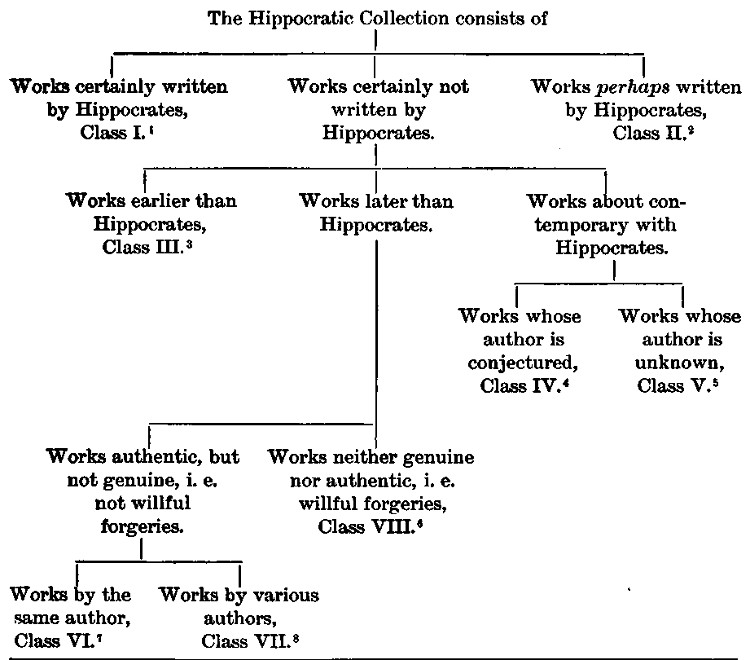
The Hippocratic Collection consists of | +-----------------------+------------------------+ | | | Works certainly written Works certainly not Works perhaps written by Hippocrates, written by by Hippocrates, Class I.[101] Hippocrates. Class II.[102] | +-----------------------+-----------------------+ | | | Works earlier than Works later than Works about Hippocrates, Hippocrates. contemporary with Class III.[103] | Hippocrates. | | | +---------+-----+ | | | | Works whose Works whose | author is author is | conjectured, unknown, | Class IV.[104] Class V.[105] | +-------------------------+ | | Works authentic, but Works neither genuine not genuine, i. e. nor authentic, i. e. not willful willful forgeries, forgeries. Class VIII.[106] | +--+--------------+ | | Works by the Works by various same author, authors, Class VI.[107] Class VII.[108]
3. No treatise is to be received as genuine which is not recognized as such by any one of the ancient authorities, however strong a case may be made out in favor of its claims by modern critics from internal evidence.
I. Περὶ ἀρχαίης ἰητρικῆς—On Ancient Medicine.
Of all the treatises which are recognized as the genuine productions of “The Great Hippocrates,” by M. Littré, this is decidedly the one which possesses the most questionable title to that honor. The only ancient authority that admits it as such is Erotian; it is passed over unnoticed by Galen and Palladius; and Athenæus does not scruple to affirm, respecting it, that some considered the one half of it spurious, and others the whole. (Deipn., ii., 16.) Foës, Schulze, and Zuinger,[109] are almost the only modern names in its favor; and it is rejected by Mercuriali, Gruner, Conringius, Ackerman, and Kühn.[110] The grounds, however, upon which Ackerman decides against its authenticity are of little weight, namely, that as it is stated in it (§ 1, 2) that medical works were numerous at the time it was composed, this circumstance implies a date considerably posterior to Hippocrates. But it is to be borne in mind, that Xenophon, who was almost contemporary with Hippocrates, puts into the mouth of Socrates, who was certainly nearly of the same age, the saying, that there were many medical works then in existence (Memorab., iv.), so that at all events the argument of Ackerman falls to the ground. M. Littré, moreover, espouses its claims with remarkable zeal, and persuades himself that he has settled this point by showing that a passage in the Phædrus of Plato,[111] which is quoted by Galen, as referring to a sentiment contained in the Hippocratic treatise “De Natura Pueri,”[112] does, in fact, have reference to the work now under consideration. This position he labors hard to establish, and succeeds at last so much to his own satisfaction, that he does not hesitate to declare, as the result of his elaborate disquisition, “that he had demonstrated the treatise “On Ancient Medicine” to be the work of Hippocrates.”[113] Now, I must be permitted to say, with great deference to M. Littré, that his prolix process of argumentation, spun out as it is over twenty-six pages, does not carry the same conviction to my mind as it does to his own.[114] But still, as this treatise has, at all events, one ancient authority in its favor, and as the matter contained in it appears to me to be highly valuable, I have not scrupled to follow the example of M. Littré in placing it at the head of the Works of Hippocrates. I shall have occasion to say more on the contents of it in the Argument prefixed to my translation.
II. Προγνωστικόν—Prognostics.
Of the genuineness of this work there has never been any question, so far as I am aware, from the time of the earliest of the ancient commentators, Herophilus, down to the present day.[115] That it is an admirable specimen of the plan upon which the Hippocratic practice was founded, there can be no doubt. The most important critical question to be decided with regard to it is the relation it bears to two other treatises on the same subject, namely, the “Prorrhetica,” and “Coacæ Prænotiones,” whether the “Prognostics” be founded on them, or whether they be made up from the “Prognostics.” This question will come more properly to be discussed in the Argument to the “Prognostics.”
Of this treatise there have been the following translations into English:
“The Booke of the Presages of the Divine Hippocrates, divided into three parts, etc. By Peter Low, Arrelian Doctor in the Faculty of Chirurgery in Paris. Lond., 1597.”
“The Prognostics and Prorrhetics of Hippocrates, translated from the original Greek, with large annotations, critical and explanatory; to which is prefixed a short account of the Life of Hippocrates. By John Moffat. Lond., 1788.”
“Hippocrates on Air, Water, and Situation: or, Prognostics, etc. By Francis Clifton, M.D. Lond., 1734.”
Of these the last is the only one which possesses the slightest claim to consideration. It is the work of a scholar, who had evidently paid the most studious attention to his author with the intention of publishing a new edition of his works, a design, by the way, which it is much to be regretted, that he did not live to execute. What became of his literary labors in this department I have never been able to ascertain. The greatest fault I find with his translation is the quaintness of his style; for it cannot be alleged of him, as of Moffat, that he often mistakes the meaning of his author. The translations of the latter are utterly worthless, in fact, they are disgraceful to the translator, who ought to have been ashamed to engage in a task for which he was so utterly unqualified. The translations by Low are done in a strangely antiquated style, and otherwise have nothing to recommend them on the score of fidelity. Moreover, all these translators introduce confusion into the subject by mixing up together the contents of the “Prognostica,” “Prorrhetica,” and “Coacæ Prænotiones.” Even Clifton is guilty of this indiscretion, although better might have been expected from him; for, considering how well acquainted he appears to have been with the spirit of his author, he ought to have been able to appreciate properly the obligations which Hippocrates had conferred on his profession by methodising subject-matters which had previously been destitute of scientific arrangement.
III. Ἀφορισμοί—Aphorisms.
That the greater part of the Book of Aphorisms is the work of Hippocrates himself there can be little or no doubt, but that it contains interpolations, some of which are of high antiquity, is equally indisputable. This is distinctly stated by Galen.[116] On this subject I would beg leave to quote the remarks of Dr. Greenhill: “Some doubts have arisen in the minds of several eminent critics as to the origin of the Aphorisms, and, indeed, the discussion of the genuineness of this work may be said to be an epitome of the questions relating to the whole Hippocratic Collection. We find here a very celebrated work, which has, from early times, borne the name of Hippocrates, but of which some parts have always been condemned as spurious. Upon examining these portions, which are considered to be genuine, we observe that the greater part of the first three sections agrees almost word for word with passages to be found in his acknowledged works; while in the remaining sections we find sentences taken apparently from spurious or doubtful treatises, thus adding greatly to our difficulties, inasmuch as they sometimes contain doctrines and theories opposed to those which we find in the works acknowledged to be genuine. And these facts are (in the opinion of the critics alluded to) to be accounted for in one of two ways; either Hippocrates himself, in his old age (for the Aphorisms have always been attributed to this period of his life), put together certain extracts from his own works, to which were afterwards added other sentences taken from later authors; or else, the collection was not formed by Hippocrates himself, but by some person or persons after his death, who made aphoristical extracts from his works, and from those of other writers, of a later date, and the whole was attributed to Hippocrates, because he was the author of the sentences that were most valuable and came first in order. This account of the formation of the Aphorisms appears extremely plausible, nor does it seem to be any decisive objection to say, that we find among them sentences which are not to be met with elsewhere; for when we recollect how many works of the old medical writers, and perhaps of Hippocrates himself, are lost, it is easy to conceive that these sentences may have been extracted from some treatise that is no longer in existence. It must, however, be confessed, that this conjecture, however plausible and probable, requires further proof and examination before it can be received as true.”[117] The fact of the matter is, that interpolation is a mode of corruption from which few works of antiquity have escaped altogether free, and it was, no doubt, often practised upon them in a very innocent manner, and without any fraudulent intention. Thus, when the subject treated of by any author came afterwards to receive any notable improvements or alterations, the possessors of such a work would naturally mark them down on the margins of their MS., and these annotations in the course of transcription would often come to be incorporated with the genuine text. Such a work as the Aphorisms, consisting of detached sentences, was particularly liable to suffer in the manner now adverted to. Another mode of vitiation, which has been frequently practised upon ancient works, is the addition of appendices to them. Every classical reader must be aware that the Odyssey of Homer is generally admitted by the critics to have come down to us in this state; nay, many learned divines do not scruple to admit that certain portions of the Sacred Volume have not been exempt from this casualty. I may mention that the last chapter of the Pentateuch, the last Psalm in the Septuagint, and even the last chapter of the Gospel of St. John, have been suspected, by very able critics, of being appendices. I have stated in another place (Paulus Ægineta, Vol. III., p. 437), that an addition in this way has probably been made to the medical works of Aëtius. On the addition of appendices to works, see further, Galen (de Placit. Hippocrat. et Plat., vi., 3). Taking all this into account, it need excite no wonder that an appendix should have been added, by some unknown hand, to the seven sections of Aphorisms, and, accordingly, it is generally admitted that the eighth section is spurious.
I shall reserve my analysis of the contents of the genuine sections to the Argument prefixed to the translation.
We have the following translations of the Aphorisms into English: “The Aphorisms of Hippocrates”, translated into English:
“By S. H. Load. 1610.”
“By Conrad Sprengel. Lond. 1708.”
“By T. Coar. Lond. 1822.”
“By J. W. Underwood. Lond. 1828.”
Of these I have only carefully examined the translations by Sprengel and Coar. That of Sprengel displays considerable pretensions to erudition, but, upon a careful examination, it will be quite apparent that the translator was not possessed of a competent acquaintance either with the Greek or English language. In short, nothing can be conceived more quaint, inelegant, and inaccurate, than the language of this translation. Lest I should be suspected of prejudices against my predecessor, and of exaggerating his faults, I shall subjoin a short list of passages which I hold to be mistranslated, so that the reader may judge for himself, whether my opinion of the work be well founded or not. (See Aph. i., 11,[118] 15,[119] 20,[120] 23;[121] ii., 6,[122] 15,[123] 27, 31, 34, 40; iii., 16, 21.)
The production of Coar is not destitute of some merit, although it is but too apparent that he was not fully competent for the task which he had undertaken. He gives, separately, every Aphorism in Greek, to which he subjoins first a Latin and then an English translation. In the Preface, he admits that “in executing the English translation considerable assistance had been derived from the elegant French translation of M. de Mercy.” From this admission it will readily be gathered, that the translator felt conscious that he did not possess a proper acquaintance with the language of the original. I subjoin references to a few of the passages which, upon examination, appeared to me to be incorrectly rendered. (See Aph. i., 2,[124] 10,[125] 20;[126] ii., 49;[127] iii., 11,[128] 26, 31; iv., 1; v., 26, 44, 68.)
IV. Ἐπιδημιῶν α’ και γ’—The First and Third Books of the Epidemics.
These are among the most undoubtedly genuine remains of Hippocrates, and well sustain the high reputation of their great author. In fact, of all the earlier records of medicine, these are about the most precious which have come down to us. Although, as I have stated, no one has questioned their genuineness, Galen complains that, by some mishap or other, they had not wholly escaped from some derangement of the subject-matters which they contain, and from additions being made to them.[129]
The following, I believe, are the only English translations of them which have ever been published.
“A Comment on forty-two histories described by Hippocrates in the First, and Third Books of his Epidemics. By J. Floyer.”
“The History of Epidemics, by Hippocrates, in Seven Books. Translated into English from the Greek, with Notes and Observations. By Samuel Farr, M.D. Lond. 1780.”
The former of these I have not been able to see. The other, although it appears to have been got up with considerable care, is manifestly the work of a man not properly acquainted with the language and doctrines of his author. In proof of this, I subjoin below a few examples collected from the first book, near the beginning.[130]
V. Περὶ διαίτης ὸξέων—On the Regimen in Acute Diseases.
This work is acknowledged as genuine by Erotian,[131] Palladius,[132] and Galen,[133] and other ancient authorities, as well as by all the modern critics, from Mercuriali and Lemos down to Littré and Greenhill. The authenticity of the latter part, indeed, is questioned by Galen, who pronounces the style, theories, and language to be different from those of Hippocrates. Yet even he admits that it is of great antiquity, being more ancient than the time of Erasistratus, who lived within less than a century from the death of Hippocrates.[134] Even if not genuine, then, this part (which is published by M. Littré as an appendix) possesses great value, not only as containing important matter, but as furnishing us with the opinions of the Coan school at a very early period after the time of our author. We shall have occasion to give a fuller analysis of its contents, in the Argument prefixed to the translation of it.
VI. Περὶ ἀέρων, ὑδάτων, καὶ τόπων—On Airs, Waters, and Places.
Fortunately there are no reasonable grounds for questioning the authenticity of this highly important work. It is admitted as genuine by Erotian, Palladius,[135] Athenæus,[136] and Galen,[137] and by every one of the modern critics, with the exception of Haller, who pronounces against it upon very insufficient grounds. He argues that it is obvious, from its contents, that the author of this treatise was a European, which cannot be said of Hippocrates, seeing that his native place, Cos, was one of the Asiatic islands.[138] But, if Haller had possessed any competent acquaintance with classical literature, he must have been aware that all the inhabitants of the islands adjoining to Asia Minor were colonists from Greece, and consequently looked upon themselves as Europeans, and not as Asiatics.[139] Nor is this more remarkable than that the present inhabitants of America should rank themselves ethnologically with the Europeans, and not with the native inhabitants of the country they now occupy.
An edition of this treatise, with a French translation, was published at Paris by a learned modern Greek, Dr. Coray, in the beginning of this century; the annotations to which are highly valuable. The only English translation of it which we possess, as far as I know, is the following:
“Hippocrates upon Air, Water, and Situation. By Francis Clifton, M.D. Lond. 1734.”
This, I am inclined to think, is the best English translation which we have of any of the Hippocratic treatises. It is generally accurate, and the only drawback to it which I am aware of, is the style, which is often exceedingly quaint and obsolete. The translator, as we stated above, was well acquainted with all the works of Hippocrates, and of his painstaking industry the notes in this treatise bear undoubted evidence. Of these I have availed myself, whenever I could derive any assistance from them, but from the translation itself I have never copied literally.
VII. Περὶ ἄρθρων—On the Articulations.
This work was received as genuine by all the ancient commentators, from Bacchius and Philinus, the disciples of Herophilus, down to Erotian, Galen,[140] and Palladius.[141] It was also admitted by all the earlier modern critics, down to Gruner, who rejected it on these grounds: 1. Because it contains a reference to the treatise “On Glands,” which all acknowledge to be spurious. 2. That in the course of the work a degree of anatomical knowledge is evinced, far beyond what its actual state in the time of Hippocrates would warrant. 3. That the legend of the Amazons, which is received as true history in the treatise “On Airs, etc.” is rejected as fabulous in this work. Grimm also agrees with Gruner in condemning it as spurious; but Littré shows good reasons for admitting it into the list of genuine productions. He replies in a very satisfactory manner to Gruner’s objections. Thus he shows, in particular, what we have adverted to previously, that the knowledge of anatomy which was possessed in the Hippocratic age, had been much underrated by Gruner and others, and that the two passages in which the Amazons are supposed to be referred to, are not parallel, and do not admit of a comparison. He also very properly insists upon it, as a strong argument in favor of the genuineness of this treatise, that it had been commented upon by Ctesias.[142] The work, indeed, contains so much valuable matter, of which subsequent authors (as Celsus and Paulus Ægineta) have freely availed themselves, in handling the subjects which are treated of in it, that I have every disposition to receive it as genuine. We shall see, afterwards, that, taken in connection with the next work, it is a perfect masterpiece on the subject of Fractures and Dislocations.