Front matter (continued 3)
Reading edition
We are the music-makers, And we are the dreamers of dreams Wandering by lone sea-breakers And sitting by desolate streams
and then certain delicious lines, untraced in origin, which Algernon Blackwood is fond of quoting:
Change is his mistress, Chance his counsellor Love cannot hold him; Duty forge no chain The wide seas and the mountains call him And grey dawns know his camp-fire in the rain.
An ideal book to carry on a tramping expedition is undoubtedly an anthology of your own compiling, a notebook filled with your favorite verses.
Other books which I think of as the tramp grows in goodness and in grace are Ibsen’s “Peer Gynt” or “Brand,” preferably “Peer Gynt,” there is much more in it. “Peer Gynt” is a very remarkable book; you can read it ten times and still fail to exhaust its poetry, its thought. It is a great book about life. It is moreover a true tramping book. Peer is a vagabond wandering about in the world, and it is never the world which is in question, but the state of his soul. “Brand” is not so much of a poem as the other, and is not so memorable. But it raises some of the eternal questions in a powerful way. If you are “sick of towns and men” “Brand” will rather indulge your mood, for it speaks Ibsen’s impatience with the petty ways and lives of average men and women.
Socrates’ Dialogues go well in the inner pocket, and so do Horace’s Odes, if you are of a Horatian turn of mind and can read them. There are many, especially in Scotland, who like to take a Homer, and fancy themselves on the hills of Greece. For a classical scholar there are many books of profound and lasting interest; a Plotinus will last you a long while. For you have not merely to read it, but to resurrect a being who lived centuries ago in a different civilization. The human heart was the same, but almost everything else had a difference.
If the mind is just attracted to ancient philosophy, I know few books to compare with Pater’s Plato and Platonism, for inner worth. I do not, however, think his Marius a good tramping book. Nature rebels against its cold chaste beauty. It needs, I think, a more artificial setting for its enjoyment.
Few novels are good tramping books. One gets through the story so quickly, and if there is no more than story there, the book is finished with. Still, there are a few knapsack companions worth having, such as The Cloister and the Hearth, John Inglesant, Wilhelm Meister, Dostoieffsky’s The Brothers Karamazoff. All rather bulky, I am afraid, for ideas, though they keep other books thin, do swell the volume of a novel. A few ideas stated in conversation and baited with picturesque descriptions take three times the space they need in the essay. It is sometimes easier to understand them, but the expression is diffuse.
Plays, however, come near to being ideal. They take up little space. The dramatist has to censor his own work vigorously with a view to cutting down the excess of verbiage which his ideas naturally claim. He is forced into paradox and epigram. His work is full of hints and suggestions which are undeveloped. It is for you to develop them. As Ibsen said, “I ask the questions; it is for you to answer them.”
A Shakespeare play is a delightful library. I nearly always take one. A drama like Richard III or Othello can be read over and over again. As You Like It and A Midsummer Night’s Dream, are the great open-air plays. You learn more about them with the birds and the stars to teach you than with the aid of the most genial producer or inspired professor. You make your camp in a natural theater among the trees, or in an arena among the rocks. There is an audience not altogether invisible. It waits, it has its programs, you have the book of the words and the brain full of moving figures. Sun and moon are working the limelight from the wings. Your camp fire is the footlights. Enter Man. Enter Hamlet. Enter Julius Cæsar, the gods, the ghosts. The tramp becomes an ancient type, a magician, a mystagogue—with a Shakespeare in his hand, in the midst of the worlds.
If modern drama rouses the fancy, you can take a Pirandello or a Shaw, and thresh it out—get a real opinion about it. It is worth while when you have to orientate your mind to certain writers of repute to make yourself intimate with at least one of their works.
I suppose some may prefer to read a book on the country through which they are tramping, and in that case a librarian’s aid may be sought. There are now scores of volumes on almost every country in the world. It is as well to look over several of them before making a choice—many prove to be slapdash, ill-informed compositions.
Does one take accounts of travel in lands other than that one is tramping in? I imagine not. Unknown Arabia is out of place in a tramp through California. But a tramp’s account of his own life is interesting reading anywhere, and one naturally thinks of W. H. Davies’ autobiography in this connection. There are few tramp writers. But probably the best short story of Maxim Gorky’s tells of his tramping life, and is called “The Fellow Traveller.” Jack London’s Valley of the Moon contains some tramping episodes. Jack London, Rudyard Kipling, Cunninghame Graham, Belloc, Chesterton, Carl Sandburg, Vachel Lindsay, are all delightful writers in the tramping mood and ask a place in the knapsack. Then there are Harry Franck’s untiring pedestrian tours in Patagonia, China, and elsewhere, perhaps in too ponderous a form as yet for field use.
I once met a tramping publisher, rara avis, a very black swan; he began his life as a colporteur of the British and Foreign Bible Society and spent twenty years on the road, going from Bibles to leaflets, which he printed himself, and thence to booklets, thence to books and an office and a vast organization. He had a simple way of business. I handed him a manuscript; he opened a drawer and handed out a wad of notes, and the transaction was concluded without a word in writing. But I suppose that was unusual even in his business. There was a savor of tramp meeting tramp in the affair.
The Bible colporteur ought, at least, to know one book the better for his calling. When all is said, there is one book more worth taking than all the rest; poetry, philosophy, history, fantasy, treatise, novel, and drama, you have all in one in the Bible, the inexhaustible book of books. You need not take it all, take the prophecies, the Psalms, the Gospels. It means much to tramp with one Gospel in the inner pocket of the coat.
CHAPTER TWENTY-ONE
LONG HALTS
IF your tramping expedition is long; if you have voted yourself plenty of time; if, for example, you are taking a wander year, you are under no compulsion to keep on tramping. One advantage of being a true Bohemian is that you are under no compulsion except that of the heart. You stop when you like, you go on when you like. You surely come to places in which you are tempted to remain—be it only for a few days. You stay a day, and the place grows on you; you stay longer. And then, when the spirit moves, you move with it, move on, enriched by your delay, by your idleness.
There are short halts and long halts. The short ones are simple and natural; the longer ones more difficult to make, but not to be foregone on that account. You come at last to the ideally simple, or beautiful, or alluring village. You ought to stay there a while, make home there for a while. And you have only your tramping kit and no word to recommend you. Still, it can be arranged, and the very modesty of your approach should help you. You come from below, not from above; the villagers will not hide their life from you. They may be shy of the stranger, but shyness will wear off as they watch you in their midst.
Do not go to the local priest who, being a responsible person, is likely to tell you that it is impossible to stay there and to fill your mind with difficulties. You want to get taken in and hire a room. You have money to pay for it. You should make your appeal direct at the house where you would like to stay. You shall be very civil to the lady, and drink with mine host. It can be arranged. They will even put themselves to trouble on your behalf.
It is so much better to be in a family than in an inn. Inside the little family of a home you are inside the bigger family of the village, and if you are a sociable soul you will soon have many friends. You will get to know the village characters and gossips, the village children, the village musicians; the stories of the village, its legends, its superstitions—and then, its love affairs, its family entanglements, its coming weddings and fêtes.
All this is worth while in the science of living. It is part of a true tramping jaunt to come back from Nature to man, not of need to civilization, but to men and women and children. The village children will prove as near to the wanderer’s heart as the birds in the woods—nearer, for they are wood fairies incarnate, trapped on the edge of the forest and made to live human lives in the villages.
The written pages of your notebook grow in the village, on the long halt, as do also the unwritten yet unfading memories within. Days and weeks tramping in the open crystallize in impression, and your past is like a tapestry on your bedroom wall. There is a space cleared for human life and love and happiness, for dance and for song, for sociality and talk.
Here is opportunity for learning new ways of life and new stories and songs. You may soak in folklore and folk music for weeks. How splendid for you if, when the time comes to go away and resume your trampings you can carry away with you drawings you have made, songs you have learned to sing, stories which you can tell. You will carry that village with you to the ends of the earth.
And then, of course, a village is not merely a village, not merely the broad and rutted roads and the cottages planted among the pigs and fowls. The village has its ways out, its views, its hillsides and streams, its loveliness on all sides. Your long halt is not a sitting still in a human settlement, but a starwise tour of all the country round about.
Going on and on in a line of route has its drawbacks. The world is not a straight line, not even a crooked line, not even the line of a man’s steps upon it—it is an area, a broad surface. Length cannot exist without some measure of breadth, but at the risk of a paradox one may say the world is breadth without length.
So also man’s life. We think of it in length of years. But that in a way is error. Life is not length of time, but breadth of human experience. Life is not a chain of events, but an area-something spreading out from a hidden center and welling at once towards all points of the compass.
In the long halt, therefore, one has not stopped living, because one has ceased going onward. You get poised on your center. You feel the origins of joy and pain—deep down at the heart’s core, the place from which something in you is welling up all the while, welling up and overflowing, flowing away in waves and tides, to break on a mystical shore.
Belike you have a child’s happiness into which you are unwilling to probe. You ask not whether it is more in one thing than in another. You tramp and you are happy, and halt and you are happy. Or happiness is not your word for what you feel, not your vein. You muse, you are at one with life, you are content, you ask only to go on in the way in which you are. Or your happiness is to feel a divine melancholy wherever you are. It is the same for all. The long halt, the dwelling among strange kindred, the choosing of some spot to be beloved in preference for a while—that also enters into the art of life, of the life of the true Bohemian and life-wanderer.
CHAPTER TWENTY-TWO
FOREIGNERS
“You are not taking up with a dirty foreigner?” “He’s quite a decent fellow, though he is a foreigner. Why do you say ‘dirty foreigner’?” “All foreigners are dirty foreigners.”
TO the majority of Englishmen foreigners are dirty foreigners, though, of course, to Americans, one concedes the name cousin. But when you travel about in the world you soon find that in other countries we also are foreigners, perhaps even “dirty foreigners.”
“He is English?” I have heard it asked. “He’s one of these people who think they own the earth?” And all too often in Europe one hears of “vulgar Americans.”
Despite the grand international ideas of this and of preceding ages, it is just as difficult for foreigners to get on together and esteem one another and understand one another. This becomes very clear upon reading modern works of travel, and perhaps clearer still upon listening to the personal adventures of people who have been traveling unconventionally in foreign lands. What is strange to us is comic, it strikes us as a burlesque; if it irks us we think it distasteful, even wrong. We take the foreigner to task for not behaving “like a perfect gentleman,” etc.
It is largely a matter of bad manners. If manners could be improved we should more easily get into sympathy with “foreigners”; if they could be perfected there would not be any foreigners.
The language difficulty is enormous. Even if we learn to speak a foreign tongue, we are liable to make mistakes and to have a queer accent. We are at least as bad as those foreigners who come to us and say “English as she is spoke.” Mistakes in language are almost always very malapropos. Beaucoup is “much” in France, but ill-pronounced it means “little” in Italian (poco). The word for Thursday in Serbian is slang for sixpence in Russian. An American lady wishing to ingratiate herself with some Germans said she felt as if in Paradise; but the word paradise in German means tomato, and her friends stared at her. An acquaintance of mine, not speaking French very well, was dancing on a Paris boulevard with some midinettes. Feeling rather tired he went up to one of them and whispered in her ear, “Ma chère danseuse, je suis en couchant” so that he seemed to imply a confession that he was a pig. Two Russian Bolsheviks in London were fumbling for a doorkey outside a house at midnight. A policeman came up and asked them what they were doing.
“I have forged a key,” one of them replied. The bobby, however, looked at them indulgently. “Forgot, you mean,” said he emphatically.
But difficulties of this kind are not confined to foreign wanderings. You can experience them at home, in Scotland, for example, or on the burring border, or even in Yorkshire. I was tramping across Yorkshire one summer, and I realized how outlandish my English sounded. They speak a different language up there. I had to make every one repeat everything twice. They frequently mistook what I said. They made me say it twice also. They reckoned I did not come from these parts.
I went into an inn one night and asked for a room.
The landlady, an elderly dame with a huge red face, asked me if I meant a room.
I said “Yes.” She said, “Ted, this gentleman wants a room.”
“All right,” he exclaimed, “in a minute.”
“Mine will be my usual drop o’ Scotch,” said an old fellow, nudging me as he went past.
I sat down in the bar parlor.
Presently the young man came and inquired if I’d like water in my room.
“Yes, I suppose so,” I answered patiently.
Then, in a few minutes, the young man Ted came in, mixing as it seemed to me a cocktail—or what might pass for a cocktail in Yorkshire. He stood in front of me, wineglass in hand, and poured a clear liquid on to a brown one, cautiously and professionally.
“Tell me when to stop,” he said.
“That’s not for me?” I queried. And I wondered if it was perhaps a custom to bring guests an unsolicited cocktail as a ritual of welcome. Yorkshire has its festive ways.
But the boy stopped stirring and pouring, and looked at me.
“It must have been somebody else,” he remarked, and turned to the red-faced landlady.
She faced me. “Yes,” she said hoarsely, “you ordered the room.”
Then the truth dawned on me.
“I asked for a room,” said I.
“Well, here it is,” said the young man.
“Not a rum, but a room! Room! Room!” I exclaimed.
“Yes, room,” said the landlady.
“A room for the night, a lodging,” I explained.
“Oh, a bed,” said she, with a chagrined face. “We have no beds. No, no beds,” and I could see her thinking the matter over in her mind, the difference between room and rum. She watched to see if I would drink what had been put before me.
But rum is not my drink, especially after a day’s tramp. I shouldered my knapsack and pushed out of the inn under the disdainful gaze of the red-faced landlady and the stare of the man who was sipping his drop of Scotch.
They say the better educated people of Edinburgh speak the best English in Great Britain, and I certainly can use my own tongue fairly well. But judge my amazement when I first went to America, and was told I did not speak English. I was tramping to Chicago, and men on the road would say to me, “Say, you haven’t been over here long. You speak the language broken.”
Prejudices are bred over the difference of saying the word “well” with the lips and “well” with the throat. Even a national laugh can be aggravating. “Haw, haw, there’s a merry laugh for you,” says the American in “So This is London,” “haw-haw—the marmalade hounds.”
Incidentally, that sentence from a clever play points to the other great cause of irritating difference in ways. The Americans do not take marmalade for breakfast. We do. It is almost a source of international misunderstanding.
“The English have such bad table manners,” I used to hear said in Moscow. And yet you should see Ivanovitch with his soup. We are too greedy at table. We accept second and third helpings, only intended to be offered, not intended to be taken. We do not know how to make a glass of tea and a saucer of jam last fifty minutes. We eye the samovar when we want more tea. We do not kiss our hostess’s hand after the repast. Americans eat with their hats on, but with their coats off. Russians smoke cigarettes between courses. Frenchmen take large towels into their collars, and pick their teeth with toothpicks while they talk. All very disgusting. Almost every variation in ways of eating is distasteful.
The tramp, the wanderer in strange lands, should at least get over this. I am sure Oliver Goldsmith and George Borrow, two delightful wanderers, never fell foul of any one for lack of speech or eating wrongly. They knew how to counteract the effect of their own foreignness, and how to accept and enjoy differences in others.
But unless the tramp intends to shun men and women altogether he has to face the problem of liking his fellow man, however unlike to himself. It is part of the art of tramping to know how to meet your fellow man, how to greet him, how to know him.
You get a companion who calmly tells you he intends to “pick your brains” during the tramp. That is very well, though the expression seems not too kind. It is easier to say “I intend to get to know you during our wanderings together”—though there, of course, the intention is towards something very difficult. It takes a long time to know a man. You may “pick his brains” in half an hour and not get to know him in a lifetime. It is mawkish for a man to talk of love, except in love, but it needs a loving heart to know any one really well.
The man you tramp with is not a foreigner, albeit foreign enough in himself, as you may discover before you discover he is kindred. You are thrown into intimate contact with him. Even if the two of you are a couple of egoists strongly self-centered, something is bound to get across in a long tramp. That is one reason why tramping is such a healthful spiritual experience. The too-too-solid flesh does melt a little, the too-too-solid heart does warm somewhat toward an outsider.
But the chance-met is much more difficult to meet, to greet, to understand. Of course, more difficult for some than for others. There are genial sympathetic souls who have an aptitude for taking a stranger at once to the heart. They are bright-eyed people, friendly at once and friendly for a long while. I have a prejudice in their favor—but, alas, there are not very many of them. The warmest thing in the world is human affection; it is the most covetable, and it is the sweetest thing to give. And it is also the saddest thing to have refused. I believe the affectionate people take the most blows in life. But also they get the greater rewards.
Still, there is shyness, timidity, stand-offishness, which commonly mask the souls of very friendly people. It is difficult to rid oneself of these defective qualities. Much travel frequently does it, and much tramping will do it also. Tramping simplifies out many of our foibles. It makes the artificial people more natural. I have seen a man afraid almost of his own shadow in town become a bold and smiling boy upon the road, not afraid to meet any one and hold frank converse with him.
Chance meetings may greatly enrich human experience, especially in a foreign country where one has so much to learn of the ways of one’s fellow man. I have found by personal experience that one of the quickest ways in which to learn the life of a people is by tramping among them.
The commonest way of attempting to make a study of a new nation is to arrive at the capital city with a wallet full of introductions to notable people. You stay at the best hotel, call at the Embassy, make friends with one of the secretaries, dine with him and learn his prejudices, go on the morrow to a friend of his, who will tell you “all you need to know.” Then you may use your introductions, checking off what the native notabilities say about their country by what you have already heard.
The visitor of this type does get impressions. That is undoubted. He feels that he is getting to know the new country very pleasantly, and yet, when his visit is over and he returns home, if he is frank with himself he must confess that he has very little real knowledge of the people. He is obliged to say—Well, I was only there for six weeks; I cannot pretend that I know much about it. But sixty weeks of that sort of thing would make little difference.
On the other hand, six weeks tramping gives you unforgettable impressions of reality. You have the great advantage of facing society from the outside of its classes. You are at the bottom of the social system and have the freedom from pride which such a position implies.
’Tis pride that pulls the country down Then take thy auld cloak about thee.
You do not need to put on airs, put on side, ape pompous acquaintances, simper, trim, bowdlerize, change clothes according to time of day, polish finger nails and balance cake, give the expected smile after futile remark, avoid contradiction, or read up the secrets of bon ton at night.
As you come along the road at any time of day everything about you says, “Here I am, the tramp; take me as I am or not at all.” The Church covers the friar so that he is immune from pride and taunt, fashion and convention. He cannot be reproached; for his garments are a token that he is bearing the reproach of Christ. And Nature covers the tramp in a similar way. He has the chance to feel and be at home in any place in the world, under any circumstances and with any people. You are never ill-dressed in the King’s uniform; you are never ill-dressed in the tramp’s.
Such stability is great gain, and frees the mind from care and fear of appearances. You can with a gay heart plunge into converse with the heir to the kingdom if he comes your way, and he will almost infallibly say after his long revealing talk with you: “Ah, I wish I were you!” You cause kings to envy you, but even peasants, who can be prouder and stiffer than kings, will feel at home with you. You must also be at home with them. You learn their accent, their special peasant version of life, their stories, their songs. Quite by accident you seem to get inside the real life of a nation and you belong to it for the time. “It is always worth while talking to a clever man,” says a character in Dostoyevsky. It is always worth while talking to a stranger.
CHAPTER TWENTY-THREE
THE ARTIST’S NOTEBOOK
Holding but lightly to material things, Happy to stay, yet eager to begone, He is the poet, though he never writ A line of metre; he is God’s free man And has the franchise of Eternity. Into his soul through every sense there steal Immortal melodies. This song of praise, This verdant life, this fragrance, the blue sky, Those mighty mountains and the distant sea Are symbols of the everlasting song Swelling from age to age among the stars.
SELF-EXPRESSION is life, What gives more satisfaction to one’s being than to have expressed oneself. One builds a house and expresses himself, another writes a poem and expresses himself, another begets a large family and expresses himself—and looking back, they can say “Vixi”: “I have lived.”
Some years ago they used to sell on the streets little blue revolving spheres for a penny; spheres with the continents and seas painted on them. They were toys. For a penny you could give your baby the world to play with.
That is what he needs, and what the world was made for. We were given the world to play with, as blocks with letters on are given to children, for play and—for expression. The whole object of the world is to help us to say a few words about ourselves. I think it is Novalis says: “The world—all nature—is an encyclopædical index of our own souls.” If you would read the cypher of your soul you must use the cypher key of Nature. If you would learn and read the language of the heart, the world, the visible universe, shall be your dictionary.
When Richard Jeffries wrote The Story of My Heart it proved to be all birds, flowers, bees, grasses, skies and trees and airs. It was no cinema story, no Tarzan romance. Nor was it booklore. He did not go to the British Museum to obtain materials for the story of his heart, did not “mug it up” with the help of great authorities. But in the wild woods and on the Wiltshire hills he spelt it out with his fingers letter by letter, like a blind man fingering Braille.
I sometimes think that the gold of all literature and art is self-expression of this kind, and that after all, the best passages and the best pictures are “impressions de voyage.” After we die we may be set to write an essay on our life story. It will be “impressions de voyage.” Fifty years in an office will be found shriveled up to a dot, and a few days in the wilds will expand into the whole essay.
Why do we stare at beautiful things? We see them—is that not enough, can we not merely glance and pass on? We stop and we stare, at that mountain side, at that flower, at that dreaming lake. We cannot pass at once. We seem to be looking intently, stargazing at something further off and yet more kindred than the stars, but we are not using our physical eyes. Perhaps we are not using our eyes at all. We are listening. Nature is trying to tell us something; she is speaking to us on a long-distance wave.
Your mind is haunted. You have forgotten something, and the flower is trying to tell you. It is reminding you of a forgotten air. Something you cannot quite hear, cannot quite make out. Once you belonged to a kingdom where ... once you knew some one young and fair ... once you were lost, still lost, always lost.... But you could join us yet, did you dare ... what is the flower trying to say? What does the mountain say, and the lone bird on the branch? The heart aches. You lie on the downs; heaven is alive with birds. The bosom of the sky heaves with their song. And you, down below on the cropped grass of the hills, lying on the chalk, shading the eyes with a hand, look up—and the heart aches. It aches with homesickness, with love for that some one of whom the flowers speak and the lark sings.
You are camped by the side of a stream, and a boatman goes past in his boat in the dusk; you are dreaming by your fire in the morning, and a wild bird comes unbidden to your wrist; you are yourself mirrored in the water below a rock just before you are about to plunge; you watch an eagle bridge a chasm with its flight; you see cliffs shaped like giants and trees like dwarfs. The snake serpentines through the dust across your path, drawing a line—thus far and no further—which, however, you overstep. You find yourself treading in primeval forest, where no step of man has ever been heard before. The trees change into great armies marching upward in platoons, in serried battalions. You come to great walls—termini. You overclimb them: death, new life. You are out of touch with below. It is the great plateau: you can yearn upward with your hands, you cannot yearn downward to those you have left below. Lark’s song comes up to you from other people’s heaven. You are in upper mountain country among glaciers and scarred rocks, amid frogs, amid storms. You dance in the air with the snowflakes. The soul plumbs the depth of the world with a sad thought dropped from the height. Listen—the little avalanches—a crack, a rumble, a thudding, a whispering. You reach and stand astride the pass between two countries. God divided up the world, and you are a pair of compasses in His hand.
The first tramp left Eden many years ago. They say he died. But to my mind he is still wandering. God made him wander. He has wandered so far his wits are wandering too. He doesn’t remember much about the garden now. It was a pleasant place. It had a snake in it, however. Very pleasant: a place in which one could lie down and rest for an eternity at a time, if it were not for the snakes in the grass. The devil got loose in it. Still, it was the only place in which one could feel at home for ever and ever. And outside of it one must wander. Life is a wandering and a seeking where it was once a sitting still and an adoring.
So the tramp’s life is a type of existence. I like the symbolism of the Jewish Passover, the standing dressed for departure into the wilderness. Man is not man sitting down; he is man on the move. Le tramp c’est l’homme.
Even if in small measure the tramp is a pilgrim. His adventure is a spiritual adventure or it is nothing. The clouds part and Orion is disclosed. The rude pencilings are erased and the main curve remains, and the curve of your adventure is a broken arc. “On earth the broken arc; in heaven the perfect round,” says Browning. But given the arc the center can be found. We revolve about the sun, but there are planets revolving around a sun invisible to us. Our souls, I suppose, revolve about some invisible spiritual sun which we are always thinking about—a center called God.
So with all our hilarity, our joyous meetings, our madcap doings, with all the fun of the tramping expedition there is the deeper interest underlying all. Most people will make the tramp without one conscious deeper thought. It does not matter. Their nature is getting something intuitively, although the mind has no knowledge of it. The gay undergraduate, all vim and no soul, shies at religion and has no thought except about climbs, leaps, jumps, food, sporting chances, pedestrian achievement! He may not see this glorious jaunt in a poetic light until years afterwards. Cunninghame Graham remarks in one of his clever prefaces that nothing in the present ever seems so good as what is past. Some years pass, and your present, which is silver to-day, becomes gold in recollection. You lie in a matter-of-fact mood under the stars in the midst of the mountains. Your mind is at rest, you ask for nothing beyond perhaps good sleep, and belike you thank neither God nor yourself for having got there. But ten years later you look back with a sigh and say “How wonderful it was, ah, I was happy then!”
The intuitive understanding rises slowly to the mind, like light traveling from a distant planet to this earth. But you get it at last and see.
So the experience is kindred for all manner of minds. The poet may exult too feverishly at first, and grow tired of his own rhapsodies; the reflective intellectual may become bored by his own meditations. But neither the poetic rhapsodies nor the intellectual notes record the measure of the tramp. For it is a measure of hidden honey that is being stored, and you are seldom allowed by Nature to eat of your own store day by day. We are bees rather than wasps.
The true beehive of inner experience is in you, and yet, of course, there are what may be called auxiliary beehives. I believe the conscious experience of a tramp can be greatly increased in a pleasurable way by the use of notebooks. It is worth while keeping a record if only to remind yourself in other years. The details of your spiritual adventures fade out unless you have a good memory or an aide-mémoire. The whole work of some writers is no more than a tramp’s notebook, Blake, for instance, a series of marvelously scrawled hieroglyphics—the story of his journey from one world to another. But one does not need to be a “writer” as it is called, or an “artist.” It is a spurious classification. We are all writers and artists from the day when we scrawl with our toy spades in the wet sand to the day when we put the seal of death to our wills. Man as such is an artist. Being public, being printed, being exhibited, are matters connected with the minor function of being professionally artistic. Giotto drew a perfect circle to show what he could do. We shall draw imperfect ones and be more true to Art.
The fact is he has lost a great deal who has not kept a daybook of the soul. Something very sweet happened to Leigh Hunt one day and he wrote.
Time you thief who love to get Sweets into your list, put that in.
It was entered in his daybook. Certain happenings make a day worth while and perhaps forever memorable to you. “To-day I knew that I had conquered all my doubtings,” wrote Carlyle once in his diary, recording his transit from scepticism to positive belief. It was an entry in his daybook.
As a practical detail, I love page-a-day diaries, the new sort used mostly in America and France. It is a nicely bound thin-paper book with a whole page for each day in the year and no postal information or cash columns. Unfortunately in England such books are generally bound to look like Bibles and have appropriate Scripture references at the head of each page. One is reminded of the Lessons and the Collects. That is very well, but we require a minimum of printed matter on our daily page. It is ours, like our life when we wake up in the morning, free and open, and we may write there only what is given to us personally to write. Such a notebook should be free from conventions. If we wish to draw sketches in it mixed with written notes, we will. If we need to overstep the limits of a page we will find a less-covered page among our yesterdays and let to-day spill over to fill out the measure of time past. If you have had a tramping expedition in the midst of an otherwise sedentary year how the empty pages will fill up from the more glorious days!
The artist’s notebook is free for sketches, notes, impressions of moments, bon mots, poems, things overheard, maps and plans, names of friends and records of their idiosyncrasies, paradoxes, musical notations, records of folksongs and other songs which you copy in order that you may sing for years afterwards. But it should not contain too much banal detail, such as petty accounts, addresses, druggists’ prescriptions, number of season ticket and fire-insurance policy, memos to send rent. These things are apt to clutter up your book, and when you come to Old Year’s Night, and sit waiting for the chime of bells which rings in another year—and you have your daybook before you, and you go over its pages, you do not want to pause on a scrawled laundry list or some Falstaffian account of wine and bread consumed at such and such an inn.
The artist’s daybook is his own living gospel—something coming after Matthew, Mark, Luke, and John—and should be sacred to him, if he is not merely a flippant and cynical fellow seeing life in large part as a buffonade.
A thought recorded, one that is your own, written down the day when it occurred, is a mental snapshot, and is at least as valuable as the photographs you may take on your journey. Yesterday’s thought is worth considering again, if only as the stepping stone of your dead self.
The thoughts of some people are constant, but of others varying and contradictory. It is like landscape. Some live their lives in the sight of a great range of mountains—they live in the presence of certain ever-abiding thoughts; others change their mental scenery from day to day, in the shallows and flats of the low country. But we all have our epochal days, our epochal thoughts. We turn to a page in our notebook and say: “On this day the thought occurred to me in the light of which I have lived ever since.” You draw two candles there, with light rays, to show the thought of the year.
It is much the same if the expression of the thought has been given you by another. Your thought of the year may take the form of a quotation. Those who search while they read naturally find in the expression of others what their souls need. I remember long periods of living with certain thoughts derived from books—Browning’s:
He placed thee midst this dance Of plastic circumstance This present thou forsooth would’st fain arrest.
and then at another time Richter’s:
“We are near awakening when we dream that we dream.”
Persistent thoughts on a path of life’s pilgrimage! Morning after morning one awakens and the thought awakens with one and goes through the day in company, in communion with one.
Each day Nature puts her magic mirror in our hands. “Oh child, do you see yourself to-day?”
We look, we look, and answer wistfully, “Not to-day, not to-day.”
Is it that the reflection is dim and vague, or that our eyes have not yet cleared? Shortsighted people see curious distortions of themselves in the glass.
But it may even be true that no one has yet seen his own face. You can never be sure that what you see in a glass is what other people see in your face. So also in the spiritual mirror of Nature, one seeks to identify oneself and yet never is satisfied. Cheek and nose are wandering with the ripples of the lake. Every pool in the marsh has its star reflections, and as you bend o’er one of them your visage is broken by the starlight.
On the desolate North Cape, amid ice floes and leaping seals, with the bleak homeless winds of the Arctic about your ears, you are as near to your own image as in the warmth of Gibraltar’s opening gates. In the center of the Great Pyramid your heart turns to dust, but coming forth it vivifies again and is young as the year of your age. Pharaoh’s uncovered face is a faded hieroglyphic, but still it asks thousands of years after death—who am I; whither do I go?
So life’s scroll is full of question marks, pointers, index fingers, records of bearings, soundings, answers and partial answers to the question: Where am I? Drake climbs a goodlie and high tree in Darien and descries afar the Southern Sea. It is a picture in his artist’s notebook. Such an artistic thing to do, and life made him do it! It was no pose, his going forth to singe the King of Spain’s beard. It was more of a pose, I think, when he refused to allow his game of bowls to be interrupted by the approach of the Armada.
Pose is, unfortunately, a prevalent disease of the quest. Some natures are betrayed to striking attitudes on the top of molehills. To-day I conquered the Mendips; henceforth there are no Mendips. But good hard, earnest living—tramping and seeking, will cure most people of the false theatrical. Beware of going to Jerusalem in order that you may come back and tell the world you have been. It spoils all you found on the way. I do not like the palmers; those who have been and have come back. Admitted that it is a vice of ourselves, we professional littéraires, we go and then partially spill over when we return, selling the wine of experience for so much. When it is genuine experience you well may:
Wonder what the vintners buy One half so precious as the goods they sell.
But, of course, one can tell one’s story and yet escape pose. “Make thyself small,” saith Buddha. Make thyself unobtrusive, lest some one may think that a very ornate and luxurious loud speaker is responsible for the music itself. In an old-fashioned phrase so difficult to stomach nowadays—“Give God the glory.”
The personal diary, however, that daybook of the soul, is not meant for other gaze. I should imagine oneself shy even of the eyes of one’s most intimate friend, wife, sweetheart, alter ego. There is a delicacy, a secrecy about the functions of mind and soul. You do not wish others to see what you have written and blush at the thought of half a line being read over your shoulder. And the better the diary is kept the more private and personal it becomes.
I do not consider Pepys’ Diary to be the type of a good daybook, though it is extremely valuable as a record of the life of the age in which Pepys lived. It is one of the great curiosities of literature. As after a lifelong imprisonment one might find the diary of a prisoner, written to kill time, so after Pepys’ life one finds this astonishing document, wherein as it were, all is written down. But that all of Pepys’ Diary is not all. It is all that is immaterial. There is much that escaped Pepys because he was not on the lookout for it. The chief omissions are the answers or attempted answers to the questions: “Who was Pepys? Whom did Pepys think he was?” The answers to these questions covering the whole of Pepys’ life could well occupy as much space as the famous diary we have.
But Pepys, perhaps without intention, described his England very well. He set down so much detail that he provided something resembling cinema films of daily life. As you read his pages you drop away from your own century and walk in his. His work is not a selection of phenomena; you make your selection from it. You can, in fact, make a diary from his diary. His many pages become one page, or half a page, in your diary.
There was in Russia, up to the Revolution, in which he perished a Pepysian writer, more selective, it is true, but determined to write down all, everything that occurred to him from day to day through life. He became naturally voluminous, and put down all manner of things, discreet and indiscreet, some very shocking to decent minds. But in one of his later volumes of fragments and thoughts he wrote, “It may be asked what possible interest is there is these things I am recording, but that is my affair. For a long while now I have been writing without reader. If some one reads, that is his lookout; I do not invite him. One resolution I have made, and will carry out, and that is to print all.” So many of his daybook entries have curious tags after them, such as “Written on my cuff at Mme. So-and-So’s reception”; “Written while waiting for the tram on Nevski.”
It is fair to him to say that he only recorded thoughts and observations. If he was making love to a Captain’s wife at any time he did not tell of it—but only gave current reflections on love and what women really are. His whole literary output makes one spiritual notebook.
Few people however have much persistence. The January mood is familiar; this year I will keep a diary. The February pages of most diaries look pale and consumptive. March may pass without a single entry, as if throughout that glorious month nothing of moment had passed before one’s eyes or occurred to one’s being. That is not, however, such a default as may appear. One drops the diary; one resumes it. To-day I take stock of life and thought and all good things that are mine; to-morrow I will swing all day on the garden gate singing a nursery rhyme; the day after I shall put on my silk hat and go to the city and a company meeting; I shall promenade at night. Something will occur sooner or later and I shall say, “Hah, my diary, my tablets, my ink fountain, that I may write down something special and wonderful and curious that has occurred to me this day.”
Some are so fortunate that their professional and intellectual life blend—the writer, the artist, the social worker, the barrister, sometimes the lawyer, the politician, often the doctor. Matters of deep interest professionally have also a personal spiritual interest. But whatever the profession or calling all interests become one on an occasion of travel, on a tramping expedition or visit to a strange country. Then the daybook rests in the inner pocket, the ready helpmeet of one’s thoughts.
In visiting foreign countries and studying other peoples, I always look out for what may be called key phenomena. I like to be able to record a fact which means so much more than its bare utterance seems to imply. Such a fact, bursting with brilliant significance is like a luminary on the page. It may be light on your way for the whole of the year. A nation reveals its secret in a sentence. Or it may be, an animal tells its nature by one trait observed. There is a curious satisfaction of the soul in knowing about the ways of men and of beasts.
Of course, I do not mean that there is any particular satisfaction in recording trivialities and prejudices. A man once wrote in his diary, “The Frenchmen eat frogs: I do not like them.” It was not worth his writing down. But one day, tramping with a hungry American, I was astonished to hear him exclaim, “I wish I could see a frog; I would soon have him in the pot.” That rid me of a prejudice, and I sat down complacently afterwards to a dish of frogs’ legs. It was worth a line in the diary.
A pilgrim once said to me: “I do not know you; to know a man one must eat forty pounds of salt.” It was worth a line in my diary. “Nitchevo,” said a Russian peasant servant to Bismarck, when out hunting they were lost in the snow in the forest. “Nitchevo,” and it lasted Bismarck all his life. He never forgot Nitchevo and was always fond of saying it. “He is a gentleman; he keeps a gig,” Carlyle overheard, and it became one of the brevities of his spiritual life—“gigmanity.” “I am a workingman; I have carried my dinner pail,” some one else said, defining himself and a workingman at the same time. Such definitions and explanations, pointers, and street lamps, are worth keeping.
The diary of this kind is sometimes called a Commonplace book, which, however, seems to me too modest a title, as one does not inscribe in it one’s commonplaces. The Dean of St. Paul’s published recently large extracts from a wonderful series of “Commonplace books,” which he had kept during most of his life, but I would rather call them uncommonplace books. Truly, in the Dean’s case these scrapbooks garnered the fruits of reading rather than of life, and my especial plea is not for the fruits of reading as for the fruits of life. The digest of books is the habit of the good student, who sets down in brevity the content of whatever he reads and so preserves knowledge for future guidance. But the keeping of the daybook represents a different habit of mind.
With many it begins in happy school days or school holidays when natural history diaries were started. The enthusiastic collector of birds’ eggs, butterflies, or beetles, makes constant expeditions and delights in chronicling the results. He may do it at length, or briefly; may describe habits of species and adventures in tracking them, or merely set down the names of captures and of the localities. In boyhood one records the marvelous doings of the oak-egger female; later on one records what man, the insect, is doing.
It is just as much worth while, though so much more difficult, to describe what people look like as to set down what they say. And then most people and things are silent to our ears; they speak more to our eyes. Certain shapes, certain groups, speak at times enormously to our eyes. But how record them if we do not describe?
It is in description that the keeper of a diary becomes artist. All description is art, and in describing an event, an action or a being, you enter to some extent into the joy of art. You are more than the mere secretary of life, patiently taking down from dictation, more than life’s mere scribe; you become its singer, the expresser of the glory of it. With a verbal description goes also sketching, the thumb-nail sketch, the vague impression, the pictorial pointer. There is no reason for being afraid of bad drawing in one’s own personal travel diary; the main thing is that it be ours and have some relationship to our eyes and the thing seen.
I have seldom gone on a tramp, or a long vagabondage, without seeing things that made the heart ache with their beauty or pathos, and other things that set the mind a-tingle with intellectual curiosity. I do not refer to great episodes, glimpses of important shows and functions, but to little things, unexpected visions of life! Some were unforgettable in themselves and seemingly needed no tablets other than those of memory, and yet it was a great addition to inner content and happiness to describe them as they occurred in my daybook of travel.
It is good also, after describing something that has specially affected one, to add one’s observations, the one line perhaps that records one’s mind at the time.
For these, and for other reasons, the artist’s notebook, the diary, the common- and uncommonplace book, the daybook of the soul are to be placed as part of the equipment of life, when faring forth, be it on pilgrimage, be it on tramp, or be it merely on the common round of daily life. Every entry is a shade of self-confession, and the whole when duly entered is a passage of self-knowledge.
CHAPTER TWENTY-FOUR
MAPS
CIVILIZATION is short of maps. It is not familiar with its own ground plan. This is due, no doubt, to the common handicap of commercialism. Maps ought to be free for all. When you ask a man the way, you do not expect him to charge you for it—“the first on the right and the second on the left; sixpence, please.” Maps are almost as cheap to print as wall paper, and could often be used as such. We need to be familiarized with the look of the chart of the world. It is of good advantage, especially to children and to young men and women at the gateway of larger life, to have maps of the world in front of them, in front of them often.
You have inherited a pretty large estate by being born. You might as well know something of the plan of the grounds. Stay-at-home natures are bred by absence of wall maps. An interesting place, the old world, with some curious corners—but the mapless do not believe in it.
Geranium follows geranium on the bedroom wall, and duck follows duck, and then in the nursery innumerable Mother Hubbards look in innumerable empty cupboards for innumerable nonexisting bones, and then in the study and workroom an endless series of pale violet rails run back and forth or posies of spoiled forget-me-nots bobble before the eyes. We break the monotony with illuminated texts, samplers, oleographs of the battle of Spion Kop, portraits of aged relatives in company with “The Laughing Cavalier.” We put “God bless our Home” in large letters over the hearth—and then forget about maps which are full of blessing.
In Paris, even at the kiosks on the boulevards you can buy maps of the world for a few francs; large separate maps of Europe and Asia and America, printed in color on paper. You do not need them on canvas. It is almost worth going to Paris to get supplies of these. Thinking of getting married: go to Paris and get plenty of maps for the new home.
Atlases are not so good. You have to take them down from a shelf and consult them. Wall maps spare you the trouble; they consult you. Atlases are to be consciously studied; wall maps are busy studying you while you are thinking of other things. You are reading the Arabian Nights but Arabia is reading you. You are turning over the pages of a picture book with a child; Siam is looking over your shoulder at the elephants. You are cooking a curry; India has marked you. As you lie in bed you see that Czechoslovakia is lying in bed, too, with her toes in the Carpathians.
Atlases have a serious defect, in that they split up the world as a butcher does a sheep, and the joints are hanging in an absurd series on hooks. Separate maps of countries and bits of countries, as for example, northwest Germany, are not so instructive as large composite maps. It is better to look at Europe as a whole than at Europe in detail. Nevertheless, a tiny book-page map of the world or Europe or America or Asia, is of very little value. There is no merit in the miniature map. The bigger the map the better—up to a point. It should not be so large that one needs a ladder to examine Greenland. The atlas and the pocket map and the revolving sphere are the auxiliaries of the wall maps—very useful in their place if the first has been provided.
When the inspiration for wandering and tramping has come we realize what a boon maps are, we come to love them, as inseparable companions. You put local maps of countries and towns and countrysides in your pockets, and large folded maps of the Continent in your knapsacks. You unfold them in the desert; you lie on them, you crawl about with a magnifying glass examining their small print and the lost names of villages in smudged mountain ranges. You learn by the scale what the length of your thumb or little finger means in kilometers and miles. You survey with a curious joy the dotted line of your peregrinations up to that point.
Have you seen enough of the world? Are you sure you will rest content at Kensal Rise or Père la Chaise when the time comes? Take a map of the world and a blue pencil, go back in memory over the whole of your life, start the pencil at your birthplace, and begin to draw the line of your goings to and fro upon the world. How you will rejoice in yourself if you can conduct that blue pencil chart across a great ocean, across Atlantic or Pacific! The longer and more bulging and loopy the line the more you will feel you have lived. In the later years of your life you will be able to say: “I was born into the world and I have seen something of it.”
Of course, maps have another function besides that of firing your imagination, and it would be neglectful to omit a further serious consideration. They are for helping you to find your way. How to read maps in detail is a matter of some study, as there is much more information hidden in a good scientific map of a country than at first meets the eye. When tramping across forest and mountain it is as well to carry with one sections of the Government survey, by the aid of which one can often locate oneself when otherwise hopelessly lost. You know also where you must make for for provisions, and whether you are approaching a marshy region which cannot be traversed on foot, where the fordings and ferries and bridges of a river or stream are to be found, where a forest ends, where open country is resumed. One inevitably spends hours of some days with one’s sectional map, trying to make out what point has been reached, verifying detail and verifying again.
This sort of map ought to be stoutly mounted, as it comes in for much use and is entirely in a different category from the large composite maps suitable for home or for folding within the large inner pocket of the knapsack. You thumb them so much because almost inevitably you come upon error, even in the best survey. It is highly difficult to digest square miles and square inches. Every map has an element of artistic impressionism, and has to be studied somewhat intuitively. What you would mark, it omits, because the map maker was of a different temperament. For that you have to allow, and not lose your patience and tear up your guide.
At home it is well to have a map cupboard and preserve and put in it every little map which has ever served you on the road or in foreign cities. You may help others with your old maps upon occasion, and you may help yourself when thinking of returning at some time upon an old track.
CHAPTER TWENTY-FIVE
TRESPASSERS’ WALK
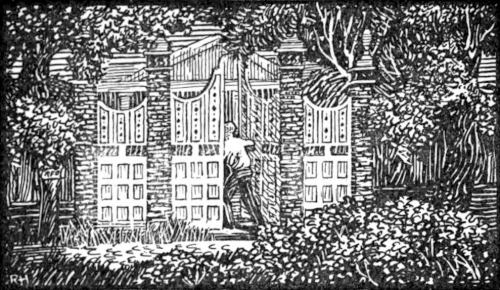
YOU are going to be very ill-mannered and stray on to other people’s property. Granted that fundamental impertinence you must be as nice as possible about it; graciously lift your hat to the proprietor when you see him. You should be as careful to do as little damage as possible; mend the hedge you have broken, put back the hurdle, avert your face if a lady is swimming in her private pool. In doing the trespassers’ walk it is as well to forego the happiness of a rigid rule. You take your compass; you decide, let us say, to go west southwest, and it will take you over commons, over ploughed land, village greens, graveyards, gardens, over loosely held but large and idle estates, perhaps through thickly propertied country. It is enough to do the walk roughly. You cannot follow a ruled straight line across sown fields and flower beds and through the lord of the manor’s kitchen. You must frame exceptions to the ruling of the compass, and be guided by the dictates of the heart and of good sense. The main idea is to see just what the land of a given country is like, and to enjoy it. You have the added thrill of not knowing whom you will meet and on what terms.
Of course, I do not guarantee that you may not come to grief. You may get on to the grounds of a very peppery squire who, resenting greatly your trespass on his land, will assail you in person, or set his keepers on you, or even let loose a fierce dog, or telephone the police. My experience is that you need not fear these chances unless you behave badly. Many landowners tacitly allow the neighboring villagers to wander in their grounds if they do not do damage. The parvenu comes and tries to clear every one out, and keep his pleasaunce entirely for himself, but even he, unless he be a Seigneur of a Channel island will not fire on a stranger at sight. The fact is, that in England anyway, there is no absolute right to keep strangers off private property. Formerly, possessed land was much more free to the use of the people in general than it is now. The tradition remains. No farmer objects to your walking alongside his cornfields or across his pastures. It is the people who enclose but do not farm who have most prejudice against strangers.
No doubt bitternesses over rights of way have hardened owners’ hearts; no doubt the breakdown of feudal relationship between squire and villager has helped to make the former a recluse; no doubt the increasing vulgarity and bad manners of people in general have made them less welcome in the eyes and on the estates of the refined and well-to-do.
But unless you do damage you are not committing a serious offense by trespassing. And the trespassers’ walk is so arduous that it can only be recommended to the few. It is worth while, not merely as an adventure, but as a means of getting a true notion of your native land. You can get it hunting; but then, not every one hunts.
One is inclined to think of England as a network of motor roads interspersed with public houses, placarded by petrol advertisements, and broken by smoky industrial towns. That England is a fair country few will deny, because you see beautiful cross sections of her from trains. But when you get out at a railway station, the vision of the carriage window is seldom realized. You are guided away from Nature, by gulleys and deep-cut or hedged roads. England becomes to you a dusty road, a series of dusty roads.
There are glorious commons here and there, and free woods, but you must travel to find them. You get tired of thoroughly tamed Sussex and Surrey and go to the Welsh hills or the Cumberland lakes. But England is more in Sussex and Surrey than it is in the mountains. Only it is enclosed, shut away, and marked “private.” Rain-washed notices put up ages ago tell you that Trespassers Will Be Prosecuted. And as we pray daily in old-fashioned phrase to have our trespasses forgiven we invest the idea of trespassing with some awe. So we keep to the road, even if we are out on a mere idle walk and not bent on reaching any given house or place. Even if you take a stile and leave road for footpath your pleasure is enhanced, and if you leave footpath for the “trackless” woods it is even further enhanced.
For the trespassers’ walk you should be lightly clad and shod, for you have to jump often. You can start at any point you choose, and take the guidance of the compass, or the sun, or some dominant landmark in the view. You then take a bee line and see where it leads you. As you are neither a bee nor a bird you cannot fly over hedges and walls, and you cannot go so fast. Every field presents its problem, but every field presents also its pleasure.
You will observe the different way the wild flowers look on the other side of the hedge that skirts the road; they are sheltered and fresh and more numerous and altogether more happy. Even that first field is a more pleasant place than the great highway.
The second hedge is likely to be lighter and more easy to get through than the first. You come into a broad meadow, and see beyond it the darkness of a woodland you have never entered. On the fringe of it the rabbits are playing. In the bushes are more nests, more fluttering of birds. You enter the wood. It is still and dreaming, apparently utterly unpopulated. It belongs to some quiet family living in a big secluded country house a mile away. There is room for a tribe where but five people and their servants are living. Naturally enough, you meet no one. You are in woodland which is after all but little visited though in the midst of crowded England. The berries on the blackberry bushes rot unpicked. No one comes seeking the many mushrooms. Even the rabbits are only shot at once a year—to keep their numbers down. You are treading on last year’s leaves, or the leaves of the year before last, on the leaf mold of ages past. England is carpeted under your feet. You delight in your steps, in the rise and fall of the land, in the sunny clearing and the vetch-covered bank where you sit watching little blue and brown butterflies fluttering about you.
No one comes to chase you off. At least you are not a trespasser until some one has seen you. You hear no one moving anywhere. You do not even hear the motor cars on the road you left. You have disenchanted the England of those roads. This is the real England, the England into which you ought to have been born, rather than that of curbed ways and tarred roads.
From the woods you emerge on to a fair pleasaunce, an upward-reaching greensward, flanked afar by a white house—the owner’s probably. Your eyes turn wistfully towards the house and its windows, but there seems to be no one there, it might be empty. There is not even a smoke from a chimney. You climb the green slope to another wood, and passing through it, come unexpectedly to a gap, no, a ditch, no, a country road, a lane, leading from you do not know where to you do not know what.
You go down into it; you climb up on the other side. You have entered a different type of property. You are in a turnip field, which you skirt. In your next field you see a fearsome animal all by himself, grazing at leisure, and it depends on your courage whether you will face the bull or make an exception to your rule of the game of the walk.
It is well to have a notebook and record the rules, by-laws, and exceptions of your walk as you frame them. In this notebook also you keep a personal record of the England you found the other side of the hedge.
Upon seeing a bull you decide to pass him in the spirit of an escaping torero, or you make a rule to meet the danger. You take a bearing by your pocket compass, and ascertain what tree or landmark you are naturally making for on the other side of the bull’s field. And having assured yourself of that, you reach it by making a detour.
Then, proceeding with your tramp, you go right through a farmhouse yard. If the compass directs that you should go right through the farmhouse you may go in and get some refreshment. You do not avoid the farmer and his spouse, or farm hands. They are part of your novel adventure, and are nearly always quite pleased to see you, even if a bit puzzled at your line of route.
It is just as well not to explain what you are up to. They will not take to it. They do not mind your walking across the farm with a given object, but will fail to understand your notion of following the compass. Assuredly they will think you rogue or mad. It is best to talk politics to them, talk of that terrible fellow Ramsay MacDonald and the dreadful doings of Labor; they love that. Your interest in the stock will not come amiss. You may ask also of land for sale, of estates falling vacant, and changes of ownership. They will tell you much about the owners of the land you travel over. The difficulty is in getting away from a farm and making the crazy exit that your compass dictates. There again a rule may be framed. You may select a point in view ahead and get to it conventionally, resuming your bee line across country there.
You are in for a delightful day or for delightful days of tramping. If you have a cottage in the country, as I had when doing this, you can do a few hours of this and then return by road or rail home, resuming, another day, at the point where you left off. On the other hand, if the weather is fine, there is no reason why you should not sleep out and tramp all the way to the sea. Only it will take longer than could be expected, as getting over hedges and walls and ditches and streams takes time. And it is more tiring than an ordinary walk on a moor or a common.
On a long tour of the kind you learn something about English life which is not easily obtained in a conventional way, and the experience should be filled out by learning the names and histories of estates and owners. If you have friends on the way you can have delightful accidental meetings and enriching conversations. If you are seriously studying English life there is no reason why you should not frankly call at the houses you see on the way and get what information you can. Some people may meet you coldly, a few boorishly, but most will be polite and friendly enough. Occasionally you will meet people who will be extremely kind and helpful. It is neither so wicked nor so dangerous to be a trespasser as might at first appear.
CHAPTER TWENTY-SIX
A ZIGZAG WALK
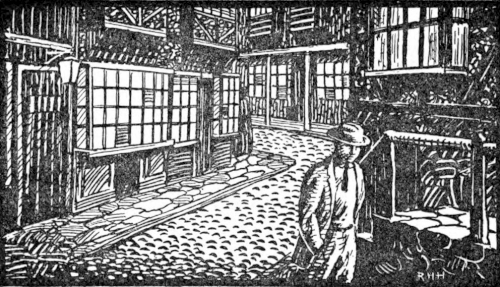
I HAVE mentioned the “zigzag” walk. Did you ever make one? Probably not, for it is my secret. I invented it. A frequent wish of the traveler and wanderer is to obtain genuinely chance impressions of cities and countries. He would trust neither his own choice of road, nor the guide’s choice, nor the map. But if he goes forth aimlessly he inevitably finds himself either making for the gayer and better-lighted places, or returning to his own door. The problem is to let chance and the town take charge of you, for the world we travel in is more wonderful than human plan or idle hearts desire.
One day in New York, wishing to explore that great city in a truly haphazard way I hit on the following device—a zigzag walk. The first turning to the left is the way of the heart. Take it at random and you are sure to find something pleasant and diverting. Take the left again and the piquancy may be repeated. But reason must come to the rescue, and you must turn to the right in order to save yourself from a mere uninteresting circle. To make a zigzag walk you take the first turning to the left, the first to the right, then the first to the left again, and so on.
I had a wonderful night’s walking thus in New York, taking cross sections of that marvelous cosmopolitan city. And many were the surprises and delights and curiosities that the city unfolded to me in its purlieus and alleys and highways and quays. That was several years ago. After New York I saw Paris for the first time, and wandered that way there. Curiously enough, I started from the conventional and tourist-stricken Avenue de l’Opéra, and the zigzag plan led me across the Seine to the Quartier Latin and Bohemian Montparnasse. I saw more of Paris in a night than many may do in a month. After Paris I tried the experiment in Cologne. That was after I had marched in with my regiment from the wilds of the Ardennes and southern Germany. I explored the city in that way. How unusual and real and satisfactory were the impressions obtained by going—not the crowd’s way, but the way of the zigzag, the diagonal between heart and reason.
However, the most charming and delightful associations of my zigzag walk are not those of the great foreign cities which I have known, but of our mysterious and crooked-streeted capital, London herself.
It was Christmas time and I said to my wife: “Let us do our shopping on the zigzag way.” We had not gone forth on such an adventure before, and were full of excitement, wondering where we should be led. What exactly we bought on the way I do not wholly remember, but London was generous to us in its cross section of houses and shops. On this occasion we started on the road of reason, since we had a definite purpose in view, and we took the first on the right, and the first on the left, instead of the first on the left, and the first on the right. It may be thought that made no difference. Believe me, all the difference in the world!
The first street we knew quite well, the second was an asphalt alley, where scores of children were playing hop-o’-my-thumb on the white-scrawled flagstones. The third street was one of the great film streets of London, with cinema stores from end to end and shop windows lurid with horror posters. The fourth turning brought us to the famous market of Pulteney, where all the surplus fruit and job lots of vegetables from Covent Garden are exhibited on donkey barrows, and cried by vociferous hawkers. Here we could buy two grapefruit on occasion for a penny, and the “rare and refreshing fruit” which the wizard from Wales once offered to the poor as a result of legislation could here be obtained by chance and in abundance. From the market we went by a crooked road from Rupert Street to Callard’s cake shop in Regent Street.
Happy forethought of London! We had coffee and mustard-and-cress sandwiches in this jolly shop, and bought a cake. Then we crossed Regent Street, bought two chickens at Louis Gautier’s in Swallow Street, and plunged for Piccadilly. We came out at St. James’ Church, and fortune was kind enough to make it possible to visit Hatchards. We went in and “browsed around” for a while and ordered a copy of The Sweet-scented Name. Our way was then by Duke Street, Jermyn Street and some others to St. James’ Street with its clubs, and we turned up St. James’ Place. As we passed Number Five, rat-a-tat-tat, from a little window; rattling and jumping like the sound of an old-fashioned motor, went the typing machine of the secretary of the world’s greatest newspaper chief. We thought we had arrived at a cul-de-sac and that we should have to retrace our footsteps—one of the natural rules of the walk—but we found an eye of a needle through which the rich men have to pass to get to the Paradise of the Green Park. It is always explained to the rich that the eye of the needle in the Gospel is only a figure of speech, and that there was a needle gate through which a camel, without too great a hump, could pass, and the alley from St. James’ Place will just admit the not too stout.
When we got to the fields beyond, the great city played with us and led us a comic dance along the paths of the Green Park. Westminster Cathedral was in view. There was a large balloon overhead in the murk of the London sky, and many people were looking up at it. Our steps took us along various grand crescents of pathway, and the intention of the city with regard to our ultimate destination began to seem very obscure. There were several knotty points as to which was a turning and which was not, and when I made an artful decision the companion of my way said to me, “You want to shape things to your own ends.”
“No,” said I. “I want to be faithful and just.”
A stiff discussion set in and we could not get the matter straight. However, we eventually found ourselves in St. James’ Park, and there was an issue for us into Birdcage Walk where, in the barracks beyond, we saw the soldiers at drill, though little did I think at the time that I was destined to drill there, and be on sentry there myself in time to come.
So the walk went on, and we passed the London Soldiers’ Home near Buckingham Gate, made our last purchase at a little shop in Wilfred Street, passed Westminster City School, and entered Victoria Street by Palace Street and took an omnibus home.
Thus ended the first lap of our zigzag walk through London, and we promised ourselves to return to the point where we had left off and continue this way of chance as soon as a convenient moment came.
Therefore, one Sunday afternoon, and not long after, we took the omnibus back to the corner of Palace Street and resumed. Fate allowed us to miss Victoria Station, and its many lines of rail, and we entered Flatdom and Belgravia, not the best part of Belgravia, but the sadder and more faded streets, the streets where the lamps of joy had died down and guttered out. Then we passed by Moreton Terrace to Lupus Street (“What a name for a London street!” says G. A. B. Dewar, in his sad tale of Letty—“Is not all London wolfish street for our Lettys?”), Colchester Street, Chichester Street, Claverton Street, streets of faded grandeur, the Embankment. Then over the river we go by Chelsea Bridge and find ourselves in a district hitherto unvisited by us.
We entered Battersea Park and had such a time in its mazes of paths that we were obliged to make a second rule for our walks, and that was that henceforward we should enter no parks. A friend to whom we had communicated the secret of our street adventure had warned us that if in the near future we should disappear from London life he would come in search of us to the Maze at Hampton Court, from which, he was afraid, once entered, we should never extricate ourselves. So we made a rule: No parks, no mazes. Incidentally, however, we spent a remarkable and amusing hour in that artificial wilderness of Battersea. If zigzagging should ever become fashionable I am afraid that most people will consider it de rigueur to follow out the mazes and labyrinths to the last intricacy and the correct issue, and that they will not have the courage to cut the Gordian knot as we did. And starting pedantically they will finish pedantically—in the literal sense, for is not pes, pedis, a foot. There were many Gordian knots which our footsteps made in the ins and outs of London.
Having given Battersea Park the go-by, we threaded many typically poor streets, not slum, just better than that. How deplorable a sight! Very poor and dirty houses which you feel moving to be worse, with broken windows here and there, and derelict barrows in the roadway. We passed under gloomy railway arches, so gloomy, as if crimes had been committed there, arches where at night spooning couples lurk or solitary bodies furtively eat fish and chips. So we came to a little house which, in the course of time, we ought to have visited, but probably would not, and there we called in our unexpected way—a call not without its sequence in our after-life. This was all in the realm of Lavender Walk and Battersea Rise. In one of the streets we came on two demure villas called Alpha and Omega, and very fitly passed from Battersea to Wandsworth.
Another day, in full fresh air, we walked along Bolingbroke Grove and the fringe of the Common and Nightingale Lane, through very respectable Suburbia, where the houses are just so, and there are plaster angels in the cemeteries. That day we went home from Earlsfield Station. Next time we passed St. Barnabas’ Church with the niches left in the bricks for saints. We made our exit from real London, watching from a railway arch the mad red caterpillars of tube trains going to and fro. The houses grew higher and the roads more spacious, and great elm trees were in the front gardens. With wild wind and rolling sky, ’twixt Putney Heath and the golf links of Wimbledon, we finished up one jolly afternoon by coming unexpectedly to tea at the house of another friend to which without jiggery-pokery the zigzag way had led us.
The next afternoon on which we ventured forth we wandered to sad Merton and the fringe of outer Suburbia. There were fields, but they had Destiny’s mark upon them; they were doomed to be imprisoned with brick by the London which was encroaching, encroaching.
Coming to this pseudo-country we made another rule. When footpaths occur we have the option whether to take them or no. (In future, as I have observed, all footpaths will no doubt be de rigueur.) A footpath took us to Lower Morden and another footpath took us through much mud, to farms, to old houses with meadows in front of them, and fine trees with many angles. The path degenerated from a rolling series of cart ruts to a faint track along the margin of a field, and faded away at last into wormrun grass. A dreadful moment. Presently, spying round, we saw a faded notice on a board—No Footpath—but,
Man is man, and master of his fate,
and we made another rule.
In short we cut across the fields to a row of houses protected by fierce-looking barbed-wire entanglements. We got on to another footpath and the footpath became a road and the road became a grand drive. I think we got to Blenheim Road, and that this degenerated to a cart track, and we were led over fields to the West Barnes Road, where trams and busses were running and we saw scrawled in front of us in big white letters—“Eternity—In Heaven or Hell. Vote Now.” We voted. Somehow we got to Raynes Park, and were much pleased with the front garden of Carter’s Seed Establishment and the many flowerpots and the ice plants.
Next day we reflected that we had become enmeshed in a net of our own contrivance. Our little plan didn’t at all fit in with the arrangement of the district. Suburbia, with crocuses in bloom, got rather on our nerves. By many circumlocutions we returned to Wimbledon. We did not know the name of the place was Wimbledon, but when we discovered this melancholy fact we realized that we had blisters on our feet.
Another day we walked to Malden, where we bought an excellent chicken which we took home in time for supper. Then by Sycamore Grove we walked to Poplar Grove, and by Poplar Grove we walked to Lime Grove, and by Lime Grove to Elm Road, by Elm Road to Beech Grove. We took the option of a footpath and skidded from this region of trees to the main highway, where the fine Hampton Court electric cars speed their handsome way. We went straight into Kingston without any more beating about the bush. We should ordinarily have gone in by the open highroad, but an alley forestalled that conventionality, and we entered by a wee way which took us inside the house of the parish, and we saw all the children playing everywhere upon the floor. Rather slummy. We passed Milner Villas (built 1902), we passed The Victoria, The Six Bells, and The Three Tuns, passed the Kingston Grammar School, where the boys have scarlet caps, and the Bunyan Baptist Tabernacle where the pastor had the kenspeckle name of Isaac Stalberg. There was a strong smell of marmalade from St. James’ Works, and Kingston Station was puffing with locomotive steam. Night had spread its glamour over everything, and we walked by several slums down to The Jolly Brewers, along paved passages and in the purlieus of the gas works, by further passages where were no houses, to the sight of the greenish mud-colored river and the rusty coppery railway bridge. The old stone bridge of Kingston also stood beautifully in our view.
When we returned to Kingston there was a lonely but lovely walk along Thames side, seeking a bridge to give us a turning on the left, with sun and wind and rain, and ducks falling through the air with a ssh, and cunning swans sailing forward expecting food, and crying gulls. It was the towing path toward Teddington Lock. The riverside houses came down to the water with lawns and landing stages, terraces, gardens, formal beauties. The Thames is a fair stream; we have made it fair. Once it was otherwise, and England also—unnamed, unloved, wild, woody, marshy. Man has made it dear unto himself. In the ever freshening morning we stood on the bridge at Teddington and looked at the waters rolling over the dam, and the green park land and the gardens beyond.
We wondered very much how we should depart from the other bank of the river, what direction Fate would have us take. But we never could guess in advance. Generally we would say: “I believe to-day we shall land up somewhere in the neighborhood of this place or that,” but our prognostications were never justified. Thus, who would have expected that having passed through Teddington we should arrive at the other side of Kingston stone bridge and be called upon to return to our starting point!
We wandered through an area of large houses possessing a certain sort of pomp and gloom, happy in the summer, not so happy in the winter. And then an area of little Hope Cottages and May Villas. Somewhere in the neighborhood of Seymour Road and Lower Teddington Road we came to a highly disputable loop of roadway which betrayed us to the return over Kingston Bridge.
We felt highly annoyed when we saw this main plank which we were about to be forced to walk. I, with Machiavellian cunning, proposed to return to that fatal loop of roadway and reinterpret its bearing, and we stood on the triangular refuge in the middle of the roadway, and discussed the point hotly. This is distinctly not a walk on which to embark with one’s wife. It reveals points of difference. It brings out the hidden crookedness of character, confirms all obstinacies and predeterminations. It is possible to get more excited over a trivial turning (mark you, trivial, a place where three ways meet) than over the most portentous decision in real life. I imagine it is always so. In any case, we stood on the triangle at Kingston and argued the point. Two stout policemen of the cinema picture type stood over on the pavement, regarding us and nodding their heads together. “What do you think is their little game?” one was possibly saying to the other, and they must have viewed me with a considerable amount of suspicion when I returned to that loop and obtained a heretical reading of the truth to suit my purpose.
“My dear Watson,” I hear the arch-detective saying, “the simplest of crimes are always the most difficult to fathom.” I think it would have puzzled the smartest of plain-clothes men had he followed us on our marvelous way from Kingston back to Kingston, or from Kingston the second time to Hampton Court.
“Onward to Hampton,” said I. “We cannot tell what joys await us there.” We went into Bushey Park, thus infringing one of our own rules, but there was an excellent road going through, and we liked to see the deer grazing near us, like cows. Fortune led us into Hampton, that gay and lively river town, and from Hampton we wandered among gray reservoirs and green embankments to Sunbury. Possibly Fate intervened to punish us for our refusal to pass over Kingston Bridge, for soon we found ourselves clinging to the Thames. It was March by now. The blackthorn was in bloom, the japonica and the almond were in blossom, the celandine was in bud, and birds were singing everywhere. At Ashford there were lots of daffodils, and I remember we passed the girls of the High School all walking in crocodile and looking very frisky and fresh, despite the primness of the teacher.
We came to the pretty and rural village of Laleham, Arnold’s village, with its old church with thickly ivied tower, ancient yew trees, and graves of the Arnolds and of the village. There were two goodly inns, the Turk’s Head, the Three Horseshoes. At the latter we had tea, and we learned that Arnold’s house had been pulled down and the present National School had been made with the bricks.
We walked along the towing path once more, but it was now a full, rushing river and was often in flood, well over the bank. The Thames had a wild aspect, reflecting livid clouds. An icy gale whipped the stream. There was a rush of snow, and the storm raged across the whiteness of the horizon like smoke. We sheltered in the coping of deserted river houses, and in order to make progress when the storm abated were obliged to walk on the iron rungs of railings. Even so, we did not escape many a bootful. In this way we passed Penton Hook, and reached, fairly and truly, Staines, one of the bright capitals of Father Thames’ kingdom.
At Staines we took the bridge, or rather the bridge took us over to the other side of the river where we waded all the way to Runnymede and Magna Carta Island—the way all Kings evidently have to go. But we signed no charter of rights. Had we worn crowns we stood in more likelihood of imitating that other remarkable feat of King John, by losing our symbols of royalty in the flood. We were slaves of the road, and the road led us into the water. I think we should have got to Windsor Castle and might conceivably have called on the King himself, the latest after King John, but the water gods intervened, or Pan had other things in view. For I was warped, we were warped away to Egham and Virginia Water. I was able to call on my artist friend, Helen Cross, who at that time lived at Egham and was doing the emblems for my idealistic first novel Priest of the Ideal; a joyous surprise visit, for I could not tell her in advance that I was coming. I did not know whether the zigzag way led to her gate. However, many nice people and some others are on the zigzag path in the jig-saw puzzle of life.
We went from Egham to Thorpe Green and Englefield Green. We went down Prune Hill and to Whitehall Farm and the length of many a longish country road. It’s a long lane that has no turning; in fact we were often comforted by that proverb and never found it disproved. All roads in England, except the horrible cul-de-sacs (which, pray you, avoid) have turnings to the left or to the right, according to the heart or consonant to the reason. The crookedest has some reason in it, and even the worst, though it has a way in, has also a way out.
From Virginia Water the zigzag way leads on to Kennaquhair, and further to a place which I have sometimes heard called the “back of beyond.” At the same time, it may be said that you will not know the name of the place until you get there. You can put no destination label on your rucksack, and if any one asks where you are going, you may tell him in confidence, whisper the dreadful fact in his ear—“honestly, you do not know.” The adventure is not getting there, it’s the on-the-way. It is not the expected; it is the surprise; not the fulfillment of prophecy, but the providence of something better than that prophesied. You are not choosing what you shall see in the world, but are giving the world an even chance to see you.
I am still on that zigzag way, pursuing the diagonal between the reason and the heart; the chart could be made by drawing lines from star to star in the night sky, not forgetting many dim, shy, fitfully glimmering out-of-the-way stars, which one would not purpose visiting. I said we would not enter a maze, but we have made one and are in one, a maze of Andalusia and Dalmatia, of Anahuac and Anatolia, of Seven Rivers Land and Seven Kings. The first to the left, the next to the right! No blind alleys. A long way. Beaucoup zigzag, eh!