Front matter (continued 2)
Reading edition
But was life merely meant for pleasure? Perhaps not. But it was meant for happiness or for the quest of happiness.
You are more likely to meet your enemies, if you have any, upon the road than off it. But then also you are more likely to meet friends there, too. You may seek your friends with success on the road. And if you wish counsel they are there to help you. “Life is like a road,” says a Kirghiz proverb. “If you go astray it is not your enemies who will show you the way, but your friends.”
Still, where the Kirghiz live, in Central Asia, there are few roads and you cannot go astray on them. The proverb must refer to mountain tracks. “Life is like a mountain track.” Yes, that is better. Let the mountain track be our first emblem of life.
For the Sokols and the Scouts, the roads shall mean much more, because their lives are auxiliary to military efficiency. They learn to be ready to resist an enemy of their homeland. A good scout becomes a good volunteer soldier, a good route marcher. But scout and sokol are transitional. The Scout movement is like a tug to take an ocean-going ship out of harbor. There comes a point when the ship can make its destiny under its own steam. The Scout and Guide movement helps boys and girls out of the rut of home and village, starts them moving, and once set going, many of them keep moving all their lives and never once stagnate. On the roads that lead out into the great world they march in their companies, with scoutmasters and commanders. Then the road is a glorious symbol of freedom and life.
The second emblem is the river, which, clear and innocent, finds the easiest and most charming way from birth to eternity. We were born on an invisible river which keeps gliding and singing and filling and flowing. We do not know where we go, but we know we are on the stream. We do not always perceive the movement, but we observe that the landscape has changed.
So when we look on a river we are affected by its hidden relationship to our own life. The river interprets our mood. The road suggests God as a taskmaster who would have us work; the river suggests Him as a poet who would have us live in poetry. The Creator must be a poet—not a General or a Judge or a Master Builder; there is so much of pure poetry in His creation. The river, like a child’s definition of a parable, is an earthly story with a heavenly meaning.
When we look on a river with a poet’s eyes we see in it the reflection of an invisible river, the river of Time, the river of man’s life, the river of Eternity. “Man may come and man may go, but I go on for ever.”
There is a strange and wonderful vigilance about the river which rolls past us where we sleep in the grass, murmuring and calling the whole night long, something of the vigilance of the starry sky. You sleep, but an eternal sleepless sentry paces by all the while.
Then in the morning, when we bathe in the river, we are our own John the Baptists, out in the wilderness, baptizing ourselves with water, and saying: “Repent, for the Kingdom of Heaven is at hand. Turn away from the road for Heaven is near by.” And we eat that wild honey of the wilderness, which the prophet ate when his baptizing was done.
When we wash in the stream we are washing ourselves with life. When we swim in the stream, especially against the stream, we are joying the heart of an unseen Mother who takes pride in us all, knowing that, although we must at last flow out with the stream, we can triumph over it for moments.
And, drinking from the stream, we partake of the water which flows from the mountain of God—Nature’s communion cup.
The third emblem of life is the wilderness—that place to which wise men and poets and saints are driven in the last resort. “There is a pleasure in the pathless woods,” wrote Byron. “There is society where none intrudes.” The wilderness tells you more, when you are attune to it. That is seldom the experience of the tramp on his first long divagation from the beaten track. The wilderness tires him, the forests blind him, the mountains wear him down, the endless plain rises under him and he smites his feet.
But there comes a point when there is a symmetry even in the wildest disarray of Nature, when man’s symmetry of parks and garden cities and roads and rides is a poor joke, a strange aberration of the human mind.
The universe is a most complicated lock with innumerable wards and windings and combination numbers. If the starry sky at night is a lock—you would say there is no key in the world to fit it. No key in the world truly—but in the human heart somewhere there is a wonderful key. “Have I not in my bosom a key called ‘Promise?’” said Pilgrim. When you find that key you can plunge it into the cunning aperture of Nature or Night. But you must know the combination numbers, and even then it will not turn if you do not first sing a verse of the Song of the Heart.
Quite a fairy tale. Even so. Life is a fairy tale, one of a series, like the Arabian Nights. And if it is a fairy tale rather than what Darwin and Herbert Spencer and Einstein have averred, how much more important to us all the fairy tale becomes.
Fairy tales are begun in the midst of woods, in strange forgotten glades, and at moments between dawn and the morning, and sunset and night.
“Fairy tales,” wrote Novalis, “are dreams of our homeland—which is everywhere and nowhere.” And to be everywhere and nowhere at the same time means to be in the wilds, and preferably quite lost. The absolute tramp, whom, I may say, I have never met, is a man with no address, no card, no reliable passport, no recognizable finger prints. But of course he is no ape man, no Tarzan, or son of Tarzan. Choice, not accident, leads him to the wilds.
The starry sky is the emblem of home, the highest roof in the universe. The sun is the mind, by whose light man seeks his way; the moon is the reflection of the mind on the heart, and is the emblem of melancholy and poetry.
However, of all these emblems, the coffeepot is apt to be the most real and vital. You will be on your knees morning and evening before your altar fire, abasing your brow and blowing the flames which are beneath it. Sun, moon, forest, river, road—these pass, but the coffeepot remains. It is so in life generally, and the tramp, however much a poet he may be, is a mortal like the rest of us. The moon may be hidden by a cloud, but that is not nearly so calamitous as having left the coffeepot at the last camping place.
CHAPTER TEN
THE FIRE
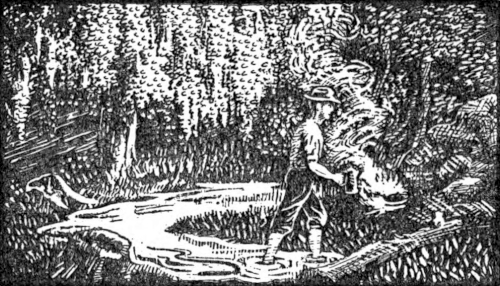
DO not forget the matches! Our dear friends and the girl guides can imitate the savages, and strike a light by rubbing two sticks together, or they carry steel and flint and tinder, and are always ready with a spark. But that is beyond us. It is difficult to light the two sticks. Remember the odd scraps of dry paper—especially on a wet day. Even a scoutmaster finds difficulty in making fire with wet sticks.
Making a fire is a considerable diversion.
Unless you are very hungry it should take time. You find the suitable place, fix your stones, gather the wood, fill the coffeepot, make yourself at home, and only then strike the match. It is a mistake to light the fire before the coffeepot is ready.
You will ascertain the direction of the wind, and put down your knapsack in a position where sparks will not fly on to it. And you will place your stones or tripod in such a position that the wind will drive the flames on to it. If your coffeepot is on the wrong side of the wind it may take a long time to boil.
You must be careful to choose stones which are high enough and ledgy enough to afford a draught for the fire, and a secure lodgement for the coffeepot.
To start the fire you need the thinnest and tiniest of bits of wood—the little dead stems which lurk in the grass. The long dry stalks of withered wild flowers are even better than wood, and if you have these you need no paper to start the fire. They burn like dry stubble—which is, in fact, what they are. Dead grass, however, is of little good; it burns, burns out, smokes, and gives little heat.
The second line of fuel is the smart little bits of crackling wood to be found nearly everywhere. The third line is of stout bits of wood. The fourth, if you feel like it, is the really substantial timber you may haul to the scene. To boil your pot you do not need this last, but, remembering you will sit an hour or so by the camp fire, you do well to have a supply beside you.
The fire laid, lit, crackling, the pot warming and heating, you may relax your attention, spread out the victuals, take off your boots, enjoy the beginning of the night’s rest. It is wonderful coffee that comes out on these occasions. You might not care for it indoors, but you revel in it as the product of your own camp fire.
You may have difficulty in lighting your fire in the damp, but it can be got going even in the wettest weather, granted, of course, that there is suitable fuel. The secret is to possess plenty of paper. You prepare a number of balls of paper and put them in a dry place until you have collected fuel. Your fuel will be first of all withered stems of weeds and bits of perfectly dead wood. If there are trees about look for dead branches in them. A dead branch in a tree is always drier and more combustible than a dead branch in the grass. The wet on it will prove to be surface damp, easily dried off. Be careful to avoid a very wet base for your fire. A rocky ledge or heap of stones is better. Having that, then even in drenching rain you may start your fire, carefully sheltering it with waterproof cape or blanket, while with the burning paper balls you dry and inflame the withered weeds and dead wood. Very soon you will have a flaming fire which has the heat in itself to dry its own fuel, even if it be both substantial and very wet. Get a big fire going, and you can defy the elements. Should you be traveling in the vicinity of a railway line you will often find many bits of coal scattered from locomotives. These are not to be disdained on a rainy day, as they greatly add to the heat at the bottom of your furnace. You fight the wet with heat rather than with flame. It is a pleasant triumph on a rainy day to watch your pot boil on a gay fire, and to feel the clothes on your back a-drying all the while.
The fire in the rain is a triumph; the night fire in darkness under the stars is the happiest, but it disputes happiness with the dawn fire. Remember that on the black patch of your evening fire you will rebuild the bonfire next morning after your night à la belle étoile. It is commonly more easy to light the fire in the morning. There may be dew, but you have a dry patch to build on. If you have had forethought you have covered both the place and some dry fuel to make easy your morning task. You are less tired, less excited, in the morning, and you know just where to look for the auxiliary fuel, the stuff that makes the first little fire burn up well.
I love to see the blue smokes crawling upward in the dawn, while, with bare legs, one struts about doing the domestic work of morning out of doors. It is part of the very poetry of the tramping life. You give a proper affirmative then to Browning’s
Morning’s at seven All’s right with the world.
Only morning is apt to be at five, and then the world is even more all right than at the bourgeois hour of seven.
The good tramp does not spend too long, however, by his morning fire. It is his best time for being on the move. All Nature’s loveliness awaits him as, with gossamer in his hair, and light burden on heart and shoulder, he fares forth for the day. He makes his coffee, and then carefully puts out the fire, so as to be sure not to start some conflagration on the waste or in the forest. And he goes onward toward midday, and that other fire which is midday between the other two. Then he seeks a shady place, a happy resting spot, viewing the mountains, or beside a stream for preference. And once more, God’s open-air kitchen is smoking.
CHAPTER ELEVEN
THE BED
Rise with the lark and with the lark to bed, Observe some solemn sentimental owl; But first, before we make ourselves a fool or fowl, Let us enquire if the larks have any beds at all.
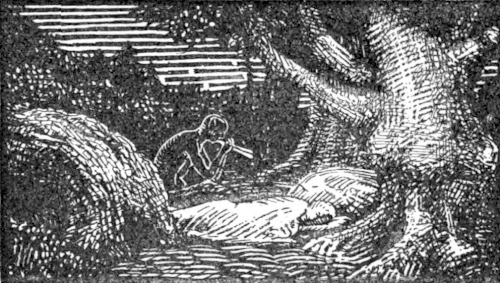
THEY have, they have. The tramp is a lark of a kind, and makes a little nest each night. It is apt to be a pleasant place. There are few “restless pillows” in the open-air bed. England, of course, is not the country for it. There is so much rain and dew that the sleeper out of doors is like to develop fungoid. But in America the ordinary population is so épris of the fresh, uncovered night, that nearly everyone outside the great cities sleeps at least on the porch, or in a garden hammock slung between trees.
I am prejudiced in favor of that kind of tramping where one sleeps out. Strictly speaking, if one sleeps in hotels or houses, it is not a tramp but a walking tour. You cannot afford to be divorced from Nature, and the winds at sundown. The continuity of day and night in the open is golden gain. The objections against it in a dry healthful climate are commonly trivial. For instance, danger. Some think it dangerous. They believe they may be attacked by robbers or by wild beasts. But robbers do not search the woods and the wilderness for likely victims. Unless, by your behavior you should attract attention, there is not the slightest risk of interference on the part of man. I can imagine some rather rich dandified intemperate pair going singing along the road from some wayside pothouse when they have incontinently advertised their intention of sleeping out. The bad lad of the village, or some local wag, has overheard, and determines on a hold-up. The victims have themselves to blame.
As evening comes on, the tramp should become more shy. It is a mistake to choose one’s evening camp in full view of the highway. For one’s own subsequent peace of mind it is better to have been unobserved. Though if you are a stout fellow, why worry? I have had midnight visitors before now, and have stirred up the embers of the fire to make another pot of coffee, but it has generally been pleasant and interesting, a diversion.
As regards wild beasts, that is a danger greatly overestimated. If you are thoroughly wild, the wild beasts will know it and respect you. They much prefer to bite the white, the soft, the civilized and the timid. The puma is an unsociable lady but she may generally be reckoned upon to leave you alone, even if she does resent your sleeping on her grounds. The bear, with his inquisitive snout, may come snuffing for your provisions, but he will not attack you unless you are going to attack him. It should be understood that wild animals have an uncanny power of sensing your state of mind and your intentions. They know if you are scared, and they know if you are going to jump up and strike at them. They know also if you have no fear, and if you are friendly. If you are calm and easy-going you can often make up to a bear and feed him. I imagine that was the secret of those early Christians who were famous for their friendship with the fiercest of animals.
More dangerous, however, are reptiles, and one should avoid lying down in a basket of snakes. In a snake-swarming country it is as well to avoid caves, especially those with many ledges. Dry ditches also, though sometimes attractive hollows for the spreading out of bedding, are often the home of snakes. You have observed them there by day. They remain at night. As regards the open, it is easy to beat out the brush so as to make sure that no rattler is going to be disturbed later on. Sleeping against walls has also its dangers, not only from snakes but from scorpions. The scorpion is a loathsome creature; even seeing one is rather a shock, and the bite is reputed to be specially poisonous. In tarantula country a sleeping bag or a hammock is preferable to a bed spread on the ground. But when all hazards have been considered, a bed out of doors is safer than a bed in a house. The roof will not fall in; there is no danger of fire.
Experience, however, tells when it comes to choosing a resting place and making it comfortable. It is not a happy thing to plump down at the end of the day at random upon feeling tired. You cannot sleep pleasantly on a heap of stones, or in a marsh, or on a canting surface. You need to think of the chances of rain, or of mosquitoes, or creeping damp.
The commonest mistake is that of leaving the choice of a resting place till too late. It is sometimes fantastically difficult to make oneself comfortable if one starts about it after nightfall, or in the late twilight. You need time. Any time after five o’clock in the afternoon, should you come upon an ideal spot for spending the night, it is better to give up tramping for the day there and then and take over your billet.
If it is raining you need the shelter of heavily foliaged trees, or of a cave, or of an overhanging rock, or of a bridge over a river, or of a barn. If it is at all likely to rain you need to have such refuges near you, so that you can decamp readily and easily, and without mislaying half your kit. Of all these, the overhanging rock is the most pleasant, and like it, the large slanting tree trunk, or some protruding bank of earth and turf.
Rain is not such a calamity in the tramp’s night as might appear, though a long spell of rainy weather may be depressing. Even if one gets a little wet at night it is not too unpleasant. I have known pleasure in a soaking night out of doors. One reckons, however, upon sunshine next morning and the chance of drying off before ten o’clock.
Much discomfort is caused by stones at night.
“Stones Thy pillow, earth Thy bed,” says the Lenten hymn, but earth thy pillow, stones thy bed, is more in the natural order. The tired body finds the stones but the hand does not. It is well to make a good clearance of stones from the natural hollow you have chosen. A goodly stone may help at the head, but the best pillow is generally one’s pack, or one’s boots with a softer covering.
If possible, it is better not to settle down to sleep on sloping ground—for you slide all night and may slide into a much worse position than that originally chosen. In the mountains, where there is little level ground, it is better to seek a hole or a hollow or a natural shelf or recess. If you have to sleep on the edge of a precipice, it is as well to choose a place which has the chance barricade of a tree or a bush or a rock. Tramps are much afraid of rolling; but if proper precautions are taken one can sleep even where the eagle builds.
In the valleys, it is well to avoid sleeping too low. Inviting dells are often covered with but a thin carpet of sun-dried earth under which is bog. Marsh damp creeps upward in the early hours of the morning, and you wake in an unpleasant fog. Insects and reptiles abound in such places, and a bad night with them may spoil a good day.
There are so many ideal spots for sleeping the night, and they are so diverse that it would be folly to catalogue or to enumerate. You see them as you go along. You get into the habit of spotting them. Even in the morning you remark as you go along: “Ah, a good place for spending a night!” It is a little like choosing villas in a locality generally agreeable. One has this point, the other has this special convenience.
The view counts for a good deal. Night is a visit to the opera. You want to see all the stars; you want a good stall. The views of the landscape, of the trees, of the sky—these are charms of residence.
You suit yourself regarding shelter from the wind or exposure to the wind, southern aspect, and all that. Some like to lie in the wind, others in the calm. As regards aspect, it is not where the sun shines at noon that interests you, but from what gap it dawns. Moon aspect also is not an inconsiderable matter.
As regards mere comfort, much may be done if there is time. You can make yourself a mattress of wild flowers, and wallow like a tramp in clover. You can pile up dried weeds under you. You can improve on your pillow, smooth down your lonely pillow, in fact. You can ingeniously use various contents of your knapsack to give more warmth or softness. Those who feel the cold can put in hot rocks.
The hot rock is a cowboy device. You take some fair-sized stones, heat them in your camp fire, then wrap them up in whatever comes handy and place at the foot of the bed—this gives a sort of hot-water bottle. When tramping in high mountains you almost inevitably approach the snow line at times, and it is cold even in July. The hot rocks come in useful. Personally, I do not feel cold much, but I have tried hot rocks and have been surprised to realize that they retain their warmth even till morning. Their chief drawback is the scorch they may give you if by chance you undo the wrapping and put your leg on a naked stone. Some walkers get so enamored of hot rocks that they will sleep hugging a big one to their bosom.
Of course, one soon discovers that a night in the shelter of a great rock is warmer than a night in the unprotected open, and a night in a cave warmer even than that. Caves facing westward over the sea keep the sun low in them all night; caves on the western sides of mountains do the same. But this does not apply to profound caves which may be very cool. A night in a cave is an adventure, but it is likely to be less pleasant than a night outside. The floor of a cave is uncommonly hard, and a ridge in the floor may wear you out if you try to sleep across it. The pleasant part of a cave for sleeping is the mouth of it. It is just as well, by the way, to make sure that the cave is uninhabited before establishing yourself for the night.
In more civilized parts I have spent very pleasant nights under bridges. I cannot recommend railway bridges, as the trains shake down dirt, but river and road bridges have frequently very sweet natural homes for wanderers, close in where the first timbers meet the ground. One should, however, arrive in time to choose a place which has not been used before you by some domestic animal, since you may find insects in such places.
In certain countries the hammock is an ideal convenience for sleeping, but it needs getting used to, and there are some people who always fall out of them in the night. In the jungles of the tropics or of subtropical countries, it is the accepted mode. You need enough mosquito netting to swathe your body three times and, wrapped in that, you swing in your boat of rope.
CHAPTER TWELVE
THE DIP
SOME tramps have a groundless fear of water. In Russia they call it vodaboyazn, which means simply “water fright,” and is a better word than hydrophobia, which means the same thing, but is connected in the mind with mad dogs. Here, no mad dog is in question. Water: a liquid recommended for external use, is greatly despised by certain winebibbers who affect to be afraid that it will get into the wine. The fact is, most of them have got the water fright. After a stout bottle of Burgundy and a cigar, what more dreadful torture can be imagined than sitting under a fountain of water. It is better to sit in an old leather chair in a Piccadilly window than on a chair in the rocks under a flowing cascade. “I am for that Piccadilly window,” says the confirmed lizard—and not a few tramps are at one with the clubman. However, once you get the water fright it is almost incurable, and perhaps not worth writing about.
Coldness of the water is a prejudice. The coldest dip in the sea is easier to take than the ordinary cold bath in a cramped bathroom. The immediate activity of the body conquers the cold. In a bathroom most people have to be painfully passive. But truly, in those seasons of the year when one is able to sleep out of doors one need not fear the temperature of the water.
The morning swim is such an embellishment of the open-air life that many are tempted to plan their whole expedition with that in view. Thus they would rather tramp along the sea-shore or in a region of many lakes than traverse a region of little rivers and springs, but no water of depth. The dip means a great deal extra in happiness, health and vigor. I think I prefer the lake to the sea—that is, after a night out of doors. It is colder and fresher. Its unruffled gray and silver seems to have been spread specially for you to plunge into.
It is a different matter to come from an hotel bed out to the margin of the mere and wade into early morning loveliness. That is good, but it is not the best. You miss the continuity of experience. A night with the moon and wild flowers, with fleeting clouds and seeming-fleeting stars, with cool and warm airs wandering, with wood whispers and the nightingale’s song, has its fitting envoi in twenty minutes’ plashing after dawn. Nature learns that the tramp is awake.
You scoop a coffeepot full of water from the same pool wherein you bathe. You see the coffeepot standing on the bank like a faithful bird awaiting your return from the water. Mother-naked, you plunge and strive and indulge in various forms of joyous excess. The gray dawn sky above is gentle as loving eyes. The blue smoke of your fire has lost itself and plays with the morning air as you do with the water.
After that, still dripping, you carry the coffeepot to the fire. You dry as you walk. It may be your pleasure as a man to return to the lakeside and shave. You stand in the freshness with no one near and brandish a lathered shaving brush; you may not get all the hair off, but what more delicious shave than this!
The next item in the program may be the morning wash. You can wash out a shirt, a pair of socks, a towel, the sugar bag, what you will, and dry them as the morning sun warms up. This is a necessary matter now and then. It is not convenient to save up bits of washing for some village lass to do, or for some town laundry; it means delay in uncongenial places.
The dip is also associated in the mind with fishing. Dawn is the hour when they jump, and the angler-tramp loves the dawn shadows of the morning twilight. He catches his breakfast before he bathes, guts his fish, gets ready his frying pan—for you do not want to wait too long for food once you have been in the water.
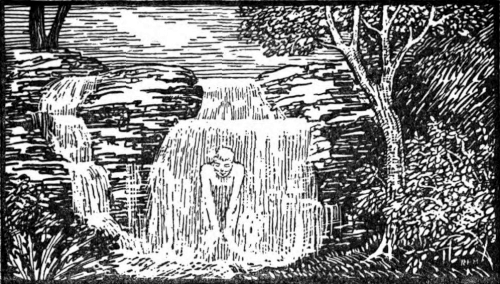
But it is not only at dawn that one bathes. Any good stream or pool at any time is a good pretext for a dip. There is some danger of overdoing it at the beginning, especially when it is sea bathing. The afternoon bathe is sometimes tiring, if one has bathed also before noon. A good plan is to bathe morning, noon and night, but not too long at any time. If you are a thoroughgoing lazy tramp you can sun bathe for an hour or so also, but of course you will not get far along the coast in the course of a day. In lake and sea there is the temptation of swimming, but most commonly, in mountain tramping, swimming is not possible. The rivers are too tumultuous, the lakes are boggy or shallow. But there is considerable pleasure. No happier noontide can be imagined than on the stairs of a cascade where a little river, plunging from a pass, makes its rocky and foaming descent to gentler levels. You sit well inside a water-worn slippery armchair, while living crystal comes down on your head and neck, on shoulders and back. In the Rockies and in the Alps, in the Caucasus, and in the Carpathians—wherever there are mountains, there are such places and such delights.
When you reach the snow line there is pleasure enough in snow bathing, though one should beware of it when the body has got very hot with arduous climbing. The snow often has a comparatively solid crust, but when this is broken it is soft underneath. It depends on your constitution whether you can stand it at a high altitude, but otherwise it is pleasant sometimes in mid-July to plaster oneself with the so-unfamiliar snow.
The evening swim, too, is a pleasure, taking the tiredness out of your limbs and adding to the happiness of your relaxation when, later, you lie with your blanket over you under the stars. It has not the joy of the dawn swim, not the joie de vivre of that of noontide. But it has the peace of an evening hymn or child’s prayer. If you are a Celt or a Slav, it has melancholy, the poetry of sadness. It tunes the soul to the night mood and the awakening of the dim stars and the coming on of that intense silence, that stopped breath of Nature, which one senses in the first hours of the night.
From baptism comes grace. The spirit of the water has found place in the bosom of the wanderer. He may be a pagan at heart, but he has come nearer to being a Christian if he has thus bathed three times a day.
CHAPTER THIRTEEN
DRYING AFTER RAIN
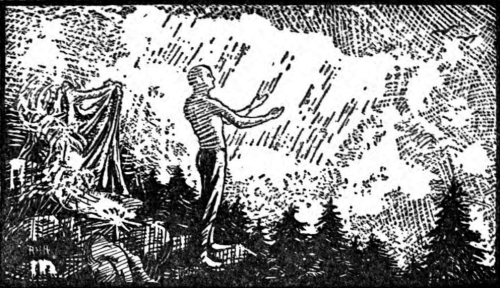
WET weather is not the tramp’s worst enemy, but it leaves him with the problem of drying his clothes. It may not damp his spirits, but will probably damp his attire. The walk in the rain, or worse than that, the walk through rain-laden thickets after the rain has ceased, the night slept in the rain when it begins to drizzle at eleven and you think naught of it, and to rain steadily at twelve and there is no refuge, and to pour gently at one and in torrents at two, and it is all the same because you are already as wet as can be—these are modifications of Nature’s blessings, pleasant or unpleasant in themselves according to taste and breeding, but having, as a natural sequence, the common duty of drying.
The wet dawn peers through the trees; pale morning looks faintly upon a washed-out camp, and two Rip Van Winkles, feeling a hundred years older, lift up heavy and rusty limbs, and reflect that it has been a wet night. The problem is to get dry.
The first means is a fire. Grant the matches have kept dry; or if they have not been kept in a canister, that one of the tramps happens to have a briquet! With a petrol lighter one is independent of wet matches. Then the fire must be carefully begun, nursed and nourished. Perhaps one can find an old ruined and red-rusty bucket on the waste—a gift of Providence. The fire may be well started in that. If you feel cold you may bring fuel to the fire spot on the run—dead fuel of branch and withered weed, heaps of it. One needs to get a good fire going, a big fire, a drier. “It can be done,” as a millionaire self-made man used to say. “Can’t must be overcome.”
You know at sight when your fire has got the upper hand of the surrounding damp. That is your moment for executing a war dance around it. The longer you dance the quicker you dry. But do not forget reserves of fuel. You need a fire on which you could roast a sheep. For you have to dry, not only your clothes, but the blanket, the knapsack, and your spare linen. You find a corner for your pot. It will boil and provide coffee while you are engaged with drying.
Somehow or other the blanket has to be hoisted up on to a line. You need string, which I hope you have brought. If there is a tree or a telegraph post or any other post, or preferably two convenient trees, two convenient posts, you can tie up the blanket and let it dry in the heat of the fire. If these are absent there may be a corner of a wired enclosure. You must shift your fire to the place where you can rig up the blanket. It is seldom that absence of uprights of any kind reduces you to holding the blanket in your own hands in front of the fire and drying it so.
Indeed, if no convenience offers, you may simply dry off your clothes and then tramp on till you find a spot better equipped for blanket drying. You will not, as a rule, have to tramp far.
Clothes, however, do not dry as quickly as expected. Especially the tweed jacket and its shoulders take an unconscionable time a-drying. It is not good for one’s health to tramp with a heavy knapsack on wet shoulders. The weight drives the damp inward, and as the back warms and perspires it takes potential rheumatism from the steam of the jacket. A night out in the rain will not give you rheumatism; many nights in the wet will not give you rheumatism. It is not getting wet which gives you these pains, it is the way you dry. You are, in fact, safer scampering naked in the wet than drying slowly in a heap of wet clothes. Perhaps it is not amiss to remark here that a waterproof worn over wet clothes is a sure way to cultivate rheumatism. The damp cannot escape outwards—and so goes inward to your very bones.
Your shirt will dry quickest and easiest. Wearing that, you can dry the rest of your clothes at the fire, the lightest first. If your boots are soaked it is better not to try and dry them by a fire. Leather liketh not fire. There is little harm in wearing wet boots and trusting them to dry themselves as best they can.
It is a happy occasion, this of drying off. One’s spirits are naturally exalted by it. It is victory of a kind. The tramp sings as he circles the fire. There is a music which belongs to the mood, and it is a pity no great musician has composed “While waiting for my clothes to dry by an early morning fire.” The musicians have not tramped enough.
However, in this light-hearted frolic, let us not allow our linen to be ruined. Beware of the long flames which try to lick your trousers as they hang there in the wind; beware of the scorching heat which browns and ruins a shirt; beware of the showers of sparks which rise when you throw a new log on the fire. For some good reason, sparks are more plentiful after rain than in the dry. Your fire may be sending up sparks all the while, big, substantial living sparks, which, settling on your drying blanket, may fret it with holes. I have had a blanket made holey by this before now. The spark settles on the wool, ignites it gently, and starts a hole which may be as big as a cigar end before you notice it. As the blanket gets nearer being perfectly dry you need to retire it from the intimate ardors of the fire. Your fire, in any case, has been getting hotter and hotter. You have not noticed that it is beginning to scorch your clothes and your wraps.
That is the way of drying off. It suits all weathers. But if, while you are engaged upon it, the sun breaks forth, promising natural heat, you may relax your energies from the fireside and place your hopes on the morning warmth. Nothing is more delightful than the sun bath after rain. You enjoy it, your clothes enjoy it, blanket enjoys it, knapsack enjoys it, coffee enjoys it. As you are all spread out on the hillside the butterflies settle on your bare chest trying to take honey from you, and flit thence to the knapsack which, perchance moistened with sugar, gives an even pleasanter reaction to the proboscis of a Vanessa.
A third dry-off is in a farmhouse at the kindly hands of a farm wife, who hangs your blanket and jacket in her kitchen, while her husband regales you in the parlor with homebrew and a hunk of fruit pie.
There are other less satisfactory ways of drying; using newspapers as blotting paper and stuffing the legs of your trousers with them. But first find your dry newspapers. Another method is to get up into a tree and sit there till you are dry. The last I have tried, but shivered so steadily that I gave it up, resumed my way, and walked myself dry. It is part of a genuine tramping outing to get once thoroughly wet—and dry off.
CHAPTER FOURTEEN
MARCHING SONGS
MAN is a singing animal, but civilization has silenced many songs. In so many places I see exposed the lugubrious mourning card—SILENCE! Silence in court, silence in the office! How annoyed we can get to feel when some one begins singing in a carriage of a train. We crave silence and our newspapers, silence and our pipes. We will not sing or listen to singing on the way to our work. Indeed, singing is not fitting; we might rather sing coming home but not going out. But coming home, we are all in too much of a hurry, and the crowds irritate us, and we have not had our supper. To tell the truth, we had but a slight lunch and no wine. We never got into the singing mood.
Our mentors are against singing. “Sing in the morning, you’ll sob before evening,” says one. “Sing on a Friday, you’ll weep on the Sunday,” says the Catholic. Children sing naturally and exuberantly on any and all occasions, but father and mother and elder brother and uncle and friend cannot bear it. Send them to the garden, send them to the nursery! We so dislike random singing that we pay street musicians—to go away, and they have learned that bad singing brings more coppers than their better efforts. They are professional irritants.
Yet singing is very natural, and when one takes to the road the singing impulse comes to the bosom. Light-heartedness begets song. We sing as we walk, we walk as we sing, and the kilometers fall behind. After a long spell of the forced habit of not singing one finds oneself accidentally singing, and there is surprise. Good Heavens! I’m singing. And singing what? Not the latest song, by any means, but something remembered from childhood and school days, the happy innocent strains of days gone by. Songs give birth to songs, memories to memories. The ear and the heart explore the lost repertoire of music. You sing all the old songs you ever knew, and snatches of this, snatches of that, still-remembered fragments of melody, tunes heard God knows where. The voice glides from one thing to another in a rhapsody of open-air happiness. It is singing of freedom, of escape, of absence of care and anxiety, of beauty. “Sing me a song of a lad that is gone”—it is singing that song over and over again on never-tiring ears. “Say, could that lad be I?”—it is asking the question, and your light heart is answering, “Yes, yes, that lad was I. The tiresome somber fellow who worked in a town was not I. I was imprisoned in him. Now I am free and I sing.”
At first it does not matter what you sing. You sing some old love song of the heart, some hymn by which your mother once sang you to sleep, some boy’s song, sung on the way to school or some “Promise of Life,” some learned song, once lisped over the shoulder of a young girl at the piano, some haunting ballad or lyric out of the Celtic twilight, or some lilting country air of an English countryside. Absurdly you stamp it out as you walk:
Oh, let the night be ever so dark And never so wet and wine-dy, I must have a will and turn back again To the girl I left behind me.
And while you are going forward you are really going back, and there is a girl waiting for you ahead on your track—the playmate girl of Nature whom you did once leave behind. You sing as you go to her. You drift from old English songs to Negro minstrelsy, and still—it is some one waiting for you, praying for you. She is waiting for you “there by the door, in oh-old Singapore.” Somewhere there is a “corn-fed bride”—where the black-eyed Susans grow. You shift to operetta and to the reveries of opera, especially in the evenings, to serenades, to boat songs and songs about stars and fair women’s eyes.
“Sing in the morning and you will sing all day,” say I. “Sing on a Friday and you will sing better on Sunday.” You shall sing by the camp fire in the morning, and sing as you dip in the stream, sing as you climb the rugged mountain road, sing yourself to noontide and the pass, like a lark rising upward in sheer joy of living. You shall sing of home as you descend in the afternoon, and sing in the dark under the night sky by your fading fire. What is a tramping day if it does not liberate a voice, so that you can sing out your soul to the free sky.
A slightly different temperament achieves the same happiness reciting poetry, repeating every verse ever conned for love of thought or sound. This is singing of a kind. Songs heard are sweet, but the unheard may be sweeter. The heart can be lifted up by poetry even more than by song. And the inner meaning and sense of a poem becomes one’s own on the march when it lends it rhythms and verbal emotions to express the hidden yearnings of one’s own being.
And the two can be combined—poetry and song. There are those who sing all poetry and call recitation singing. They incant and intone as they tramp. They are lifted up in an ecstasy which makes them independent of physical tiredness or difficulties or meannesses or past misfortunes or ill-treatment. Song and poetry enfranchise you in the universe. The tramp for moments becomes citizen of the universe and knows all secrets, all mysteries, all depths, all heights. He comes back to earth anon, but he has seen and understood.
Such happiness is explored in one’s personal repertoire of poetry and song that the tramp who makes tramping a great part of his life does well to add to what he has, taking pains to note down the words of haunting airs and verses. In Italy, in France, Spain, Germany, and Slav countries, one inevitably hears melodies one would like to remember. There is folk music, and it can only be learned in the countries where it is natural. There is something in the singing of it which escapes all notation. The ear, the mood of the soul, can alone enable you to imitate it, to repeat just what you have heard, what moved you. Even those who know little of music can capture these songs if they will take the trouble to copy the words and make the native singers repeat and repeat till the songs come back again truly from your lips.
CHAPTER FIFTEEN
SCROUNGING
ONE might call it by a better name; it means getting a meal for nothing when you can. In certain unspoiled parts of the world there are outlandish folk who will take the wanderer in, give him meat and drink, and send him on his way rejoicing. You can still get a swig of milk and a heaped pile of bannocks in the North. They will fill you with apples in Hereford and cream in Devon. A good deal depends on your appearance. It is not always fair, when you have been turned away, to think you have met with inhospitality. You may have a fearsome appearance. You have omitted the daily shave; your hat may have a hole in it. Some one may have been at the house asking ungraciously for something just before you came.
One should not trade upon hospitality. But it is pleasant now and then to knock up a farmer for a dinner, or rather, a farmer’s wife, when the farmer has gone to the fields. For she is much more tender-hearted. Unfortunately, in America, the professional hobo has spoilt the field for Nature’s knight-errant. The hobo shamelessly works whole neighborhoods, leaving nothing to chance or choice, and will bang every door in a village till he gets what he calls a “hand-out.”
The supposed tramp hieroglyphics are of little value—“Good feed here,” “’Ware dog; want you to work for it,” etc. You have to make good where these sharks have failed, and it can be done occasionally by sheer good humor and high spirits. A hot meal is worth having occasionally, even if one has to make friends with baby, or rescue the cat or blarney the farm wife.
A good method of approach is by offering to buy something. One has always to be buying milk for one’s coffee. The purchase may lead to a friendly interest and the interest to a seat at the table with the family, or at least in the kitchen. Generally, speaking, it is better for the family to have you in their midst. You come from far, you have stories to tell, you have the record of wild life. The children’s eyes open as you discourse. The good man drops his fork—but you do not drop yours.
Thus the tramp may sometimes, for a change, spend a pleasant noontide or evening at a farm, fill up with a change of food, get some good drink, and then round it off with a pleasant sleep in a barn.
For this the shoddy make-up of the professional hobo is out of place. It is of no use imitating his “hard luck” stories, no use to talk hypocritically of seeking work which it is difficult to get. One should avoid the skulking look which begets suspicion, and the sneaking round the kitchen door. A brave and debonair gait pays best. You enter as a gentleman and cannot afford to be treated as a potential thief or bandit. So much harm has, alas, been done by cynical and callous tramps who have abused hospitality where they have found it, cursing, nevertheless, where it has been denied. One should endeavor to give something in return—not money—where hospitality has been found, and so help to restore a good thing in the world.
By one’s manners, by one’s talk, by a little memento or token here and there, one pays for hospitality received. In return for hospitality of the body—food or lodging, one should always give hospitality of the mind or spirit, sympathy, fellow feeling, bonhomie, a readiness to be at the disposal of your host.
There are, however, accidental modes of scrounging which have no palliatives. Who, can resist robbing an orchard of a few apples? Oh, those Ohio apples! I’ve eaten many a one at dawn without paying for it, big as your fist, streaked with cheek-red, sweet as a kiss. I have lifted the strawberries, too, from the strawberry beds—the birds were not always to blame—and I have picked the watched pear which was growing daily with nectarine. One does not burn everlastingly for this in the hereafter. All I can say is, that if I settle on the land in my old age, some tramps may then rob me for my sins.
Another useful gain to the tramp’s kitchen is fish. Unless, however, he is a fisherman he may find fish difficult to obtain. But upon occasion, tramping beside lakes and rivers, one may fall in with fishermen who, as a rule, will gladly part with a portion of the catch, a proletarian for cash, a gentleman for naught. “Do you eat all you catch?” I once asked of a tweed-clad angler. “Good heavens, no!” he replied. “I throw most of what I catch back in the stream.”—“Well, throw a couple in this frying pan!” One should beware, however, of making seemingly facetious remarks to the melancholy angler, who has fished all night and caught nothing. Like the apostles, he needs a miracle to cheer him up.
When the Indian corn is ripe there is again delightful food for stealing, and no one will call you thief. Just go into one of those wonderful bearded fields and select your cobs. Take them to the camp fire and bake them or boil them. It’s a great addition to dinner or supper. Have you saved a little butter to melt on the hot cob? What luxury! This is not a tramp’s life. There are American millionaires who, could they be clairvoyant in their expensive hotels, would weep with envy.
The beloved Master of all Christian folk showed us the way when, walking with his pupils, he plucked the corn. He would have loved corn on the cob, but Palestine is a sterile place.
You have lifted the corn, you may go further, less legitimately, and scrounge a small marrow, and again a melon. In certain countries that means no loss to any one. But let us be diffident of taking the only melon, the only marrow.
The best fun is, however, amid the wild fruit, the berries, the grapes, the plums. One lives on the kindly fruits of the earth. You come on a hillside rusty-brown with little strawberries, and only the birds to share them with you. One spends hours grazing on strawberries. Wild grapes, too, one eats with the mouth from the vine without picking them. Scrounging by and large is not the noblest thing in a tramp’s life, but it means much to him; there is happiness in it.
CHAPTER SIXTEEN
SEEKING SHELTER
SOMETIMES, at high altitudes in the Alps, the Rockies, and elsewhere, one comes upon bleak empty shelters built for protection against wind and snow. Ordinary tramping is not mountaineering, but, nevertheless, it leads one upon occasion to wild and desolate exalted regions. There seems to be no particular danger except that of failing to obtain provisions after supplies have run out. But there is a danger, often unforeseen; the coming on of a great storm.
A raging blizzard of snow is sometimes blinding and perishing. All is veiled in driving whiteness. The wind is piercing. After a few steps the track, if there is one, is lost; landmarks have disappeared from view, and it is safer to stop than to go on. Not a few people have met their deaths in an unexpected snowstorm in the upper Alps. They may be in fairly safe mountain country, but it is easy to misjudge distance in such circumstances, and go over a cliffside by a random step in the snow. Unless you can find some sort of shelter you are changed to a snow man in a few minutes, and get disgustingly numbed. Even if you lie down flat in the snow the storm pierces to your bones.
Fortunately, one can generally see a storm coming, and find a rock or a cave or some sort of kraal or shepherd’s house. The cave is a good place in which to await the storm and then watch it pass.
Thunderstorms may be almost as perilous as blizzards, and certainly more frightening. You are up where the clouds meet; the electric currents surge through you. Something dark comes driving up the wedge between the ranges, roaring below through the ravine. It is the oncoming wind and rain. Thunders prodigious and bellowing, break out upon the right and left. You suddenly find yourself in an island of pale subdued light, with clouds rolling up to you from below. It is an experience worth having if you possess the nerve to take it calmly.
The lightnings are sometimes amazingly intimate, wrapping you, wreathing you, bathing you with fire, almost searing your eyeballs. Criss-cross, flash, blare, effusion, confusion. The explosions are dumbfounding and the many echoes confound in one great infernal battle music. There is an oncoming enemy who always threatens, and never seems quite to arrive. Or you are in the midst of the mêlée with torrents battling across and across you. You get soaked, the knapsack gets soaked, the boots get soaked, the rock under you becomes a water channel; the cliffs on all sides discharge water against you, to say nothing of what is raging out of the sky.
Once more, it is better to watch it from a cave. There is the enormous advantage of keeping relatively dry. In a great storm a certain amount of rain is bound to blow into any cave, but there is the advantage of feeling safer, whether one is or not. The lightnings do not play quite so much about your eyes. You are also out of the way of those rain-loosened boulders which have a way of detaching themselves in a storm, and coming violently from above, falling sometimes at your feet or dashing past your knees to fall another two thousand feet into the abyss below you. In the cave a falling rock is merely a feature of interest, while you watch the grand spectacle of a thunderstorm in the mountains. If the storm last too long, one can generally glean a coffeepot full of water, light a fire at the mouth of the cave, and make some coffee or tea.
In like manner one can take shelter from mountain gales which sometimes spring up with hurricane force and make perilous the passage of some knife-edge track. It is not wise to brave the elements when one false step risks your life. Such gales commonly die down before sunset, and the succeeding calm can be waited for with patience.
These are heroic occasions, but there are others less heroic which bid us seek shelter. One may be down below in the quiet country, and yet as devastating a thunderstorm intervene, or heavy drenching rain, or a bone-searching northeaster. But down below it is easier to find refuge. There are keepers’ huts in forests, holes dug by animals, hollow trees, there are deserted houses, barns, outhouses, bridges. There are human homes, inns, hotels—even railway stations and covered vans. Obtaining shelter, except on wide and desolate moors, is not so difficult. On moorland there is nothing for it but to put on one’s waterproof cape, over knapsack and all, and brave it out. You will find of what enormous value the waterproof cape can be, not only being your ground sheet at night, but saving you your provisions and kit, from a deluge of rain.
It sometimes happens that a storm beginning in the afternoon will last all night. One must judge by the look of the sky. On a shelterless moor or plateau it is no gain to shut one’s eyes to the dire possibilities of the situation. It is an occasion when the art of idleness can be put aside. If it is necessary to walk a steady twenty miles to some place of shelter for the night, it is as well to set the mind to it. After the first mile in the rain the tramp becomes pleasant; after five or ten miles one begins to sing. One generally finishes in the highest of spirits, even though soaked to the skin. Then shines the opportunity of the good inn or the farmhouse with kitchen fire. One hangs up all to dry and, sitting in a pair of mine host’s breeches, makes mirth with a vast platter of ham and eggs, to say nothing of a chicken stewed in its own soup, and a bottle of Burgundy, or a deep draught of cider, or a Yorkshire tea. After that, one burrows deep into the unfamiliar softness of a feather bed and listens to the rain still pouring on the just and the unjust outside.
It may happen, however, that this idyllic dénouement is not realized; you make no house in twenty miles. You are fain at last to get into a stone breaker’s hut, or a wet cave or a deserted cabin. You come to a house with only three rafters left of its ruined roof, and you snuggle somehow into its one dry corner, possibly making a fire in a convenient place of bits of flooring, and old newspapers. By this you dry off a little, boil your pot, and make the best of a wet world. After all, one’s not likely to take cold or feel any ill effects. The open air gives strength and health to resist cold and damp. The body goes hot as you lie in the draught of the ruin; it finds its own heat and will dry your shirt for you as you lie there in the cold and the dark.
You find, however, that it is more cold in a ruined or empty house than in the open. The less ruined the house, the more cold. In some places you come upon many empty houses. The owners are far away; the houses are locked, the windows shut. There is nothing inside; every room gapes at you from its dreary window. It is always easy to get inside. Owners leave some door or window free. You get in on to the kitchen sink, into the dreary kitchen, open its further door and come to the silent parlor, climb the stairs, half fearing to meet a ghost, and come upon those weird bedchambers where no one sleeps. It takes some nerve to settle down there for the night. The wind whistles in the keyholes, creeps with a knife-edge under the door, searching your cold toes. You lie and quake, fearing you do not know what—the house imps, the sprites of dead children, the opening of the dread door in front of you and the coming in of some ghostly aged grandma, holding a candle in one hand.
Not a danger, but one feels one would scream, one would rend the roof of the house with a great yell of horror. I have slept in such places, but do not recall them with gladness. The best place is to open the front or the back door and lie down to sleep on the threshold, looking out upon the free spacious rain-drenched open-air world.
Or the tramp may seem to have better luck. He comes in the water-washed twilight into view of some lamp-lighted window and makes for it, as a ship for a harbor—any port in a storm. It is common to buoy oneself up with unusual hopes about that window and the home behind it. The tired man thinks of a happy cosy home, joy in welcome, warmth in hospitality. But too often the light proves to be a will-o’-the-wisp. The house may be a home, but you are not wanted there. The man of the house will tell you of a place five miles on where you can stay; he will tell you of a hearsay inn, and you must trudge on till you see another light. On such occasions the weary wanderer may feel bitter. He feels hurt. He feels he had a right to be taken indoors. But he does not think of his wild looks, his forbidding aspect, his drenched and perhaps holey breeches. It is getting late. The man in the desolate house is simply afraid to take him in, fears he may be robbed in the night, or worse.
In these inhospitable days it is better to use a little stealth—put one’s foot in the door, so to speak, get a hot supper first, win a few kind looks from the lady, talk of bed later. It takes half an hour or so to introduce oneself for a bed. It is only the rare chance where all seems to have been prepared as for an expected guest, a spare corner even laid at the table where the family is supping, an occasion to rejoice over and remember for a long time. I well remember one such time when I had been a long while in the snow, and landed up at a desolate ranch. It was as if a long-lost son had arrived. I was at once in the bosom of the family with a pack of new sisters and young brothers, to say nothing of a cowboy father and a farm-wife mother. Very pleasant! Rare!
CHAPTER SEVENTEEN
THE OPEN
He is blooded to the open and the sky; He is taken in a snare which shall not fail.
I THINK of storms and of heavy rain and biting wind as exceptional. They give feature in the midst of halcyon days and nights. The tramping life is not in caves and huts and holes and inns, but in the open. The life opens us with its very breadth. Is your friend too thin; do not diet him under a white ceiling, but give him air. Air will fill him. It is not the air alone that cures and fills, but what you breathe in with the air. You breathe in the spirit of the open. You breathe in the wideness of the sky; you reach out to the free horizon. It makes a man big, it builds a man within.
The lark sings as it rises, conquering the world; it is sheer joy in the open which causes that sweet bird breast to heave in music far in the heavens above. And as we rise, and the earth in its grandeur falls away to right and left, our being heaves in a life which is joy. Ours is a bird’s happiness.
It is a joyous moment which delivers us from the control of a narrow gorge. We wind in and out of the shadow of great rocks. Enormous cliffs hang over the way. I think, for instance, of the great gorge of Dariel in the Caucasus. It is interesting, but it is oppressive. You come to it from the glorious northern plateau, the Terek Steppes, where there is space and sun for miles of Indian corn. You follow the river into the gloom of the way it has cut through the range. It is somewhat enchanting. You come in sight of a shut-off corner, and it calls to your feet. You must see what is round that corner. But when you get there you find a road merely to another magnetic shut-off corner. You must go on. The next corner reveals another corner, always darker, gloomier. The noise of the rushing river increases as the great walls enclosing it come nearer together. You feel yourself becoming smaller and smaller, as if seen from above. You and your friend are a couple of small animals groveling at the bottom of a pit. On the right you see the ruins of Queen Tamara’s castle and that fatal window where her unfortunate guests were hurled into the river—the castle to which the Demon came. You feel yourself on your guard, as if some mysterious fate were in store for you. I have slept several times in a recess below that castle, and experienced an eerie feeling which is not caused entirely by history and tradition, but by something dreadful in the actual geography of the place. Thence, however, it is a splendid tramp up to the slopes of the great Kazbek mountain. You get into an exalted region, among stars and young clouds, and feel as if you had got away from the Devil and come nearer to God.
This grand open upper mountain country is continued to Kobi, which is a little Georgian village, hidden somewhere in a spacious basin of rose-colored porphyry. An ideal place in many respects. I have often thought of going there to live for a fair space of time. But since the War the region has become much more dangerous to strangers.
Of course, it may be urged that for glorious open country, it is hard to rival Salisbury Plain and the Wiltshire Downs. That is true. It is fine country for a short tramping expedition. It widens the mind. A great thing to have a mind as wide and tolerant as the Great Plain, as healthy as the Downs.
The Steppes, however, make a greater impression—being so vast, so wild, so untamed, untameable. There is an exuberance of earth which I would not miss. There is an infinity greater than our domestic infinities. It will soon strike you when tramping that the word infinite does not always mean the same: there are grades in infinity and measures of the immeasurable. Thus there is a further and greater infinity upon the Steppes, upon the Veldt, upon the Canadian cornlands, than, for instance, on a clear day in the Fens.
There is also greater measure upward. The tent pole of the sky is longer. Clearer air gives a greater sense of the upward depth of space. At night this is especially noticeable. The stars are not pasted on black canvas, all one level surface. There is depth in the outer sky. You can see the planets poised; you can see behind the moon.
One may dream of prison in a cave, or gain a morbid fear of the narrowing walls of a ravine, but open country disenchants the mind. Freedom, room to breathe, is at least suggested to the senses. The wind does not attack in storm battalions, but comes equably and large-heartedly across the plain. The wind is a sane traveler, flicking the tops of the grasses as you do with your staff. It does not behave like a madman with a sword; it is not a wild cat springing from tree to tree. Not that you cannot get the worst of the wildness of a wind upon the moor—but it has a quality that gives courage, that puts heart into a man. Hence the Borrovian: “There’s a wind on the heath, brother!” The wind there is one’s friend.
Traveling on the Central Asian plain I remember a steady wind that blew all night long, as if it were engaged on the whole-time job of keeping the starry sky polished and swept. All night the ends of my sleeping sack flapped in the wind and I looked through trembling eyelashes at the moonlit snowy peaks of the great mountain wall between the “Tableland of Fools” and India.
A wind that came all the way out of the heart of China, never ceased to blow, and yet never raised the desert sand. The great wind of the old world was blowing, as it has blown for ages. It blew out of the past, turning the monotonous page of history books, blew out of dreams and legends of forgotten man, as out of the storybooks of the Caliphs, a wind which arose God knows where, far beyond the trails of the caravans, in the heart of the East.
You lie in a marvelous stillness. The stars become your men and women. You become a man of Chaldea, and the constellations revive. There steals into your heart, and oh, how you needed it, the sweet influence of the Pleiades. Spellbound, you watch a ballet, a story up above. There are men on elephants and men tending camels, long strings of camels, ropes of camels, gulf streams of camels wending their way out of the South of the Universe into the bleak North. There are jeweled queens and striding harlequins and hesitating dwarfs. There are thirteen-year-old brides, with streaming luminous hair, riding on high-stepping ponies, riding the ways of the dark sky, till bid for by the heroes who come striding along the great ways from Arcturus.
The civilized world has been removed like a table that has been cleared, a table cluttered with papers and dishes. Civilization has been swept to one side. You cannot see it now; it is far away—indeed, out of your ken entirely. You are reduced to a child—whatever your age. You are a petted child of the universe. You shall be all by yourself in the midst of the world, and the Divine picture book shall be put in your hands for you to open, to look at, to turn the marvelous page. So you lie there enthralled, with dilated, excited, bright-shining eyes; just you, so many feet by so many, and look up at infinite breadth and infinite depth. What is a cabinet thought about the stars, a
“Whoever looked upon them shining Nor turned to earth without repining.”
compared with the rapturous poetic experience of having lived nights with them, reading them in the great open chamber of the Universe!
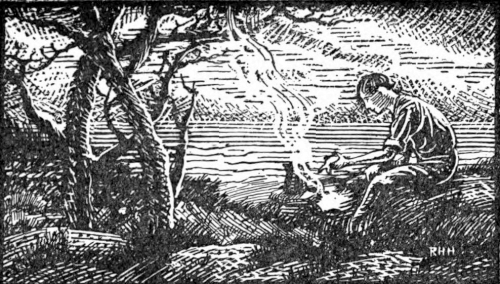
CHAPTER EIGHTEEN
THE TRAMP AS COOK
Then did he study some half hour But as the Comick saith his heart was in the kitchen.
I THINK Coleridge was annoyed by the man who interrupted him with the words “Them’s the jockeys for me,” referring to some steak puddings which had been brought before his eyes. Coleridge was regarding some choice bit of Scottish scenery, the Falls of Clyde, I think, and a rough, unlikely-looking fellow had used what Coleridge had considered absolutely the right adjective concerning them—majestic—and the poet turned on him to learn more of this verbal grace. Then a toad leapt from the mouth of the princess who had previously given a pearl. “Them’s the jockeys for me,” said he, regarding the steak puddings. It is recorded somewhere in Coleridge’s Table Talk. I read it some twenty or twenty-five years ago, and the two expressions have remained with me—“majestic” and “them’s the jockeys.” In fact, I adopted the word majestic as applied to scenery there and then, that, and the Shakespearian “majestical.” “It seemed I did him wrong, being so majestical.” It has almost become a vice of style. That, however, is by the way. The poetry of our life, and of our book, shall be interlarded with—I may not say puddings; one does not lard with puddings, with the fatness of cooking and eating.
The dawn stars make one hungry. Noontide makes one hungry, and so does afternoon. The tramp is loath to tighten his belt.
I have described, in another book, how one should make coffee, and I will not repeat. But the first thing about it is love, as I wrote in a verse during my tramp with Vachel Lindsay, “Coffee should be made with love; that’s the first ingredient,” and “the chief cause of coffee being just indifferent is your indifference towards the coffee.” I feel this is also true of the most of cooking. You must bring a loving heart to the primus or the camp fire. No soured personality can be trusted to stir the beans, far less make the coffee. I have not examined the psychology of good cooks, but I imagine few of them are bitter, few of them are egoists. Watch a thoroughgoing egoist over the camp fire, cooking for you. But I ask too much—take the pan from him, take the pot away.
He will be saying to you, “I had a very interesting letter from Thomas Hardy apropos of a letter I wrote to the Times, approving entirely what I said—” Meanwhile the coffeepot has tilted on its stone and is pouring its goodness to the ants and the beetles. It is a miching malicho, it means mischief. You must take over from him, let him sit himself on a rock and pour forth, but not tend the fire and let the coffeepot pour forth.
Lindsay wrote a reply to my recipe for making coffee. His was a recipe for making tea. He did not omit love. But as well as tea leaves he recommended leaves of various books to be put in the pot. I do not know that I care for this tea from book leaves and, I suppose, old bindings. I have had it indoors, given me by some dusty recluse, in his portentous library. Qua tea it was not so excellent, qua soporific, it was good.
One may put in a little philosophy, however, with both tea and coffee. “Hast any philosophy in thee, shepherd?” We need a little for our repast, but we want no soda to bring out the flavor.
Lindsay, being an American, knew little of tea. That is why we traveled almost exclusively on coffee. In any case, a practical detail to be noted, it is not wise to make coffee and tea from the same pot. The flavors adhere even to a very well rinsed vessel and spoil one another. If there are two of you, each may carry his own pot, one for tea, one for coffee. But it is simpler to be unanimous as regards the choice of beverage. In Russia I tramped almost always on tea, because the tea is so good there and needs no milk. In some districts milk is difficult to obtain. In America, however, “evaporated” and “condensed” in cans are obtainable everywhere, and are conveniently carried. You need only make two tiny perforations in the lid of the condensed milk tin. You blow through one, and it drives a thin stream of milk out at the other. You cover these perforations with a leaf or a piece of paper, and thus sealed, the can is carried safely in the rucksack. Of course, if you open with a can opener it is likely to be difficult to keep your milk for more than one meal—or it will make an unpleasant mixture in your rucksack.
China tea has the advantage that it needs no milk. Indeed, milk spoils it. It should be made very weak, and it is then more refreshing than Indian tea. I prefer a good Chinese blend, especially on tramp. It is not, however, possible to prepare tea in any elegant fashion. There is no “five o’clock” in the wilds. You brew a pot of tea at any hour which taste suggests. The luxurious may carry a small teapot and merely boil the water in the can or coffeepot. But the rougher method is not without appeal. You can sift two spoonfuls of tea into your coffeepot when the water is boiling and at once take it off the fire. A better plan is to cut off a small square from your mosquito netting and tie the tea in that. Your first mugful will be rather weak, but your second, third and fourth, progressively stronger unless you are able to pull out the little bag of swollen tea leaves. Wash the bit of netting, and it is ready for next time. It will last several weeks if you do not lose it.
I find you can walk further after tea, but coffee makes you more sociable. You talk more after coffee. If Mrs. Thrale had made the great Doctor coffee instead of tea Boswell would have missed much more of what he said. Though tea indoors is very different from tea out of doors. As a domestic drink it is productive of high spirits, but out of doors it enkindles purpose. You walk and think and are silent. It is good for artists and writers. Forms and ideas rise unbidden to the mind. What good thinking comes after the morning tea on the road—whole chapters, whole stories, curious conceits and fancies! But after coffee you cannot keep anything to yourself, and if you have no companion you take to singing.
If, however, you are very tired or wet through with rain, coffee has more power to restore. It is better then to make it without milk. Put seven or eight lumps of sugar in the pot and heat water and sugar together, not too much water. When quite hot, sizzling, float a double portion or even treble portion of coffee on top. Do not, for this potation, use mosquito netting. The coffee should then be watched—for it may rise suddenly and become wasted. It is as well to stir it, and then a useful device is the using of cross sticks. “If you make the sign of the cross over a pot of coffee it will not boil over,” say the cowboys. And it is a curious fact that two dead twigs, placed crosswise over the top of the coffeepot, seem to cast a spell on the brew. The brew should simmer for a quarter of an hour or more. Then add a little cold water and stir up. The grouts will go to the bottom, leaving a fine liquor. Though very strong, this type of coffee is not bitter. You sip it; it lasts a long while. It is much better than medicine for you, and will drive out any amount of damp from your system. I think it better than coffee and rum, or warm damson gin, or any of the concomitants of aspirin. No tramp should carry aspirin. It is depressing to mind and soul, and generally causes you to give up adventures.
Bread and cheese and coffee make a good combination, as of course do cake and coffee, any sort of coffee and cake. Bread and sardine and coffee go down very well, to say nothing of fried trout. Directly you get your fish, scrape it and clean it, a dirty job, but you get used to it, wash it and fry it. If you can eat it within a quarter of an hour of its swimming in the stream you get some of the hidden and lost potentialities of trout, the inner worth of those delightful pink spots, those scales your color-loving eye is loath to scrape. However, remember the coffee. It can simmer gently while you fry. Bully beef is redeemed by coffee, so is Maconochie. Eggs go well, but they must be fried. Boiled eggs go better with tea. Wash them and then boil them in the same water from which you will make the tea. It improves the tea. But be careful of the eggs as they boil that they do not dance together and crack one another. For in that case your tea water will be spoiled.
In Poland, and in Border States and in Russia there are excellent hard bannocks which soften when heated. You slit them and insert butter. In Russia they are called bubliki; they sell them in the East End of all great cities. They go remarkably well with tea.
In Scotland, Norway, Denmark, Sweden, and Finland, there are excellent oaten and rye cakes. They are delightful with Indian tea and milk; not so good with China tea.
America, marvelous country, provides the greatest variety of breakfast foods, cakes, and pies in the world. What can compare with pumpkin pie, blackberry pie, peach pie? You go into an unromantic-looking “ville” or “burg,” and surely come away with an unbroken round of pie to civilize the camp cuisine.
On a long tramping expedition one is bound to study to some degree the body and its needs. The Army marches on its stomach, so do you. An attack of indigestion can make a strong man almost too weak to move. Beware of the cakes of bread sold in the market place in Mohammedan cities, what in Central Asia the Sarts and Uzbeks bake. They are difficult to swallow, even with wine, and once inside become a stiff indigestible mass. Millet bread is also difficult to assimilate. Maize flour bread is also upon occasion bad to tramp on. On the other hand, no harm comes from any variety of wheaten and oaten biscuit. One of the tramp’s temptations is toward wild fruit. He can easily make himself very unwell by eating unripe or bitter ripe fruit—even when boiled with sugar. Again, if the coffeepot gets dirty inside and brown curds adhere to the side you will find you are drinking something rather upsetting with your coffee. There is no need to scrub the outside of the coffeepot but cleanliness within should be de rigueur. Dried apricots, when obtainable, are ideal to take on tramp, but they should be washed before cooking. The stones should be broken and the kernels thrown in with the flesh of the fruit and some sugar—an ideal dish.
Potatoes are difficult to carry, but when obtained can be easily cooked under the seemingly dead ashes of your camp fire. They are greatly enjoyed, as all know who have even on a picnic roasted them and dandled them timorously in their fingers. It is just as well to hoist them out of the ashes on the end of a sharpened stick. If the stick will not go in, the potatoes are probably not yet cooked.
Similarly, various birds, having been plucked of feathers, can be cooked under the ashes. The fire ought to have been burning an hour or so, and have accumulated much ember before cooking a bird is tried. But a hollow may be found for your chicken and the ashes carefully raked and heaped over it.
Perhaps, however, the best way to cook a young chicken is to fry it. It is easily fried over the glowing embers and is immensely tasty. Chicken, with a tang of wood smoke is a feast! One cannot think of having a chicken every day. But enough has been said to show that the cuisine of the out-of-door life is not utterly primitive. There is a variety of good things for those who are not ascetics. And besides all these good things there enter by chance into the ménage mushrooms, so shockingly overlooked by town-bred folk; wine, especially the vin du pays, which is sometimes almost a free gift to the wanderer; honey just taken from the bee; Devonshire cream if you are in the English West Country, and also bountiful cider. There are good cheeses; though out of door all cheese is good. You can take your fresh petit Suisse along with you in France; your Gruyère, your Stilton—there is some good cheese in every country, and all manner of rough cream cheeses in the mountains. Goat-milk cheese is apt to make one very thirsty, so one should have wine to go with it. In America there is the never-to-be-forgotten strawberry shortcake. You can also get a brick of ice cream if you carry a chilling box. In Turkish villages you can go into the restaurants and lift such delicacies as stuffed peppers—even the thought of them is an appetiser. The bon viveur can carry with him his petit verre. Upon my honor, this tramping business is not altogether an “eating of roots in the desert.” Still, when provisions run out and you are far from human habitation, you may be reduced to eating grass. That is the reverse side of the picture.
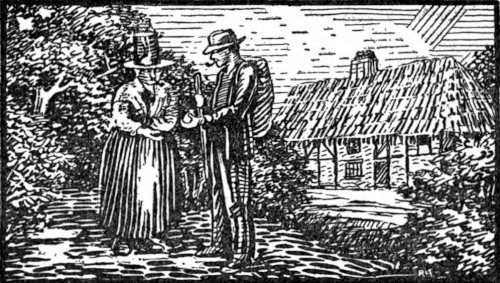
CHAPTER NINETEEN
TOBACCO
IT has been said that whereas a pipe is a man’s wife, a cigarette is his lady friend. In these terms it is difficult to define a cigar, but it will be agreed that the cigar is unnecessary on tramp. We have no afterdinner mood. A pipe will go a long way, the cigarette has to be cast off and renewed—the cigar does not enter in.
Nevertheless, I shall hear of excellent walkers who carried boxes of cigars in their rucksacks and lifted the smoke of Havana to the noon sky. Some fellows even chew an unlighted cigar as they walk.
It has frequently been said to me: “I should think when you got to some point on your tramps—with great views opening before you, it was a rare place for a smoke.”
This moved me in my intolerant years to much mirth. How could I share the beauties of Nature with a pipe! I asked. It seemed to me strange that one should wish to smoke when the fire of one’s own thoughts was burning brightly and streaming upward in poetic exhalation.
Even now I cannot go back on my personal experience of years past. One of the most romantic occasions in tramping that I remember was during a vagabondage in the Crimea, when I reached the Gate of Baidari and watched for an hour a marvelous changing sunset far over the Black Sea and its mountainous shore. It was my busiest hour of the day: I was soaking in that sunset to the core of my intelligence. What rapture, what prayerful vigilance was mine then, as in the late twilight, knapsack on back, I stood on grand platforms over the sea and was, as it were, alone, the one pilgrim in the universe.
In those days I was a nonsmoker. But even later when, through offering friends cigarettes, I at last began offering them to myself, I do not associate tobacco with great moments. It is very delightful when riding a horse to light a cigarette and smoke as you amble along, and it makes a difference on a long train journey to have the narcotic of tobacco, but to me, smoking is not naturally associated with tramping. One very memorable moment after I had begun to smoke, was when I climbed out of the jungles of Darien on the ridge where Balboa saw the Pacific for the first time. It was pure poetry to see the blue triangle of the Southern Sea far o’er the forests and the hills. But where Balboa and his men sang a “Te Deum” I did not sit on a stone and light up a pipe.
However, there is no doubt that smoking in company is a social grace. It gives a sense of unity, and at the same time, it is a source of some pleasure. We are always warned that our cigarette ends have set forests afire. But the rest of the cigarette has lighted our faces and lightened our packs. As the soldier finds the route march more supportable if he has permission to smoke, so also the tramp, on a long and arduous hill, can get much help from cigarette or pipe. It gives patience on the way, and then patience again in camp, while waiting for the pot to boil. And the final peace pipe at the end of the day settles all experiences into a harmonious unity and prepares the mind for the night.
Smoking seems to fill up the empty cells in time—when there is nothing else to do a man takes out a cigarette. On the other hand, after stress or strain it soothes and it prepares the mind for artistic work. At the same time in writing, it seems to me, that as good literary work can be done without tobacco as with it.
Upon occasion, the cigarette, and more often the cigar, will deaden one’s sensibilities. The effect is the rising of somber impressions, rather than bright thinking. Tobacco has had considerable influence on modern literature, though it would be difficult to show just where the difference is. It has made some writers tolerant, but others merely laconic; helped some to be witty, helped others to be merely cynical. Thousands of cigarettes have gone to the making of a novel, and it would be amusing, and perhaps also interesting, if one could compute the numbers that went to the various chapters. That is not entirely irrelevant here, for it is the custom of many writers to think out their work while walking. They walk and they smoke, and they think, and the ideas form.
Curiously enough, I smoked my first cigar on the way to Havana, and could not finish it. It almost finished me. I used to say that cigars belonged to a certain later period in a man’s life, when he had succeeded and could lean back in his chair and view the world at ease. It is perhaps an English idea. Cigars in England are a luxury. But it is not so in other parts of the world. In England, when we smoke a cigar, we smoke largely tax. But in other parts of the world this choicer weed enjoys more freedom from impost. In Germany, in Austria, in Holland, in the Indies and Mexico, and in many other places, a cigar is no more a luxury than a cigarette—as cheap, as popular, and better to smoke.
Hood could write:
Honours have passed to men My junior at the Bar. No matter, I can wait, So I have my cigar.
but he could hardly have written—So I have my cigarette. The cigar for us means Nirvana, release from cares, relaxation of the whole being. I do not think it either the meet reward or the need of the tramp after his day’s march. When he has had wordy warfare with the police concerning the validity of his passport, when he finds that he has lost all his money and half his kit, when he has proposed to his sweetheart and been rejected, or refused, he may light up a Havana if he has one. But I take comfort in the thought that unless he has lately parted from a rich uncle he is unlikely to have a stock of the commodity, and will draw rather upon the resources of philosophy which he has somehow stored within.
CHAPTER TWENTY
BOOKS
YOU need a book, but you cannot carry Gibbon’s Decline and Fall with you, even if you feel the need. The tramp’s library is limited, for books are heavy. It is best to tramp with one book only. But it is a missed opportunity not to have one book. For you can gain an intimacy with a book and an author in that way, which it is difficult to obtain in a library or in the midst of the rush of the books of the season.
Each will have his choice though many will choose alike. The inexperienced may pop the latest yellow-back into the rucksack, not grasping that it will be read through in two lazy afternoons, and that then he will have no book to fall back upon. In the trenches in France a happy habit developed of leaving read books upon dry ledges in the dugouts. One often came upon a treasure trove of the kind. But when tramping, you cannot leave books for others with much hope of their being found. And rarely does one find any stray literature unless it be some tract on the futility of sin.
It is better, therefore, to take with one a whole-time book. It is good to have a book that is full of meat, one with broad margins for scribblings and extra pages for thoughts, poems, thumb-nail sketches. After a long tramp it is nice to see a book which has been clothed with pencilings. It records in a way the spiritual life of the adventure, and will recall it to you when in later years you turn over the page again.
It is well to take a book that you do not quite understand, one that you have already nibbled at but have found difficult. I do not mean an abstruse work, but one you are just on the verge of understanding and making your own.
At different stages of development you will have different books. A boy just beginning to think could do worse than take The Autocrat at the Breakfast Table, or Thoreau’s Walden; a little later comes Erewhon or Eöthen. At eighteen Sartor Resartus or Carpenter’s Towards Democracy, or Browning’s “Paracelsus.” A good deal depends on temperament as to whether a volume of Shelley or Keats will keep you company all the while. You read and reread a poem that you like until it begins to sing in your mind. It becomes your possession. There are marvelous passages lying hidden in a poem like “Paracelsus”:
Ask the gier-eagle when she stoops at once Into the vast and unexplored abyss, What full-grown power informs her from the first Why she not marvels strenuously beating The silent, boundless regions of the sky!
It is a poem of a man seeking life, seeking a way. It ought to move most young men who are on the threshold of life, unless they are dull or have been infected by cynicism. For my part, I look back loyally to the time when I was Paracelsus and could say his lines as from my own heart: “’Tis time new hopes should animate the world,” I whispered as I walked, and the new hopes were my hopes.
Much of “Paracelsus” should go into the true Tramp’s Anthology, and with it, not contradicting it, Omar Khayyam and also O’Shaughnessy’s