WILLIAM HENRY HARRISON.
Reading edition

Among the most successful officers of the war of 1812, was Major General William Henry Harrison. Descended from a good old revolutionary stock, and thoroughly imbued, in his boyhood, with sentiments of the most sincere and devoted patriotism, he laid the foundation, at an early age, of the fame and distinction which he acquired in maturer years. Throughout a long life,—one full of interest, and replete with important incidents,—he enjoyed a wide-spread popularity, which, in the western states of the Union, was sometimes manifested with all the fervor of enthusiasm. No one better deserved the respect and esteem of his countrymen, and there are few whose character has come brighter or purer from the ordeal, when submitted to that Areopagus of public opinion, whose decisions admit not of dispute.
HIS FATHER.
He was born at Berkeley, the family seat of his father, on James river, Virginia, on the ninth day of February, 1773; being the youngest of three sons. His father, Colonel Benjamin Harrison, was a descendant of the celebrated officer of the same name, who fought by the side of Cromwell for civil and religious liberty, but, preferring a turbulent democracy to a quiet despotism, opposed the ambitious projects of the Lord Protector, with the same stubborn vehemence with which he had contended against the attempted usurpations of the tyrant Charles. But—what is of more immediate value to us as Americans—he was one of the signers of the Declaration of Independence, and “the intimate friend of Washington”!
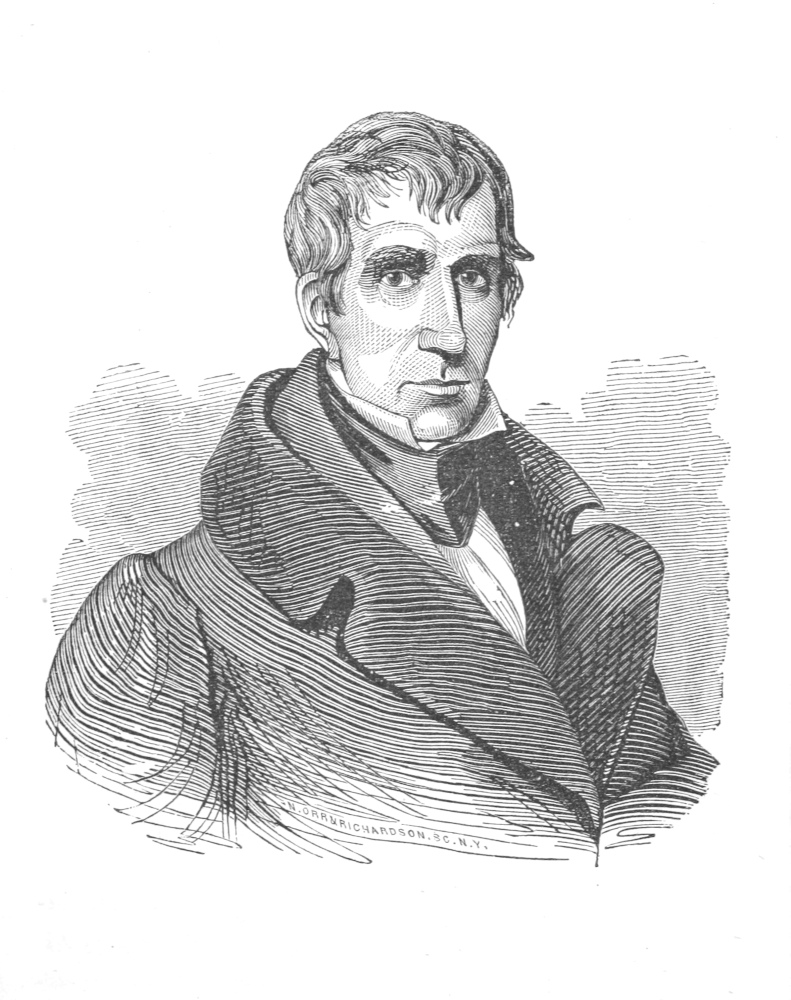
WILLIAM HENRY HARRISON.
Colonel Harrison took his seat in the Congress of the Confederation, as one of the delegates from Virginia, in 1774, and remained a member of that body, during that and the two following years. On the resignation of his brother-in-law, Peyton Randolph, the president of Congress, he was urged by a number of friends to take the vacant place, but declined the honor, and, on his nomination, John Hancock was appointed to fill the station. It is also stated, in connection with this circumstance, that when the latter manifested some hesitation about accepting the office, Colonel Harrison caught the modest patriot in his arms, and almost carried him to the chair, nolens volens. He took an active part in the discussions and deliberations that preceded the adoption of the Declaration, and was the chairman of the committee of the whole when the vote to agree to it was taken. There is an anecdote related of him at this juncture, which attests the warmth of his feelings, and the sterling genuineness of his patriotism. Although John Dickinson was openly and avowedly opposed to the separation from the mother country, his honesty and integrity were never questioned, and his conceded ability secured the respect of the other members of Congress. Upon his urgent request, he was permitted to draw the second petition to the King, which was adopted, though with considerable reluctance. After the vote was taken, Mr. Dickinson could not refrain from expressing his satisfaction, and, at the close of his remarks, said, that there was but one word which he disapproved, and that was the word “Congress.” Colonel Harrison sprang to his feet the instant Mr. Dickinson was seated, and exclaimed with emphatic earnestness—“There is but one word in the paper, Mr. President, of which I approve, and that is the word ‘Congress’!”
Colonel Harrison was afterwards, for several years in succession, a member of the Virginia house of delegates, and filled the office of speaker till the close of the year 1781, when he succeeded Governor Nelson in the executive chair of that state. On the expiration of his official term in 1784, he retired to private life, but to the time of his death, which occurred in 1791, he was known and esteemed by the ablest men in the nation, and revered and honored by all classes and parties of his fellow-citizens.
The subject of this biography, William Henry Harrison, was early placed at Hampden-Sidney college. At the age of seventeen he left the institution with his mind well stored with classical lore, and not long after, in compliance with the wishes of his father, whose liberal hospitality forbade the bestowal of large fortunes on his children, commenced the study of medicine. Having completed a short preparatory course of reading, he proceeded to Philadelphia, in the spring of 1791, to attend the lectures at the University, and avail himself of the other facilities afforded in that city for obtaining a knowledge of the profession which he had selected. He had but just arrived there and resumed his studies, when the intelligence of his father’s death reached him, and effected an entire change in his plans for the future.
DEFEAT OF ST. CLAIR.
Notwithstanding the earnest remonstrances of his guardian, Robert Morris, the celebrated financier, who depicted, in glowing colors, the fatigues and hardships which he would be compelled to undergo, he determined to enter the army, and with his own good sword hew out a way to distinction. Preparations were then making for another campaign against the Indians on the northwestern frontier,—the expedition of the previous year, under General Harmar, having failed of accomplishing any decisive results. This added fire to the spirit of young Harrison. Washington was applied to,—and respect for the memory of the father, and esteem for the son, whose importunities could not be disregarded, procured for the latter an ensign’s commission in the regular service. He departed immediately for Fort Washington, now Cincinnati, but, though he hurried forward with eager impetuosity, did not succeed in joining the army, then but a remnant of what it had once been, till after the disastrous defeat of the brave and honest, but unfortunate St. Clair, on the fourth of November, 1791. On joining his regiment, at Fort Washington, he learned the particulars of the sad tragedy which had just been enacted. The melancholy fate of Butler, Oldham, Hardin, and their companions, who had fallen victims to the wiles of a barbarous and cruel enemy, so far from damping his ardor, or chilling his enthusiasm, only heightened the fire of patriotic indignation that burned in his bosom, and increased his anxiety to take the field, and aid in inflicting a summary punishment upon the merciless savages.
At this time there were no settlements of consequence north of the Ohio, except those at Kaskaskia, Vincennes, Fort Washington, and Marietta; and, on the south, between that river and the Tennessee, there were comparatively few inhabitants scattered over the territory previously known as Kentuckeè, “the Bloody Land,”—for many years the battle-ground of the Northern and Southern Indians. The protection, therefore, of the exposed frontiers, depended mainly on the regular force of the General Government, and the militia of Pennsylvania and Virginia; for, though the citizens of this remote region were ever prompt to obey the call to arms, they were too feeble in numbers, to cope, unassisted, with so powerful a foe. General St. Clair, governor of the “Territory north-west of the Ohio,” had moved upon the Miami villages with over fourteen hundred men; of this number, six hundred and thirty-one were killed in the fearful onslaught of the fourth of November, and there were two hundred and sixty-seven wounded; consequently, it was necessary to raise a large additional force, before offensive operations could be further prosecuted. President Washington immediately recommended a considerable increase of the army, and Congress adopted his suggestions.
CAMPAIGN UNDER WAYNE.
In the then state of the country, it required no little time and preparation to fit a great body of troops for the field; numerous and unavoidable delays occurred; and, in the meanwhile, attempts were made to conclude a peace with the hostile Indians. The messengers dispatched by the Executive of the United States were treacherously murdered, and negotiation was no longer admissible, save at the point of the bayonet. In the autumn of 1793, a force of twenty-six hundred men, nearly all of whom were regulars, under the command of General Wayne, were concentrated at an encampment established near Fort Washington on the Ohio.
While these preparations were in progress, young Harrison, who had been promoted to a lieutenancy, was sedulously employed in studying his profession. His skill and proficiency as a tactician, attracted the attention of the officer selected to take command of the projected expedition, and he was designated as one of his aids. Having completed his arrangements, General Wayne took up the line of march for the Indian country, early in October. The lateness of the season rendered it impossible to accomplish anything till another campaign, and on his arrival at one of the tributaries of the Stillwater branch of the Big Miami, he established himself in winter quarters, and commenced organizing and disciplining his troops. Lieutenant Harrison was prominent among the young officers engaged in the work of instruction, and his services were flatteringly noticed by the commanding general.
In the summer of 1794, General Wayne was joined by upwards of one thousand mounted militia, and without delay set out in pursuit of the enemy, who, he learned, were in strong force at the Rapids of the Maumee. On the twentieth of August, he encountered the Indians, who had vainly attempted to draw him into an ambush, near the Roche de Bouc, on the north bank of the river, and defeated them with great slaughter. Their chief, Turkey-foot, and a large number of their best and bravest warriors, were slain; and the remainder either dispersed, or sought shelter under the guns of Fort Maumee, then occupied by a British garrison. The bravery and intrepidity of Lieutenant Harrison in this affair, were conspicuous; and in the official report of the action, his name is mentioned in terms of high commendation.[8] While the army lay in the vicinity of Fort Maumee, an incident transpired, which came very near terminating, in all probability, the life of General Wayne, and that of his gallant aid.
Positive instructions had been received to demolish the fort occupied by the English troops, in utter disregard of the provisions of the treaty of 1783, and in order to enable him to decide upon the propriety of an attempt to reduce it, General Wayne, accompanied by his suite, advanced to reconnoitre. In this daring reconnaissance, the general, who possessed a constitutional indifference to danger, with Lieutenant Harrison at his side, rode within eighty yards of the fort, and within point blank range of its guns. While making their observations, with the utmost coolness, an English captain of marines turned one of the pieces upon them, and was about to apply the port-fire, when Major Campbell, the commandant of the garrison, interposed, just in time to prevent the catastrophe that would most likely have occurred. Major Campbell subsequently apologized for the unofficer-like conduct of his subordinate, and to his gentlemanly behavior the preservation of peace between the two countries may be attributed.
General Wayne did not deem it advisable to attack the post with the means at his command, and having destroyed the Indian villages within fifty miles of either side of the river, he returned to Fort Defiance, at the confluence of the Au Glaize and Maumee. The defeat which the Indians had sustained was decisive; everything remained quiet during the ensuing winter; and in July, 1795, General Wayne concluded a favorable treaty, at Greenville, with a number of chiefs representing ten different nations.
Upon the conclusion of the treaty, Harrison, now raised to the rank of captain, was placed in command of Fort Washington, and, shortly after, was married to a daughter of Judge Symmes,—a most amiable woman; distinguished for high moral worth, for her piety and benevolence; and esteemed and loved by a large circle of friends and acquaintances.
COMMENCES HIS CIVIL CAREER.
Captain Harrison soon became dissatisfied with the idle routine of a garrison life; there seemed to be no prospect that his serviced would be required in the field; and he longed for more active employment. Accordingly he resigned his commission, and in 1797, at the age of twenty-four, commenced his civil career, as secretary of the territory, under Governor St. Clair. His talents and many estimable qualities had already brought him into favorable notice, and the duties of his office were discharged with so much promptitude and fidelity, that he was regarded as one of the ablest young men in the territory. His popularity steadily increased, and in 1799, he was elected as the first delegate in congress. On taking his seat, in December, of that year, he was appointed, upon his urgent solicitation, chairman of the committee on the public lands,—the only instance, it is stated, in which a delegate was so distinguished.
The improvement of the existing land system had long been a favorite object with him. Many of its features were wholly inconsistent with the genius and spirit of democratic institutions, and calculated to retard the growth and prosperity of the great West. Among other provisions equally odious in their character, was one forbidding the sale of land by the government, in quantities of less than four thousand acres, except where there were fractions on the banks of large streams. Harrison had the forecast to discover, what a boundless field would be opened for the enterprising youth and industrious laboring classes of the Atlantic states, by the removal of this obstacle to the settlement of the territory, the development of the resources which nature had so lavishly bestowed upon it, and its rapid advancement to wealth and greatness. Through his instrumentality, aided by the efforts of other able members of both houses, who united with him in procuring this reform, a law was enacted, requiring one half of the public lands remaining unsold, to be divided into sections of six hundred and forty acres each, and the remaining moiety into sections of three hundred and twenty acres; the old system of forfeiture for non-payment was abolished, and payments were directed to be made, in future, one quarter down, and the remainder in two, three, and four years, with a further forbearance of one year on the last payment, if desired.
GOVERNOR OF INDIANA TERRITORY.
This was not all that Harrison wished to effect; but an important point was gained. Emigrants flocked into the territory by scores and hundreds, and the gratitude of the citizens, both the old inhabitants, and the new-comers, who had been benefited by his exertions, never failed to follow his footsteps as those of a benefactor and friend.—Such was the estimation in which he was held by his constituents, that he was solicited, on all hands, to take the place of Governor St. Clair. In reply to every intimation of this kind, Harrison steadily refused to permit any effort to be made, to supersede the war-worn veteran, whose only fault, if fault it be, was, that fortune had been chary of her favors to him, when her smiles, doubtless for some wise purpose, were showered upon those not more able, not more deserving, nor more prompt in the performance of every duty. The desire of Harrison’s friends was soon gratified, however, in his appointment by President Adams, in 1800, as the first governor of the newly erected territory of Indiana. Though deprived, by his position as a delegate, from taking part in the general legislation of the country, his sound judgment and sterling worth had secured him an enviable reputation, and when he left Congress, he was followed by the regard and cordial good wishes of his associates.
Shortly before his leaving the Capital, a circumstance occurred, which deserves to be mentioned, as illustrating the purity of motive, and honesty of purpose, which marked his public conduct. His father-in-law, Judge Symmes, was the proprietor of the Miami purchase; and previous to obtaining his patent, he had made a number of sales. It was doubtful whether the rights thus acquired were of any value, even in equity; but, upon the introduction of a bill in Congress providing for the settlement of the purchase, although the interests of Judge Symmes, and, indirectly, his own, were jeoparded, Harrison went before the committee having the bill in charge, and successfully urged the insertion of a clause amply protecting the claims of the purchasers.
In 1801, Governor Harrison entered upon the discharge of his official duties, at Vincennes, an old military and trading post, on the left bank of the Wabash, which was settled by the French about the year 1730. Though invested with extraordinary powers, the office to which he had been appointed was no sinecure. Besides the settlement at Vincennes, there were but two others, of importance, in the whole territory, out of which was afterwards formed the states of Indiana and Illinois, viz.; Clarke’s Grant at the falls of the Ohio, and the settlement extending along the Mississippi, from Kaskaskia to Cahokia. The white population did not exceed five thousand souls, and they were entirely surrounded, on the north and west, by numerous bands of Indians, who were either openly and avowedly hostile, or wanted but a favorable opportunity to manifest their hatred and ill-will.
VARIED SERVICES.
To provide for the security of the settlements in the territory, however remote, or widely separated; to overawe the savages, or hold them in check; to encourage immigration; and to promote, in all things, the happiness and welfare of the inhabitants,—were the objects to which Governor Harrison unremittingly devoted his time and attention. In addition to his other duties, he acted as commissioner of Indian affairs, in which capacity he concluded fifteen treaties, and extinguished the title of the aborigines to more than seventy million acres of land—then, for the most part, an unbroken wilderness, but now dotted all over with the abodes of wealth and contentment, and teeming with a thriving and industrious population. Frequent journeys were performed by him, along the wild forest paths, and miserable traces, which led from one station or settlement to another. Dangers were fearlessly encountered; fatigue never disheartened him. He cheerfully shared the privations of the settlers; partaking with them of the rudest cheer, or, seated on a hewed block before a roaring fire, listening attentively to tales of trial and hardship, and offering the kind word of sympathy and encouragement. Wrapt in his blanket, or enveloped in the folds of a bear skin or buffalo robe, he slept, too, as soundly and sweetly on the bare earth in the hunter’s lodge, or the puncheon floor of a log cabin, as upon the beds of down in his father’s mansion.
In 1802, Ohio was admitted into the Union as a state, and Wayne county,—afterwards the territory, and, still later, the state of Michigan,—was then attached to the territory of Indiana. The duties of Governor Harrison were thus rendered still more arduous. He was relieved from this additional care, however, in 1805, when Michigan was erected into a separate territory. The country filled up so rapidly, that it became necessary, in a few years, to relieve him yet further, and in 1809, a territorial government was formed for Illinois.
Many years elapsed after the conclusion of the treaty of peace, in 1783, before Great Britain entirely abandoned her expectations of reëstablishing, at some future, and not very remote day, her authority over her revolted American colonies. It was customary for her writers and politicians to underrate the importance, and sneer at the pretensions of the young republic, till they saw, in the rapidly-extending commerce and growing prosperity which followed the restoration of peace and tranquillity, unmistakable indications that the daughter would soon be no mean rival of the mother country in the race of nations. To check these germs of greatness, ere they should bud and blossom, was now the favorite object of English statesmen. As no pretext existed for open hostilities, resort was had to the low arts of diplomacy—to intrigue and cunning; and amid the moral and political corruption, which, at that era, polluted the atmosphere of St. James, plans were concocted, whose atrocity must ever stand out in bold relief on the page of impartial history.
ENGLISH INTRIGUES.
Disregarding the provisions of the treaty of 1783, the British authorities retained possession of the military posts northwest of the Ohio, and to these, and similar establishments in the Canadas, agents were sent, to suborn, and tamper with, the savages on the northern frontiers of the American Union, and incite them to commit acts of hostility upon the persons and property of the settlers who had found their way into the rich valley of the Mississippi. It was the policy of Washington,—and, after him, of Adams, Jefferson, and Madison,—to purchase the lands belonging to the Indian tribes, required by the increasing white population of the country, at a fair equivalent; to furnish them the means of civilization; to provide for them the restraints of well-ordered and wholesome regulations; to enkindle new desires, and implant new motives in their breasts; to enlighten their minds and Christianize their hearts. England, on the contrary, forgetting the eloquent and indignant denunciations of her Chatham, and careless how she sullied the national escutcheon, already stained by many a foul blot, supplied them with arms and ammunition,—with blankets, tobacco, and “fire-water,”—not to induce them to cultivate harmony and good-will with their neighbors, the citizens of the United States; but to minister to their most depraved appetites, and arouse the most vindictive passions of their natures. She asked them, not to lay aside the implements of death, and engage in the pursuits of peace; but invited them to continue their barbarous warfare, and glut their vengeance, to the full, with the tomahawk and scalping-knife!
Under the auspices of Simcoe, and other agents of Great Britain, immediately after the peace, a combination was formed among the Northwestern Indians, the object of which was to prevent the Americans from extending their settlements beyond the Alleghanies. The border inhabitants were constantly harassed by the irruptions of the savages; scenes of bloodshed and murder were of frequent occurrence; and when efforts were made to chastise the perpetrators of these outrages, they found in England a fast and firm friend, whose assistance, though not openly rendered, proved of essential service to her allies. Her influence was felt in the defeat of Harmar and St. Clair, and when the mounted volunteers under the gallant Wayne scattered the savages in confusion, on the banks of the Maumee, they fled for protection beneath the guns of a fortress over which floated the red cross of St. George.
The defeat of the Indians by Wayne was a severe lesson, and it was long remembered. Fortunately, too, for our country,—who needed only a season of peace, and repose from “war’s alarms,” to advance with rapid strides to the high destiny before her,—the revolutionary spirit had, at this time, crossed the Atlantic, and the watch-fires of liberty were blazing on the continent of Europe. Alarmed for the stability of her institutions at home, England had no time to spend in courting the favor of the North American savages, even though her machinations promised to terminate in the restoration of “the brightest jewel of her crown.” In November, 1794, three months after Wayne’s victory, Mr. Jay concluded his commercial treaty, in which it was stipulated that the western posts should be surrendered by the first of June, 1796, which was accordingly done; and in the summer of 1795, as we have seen, the treaty of Greenville was made with the Indian tribes.—The quiet thus restored was deceitful, and temporary in its duration.
SEIZURES BY THE ENGLISH.
The treaty of Mr. Jay provided, among other things, for compensation for British spoliations on American commerce, growing out of the war with France; yet the ratifications of that instrument had scarcely been exchanged, when outrages of the same character, but greater in degree, were committed. Taking advantage of the distracted state of affairs on the continent, the enterprising citizens of America had extensively engaged in the carrying trade; and their commerce had increased with so much rapidity, that the jealousy of England was again awakened. Large quantities of American provisions were also shipped to Europe, and especially to France, and to her possessions in the West Indies, the prices paid for which, during the continuance of hostilities, afforded handsome profits; but this interfered, very materially, with the determination of England, by means of her maritime supremacy, to starve the French people into an abandonment of their republican notions, and to prevent it, she caused blockades to be declared, which were enforced by no suitable naval power, and orders to be issued, in defiance of the law of nations, requiring neutral vessels to be seized though not carrying articles contraband of war.
Remonstrance on the part of the authorities of the United States, was of no avail. The example set by England was followed by France—every act of injustice on the one side being succeeded by a still more odious one on the other. The treaty of Amiens, in 1802, afforded the Americans a brief respite; but, on the renewal of the war, in the following year, seizures and condemnations of our vessels became more frequent than ever. England joined the coalition formed to establish Continental despotism on a firmer basis, and restore the Bourbon dynasty to the throne which they had disgraced; and she stopped at nothing to accomplish her purposes. Not content with watching the ports of France, she sent her privateers and vessels of war, under her pirate flag, to hover on our coast, and plunder our commerce. Her navy having been seriously reduced, in men, by the long continued warfare in which she had been engaged, she likewise resorted to the impressment of American seamen, to fill up the complements of her crews. Large numbers of sailors were taken from our merchantmen; and, to conclude these high-handed offences, the frigate Chesapeake was despoiled of a portion of her crew, on the twenty-second of June, 1807.
In the meantime the emissaries of Great Britain had been busy among the savages on the Northwestern frontier. So complete and irrefragable were the proofs furnished to Congress of this fact, that, in 1797, a law was passed to prevent the tampering of foreign agents with the Indians, which imposed severe penalties and punishments. This law was easily evaded, and it was therefore ineffectual. The Indians were invited to the British posts; they were flattered and caressed, and loaded with gifts and favors; their minds were soured; and no means were left untried to keep up a constant strife between them and the settlers. It has often been said, that the interference of British agents in this particular existed only in imagination, and that the Indians were provoked to hostilities by acts of violence committed by the Americans. Doubtless, there were isolated cases of wrong and injustice, which cannot, and should not, be palliated or excused; but it is idle to suppose, that the settlers generally would have so causelessly endangered their own security, and so recklessly jeoparded the lives of those who leaned on them for protection, and looked up to them for sympathy and love.
TAMPERING WITH THE INDIANS.
Governor Harrison was not an indifferent, nor, from his position, an uninterested spectator, of these events. The movements of the British emissaries did not escape his attention; he repeatedly cautioned his government against their designs, and labored incessantly to counteract them. He endeavored in every way to conciliate the savages, but his efforts were often frustrated by the unseen power so long felt in these border troubles. When the attack on the Chesapeake was made known in the United States, it excited a general sentiment of indignation. He shared deeply in this feeling, and embraced the first public opportunity to make known his opinions. In his speech delivered on the eighteenth of August, 1807, before the General Assembly of Indiana Territory, at their regular session, he referred, in emphatic terms of condemnation, to the conduct of the British agents who were secretly instigating the Indians on the frontier, and, avowing himself in favor of immediate hostilities, alluded to the affair of the Chesapeake, as being necessary, perhaps, to arouse the American people from their lethargy, and awaken them to the importance of teaching other countries and governments, that “a nation of freemen,” to quote his own language, “are not to be insulted with impunity”!
France, at length, ceased her unjust and oppressive measures; but England refused to abandon her position. Embargo and non-intercourse were tried in vain. The commercial relations of the country suffered more and more. Jefferson and Madison both desired peace; yet, notwithstanding their pacific inclinations, affairs daily grew worse, and war seemed inevitable. While matters were fast verging towards the crisis, the agents of Great Britain were actively engaged among the Northwestern Indians. Governor Harrison watched their movements with a vigilance that never slumbered, and sought by every means in his power to defeat their plans and combinations, and, at least, to prevail upon the Indians not to take up arms in favor of either party, in case hostilities should commence between England and the United States.
In the winter of 1810–11, crowds of Indian warriors collected around the British posts in Upper Canada,—their war-plumes streaming from their scalp locks, and their checks disfigured with the war-paint; and when the sweet notes of the blue robin, the welcome harbinger of spring, were heard echoing through the western forests, they went forth upon their bloody mission. Nature’s hymn of melody was hushed, as their shrill war-whoop resounded through valley and woodland, and the heavens became resplendent with the glow of blazing ricks and cabins.
COUNCIL AT VINCENNES.
Meanwhile Governor Harrison had succeeded in partially conciliating the Kickapoos, and some other tribes, and had effected the purchase of a large tract of land from them. It was the anxious desire of the General Government, to secure, at every hazard, the neutrality of the Indian tribes, in the event of a collision with Great Britain. This was regarded as of paramount importance; for the sad experience of the past had shown how much they were to be feared and dreaded, particularly when the military strength and resources of the nation should be employed in a contest with a powerful opponent. Governor Harrison faithfully reflected the views, and carried out the wishes of those whom he represented, and in the summer of 1811, a council was held at Vincennes, for which extensive preparations were made, and at which the leading, and most influential chiefs, of the Northwestern tribes, were present, by his invitation. The object of this assemblage was, to conclude a more general treaty, and complete the efforts which had been made to induce the Indians to remain neutral.
Among the forest warriors who came to Vincennes, in pursuance of the summons of Governor Harrison, was Tecumseh, the Shawano chief,—conspicuous, then, for his tall and manly frame, his earnest and thrilling eloquence, his hostility to the whites, his boldness, bravery, and sagacity, and his feats of daring in the chase and valor on the war-path; and afterwards celebrated, for the ascendancy he acquired over his red brethren, and for his steadfast devotion to the English cause. Deep rankling in his heart there had long existed a feeling of inveterate hatred towards the American people, which had been carefully nurtured and cherished. Several years previous, he had formed the project of uniting the tribes, north, south, and west of the United States, in a combination, to refuse to sell any portion of their remaining lands, to resist every effort to dispossess them, and, if possible, to drive back the white settlers from the Mississippi valley. Motives of ambition may have been mingled with his aspirations, and it is not improbable, that he looked forward to the day when a grand native confederacy should be established beyond the Alleghanies, with himself as its leader and head.
The project of this “forest-born Demosthenes” was a vast one, and he devoted himself with untiring zeal and pertinacity to its accomplishment. His exertions were powerfully seconded by his brother, Tensquataway—so well known as the Shawnee Prophet, or Impostor. The latter was blind of one eye, and lacked the oratorical powers of Tecumseh; but, claiming to receive direct revelations from the Great Spirit, which, though always possessing a singular resemblance to the public harangues of his brother, he imparted to his savage hearers,—and availing himself of that superstitious reverence, that, in a rude and uncultivated people, renders them so impressible, so credulous, and so easy to be governed and directed, by the practice of rites and incantations which are said to have thrilled and terrified the hearts of those who witnessed them—he acquired an influence second only to that of the chieftain whose ambitious designs he hoped to further. Tecumseh had already visited most of the Northwestern tribes, and was only waiting for the anticipated war with England, to marshal his bands and lead them out under her banner, hoping with her assistance to accomplish the great object he had so much at heart; and he now appeared in the council held at Vincennes, not to bury the tomahawk and smoke the calumet of peace, but to remonstrate against the purchase from the Kickapoos and other tribes, and hurl the gauntlet of defiance.
SPEECH OF TECUMSEH.
What excited the indignation of Tecumseh, more than all, was the claim of the white man to superiority, and the arrogance, as he termed it, evinced in calling the Indians his children. Upon the opening of the council, Governor Harrison kindly handed him a chair, saying, at the same time, in a courteous, yet dignified tone, “Your father offers you a seat.” “My father!”—exclaimed the chief, while he drew his form up to its full height, and his eye flashed with the fire of insulted pride—“My father!—the Sun is my father, and the Earth my mother; she gives me sustenance, and I will rest on her bosom!” Thus speaking he seated himself upon the ground, with as lofty and commanding an air, as if the green sward beneath him had been the throne of the Cæsars.
After the preliminary business of the council was disposed of, Tecumseh rose, and in a strain of impassioned eloquence, which has rarely been equalled, and never, perhaps, surpassed, by any native orator, reviewed the conduct of the whites, and the wrongs of the Indians, from the time when the former first disembarked on the Atlantic coast, to that moment—insisting that the land was given by the Great Spirit to the red men in common, and that no portion of it could be sold without the consent of all. His speech was well calculated to inflame the prejudices, and arouse the passions, of his savage listeners, and when he had concluded, Governor Harrison commenced a reply. While the latter was speaking, Tecumseh, carried away by his emotions, sprang to his feet, and, grasping his tomahawk, boldly charged the governor with having uttered a falsehood. Twenty or thirty of the warriors followed the example of the chief, and instantly arrayed themselves in a hostile attitude.
Governor Harrison was no “weak-heart;”[9] nor was he to be intimidated by menace. Anticipating a sudden outburst of ill-temper, as he had discovered some unfriendly indications, he had posted a guard of soldiers within call. At the signal, they darted forward to take part in the threatened struggle. But Tecumseh was as politic as he was brave; he saw that the time had not yet come for him to strike; and he wisely avoided a conflict. The council was broken up, however; and all hope of securing the neutrality of the Indians was abandoned. The savages returned to their homes in the wilderness, and shortly after renewed their outrages, murdering the frontier settlers, plundering and burning their homes, and destroying or carrying off large quantities of property.
Governor Harrison’s decision was soon taken. Having obtained permission from the government to march into the Indian country with a military force, he made his preparations with his accustomed promptness and energy. Orders were sent to Colonel Boyd, of the 4th infantry, then at Pittsburgh, to join him forthwith with his regiment, and a strong militia force, part of whom were mounted, were imbodied in Kentucky and Indiana—the citizens gladly responding to the call of patriotism—and marched to Vincennes. Leaving that place at the head of about fourteen hundred men, considerably less than one half being regulars, the governor moved up the Wabash. About fifty miles above Vincennes he constructed a stockade fort, afterwards known as Fort Harrison, and then directed his course, without loss of time, to Tippecanoe, the Prophet’s Town, which lay on the west bank of the Tippecanoe river, not far from its junction with the Wabash.
BATTLE OF TIPPECANOE.
On approaching the Indian town, on the sixth of November, Governor Harrison proceeded slowly and cautiously; as the enemy’s warriors were frequently seen flitting through the woods in advance of the army, and their scouts were discovered posted on the hills in every direction. Within a short distance of the village, he was met by the principal chiefs—Tecumseh himself being absent on a mission to the southern tribes—who, in reply to Harrison’s demand of satisfaction for the outrages which had been perpetrated, proposed that an amicable conference should be held on the following morning, and that, in the interim, neither party should commit any act of hostility. During the day he had made repeated efforts, without success, to bring the Indians to a parley, and he still distrusted their sincerity; but, being willing to grant them favorable terms of peace, if his demands were complied with, he acceded to their request.
Orders were now issued to encamp for the night. Majors Clarke and W. Taylor were sent forward to select a suitable position, and on their report Governor Harrison marched his command to an elevated knoll of dry oak land, rising in the midst of the open prairie, about one mile northwest of the village. The horses were picketed, the guards posted, and every preparation made for the bivouac. Having partaken of their evening meal, the Americans lay down upon the bare earth, to refresh their wearied limbs. From his long acquaintance with the character of Indian warfare, Governor Harrison was familiar with the arts and devices of the savages; and apprehending treachery, and knowing, that, if attacked at all, it would be under cover of the darkness, he required his men to sleep on their arms, and directed that the order of encampment should be the order of battle.
The troops were arranged in two columns, separated on the left, one hundred and eighty yards, and about half that distance on the right. The front line consisted of the first battalion of the 4th infantry, under Major Floyd, flanked, on the right, by two companies, and on the left by one company, of the regiment of Indiana militia, under Colonel Bartholomew; and the rear line was composed of the second battalion of the 4th infantry, under Captain Baer, flanked by four companies of the Indiana militia, under Lieutenant-Colonel Decker. Two companies of Indiana and Kentucky rifles, under General Wells, were thrown out to cover the left flank, and Captain Spencer’s troop of Indiana rifles was posted on the right. Two troops of dragoons were stationed in rear of the left flank, and one in rear of the front line, under Major Daviess. The left front and left rear angles,—that flank being the most exposed to an attack,—were turned by a portion of the regular troops. A strong guard was also detailed, each man of which was instructed to be prompt and vigilant. In the event of an assault, the different corps were ordered to maintain their respective positions till they were relieved; and the cavalry were directed to parade on foot, with their swords and pistols, and wait for orders.
ATTACK ON THE LEFT.
These dispositions being completed, Governor Harrison lay down among his men, having his horse near him, saddled, and in readiness for him to mount at a moment’s warning. Hour after hour went by in silence. The camp fires gleamed brightly in the distance till long after midnight, when they were suffered partially to die away. The cold chilling wind moaned dismally as it swept through the encampment, gently lifting the locks of many a tired sleeper who had looked for the last time on the setting sun, and fanning into a brighter glow the smouldering embers of the watch-fires. The beams of the young moon struggled almost vainly to pierce through the thick veil of clouds, from which a drizzling rain descended that hissed and sputtered as it fell on the heated ashes. The hour of darkness which precedes the dawn had nearly passed, when the governor rose from his rude couch, and ordered the réveille to be beaten. He then sat down before the fire, and commenced a conversation with some of his officers. While thus engaged, the stillness was suddenly broken, by the sentinels discharging their pieces, on the left of the encampment, and a fierce and hideous yell that roused every man from his slumbers.
Wistful and inquiring glances were at once turned towards the quarter from whence the alarm proceeded; the cry, “To arms!—To arms!” was raised on every side; and the wild slogan of the savage bands, rising higher and higher as the conflict deepened, was echoed far down the valley of the Wabash. For a few moments the encampment presented a scene of confusion; but the active exertions of Governor Harrison, Colonel Boyd, and other officers, soon restored order and discipline.
At first the attack was partially successful. The stealthy approach of the enemy was not observed until they were in the immediate vicinity of the pickets. It was their intention to creep up to the sentinels as close as possible, and then to spring upon them, and kill them, before they could fire; but, on finding that they were discovered, and the alarm given, they gave a deafening yell, rattled their deer hoofs—by which their movements in battle were guided—and rushed furiously on the guard posted on the left flank. The latter gave way almost instantly, and the whole brunt of the onset was sustained by Captain Barton’s regulars, and the mounted rifles of Captain Guiger, who occupied the left angle of the rear line. In every other part of the encampment the fires had already been extinguished, in obedience to the directions of Governor Harrison;—but, on this flank, there was not sufficient time, and the troops were exposed to the murderous aim of the Indian warriors, without even the protection afforded by the darkness. Nevertheless, they held their position gallantly, amid the storm of bullets that whistled incessantly through their ranks, till they were reinforced by two companies from the centre of the rear line, ordered to their support by the governor.
Such was the desperation evinced by the savages, at the outset of the action, that a number of them forced their way into the centre of the encampment. Here, for a brief space, the contest was foot to foot, and man to man. Fire brands were hurled, and rifles and muskets clubbed. The scalping knife glistened momentarily, as it cut the air in its descending course; and a dull crashing sound was heard, as the tomahawk sank into the quivering brain of some unfortunate victim. Louder and louder rang the Indian war-whoop; but the American soldiers—their confidence now regained—returned shout for shout, and yell for yell. Vengeance was not long deferred. Not one of the enemy who had entered within the lines was suffered to escape:—all were cut down, uttering, as they fell, in shrieking tones, their bitter and unrelenting curse upon the white man.
FORTUNATE CIRCUMSTANCE.
A short distance in front of the American left, there was a small group of sturdy oaks, which afforded shelter to a number of the most skilful marksmen among the assailing band, who poured a galling and intense fire, mingled with rapid flights of arrows, from their concealment. Major Daviess instantly requested permission to charge upon the cover with his cavalry. Governor Harrison granted the request, and the major ordered his bugles to sound the charge. His manly tones rung cheerily out on the night air, as he called upon his men to follow. Nobly did they second him. The charge was made, and the Indians scattered like the leaves of the forest before the fury of the autumn blast; but it was the last bold stroke of him, whose eloquence is yet remembered, and whose memory is still carefully treasured, among the people of the West. By his side, too, fell Colonel White, of the Indiana militia, like him, mortally wounded, in that sanguinary fray. Disheartened by the loss of their leader and many of their comrades, the cavalry fell back, and the Indians recovered the ground, opening a still more destructive fire on their opponents. As the dragoons retired, Captain Snelling promptly led forward his company of the 4th infantry, and again drove the savages from their shelter with the bayonet.
In the meantime, a heavy fire had been opened on the companies of Captains Spencer and Warwick, on the right of the line. The former, and his two lieutenants, were killed, and Captain Warwick was mortally wounded. All immediate danger being over on the left flank, Governor Harrison hastened to the right, to encourage the men to remain firm, and maintain the ground till daylight. At the first alarm, he had fortunately mounted the horse nearest him, without waiting for his own to be brought up, which was well known to the enemy. The dark eyes of many a red warrior glared fiercely, as they were turned hither and thither through the encampment, in search of the favorite steed of the governor. As he dashed to the right, he was accompanied by his aid, Colonel Owen, who rode a horse similar in color to that on which he had been mounted the previous day. A shower of rifle balls fell around them. Colonel Owen was killed, and the governor’s cravat was pierced by a bullet, that chanced not to injure his person.
In passing to the right flank, the governor found the company of Captain Robb, which had fallen back at the commencement of the attack, in the centre of the camp. Leading them to the support of Spencer’s and Warwick’s companies, he strengthened this part of the line, and by his presence encouraged the men to more animated exertions. A warm fire was now kept up till the early dawn, in front, on both flanks, and partly in rear of the encampment; the sharp crack of the rifle, and the prolonged rattle of musketry, mingling with the shouts and cheers of the American soldiers. Governor Harrison well knew, as the great father of the English drama had written years before, that “advantage is a better soldier than rashness,” and he did not hazard the safety of his command, though suffering severely from the heavy fire, by any offensive movement, till the light of day enabled him to ascertain the position and numbers of the enemy.
THE INDIAN VILLAGE BURNED.
But when the morning broke, a general charge was ordered. The left wing, consisting of five companies of the 4th infantry, and a party of dragoons, led by General Wells,—and the right, consisting of the remaining companies of the 4th infantry and cavalry, and the mounted rifles and militia,—moved rapidly upon the positions occupied by the savages. The latter made no further effort to continue the fight. Their desperate bravery had proved of no avail against the disciplined valor and persevering courage of the American troops. Hotly pursued by the gallant soldiers of Harrison, they fled in dismay to the neighboring swamps and thickets, in whose impenetrable recesses they at length found a secure retreat. The Prophet’s town was entirely abandoned by its late occupants. Having collected his wounded, and buried his dead, Governor Harrison advanced with his forces to the village, which he ordered to be burned. The surrounding district was also laid waste, and he then returned into the settled country.
The battle of Tippecanoe was one of the bloodiest engagements recorded in the annals of Indian warfare. It was bravely fought and bravely won. The cautious foresight, the prudence and vigilance of Governor Harrison, alone saved his little army from destruction. His loss in killed and wounded, was one hundred and eighty-eight; that of the enemy was supposed to be about the same.
Tecumseh, as has been mentioned, was absent at the time of this engagement. Had he been present, perhaps the result might have been different. When the particulars of the disaster reached him, he affected to regard it as of little moment, and always spoke of it, as the “unfortunate transaction that took place between the white people and a few of his young men”; yet it is very evident that this untoward occurrence preyed deeply on his spirits, since it tended, probably more than any other single circumstance, to the defeat of his plans. The result of the action intimidated many of the tribes who were preparing to join his confederacy, and they immediately sent deputations to Governor Harrison to sue for peace.
The general assembly of Indiana territory passed a resolution, at the next session after the battle of Tippecanoe, complimenting Governor Harrison in the highest terms, and the Legislature of Kentucky also testified, in a similar manner, their approbation of “his cool, deliberate, skilful, and gallant conduct.”—Thus was laid the foundation of that military reputation, which secured him the regard and esteem of his countrymen, and elevated him, in after times, to a memorable distinction among the great men of the Nation.
DECLARATION OF WAR.
Another effect of the battle of Tippecanoe was soon witnessed. The tone of the public press became more bold and warlike, and the public temper was inflamed to the highest degree. Doubts as to the necessity of a war with England were speedily transformed into settled convictions. After a long and tedious negotiation, in the summer of 1811, reparation was offered for the attack on the Chesapeake; but Great Britain abandoned not one of her objectionable positions, nor ceased the piratical plunder of our commerce, so long stimulated and encouraged by Lords Liverpool and Castlereagh. Forbearance could no longer be regarded as a virtue; nor was peace desirable, when it could only be preserved by the sacrifice of national honor and dignity. War was therefore declared, on the eighteenth of June, 1812, and publicly proclaimed by President Madison on the following day.
The declaration of war found Governor Harrison actively engaged in the discharge of his duties as governor of the territory of Indiana, and in his endeavors to secure the neutrality of the Northwestern savages. The general sentiment of that section of the country would then have applauded his selection as the commanding officer of the forces destined to operate in that quarter; but the appointment was conferred on William Hull, governor of the territory of Michigan, an officer who had served with credit and ability during the war of the Revolution.
The campaign of 1812 was signalized by General Hull’s invasion of Canada, in July, and his humiliating surrender, at Detroit, in the following August. When the tidings of this event were made known in Ohio, Kentucky, and Tennessee, they were scarcely credited. Subsequent information confirmed the rumor, however, and the intelligence produced a spontaneous outburst of indignation. To retrieve the tarnished honor of the country, was the first impulse of every heart. An irrepressible feeling of enthusiasm pervaded all classes. The people rose, in a mass, like the upheaving of the ocean. Places of rendezvous were appointed, and the hunters of the west flocked in crowds around the national standard—all animated by one motive, and influenced by one desire. They were cheered, too, by the approving smiles, and encouraged by the kind words of their wives and mothers, their sisters, daughters, and sweet-hearts, whose hands were constantly employed in furnishing them with clothing and other necessaries for the march. Such was the alacrity displayed in responding to the call to arms, that whole companies were frequently enrolled, and equipped, in a single day!
In Ohio, the most patriotic exertions were made by Governor Meigs, to fit the militia of that state for the field. In Kentucky, an unusual degree of ardor was manifested. The fire of ’76 was rekindled in the bosom of the veteran Shelby. Infected with the spirit prevailing among their constituents, several members of Congress enrolled themselves as privates, and cheerfully shouldered the rifle or musket. Henry Clay, the eloquent advocate of the war on the floor of Congress, though not under arms, appeared at the musters, and addressed the volunteers in fervid and impassioned appeals to their patriotism, that thrilled the hearts of those who heard him. Large numbers of militia were also imbodied, in Virginia, and in the western part of Pennsylvania. In Tennessee, likewise, the utmost eagerness to take the field was exhibited by the hardy yeomanry, who were doubtless influenced by the noble example of General Jackson and his patriotic division.
APPOINTED A MAJOR GENERAL.
In a few weeks, about eight thousand men were collected at various points on the Ohio river and in its vicinity. The selection of an officer to take command of the army, was attended with considerable difficulty; but it was finally determined, at a sort of military caucus, at which Isaac Shelby, Judge Todd of the Supreme Court of the United States, Mr. Clay, and other leading men, were present, that Governor Harrison should be commissioned a major general by brevet, by Governor Scott, of Kentucky, and temporarily invested with the command. This was accordingly done, and General Harrison immediately entered upon the performance of his duties. His military life had been an irregular one, and his experience, therefore, was extremely limited; yet he found himself placed at the head of a numerous body of troops, under such disheartening circumstances, and in a season of despondency and gloom. To add to his embarrassments, he discovered, on examination, that everything was in confusion. Men there were in abundance; but they were deficient in arms and ammunition, and poorly provided with supplies of every kind. Still, he did not lack the moral courage necessary to sustain him at so important a crisis, but labored indefatigably to correct what had been done amiss, and to secure the efficient action of the army placed under his orders.
The capture of Detroit, and the consequent occupation of all the important posts in the territory of Michigan, and about the head of Lake Erie, by the British troops, removed every restraint from the savages on the frontier, who poured down from their northern hives in torrents. The security of the border settlements against their murderous incursions was the first object to be attained; and in order to accomplish this effectually, it was necessary to move without delay to the relief of the frontier posts,—particularly Fort Harrison, on the Wabash; and Fort Wayne, at the confluence of the St. Mary’s and St. Joseph’s, which form the Maumee, or Miami of the Lakes, as it was originally called. It was determined to penetrate the Indian country in two columns; one, under General Harrison, being ordered to rendezvous at Cincinnati and Urbanna, and the other, under General Hopkins, of the Kentucky militia, at Vincennes.
General Harrison put his troops in motion from Cincinnati, on the twenty-ninth of August, and reached Piqua on the thirtieth instant, with about twenty-five hundred men. Here he completed his final arrangements, and received his military stores; and, on the sixth of September, he resumed his march for Fort Wayne, where he arrived on the twelfth, to the great joy of the garrison, which consisted of only seventy men. The post had been for several days invested by a large body of Indians who resorted to every stratagem and device to induce the garrison to surrender, and, failing in this, made repeated attempts to carry the fort by assault. On hearing of the approach of General Harrison, the savages retreated precipitately, after destroying everything outside the works.
On his arrival at Fort Wayne, General Harrison forthwith organized two expeditions to lay waste the Indian villages. Colonel Wells, of the 17th infantry, was dispatched on the fourteenth of September, with his regiment, and that of Colonel Scott of the Kentucky militia, and two hundred mounted rifles, against the Potowatomie town on the upper St. Joseph, which disembogues into Lake Michigan. Another detachment, commanded by General Payne, consisting of two Kentucky regiments, under Colonels Lewis and Allen, and one company of mounted men, marched against the Miami villages. Both expeditions were successful. Nine Indian towns, which had been abandoned by the inhabitants, on the approach of the American troops, were utterly destroyed; the wigwams and wooden huts were burnt, and the growing corn cut up.
DEFENCE OF FORT HARRISON.
Meanwhile, the column under General Hopkins, which had rendezvoused at Vincennes, had moved to the relief of Fort Harrison. This post was occupied by Captain Z. Taylor, of the 7th infantry, with a feeble garrison of fifty men, not one half of whom were effective. On the night of the fourth of September, it was assaulted by between four and five hundred Indians, who succeeded in firing one of the block-houses, in which a large quantity of spirits was stored. The flames spread with great rapidity, and the garrison were fast giving way to despair, when Captain Taylor directed the roofs of the adjoining barracks to be removed. This was quickly accomplished, and the fire prevented from extending to the other buildings in the fort. Animated by the heroic example of their commander, and reässured by the admirable coolness and presence of mind which he had exhibited, the soldiers then engaged in the defence of the post, with a courage akin to desperation. The assailants failed to make any further impression, and after daylight on the morning of the fifth, the American fire became so destructive, that they moved out of range. They lingered near the post during the day, but retired early on the following morning, though they still hovered in the vicinity, keeping watch on the principal roads, cutting off the communications with the fort, and committing their depredations through the surrounding country.
The long-continued anxiety of the garrison was relieved on the sixteenth of September, by the arrival of Colonel Russell, with eleven hundred men, and a few days later General Hopkins came up with the remainder of his column. Preparations were now made for an expedition against the Peoria villages, on the Illinois river, and other Indian towns on that stream and the Wabash, which had been determined on previous to the march of the troops from Vincennes. It was agreed that Colonel Russell should proceed directly across the country, with his corps of Kentucky rangers, and a party of mounted rifles under Governor Edwards of Illinois Territory, three hundred and sixty men in all; and that General Hopkins, with the main body, should advance by a more northern route, and effect a junction with him at the Peoria towns. Another detachment, of eighty men, under Captain Craig, was ordered to move up the Illinois, and join them at the same place.
INDIAN TOWNS DESTROYED.
Colonel Russell left Fort Harrison with his command on the seventh of October, and General Hopkins commenced his march on the fifteenth instant. The route pursued by the latter lay through a pleasant champaign country, and his force was strong enough to set all opposition at defiance. But the men were totally undisciplined and unaccustomed to restraint; and on the fourth day out refused to proceed any further. The remonstrances and entreaties of the general produced no effect, and he was compelled to follow his refractory troops, in their retrograde march to Fort Harrison. Colonel Russell, however, continued his course to the Illinois river. Though disappointed in not meeting General Hopkins, he persevered in his enterprise, and destroyed one of the principal villages of the Peorias, called Pamitaris’ town, together with their winter stock of provisions. The Indians were pursued into a swamp in the vicinity where they had fled for shelter,—Colonel Russell and his men wading for several miles up to their waists in water,—and upwards of twenty of them were killed on the bank of the river. After the destruction of the town, the detachment returned to Fort Harrison, where they arrived on the twenty-first of October.
In November, General Hopkins made a more successful foray. Leaving Fort Harrison on the eleventh instant, at the head of about twelve hundred men, he proceeded up the Wabash, and destroyed the Prophet’s town, and a large Kickapoo village near it, with the store of corn provided by the savages for the coming winter. The Winnebago towns on Ponce Passu creek were also destroyed by a detachment under Colonel Butler.
About the same time, Lieutenant Colonel Campbell, of the 19th infantry, was dispatched from Greenville, with a party of six hundred men, against the Indian towns on the Mississinewa river, one of the tributaries of the Wabash. On the seventeenth of November, he surprised a village inhabited by Delawares and Miamis, captured thirty-seven prisoners, and killed eight of the enemy’s warriors. The town, and two others in the neighborhood, were then burned, and the party encamped for the night. Just before daylight, the next morning, they were attacked by a party of Indians three hundred strong. A desperate contest was kept up for nearly an hour, when the enemy were driven off by a charge of cavalry, leaving forty of their best and bravest warriors dead on the field. The Americans lost eight men killed, and about thirty wounded. Another attack was anticipated, as Tecumseh was understood to be in the vicinity with four or five hundred warriors, but reïnforcements soon coming up from Greenville, the detachment completed the destruction of the towns on the river, and returned without molestation.
These repeated incursions had the desired effect. Frequent hostilities afterwards arose and engagements took place, but these were confined to small parties of volunteers and similar bands of savages; exempted from the irruptions of the Indians, the border settlements continued to enjoy, for a long period, a degree of tranquillity which they had never before witnessed.
DISPOSITION OF THE TROOPS.
After the return of the troops sent out by General Harrison, from Fort Wayne, it was his intention to advance towards Detroit, and recover the territory occupied by the British forces, as soon as he found his means adequate to the object. His plans were temporarily disarranged by the arrival of Brigadier General Winchester, who had originally been designated for the command of the northwestern army, with large reïnforcements from Ohio and Kentucky. General Harrison accordingly relinquished the command, and set out on his return to Indiana territory, accompanied by a considerable force of mounted men with which he designed to break up the Indian towns in that quarter. It subsequently appeared, that President Madison was ignorant of his brevet appointment, and of the general desire of the western people that he should be placed in command, at the time the orders to General Winchester were issued. General Harrison had not proceeded far on his return, when he was overtaken by an express bearing a commission as brigadier general in the regular army, together with instructions requiring him to take command of the forces on the northwestern frontier.
General Harrison returned to Fort Wayne, and resumed the command, on the twenty-third of September. Arrived here, he learned that General Winchester had marched on the previous day, for Fort Defiance, on his way to the Rapids of the Maumee, the place fixed upon for the general rendezvous preparatory to the contemplated movement for the recovery of Michigan, with four hundred regulars, a brigade of Kentucky militia, and a troop of horse,—in all two thousand men. He then proceeded to Fort St. Mary’s to make further preparations for the campaign, and dispatched Colonel Jennings down the Au Glaize, with a detachment, having in charge a quantity of supplies for General Winchester, whose men had but a limited stock of provisions.
The march of General Winchester was impeded, not only by the natural obstacles of the wet and marshy country through which he was compelled to pass, but also by a series of annoying skirmishes with the advanced parties of a force lying in and near Fort Defiance, consisting of two hundred British regulars and one thousand savages, which was destined for the capture of Fort Wayne. Making his way through the numerous difficulties that retarded his progress, and forcing the enemy to retire down the river as he advanced, he reached Fort Defiance on the thirteenth of September, where he was joined by the detachment under Colonel Jennings. While on his way, he had sent an express to General Harrison, informing him of the situation of his troops, and the harassing warfare kept up with the enemy. The latter arrived at the fort on the third of October, with additional reïnforcements, but returned again, on the ensuing day, to the settled country, to bring the remainder of the troops, composing the centre and right wing of his army, into the field. General Winchester remained at Fort Defiance in command of the left wing.
Before leaving the fort, General Harrison directed General Tupper to proceed down the river with the Ohio mounted men, about one thousand strong, and drive the enemy from the Rapids. The command of General Tupper consisted of raw and inexperienced militia, and, though he made every effort, he was unable to comply with the orders he had received. In consequence of some misunderstanding between himself and General Winchester, he soon after returned with the Ohio cavalry, to Urbanna, whence he was ordered forward, with the centre of the northwestern army, which was composed of one regiment of regulars, and the Ohio volunteers and militia, to Fort M’Arthur. About the same time, the right wing, consisting of the Pennsylvania and Virginia brigades, under Generals Crooks and Leftwich, was advanced to Sandusky.
On his arrival at Fort M’Arthur, General Tupper organized another expedition to proceed to the Rapids. He left the fort on the tenth of November, with six hundred men, carrying five days’ rations in their knapsacks. On the evening of the thirteenth instant, he arrived within thirteen miles of the Rapids, and sent an officer in advance to reconnoitre. It was ascertained that Fort Maumee, and the settlement, were still occupied by the British and their savage allies, and their boats and vessels were discovered in the stream below. General Tupper made several unavailing attempts to cross the river, and then endeavored to decoy the enemy over. In this he was more successful; a large party of Indians crossed the river, whom he attacked and routed; but, on account of the failure of his provisions, he was soon obliged to return to Fort M’Arthur without accomplishing the object of the expedition. On the thirteenth of December, he conducted another detachment to the Rapids, between fifteen hundred and two thousand strong. On this occasion he encountered about three hundred British regulars and seven hundred Indians, on the right bank of the stream, a few miles above the Rapids. These he attacked and completely routed. The enemy left one hundred of their number on the field, and many were killed while attempting to swim across the river. Shortly after this affair, the British evacuated the post and retired to Malden and Detroit.
WINTER CAMPAIGN.
In the meantime, General Harrison, whose headquarters were established at Franklinton, had labored unceasingly, in connection with Governor Meigs, to complete his preparations for the projected winter campaign. It was designed that the army should advance, in three divisions, from Fort Defiance, Fort M’Arthur, and Sandusky, to the Rapids of the Maumee, where they were to receive their supplies of ordnance and provisions. A feint was then to be made upon Detroit, when the troops were to cross the river and invest Fort Malden.
The army under the orders of General Harrison nominally consisted of ten thousand men. But little over six thousand of these were effective, and many of the latter number were undisciplined and inexperienced. All were poorly clothed and worse fed. The efforts of the commanding general were unwearied and untiring, but he encountered obstacles and difficulties at every step. The army rendered an important service in holding the Indians in check, yet they were unable to move forward, and General Harrison was warmly censured, by those who were unacquainted with the real state of things, for his inactivity. A simple statement of the position of affairs on this frontier will be his best defence.—The enemy had the command on Lake Erie, and it seemed almost impossible to furnish the troops in this remote region with the supplies that they needed, and without which it would have been mere fool-hardiness to advance. It was necessary to transport the ordnance and heavy stores over the Alleghanies, and down the Ohio, and thence they were hauled, over land, hundreds of miles, along blazed forest paths and miserable trails, across half-frozen swamps and through trackless forests, to the banks of the Maumee.
Against such embarrassments, General Harrison struggled almost hopelessly, yet as it proved in the sequel, successfully, notwithstanding that his plans were frequently thwarted, and his measures disconcerted, by the War Department. In January, 1813, Dr. Eustis was succeeded by General Armstrong as Secretary of War. The latter had imbibed strong prejudices against a militia force, and entertained a marked dislike towards General Harrison, who,—though possessing the confidence of Madison himself,—never knew what it was to be cordially sustained by the executive officers of the government, while he remained in service.
DIFFICULTIES AND EMBARRASSMENTS.
While General Harrison was busily engaged in distributing the supplies, and organizing the reïnforcements, as they arrived, an event took place, which, it has been truly said, “clothed Kentucky in mourning.”—The left wing of the army, under General Winchester, remained at Fort Defiance, on the site of which they constructed a new fort, named, after the general in command, Fort Winchester, till November. Having constructed a number of pirogues, for the transportation of their baggage, they moved down the river about six miles, to camp No. 3, where they were delayed until the eighth of January, 1813—suffering greatly, in the meantime, for the want of clothing and provisions. Orders were then issued for the advance. The weather was exceedingly inclement, the river blocked up with ice, and the ground covered with snow to the depth of twenty-seven inches;—yet the brave Kentuckians, of whom General Winchester’s command was almost exclusively composed, harnessed themselves to sleighs on which they placed their baggage, and performed the weary march of twenty-seven miles, to the Rapids, in two days. Immediately after his arrival at this point, the general received a message from the inhabitants of Frenchtown, a small village situated on the left bank, and near the mouth, of the river Raisin, informing him that a large body of British and Indians were about to make a descent on that place, and urgently entreating him to hasten to their assistance.
Sickness, and the expiration of the terms of service of the volunteers, had reduced the strength of his column to but little over eight hundred men; and General Winchester hesitated to place any portion of this small command, within a single day’s march,—as the Detroit river was then frozen over,—of the British forces concentrated at Malden. His officers, however, unanimously, and earnestly, advised a compliance with the request; and, impelled by motives of humanity, without waiting to communicate with General Harrison, and, indeed, contrary to his own better judgment, he detached Colonels Lewis and Allen, with about five hundred men, on the seventeenth of January, instructing them to proceed to Presque Isle, and there await his arrival with the remainder of the column.
At Presque Isle, Colonel Lewis, who had been placed in command of the detachment, learned that an advanced party of British and Indians were already in possession of Frenchtown. He therefore determined to hasten forward and attack them. The march was resumed, through the ice and snow, and at three o’clock in the afternoon of the eighteenth instant, he arrived on the southern bank of the river, opposite to the village in which the enemy, about five hundred in number, under the command of Major Reynolds, were posted. The stream being bridged with ice, Colonel Lewis formed Irishmen for action, and advanced steadily to the further shore. A warm contest ensued, which was terminated only by the darkness. The enemy were forced from their position, and driven nearly two miles into the woods, under a continual charge. Colonel Lewis had twelve men killed and fifty-five wounded. The enemy’s loss was supposed to be far more severe, as fifteen Indian warriors were found on the field,—though it could never be ascertained with certainty.
Colonel Lewis was joined on the twentieth instant by General Winchester, with two hundred and fifty men,—the latter having previously advised General Harrison, then at Lower Sandusky, of the advance to Frenchtown. General Harrison received the dispatch of General Winchester on the nineteenth of January, and, though deeply chagrined at this interference with the general plan of his operations, he set out immediately for the Rapids. His inspector general, Captain Hart, was dispatched to General Winchester, with orders to maintain the position to which he had advanced at all hazards. On the twenty-third instant, a reïnforcement of three hundred men, under Major Cotgreves, took up the line of march for Frenchtown, and on the same day General Harrison followed, with another corps, three hundred and sixty strong.
MASSACRE ON THE RAISIN.
It was all too late! The catastrophe which General Harrison feared had already occurred;—the blow had been struck that desolated so many homes, and widowed so many hearts, in the fair state of Kentucky.—Early in the morning of the twenty-second, General Winchester was attacked by an overwhelming force of British and Indians, numbering at least fifteen hundred men, with six pieces of artillery, under Colonel Proctor and the chiefs Round-Head and Split-Log. His men maintained a stout resistance—fighting bravely for hours, exposed to a most murderous fire. At length, after one half their number were either killed or wounded, the remainder—a sadly diminished band—surrendered themselves prisoners of war, upon the pledge of the British commander to protect them from Indian violence.
The pledge was basely violated. Another, and still darker feature, was added to the worse than brutal warfare waged on the part of the English government. On the day after the engagement, Colonel Proctor returned to Detroit, leaving between fifty and sixty wounded prisoners at Frenchtown, who were cruelly butchered by his savage associates,—a half-breed, who held a high commission in the Royal service, boasting, in the presence of the British officers, that the Indians were “excellent doctors”! The houses in which the unfortunate victims perished were set on fire, and their bodies consumed. Other prisoners, not wounded, were murdered in cold blood; the rites of sepulture were denied to their remains, and those of their comrades who had fallen in the action; and their bones were left to whiten in the wintry storm that howled its requiem above their resting place. Some perished by the way side, on the march to Detroit, from the inclemency of the weather; others sank beneath the tomahawk of the savage. The survivors,—few in number,—to the lasting dishonor of a nation whose sovereign rewarded the officer, who connived at, or tolerated these abuses, with the commission of a brigadier general, were stripped and plundered, and subjected to the grossest indignities and outrages.
BRUTAL CONDUCT OF THE ENEMY.
General Harrison was three miles in advance of the Rapids, hurrying rapidly on with his reïnforcements, when he received the intelligence of this sad disaster. Selecting a picked corps of one hundred and seventy men, he detached them to the assistance of the fugitives, but few of whom made their escape from the field of battle, in consequence of the great depth of snow. He also dispatched a surgeon, with two companions, provided with money, under a flag of truce, to attend the sick and wounded prisoners of General Winchester’s command. One of the party was murdered by the Indians, and the others were robbed, and otherwise inhumanly treated, by both British and savages. After suffering for several months in confinement, having been transferred from one dungeon to another, they were finally set at liberty in Quebec.
Had General Harrison consulted his first impulses, he would have hastened forward with his whole disposable force, to avenge the massacre at Frenchtown. Doubtless, it would have been better, had he done so—provided he could have been successful, which is not entirely free from doubt—and he would then have escaped the censure bestowed on his conduct, undeserved and ungenerous though it was. But the roads, miserable as they were in the most favorable weather, were covered with three feet of snow, and almost impracticable for artillery; it was not then known that Proctor had himself retired; the force of the enemy was greatly exaggerated; and the unanimous advice of his officers counselled him to fall back without delay. It might be improper to call him a bold man,—because he did not court danger unnecessarily. Yet he did not lack bravery; he was not timid; nor was his courage like “fire in a flint which will not show without knocking.” He was firm, resolute, and unflinching, when occasion required,—he was only not rash, not reckless. He was responsible for the success, or failure, of the whole campaign; the security of the entire frontier depended on his army alone,—the only barrier against the swooping torrent of Indian warriors who wanted but the opportunity to precipitate themselves on the defenceless settlements, in terror and blood.
In conformity with the advice of his officers, General Harrison fell back to Carrying river, about midway between the Sandusky and Maumee, on the twenty-third of January, in order to effect a junction with the troops in the rear, and to cover the transportation of artillery, and other stores, from Upper Sandusky. Having been reïnforced by two Ohio regiments, promptly dispatched to his assistance by Governor Meigs, he again advanced, in the month of February, to the Rapids, at the foot of which, and nearly opposite Fort Maumee, he commenced the construction of a fort, named, in honor of the governor, Fort Meigs.
The advance of General Winchester to Frenchtown, and the consequent defeat and surrender of his command, entirely deranged the plans of General Harrison for the winter campaign. The term of service of a large portion of his militia force shortly after expired, and it became necessary to call out new levies before anything further could be attempted. He therefore returned to the interior of Ohio, to procure additional troops from that state, and Kentucky. In neither was there any lack of patriotism exhibited,—but, in the latter, where there was scarcely a family that did not mourn the loss of some near friend or relative, one general outcry was raised, for vengeance upon the perpetrators of that bloody massacre on the banks of the Raisin.
The legislature of Kentucky, at its winter session, authorized Governor Shelby, who had been elected the year previous, to take command in person of three thousand militia; and Colonel Richard M. Johnson, also of that state, was empowered by the War Department to raise a regiment of mounted men—which troops were designed for the reïnforcement of General Harrison in the spring.
SIEGE OF FORT MEIGS.
Early in April, General Harrison, now promoted to the rank of major general by brevet, and appointed to the command of the eighth military district, learned that extensive preparations were being made by General Proctor and Tecumseh, for a combined attack on Fort Meigs. He immediately returned to the fort, and, in connection with the engineer officers, Captains Wood and Gratiot, labored indefatigably, night and day, to put it in a more favorable posture of defence. The fort was an octagon, containing about nine acres, and was situated on the rising ground overlooking the river bottom. At each corner there was a strong block-house, “with cannon planted so as to rake each front and command every elevated point near the fort”; the block-houses were connected by strong picketings fifteen feet high, against which a breastwork of clayey earth was thrown up, on either side. There were several long batteries also constructed, which were well garnished with cannon. The means of defence were ample, with the exception of the garrison, which consisted of only twelve hundred men, the greater part of whom were volunteers. The regulars were the 19th infantry, under Lieutenant Colonel Miller; and the volunteers present, composed the Pennsylvania brigade commanded by General Crooks. The term of service of the Pennsylvanians had expired, but they generously volunteered to remain and defend the fort. All were animated by the best spirit, and determined on holding the work as long as it proved tenable; and, when their defences failed, to sell their lives dearly.
On the twenty-eighth of April, one of the patrolling parties reported that the enemy were ascending the river from the lake, and that they were in great force about three miles below. A few British and Indians were also discovered on the opposite bank of the river, who were driven off by the fire of an eighteen-pounder gun. A brigade of Kentucky militia, twelve hundred strong, under General Green Clay, were, at this time, approaching the fort from Cincinnati, and a dispatch was now sent to quicken their march.
It was the intention of General Proctor, who commanded the British force, which consisted of between nine and ten hundred regulars and Canadian militia and twelve hundred Indians, to make a dash at the American works, and carry them, before the garrison could be reïnforced. The wary foresight of General Harrison frustrated his design. Disappointed in his original purpose, the British commander sat down deliberately before the fort, and began his preparations for a regular investment. The light troops, and a part of the Indians, were thrown across the river, with directions to occupy the most favorable positions for annoying the garrison, while General Proctor superintended the erection of batteries on the left bank. The fire from the fort prevented the speedy completion of the batteries, as the enemy were obliged to perform most of the work under cover of the night. A warm fire was kept up on the garrison by their skirmishers, but it produced little effect. No inconvenience, of especial importance, was felt by the Americans, except the want of water; the well in the fort not being completed, it was necessary to procure it from the river, after nightfall, which was attended with considerable risk, as bands of Indians were constantly lying in wait to intercept stragglers.
FORTUNATE ESCAPE.
General Proctor completed his batteries, and mounted his guns, on the first of May, and immediately opened a vigorous fire from one twenty-four, one twelve, and one six-pounder, and one howitzer. The guns in the fort were effectively served, in return. The enemy produced no sensible impression, although General Harrison made a fortunate escape. During the cannonade, he was seated on a bench attentively watching the play of the guns, when a ball came plunging down into the fort close beside him. With Napoleon at Montereau, he might have said, “The bullet which is to kill me, is not yet cast!”—The bench on which he was sitting, was shivered in pieces, but he himself received no injury.
An additional battery was opened, on the third instant, at a distance of two hundred and fifty yards from the fort, on the south side of the river. On this a mortar was planted, from which a number of shells were thrown. The Americans turned their guns upon it, however; and their fire told so well, that it was soon silenced. After the opening of the fire from the mortar battery, the garrison was for the first time summoned to surrender. General Proctor assured the American commander, in his summons, with the most bare-faced effrontery, that he was actuated solely by the desire of sparing the effusion of blood; that successful resistance was out of the question against so numerous a force; and that a prompt surrender could alone save the garrison from the horrors of Indian warfare. The reply of General Harrison was such as became him:—while he had the honor to command an American fort, he said, it should never be surrendered, and, least of all, to General Proctor and the savage hordes with whom he fraternized.
The enemy now pressed the siege with increased zeal, and the garrison suffered far more than they had previously done, from the fire of the Indians on the right bank of the river, who climbed the tall forest trees, and, sheltered by the intertwining branches, rained their rifle balls upon the heads of the American troops. A brisk fire was maintained on both sides, till the morning of the fifth instant, when a small party from the brigade of General Clay, then descending the river from Fort Defiance, arrived at Fort Meigs, with the information that the column to which they belonged was rapidly approaching. General Harrison’s decision was soon taken: be resolved on making an effort that day to raise the siege, and, having matured his plans, dispatched a messenger to General Clay, with orders to land eight hundred of his men on the left bank of the river and destroy the enemy’s batteries, while a sortie should be made from the fort upon those on the other side. The remainder of General Clay’s brigade were directed to descend the right bank of the stream to the fort.
APPROACH OF REINFORCEMENTS.
General Harrison’s plan was a skilful one, and would have been attended with complete success, had it not been for the “superabundant bravery” of the Kentuckians. In compliance with his orders, General Clay detached eight hundred of his best troops, under Colonel Dudley, who landed his men in good order, and advanced boldly upon the enemy’s batteries, in three columns. The British were surprised at the suddenness of the attack, and abandoned their guns almost instantly, leaving them in possession of the victors. Unfortunately, the American officers lost all control over their men. Animated by a burning thirst for vengeance, they refused to obey the orders of General Harrison, directing them to spike the cannon and retire across the river, but eagerly pursued the fugitive artillerists, or engaged in a straggling contest with the Indians who now made their appearance. The consequence was what might have been foreseen. The enemy rallied, and being joined by a reïnforcement from the main camp about two miles below, and a strong body of Indian warriors under Tecumseh, who had just arrived, they became, in turn, the aggressors. Colonel Dudley exerted himself to the utmost, to draw off his men in safety, and lost his life in the attempt. The Americans fought bravely; but they lacked discipline, as they wanted discretion. But one hundred and fifty men of the command succeeded in crossing the river and reaching the fort; the remainder being killed, wounded, or taken prisoners.
The sortie on the right bank of the river was made by a detachment of three hundred and fifty men, headed by Lieutenant Colonel Miller, of the 19th infantry. Imitating the intrepid conduct of their leader, they dashed upon the batteries, and drove out the artillerists and their supporting party, at the point of the bayonet. After spiking the cannon and destroying the carriages, Lieutenant Colonel Miller returned with forty-two prisoners. While in the act of retiring, the enemy rallied and pressed upon him; but he gallantly held them at bay till he reached the fort,—having accomplished the object for which his command was detached, in a short time, and with comparatively trifling loss.
Meanwhile the remainder of General Clay’s command encountered the Indians on the right bank of the river, where they landed, and routed them with great ease. Incautiously advancing too far, they came very near being drawn into an ambush, from which they were timely rescued by General Harrison, who dispatched a troop of horse to cover their retreat into the fort.
RETREAT OF PROCTOR.
On the sixth a tacit suspension of hostilities took place, which continued during that and the two following days. After the sortie, the Indian warriors, in accordance with their custom, began to return, in large numbers, to their villages,—the eloquent remonstrances of Tecumseh proving powerless to detain them. General Proctor now feared that the Americans would soon turn upon him, and he well knew that he had but little to hope from the outraged Kentuckians, should the fortune of war place him in their power. He therefore decided to abandon the attempt on the fort, and on the evening of the ninth instant commenced embarking his ordnance and stores. A warm fire from the American guns checked the movement for the time; but, early in the morning of the tenth, he made a precipitate retreat down the river with his whole command.
The Americans lost two hundred and seventy men, killed and wounded, during the siege. That of the enemy was probably about one hundred. Although the defence of the fort was attended by no brilliant successes, the savages were thereby prevented from making their hostile incursions into the settlements.
At the opening of the season, General Harrison became convinced that the command of Lake Erie would be decisive of the campaign, and that without it a column could not be supplied with the ordnance and heavy stores necessary for a march on Detroit, or Malden. He therefore recommended the construction of a fleet, and Captain Perry was detailed for this service. While the naval preparations were in progress, General Harrison left Fort Meigs in charge of General Clay, and repaired to Franklinton, where the new regiments from Ohio and Kentucky were ordered to rendezvous. At this place, also, he received into the service a large body of Indian warriors, belonging to the friendly tribes in the state of Ohio, and the territories of Indiana and Illinois, who could not be induced to remain neutral, especially as they had recently been attacked by the hostile Indians; but, unlike the British officers, whose conduct throughout contrasts so unfavorably with his, he pledged them to spare their prisoners, and to refrain from injuring defenceless women and children.
During the summer months, while General Harrison necessarily remained inactive, the British made several threatening movements upon Fort Meigs, Fort Stephenson, (at Lower Sandusky,) Cleveland and Erie. Towards the latter part of July, General Proctor again made his appearance before Fort Meigs, with between three and four thousand troops, including his Indian allies. General Clay was well prepared for his reception, and on discovering this, he retired down the river. Accompanied by about five hundred regulars and militia, and seven or eight hundred savages, he proceeded to Fort Stephenson, then garrisoned by Major Croghan, with one hundred and sixty men, and a single six-pounder gun. The fort was invested, and the garrison summoned to surrender; the usual threat in regard to the ferocity of the Indians being added, with a view of terrifying the garrison. Nowise intimidated by the superior force of the enemy, the gallant Croghan replied that, “when the fort should be taken, there would be none left to massacre,—as it would not be given up while a man was able to fight.”
PERRY’S VICTORY.
The breaking day was spreading its warm bright flush over the surrounding scenery, on the second of August when the enemy opened a vigorous fire from three six-pounders planted on the shore during the night, and two six-pounders and a howitzer in their gunboats lying in the Sandusky. The fire was kept up all day, though with trifling effect, and just before sunset, an assaulting column of three hundred and fifty men, led by Lieutenant Colonel Short, advanced to the storm,—several feints being made, at the same time, to draw the attention of the besieged from the real point of attack. Major Croghan was not to be deceived; loading his six-pounder to its utmost capacity, with grape and slugs, he placed it at a masked porthole in a blockhouse at the northwestern angle of the work, so as to rake the ditch. This proved to be the point assailed. Enveloped in smoke, the assailants advanced rapidly up the glacis. When within twenty paces of the ditch, a volley of musketry caused them to stagger. Rallied by their commander, the foremost files sprang with him into the ditch. At the instant, the charge of the six-pounder was poured in upon them, strewing its fiery pathway with the dying and the dead. The head of the column was completely cut off, and the remainder fled in confusion, leaving behind them their fallen leader, and a great number of their comrades.
General Proctor made no further effort to reduce the fort. Retreating in haste to his boats, he retired down the river to the lake, and thence to Malden,—having lost, in this fruitless attempt, one hundred and fifty men, either killed or wounded. The Americans had but one man killed and seven wounded.
After weeks and months of incessant toil, Commodore Perry finally got his fleet in readiness. On the fourth of August he crossed the bar at Erie with his squadron,—consisting of three brigs, five schooners, and one sloop, carrying fifty-four guns,—and sailed in quest of the enemy. On the tenth of September, off Put-in Bay, he encountered the British squadron, under Captain Barclay, consisting of two ships, one brig, two schooners, and one sloop, carrying, in all, sixty-three guns. A desperate engagement, of three hours’ duration, terminated in the surrender of the hostile fleet. This well-fought action was the prelude to one equally glorious, and removed the only obstacle to the advance of the northwestern army into Canada.
Commodore Perry immediately returned to Put-in Bay, to coöperate with the land forces in an expedition already projected. General Harrison soon concentrated all his disposable troops, among whom were between three and four thousand Kentucky volunteers, under Governor Shelby, at this point. The regiment of mounted men commanded by Colonel R. M. Johnson, one thousand strong, was ordered to proceed to Detroit by land; and the remainder of the army embarked on the vessels of Commodore Perry, in which they were transported to the islands in the vicinity of Malden. On the twenty-seventh of September they effected a landing on the Canada shore, about three miles below that post.
The hour of reckoning had come for General Proctor and the savage banditti whom he had gathered round him. Strong in his position at Malden, and in the men and means necessary for its defence, he yet lacked the courage to maintain it. The earnest exhortations of Tecumseh and the other Indian chiefs, who entreated him to remain firm, failed to reässure him. He felt that a cause which had been sullied by so much of dishonor, was, indeed, hopeless; and he feared, as well he might, to meet the awakened wrath of the kinsmen and friends of the brave men who perished on the Raisin. Under his orders, the fort was dismantled and blown up, and the navy yard, barracks, and store-houses were burned. He then retreated hastily towards the river Thames, or La Tranchée, with his whole force, taking with him large stores of private property, which he had plundered from American prisoners, and the citizens of Detroit.