ILLUSTRATIONS (continued 4)
Reading edition
When one takes count of the forces of intelligence upon which we may rely in the great conflict against matter, brute instinct, and individualistic disorder, to make the new social state, when we consider the organizing forms that emerge already from the general vague confusion, we find apparent in every modern state three chief series of developments. There is first the thinking and investigatory elements that grow constantly more important in our university life, the enlarging recognition of the need of a systematic issue of university publications, books, periodicals, and of sustained and fertilizing discussion. Then there is the greater, cruder, and bolder sea of mental activities outside academic limits, the amateurs, the free lances of thought and inquiry, the writers and artists, the innumerable ill-disciplined, untrained, but interested and well-meaning people who write and talk. They find their medium in contemporary literature, in journalism, in organizations for the propaganda of opinion. And, thirdly, there is the immense, nearly universally diffused system of education which, inadequately enough, serves to spread the new ideas as they are elaborated, which does, at any rate by its preparatory work, render them accessible. All these new manifestations of mind embody themselves in material forms, in class-rooms and laboratories, in libraries, and a vast machinery of book and newspaper production and distribution.
Consider the new universities that spring up all over America. Almost imperceptibly throughout the past century, little by little, the conception of a university has changed, until now it is nearly altogether changed. The old-time university was a collection of learned men; it believed that all the generalizations had been made, all the fundamental things said; it had no vistas towards the future; it existed for teaching and exercises, and more than half implied what Dr. Johnson, for example, believed, that secular degeneration was the rule of human life. All that, you know, has gone; every university, even Oxford (though, poor pretentious dear, she still professes to read and think metaphysics in "the original" Greek) admits the conception of a philosophy that progresses, that broadens and intensifies, age by age. But to come to America is to come to a country far more alive to the thinking and knowledge-making function of universities than Great Britain. One splendidly endowed foundation, the Johns Hopkins University, Baltimore, exists only for research, and that was the first intention of Chicago University also. In sociology, in pedagogics, in social psychology, these vital sciences for the modern state, America is producing an amount of work which, however trivial in proportion to the task before her, is at any rate immense in comparison with our own British output....
III
Columbia University
I did my amateurish and transitory best to see something of the American universities. There was Columbia. Thither I went with a letter to Professor Giddings, whose sociological writings are world famous. I found him busy with a secretary in a businesslike little room, stowed away somewhere under the dome of the magnificent building of the university library. He took me round the opulent spaces, the fine buildings of Columbia.... I suppose it is inevitable that a visitor should see the constituents of a university out of proportion, but I came away with an impression overwhelmingly architectural. The library dome, I confess, was fine, and the desks below well filled with students, the books were abundant, well arranged, and well tended. But I recall marble staircases, I recall great wastes of marble steps, I recall, in particular, students' baths of extraordinary splendor, and I do not recall anything like an equivalent effect of large leisure and dignity for intellectual men. Professor Giddings seemed driven and busy, the few men I met there appeared all to have a lot of immediate work to do. It occurred to me in Columbia, as it occurred to me later in the University of Chicago, that the disposition of the university founder is altogether too much towards buildings and memorial inscriptions, and all too little towards the more difficult and far more valuable end of putting men of pre-eminent ability into positions of stimulated leisure. This is not a distinctly American effect. In Oxford, just as much as in Columbia, nay, far more! you find stone and student lording it over the creative mental thing; the dons go about like some sort of little short-coated parasite, pointing respectfully to tower and façade, which have, in truth, no reason for existing except to shelter them. Columbia is almost as badly off for means of publication as Oxford, and quite as poor in inducements towards creative work. Professors talk in an altogether British way of getting work done in the vacation.
Moreover, there was an effect of remoteness about Columbia. It may have been the quality of a blue still morning of sunshine that invaded my impression. I came up out of the crowded tumult of New York to it, with a sense of the hooting, hurrying traffics of the wide harbor, the teeming East Side, the glitter of spending, the rush of finance, the whole headlong process of America, behind me. I came out of the subway station into wide still streets. It was very spacious, very dignified, very quiet. Well, I want the universities of the modern state to be more aggressive. I want to think of a Columbia University of a less detached appearance, even if she is less splendidly clad. I want to think of her as sitting up there, cheek on hand, with knitted brows, brooding upon the millions below. I want to think of all the best minds conceivable going to and fro—thoughts and purposes in her organized mind. And when she speaks that busy world should listen....
As a matter of fact, much of that busy world still regards a professor as something between a dealer in scientific magic and a crank, and a university as an institution every good American should be honestly proud of and avoid.
IV
Harvard
Harvard, too, is detached, though not quite with the same immediacy of contrast. Harvard reminded me very much of my first impressions of Oxford. One was taken about in the same way to see this or that point of view. Much of Harvard is Georgian red brick, that must have seemed very ripe and venerable until a year or so ago one bitter winter killed all the English ivy. There are students' clubs, after the fashion of the Oxford Union, but finer and better equipped; there is an amazing Germanic museum, the gift of the present Emperor, that does, in a concentrated form, present all that is flamboyant of Germany; there are noble museums and libraries, and very many fine and dignified aspects and spaces, and an abundant intellectual life. Harvard is happily free from the collegiate politics that absorb most of the surplus mental energy of Oxford and Cambridge, and the professors can and do meet and talk. At Harvard men count. I was condoled with on all hands in my disappointment that I could not meet Professor William James—he was still in California—and I had the good fortune to meet and talk to President Eliot, who is, indeed, a very considerable voice in American affairs. To me he talked quite readily and frankly of a very living subject, the integrity of the press in relation to the systematic and successful efforts of the advertising chemists and druggists to stifle exposures of noxious proprietary articles. He saw the problem as the subtle play of group psychology it is; there was none of that feeble horror of these troubles as "modern and vulgar" that one would expect in an English university leader. I fell into a great respect for his lean fine face and figure, his deliberate voice, his open, balanced, and constructive mind. He was the first man I had met who had any suggestion of a force and quality that might stand up to and prevail against the forces of acquisition and brute trading. He bore himself as though some sure power were behind him, unlike many other men I met who criticised abuses abusively, or in the key of facetious despair. He had very much of that fine aristocratic quality one finds cropping up so frequently among Americans of old tradition, an aristocratic quality that is free from either privilege or pretension....
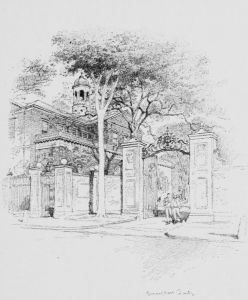
HARVARD HALL AND THE JOHNSON GATE, CAMBRIDGE
At Harvard, too, I met Professor Münsterberg, one of the few writers of standing who have attempted a general review of the American situation. He is a tall fair German, but newly annexed to America, with a certain diplomatic quality in his personality, standing almost consciously, as it were, for Germany in America, and for America in Germany. He has written a book for either people, because hitherto they have seen each other too much through English media ("von Englischen linseln retouchiert"), and he has done much to spread the conception of a common quality and sympathy between Germany and America. "Blood," he says in this connection, "is thicker than water, but ... printer's ink is thicker than blood." England is too aristocratic, France too shockingly immoral, Russia too absolutist to be the sympathetic and similar friend of America, and so, by a process of exhaustion, Germany remains the one power on earth capable of an "inner understanding." (Also he has drawn an alluring parallel between President Roosevelt and the Emperor William to complete the approximation of "die beiden Edelnationen"). I had read all this, and was interested to encounter him therefore at a Harvard table in a circle of his colleagues, agreeable and courteous, and still scarcely more assimilated than the brightly new white Germanic museum among the red brick traditions of Kirkland and Cambridge streets....
Harvard impresses me altogether as a very living factor in the present American outlook, not only when I was in Cambridge, but in the way the place tells in New York, in Chicago, in Washington. It has a living and contemporary attitude, and it is becoming more and more audible. Harvard opinion influences the magazines and affects the press, at least in the East, to an increasing extent. It may, in the near future, become still more rapidly audible. Professor Eliot is now full of years and honor, and I found in New York, in Boston, in Washington, that his successor was being discussed. In all these cities I met people disposed to believe that if President Roosevelt does not become President of the United States for a further term, he may succeed President Eliot. Now that I have seen President Roosevelt it seems to me that this might have a most extraordinary effect in accelerating the reaction upon the people of America of the best and least mercenary of their national thought. Already he is exerting an immense influence in the advertisement of new ideas and ideals. But of President Roosevelt I shall write more fully later....
V
Chicago University
Chicago University, too, is a splendid place of fine buildings and green spaces and trees, with a great going to and fro of students, a wonderful contrast to the dark congestions of the mercantile city to the north. To all the disorganization of that it is even physically antagonistic, and I could think as I went about it that already this new organization has produced such writing as Veblen's admirable ironies (The Theory of Business Enterprise, for example), and such sociological work as that of Zueblin and Albion Small. I went through the vigorous and admirably equipped pedagogic department, which is evidently a centre of thought and stimulus for the whole teaching profession of Illinois; I saw a library of sociology and economics beyond anything that London can boast; I came upon little groups of students working amid piles of books in a businesslike manner, and if at times in other sections this suggestion was still insistent that thought was as yet only "moving in" and, as it were, getting the carpets down, it was equally clear that thought was going to live freely and spaciously, to an unprecedented extent, so soon as things were in order.
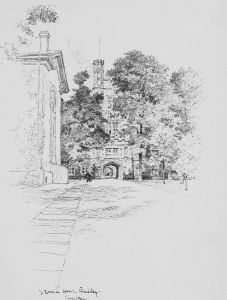
A BIT OF PRINCETON UNIVERSITY
I visited only these three great foundations, each in its materially embodiment already larger, wealthier, and more hopeful than any contemporary British institution, and it required an effort to realize that they were but a portion of the embattled universities of America, that I had not seen Yale nor Princeton nor Cornell nor Leland Stanford nor any Western State university, not a tithe, indeed, of America's drilling levies in the coming war of thought against chaos. I am in no way equipped to estimate the value of the drilling; I have been unable to get any conception how far these tens of thousands of students in these institutions are really alive intellectually, are really inquiring, discussing, reading, and criticising; I have no doubt the great numbers of them spend many hours after the fashion of one roomful I saw intent upon a blackboard covered with Greek; but allowing the utmost for indolence, games, distractions, and waste of time and energy upon unfruitful and obsolete studies, the fact of this great increasing proportion of minds at least a little trained in things immaterial, a little exercised in the critical habit, remains a fact to put over against that million and a half child workers who can barely have learned to read—the other side, the redeeming side of the American prospect.
VI
A Voice from Cornell
I am impressed by the evident consciousness of the American universities of the rôle they have to play in America's future. They seem to me pervaded by the constructive spirit. They are intelligently antagonistic to lethargic and self-indulgent traditions, to disorder, and disorderly institutions. It is from the universities that the deliberate invasion of the political machine by independent men of honor and position—of whom President Roosevelt is the type and chief—proceeds. Mr. George Iles has called my attention to a remarkable address made so long ago as the year 1883 before the Yale Alumni, by President Andrew D. White (the first president), of Cornell, who was afterwards American Ambassador at St. Petersburg and Berlin. President White was a member of the class of '53, and he addressed himself particularly to the men of that year. His title was "The Message of the Nineteenth Century to the Twentieth," and it is full of a spirit that grows and spreads throughout American life, that may ultimately spread throughout the life of the whole nation, a spirit of criticism and constructive effort, of a scope and quality the world has never seen before. The new class of '83 are the messengers.
"To a few tottering old men of our dear class of '53 it will be granted to look with straining eyes over the boundary into the twentieth century; but even these can do little to make themselves heard then. Most of us shall not see it. But before us and around us; nay, in our own families are the men who shall see it. The men who go forth from these dear shades to-morrow are girding themselves for it. Often as I have stood in the presence of such bands of youthful messengers I have never been able to resist a feeling of awe, as in my boyhood when I stood before men who were soon to see Palestine and the Far East, or the Golden Gates of the West, and the islands of the Pacific. The old story of St. Fillipo Neri at Rome comes back to me, who, in the days of the Elizabethan persecutions, made men bring him out into the open air and set him opposite the door of the Papal College of Rome, that he might look into the faces of the English students, destined to go forth to triumph or to martyrdom for the faith in far-off, heretic England."
I cannot forbear from quoting further from this address; it is all so congenial to my own beliefs. Indeed, I like to think of that gathering of young men and old as if it were still existing, as though the old fellows of '53 were still sitting, listening and looking up responsive to this appeal that comes down to us. I fancy President White on the platform before them, a little figure in the perspective of a quarter of a century, but still quite clearly audible, delivering his periods to that now indistinguishable audience:
"What, then, is to be done? Mercantilism, necessitated at first by our circumstances and position, has been in the main a great blessing. It has been so under a simple law of history. How shall it be prevented from becoming in obedience to a similar inexorable law, a curse?
"Here, in the answer to this question, it seems to me, is the most important message from this century to the next.
"For the great thing to be done is neither more nor less than to develop other great elements of civilization now held in check, which shall take their rightful place in the United States, which shall modify the mercantile spirit, ... which shall make the history of our country something greater and broader than anything we have reached, or ever can reach, under the sway of mercantilism alone.
"What shall be those counter elements of civilization? Monarchy, aristocracy, militarism we could not have if we would, we would not have if we could. What shall we have?
"I answer simply that we must do all that we can to rear greater fabrics of religious, philosophic thought, literary thought, scientific, artistic, political thought to summon young men more and more into these fields, not as a matter of taste or social opportunity, but as a patriotic duty; to hold before them not the incentive of mere gain or of mere pleasure or of mere reputation, but the ideal of a new and higher civilization. The greatest work which the coming century has to do in this country is to build up an aristocracy of thought and feeling which shall hold its own against the aristocracy of mercantilism. I would have more and more the appeal made to every young man who feels within him the ability to do good or great things in any of these higher fields, to devote his powers to them as a sacred duty, no matter how strongly the mercantile or business spirit may draw him. I would have the idea preached early and late....
"And as the guardian of such a movement, ... I would strengthen at every point this venerable university, and others like it throughout the country. Remiss, indeed, have the graduates and friends of our own honored Yale been in their treatment of her. She has never had the means to do a tithe of what she might do. She ought to be made strong enough, with more departments, more professors, more fellowships, to become one of a series of great rallying points or fortresses, and to hold always concentrated here a strong army, ever active against mercantilism, materialism, and Philistinism....
"But, after all, the effort to create these new counterpoising, modifying elements of a greater civilization must be begun in the individual man, and especially in the youth who feels within himself the power to think, the power to write, the power to carve the marble, to paint, to leave something behind him better than dollars. In the individual minds and hearts and souls of the messengers who are preparing for the next century is a source of regeneration. They must form an ideal of religion higher than that of a life devoted to grasping and grinding and griping, with a whine for mercy at the end of it. They must form an ideal of science higher than that of increasing the production of iron or cotton. They must form an ideal of literature and of art higher than that of pandering to the latest prejudice or whimsey. And they must form an ideal of man himself worthy of that century into which are to be poured the accumulations of this. So shall material elements be brought to their proper place, made stronger for good, made harmless for evil. So shall we have that development of new and greater elements, that balance of principles which shall make this republic greater than anything of which we now can dream."
CHAPTER XIV
CULTURE
I
The Boston Enchantment
Yet even as I write of the universities as the central intellectual organ of a modern state, as I sit implying salvation by schools, there comes into my mind a mass of qualification. The devil in the American world drama may be mercantilism, ensnaring, tempting, battling against my hero, the creative mind of man, but mercantilism is not the only antagonist. In Fifth Avenue or Paterson one may find nothing but the zenith and nadir of the dollar hunt, at a Harvard table one may encounter nothing but living minds, but in Boston—I mean not only Beacon Street and Commonwealth Avenue, but that Boston of the mind and heart that pervades American refinement and goes about the world—one finds the human mind not base, nor brutal, nor stupid, nor ignorant, but mysteriously enchanting and ineffectual, so that having eyes it yet does not see, having powers it achieves nothing....
I remember Boston as a quiet effect, as something a little withdrawn, as a place standing aside from the throbbing interchange of East and West. When I hear the word Boston now it is that quality returns. I do not think of the spreading parkways of Mr. Woodbury and Mr. Olmstead nor of the crowded harbor; the congested tenement-house regions, full of those aliens whose tongues struck so strangely on the ears of Mr. Henry James, come not to mind. But I think of rows of well-built, brown and ruddy homes, each with a certain sound architectural distinction, each with its two squares of neatly trimmed grass between itself and the broad, quiet street, and each with its family of cultured people within. I am reminded of deferential but unostentatious servants, and of being ushered into large, dignified entrance-halls. I think of spacious stairways, curtained archways, and rooms of agreeable, receptive persons. I recall the finished informality of the high tea. All the people of my impression have been taught to speak English with a quite admirable intonation; some of the men and most of the women are proficient in two or three languages; they have travelled in Italy, they have all the recognized classics of European literature in their minds, and apt quotations at command. And I think of the constant presence of treasured associations with the titanic and now mellowing literary reputations of Victorian times, with Emerson (who called Poe "that jingle man"), and with Longfellow, whose house is now sacred, its view towards the Charles River and the stadium—it is a real, correct stadium—secured by the purchase of the sward before it forever....
At the mention of Boston I think, too, of autotypes and then of plaster casts. I do not think I shall ever see an autotype again without thinking of Boston. I think of autotypes of the supreme masterpieces of sculpture and painting, and particularly of the fluttering garments of the "Nike of Samothrace." (That I saw, also, in little casts and big, and photographed from every conceivable point of view.) It is incredible how many people in Boston have selected her for their æsthetic symbol and expression. Always that lady was in evidence about me, unobtrusively persistent, until at last her frozen stride pursued me into my dreams. That frozen stride became the visible spirit of Boston in my imagination, a sort of blind, headless, and unprogressive fine resolution that took no heed of any contemporary thing. Next to that I recall, as inseparably Bostonian, the dreaming grace of Botticelli's "Prima vera." All Bostonians admire Botticelli, and have a feeling for the roof of the Sistine chapel—to so casual and adventurous a person as myself, indeed, Boston presents a terrible, a terrifying unanimity of æsthetic discriminations. I was nearly brought back to my childhood's persuasion that, after all, there is a right and wrong in these things. And Boston clearly thought the less of Mr. Bernard Shaw when I told her he had induced me to buy a pianola, not that Boston ever did set much store by so contemporary a person as Mr. Bernard Shaw. The books she reads are toned and seasoned books—preferably in the old or else in limited editions, and by authors who may be lectured upon without decorum....
Boston has in her symphony concerts the best music in America, and here her tastes are severely orthodox and classic. I heard Beethoven's Fifth Symphony extraordinarily well done, the familiar pinnacled Fifth Symphony, and now, whenever I grind that out upon the convenient mechanism beside my desk at home, mentally I shall be transferred to Boston again, shall hear its magnificent aggressive thumpings transfigured into exquisite orchestration, and sit again among that audience of pleased and pleasant ladies in chaste, high-necked, expensive dresses, and refined, attentive, appreciative, bald, or iron-gray men....
II
Boston's Antiquity
Then Boston has historical associations that impressed me like iron-moulded, leather-bound, eighteenth-century books. The War of Independence, that to us in England seems half-way back to the days of Elizabeth, is a thing of yesterday in Boston. "Here," your host will say and pause, "came marching" so-and-so, "with his troops to relieve" so-and-so. And you will find he is the great-grandson of so-and-so, and still keeps that ancient colonial's sword. And these things happened before they dug the Hythe military canal, before Sandgate, except for a decrepit castle, existed; before the days when Bonaparte gathered his army at Boulogne—in the days of muskets and pigtails—and erected that column my telescope at home can reach for me on a clear day. All that is ancient history in England and in Boston the decade before those distant alarums and excursions is yesterday. A year or so ago they restored the British arms to the old State-House. "Feeling," my informant witnessed, "was dying down." But there were protests, nevertheless....
If there is one note of incongruity in Boston, it is in the gilt dome of the Massachusetts State-House at night. They illuminate it with electric light. That shocked me as an anachronism. It shocked me—much as it would have shocked me to see one of the colonial portraits, or even one of the endless autotypes of the Belvidere Apollo replaced, let us say, by one of Mr. Alvin Coburn's wonderfully beautiful photographs of modern New York. That electric glitter breaks the spell; it is the admission of the present, of the twentieth century. It is just as if the Quirinal and Vatican took to an exchange of badinage with search-lights, or the King mounted an illuminated E.R. on the Round Tower at Windsor.
Save for that one discord there broods over the real Boston an immense effect of finality. One feels in Boston, as one feels in no other part of the States, that the intellectual movement has ceased. Boston is now producing no literature except a little criticism. Contemporary Boston art is imitative art, its writers are correct and imitative writers the central figure of its literary world is that charming old lady of eighty-eight, Mrs. Julia Ward Howe. One meets her and Colonel Higginson in the midst of an authors' society that is not so much composed of minor stars as a chorus of indistinguishable culture. There are an admirable library and a museum in Boston, and the library is Italianate, and decorated within like an ancient missal. In the less ornamental spaces of this place there are books and readers. There is particularly a charming large room for children, full of pigmy chairs and tables, in which quite little tots sit reading. I regret now I did not ascertain precisely what they were reading, but I have no doubt it was classical matter.
I do not know why the full sensing of what is ripe and good in the past should carry with it this quality of discriminating against the present and the future. The fact remains that it does so almost oppressively. I found myself by some accident of hospitality one evening in the company of a number of Boston gentlemen who constituted a book-collecting club. They had dined, and they were listening to a paper on Bibles printed in America. It was a scholarly, valuable, and exhaustive piece of research. The surviving copies of each edition were traced, and when some rare specimen was mentioned as the property of any member of the club there was decorously warm applause. I had been seeing Boston, drinking in the Boston atmosphere all day.... I know it will seem an ungracious and ungrateful thing to confess (yet the necessities of my picture of America compel me), but as I sat at the large and beautifully ordered table, with these fine, rich men about me, and listened to the steady progress of the reader's ever unrhetorical sentences, and the little bursts of approval, it came to me with a horrible quality of conviction that the mind of the world was dead, and that this was a distribution of souvenirs.
Indeed, so strongly did this grip me that presently, upon some slight occasion, I excused myself and went out into the night. I wandered about Boston for some hours, trying to shake off this unfortunate idea. I felt that all the books had been written, all the pictures painted, all the thoughts said—or at least that nobody would ever believe this wasn't so. I felt it was dreadful nonsense to go on writing books. Nothing remained but to collect them in the richest, finest manner one could. Somewhere about midnight I came to a publisher's window, and stood in the dim moonlight peering enviously at piled copies of Izaak Walton and Omar Khayyam, and all the happy immortals who got in before the gates were shut. And then in the corner I discovered a thin, small book. For a time I could scarcely believe my eyes. I lit a match to be the surer. And it was A Modern Symposium, by Lowes Dickinson, beyond all disputing. It was strangely comforting to see it there—a leaf of olive from the world of thought I had imagined drowned forever.
That was just one night's mood. I do not wish to accuse Boston of any wilful, deliberate repudiation of the present and the future. But I think that Boston—when I say Boston let the reader always understand I mean that intellectual and spiritual Boston that goes about the world, that traffics in book-shops in Rome and Piccadilly, that I have dined with and wrangled with in my friend W.'s house in Blackheath, dear W., who, I believe, has never seen America—I think, I say, that Boston commits the scholastic error and tries to remember too much, to treasure too much, and has refined and studied and collected herself into a state of hopeless intellectual and æsthetic repletion in consequence. In these matters there are limits. The finality of Boston is a quantitive consequence. The capacity of Boston, it would seem, was just sufficient but no more than sufficient, to comprehend the whole achievement of the human intellect up, let us say, to the year 1875 A.D. Then an equilibrium was established. At or about that year Boston filled up.
III
About Wellesley
It is the peculiarity of Boston's intellectual quality that she cannot unload again. She treasures Longfellow in quantity. She treasures his works, she treasures associations, she treasures his Cambridge home. Now, really, to be perfectly frank about him, Longfellow is not good enough for that amount of intellectual house room. He cumbers Boston. And when I went out to Wellesley to see that delightful girls' college everybody told me I should be reminded of the "Princess." For the life of me I could not remember what "Princess." Much of my time in Boston was darkened by the constant strain of concealing the frightful gaps in my intellectual baggage, this absence of things I might reasonably be supposed, as a cultivated person, to have, but which, as a matter of fact, I'd either left behind, never possessed, or deliberately thrown away. I felt instinctively that Boston could never possibly understand the light travelling of a philosophical carpet-bagger. But I hid—in full view of the tree-set Wellesley lake, ay, with the skiffs of "sweet girl graduates"—own up. "I say," I said, "I wish you wouldn't all be so allusive. What Princess?"
It was, of course, that thing of Tennyson's. It is a long, frequently happy and elegant, and always meritorious narrative poem, in which a chaste Victorian amorousness struggles with the early formulæ of the feminist movement. I had read it when I was a boy, I was delighted to be able to claim, and had honorably forgotten the incident. But in Boston they treat it as a living classic, and expect you to remember constantly and with appreciation this passage and that. I think that quite typical of the Bostonian weakness. It is the error of the clever high-school girl, it is the mistake of the scholastic mind all the world over, to learn too thoroughly and to carry too much. They want to know and remember Longfellow and Tennyson—just as in art they want to know and remember Raphael and all the elegant inanity of the sacrifice at Lystra, or the miraculous draught of Fishes; just as in history they keep all the picturesque legends of the War of Independence—looking up the dates and minor names, one imagines, ever and again. Some years ago I met two Boston ladies in Rome. Each day they sallied forth from our hotel to see and appreciate; each evening, after dinner, they revised and underlined in Baedeker what they had seen. They meant to miss nothing in Rome. It's fine in its way—this receptive eagerness, this learners' avidity. Only people who can go about in this spirit need, if their minds are to remain mobile, not so much heads as cephalic pantechnicon vans....
IV
The Wellesley Cabinets
I find this appetite to have all the mellow and refined and beautiful things in life to the exclusion of all thought for the present and the future even in the sweet, free air of Wellesley's broad park, that most delightful, that almost incredible girls' university, with its class-rooms, its halls of residence, its club-houses and gathering-places among the glades and trees. I have very vivid in my mind a sunlit room in which girls were copying the detail in the photographs of masterpieces, and all around this room were cabinets of drawers, and in each drawer photographs. There must be in that room photographs of every picture of the slightest importance in Italy, and detailed studies of many. I suppose, too, there are photographs of all the sculpture and buildings in Italy that are by any standard considerable. There is, indeed, a great civilization, stretching over centuries and embodying the thought and devotion, the scepticism and levities, the ambition, the pretensions, the passions, and desires of innumerable sinful and world-used men—canned, as it were, in this one room, and freed from any deleterious ingredients. The young ladies, under the direction of competent instructors, go through it, no doubt, industriously, and emerge—capable of Browning.
I was taken into two or three charming club-houses that dot this beautiful domain. There was a Shakespeare club-house, with a delightful theatre, Elizabethan in style, and all set about with Shakespearean things; there was the club-house of the girls who are fitting themselves for their share in the great American problem by the study of Greek. Groups of pleasant girls in each, grave with the fine gravity of youth, entertained the reluctantly critical visitor, and were unmistakably delighted and relaxed when one made it clear that one was not in the Great Teacher line of business, when one confided that one was there on false pretences, and insisting on seeing the pantry. They have jolly little pantries, and they make excellent tea.
I returned to Boston at last in a state of mighty doubting, provided with a Wellesley College calendar to study at my leisure.
I cannot, for the life of me, determine how far Wellesley is an aspect of what I have called Boston; how far it is a part of that wide forward movement of the universities upon which I lavish hope and blessings. Those drawings of photographed Madonnas and Holy Families and Annunciations, the sustained study of Greek, the class in the French drama of the seventeenth century, the study of the topography of Rome fill me with misgivings, seeing the world is in torment for the want of living thought about its present affairs. But, on the other hand, there are courses upon socialism—though the text-book is still Das Kapital of Marx—and upon the industrial history of England and America. I didn't discover a debating society, but there is a large accessible library.
How far, I wonder still, are these girls thinking and feeding mentally for themselves? What do they discuss one with another? How far do they suffer under that plight of feminine education—notetaking from lectures?...
But, after all, this about Wellesley is a digression into which I fell by way of Boston's autotypes. My main thesis was that culture, as it is conceived in Boston, is no contribution to the future of America, that cultivated people may be, in effect, as state-blind as—Mr. Morgan Richards. It matters little in the mind of the world whether any one is concentrated upon mediæval poetry, Florentine pictures, or the propagation of pills. The common, significant fact in all these cases is this, a blindness to the crude splendor of the possibilities of America now, to the tragic greatness of the unheeded issues that blunder towards solution. Frankly, I grieve over Boston—Boston throughout the world—as a great waste of leisure and energy, as a frittering away of moral and intellectual possibilities. We give too much to the past. New York is not simply more interesting than Rome, but more significant, more stimulating, and far more beautiful, and the idea that to be concerned about the latter in preference to the former is a mark of a finer mental quality is one of the most mischievous and foolish ideas that ever invaded the mind of man. We are obsessed by the scholastic prestige of mere knowledge and genteel remoteness. Over against unthinking ignorance is scholarly refinement, the spirit of Boston; between that Scylla and this Charybdis the creative mind of man steers its precarious way.
CHAPTER XV
AT WASHINGTON
I
Washington as Anti-climax
I came to Washington full of expectations and curiosities. Here, I felt, so far as it could exist visibly and palpably anywhere, was the head and mind of this colossal America over which my observant curiosities had wandered. In this place I should find, among other things, perhaps as many as ten thousand men who would not be concerned in trade. There would be all the Senators and representatives, their secretaries and officials, and four thousand and more scientific and literary men of Washington's institutions and libraries, the diplomatic corps, the educational centres, the civil service, the writers and thinking men who must inevitably be drawn to this predestined centre. I promised myself arduous intercourse with a teeming intellectual life. Here I should find questions answered, discover missing clues, get hold of the last connections in my inquiry. I should complete at Washington my vision of America; my forecast would follow.
I don't precisely remember how this vision departed. I know only that after a day or so in Washington an entirely different conception was established, a conception of Washington as architecture and avenues, as a place of picture post-cards and excursions, with sightseers instead of thoughts going to and fro. I had imagined that in Washington I should find such mentally vigorous discussion-centres as the New York X Club on a quite magnificent scale. Instead, I found the chief scientific gathering-place has, like so many messes in the British army before the Boer war, a rule against talking "shop." In all Washington there is no clearing-house of thought at all; Washington has no literary journals, no magazines, no publications other than those of the official specialist—there does not seem to be a living for a single firm of publishers in this magnificent empty city.
I went about the place in a state of ridiculous and deepening concern. I went through the splendid Botanical Gardens, through the spacious and beautiful Capitol, and so to the magnificently equipped Library of Congress. There in an upper chamber that commands an altogether beautiful view of long vistas of avenue and garden to that stupendous unmeaning obelisk (the work of the women of America) that dominates all Washington, I found at last a little group of men who could talk. It was like a small raft upon a limitless empty sea. I lunched with them at their Round Table, and afterwards Mr. Putnam showed me the Rotunda, quite the most gracious reading-room dome the world possesses, and explained the wonderful mechanical organization that brings almost every volume in that immense collection within a minute of one's hand. "With all this," I asked him, "why doesn't the place think?" He seemed, discreetly, to consider it did.
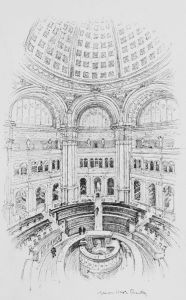
IN THE CONGRESSIONAL LIBRARY
It was in the vein of Washington's detached deadness that I should find Professor Langley (whose flying experiments I have followed for some years with close interest) was dead, and I went through the long galleries of archæological specimens and stuffed animals in the Smithsonian Institution to inflict my questions upon his temporary successor, Dr. Cyrus Adler. He had no adequate excuses. He found a kind of explanation in the want of enterprise of American publishers, so that none of them come to Washington to tap its latent resources of knowledge and intellectual capacity; but that does not account for the absence of any traffic in ideas. It is perhaps near the truth to say that this dearth of any general and comprehensive intellectual activity is due to intellectual specialization. The four thousand scientific men in Washington are all too energetically busy with ethnographic details, electrical computations, or herbaria to talk about common and universal things. They ought not to be so busy, and a science so specialized sinks half-way down the scale of sciences. Science is one of those things that cannot hustle; if it does, it loses its connections. In Washington some men, I gathered, hustle, others play bridge, and general questions are left, a little contemptuously, as being of the nature of "gas," to the newspapers and magazines. Philosophy, which correlates the sciences and keeps them subservient to the universals of life, has no seat there. My anticipated synthesis of ten thousand minds refused, under examination, to synthesize at all; it remained disintegrated, a mob, individually active and collectively futile, of specialists and politicians.
II
The City of Conversation
But that is only one side of Washington life, the side east and south of the White House. Northwestward I found, I confess, the most agreeable social atmosphere in America. It is a region of large fine houses, of dignified and ample-minded people, people not given over to "smartness" nor redolent of dollars, unhurried and reflective, not altogether lost to the wider aspects of life. In Washington I met again that peculiarly aristocratic quality I had found in Harvard—in the person of President Eliot, for example—an aristocratic quality that is all the finer for the absence of rank, that has integral in it—books, thought, and responsibility. And yet I could have wished these fine people more alive to present and future things, a little less established upon completed and mellowing foundations, a little less final in their admirable finish....
There was, I found, a little breeze of satisfaction fluttering the Washington atmosphere in this region. Mr. Henry James came through the States last year distributing epithets among their cities with the justest aptitude. Washington was the "City of Conversation"; and she was pleasantly conscious that she merited this friendly coronation.
Washington, indeed, converses well, without awkwardness, without chatterings, kindly, watchful, agreeably witty. She lulled and tamed my purpose to ask about primary things, to discuss large questions. Only once, and that was in an after-dinner duologue, did I get at all into a question in Washington. For the rest, Washington remarked and alluded and made her point and got away.
III
Mount Vernon
And Washington, with a remarkable unanimity and in the most charming manner, assured me that if I came to see and understand America I must on no account miss Mount Vernon. To have passed indifferently by Concord was bad enough, I was told, but to ignore the home of the first president, to turn my back upon that ripe monument of colonial simplicity, would be quite criminal neglect. To me it was a revelation how sincerely insistent they were upon this. It reminded me of an effect I had already appreciated very keenly in Boston—and even before Boston, when Mr. Z took me across Spuyten Duyvil into the country of Sleepy Hollow, and spoke of Cornwallis as though he had died yesterday—and that is the longer historical perspectives of America. America is an older country than any European one, for she has not rejuvenesced for a hundred and thirty years. In endless ways America fails to be contemporary. In many respects, no doubt, she is decades in front of Europe, in mechanism, for example, and productive organization, but in very many other and more fundamental ones she is decades behind. Go but a little way back and you will find the European's perspectives close up; they close at '71, at '48, down a vista of reform bills, at Waterloo and the treaty of Paris, at the Irish Union, at the coming of Victor Emanuel; Great Britain, for example, in the last hundred years has reconstructed politically and socially, created half her present peerage, evolved the Empire of India, developed Australia, New Zealand, South Africa, fought fifty considerable wars. Mount Vernon, on the other hand, goes back with unbroken continuity, a broad band of mellow tradition, to the War of Independence.
Well, I got all that in conversation at Washington, and so I didn't need to go to Mount Vernon, after all. I got all that about 1777, and I failed altogether to get anything of any value whatever about 1977—which is the year of greater interest to me. About the direction and destinies of that great American process that echoes so remotely through Washington's cool gracefulness of architecture and her umbrageous parks, this cultivated society seemed to me to be terribly incurious and indifferent. It was alive to political personalities, no doubt, its sons and husbands were Senators, judges, ambassadors, and the like; it was concerned with their speeches and prospects, but as to the trend of the whole thing Washington does not picture it, does not want to picture it. I found myself presently excusing myself for Mount Vernon on the ground that I was not a retrospective American, but a go-ahead Englishman, and so apologizing for my want of reverence for venerable things. "We are a young people," I maintained. "We are a new generation."
IV
In the Senate-House
I went to see the Senate debating the railway-rate bill, and from the Senatorial gallery I had pointed out to me Tillman and Platt, Foraker and Lodge, and all the varied personalities of the assembly. The chamber is a circular one, with enormously capacious galleries. The members speak from their desks, other members write letters, read (and rustle) newspapers, sit among accumulations of torn paper, or stand round the apartment in audibly conversational groups. A number of messenger-boys—they wear no uniform—share the floor of the House with the representatives, and are called by clapping the hands. They go to and fro, or sit at the feet of the Vice-President. Behind and above the Vice-President the newspaper men sit in a state of partial attention, occasionally making notes for the vivid descriptions that have long since superseded verbatim reports in America. The public galleries contain hundreds of intermittently talkative spectators. For the most part these did not seem to me to represent, as the little strangers' gallery in the House of Commons represents, interests affected. They were rather spectators seeing Washington, taking the Senate en route for the obelisk top and Mount Vernon. They made little attempt to hear the speeches.
In a large distinguished emptiness among these galleries is the space devoted to diplomatic representatives, and there I saw, sitting in a meritorious solitude, the British charge d'affaires and his wife following the debate below. I found it altogether too submerged for me to follow. The countless spectators, the Senators, the boy messengers, the comings and goings kept up a perpetual confusing babblement. One saw men walking carelessly between the Speaker and the Vice-President, and at one time two gentlemen with their backs to the member in possession of the House engaged the Vice-President in an earnest conversation. The messengers circulated at a brisk trot, or sat on the edge of the dais exchanging subdued badinage. I have never seen a more distracted Legislature.
The whole effect of Washington is a want of concentration, of something unprehensile and apart. It is on, not in, the American process. The place seems to me to reflect, even in its sounds and physical forms, that dispersal of power, that evasion of a simple conclusiveness, which is the peculiar effect of that ancient compromise, the American Constitution. The framers of that treaty were haunted by two terrible bogies, a military dictatorship and what they called "mob rule," they were obsessed by the need of safeguards against these dangers, they were controlled by the mutual distrust of constituent States far more alien to one another than they are now, and they failed to foresee both the enormous assimilation of interests and character presently to be wrought by the railways and telegraphs, and the huge possibilities of corruption, elaborate electrical arrangements offer to clever unscrupulous men. And here in Washington is the result, a Legislature that fails to legislate, a government that cannot govern, a pseudo-responsible administration that offers enormous scope for corruption, and that is perhaps invincibly intrenched behind the two-party system from any insurgence of the popular will. The plain fact of the case is that Congress, as it is constituted at present, is the feeblest, least accessible, and most inefficient central government of any civilized nation in the worst west of Russia. Congress is entirely inadequate to the tasks of the present time.
I came away from Washington with my pre-conception enormously reinforced that the supreme need of America, the preliminary thing to any social or economic reconstruction, is political reform. It seems to me to lie upon the surface that America has to be democratized. It is necessary to make the Senate and the House of Representatives more interdependent, and to abolish the possibilities of deadlocks between them, to make election to the Senate direct from the people, and to qualify and weaken the power of the two-party system by the introduction of "second ballots" and the referendum....
But how such drastic changes are to be achieved constitutionally in America I cannot imagine. Only a great educated, trained, and sustained agitation can bring about so fundamental a political revolution, and at present I can find nowhere even the beginnings of a realization of this need.
V
President Roosevelt
In the White House, set midway between the Washington of the sightseers and the Washington of brilliant conversation, I met President Roosevelt. I was mightily pleased by the White House; it is dignified and simple—once again am I tempted to use the phrase "aristocratic in the best sense" of things American; and an entire absence of uniforms or liveries creates an atmosphere of Republican equality that is reinforced by "Mr. President's" friendly grasp of one's undistinguishable hand. And after lunch I walked about the grounds with him, and so achieved my ambition to get him "placed," as it were, in my vision of America.
In the rare chances I have had of meeting statesmen, there has always been one common effect, an effect of their being smaller, less audible, and less saliently featured than one had expected. A common man builds up his picture of the men prominent in the great game of life very largely out of caricature, out of head-lines, out of posed and "characteristic" portraits. One associates them with actresses and actors, literary poseurs and such-like public performers, anticipates the same vivid self-consciousness as these display in common intercourse, keys one's self up for the paint on their faces, and for voices and manners altogether too accentuated for the gray-toned lives of common men. I've met politicians who remained at that. But so soon as Mr. Roosevelt entered the room, "Teddy," the Teddy of the slouch hat, the glasses, the teeth, and the sword, that strenuous vehement Teddy (who had, let me admit, survived a full course of reading in the President's earlier writings) vanished, and gave place to an entirely negotiable individuality. To-day, at any rate, the "Teddy" legend is untrue. Perhaps it wasn't always quite untrue. There was a time during the world predominance of Mr. Kipling, when I think the caricature must have come close to certain of Mr. Roosevelt's acceptances and attitudes. But that was ten years and more ago, and Mr. Roosevelt to this day goes on thinking and changing and growing....
For me, anyhow, that strenuousness has vanished beyond recalling, and there has emerged a figure in gray of a quite reasonable size, with a face far more thoughtful and perplexed than strenuous, with a clinched hand that does indeed gesticulate, though it is by no means a gigantic fist—and with quick movements, a voice strained indeed, a little forced for oratory, but not raised or aggressive in any fashion, and friendly screwed-up eyes behind the glasses.
It isn't my purpose at all to report a conversation that went from point to point. I wasn't interviewing the President, and I made no note at the time of the things said. My impression was of a mind—for the situation—quite extraordinarily open. That is the value of President Roosevelt for me, and why I can't for the life of my book leave him out. He is the seeking mind of America displayed. The ordinary politician goes through his career like a charging bull, with his eyes shut to any changes in the premises. He locks up his mind like a powder magazine. But any spark may fire the mind of President Roosevelt. His range of reading is amazing; he seems to be echoing with all the thought of the time, he has receptivity to the pitch of genius. And he does not merely receive, he digests and reconstructs; he thinks. It is his political misfortune that at times he thinks aloud. His mind is active with projects of solution for the teeming problems around him. Traditions have no hold upon him—nor, his enemies say, have any but quite formal pledges. It is hard to tie him. In all these things he is to a single completeness, to mind and will of contemporary America. And by an unparalleled conspiracy of political accidents, as all the world knows, he has got to the White House. He is not a part of the regular American political system at all—he has, it happens, stuck through.
Now my picture of America is, as I have tried to make clear, one of a gigantic process of growth, of economic coming and going, spaced out over vast distances and involving millions of hastening men; I see America as towns and urgency and greatnesses beyond, I suppose, any precedent that has ever been in the world. And like a little island of order amid that ocean of enormous opportunity and business turmoil and striving individualities, is this District of Columbia, with Washington and its Capitol and obelisk. It is a mere pin-point in the unlimited, on which, in peace times, the national government lies marooned, twisted up into knots, bound with safeguards, and altogether impotently stranded. And peering closely, and looking from the Capitol down the vista of Pennsylvania Avenue, I see the White House, minute and clear, with a fountain playing before it, and behind it a railed garden set with fine trees. The trees are not so thick, nor the railings so high but that the people on the big "seeing Washington" cannot crane to look into it and watch whoever walk about it. And in this garden goes a living speck, as it were, in gray, talking, swinging a white clinched hand, and trying vigorously and resolutely to get a hold upon the significance of the whole vast process in which he and his island of government are set.
Always before him there have been political resultants, irrelevancies and futilities of the White House; and after him, it would seem, they may come again. I do not know anything of the quality of Mr. Bryan, who may perhaps succeed him. He, too, is something of an exception, it seems, and keeps a still developing and inquiring mind. Beyond is a vista of figures of questionable value so far as I am concerned. They have this in common that they don't stand for thought. For the present, at any rate, a personality, extraordinarily representative, occupies the White House. And what he chooses to say publicly (and some things he says privately) are, by an exceptional law of acoustics, heard in San Francisco, in Chicago, in New Orleans, in New York and Boston, in Kansas, and Maine, throughout the whole breadth of the United States of America. He assimilates contemporary thought, delocalizes and reverberates it. He is America for the first time vocal to itself.
What is America saying to itself?
I've read most of the President's recent speeches, and they fall in oddly with that quality in his face that so many photographs even convey, a complex mingling of will and a critical perplexity. Taken all together they amount to a mass of not always consistent suggestions, that and conflict overlap. Things crowd upon him, rebate scandals, insurance scandals, the meat scandals, this insecurity and that. The conditions of his position press upon him. It is no wonder he gives out no single, simple note....
The plain fact is that in the face of the teeming situations of to-day America does not know what to do. Nobody, except those happily gifted individuals who can see but one aspect of an intricate infinitude, imagines any simple solution. For the rest the time is one of ample, vigorous, and at times impatient inquiry, and of intense disillusionment with old assumptions and methods. And never did a President before so reflect the quality of his time. The trend is altogether away from the anarchistic individualism of the nineteenth century, that much is sure, and towards some constructive scheme which, if not exactly socialism, as socialism is defined, will be, at any rate, closely analogous to socialism. This is the immense change of thought and attitude in which President Roosevelt participates, and to which he gives a unique expression. Day by day he changes with the big world about him—contradicts himself....
I came away with the clear impression that neither President Roosevelt nor America will ever, as some people prophesy, "declare for socialism," but my impression is equally clear, that he and all the world of men he stands for, have done forever with the threadbare formulæ that have served America such an unconscionable time. We talked of the press and books and of the question of color, and then for a while about the rôle of the universities in the life of the coming time.
Now it is a curious thing that as I talked with President Roosevelt in the garden of the White House there came back to me quite forcibly that undertone of doubt that has haunted me throughout this journey. After all, does this magnificent appearance of beginnings which is America, convey any clear and certain promise of permanence and fulfilment whatever? Much makes for construction, a great wave of reform is going on, but will it drive on to anything more than a breaking impact upon even more gigantic uncertainties and dangers. Is America a giant childhood or a gigantic futility, a mere latest phase of that long succession of experiments which has been and may be for interminable years—may be indeed altogether until the end—man's social history? I can't now recall how our discursive talk settled towards that, but it is clear to me that I struck upon a familiar vein of thought in the President's mind. He hadn't, he said, an effectual disproof of any pessimistic interpretation of the future. If one chose to say America must presently lose the impetus of her ascent, that she and all mankind must culminate and pass, he could not conclusively deny that possibility. Only he chose to live as if this were not so.
That remained in his mind. Presently he reverted to it. He made a sort of apology for his life against the doubts and scepticisms that, I fear, must be in the background of the thoughts of every modern man who is intellectually alive. He mentioned a little book of mine, an early book full of the deliberate pessimism of youth, in which I drew a picture of a future of decadence, of a time when constructive effort had fought its fight and failed, when the inevitable segregations of an individualistic system had worked themselves out and all the hope and vigor of humanity had gone forever. The descendants of the workers had become etiolated, sinister, and subterranean monsters, the property-owners had degenerated into a hectic and feebly self-indulgent race, living fitfully amid the ruins of the present time. He became gesticulatory, and his straining voice a note higher in denying this as a credible interpretation of destiny. With one of those sudden movements of his, he knelt forward in a garden chair—we were standing before our parting beneath the colonnade—and addressed me very earnestly over the back, clutching it, and then thrusting out his familiar gesture, a hand first partly open and then closed.
"Suppose after all," he said, slowly, "that should prove to be right, and it all ends in your butterflies and morlocks. That doesn't matter now. The effort's real. It's worth going on with. It's worth it. It's worth it—even then."...
I can see him now and hear his unmusical voice saying "The effort—the effort's worth it," and see the gesture of his clinched hand and the—how can I describe it? the friendly peering snarl of his face, like a man with the sun in his eyes. He sticks in my mind as that, as a very symbol of the creative will in man, in its limitations, its doubtful adequacy, its valiant persistence amid perplexities and confusions. He kneels out, assertive against his setting—and his setting is the White House with a background of all America.
I could almost write, with a background of all the world—for I know of no other a tithe so representative of the creative purpose, the good-will in men as he. In his undisciplined hastiness, his limitations, his prejudices, his unfairness, his frequent errors, just as much as in his force, his sustained courage, his integrity, his open intelligence, he stands for his people and his kind.
THE ENVOY
And at last I am back in my study by the sea. It is high June. When I said good-bye to things it was March, a March warm and eager to begin with, and then dashed with sleet and wind; but the daffodils were out, and the primulas and primroses shone brown and yellow in the unseasonable snow. The spring display that was just beginning is over. The iris rules. Outside the window is a long level line of black fleur-de-lys rising from a serried rank of leaf-blades. Their silhouettes stand out against the brightness of the twilight sea. They mark, so opened, two months of absence. And in the interval I have seen a great world.
I have tried to render it as I saw it. I have tried to present the first exhilaration produced by the sheer growth of it, the morning-time hopefulness of spacious and magnificent opportunity, the optimism of successful, swift, progressive effort in material things. And from that I have passed to my sense of the chaotic condition of the American will, and that first confidence has darkened more and more towards doubt again. I came to America questioning the certitudes of progress. For a time I forgot my questionings; I sincerely believed, "These people can do anything," and, now I have it all in perspective, I have to confess that doubt has taken me again. "These people," I say, "might do anything. They are the finest people upon earth—the most hopeful. But they are vain and hasty; they are thoughtless, harsh, and undisciplined. In the end, it may be, they will accomplish nothing." I see, I have noted in its place, the great forces of construction, the buoyant, creative spirit of America. But I have marked, too, the intricacy of snares and obstacles in its path. The problem of America, save in its scale and freedom, is no different from the problem of Great Britain, of Europe, of all humanity; it is one chiefly moral and intellectual; it is to resolve a confusion of purposes, traditions, habits, into a common ordered intention. Everywhere one finds what seem to me the beginnings of that—and, for this epoch it is all too possible, they may get no further than beginnings. Yet another Decline and Fall may remain to be written, another and another, and it may be another, before the World State comes and Peace.
Yet against this prospect of a dispersal of will, of a secular decline in honor, education, public spirit, and confidence, of a secular intensification of corruption, lawlessness, and disorder, I do, with a confidence that waxes and wanes, balance the creative spirit in America, and that kindred spirit that for me finds its best symbol in the President's kneeling, gesticulating figure, and his urgent "The effort's worth it!" Who can gauge the far-reaching influence of even the science we have, in ordering and quickening the imagination of man, in enhancing and assuring their powers? Common men feel secure to-day in enterprises it needed men of genius to conceive in former times. And there is a literature—for all our faults we do write more widely, deeply, disinterestedly, more freely and frankly than any set of writers ever did before—reaching incalculable masses of readers, and embodying an amount of common consciousness and purpose beyond all precedent. Consider only how nowadays the problems that were once the inaccessible thoughts of statesmen may be envisaged by common men! Here am I really able, in a few weeks of observant work, to get a picture of America. I publish it. If it bears a likeness, it will live and be of use; if not it will die, and be no irreparable loss. Some fragment, some suggestion may survive. My friend Mr. F. Madox Hueffer was here a day or so ago to say good-bye; he starts for America as I write here, to get his vision. As I have been writing these papers I have also been reading, instalment by instalment, the subtle, fine renderings of America revisited by Mr. Henry James. We work in shoals, great and small together, one trial thought following another. We are getting the world presented. It is not simply America that we swarm over and build up into a conceivable process, into something understandable and negotiable by the mind. I find on my desk here waiting for me a most illuminating Vision of India, in which Mr. Sidney Low, with a marvellous aptitude, has interpreted east to west. Besides my poor superficialities in The Tribune appears Sir William Butler, with a livid frankness expounding the most intimate aspects of the South African situation. A friend who called to-day spoke of Nevinson's raid upon the slave trade of Portuguese East Africa, and of two irrepressible writers upon the Congo crimes. I have already mentioned the economic and social literature, the so-called literature of exposure in America. This altogether represents collectively a tremendous illumination. No social development was ever so lit and seen before. Collectively, this literature of facts and theories and impressions is of immense importance. Things are done in the light, more and more are they done in the light. The world perceives and thinks....
After all is said and done, I do find the balance of my mind tilts steadily to a belief in a continuing and accelerated progress now in human affairs. And in spite of my patriotic inclinations, in spite, too, of the present high intelligence and efficiency of Germany, it seems to me that in America, by sheer virtue of its size, its free traditions, and the habit of initiative in its people, the leadership of progress must ultimately rest. Things like the Chicago scandals, the insurance scandals, and all the manifest crudities of the American spectacle, don't seem to me to be more than relatively trivial after all. There are the universities, the turbines of Niagara, the New York architecture, and the quality of the mediocre people to set against these....
Within a week after I saw the President I was on the Umbria and steaming slowly through the long spectacle of that harbor which was my first impression of America, which still, to my imagination, stands so largely for America. The crowded ferry-boats hooted past; athwart the shining water, tugs clamored to and fro. The sky-scrapers raised their slender masses heavenward—America's gay bunting lit the scene. As we dropped down I had a last glimpse of the Brooklyn Bridge. There to the right was Ellis Island, where the immigrants, minute by minute, drip and drip into America, and beyond that the tall spike-headed Liberty with the reluctant torch, which I have sought to make the centre of all this writing. And suddenly as I looked back at the sky-scrapers of lower New York a queer fancy sprang into my head. They reminded me quite irresistibly of piled-up packing cases outside a warehouse. I was amazed I had not seen the resemblance before. I could really have believed for a moment that that was what they were, and that presently out of these would come the real thing, palaces and noble places, free, high circumstances, and space and leisure, light and fine living for the sons of men....
Ocean, cities, multitudes, long journeys, mountains, lakes as large as seas, and the riddle of a nation's destiny; I've done my impertinent best now with this monstrous insoluble problem. I finish.
The air is very warm and pleasant in my garden to-night, the sunset has left a rim of greenish-gold about the northward sky, shading up a blue that is, as yet, scarce pierced by any star. I write down these last words here, and then I shall step through the window and sit out there in the kindly twilight, now quiet, now gossiping idly of what so-and-so has done while I have been away, of personal motives and of little incidents and entertaining intimate things.
THE END