ILLUSTRATIONS (continued 2)
Reading edition
The long distances of travel, and the sense of isolation between place and place, the remoteness verging upon inaudibility of Washington in Chicago, of Chicago in Boston, the vision I have had of America from observation cars and railroad windows brings home to me more and more that this huge development of human appliances and resources is here going on in a community that is still, for all the dense crowds of New York, the teeming congestion of the East Side, extraordinarily scattered. America, one recalls, is still an unoccupied country, across which the latest developments of civilization are rushing. We are dealing here with a continuous area of land which is, leaving Alaska out of account altogether, equal to Great Britain, France, the German Empire, the Austro-Hungarian Empire, Italy, Belgium, Japan, Holland, Spain and Portugal, Sweden and Norway, Turkey in Europe, Egypt and the whole Empire of India, and the population spread out over this vast space is still less than the joint population of the first two countries named and not a quarter that of India. Moreover, it is not spread at all evenly. Much of it is in undistributed clots. It is not upon the soil, barely half of it is in holdings and homes and authentic communities. It is a population of an extremely modern type. Urban concentration has already gone far with it; fifteen millions of it are crowded into and about twenty great cities, other eighteen millions make up five hundred towns. Between these centres of population run railways indeed, telegraph wires, telephone connections, tracks of various sorts, but to the European eye these are mere scratchings on a virgin surface. An empty wilderness manifests itself through this thin network of human conveniences, appears in the meshes even at the railroad side. Essentially America is still an unsettled land, with only a few incidental good roads in favored places, with no universal police, with no wayside inns where a civilized man may rest, with still only the crudest of rural postal deliveries, with long stretches of swamp and forest and desert by the track side, still unassailed by industry. This much one sees clearly enough eastward of Chicago. Westward, I am told, it becomes more and more the fact. In Idaho at last, comes the untouched and perhaps invincible desert, plain and continuous through the long hours of travel. Huge areas do not contain one human being to the square mile, still vaster portions fall short of two....
And this community, to which material progress is bringing such enormous powers, and that is knotted so densely here and there, and is otherwise so attenuated a veil over the huge land surface, is, as Professor Münsterberg points out, in spite of vast and increasing masses of immigrants still a curiously homogeneous one, homogeneous in the spirit of its activities and speaking a common tongue. It is sustained by certain economic conventions, inspired throughout by certain habits, certain trends of suggestion, certain phrases and certain interpretations that collectively make up what one may call the American Idea. To the process of enlargement and diffusion and increase and multiplying resources, we must now bring the consideration of the social and economic process that is going on. What is the form of that process as one finds it in America? An English Tory will tell you promptly, "a scramble for dollars." A good American will tell you it is self realization under equality of opportunity. The English Tory will probably allege that that amounts to the same thing.
Let us look into that.
II
Liberty of Property
One contrast between America and the old world I had in mind before ever I crossed the Atlantic, and now it comes before me very vividly,—returns reinforced by a hundred little things observed and felt. The contrast consists in the almost complete absence from the normal American scheme, of certain immemorial factors in the social structure of our European nations.
In the first place, every European nation except the English is rooted to the soil by a peasantry, and even in England one still finds the peasant represented, in most of his features by those sons of dispossessed serf-peasants, the agricultural laborers. Here in America, except in the regions where the negro abounds, there is no lower stratum, no "soil people," to this community at all; your bottom-most man is a mobile free man who can read, and who has ideas above digging and pigs and poultry keeping, except incidentally for his own ends. No one owns to subordination. As a consequence, any position which involves the acknowledgment of an innate inferiority is difficult to fill; there is, from the European point of view, an extraordinary dearth of servants, and this endures in spite of a great peasant immigration. The servile tradition will not root here now, it dies in this soil. An enormous importation of European serfs and peasants goes on, but as they touch this soil their backs begin to stiffen with a new assertion.
And at the other end of the scale, also, one misses an element. There is no territorial aristocracy, no aristocracy at all, no throne, no legitimate and acknowledged representative of that upper social structure of leisure, power, State responsibility, which in the old European theory of society was supposed to give significance to the whole. The American community, one cannot too clearly insist, does not correspond to an entire European community at all, but only to the middle masses of it, to the trading and manufacturing class between the dimensions of the magnate and the clerk and skilled artisan. It is the central part of the European organism without either the dreaming head or the subjugated feet. Even the highly feudal slave-holding "county family" traditions of Virginia and the South pass now out of memory. So that in a very real sense the past of this American community is in Europe, and the settled order of the past is left behind there. This community was, as it were, taken off its roots, clipped of its branches and brought hither. It began neither serf nor lord, but burgher and farmer, it followed the normal development of the middle class under Progress everywhere and became capitalistic. Essentially America is a middle-class become a community and so its essential problems are the problems of a modern individualistic society, stark and clear, unhampered and unilluminated by any feudal traditions either at its crest or at its base.
It would be interesting and at first only very slightly misleading to pursue the rough contrast of American and English conditions upon these lines. It is not difficult to show for example, that the two great political parties in America represent only one English party, the middle-class Liberal party, the party of industrialism and freedom. There are no Tories to represent the feudal system, and no Labor party. It is history, it is no mere ingenious gloss upon history, that the Tories, the party of the crown, of the high gentry and control, of mitigated property and an organic state, vanished from America at the Revolution. They left the new world to the Whigs and Nonconformists and to those less constructive, less logical, more popular and liberating thinkers who became Radicals in England, and Jeffersonians and then Democrats in America. All Americans are, from the English point of view, Liberals of one sort or another. You will find a fac-simile of the Declaration of Independence displayed conspicuously and triumphantly beside Magna Charter in the London Reform Club, to carry out this suggestion.
But these fascinating parallelisms will lead away from the chief argument in hand, which is that the Americans started almost clear of the medieval heritage, and developed in the utmost—purity if you like—or simplicity or crudeness, whichever you will, the modern type of productive social organization. They took the economic conventions that were modern and progressive at the end of the eighteenth century and stamped them into the Constitution as if they meant to stamp them there for all time. In England you can still find feudalism, medievalism, the Renascence, at every turn. America is pure eighteenth century—still crystallizing out from a turbid and troubled solution.
To turn from any European state to America is, in these matters anyhow, to turn from complication to a stark simplicity. The relationship between employer and employed, between organizer and worker, between capital and labor, which in England is qualified and mellowed and disguised and entangled with a thousand traditional attitudes and subordinations, stands out sharply in a bleak cold rationalism. There is no feeling that property, privilege, honor, and a grave liability to official public service ought to go together, none that uncritical obedience is a virtue in a worker or that subordination carries with it not only a sense of service but a claim for help. Coming across the Atlantic has in these matters an effect of coming out of an iridescent fog into a clear bright air.
This homologization of the whole American social mass, not with the whole English social mass, but with its "modern" classes, its great middle portion, and of its political sides with the two ingredients of English Liberalism, goes further than a rough parallel. An Englishman who, like myself, has been bred and who has lived all his life either in London, with its predominant West-End, or the southern counties with their fair large estates and the great country houses, is constantly being reminded, when he meets manufacturing and business men from Birmingham or Lancashire, of Americans, and when he meets Americans, of industrial North-country people. There is more push and less tacit assumption, more definition, more displayed energy and less restraint, more action and less subtlety, more enterprise and self-assertion than there is in the typical Englishman of London and the home counties. The American carries on the contrast further, it is true, and his speech is not northernly, but marked by the accent of Hampshire or East Anglia, and better and clearer than his English equivalent's; but one feels the two are of the same stuff, nevertheless, and made by parallel conditions. The liberalism of the eighteenth century, the material progress of the nineteenth have made them both—out of the undifferentiated Stuart Englishman. And they are the same in their attitude towards property and social duty, individualists to the marrow. But the one grew inside a frame of regal, aristocratic, and feudal institutions, and has chafed against it, struggled with it, modified it, strained it, and been modified by it, but has remained within it; the other broke it and escaped to complete self-development.
The liberalism of the eighteenth century was essentially the rebellion of the modern industrial organization against the monarchial and aristocratic State,—against hereditary privilege, against restrictions upon bargains—whether they were hard bargains or not. Its spirit was essentially Anarchistic,—the antithesis of Socialism. It was the anti-State. It aimed not only to liberate men but property from State control. Its most typical expressions, the Declaration of Independence, and the French Declaration of the Rights of Man, are zealously emphatic for the latter interest—for the sacredness of contracts and possessions. Post Reformation liberalism did to a large extent let loose property upon mankind. The English Civil War of the seventeenth century, like the American revolution of the eighteenth, embodied essentially the triumphant refusal of private property to submit to taxation without consent. In England the result was tempered and qualified, security for private property was achieved, but not cast-iron security; each man who had property became king of that property, but only a constitutional and conditional king. In America the victory of private property was complete. Let one instance suffice to show how decisively it was established that individual property and credit and money were sacred. Ten years ago the Supreme Court, trying a case arising out of the General Revenue tax of 1894, decided that a graduated income-tax, such as the English Parliament might pass to-morrow, can never be levied upon the United States nation without a change in the Constitution, which can be effected only by a vote of two-thirds of both Houses of Congress as an initiative, and this must be ratified either by the legislatures of three-fourths of the States, or by special conventions representing three-fourths of the States. The fundamental law of the States forbids any such invasion of the individual's ownership. No national income-tax is legal, and there is practically no power, short of revolution, to alter that....
Could anything be more emphatic? That tall Liberty with its spiky crown that stands in New York Harbor and casts an electric flare upon the world, is, indeed, the liberty of Property, and there she stands at the Zenith....
III
Aggregation and Some Protests
Now the middle-class of the English population and the whole population of America that matters at all when we discuss ideas, is essentially an emancipated class, a class that has rebelled against superimposed privilege and honor, and achieved freedom for its individuals and their property. Without property its freedom is a featureless and unsubstantial theory, and so it relies for the reality of life upon that, upon the possession and acquisition and development of property, that is to say upon "business." That is the quality of its life.
Everywhere in the modern industrial and commercial class this deep-lying feeling that the State is something escaped from, has worked out to the same mental habit of social irresponsibility, and in America it has worked unimpeded. Patriotism has become a mere national self-assertion, a sentimentality of flag cheering, with no constructive duties. Law, social justice, the pride and preservation of the state as a whole are taken as provided for before the game began, and one devotes one-self to business. At business all men are held to be equal, and none is his brother's keeper.
All men are equal at the great game of business. You try for the best of each bargain and so does your opponent; if you chance to have more in your hand than he—well, that's your advantage, and you use it. Presently he may have more than you. You take care he doesn't if you can, but you play fair—except for the advantage in your hand; you play fair—and hard.
Now this middle-class equality ultimately destroys itself. Out of this conflict of equals, and by virtue of the fact that property, like all sorts of matter, does tend to gravitate towards itself whenever it is free, there emerge the modern rich and the modern toiler.
One can trace the process in two or three generations in Lancashire or the Potteries, or any industrial region of England. One sees first the early Lancashire industrialism, sees a district of cotton-spinners more or less equal together, small men all; then come developments, comes a state of ideally free competition with some men growing large, with most men dropping into employment, but still with ample chances for an industrious young man to end as a prosperous master; and so through a steady growth in the size of the organization to the present opposition of an employer class in possession of everything, almost inaccessibly above, and an employed class below. The railways come, and the wealthy class reaches out to master these new enterprises, capitalistic from the outset....
America is simply repeating the history of the Lancashire industrialism on a gigantic scale, and under an enormous variety of forms.
But in England, as the modern Rich rise up, they come into a world of gentry with a tradition of public service and authority; they learn one by one and assimilate themselves to the legend of the "governing class" with a sense of proprietorship which is also, in its humanly limited way, a sense of duty to the state. They are pseudomorphs after aristocrats. They receive honors, they inter-marry, they fall (and their defeated competitors too fall) into the mellowed relationships of an aristocratic system. That is not a permanent mutual attitude; it does, however, mask and soften the British outline. Industrialism becomes quasi-feudal. America, on the other hand, had no effectual "governing class," there has been no such modification, no clouding of the issue. Its Rich, to one's superficial inspection, do seem to lop out, swell up into an immense consumption and power and inanity, develop no sense of public duties, remain winners of a strange game they do not criticise, concerned now only to hold and intensify their winnings. The losers accept no subservience. That material progress, that secular growth in scale of all modern enterprises, widens the gulf between Owner and Worker daily. More and more do men realize that this game of free competition and unrestricted property does not go on for ever; it is a game that first in this industry and then in that, and at last in all, can be played out and is being played out. Property becomes organized, consolidated, concentrated, and secured. This is the fact to which America is slowly awaking at the present time. The American community is discovering a secular extinction of opportunity, and the appearance of powers against which individual enterprise and competition are hopeless. Enormous sections of the American public are losing their faith in any personal chance of growing rich and truly free, and are developing the consciousness of an expropriated class.
This realization has come slowlier in America than in Europe, because of the enormous undeveloped resources of America. So long as there was an unlimited extent of unappropriated and unexplored land westward, so long could tension be relieved by so simple an injunction as Horace Greeley's, "Go West, young man; go West." And to-day, albeit that is no longer true of the land, and there are already far larger concentrations of individual possessions in the United States of America than anywhere else in the world, yet so vast are their continental resources that it still remains true that nowhere in the world is property so widely diffused. Consider the one fact that America can take in three-quarters of a million of workers in one year without producing a perceptible fall in wages, and you will appreciate the scale upon which things are measured here, the scale by which even Mr. J.D. Rockefeller's billion dollars becomes no more than a respectable but by no means overwhelming "pile." For all these concentrations, the western farmers still own their farms, and it is the rule rather than the exception for a family to possess the freehold of the house it lives in. But the process of concentration goes on nevertheless—is going on now perceptibly to the American mind. That it has not gone so far as in the European instance it is a question of size, just as the gestation of an elephant takes longer than that of a mouse. If the process is larger and slower, it is, for the reasons I have given, plainer, and it will be discussed and dealt with plainly. That steady trend towards concentration under individualistic rules, until individual competition becomes disheartened and hopeless, is the essential form of the economic and social process in America as I see it now, and it has become the cardinal topic of thought and discussion in the American mind.
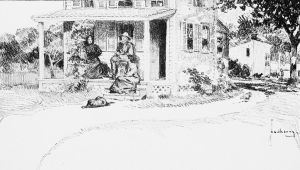
WESTERN FARMERS STILL OWN THEIR FARMS
This realization has been reached after the most curious hesitation. There is every reason for this; for it involves the contradiction of much that seems fundamental in the American idea. It amounts to a national change of attitude. It is a conscious change of attitude that is being deliberately made.
This slow reluctant process of disillusionment with individualism is interestingly traceable through the main political innovations of the last twenty years. There was the discovery in the east that the supply of land was not limitless, and we had the Single Tax movement, and the epoch of the first Mr. Henry George. He explained fervently of course, how individualistic, how profoundly American he was—but land was not to be monopolized. Then came the discovery in the west that there were limits to borrowing and that gold appreciated against the debtor, and so we have the Populist movement and extraordinary schemes for destroying the monopolization of gold and credit. Mr. Bryan led that and nearly captured the country, but only in last May's issue of the Century Magazine I found him explaining (expounding meanwhile a largely socialistic programme) that he too is an Individualist of the purest water. And then the attack shifted to the destruction of free competition by the trusts. The small business went on sufferance, 'not knowing from week to week when its hour to sell out or fight might come. The Trusts have crushed competition, raised prices against the consumer, and served him often quite abominably. The curious reader may find in Mr. Upton Sinclair's essentially veracious Jungle the possibilities of individualistic enterprise in the matter of food and decency. The States have been agitated by a big disorganized Anti-Trust movement for some years, it becomes of the gravest political importance at every election, and the sustained study of the affairs and methods of that most typical and prominent of trust organizations, the Standard Oil Company, by Miss Tarbell and a host of followers, is bringing to light more and more clearly the defencelessness of the common person, and his hopelessness, however enterprising, as a competitor against those great business aggregations. His faith in all his reliances and securities fades in the new light that grows about him, he sees his little investments, his insurance policy, his once open and impartial route to market by steamboat and rail, all passing into the grip of the great property accumulators. The aggregation of property has created powers that are stronger than state legislatures and more persistent than any public opinion can be, that have no awe and no sentiment for legislation, that are prepared to disregard it or evade it whenever they can.
And these aggregations are taking on immortality and declining to disintegrate when their founders die. The Astor property, the Jay Gould property, the Marshall Field property, for example, do not break up, become undying centres for the concentration of wealth, and it is doubtful if there is any power to hinder such a development of perpetual fortunes. In England when Thelussen left his investments to accumulate, a simple little act of Parliament set his will aside. But Congress is not sovereign, there is no national sovereign power in America, and Property in America, it would seem, is absolutely free to do these things. So you have President Roosevelt in a recent oration attacking the man with the Muck Rake (who gathered vile dross for the love of it), and threatening the limitation of inheritance. But he too, quite as much as Mr. Bryan, assures the public that he is a fervent individualist.
So in this American community, whose distinctive conception is its emphatic assertion of the freedom of individual property, whose very symbol is that spike-crowned Liberty gripping a torch in New York Harbor, there has been and is going on a successive repudiation of that freedom in almost every department of ownable things by considerable masses of thinking people, a denial of the soundness of individual property in land, an organized attempt against the accumulation of gold and credit, by a systematic watering of the currency, a revolt against the aggregatory outcome of untrammelled business competition, a systematic interference with the freedom of railways and carriers to do business as they please, and a protest from the most representative of Americans against hereditary wealth....
That, in general terms, is the economic and social process as one sees it in America now, a process of systematically concentrating wealth on the part of an energetic minority, and of a great insurgence of alarm, of waves of indignation and protest and threat on the part of that vague indefinite public that Mr. Roosevelt calls the "nation."
And this goes on side by side with a process of material progress that partly masks its quality, that keeps the standard of life from falling and prevents any sense of impoverishment among the mass of the losers in the economic struggle. Through this material progress there is a constant substitution of larger, cleaner, more efficient possibilities, and more and more wholesale and far-sighted methods of organization for the dark, confused, untidy individualistic expedients of the Victorian time. An epoch which was coaly and mechanical, commercial and adventurous after the earlier fashion is giving place, almost automatically, to one that will be electrical and scientific, artistic and creative. The material progress due to a secular increase in knowledge, and the economic progress interfere and combine with and complicate one another, the former constantly changes the forms and appliances of the latter, changes the weapons and conditions, and may ultimately change the spirit and conceptions of the struggle. The latter now clogs and arrests the former. So in its broad features, as a conflict between the birth strength of a splendid civilization and a hampering commercialism, I see America.
CHAPTER VI
SOME ASPECTS OF AMERICAN WEALTH
I
The Spenders
It is obvious that in a community that has disavowed aristocracy or rule and subordination or service, which has granted unparalleled freedoms to property and despised and distrusted the state, the chief business of life will consist in getting or attempting to get. But the chief aspect of American life that impinges first upon the European is not this, but the behavior of a certain overflow at the top, of people who have largely and triumphantly got, and with hand, pockets, safe-deposit vaults full of dollars, are proceeding to realize victory. Before I came to America it was in his capacity of spender that I chiefly knew the American; as a person who had demoralized Regent Street and the Rue de Rivoli, who had taught the London cabman to demand "arf a dollar" for a shilling fare, who bought old books and old castles, and had driven the prices of old furniture to incredible altitudes, and was slowly transferring our incubus of artistic achievement to American soil. One of my friends in London is Mr. X, who owns those two houses full of fine "pieces" near the British Museum and keeps his honor unsullied in the most deleterious of trades. "They come to me," he said, "and ask me to buy for them. It's just buying. One of them wants to beat the silver of another, doesn't care what he pays. Another clamors for tapestry. They trust me as they trust a doctor. There's no understanding—no feeling. It's hard to treat them well."
And there is the story of Y, who is wise about pictures. "If you want a Botticelli that size, Mr. Record, I can't find it," he said; "you'll have to have it made for you."
These American spenders have got the whole world "beat" at the foolish game of collecting, and in all the peculiar delights of shopping they excel. And they are the crown and glory of hotel managers throughout the world. There is something naïve, something childishly expectant and acquisitive, about this aspect of American riches. There appears no aristocracy in their tradition, no sense of permanence and great responsibility, there appears no sense of subordination and service; from the individualistic business struggle they have emerged triumphant, and what is there to do now but spend and have a good time?
They swarm in the pleasant places of the Riviera, they pervade Paris and Rome, they occupy Scotch castles and English estates, their motor-cars are terrible and wonderful. And the London Savoy Hotel still flaunts its memory of one splendid American night. The court-yard was flooded with water tinted an artistic blue—to the great discomfort of the practically inevitable gold-fish, and on this floated a dream of a gondola. And in the gondola the table was spread and served by the Savoy staff, mysteriously disguised in appropriate fancy costume. The whole thing—there's only two words for it—was "perfectly lovely." "The illusion"—whatever that was—we are assured, was complete. It wasn't a nursery treat, you know. The guests, I am told, were important grown-up people.
This sort of childishness, of course, has nothing distinctively American in it. Any people of sluggish and uneducated imagination who find themselves profusely wealthy, and are too stupid to understand the huge moral burden, the burden of splendid possibilities it carries, may do things of this sort. It was not Americans but a party of South-African millionaires who achieved the kindred triumph of the shirt-and-belt dinner under a tent in a London hotel dining-room. The glittering procession of carriages and motor-carriages which I watched driving down Fifth Avenue, New York, apparently for the pleasure of driving up again, is to be paralleled on the Pincio, in Naples, in Paris, and anywhere where irresponsible pleasure-seekers gather together. After the naïve joy of buying things comes the joy of wearing them publicly, the simple pleasure of the promenade. These things are universals. But nowhere has this spending struck me as being so solid and substantial, so nearly twenty-two carats fine, as here. The shops have an air of solid worth, are in the key of butlers, bishops, opera-boxes, high-class florists, powdered footmen, Roman beadles, motor-broughams, to an extent that altogether outshines either Paris or London.
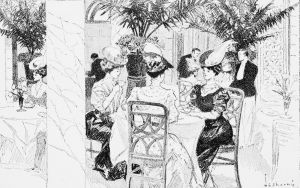
PLUMP AND PRETTY PUPILS OF EXTRAVAGANCE
And in such great hotels as the Waldorf-Astoria, one finds the new arrivals, the wives and daughters from the West and the South, in new, bright hats, and splendors of costume, clubbed together, under the discreetest management, for this and that, learning how to spend collectively, reaching out to assemblies, to dinners. From an observant tea-table beneath the fronds of a palm, I surveyed a fine array of these plump and pretty pupils of extravagance. They were for the most part quite brilliantly as well as newly dressed, and with an artless and pleasing unconsciousness of the living from inside. Smart innocents! I found all that gathering most contagiously interested and happy and fresh.
And I watched spending, too, as one sees it in the various incompatible houses of upper Fifth Avenue and along the border of Central Park. That, too, suggests a shop, a shop where country houses are sold and stored; there is the Tiffany house, a most expensive-looking article, on the shelf, and the Carnegie house. There had been no pretence on the part of the architects that any house belonged in any sense to any other, that any sort of community held them together. The link is just spending. You come to New York and spend; you go away again. To some of these palaces people came and went; others had their blinds down and conveyed a curious effect of a sunlit child excursionist in a train who falls asleep and droops against his neighbor. One of the Vanderbilt houses was frankly and brutally boarded up. Newport, I am told, takes up and carries on the same note of magnificent irresponsibility, and there one admires the richest forms of simplicity, triumphs of villa architecture in thatch, and bathing bungalows in marble....
There exists already, of these irresponsible American rich, a splendid group of portraits, done without extenuation and without malice, in the later work of that great master of English fiction, Mr. Henry James. There one sees them at their best, their refinement, their large wealthiness, their incredible unreality. I think of The Ambassadors and that mysterious source of the income of the Newcomes, a mystery that, with infinite artistic tact, was never explained; but more I think of The Golden Bowl, most spacious and serene of novels.
In that splendid and luminous bubble, the Prince Amerigo and Maggie Verver, Mr. Verver, that assiduous collector, and the adventurous Charlotte Stant float far above a world of toil and anxiety, spending with a large refinement, with a perfected assurance and precision. They spend as flowers open. But this is the quintessence, the sublimation, the idealization of the rich American. Few have the restraint for this. For the rest, when one has shopped and shopped, and collected and bought everything, and promenaded on foot, in motor-car and motor-brougham and motor-boat, in yacht and special train; when one has a fine house here and a fine house there, and photography and the special article have exhausted admiration, there remains chiefly that one broader and more presumptuous pleasure—spending to give. American givers give most generously, and some of them, it must be admitted, give well. But they give individually, incoherently, each pursuing a personal ideal. There are unsuccessful givers....
American cities are being littered with a disorder of unsystematized foundations and picturesque legacies, much as I find my nursery floor littered with abandoned toys and battles and buildings when the children are in bed after a long, wet day. Yet some of the gifts are very splendid things. There is, for example, the Leland Stanford Junior University in California, a vast monument of parental affection and Richardsonian architecture, with professors, and teaching going on in its interstices; and there is Mrs. Gardner's delightful Fenway Court, a Venetian palace, brought almost bodily from Italy and full of finely gathered treasures....
All this giving is, in its aggregate effect, as confused as industrial Chicago. It presents no clear scheme of the future, promises no growth; it is due to the impulsive generosity of a mob of wealthy persons, with no broad common conceptions, with no collective dream, with little to hold them together but imitation and the burning possession of money; the gifts overlap, they lie at any angle, one with another. Some are needless, some mischievous. There are great gaps of unfulfilled need between.
And through the multitude of lesser, though still mighty, givers, comes that colossus of property, Mr. Andrew Carnegie, the jubilee plunger of beneficence, that rosy, gray-haired, nimble little figure, going to and fro between two continents, scattering library buildings as if he sowed wild oats, buildings that may or may not have some educational value, if presently they are reorganized and properly stocked with books. Anon he appals the thrifty burgesses of Dunfermline with vast and uncongenial responsibilities of expenditure; anon he precipitates the library of the late Lord Acton upon our embarrassed Mr. Morley; anon he pauperizes the students of Scotland. He diffuses his monument throughout the English-speaking lands, amid circumstances of the most flagrant publicity; the receptive learned, the philanthropic noble, bow in expectant swaths before him. He is the American fable come true; nothing seems too wild to believe of him, and he fills the European imagination with an altogether erroneous conception of the self-dissipating quality in American wealth.
II
The Astor Fortune
Because, now, as a matter of fact, dissipation is by no means the characteristic quality of American getting. The good American will indeed tell you solemnly that in America it is three generations "from shirt-sleeves to shirt-sleeves"; but this has about as much truth in it as that remarkable absence of any pure-bred Londoners of the third generation, dear to the British imagination.
Amid the vast yeasty tumult of American business, of the getting and losing which are the main life of this community, nothing could be clearer than the steady accumulation of great masses of property that show no signs of disintegrating again. The very rich people display an indisposition to divide their estates; the Marshall Field estate in Chicago, for example, accumulates; the Jay Gould inheritance survives great strains. And when first I heard that "shirt-sleeves to shirt-sleeves" proverb, Which is so fortifying a consolation to the older school of Americans, my mind flew back to the Thames Embankment, as one sees it from the steamboat on the river. There, just eastward of the tall red Education offices of the London County Council, stands a quite graceful and decorative little building of gray stone, that jars not at all with the fine traditions of the adjacent Temple, but catches the eye, nevertheless, with its very big, very gilded vane in the form of a ship. This is the handsome strong-box to which New York pays gigantic yearly tribute, the office in which Mr. W.W. Astor conducts his affairs. They are not his private and individual affairs, but the affairs of the estate of the late J.J. Astor—still undivided, and still growing year by year.
Mr. Astor seems to me to be a much more representative figure of American wealth than any of the conspicuous spenders who strike so vividly upon the European imagination. His is the most retiring of personalities. In this picturesque stone casket he works; his staff works under his cognizance, and administers, I know not to what ends nor to what extent, revenues that exceed those of many sovereign states. He himself is impressed by it, and, without arrogance, he makes a visit to his offices, with a view of its storage vaults, its halls of disciplined clerks, a novel and characteristic form of entertainment. For the rest, Mr. Astor leads a life of modest affluence, and recreates himself with the genealogy of his family, short stories about treasure lost and found, and such like literary work.
Now here you have wealth with, as it were, the minimum of ownership, as indeed owning its possessor. Nobody seems to be spending that huge income the crowded enormity of New York squeezes out. The "Estate of the late J.J. Astor" must be accumulating more wealth and still more; under careful and systematic management must be rolling up like a golden snowball under that golden weather-vane. In the most accidental relation to its undistinguished, harmless, arithmetical proprietor!
Your anarchist orator or your crude socialist is always talking of the rich as blood-suckers, robbers, robber-barons, grafters and so on. It really is nonsense to talk like that. In the presence of Mr. W.W. Astor these preposterous accusations answer themselves. The thing is a logical outcome of the assumptions about private property on which our contemporary civilization is based, and Mr. Astor, for all that he draws gold from New York as effectually as a ferret draws blood from a rabbit, is indeed the most innocent of men. He finds himself in a certain position, and he sits down very congenially and adds and adds and adds, and relieves the tedium of his leisure in literary composition. Had he been born at the level of a dry-goods clerk he would probably have done the same sort of thing on a smaller scale, and it would have been the little Poddlecombe literary society, and not the Pall Mall Magazine, that would have been the richer for his compositions. It is just the scale of the circumstances that differs....
III
The Chief Getters
The lavish spending of Fifth Avenue and Paris and Rome and Mayfair is but the flower, the often brilliant, the sometimes gaudy flower of the American economic process; and such slow and patient accumulators as Mr. Astor the rounding and ripening fruit. One need be only a little while in America to realize this, and to discern the branch and leaf, and at last even the aggressive insatiable spreading root of aggregating property, that was liberated so effectually when America declared herself free.
The group of people that attracts the largest amount of attention in press and talk, that most obsesses the American imagination, and that is indeed the most significant at the present time, is the little group—a few score men perhaps altogether—who are emerging distinctly as winners in that great struggle to get, into which this commercial industrialism has naturally resolved itself. Central among them are the men of the Standard Oil group, the "octopus" which spreads its ramifying tentacles through the whole system of American business, absorbing and absorbing, grasping and growing. The extraordinarily able investigations of such writers as Miss Tarbell and Ray Stannard Baker, the rhetorical exposures of Mr. T.W. Lawson, have brought out the methods and quality of this group of persons with a particularity that has been reserved heretofore for great statesmen and crowned heads, and with an unflattering lucidity altogether unprecedented. Not only is every hair on their heads numbered, but the number is published. They are known to their pettiest weaknesses and to their most accidental associations. And in this astonishing blaze of illumination they continue steadfastly to get.
These men, who are creating the greatest system of correlated private properties in the world, who are wealthy beyond all precedent, seem for the most part to be men with no ulterior dream or aim. They are not voluptuaries, they are neither artists nor any sort of creators, and they betray no high political ambitions. Had they anything of the sort they would not be what they are, they would be more than that and less. They want and they get, they are inspired by the brute will in their wealth to have more wealth and more, to a systematic ardor. They are men of a competing, patient, enterprising, acquisitive enthusiasm. They have found in America the perfectly favorable environment for their temperaments. In no other country and in no other age could they have risen to such eminence. America is still, by virtue of its great Puritan tradition and in the older sense of the word, an intensely moral land. Most lusts here are strongly curbed, by public opinion, by training and tradition. But the lust of acquisition has not been curbed but glorified....
These financial leaders are accused by the press of every sort of crime in the development of their great organizations and their fight against competitors, but I feel impelled myself to acquit them of anything so heroic as a general scheme of criminality, as a systematic organization of power. They are men with a good deal of contempt for legislation and state interference, but that is no distinction, it has unhappily been part of the training of the average American citizen, and they have no doubt exceeded the letter if not the spirit of the laws of business competition. They have played to win and not for style, and if they personally had not done so somebody else would; they fill a position which from the nature of things, somebody is bound to fill. They have, no doubt, carried sharpness to the very edge of dishonesty, but what else was to be expected from the American conditions? Only by doing so and taking risks is pre-eminent success in getting to be attained. They have developed an enormous system of espionage, but on his smaller scale every retail grocer, every employer of servants does something in that way. They have secret agents, false names, concealed bargains,—what else could one expect? People have committed suicide through their operations—but in a game which is bound to bring the losers to despair it is childish to charge the winners with murder. It's the game that is criminal. It is ridiculous, I say, to write of these men as though they were unparalleled villains, intellectual overmen, conscienceless conquerors of the world. Mr. J.D. Rockefeller's mild, thin-lipped, pleasant face gives the lie to all such melodramatic nonsense.
I must confess to a sneaking liking for this much-reviled man. One thinks of Miss Tarbell's description of him, displaying his first boyish account-book, his ledger A, to a sympathetic gathering of the Baptist young, telling how he earned fifty dollars in the first three months of his clerking in a Chicago warehouse, and how savingly he dealt with it. Hear his words:
"You could not get that book from me for all the modern ledgers in New York, nor for all that they would bring. It almost brings tears to my eyes when I read over this little book, and it fills me with a sense of gratitude I cannot express....
"I know some people, ... especially some young men, find it difficult to keep a little money in their pocket-book. I learned to keep money, and, as we have a way of saying, it did not burn a hole in my pocket. I was taught that it was the thing to keep the money and take care of it. Among the early experiences that were helpful to me that I recollect with pleasure, was one of working a few days for a neighbor digging potatoes—an enterprising and thrifty farmer who could dig a great many potatoes. I was a boy perhaps thirteen or fourteen years of age, and he kept me busy from morning until night. It was a ten-hour day....
"And as I was saving these little sums, I soon learned I could get as much interest for fifty dollars loaned at seven per cent.—the legal rate in the State of New York at that time for a year—as I could earn by digging potatoes ten days. The impression was gaining ground with me that it was a good thing to let money be my slave and not make myself a slave to money. I have tried to remember that in every sense."
This is not the voice of any sort of contemptuous trampler of his species. This is the voice of an industrious, acquisitive, commonplace, pious man, as honestly and simply proud of his acquisitiveness as a stamp-collector might be. At times, in his acquisitions, the strength of his passion may have driven him to lengths beyond the severe moral code, but the same has been true of stamp-collectors. He is a man who has taken up with great natural aptitude an ignoble tradition which links economy and earning with piety and honor. His teachers were to blame, that Baptist community that is now so ashamed of its son that it refuses his gifts. To a large extent he is the creature of opportunity; he has been flung to the topmost pinnacle of human envy, partly by accident, partly by that peculiarity of American conditions that has subordinated, in the name of liberty, all the grave and ennobling affairs of statecraft to a middle-class freedom of commercial enterprise. Quarrel with that if you like. It is unfair and ridiculous to quarrel with him.
CHAPTER VII
CERTAIN WORKERS
I
Those Who Do Not Get
Let us now look a little at another aspect of this process of individualistic competition which is the economic process in America, and which is giving us on its upper side the spenders of Fifth Avenue, the slow accumulators of the Astor type, and the great getters of the giant business organizations, the Trusts and acquisitive finance. We have concluded that this process of free and open competition in business which, clearly, the framers of the American Constitution imagined to be immortal, does as a matter of fact tend to kill itself through the advantage property gives in the acquisition of more property. But before we can go on to estimate the further future of this process we must experiment with another question. What is happening to those who have not got and who are not getting wealth, who are, in fact, falling back in the competition?
Now there can be little doubt to any one who goes to and fro in America that in spite of the huge accumulation of property in a few hands that is now in progress, there is still no general effect of impoverishment. To me, coming from London to New York, the effect of the crowd in the trolley-cars and subways and streets was one of exceptional prosperity. New York has no doubt its effects of noise, disorder, discomfort, and a sort of brutality, but to begin with one sees nothing of the underfed people, the numerous dingily clad and grayly housed people who catch the eye in London. Even in the congested arteries, the filthy back streets of the East Side I found myself saying, as a thing remarkable, "These people have money to spend." In London one travels long distances for two cents, and great regiments of people walk; in New York the universal fare is five cents and everybody rides. Common people are better gloved and better booted in America than in any European country I know, in spite of the higher prices for clothing here, the men wear ready-made suits, it is true, to a much greater extent, but they are newer and brighter than the London clerk's carefully brushed, tailor-made garments. Wages translated from dollars into shillings seem enormous.
And there is no perceptible fall in wages going on. On the whole wages tend to rise. For almost all sorts of men, for working women who are not "refined," there is a limitless field of employment. The fact that a growing proportion of the wealth of the community is passing into the hands of a small minority of successful getters, is masked to superficial observation by the enormous increase of the total wealth. The growth process overrides the economic process and may continue to do so for many years.
So that the great mass of the population is not consciously defeated in the economic game. It is only failing to get a large share in the increment of wealth. The European reader must dismiss from his mind any conception of the general American population as a mass of people undergoing impoverishment through the enrichment of the few. He must substitute for that figure a mass of people, very busy, roughly prosperous, generally self-satisfied, but ever and again stirred to bouts of irascibility and suspicion, inundated by a constantly swelling flood of prosperity that pours through it and over it and passes by it, without changing or enriching it at all. Ever and again it is irritated by some rise in price, an advance in coal, for example, or meat or rent, that swallows up some anticipated gain, but that is an entirely different thing from want or distress, from the fireless hungering poverty of Europe.
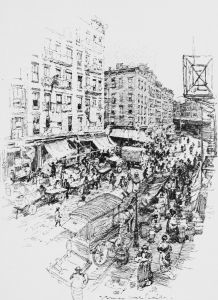
NEW YORK'S CROWDED, LITTERED EAST SIDE
Nevertheless, the sense of losing develops and spreads in the mass of the American people. Privations are not needed to create a sense of economic disadvantage; thwarted hopes suffice. The speed and pressure of work here is much greater than in Europe, the impatience for realization intenser. The average American comes into life prepared to "get on," and ready to subordinate most things in life to that. He encounters a rising standard of living. He finds it more difficult to get on than his father did before him. He is perplexed and irritated by the spectacle of lavish spending and the report of gigantic accumulations that outshine his utmost possibilities of enjoyment or success. He is a busy and industrious man, greatly preoccupied by the struggle, but when he stops to think and talk at all, there can be little doubt that his outlook is a disillusioned one, more and more tinged with a deepening discontent.
II
The Little Messenger-boy
But the state of mind of the average American we have to consider later. That is the central problem of this horoscope we contemplate. Before we come to that we have to sketch out all the broad aspects of the situation with which that mind has to deal.
Now in the preceding chapter I tried to convey my impression of the spending and wealth-getting of this vast community; I tried to convey how irresponsible it was, how unpremeditated. The American rich have, as it were, floated up out of a confused struggle of equal individuals. That individualistic commercial struggle has not only flung up these rich to their own and the world's amazement, it is also, with an equal blindness, crushing and maiming great multitudes of souls. But this is a fact that does not smite upon one's attention at the outset. The English visitor to the great towns sees the spending, sees the general prosperity, the universal air of confident pride; he must go out of his way to find the under side to these things.
One little thing set me questioning. I had been one Sunday night down-town, supping and talking with Mr. Abraham Cahan about the "East Side," that strange city within a city which has a drama of its own and a literature and a press, and about Russia and her problem, and I was returning on the subway about two o'clock in the morning. I became aware of a little lad sitting opposite me, a childish-faced delicate little creature of eleven years old or so, wearing the uniform of a messenger-boy. He drooped with fatigue, roused himself with a start, edged off his seat with a sigh, stepped off the car, and was vanishing up-stairs into the electric glare of Astor Place as the train ran out of the station.
"What on earth," said I, "is that baby doing abroad at this time of night?"
For me this weary little wretch became the irritant centre of a painful region of inquiry. "How many hours a day may a child work in New York," I began to ask people, "and when may a boy leave school?"
I had blundered, I found, upon the weakest spot in America's fine front of national well-being. My eyes were opened to the childish newsboys who sold me papers, and the little bootblacks at the street corners. Nocturnal child employment is a social abomination. I gathered stories of juvenile vice, of lads of nine and ten suffering from terrible diseases, of the contingent sent by these messengers to the hospitals and jails. I began to realize another aspect of that great theory of the liberty of property and the subordination of the state to business, upon which American institutions are based. That theory has no regard for children. Indeed, it is a theory that disregards women and children, the cardinal facts of life altogether. They are private things....
It is curious how little we, who live in the dawning light of a new time, question the intellectual assumptions of the social order about us. We find ourselves in a life of huge confusions and many cruelties, we plan this and that to remedy and improve, but very few of us go down to the ideas that begot these ugly conditions, the laws, the usages and liberties that are now in their detailed expansion so perplexing, intricate, and overwhelming. Yet the life of man is altogether made up of will cast into the mould of ideas, and only by correcting ideas, changing ideas and replacing ideas are any ameliorations and advances to be achieved in human destiny. All other things are subordinate to that.
Now the theory of liberty upon which the liberalism of Great Britain, the Constitution of the United States, and the bourgeois Republic of France rests, assumes that all men are free and equal. They are all tacitly supposed to be adult and immortal, they are sovereign over their property and over their wives and children, and everything is framed with a view to insuring them security in the enjoyment of their rights. No doubt this was a better theory than that of the divine right of kings, against which it did triumphant battle, but it does, as one sees it to-day, fall most extraordinarily short of the truth, and only a few logical fanatics have ever tried to carry it out to its complete consequences. For example, it ignored the facts that more than half of the adult people in a country are women, and that all the men and women of a country taken together are hardly as numerous and far less important to the welfare of that country than the individuals under age. It regarded living as just living, a stupid dead level of egotistical effort and enjoyment; it was blind to the fact that living is part growing, part learning, part dying to make way and altogether service and sacrifice. It asserted that the care and education of children, and business bargains affecting the employment and welfare of women and children, are private affairs. It resisted the compulsory education of children and factory legislation, therefore, with extraordinary persistence and bitterness. The commonsense of the three great progressive nations concerned has been stronger than their theory, but to this day enormous social evils are to be traced to that passionate jealousy of state intervention between a man and his wife, his children, and other property, which is the distinctive unprecedented feature of the originally middle-class modern organization of society upon commercial and industrial conceptions in which we are all (and America most deeply) living.
I began with a drowsy little messenger-boy in the New York Subway. Before I had done with the question I had come upon amazing things. Just think of it! This richest, greatest country the world has ever seen has over 1,700,000 children under fifteen years of age toiling in fields, factories, mines, and workshops. And Robert Hunter—whose Poverty, if I were autocrat, should be compulsory reading for every prosperous adult in the United States, tells me of "not less than eighty thousand children, most of whom are little girls, at present employed in the textile mills of this country. In the South there are now six times as many children at work as there were twenty years ago. Child labor is increasing yearly in that section of the country. Each year more little ones are brought in from the fields and hills to live in the degrading atmosphere of the mill towns."...
Children are deliberately imported by the Italians. I gathered from Commissioner Watchorn at Ellis Island that the proportion of little nephews and nieces, friends' sons, and so forth, brought in by them is peculiarly high, and I heard him try and condemn a doubtful case. It was a particularly unattractive Italian in charge of a dull-eyed little boy of no ascertainable relationship....
In the worst days of cotton-milling in England the conditions were hardly worse than those now existing in the South. Children, the tiniest and frailest, of five and six years of age, rise in the morning and, like old men and women, go to the mills to do their day's labor; and when they return home, "wearily fling themselves on their beds, too tired to take off their clothes." Many children work all night—"in the maddening racket of the machinery, in an atmosphere unsanitary and clouded with humidity and lint."
"It will be long," adds Mr. Hunter, in his description, "before I forget the face of a little boy of six years, with his hands stretched forward to rearrange a bit of machinery, his pallid face and spare form already showing the physical effects of labor. This child, six years of age, was working twelve hours a day."
From Mr. Spargo's Bitter Cry of the Children I learn this much of the joys of certain among the youth of Pennsylvania:
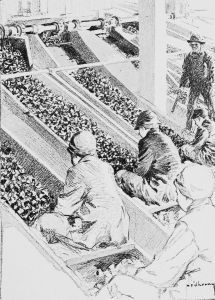
BREAKER BOYS AT A PENNSYLVANIA COLLIERY
"For ten or eleven hours a day children of ten and eleven stoop over the chute and pick out the slate and other impurities from the coal as it moves past them. The air is black with coal-dust, and the roar of the crushers, screens, and rushing mill-race of coal is deafening. Sometimes one of the children falls into the machinery and is terribly mangled, or slips into the chute and is smothered to death. Many children are killed in this way. Many others, after a time, contract coal-miners' asthma and consumption, which gradually undermine their health. Breathing continually day after day the clouds of coal-dust, their lungs become black and choked with small particles of anthracite."...
In Massachusetts, at Fall River, the Hon. J.F. Carey tells us how little naked boys, free Americans, work for Mr. Borden, the New York millionaire, packing cloth into bleaching vats in a bath of chemicals that bleaches their little bodies like the bodies of lepers....
Well, we English have no right to condemn the Americans for these things. The history of our own industrial development is black with the blood of tortured and murdered children. America still has the factory serfs. New Jersey sends her pauper children south to-day into worse than slavery, but, as Cottle tells in his reminiscences of Southey and Coleridge, that is precisely the same wretched export Bristol packed off to feed the mills of Manchester in late Georgian times. We got ahead with factory legislation by no peculiar virtue in our statecraft, it was just the revenge the landlords took upon the manufacturers for reform and free trade in corn and food. In America the manufacturers have had things to themselves.
And America has difficulties to encounter of which we know nothing. In the matter of labor legislation each State legislature is supreme; in each separate State the forces of light and progress must fight the battle of the children and the future over again against interests, lies, prejudice and stupidity. Each State pleads the bad example of another State, and there is always the threat that capital will withdraw. No national minimum is possible under existing conditions. And when the laws have passed there is still the universal contempt for State control to reckon with, the impossibilities of enforcement. Illinois, for instance, scandalized at the spectacle of children in those filthy stock-yards, ankle-deep in blood, cleaning intestines and trimming meat, recently passed a child-labor law that raised the minimum age for such employment to sixteen, but evasion, they told me in Chicago, was simple and easy. New York, too, can show by its statute-books that my drowsy nocturnal messenger-boy was illegal and impossible....
This is the bottomest end of the scale that at the top has all the lavish spending of Fifth Avenue, the joyous wanton giving of Mr. Andrew Carnegie. Equally with these things it is an unpremeditated consequence of an inadequate theory of freedom. The foolish extravagances of the rich, the architectural pathos of Newport, the dingy, noisy, economic jumble of central and south Chicago, the Standard Oil offices in Broadway, the darkened streets beneath New York's elevated railroad, the littered ugliness of Niagara's banks, and the lower-most hell of child suffering are all so many accordant aspects and inexorable consequences of the same undisciplined way of living. Let each man push for himself—it comes to these things....
So far as our purpose of casting a horoscope goes we have particularly to note this as affecting the future; these working children cannot be learning to read—though they will presently be having votes—they cannot grow up fit to bear arms, to be in any sense but a vile computing sweater's sense, men. So miserably they will avenge themselves by supplying the stuff for vice, for crime, for yet more criminal and political manipulations. One million seven hundred children, practically uneducated, are toiling over here, and growing up, darkened, marred, and dangerous, into the American future I am seeking to forecast.
CHAPTER VIII
CORRUPTION
I
The Problem of the Nation
So, it seems to me, in this new crude continental commonwealth, there is going on the same economic process, on a grander scale, indeed, than has gone so far in our own island. There is a great concentration of wealth above, and below, deep and growing is the abyss, that sunken multitude on the margin of subsistence which is a characteristic and necessary feature of competitive industrialism, that teeming abyss where children have no chance, where men and women dream neither of leisure nor of self-respect. And between this efflorescence of wealth above and spreading degradation below, comes the great mass of the population, perhaps fifty millions and more of healthy and active men, women and children (I leave out of count altogether the colored people and the special trouble of the South until a later chapter) who are neither irresponsibly free nor hopelessly bound, who are the living determining substance of America.
Collectively they constitute what Mr. Roosevelt calls the "Nation," what an older school of Americans used to write of as the People. The Nation is neither rich nor poor, neither capitalist nor laborer, neither Republican nor Democrat; it is a great diversified multitude including all these things. It is a comprehensive abstraction; it is the ultimate reality. You may seek for it in America and you cannot find it, as one seeks in vain for the forest among the trees. It has no clear voice; the confused and local utterances of a dispersed innumerable press, of thousands of public speakers, of books and preachers, evoke fragmentary responses or drop rejected into oblivion. I have been told by countless people where I shall find the typical American; one says in Maine, one in the Alleghenies, one "farther west," one in Kansas, one in Cleveland. He is indeed nowhere and everywhere. He is an English-speaking person, with extraordinarily English traits still, in spite of much good German and Scandinavian and Irish blood he has assimilated. He has a distrust of lucid theories, and logic, and he talks unwillingly of ideas. He is preoccupied, he is busy with his individual affairs, but he is—I can feel it in the air—thinking.
How widely and practically he is thinking that curious product of the last few years, the ten-cent magazine, will show. In England our sixpenny magazines seem all written for boys and careless people; they are nothing but stories and jests and pictures. The weekly ones achieve an extraordinarily agreeable emptiness. Their American equivalents are full of the studied and remarkably well-written discussion of grave public questions. I pick up one magazine and find a masterly exposition of the public aspect of railway rebates, another and a trust is analyzed. Then here are some titles of books that all across this continent are being multitudinously read: Parson's Heart of the Railway Problem, Steffens's Shame of the Cities, Lawson's Frenzied Finance, Miss Tarbell's Story of Standard Oil, Abbott's Industrial Problem, Spargo's Bitter Cry of the Children, Hunter's Poverty, and, pioneer of them all, Lloyd's Wealth Against Commonwealth. These are titles quoted almost at hap-hazard. Within a remarkably brief space of time the American nation has turned away from all the heady self-satisfaction of the nineteenth century and commenced a process of heart searching quite unparalleled in history. Its egotistical interest in its own past is over and done. While Mr. Upton Sinclair, the youngest, most distinctive of recent American novelists, achieved but a secondary success with his admirably conceived romance of the Civil War, Manassas, The Jungle, his book about the beef trust and the soul of the immigrant, the most unflattering picture of America that any one has yet dared to draw, has fired the country.
The American nation, which a few years ago seemed invincibly wedded to an extreme individualism, seemed resolved, as it were, to sit on the safety valves of the economic process and go on to the ultimate catastrophe, displays itself now alert and questioning. It has roused itself to a grave and extensive consideration of the intricate economic and political problems that close like a net about its future. The essential question for America, as for Europe, is the rescue of her land, her public service, and the whole of her great economic process from the anarchic and irresponsible control of private owners—how dangerous and horrible that control may become the Railway and Beef Trust investigations have shown—and the organization of her social life upon the broad, clean, humane conceptions of modern science. In every country, however, this huge problem of reconstruction which is the alternative to a plutocratic decadence, is enormously complicated by irrelevant and special difficulties. In Great Britain, for example, the ever-pressing problem of holding the empire, and the fact that one legislative body is composed almost entirely of private land-owners, hampers every step towards a better order. Upon every country in Europe weighs the armor of war. In America the complications are distinctive and peculiar. She is free, indeed, now to a large extent from the possibility of any grave military stresses, her one overseas investment in the Philippines she is evidently resolved to forget and be rid of at as early a date as possible. But, on the other hand, she is confronted by a system of legal entanglements of extraordinary difficulty and perplexity, she has the most powerful tradition of individualism in the world, and a degraded political system, and she has in the presence of a vast and increasing proportion of unassimilable aliens in her substance—negroes, south European peasants, Russian Jews and the like—an ever-intensifying complication.
II
Graft
Now what is called corruption in America is a thing not confined to politics; it is a defect of moral method found in every department of American life. I find in big print in every paper I open, "GRAFT." All through my journey in America I have been trying to gauge the quality of this corruption, I have been talking to all kinds of people about it, I have had long conversations about it with President Eliot of Harvard, with District-Attorney Jerome, with one leading insurance president, with a number of the City Club people in Chicago, with several East-Siders in New York, with men engaged in public work in every city I have visited, with Senators at Washington, with a Chicago saloon-keeper and his friend, a shepherd of votes, and with a varied and casual assortment of Americans upon trains and boats; I read my Ostrogorsky, my Otünsterberg, and my Roosevelt before I came to America, and I find myself going through any American newspaper that comes to hand always with an eye to this. It is to me a most vital issue in the horoscope I contemplate. All depends upon the answer to this question: Is the average citizen fundamentally dishonest? Is he a rascal and humbug in grain? If he is, the future can needs be no more than a monstrous social disorganization in the face of divine opportunities. Or is he fundamentally honest, but a little confused ethically?...
The latter, I think, is the truer alternative, but I will confess I have ranged through all the scale between a buoyant optimism and despair. It is extraordinarily difficult to move among the crowded contrasts of this perplexing country and emerge with any satisfactory generalization. But there is one word I find all too frequently in the American papers, and that is "stealing." They come near calling any profitable, rather unfair bargain with the public a "steal." It's the common journalistic vice here always to overstate. Every land has its criminals, no doubt, but the American, I am convinced, is the last man in the world to steal. Nor does he tell you lies to your face, except in the way of business. He's not that sort of man. Nor does he sneak bad money into your confiding hand. Nor ask a higher price than he means to accept. Nor cheat on exchange. For all the frequency of "graft" and "stealing" in the press head-lines, I feel the American is pretty distinctly less "mean" than many Europeans in these respects, and much more disposed to be ashamed of meanness.
But he certainly has an ethical system of a highly commercial type. If he isn't dishonest he's commercialized. He lives to get, to come out of every transaction with more than he gave.
In the highly imaginative theory that underlies the realities of an individualistic society there is such a thing as honest trading. In practice I don't believe there is. Exchangeable things are supposed to have a fixed quality called their value, and honest trading is, I am told, the exchange of things of equal value. Nobody gains or loses by honest trading, and therefore nobody can grow rich by it. And nobody would do business except to subsist by a profit and attempt to grow rich. The honest merchant in the individualist's dream is a worthy and urbane person who intervenes between the seller here and the buyer there, fetches from one to another, stores a surplus of goods, takes risks, and indemnifies himself by charging the seller and the buyer a small fee for his waiting and his carrying and his speculative hawking about. He would be sick and ashamed to undervalue a purchase or overcharge a customer, and it scarcely requires a competitor to reduce his fee to a minimum. He draws a line between customers with whom he deals and competitors with whom he wouldn't dream of dealing. And though it seems a little incredible, he grows rich and beautiful in these practices and endows Art, Science, and Literature. Such is the commercial life in a world of economic angels, magic justice and the Individualist's Utopia. In reality flesh and blood cannot resist a bargain, and people trade to get. In reality value is a dream, and the commercial ideal is to buy from the needy, sell to the urgent need, and get all that can possibly be got out of every transaction. To do anything else isn't business—it's some other sort of game. Let us look squarely into the pretences of trading. The plain fact of the case is that in trading for profit there is no natural line at which legitimate bargaining ends and cheating begins. The seller wants to get above the value and the buyer below it. The seller seeks to appreciate, the buyer to depreciate; and where is there room for truth in that contest? In bargaining, overvaluing and undervaluing are not only permissible but inevitable, attempts to increase the desire to buy and willingness to sell. Who can invent a rule to determine what expedients are permissible and what not? You may draw an arbitrary boundary—the law does here and there, a little discontinuously—but that is all. For example, consider these questions that follow: Nothing is perfect in this world; all goods are defective. Are you bound to inform your customer of every defect? Suppose you are, then are you bound to examine your goods minutely for defects? Grant that. Then if you intrust that duty to an employee ought you to dismiss him for selling defective goods for you? The customer will buy your goods anyhow. Are you bound to spend more upon cleaning and packing them than he demands?—to wrap them in gold-foil gratuitously, for example? How are you going to answer these questions? Let me suppose that your one dream in life is to grow rich. Suppose you want to grow very rich and found a noble university, let us say?
You answer them in the Roman spirit, with caveat emptor. Then can you decently join in the outcry against the Chicago butchers?
Then turn again to the group of problems the Standard Oil history raises. You want the customer to buy your goods and not your competitor's. Naturally you do everything to get your goods to him, to make them seem best to him, to reduce the influx of the other man's stuff. You don't lend your competitor your shop-window anyhow. If there's a hoarding you don't restrict your advertisements because otherwise there won't be room for him. And if you happen to have a paramount interest in the carrying line that bears your goods and his, why shouldn't you see that your own goods arrive first? And at a cheaper rate?...
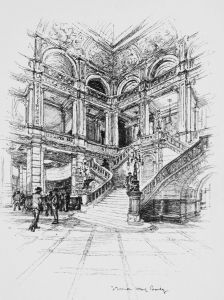
INTERIOR OF A NEW YORK OFFICE BUILDING
You see one has to admit there is always this element of overreaching, of outwitting, of fore-stalling, in all systematic trade. It may be refined, it may be dignified, but it is there. It differs in degree and not in quality from cheating. A very scrupulous man stops at one point, a less scrupulous man at another, an eager, ambitious man may find himself carried by his own impetus very far. Too often the least scrupulous wins. In all ages, among all races, this taint in trade has been felt. Modern western Europe, led by England, and America have denied it stoutly, have glorified the trader, called him a "merchant prince," wrapped him in the purple of the word "financier," bowed down before him. The trader remains a trader, a hand that clutches, an uncreative brain that lays snares. Occasionally, no doubt, he exceeds his function and is better than his occupations. But it is not he but the maker who must be the power and ruler of the great and luminous social order that must surely come, that new order I have persuaded myself I find in glimmering evasive promises amid the congestions of New York, the sheds and defilements of Niagara, and the Chicago reek and grime.... The American, I feel assured, can be a bold and splendid maker. He is not, like the uncreative Parsee or Jew or Armenian, a trader by blood and nature. The architecture I have seen, the finely planned, internally beautiful, and admirably organized office buildings (to step into them from the street is to step up fifty years in the scale of civilization), the business organizations, the industrial skill—I visited a trap and chain factory at Oneida, right in the heart of New York State, that was like the interior of a well-made clock—above all, the plans for reconstructing his cities show that. Those others make nothing. But nevertheless, since he, more than any man, has subserved the full development of eighteenth and nineteenth century conceptions, he has acquired some of the very worst habits of the trader. Too often he is a gambler. Ever and again I have had glimpses of preoccupied groups of men at green tables in little rooms, playing that dreary game poker, wherein there is no skill, no variety except in the sum at hazard, no orderly development, only a sort of expressionless lying called "bluffing." Indeed, poker isn't so much a game as a bad habit. Yet the American sits for long hours at it, dispersing and accumulating dollars, and he carries its great conception of "bluff" and a certain experience of kinetic physiognomy back with him to his office....
And Americans talk dollars to an astonishing extent....
Now this is the reality of American corruption, a huge exclusive preoccupation with dollar-getting. What is called corruption by the press is really no more than the acute expression in individual cases of this general fault.
Where everybody is getting it is idle to expect a romantic standard of honesty between employers and employed. The official who buys rails for the big railway company that is professedly squeezing every penny it can out of the public for its shareholders as its highest aim, is not likely to display any religious self-abnegation of a share for himself in this great work. The director finds it hard to distinguish between getting for himself and getting for his company, and the duty to one-self of a discreet use of opportunity taints the whole staff from manager to messenger-boy. The politicians who protect the interests of the same railway in the House of Commons or the Senate, as the case may be, are not going to do it for love either. Nobody will have any mercy for their wives or children if they die poor. The policeman who stands between the property of the company and the irregular enterprise of robbers feels his vigilance merits a special recognition. A position of trust is a position of advantage, and deserves a percentage. Everywhere, as every one knows, in all the modern States, quite as much as in China, there are commissions, there are tips, there are extortions and secret profits, there is, in a word, "graft." It's no American specialty. Things are very much the same in this matter in Great Britain as in America, but Americans talk more and louder than we do. And indeed all this is no more than an inevitable development of the idea of trading in the mind, that every transaction must leave something behind for the agent. It's not stealing, but nevertheless, the automatic cash-register becomes more and more of a necessity in this thickening atmosphere of private enterprise.
III
Political Dishonesty
It seems to me that the political corruption that still plays so large a part in the American problem is a natural and necessary underside to a purely middle-class organization of society for business. Nobody is left over to watch the politician. And the evil is enormously aggravated by the complexities of the political machinery, by the methods of the presidential election that practically prescribes a ticket method of voting, and by the absence of any second ballots. Moreover, the passion of the simpler minded Americans for aggressive legislation controlling private morality has made the control of the police a main source of party revenue, and dragged the saloon and brothel, essentially retiring though these institutions are, into politics. The Constitution ties up political reform in the most extraordinary way, it was planned by devout Republicans equally afraid of a dictatorship and the people; it does not so much distribute power as disperse it, the machinery falls readily into the hands of professional politicians with no end to secure but their immediate profit, and is almost inaccessible to poor men who cannot make their incomes in its working. An increasing number of wealthy young men have followed President Roosevelt into political life—one thinks of such figures as Senator Colby of New Jersey, but they are but incidental mitigations of a generally vicious scheme. Before the nation, so busy with its diversified private affairs, lies the devious and difficult problem of a great reconstruction of its political methods, as a preliminary to any broad change of its social organization....
How vicious things are I have had some inkling in a dozen whispered stories of votes, of ballot-boxes rifled, of votes destroyed, of the violent personation of cowed and ill-treated men. And in Chicago I saw a little of the physical aspect of the system.
I made the acquaintance of Alderman Kenna, who is better known, I found, throughout the States as "Hinky-Dink," saw his two saloons and something of the Chinese quarter about him. He is a compact, upright little man, with iron-gray hair, a clear blue eye, and a dry manner. He wore a bowler hat through all our experiences in common, and kept his hands in his jacket-pockets. He filled me with a ridiculous idea, for which I apologize, that had it fallen to the lot of Mr. J.M. Barrie to miss a university education, and keep a saloon in Chicago and organize voters, he would have looked own brother to Mr. Kenna. We commenced in the first saloon, a fine, handsome place, with mirrors and tables and decorations and a consumption of mitigated mineral waters and beer in bottles; then I was taken over to see the other saloon, the one across the way. We went behind the counter, and while I professed a comparative interest in English and American beer-engines, and the Alderman exchanged commonplaces with two or three of the shirt-sleeved barmen, I was able to survey the assembled customers.
It struck me as a pretty tough gathering.
The first thing that met the eye were the schooners of beer. There is nothing quite like the American beer-schooner in England. It would appeal strongly to an unstinted appetite for beer, and I should be curious to try it upon a British agricultural laborer and see how many he could hold. He would, I am convinced, have to be entirely hollowed out to hold two. Those I saw impressed me as being about the size of small fish-globes set upon stems, and each was filled with a very substantial-looking beer indeed. They stood in a careless row all along the length of the saloon counter. Below them, in attitudes of negligent proprietorship, lounged the "crowd" in a haze of smoke and conversation. For the most part I should think they were Americanized immigrants. I looked across the counter at them, met their eyes, got the quality of their faces—and it seemed to me I was a very flimsy and unsubstantial intellectual thing indeed. It struck me that I would as soon go to live in a pen in a stock-yard as into American politics.
That was my momentary impression. But that line of base and coarse faces seen through the reek was only one sample of the great saloon stratum of the American population in which resides political power. They have no ideas and they have votes; they are capable, if need be, of meeting violence by violence, and that is the sort of thing American methods demand....
Now Alderman Kenna is a straight man, the sort of man one likes and trusts at sight, and he did not invent his profession. He follows his own ideas of right and wrong, and compared with my ideas of right and wrong, they seem tough, compact, decided things. He is very kind to all his crowd. He helps them when they are in trouble, even if it is trouble with the police; he helps them find employment when they are down on their luck; he stands between them and the impacts of an unsympathetic and altogether too-careless social structure in a sturdy and almost parental way. I can quite believe what I was told, that in the lives of many of these rough undesirables he's almost the only decent influence. He gets wives well treated, and he has an open heart for children. And he tells them how to vote, a duty of citizenship they might otherwise neglect, and sees that they do it properly. And whenever you want to do things in Chicago you must reckon carefully with him....
There you have a chip, a hand specimen, from the basement structure upon which American politics rest. That is the remarkable alternative to private enterprise as things are at present. It is America's only other way. If public services are to be taken out of the hands of such associations of financiers as the Standard Oil group they have to be put into the hands of politicians resting at last upon this sort of basis. Therein resides the impossibility of socialism in America—as the case for socialism is put at present. The third course is the far more complex, difficult and heroic one of creating imaginatively and bringing into being a new state—a feat no people in the world has yet achieved, but a feat that any people which aspires to lead the future is bound, I think, to attempt.
CHAPTER IX
THE IMMIGRANT
I
The Flood
My picture of America assumes now a certain definite form. I have tried to convey the effect of a great and energetic English-speaking population strewn across a continent so vast as to make it seem small and thin; I have tried to show this population caught by the upward sweep of that great increase in knowledge that is everywhere enlarging the power and scope of human effort, exhilarated by it, and active and hopeful beyond any population the world has ever seen, and I have tried to show how the members of this population struggle and differentiate among themselves in a universal commercial competition that must, in the end, if it is not modified, divide them into two permanent classes of rich and poor. I have ventured to hint at a certain emptiness in the resulting wealthy, and to note some of the uglinesses and miseries inseparable from this competition. I have tried to give my impressions of the vague, yet widely diffused, will in the nation to resist this differentiation, and of a dim, large movement of thought towards a change of national method. I have glanced at the debasement of politics that bars any immediate hope of such reconstruction. And now it is time to introduce a new element of obstruction and difficulty into this complicating problem—the immigrants.
Into the lower levels of the American community there pours perpetually a vast torrent of strangers, speaking alien tongues, inspired by alien traditions, for the most part illiterate peasants and working-people. They come in at the bottom: that must be insisted upon. An enormous and ever-increasing proportion of the laboring classes, of all the lower class in America, is of recent European origin, is either of foreign birth or foreign parentage. The older American population is being floated up on the top of this influx, a sterile aristocracy above a racially different and astonishingly fecund proletariat. (For it grows rankly in this new soil. One section of immigrants, the Hungarians, have here a birth-rate of forty-six in the thousand, the highest of any civilized people in the world.)
Few people grasp the true dimensions of this invasion. Figures carry so little. The influx has clambered from half a million to 700,000, to 800,000; this year the swelling figures roll up as if they mean to go far over the million mark. The flood swells to overtake the total birth-rate; it has already over-topped the total of births of children to native-American parents.
I have already told something of the effect of Ellis Island. I have told how I watched the long procession of simple-looking, hopeful, sunburned country folk from Russia, from the Carpathians, from southern Italy and Turkey and Syria, filing through the wickets, bringing their young wives for the mills of Paterson and Fall River, their children for the Pennsylvania coal-breakers and the cotton-mills of the South.
Yet there are moments when I could have imagined there were no immigrants at all. All the time, except for one distinctive evening, I seem to have been talking to English-speaking men, now and then to the Irishman, now and then, but less frequently, to an Americanized German. In the clubs there are no immigrants. There are not even Jews, as there are in London clubs. One goes about the wide streets of Boston, one meets all sorts of Boston people, one visits the State-House; it's all the authentic English-speaking America. Fifth Avenue, too, is America without a touch of foreign-born; and Washington. You go a hundred yards south of the pretty Boston Common and, behold! you are in a polyglot slum! You go a block or so east of Fifth Avenue and you are in a vaster, more Yiddish Whitechapel. You cross from New York to Staten Island, attracted by its distant picturesque suggestion of scattered homes among the trees, and you discover black-tressed, bold-eyed women on those pleasant verandas, half-clad brats, and ambiguous washing, where once the native American held his simple state. You ask the way of a young man who has just emerged from a ramshackle factory, and you are answered in some totally incomprehensible tongue. You come up again after such a dive below, to dine with the original Americans again, talk With them, go about with them and forget....
In Boston, one Sunday afternoon, this fact of immigration struck upon Mr. Henry James:
"There went forward across the cop of the hill a continuous passage of men and women, in couples and talkative companies, who struck me as laboring wage-earners of the simpler sort arrayed in their Sunday best and decently enjoying their leisure ... no sound of English in a single instance escaped their lips; the greater number spoke a rude form of Italian, the others some outland dialect unknown to me—though I waited and waited to catch an echo of antique refrains."
That's one of a series of recurrent, uneasy observations of this great replacement I find in Mr. James's book.
The immigrant does not clamor for attention. He is, indeed, almost entirely inaudible, inarticulate, and underneath. He is in origin a peasant, inarticulate, and underneath by habit and tradition. Mr. James has, as it were, to put his ear to earth, to catch the murmuring of strange tongues. The incomer is of diverse nationality and diverse tongues, and that "breaks him up" politically and socially. He drops into American clothes, and then he does not catch the careless eye. He goes into special regions and works there. Where Americans talk or think or have leisure to observe, he does not intrude. The bulk of the Americans don't get as yet any real sense of his portentous multitude at all. He does not read very much, and so he produces no effect upon the book trade or magazines. You can go through such a periodical as Harper's Magazine, for example, from cover to cover, and unless there is some article or story bearing specifically upon the subject you might doubt if there was an immigrant in the country. On the liner coming over, at Ellis Island, and sometimes on the railroads one saw him—him and his womankind,—in some picturesque east-European garb, very respectful, very polite, adventurous, and a little scared. Then he became less visible. He had got into cheap American clothes, resorted to what naturalists call "protective mimicry," even perhaps acquired a collar. Also his bearing had changed, become charged with a certain aggression. He had got a pocket-handkerchief, and had learned to move fast and work fast, and to chew and spit with the proper meditative expression. One detected him by his diminishing accent, and by a few persistent traits—rings in his ears, perhaps, or the like adornment. In the next stage these also had gone; he had become ashamed of the music of his native tongue, and talked even to his wife, on the trolley-car and other public places, at least, in brief remarkable American. Before that he had become ripe for a vote.
The next stage of Americanization, I suppose, is this dingy quick-eyed citizen with his schooner of beer in my Chicago saloon—if it is not that crumpled thing I saw lying so still in the sunlight under the trestle bridge on my way to Washington....
II
In Defence of Immigration
Every American above forty, and most of those below that limit, seem to be enthusiastic advocates of unrestricted immigration. I could not make them understand the apprehension with which this huge dilution of the American people with profoundly ignorant foreign peasants filled me. I rode out on an automobile into the pretty New York country beyond Yonkers with that finely typical American, Mr. Z.—he wanted to show me the pleasantness of the land,—and he sang the song of American confidence, I think, more clearly and loudly than any. He told me how everybody had hope, how everybody had incentive, how magnificently it was all going on. He told me—what is, I am afraid, a widely spread delusion—that elementary education stands on a higher level of efficiency in the States than in England. He had no doubt whatever of the national powers of assimilation. "Let them all come," he said, cheerfully.
"The Chinese?" said I.
"We can do with them all."...
He was exceptional in that extension. Most Americans stop at the Ural Mountains, and refuse the "Asiatic." It was not a matter for discussion with him, but a question of belief. He had ceased to reason about immigration long ago. He was a man in the fine autumn of life, abounding in honors, wrapped in furs, and we drove swiftly in his automobile, through the spring sunshine. ("By Jove!" thought I, "you talk like Pippa's rich uncle.") By some half-brother of a coincidence we happened first upon this monument commemorating a memorable incident of the War of Independence, and then upon that. He recalled details of that great campaign as Washington was fought out of Manhattan northward. I remember one stone among the shooting trees that indicated where in the Hudson River near by a British sloop had fired the first salute in honor of the American flag. That salute was vividly present still to him; it echoed among the woods, it filled him with a sense of personal triumph; it seemed half-way back to Agincourt to me. All that bright morning the stars and stripes made an almost luminous visible presence about us. Open-handed hospitality and confidence in God so swayed me that it is indeed only now, as I put this book together, I see this shining buoyancy, this bunting patriotism, in its direct relation to the Italian babies in the cotton-mills, to the sinister crowd that stands in the saloon smoking and drinking beer, an accumulating reserve of unintelligent force behind the manœuvres of the professional politicians....