Chapter XII · THE PEOPLES OF TURKEY
Reading edition
CHAPTER XII THE PEOPLES OF TURKEY
The peoples and ideas emanating from within the realm which still bears the name of Turkey have left an indelible mark on the rest of the world. Crossed by some of the great highroads of history, the land is inspiring in every aspect in which it is regarded. Its heritage of memories and the prestige of a happier and grander past are undisturbed by marks of decadence. Most of the foundations of our progressive spirit were laid in that eastern region. From a purely scientific standpoint, its human grouping and surface configuration present highly interesting interdependence.
The region is divisible into six major geographical sections. Each forms a background against which distinct types of the human family are displayed. The various groups differ from one another in religion and language, often even in race. A fringe of fresh and verdant coastland which surrounds the elevated shelf of Asia Minor is largely Greek and Christian. The only foothold which western thought, art or temper ever obtained in Asiatic Turkey is found within this wave-washed strip of land. The plateau-heart of Anatolia is predominantly Turkish and Mohammedan. The Christian element scattered on its steppe-like surface is unable to assert itself and yields to Oriental ascendancy. The high and broad mountain masses which border it on the east are the home of the Armenoids, generally Christians, sometimes Mohammedans, but almost always characterized by broad-headedness accompanied by a peculiar flattening of the back of the skull. Beyond this mountain barrier Asiatic Turkey becomes entirely Semitic, being mainly Arabian in speech and overwhelmingly Mohammedan in creed. Three main regions characterize this southern area. The long and narrow corridor of Syria became the highway which in antiquity bound the flourishing empires of the Nile basin to the powerful kingdoms of the Hittite highlands and the Mesopotamian lowlands. Its motley population, containing representatives of every race, is a relic of former to-and-fro human displacements along its trough-like extension. In the adjoining desert Bedouin tribes find their favorite tramping ground. The twin valley of Mesopotamia is the home of peoples in whom fusion of Semitic and Indo-European elements is observable.
The history of this land is that of its invaders. Successive streams of humanity poured into it from four superabundant reservoirs. Its central mountain zone was the motherland of a virile race whose sons went forth at intervals to breathe vitality into gentler populations scattered between the Ægean coast and the valleys of the Nile and Mesopotamia. Armenians and a number of Mohammedan sects represent today this Alpine race. Mediterranean men proceeded constantly from the south and west to new homes in the pleasant valleys that connected eastern Ægean shores with the interior table-land. Mobile Semitic hosts abandoned the plateau of inner Arabia before the time of our earliest records and drifted naturally northwards towards the fertile Tigris-Euphrates basin or the commercial routes of Syria. Finally a Turki element, lured out of its mountain cradle in the Altai by scattered grass lands extending westwards, swarmed in successive hordes into Asia Minor and even beyond, well into the heart of Europe.
In addition to the foregoing fundamental wanderings, the inflow of an Iranian element, composed of men of Aryan speech, may be observed. This contingent marched out of the plateau of Iran and reached the Turkish highland without having to scale its slopes. As a result of this migration Persian words permeate Armenian[214] extensively. The Turks also have appropriated a certain amount of Persian words and culture from the same source. Racially, however, the eastern element was absorbed by the Armenoid population.
The present inhabitants of the diversified domains of the Sultans have been welded by the run of history into a shadowy political unity which has failed to harmonize their incompatibilities of origin and ideals. Turkey is a thoroughly theocratic state. Its sovereign-caliph and his subjects have always considered it their most important mission to bring Islam to the infidel. So great is the hold of ideals over the human mind, however, that the non-Mohammedan populations have clung passionately to their religious beliefs. We are forced to seek in creed the main distinguishing traits which, outwardly at least, divide the inhabitants of Turkey into groups of different names. We shall see, however, that in the minds of many of them, language or historical traditions have little significance. At the same time it is believed that distinctions of a more fundamental character will be brought out in the course of this chapter.
The Greeks
Our knowledge of the first appearance of Greeks in Asia Minor has undergone radical revision in recent years. Their prehistoric culture can be traced as far back as the Neolithic. The chief interest of modern discovery centers around the now accepted fact that Greek culture originally invaded the region from the south and that the Indo-European element which brought Aryan speech to the land is a later wave which flooded the original Mediterranean stock at some time during the transition from the Age of Bronze to that of Iron.[215] The southwestern coast was first colonized. A northerly extension occurred thence and proceeded mainly along the coast.[216]
The sequence of geological events preceding man’s appearance upon the Ægean coast of Asia had imparted features which were destined to favor human development to an exceptional degree. A land-bridge connecting the Balkan and Anatolian peninsulas occupied the site of the Ægean Sea at the dawn of quaternary times. The subsidence of the land during this period was accompanied by heavy fracturing trending in east-west lines. The Ægean archipelago, studded with islands and surrounded by deeply indented coasts, conveys a vivid picture, on the map, of the crustal deformity which occurred.
Climate also conferred its share of advantages. The long and narrow valleys are sheltered by mountains on all sides except to seaward. Northerly air currents cannot reach them. Frosts or snows are therefore unusual.[217] The course of moisture-laden winds blowing landward from the seas that wash the three coasts of Asia Minor is arrested by the mountainous rim of the peninsula. Precipitation is almost entirely expended upon the narrow shore lands. Copious rainfall and flowing rivers thus provide this historic Anatolian fringe with patches of luxuriant vegetation and green valleys. The interior plateau, on the other hand, remains parched and barren during the summer months.
A splendid stage for Greek history was thus built during the prehuman period. Early Mediterranean oncomers discovered sheltered havens and fertile inlets along the entire development of the fancifully dissected coast. A natural festoon of outlying islands increased their security by providing them with advanced posts for the detection of hostile raids. Erosion along the parallel lines of east-west rifts had carved fair valleys in which the winding rivers of classical literature found a channel. But above all, the sea contributed commerce and cosmopolitanism, both great elements of world power. These in turn favored the growth of tolerance,—a trait which has ever marked the western mind and which, at that particular spot, was to constitute a bastion destined to remain impregnable to the opposing spirit of the east.[218]
The American Geographical Society of New York
Frontiers of Language and Nationality in Europe, 1917, Pl. VII
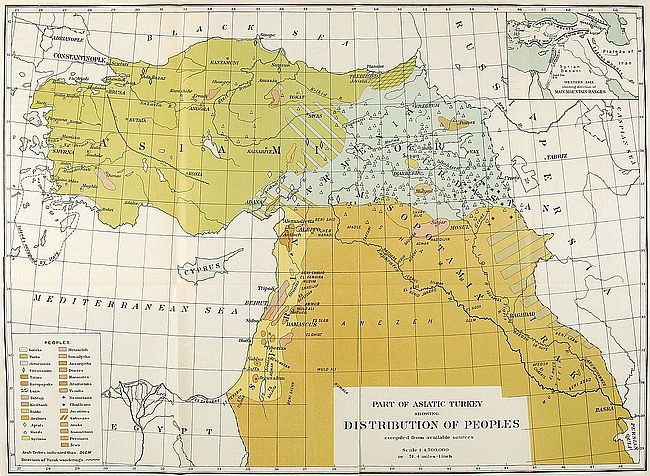
View larger image here
PART OF ASIATIC TURKEY SHOWING DISTRIBUTION OF PEOPLES
Intermediate site, low relief above sea level and genial climate combined to give the Greeks a full share of the joy of life. These are the physical elements upon which the striking cultural superiority of Hellenism is founded and without the concourse of which it has never set permanent foot anywhere. The brilliant florescence of Greek civilization in pagan time attained its apogee wherever these three geographical factors prevailed. The Byzantine Empire succumbed before eastern onslaught because it was gradually converted into an Asiatic state and thus exceeded the boundaries marked by nature for Greek humanity.
The sixth century of the pagan era was the Golden Age of Hellenism in Asia Minor. The elongated seaward valleys became the seat of flourishing and independent nations. A strong democratic spirit prevailed among their inhabitants. City states or self-governing communities were numerous. Their merchant princes drew on the vast eastern rearland for supplies which they sold to Europe. They also collected heavy tolls from freight going eastwards. A double stream of wealth thus flowed into their treasuries. The prosperity of this period has never since been paralleled in the region.
Creative art found a home upon a site so eminently favored by nature. The heart and mind of its inhabitants throbbed responsively to the stirring events which were the result of their country’s situation at the junction of the most important sea and land highways of the then known world. There the antagonism between east and west, out of which so much world history has been made, broke into violent clashes after periods of commercial interchange. Talent was spurred to high achievement under the stimulus of foreign contact, wealthy patronage and genial environment. Imposing ruins and prolific discoveries of masterpieces of art convey ample testimony of nature’s concentrated prodigality on this famous coastland.
The present Greek occupants of the Anatolian shores reflect the pleasant character of their environment in the lightness of heart which is one of their distinguishing characteristics. Their craving for gaiety, society and enjoyment is unfailing. Even the gloom of Asiatic dominion does not prevent merrymaking at every opportunity. In these respects the Greeks share to an eminent degree the feelings of the nations of the western world.
With the exception perhaps of the Circassians, the Greeks are the handsomest of the inhabitants of Asiatic Turkey. Classical forms of the head and of the general cast of countenance are met in every nook of the Anatolian seaboard. Their profiles are those of the gently curving lines of ancient Greek statues and medals. Among women graceful carriage of the head and neck adds to their charm. The men are erect and firm of gait.
Fishing and sailoring are the hereditary occupations of the coastal Greek populations of Asia Minor. Inland they become traders. The “corner” grocery or the village butcher shop is generally owned by a Greek. In recent years the Greek has learned to play the part of the promoter in the growing development of Asia Minor. He is often the middleman who brings western capital to eastern opportunity. Herein his rôle differs but slightly from that of his Lydian or Carian ancestors.
The true Greek is met only as far inland as a whiff of the salt sea air can be inhaled. Eastward, on the Anatolian table-land, Greek communities of the ancient Phrygian and Cappadocian lands differ from kindred coastal populations as widely as the fascinating greenswards of the one vary from the semi-arid steppe of the other. Once beyond the range of maritime influences, Greeks often forget their own language and adopt Turkish instead. This is frequently the case in many of the inland settlements where Turkish is now the only medium of oral expression for Christian thought.[219] Racially, too, the Greeks of the inland towns and villages betray Alpine or Armenoid origin rather than Mediterranean descent. Short stature, ample chest development and broad-headedness are conspicuous among them. The rock-hewn villages south of Mt. Argaeus afford a clue to the origin and antiquity of these mountain Greeks.[220] They are descendants of the natives who were conquered by the armies of Greek pagan states or by Byzantine troops. The conquerors brought language and culture to the upland populations but were numerically insufficient to impose a new racial stratum. Later the wave of Turkish invasion drove out Greek and forced Asiatic speech on the same mountain populations without always replacing Christianity by Mohammedanism.
Duality of language is sometimes accompanied by a strange duality of creed among Anatolian Greeks. At Jevizlik, on the road between Trebizond and Gumushchane, dwell crypto-Christian Greeks who publicly profess Mohammedanism while maintaining in secret the Greek orthodox faith.[221] The inauguration of a constitutional form of government in 1908, with its promise of religious liberty, gave the members of the community an opportunity to renounce their outward form of faith and proclaim complete adherence to the religion they had never really forsaken.
To the philologist these ancient Greek communities are veritable treasure grounds, especially when found in mountainous districts. Archaic forms of speech are in current use among their inhabitants. In many, the purity of the ancient Greek dialects of Asia Minor has been preserved with but slight contamination from later literary influences. The very names of those who speak these vernaculars show interesting connection with the classical period of Hellenism. Socrates or Pericles will cook daily for the traveler, and Themistocles supply him with tobacco. More than that, they all make themselves intelligible in the style—and the spirit, too—of inscriptional language. But the old Hellenic dialects should not be confused with the still unknown Lycian, Lydian and Carian languages found in inscriptions. There is reason to believe that these primitive speeches of the Anatolian plateau represent exceedingly early stages in the development of Indo-European forms.
Many of the Greek communities owe their survival to the proficiency of their members in a particular industry. The settlements of Greek miners scattered in the Pontic and Tauric mining districts are instances in point. The Turkish conquest of the Byzantine Empire was accomplished by Asiatic barbarians who knew how to fight but included no artisans in their ranks. They were therefore obliged to rely upon the populations of the conquered lands for the maintenance of industrial and commercial activity. This notorious incompetence of the Turk for any pursuit other than that of soldiering is, at bottom, the prime cause of the survival of Christian communities within Ottoman boundaries.
The Turks
The appearance and establishment of the Turks in a land which was not that of their origin follows their life as nomad tribesmen of the vast steppeland of central Asia. They were men at large upon the world’s largest continent, the northerners of the east who naturally and unconsciously went forth in quest of the greater comforts afforded by southern regions. The flatlands which gave birth to their race lie open to the frozen gales of the north. Their continental climate, icy cold or burning hot in turn, is cut off from the tempering influences prevailing behind the folds of tertiary mountain piles to the south. As the steppemen migrated southward their gradually swelling numbers imparted density to the mass they formed because expansion on the east or west was denied them. China and the Chinese, admirably sheltered by barriers of deserts and mountains, stopped their easterly extension. Christian Russia stopped them on the west, though at a heavy cost to herself, for no obstacle had been raised by nature to meet their advance. The open plain of central Asia merges insensibly into that of north Europe. That is why incidentally Russia is half Tatar today. The Asiatic was forced upon her. She sacrificed herself by absorbing him into her bosom, saving Europe thereby from this eastern scourge, but forfeiting the advantages of progress.
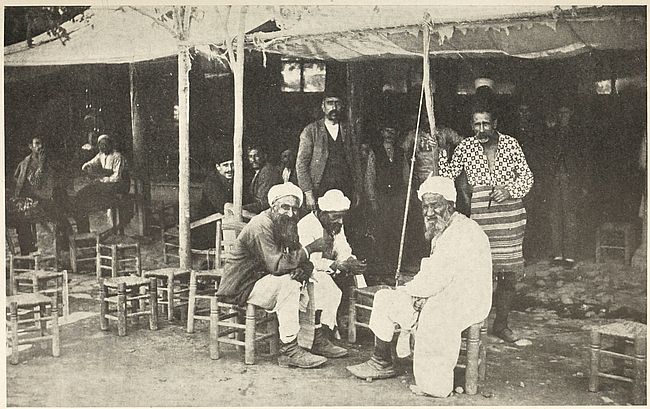
Fig. 58—A group of Turks who have none of the racial traits indicated by their name. The seated members in the foreground are typical inhabitants of the Anatolian plateau. The Greek type, closely resembling the Italian, appears in the background.
Cut off from east and west in this manner, the only alternative left to the Turk was to scale the plateau region of western Asia and to swarm into the avenues that led him to conquered territory where he succeeded in attaining power and organizing his undisciplined hosts into the semblance of a state. The presence of the Turk upon the land to which he conferred his Mongolian name and the very foundation of the Turkish state can in this manner be attributed to outward causes rather than to local development. It was essentially a process of transplantation. The consolidation and rise to power of the Ottoman Empire between the thirteenth and sixteenth centuries were largely due to foreign conditions, for during that interval Europe was busily engaged in extirpating feudalism and the objectionable phases of medieval clerical influences from its soil.
The Turks and their name were first known to the western world in the sixth century of our era. But their invasion of Asia Minor should rather be considered as a gradual infiltration begun in prehistoric times. Hittite carvings represent, among others, a recognizable Mongoloid type of Tatar soldiers who fought as allies of the great mountain state.[222] Pig-tails, high cheek-bones and oblique eyes have been conspicuously modeled by the sculptor. Tatar migrations are thus discerned in the morning of the history of Asia Minor. The early invaders were steadily reinforced from the east by their kinsmen. The rise of the Seljuk Turks to dominance was the explosion of energy accumulated in the course of the centuries in which this movement of Altaic tribes had persisted. The consolidation of Ottoman power marked its culmination. A single tribe could never have acquired sufficient strength to establish a mighty empire had not its ranks been swollen by members of kindred groups encountered during its migration. This is what actually happened when Jenghiz Khan and Timur appeared on the stage of history. Turkish accounts describe both as fiery leaders, men who could command the adherence of the vast swarm of descendants of their kinsmen, in whose footsteps they marched. Sultan Osman, the founder of the present Turkish dynasty and reputed to be of the same caliber, likewise drew on a human legacy of centuries for the accomplishment of his designs.
Unfortunately, the Turks bear a name which is utterly void of significance. They themselves apply it to every Mohammedan inhabitant of Asia Minor without discrimination of race or origin. But for fully eight centuries they have stocked their harems with women seized from conquered populations. It is no exaggeration to say that this human tax has been levied on almost every family of the Caucasus, western Asia and the countries of the Balkan peninsula. Today the net result of this variegated intermixture is that the Tatar origin of the average Turk, so called, is entirely concealed by the mingling with Mediterranean, Armenoid-Alpine and even Nordic elements. Except in a few isolated instances the Turki type of central Asia is rarely met within Turkish boundaries. Clearly no valid claim to racial distinctiveness can be set up by the Turks.
In religion the Turk is no innovator. He has merely taken unto himself the idealism of Arabia. And yet his efficient wield of the fine edge of Mohammedan fanaticism failed to sever the ties which bind Islam to this land. Even his language is not his own. The splendor of Arabian syntax and the supple elegance of Persian style alone confer literary flavor upon it. Over 70 per cent of the words in Turkish are Arabic retained in unalloyed purity. A scant sprinkling of Tatar words merely recalls by their sound the raucous articulations which form the nomad’s speech, while their paucity is a true measure of the limited range of concepts which find lodgment in his mind.
Turkish nationality is equally meaningless. The descendants of Asiatic nomads became masters of western Asia without ever conferring the boon of government or of nationality upon the land and its peoples. In Gibbon’s mordant words “the camp and not the soil is the country of the genuine Tatar.” And Turkey is still a vast field in which the Turk has pitched his tent and merely waits, knowing that the day is not far off when he will have to break camp and seek new pasturages for his herds and flocks. But the site on which he has settled for the past five centuries had been the seat of a highly organized government. Seeing himself master of this estate the Turk unhesitatingly adopted its institutions. Thus, under the mantle of Islamic theocracy, Byzantine government and customs have continued to flourish in Ottoman dominions. Barring special features belonging to Mohammedanism, the ceremonials of the Sultan’s court may be traced, step by step, to Byzantine forms. The very absolutism of the caliphs is alien to the fundamentally democratic character of both Tatar societies and Koranic teaching. It is Byzantine and a relic of the despotism of the Roman Caesars.
In speaking of the Turks it is necessary to carry two distinct types in mind. The pure Tatar vagrant, true to his native indolence, which unfits him for sedentary occupation, is in the minority. The mass of the Turkish population consists of a mixed element in which the racial strain of given localities persists along with characteristics imparted by fusion with Turki conquerors. This mingling is indicated further by the spirit which moves this people in the performance of their daily tasks. Its members are recruited among the plodding, gentle-mannered and kind-hearted peasants of the land. Local influence accounts for these qualities. Occasionally, however, the foreign strain will crop out. Then, like their nomad ancestors, who, from peaceful shepherds roaming leisurely from patch to patch of green, are transformed into fiends incarnate by the approach of a thief or a beast of prey, or whom a passing storm will throw into fits of uncontrollable rage which vents itself in passionate outbursts of shrieking and gesticulation, the Turkish peasants can cast their natural softness of character to the winds and become either bloodthirsty murderers smiting unarmed Christians or else heroes performing gallant deeds on the battlefield.
The majority of this Turkish population finds a congenial home on the Anatolian upland. Their ancestors beheld here an environment in which the physical characteristics of the plateaus of central Asia were reproduced. They took to it naturally. The table-land is a rolling expanse mournfully devoid of vegetation, save for rare clusters of stunted trees. Scanty plots of grass, surrounding sickly pools or streams, resemble holes in a ragged garment spread over its surface. Sun-baked in summer, chilled in winter, with a climate too deficient in moisture for the favorable development of human societies, the land could only appeal to Asiatic sons of semi-arid areas. In recent years, the tendency of Turks to retire to this region is observable wherever the industry of Christian populations of the encircling coastland has rendered life too arduous for Turkish love of ease.
The penetration of this table-land by nomads from the heart of Asia goes on today as in the past, albeit with abated intensity. It is no rare occurrence in Asia Minor to meet Tatars or Turkomans who have been on a slow westerly march for periods of from five to ten years at a time. Most of them come from the Kirghiz steppes. A vague desire to change their residence from a Christian to a Mohammedan country impels their wanderings, according to their own accounts. Constantinople looms as an objective nebulously impressed in their minds. But the goal is rarely attained. In reality their migration is as unconscious as that of their forefathers and merely carries them out of sheer necessity from pasturage to pasturage in the manner it affected former generations.
Mohammedan Immigrants
Ever since the establishment of Turkish authority in western Asia the policy of the Sultan’s officials has been directed towards attracting Mohammedan settlers from foreign countries to the unpopulated districts of Turkey. Particularly at the end of unsuccessful wars, special efforts are made to induce Moslem inhabitants of lost provinces to return within Turkish boundaries, where land often exempt from taxation is assigned to them. Widely distributed Circassian, Tatar and Turkoman settlements owe their origin to this Turkish method of increasing the Mohammedan element in the country. The Bithynian peninsula, where Cretaceous limestones and sandy Eocene beds provide excellent soils, is a region favored by immigrants.
Russia’s southwesterly spread of empire is responsible for the movement of some 500,000 Circassians from the Caucasus highlands to Asiatic Turkey. Lithe of figure, brilliant-eyed and nimble in mind, these immigrants are morally and physically far superior to their new countrymen. They bring with them the higher standard of living of their native land. Their dwellings are more solidly built than the customary shanties or hovels of the Anatolian table-land, and their food is of the average European quality. Wherever settled, they live in a degree of comfort unknown to the Turkish peasant. Flourishing farming communities have grown up around their villages. In cities they are distinguished by a natural aptitude for commerce, and many an able government official has been recruited from their numbers.
In race, language and religion the Circassians of Turkey present, according to tribal origin, the confusion existing in their cradle land. The Kabardian group of the Uzun Yaila are of western Caucasus extraction and speak an incorporative language. The Chechen settled in Syria are derived from Daghestani highlanders. In some cases Circassians bear Christian names, but worship in mosques. Representatives of central Asiatic, European and even Semitic races are found among them.
A colony of Noghai Tatar refugees was founded in the lower Jeihun valley after the Crimean War, at which time it consisted of some 60,000 individuals. Their numbers were speedily reduced, however, by the malaria and fevers of the unhealthful Cilician coast land. A decimated remnant is now engaged in farming the marshy lands originally bestowed on their fathers. They maintain excellent relations with the Turks, with whom they intermarry.
The Turkomans of Asia Minor are, according to their statements, refugees from Muscovite Christianity. In reality they seek escape from Russian pressure exerted to force them to abandon nomadism. This name is applied generally to immigrants coming from Turkestan who preserved their roving habits. The cruel Turki type of lineament and expression is observable on their faces. They are Sunnis, or orthodox Mohammedans, and a Turkish-speaking people, but have little intercourse with native Turks.
The Karapapaks, or Black Caps, known also by the name of Terekimans, are Shiites, or adherents of the eastern branch of Mohammedanism, from Russian Armenia, who have crossed the Turkish frontier and settled near Patnoz in the Van vilayet. The original seat of this people is between Chaldir and Daghestan. Racially they are of Turki stock. Tatar types predominate among them, although Circassian and Persian physiognomies are by no means uncommon.
The Lazis of northeasternmost Turkey, who are sometimes known by the name Tchan, form the connecting link between the Caucasian and Anatolian populations. Many of them have forsaken their Russian homes in the past thirty years for the land of their kinsmen on the Turkish side of the frontier. They occupy, in fairly dense communities, villages nestling on the forested seaward slopes of the Pontic Alps, as well as the narrow strip of coast east of Platana. Former generations looked on them as pirates or brigands. They now follow less irregular pursuits, but still bear the reputation of being daring smugglers. The Turkish navy recruits sailors from among them.
By race the Lazis are allied to the Georgian group of Caucasus peoples, and their intermixture with ancient Armenian populations is probable. Their adherence to Mohammedanism is lax. They speak a southern dialect of the Grusinian language closely allied to Mingrelian but mingled with Greek and Turkish words. In some localities Turkish entirely replaces their vernacular. The limits of their language in Turkey coincide with the western boundary of the sanjak of Lazistan. They extend thence eastward, in a belt fringing the southern base of the Caucasus, all the way between the Black and Caspian seas.[223]
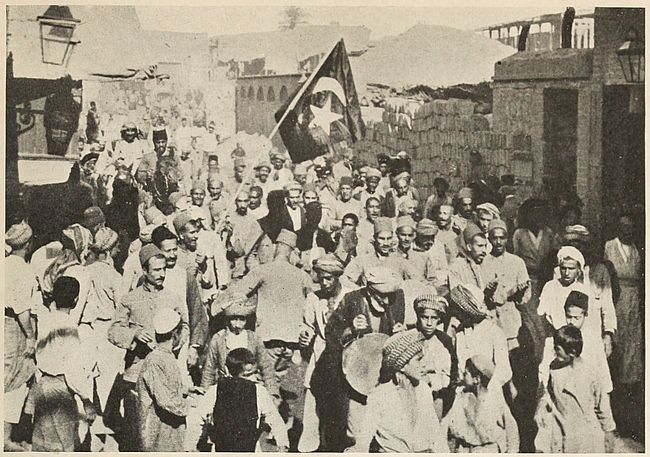
Fig. 59—“Turkish” crowd in an Anatolian city (Trebizond). A gathering in these Turkish cities contains representatives of almost every race in the world.
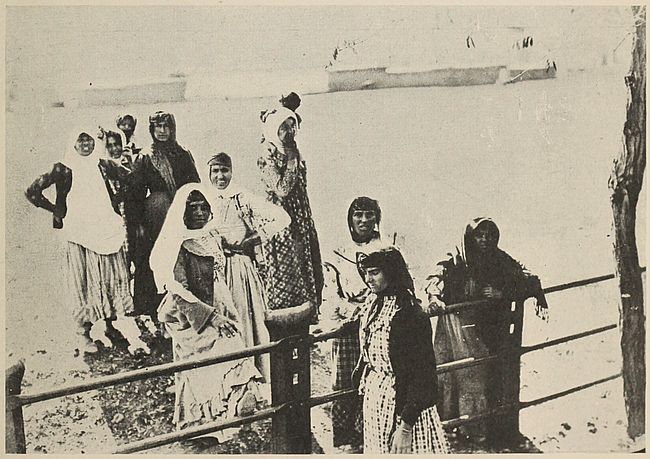
Fig. 60—A group of Maronite women. Their sturdy appearance suggests their highland origin.
Mohammedan Dissenters
A number of communities whose origin is wrapped in obscurity are found off well-beaten avenues on the Anatolian table-land. A mild, temperate lot, broad-shouldered and open-faced, they have much in common, in spite of diversity of worship and isolation. Racially they present few of the Turki features. Their speech is usually Turkish, but they keep rigidly apart from the Turks. They are Mohammedans in name only. Having secured immunity from the fanaticism of the masters of the land, they have secretly maintained ancestral beliefs to their full extent. When the light of ethnographic research shall have been fully shed on their rites, it is likely that the transition of religious thought from the paganism of Hellenic times to the Christianity of the Byzantine era will be made clear.
To this group belong the inhospitable Tahtajis (known also as Chepmi and, in their westernmost extension in the Aidin vilayet, as Allevis), who are the woodcutters of the upper recesses of the Lycian mountains. A people of almost primitive manners, they form a community of about 5,000 souls. Eastern and western culture swept by their mountain homes, leaving the faintest of traces among them. Having neither priests nor churches they are held in disrepute by the Turks. Similarity with eastern religions can nevertheless be traced in their worship. They wail over the corpses of their dead as do the Egyptians. A vague connection with Iranian ideas is discernible in the belief they hold regarding the incarnation of the devil in the form of a peacock. They cannot be induced to discuss their rites with strangers. In their simple minds faith is all in all, and well accentuates the separatist tendency determined by their rugged mountains.
A more important group, the Kizilbash, present racial characteristics peculiar to the Nordic race, although they too have mingled extensively with the Armenoid natives of the Anatolian mountains over which their settlements are scattered. The name is pure Turkish for “red head,” but cannot be traced to head-gear in Turkey. In Persia however allied communities are known whose members wear scarlet caps. The bends of the Kizil Irmak[224] and of the Yechil Irmak contain their villages.[225] They also have settlements in the highlands which extend from the Taurus to Upper Mesopotamia.
A Turkish-speaking people of peaceful habits, engaged exclusively in the tillage of their lands, submissive to authority, frugal and industrious, such are the Kizilbash in the midst of their Turkish, Kurdish and Armenian neighbors. They are usually on excellent terms with the Christians. But to this day, after centuries of occupation of the valleys of the Sakaria and Halys, they have remained as foreigners among the Turks who colonized their territory long after them. Probably on account of religious divergences the newcomers have always held them in contempt.
It is not unlikely that the Kizilbash are lineal descendants of the Galatae of Asia Minor. This western people entered the peninsula through the notch cut by the valley of the Sakaria—an avenue also chosen by the Phrygians sung by Homer. Later the Cimmerians also followed the same route. All these invasions from the west brought blondness into Turkey—though not of the pure Nordic type, for the roads leading out of northern Europe had their longest stretches in the brunet territory of central and southern Europe. Nevertheless mingling incurred in the course of migration, as well as after settlement, has not obliterated entirely the fair ancestral type. The strongest argument in favor of the relationship between the Galatae and the Kizilbash lies in the identity of the territory occupied by both peoples. The racial distinction between the two lies in the greater admixture of Tatar blood in the Kizilbash of our times. Gradual change of the Galatian of European provenience into the Kizilbash type of Asiatic affinity was accompanied by the replacement of Celtic by Tatar culture.
Galates to the Greeks meant any western barbarian. The term was applied to the foreigners whose coming was always marked by destruction and who, in the third and second centuries B.C., terrorized Thrace before crossing into Asia Minor. Here they introduced Celtic forms of speech which were current in their settlements as late as the fourth century of our era. At that time the language spoken in parts of Anatolia was similar to the dialect of the Traveri, a Celtic tribe on the Moselle whose name has been perpetuated in that of the city of Trèves.[226] Arrian, a native of Bithynia, describing the customs of the Celts gives accounts of usages, such as the worship of the oak, which prevailed in his country and which on investigation are found to have their counterparts in Europe.
In religious thought, the Kizilbash may be classed as the most liberal among the Mohammedans of Turkey. Their interpretation of the Koran exempts them from keeping fasts and allows them the use of wine. They permit their women to go about with a freedom which has never been tolerated among Sunnis. Christian rites, such as the custom of praying over bread and wine, are performed among them. Fragmentary survivals of pagan observances likewise form part of their worship.
The Kizilbash are closely affiliated with the Bektash confraternity, a once powerful Islamic organization which still owns a large number of convents (tekkes) and churches in Turkey. Indiscriminate use of the two names has led to much confusion in the writings of travelers. It seems preferable to restrict the name of Kizilbash to the group of Anatolian people whose mountain origin is amply proven by somatic traits and whose cultural development denotes amalgamation with invaders of the table-land. The term Bektash can then be applied to the form of religion to which this people adheres at present. The connection is probably founded on the ease with which Bektash proselytism drew recruits from among Kizilbash populations. In the light of this distinction the so-called Bektash people of the Lycian mountains are merely a sub-group of the Kizilbash, to whom they are related in part by race, language and religion.
The Balikis, or Belekis, living on the southern fringe of Sasun,[227] are probably also a remnant of the old highland population. The Mohammedanism they profess is tainted with dim reminiscences of Christian worship and was probably adopted as a self-preservatory measure. Religious beliefs weigh lightly however on this community. Its members possess neither church nor mosque. A term of residence among them would probably enable an observer to discover survival of very ancient customs. The passing traveler can do little more than note the unusual freedom with which their women go about unveiled or note the mixture of Arabic, Kurdish and Armenian words in their language.
The Avshars, descended from Persian immigrants mingled with native hill populations, are settled mainly on the eastern slopes of the Anti-Taurus facing the northern end of the Binbogha range.[228] The two elements which are blended in this people are also represented in their religion. The newcomers brought Shiite Mohammedanism and insured the predominance of their views over the relics of the nature cults of the aboriginal groups. Traces of Christian influence are observable in their daily life. Around Cesarea these Avshars give the shape of a cross to the loaves of unleavened bread they bake. In view of the deep-rooted aversion of Mohammedans towards any trace of Christian symbolism, it is evident that we are here in the presence of an old-established usage rather than one adopted in post-Mohammedan times. But in speech, custom and occupation the community differs in no respect from neighboring Turks.
The nomad element of the Anatolian plateau is represented mainly by the Yuruks, whose wanderings range from the northern landward slopes of the Cilician Taurus to the mountainous tract surrounding Mt. Olympus. They are divided into tribes of varying size, some not exceeding twenty tents. Their number is estimated at about 200,000. Roving over barren districts, the members of this group are half-starved human products bred in areas of defective food supply. The men know no other occupation than that of tending their sheep and horses. The women are noted carpet-weavers. Strangers passing within sight of their tent settlements can generally rely on finding the nomad’s proverbial hospitality under their felt roofs.
In common with kindred plateau communities, the Yuruks hold severely aloof from the Turks. But they have adopted Turkish speech, and it is gradually replacing their ancient vernacular. They have sometimes been connected with European gipsies, although the little that is known concerning their history and traditions hardly warrants such an assumption. A promising field for ethnographic research still awaits exploitation among their settlements. They call themselves Mohammedans and circumcise, but have no priests or churches.[229]
The Aptals of the lofty valleys of northern Syria also have nomadic habits and appear to be closely related to the gipsies. Although they claim to be Sunnis they rarely intermarry with settled Mohammedans. Their roaming life carries them from village to village, generally in the capacity of musicians and entertainers. According to their traditions they were expelled from the lower Tigris regions in the ninth century.[230]
The Armenians
The table-land on which Armenian life unfolded itself was faulted into blocks and covered by flows of huge volcanoes after the Miocene. Pontic ranges fringe it on the north and thereby forbid access to the Black Sea.[231] On the south, the folds of the Anti-Taurus mountains likewise act as successive barriers. But no mountain obstacles intervene to the east or west of Armenia. Close racial, linguistic and historical relations can therefore be traced between Armenians and Persians today. Furthermore, the existence of important Armenian communities scattered all the way west of Armenia to the coasts of the Ægean becomes intelligible. The very crowning of Armenians as Byzantine emperors may ultimately be explained by this east-west extension of relief in western Asia.
The heart of the Armenian plateau is found in the gently folded limestones and lacustrine deposits surrounding Lake Van. Here an elevated plain relieves the ruggedness of environing peaks. Here, too, our earliest knowledge of Armenian history is centered. But the formation of nationality upon the surrounding sites of intricate relief was a long-drawn process. A highland dissected into numerous valleys could not become the seat of a united people. The region, being broken up, favored division. Accordingly feudalism flourished undisturbed throughout its extent. Each valley or habitable stretch was governed by its own princeling. These petty chiefs relied on the security provided by their rugged environment and were naturally disinclined to acknowledge authority emanating from outside their valley homes.
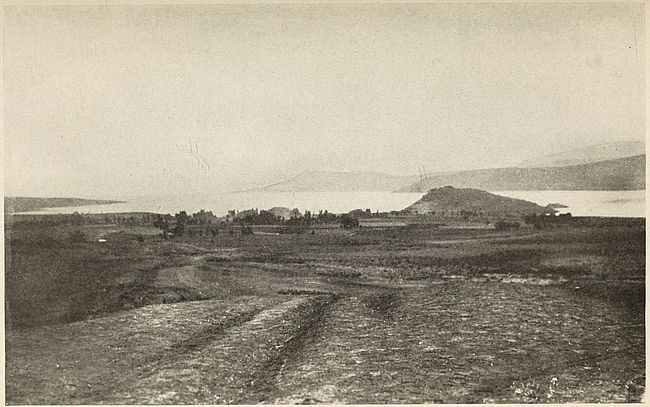
Fig. 61—The plain of Van. The photograph shows the three features which make the site a center of Armenian history. The plain afforded farming land and was dominated by a lone eminence to the protection of which Armenians have resorted to this very day. The broad lake in the background added to the natural strength of this position.
The plain of Van has always loomed large in the history of Armenia. This interesting depression occupies the southeastern corner of the great central plateau and lies surrounded by volcanoes which were centers of lively eruptive activity during the Pleistocene. Together with the plain of Mush it forms a single basin which was once a lake bed. The heavily saline waters of Lake Van still cover its deepest section. The exposed lake bottom consists of volcanic matter carrying fertilizers in abundance. Rich brown loams contributed to the region’s famed fertility. Between the tenth and ninth centuries B.C. the Vannic community became the nucleus of a confederacy of mountain tribes forming the kingdom of Urartu,[232] which extended to the heads of the valleys debouching on Assyrian territory.[233] After successful resistance against Assyria the independence of the Armenian state became well established about 800 B.C.
The ancient history of the Armenians is closely related to that of the Hittites. The appearance of the former is coeval with the disappearance of the latter. The probability of a common origin is strong. Enough light has been shed on the history of the Armenian table-land prior to 700 B.C. to enable us to divide its political subdivisions into two great groups. The Vannic states of the kingdom of Urartu held sway in the northern ranges. Hittite dominance extended to the southern group of mountains. It may be assumed that the Armenians of the present day are direct descendants of these ancient populations, due allowance being made for the invasion of Iranian peoples who brought eastern culture to the land. The free inflow of this eastern element was impeded, however, by the highly dissected table-land of Armenia. It trickled westward without ever assuming the proportion of a flood. Hence the Armenian physical type is preserved with considerable purity beneath the shroud of Aryan culture.
The Armenians call themselves Hai and trace their descent to a mythical mountain chief Haik. Hai-istan is the name of their native land in Armenian. The word Armenia itself is of Persian derivation and foreign to Armenian. A remote possibility of the connection of Hai with the old name Hit or Hatti may be advanced in view of the frequency with which the elision of the letter t and the replacement of d-t sounds by y occur in Armenian.[234] The etymology of the name, however, still awaits more thorough elucidation.
Although the relation between the Hittite and Armenian languages yet remains to be determined, and the secrets of the old Vannic language are not fully revealed, enough is known to prove Armenian an Aryan infiltration from the west. Herodotus refers to them in a natural manner as the Φρυγῶν ἄποικοι (VII, 73), “Phrygian colonists.” It is significant to note that this Greek appellation was bestowed on the Armenians at a time when western Asia was better known to the civilized countries of the world than it is at present. Modern research, however, places the inhabitants of the plateau of Anatolia and of the Armenian mountain land in the same racial type.
Planted squarely on the scene of the secular conflict between the civilization of Europe and Asia, Armenia became the prey of the victor of the moment. But the united influence of site and configuration was more than once during this long struggle strong enough to confer independence on the Armenian. As a buffer between eastern and western empires the country enjoyed three distinct periods of native rule prior to the Ottoman conquest.
Throughout these vicissitudes, Armenian life centered mainly around its mountain home. Nevertheless, altitude alone does not suffice to explain the characteristics of the people. Climate must also be taken into account. Armenians are distributed in a belt extending one degree on either side of the line of north latitude 39°. Within this zone the products of the soil as well as the customs are those of temperate regions bordering on the warm. The narrow highland valleys are wonderfully fertile. Wheat is harvested before July at an elevation of 3,600 feet in many districts. The country enjoys fame for the variety and excellence of its fruits.
Little wonder, then, that traits which distinguish populations reared in sunny lands should also prevail among the dwellers of this rugged mountain zone. Voluble in the extreme, endowed with a highly developed imaginative sense and with an innate tendency to aggrandize and glorify the facts of ordinary life, the Armenian is often an eastern counterpart of the celebrated Tarasconese created by Daudet’s genial fancy.
But a rocky environment is equally reflected in the minds of the Armenians. Harshness of manner and a certain degree of uncouthness are present along with tenacity of purpose and moral fortitude. Through the latter, endurance of Turkish persecution, which has generally assumed exceedingly savage form, was made possible. Armenians are also known for their martial spirit. Dwellers of many of the less accessible recesses of the Tauric or Armenian highlands held their Turkish foes in check for centuries and managed to maintain a state of semi-independence in their conqueror’s land until confronted by modern artillery.
Again, the influence of the mountain home of the Armenians is expressed in their art. Poems and songs often extol the fairness of the valleys where rest will be found after descent along interminable slopes. Sometimes the beauty of lakes, embosomed in high plateaus, fires the poet’s fancy. Towering summits figure in legend as steeples from which melodious chimes send forth their tones. Armenian music, too, resounds with echoes that seem to reverberate from valleys cut deep in the sides of their mountains.
Perhaps it is these varied influences which convert the rough and mannerless mountain boors into the most polished and cultured citizens of Turkish cities. Armenians have the reputation of being energetic business men. Their honesty was proverbial among the Turks, who generally intrusted the management of estates or domains to their hands. Among them alone throughout the inland districts of Asiatic Turkey, western progress found receptive minds.
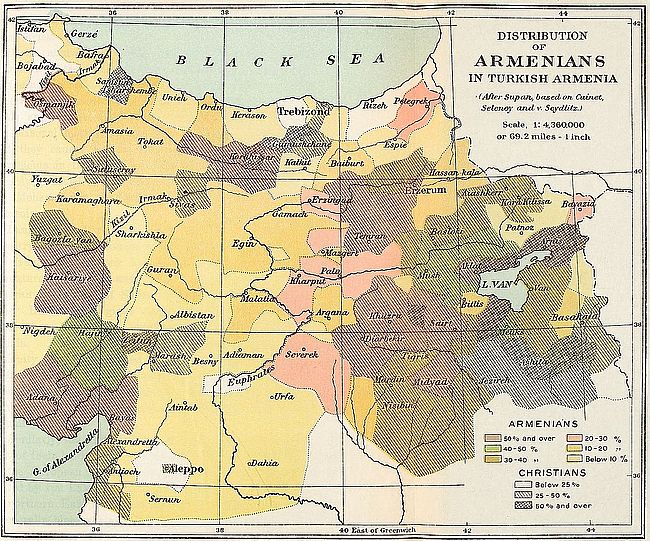
The size of the Armenian population of Asiatic Turkey has never been accurately determined. The inaccuracy of Turkish statistics is notorious. Furthermore the boundaries of Turkish administrative provinces have been drawn with the sole view of creating groups in which the Mohammedan element would predominate. The estimate of 2,100,000 Armenians for Asiatic Turkey given by so reputable a writer as Major-General Sir Charles Wilson[235] is undoubtedly high. Cuinet’s figures given by Selenoy and Seidlitz[236] probably come nearer the truth. The wholesale massacre of Armenian males which has been systematically conducted by the Turks for the past twenty years and which culminated in the massacres and deportations of the past two years, makes it improbable that over 1,000,000 Turkish Armenians still live. Prior to the European war, the only districts of any size in which they constituted a majority of the population were found west of Nimrud Dagh in the plains surrounding Mush as well as in the Kozan district north of the Cilician plains.[237]
The American Geographical Society of New York
Frontiers of Language and Nationality in Europe, 1917, Pl. VIII
View larger image here
DISTRIBUTION OF ARMENIANS IN TURKISH ARMENIA
The Kurds
An Alpine zone of transition connecting the plains of northern Mesopotamia with the surrounding mountains on the north and east became the homeland of the Kurds. In a broad sense it is the drainage area of the Tigris and Euphrates. It is also the site of important mountain gaps through which human movements from east to west or vice versa have proceeded. Before the consolidation of Turkish authority in this region, a matter of less than a century ago and still in an imperfect stage of completion, Kurdish clans, each under the sole leadership of their respective Chieftains, controlled the pass through which traffic from the southern lowlands or the eastern plateau was directed towards the Anatolian table-land. They exacted heavy tolls from passing caravans and derived their chief source of revenue from these levies.
Their manner of living conforms with the intermediary character of their habitat. The semi-nomads of the plains and southern hills seek cool uplands during the summer months. In winter they descend to the warm plains with their flocks and herds and mingle with their Arab neighbors. Their instinct for seasonal migrations has been developed to such an extent that they cannot refrain from maintaining their semi-annual movements in the Armenian districts to which they have been forcibly removed by the Turkish government, desirous of insuring Mohammedan predominance in the Christian valleys of Armenia.
Language and religion carry the Kurds back to eastern ancestry. However diverse their dialects, Aryan roots forming the framework of their speech have survived in spite of the admixture of Turkish and Arabian words. By creed they are generally upholders of Shiite tradition in its westernmost confines. But their religious views vary from tribe to tribe and present as composite a character as their race. Many are Sunnis. Wandering into eastern Asia Minor since hoary antiquity they have culled from Paganism, Christianity and Islamism alike. The predominance of the ideals which inspire these faiths among the individual clans probably affords a clue to the period of their arrival in the localities which they now inhabit.
Similarly, the racial relation of the Kurds with peoples found east of their land is well established.[238] They undoubtedly belong to the European family, though perhaps not in the sense suggested by von Luschan, who would connect them with inhabitants of northern Europe. From the writer’s own observations the “generally blue eyes and fair hair” are by no means dominant in the regiments of Hamidyeh cavalry recruited exclusively from among Kurdish tribesmen.[239] The three groups studied by the eminent anthropologist near Karakush, on the Nimrud mountain, and at Sinjirli were probably remarkably pure, as might be inferred from the nature of their secluded districts. As early invaders of a transition land the Kurds have intermingled extensively with both highland and lowland populations.[240] The Kurd varies therefore according to region, the inhabitants of the elevated sections being stocky and of massive build, while the tall and sallow Semitic type appears among those on the southern plains.[241]
The Kurds, particularly in the semi-nomadic state, are noted freebooters. Travel in the districts they occupy is generally unsafe. Armenians and other Christians find them an inexorable foe. They are none too loath to prey even on Turks, although as a rule the latter obtain immunity in return for the lenient dealing of the government in cases of Kurdish depredations on non-Moslem communities. The strong arm of an organized police alone will end the lawlessness with which their name is coupled in Turkey.
Good qualities are not wanting among them. A Kurd is generally true to his word. The rude code of honor in vogue among their tribes is rarely violated, and, whenever disposed, the Kurd can become as hospitable as his Arab neighbors. The tempering influence of a settled existence among sedentary tribes is marked by harmonious intercourse with surrounding non-Kurdish communities. At bottom their vices are chiefly those of the restless life they lead in a land in which organized government has been unknown for the past eight centuries.
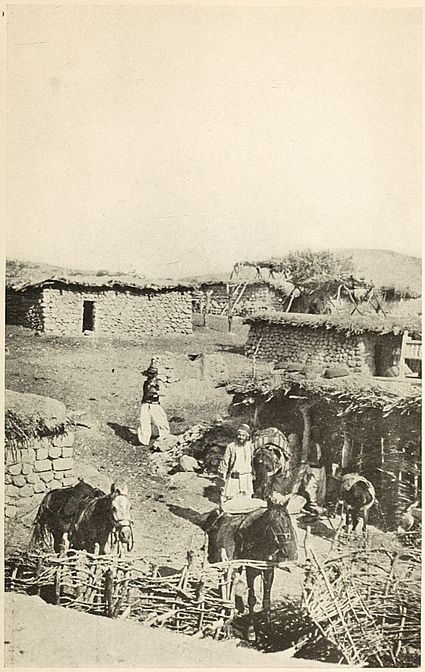
Fig. 62—A Kurdish village in Upper Mesopotamia with characteristic stone shanties peculiar to semi-arid regions.
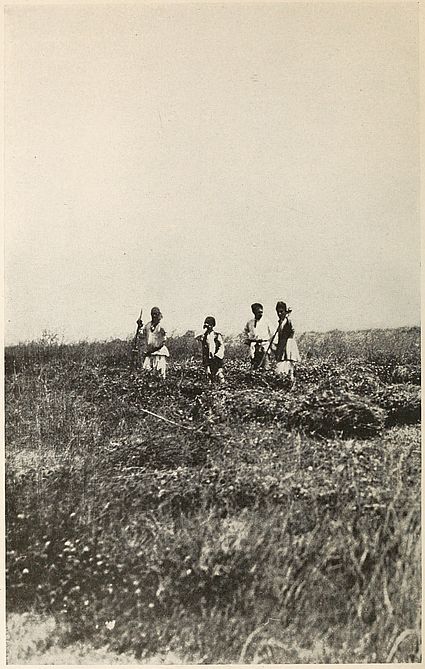
Fig. 63—A harvest scene in Upper Mesopotamia with Kurds at work.
The Syrians
Syria is the elongated land passage, barely fifty miles in width, which connects northern Africa with western Asia. It is one of the world’s best-defined natural regions. The sea on the west, and the desert on the east, sharply mark off its fringe-like extension. On the north the Amanus ranges constitute a wall that has proved well-nigh impassable to Semites. To the south the land naturally ends in the Sinai peninsula.[242]
The province is mountainous in its northern half. Its mountains are the monuments that throw light on the utter failure of the cause of human progress in northern Syria. A single redeeming feature, the Orontes river valley, favored foreign contact. At its mouth on the Mediterranean western ideas filtered into the land while a blend of eastern influences, Persian and Arabian, flowed down with its waters. All converged at Antioch, the region’s greatest center of life and a true product of the Orontes’ lower course. Absence of relief in southern Syria, however, was coupled to a Mediterranean climate and fertile soils. These permitted the development of the flourishing civilizations of antiquity. Herein lies the physical basis of the historical evolution of the Syrian fringe and the explanation of the growth of nations and of world religions in its southern lands.
As a land-bridge of early humanity Syria was necessarily the scene of much coming and going at a time when the civilization of the world was largely confined to what is now known as Asiatic Turkey. Its population therefore presents a mixed character. Hittites, Arameans, Assyrians, Egyptians, Greeks, Romans, Arabs and Turks conquered the land in turn and imparted their native customs to its inhabitants. The inhabitants of its southern area are now transformed almost beyond the possibility of analysis. The settlements of the elevated and broken northern area, on the other hand, represent very ancient communities.
The mountains of Syria harbor strange denizens in their northern end. In the northern Lebanon many villages of the western slopes are inhabited by the Metauilehs, who are Shiite dissenters and bear unenviable reputation for ignorance and inhospitality.[243] Their own traditions point to Persian or Arabian origins. Religion seems to confirm the former claim. At the same time they are known to the Syrians as a sturdy mountain people. Scattered through the same mountain districts the Ismailyehs, another highland folk who under the name of Assassins enjoyed sinister fame during the Middle Ages, maintain their abode in inaccessible valleys. The epithet which is coupled to their name is an altogether illogical rendering of the Arabic “hasheeshin” and does not convey any worse meaning than that of “hasheesh” fiends. They live mainly in groups around old Saracen castles.
The Ansariyehs
The Ansariyehs, or Nusariyehs, form an important group among northern Syrians. Their settlements are generally confined to the grassy seaward slopes of the mountains stretching north of the Nahr-el-Kebir towards the Gulf of Alexandretta. They also occupy villages in the plains surrounding Antioch. In recent years they have shown a tendency to abandon their mountain homes for the less arduous life of the plains. Officially they are regarded as Mohammedans and bear Mohammedan names, but the religion which differentiates them from the other inhabitants of northern Syria teaches Christian and Sabean doctrines alike. It is believed that they still maintain observances of exceedingly ancient nature cults. The fundamental principles of their creed are transmitted by word of mouth and with injunction to secrecy.[244] Their deification of the conception of fertility is couched in highly metaphorical language in which the productivity of the earth and of the human race is extolled. By making proper allowance for the imagery which clothes the wording of their prayers it will probably be found that their religion resolves itself into a relic of the worship of the mother-goddess which was deeply rooted throughout the mountain districts of Asia Minor. Hints of nocturnal orgies accompanying their worship should be taken with a grain of suspicion, as orthodox Mohammedans are prone to such imputations whenever dissension from the Koran is suspected. In this Mohammedans merely follow the lead of Byzantine Christians in whose eyes the relics of Anatolian paganism were as obnoxious as the heresies of their own times.
The ancestors of the Ansariyehs and other small sects in northern Syria were closely related to their powerful Hittite neighbors. These peoples all occupy, together with the Druzes and Maronites, the southern limit of known Hittite monuments.[245] Their land is the frontier zone between Syria, Asia Minor and the Armenian highland. It is studded with ruined strongholds which figured prominently in ancient battle.
The Druzes
The southern Lebanon and Anti-Lebanon ranges in the rear-land of the Haifa-Beirut coast[246] are inhabited by Druzes. Tribes of this people are met as far southeast as the Hawran volcanic uplift, whither they have steadily emigrated from the Lebanon in the course of the past hundred years and where they have succeeded in dislodging the former Bedouin inhabitants. These Druzes are best known for their warlike disposition. Although numerically inferior to the Christian population of their native districts, their bellicose qualities have won them predominance in central Syria. In religion they are pure monotheists. Their standard of morality is high. They call themselves Mohammedans but do not maintain mosques and rarely practise polygamy. Orthodox Moslems generally repudiate them on account of the discrepancy between their teachings and the tenets of the Koran. As far as can be determined the doctrines of the Mosaic law, the Gospels, the Koran and Sufi allegories are represented in their creed. Often when with Christians they will not hesitate to assert belief in Christianity. The leaven of Iranian influences which pervades their doctrines estranges them from the surrounding Semitism just as their highland home separates them from the plainsmen settled around them. The dominance of this eastern strain in their thoughts does not, however, necessarily indicate racial migrations. Historical testimony is available to prove that the known form of Druze religion can be traced to the teachings of Hamze, a Persian disciple of Hakem.[247] The case is more probably that of an infiltration of foreign ideals and its retention within a region deprived by its relief from intercourse with the more progressive life of the surrounding lowland.
The Maronites
Closely related to the Druzes are their northwestern neighbors, the Maronites, a Christian people, who seceded from the Roman Church in the great schism that followed the council of Chalcedon in 451 A.D.[248] They form a compact mass settled on the western slopes of the Lebanon mountains between the valleys of the Nahr-el-Kebir and the Nahr-el-Barid. Mountain isolation and intermarriage among them have maintained an old type with remarkable purity. Being better farmers than warriors they have suffered from the oft repeated depredations of their war-like neighbors.[249] Enmity with their Mohammedan neighbors dates from the time of the Crusades when the Maronites had sided with the Christian knights.
The Jews
The Jews of Turkey include a small remnant of the captivity settled around Jerusalem and in Mesopotamia.[250] After the destruction of Jerusalem, the valley of the Tigris became the most important seat of the Hebrews. Parthian tolerance granted them a partial autonomy under the authority of a chief chosen from among the descendants of the house of David.[251] This liberal régime ended with the decline in power of the Abbasside caliphs of Bagdad. The Jews were then forced to abandon Chaldea. Many emigrated to Spain. Later, under the reign of Ferdinand and Isabella, they were compelled to flee from Spanish persecution and seek a home again in Turkey. Descendants of these emigrants, known as Sephardim, are settled in cities of Asia Minor and Syria. Small colonies of Ashkenazim Jews are also scattered in various Turkish towns. An old colony of a few hundred Samaritans survives in the vicinity of Nablus.
The Jews are an exceedingly composite people and, contrary to popular belief, do not represent as pure a type of the Semitic race as the Bedouin Arabs. Southern Syria was a prey to invaders from every quarter of the compass. It was the clashing ground of Hittite and Nilotic civilizations. From the west, Mediterranean seafaring populations swarmed in from earliest antiquity. At least three great waves of Semitic migrations overwhelmed the land prior to the coming of the Arabs. The Jew, therefore, represents the fusion of four distinct races of men. The purity he has retained is that of the fused type. His language alone is Semitic. His physical appearance recalls Hittite traits more prominently than Semitic and this probably accounts for the frequent mistaking, in western Europe and in the United States, of Armenians for Jews.
Arameans
The Arameans are either direct ancestors of modern Jews or else close congeners of early Hebrews. Both peoples are closely allied. They represent one of the many waves of Semitic humanity which have rolled out of Arabia’s highland steppes. A period of settlement in the fertile districts around the mouth of the Euphrates and Tigris precedes their spread throughout Mesopotamia and northeastern Syria. References to their history abound in sacred texts, as well in inscriptional remains[252] found throughout western Asia. The accounts, however, are fragmentary and so far have made possible only partial reconstitution of their history. An Aramean nation or a number of Aramean states undoubtedly existed in the tenth century B.C. This body subsequently acquired considerable power and founded colonies all over Mesopotamia and Syria. Damascus and Hamath, both in the latter province, became the greatest centers of Aramean power, owing to the natural resources of the districts around their sites as well as to their commanding position on important trade routes.
It seems established that the vast territory designated by the Assyrians by the name of “Mat Aram,” or land of Aram, did not necessarily contain Aramaic populations. It was more probably conquered by Arameans, who imposed their language on the subjugated peoples. Soon after the capture of Damascus by the Assyrians in 732 B.C. the Aramean nation disappears from history. Aramaic, however, survived and was even adopted by the victors.[253] But, in common with other Semitic languages, it could not withstand the advance of Arabic. The only locality in which it is now spoken is found northeast of Damascus in the environs of the villages of Malula, Bakha and Yubb Adin, where the natives still use a dialect similar to the Palestinian Aramaic spoken thirteen centuries ago. There is reason to believe that this sub-group of Syrians represents today the old Aramean stock in as pure a degree as is consistent with the secular mingling of peoples which has taken place in the region.[254]
The Yezidis
The Sinjar range of hills stretching in a westerly direction from Mosul is the only upland of importance in the Mesopotamian valley. The largest compact mass of Yezidis are domiciled in this hilly country. A minor group occupies the Samaan mountains in Syria.[255]
The appellation of devil-worshipers which generally accompanies the name of Yezidi conveys a totally erroneous impression regarding their beliefs. They recognize, in fact, a benign deity, the Khode-Qanj, who reigns supreme over creation but with whom is associated an inferior divine essence, the Malik-i-Tawus, or Peacock King, who is lord of all evil and whom they consider necessary to propitiate in order to avert misfortune. But the ceremonies and sacrifices performed in honor of the subordinate deity do not interfere with the primary worship with which the God of Good is revered.[256] This interpretation of divinity bears deep analogy to the Iranian cult which revolves around the central figures of Ormuzd and Ahriman, respectively the good and the evil principle. The language of the Yezidis, which is akin to Kurdish, brings added evidence of the eastern derivation of their culture.
According to their own traditions the Yezidis came originally from the districts of the lower Euphrates. Certain Sabean features of their religion indicate intimate contact with Semitic populations. Little is known about their curious religious celebrations, to which strangers are never admitted. Their practice of bowing before the rising sun is a clear relic of Zoroastrian influence. They also perform rites which have analogy to Christian commemorations. In a land overrun in all directions no simple feature of the views they hold can account for their origin. The religion of the moment was imposed by the dominant element over all the peoples of Asiatic Turkey. Hence a given group merely shows successive strata of religious invasions.
The sturdily-built Yezidi is active and hardy. His energy sets him apart from the lithe-limbed and easy-going Arabs. His vigor and fighting blood saved him from the frightful persecutions for which the particularly obnoxious feature of his dual deity was responsible. Byzantine bishops and Arabian mollahs in turn reserved the wildest thunder of their intolerance for the Yezidi, whom they execrated beyond all others among heretics and unbelievers. This hatred of the presumed worshiper of the devil has not yet been outlived, and a devout Mohammedan will today spit upon the ground and mutter a curse whenever the abhorred name crosses his lips.
The Yezidis enjoy fame as agriculturists who know how to exact good yield from their mountain farms. They live a retired life and rarely allow strangers to travel through the Sinjar range. The modern armament of Turkish expeditions has cowed the present generation into a submission which their fathers would have scorned. But they still remain unwilling tax payers who rely on the natural disinclination of Turkish tax collectors to mountain-climbing.
The Nestorians
The Nestorians, a Christian sect, are descendants of the followers of Nestorius, who seceded from established orthodoxy in the sixth century. They inhabit scattered villages in a region which changes from mountain to plain as it extends west of the Persian frontier to the Tigris river, roughly between latitudes 34° and 38°. On the north they rarely venture beyond the Bohtan river. The mountainous tract produces a manly set, who have more than held their own against the martial Kurds. Poverty and dependence mark the lot of the plainsmen in spite of their industry as agriculturists.
To say that the inhabitants of Turkey have religious nationality is perhaps the happiest way of accounting for the presence of large numbers of independent communities owing political allegiance to the Sultan. The bond of faith in the case of the Nestorians is one of remarkable strength, because this community represents the persecuted remnant of the ancient church of central Asia. Owing to its situation on the very outskirts of early Christianity the church became engaged in propagating the Gospel on a scale exceeded only by the see of Rome in the sixth and sixteenth centuries.[257] Consciousness of this tradition has not forsaken the Nestorians of the present day. The great influence wielded by their patriarch or religious head, the Mar Shimun, as he is called, is a relic of former authority.
The speech of the Nestorians is a Syriac dialect in which Persian, Arabic and Kurdish words have found place. Religious services are conducted, however, in the uncontaminated language. The Nestorians call themselves Syrians and refuse to recognize any other appellation. Owing to this fact much confusion has arisen in the minds of travelers who have attempted to describe them.
The Chaldeans
The Chaldeans are racially akin to the Nestorians, with whom they formed a single religious community prior to the seventeenth century. The hope of obtaining relief from Mohammedan persecution induced an important section of the old community to join the church of Rome at that time. In recent years, however, many have forsaken Roman Catholicism and formed a new sect which is known by the name of New Chaldeans. Protestant communities of this people as well as of Nestorians and Jacobites exist.
The Jacobites
The rugged limestone district around Midyad is the home of another mountain people known as the Jacobites. Banded together by the ties of religion they form a community of husbandmen living aloof from their neighbors of divergent religious views. They are described as of warlike nature and independent spirit. Language also differentiates them from other Ottoman groups, a Syriac dialect differing considerably from Nestorian being in use among them.[258] In Turabdin they speak an Aramaic dialect known as Turani. The Jacobites are noted for their aptitude for business. The important colony of traders founded in the eighteenth century in the vicinity of Bagdad owes its origin to the desert traffic and the Indian trade by way of Basra.
This people traces its religious origin to the teachings of Jacobus Baradeus,[259] who, in the middle of the sixth century, traveled through Asia Minor and consolidated scattered groups of Monophysite recusants into a single body. They constituted a large sect during the Middle Ages, but defections, notably in favor of the Roman Church, have thinned their numbers considerably since then. At present they muster hardly more than 15,000 individuals.
The Sabeans
We are still in the dark concerning the history of the Sabeans, a people of Semitic origin who profess Christianity. That they once formed a powerful nation is attested by numerous ruins and inscriptions. This state began to decline in the first century of the Christian era and had completely disappeared by 500 A.D. They call themselves Mendai and are often known by the name of Christians of St. John. The community is small, numbering hardly 3,000 souls, mostly goldsmiths and boatbuilders who ply their trade in the Arab encampments of the Amara and Muntefik sanjaks in the vilayet of Basra. They talk a Semitic dialect and dress like the Arabs, from whom they can scarcely be distinguished. Their original homeland is believed to have been Yemen.
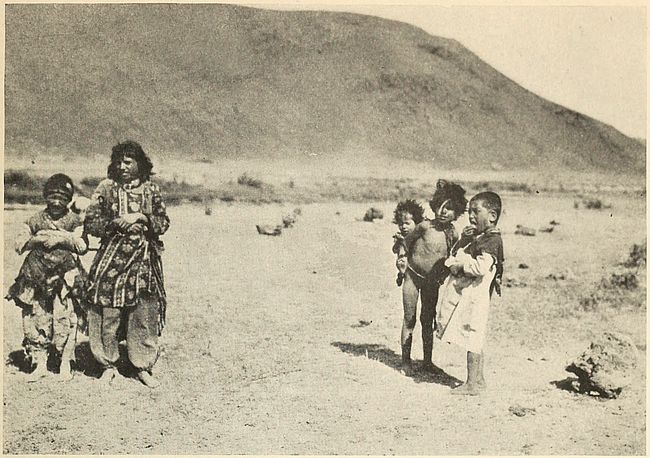
Fig. 64—Kurd children of the Armenian borderland. The poverty of the land is reflected in their appearance no less than in the arid background of the photograph.
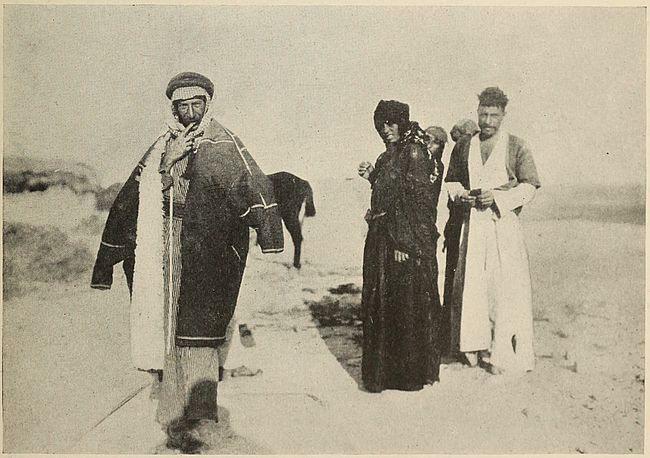
Fig. 65—A family of sedentary Arabs in Mesopotamia.
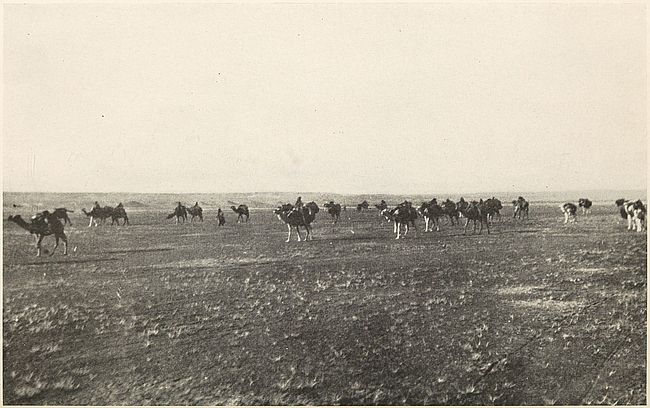
Fig. 66—In the desert of Syria. A tribe of Anezeh Arabs moving from an exhausted pasture to a fresh one.
The Arabs
The Arab folk, sparsely distributed over the Syrian desert and forming the majority of the inhabitants of the featureless downs of Mesopotamia, represent the ebbing of the last tide of Semitic invasion. In the sandy waste of their western extension, their tribes, shifting perpetually from seat to seat, like the dunes around which they roam, consist of Bedouin or “tent men.” The contribution of these nomads to society is as insignificant as the yield of the unproductive lands of their wandering. Towards the east, however, where two mighty rivers bring fertility and life to the soil, the genius of the race blossomed untrammeled and gave Mohammedan civilization to the world.
The purest living representatives of the Semitic race are found among these Bedouins. Civilization pursued its steady growth around their tent homes without affecting their lives. Better favored belts encircling the Syrian desert attracted the human migrations which took place in western Asia. From the last outliers of the hill system fringing the southern Taurus to the northern confines of the Arabian peninsula, the patriarchal state of society prevailing today differs little from the condition in which a dreamer well past middle age found it fourteen centuries ago and brought it within the pale of modern thought by inspiring it with the enthusiasm of his own belief in a single God. Stripped of his religion and of his rifle, the Bedouin stands today before the historian as the living image of long remote ancestors whose invasions caused profound upheavals in the societies established east and west of his present tramping ground.
But the Arab settled in the long elongated plain watered by the Tigris and Euphrates can never lay claim to equal purity of stock. He lives in a land which by virtue of a great twin river system gave rise to the oldest civilization of the world. Its inhabitants, whether aboriginal or invaders from the table-land on the east, derived more than mere sustenance from proximity to these mothering watercourses. Surrounded by desert and mountain, this region naturally became a seat of population. Its native element, already much mixed, was assimilated to a large extent by the Arabs since the period of their appearance in Mesopotamia.
The floating masses of Bedouins have successfully resisted Turkish effort to induce them to abandon nomadism. Occasionally, as in the belt of Tauric precipitation or along the borders of the zone of Mediterranean rains no less than under the benign influence of Mesopotamian rivers, they become sedentary. They are then known as fellaheen. But the change is incompatible with their immemorial restlessness and implies loss of caste in their own eyes.
TABLE I
Names and Peoples of Some Non-Turkish Villages in Asia Minor
Peoples designated as follows:
AleviAl.
ArmeniansAr.
AvsharsAv.
ChaldeansCh.
CircassiansCir.
GreeksGr.
KarapapaksKpk.
KizilbashKz.
KurdsKd.
NestoriansN.
New ChaldeansN. Ch.
TatarsTa.
TurkomansTkn.
YezidiYd.
Name of VillagePeoplesName of VillagePeoples
Aghje KalehKd.AtessN.
Agh-ovaKd.AvviranGr.
AivaliGr.BazarjikKd.
Ak-bunarCir.BerarAr.
AkdamAr.BeyCh.
AkhlatKd.BirgamiKd.
AkstafaKpk.ChateranAr.
AlaklissiaGr.ChevirmeKd.
AlexandropolAr.ChukhAr.
AlkoshN. Ch.DelilerKd.
AlteaGr.DerendehAr.
AngoraAr.Diz-deranKd.
Arabja KeupriGr. & Cir.EkrekAr.
ArdiaCir.FeshapurCh.
ArjiN.FundukCir.
Name of VillagePeoplesName of VillagePeoples
FurinjiKd.MisliGr.
GaribKd.Mush plainAr.
GarniAr.NerdivanKd.
GemerekAr.NeribKd.
GundernoAr.NigdehGr.
Gunig-kalehAr.NiksarGr.
GurgujeliTkn.NorchukAr.
GurunAr.OmarKd.
HaikAr.OrbüluKd.
HamsiGr.PekariehAr.
HanefiAl.PinganAr.
HarrasKd.PorrotKd.
HelaisKd.PulkAr.
HornovaAr.RabatKd.
HoshmatAr.RedvanYd.
IneviTkn.SamsatKd.
InstoshAr.SekunisN.
IsbartaGr.SemilYd.
IsoghluKd.SeraiN.
JenanKd.Shabin Kara-HissarAr.
JessiKd.ShahrAr.
KaialikKd.Sha-utaN.
KainarCir.Sheik AdiYd.
KarachuKd.Sheikh AmirKd.
Kara-gebenAr.SheikhanKd.
Keklik-oghluKd.ShenKd.
KelebeshGr.ShernakKd.
KemerAv.Sultan OghluTkn.
KeupriTkn.TadvanAr.
KezanlikCir.TakvaranKd.
KhakkaravokhKd.TashanAr.
Khasta-KhânehAv.TashbunarCir.
KhusiN.TerziliAr.
KinskhKd.ThorubCh.
Kizil-doghanGr.TokatAr.
KilisseAr.TomarzeAr.
KochannesN.Top-agachAr.
Koch-hissarAr.TorTkn.
KojeriAr.UlashAr.
KoshmetKz.Uzum YailaCir.
KotniKd.VurlaGr.
KulaGr.Yakshi-khânTa.
KwanehN.YalakAv.
MadenN.YarzuatTa.
MadrakKd.Yeni KeuiKd.
MansuriyehCh.ZaraAr.
MelendisGr.ZelaAr.
MervanenN.
TABLE II
Classification of the Peoples of Asiatic Turkey
NameRaceReligionSpeechHomelandEstimated Number
Allevis (see Tahtajis)
AnsariyehsArmenoidMonotheisticArabicSyrian mts. and Cilician plains175,000
AptalsArmenoidSunniArabicSyrian mts.uncertain
ArabsSemiticMohammedanArabicSouth of Tauric and Armenian mts.300,000?
ArameansSemiticHebrewAramean300
ArmeniansArmenoidChristianArmenian (Aryan)Armenian highland, Taurus and Anti-Taurus ranges 1,000,000[260]
Asdias (see Yezidis)
AvsharsTurkiShiaTurkishAnti-Taurusuncertain
BalikisArmenoidMixed Mohammedan and ChristianMixed Arabic, Kurdish and ArmenianNear Sasununcertain
BejvansSemiticMixed Mohammedan and ChristianArabicNear Mosuluncertain
ChaldeansSemiticRoman CatholicSyriac, Kurdish and ArabicNear Diarbekr and Jezireh; Sert and Khabur basin50,000
Chepmis (see Tahtajis)
CircassiansMixed Turki and Indo-EuropeanMohammedanTurkishAnatolia, N. Syria, N. Mesopotamia500,000
DruzesArmenoidMohammedanArabicLebanon; Anti-Lebanon, Hawran mts., around Damascus200,000
Greeks[261]Mediter-raneanChristianGreek Coast districts, mining districts, large cities2,000,000
IsmailyehsArmenoidMohammedanSemiticNorthern Syria22,000
JacobitesSemiticChristian (Monophy-sites)SyriacSyria, Mesopotamia15,000
JewsMixed Semitic, Mediterranean and ArmenoidHebrewHebrewJerusalem; environs of Damascus150,000
KarapapaksTurkiShiaTurkishTutakh-Patnoz3,000
KizilbashArmenoid mixed with TurkiShia, or mixture of Shiism, Paganism, Manichaeism, and ChristianityTurkishAngora and Sivas vilayets; Dersim400,000
KurdsIndo-EuropeanMohammedanAryan languagesWest of the Sakaria river; Kurdistan1,500,000
LazisGeorgian branch of the Caucaso-Thibetan peoplesMohammedanGrusinianLazistan; north of Choruk Su, around Rizauncertain
MaronitesArmenoidChristianArabicMt. Lebanon, Anti-Lebanon350,000
MetauilehsProbably ArmenoidShiaArabicNorthern Lebanonunder 50,000
NestoriansArmenoidChristianSyriacBasin of the Great Zab; valleys of the Bohtan and Khabar60,000
New ChaldeansSemiticChristianSyriacAlkoshuncertain
SabeansSemiticChristianSyriacAmara and Muntefik sanjaks of the Basra vilayet3,000
SamaritansSemiticHebrewHebrewNear Nablus300
SyriansSemiticChristian and MohammedanArabicSyria and Mesopotamiauncertain
TahtajisArmenoidMohammedanTurkishLycian mts.5,000
TatarsTurkiMohammedanTurkishAnatolia and Cilician plains25,000
Terekimans (see Karapapaks)
TurkomansTurkiMohammedanTurkishAngora, Adana and Aleppo vilayetsuncertain
TurksTurki mixed with ArmenoidMohammedanTurkishAnatolia mainly8,000,000
Yezidis or AsdaisMixed Armenoid and Indo-EuropeanDevil-worshipers, mixture of the old Babylonian religion; Zoroastrianism; Manichaeism and ChristianityKermanji Kurt Dagh on the W. to Zakho E. of the Tigris; Badi near Mosul; Sinjar range40,000
YuruksArmenoidMohammedanTurkishKonia vilayet200,000
Total15,048,600
TABLE III
The Christians of the Turko-Persian Borderland
I. Mosul and the Valley of the Tigris (by families)[262]
District of Mosul.
City of Mosul2,000R. C.[263]
City of Mosul1,200J.
City of Mosul400R. C. s.
Telkief2,000R. C.
Bagdair700J.
Bartila300R. C.
Batnai400R. C.
Tel Uskof450R. C.
Alkosh700R. C.
Dohuk150R. C.
Bait Kupa300R. C.
Mar Yakob & Sheus100R. C.
Total8,7008,700
District of Sapna.
Mangeshie200R. C.
Dihie30P.
Daviria100R. C.
Tinn70R. C.
Aradin200R. C.
Haszia & Benata50R. C.
Bibaidi30N.
Diri40N.
Dirginie35N.
Lower Barnai, Maisie, Chamankie, etc.120R. C.
Total875875
District of Zakhu.
Zakhu100R. C.
Bait Daru90R. C.
Peshawur110R. C.
Bersiwi70R. C.
Sharnish50R. C.
Margu & Baiju95R. C.
Wasta80R. C.
Total595595
District of Bohtan.
Tilkuba60R. C.
Jazera (Jezireh)150R. C.
Mansuria60P.
Hassan70N.
Shakh30P.
Mar Akha30P.
Mar Yohannan10P.
A few other villages50N.
Total460460
District of Zibar.
Esan30N.
Argin7N.
Shushu & Sharman25N.
Shaklawa (in Akra)500R. C.
Akra300R. C.
Total862862
District of E. Berwar.
Aina d’Nuni50N.
Duri35N.
Ikri & Malakhta40N.
Bait Baluk20N.
Four villages, including Halwa, Khwara50N.
Dirishki20N.
Maiyi25N.
Haiyiz30N.
Bishmeyayi20N.
Iad20N.
Tashish30N.
Musakka20N.
Three small villages25N.
Jadeda15N.
Chalik30N.
Kaneba Labi20N.
Total450450
11,942
II. The Highlands of Kurdistan
Tyari5,000
Tkhuma2,500
Baz800
Tal700
Diz600
Jilu2,500
Berwar (Qudshanis included)900
Lewan (west of Julamerk)300
Serai (45 miles east of Van)300
Eleven villages around Serai400
Norduz (on Van-Julamerk road)200
Albak (near Bashkala)300
Gawar400
Six villages in Nerwan & Rekan200
Shemsdinan & Bar Bhishu (estimated)200
Total families15,30015,300
Grand total27,242
Total individuals at six to a family163,452