Chapter IV · BAYEZID THE OSMANLIS INHERIT THE BYZANTINE EMPIRE (continued 2)
Reading edition
Manuel did not appreciate this. Because his optimism could not grasp the difference between what costs and what does not cost, he allowed himself to be cradled with false hopes for two years.
Henry IV had personally great sympathy with the mission of Manuel; for in Africa he had borne arms against the Moslems with the cross upon his breast, and, until he succeeded Richard II, it had always been his dream to lead a crusade. He understood the peril of Constantinople, and in a letter from Westminster, in January, 1401, he called the attention of the Archbishop of Canterbury to the necessity of helping Manuel, in order that Constantinople might not be lost, and authorized a collection in all the churches of his realm.[603] But Henry was not secure upon his throne. In France, the Dukes of Burgundy and Orleans were still struggling for the power that the insane king was unable to wield.
Manuel waited two years in western Europe. While he was making his heart sick with deferred hope, the great events that were to change the personal fortune of Bayezid, if not that of his family and his race, were shaping themselves in the East. It was a Moslem prince who was to afford a respite to Constantinople.
After Manuel left for the west, only the small force of chevaliers under Châteaumorand, who had remained behind from the crusaders of Boucicaut, saved Constantinople. The inhabitants of the city were so hungry that they slipped over the walls by cords, and surrendered themselves to the Osmanlis. John did nothing. There was no money in the imperial treasury. The crusaders got their own provisions by raids on the Asiatic shore of the Bosphorus, and by intercepting galleys. After the shock of the fall of Sivas, Bayezid realized that he must expend the best of his force and energy in solidifying his conquests in Europe and Asia, and in raising a larger army to combat Timur, if he threatened again to invade Anatolia.
Although the siege was not pushed with vigour, the city was on the point of yielding. The miserable John made a treaty to give up the city, should Bayezid beat Timur.[604] Even the patriarch Matthew was supposed to have an understanding with Bayezid to retain his position if the city were taken. In a proclamation, which vividly depicted the misery of the city, afflicted by six years of siege and famine, Matthew urged the inhabitants to repent of their crimes, and defended himself from the charge of having treated with Bayezid.[605]
Not only against Constantinople was Bayezid preparing the final blow. In the Morea, the Greeks feared for the safety of Modon, where Manuel had left his family.[606] Since 1399, the Venetian Senate had been alarmed by the gradual Ottoman conquest of Albania, and finally for the safety of Corfu, because the Osmanlis had appeared in force in the Adriatic.[607]
In the early spring of 1402, Ottoman activities ceased in the Balkan peninsula, and every soldier that could be mustered—Christian as well as Moslem—was hurried into Asia Minor; for a greater than Djenghiz Khan was marching westward.
XV
When the Tartars first saw iron, and their strongest warriors failed to bend it, they thought there must be a substance under the surface. So they called it timur, which means something stuffed or filled.[608] It soon became a custom to name their great leaders Timur. But even among primitive peoples the qualities of leadership have not necessarily included purely physical strength. Many Samsons among the Tartars received the distinction of being called Iron. None of them made an indelible mark upon the history of the world, save the great Timur, who had his left arm and left leg partially paralysed.[609] At the height of his career, when his hordes marched against Bagdad, he was too weak to sit upon a horse, and was carried in a litter.[610]
Timur claimed descent from the grand vizier of Djagataï, son and successor of Djenghiz Khan. He came to the throne of Khorassan, with residence at Samarkand, in 1369. In thirty years, while Murad and Bayezid were winning an empire in the Balkan peninsula, Timur became master of the greater part of the Moslem world. Persia, Armenia, the upper valleys of the Tigris and Euphrates, the steppes between the Caspian and Black Seas, Russia from the Volga to the Don and Dnieper, Mesopotamia, the coasts of the Indian Ocean and the Persian Gulf, and western and northern India was his path of conquest.
After he had captured Sivas, Bayezid had not been able to curb the altogether natural impulse that led him into the valley of the Euphrates. In his way stood Kara-Yussuf, a Turcoman prince of Kharput, who was to be, after Timur’s death, the founder of the famous dynasty of the Black Sheep.[611] In 1399, Bayezid had put his son Soleiman, assisted by several of his ablest generals, in charge of an advance movement to the east. Sivas was the base of operations.
Kara-Yussuf, who had a claim upon Timur’s protection because he had guided him on his first expedition into Armenia, appealed to the Tartar court. Before Timur could remonstrate, Kara-Yussuf was captured by the Osmanlis. When Timur learned this, his anger was for the first time directed specifically against Bayezid. There were old complaints against Bayezid. The refugee emirs had not lived at his court for years without impressing upon Timur their woes and the injustice that had been done to them. But Timur was busy with other plans and other conquests. Bayezid’s former activities had not directly touched him.
In his memoirs, Timur records that he tried first to bring Bayezid to reason. ‘I wrote to him a letter of which this is the substance: Praise to God, master of heaven and earth, who has submitted to my authority several of the seven climates and who has allowed the potentates and masters of the world to bend their neck under my yoke. God have mercy upon his humble servant, who knows the limits which are prescribed for him and who does not cross them by a single step. All the world knows your origin, and it is not fitting for a man of your extraction to advance the foot of pride; for you will be able to throw yourself into the abyss of affliction and of misfortune: resist the suggestions of miserable counsellors.... Refrain from opening to confusion and to evils the door of your empire. Send me Kara-Yussuf: if not, by the coming together of our two armies all that is hidden under the veil of destiny will be uncovered to you.’[612]
Instead of paying attention to this letter, Bayezid deliberately committed another overt act by summoning Taharten, emir of Erzindjian, whom he knew to be a vassal of Timur, to appear at the Ottoman court, bringing his treasures with him! When Timur again remonstrated with Bayezid and reminded him of his duty ‘gently and like a friend’, Bayezid responded by summoning Timur to appear before him, and threatening to deprive him of his harem if he refused to come. In order to express his contempt for the Tartar conqueror, Bayezid placed his own name first in letters of gold, and Timur’s name underneath in small black letters.[613]
Why Bayezid took this tack in dealing with Timur is inexplicable. It is impossible to believe that he underrated the power of Timur. One can only suppose that his informants and advisers, to whom Timur alluded in the first warning to Bayezid, urged upon the Ottoman emir the improbability of a Tartar invasion of Asia Minor; for, even after the terrible lesson of 1400, when Bayezid had two years of respite, he took no steps to placate Timur or to prepare adequately against an invasion. He went on blindly to his doom, and displayed none of the consummate diplomatic and military skill that had made the first eight years of his reign among the most brilliant of all Ottoman history.
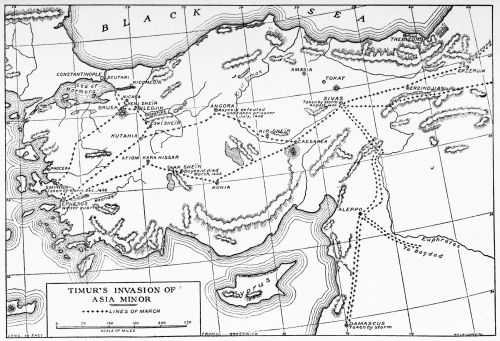
When Timur saw that Bayezid would not even treat with him, he took the field immediately. Soleiman sent an appeal to Bayezid, who was in Thessaly.[614] There was no response. With feverish haste, Soleiman attempted to put into condition the defences of Sivas, whose strong walls had been admirably constructed by the Seljuk Sultan Alaeddin Kaïkobad
TIMUR’S INVASION OF ASIA MINOR
[Largest view.]
one hundred and sixty years before.[615] He then went boldly forth to meet the Tartars, but, when he realized that his twenty thousand horsemen could not hold their own against Timur, he withdrew to the north-west, abandoning the city to its fate.[616]
It took Timur eighteen days of incessant attack to weaken the defences of Sivas. The walls were sapped, and piles driven under them, which were smeared with pitch and set on fire. Only after several of the towers had fallen did the garrison agree to surrender upon Timur’s promise that their lives should be spared and the whole city preserved. As far as the Moslems were concerned, this promise was partially fulfilled. They were allowed to pay for their freedom. The city, however, was pillaged and burned, and its Christian inhabitants were sold into slavery. Three or four thousand Armenian horsemen, who had been bravest and most stubborn in the defence, were buried alive in the moats.[617]
The destruction of Sivas was in August, 1400.[618] The conduct of Timur after this victory lends colour to the supposition that it was not at all in his mind to subdue Asia Minor and overthrow the Ottoman Empire. He had come not to conquer, but merely to give Bayezid a salutary lesson. Instead of continuing his westward march, Timur withdrew to the Euphrates, and spent the next eighteen months in the famous campaigns that ended in the destruction of Damascus and Bagdad.
XVI
In the winter of 1401-2, fresh from his triumphs in Syria and Mesopotamia, Timur paused for several months on the confines of Asia Minor. He had not yet made up his mind to attack Bayezid.
Through a Dominican friar, who had been trying to convert him, he wrote to Charles VI of France, whom he believed to be the most powerful king of the Occident, making to him a proposal for sharing the world, such as no European sovereign had put before him again until Alexander met Napoleon on the raft at Tilsit.[619] There was also an exchange of gifts and embassies with Genoa. The Genoese ambassador pointed out to Timur the necessity of destroying Bayezid. When the Tartar embassy went to Pera, the standard of Timur was flown in its honour from the Galata tower.[620] Even the distant king of Castile had two ambassadors in the camp of Timur, who were privileged to witness the battle of Angora from the Tartar side.[621]
The fall of Sivas was the first set-back of Bayezid’s career. It came to him as a heavy blow, if we are to believe the Ottoman chroniclers. But it did not result in spurring him on to immediate military and diplomatic effort, as such a calamity would certainly have done in the early days of his reign. He had become a voluptuary, debauched mentally and physically. His pride and self-confidence had increased in inverse ratio to his ability to make good his arrogant assumptions.
Negotiations were reopened between the two great sovereigns of Islam. The letters became more menacing on the part of Timur and more insulting on the part of Bayezid.[622] Timur’s earlier admiration for Bayezid as champion of the Prophet against the infidels, and his earlier reluctance to make war against a nation of his own faith, had disappeared in the course of his last conquests. The fire at Damascus was one indication of Timur’s religious indifference: his willingness to treat with Christian Europe was another. At last determined to humble Bayezid, Timur brought his huge army into camp near Sivas. He did not, however, definitely decide upon the invasion of Ottoman territory until he heard that Bayezid was starting for Tokat.
To strike at Bayezid directly was impracticable, owing to the hardships that his large army would encounter in traversing the thickly wooded and mountainous country between him and the region in which his spies reported the Ottoman army to be. He followed the valley of the Halys to Caesarea. By keeping to the water-courses his army was enabled to live off the land. It was just harvest time, and the soldiers gathered in all the grain in the valley of the Halys and its tributaries. It took six days to get to Caesarea, and four days more to reach Kirsheïr. In the meantime, the advance guard of the Osmanlis had fallen back from Tokat and Amassia to Angora. By a reconnaissance from Kirsheïr, Timur learned that the bulk of the Ottoman forces were at Angora. Three days more brought him to the Ottoman outposts.[623]
There was no further parley. Timur saw in Bayezid an enemy that must be crushed. He had every confidence in his star. Bayezid had hardly recovered from the awakening which came when he realized that Timur was actually marching against him. His resourcefulness, his coolness, his marvellous judgement had left him. His soldiers were exhausted by forced marches in the hot midsummer sun, for it was the last week of July.[624] He could have withdrawn for several days to the mountains to recuperate, and let Timur do the seeking. Then Timur would have expended his strength in an attack upon Angora under the broiling sun. Timur could not have left Angora uncaptured behind him, or have moved westward in pursuit of the Osmanlis without waiting to replenish his food supply. But Bayezid, eager and lacking in self-control, as men sometimes are from the presentiment of disaster rather than the confidence of success, decided upon an immediate battle. This was just what Timur wanted.
Bayezid’s second mistake was in putting his Tartar allies in the first line. He did this in accordance with the established Ottoman tactics, that the enemy be allowed to expend his strength upon the untrained rabble, and to reach the second line exhausted. But he had not taken into consideration the fact that these Tartars were kin to his enemy, and could easiest desert when placed in front.[625] A third mistake was in taking the offensive rather than waiting for Timur to attack;[626] for Bayezid had the advantage in being able to choose his position. From Nicopolis to Plevna, Tchataldja and Gallipoli, the Osmanlis have always shown their fighting qualities best in a defensive action.
There was nothing the matter with Bayezid’s army. Like the empire he had been building, it was composed of all the Moslem and Christian elements of Asia Minor and the Balkan peninsula. With the exception of the Tartars, they were loyal to Bayezid, and had become accustomed to fighting together with a discipline and bravery fully equal to, if not superior to, that of Timur’s veteran warriors from central Asia. The right wing was under Stephen Lazarevitch, brother-in-law and faithful friend of Bayezid. In addition to Serbian horsemen, Stephen’s command contained the other European contingents, Moslem as well as Christian.[627] In the left wing were the troops of Anatolia, led by Soleiman Tchelebi, Bayezid’s eldest son. The emir himself was in the centre, surrounded by his janissaries and his three sons, Mustafa, Isa, and Musa. To Mohammed, whose reliability and judgement Bayezid esteemed second only to Soleiman’s among his sons, was entrusted the rear guard.[628]
Elephants were used on both sides. Timur’s first line threw balls of Greek fire into the midst of the archers who were covering the Ottoman advance. The desertion of the Tartar auxiliaries, who formed a quarter or more of Bayezid’s total strength, decided the battle before the fighting really started.[629] When Bayezid saw that he could not prevent the Tartars from going over to Timur, he ordered the left wing to advance to the attack.
Fifteen thousand men fell in a vain effort to pierce the Tartar lines. The slaughter was so great that Soleiman was unable to rally his forces.[630] When they broke and fled, the offensive movement of the Osmanlis was at an end. Bayezid, now on the defensive, was driven back step by step. His retreat was cut off. With his bodyguard and the refugees from other battalions, he made a gallant fight upon a small hill, holding off the enemy for hours.[631] Long after nightfall, when the main forces of Timur’s army, who had been pursuing the Osmanlis, returned to the scene of victory, they learned that the Ottoman sovereign was still fighting on the hill. There was no more hope for Bayezid. The last of the defenders were overwhelmed. ‘The Thunderbolt continued to wield a heavy battle-ax. As a starving wolf scatters a flock of sheep, he scattered the enemy. Each blow of his redoubtable ax struck in such a way that there was no need of a second blow.’[632] At last, as he tried to withdraw over the hill, he was overpowered,[633] his hands were bound behind his back, and he was sent to Timur’s tent.
With Bayezid, his son Musa and several of his highest officials, one of whom was Timurtash, were taken prisoners. Mustafa disappeared. Soleiman, Mohammed, and Isa succeeded in escaping.[634]
The battle of Angora is memorable in Ottoman annals as the only crushing defeat experienced by the Osmanlis in the first three centuries of their history, and as the one instance where a sovereign of the house of Osman has been captured. But it cannot be placed among the memorable conflicts that have changed the course of history; for it did not affect the fortunes of the nation that won or of the nation that lost. It was not like Kossova and Nicopolis.
XVII
Bayezid was brought before his conqueror at midnight, when Timur was seeking relaxation from the strain of the combat in his favourite game of chess with his son, Shah-Rokh. Bayezid had lost nothing of his haughty spirit, and did not try to win the good graces of Timur. He was never more the sovereign than in this moment of humiliation. So impressed was Timur with the manner and bearing of his prisoner, that he accorded him every honour due to his rank.
But this spirit of generosity quickly passed. Whether it was because Bayezid tried to escape or that Timur feared an attempt at rescue as he marched farther into Ottoman territory, Timur’s attitude soon changed. To break Bayezid’s spirit he began to mock him and treat him with contempt. He ordered him to be put in chains at night, and to be carried on the march in a litter with bars, which was nothing less than a cage.[635] At Brusa, Bayezid’s harem was taken from him. It has been recorded that Timur went so far as to use his unfortunate rival as a footstool for mounting his horse and at the table, and that Bayezid was compelled to witness the degradation of his wife, the Serbian princess Despina, who in a state of nudity served the Tartar conqueror with wine at his feasts.[636]
This disgraceful treatment, coupled with the fact that his sons made no attempt to bring another army to fight for their father’s freedom or even to ransom him, at last broke the spirit of Bayezid. For nine months he had been held up to ridicule in the Tartar army. He had seen his harem violated. He had seen Timur pass with ease from one portion of the Ottoman possessions in Asia to another. Smyrna, which he had never been able to attack, fell before the Tartars. The Turkish emirs whom he had dispossessed were settled again in their states. When Bayezid learned that he was to be taken to Konia, and then to Samarkand, his mind gave way. He died of apoplexy at Ak Sheïr.[637] Timur allowed Musa to take his father’s body to Brusa for burial.[638] He had by this time lost interest in the Osmanlis and Asia Minor, and was dreaming of new fields of conquest.
Bayezid died a victim not ‘to his destiny’, as the Ottoman historians put it, but to his vices, and to his abandonment of the policy of his predecessors, that assimilation should keep pace with territorial aggrandizement. There never need have been an Angora. Timur had no inclination to invade the Ottoman dominions. Bayezid goaded him into it. Even if the test of an Angora had been necessary, Bayezid would have sustained it and weathered the Tartar storm, had he been the same man he was at Nicopolis. In facing a Tartar invasion, the advantage was all on Bayezid’s side. He failed because his mental and physical faculties, which rivalled, if they did not surpass, those of any man of his age, had become impaired by a life of debauchery.
XVIII
After the victory at Angora, the Tartar hordes swept across Asia Minor. Timur sent his grandson, Mohammed-Sultan, in pursuit of Soleiman, who succeeded in escaping from Brusa just as the Tartar horsemen arrived at the gates of the city. The Tartars stabled their horses in the mosques, while the city was ransacked for its treasures and its young girls. Fire followed pillage.[639] The sons of Alaeddin of Karamania were set free, and Bayezid’s wives and daughters, with one exception, were sent to Timur, who had established his residence at Kutayia.
In the search for Soleiman, of whose movements he was in ignorance, Mohammed-Sultan sent soldiers north to Gemlik and Nicaea, and west to Mikhalitch and Karasi. These cities were pillaged, and their inhabitants reduced to slavery. When Mohammed-Sultan learned that Soleiman had escaped to Europe, he sent an embassy to him demanding unconditional surrender. There was no reply. The question of invading Europe was referred to Timur. In the meantime, the advance guard of the Tartars devastated the country which was the cradle of the Ottoman race, while their commander celebrated at Yeni Sheïr his marriage to the eldest daughter of Bayezid. Thus were united the families of Timur and his vanquished foe.[640]
Mohammed-Sultan went into winter quarters at Magnesia.[641] Timur left Kutayia in charge of Shah-Rokh, and moved on to Ephesus. He recalled the columns which had been devastating western Asia Minor, and concentrated his forces against Smyrna. What Bayezid had been unable to accomplish in seven years, Timur did in two weeks.[642] The assault of Smyrna was carried on with unceasing energy, and every possible measure was taken to bring it to a speedy conclusion. The walls were undermined, and bridges built out over the water in order that an attack might be made from the side of the sea. When the fortress which crowns the hill behind the city was entered from the land side, the chevaliers of Rhodes fought their way down to their galleys. With lance and sword and oar they beat off the despairing inhabitants who would have swamped their boats. All except a thousand succeeded in escaping. These were decapitated, and of their heads Timur built a pyramid to commemorate his victory.[643]
Timur returned to Ephesus. As he approached the city, children came out to meet him, singing songs to appease his wrath. ‘What is this noise?’ he asked. When his attendants told him, he ordered his horsemen to ride over the children. They were trampled to death.[644]
Smyrna fell in December, 1402. Timur spent the rest of the winter in Ephesus. He destroyed the work of Bayezid in Asia Minor by restoring to the deposed emirs or their heirs the emirates of Karamania, Tekke, Menteshe, Sarukhan, Aïdin, Kastemuni, and Erzindjian. When he saw that the sons of Bayezid were ready to quarrel about the succession of their father, he began to treat with Isa, Musa and Mohammed, encouraging in each the hope of recognition as sole heir. To Soleiman he sent a diploma, investing him with the Ottoman possessions in Europe as Tartar vassal.[645]
Timur enjoyed the position he had won of arbiter of the destinies of the Ottoman Empire. The princes of Europe were now seeking his favour more insistently than before Angora. Henry IV of England wrote to him most cordially, and expressed the hope that he would be converted and become the champion of Christianity.[646]
Manuel Palaeologos, who had learned from the Venetian Senate the news of Bayezid’s defeat at Angora, hurried home from Europe.[647] He banished John to Lemnos, expelled the Ottoman colonists from Constantinople, and closed their tribunal.[648] To Timur he sent an embassy offering to acknowledge his suzerainty, and expressing his willingness to pay to him the tribute that had been given to Bayezid. But when Timur responded with an order to prepare a fleet to help the Tartar hordes to pass into Europe, Manuel was seized with panic. Smyrna had just fallen, and he felt that a similar fate was now reserved for Constantinople. An ambassador was sent to Rome and Venice to implore the immediate aid of the Vatican and the Senate.[649]
Timur, however, had become tired of Asia Minor and the western campaign. He had no constructive policy. He never attempted to organize his conquests into a world empire. Like the earlier conquerors of his race, Timur was a raider. Satiety came with destruction and victory, that is, satiety for the particular conquest in which he was engaged. So he turned his back on Constantinople and the glittering possibilities of a European invasion. He wanted to return to Samarkand to enjoy the fruits of his victories. Perhaps his character was only the reflection of that of his followers.
The march had hardly started when Bayezid died at Ak Sheïr, in March, 1403. From this moment Timur forgot all about the Osmanlis. After a brief sojourn at Konia, he left Asia Minor. Within two years he died of fever while on his way to conquer China.[650]
XIX
After Angora the Ottoman army could have been annihilated; for Timur sent his victorious Tartars hot upon the heels of the refugees. Not only did they follow Soleiman to the Sea of Marmora, and the divisions which had retreated to the Bosphorus, but they pursued closely the main body of the army, which, to the number of possibly forty thousand, had fled along the customary line of march to the Dardanelles.[651] There Greeks and Latins vied in helping the refugees to cross.[652] A Venetian eye-witness of the crossing of the Bosphorus wrote that the Venetians in good faith offered to join with the Genoese in refusing to transport the Osmanlis who were crowded upon the Asiatic shore. But the Genoese started secretly to ferry them over to Europe, with the aid of the Greeks. Then the Venetians, fearing to lose favour with the Osmanlis, started in to help.[653] This testimony is corroborated by Clavijo, who visited Constantinople in the following year. He adds that Timur was disgusted with the way the Greeks and Latins failed to co-operate with him in destroying the Ottoman army.[654]
The astonishing fact is then clearly demonstrated that Greeks, Venetians, and Genoese made no effort to take advantage of their great opportunity. Nor did they, during the ten years of civil war that followed the death of Bayezid, make any move, in concert or separately, to drive the Osmanlis out of Europe. When it was not yet certain what Timur would do in regard to Asia Minor, or even whether he would invade Europe,[655] the Venetians and Genoese established with Soleiman at Adrianople the same friendly relations that they had been so careful to maintain with his father, and fought each other in the Bosphorus. Pope Boniface was straining every nerve to help Ladislas of Sicily to win the crown of Hungary against Sigismund,[656] who, alone of the princes of Europe, had his hands been free, might have contested the Balkan peninsula with the warring factions of the Osmanlis.
The decade of civil war among the sons of Bayezid passed without interference from the outside world, and without a single uprising on the part of the subjugated Balkan Christians. The house of Osman, although divided against itself, did stand. In 1413, Mohammed I, triumphing over his brothers, became sole sovereign of the Osmanlis. The crisis was over, and the career of conquest, interrupted for the moment by Timur, was resumed.
Nicopolis had proved that the Osmanlis could hold against Europe what they had won. Angora had proved that they were too firmly rooted in the Balkan peninsula and in north-western Asia Minor, as an indigenous race and as a nation, to be destroyed by the misfortunes of their dynasty. Since the test of possession is ability to hold, in foul weather as well as in fair, who can deny that the Osmanlis under Bayezid had inherited the Byzantine Empire?