THE FORMS OF WATER (continued 3)
Reading edition
360. This is the place to mention a notion long entertained by the inhabitants of the high Alps, that glaciers possess the power of thrusting out all impurities from them. On the Mer de Glace you and I have noticed large patches of clay and black mud which evidently came from the body of the glacier, and we can therefore understand how natural was this notion of extrusion to people unaccustomed to close observation. But the power of the glacier in this respect is in reality the power of the sun, which fuses the ice above concealed impurities, and, like the bodies of the guides on the Glacier des Bossons (143), brings them to the light of day.
361. On no other glacier will you find more objects of interest than on the Görner. Sand-cones, glacier-tables, deep ice-gorges cut by streams and bridged fantastically by boulders, moulins, sometimes arched ice-caverns of extraordinary size and beauty. On the lower part of the glacier we notice the partial disappearance of the medial moraine in the crevasses, and its reappearance at the foot of the incline. For many years this glacier was steadily advancing on the meadow in front of it, ploughing up the soil and overturning the chalets in its way. It now shares in the general retreat exhibited during the last fifteen years among the glaciers of the Alps. As usual, a river, the Visp, rushes from a vault at the extremity of the Görner glacier.
§ 53. Ancient Glaciers of Switzerland.
362. You have not lost the memory of the old Moraine, which interested us so much in our first ascent from the source of the Arveiron; for it opened our minds to the fact that at one period of its history the Mer de Glace attained far greater dimensions than it now exhibits. Our experience since that time has enabled us to pursue these evidences of ice action to an extent of which we had then no notion.
363. Close to the existing glacier, for example, we have repeatedly seen the mountain side laid bare by the retreat of the ice. This is especially conspicuous just now, because for the last fifteen or sixteen years the glaciers of the Alps have been steadily shrinking; so that it is no uncommon thing to see the marginal rocks laid bare for a height of fifty, sixty, eighty, or even one hundred feet above the present glacier. On the rocks thus exposed we see the evident marks of the sliding; and our eyes and minds have been so educated in the observation of these appearances that we are now able to detect, with certainty, icemarks, or moraines, ancient or modern, wherever they appear.
364. But the elevations at which we have found such evidence might well shake belief in the conclusions to which they point. Beside the Massa Gorge, at 1,000 feet above the present Aletsch, we found a great old moraine. Descending the meadows between the Bel Alp and Flatten, we found another, now clothed with grass, and bearing a village on its back. But I wish to carry you to a region which exhibits these evidences on a still grander and more impressive scale. We have already taken a brief flight to the valley of Hasli and the Glacier of the Aar. Let us make that glacier our starting-point. Walking from it downwards towards the Grimsel, we pass everywhere over rocks singularly rounded, and fluted, and scarred. These appearances are manifestly the work of the glacier in recent times. But we approach the Grimsel, and at the turning of the valley stand before the precipitous granite flank of the mountain. The traces of the ancient ice are here as plain as they are amazing. The rocks are so hard that not only the fluting and polishing, but even the fine scratches which date back unnamable thousands of years are as evident as if they had been made yesterday. We may trace these evidences to a height of two thousand feet above the present valley bed. It is indubitable that an ice-river of this astounding depth once flowed through the vale of Hasli.
365. Yonder is the summit of the Siedelhorn; and if we gain it, the Unteraar glacier will lie like a map below us. From this commanding point we plainly see marked upon the mountain sides the height to which the ancient ice extended. The ice-ground part of the mountains is clearly distinguished from the splintered crests which in those distant days rose above the surface of the glacier, and which must have then appeared as island peaks and crests in the midst of an ocean of ice.
366. We now scamper down the Siedelhorn, get once more into the valley of Hasli, along which we follow for more than twenty miles the traces of the ice. Fluted precipices, polished slabs, and beautifully-rounded granite domes. Right and left upon the mountain flanks, at great elevations, the evidences appear. We follow the footsteps of the glacier to the Lake of Brientz; and if we prolonged our enquiries, we should learn that all the lake beds of this region, at the time now referred to, bore the burden of immense masses of ice.
367. Instead of the vale of Hasli, we might take the valley of the Rhone. The traces of a mighty glacier, which formerly filled it, may be followed all the way to Martigny, which is 60 miles distant from the present ice. At Martigny the Rhone glacier was reinforced by another from Mont Blanc, and the welded masses moved onward, planing the mountains right and left, to the Lake of Geneva, the basin of which they entirely filled. Other evidences prove that the glacier did not end here, but pushed across the low country until it encountered the limestone barrier of the Jura Mountains.
§ 54. Erratic Blocks.
368. What are these other evidences? We have seen mighty rocks poised on the moraines of the Mer de Glace, and we now know that, unless they are split and shattered by the frost, these rocks will, at some distant day, be landed bodily by the Glacier des Bois in the valley of Chamouni. You have already learned that these boulders often reveal the mineralogical nature of the mountains among which the glacier has passed; that specimens are thus brought down of a character totally different from the rocks among which they are finally landed; this is strikingly the case with the erratic blocks stranded along the Jura.
369. For the Jura itself, as already stated, is limestone; there is no trace of native granite to be found amongst these hills. Still along the breast of the mountain above the town of Neufchâtel, and at about 800 feet above the lake of Neufchâtel, we find stranded a belt of granite boulders from Mont Blanc. And when we clear the soil away from the adjacent mountain side, we find upon the limestone rocks the scarrings of the ancient glacier which brought the boulders here.
370. The most famous of these rocks, called the Pierre à Bôt, measures 50 feet in length, 40 in height, and 20 in width. Multiplying these three numbers together, we obtain 40,000 cubic feet as the volume of the boulder.
371. But this is small compared with some of the rocks which constitute the freight of even recent glaciers. Let us visit another of them. We have already been to Stalden, where the valley divides into two branches, the right branch running to St. Nicholas and Zermatt, and the left one to Saas and the Monte Moro. Three hours above Saas we come upon the end of the Allelein glacier, not filling the main valley, but thrown athwart it so as to stop its drainage like a dam. Above this ice-dam we have the Mattmark Lake, and at the head of the lake a small inn well known to travellers over the Monte Moro.
372. Close to this inn is the greatest boulder that we have ever seen. It measures 240,000 cubic feet. Looking across the valley we notice a glacier with its present end half a mile from the boulder. The stone, I believe, is serpentine, and were you and I to explore the Schwartzberg glacier to its upper fastnesses, we should find among them the birthplace of this gigantic stone. Four-and-twenty years ago, when the glacier reached the place now occupied by the boulder, it landed there its mighty freight, and then retreated. There is a second ice-borne rock at hand which would be considered vast were it not dwarfed by the aspect of its huger neighbour.
373. Evidence of this kind might be multiplied to any extent. In fact, at this moment, distinguished men, like Professor Favre of Geneva, are determining from the distribution of the erratic blocks the extent of the ancient glaciers of Switzerland. It was, however, an engineer named Venetz that first brought these evidences to light, and announced to an incredulous world the vast extension of the ancient ice. M. Agassiz afterwards developed and wonderfully expanded the discovery. Perhaps the most interesting observation regarding ancient glaciers is that of Dr. Hooker, who, during a recent visit to Palestine, found the celebrated Cedars of Lebanon growing upon ancient moraines.
§ 55. Ancient Glaciers of England, Ireland, Scotland, and Wales.
374. At the time the ice attained this extraordinary development in the Alps, many other portions of Europe, where no glaciers now exist, were covered with them. In the Highlands of Scotland, among the mountains of England, Ireland, and Wales, the ancient glaciers have written their story as plainly as in the Alps themselves. I should like to wander with you through Borrodale in Cumberland, or through the valleys near Bethgellert in Wales. Under all the beauty of the present scenery we should discover the memorials of a time when the whole region was locked in the embrace of ice. Professor Ramsay is especially distinguished by his writings on the ancient glaciers of Wales.
375. We have made the acquaintance of the Reeks of Magillicuddy as the great condensers of Atlantic vapour. At the time now referred to, this moisture did not fall as soft and fructifying rain, but as snow, which formed the nutriment of great glaciers. A chain of lakes now constitutes the chief attraction of Killarney, the Lower, the Middle, and the Upper Lake. Let us suppose ourselves rowing towards the head of the Upper Lake with the Purple Mountain to our left. Remembering our travels in the Alps, you would infallibly call my attention to the planing of the rocks, and declare the action to be unmistakably that of glaciers. With our attention thus sharpened, we land at the head of the lake, and walk up the Black Valley to the base of Magillicuddy's Reeks. Your conclusion would be, that this valley tells a tale as wonderful as that of Hasli.
376. We reach our boat and row homewards along the Upper Lake. Its islands now possess a new interest for us. Some of them are bare, others are covered wholly or in part with luxuriant vegetation; but both the naked and clothed islands are glaciated. The weathering of ages has not altered their forms: there are the Cannon Rock, the Giant's Coffin, the Man of War, all sculptured as if the chisel had passed over them in our own lifetime. These lakes, now fringed with tender woodland beauty, were all occupied by the ancient ice. It has disappeared, and seeds from other regions have been wafted thither to sow the trees, the shrubs, the ferns, and the grasses which now beautify Killarney. Man himself, they say, has made his appearance in the world since that time of ice; but of the real period and manner of man's introduction little is professed to be known since, to make them square with science, new meanings have been found for the beautiful myths and stories of the Bible.
377. It is the nature and tendency of the human mind to look backward and forward; to endeavour to restore the past and predict the future. Thus endowed, from data patiently and painfully won, we recover in idea a state of things which existed thousands, it may be millions, of years before the history of the human race began.
§ 56. The Glacial Epoch.
378. This period of ice-extension has been named the Glacial Epoch. In accounting for it great minds have fallen into grave errors, as we shall presently see.
379. The substance on which we have thus far been working exists in three different states: as a solid in ice; as a liquid in water; as a gas in vapour. To cause it to pass from one of these states to the next following one, heat is necessary.
380. Dig a hole in the ice of the Mer de Glace in summer, and place a thermometer in the hole; it will stand at 32° Fahr. Dip your thermometer into one of the glacier streams; it will still mark 32°. The water is therefore as cold as ice.
381. Hence the whole of the heat poured by the sun upon the glacier, and which has been absorbed by the glacier, is expended in simply liquefying the ice, and not in rendering either ice or water a single degree warmer.
382. Expose water to a fire; it becomes hotter for a time. It boils, and from that moment it ceases to get hotter. After it has begun to boil, all the heat communicated by the fire is carried away by the steam, though the steam itself is not the least fraction of a degree hotter than the water.
383. In fact, simply to liquefy ice a large quantity of heat is necessary, and to vaporize water a still larger quantity is necessary. And inasmuch as this heat does not render the water warmer than the ice, nor the steam warmer than the water, it was at one time supposed to be hidden in the water and in the steam. And it was therefore called latent heat.
384. Let us ask how much heat must the sun expend in order to convert a pound weight of the tropical ocean into vapour? This problem has been accurately solved by experiment. It would require in round numbers 1,000 times the amount of heat necessary to raise one pound of water one degree in temperature.
385. But the quantity of heat which would raise the temperature of a pound of water one degree would raise the temperature of a pound of iron ten degrees. This has been also proved by experiment. Hence to convert one pound of the tropical ocean into vapour the sun must expend 10,000 times as much heat as would raise one pound of iron one degree in temperature.
386. This quantity of heat would raise the temperature of 5 lbs. of iron 2,000 degrees, which is the fusing point of cast iron; at this temperature the metal would not only be white hot, but would be passing into the molten condition.
387. Consider the conclusions at which we have now arrived. For every pound of tropical vapour, or for every pound of Alpine ice produced by the congelation of that vapour, an amount of heat has been expended by the sun sufficient to raise 5 lbs. of cast iron to its melting-point.
388. It would not be difficult to calculate approximately the weight of the Mer de Glace and its tributaries—to say, for example, that they contained so many millions of millions of tons of ice and snow. Let the place of the ice be taken by a mass of white-hot iron of quintuple the weight; with such a picture before your mind you get some notion of the enormous amount of heat paid out by the sun to produce the present glacier.
389. You must think over this, until it is as clear as sunshine. For you must never henceforth fall into the error already referred to, and which has entangled so many. So natural was the association of ice and cold, that even celebrated men assumed that all that is needed to produce a great extension of our glaciers is a diminution of the sun's temperature. Had they gone through the foregoing reflections and calculations, they would probably have demanded more heat instead of less for the production of a "glacial epoch." What they really needed were condensers sufficiently powerful to congeal the vapour generated by the heat of the sun.
§ 57. Glacier Theories.
390. You have not forgotten, and hardly ever can forget, our climbs to the Cleft Station. Thoughts were then suggested which we have not yet discussed. We saw the branch glaciers coming down from their névés, welding themselves together, pushing through Trélaporte, and afterwards moving through the sinuous valley of the Mer de Glace. These appearances alone, without taking into account subsequent observations, were sufficient to suggest the idea that glacier ice, however hard and brittle it may appear, is really a viscous substance, resembling treacle, or honey, or tar, or lava.
§ 58. Dilatation and Sliding Theories.
391. Still this was not the notion expressed by the majority of writers upon glaciers. Scheuchzer of Zürich, a great naturalist, visited the glaciers in 1705, and propounded a theory of their motion. Water, he knew, expands in freezing, and the force of expansion is so great, that thick bombshells filled with water, and permitted to freeze, are, as we know (312), shattered to pieces by the ice within. Scheuchzer supposed that the water in the fissures of the glaciers, freezing there and expanding with resistless force, was the power which urged the glacier downwards. He added to this theory other notions of a less scientific kind.
392. Many years subsequently, De Charpentier of Bex renewed and developed this theory with such ability and completeness, that it was long known as Charpentier's Theory of Dilatation. M. Agassiz for a time espoused this theory, and it was also more or less distinctly held by other writers. The glacier, in fact, was considered to be a magazine of cold, capable of freezing all water percolating through it. The theory was abandoned when this notion of glacier cold was proved by M. Agassiz to be untenable.
393. In 1760, Altmann and Grüner propounded the view that glaciers moved by sliding over their beds. Nearly forty years subsequently, this notion was revived by De Saussure, and it has therefore been called "De Saussure's Theory," or the "Sliding Theory" of glacier motion.
394. There was, however, but little reason to connect the name of De Saussure with this or any other theory of glaciers. Incessantly occupied in observations of another kind, this celebrated man devoted very little time or thought to the question of glacier motion. What he has written upon the subject reads less like the elaboration of a theory than the expression of an opinion.
§ 59. Plastic Theory.
395. By none of these writers is the property of viscosity or plasticity ascribed to glacier ice; the appearances of many glaciers are, however, so suggestive of this idea that we may be sure it would have found more frequent expression, were it not in such apparent contradiction with our every-day experience of ice.
396. Still the idea found its advocates. In a little book, published in 1773, and entitled "Picturesque Journey to the Glaciers of Savoy," Bordier of Geneva wrote thus:—"It is now time to look at all these objects with the eyes of reason; to study, in the first place, the position and the progression of glaciers, and to seek the solution of their principal phenomena. At the first aspect of the ice-mountains an observation presents itself, which appears sufficient to explain all. It is that the entire mass of ice is connected together, and presses from above downwards after the manner of fluids. Let us then regard the ice, not as a mass entirely rigid and immobile, but as a heap of coagulated matter, or as softened wax, flexible and ductile to a certain point."[F] Here probably for the first time the quality of plasticity is ascribed to the ice of glaciers.
397. To us, familiar with the aspect of the glaciers, it must seem strange that this idea once expressed did not at once receive recognition and development. But in those early days explorers were few, and the "Picturesque Journey" probably but little known, so that the notion of plasticity lay dormant for more than half a century. But Bordier was at length succeeded by a man of far greater scientific grasp and insight than himself. This was Rendu, a Catholic priest and canon when he wrote, and afterwards Bishop of Annecy. In 1841 Rendu laid before the Royal Academy of Sciences of Savoy his "Theory of the Glaciers of Savoy," a contribution for ever memorable in relation to this subject.[G]
398. Rendu seized the idea of glacier plasticity with great power and clearness, and followed it resolutely to its consequences. It is not known that he had ever seen the work of Bordier; probably not, as he never mentions it. Let me quote for you some of Rendu's expressions, which, however, fail to give an adequate idea of his insight and precision of thought:—"Between the Mer de Glace and a river there is a resemblance so complete that it is impossible to find in the glacier a circumstance which does not exist in the river. In currents of water the motion is not uniform either throughout their width or throughout their depth. The friction of the bottom and of the sides, with the action of local hindrances, causes the motion to vary, and only towards the middle of the surface do we obtain the full motion."
399. This reads like a prediction of what has since been established by measurement. Looking at the glacier of Mont Dolent, which resembles a sheaf in form, wide at both ends and narrow in the middle, and reflecting that the upper wide part had become narrow, and the narrow middle part again wide, Rendu observes, "There is a multitude of facts which seem to necessitate the belief that glacier ice enjoys a kind of ductility which enables it to mould itself to its locality, to thin out, to swell, and to contract as if it were a soft paste."
400. To fully test his conclusions, Rendu required the accurate measurement of glacier motion. Had he added to his other endowments the practical skill of a land-surveyor, he would now be regarded as the prince of glacialists. As it was he was obliged to be content with imperfect measurements. In one of his excursions he examined the guides regarding the successive positions of a vast rock which he found upon the ice close to the side of the glacier. The mean of five years gave him a motion for this block of 40 feet a year.
401. Another block, the transport of which he subsequently measured more accurately, gave him a velocity of 400 feet a year. Note his explanation of this discrepancy:—"The enormous difference of these two observations arises from the fact that one block stood near the centre of the glacier, which moves most rapidly, while the other stood near the side, where the ice is held back by friction." So clear and definite were Rendu's ideas of the plastic motion of glaciers, that had the question of curvature occurred to him, I entertain no doubt that he would have enunciated beforehand the shifting of the point of maximum motion from side to side across the axis of the glacier (§ 25).
402. It is right that you should know that scientific men do not always agree in their estimates of the comparative value of facts and ideas; and it is especially right that you should know that your present tutor attaches a very high value to ideas when they spring from the profound and persistent pondering of superior minds, and are not, as is too often the case, thrown out without the warrant of either deep thought or natural capacity. It is because I believe Rendu's labours fulfil this condition, that I ascribe to them so high a value. But when you become older and better informed, you may differ from me; and I write these words lest you should too readily accept my opinion of Rendu. Judge me, if you care to do so, when your knowledge is matured. I certainly shall not fear your verdict.
403. But, much as I prize the prompting idea, and thoroughly as I believe that often in it the force of genius mainly lies, it would, in my opinion, be an error of omission of the gravest kind, and which, if habitual, would ensure the ultimate decay of natural knowledge, to neglect verifying our ideas, and giving them outward reality and substance when the means of doing so are at hand. In science thought, as far as possible, ought to be wedded to fact. This was attempted by Rendu, and in part accomplished by Agassiz and Forbes.
§ 60. Viscous Theory.
404. Here indeed the merits of the distinguished glacialist last named rise conspicuously to view. From the able and earnest advocacy of Professor Forbes, the public knowledge of this doctrine of glacial plasticity is almost wholly derived. He gave the doctrine a more distinctive form; he first applied the term viscous to glacier ice, and sought to found upon precise measurements a "Viscous Theory" of glacier motion.
405. I am here obliged to state facts in their historic sequence. Professor Forbes when he began his investigations was acquainted with the labours of Rendu. In his earliest work upon the Alps he refers to those labours in terms of flattering recognition. But though as a matter of fact Rendu's ideas were there to prompt him, it would be too much to say that he needed their inspiration. Had Rendu not preceded him, he might none the less have grasped the idea of viscosity, executing his measurements and applying his knowledge to maintain it. Be that as it may, the appearance of Professor Forbes on the Unteraar glacier in 1841, and on the Mer de Glace in 1842, and his labours then and subsequently, have given him a name not to be forgotten in the scientific history of glaciers.
406. The theory advocated by Professor Forbes was enunciated by himself in these words:—"A glacier is an imperfect fluid, or viscous body, which is urged down slopes of certain inclination by the natural pressure of its parts." In 1773 Bordier wrote thus:—"As the glaciers always advance upon the plain, and never disappear, it is absolutely essential that new ice shall perpetually take the place of that which is melted: it must therefore be pressed forward from above. One can hardly refuse then to accept the astonishing truth, that this vast extent of hard and solid ice moves as a single piece downwards." In the passage already quoted he speaks of the ice being pressed as a fluid from above. These constitute, I believe, Bordier's contributions to this subject. The quotations show his sagacity at an early date; but, in point of completeness, his views are not to be compared with those of Rendu and Forbes.
407. I must not omit to state here that though the idea of viscosity has not been espoused by M. Agassiz, his measurements, and maps of measurements, on the Unteraar glacier have been recently cited as the most clear and conclusive illustrations of a quality which, at all events, closely resembles viscosity.
408. But why, with proofs before him more copious and characteristic than those of any other observer, does M. Agassiz hesitate to accept the idea of viscosity as applied to ice? Doubtless because he believes the notion to be contradicted by our every-day experience of the substance.
409. Take a mass of ice ten or even fifteen cubic feet in volume; draw a saw across it to a depth of half an inch or an inch; and strike a pointed pricker, not thicker than a very small round file, into the groove; the substance will split from top to bottom with a clean crystalline fracture. How is this brittleness to be reconciled with the notion of viscosity?
410. We have, moreover, been upon the glacier and have witnessed the birth of crevasses. We have seen them beginning as narrow cracks suddenly formed, days being required to open them a single inch. In many glaciers fissures may be traced narrow and profound for hundreds of yards through the ice. What does this prove? Did the ice possess even a very small modicum of that power of stretching, which is characteristic of a viscous substance, such crevasses could not be formed.
411. Still it is undoubted that the glacier moves like a viscous body. The centre flows past the sides, the top flows over the bottom, and the motion through a curved valley corresponds to fluid motion. Mr. Mathews, Mr. Froude, and above all Signor Bianconi, have, moreover, recently made experiments on ice which strikingly illustrate the flexibility of the substance. These experiments merit, and will doubtless receive, full attention at a future time.
§ 61. Regelation Theory.
412. I will now describe to you an attempt that has been made of late years to reconcile the brittleness of ice with, its motion in glaciers. It is founded on the observation, made by Mr. Faraday in 1850, that when two pieces of thawing ice are placed together they freeze together at the place of contact.
413. This fact may not surprise you; still it surprised Mr. Faraday and others, and men of very great distinction in science have differed in their interpretation of the fact. The difficulty is to explain where, or how, in ice already thawing the cold is to be found requisite to freeze the film of water between the two touching surfaces.
414. The word Regelation was proposed by Dr. Hooker to express the freezing together of two pieces of thawing ice observed by Faraday; and the memoir in which the term was first used was published by Mr. Huxley and Mr. Tyndall in the Philosophical Transactions for 1857.
415. The fact of regelation, and its application irrespective of the cause of regelation, may be thus illustrated:—Saw two slabs from a block of ice, and bring their flat surfaces into contact; they immediately freeze together. Two plates of ice, laid one upon the other, with flannel round them overnight, are sometimes so firmly frozen in the morning that they will rather break elsewhere than along their surface of junction. If you enter one of the dripping ice-caves of Switzerland, you have only to press for a moment a slab of ice against the roof of the cave to cause it to freeze there and stick to the roof.
416. Place a number of fragments of ice in a basin of water, and cause them to touch each other; they freeze together where they touch. You can form a chain of such fragments; and then, by taking hold of one end of the chain, you can draw the whole series after it. Chains of icebergs are sometimes formed in this way in the Arctic seas.
417. Consider what follows from these observations. Snow consists of small particles of ice. Now if by pressure we squeeze out the air entangled in thawing snow, and bring the little ice-granules into close contact, they may be expected to freeze together; and if the expulsion of the air be complete, the squeezed snow may be expected to assume the appearance of compact ice.
418. We arrive at this conclusion by reasoning; let us now test it by experiment, employing a suitable hydraulic press, and a mould to hold the snow. In exact accordance with our expectation, we convert by pressure the snow into ice.[H]
419. Place a compact mass of ice in a proper mould, and subject it to pressure. It breaks in pieces: squeeze the pieces forcibly together; they re-unite by regelation, and a compact piece of ice, totally different in shape from the first one, is taken from the press. To produce this effect the ice must be in a thawing condition. When its temperature is much below the melting point it is crushed by pressure, not into a pellucid mass of another shape, but into a white powder.
420. By means of suitable moulds you may in this way change the shape of ice to any extent, turning out spheres, and cups, and rings, and twisted ropes of the substance; the change of form in these cases being effected through rude fracture and regelation.
421. By applying the pressure carefully, rude fracture may be avoided, and the ice compelled slowly to change its form as if it were a plastic body.
422. Now our first experiment illustrates the consolidation of the snows of the higher Alpine regions. The deeper layers of the névé have to bear the weight of all above them, and are thereby converted into more or less perfect ice. And our last experiment illustrates the changes of form observed upon the glacier, where, by the slow and constant application of pressure, the ice gradually moulds itself to the valley, which it fills.
423. In glaciers, however, we have also ample illustrations of rude fracture and regelation. The opening and closing of crevasses illustrate this. The glacier is broken on the cascades and mended at their bases. When two branch glaciers lay their sides together, the regelation is so firm that they begin immediately to flow in the trunk glacier as a single stream. The medial moraine gives no indication by its slowness of motion that it is derived from the sluggish ice of the sides of the branch glaciers.
424. The gist of the Regelation Theory is that the ice of glaciers changes its form and preserves its continuity under pressure which keeps its particles together. But when subjected to tension, sooner than stretch it breaks, and behaves no longer as a viscous body.
§ 62. Cause of Regelation.
425. Here the fact of regelation is applied to explain the plasticity of glacier ice, no attempt being made to assign the cause of regelation itself. They are two entirely distinct questions. But a little time will be well spent in looking more closely into the cause of regelation. You may feel some surprise that eminent men should devote their attention to so small a point, but we must not forget that in nature nothing is small. Laws and principles interest the scientific student most, and these may be as well illustrated by small things as by large ones.
426. The question of regelation immediately connects itself with that of "latent heat," already referred to (383), but which we must now subject to further examination. To melt ice, as already stated, a large amount of heat is necessary, and in the case of the glaciers this heat is furnished by the sun. Neither the ice so melted nor the water which results from its liquefaction can fall below 32° Fahrenheit. The freezing point of water and the melting point of ice touch each other, as it were, at this temperature. A hair's-breadth lower water freezes; a hair's-breadth higher ice melts.
427. But if the ice could be caused to melt without this supply of solar heat, a temperature lower than that of ordinary thawing ice would result. When snow and salt, or pounded ice and salt, are mixed together, the salt causes the ice to melt, and in this way a cold of 20 or 30 degrees below the freezing point may be produced. Here, in fact, the ice consumes its own warmth in the work of liquefaction. Such a mixture of ice and salt is called "a freezing mixture."
428. And if by any other means ice at the temperature of 32° Fahrenheit could be liquefied without access of heat from without, the water produced would be colder than the ice. Now Professor James Thomson has proved that ice may be liquefied by mere pressure, and his brother, Sir William Thomson, has also shown that water under pressure requires a lower temperature to freeze it than when the pressure is removed. Professor Mousson subsequently liquefied large masses of ice by a hydraulic press; and by a beautiful experiment Professor Helmholtz has proved that water in a vessel from which the air has been removed, and which is therefore relieved from the pressure of the atmosphere, freezes and forms ice-crystals when surrounded by melting ice. All these facts are summed up in the brief statement that the freezing point of water is lowered by pressure.[I]
429. For our own instruction we may produce the liquefaction of ice by pressure in the following way:—You remember the beautiful flowers obtained when a sunbeam is sent through lake ice (§ 11), and you have not forgotten that the flowers always form parallel to the surface of freezing. Let us cut a prism, or small column of ice with the planes of freezing running across it at right angles; we place that prism between two slabs of wood, and bring carefully to bear upon it the squeezing force of a small hydraulic press.
430. It is well to converge by means of a concave mirror a good light upon the ice, and to view it through a magnifying lens. You already see the result. Hazy surfaces are formed in the very body of the ice, which gradually expand as the pressure is slowly augmented. Here and there you notice something resembling crystallisation; fern-shaped figures run with considerable rapidity through the ice, and when you look carefully at their points and edges you find them in visible motion. These hazy surfaces are spaces of liquefaction, and the motion you see is that of the ice falling to water under the pressure. That water is colder than the ice was before the pressure was applied, and if the pressure be relieved, not only does the liquefaction cease, but the water re-freezes. The cold produced by its liquefaction under pressure is sufficient to re-congeal it when the pressure is removed.
431. If instead of diffusing the pressure over surfaces of considerable extent, we concentrate it on a small surface, the liquefaction will of course be more rapid, and this is what Mr. Bottomley has recently done in an experiment of singular beauty and interest. Let us support on blocks of wood the two ends of a bar of ice 10 inches long, 4 inches deep, and 3 wide, and let us loop over its middle a copper wire one-twentieth, or even one-tenth, of an inch in thickness. Connecting the two ends of the wire together, and suspending from it a weight of 12 or 14 pounds, the whole pressure of this weight is concentrated on the ice which supports the wire. What is the consequence? The ice underneath the wire liquefies; the water of liquefaction escapes round the wire, but the moment it is relieved from the pressure it freezes, and round about the wire, even before it has entered the ice, you have a frozen casing. The wire continues to sink in the ice; the water incessantly escapes, freezing as it does so behind the wire. In half an hour the weight falls; the wire has gone clean through the ice. You can plainly see where it has passed, but the two severed pieces of ice are so firmly frozen together that they will break elsewhere as soon as along the surface of regelation.
432. Another beautiful experiment bearing upon this point has recently been made by M. Boussingault. He filled a hollow steel cylinder with water and chilled it. In passing to ice, water, as you know, expands (§ 45); in fact, room for expansion is a necessary condition of solidification. But in the present case the strong steel resisted the expansion, the water in consequence remaining liquid at a temperature of more than 30° Fahr. below the ordinary freezing point. A bullet within the cylinder rattled about at this temperature, showing that the water was still liquid. On opening the tap the liquid, relieved of the pressure, was instantly converted into ice.
433. It is only substances which expand on solidifying that behave in this manner. The metal bismuth, as we know, is an example similar to water; while lead, wax, or sulphur, all of which contract on solidifying, have their point of fusion heightened by pressure.
434. And now you are prepared to understand Professor James Thomson's theory of regelation. When two pieces of ice are pressed together liquefaction, he contends, results. The water spreads out around the points of pressure, and when released re-freezes, thus forming a kind of cement between the pieces of ice.
§ 63. Faraday's View of Regelation.
435. Faraday's view of regelation is not so easily expressed, still I will try to give you some notion of it, dealing in the first place with admitted facts. Water, even in open vessels, may be lowered many degrees below its freezing temperature, and still remain liquid; it may also be raised to a temperature far higher than its boiling point, and still resist boiling. This is due to the mutual cohesion of the water particles, which resists the change of the liquid either into the solid or the vaporous condition.
436. But if into the over-chilled water you throw a particle of ice, the cohesion is ruptured, and congelation immediately sets in. And if into the superheated water you introduce a bubble of air or of steam, cohesion is likewise ruptured, and ebullition immediately commences.
437. Faraday concluded that in the interior of any body, whether solid or liquid, where every particle is grasped so to speak by the surrounding particles, and grasps them in turn, the bond of cohesion is so strong as to require a higher temperature to change the state of aggregation than is necessary at the surface. At the surface of a piece of ice, for example, the molecules are free on one side from the control of other molecules; and they therefore yield to heat more readily than in the interior. The bubble of air or steam in overheated water also frees the molecules on one side; hence the ebullition consequent upon its introduction. Practically speaking, then, the point of liquefaction of the interior ice is higher than that of the superficial ice. Faraday also refers to the special solidifying power which bodies exert upon their own molecules. Camphor in a glass bottle fills the bottle with an atmosphere of camphor. In such an atmosphere large crystals of the substance may grow by the incessant deposition of camphor molecules upon camphor, at a temperature too high to permit of the slightest deposit upon the adjacent glass. A similar remark applies to sulphur, phosphorus, and the metals in a state of fusion. They are deposited upon solid portions of their own substance at temperatures not low enough to cause them to solidify against other substances.
438. Water furnishes an eminent example of this special solidifying power. It may be cooled ten degrees and more below its freezing point without freezing. But this is not possible if the smallest fragment of ice be floating in the water. It then freezes accurately at 32° Fahr., depositing itself, however, not upon the sides of the containing vessel, but upon the ice. Faraday observed in a freezing apparatus thin crystals of ice growing in ice-cold water to a length of six, eight, or ten inches, at a temperature incompetent to produce their deposition upon the sides of the containing vessel.
439. And now we are prepared for Faraday's view of regelation. When the surfaces of two pieces of ice, covered with a film of the water of liquefaction, are brought together, the covering film is transferred from the surface to the centre of the ice, where the point of liquefaction, as before shown, is higher than at the surface. The special solidifying power of ice upon water is now brought into play on both sides of the film. Under these circumstances, Faraday held that the film would congeal, and freeze the two surfaces together.
440. The lowering of the freezing point by pressure amounts to no more than one-seventieth of a degree Fahrenheit for a whole atmosphere. Considering the infinitesimal fraction of this pressure which is brought into play in some cases of regelation, Faraday thought its effect insensible. He suspended pieces of ice, and brought them into contact without sensible pressure, still they froze together. Professor James Thomson, however, considered that even the capillary attraction exerted between two such masses would be sufficient to produce regelation. You may make the following experiments, in further illustration of this subject:—
441. Place a small piece of ice in water, and press it underneath the surface by a second piece. The submerged piece may be so small as to render the pressure infinitesimal; still it will freeze to the under surface of the superior piece.
442. Place two pieces of ice in a basin of warm water, and allow them to come together; they freeze together when they touch. The parts surrounding the place of contact melt away, but the pieces continue for a time united by a narrow bridge of ice. The bridge finally melts, and the pieces for a moment are separated. But capillary attraction immediately draws them together, and regelation sets in once more. A new bridge is formed, which in its turn is dissolved, the separated pieces again closing up. A kind of pulsation is thus established between the two pieces of ice. They touch, they freeze, a bridge is formed and melted; and thus the rhythmic action continues until the ice disappears.
443. According to Professor James Thomson's theory, pressure is necessary to liquefy the ice. The heat necessary for liquefaction must be drawn from the ice itself, and the cold water must escape from the pressure to be re-frozen. Now in the foregoing experiments the cold water, instead of being allowed to freeze, issues into the warm water, still the floating fragments regelate in a moment. The touching surfaces may, moreover, be convex; they may be reduced practically to points, clasped all round by the warm water, which indeed rapidly dissolve them as they approach each other; still they freeze immediately when they touch.
444. You may learn from this discussion that in scientific matters, as in all others, there is room for differences of opinion. The frame of mind to be cultivated here is a suspension of judgment as long as the meaning remains in doubt. It may be that Faraday's action and Thomson's action come both into play. I cannot do better than finish these remarks by quoting Faraday's own concluding words, which show how in his mind scientific conviction dwelt apart from dogmatism:—"No doubt," he says, "nice experiments will enable us hereafter to criticise such results as these, and separating the true from the untrue will establish the correct theory of regelation."
§ 64. The Blue Veins of Glaciers.
445. We now approach the end, one important question only remaining to be discussed. Hitherto we have kept it back, for a wide acquaintance with the glaciers was necessary to its solution. We had also to make ourselves familiar by actual experiment with the power of ice, softened by thaw, to yield to pressure, and to liquefy under such pressure.
446. Snow is white. But if you examine its individual particles you would call them transparent, not white. The whiteness arises from the mixture of the ice particles with small spaces of air. In the case of all transparent bodies whiteness results from such a mixture. The clearest glass or crystal when crushed becomes a white powder. The foam of champagne is white through the intimate admixture of a transparent liquid with transparent carbonic acid gas. The whitest paper, moreover, is composed of fibres which are individually transparent.
447. It is not, however, the air or the gas, but the optical severance of the particles, giving rise to a multitude of reflexions of the white solar light at their surfaces, that produces the whiteness.
448. The whiteness of the surface of a clean glacier (112), and of the icebergs of the Märgelin See (357), has been already referred to a similar cause. The surface is broken into innumerable fissures by the solar heat, the reflexion of solar light from the sides of the little fissures producing the observed appearance.
449. In like manner if you freeze water in a test-tube by plunging it into a freezing mixture, the ice produced is white. For the most part also the ice formed in freezing machines is white. Examine such, ice, and you will find it filled with small air-bubbles. When the freezing is extremely slow the crystallising force pushes the air effectually aside, and the resulting ice is transparent; when the freezing is rapid, the air is entangled before it can escape, and the ice is translucent. But even in the case of quick freezing Mr. Faraday obtained transparent ice by skilfully removing the air-bubbles as fast as they appeared with a feather.
450. In the case of lake ice the freezing is not uniform, but intermittent. It is sometimes slow, sometimes rapid. When slow the air dissolved in the water is effectually squeezed out and forms a layer of bubbles on the under-surface of the ice. An act of sudden freezing entangles the air, and hence we find lake ice usually composed of layers alternately clear, and filled with bubbles. Such layers render it easy to detect the planes of freezing in lake ice.
451. And now for the bearing of these facts. Under the fall of the Géant, at the base of the Talèfre cascade, and lower down the Mer de Glace; in the higher regions of the Grindelwald, the Aar, the Aletsch and the Görner glaciers, the ice does not possess the transparency which it exhibits near the ends of the glaciers. It is white, or whitish. Why? Examination shows it to be filled with small air-bubbles; and these, as we now learn, are the cause of its whiteness.
452. They are the residue of the air originally entangled in the snow, and connected, as before stated, with the whiteness of the snow. During the descent of the glacier, the bubbles are gradually expelled by the enormous pressures brought to bear upon the ice. Not only is the expulsion caused by the mechanical yielding of the soft thawing ice, but the liquefaction of the substance at places of violent pressure, opening, as it does, fissures for the escape of the air, must play an important part in the consolidation of the glacier.
453. The expulsion of the bubbles is, however, not uniform; for neither ice nor any other substance offers an absolutely uniform resistance to pressure. At the base of every cascade that we have visited, and on the walls of the crevasses there formed, we have noticed innumerable blue streaks drawn through the white translucent ice, and giving the whole mass the appearance of lamination. These blue veins turned out upon examination to be spaces from which the air-bubbles had been almost wholly expelled, translucency being thus converted into transparency.
454. This is the veined or ribboned structure of glaciers, regarding the origin of which diverse opinions are now entertained.
455. It is now our duty to take up the problem, and to solve it if we can. On the névés of the Col du Géant, and other glaciers, we have found great cracks, and faults, and Bergschrunds, exposing deep sections of the névé; and on these sections we have found marked the edges of half-consolidated strata evidently produced by successive falls of snow. The névé is stratified because its supply of material from the atmosphere is intermittent, and when we first observed the blue veins we were disposed to regard them as due to this stratification.
456. But observation and reflexion soon dispelled this notion. Indeed it could hardly stand in the presence of the single fact that at the bases of the ice-falls the veins are always vertical, or nearly so. We saw no way of explaining how the horizontal strata of the névé could be so tilted up at the base of the fall as to be set on edge. Nor is the aspect of the veins that of stratification.
457. On the central portions of the cascades, moreover, there are no signs of the veins. At the bases they first appear, reaching in each case their maximum development a little below the base. As you and I stood upon the heights above the Zäsenberg and scrutinised the cascade of the Strahleck branch of the Grindelwald glacier, we could not doubt that the base of the fall was the birthplace of the veins. We called this portion of the glacier a "Structure Mill," intimating that here, and not on the névé, the veined structure was manufactured.
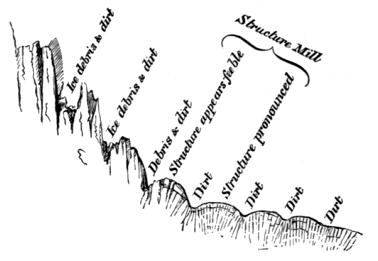
SECTION OF ICEFALL, AND GLACIER BELOW IT, SHOWING ORIGIN OF VEINED STRUCTURE.
458. This, however, is, at bottom, the language of strong opinion merely, not that of demonstration; and in science opinion ought to content us only so long as positive proof is unattainable. The love of repose must not prevent us from seeking this proof. There is no sterner conscience than the scientific conscience, and it demands, in every possible case, the substitution for private conviction of demonstration which shall be conclusive to all.
459. Let us, for example, be shown a case in which the stratification of the névé is prolonged into the glacier; let us see the planes of bedding and the planes of lamination existing side by side, and still indubitably distinct. Such an observation would effectually exclude stratification from the problem of the veined structure, and through the removal of this tempting source of error, we should be rendered more free to pursue the truth.
460. We sought for this conclusive test upon the Mer de Glace, but did not find it. We sought it on the Grindelwald, and the Aar glaciers,[J] with an equal want of success. On the Aletsch glacier, for the first time, we observed the apparent coexistence of bedding and structure, the one cutting the other upon the walls of the same crevasse. Still the case was not sufficiently pronounced to produce entire conviction, and we visited the Görner glacier with the view of following up our quest.
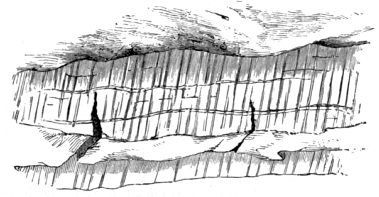
STRUCTURE AND BEDDING ON ALETSCH GLACIER.
461. Here day after day added to the conviction that the bedding and the structure were two different things. Still day after day passed without revealing to us the final proof. Surely we have not let our own ease stand in the way of its attainment, and if we retire baffled we shall do so with the consciousness of having done our best. Yonder, however, at the base of the Matterhorn, is the Furgge glacier that we have not yet explored. Upon it our final attempt must be made.
462. We get upon the glacier near its end, and ascend it. We are soon fronted by a barrier composed of three successive walls of névé, the one rising above the other, and each retreating behind the other. The bottom of each wall is separated from the top of the succeeding one by a ledge, on which threatening masses of broken névé now rest. We stand amid blocks and rubbish which have been evidently discharged from these ledges, on which other masses, ready apparently to tumble, are now poised.
463. On the vertical walls of this barrier we see, marked with the utmost plainness, the horizontal lines of stratification, while something exceedingly like the veined structure appears to cross the lines of bedding at nearly a right angle. The vertical surface is, however weathered, and the lines of structure, if they be such, are indistinct. The problem now is to remove the surface, and expose the ice underneath. It is one of the many cases that have come before us, where the value of an observation is to be balanced against the danger which it involves.
464. We do nothing rashly; but scanning the ledges and selecting a point of attack, we conclude that the danger is not too great to be incurred. We advance to the wall, remove the surface, and are rewarded by the discovery underneath it of the true blue veins. They, moreover, are vertical, while the bedding is horizontal. Bruce, as you know, was defeated in many a battle, but he persisted and won at last. Here, upon the Furgge glacier, you also have fought and won your little Bannockburn.
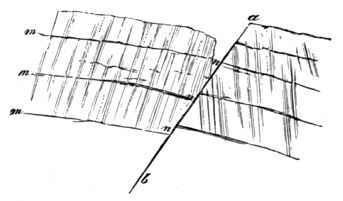
STRUCTURE AND BEDDING ON FURGGE GLACIER.
465. But let us not use the language of victory too soon. The stratification theory has been removed out of the field of explanation, but nothing has as yet been offered in its place.
§ 65. Relation of Structure to Pressure.
466. This veined structure was first described by the distinguished Swiss naturalist, Guyot, now a resident in the United States. From the Grimsel Pass I have already pointed out to you the Gries glacier overspreading the mountains at the opposite side of the valley of the Rhone. It was on this glacier that M. Guyot made his observation.
467. "I saw," he said, "under my feet the surface of the entire glacier covered with regular furrows, from one to two inches wide, hollowed out in a half-snowy mass, and separated by protruding plates of harder and more transparent ice. It was evident that the glacier here was composed of two kinds of ice, one that of the furrows, snowy and more easily melted; the other of the plates, more perfect, crystalline, glassy, and resistant; and that the unequal resistance which the two kinds of ice presented to the atmosphere was the cause of the ridges.
468. "After having followed them for several hundred yards, I reached a crevasse twenty or thirty feet wide, which, as it cut the plates and furrows at right angles, exposed the interior of the glacier to a depth of thirty or forty feet, and gave a beautiful transverse section of the structure. As far as my eyes could reach, I saw the mass of the glacier composed of layers of snowy ice, each two of which were separated by one of the hard plates of which I have spoken, the whole forming a regularly laminated mass, which resembled certain calcareous slates."
469. I have not failed to point out to you upon all the glaciers that we have visited the little superficial furrows here described; and you have, moreover, noticed that in the furrows mainly is lodged the finer dirt which is scattered over the glacier. They suggest the passage of a rake over the ice. And whenever these furrows were interrupted by a crevasse, the veined structure invariably revealed itself upon the walls of the fissure. The surface grooving is indeed an infallible indication of the interior lamination of the ice.
470. We have tracked the structure through the various parts of the glaciers at which its appearance was most distinct; and we have paid particular attention to the condition of the ice at these places. The very fact of its cutting the crevasses at right angles is significant. We know the mechanical origin of the crevasses; that they are cracks formed at right angles to lines of tension. But since the crevasses are also perpendicular to the planes of structure, these planes must be parallel to the lines of tension.
471. On the glaciers, however, tension rarely occurs alone. At the sides of the glacier, for example, where marginal crevasses are formed, the tension is always accompanied by pressure; the one force acting at right angles to the other. Here, therefore, the veined structure, which is parallel to the lines of tension, is perpendicular to the lines of pressure.
472. That this is so will be evident to you in a moment. Let the adjacent figure represent the channel of the glacier moving in the direction of the arrow. Suppose three circles to be marked upon the ice, one at the centre and the two others at the sides. In a glacier of uniform inclination all these circles would move downward, the central one only remaining a circle. By the retardation of the sides the marginal circles would be drawn out to ovals. The two circles would be elongated in one direction, and compressed in another. Across the long diameter, which is the direction of strain, we have the marginal crevasses; across the short diameter m n, which is the direction of pressure, we have the marginal veined structure.
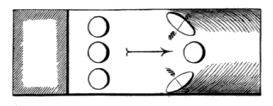
473. This association of pressure and structure is invariable. At the bases of the cascades, where the inclination of the bed of the glacier suddenly changes, the pressure in many cases suffices not only to close the crevasses but to violently squeeze the ice. At such places the structure always appears, sweeping quite across the glacier. When two branch glaciers unite, their mutual thrust intensifies the pre-existing marginal structure of the branches, and developes new planes of lamination. Under the medial moraines, therefore, we have usually a good development of the structure. It is finely displayed, for example, under the great medial moraine of the glacier of the Aar.
474. Upon this glacier, indeed, the blue veins were observed independently three years after M. Guyot had first described them. I say independently, because M. Guyot's description, though written in 1838, remained imprinted, and was unknown in 1841 to the observers on the Aar. These were M. Agassiz and Professor Forbes. To the question of structure Professor Forbes subsequently devoted much attention, and it was mainly his observations and reasonings that gave it the important position now assigned to it in the phenomena of glaciers.
475. Thus without quitting the glaciers themselves, we establish the connexion between pressure and structure. Is there anything in our previous scientific experience with which these facts may be connected? The new knowledge of nature must always strike its roots into the old, and spring from it as an organic growth.
§ 66. Slate Cleavage and Glacier Lamination.
476. M. Guyot threw out an exceedingly sagacious hint, when he compared the veined structure to the cleavage of slate rocks. We must learn something of this cleavage, for it really furnishes the key to the problem which now occupies us. Let us go then to the quarries of Bangor or Cumberland, and observe the quarrymen in their sheds splitting the rocks. With a sharp point struck skilfully into the edge of the slate, they cause it to divide into thin plates, fit for roofing or ciphering, as the case may be. The surfaces along which the rock cleaves are called its planes of cleavage.
477. All through the quarry you notice the direction of these planes to be perfectly constant. How is this laminated structure to be accounted for?
478. You might be disposed to consider that cleavage is a case of stratification or bedding; for it is true that in various parts of England there are rocks which can be cloven into thin flags along the planes of bedding. But when we examine these slate rocks we verify the observation, first I believe made by the eminent and venerable Professor Sedgwick, that the planes of bedding usually run across the planes of cleavage.
479. We have here, as you observe, a case exactly similar to that of glacier lamination, which we were at first disposed to regard as due to stratification. We afterwards, however, found planes of lamination crossing the layers of the névé, exactly as the planes of cleavage cross the beds of slate rocks.
480. But the analogy extends further. Slate cleavage continued to be a puzzle to geologists till the late Mr. Daniel Sharpe made the discovery that shells and other fossils and bodies found in slate rocks are invariably flattened out in the planes of cleavage.
481. Turn into any well-arranged museum—for example, into the School of Mines in Jermyn Street, and observe the evidence there collected. Look particularly to the fossil trilobites taken from the slate rock. They are in some cases squeezed to one third of their primitive thickness. Numerous other specimens show in the most striking manner the flattening out of shells.
482. To the evidence adduced by Mr. Sharpe, Mr. Sorby added other powerful evidence, founded upon the microscopic examination of slate rock. Taking both into account, the conclusion is irresistible that such rocks have suffered enormous pressure at right angles to the planes of cleavage, exactly as the glacier has demonstrably suffered great pressure at right angles to its planes of lamination.
483. The association of pressure and cleavage is thus demonstrated; but the question arises, do they stand to each other in the relation of cause and effect? The only way of replying to this question is to combine artificially the conditions of nature, and see whether we cannot produce her results.
484. The substance of slate rocks was once a plastic mud, in which fossils were embedded. Let us imitate the action of pressure upon such mud by employing, instead of it, softened white wax. Placing a ball of the wax between two glass plates, wetted to prevent it from sticking, we apply pressure and flatten out the wax.
485. The flattened mass is at first too soft to cleave sharply; but you can see, by tearing, that it is laminated. Let us chill it with ice. We find afterwards that no slate rock ever exhibited so fine a cleavage. The laminæ, it need hardly be said, are perpendicular to the pressure.
486. One cause of this lamination is that the wax is an aggregate of granules the surfaces of which are places of weak cohesion; and that by the pressure these granules are squeezed flat, thus producing planes of weakness at right angles to the pressure.
487. But the main cause of the cleavage I take to be the lateral sliding of the particles of wax over each other. Old attachments are thereby severed, which the new ones fail to make good. Thus the tangential sliding produces lamination, as the rails near a station are caused to exfoliate by the gliding of the wheel.
488. Instead of wax we may take the slate itself, grind it to fine powder, add water, and thus reproduce the pristine mud. By the proper compression of such mud, in one direction, the cleavage is restored.
489. Call now to mind the evidences we have had of the power of thawing ice to yield to pressure. Recollect the shortening of the Glacier du Géant, and the squeezing of the Glacier de Léchaud, at Trélaporte. Such a substance, slowly acted upon by pressure, will yield laterally. Its particles will slide over each other, the severed attachments being immediately made good by regelation. It will not yield uniformly, but along special planes. It will also liquefy, not uniformly, but along special surfaces. Both the sliding and the liquefaction will take place principally at right angles to the pressure, and glacier lamination is the result.
490. As long as it is sound the laminated glacier ice resists cleavage. Regelation, as I have said, makes the severed attachments good. But when such ice is exposed to the weather the structure is revealed, and the ice can then be cloven into tablets a square foot, or even a square yard in area.
§ 67. Conclusion.
491. Here, my friend, our labours close. It has been a true pleasure to me to have you at my side so long. In the sweat of our brows we have often reached the heights where our work lay, but you have been steadfast and industrious throughout, using in all possible cases your own muscles instead of relying upon mine. Here and there I have stretched an arm and helped you to a ledge, but the work of climbing has been almost exclusively your own. It is thus that I should like to teach you all things; showing you the way to profitable exertion, but leaving the exertion to you more anxious to bring out your manliness in the presence of difficulty than to make your way smooth by toning difficulties down.
492. Steadfast, prudent, without terror, though not at all times without awe, I have found you on rock and ice, and you have shown the still rarer quality of steadfastness in intellectual effort. As here set forth, our task seems plain enough, but you and I know how often we have had to wrangle resolutely with the facts to bring out their meaning. The work, however, is now done, and you are master of a fragment of that sure and certain knowledge which is founded on the faithful study of nature. Is it not worth the price paid for it? Or rather, was not the paying of the price the healthful, if sometimes hard, exercise of mind and body, upon alp and glacier—a portion of our delight?
493. Here then we part. And should we not meet again, the memory of these days will still unite us. Give me your hand. Good bye.