THE FORMS OF WATER (continued 2)
Reading edition
Third Line: C C' upon the Sketch.
East West
Stake 1 2 3 4 5 6 7 8 9 10 11
Inches 20 23 29 30 34 28 25 25 25 18 9
172. Both the first stake and the eleventh in this series stood near the sides of the glacier. On the eastern side the motion is 20 inches, while on the western side it is only 9. It rises on the eastern side from 20 to 34 inches at the 5th stake, which we, standing upon the glacier, can see to be much nearer to the eastern than to the western side. The united evidence of these three lines places the fact beyond doubt, that opposite the Montanvert, and for some distance above it and below it, the whole eastern side of the glacier is moving more quickly than the western side.
§ 24. Suggestion of a new Likeness of Glacier Motion to River Motion. Conjecture tested.
173. Here we have cause for reflection, and facts are comparatively worthless if they do not provoke this exercise of the mind. It is because facts of nature are not isolated but connected, that science, to follow them, must also form a connected whole. The mind of the natural philosopher must, as it were, be a web of thought corresponding in all its fibres with the web of fact in nature.
174. Let us, then, ascend to a point which commands a good view of this portion of the Mer de Glace. The ice-river we see is not straight but curved, and its curvature is from the Montanvert; that is to say, its convex side is east, and its concave side is west (look to the sketch). You have already pondered the fact that a glacier, in some respects, moves like a river. How would a river move through a curved channel? This is known. Were the ice of the Mer de Glace displaced by water, the point of swiftest motion at the Montanvert would not be the centre, but a point east of the centre. Can it be then that this "water-rock," as ice is sometimes called, acts in this respect also like water?
175. This is a thought suggested on the spot; it may or it may not be true, but the means of testing it are at hand. Looking up the glacier, we see that at les Ponts it also bends, but that there its convex curvature is towards the western side of the valley (look again to the sketch). If our surmise be true, the point of swiftest motion opposite les Ponts ought to lie west of the axis of the glacier.
176. Let us test this conjecture. On July 25 we fix in a line across this portion of the glacier seventeen stakes; every one of them has remained firm, and on the 26th we find the motion for 24 hours to be as follows:—
Fourth Line: D D' upon the Sketch.
East West
Stake 1 2 3 4 5 8 7 8 9 10 11 12 13 14 15
Inches 7 8 13 15 16 19 20 21 21 23 23 21 22 17 15
177. Inspected by the naked eye alone, the stakes 10 and 11, where the glacier reaches its greatest motion, are seen to be considerably to the west of the axis of the glacier. Thus far we have a perfect verification of the guess which prompted us to make these measurements. You will here observe that the "guesses" of science are not the work of chance, but of thoughtful pondering over antecedent facts. The guess is the "induction" facts, to be ratified or exploded by the test of subsequent experiment.
178. And though even now we have exceedingly strong reason for holding that the point of maximum velocity obeys the law of liquid motion, the strength of our conclusion will be doubled if we can show that the point shifts back to the eastern side of the axis at another place of flexure. Fortunately such a place exists opposite Trélaporte. Here the convex curvature of the valley turns again to the east. Across this portion of the glacier a line was set out on July 28, and from measurements on the 31st, the rate of motion per 24 hours was determined.
Fifth Line: E E' upon the Sketch.
West East
Stake 1 2 3 4 5 6 7 8 9 10 11 12 13 14 15
Inches 11 14 13 15 15 16 17 19 20 19 20 18 16 15 10
179. Here, again, the mere estimate of distances by the eye would show us that the three stakes which moved fastest, viz. the 9th, 10th, and 11th, were all to the east of the middle line of the glacier. The demonstration that the point of swiftest motion wanders to and fro across the axis, as the flexure of the valley changes, is, therefore,—shall I say complete?
180. Not yet. For if surer means are open to us we must not rest content with estimates by the eye. We have with us a surveying chain: let us shake it out and measure these lines, noting the distance of every stake from the side of the glacier. This is no easy work among the crevasses, but I confide it confidently to Mr. Hirst and you. We can afterwards compare a number of stakes on the eastern side with the same number of stakes taken at the same distances from the western side. For example, a pair of stakes, one ten yards from the eastern side and the other ten yards from the western side; another pair, one fifty yards from the eastern side and the other fifty yards from the western side, and so on, can be compared together. For the sake of easy reference, let us call the points thus compared in pairs, equivalent points.
181. There were five pairs of such points upon our fourth line, D D', and here are their velocities:
Eastern points; motion in inches 13 15 16 18 20
Western " " " " 15 17 22 23 23
In every case here the stake at the western side moved more rapidly than the equivalent stake at the eastern side.
182. Applying the same analysis to our fifth line, E E', we have the following series of velocities of three pairs of equivalent points:—
Eastern points; motion in inches 15 18 19
Western " " " " 13 15 17
183. Here the three points on the eastern side move more rapidly than the equivalent points on the western side.
184. It is thus proved:—
1. That opposite the Montanvert the eastern half of the Mer de Glace moves more rapidly than the western half.
2. That opposite les Fonts the western half of the glacier moves more rapidly than the eastern half.
3. That opposite Trélaporte the eastern half of the glacier again moves more rapidly than the western half.
4. That these changes in the place of greatest motion are determined by the flexures of the valley through which the Mer de Glace moves.
§ 25. New Law of Glacier Motion.
185. Let us express these facts in another way. Supposing the points of swiftest motion for a very great number of lines crossing the Mer de Glace to be determined; the line joining all those points together is what mathematicians would call the locus of the point of swiftest motion.
186. At Trélaporte this line would lie east of the centre; at the Ponts it would lie west of the centre; hence in passing from Trélaporte to the Ponts it would cross the centre. But at the Montanvert it would again lie east of the centre; hence between the Ponts and the Montanvert the centre must be crossed a second time. If there were further sinuosities upon the Mer de Glace there would be further crossings of the axis of the glacier.
187. The points on the axis which mark the transition from eastern to western bending, and the reverse, may be called points of contrary flexure.
188. Now what is true of the Mer de Glace is true of all other glaciers moving through sinuous valleys; so that the facts established in the Mer de Glace may be expanded into the following general law of glacier motion:—
When a glacier moves through a sinuous valley, the locus of the points of maximum motion does not coincide with the centre of the glacier, but, on the contrary, always lies on the convex side of the central line. The locus is therefore a curved line more deeply sinuous than the valley itself, and crosses the axis of the glacier at each point of contrary flexure.
189. The dotted line on the Outline Plan (page 68) represents the locus of the point of maximum motion, the firm line marking the centre of the glacier.
190. Substituting the word river for glacier, this law is also true. The motion of the water is ruled by precisely the same conditions as the motion of the ice.
191. Let us now apply our law to the explanation of a difficulty. Turning to the careful measurements executed by M. Agassiz on the glacier of the Unteraar, we notice in the discussion of these measurements a section of the "Système glaciaire" devoted to the "Migrations of the Centre." It is here shown that the middle of the Unteraar glacier is not always the point of swiftest motion. This fact has hitherto remained without explanation; but a glance at the Unteraar valley, or at the map of the valley, shows the enigma to be an illustration of the law which we have just established on the Mer de Glace.
§ 26. Motion of Axis of Mer de Glace.
192. We have now measured the rate of motion of five different lines across the trunk of the Mer de Glace. Do they all move alike? No. Like a river, a glacier at different places moves at different rates. Comparing together the points of maximum motion of all five lines, we have this result:
MOTION OF MER DE GLACE.
At Trélaporte 20 inches a day.
At les Ponts 23 " "
Above the Montanvert 26 " "
At the Montanvert 34 " "
Below the Montanvert 33[C] " "
193. There is thus an increase of rapidity as we descend the glacier from Trélaporte to the Montanvert; the maximum, motion at the Montanvert being fourteen inches a day greater than at Trélaporte.
§ 27. Motion of Tributary Glaciers.
194. So much for the trunk glacier; let us now investigate the branches, permitting, as we have hitherto done, reflection on known facts to precede our attempts to discover unknown ones.
195. As we stood upon our "cleft station," whence we had so capital a view of the Mer de Glace, we were struck by the fact that some of the tributaries of the glacier were wider than the glacier itself. Supposing water to be substituted for the ice, how do you suppose it would behave? You would doubtless conclude that the motion down the broad and slightly-inclined valleys of the Géant and the Léchaud would be comparatively slow, but that the water would force itself with increased rapidity through the "narrows" of Trélaporte. Let us test this notion as applied to the ice.
196. Planting our theodolite in the shadow of Mont Tacul, and choosing a suitable point at the opposite side of the Glacier du Géant, we fix on July 29 a series of ten stakes across the glacier. The motion of this line in twenty-four hours was as follows:—
MOTION OF GLACIER DU GÉANT.
Sixth Line: H H' upon Sketch.
Stake 1 2 3 4 5 6 7 8 9 10
Inches 11 10 12 13 12 13 11 10 9 5
197. Our conjecture is fully verified. The maximum motion here is seven inches a day less than that of the Mer de Glace at Trélaporte (192).
198. And now for the Léchaud branch. On August 1 we fix ten stakes across this glacier above the point where it is joined by the Talèfre. Measured on August 3, and reduced to twenty-four hours, the motion was found to be—
MOTION OF GLACIER DE LÉCHAUD.
Seventh Line: K K' upon Sketch.
Stake 1 2 3 4 5 6 7 8 9 10
Inches 5 8 10 9 9 8 6 9 7 6
199. Here our conjecture is still further verified, the rate of motion being even less than that of the Glacier du Géant.
§ 28. Motion of Top and Bottom of Glacier.
200. We have here the most ample and varied evidence that the sides of a glacier, like those of a river, are retarded by friction against its boundaries. But the likeness does not end here. The motion of a river is retarded by the friction against its bed. Two observers, viz. Prof. Forbes and M. Charles Martins, concur in showing the same to be the case with a glacier. The observations of both have been objected to; hence it is all the more incumbent on us to seek for decisive evidence.
201. At the Tacul (near the point a upon the sketch plan, p. 83) a wall of ice about 150 feet high has already attracted our attention. Bending round to join the Léchaud the Glacier du Géant is here drawn away from the mountain side, and exposes a fine section. We try to measure it top, bottom, and middle, and are defeated twice over. We try it a third time and succeed. A stake is fixed at the summit of the ice-precipice, another at 4 feet from the bottom, and a third at 35 feet above the bottom. These lower stakes are fixed at some risk of boulders falling upon us from above; but by skill and caution we succeed in measuring the motions of all three. For 24 hours the motions are:—
Top stake 6 inches.
Middle stake 4 ½ "
Bottom stake 2 ⅔ "
202. The retarding influence of the bed of the glacier is reduced to demonstration by these measurements. The bottom does not move with half the velocity of the surface.
§ 29. Lateral Compression of a Glacier.
203. Furnished with the knowledge which these labours and measurements have given us, let us once more climb to our station beside the Cleft under the Aiguille de Charmoz. At our first visit we saw the medial moraines of the glacier, but we knew nothing about their cause. We now know that they mark upon the trunk its tributary glaciers. Cast your eye, then, first upon the Glacier du Géant; realise its width in its own valley, and see how much it is narrowed at Trélaporte. The broad ice-stream of the Léchaud is still more surprising, being squeezed upon the Mer de Glace to a narrow white band between its bounding moraines. The Talèfre undergoes similar compression. Let us now descend, shake out our chain, measure, and express in numbers the width of the tributaries, and the actual amount of compression suffered at Trélaporte.
204. We find the width of the Glacier du Géant to be 5,155 links, or 1,134 yards.
205. The width of the Glacier de Léchaud we find to be 3,725 links, or 825 yards.
206. The width of the Talèfre we find to be 2,900 links, or 638 yards.
207. The sum of the widths of the three branch glaciers is therefore 2,597 yards.
208. At Trélaporte these three branches are forced through a gorge 893 yards wide, or one-third of their previous width, at the rate of twenty inches a day.
209. If we limit our view to the Glacier de Léchaud, the facts are still more astonishing. Previous to its junction with the Talèfre, this glacier has a width of 825 yards; in passing through the jaws of the granite vice at Trélaporte, its width is reduced to eighty-eight yards, or in round numbers to one-tenth of its previous width. (Look to the sketch on the next page.)
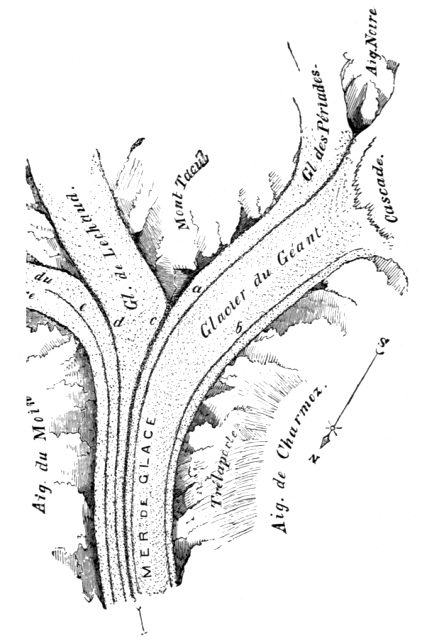
SKETCH-PLAN SHOWING THE MORAINES, a, b, c, d, e, OF THE MER DE GLACE.
210. Are we to understand by this that the ice of the Léchaud is squeezed to one-tenth of its former volume? By no means. It is mainly a change of form, not of volume, that occurs at Trélaporte. Previous to its compression, the glacier resembles a plate of ice lying flat upon its bed. After its compression, it resembles a plate fixed upon its edge. The squeezing, doubtless, has deepened the ice.
§ 30. Longitudinal Compression of a Glacier.
211. The ice is forced through the gorge at Trélaporte by a pressure from behind; in fact the Glacier du Géant, immediately above Trélaporte, represents a piston or a plug which drives the ice through the gorge. What effect must this pressure have upon the plug itself? Reasoning alone renders it probable that the pressure will shorten the plug; that the lower part of the Glacier du Géant will to some extent yield to the pressure from behind.
212. Let us test this notion. About three-quarters of a mile above the Tacul, and on the mountain slope to the left as we ascend, we observe a patch of verdure. Thither we climb; there we plant our theodolite, and set out across the Glacier du Géant, a line, which we will call line No. 1 (F F' upon sketch, p. 68).
213. About a quarter of a mile lower down we find a practicable couloir on the mountain side; we ascend it, reach a suitable platform, plant our instrument, and set out a second line, No. 2 (G G' upon sketch). We must hasten our work here, for along this couloir stones are discharged from a small glacier which rests upon the slope of Mont Tacul.
214. Still lower down by another quarter of a mile, which brings us near the Tacul, we set out a third line, No. 3 (H H' upon sketch), across the glacier.
215. The daily motion of the centres of these three lines is as follows:—
Inches Distances asunder
No. 1 No. 2 No. 3 50·55 15·43 12·75 } } 545 yards. 487 "
216. The first line here moves five inches a day more than the second; and the second nearly three inches a day more than the third. The reasoning is therefore confirmed. The ice-plug, which is in round numbers one thousand yards long, is shortened by the pressure exerted on its front at the rate of about eight inches a day.
217. A river descending the Valley du Géant would behave in substantially the same fashion. It would have its motion on approaching Trélaporte diminished, and it would pour through the defile with a velocity greater than that of the water behind.
§ 31. Sliding and Flowing. Hard Ice and Soft Ice.
218. We have thus far confined ourselves to the measurement and discussion of glacier motion; but in our excursions we have noticed many things besides. Here and there, where the ice has retreated from the mountain side, we have seen the rocks fluted, scored, and polished; thus proving that the ice had slidden over them and ground them down. At the source of the Arveiron we noticed the water rushing from beneath the glacier charged with fine matter. All glacier rivers are similarly charged. The Rhone carries its load of matter into the Lake of Geneva; the rush of the river is here arrested, the matter subsides, and the Rhone quits the lake clear and blue. The Lake of Geneva, and many other Swiss lakes, are in part filled up with this matter, and will, in all probability, finally be obliterated by it.
219. One portion of the motion of a glacier is due to this bodily sliding of the mass over its bed.
220. We have seen in our journeys over the glacier streams formed by the melting of the ice, and escaping through cracks and crevasses to the bed of the glacier. The fine matter ground down is thus washed away; the bed is kept lubricated, and the sliding of the ice rendered more easy than it would otherwise be.
221. As a skater also you know how much ice is weakened by a thaw. Before it actually melts it becomes rotten and unsafe. Test such ice with your penknife: you can dig the blade readily into it, or cut the ice with ease. Try good sound ice in the same way: you find it much more resistant. The one, indeed, resembles soft chalk; the other hard stone.
222. Now the Mer de Glace in summer is in this thawing condition. Its ice is rendered soft and yielding by the sun; its motion is thereby facilitated. We have seen that not only does the glacier slide over its bed, but that the upper layers slide over the under ones, and that the centre slides past the sides. The softer and more yielding the ice is, the more free will be this motion, and the more readily also will it be forced through a defile like Trélaporte.
223. But in winter the thaw ceases; the quantity of water reaching the bed of the glacier is diminished or entirely cut off. The ice also, to a certain depth at least, is frozen hard. These considerations would justify the opinion that in winter the glacier, if it moves at all, must move more slowly than in summer. At all events, the summer measurements give no clue to the winter motion.
224. This point merits examination. I will not, however, ask you to visit the Alps in mid-winter; but, if you allow me, I will be your deputy to the mountains, and report to you faithfully the aspect of the region and the behaviour of the ice.
§ 32. Winter on the Mer de Glace.
225. The winter chosen is an inclement one. There is snow in London, snow in Paris, snow in Geneva; snow near Chamouni so deep that the road fences are entirely effaced. On Christmas night—nearly at mid-night—1859, your deputy reaches Chamouni.
226. The snow fell heavily on December 26; but on the 27th, during a lull in the storm, we turn out. There are with me four good guides and a porter. They tie planks to their feet to prevent them from sinking in the snow; I neglect this precaution and sink often to the waist. Four or five times during our ascent the slope cracks with an explosive sound, and the snow threatens to come down in avalanches.[D]
The freshly-fallen snow was in that particular condition which causes its granules to adhere, and hence every flake falling on the trees had been retained there. The laden pines presented beautiful and often fantastic forms.
227. After five hours and a half of arduous work the Montanvert was attained. We unlocked the forsaken auberge, round which the snow was reared in buttresses. I have already spoken of the complex play of crystallising forces. The frost figures on the window-panes of the auberge were wonderful: mimic shrubs and ferns wrought by the building power while hampered by the adhesion between the glass and the film in which it worked. The appearance of the glacier was very impressive; all sounds were stilled. The cascades which in summer fill the air with their music were silent, hanging from the ledges of the rocks in fluted columns of ice. The surface of the glacier was obviously higher than it had been in summer; suggesting the thought that while the winter cold maintained the lower end of the glacier jammed between its boundaries, the upper portions still moved downwards and thickened the ice. The peak of the Aiguille du Dru shook out a cloud-banner, the origin and nature of which have been already explained (84). (See Frontispiece.)
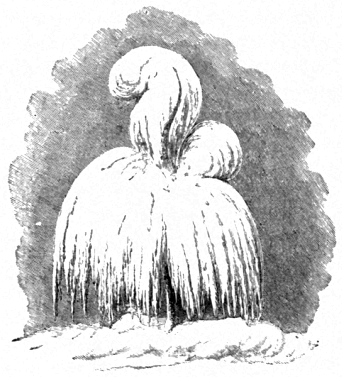
SNOW-LADEN PINE-TREE.
228. On the morning of the 28th this banner was strikingly large and grand, and reddened by the light of the rising sun, it glowed like a flame. Roses of cloud also clustered round the crests of the Grande Jorasse and hung upon the pinnacles of Charmoz. Four men, well roped together, descended to the glacier. I had trained one of them in 1857, and he was now to fix the stakes. The storm had so distributed the snow as to leave alternate lengths of the glacier bare and thickly covered. Where much snow lay great caution was required, for hidden crevasses were underneath. The men sounded with their staffs at every step. Once while looking at the party through my telescope the leader suddenly disappeared; the roof of a crevasse had given way beneath him; but the other three men promptly gathered round and lifted him out of the fissure. The true line was soon picked up by the theodolite; one by one the stakes were fixed until a series of eleven of them stood across the glacier.
229. To get higher up the valley was impracticable; the snow was too deep, and the aspect of the weather too threatening; so the theodolite was planted amid the pines a Little way below the Montanvert, whence through a vista I could see across the glacier. The men were wrapped at intervals by whirling snow-wreaths which quite hid them, and we had to take advantage of the lulls in the wind. Fitfully it came up the valley, darkening the air, catching the snow upon the glacier, and tossing it throughout its entire length into high and violently agitated clouds, separated from each other by cloudless spaces corresponding to the naked portions of the ice. In the midst of this turmoil the men continued to work. Bravely and steadfastly stake after stake was set, until at length a series of ten of them was fixed across the glacier.
230. Many of the stakes were fixed in the snow. They were four feet in length, and were driven in to a depth of about three feet. But that night, while listening to the wild onset of the storm, I thought it possible that the stakes and the snow which held them might be carried bodily away before the morning. The wind, however, lulled. We rose with the dawn, but the air was thick with descending snow. It was all composed of those exquisite six-petaled flowers, or six-rayed stars, which have been already figured and described (§ 9). The weather brightening, the theodolite was planted at the end of the first line. The men descended, and, trained by their previous experience, rapidly executed the measurements. The first line was completed before 11 A. M. Again the snow began to fall, filling all the air. Spangles innumerable were showered upon the heights. Contrary to expectation, the men could be seen and directed through the shower.
231. To reach the position occupied by the theodolite at the end of our second line, I had to wade breast-deep through snow which seemed as dry and soft as flour. The toil of the men upon the glacier in breaking through the snow was prodigious. But they did not flinch, and after a time the leader stood behind the farthest stake, and cried, Nous avons fini. I was surprised to hear him so distinctly, for falling snow had been thought very deadening to sound. The work was finished, and I struck my theodolite with a feeling of a general who had won a small battle.
232. We put the house in order, packed up, and shot by glissade down the steep slopes of La Filia to the vault of the Arveiron. We found the river feeble, but not dried up. Many weeks must have elapsed since any water had been sent down from the surface of the glacier. But at the setting in of winter the fissures were in a great measure charged with water; and the Arveiron of to-day was probably due to the gradual drainage of the glacier. There was now no danger of entering the vault, for the ice seemed as firm as marble. In the cavern we were bathed by blue light. The strange beauty of the place suggested magic, and put me in mind of stories about fairy caves which I had read when a boy. At the source of the Arveiron our winter visit to the Mer de Glace ends; next morning your deputy was on his way to London.
§ 33. Winter Motion of the Mer de Glace.
233. Here are the measurements executed in the winter of 1859:—
Line No. I.
Stake 1 2 3 4 5 6 7 8 9 10 11
Inches 7 11 14 13 14 14 16 16 12 12 7
Line No. II.
Stake 1 2 3 4 5 6 7 8 9 10
Inches 8 10 14 16 16 16 18 17 15 14
234. Thus the winter motion of the Mer de Glace near the Montanvert is, in round numbers, half the summer motion.
235. As in summer, the eastern side of the glacier at this place moved quicker than the western.
§ 34. Motion of the Grindelwald and Aletsch Glaciers.
236. As regards the question of motion, to no other glacier have we devoted ourselves with such thoroughness as to the Mer de Glace; we are, however, able to add a few measurements of other celebrated glaciers. Rear the village of Grindelwald in the Bernese Oberland, there are two great ice-streams called respectively the Upper and the Lower Grindelwald glaciers, the second of which is frequently visited by travellers in the Alps. Across it on August 6, 1860, a series of twelve stakes was fixed by Mr. Vaughan Hawkins and myself. Measured on the 8th and reduced to its daily rate, the motion of these stakes was as follows:—
MOTION OF LOWER GRINDELWALD GLACIER.
Stake 1 2 3 4 5 6 7 8 9 10 11 12
Inches 18 19 20 21 21 21 22 20 19 18 17 14
237. The theodolite was here planted a little below the footway leading to the higher glacier region, and at about a mile above the end of the glacier. The measurement was rendered difficult by crevasses.
238. The largest glacier in Switzerland is the Great Aletsch, to which further reference shall subsequently be made. Across it on August 14, 1860, a series of thirty-four stakes was planted by Mr. Hawkins and me. Measured on the 16th and reduced to their daily rate, the velocities were found to be as follows:—
MOTION OF GREAT ALETSCH GLACIER.
East
Stake 1 2 3 4 5 6 7 8 9 10 11 12
Inches 2 3 4 6 8 11 13 14 16 17 17 19
Stake 13 14 15 16 17 18 19 20 21 22 23
Inches 19 18 18 17 19 19 19 19 17 17 15
Stake 24 25 26 27 28 29 30 31 32 33 34
Inches 16 17 17 17 17 17 17 17 16 12 12
West
239. The maximum motion here is nineteen inches a day. Probably the eastern side of the glacier is shallow, the retardation of the bed making the motion of the eastern stakes inconsiderable. The width of the glacier here is 9,030 links, or about a mile and a furlong. The theodolite was planted high among the rocks on the western flank of the mountain, about half a mile above the Märgelin See.
§ 35. Motion of Morteratsch Glacier.
240. Far to the east of the Oberland and in that interesting part of Switzerland known as the Ober Engadin, stands a noble group of mountains, less in height than those of the Oberland, but still of commanding elevation. The group derives its name from its most dominant peak, the Piz Bernina. To reach the place we travel by railway from Basel to Zürich, and from Zürich to Chur (French Coire), whence we pass by diligence over either the Albula pass or the Julier pass to the village of Pontresina. Here we are in the immediate neighbourhood of the Bernina mountains.
241. From Pontresina we may walk or drive along a good coach road over the Bernina pass into Italy. At about an hour above the village you would look from the road into the heart of the mountains, the line of vision passing through a valley, in which is couched a glacier of considerable size. Along its back you would trace a medial moraine, and you could hardly fail to notice how the moraine, from a mere narrow streak at first, widens gradually as it descends, until finally it quite covers the lower end of the glacier. Nor is this an effect of perspective; for were you to stand upon the mountain slopes which nourish the glacier, you would see thence also the widening of the streak of rubbish, though the perspective here would tend to narrow the moraine as it retreats downwards.
242. The ice-stream here referred to is the Morteratsch glacier, the end of which is a short hour's walk from the village of Pontresina. We have now to determine its rate of motion and to account for the widening of its medial moraine.
243. In the summer of 1864 Mr. Hirst and myself set out three lines of stakes across the glacier. The first line crossed the ice high up; the second a good distance lower down, and the third lower still. Even the third line, however, was at a considerable distance above the actual snout of the glacier. The daily motion of these three lines was as follows:—
First Line.
Stake 1 2 3 4 5 6 7 8 9 10 11
Inches 8 12 13 13 14 13 12 12 10 7 5
Second Line.
Stake 1 2 3 4 5 6 7 8 9 10 11
Inches 1 4 6 8 10 11 11 11 11 11 11
Third Line.
Stake 1 2 3 4 5 6 7 8 9 10 11
Inches 1 2 4 5 6 6 7 7 5 5 4
244. Compare these lines together. You notice the velocity of the first is greater than that of the second, and the velocity of the second greater than that of the third.
245. The lines were permitted to move down wards for 100 hours, at the end of which time the spaces passed over by the points of swiftest motion of the three lines were as follows:
Maximum Motion in 100 Hours.
First line 56 inches.
Second line 45 "
Third line 30 "
246. Here then is a demonstration that the upper portions of the Morteratsch glacier are advancing on the lower ones. In 1871 the motion of a point on the middle of the glacier near its snout was found to be less than two inches a day!
247. What, then, is the consequence of this swifter march of the upper glacier? Obviously to squeeze this medial moraine longitudinally, and to cause it to spread out laterally. We have here distinctly revealed the cause of the widening of the medial moraine.
248. It has been a question much discussed, whether a glacier is competent to scoop out or deepen a valley through which it moves, and this very Morteratsch glacier has been cited to prove that such is not the case. Observers went to the snout of the glacier, and finding it sensibly quiescent, they concluded that no scooping occurred. But those who contended for the power of glaciers to excavate valleys never stated, or meant to state, that it was the snout of the glacier which did the work. In the Morteratsch glacier the work of excavation, which certainly goes on to a greater or less extent, must be far more effectual high up the valley than at the end of the glacier.
§ 36. Birth of a Crevasse: Reflections.
249. Preserving the notion that we are working together, we will now enter upon a new field of enquiry. We have wrapped up our chain, and are turning homewards after a hard day's work upon the Glacier du Géant, when under our feet, as if coming from the body of the glacier, an explosion is heard. Somewhat startled, we look enquiringly over the ice. The sound is repeated, several shots being fired in quick succession. They seem sometimes to our right, sometimes to our left, giving the impression that the glacier is breaking all round us. Still nothing is to be seen.
250. We closely scan the ice, and after an hour's strict search we discover the cause of the reports. They announce the birth of a crevasse. Through a pool upon the glacier we notice air bubbles ascending, and find the bottom of the pool crossed by a narrow crack, from which the bubbles issue. Eight and left from this pool we trace the young fissure through long distances. It is sometimes almost too feeble to be seen, and at no place is it wide enough to admit a knife-blade.
251. It is difficult to believe that the formidable fissures among which you and I have so often trodden with awe, could commence in this small way. Such, however, is the case. The great and gaping chasms on and above the ice-falls of the Géant and the Talèfre begin as narrow cracks, which open gradually to crevasses. We are thus taught in an instructive and impressive way that appearances suggestive of very violent action may really be produced by processes so slow as to require refined observations to detect them. In the production of natural phenomena two things always come into play, the intensity of the acting force, and the time during which it acts. Make the intensity great, and the time small, and you have sudden convulsion; but precisely the same apparent effect may be produced by making the intensity small, and the time great. This truth is strikingly illustrated by the Alpine ice-falls and crevasses; and many geological phenomena, which at first sight suggest violent convulsion, may be really produced in the selfsame almost imperceptible way.
§ 37. Icicles.
252. The crevasses are grandest on the higher névés, where they sometimes appear as long yawning fissures, and sometimes as chasms of irregular outline. A delicate blue light shimmers from them, but this is gradually lost in the darkness of their profounder portions. Over the edges of the chasms, and mostly over the southern edges, hangs a coping of snow, and from this depend like stalactites rows of transparent icicles, 10, 20, 30 feet long. These pendent spears constitute one of the most beautiful features of the higher crevasses.
253. How are they produced? Evidently by the thawing of the snow. But why, when once thawed, should the water freeze again to solid spears? You have seen icicles pendent from a house-eave, which have been manifestly produced by the thawing of the snow upon the roof. If we understand these, we shall also understand the vaster stalactites of the Alpine crevasses.
254. Gathering up such knowledge as we possess, and reflecting upon it patiently, let us found upon it, if we can, a theory of icicles.
255. First, then, you are to know that the air of our atmosphere is hardly heated at all by the rays of the sun, whether visible or invisible. The air is highly transparent to all kinds of rays, and it is only the scanty fraction to which it is not transparent that expend their force in warming it.
256. Not so, however, with the snow on which the sunbeams fall. It absorbs the solar heat, and on a sunny day you may see the summits of the high Alps glistening with the water of liquefaction. The air above and around the mountains may at the same time be many degrees below the freezing point in temperature.
257. You have only to pass from sunshine into shade to prove this. A single step suffices to carry you from a place where the thermometer stands high to one where it stands low; the change being due, not to any difference in the temperature of the air, but simply to the withdrawal of the thermometer from the direct action of the solar rays. Nay, without shifting the thermometer at all, by interposing a suitable screen, which cuts off the sun's rays, the coldness of the air may be demonstrated.
258. Look now to the snow upon your house roof. The sun plays upon it, and melts it; the water trickles to the eave and then drops down. If the eave face the sun the water remains water; but if the eave do not face the sun, the drop, before it quits its parent snow, is already in shadow. Now the shaded space, as we have learnt, may be below the freezing temperature. If so the drop, instead of falling, congeals, and the rudiment of an icicle is formed. Other drops and driblets succeed, which trickle over the rudiment, congeal upon it in part and thicken it at the root. But a portion of the water reaches the free end of the icicle, hangs from it, and is there congealed before it escapes. The icicle is thus lengthened. In the Alps, where the liquefaction is copious and the cold of the shaded crevasse intense, the icicles, though produced in the same way, naturally grow to a greater size. The drainage of the snow after the sun's power is withdrawn also produces icicles.
259. It is interesting and important that you should be able to explain the formation of an icicle; but it is far more important that you should realise the way in which the various threads of what we call Nature are woven together. You cannot fully understand an icicle without first knowing that solar beams powerful enough to fuse the snows and blister the human skin, nay, it might be added, powerful enough, when concentrated, to burn up the human body itself, may pass through the air, and still leave it at an icy temperature.
§ 38. The Bergschrund.
260. Having cleared away this difficulty, let us turn once more to the crevasses, taking them in the order of their formation. First then above the névé we have the final Alpine peaks and crests, against which the snow is often reared as a steep buttress. We have already learned that both névés and glaciers are moving slowly downwards; but it usually happens that the attachment of the highest portion of the buttress to the rocks is great enough to enable it to hold on while the lower portion breaks away. A very characteristic crevasse is thus formed, called in the German-speaking portion of the Alps a Bergschrund. It often surrounds a peak like a fosse, as if to defend it against the assaults of climbers.
261. Look more closely into its formation. Imagine the snow as yet unbroken. Its higher portions cling to the rocks, and move downwards with extreme slowness. But its lower portions, whether from their greater depth and weight, or their less perfect attachment, are compelled to move more quickly. A pull is therefore exerted, tending to separate the lower from the upper snow. For a time this pull is resisted by the cohesion of the névé; but this at length gives way, and a crack is formed exactly across the line in which the pull is exerted. In other words, a crevasse is formed at right angles to the line of tension.
§ 39. Transverse Crevasses.
262. Both on the névé and on the glacier the origin of the crevasses is the same. Through some cause or other the ice is thrown into a state of strain, and as it cannot stretch it breaks across the line of tension. Take for example, the ice-fall of the Géant, or of the Talèfre, above which you know the crevasses yawn terribly. Imagine the névé and the glacier entirely peeled away, so as to expose the surface over which they move. From the Col du Géant we should see this surface falling gently to the place now occupied by the brow of the cascade. Here the surface would fall steeply down to the bed of the present Glacier du Géant, where the slope would become gentle once more.
263. Think of the névé moving over such a surface. It descends from the Col till it reaches the brow just referred to. It crosses the brow, and must bend down to keep upon its bed. Realise clearly what must occur. The surface of the névé is evidently thrown into a state of strain; it breaks and forms a crevasse. Each fresh portion of the névé as it passes the brow is similarly broken, and thus a succession of crevasses is sent down the fall. Between every two chasms is a great transverse ridge. Through local strains upon the fall those ridges are also frequently broken across, towers of ice—séracs—being the result. Down the fall both ridges and séracs are borne, the dislocation being augmented during the descent.
264. What must occur at the foot of the fall? Here the slope suddenly lessens in steepness. It is plain that the crevasses must not only cease to open here, but that they must in whole or in part close up. At the summit of the fall, the bending was such as to make the surface convex; at the bottom of the fall the bending renders the surface concave. In the one case we have strain, in the other pressure. In the one case, therefore, we have the opening, and in the other the closing of crevasses. This reasoning corresponds exactly with the facts of observation.
265. Lay bare your arm and stretch it straight. Make two ink dots half an inch or an inch apart, exactly opposite the elbow. Bend your arm, the dots approach each other, and are finally brought together. Let the two dots represent the two sides of a crevasse at the bottom of an ice-fall; the bending of the arm resembles the bending of the ice, and the closing up of the dots resembles the closing of the fissures.
266. The same remarks apply to various portions of the Mer de Glace. At certain places the inclination changes from a gentler to a steeper slope, and on crossing the brow between both the glacier breaks its back. Transverse crevasses are thus formed. There is such a change of inclination opposite to the Angle, and a still greater but similar change at the head of the Glacier des Bois. The consequence is that the Mer de Glace at the former point is impassable, and at the latter the rending and dislocation are such as we have seen and described. Below the Angle, and at the bottom of the Glacier des Bois, the steepness relaxes, the crevasses heal up, and the glacier becomes once more continuous and compact.
§ 40. Marginal Crevasses.
267. Supposing, then, that we had no changes of inclination, should we have no crevasses? We should certainly have less of them, but they would not wholly disappear. For other circumstances exist to throw the ice into a state of strain, and to determine its fracture. The principal of these is the more rapid movement of the centre of the glacier.
268. Helped by the labours of an eminent man, now dead, the late Mr. Wm. Hopkins, of Cambridge, let us master the explanation of this point together. But the pleasure of mastering it would be enhanced if we could see beforehand the perplexing and delusive appearances accounted for by the explanation. Could my wishes be followed out, I would at this point of our researches carry you off with me to Basel, thence to Thun, thence to Interlaken, thence to Grindelwald, where you would find yourself in the actual presence of the Wetterhorn and the Eiger, with all the greatest peaks of the Bernese Oberland, the Finsteraarhorn, the Schreckhorn, the Monch, the Jungfrau, at hand. At Grindelwald, as we have already learnt, there are two well-known glaciers—the Ober Grindelwald and the Unter Grindelwald glaciers—on the latter of which our observations should commence.
269. Dropping down from the village to the bottom of the valley, we should breast the opposite mountain, and with the great limestone precipices of the Wetterhorn to our left, we should get upon a path which commands a view of the glacier. Here we should see beautiful examples of the opening of crevasses at the summit of a brow, and their closing at the bottom. But the chief point of interest would be the crevasses formed at the side of this glacier—the marginal crevasses, as they may be called.
270. We should find the side copiously fissured, even at those places where the centre is compact; and we should particularly notice that the fissures would neither run in the direction of the glacier, nor straight across it, but that they would be oblique to it, enclosing an angle of about 45 degrees with the sides. Starting from the side of the glacier the crevasses would be seen to point upwards; that is to say, the ends of the fissures abutting against the bounding mountain would appear to be dragged down. Were you less instructed than you now are, I might lay a wager that the aspect of these fissures would cause you to conclude that the centre of the glacier is left behind by the quicker motion of the sides.
271. This indeed was the conclusion drawn by M. Agassiz from this very appearance, before he had measured the motion of the sides and centre of the glacier of the Unteraar. Intimately versed with the treatment of mechanical problems, Mr. Hopkins immediately deduced the obliquity of the lateral crevasses from the quicker flow of the centre. Standing beside the glacier with pencil and note-book in hand, I would at once make the matter clear to you thus.
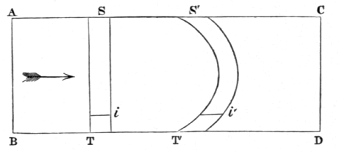
272. Let A C, in the annexed figure, be one side of the glacier, and B D the other; and let the direction of motion be that indicated by the arrow. Let S T be a transverse slice of the glacier, taken straight across it, say to-day. A few days or weeks hence this slice will have been carried down, and because the centre moves more quickly than the sides it will not remain straight, but will bend into the form S' T'.
273. Supposing T i to be a small square of the original slice near the side of the glacier. In its new position the square will be distorted to the lozenge-shaped figure T' i'. Fix your attention upon the diagonal T i of the square; in the lowest position this diagonal, if the ice could stretch, would be lengthened to T' i'. But the ice does not stretch; it breaks, and we have a crevasse formed at right angles to T' i'. The mere inspection of the diagram will assure you that the crevasse will point obliquely upwards.
274. Along the whole side of the glacier the quicker movement of the centre produces a similar state of strain; and the consequence is that the sides are copiously cut by those oblique crevasses, even at places where the centre is free from them.
275. It is curious to see at other places the transverse fissures of the centre uniting with those at the sides, so as to form great curved crevasses which stretch across the glacier from side to side. The convexity of the curve is turned upwards, as mechanical principles declare it ought to be. (See sketch on opposite page.) But if you were ignorant of those principles, you would never infer from the aspect of these curves the quicker motion of the centre. In landslips, and in the motion of partially indurated mud, you may sometimes notice appearances similar to those exhibited by the ice.
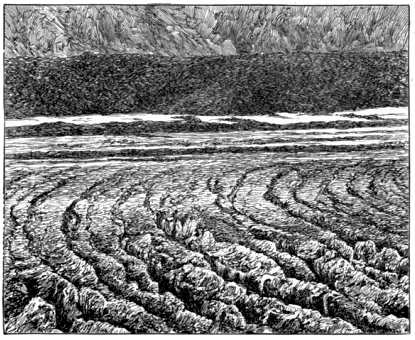
SKETCH OF CURVED CREVASSES: THE GLACIER MOVES FROM LEFT TO RIGHT.
§ 41. Longitudinal Crevasses.
276. We have thus unravelled the origin of both transverse and marginal crevasses. But where a glacier issues from a steep and narrow defile upon a comparatively level plain which allows it room to expand laterally, its motion is in part arrested, and the level portion has to bear the thrust of the steeper portions behind. Here the line of thrust is in the direction of the glacier, while the direction at right angles to this is one of tension. Across this latter the glacier breaks, and longitudinal crevasses are formed.
277. Examples of this kind of crevasse are furnished by the lower part of the Glacier of the Rhone, when looked down upon from the Grimsel Pass, or from any commanding point on the flanking mountains.
§ 42. Crevasses in relation to Curvature of Glacier.
278. One point in addition remains to be discussed, and your present knowledge will enable you to master it in a moment. You remember at an early period of OUT researches that we crossed the Mer de Glace from the Chapeau side to the Montanvert side. I then desired you to notice that the Chapeau side of the glacier was more fissured than either the centre or the Montanvert side (75). Why should this be so? Knowing as we now do that the Chapeau side of the glacier moves more quickly than the other; that the point of maximum motion does not lie on the centre but far east of it, we are prepared to answer this question in a perfectly satisfactory manner.
279. Let A B and C D, in the diagram opposite, represent the two curved sides of the Mer de Glace at the Montanvert, and let m n be a straight line across the glacier. Let o be the point of maximum motion. The mechanical state of the two sides of the glacier may be thus made plain. Supposing the line m n to be a straight elastic string with its ends fixed; let it be grasped firmly at the point o by the finger and thumb, and drawn to o', keeping the distance between o' and the side C D constant. Here the length, n o of the string would have stretched to n o', and the length m o to m o' and you see plainly that the stretching of the short line, in comparison with its length, is greater than that of the long line in comparison with its length. In other words, the strain upon n o' is greater than that upon m o'; so that if one of them were to break under the strain, it would be the short one.
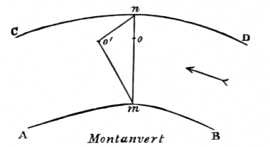
280. These two lines represent the conditions of strain upon the two sides of the glacier. The sides are held back, and the centre tries to move on, a strain being thus set up between the centre and sides. But the displacement of the point of maximum motion through the curvature of the valley makes the strain upon the eastern ice greater than that upon the western. The eastern side of the glacier is therefore more crevassed than the western.
281. Here indeed resides the difficulty of getting along the eastern side of the Mer de Glace: a difficulty which was one reason for our crossing the glacier opposite to the Montanvert. There are two convex sweeps on the eastern side to one on the western side, hence on the whole the eastern side of the Mer de Glace is most riven.
§ 43. Moraine-ridges, Glacier Tables, and Sand-Cones.
282. When you and I first crossed the Mer de Glace from Trélaporte to the Couvercle, we found that the stripes of rocks and rubbish which constituted the medial moraines were ridges raised above the general level of the glacier to a height at some places of twenty or thirty feet. On examining these ridges we found the rubbish to be superficial, and that it rested upon a great spine of ice which ran along the back of the glacier. By what means has this ridge of ice been raised?
283. Most boys have read the story of Dr. Franklin's placing bits of cloth of various colours upon snow on a sunny day. The bits of cloth sank in the snow, the dark ones most.
284. Consider this experiment. The sun's rays first of all fall upon the upper surface of the cloth and warm it. The heat is then conducted through the cloth to the under surface, and the under surface passes it on to the snow, which is finally liquefied by the heat. It is quite manifest that the quantity of snow melted will altogether depend upon the amount of heat sent from the upper to the under surface of the cloth.
285. Now cloth is what is called a bad conductor. It does not permit heat to travel freely through it. But where it has merely to pass through the thickness of a single bit of cloth, a good quantity of the heat gets through. But if you double or treble or quintuple the thickness of the cloth; or, what is easier, if you put several pieces one upon the other, you come at length to a point where no sensible amount of heat could get through from the upper to the under surface.
286. What must occur if such a thick piece, or such a series of pieces of cloth, were placed upon snow on which a strong sun is falling? The snow round the cloth is melted, but that underneath the cloth is protected. If the action continue long enough the inevitable result will be, that the level of the snow all round the cloth will sink, and the cloth will be left behind perched upon an eminence of snow.
287. If you understand this, you have already mastered the cause of the moraine-ridges. They are not produced by any swelling of the ice upwards. But the ice underneath the rocks and rubbish being protected from the sun, the glacier right and left melts away and leaves a ridge behind.
288. Various other appearances upon the glacier are accounted for in the same way. Here upon the Mer de Glace we have flat slabs of rock sometimes lifted up on pillars of ice. These are the so-called Glacier Tables. They are produced, not by the growth of a stalk of ice out of the glacier, but by the melting of the glacier all round the ice protected by the stone. Here is a sketch of one of the Tables of the Mer de Glace.
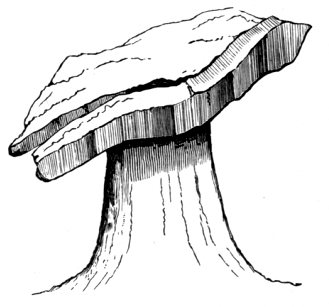
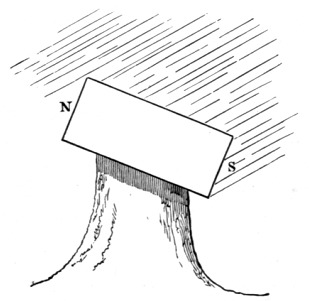
289. Notice moreover that a glacier table is hardly ever set square upon its pillar. It generally leans to one side, and repeated observation teaches you that it so leans as to enable you always to draw the north and south line upon the glacier. For the sun being south of the zenith at noon pours its rays against the southern end of the table, while the northern end remains in shadow. The southern end, therefore, being most warmed does not protect the ice underneath it so effectually as the northern end. The table becomes inclined, and ends by sliding bodily off its pedestal.
290. In the figure opposite we have what maybe called an ideal Table. The oblique lines represent the direction of the sunbeams, and the consequent tilting of the table here shown resembles that observed upon the glaciers.
291. A pebble will not rise thus: like Franklin's single bit of cloth, a dark-coloured pebble sinks in the ice. A spot of black mould will not rest upon the surface, but will sink; and various parts of the Glacier du Géant are honeycombed by the sinking of such spots of dirt into the ice.
292. But when the dirt is of a thickness sufficient to protect the ice the case is different. Sand is often washed away by a stream from the mountains, or from the moraines, and strewn over certain spaces of the glacier. A most curious action follows: the sanded surface rises, the part on which the sand lies thickest rising highest. Little peaks and eminences jut forth, and when the distribution of the sand is favourable, and the action sufficiently prolonged, you have little mountains formed, sometimes singly, and sometimes grouped so as to mimic the Alps themselves. The Sand-Cones of the Mer de Glace are not striking; but on the Görner, the Aletsch, the Morteratsch, and other glaciers, they form singly and in groups, reaching sometimes a height of ten or twenty feet.
§ 44. The Glacier Mills or Moulins.
293. You and I have learned by long experience the character of the Mer de Glace. We have marched over it daily, with a definite object in view, but we have not closed our eyes to other objects. It is from side glimpses of things which are not at the moment occupying our attention that fresh subjects of enquiry arise in scientific investigation.
294. Thus in marching over the ice near Trélaporte we were often struck by a sound resembling low rumbling thunder. We subsequently sought out the origin of this sound, and found it.
295. A large area of this portion of the glacier is unbroken. Driblets of water have room to form rills; rills to unite and form streams; streams to combine to form rushing brooks, which sometimes cut deep channels in the ice. Sooner or later these streams reach a strained portion of the glacier, where a crack is formed across the stream. A way is thus opened for the water to the bottom of the glacier. By long action the stream hollows out a shaft, the crack thus becoming the starting-point of a funnel of unseen depth, into which the water leaps with the sound of thunder.
296. This funnel and its cataract form a glacier Mill or Moulin.
297. Let me grasp your hand firmly while you stand upon the edge of this shaft and look into it. The hole, with its pure blue shimmer, is beautiful, but it is terrible. Incautious persons have fallen into these shafts, a second or two of bewilderment being followed by sudden death. But caution upon the glaciers and mountains ought, by habit, to be made a second nature to explorers like you and me.
298. The crack into which the stream first descended to form the moulin, moves down with the glacier. A succeeding portion of the ice reaches the place where the breaking strain is exerted. A new crack is then formed above the moulin, which is thenceforth forsaken by the stream, and moves downward as an empty shaft. Here upon the Mer de Glace, in advance of the Grand Moulin, we see no less than six of these forsaken holes. Some of them we sound to a depth of 90 feet.
299. But you and I both wish to determine, if possible, the entire depth of the Mer de Glace. The Grand Moulin offers a chance of doing this which we must not neglect. Our first effort to sound the moulin fails through the breaking of our cord by the impetuous plunge of the water. A lump of grease in the hollow of a weight enables a mariner to judge of a sea bottom. We employ such a weight, but cannot reach the bed of the glacier. A depth of 163 feet is the utmost reached by our plummet.
300. From July 28 to August 8 we have watched the progress of the Grand Moulin. On the former date the position of the Moulin was fixed. On the 31st it had moved down 50 inches; a little more than a day afterwards it had moved 74 inches. On August 8 it had moved 198 inches, which gives an average of about 18 inches in twenty-four hours. No doubt next summer upon the Mer de Glace a Grand Moulin will be found thundering near Trélaporte; but like the crevasse of the Grand Plateau, already referred to (§ 16), it will not be our Moulin. This, or rather the ice which it penetrated, is now probably more than a mile lower down than it was in 1857.
§ 45. The Changes of Volume of Water by Heat and Cold.
301. We have noticed upon the glacier shafts and pits filled with water of the most delicate blue. In some cases these have been the shafts of extinct moulins closed at the bottom. A theory has been advanced to account for them, which, though it may be untenable, opens out considerations regarding the properties of water that ought to be familiar to enquirers like you and me.
302. In our dissection of lake ice by a beam of heat (§ 11) we noticed little vacuous spots at the centres of the liquid flowers formed by the beam. These spots we referred to the fact that when ice is melted the water produced is less in volume than the ice, and that hence the water of the flower was not able to occupy the whole space covered by the flower.
303. Let us more fully illustrate this subject. Stop a small flask water-tight with a cork, and through the cork introduce a narrow glass tube also water-tight. It is easy to fill the flask with water so that the liquid shall stand at a certain height in the glass tube.
304. Let us now warm the flask with the flame of a spirit-lamp. On first applying the flame you notice a momentary sinking of the liquid in the glass tube. This is due to the momentary expansion of the flask by heat; it becomes suddenly larger when the flame is first applied.
305. But the expansion of the water soon overtakes that of the flask and surpasses it. We immediately see the rise of the liquid column in the glass tube, exactly as mercury rises in the tube of a warmed thermometer.
306. Our glass tube is ten inches long, and at starting the water stood in it at a height of five inches. We will apply the spirit-lamp flame until the water rises quite to the top of the tube and trickles over. This experiment suffices to show the expansion of the water by heat.
307. We now take a common finger-glass and put into it a little pounded ice and salt. On this we place the flask, and then build round it the freezing mixture. The liquid column retreats down the tube, proving the contraction of the liquid by cold. We allow the shrinking to continue for some minutes, noticing that the downward retreat of the liquid becomes gradually slower, and that it finally ceases altogether.
308. Keep your eye upon the liquid column; it remains quiescent for a fraction of a minute, and then moves once more. But its motion is now upwards instead of downwards. The freezing mixture now acts exactly like the flame.
309. It would not be difficult to pass a thermometer through the cork into the flask, and it would tell us the exact temperature at which the liquid ceased to contract and began to expand. At that moment we should find the temperature of the liquid a shade over 39° Fahr.
310. At this temperature, then, water attains its maximum density.
311. Seven degrees below this temperature, or at 32° Fahr., the liquid begins to turn into solid crystals of ice, which you know swims upon water because it is bulkier for a given weight. In fact, this halt of the approaching molecules at the temperature of 39°, is but the preparation for the subsequent act of crystallisation, in which the expansion by cold culminates. Up to the point of solidification the increase of volume is slow and gradual; while in the act of solidification it is sudden, and of overwhelming strength.
312. By this force of expansion the Florentine Academicians long ago burst a sphere of copper nearly three quarters of an inch in thickness. By the same force the celebrated astronomer Huyghens burst in 1667 iron cannons a finger breadth thick. Such experiments have been frequently made since. Major Williams during a severe Quebec winter filled a mortar with water, and closed it by driving into its muzzle a plug of wood. Exposed to a temperature 50° Fahr. below the freezing point of water, the metal resisted the strain, but the plug gave way, being projected to a distance of 400 feet. At Warsaw howitzer shells have been thus exploded; and you and I have shivered thick bombshells to fragments, by placing them for half an hour in a freezing mixture.
313. The theory of the shafts and pits referred to at the beginning of this section is this: The water at the surface of the shaft is warmed by the sun, say to a temperature of 39° Fahr. The water at the bottom, in contact with the ice, must be at 32° or near it. The heavier water is therefore at the top; it will descend to the bottom, melt the ice there, and thus deepen the shaft.
314. The circulation here referred to undoubtedly goes on, and some curious effects are due to it; but not, I think, the one here ascribed to it. The deepening of a shaft implies a quicker melting of its bottom than of the surface of the glacier. It is not easy to see how the fact of the solar heat being first absorbed by water, and then conveyed by it to the bottom of the shaft, should make the melting of the bottom more rapid than that of the ice which receives the direct impact of the solar rays. The surface of the glacier must sink at least as rapidly as the bottom of the pit, so that the circulation, though actually existing, cannot produce the effect ascribed to it.
§ 46. Consequences flowing from the foregoing Properties of Water. Correction of Errors.
315. I was not much above your age when the property of water ceasing to contract by cold at a temperature of 39° Fahr. was made known to me, and I still remember the impression it made upon me. For I was asked to consider what would occur in case this solitary exception to an otherwise universal law ceased to exist.
316. I was asked to reflect upon the condition of a lake stored with fish and offering its surface to very cold air. It was made clear to me that the water on being first chilled would shrink in volume and become heavier, that it would therefore sink and have its place supplied by the warmer and lighter water from the deeper portions of the lake.
317. It was pointed out to me that without the law referred to this process of circulation would go on until the whole water of the lake had been lowered to the freezing temperature. Congelation would then begin, and would continue as long as any water remained to be solidified. One consequence of this would be to destroy every living thing contained in the lake. Other calamities were added, all of which were said to be prevented by the perfectly exceptional arrangement, that after a certain time the colder water becomes the lighter, floats on the surface of the lake, is there congealed, thus throwing a protecting roof over the life below.
318. Count Rumford, one of the most solid of scientific men, writes in the following strain about this question:—"It does not appear to me that there is anything which human sagacity can fathom, within the wide-extended bounds of the visible creation, which affords a more striking or more palpable proof of the wisdom of the Creator, and of the special care He has taken in the general arrangement of the universe, to preserve animal life, than this wonderful contrivance.
319. "Let me beg the attention of my readers while I endeavour to investigate this most interesting subject; and let me at the same time bespeak his candour and indulgence. I feel the danger to which a mortal exposes himself who has the temerity to explain the designs of Infinite Wisdom. The enterprise is adventurous, but it surely cannot be improper.
320. "Had not Providence interfered on this occasion in a manner which may well be considered as miraculous, all the fresh water within the polar circle must inevitably have been frozen to a very great depth in winter, and every plant and tree destroyed."
321. Through many pages of his book Count Rumford continues in this strain to expound the ways and intentions of the Almighty, and he does not hesitate to apply very harsh words to those who cannot share his notions. He calls them hardened and degraded. We are here warned of the fact, which is too often forgotten, that the pleasure or comfort of a belief, or the warmth or exaltation of feeling which it produces, is no guarantee of its truth. For the whole of Count Rumford's delight and enthusiasm in connexion with this subject, and the whole of his ire against those who did not share his opinions, were founded upon an erroneous notion.
322. Water is not a solitary exception to an otherwise general law. There are other molecules than those of this liquid which require more room in the solid crystalline condition than in the adjacent molten condition. Iron is a case in point. Solid iron floats upon molten iron exactly as ice floats upon water. Bismuth is a still more impressive case, and we could shiver a bomb as certainly by the solidification of bismuth as by that of water. There is no fish, to be taken care of here, still the "contrivance" is the same.
323. I am reluctant to mention them in the same breath with Count Rumford, but I am told that in our own day there are people who profess to find the comforts of a religion in a superstition lower than any that has hitherto degraded the civilized human mind. So that the happiness of a faith and the truth of a faith are two totally different things.
324. Life and the conditions of life are in necessary harmony. This is a truism, for without the suitable conditions life could not exist. But both life and its conditions set forth the operations of inscrutable Power. We know not its origin; we know not its end. And the presumption, if not the degradation, rests with those who place upon the throne of the universe a magnified image of themselves, and make its doings a mere colossal imitation of their own.
§ 47. The Molecular Mechanism of Water-Congelation.
325. But let us return to our science. How are we to picture this act of expansion on the part of freezing water? By what operation do the molecules demand with such irresistible emphasis more room in the solid than in the adjacent liquid condition? In all cases of this kind we must derive our conceptions from the world of the senses, and transfer them afterwards to a world transcending the range of the senses.
326. You have not forgotten our conversation regarding "atomic poles" (§ 10), and how the notion of polar force came to be applied to crystals. With this fresh in your memory, you will have no great difficulty in understanding how expansion of volume may accompany the act of crystallisation.
327. I place a number of magnets before you. They, as matter, are affected by gravity, and, if perfectly free, they would move towards each other in obedience to the attraction of gravity.
328. But they are not only matter, but magnetic matter. They not only act upon each other by the simple force of gravity, but by the polar force of magnetism. Imagine them placed at a distance from each other, and perfectly free to move. Gravity first makes itself felt and draws them together. For a time the magnetic force issuing from the poles is insensible; but when a certain nearness is attained, the polar force comes into play. The mutually attracting points close up, the mutually repellent points retreat, and it is easy to see that this action may produce an arrangement of the magnets which requires more room. Suppose them surrounded by a box which exactly encloses them at the moment the polar force first comes into play. It is easy to see that in arranging themselves subsequently the repelled corners and ends of the magnets may be caused to press against the sides of the box, and even to burst it, if the forces be sufficiently strong.
329. Here then we have a conception which may be applied to the molecules of water. They, like the magnets, are acted upon by two distinct forces. For a time while the liquid is being cooled they approach each other, in obedience to their general attraction for each other. But at a certain point new forces, some attractive, some repulsive, emanating from special points of the molecules, come into play. The attracted points close up, the repelled points retreat. Thus the molecules turn and rearrange themselves, demanding, as they do so, more space, and overcoming all ordinary resistance by the energy of their demand. This, in general terms, is an explanation of the expansion of water in solidifying: it would be easy to construct an apparatus for its illustration.
§ 48. The Dirt Bands of the Mer de Glace.
330. Pass from bright sunshine into a moderately lighted room; for a time all appears so dark that the objects in the room are not to be clearly distinguished. Hit violently by the waves of light (§ 3) the optic nerve is numbed, and requires time to recover its sensitiveness.
331. It is for this reason that I choose the present hour for a special observation on the Mer de Glace. The sun has sunk behind the ridge of Charmoz, and the surface of the glacier is in sober shade. The main portion of our day's work is finished, but we have still sufficient energy to climb the slopes adjacent to the Montanvert to a height of a thousand feet or thereabouts above the ice.
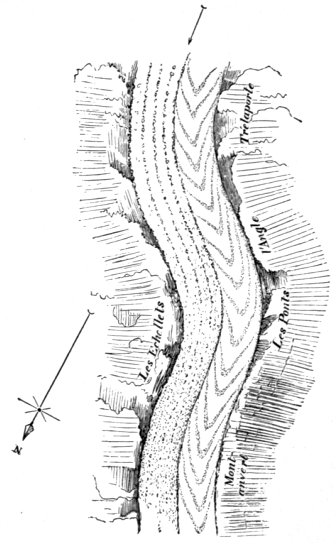
332. We now look fairly down upon the glacier, and see it less foreshortened than from the Montanvert. We notice the diet overspreading its eastern side, due to the crowding together of its medial moraines. We see the comparatively clean surface of the Glacier du Géant; but we notice upon this surface an appearance which we have not hitherto seen. It is crossed by a series of grey bent bands, which follow each other in succession, from Trélaporte downwards. We count eighteen of these from our present position. (See sketch, page 128.)
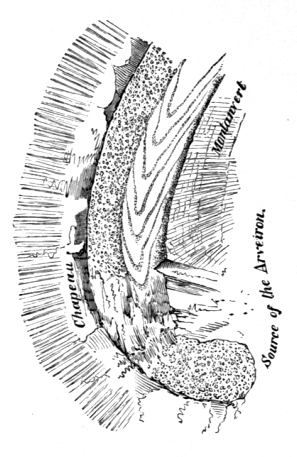
333. These are the Dirt Bands of the Mer de Glace; they were first observed by Professor Forbes in 1842.
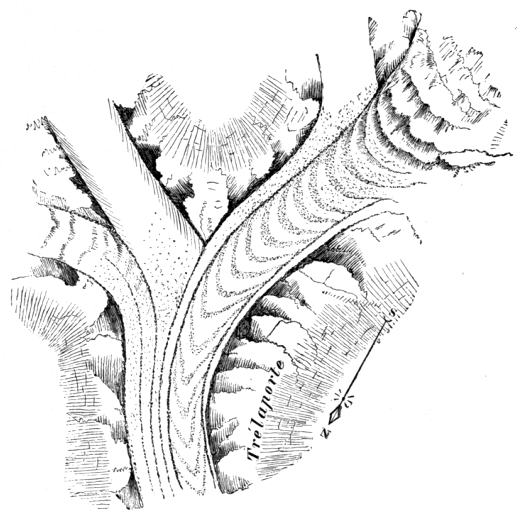
334. They extend down the glacier further than we can see; and if we cross the valley of Chamouni, and climb the mountains at the opposite side, to a point near the little auberge, called La Flégère, we shall command a view of the end of the glacier and observe the completion of the series of bands. We notice that they are confined throughout to the portion of the glacier derived from the Col du Géant. (See sketch, page 129.)
335. We must trace them to their source. You know how noble and complete a view is obtained of the glacier and Col du Géant from the Cleft Station above Trélaporte. Thither we must once more climb; and thence we can see the succession of bands stretching downwards to the Montanvert, and upwards to the base of the ice-cascade upon the Glacier du Géant. The cascade is evidently concerned in their formation. (See sketch opposite.)
336. And how? Simply enough. The glacier, as we know, is broken transversely at the summit of the ice-fall, and descends the declivity in a series of great transverse ridges. At the base of the fall, the chasms are closed, but the ridges in part remain forming protuberances, which run like vast wrinkles across the glacier. These protuberances are more and more bent because of the quicker motion of the centre, and the depressions between them form receptacles for the fine mud and débris washed by the little rills from the adjacent slopes.
337. The protuberances sink gradually through the wasting action of the sun, so that long before Trélaporte is reached they have wholly disappeared. Not so the dirt of which they were the collectors: it continues to occupy, in transverse bands, the flat surface of the glacier. At Trélaporte, moreover, where the valley becomes narrow, the bands are much sharpened, obtaining there the character which they afterwards preserve throughout the Mer de Glace. Other glaciers with cascades also exhibit similar bands.
§ 49. Sea Ice and Icebergs.
338. We are now equipped intellectually for a campaign into another territory. Water becomes heavier and more difficult to freeze when salt is dissolved in it. Sea water is therefore heavier than fresh, and the Greenland Ocean requires to freeze it a temperature 3½ degrees lower than fresh water. When concentrated till its specific gravity reaches 1.1045, sea water requires for its congelation a temperature 18⅓ degrees lower than the ordinary freezing-point.[E]
339. But even when the water is saturated with salt, the crystallising force studiously rejects the salt, and devotes itself to the congelation of the water alone. Hence the ice of sea water, when melted, produces fresh water. The only saline particles existing in such ice are those entangled 'mechanically in its pores. They have no part or lot in the structure of the crystal.
340. This exclusiveness, if I may use the term, of the water molecules; this entire rejection of all foreign elements from the edifices which they build, is enforced to a surprising degree. Sulphuric acid has so strong an affinity for water that it is one of the most powerful agents known to the chemist for the removal of humidity from air. Still, as shown by Faraday, when a mixture of sulphuric acid and water is frozen, the crystal formed is perfectly sweet and free from acidity. The water alone has lent itself to the crystallising force.
341. Every winter in the Arctic regions the sea freezes, roofing itself with ice of enormous thickness and vast extent. By the summer heat, and the tossing of the waves, this is broken up; the fragments are drifted by winds and borne by currents. They clash, they crush each other, they pile themselves into heaps, thus constituting the chief danger encountered by mariners in the polar seas.
342. But among the drifting masses of flat sea-ice, vaster masses sail, which spring from a totally different source. These are the Icebergs of the Arctic seas. They rise sometimes to an elevation of hundreds of feet above the water, while the weight of ice submerged is about seven times that seen above.
343. The first observers of striking natural phenomena generally allow wonder and imagination more than their due place. But to exclude all error arising from this cause, I will refer to the journal of a cool and intrepid Arctic navigator, Sir Leopold McClintock. He describes an iceberg 250 feet high, which was aground in 500 feet of water. This would make the entire height of the berg 750 feet, not an unusual altitude for the greater icebergs.
344. From Baffin's Bay these mighty masses come sailing down through Davis' Straits into the broad Atlantic. A vast amount of heat is demanded for the simple liquefaction of ice (§ 48); and the melting of icebergs is on this account so slow, that when large they sometimes maintain themselves till they have been drifted 2000 miles from their place of birth.
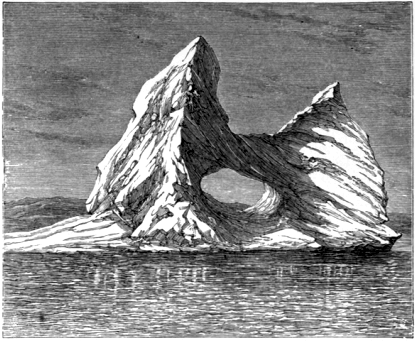
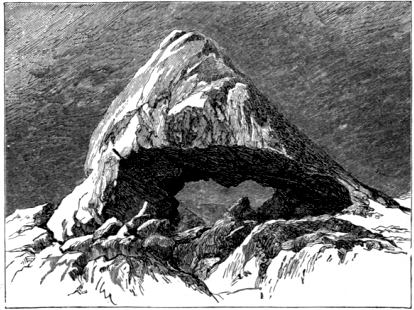
345. What is their origin? The Arctic glaciers. From the mountains in the interior the indurated snows slide into the valleys and fill them with ice. The glaciers thus formed move like the Swiss ones, incessantly downward. But the Arctic glaciers reach the sea, enter it, often ploughing up its bottom into submarine moraines. Undermined by the lapping of the waves, and unable to resist the strain imposed by their own weight, they break across, and discharge vast masses into the ocean. Some of these run aground on the adjacent shores, and often maintain themselves for years. Others escape southward, to be finally dissolved in the warm waters of the Atlantic. The first engraving on the opposite page is copied from a photograph taken by Mr. Bradford during a recent expedition to the Northern seas. The second represents a mass of ice upon the Glacier des Bossons. Their likeness suggests their common origin.
§ 50. The Æggischhorn, the Märgelin See and its Icebergs.
346. I am, however, unwilling that you should quit Switzerland without seeing such icebergs as it can show, and indeed there are other still nobler glaciers than the Mer de Glace with which you ought to be acquainted. In tracing the Rhone to its source, you have already ascended the valley of the Rhone. Let us visit it again together; halt at the little town of Viesch, and go from it straight up to the excellent hostelry on the slope of the Æggischhorn. This we shall make our head-quarters while we explore that monarch of European ice-streams,—the great Aletsch glacier.
347. Including the longest of its branches, this noble ice-river is about twenty miles long, while at the middle of its trunk it measures nearly a mile and a quarter from side to side. The grandest mountains of the Bernese Oberland, the Jungfrau, the Monch, the Trugberg, the Aletschhorn, the Breithorn, the Gletscherhorn, and many another noble peak and ridge, are the collectors of its névés. From three great valleys formed in the heart of the mountains these névés are poured, uniting together to form the trunk of the Aletsch at a place named by a witty mountaineer, the "Place de la Concorde of Nature." If the phrase be meant to convey the ideas of tranquil grandeur, beauty of form, and purity of hue, it is well bestowed.
348. Our hotel is not upon the peak of the Æggischhorn, but a brisk morning walk soon places us upon the top. Thence we see the glacier like a broad river stretching upwards to the roots of the Jungfrau, and downwards past the Bel Alp towards its end. Prolonging the vision downwards, we strike the noblest mountain group in all the Alps,—the Dom and its attendant peaks, the Matterhorn and the Weisshorn. The scene indeed is one of impressive grandeur, a multitude of peaks and crests here unnamed contributing to its glory.
349. But low down to our right, and surrounded by the sheltering mountains, is an object the beauty of which startles those who are unprepared for it. Yonder we see the naked side of the glacier, exposing glistening ice-cliffs sixty or seventy feet high. It would seem as if the Aletsch here were engaged in the vain attempt to thrust an arm through a lateral valley. It once did so; but the arm is now incessantly broken off close to the body of the glacier, a great space formerly covered by the ice being occupied by its water of liquefaction. A lake of the loveliest blue is thus formed, which reaches quite to the base of the ice-cliffs, saps them, as the Arctic waves sap the Greenland glaciers, and receives from them the broken masses which it has undermined. As we look down upon the lake, small icebergs sail over the tranquil surface, each resembling a snowy swan accompanied by its shadow.
350. This is the beautiful little lake of Märgelin, or, as the Swiss here call it, the Märgelin See. You see that splash, and immediately afterwards hear the sound of the plunging ice. The glacier has broken before our eyes, and dropped an iceberg into the lake. All over the lake the water is set in commotion, thus illustrating on a small scale the swamping waves produced by the descent of vast islands of ice from the Arctic glaciers. Look to the end of the lake. It is cumbered with the remnants of icebergs now aground, which have been in part wafted thither by the wind, but in part slowly borne by the water which moves gently in this direction.
351. Imagine us below upon the margin of the lake, as I happened to be on one occasion. There is one large and lonely iceberg about the middle. Suddenly a sound like that of a cataract is heard; we look towards the iceberg and see water teeming from its sides. Whence comes the water? the berg has become top-heavy through the melting underneath; it is in the act of performing a somersault, and in rolling over carries with it a vast quantity of water, which rushes like a waterfall down its sides. And notice that the iceberg, which a moment ago was snowy-white, now exhibits the delicate blue colour characteristic of compact ice. It will soon, however, be rendered white again by the action of the sun. The vaster icebergs of the Northern seas sometimes roll over in the same fashion. A week may be spent with delight and profit at the Æggischhorn.
§ 51. The Bel Alp.
352. From the Æggischhorn I might lead you along the mountain ridge by the Betten See, the fish of which we have already tasted, to the Rieder Alp, and thence across the Aletsch to the Bel Alp. This is a fine mountain ramble, but you and I prefer making the glacier our highway downwards. Easy at some places, it is by no means child's play at others to unravel its crevasses. But the steady constancy and close observation which we have hitherto found availing in difficult places do not forsake us here. We clear the fissures; and, after four hours of exhilarating work, we find ourselves upon the slope leading up to the Bel Alp hotel.
353. This is one of the finest halting-places in the Alps. Stretching before us up to the Æggischhorn and Märgelin See is the long last reach of the Aletsch, with its great medial moraine running along its back. At hand is the wild gorge of the Massa, in which the snout of the glacier lies couched like the head of a serpent. The beautiful system of the Oberaletsch glaciers is within easy reach. Above us is a peak called the Sparrenhorn, accessible to the most moderate climber, and on the summit of which little more than an hour's exertion will place you and me. Below us now is the Oberaletsch glacier, exhibiting the most perfect of medial moraines. Near us is the great mass of the Aletschhorn, clasped by its névés, and culminating in brown rock. It is supported by other peaks almost as noble as itself. The Nesthorn is at hand; while sweeping round to the west we strike the glorious triad already referred to, the Weisshorn, the Matterhorn, and the Dom. Take one glance at the crevasses of the glacier immediately below us. It tumbles at its end down a steep incline, and is greatly riven. But the crevasses open before the steep part is reached, and you notice the coalescence of marginal and transverse crevasses, producing a system of curved fissures with the convexities of the curves pointing upwards. The mechanical reason of this is now known to you. The glacier-tables are also numerous and fine. I should like to linger with you here for a week, exploring the existing glaciers, and tracing out the evidences of others that have passed away.
§ 52. The Riffelberg and Görner Glacier.
354. And though our measurements and observations on the Mer de Glace are more or less representative of all that can be made or solved elsewhere, I am unwilling to leave you unacquainted with the great system of glaciers which stream from the northern slopes of Monte Rosa and the adjacent mountains. From the Bel Alp we can descend to Brieg, and thence drive to Visp; but you and I prefer the breezy heights, so we sweep round the promontory of the Nessel, until we stand over the Rhone valley, in front of Visp. From this village an hour's walking carries us to Stalden, where the valley divides into two branches: the one leading through Saas over the Monte Moro, and the other through St. Nicholas to Zermatt. The latter is our route.
355. We reach Zermatt, but do not halt here. On the mountain ridge, 4,000 feet above the valley, we discern the Riffelberg hotel. This we reach. Right in front of us is the pinnacle of the Matterhorn, upon the top of which it must appear incredible to you that a human foot could ever tread. Constancy and skill, however, accomplished this, but in the first instance at a terrible price. In the little churchyard of Zermatt we have seen the graves of two of the greatest mountaineers that Savoy and England have produced: and who, with two gallant young companions, fell from the Matterhorn in 1865.
356. At the Riffelberg we are within an hour's walk of the famous Görner Grat, which commands so grand a view of the glaciers of Monte Rosa. But yonder huge knob of perfectly bare rock, which is called the Riffelhorn, must be our station. What the Cleft Station is to the Mer de Glace, the Riffelhorn is to the Görner glacier and its tributaries. From its lower side the rock, easy as it may seem, is inaccessible. Here, indeed, in 1865, a fifth good man met his end, and he also lies beside his fellow countrymen in the churchyard of Zermatt. Passing a little tarn, or lake, called the Riffel See, we assail the Riffelhorn on its upper side. It is capital rock-practice to reach the summit; and from it we command a most extraordinary scene.
357. The huge and many-peaked mass of Monte Rosa faces us, and we scan its snows from bottom to top. To the right is the mighty ridge of the Lyskamm, also laden with snow; and between both lies the Western Glacier of Monte Rosa. This glacier meets another from the vast snow-fields of the Cima di Jazzi; they join to form the Görner glacier, and from their place of junction stretches the customary medial moraine. On this side of the Lyskamm rise two beautifully snowy eminences, the Twins Castor and Pollux; then come the brown crags of the Breithorn, then the Little Matterhorn, and then the broad snow-field of the Théodule, out of which springs the Great Matterhorn, and which you and I will cross subsequently into Italy.
358. The valleys and depressions between these mountains are filled with glaciers. Down the flanks of the Twin Castor comes the Glacier des Jumeaux, from Pollux comes the Schwartze glacier, from the Breithorn the Trifti glacier, then come the Little Matterhorn glacier and the Théodule glacier, each, as it welds itself to the trunk, carrying with it its medial moraine. We can count nine such moraines from our present position. And to a still more surprising degree than on the Mer de Glace, we notice the power of the ice to yield to pressure; the broad névés being squeezed on the trunk of the Görner into white stripes, which become ever narrower between the bounding moraines, and finally disappear under their own shingle.
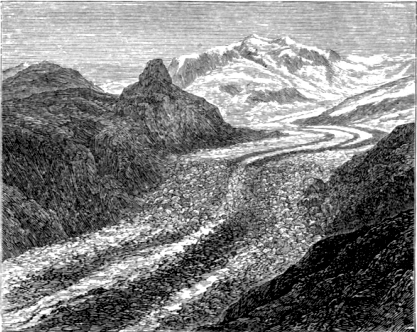
THE GÖRNER GLACIER, WITH MONTE ROSA IN THE DISTANCE, AND THE RIFFELHORN TO THE LEFT.
359. On the two main tributaries we also notice moraines which seem in each case to rise from the body of the glacier, appearing in the middle of the ice without any apparent origin higher up. These at their sources, are sub-glacial moraines, which have been rubbed away from rocky promontories entirely covered with ice. They lie hidden for a time in the body of the glacier, and appear at the surface where the ice above them has been melted away by the sun.