THE FLYING BOAT (continued 3)
Reading edition
"No. Not much chance with the window barred and four blackguards at the door--not to speak of a ten-foot wall, and absolute ignorance of the lie of the land. You had better leave it to the consul, hadn't you?"
"Not I. Everything has worked out well so far, and with a little luck we'll dish Su Fing."
"Look here, old Mole, there's a thing I must say. Since I've been here I've had plenty of time to think things over, and I see now what a thundering ass and ungrateful beast I've----"
"Shut up!"
"No, I've got to get it out. I chucked away my money on those cards, got into debt all round, went to the Chinky moneylenders like a fool, and cut up rough when you and Ting tried to put the brake on----"
"Oh, chuck it! Wasn't I juggins enough to wonder if you'd done me over that deal with Feng Wai? We'll cry quits, old man."
"Ting asked me to promise not to gamble again, and I let out at him. But if you'll take the promise I'll be glad. If we get out of this I'll never play for money again."
CHAPTER XIV
'MY BROTHER!'
The two friends sat for a long time discussing their situation. The problem of escape was a thorny one. The yamen was at some distance from the landing-stage, and the labyrinth of narrow ways by which Burroughs had come to it would puzzle anybody but a Chinaman acquainted with the town. Even if they contrived to elude the sentinels they might easily lose their way, especially in darkness--and they had already come to the conclusion that only by night could they hope to reach the river safely. The appearance of two Europeans in a town where there were no European residents would at once attract a curious crowd, and detection must be inevitable. And the first step of all, the escape from the room in which they were, was itself at present utterly baffling. Time was of the utmost importance. Su Fing might return any day; it was scarcely possible that a man whose mental powers were attested by the passing of so many examinations would be imposed on as the simple Chung Pi had been; and there was no knowing what summary methods he might use in dealing with the two Englishmen to whom he owed a grudge.
Burroughs examined the bars of the window. They were so deeply imbedded in the masonry that to loosen them within a reasonable time seemed a hopeless undertaking. The chances of succeeding in a rush through the doorway, when the door was opened, seemed slight. Burroughs had his revolver; Errington was unarmed; and though Chin Tai, who was waiting without to act as interpreter between Chung Pi and his German visitor, had his knife, it was not very likely that Burroughs and he could overpower the four sentinels on guard at the door. Even if they were taken by surprise, the sound of the scuffle would quickly bring up others from the gates and courtyards between the room and the outer wall. The more they thought of the problem, the more thoroughly were they convinced that violent measures were doomed to failure; they must have recourse to stratagem. But puzzle as they might, neither had the glimmering of a notion what the first move in the game must be.
They were so deeply immersed in talk that they did not notice the flight of time, and both were surprised when the door was opened, and a Chinese cook brought in their breakfast.
"Rice and beans again, I suppose!" said Errington, with a groan. "I've had nothing else."
An idea occurred to Burroughs.
"Take care not to seem friendly with me," he said, twirling his moustache--Reinhardt's moustache!--and turning his back on Errington with true Germanic disdain. "Hai! Chin Tai, tell these fellows that I demand to see the captain at once."
He had some doubt whether his demand would be acceded to, but Chung Pi had apparently anticipated something of the sort, for one of the sentinels called up a man from the courtyard, and sent him with the message to the captain.
When Chung Pi appeared, it was evident that he was much amused. He laughed as he spoke to Chin Tai.
"He say massa hab catchee too plenty muchee plison," said Chin Tai.
"It's all very well," said Burroughs, frowning haughtily. "I asked you to arrest me, for form's sake, but I didn't say I'd agree to be starved. Is this the fare to put before a German? It is good enough for the Englishman, but it won't do for me."
He glanced scornfully at Errington, who, taking the cue, assumed an air of dejection and humility.
"I am sorry," said Chung Pi contritely. "It was a mere oversight on my part. The cook naturally provided for the second prisoner as for the first. He did not know of the understanding between your honourable excellency and my unworthy self. I will at once have a dinner prepared worthy of your august eminence."
"That is well," said Burroughs. "When I have finished my meal, I shall give myself the pleasure of showing to you the boat which lies at the landing-stage."
"I must sleep a little first," said Chung Pi. "I have eaten so many melon seeds that my belt is exceedingly tight."
"At any time your excellency pleases," said Burroughs, with a bow.
The captain retired, after giving orders to the cook. Presently the servant returned, bringing a right royal feast--pickled duck's eggs, bean curd, pork patties, chopped cucumber, millet cakes soaked in treacle, fried cabbage--all very tastily dressed, together with water melons and tea.
As soon as the door was shut, the two prisoners fell to with a will.
"You'll want something better than rice and beans if we're to have any bother," said Burroughs. "This is very good; I only wish they didn't use quite so much garlic and oil."
When they had finished their dinner, Burroughs knocked at the door, and ordered Chin Tai, who meanwhile had had to satisfy himself with rice, to let the captain know that he was ready. It was some time before Chung Pi appeared, cracking and eating melon seeds. What explanation he gave to the sentinels of his indulgence to the second prisoner, or whether he condescended to give any explanation at all, Burroughs never knew. He accompanied Chung Pi to the outer gate, where chairs were waiting, and when they had entered these antiquated vehicles, each was lifted by four chai-jen or yamen runners, and carried through crooked and unsavoury streets, too narrow to admit of more than one passing at a time, down to the landing-stage. Two chai-jen went in advance, clearing a way with their sticks through the crowd. Chin Tai followed.
Lo San's face beamed at the sight of "Massa Bullows." He had begun to fear that some mishap had befallen him, and saw another beating in prospect.
Burroughs invited the captain to step into the hydroplane, but Chung Pi excused himself with many apologies, regretting that the present state of his health--by which Burroughs understood a surfeit of melon seeds--rendered it inadvisable for him to undergo any excitement. Leaving Chin Tai on the landing-stage, as a guarantee of good faith, Burroughs accordingly embarked alone, and for the space of a quarter of an hour or so exhibited the qualities of the vessel as a hydroplane, skimming up and down the river at full speed. Its flying powers, however, he refrained from showing.
Chung Pi was so much impressed and delighted with the marvellous vessel that he overcame his squeamishness, and consented to try a short trip up-stream. A few miles above the town, Burroughs caught sight of a small launch coming down swiftly on the current, and ran up to meet it, intending to turn and race it, with the object of still further impressing the captain. But in a few moments Lo San, interpreting a sentence of his passenger, informed him that the launch was one of Su Fing's dispatch boats, and was probably bringing a message from the chief to Chung Pi.
Feeling somewhat alarmed, Burroughs slowed down, and ran the hydroplane alongside the launch. A sashed and turbaned officer on deck shouted a greeting to Chung Pi, and told him that Su Fing was now on his way down the river with the bulk of his force, and might be expected to arrive before sunset.
"He say you velly happy this time," Lo San interpreted. "Su Fing he come look-see boat, say he velly good, numpa one boat."
Burroughs was anything but happy. He forced a smile, but felt most unphilosophically irritated when the ends of Reinhardt's moustache tickled his cheeks. He listened unheeding to the monotonous voice of Lo San translating the encomiums passed by Chung Pi on the admirable vessel, and steered mechanically down-stream towards Meichow, whither the captain said they must return at once in order to make preparations for Su Fing's fitting reception. Sufficiently alive to the necessity of sparing petrol, he did not drive the vessel at full speed, much to the disappointment of Chung Pi, who was looking forward to a dashing reappearance before the eyes of the thousands of admiring spectators now, beyond doubt, congregated at the riverside.
The imminent return of Su Fing threatened to put a bar to any plan that might be evolved for releasing Errington. As yet, think as hard as he might, Burroughs had been quite unable to form any likely scheme. On the way down the river he bent his brains exclusively on the problem, blind to the probability that Chung Pi might become suspicious of his lack of exhilaration at the prospect of a speedy meeting with the chief. The more he puzzled, the more hopeless the situation appeared. He knew that the coming of Su Fing would draw the whole population into the narrow contorted alley-ways that served as streets, so that, even if he got Errington out of the yamen, the chances of gaining the landing-stage undetected were naught. He tried to think of some means of persuading Chung Pi to bring Errington to the hydroplane; indeed, he ventured to hint that it would be a fine thing to meet the chief far up the river, and offer the prisoner to him as a sort of slave to grace his triumph. But Chung Pi would not hear of it. He objected that the orders he had received were strict: the Englishman was to be closely guarded; and it was as much as his rank was worth to disobey commands so explicit. Burroughs would not excite suspicion by pressing the point; and, indeed, he liked the fat simpleton so well as to wish to avoid getting him into hot water.
Thus uneasy, depressed, more nervous than he had ever been in his life before, he was running towards the landing-stage, not giving a glance beyond, when an exclamation from Lo San caused him to lift his eyes. Then he saw something that shot a cold shiver through him. This was the last straw. A quarter of a mile beyond the landing-stage, coming round a bend in the river, was the nose of a launch which he instantly recognized as Reinhardt's. It would reach the stage about the same time as his own vessel. The game was up! Reinhardt was certainly on board; the launch had never been seen on the river without him. He would certainly betray the pseudo-German. There had never been any love lost between them. They had parted in anger. And with a man of Reinhardt's temperament the "rape of the lock," the explanation of which would flash upon him the moment he caught sight of it adorning Burroughs' lip, would supply the fiercest motive for revenge.
Burroughs turned his head away from Chung Pi; he could no longer keep up the forced smile, which he felt must have become an awful grimace. Always a little slow of thought, he did not remember, for a moment or two, that in his story to Chung Pi he had unwittingly provided himself with an avenue of safety. All at once the recollection flashed upon him: he was Lieutenant Eitel Reinhardt, of the gunboat Kaiser Wilhelm. The moustacheless German was his brother!
"My brother! my brother!" he shouted excitedly.
Lo San looked at him in amazement. Was his master mad? Then he, too, remembered.
"My honourable master's brother," he exclaimed to Chung Pi.
The captain's broad face gleamed with interest and satisfaction. This new arrival was the very man who had arranged the gifts for Su Fing, whom his brother had so unfortunately missed, of whose money he himself had a hundred dollars safely tucked into his pouch.
"Brothers are as double cherries," he said. "The coming of your august relative is as the shining of the morning sun on the closed petals of a rose."
Burroughs bowed as Lo San translated, feeling that another word would make him shout with maniacal laughter. With a turn of the wrist he ran the boat alongside the landing-stage, just a second or two before the launch came up at the farther end. With Chung Pi he stepped off, observing that Reinhardt was standing at his gangway, waiting for his heavier and more cumbersome vessel to be brought alongside. And almost wishing that the planks might part, and plunge him into the water and oblivion, he walked forward to meet his fate.
CHAPTER XV
REINHARDT IN THE TOILS
Burroughs and the smiling captain were still some few yards away from Reinhardt's gangway; Reinhardt was staring with puzzled curiosity at the tall German with the moustache so like his own lost treasure; when Burroughs whispered to Lo San--
"Say to the captain: 'That is the launch, but where is my brother? My brother wears a moustache like mine. Do not the English shave the lip? Ask him who he is.'"
Chung Pi was a horse-boy turned captain; like many great men sprung from humble origin, he was apt to stand upon his dignity. Advancing towards the stranger as he stepped on to the landing-stage, he introduced himself with a grave pomposity, and asked Reinhardt to what Meichow owed the honour of his visit.
The German's eyes were fixed in a puzzled stare on Burroughs, who had taken off his cap as in respectful salutation. The close-cropped hair, the pencilled eyebrows, the stiff perpendicularity of his waxed moustache-ends, had so much altered his appearance that Reinhardt, though he felt that he had seen him somewhere before, did not recognize him. Germanic though his aspect was, there was a nameless something about him that put Reinhardt on his guard. Turning to Chung Pi, he replied courteously, in Chinese, that he was a German employed by his government to keep in touch with the august Su Fing, and that his honourable questioner without doubt knew the name of Reinhardt as a friend and ally of his chief.
Lo San was quick-witted. He saw that there was no time to translate the conversation to Burroughs, and for the moment held his peace. Burroughs could only stand in a commanding attitude with folded arms, accusation in his frown. He bethought himself of his moustache, and gave it a cautious twirl. And all the time he wished with desperate anxiety that he could understand what Reinhardt was saying.
Chung Pi looked at the German with fatuous indecision. Burroughs felt that another moment might seal his fate. He was beating his brains for a possible move if his stratagem failed, when Lo San interrupted Reinhardt as he was asking whether Su Fing had returned to the town.
"You see, honourable captain," he said, "that this man who calls himself a German has no moustache!"
And now the pen of the narrator fails: only a gramophone and a cinematograph could faithfully record the scene. Imagine the three men: the magnified horse-boy, bewildered between a furious German, shouting in Chinese, and a calm but quaking Englishman, standing like a judge about to condemn; with a shrill-voiced China boy at his side, screaming into Chung Pi's very ear; the men on the landing-stage gaping; the motley crowd at the shoreward end watching keenly, like the spectators at a boxing-match. Chung Pi, Reinhardt, Lo San, were all talking at once. Reinhardt, incoherent with rage, yelled "I am a German." Chung Pi asked him not to shout. Lo San, determined to make himself heard, screamed "He is an Englishman. As your excellency knows, the friend of Su Fing wears a moustache; it is the custom in his country; look at my august master."
Chung Pi, a peasant beneath his uniform, was slow, tenacious and pig-headed. He had seen Reinhardt once or twice, and carried away an impression of a moustache and little more. If this was Reinhardt, where was the moustache? He felt that he was being played with--he, the lieutenant of Su Fing, was bemocked by a man whose upper lip was even cleaner than that of the Englishman in the yamen. And when Burroughs, taking advantage of Reinhardt's vociferous abuse, whispered to Lo San to suggest that the man should be put with the other Englishman, and Lo San yelled the suggestion into the captain's ear, Chung Pi's simple mind was made up. Beckoning to some of his ruffians who stood expectantly by, he ordered them to seize the pig of an Englishman and carry him to the yamen. The chief should deal with him.
For a few seconds a whirling mass gyrated at the edge of the landing-stage. The centre of it was Conrad Reinhardt; the circumference was formed by a dozen Chinese legs. Yells of rage and derision arose from the variegated crowd of spectators as they watched the supposed Englishman--as much as they could see of him--struggling in the grasp of the spearmen. The scuffle ceased as suddenly as it had begun. Reinhardt appeared to bethink himself of his dignity. He made no further resistance, but allowed the insurgents to lead him away.
That procession is probably a cherished memory in Meichow to this day. It was led by the lictors--if the ragged ruffians may be dignified with that name for the nonce--who thrust back the shouting people that flocked from every alley to see the sight. Then came the prisoner amid the spearmen. A few paces behind marched the two sets of chairmen, carrying Burroughs and Chung Pi, with Chin Tai stepping beside. More spearmen brought up the rear. Lo San had returned to the hydroplane.
At the gate of the yamen Burroughs got out of his chair and approached that of the captain, beckoning Chin Tai forward to interpret.
"Your honourable presence," he said, "has no doubt great preparations to make for the reception of the august Su Fing. I feel that it would ill beseem me to take up more of your time. For myself, I think I ought to follow the prisoner. Who knows what conspiracy he may not hatch with the other if I am not there to keep an eye on them!"
"But you may be in danger from their violence," said Chung Pi. "You saw how the Englishman fought and kicked."
"Yes, he behaved very badly," replied Burroughs; "but with four of your brave warriors outside the door, the prisoners would not dare to molest me."
And with ceremonious salutations they parted.
Meanwhile Reinhardt had been marched through the courtyards, and taken to the room where Errington was wondering anxiously what had happened to his friend. The door was thrown open, and the German thrust inside. The spearmen reported by and by to their captain that on entering the room, the new prisoner advanced towards the other, holding out his hand, and saying some few words of greeting. The first prisoner neither took his hand nor replied to him. Chung Pi had sufficient intelligence to explain this incident satisfactorily to himself. The new-comer was undoubtedly English. He had recognized the prisoner, who, however, was more prudent, and pretended not to know him. Chung Pi plumed himself on his sagacity, and basked in the anticipated light of Su Fing's countenance when he should return and find two birds in his cage.
Reinhardt had made up his mind, while walking up to the yamen, to accept with as good a grace as possible the temporary inconvenience which he owed to the loss of his moustache--also temporary: he felt his upper lip, and discovered proofs of a new crop. By keeping his temper under control he would give himself the best chance of dealing with circumstances as they arose. Of course, when Su Fing returned all would be set right; and he promised himself that the ass of a captain who had so stupidly mistaken him should have cause to regret his imbecility. But he was a good deal puzzled. Who was this man, ostensibly a German, who had stood by indifferent while a compatriot of his own was being shamed? And who was the Chinaman who had uttered such abominable things about him? He was something like Lo San, Errington's boy. And then a light flashed upon him: it was Lo San; Errington, he knew, had been captured; no doubt he was the "other Englishman" who had been mentioned; and the whole affair was a plot on Lo San's part to bring his master and Reinhardt together, in the hope that the German might be persuaded to plead for him with the chief.
This thought comforted Reinhardt. Lo San was evidently a clever fellow; and as Errington's career was of course ended, his boy would probably be quite willing to enter the service of a new master. The German was therefore prepared, when he was pushed forward into the room, to find Errington waiting with open arms to receive him.
He was surprised when Errington refused to speak to him.
"Come, my friend," he said, "zis is not kind. Here am I, come at great cost to serve you, and you cut me! Zere is some big mistake; ze fool of a captain supposes me to be English, and makes me a prisoner. We are two prisoners togezer. Zis is not ze time for coldness between friends. Wizout you, I should not be here at zis moment." Reinhardt was unaware how truly he had spoken. "You owe me much. But you are young, and like many young men, you do not know your best friends."
Errington, on his part, was thoroughly amazed when he saw Reinhardt enter the room. Hearing footsteps outside the door, he had expected to see Burroughs again. The entrance of a man whom, after his recent interview with Burroughs, he distrusted and despised gave him a shock. Instinctively he refused him his hand. But now, at the German's explanation, strange as it was, he began to wonder whether he had not done him a double injustice. Perhaps the man had repented of his refusal of Burroughs' appeal, and after all had come up the river to his assistance.
He was wavering, on the point of asking Reinhardt whether he had seen Burroughs, when the German began to speak again.
"Yes, when your own countrymen do nozink for you, behold me, a German, putting my head into ze lion's mouse on your behalf. I ask you, why should I do so? You owe me five hundred dollars: bah! I zink nozink of zat. You are to me nozink but a friend----"
"And a servant of your firm," Errington blurted out, resenting the reference to his debt, and desperately uneasy now that it was clear that Burroughs and the German had not met.
"Not so," said Reinhardt complacently. "Zere is no reason why I should come to help you--nozink but friendship. You are no longer employed by my firm."
This took Errington's breath away. He listened in stony silence as Reinhardt proceeded.
"Zey pay you zree munce salary instead of notice. I have ze cheque in my pocket. Now you see what a friend I am, when you are no longer wiz me in business, and owe me five hundred dollars. Which is ze friend, Conrad Reinhardt, or Burroughs, ze man what preach, ze man who is what you call a smug, who eats and drinks merry when his old friend is----"
Errington could stand no more. Springing to his feet, he hit out a swinging blow that sent the German spinning across the room.
Reinhardt's hand flew to his breast pocket. He whipped out a revolver, and was taking a snapshot at Errington when his arm was struck up from behind; the weapon exploded harmlessly, and next moment was wrenched from his grasp and flung across the room. Unseen, unheard, Burroughs had quietly entered the room and taken in the situation at a glance.
No word had been spoken. While a man might count three there was a dead silence in the room. Then Burroughs, stepping to the still open door, confronted the sentinels and Chin Tai, who were pressing forward, alarmed by the shot.
"Bind that man!" cried Burroughs, pointing to the German, now slowly rising to his feet.
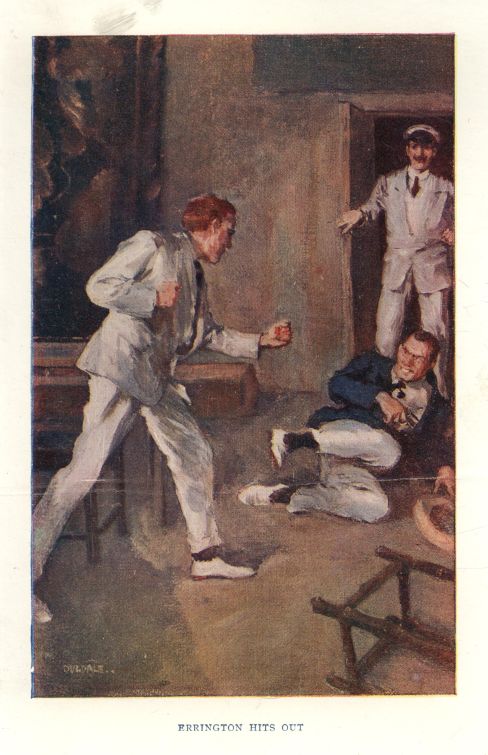
ERRINGTON HITS OUT
There was no hesitation among the men. They understood by this time that the supposed detention of Burroughs was only a move in their chief's policy. They did not understand it, but it was no affair of theirs. There were no ropes at hand, but they stripped off their cummerbunds; and in a few minutes Reinhardt, glowering from Burroughs to Errington, and from Errington to Burroughs, lay on the floor, trussed with bonds of yellow and red.
CHAPTER XVI
A LITTLE LUNCHEON PARTY
"What's the row, Pidge?" asked Burroughs, when the sentinels and Chin Tai had been dismissed, and the door closed behind them.
"Oh, he'd been telling a heap of lies, and when he started abusing you, I knocked him down."
Reinhardt started when he heard Burroughs speak in his natural voice. The disguise as it were fell off: his vague misgiving was justified; the cropped hair, the thickened eyebrows, the upturned moustache, no longer imposed upon him, and he writhed in his bonds.
Burroughs gave him a contemptuous stare.
"I don't care, personally," he said very quietly, "what lies you tell about me. There never has been any love lost between us. All I regret is that, among Chinamen, I should have had to treat a European--even such a European as you are--with such indignity. But you've brought it on yourself. You're a dangerous man. You're in league with these rebels; I know it, you needn't protest; in spite of that, in spite of my appeal to you, you wouldn't move a finger in Errington's behalf. I must treat you as an enemy--a secret enemy, and take the precautions that fit the case. Errington and I have matters to discuss, and owing to the action of your friends the rebels, we have to discuss them here. Your company has been forced upon us, so I'll take the liberty of relieving you from the necessity of overhearing our conversation."
"I protest," the German began, blusteringly. "I don't want to hear your conversation. Speak in ze corner; whisper."
Burroughs paid him no attention, but opened the door and called to Chin Tai.
"Stuff up Mr. Reinhardt's ears," he said.
Chin Tai produced a dirty rag from the pouch at his waist.
"No, not that," said Errington impulsively. "Haven't you a handkerchief, Ted?"
Burroughs gave his handkerchief to the Chinaman, who tore it in strips, and rolled up two wads which he placed in the German's ears.
"Wait outside, and let me know if the captain comes."
As soon as the door was shut, Burroughs took Errington to the window.
"The position's this, old man," he said. "Su Fing is coming down river. It's all up with us if he finds us here. Reinhardt won't stick at a trifle. We must get away somehow or other before evening. How it's to be done beats me."
"Where did you go when you left me?"
"I showed off the boat to Chung Pi. He'd eaten so many melon seeds that he wouldn't venture on board at first; but I got him on after a bit. I only did it to heighten my importance. It was when we were going up-stream that we met a launch of Su Fing's, and heard that the chief would be here to-night."
"You didn't fly?"
"No. Chung Pi is sure to have heard of the flying boat, and he'd have smelt a rat. Why?"
"I've just had an idea," said Errington eagerly.
"Gently, old chap. I'm not at all sure that Reinhardt can't hear if you raise your voice. What is it?"
In a low tone, but with great animation, Errington explained the plan which had suddenly suggested itself. For some time the two discussed it together. It was a strange conversation, conducted under the eyes of the German, glaring at them as he lay fierce and helpless on the floor.
They were interrupted by the entrance of the cook man bringing the midday meal. It was a generous repast; the cook had taken a hint from what happened at breakfast-time, and provided food in even greater variety than before. Burroughs and Errington took their chop-sticks and sat on the floor in front of the pots and pans. Errington glanced at Reinhardt.
"We can't feed while he goes hungry," he said.
"Speak for yourself," said Burroughs. "I've not the slightest objection."
"But they've brought grub for him. He'd better have his share."
"Just like you! All right; but he'll be a sort of skeleton at the feast."
"A substantial skeleton! He won't depress me. But it's a rummy go, when you come to think of it."
Burroughs went to the German and released him.
"Some of this food is for you," he said, speaking close to Reinhardt's ear. "Errington suggests that you should join us."
He went back to his place beside Errington. For some seconds Reinhardt made no movement beyond sitting up and stretching himself, with a sullen stare at Burroughs. Then either the matter-of-fact consideration that he was hungry, or something in the humour of the situation, caused him to banish his sulks. He crossed the room, and squatted heavily opposite the Englishmen.
"Whatever happens to any of us, this is certainly the last time we three are likely to have a meal together," said Errington.
The situation was certainly novel. Men have sat down at table with murder in their hearts; quarrels have arisen at the board; but it is not common for two men to eat with a third whom one has just knocked down, and whose moustache the other is wearing.
There was naturally a constraint upon the party--upon Errington more particularly, for he could not forget that he had once been Reinhardt's friend, nor that he owed him money. He might suspect that the German had cheated him, but a debt is a debt. Yet to eat in silence was impossible, and presently Burroughs broke the ice.
"Have some of this," he said to Reinhardt, looking into one of the pans.
"I beg pardon," said Reinhardt. "I am a little hard of hearing."
The Englishmen glanced at each other.
"Better go the whole hog and do it decently while we are about it," said Errington.
"Perhaps you can do something to cure yourself," said Burroughs in a loud tone to the German.
Reinhardt removed the wads from his ears, and looking at them doubtfully for a moment, laid them down on the floor beside him.
"Zanks," he said. "Now I am all attention."
"Not at all," said Burroughs. "Have some of this--I don't know what it is."
He ladled a sort of stew on to Reinhardt's plate. For a few moments there was silence as they plied their chop-sticks. Then Reinhardt, glancing up under his eyebrows, said gravely--
"I zink it is chow--puppy-dog, you know."
The others held their chop-sticks suspended.
"I'll try something else," said Burroughs, looking suspiciously into another pan.
"In China one must not inquire too much," the German went on. "One must have faith. Once I was at an inn, deep in ze country. I demand dinner; zey say zere is none. Naturally I must have dinner, and I command ze innkeeper very loud. Zat is effective. Soon he bring me a ragout--excellent; I eat it wiz gusto. Afterwards I discover it is rats."
The Englishmen's faces expressed their disgust, and again there was silence.
"China is a great country for rats," said Errington lamely.
"Zat is true; zere are rats all up ze Yang-tse."
"Water-rats," suggested Burroughs.
"So; four legs--and two," said the German.
"Tails--and pigtails," said Burroughs.
"I make a study of zem all."
"My boy says that rats' whiskers are lucky," said Errington after a pause.
"White rats!" added Burroughs.
Reinhardt's eyelids flickered. He seemed to avert his gaze with an effort from Burroughs' moustache.
"I zink he is perhaps mistaken," he said.
Then he appeared to feel that he was skating on thin ice, towards a danger-mark. An observant onlooker might have discovered a resemblance between these three men, talking so quietly over their meal, and fencers, warily feeling for each other, but careful not to engage. Each was trying to "make" conversation, and found, almost in spite of himself, that it trended towards the personal. Reinhardt, the keenest and most experienced of the three, was the first to feel the tendency, and to attempt to divert it.
"Ze Chinese," he went on, "zey are very superstitious. Zey believe in spells and charms, zings which Europe dismissed hundred years ago, and more. Zey talk always of luck."
"Don't you see that men make their own luck," said Burroughs.
"Perhaps, but not at cards," said Reinhardt. "Zat is skill." He pulled himself up suddenly. "Ze Chinese are indeed extremely skilful. As you English say, zey will catch a weasel asleep."
"And skin him!" said Errington artlessly.
"I have heard of that too," said Burroughs, catching Reinhardt's eyes again fixed on his moustache.
"Is zere any more cabbage?" asked the German, bending forward over the pan.
"No, but there is some parsley," replied Burroughs, in best phrase-book style; and a minute or two afterwards the meal and the difficult conversation came to an end together.
During the pauses each of the party had been busily thinking: Burroughs and Errington of the scheme which they had partially discussed, Reinhardt of the extraordinary circumstances in which he found himself. For once, at any rate, the German felt that he had no trumps. He saw through Burroughs' imposture; and he was pretty sure that the moustache which had fascinated his eyes during the meal was his own. Inwardly boiling with indignation and outraged vanity, he was sportsman enough to enter into the spirit of the situation so far as speech was concerned; his brain was cogitating an exemplary vengeance, and he hugged himself with the thought that the hour of revenge was at hand. The apparent coolness of the Englishmen amazed him. With Su Fing already on his way down the river, their heads were as good as gone. Yet nobody watching them, or listening to their talk, could ever have imagined that their lives hung on a thread.
At the conclusion of the meal, Burroughs said politely--
"I regret the necessity of tying you up again."
"And I," said the German, with equal courtesy, though his eyes were blazing, "I regret to be ze cause of so much trouble."
Burroughs called in his servant and the sentinels, and by their hands Reinhardt was again bound. Chin Tai caught sight of the ear-wads lying beside the German's plate.
"He wantchee he 'nother time all-same?" he asked his master.
"Your conversation--is it not finished?" the German interposed. "One is incomplete wizout ears."
"I'm afraid you must remain incomplete for a while," said Burroughs. "Put them in, Chin Tai; then tell those fellows they can clear away the food and eat what's left. I want you."
As soon as the door was closed behind the guard, Burroughs took Errington and Chin Tai to the window, and the three remained for some minutes in earnest conversation.
"Now," said Burroughs at last to the servant, "you know what you have to do. First of all, cut off to the captain; he has finished his luncheon by this time--and say that I request the honour of waiting upon him on a matter of great urgency."
"Allo lightee, sah; my talkee he allo plopa."
And he went with an air of much self-importance to fulfil his errand, reflecting with a chuckle that Lo San was out of this.
CHAPTER XVII
THE DASH FROM THE YAMEN
Chin Tai returned in about twenty minutes.
"Captain he say hon'ble genelum come this time; he velly glad look-see."
"Good luck," said Errington as Burroughs got up. "If there's any hitch, don't mind about me."
Burroughs mumbled something and went out with his servant. The chair was awaiting him at the outer gate. Ordering two of the guards there to accompany him for appearance' sake, he had himself carried to the captain's quarters hard by. On the way he noticed, without any appearance of concern, a large number of wild-looking warriors assembling to form, as he guessed, a guard of honour for the chief on his return. Many of the men scowled at him as he passed. They did not distinguish one "foreign devil" from another. To many of the lower orders of Chinamen, all foreigners are poison.
Chung Pi had evidently been indulging freely in the pleasures of the table. He was breathing rather hard; melon seeds are very "filling"; and the number of thimblefuls of hot sam-shu, a fiery drink made of millet, which he had consumed had reddened his face and put him on very good terms with himself.
"Honourable stranger," he said, when Burroughs entered, "your honourable face is like the sun at noon-day. You have fed well?"
"Excellently, noble captain."
"You cracked many melon seeds?"
"Not a great number."
"Then you will never be fat. Will you take a little sam-shu?"
"Thank you, not now. Better reserve that until your august chief returns. There has been no further message from him?"
"No; but I have made preparations for greeting him. The bannermen and gong-beaters will go down to the river in due time, and we shall issue forth to greet the illustrious Su Fing with bands of music."
"Would it not be fitting, noble captain, a deed worthy of your high renown, to meet your chief on the marvellous vessel of whose speed you have already made trial? Su Fing returns victorious; he would feel himself duly honoured if his trusty lieutenant met him while still a great way from the town, offering for his acceptance this matchless gift from a great nation."
"You speak well, illustrious stranger. The gift is indeed a noble one. But I fear that I cannot dispense with my afternoon nap. Sleep after meat is a gift of the gods."
"I would not deprive you of it for worlds. I must go down to the boat, to see that all is in order for the journey we propose to make. I will do that while you sleep."
"Not so. The boat pleases me, and drowsy though I am, I am disposed to accompany you. Perhaps Su Fing may give the vessel into my charge; it will be well, then, that I understand something of its qualities. I shall thereby be superior to any other officer of my chief's, and the way of promotion will be open to me."
"By all means, noble captain."
"Yes. To be well fed is vain without true understanding. But tell me, what of the Englishmen? It was told me that one of them was so daring and wicked as to fire a shot at the other. The guards ought to have searched him; I have given orders that when the rejoicings are over they shall be soundly beaten with the leather."
"The man who attempted the crime is bound hand and foot. He can do no more mischief."
"It is well. I am fortunate in having another Englishman for Su Fing. He hates all Englishmen, because they do not approve of his warlike deeds. Furthermore, he was wounded by an Englishman, and taken captive, and he suffered stripes and the cage. His heart will laugh when he knows that another of the hated race lies bound in his yamen. Now let us go."
He summoned his chairmen and armed escort, and was carried along with Burroughs down to the landing-stage, and on to the vessel. There he watched curiously as the Englishman overhauled the engine, and filled his petrol tank. When this was done, Burroughs took from the end of his watch-chain an Indian charm which had been given him by his mother, and made a few meaningless passes with it over the throttle.
"Why do you do that?" Chung Pi asked.
"To ward off evil spirits," replied Burroughs. "We must have a lucky voyage."
"You do well. I myself, as you perceive, have a thread of red silk braided in my queue for the same purpose; and I wear a charm attached to a red string within my shirt. So we shall be doubly secure."
Burroughs, having satisfied himself that everything was in working order, was at leisure to answer the innumerable questions about the hydroplane with which the Chinaman plied him. They were such futile questions as a simple ignorant peasant might put. Burroughs felt that he was answering a fool according to his folly, and again had compunctions about making this guileless ignoramus his accomplice. It was clear that Chung Pi's vanity was flattered by the idea of showing a new importance before the populace. The machine had become an obsession with him, and as he grew more and more wonder-struck at what Burroughs told him, the approaching arrival of his chief became of less interest to him than the prospect of making an impression on the home-coming warriors.
Time slipped away. Burroughs felt restless and impatient. Chung Pi had told him that the approach of the chief's launch would be signalled by a man stationed on the roof of the yamen, which rose high above the surrounding country, and from which another signal station could be seen many miles distant. Burroughs dared not start until the signal was given; yet he felt that time was being wasted.
At last, turning to Chung Pi, he said that he had one great surprise in store for him. He had in fact two, but the second was to be revealed at the proper time.
"You have seen, noble captain," he said, "with what marvellous speed this vessel skims the water, but you have yet to see that it can also fly--even as a duck, which swims ordinarily on the surface, can at need raise itself upon its wings and take the air. But a duck cannot fly so well as this vessel."
"What end is there to the marvels you tell me!" exclaimed the captain. "In truth I have heard of a flying boat, belonging to an Englishman at Sui-Fu; but I mocked at the tale, for men are liars."
"It is true. This boat is even as that of the Englishman; it flies quite as well."
"But how can a boat fly without wings?"
"I will show you."
Burroughs unfolded and spread out the canvas planes at the sides of the boat.
"Wonderful!" said the Chinaman. "It is very like a butterfly."
"How fine a thing it would be to fly to meet Su Fing, noble captain! That would indeed show at once the matchless qualities of this vessel, and the courage of the illustrious officer who so well fills the place of the chief here."
Chung Pi's simple face expressed the longing and the terror which a child shows when he is invited for the first time to taste some new experience--the first ride on an elephant, or on a hobby-horse at the village fair.
"If you would show me first," he said.
He stepped on to the landing-stage, and stood fascinated as the vessel, skimming the surface until it attained its lifting speed, rose into the air, circled, and returning, alighted gently at the very spot whence it had started. Beyond measure delighted, Chung Pi hesitated no longer. Making sure that the red string sustaining his charm was securely about his neck, he entered the boat, and uttered childish exclamations of wonderment and pleasure as the vessel once more performed the same flight. On landing, he bore himself with a vainglorious swagger before the crowd of excited onlookers. He insisted on taking Burroughs back to his own house for a few melon seeds and cups of tea, and talked incessantly of the sensation he would make when he flew to meet Su Fing.
While they were at tea, with Chin Tai in attendance as interpreter, Lo San, enjoying a certain prestige as the servant of the kind German who had brought so precious a gift, was entertained by the captain's escort. They were exchanging notes with him when the long-expected message was signalled: the watchman on the roof of the yamen had seen a signal on a hill two miles away; the signaller there had received the message from another, and he from another. Su Fing was little more than an hour's journey distant. At once there was a ringing of bells and beating of gongs. Chung Pi, trembling with eagerness, came forth with Burroughs; a procession was formed, and with an armed escort before and behind the chairmen carried their burdens down to the river.
At the landing-stage Lo San approached Burroughs, and said in an undertone--
"Su Fing he no lick all-same. Fellas he say Su Fing hab catchee numpa one beatin' Cheng Tu side. He belongey velly bad temper."
Rumour, flying swiftly through the country, had brought news that the chief, so far from being victorious, had been driven headlong from Cheng Tu by regular forces summoned from Tibet, and was now falling back on Meichow to recoup his losses. There was no doubt that Chung Pi had heard the news; but Burroughs guessed that it was as much as his place was worth to greet his master otherwise than as a conqueror.
This information, strange as it may appear, rendered Burroughs the more anxious to set off on his trip up-river. Chung Pi was equally eager, for a different reason. They entered the boat, followed by Chin Tai and Lo San. The ropes were cast off; Burroughs started the engine, and amid loud shouts from the assembled soldiery drawn up on the shore and about the landing-stage in anticipation of the chief's arrival, and from the rag-tag populace swarming on every patch of open space, the vessel ran a few yards up the river, planed as it gathered speed, and finally soared smoothly into the air.
Burroughs flew low, so that the trees that edged the river might prevent the spectators at the harbour from following too closely the direction of his flight. Chung Pi was as happy as a lark. He sat, beaming a bland smile, in the seat which Errington had so often occupied. What visions of greatness shone before his soaring soul! He wished that the honourable stranger would rise higher, so that he might descend upon his chief like a celestial benediction. But the honourable stranger's mood seemed to have changed since he left the town. There, he was affable, condescending, communicative; he had a pleasant smile; now he was silent, his lips were pressed together, his moustache appeared stern and forbidding. Chung Pi reflected that he naturally felt his responsibility.
For some two miles Burroughs headed straight up the river. Then, well clear of the town, he suddenly altered his course, leaving the river, flying inland, rising as he did so, in order to clear the tree-tops and to get a complete view of the city. The flying boat was describing a circle; presently it was heading on a straight course for Su Fing's yamen, that stood, bright and picturesque, a conspicuous object on its elevated site.
"But what is this?" said Chung Pi anxiously. "We are going back!"
Burroughs did not turn his head or open his lips. But Chin Tai, squatting a little in the rear of the captain, remembered the instructions which his master had impressed upon him in that quiet talk by the window of the prisoner's room.
"Be not alarmed, noble captain," he said with obsequious reverence. "My august master has forgotten the little charm which he carries to keep off the evil spirits of the air. It would be terrible to start on so important a journey without this necessary talisman."
"But we have already started," Chung Pi objected. "And have I not the red silk in my queue, and my own charm about my neck? Will they not suffice, O foolish one?"
"Heaven-born excellency," replied Chin Tai in still more submissive tones, "you perceive that we have started to return to the yamen. We shall begin our real journey from there."
"But your illustrious master has the charm. He showed it me long ago."
For a moment Chin Tai was staggered; but ready wit coming to his aid, he said--
"This is another charm, noble captain--a better one. My august master must have left it in the yamen. Even the great are at times foolish."
"That is true," said Chung Pi, thinking of Su Fing. "Your illustrious master does well to be quite safe, but we waste much time."
"Very little, illustrious captain. Are we not flying swift as any bird? Your excellency will be amazed to see how fast we can go, before our flight is finished."
Chung Pi was pacified. Indeed, he began to revel in his sensations. How smoothly the vessel flew! How delightful was the scene below--the tree-tops never beheld yet except by the birds of the air, the rolling river, the woods and vales beyond; the city, so rapidly approaching, in its new aspect no longer a labyrinth of mean streets, but a picturesque pattern of masonry! Su Fing, with all his examinations, had never learnt these secrets of the air; Chung Pi began to wonder whether so ignorant a man was fitted to be chief.
Burroughs steered straight for the yamen. It was a severe test of his airmanship to alight on the narrow piece of ornamental water that graced the gardens, and to avoid the bridge that zigzagged across it from shore to shore. He shaved it almost by a hair-breadth, and came safely down upon the lake's unruffled surface. Then he ran the vessel to the end nearest the yamen, and brought it up against the stone parapet of a terrace on which Su Fing was wont to walk of an evening, watching the graceful movements of his swans, and meditating his projects against tyranny.
And now Burroughs found his tongue. Speaking with a curt brevity that somewhat offended the captain's sense of what was due to his new-born dignity, he ordered--for it was more an order than a request--Chung Pi to remain in the boat with Lo San; he himself with his servant would proceed to the yamen and fetch the charm. Lo San was nervous. He had made up his mind to throttle the captain if any harm befell "Massa Bullows," or if he attempted in any way to interfere. But looking at the big man, his muscular limbs, his sword and dagger, he felt that the task might prove to be beyond his powers.
"Massa Bullows" had ordered him to turn the vessel round, so that its head pointed towards the river, and to be ready to throw the engine into first speed as soon as he gave the word on his return. Having brought the boat again alongside the parapet, he sat waiting, with his eyes fixed on Chung Pi's half-sullen face.
Burroughs, meanwhile, had hurried with Chin Tai through the garden, crossed the rising terraces, and come round to the entrance of the yamen. The guards stood aside to let him pass. Without any appearance of haste he entered, and reached the door of the room in which Errington and Reinhardt were still confined. The sentinels were clustered about a window at one end of the passage, gazing with curiosity at the boat in which their captain sat. Chin Tai hailed them, and pointing to Chung Pi, ordered the men to enter the room, release the bound prisoner, and march him down to the vessel. Burroughs watched them nervously, asking himself whether his scheme would succeed. It was at this point that it threatened to break down. He had calculated that all four men would flock into the room together, but only three did so, the fourth remaining outside.
"Watch this man," said Burroughs to Chin Tai, following the three men into the room.
They were stooping over the German, fumbling with the knots which they had themselves tied, when Errington, who had moved unconcernedly towards the door, suddenly darted out. At the same moment Burroughs stepped back into the passage, pulled the door after him, and shot the bolt; and Chin Tai sprang at the bewildered sentinel, caught him by the throat, and held on until he was half strangled. Then Burroughs drew from his pocket some cords and a piece of canvas he had brought from the boat, and with Errington's assistance gagged and bound the man.
Before this was done, the sentinels bolted in the room had begun to yell, hammering on the door with the butts of their spears. The sounds attracted two or three servants of the yamen, who had nothing to do until their master returned. They came running into the passage from the outer courtyard, just in time to see the two foreigners, and the Chinaman, leap from the window on to the walk beneath. Instead of opening the door of the prisoner's room, the servants ran yelling towards the outer gate, to inform the guards that the English prisoner had escaped, and was being pursued by the German and his boy. The guards rushed up to the walk beneath the window, from which they could see Errington spring like a deer from terrace to terrace, with the two others close behind as if chasing him.
Burroughs had calculated that, even if Chung Pi should catch sight of them the moment they left the house, he would scarcely be able to grasp and grapple with the situation during the few seconds in which they were sprinting across the eighty yards of terraces that separated the yamen from the lakeside. They expected that his first movement would be to spring ashore, and Lo San had been ordered to lay the boat at the steps leading up to the parapet so as to give him an opportunity of doing so. But they had not reckoned with the effect of their startling actions upon the captain's wits, or with the clamour that had sprung up behind them. The whole population of the yamen was streaming out into the grounds, yelling at the top of their voices, many of them without knowing why. Su Fing's wife and children were drawn from their secluded quarters; cooks, scullions, hair-dressers, nurses, gardeners, all the personnel of the chief's establishment were out of doors.
Chung Pi, who had been sitting in impatient dudgeon in the boat, rose to his feet at this extraordinary hullabaloo, and gazed in consternation up towards the yamen, missing the three men, who were nearer to him, but partially hidden by the shrubbery of the terraces. When they pulled themselves up sharply at the stone parapet, leapt down the stairs, and stepped gingerly, as became the light framework of the craft, into the canvas boat, he sank, utterly unstrung, on to one of the thwarts.
This unhappy consequence of a surfeit of melon seeds and sam-shu very much simplified the matter for Burroughs and Errington. They had discussed in the room in the yamen what they should do if the genial warrior showed fight, and had come reluctantly to the conclusion that it might be necessary to tumble him into the lake. It was shallow, and there was no danger of so buoyant a man drowning. The fugitives were much relieved to find that it was unnecessary to adopt a violent course with him. It went against the grain to discommode physically so friendly a simpleton, to say nothing of the unwisdom of engaging in a tussle when a score or two pursuers were within a few yards of them.
At the moment of reaching the lakeside Burroughs signed to Lo San to put the engine at full speed. Then dashing past the bewildered captain, he seized the steering-wheel as the vessel moved out. For a few yards the boat planed, but by the time it had gathered way, and Burroughs adjusted the elevator and switched the engine on to the air tractor, the bridge was perilously near. But for the zigzag construction of the bridge, the boat could hardly have been prevented from dashing into it. But a slight movement of the rudder caused it to clear the bridge where it dropped down towards the approach on the lakeside, and it soared over the stonework with the narrowest of margins. From that point the grounds of the yamen were open for the space of more than a hundred yards, except for some clumps of shrubbery which were easily avoided. Free now to employ the elevating planes, Burroughs sent the vessel aloft, cleared the outer walls, dodged the trees beyond, and set his course straight for the river.
By this time Chung Pi had partially regained his composure. Not a word had been spoken; everything had happened in the space of a minute or two. The captain's dominating feeling was annoyance that the stranger had dared to bring the prisoner from the yamen without consulting him; indeed, in defiance of the contrary wish he had expressed earlier in the day. But he put it down to an ambitious desire to cut a figure before the chief; and since he, Chung Pi, would share in the glory of the feat, he decided to overlook the presumption and content himself by and by with a reprimand.
His feeling changed, however, to amazement, suspicion and foreboding, when he saw that the flying boat, instead of turning up-river, skimmed over the tops of the houses in the contrary direction. He heard the shouts of the crowds below, the ringing of bells, the beating of gongs, and glancing to the right he saw with dismay the smoke of the chief's launch high up the river.
"We are going the wrong way!" he cried in desperation. "Su Fing is at hand!"
"Be at ease, noble captain," said Lo San pleasantly. "We shall soon be at Sui-Fu!"
He flattered himself that the shock of this announcement would give Chung Pi "pins and needles inside," as he said afterwards; little foreseeing that he himself was to have a succession of very unpleasant shocks before night.
CHAPTER XVIII
WINGED
For the first time in twenty-four hours Burroughs felt at ease; Errington was with him, Meichow was already far behind, and there was little more to fear from the enemy. Su Fing's launch was an old steamer, incapable of effective pursuit. The only vessel of any speed at Meichow was Reinhardt's motor launch, though even in the water that could not vie with the flying boat. No doubt by this time the door of Errington's room in the yamen had been opened, and Reinhardt might have convinced the sentinel that a trick had been played upon their captain, and that he, not the insolent stranger, was the true German. But it was unlikely that he would be wholly liberated until the chief's arrival, and then it would be too late even to attempt pursuit.
But all depended on the possibility of keeping the machine in good running order, and Burroughs soon began to be anxious on this score. When flying, it consumed a great deal more petrol than when used as a hydroplane, and the trial trips and the false start had deplenished his supply.
"I doubt whether we've got enough to carry us to Sui-Fu," he said to Errington at his side.
"Chia-ling Fu is still in the hands of the rebels?"
"It was yesterday. We shan't be safe until we reach Sui-Fu."
"You had better drop, then, and run in the water. We've come too far already for them to overtake us."
This seemed good advice, and Burroughs shut off the tractor and let the vessel drop gently into the water. Assisted by the current, and with the engine at little more than half speed, it skimmed along at the rate of at least twenty-five knots.
"I think I had better go and have a word with Chung Pi," said Burroughs to Errington. "He's in a terrible stew by the look of him."
"He's done for with Su Fing, beyond doubt. Go and smooth him down as well as you can, old man."
Burroughs left Errington to navigate the boat, and sat down at Chung Pi's feet, calling Chin Tai to interpret.
"Have the evil spirits taken possession of the thing?" asked the unhappy captain. "But no; I see that you are not perturbed in mind, honourable stranger. What is the meaning of this? Did you not see the chief's launch? Why do you not give him the boat, and the thousand dollars that your august mandarins sent to support him?"
"I owe you a humble apology, noble captain," replied Burroughs. "I will confess all to you, and when you have heard me, I hope you will pardon me. The prisoner there is my friend."
"But you are a German!" Chung Pi interrupted.
"No. I am an Englishman." Chung Pi groaned. "My friend, as you know, had the ill-fortune to interfere with your chief in a little fight down-stream, and your chief very naturally got even with him as soon as he could. Since he could be released in no other way, I came up on this vessel to see what I could do. Imagine, then, my dismay when, on returning with you from our little trip, I saw the launch of a man, a German, who had been a bad friend to my friend there, and had refused to help him, though I begged him to do so, knowing his relations with your chief."
"Ah! It is ill to catch a fish, and throw away the net," said Chung Pi sententiously. "But you say he is a German. Where, then, is his moustache?"
"Here!" said Burroughs solemnly, pointing to his upper lip.
The Chinaman gasped. Bending forward, he examined the moustache closely.
"Such a thing I never heard of," he cried. "Are you speaking the truth? You have deceived me once and twice."
"I know--I'm sorry I had to do it. The moustache was shaved from the German in an opium house, and a skilful countryman of yours fitted it to my own hairless lip."
The Chinaman smiled; then he appeared to reflect.
"It was well done," he said presently. "Will you tell me where I can find that man?"
"My comprador can tell you," Burroughs replied. "Are you thinking of employing him?"
"I should like my moustache to grow up instead of down," said Chung Pi simply. "Yours is so much more becoming to a warrior."
"If it didn't tickle so! But, noble captain, we must consider your position."
Chung Pi's look of anxiety returned; in his preoccupation with this wonderful matter of the moustache he had forgotten that he too was a fugitive.
"Su Fing has a very hasty temper, by all accounts," Burroughs went on. "The loss of his prisoner, and your treatment of his German friend, will make him very angry with you; he will believe, no doubt, that you are a party to the whole scheme, and I'm very much afraid that it won't be safe for you to show your face at Meichow again."
"Su Fing would chop off my head," said the captain ruefully.
"And that would be an irreparable loss," said Burroughs. ("Not like the loss of a moustache," added Chin Tai in translating.) "We are going to Sui-Fu. Will you come with us, or shall we put you down somewhere near Chia-ling Fu, and leave you to make your peace with the chief?"
"Not that," said Chung Pi decisively. "A fish may sport in the kettle, but his life will not be long. I will go with you to Sui-Fu. And then----"
He fell into a train of deep reflection. Burroughs waited, expecting him to reveal something of what was passing in his mind; but after some minutes' silence, he said--
"I feel that I have treated you very shabbily, noble captain; but perhaps if you consider what you yourself would have done in the same circumstances----"
"Say no more, illustrious stranger," Chung Pi interrupted, with a smile which Burroughs at the time was at a loss to understand. "I feel that I am hanging on the tail of a beautiful horse."
"What does he mean?" asked Burroughs of Chin Tai, who grinned as he translated the captain's remark.
"Hai! He say he catchee tailo numpa one hoss," said the man; "that tell he tink he belongey some time topside fella."
"Get a rise in the world? I don't quite see it."
"Massa no unastand this time; some time massa savvy pidgin all same," said Chin Tai.
The explanation was as obscure as the original statement; but Burroughs did not press the matter; he had caught sight of Chia-ling Fu in the distance.
His intention was to run past the town at full speed. It was in the occupation of the rebels: the river was no doubt crowded with their sampans and other small craft; but the speed of the hydroplane was so great that it ought to be easy to slip past almost before the rebels were aware of their approach. When once they had run by, there was nothing in the harbour that could catch them. Then, with evening closing upon them, the remainder of the journey down to Sui-Fu would be free from peril.
The Englishmen were, however, much startled when, on drawing nearer to the town, they saw, apparently anchored in mid-stream, one of the gunboats which had been lying early that morning in the river above Mei-chow. Burroughs remembered now that when he had accompanied Chung Pi down to the landing-stage the vessel had left its moorings. He had supposed that it had gone up-stream to meet the chief; but it seemed probable that it had been sent downstream to announce at Chia-ling Fu the victory which Su Fing wished his supporters to believe that he had won.
"This is rather awkward," said Errington. "That's the very boat that took me to Mei-chow. If they see me here they'll smell a rat."
"You can duck down: then they won't see you. Besides, if they see Chung Pi they'll never dream there's anything wrong."
"There's something in that; but it looks to me as if they are waiting for us. If they are they may fire before we are near enough for them to see Chung Pi."
They knew the vessel well. She had been employed for some time in patrolling the river, before she was captured by the pirates. She carried a ten-pounder and a couple of machine guns. Su Fing, on arriving at his headquarters and learning what had happened, had at once telegraphed to Chia-ling Fu, ordering the gunboat to intercept the hydroplane.
Almost as soon as Errington had spoken, there was a spurt of flame from the bows of the vessel, and a heavy splash in the water only twenty or thirty yards behind them. No further proof was needed that the gunboat had been lying in wait for them, and that the gunners had got the range to a nicety. Only the great speed of the hydroplane had saved it.
Burroughs did not lose a moment in meeting this emergency. Throwing the differential gearing into action, he set the air tractor in motion, and managed to lift the vessel above the surface just as a second shot dashed up a shower of spray beneath him. He glanced at the banks right and left: the country was too open to give any shelter from the enemy's fire, and no matter in which direction he steered, he could hardly be safe against the gun for several minutes, when he should have succeeded in rising to an altitude at which only high-angle fire could be effective. And to make matters worse, the machine guns were brought into action, and a stream of bullets rattled and hissed around him.
Chung Pi and the other Chinamen had at the first shot thrown themselves face downwards in the bottom of the boat.
"Straight forward, Ted; right over their heads," cried Errington, "it's the only chance. They can't use their guns then, and I'll give odds against their doing any damage with rifles."
Clearly this was the best thing to be done. The next few moments were tense with excitement. The vessel rose, but it seemed to Burroughs that she had never answered so slowly to the elevating lever. Above the hum of the tractor could be heard the zip of bullets as they tore their way through the canvas of the planes and the sides of the boat. Burroughs felt a nervous dread lest a shot should reach the petrol tank or the cylinders. But the boat still rose; it was drawing rapidly nearer to the enemy, and the Englishmen held their breath with suspense.
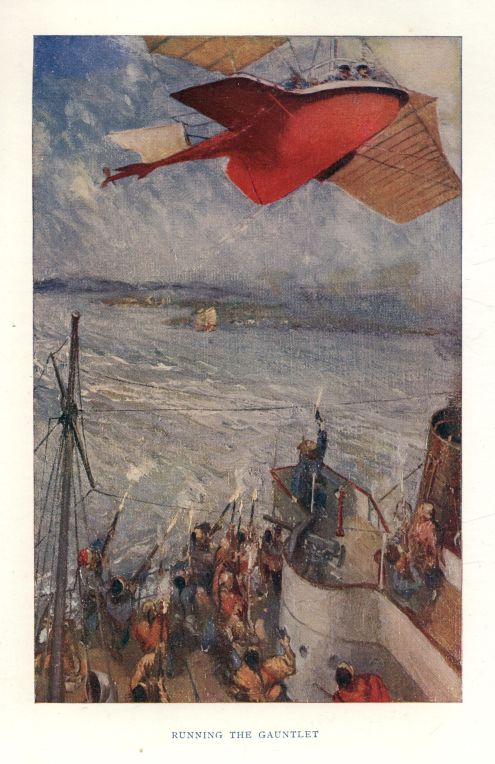
RUNNING THE GAUNTLET
There fell a sudden silence. Burroughs' intention had been seen by the gunners, and as they could not lift their pieces high enough to take aim at the vessel now that it was rising, and the range altering every moment, the gunboat was slewing round as if to head down-stream. It was broadside against the stream when the flying boat flashed by at a height of sixty feet. The occupants heard the reports of several rifles; but they were now travelling at the rate of fifty or sixty miles an hour, and nothing but a shower of bullets from the machine guns had any likelihood of striking them.
"All right now," said Errington, with a gasp of relief, when the flying boat was a good two hundred yards down-stream, and the gunboat was still turning.
"I hope so," replied Burroughs.
He glanced from right to left, undecided whether it would not be advisable to strike inland and return to the river lower down; for the channel was pretty straight for a long distance, and the vessel, if it flew directly forward, would still be in danger from the guns. In a few moments, however, he decided that there was even more risk in leaving the river if any mischance should happen to the boat. For one thing, the longer he flew, the more petrol he consumed; for another, if the engine failed, and he was forced to descend, on land he would be at the mercy of any wandering predatory band, whereas on the water he could always drift on the current, with some chance of safety if he did not happen to be observed. Accordingly he flew straight ahead, intending to sink upon the surface as soon as a bend in the river hid the vessel from view.
In another half-minute the machine guns recommenced firing. The aim of the gunners appeared to be even wilder than before. Chung Pi and the servants had recovered courage enough to rise to their knees and peer over the edge of the canvas side at the gunboat far behind. The captain laughed as he heard the report of the guns, and made a jocular remark about the paltry skill of Su Fing's gunners. There was no longer the whistle of bullets flying around, nor the slight ripping sound of the shots passing through the planes. It seemed that all danger was over.
The flying boat was now skirting the edge of the swamp in which it had been concealed by the river pirates, and Errington remembered that Burroughs had never heard the full story of that strange episode. He had been tempted to refer to the matter during the lunch with Reinhardt, but the German was in a sense their guest; and since Burroughs did not mention it, Errington said nothing. After all it was Burroughs' affair. The story would keep until they reached Sui-Fu.
They were now about three-quarters of a mile from the gunboat, and Burroughs, with his eye on a bend in the course a short distance ahead, just where the painted rocks gave warning that the water-way was not clear, was congratulating himself that at that point he might safely descend. Suddenly the firing behind redoubled in fury; it seemed that the gunners had realized that in a few seconds their chance would be gone. Bullets sang around; the Chinamen again ducked their heads below the gunwale; and once or twice there were the ominous sounds of bullets tearing through the planes, or flattening themselves against the metal parts of the framework.
They were within a hundred yards of safety when a double catastrophe happened. Almost at the same instant the engine ceased to work and one of the stays was cut clean through. In the excitement and anxiety of the moment Burroughs was unaware that he was wounded, and a cry uttered by Chung Pi passed quite unnoticed. The vessel tilted; for a terrible second it seemed that it must turn completely over; but Burroughs by a dexterous movement succeeded in partially righting it, at the same time shifting the rudder so as to steer to the right over the swamp. He had at once recognized that to fall into the river would have thrown the whole party into the hands of the rebels. Flight and hydroplaning were equally impossible; and the only chance of evading capture was to steer over the swamp. He had seen at a glance that the intricate network of channels, overgrown with weeds, might furnish a temporary refuge until the vessel's injuries had been examined and if possible repaired.
The momentum of the boat carried it perhaps a quarter of a mile after the accident happened. Burroughs was able to bring it safely to the surface of one of the channels.
"Here's a pretty look-out!" he said to Errington. "They'll see what has happened, run down at full speed, and be up with us in ten minutes at the most. Luckily the gunboat can't follow us into this swamp; they'll have to lower boats to find us; we've got a few minutes to discover a hiding-place."
"That's all right, old man," said Errington cheerfully. "I know this swamp. We'll give them a chase at any rate."
CHAPTER XIX
HIDE AND SEEK
At this point Errington assumed the direction of affairs--much to the contentment of Burroughs, who had now learnt by the pain in his shoulder that he had not run the gauntlet unscathed. But Errington was by no means happy. It was one thing to enter the swamp by the broad channel from the river, and quite another to come down into it from the air. He had at once thought of seeking out the deep reed-screened recess where he had discovered the flying boat. The huts, of course, might be occupied; in that case some other hiding-place must be found; but the fact that they had been empty on the occasion of his first visit seemed to show that they were inhabited only occasionally, and by good fortune they might be deserted now. It was scarcely probable that the crew of the gunboat were the same men who had been engaged in Reinhardt's little act of piracy, so that only by the most extraordinary coincidence would they spontaneously make for the same hiding-place. If he could only discover it, Errington hoped that the boat might remain concealed while the necessary repairs were made.
But it was nearly dark. In such a labyrinth of waterways one might go hither and thither perhaps for hours without coming into the channel leading to the clear pool. Still the attempt must be made; and there was a chance that even if the former hiding-place were not discovered, some other secluded spot might be found that would serve equally well. The danger was that two or three boats would be employed in searching for them, one or another of which might be lucky.
There was no time to be lost. The first thing was to fold back the planes, which were an encumbrance to the vessel at all times on the water, and especially among the reed-beds. The next thing was to get out the punting poles with which the boat was provided, and propel it up the channel; the farther they got from the river the better.
The Chinese servants plied the poles, while Errington steered, and Burroughs sat near Chung Pi, condoling with him on his misfortune in being wounded at the eleventh hour.
"It is a mark of honour for the captain to be wounded when the private escapes," said Chung Pi; but as it was difficult for either Lo San or Chin Tai to interpret while attending to their task, the two wounded men relapsed into silence, regarding each other with mutual sympathy.
An altercation sprang up between the two punters. Each declared that the other was a fool, and would wreck the boat. Lo San, presuming on his acquaintance with the swamp, let fall slighting remarks on Chin Tai's ignorance, which exasperated his fellow-servant. But mindful of Errington's threats on a former occasion, they subdued their voices; and since they spoke in Chinese, the Englishmen never knew what insults they hurled at each other.
Errington thought his best course was to steer straight up the channel into which the boat had fallen, rather than diverge to right or left into the cross channels to which he came at frequent intervals. The sky was growing darker and darker; it would soon be impossible to proceed, and the prospect of spending the night in comparatively open water, with the chance of being stumbled upon by the pursuers, or spied in the morning, was exceedingly damping to the spirits. A very few minutes after the vessel had been got under way, the throb of the gunboat's engine was distinctly heard; and Errington, ordering the men to keep silent, shortly afterwards caught the sound of voices and then the thud of oars from the direction of the river. There was little doubt that two, if not three, boats had been lowered from the gunboat, and were already coming at a good pace into the swamp. This was, however, so broad that the fugitives were fairly safe for the present. The pursuers might, indeed, by some unlucky chance, know of the hiding-place which Errington was seeking; but they could not have any reason to guess that Errington knew of it, unless they had among them some of the men from whom he had escaped before; and in any case the growing darkness would render it as difficult for them as for Errington to make their way there.
For some time the vessel was punted slowly along; the sounds of pursuit drew nearer; and Errington almost despaired of succeeding in his quest when Lo San gave a low exclamation, and signed eagerly to his master to steer to the right. In another minute the boat emerged into the pool. To cross it was the work of only a few seconds, and Errington recognized with great relief the opening of the narrow, tortuous passage through which the boat had been towed. Leaving the steering wheel, he got over the side into the water, and went to the nose of the boat, so that he might the more easily prevent it from sticking in the reed-beds. Thus, wading and punting, they forced the vessel through the passage until they came within a few yards of the patch of dry land.
Here they stopped for a few minutes, while Errington stole forward and reconnoitred. There were the huts, just distinguishable in the darkness. All was quiet. The same few broken sampans were drawn up on the shore. In the midst of the open space was the cooking-stove at which the old Chinawoman had been broiling fish. Errington, with many a cautious look around, stepped on to the shore and walked rapidly but stealthily up to the huts. He paused at each, listening. No voices, no snores, came from within them. The place was deserted.
Returning to the boat, he brought it from out its shelter among the reeds, and soon had it drawn up for a few feet on the muddy shore. Every one of the party breathed more freely. They sat on the sampans to rest. For some little time no one spoke; they all listened intently: would the pursuers come to the same spot? They could hear voices, faint in the distance; but the sounds seemed to be receding. It appeared certain that, whether they knew of it or not, the pursuers were not at present rowing in the direction of the hiding-place. Presently absolute silence reigned; and Errington reckoned that they were lucky in having approached so late in the evening, when the wild fowl had settled themselves; otherwise they might have been betrayed by the birds' flight.
"We can't see what's wrong with the machine in the darkness," said Burroughs at length, in a whisper; "and we daren't strike a light."
"No; the only thing we can do is to wait for morning," replied Errington. "We shall pass a wretched night, old man."
"It might be worse. I only wish I hadn't got this whack in the shoulder; it stings horribly."
"I can bathe it and tie it up; hope it's not serious; but if we can get the machine mended we shan't be long running down to Sui-Fu in the morning, and then we'll soon put you to rights."
Errington took a dipper down to the water, filled it, and returned to bathe Burroughs' wound. Lo San met him.
"Captin he glumble velly much," he said. "He say wantchee chow-chow; long time he hab catchee nuffin to eat."
Burroughs had brought a little food from Sui-Fu--enough to provide himself and the two Chinamen with meals for a day. A portion of these provisions still remained; but knowing Chung Pi's appetite, he doubted whether the captain would be satisfied if the food were divided.
"Tell him he can have a crust of bread, a sausage end, and a mug of beer," he said. "We haven't got any melon seeds or sam-shu."
Chung Pi gobbled the food with great celerity, but drank the beer in slow sips, having been assured that he could have no more. He still grumbled very much, and it struck Burroughs suddenly that cold and hunger might so work on the captain that he might be tempted to betray them. Henceforth he would be a marked man so far as the rebels were concerned; and the chance to reinstate himself in the favour of his chief, Su Fing, might prevail over the prospect of advancement at which he had mysteriously hinted.
"You two men keep your eye on Chung Pi," said Burroughs to the servants. "He's not to stir from the sampan he's on. Show him a knife if he objects, but don't use it."
Burroughs need not have been alarmed. Chung Pi slept through the greater part of the night; and in the intervals of wakefulness he comforted himself for the cold and hunger he felt by blissful imaginings of plenty of sam-shu and melon seeds in a not distant future.
It was a wearisome, comfortless night for the two Englishmen. The cold was intense, and the want of food rendered them the less able to bear it. Burroughs' shoulder, too, gave him much pain, and became very stiff. During that long darkness the friends talked of many things--of old times, of recent experiences, of the future. Errington related the full story of his recovery of the flying boat; Burroughs in return told at greater length than he had done in the yamen the pilgrimage which Lo San had undertaken for his master. Errington said nothing to Lo San at the time; but he resolved to requite his servant's devotion substantially if they got safe home.
They discussed one matter about which Errington was troubled. His dismissal from the service of Ehrlich Söhne was in one sense a relief; he wished to have nothing more to do with Reinhardt, and remembering that the German held a cheque for three months' salary, he was glad to think that here was a means of liquidating his debt. But he felt much depressed about the future. His late firm was of good standing, and to be dismissed by them for what Reinhardt called "irregularities" made him fear that other employers would hesitate to take him into their service.
"That's absolute rot," said Burroughs, when Errington spoke of his fears. "Nobody will think any the worse of you in the end. Making an ass of yourself----"
"Rub it in!" interrupted Errington gloomily.
"Well, we all do it some time or other; and making an ass of yourself isn't a crime, or the prisons would be pretty full. There are plenty of firms as good as Ehrlich; if I didn't know how touchy you are I'd suggest your joining us; the pater----"
"Dry up! D'you think I'll ask your governor for a crib when I'm a rank failure, a regular rotter? A pretty fine thing that 'ud be, in return for all his kindness!"
"There you are! I knew that's how you'd take it. A failure! Why, you're no end better at business than I am. Everybody knows it. Look here, just shut down on those idiotic notions of yours. Chuck 'em away. A fellow that never made a mistake never made anything, somebody said. It's jolly well true. Of course, if a fellow goes on making mistakes, can't learn, hasn't got the sense or the will-power to pull up, he is a rotter, and there's no good disguising it. But many a juggins has turned out a jolly fine chap; in a year or two you'll laugh at yourself, and----"
"And thank my stars I had such a pal as the Mole, even if he does lecture a bit. Why didn't you say all that and other things before?"
"Well, you know--I--well, I suppose I was a juggins too, but you'd have shied a brick at my head if I had, wouldn't you?"
What more they said need not be told. That talk in the dead of night, under the silent stars, knit them closer together in a friendship which neither time nor circumstance will ever break asunder.
As soon as there was a glimmer of light they inspected the vessel. The damage was greater than they supposed. The petrol pipe union had been snapped; one of the stays of the starboard plane was broken in two; and a bullet had pierced a hole near the bottom of one of the petrol cans, the contents of which had almost entirely trickled away. They had only another half can of the spirit left. This was a very disturbing discovery, but it suggested at the same time what a lucky escape they had had. They might well have expected that the heat caused by the impact of the bullet would set the petrol on fire.
"Rather a long job before us," said Errington; "that is, if we try to mend the stay."
"The pipe won't take long," said Burroughs. "There's a bit of rubber tubing in the locker. We can stick the broken ends of the pipe into that. The stay is a different matter."
"Couldn't we leave that alone, and trust to our speed on the water?" Errington suggested.
"Rather risky. Unless the blackguards have got sick of waiting all night and sheered off, they'll spot us as soon as we take the river, and another shot might do for us altogether. No; we must mend the stay somehow, and then fly inland until we're out of harm's way--until the petrol gives out."
"But the stay must be welded; and we can't do that without hammering. If the gunboat's crew are anywhere about they are sure to hear the row, and find us out in no time."
"We'll have to chance that," said Burroughs. "A worse thing is the want of proper tools. There's a hammer in the locker, but we haven't got a forge. We can make a fire in that old stove there; but we've no bellows, and we can never get heat enough without."
"Never say die. Where there's a stove there ought to be bellows. I'm going to look round. But work before breakfast, and no supper the night before, doesn't make you feel amiable, does it?"
"While you are looking for the bellows I'll stroll along the shore and find out what sort of a place we're on. It's just as well to know something about our whereabouts."
Burroughs walked past the sampan where Chung Pi had passed the night. A thick white mist lay over the swamp, through which nothing was visible beyond two or three yards. Chung Pi was sitting in the sampan with his arms tightly folded. He seemed to have shrunk; Lo San and Chin Tai also were blue with hunger and cold. Burroughs felt sorry for them all.
"I regret having been compelled to inflict these inconveniences on you, noble captain," he said; "it is a pity our charms have not availed."
"Ah! If you had not gone back for the second talisman we should have been safe," said Chung Pi mournfully.
Burroughs had heard nothing about the second talisman, but he did not ask for an explanation, merely promising that Chung Pi should enjoy a substantial feast as soon as they reached Sui-Fu.
Proceeding along the shore, picking his way carefully because of the mist, he had walked for about a quarter of a mile when he came suddenly upon a sampan, and halted, fearing that it might belong to the enemy. But as he stood there surrounded by the clinging fog, he heard Errington's voice apparently only a few yards away. The explanation flashed upon him at once. They were on a small island, encompassed by a continuous screen of reeds. This was in a measure reassuring, for it diminished the risk of being discovered.
He moved forward. Errington saw a figure looming through the mist, and instantly challenged.
"It's all right, Pidge. I've made a tour of the place; it's an island. Any luck?"
"Yes, I've found a cranky pair of bellows, very Chinese, in one of the huts. We can start our forge at once.... Hullo!"
The exclamation was provoked by the sound of a shot in the distance.
"What's that mean, I wonder?" said Burroughs.
"Don't know. Shooting a duck for breakfast, perhaps. It's pretty clear that the beggars haven't given us up. When we start hammering they'll hear us and are sure to find us out."
"Better carry the stove into one of the huts and shut yourself up there. The sound will be deadened then. I wish now I'd brought my engineer; he'd have made a better job of it than you and Lo San; I can't help, I'm sorry to say; my wretched arm is as stiff as a poker."
"I've taken off the broken stay; half-an-hour's work ought to finish the job as soon as we get the fire going. This mist is a godsend; they can't see our smoke."
"Well, you take the two boys to lend a hand in the hut, while I keep an eye on Chung Pi and listen for the enemy."
The servants carried the stove and the broken stay into the largest of the huts. One of the others furnished plenty of wood for the fire, and in a few minutes they had a good blaze, and began the work of welding the stay. Burroughs was disconcerted to find that although the hut was shut up as closely as the ramshackle timbers allowed, the sound of hammering was distinctly audible outside. He sat on the sampan beside the dejected figure of Chung Pi, peering through the mist, and listening intently.
By and by he fancied he heard voices from the direction of the channel, and a few minutes afterwards the muffled splash of paddles struck his ear. He waited until he was no longer in doubt that the sounds were approaching; then, taking Chung Pi by the sleeve, he hurried him up to the hut where the work was going on.
"They're coming this way, Pidge," he said. "Better knock off until we know what's happening."
"I'll take Lo San down to the shore," said Errington. "Let us hope they'll miss the place."
At the shore Errington and the Chinaman stood listening in silence. The sound of paddles was now distinctly audible, growing louder every moment. Presently there were mingled with it the high-toned voices of Chinamen.
"Can you hear what they say?" Errington whispered.
Lo San bent forward.
"He say 'Come this side,'" he whispered. "He savvy this place all same."
"How many boats?"
"My tinkee two piecee sampan. Hai! He say: 'This side bobbely; muss belongey place where tings belongey pilates.'"
Such fragments as these were alarming. The boats could not be more than thirty yards away, and it seemed as though one of the men knew of the pirates' lair, and having suspected that the hammering had proceeded thence, was trying to guide the party towards it. But gradually the sounds receded. Lo San heard one man suggest that they should go back to the ship. Apparently they had failed to find their way in the mist. A more distant voice seemed to acquiesce in the suggestion, and the sounds died away until there was again complete silence.
Then Errington returned to the hut and resumed work on the stay, while Burroughs, this time leaving Chung Pi behind, went down to the shore to keep watch. The mist was gradually lifting; the screen of reeds facing the island first became visible, then a short stretch of the waterway that cut it in two. Little by little the whole prospect became clear; from behind came the dull hammering.
It was perhaps half-an-hour after Errington had recommenced work when Burroughs again caught the distant splash of oars. He instantly ran up to the hut and gave the word to cease work; then returned with Errington and Lo San to the shore. Nearer and nearer drew the sounds. There was no doubt that the pursuers were making in the direction of the island.
The watchers dropped down behind one of the stranded sampans and peered anxiously over the edge. If the approaching boat or boats came within sight of the island, to escape discovery was impossible. The Englishmen thought dismally of their chances if it came to a fight. They had a couple of revolvers; the Chinamen had their knives; but the pursuers, besides being more numerous, were without doubt completely armed. There could be only one end to the struggle, and there was no means of avoiding it. The stay was not completely repaired; it had to be refitted to the plane; and if the pursuers' boat held on its present course, as indicated by the growing sound, it must come within sight of the island long before the hydroplane could be got ready.