THE FLYING BOAT (continued 2)
Reading edition
After proceeding for a few yards, however, he found that the water became slightly deeper, and there were some signs of the reeds having been cut. An attempt had apparently been made to clear a channel. His former idea returned to him; perhaps it led to an encampment after all. He drove the sampan on with even greater caution, becoming more and more interested as he noticed how the channel wound this way and that among the thickest beds of rushes.
Threading this tortuous channel for perhaps a hundred yards, he came with startling suddenness upon the object of his search. The reeds came to an end, and on a stretch of firm ground, rising three or four feet above the level of the swamp, four or five low ramshackle huts, constructed of poles and matting, stood about thirty yards back from the edge of the water. The space between them and the water was littered with an extraordinary miscellany of objects, all of them of a more or less imperishable character--pots and pans, vases, tiles, native images, and other things, which from their arrangement in bales, bundles, or stacks, appeared to be articles of merchandise, but not in actual use here.
With his knowledge of the kind of thing that went on in these swamps, Errington at once guessed that these objects were the spoil of trading vessels captured by the river pirates and brought to this cunningly devised or carefully sought hiding-place. There were black rings here and there on the ground that were without doubt the marks of camp-fires. But the place had a deserted, a neglected, look. The huts were boarded up, except where they were so tumbledown that no such precaution was possible. Three or four old and rickety sampans were drawn up at the brink. But the object which had been towed by the dinghy was floating, secured by a rope to one of the uprights of a ruined hut close to the shore.
Errington looked at it curiously. It appeared from its shape to be a boat of some kind, but being completely covered with matting its outlines were indistinguishable. Wondering what its contents could be, to be so carefully covered up, Errington punted the sampan alongside, and lifted a corner of the matting. What he saw gave him a surprise comparable only to a galvanic shock. Underneath was a stretch of canvas that exactly resembled a wing of the flying boat, folded back, as Burroughs' custom was when the vessel was not in use. Lifting the matting further, Errington had no more doubt. The object before him, shapeless and ungainly as it was under its cover, was indeed the flying boat.
Lo San's astonishment was equal to his own. The Chinaman uttered a smothered "Hai!" then looked fearfully around, as if expecting that the sound would bring a crew of the dreaded pirates yelling about them. But there was no sound, no sign of life.
Errington's first impulse was to tow the vessel out, and convey it to his own station. Then a doubt crossed his mind. The dinghy which had brought it to this spot had been unmistakably of European build. The vessel from which it had come was probably not far distant. Perhaps Burroughs himself was on it. Errington puzzled his brain to hit upon any reason why his old friend should have wished to conceal his hydroplane in this swamp. Had he come up on business, or pleasure? Could it be that Mr. Ting, in his journey down-stream, had called at Sui-Fu, informed Burroughs of the mess into which Errington had got, and persuaded him to come up and attempt to set matters right? The thought made him angry. He flushed hot at what, in his perverted imagination, he looked upon as a breach of confidence.
"Hanged if I'll interfere!" his thoughts ran. "I'm not the keeper of the thing, confound it!" (This was the vessel in which he and Burroughs had spent so many pleasant hours.) "A pretty ass I should look if I took it back, and found that the Mole intended it to be hidden. The place is evidently deserted. No, I'm dashed if I do anything. It's no concern of mine."
Dropping the matting back, he swung the sampan round, and begun to punt somewhat savagely towards the pool. The old sore was reopened. The occupation and excitement had for a time banished all recollection of his wretched circumstances; but everything now came back to him; the weight bore down again upon his spirit.
"Makee too muchee bobbely,[#] sah!" murmured Lo San anxiously.
[#] Noise.
The warning recalled Errington's caution. He was still within the pirates' hunting-ground. He took care to urge the sampan less violently; but, on coming safely to the river, resumed his energetic movements. It was a long pull back, and he was tired when, late in the afternoon, he again reached the town.
CHAPTER VIII
CROWDED MOMENTS
Feverishly anxious not to be left alone with his thoughts, Errington was glad to accept an invitation to dinner that evening with an Englishman with whom he had lately become rather friendly. They were sitting over their coffee when a third member of the little community came in.
"Sit down, Hamilton," said Errington's host, whose name was Stevens. "Have a cigar? You look as if you'd hurried up. Anything wrong?"
"Same old thing. The rebels have licked the Government troops, and are marching on Cheng Tu. The same performance will be gone through, I suppose: riot and burning, a bit of a massacre, a scare among the Europeans; then the Viceroy will take it in hand; he'll pay for the capture of Su Fing; his head will fly, and then we'll have peace for a year or two. All comes of education, Stevens; you don't agree with me, I know; but if they weren't so desperately fond of examinations and remained in their primal ignorance, I believe there'd be no rebellions. Su Fing has passed more examinations than any other man in the province."
"Well, let's be thankful they're so far away. They won't trouble us."
"I'm not so sure. You know young Burroughs of Sui-Fu? You know him, of course, Errington?"
"Yes."
Errington had never spoken of Burroughs or his intimacy with him: the subject was too sore.
"Well, that flying boat of his of which we've heard accounts has disappeared. I don't know the particulars, but we got a wire an hour ago asking us to keep a look-out."
"A trick of the river pirates, I suppose," said Mr. Stevens: "nothing to do with the rebellion."
"Perhaps not; but Su Fing owes Burroughs a grudge for his interference in that affair with Ting Chuh. By the way, weren't you in that too, Errington?"
"I lent a hand."
"If Su Fing isn't in it himself, you may be sure some of his people are, and it looks as if we shall have trouble all up the Min."
"You're not going, Errington?" said Mr. Stevens, as his guest rose.
"If you don't mind. I've a bit of a headache, and mean to turn in early."
"Sorry. Well, come up to-morrow, and we'll have a rubber. Good-night."
The headache was not feigned, but Errington's principal reason for leaving early was that he wished to think over the news he had just heard. The flying boat had been stolen, then! He could hardly explain to himself why he had said nothing of his discovery; unconsciously, no doubt, he felt that to speak would have opened up the matter of his lost friendship with Burroughs--a matter which he could not have discussed.
"What a fool I was not to bring it away!" he thought. "Yet why should I bother myself? The Mole's no pal of mine now. Let him look after his own property."
But this attitude did not last. The roots of the old comradeship remained, though the leaves had withered. In the night recollections of former days crowded upon his mind, and his thoughts of the Mole became more kindly.
"Hanged if I don't fetch it, and send it back to him," he said to himself.
He got up about four o'clock in the morning, called Lo San, and told him to put some chapatties and soda water into the sampan.
"We're going to fetch Mr. Burroughs' flying boat," he said.
"No this time, sah," said the servant, anxiously. "No belongey leason.[#] Plenty bad fellas longside ribber."
[#] It's unreasonable.
"Sa-ni kow-tow[#]!" cried Errington, using a phrase often employed by the common people. "You no come, I go all-same alone. Savvy?"
[#] I'll cut off your head.
But Lo San, like most of his kind, had a sense of loyalty. He made no further protest, but went sullenly about the preparations for the journey.
Errington, now that he had made up his mind to get the flying boat, determined to leave nothing undone to ensure success. He took a rifle as well as his revolver, and gave similar weapons to his "boy." It occurred to him that he would have done more prudently in enlisting help among the other Englishmen; but he took a sort of grim pleasure in setting out unaided; it would be heaping coals of fire on Burroughs' head, he thought, to restore the flying boat to him. And he did not mean him to know to whom he was indebted for its recovery.
They left the town before sunrise, when nobody was about. In his pursuit of sport on the previous day Errington had been led on so insensibly that he had not taken particular note of the course; and as Lo San, with the China boy's usual indifference, had left everything to his master, they were some hours in discovering the channel through the swamp. Then, however, they proceeded rapidly, though with great caution. On arriving at the broad pool, they moved slowly round it, prying up and down the channels opening from it, to make sure that no other craft was in sight. Then they crept into the tortuous passage to the right among the reeds, and silently approached the shore where they had seen the flying boat.
Errington had reason to bless his circumspection when, on rounding the last curve, he caught sight of six or eight sampans drawn up on the shoaling ground. He instantly checked his own craft and withdrew a few yards into the reed-bed, where he could see, without being seen. Two or three of the better shanties, which on the day before had been boarded up, were now open. A wizened old Chinawoman was cooking fish at a small stove in the open space in front--no doubt a late breakfast for the crews of the sampans, who were resting after nocturnal prowlings.
Errington considered what he should do. In his decision impulse and calculation had an equal share. An alarm would bring perhaps a score of pirates after him, and it would be impossible to tow the flying boat fast enough to escape the pursuit of the pirates' sampans. Even with nothing in tow, he could not propel his craft so rapidly as these men who lived on the river. Nor could he bring the boat away by its own power, for the engine could not be started without noise; and supposing he got away in time to escape the rifles of the pirates, he would almost certainly stick in a reed-bed and fall an easy prey. Besides, the engine might not be in working order. If the flying boat was to be brought away, swiftness and silence were equally necessary. There was little doubt that as soon as the meal was cooked, the Chinawoman would rouse her employers.
The bow of the flying boat touched the shore, where, as Errington had noticed on the previous day, it was held by a rope attached to a ruined hut. The stern was partially concealed by a thin clump of rushes. Errington made up his mind that he must get on board, approaching through these rushes, and discover whether the engine was in working order, and whether there was any petrol on board. If the engine was workable, Lo San must tow the vessel out until he reached clear water, while he himself got ready to run it under its own power.
It was a chilly morning, but Lo San was shivering rather with fright than with cold. He looked aghast when his master told him in a rapid whisper the plan he had formed. But he knew that his best chance of saving his skin was to do as he was told, and at Errington's order he gently propelled the sampan until it lay within the shelter of the reeds near the stern of the flying boat. Telling him to remain perfectly still, Errington let himself gently down over the side, carrying a rope; then, keeping the flying boat as much as possible between himself and the old Chinawoman, he waded the few yards that separated him from the stern of the vessel. To this he made fast the rope; then, gently lifting the matting a foot or two, he clambered as quietly as possible over the side and into the hull.
A little light filtered through the meshes of the mats, but not enough for his purpose. Accordingly he took out his knife and cut a slit in the covering on the side away from the huts. Then, crouching low so that the matting should not be disturbed by his movements, he crept to the engine.
He found that the petrol tank was nearly empty, but luckily there were two or three unbroached cans of the spirit. One of these he opened, and poured the petrol in a slow noiseless trickle into the tank. It was impossible without noise to test the machinery, but he examined it as carefully as he could in the dim light: everything appeared to be in order.
Now crawling into the fore part of the boat, he slipped his hand between the matting and the gunwale, and cautiously cut through the mooring-rope. It fell into the water with a dull splash; fortunately the vessel was so low built that the rope had only a foot or two to fall. Waiting until the unbroken silence without assured him that the old woman had not taken alarm, he crept back again towards the stern, lowered himself into the water as silently as he had raised himself before, and began to haul very gently. The shore was soft, so that the movement of the keel over it made no sound; on the other hand, the soil clung to the keel, and to move the vessel required more force than Errington expected. But it slid inch by inch towards the water, and might have floated in absolute silence had Errington been able to see what he was doing. But just at the critical moment, when the most minute care was needed, he pulled a little harder than he should have done, and the bow dropped into the water with a splash.
Errington, hidden behind the stern, did not see the little contretemps which might have provoked a smile from Lo San, if he had had any sense of humour, and had not been quaking with fright. At the splash the old woman looked up from her cooking, in the direction of the waterway through which the sampans had come. Seeing nothing there, she muttered a malediction, and was turning to her stove again, when she happened to notice that the mat-covered craft a few yards away was floating free, and that the mooring-rope lay on the shore. Without any suspicion other than that the vessel had somehow worked loose, she dropped the fish she had been preparing, and hobbled down the shore with the intention of tying the boat up again. Quickening her steps as she saw that it was moving away, she leant forward to clutch it, missed her footing, and plunged headlong into the water with a stifled scream.
Hitherto Errington had carefully kept out of sight; but at the double sound of scream and splash he could not refrain from peeping round the side of the boat. The old woman was floundering in the effort to regain her feet. The water was no more than three feet deep, but the bottom was muddy, and the woman, scared by what was probably the first immersion of her life, could not stand up, but was still on hands and knees, only her head showing. Errington had never heard such screaming. Fearing that the old creature would be drowned, he rushed forward in his impulsive way to help her.
His chivalry deserved a better reward. The old crone, as soon as she saw him, let out a series of even more piercing shrieks than before, and, finding her feet at last, scrambled ashore, and with a limping trot like that of an aged cab-horse, fled towards the huts. "Fan-kwei! Fan-kwei[#]!" she screamed, rubbing her wet face with her fishy fingers.
[#] Foreign devil.
Even as he had reached her, Errington repented of his impulse, for the woman's shrieks had already drawn a grimy head to the entrance of one of the huts. The pirate was presumably too sleepy, or too much confused at the sudden awakening, to see clearly what was going on, for he gave Errington time to dash back to the stern of the boat. Hauling it through the reed-bed--and it required little force now that the vessel was afloat---he fastened the stern to the sampan with a few turns of the rope, telling Lo San to paddle with all his might towards the water-way.
The Chinaman needed no second bidding. The huts were already discharging their fierce-eyed occupants. Lo San paddled with an energy of which he had never shown himself capable in the service of his master. Errington waded beside the flying boat, doing what he could to fend it off the reed banks. He was already out of sight of the huts, but the yells and execrations behind showed only too clearly that the pirates were launching their sampans in pursuit. Had he got sufficient start of them to gain the pool?
"Ossoty! ossoty[#]!" he cried to Lo San, and the panting Chinaman put still more force into his strokes. Errington looked behind, but the windings of the channel, and the encumbering reeds, prevented him from seeing how near the pursuers had come. His momentary turn caused the boat to jam against a clump of rushes, and a few seconds were lost while he went to the bows and with a heave of the shoulder sent the vessel once more into the stream.
[#] Make haste.
In a few seconds more, Lo San gave a jubilant shout of "Hai galaw!" He had come to the pool. Instantly Errington sprang into the flying boat and, telling the boy still to paddle hard, flung off the matting and switched on the current. To his intense relief the sparking was instantaneous.
"Stop!" he yelled.
Lo San dropped his paddle. The propeller was whirling round, and Errington with his hand on the wheel turned the vessel towards the open channel. A sampan shot out from the network of reeds behind them. The man in it uttered a shout, threw down his paddle, lifted his rifle, and fired. Lo San tumbled into the bottom of the sampan, which was now being towed by the hydroplane. Errington did not see him; his eyes were glued on the channel in front. He dared not as yet put the engine at full speed; the reed-beds on either side projected here and there too far into the water-way; if the propeller became entangled the game would be up. More sampans emerged from the rushes; more shots were fired; but the pirates' marksmanship was wild, and seeing that the hydroplane was going at a slow pace, they ceased firing and paddled frantically on, hoping to overtake the vessel before it came clear of the channel into the main stream.
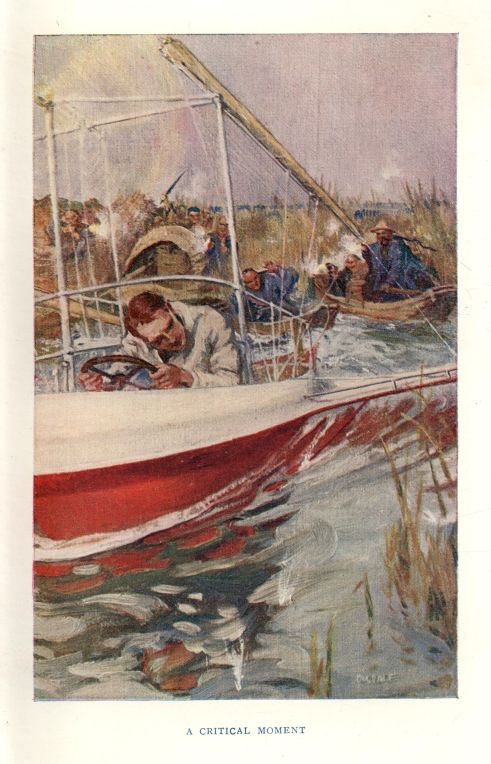
A CRITICAL MOMENT
The foremost sampan was within a few yards of the little craft in which Lo San, quite unhurt, lay cowering in the bottom, when Errington at last considered it safe to open his throttle. The hydroplane shot forward at a pace that seemed to snatch the following sampan out of the very hands of the pursuers. From this time the chase was hopeless. The pirates paddled on a short distance further, then stopped, yelling with rage, and firing after their quarry with blind fury. Not a shot took effect. The hydroplane was soon out of sight, if not out of range.
Errington looked behind. Lo San was not to be seen. With a qualm lest the boy had been hurt, Errington slowed down, stopped, and waited anxiously until the sampan came up by its own momentum.
"Are you hurt?" he cried, seeing the boy inert.
"No, sah: velly muchee funk," replied Lo San, without offering to rise.
"Then get up, you owl, and come aboard," said Errington. "Lug the sampan up after you. First chop numpa one fightee man you are."
"My no likee fightee pidgin," mumbled the boy, as he clambered up.
"You belongey chow-chow pidgin,"[#] said Errington. "Sit down."
[#] You're better at eating.
And starting the engine again he ran into the open river, and rushed up-stream against a strong current at the rate of twenty-five knots.
On arriving below the town, he steered the vessel into a narrow unfrequented creek, lowered the sampan, and finished the journey as he had begun it.
"Don't say a word about this, or I'll sack you," he said to Lo San.
He walked up the town, to the office of the local agent of Mr. Burroughs.
"Mr. Ted has lost his flying boat, I hear," he said unconcernedly.
"Yes," replied the agent. "It was stolen yesterday."
"Well, the thieves apparently didn't know what to do with it. You'll find it in the creek just below Mr. Stevens' wharf."
"You don't say so, Mr. Errington! That's extraordinary. I'll wire to Sui-Fu at once."
"You had better say that you'll send it down in tow of the first steamer. That'll be safe enough, I think."
"I'll do that; but maybe Mr. Ted will come up and fetch it himself. I'm glad it's so soon found, any way."
"Yes. And oh!--I say, you needn't mention me," said Errington as he walked out of the office.
The agent telegraphed the bare news of the recovery of the vessel, and asked for instructions. But thinking over the matter, he felt a little puzzled at Errington's manner, and made a shrewd guess that he had somehow gained possession of the stolen vessel. He wrote next day to Burroughs, mentioning his suspicion.
Burroughs, who had himself housed the flying boat on the night preceding the disappearance, and heard of the theft early next morning, was naturally delighted to hear that his vessel had been recovered. But he felt somewhat surprised that it had been found at such a distance up the river. He had at once suspected that the theft was the work of river pirates, but so far as he knew they were quite unfamiliar with the working of a petrol motor, and they could hardly have towed the vessel so far against a strong current in the time which had elapsed between its loss and its recovery. He telegraphed to his agent to report how much petrol there was on board, and the reply that the tank was nearly full, and that there were two unopened cans besides, confirmed his belief that the boat had not travelled under its own power.
This made him suspect that it had been carried up on some larger vessel; but no steamer had gone in that direction, nor was it in any case likely that the boat would have been put on board any of the regular steamers--unless some one had purloined it for a joke. That was inconceivable. He mentioned the matter to his comprador, Sing Wen, who said that he would make inquiries.
Later in the day, the comprador reported that Reinhardt's motor launch had been seen within a few miles of the port, shortly before dark on the evening of the theft. A telegram to his agent brought the news that the launch had passed Chia-ling Fu on the following morning. Putting these two facts together, Burroughs came to the conclusion that the German had been concerned in the theft, though for what motive he could not imagine.
His agent's letter, suggesting that Errington had at least played some part in its recovery, gave him a good deal of pleasure. The severance of their friendship had troubled him, and Errington's complete silence since his removal to Chia-ling Fu had inflicted a deep wound. To him, looking back upon it, the cause of the quarrel appeared too trumpery to justify a permanent breach; but knowing his old friend's temper, he had hesitated to take the first step towards a reconciliation. And being somewhat stiff-necked himself when he believed that he was in the right, he could not bring himself to apologize for a wrong which he had not done.
Now, however, there seemed to be an opening, and he wrote to Errington the following note:--
"MY DEAR PIDGE,
"I've just heard that I owe the recovery of the old flier to you. Many thanks. I'm burning to know more about it, and would run up if I weren't too busy just now. When I can find time I shall come, and give you a call. I hope you like your new quarters.
"Yours ever, "THE MOLE."
Errington read the note with a curling lip.
"He thinks I've forgotten, does he?" he thought.
And he tore the note across, and threw it petulantly into the waste-paper basket.
CHAPTER IX
SU FING'S PRISONER
Four days after Burroughs dispatched his letter to Errington, when the lapse of time showed pretty plainly that it was not likely to get an answer, he received a visit from Mr. Ting. The merchant, though he had refused Errington's request for help, had not done so out of hard-heartedness or stinginess, but from a wish that the boy should learn a severe lesson, that would leave an enduring stamp. But when he had gone a few days' journey down the river his heart smote him. He was young enough himself to understand the racking anxiety which his old friend's son was suffering; and his knowledge of the desperate expedients to which harassed young fellows sometimes resorted, made him decide to return to Chia-ling Fu, so that he might be at hand to rescue Errington from the worst consequences of his folly.
He had called at Sui-Fu on his way up a few days before, intending to find out from Burroughs more precise details of Errington's circumstances; for as yet he had not heard of the split between the two friends. But Burroughs chanced to be absent up country, and they did not meet. On this second occasion, however, Burroughs was in his office when the Chinaman called.
"How d'you do, Mr. Ting?" he said; "sorry I wasn't in the other day. All well at Shanghai?"
"Yes, when I left. That is now some days ago. You are doing well, your father says."
"Rubbing along, you know. These disturbances up the river aren't good for business."
"That is tlue. And your flend Pidge--I have his school name, you see--will know that even better than you. I saw him a few days ago."
Burroughs did not reply, and Mr. Ting's observant eyes detected an air of constraint in his manner.
"You do not see him so often now, of course," the Chinaman went on. "That is a pity, when you are such good flends. It is a pity, too, that he is so fa' away. He did not look well: do you know what tloubles him?"
"He hasn't said anything to me," said Burroughs, looking still more uncomfortable.
"He has not sent you a letter lately?"
"No," said Burroughs, adding hastily: "but I wrote to him a few days ago."
"And you have heard of no tlouble he is in?" Mr. Ting persisted.
Burroughs hesitated: it was his way to think before he spoke. He had heard only gossip about the card-playing that went on at Chia-ling Fu, and it seemed hardly fair to Errington to discuss his personal matters merely on hearsay. Mr. Ting, of course, was his friend; all the more reason, thought Burroughs, for not telling what Errington himself had evidently not told. But Mr. Ting seemed to divine what was passing in the boy's mind.
"I think you had better tell me all about it," he said quietly. "I have a good leason for asking: we are both his flends. Tlouble neglected becomes still more tloublesome, as we say. Tell me, then."
"The truth is," said Burroughs, won over by the Chinaman's evident sincerity, "Pidge and I have had a row. A ridiculous cause. He thought I doubted his honour; I lost my wool----"
"Your wool! I do not understand: is it not cotton?"
"My temper, I mean," said Burroughs, with a smile. "A silly thing to do, because you always say more than you mean."
"Ah yes! Anger is a little fire: if it is not checked, it burns down a lofty pile. Well?"
"We parted on bad terms, and haven't spoken since. He said he wouldn't have anything to do with me till I apologized."
"And the apology? You sent it in your letter?"
"No, I'm sorry to say I didn't. Idiotic pride on my part, for of course I never really doubted him; only after you've had a row it's jolly hard to say so--to a fellow like me, at any rate."
"Then you come with me, and you shall be flends again. The yielding tongue endures: the stubborn teeth pelish. Now you have had confidence in me, I will be open too. Pidge has been gambling."
"I know," said Burroughs gloomily.
"And he owes a thousand dollars or mo'e. We must save him flom the men who have led him away, and turn him flom gambling. I asked him to plomise not to gamble again: he would not; plaps for you he will."
"I don't know," said Burroughs. "He is so touchy, you know; can't bear to be advised. We shall have to go very carefully to work. But there's a hope in what has happened lately. He can't really bear me a serious grudge, because he took the trouble to recover my flying boat and send it back to me."
"Hai! How was that?"
Burroughs told of the theft of the vessel, and of what had happened since. Mr. Ting listened attentively, and then related a curious story.
On his way up the river he had met the captain of a junk whom he occasionally employed, and in conversation with him learnt of a strange experience that had befallen him not far above Sui-Fu. He had been sailing down in his junk, and called at a riverside village to take on some goods. Having stowed his cargo, and wishing that the junk should reach Sui-Fu before night, for fear of the river pirates, he sent her on under charge of his mate, while he remained to negotiate a certain business transaction with an up-country merchant whose arrival at the village had been delayed.
On the completion of his business, just before sunset, he started in a sampan manned by two men, expecting to overtake the junk before she anchored for the night. Much to his alarm, when only three or four miles above the port, he discovered that a boat was dogging him. He did not know whether the crew were pirates or police: it was now too dark to distinguish; but as a matter of precaution he ordered his men to pull into the bank, and wait until the boat passed.
When he got within the shadow of some trees overhanging the stream, he was more alarmed than ever: the pursuers were also making for the bank. He was quaking in his shoes; but the boat, instead of coming directly towards him, passed by at a distance of some thirty yards, and disappeared.
He waited until it had had time to get out of earshot, and resumed his journey. But he had hardly gone a quarter-mile down stream, when he heard a low hail, and then the sound of several voices. Steering again into the bank, he looked down the river, upon which a crescent moon was throwing a pale light. And then he saw the boat re-appear, towing what looked like a launch into mid-stream. At the same moment he heard the throbbing of a motor vessel, and from round a bend in the river there came a large launch, which hove to as it reached the boat.
In a few minutes the motor launch was again under way, and as it passed rapidly up stream, the captain of the junk, being well acquainted with all the motor vessels on the river, recognized it at once as that belonging to Reinhardt. But it was not alone. It had in tow the smaller craft which had been drawn out from the bank. This smaller vessel would perhaps not have attracted the captain's attention had it not been somewhat curious in shape, owing, as he supposed, to a full cargo which was concealed under matting.
"There's not much doubt it was my boat," said Burroughs, when Mr. Ting had ended his story. His face had gone pale, and there was a twitching of his nostrils; but his tone of voice was perhaps even more equable than usual. Mr. Ting noted how he differed from Errington in that respect.
"It looks as if Mr. Reinhardt wanted to pick a quarrel," he added.
"Velly culious," said Mr. Ting, reflectively. "What you call a plactical joke, plaps."
"A kind of joke I don't appreciate," said Burroughs shortly. "I think Pidge must have understood that. He's thick with Reinhardt, who probably told him of the trick, and learnt that he had gone a trifle too far. Are you going up to Chia-ling Fu to-day, sir?"
"If you will come with me. A word of advice, if I may. Say nothing to Leinhadt about the matter until you know. One egg is better than ten cackles."
Burroughs discussed a few business matters with his comprador; his boy Chin Tai meanwhile packed his bag; and in an hour he was ready to accompany the merchant to his launch. They had crossed the gang-way, and were waiting for the skipper to cast off, when they saw an old steam launch coming swiftly down from the direction of Chia-ling Fu.
"Do you mind holding on a few minutes?" said Burroughs. "She may have a letter from Pidge on board."
"Velly well," said Mr. Ting, putting on his spectacles. "Lot of passengers, you see: velly culious."
The deck of the launch did, indeed, present an unusual appearance. Instead of the one or two white passengers who might have been expected at this hour--for the vessel must have left Chia-ling Fu very early in the morning--there was a considerable crowd of men, women and children. Every inch of standing room appeared to be occupied. And as the launch drew nearer, it was plain that the passengers were of all nationalities--German, English and Japanese traders with their families, English and French missionaries conspicuous among the rest by their Chinese garments.
"Looks like a general exodus," said Burroughs, his eyes narrowing. "Something is wrong."
"Yes," said Mr. Ting: "velly much long."
He recrossed the gangway to the quay. Burroughs, shading his eyes against the sunlight, remained on the boat, searching the crowd for the familiar tall form of Errington.
The launch drew in, and the merchants on board, recognizing Mr. Ting, began to shout to him; but all speaking together in their respective languages, it was impossible to make out what any of them said. As soon as they had landed, however, Burroughs, who had now returned to the quay, was singled out by his agent, and told of the exciting events which had happened at Chia-ling Fu.
For several days the European community had been in a state of nervous tension owing to reports of the successes of the rebels further north. Despite all the efforts of the ill-armed, ill-disciplined rabble that so frequently masquerades as an army in the interior of China, the insurgents had made great headway. They had captured Cheng Tu, and an attempt to retake the place had been defeated, with considerable loss to the so-called regular troops. The success of the rebels had brought, as is always the case, large accessions to their numbers. All the restless and turbulent elements of the province for two hundred miles round had flocked to the captured city. There were no Europeans there except a few French missionaries who were reported to be held prisoners, but to have suffered no ill-usage.
This news put every one at Chia-ling Fu on the alert. Arrangements were made to move down river at short notice. The Europeans recognized that, whatever might be the treatment of the missionary prisoners, the lives of any white men captured by the insurgents must always be in jeopardy. Even where their leaders desired, from policy, to protect their prisoners, the blood-thirstiness and anti-foreign prejudices of their ignorant following were always likely to force their hand.
It had been expected at Chia-ling Fu, however, that news of any southward movement of the rebels would be reported by native spies in time to enable the Europeans to make their escape. But just before dawn on this morning, they had been wakened by the sound of shots and a great hubbub. They sprang up, pulled on their clothes hurriedly, seized their arms, and sallied out to see what was afoot. They found the city already in the hands of the insurgents. Making a wide circuit by night, an immense force had crept upon the place from the landward side, and at the same time a large fleet of vessels of all descriptions, including two or three steamers captured at Cheng Tu, had come down the river and anchored at some little distance above the city. The sleepy sentinels at all the gates had been surprised and overpowered, the rabble poured in, and the place fell without striking a blow.
All these details were not known until afterwards: the confusion at dawn had been so great that the Europeans knew nothing except the bare fact that the city was captured, and that they were prisoners. To their great surprise, in a few hours they were all released, told to collect their belongings, and conveyed to the steamer which had just brought them down the river. Clearly the leaders of the insurgents intended to show that the rising was a purely domestic one; they did not wish to provoke action by the foreign Powers.
All the time that Burroughs was listening to the story told him by his agent, he kept his eyes on the gangway, hoping to see Errington step off. He recognized several acquaintances among the passengers, but his old friend did not appear.
"Where's Mr. Errington?" he asked his agent.
"Upon my word, Mr. Burroughs, I don't know. I never thought of him. I suppose----"
"Mr. Stevens, was Errington on the boat?" asked Burroughs, stepping towards the gangway and taking the merchant by the sleeve.
"Errington! Of course he was. That is, I suppose so. We are all here; but such a crowd of us that we were very much mixed up. Hamilton, did you see Errington?"
"Surely: but no, now I come to think of it, I didn't. Isn't he here?"
Answers of the same kind came from all the passengers who were interrogated. In the confusion and excitement, in their preoccupation with themselves and their families, they hardly knew who had been among them, and who not. It was very soon certain, however, that Errington was not among those who left the vessel.
"What can have happened to him?" Burroughs said to Mr. Ting anxiously. "He's such a hot-headed chap that it would be just like him to show fight."
Mr. Ting looked more troubled than Burroughs had ever before seen him.
"I hope he is safe," he said. "Plaps he escaped in a sampan, and will come by and by. We must wait and see."
But though several vessels came down in the course of the day, bringing native merchants who had fled from the city, Errington was not in any of them, nor did his boy appear. Mr. Ting's journey up-stream was necessarily abandoned. With the rebels in possession of the river no one would be safe. It was with very anxious hearts that Burroughs and the Chinaman awaited the dawn of another day.
CHAPTER X
LO SAN'S PILGRIMAGE
Startled from sleep by the mingled din of shots and yells, Errington sprang from his bed, and seizing his revolver, rushed to the door of his little bungalow and unlocked it. It was thrown back in his face, and before he could recover himself, the weapon was knocked from his hand, and he found himself on the floor, with a dozen villainous-looking, ragged and dirty Chinamen on top of him, screeching at the pitch of their voices. He understood not a word of what they said; none of them could speak even pidgin-English: had he known Chinese he would have learnt that the "foreign devil" was destined to be carried to the arch-leader of the insurrection. Su Fing had an old grudge to pay off against him. The brigand had taken particular trouble to ascertain the dwelling of the young Englishman to whom he owed a deep scar on his learned brow, and a period of imprisonment which, though short, had left a rankling sore in his aspiring soul.
Errington made his captors understand by signs that he preferred not to face the world in his pyjamas, and was allowed to dress himself in their presence, amid a battery of remarks more or less offensive, but luckily incomprehensible to him. His hands were then tied behind him, and he was hurried down to the quay, placed on board a gunboat, and carried up the river.
His captors, squatting about him with their spears held upright in their hands, may perhaps have been surprised at the smile upon the young Englishman's face. Errington was, in fact, amused at his situation--rather relieved than dismayed. This was the very day on which he had promised to pay his debt to Reinhardt--the end of the week of grace. He had gone to bed feeling that next day he would be ruined and shamed; to find himself the prisoner of Chinese rebels, who were carrying him he knew not where, but certainly out of Reinhardt's reach, struck him as a comical trick of fate. At that moment he felt almost affectionate towards the ugly ruffians who were squinting at him.
Meanwhile some of the rebel band were making themselves very free with his belongings. They ransacked his wardrobe, appropriated his rifle, his silver cups and other trophies of athletic prowess, tossed about his papers and a pack of cards they discovered in a drawer, and gathered up into bundles all that they deemed worth looting. One of them, passing into the out-buildings at the back, caught Lo San by the pigtail, and soundly thrashed him for being so evil-disposed as to serve a European master. The cook and the other domestics had already seen the error of their ways and left without notice.
It would perhaps have surprised any one who had seen Lo San only on the occasion of the adventure in the swamp, to find that he alone of Errington's household had not fled at this climax of his master's misfortunes. But Lo San was made of good stuff. He might tremble before a pirate, but his soul was staunch to the master who had been kind to him and paid him well. The devotion of his native servant is a gift which many an Englishman in the East has learnt to prize.
Lo San hung about the house, having received his thrashing meekly, until the looters had stripped it bare. When they had gone away, he wandered disconsolately through the disordered rooms; nothing of value was left, but he collected the scattered papers and the pack of cards: "Massa velly muchee likee he," he murmured.
Then he sat down to think. He was very sore, in body and mind; and very poor, for his castigator had snatched away the little bag, hung at his waist, in which he kept his store of cash. "Massa Ellington" was gone, and it seemed to Lo San that he would know no peace of mind until he at least discovered his master's fate. "Supposey he come back sometime," he thought, "and look-see my belongey 'nother massa! My no catchee plopa pidgin[#] that time, galaw!" And after an hour's solemn meditation he got up, groaning as the movement reminded him of his stripes, and went out into the town.
[#] That won't be good business.
Outside a mean little eating-house he saw a group of insurgents eating a breakfast (for which they had not paid) of fat pork, rice and beans, washed down with tea. He looked at them hard; none of the looters of his master's bungalow were among them; and it occurred to him that, as he had probably a long journey before him, it was sound sense to fortify himself with a meal. But he had no money; and though he guessed, by the lugubrious countenance of the eating-house keeper in the background, that the eaters had none either, or at any rate would not part with any, he was shy of joining himself to them uninvited. All at once a happy thought struck him. He put on an engaging air of cheerful humility, and addressing the group in the terms of flowery compliment that come natural to a Chinaman, he offered to show them a little magic in return for food. Being as comfortable and content as men may be who have fed well at another's expense, they gave a glad assent, and Lo San, squatting before them, produced the pack of cards. He was a very watchful and observant person, and, silent and unnoticed in his master's room, had looked on sometimes when Errington amused his company with those tricks that seem to the uninitiated such marvels of thought-reading. He had picked up the secrets of one or two, and now for a good hour he amazed and mystified the rebels with simple tricks which he had to repeat over and over again.
Thus establishing himself in their good graces, he accepted with unctuous gratitude the food which they dealt out to him--somewhat meagrely, as a sea-beach audience rewards its entertainers; and then, praising their valour, generously buttering them, he led them on to talk of the doings of the day. It was not long before he had heard more than enough about the exceeding greatness of Su Fing, their august chief, whose Chinese virtues shone with the lustre of the sun: and with quick wit he jumped to the conclusion that his master had been captured by emissaries of Su Fing, who to be sure had reason to remember his only meeting with the Englishman. The prisoner had without doubt been carried to the rebel chief's headquarters at Meichow, higher up the river; and Lo San made up his mind that it was his plain duty to journey to Meichow and discover what his master's fate was to be.
Putting up the cards very carefully, for they had a new value for him, he kow-towed to his illustrious benefactors, as he called the sorry ruffians, and took his way to the riverside. The river was crowded with various craft of the insurgents, and some distance down stream the launch on which the Europeans had been placed was puffing towards Sui-Fu. Lo San, primed with information gleaned from his late hosts, found it now an easy matter to pass himself off as a rebel, especially as he contrived to get possession of a spear which had been incautiously laid down by its owner. Swaggering with a truculent air among the crowd, he soon discovered from their talk that the Europeans had been released, and supposed that his master was among them. But just as he was considering which of the sampans lying at the shore he should appropriate for a night journey to Sui-Fu, he was unlucky enough to catch the eye of a seller of wood, whom he had kicked from the house a day or two before for asking an absurd price. This man also had armed himself with a spear, and letting out a fierce "Hai yah!" he sprang towards Lo San to avenge himself for his kicking, at the same time acquainting people at large with the fact that the wretch was the impudent wind-inflated hireling of a foreign devil. The unhappy consequence was that Lo San was set upon by a dozen others besides the wood-seller, and soundly thrashed a second time for the same offence, an injustice that wounded his soul even more poignantly than the spear-butts his body.
But there was compensation even in this, for while his persecutors were belabouring him, they let their tongues wag freely with abuse and objurgation, and the wood-seller taunted him with the loss of his master, who would soon, he said, be "sliced" for the amusement of the august Su Fing. Lo San, when left to himself, reflected that but for this second beating he might have gone down uselessly to Sui-Fu, when his master had been carried in a quite contrary direction. "Even in the blackest thunderstorm there is a flash of lightning," he said to himself, resolving to journey up-stream as soon as he ached less.
His misfortunes, however, made him wary. If he purloined a sampan and paddled up the river, he would certainly meet many rebels; and with his self-confidence shaken he could not face the risk of another thrashing. So he resolved to perform the journey to Meichow on foot. He found a secluded nook where he might rest a while; then, still sore, and beginning to feel hungry again, he set off on his long tramp.
It is not necessary to describe his journey at length. There was no beaten road; he had to find his way over fields of mustard and beans, through woods, and across streams lined with bamboos. He passed the night, cold and hungry, perched in the lower branches of an oak, and started again as soon as it was light. When he came to a village, he procured food by exhibiting his magical skill with the cards; but he avoided the more populous places, and walked for hours together without seeing a human being. It was a very weary, tattered, woebegone object that at length stole into Meichow.
Here again he put the cards to profitable use at an eating-house. He learnt that Su Fing was absent, having gone westward with a large force to deal with the regular troops that were said to be marching from Tibet. Everybody knew that an English prisoner had been brought in the day before, and was now incarcerated in the yamen of the prefect, who had fled when Su Fing raided the town. It was a commodious mansion, standing in excellently laid-out grounds, with a large piece of ornamental water on which the prefect had been wont to paddle his pagoda-boat of an evening, feeding his swans. In Su Fing's absence, the place was occupied by his personal retainers.
Footsore and exceedingly depressed, Lo San dragged himself to the yamen, and stood like a humble mendicant at the gate, watching the stream of people that went in and out. If only he had had his bag of cash, he might have been able to convey a message to the prisoner within; door-keepers, and more important officials, in China will do much for money. But he had no money; even his pack of cards was useless now, and Lo San limped sorrowfully away.
Once more giving himself to meditation, his thoughts turned to "Massa Bullows." He knew of the rift between the friends; he knew its cause; there is little concerning his master that a Chinese "boy" does not know. He liked Burroughs; the only thing in his disfavour was that he employed a wretched creature named Chin Tai. It occurred to Lo San that "Massa Bullows" ought at least to know of "Massa Ellington's" whereabouts. So it happened that under cover of night the Chinaman loosed a sampan from its moorings, steered it into the river, and allowed himself to be carried down by the stream towards Chia-ling Fu and Sui-Fu beyond. There was not the same risk in going down the river as there would have been in coming up, and Lo San, paddling as soon as he was out of earshot, was soon speeding along at a rapid rate towards Sui-Fu.
CHAPTER XI
REINHARDT SHOWS HIS COLOURS
Early next morning, Burroughs, lying awake, thinking about getting up, and worrying about Errington, heard sounds of a violent altercation in the compound outside his windows. He recognized the voice of his boy Chin Tai, raised to an indignant squeal, mingled with tones less shrill indeed, but quite as angry. The disputants were raging at each other in Chinese, the words following one upon another like the magnified twittering of birds, or, as Burroughs thought with mild amusement, like the click of typewriters.
Knowing no Chinese, he was unable to follow the furious dialogue, and listened drowsily, expecting that the noise would soon subside. But presently he heard the sound of blows; the war of words had led to active hostilities. Springing out of bed, he went to the window, and saw Chin Tai wrestling with a Chinaman of most disreputable appearance--some beggar, perhaps, who had proved too importunate.
A moment afterwards Chin Tai flung his opponent to the ground, knelt upon him, and clasping his hands about the man's throat was proceeding to knock his head against the ground, when Burroughs called sharply from the window.
"Get up!" he said. "What for you makee all this bobbely?"
Chin Tai rose at once, trembling with rage, and for the moment unable to express himself. Released from his clutches, the other man staggered to his feet as soon as he had regained his breath; and Burroughs recognized him, with a start of amazement, as Lo San, Errington's boy.
"He come this side makee bobbely, sah," shouted Chin Tai. "He hab catchee plenty muck, no plopa come look-see massa so-fashion."
"Get out of it," cried Burroughs. "Where did you come from, Lo San? Where's Mr. Errington?"
"Massa Ellington he Meichow side, sah. He belongey plison Su Fing. My come this side tellum massa; Chin Tai he belongey too-muchee sassy[#]; he say no can see massa; my come long long wailo nightey-time, velly sick inside. What time my stlong, my smash Chin Tai he ugly facee."
[#] Saucy.
"That'll do. I'll be down in a minute. Stay where you are."
Burroughs made a hasty toilet, ran down into the compound, and eagerly questioned the man, who he could see was half dead with fatigue and hunger. He shouted a peremptory order to Chin Tai to bring some food, which the boy obeyed with a very bad grace. Lo San told his story, and produced the pack of cards, now bent, torn and indescribably dirty.
His news gave Burroughs a great shock. He had half convinced himself that Errington had escaped from Chia-ling Fu at the first alarm, and probably made his way down stream with the idea of taking refuge on Reinhardt's launch, which had been seen off Pa-tang. There was just a chance that he had shown fight, and been overpowered; but the fact that the other Europeans had suffered no ill-treatment reassured Burroughs as to Errington's ultimate safety. The knowledge that he had been deliberately captured by Su Fing's orders and carried to the rebel's head-quarters was alarming. It seemed that Su Fing's personal grudge against the Englishman had prevailed over his wish to avoid any act that would call for intervention by a European Power.
Burroughs at once sent for his comprador, Sing Wen. He wished that he could have consulted Mr. Ting, but the merchant had gone down-stream to urge on preparations for an expedition to recapture Chia-ling Fu. A few hundred soldiers had come into Sui-Fu on the previous day, and a small Chinese gunboat was expected to arrive shortly; but it was generally known that two or three weeks must elapse before it was possible to bring up a force large enough to cope with the insurgents. Meanwhile what was to become of Errington? Lo San had reported the wood-seller's boast that Su Fing would "slice" his prisoner; and though it was incredible to Burroughs that the rebel chief should dare to commit so monstrous a crime, he felt very uneasy: there were many indignities short of actual torture or death that his old friend might suffer by Chinese ingenuity. It was important, if anything was to be done for Errington, that it should be done at once.
Having put all this to his comprador, Burroughs asked for his advice. Sing Wen was a solid, hard-headed man of forty, who had many connections of a business kind up the river. But he had to confess that in this emergency he was at a loss. Burroughs suggested the bribing of the guards at Su Fing's yamen before Su Fing himself returned; but Sing Wen, while admitting that money would work wonders sometimes, pointed out that the present case was exceptional. The rebel chief's underlings would scarcely be persuaded to connive at the prisoner's escape, knowing that on Su Fing's return they would certainly be put to the torture. Sing Wen quoted the maxim of the famous bandit Ah Lum
"Virtue is best: hold Knavery in dread;
A Thief gains nothing if he lose his Head."
Still, it would be something to open up communications with the insurgents; and Sing Wen in the last resort mentioned his brother's brother-in-law, the keeper of the opium den at Pa-tang, who had an extensive acquaintance among Chinamen of doubtful reputation, and could learn, better than any other man he knew, what were the possibilities of bringing influence to bear at Meichow.
Pa-tang was not quite half-way between Sui-Fu and Chia-ling Fu. It was likely to escape annoyance by the rebels because it contained the only well-equipped opium establishment in the district, and would be visited indifferently by insurgents and Government troops as neutral ground. Burroughs decided to run up there with the comprador in his hydroplane. Sing Wen pointed out that caution would be necessary, because the river between Pa-tang and Chia-ling Fu would certainly be well patrolled by the rebels, and there was some risk of being snapped up if the vessel were discovered out of bounds, so to speak. Burroughs, however, made light of this. His machine was in perfect order, and he was confident of being able to escape danger from anything less than a shot from a gunboat.
They started before noon, and ran into the little harbour of Pa-tang without attracting much attention. Burroughs remained on the boat while Sing Wen visited his brother's brother-in-law. The comprador returned in the course of an hour, and reported that, as he had expected, his brother's brother-in-law knew one of Su Fing's most trusted retainers. He was ready to go up river himself and see what could be done to arrange the escape of the prisoner.
Sing Wen, however, looked so downcast that Burroughs asked him what was the inside matter.
"My no likee pidgin so-fashion," replied the man. "My velly 'spectable fella, catchee bad namee supposey fellas see my walkee inside smokee houso."
Burroughs agreed, but pointed out that an Englishman's life was at least as valuable as a Chinaman's good name. Since, however, he wished to see the brother's brother-in-law himself, it was arranged that the three should meet at a little inn at the head of a creek below the town, into which the hydroplane could be run.
Thither the comprador brought his relative, a man of perfectly respectable appearance. Burroughs told him to offer five hundred dollars down to his friend at Pa-tang, and promise a further two thousand, to be paid in Shanghai, if the prisoner was permitted to escape. For his work as honest broker the opium-house keeper should receive five hundred dollars. This arrangement having been made, Burroughs returned to Sui-Fu, promising to run up to the inn from time to time to meet the man on his return, the date of which would depend on circumstances.
Burroughs found it difficult to control his impatience. During the next three days he ran to Pa-tang and back several times--more often than his comprador thought wise. On the afternoon of the fourth day the negotiator returned, only to report failure. The man he had hoped to bribe was, if not too faithful, at least too fearful to undertake the job: Su Fing had shown himself swift and terrible in his punishments. Endeavours to open up negotiations in other directions had almost ended in discovery, and the emissary had received from his friend a hint that he was in imminent danger. He flatly refused to venture a second time within the lion's jaws.
While they were speaking at the door of the inn, they heard the sound of a launch coming down the river. The inn stood on a slight eminence, from which the river could be seen for some distance in each direction. Sing Wen closely scanned the approaching vessel, and in a few moments recognized it as Reinhardt's launch. It drew to the side and entered the harbour. A European was seen to land.
"That massa Leinhadt," said the brother's brother-in-law. "My savvy he come my shop. He velly good customer. My belongey go chop-chop, no can keep he waitin'. He no likee pipe got leady 'nother fella. Velly solly, sah; no good this time."
He went away, and Burroughs was left to digest the loss of five hundred dollars, and to face the problem over again. It seemed quite hopeless. If two thousand dollars would not tempt the rebel, nothing would. To most Chinamen up-country, such a sum represented affluence beyond their wildest dreams. But Burroughs was one of those men who never let go. At school he had been a plodder; all his successes had been won by dogged perseverance; and he returned to Sui-Fu determined to find some means or other of securing the safety of his friend.
An idea occurred to him later in the day. Reinhardt had been coming down the river, from the direction of Chia-ling Fu. That fact suggested that he was at any rate on good terms with the rebels; indeed, it reawakened Burroughs' suspicion that, behind the scenes, the German was taking some part in the insurrection. He wondered whether Reinhardt knew of Errington's capture and imprisonment, and decided that it was impossible, for the German, if he had any influence with the rebels, would certainly have taken immediate steps to liberate a servant of his own firm, and one who had been so closely associated with himself. Burroughs caught at the idea that Reinhardt, as soon as he knew of Errington's plight, would at once communicate with the rebels on his behalf.
Reinhardt was at Pa-tang. Burroughs considered whether he should go there and call upon him. But reflecting that he would find him at the opium-shop, he came to the conclusion that it would be imprudent and possibly useless to open the matter to him there. He was thinking of sending him a note when, from his window, he saw the motor launch coming down-stream, and steering towards the town. Reinhardt must have paid only a passing call at Pa-tang, he thought.
He sent Chin Tai down to the harbour to discover if the German landed from the vessel. In twenty minutes the man returned with the news that Reinhardt had gone to his own bungalow. Instantly putting on his hat, Burroughs hurried to see the German.
"Ah, Mr. Burroughs, zis is an honour," said Reinhardt, as his visitor was shown in. "It is ze first time you visit my little house; I hope it will not be ze last."
"Thanks, I'm sure," said Burroughs. "I've come on a private matter of importance, Mr. Reinhardt. You've heard about Errington?"
"What! Has he apsconded?"
"Absconded! What on earth do you mean? He's shut up in Su Fing's yamen at Meichow."
"Indeed! Zat surprise me. Zat is a little awkward for your friend."
"Your friend too, Mr. Reinhardt," said Burroughs bluntly. "I am glad you didn't know it. I came to ask if you would use your influence with Su Fing to get the poor chap released."
"My influence! Wiz Su Fing! Himmel, do you not know zat Su Fing is ze leader, ze motor spirit, of zis insurrection? Zat he violates law and order? And you speak of me, a German, having influence wiz him? My dear boy," he went on, laying his hand on Burroughs' arm, "you are young, wiz not much experience; zerefore I forgive ze insult."
Burroughs drew his arm away, and was on the point of blurting out the common talk of the place; but his habit of self-restraint came to his aid.
"I didn't intend any insult," he said. "If you take it so, I apologize. But anyhow, Mr. Reinhardt, don't you think that strong representations on your part, on behalf of Ehrlich Söhne, might prove very effectual? Even Su Fing has a wholesome respect for the Kaiser, you may be sure."
"Wizout doubt, but zat enters not into ze business. It is not a matter zat concerns Ehrlich Söhne: your friend no longer is in zeir employ."
"What?"
"I am sorry," said the German, with a shrug; "but it must be. He was so very irregular, you know; let ze business go all to pieces; piled up debts--I beg your pardon?"
In his honest indignation Burroughs had let fall a word, but pulled himself up in time: it was not his cue at present to quarrel with the German.
"Ze firm could not stand no more," Reinhardt went on, "so zey have dismissed him: I have ze cheque for his zree munce salary."
"It's an unfortunate affair," said Burroughs, as calmly as he could. "Still, even though he is no longer a servant of your firm, you have yourself been so thick with him that I'm sure you will do all you can, as a merely personal matter."
"So zick! Yes; and what is ze consequence? He is in my debt; he bleed me, sir: he owe me five hundred dollars and more. He promised to pay me wizin a week; ze week is past: he did not pay; and now he is a prisoner: I never see my money. You say, do somezink for him; what has he done for me? You ask me to spend my money, risk my life, for a young fool wiz no principle, no backbone, as you say--for a fellow zat sponge on me, and zen cheat me----"
The German was working up to a fine heat of spurious indignation; but he was suddenly checked by an abrupt movement on Burroughs' part. White with anger the young Englishman had clenched his fist and raised his arm to strike. But he curbed himself as Reinhardt shrank back.
"This is your house," he said, in a fierce low tone, "and for the moment I am your guest. You may think yourself lucky. If I hear of your repeating any of the lies you have just uttered, I swear I'll thrash you within an inch of your life--you mean hound!"
He could not help catching the man by the collar and shaking him. Then, flinging him off, he hurried out of the house.
CHAPTER XII
THE PRICE OF A MOUSTACHE
A man in a rage cannot think clearly; and Burroughs was in such a heat of indignation with Reinhardt that it was some time before he was able to devote himself calmly to the still unsolved problem. The solution came to him presently in a flash: he must save Errington himself. He could not leave his friend to an unknown fate; something must be done; he alone could do it. His flying boat was the fastest craft on the river. He must fly up to Meichow, get Errington out of the yamen by hook or crook, and bring him back. If he were discovered and pursued, his speed, whether on the water or in the air, would give him at least a good chance of escape.
He sent for his comprador.
"I'm going up to Meichow, Sing Wen," he said. "You'll be in charge during my absence. If any one inquires for me, tell nothing."
"Hai galaw! No can do!" cried the astonished Chinaman. "Fly boatee velly good: no can get inside plison; China fellas look-see Yinkelis[#] man; makee plenty bobbely, catchee all-same."
[#] English.
"Could you make me look like a Chinaman?"
"Plaps can do," said the comprador, doubtfully. "Yinkelis man no can talkee Chinee all-same; he no smart inside."
"That's true. I wish I could talk Chinese like Reinhardt. But look here: why shouldn't I go as a German? Mr. Errington's firm is German; and if there is any hanky-panky between the Germans and the rebels I shall be all right in Meichow; at any rate I can bluff it out."
"My no aglee all same."
"I don't want you to agree; you've nothing to do with it."
"Supposey you catchee tlouble, what my tellum boss Shanghai side? He say my no do plopa pidgin let you go wailo."
"I'll leave a note saying that I went against your advice, so that in case anything happens to me my father won't hold you responsible. You needn't say any more: it's fixed. You must make me look as much like a German as you can; darken my eyebrows, crop my hair. I can't grow a moustache, worse luck."
Feeling that an awkward situation might arise if he made any change in his appearance at Sui-Fu, he decided to run up to the creek below Pa-tang, and do on board the boat what little was possible to disguise himself. He set off when the Europeans were taking their midday meal, accompanied by Sing Wen, who would leave him at Pa-tang, and by Chin Tai and Lo San, the latter because he had already visited Meichow, and knew something of the conditions there.
Very reluctantly the comprador proceeded to carry out his master's instructions. An hour's work with burnt cork and scissors changed the Englishman's appearance passably to that of a young German.
While Sing Wen was putting the finishing touches to his work, Burroughs saw Reinhardt's launch pass the mouth of the creek in the direction of Pa-tang.
"Not after me?" he said. "He's probably going for his smoke; don't you think so?"
"Yes, sah: Massa Leinhadt velly fond smokee."
"Well, I only wish I had his moustache. I'd give a hundred dollars down for one like it."
He felt that all that was wanted to complete his transformation was a thick moustache like the one that Reinhardt brushed and tended with such affectionate care.
"It's a pity he has come, though," he went on. "I mustn't start before dark, in case he sees the boat, or hears it. And I ought to keep that opium fellow's mouth shut. Sing Wen, you'd better go and tell your disreputable relative that it'll pay him to say nothing about me."
"Velly good, sah," said the comprador. "Hai! My fo'get one ting. No hab got no chow-chow.[#]"
[#] Food.
"Well, bring some back with you. Make your brother's brother-in-law understand clearly."
The comprador went ashore. He was absent much longer than Burroughs anticipated. When he at length returned, his usually inexpressive face wore a look of smug satisfaction hardly to be accounted for by his purchases of food.
"What a time you have been!" said Burroughs. "Have you made it all right with your brother's brother-in-law?"
"Yes, sah, allo lightee," replied the man, with a gleam of suppressed amusement.
He laid his bundles in the boat, then approached his master, fumbled in the little bag he wore at his waist, and drew from it a small packet done up in rice paper, which he handed to Burroughs.
"Allo lightee, sah," he repeated.
Burroughs opened the packet with a mild curiosity, and started. There lay a thick brown moustache, brushed up and waxed at each end, and neatly attached to a strip of light flexible gauze.
"Where on earth did you get this?" he asked, fingering the stiff hair.
"Pa-tang, sah. My catchee he fo' hundled dolla."
"I hadn't any idea you could buy such things here. Where did you buy it?"
The comprador smiled an enigmatical smile.
"My makee allo plopa Toitsche,[#]" he said, and, taking from his pouch a small bottle of gum, he proceeded to fix the moustache upon his master's upper lip. When this was done to his satisfaction, he produced a small cracked mirror which he had obtained in the town, and held it before Burroughs' face.
[#] German.
"By George! It's almost exactly like Reinhardt's," he said; "a shade darker, perhaps. It's the very thing, Sing Wen; you shall have the money when I get back. I could almost venture to start now, but I suppose I had better wait until night."
There being three or four hours to spare, he decided to employ part of the time in thoroughly overhauling the engine. His Chinese engineer was supposed to have seen that everything was in order, but Burroughs always examined things for himself, and had only omitted to do so in the hurry of starting. The engineer had been left behind as an unnecessary encumbrance. All the parts had been well cleaned; there was plenty of petrol; but Burroughs saw to his annoyance that the lubricating oil was low. Luckily there was still time to supply the deficiency. He sent Chin Tai into the town to buy some castor oil, warning him not to talk, and to be very careful not to bring any one upon his track.
It was nearly dark before the man returned. Then he ran up in great excitement.
"My hab catchee plenty muchee fun, sah," he said breathlessly. "My go longside opium houso. Hai! boss he come outside chop-chop; bang! Knock my velly hard, makee my spill plenty oil. Whitey man he come bust 'long after boss, catchee he, catchee pigtail, whack, whack, velly hard. He say all time: 'What fo' you steal my moustachee? What fo' you piecee devil steal my moustachee?' Boss he makee plenty bobbely; he call p'liceman; two piecee p'liceman he come, catchee boss, catchee whitey man all same, makee he belongey chop-chop inside yamen. My belongey inside too--What fo' you pinch my?" he cried, suddenly turning on the comprador, who had sidled up to him.
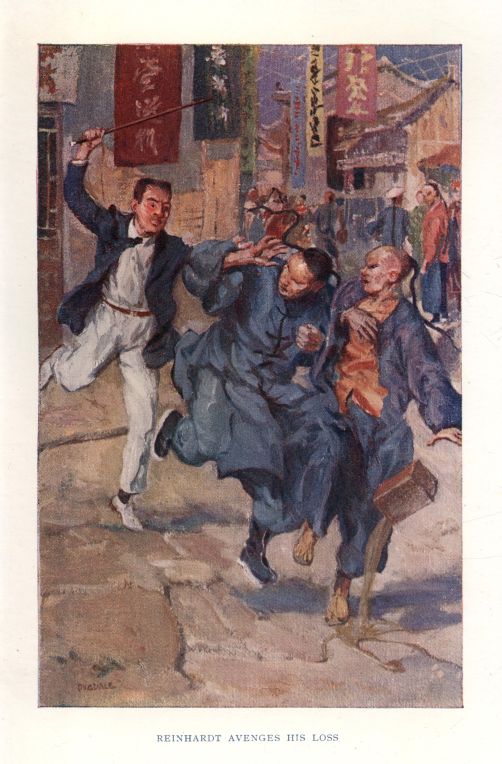
REINHARDT AVENGES HIS LOSS
"You talkee plenty too muchee all same," said Sing Wen, indignantly. "Massa no wantchee listen foolo talkee."
"Let him alone," said Burroughs. "Go on, Chin Tai."
"My go inside yamen," the boy continued, while the comprador sidled away, gained the gangway unobserved, and presently slipped ashore. "Plenty men inside. White man he say he go sleep inside houso little time, wake up, no can find moustachee. He velly angly; he say mandalin makee opium boss smart. Mandalin say boss muss find moustachee. Boss say no can do. He say: 'Hon'ble fan-kwei[#] he belongey plenty big moustachee what time he come inside houso; no belongey what time he go wailo. Two piecee man inside all same; he look-see fan-kwei sleep; my look-see other side; hai! he shave moustachee, fan-kwei no savvy all same. My no savvy nuffin."
[#] Foreign devil.
"Mandalin he say, 'You plenty bad fella: you pay hundled dolla.' Boss he cly he velly poor man; mandalin say he catchee plenty big stick: boss he pay all same. Massa Leinhadt----"
"Sing Wen!" called Burroughs.
But the comprador had disappeared.
Burroughs was at once amused and concerned at the story. He could hardly return the moustache; he guessed that Reinhardt would hardly be pleased if he did. The trick was one of which he would not have believed his staid comprador capable; but he could only admire the dexterity with which the stolen moustache had been mounted by some ingenious Chinese barber. He felt rather sorry for the brother's brother-in-law, who had had to disgorge the hundred dollars he had earned at the expense of Reinhardt's future patronage. Considering the matter seriously, he felt that he had better use the ornament that so materially improved his disguise. Perhaps he might regard it as a set-off against the loan of the hydroplane. And Reinhardt could not expect much sympathy after his callous refusal to aid the man whom he had helped to ruin.
The rage into which Reinhardt had been thrown by the loss of his cherished moustache made it the more necessary not to start up the river until late. Burroughs filled the interval by carefully coaching the two servants in the parts they were to play. The story he concocted did some credit to his ingenuity. He was the younger brother of Reinhardt, and had just come from Kiauchou to find his brother, and hand over to him the hydroplane and a sum of money, to be placed at the service of Su Fing, of course secretly. Having missed his brother somewhere on the river, he had pushed on rather than wait and delay the gifts of his government. In order to relieve the German authorities from the suspicion of acting in concert with the rebels, Burroughs would suggest that these latter should arrest him, and place him in the same prison as the Englishman whom they had already captured. By meting out the same treatment to a supposed German, they would certainly avert suspicion. Naturally the imprisonment would be only a pretence: he must be allowed freedom to come and go; but the pretence must be kept up with a reasonable show of determination.
Such was the story with which Burroughs primed Chin Tai and Lo San. He warned them that difficulties might arise; he could not foresee events at Meichow; but they must employ all their wits to support the fiction, and above all things they were to remember that he was Lieutenant Eitel Reinhardt of the German gunboat Kaiser Wilhelm, which, as Burroughs was aware, was then in Chinese waters.
"And there's one thing more," he said sternly in conclusion. "If you two boys squabble, I shall first knock your heads together, and then put you ashore and leave you. Mr. Errington's life may depend on us; when we know that he is safe you can black each other's eyes if you like, so long as you don't make a row."
The Chinamen both protested that they loved each other like brothers, scowling all the time.
Having purchased the silence of the inn-keeper, Burroughs borrowed a sampan from him; and as soon as darkness fell over the river, the two servants towed the hydroplane down the creek and for some distance up stream. Reinhardt's launch still lay off the town: the German was apparently spending the night on board. Burroughs guessed that he would shrink from facing his friends in Sui-Fu and the ordeal of their interrogations. But of course the story of the moustache would be all over the district in a day or two, and Burroughs was somewhat anxious lest it should penetrate to Meichow, and give rise to suspicion.
The hydroplane was thus towed up until the port had been left some distance behind. Then, when there was no danger of the throb of the engine being heard and provoking awkward inquiries, the sampan was hoisted on board, the engine was started, and the light craft skimmed up the river at the rate of twenty-five knots against the current.
CHAPTER XIII
RECONCILIATION
It was midnight when the hydroplane came in sight of Chia-ling Fu. The river was thronged with junks and other vessels moored for the night, and as many of these no doubt had their crews sleeping on board, Burroughs thought it desirable again to tow the hydroplane. It was necessary that no alarm should be given which might have the effect of causing uneasiness at Meichow. He wished that Su Fing had selected a smaller and less busy place than Meichow for his head-quarters; the larger the population, the greater the risk that the hydroplane would be recognized; for it was quite on the cards that some of the river boatmen had seen it skimming or flying on the lower reaches of the Yang-tse. But it was probably known that the vessel had once been stolen from its rightful owner at Sui-Fu, in which case any suspicious person might perhaps be persuaded that the theft had been repeated, with more success.
They got safely past Chia-ling Fu, and then Burroughs moored the hydroplane for a time, so that he might not arrive at Meichow before morning. As he waited, he pondered deeply on the knotty problem that would face him next day. The silence of a cold winter night does not conduce to over-confidence, and Burroughs was at no time one who saw things in too rosy a light. His story was plausible enough, if he had not made an egregious mistake in supposing that Reinhardt was more or less in league with the rebels. But the bubble would be pricked if Reinhardt were to follow him speedily up the river. Much depended also on whether Su Fing was still absent, for the rebel chief was no fool, and the slightest slip might land him in a quagmire from which there would be no escape. As he sat leaning his arms on the gunwale, and watching the dark water swirling by, Burroughs was conscious of many qualms; but in the background of his mind there was always the image of his old-time friend eating his heart out in captivity, and for the sake of his friend he was ready to dare all, to risk all, disregarding the consequences to himself.
He had made up his mind what to do on reaching Meichow; beyond that moment all must be left to the course of circumstances. When, in the early dawn, he came in sight of the town, he ordered Chin Tai to hail the landing-stage as soon as he was near enough, and command a rope to be thrown. His only safety lay in boldness. The rope having been thrown, Chin Tai was to say that his master had come on a visit to Su Fing, and demand a guide.
Just before arriving at the landing-stage, they passed a river gunboat lying off the town. The sight of this craft somewhat surprised him, until he learnt later that it had been employed by the Chinese Government in policing the upper reaches of the Yang-tse-kiang, and fallen a prey to the rebels.
There was no sign of the morning bustle that was usually to be seen at a riverside town. The seizure of the place by Su Fing had put a stop to trade for the time being. The man on the landing-stage responded somewhat sleepily to Chin Tai's order; but the boy, being jealous of Lo San's enterprise in previously visiting the town, was determined to show that he also was a man of mettle, and hurled such a torrent of abuse at the sluggard as caused him to hurry. The hydroplane was moored; Burroughs stepped on to the landing-stage, assuming a mien as like Reinhardt's as he could muster; and Chin Tai, with the self-importance natural to the servant of an august personage, demanded that his honourable master should be instantly led to the chief. The man said something in reply.
"He say hon'ble Su Fing no belongey Meichow this time," Chin Tai reported.
"Ask him who is in charge."
"He say hon'ble Fen Ti," said Chin Tai, after questioning the man; "all same Fen Ti gone wailo; he takee tousand fightee men help Su Fing Cheng Tu side."
"Tell him not to waste time; who is in charge now?"
It was at length explained that the man at present in command was one Chung Pi.
"He no muchee big fella," said Chin Tai scornfully; "one time he mafoo[#]; he belongey good fightee man; this time he tinkee numpa one topside fella."
[#] Horse-boy.
"Does he live in the yamen?"
The reply was that Chung Pi was not a big enough man to occupy the yamen, but was living in a small house hard by.
"Then I'll go and see Chung Pi," said Burroughs.
A guide was called up, and Burroughs was led through an extraordinary succession of narrow lanes and by-ways to a small house a few yards from the gate of the yamen. Chin Tai accompanied his master, Lo San remaining on the boat, with strict orders to sound the siren if he saw any vessel of importance approaching.
On arriving at the house, Chin Tai learnt from the door-keeper that his honourable master was still in bed. Burroughs was in ordinary circumstances courtesy itself; but he felt that he would lose a point now if he allowed himself to be kept waiting. Accordingly, with a curtness that went much against the grain, he bade Chin Tai tell the man that his honourable master must be immediately roused. His manner impressed the servant; the servant evidently conveyed the impression to his master; for in a few minutes there appeared at the door, kow-towing in the manner of an inferior humbly inviting an august visitor to enter his unworthy dwelling, a stout jolly-looking Chinaman, whose appearance strangely reminded Burroughs of a well-fed lord mayor's coachman. The horse-boy had grown in girth; his prowess as a fighting man might have won for him his present position; but at bottom he was a horse-boy still, with all the cheerfulness and ready good-humour of his kind.
Burroughs felt so much attracted to the man that he had some compunction about deceiving him; but he hoped that he could serve his friend without doing Chung Pi any harm. Accepting his invitation to enter his insignificant abode, Burroughs made a few complimentary remarks, which he ordered Chin Tai to translate scrupulously, and then plunged into his story, wishing that he could tell it himself in Chinese. But Chin Tai evidently did not diminish his master's importance; Chung Pi looked more and more impressed; and to do honour to his guest he ordered in breakfast, and regaled him with melon seeds, pea-nuts, fat pork boiled with rice, and weak tea.
Burroughs ventured to ask him whether he knew his brother.
"No," replied the man, "but I have seen him. He has a moustache like your honourable excellency's. Our fighting men envy that moustache. Not one of them has a moustache like your excellency's honourable brother. Theirs are long and silky, like mine; but, as you perceive, they turn downwards. Yours and your honourable brother's are firm and stiff like your noble hearts; they turn up, surely a sign of greatness and majesty."
This was very comforting to Burroughs. He had not before imagined that so much virtue could reside in a moustache.
It was now time to make the suggestion that he should be arrested and imprisoned with the Englishman. At this his host looked troubled.
"I am a poor unworthy captain," he said, trying to draw in his waist. "It is not for me to meddle with the arrangements made in the yamen of my august master Su Fing. Nobody but Su Fing himself, or his honourable lieutenant, Fen Ti, could do that."
Burroughs felt bound to put on an air of extreme indignation.
"Do you mean to tell me," he said, "that you will endanger the success of your master's mighty enterprise, lose the support of the greatest nation in the world, and compel me to return with the swift boat and the thousand dollars I carry? Of a truth, when your august chief returns he will think that the honourable captain he left to fill his place ought to have shown more discretion. Do you not see that if it is known I am supporting your master it may lead to war between Germany and England? My country, of course, has no fear of failure in such a war. but it suits our purpose at present to avoid it. It must be told in the ports up-river that your chief is arresting Germans as well as Englishmen."
Chung Pi, being no politician, was properly impressed by the possible momentous consequences of his refusal to have greatness thrust upon him. After some further talk, he came round to the view that it was his duty to serve Germans and English alike, and he went off to the yamen to make the necessary arrangements. On his return he explained that the room in which the Englishman was confined was at his honourable guest's service, and it would give him great pleasure to shut the two foreign devils up together. At this Burroughs feared that he had perhaps pressed the point too far: to be strictly confined would not suit him at all, So he carefully explained that the prison was a detail of no importance: all that was necessary was that it should be given out that a German had been arrested. The rumour would be carried down the river, and come to the ears of the English; whereupon the German emperor and the English king would be so much occupied in disputing which should have his man out first, that Su Fing would have plenty of time to overrun the whole province and make good his position with the aid of German gold.
Before he left Chung Pi's house for the yamen, he asked that the boat should be carefully guarded during his absence, promising to give the Chinaman a trip in the vessel before it was formally handed over to his chief. The transfer could not properly be made except to Su Fing himself, but he felt that his government would warmly approve of his handing a hundred dollars to so trusty a lieutenant as Chung Pi. He passed the notes to the gratified captain with a flowery compliment which Chin Tai took pains to embellish; and Chung Pi, well satisfied with himself and his guest, sent for his chair and an escort, put a rope round Burroughs' neck for form's sake, and was carried to the yamen, his prisoner following among the escort.
Burroughs did not much like the look of the rebel soldiers. They were the ugliest set of ruffians he had ever set eyes on. Their uniforms were as dirty as they were gaudy: cummerbunds about their waists, enormous turbans of yellow and scarlet on their heads. Some had spears, some rifles or muskets; all had immense knives thrust through their sashes.
He was surprised, however, agreeably in one respect, disagreeably in another, at the appearance of the yamen. It stood within a large enclosure, surrounded by a wall ten feet high and five thick. The gate opened upon a courtyard, beyond which stood a palatial mansion, consisting of several lofty halls rising one behind another, their walls of brick, their tiled roofs supported on massive wooden pillars. The grounds were laid out in groves and terraced gardens, and Burroughs caught a glimpse between the trees of the large ornamental water or fish-pond of which Lo San had spoken. It was surrounded by a stone quay, and crossed by a zigzag bridge of quaintly carved stone. Excellently picturesque as a residence, the yamen was, however, not pleasant to contemplate as a prison, for every gate was guarded by sentries as ruffianly as the captain's escort, and when the gates were closed, it would be an almost impossible feat to climb the stout walls.
Chung Pi descended from his chair at the entrance of the yamen, and speaking in a hectoring tone that consorted ill with his jolly friendly countenance, ordered his escort to conduct the prisoner to the inner room in which the Englishman was confined. He himself brought up the rear. Burroughs protested violently against the indignity a German suffered in being shut up with an Englishman; and Chung Pi, obviously relishing the joke, declared with a chuckle that brown pigs and black often occupied the same sty. The door of the room was opened, Burroughs was thrust in, and the door having been shut and locked, Chung Pi walked away rolling his bulky form with enjoyment.
Errington, sitting on a small stool, looking disconsolately out through a barred window upon the pleasant garden, was suddenly startled from a reverie by the sound of a voice which, muffled as it came through the door, seemed to him to be that of the Mole. He turned about eagerly, then felt a keen pang of disappointment when he saw enter the tall straight figure of a moustachioed German. But the German was smiling at him; and puzzled as he was at the fiercely aggressive moustache, he could not mistake the steady honest eyes of his old chum. He sprang up, and rushed forward with outstretched hand--then drew back suddenly, muttering with a cloudy face---
"I was forgetting."
"It's the apology, is it?" cried Burroughs. "Well then, I apologize--you old fathead!"
They shook hands--and when English boys shake hands the action has a meaning beyond the conventional. The past was buried: they were chums again.
"You've come to get me out; it's jolly good of you," said Errington. "But why are you got up like this? Where did you get your moustache? You look a regular German."
"Like Reinhardt, eh?"
"Don't mention the fellow. What a fool I've been! But I mustn't say anything against him: I owe him five hundred dollars; and to tell you the truth, I was in so much of a funk that I was actually glad the brigands collared me: it staved off the evil day."
"We'll settle with Reinhardt by and by. This moustache is his: it cost me a hundred dollars--cheap at the price."
He told the story of his comprador's enterprise, and Errington was much tickled at the opium-house keeper's having to disgorge as a fine the sum he had received for shaving off the moustache. Burroughs checked his laughter; the guards at the door must not suspect that the Englishman and the supposed German were fraternizing. He then related how Lo San had trudged the weary miles to find his master, and explained why he had come disguised as a German, and the means by which he had gained admittance to Errington's room. Errington was troubled.
"I didn't suspect that," he said. "You're running a fearful risk. If that fellow Su Fing catches you here, we shall both be in the same cart: he owes you the same grudge as me."
"Let's hope he won't come back in a hurry. He sent for more of his ruffians, which looks as if he's got his hands full. We'll get away together, old man. Chung Pi is such a genial ass that we shall be able to get over him. You haven't tried to bolt?"