Front matter (continued 5)
Reading edition
They could only wait until Jansen chose to open the door. A quarter of an hour passed and gradually the voices died away to a murmur and then ceased altogether. After that there was the sound of a heavy footstep on the floor and the door was flung open. Jansen stood on the threshold, glancing back with an evil grin upon his face. It was so dark on the landing that it was impossible for him to detect the figures standing so close beside him. The Dutchman seemed to be on exceedingly good terms with himself, for he kissed his hand gaily.
"That is well," he said. "That is exceedingly well. I do not think, my friends, that you are likely to trouble me for many hours to come, so I will go about my business. There is no chance of anybody coming in, no chance of anybody discovering what has happened. Strange that men, in some ways so clever, should be so innocent in matters outside their understanding."
Jansen uttered the last words in a tone of regret. He went quietly down the stairs as if fearful of arousing his landlord. The door closed softly behind him and he was gone. Uzali strode into the stuffy little sitting-room and applied his foot vigorously to two little yellow men lying like logs on the carpet. In spite of the rough punishment nothing came from either except a suppressed grunt or two.
"What did I tell you?" Uzali said in disgust. "Did I not say that I should find my other fellow-countrymen here. They have become tools of Jansen. You can see for yourself what has happened to them."
"They have smoked themselves into a state of torpor," Russell said.
"Yes, and been drugged into the bargain. You heard what Jansen said before he went out. They will lie here like logs, perhaps for the next twenty-four hours, until Jansen has accomplished his deep scheme. But I am going to frustrate all that. Let us get out of here at once."
"I am ready," Russell said. "Where do you want to go?"
"Maldon Grange," Uzali replied. "We are going there at once. You can ask questions on the way."
CHAPTER XLI
VANISHED!
It was as easy to leave the house as it had been to enter it. No sooner were Uzali and his companion off the premises than Goatley appeared all excitement.
"I could not make you hear," he said. "I whistled till I was afraid to whistle any longer. Jansen has gone away. He went up the street in a tremendous hurry as if he had some most important business on hand."
"Oh, we know about that," Russell explained. "You have done a very good evening's work and we shall not want you any more."
Russell hastened to overtake his companion who was striding down the street as if he wished to overtake Jansen. His manner was abrupt and irritable. He had little to say as Russell rejoined him.
"Has anything gone wrong?" the latter asked.
"Well, things are not as I expected," Uzali admitted. "And the worst of it is we are bound to lose time in picking up information. We shall have to go to my rooms to get Bradshaw. My dear friend, don't ask any unnecessary questions. The loss of every moment annoys me. What an extraordinary thing it is that you never see a cab in the street when you want one."
At length they reached the flat where Uzali immediately consulted his Bradshaw. When he came to what he wanted, something like an execration broke from his lips as he glanced at the clock on the mantel-piece.
"We have missed the down express by ten minutes," he exclaimed. "If we had been a quarter of an hour earlier we might have had the pleasure of travelling in the same train as Mr. Jansen. But it can't be helped. Now here is the position of things. It is half past one. London is fast asleep, and we are thirty miles from Maldon Grange. What I want you to tell me is this. How are we to get there in an hour and a half?"
Russell shook his head. He was bound to confess that the problem was beyond him. The feat could not be accomplished. Uzali glanced at him with something like contempt in his narrow dark eyes.
"I thought it was always your boast," he said, "that day or night this London of yours could produce anything you required. Don't you know any place that you could ring up on the telephone and get a motor-car? Mind, I don't care what I pay for it. The only stipulation is this—it must be here in a quarter of an hour and I must drive it myself. We cannot afford to have any curious outsiders in this business. Can you manage that? I have plenty of ready cash and am prepared to put it down if you find the owners of the machine at all suspicious."
Russell thought for a moment. Surely the thing ought not to be impossible. He might learn what he wanted at the nearest police or fire station. He strode out of the house and accosted the first policeman he met. A judicious half-crown produced the desired information.
"Oh, that is an easy enough matter, sir," the officer said. "There are one or two livery-stable-keepers hereabouts who have been investing in motors lately, and no doubt you could hire one, providing your references are right. Come with me, sir, and I'll see what I can do."
The thing was not so easily achieved as the policeman had prophesied. The livery-stable-keeper listened suspiciously, but was won over by the sight of a five-pound note and an offer to pay for the hire before it left the yard. At the end of half an hour Russell was back at Uzali's flat with a smart-looking car, which was handed over on receipt of twenty pounds in hard cash. All Uzali's irritation seemed to disappear. He threw himself heart and soul into the management of the car which, before long, was speeding Citywards.
"This isn't the way," Russell protested. "You ought to have taken the Hampstead Road."
"And so I will," Uzali said gaily. "We are not going to Maldon Grange alone. I will take those countrymen of mine with me. They'll be all right in the bottom of the car. We'll just slip round to the back of the house in Gray's Inn Road and you shall go up to Jansen's room and hand them down to me as if they were sacks of flour. I admit there is an element of risk in the job, but it must be done. I can't get on without them."
The car stopped presently. It stood silent and motionless on the waste ground behind the little bird-shop, where, once more, Russell climbed into the house and made his way into Jansen's sitting-room. He was not afraid of interruption. He walked towards the fire-place, then stopped and rubbed his eyes. He had even cause for astonishment, for the little men had vanished, leaving no sign behind them.
"Extraordinary!" Russell muttered. "I wonder if this amazing tangle will ever come straight. Now what can have become of those chaps? Three quarters of an hour ago they lay drugged into insensibility and now they have vanished. Well, I must look for them if I have to search the house from top to bottom."
Uzali was waiting impatiently in the yard when Russell reappeared after the lapse of nearly a quarter of an hour.
"Where have you been?" the former exclaimed. "And why have you come empty-handed?"
"For the simple reason that there was nothing to bring," Russell said grimly. "Those fellows have vanished. Did I search the house? Why, of course, I searched the house. But what was the good of doing that? It was only a waste of time. You saw what a state of insensibility they were in. You must know it was impossible for them to get away without assistance. Somebody has been to the house and carted them off. If you wish it, I will go back and have another look."
Uzali shrugged his shoulders impatiently.
"Absolute waste of time," he said. "Let us get into the country as soon as we can. It is not worth while to run the risk of some policeman coming along and asking our business, and goodness knows there is enough to do before daylight."
Russell stepped into the car without another word, and for some time they flew silently through the London streets. When the open country was gained they took the risks of the road, travelling at as high a speed as the car permitted. Uzali drove like a man who had been accustomed to cars all his life. Not once did he make a mistake, not once did he swerve from the straight path. By the light of the acetylene lamps Russell could see his eyes glowing, his face gleaming with excitement.
"You seem to like it," Russell murmured.
"There is nothing in the world so exhilarating," Uzali exclaimed, "and it is none the less fascinating because of the danger of it. If my eye were to deceive me, if I were to swerve even as much as a hair's breadth, what should happen in consequence would have no interest for us. Given luck we shall be at Maldon Grange in time to spoil the plans of our friend Jansen."
The car pulled up at length under Russell's instructions, for the ground was new to Uzali. They turned in through the lodge gates, going more cautiously, until they came to a thicket of trees in which they hid the car.
They were in front of the house, which was all in darkness with the exception of two windows on the first floor. It wanted no great foresight to infer that it was here where Samuel Flower was lying. For some time Uzali gazed up at the windows, as if hesitating what to do next.
"I wish I knew who was there," he muttered. "It is necessary that we should get into the house and, what is more, we must do so without alarming the servants. It is a desperate chance, of course, but do you think it possible that your friend, Dr. Mercer, is there? I meant to go through Oldborough to ascertain for myself, but in the excitement of the moment I forgot about it."
"It is possible," Russell said. "I don't suppose he would very much care for Miss Galloway to stay in a house like this at present. He may have induced Miss Galloway to go to his mother's whilst he remained here. But can't you invent some story about having lost your way. We shall be able to find out then. Throw a handful of gravel at the window and see what comes of it. It can't do any harm."
On the impulse of the moment Uzali stooped and raised a handful of pebbles and tossed them gently at the window. The experiment was repeated twice before the blinds were pulled up and somebody looked out and demanded to know what was the matter. At the sound of the speaker's voice Russell gave a cry of triumph.
"It is all right," he said. "What a tremendous slice of luck! It's Mercer himself. Wilfrid, come down and let us in. We must see you for a few moments."
CHAPTER XLII
TREASURE TROVE
Mercer's patient was sleeping peacefully. There appeared to be no reason why he should give any further trouble, and so far the nurse had not put in an appearance. Wilfrid concluded that only something out of the common would have brought Uzali and Russell at that time in the morning. From the way in which they spoke, too, their errand did not admit of delay. In the circumstances, it was no bad thing, either, to have a couple of friends in the house.
"One moment," Mercer whispered. "Stay where you are and I will let you in."
He unfastened the bolts of the front door, and the intruders strode into the dining-room where the lights were full on.
"Perhaps you had better explain," Wilfrid said. "I have been wondering what had become of you, Russell. I could not stay in London as I had my own affairs to look after, and that is why I am here. But how did you guess it?"
"It was mere chance," Uzali explained. "As for myself, I was bound to come here. I came to prevent bloodshed. We calculated you had left London and we thought it possible that Miss Galloway would prevail upon you to take up your quarters here for the present, and upon that theory I didn't hesitate to give you a signal."
"This is the second night I have been here," Wilfrid explained. "Miss Galloway is staying with my mother in Oldborough. But tell me what you want. Mr. Flower's nurse has gone into Castlebridge for some necessaries and there is nobody but myself to look after the patient. And he is in no fit state to leave, I assure you. He has led me a pretty dance already to-night and I shall be very glad when Mason comes back."
"Is he in his right senses?" Uzali asked.
"Oh, dear, no, and I question very much if he ever will be again. But tell me what you want me to do. You would not have come at this hour of the night unless yours had been an exceedingly desperate errand."
"I forgot," Uzali murmured. "I suppose everybody has gone to bed except yourself. If we stay here we are not likely to be disturbed by the servants."
"You need not worry about them," Wilfrid remarked.
"Very good. In that case we are safe. And now, assuming the nurse knows nothing about the family, he will be prepared to believe anything you say about us. We want to stay here just as we are till morning on the pretext that we are friends of Mr. Flower's and have come down on business. The rest you can leave to us. I suppose when the nurse comes back you will be free to help us if we give the signal. We may need your services."
Wilfrid nodded emphatically. It was plain that Uzali meant to say no more for the moment and he went upstairs again into the sick-room. Flower was lying perfectly still, and there seemed to be no suggestion that he was likely to wake up. A few minutes later there was a ring at the front-door bell and Mason returned. He seemed to have all he wanted, but he paused and looked at Wilfrid as he caught the murmur of voices in the dining-room.
"Friends of your patient," Wilfrid said glibly. "They have come from London on urgent business. I presume they were not aware that Mr. Flower was so ill. They will stay till morning on the chance of Mr. Flower's being able to see them."
The nurse smiled grimly.
"There is no reason why they shouldn't wait, sir," he said. "But it is precious little business Mr. Flower will be able to transact for some time to come. I hope he was all right while I was away."
Wilfrid smiled in non-committal fashion. On the whole, it seemed best to say nothing about the patient's escapade.
"You had better get yourself some tea or coffee," he said. "I don't mind sitting up for another hour or so, and then I shall go to bed."
The nurse made his preparations by means of a spirit-lamp which he had in the dressing-room. Meanwhile, Wilfrid sat in a chair before the fire and dozed off. He was utterly fagged. The anxieties of the day had told upon him more than he was aware. At last the nurse aroused him and intimated that one of the gentlemen downstairs wished to speak to him. In the interval Uzali and Russell had not wasted their time. At first they sat smoking and helping themselves freely to the decanters on the table till Uzali grew more taciturn and appeared to be listening intently.
"What is the matter?" Russell asked.
"Our friends are beginning to move," Uzali said in a whisper. "I have not been far out in my deductions and, if you will oblige me, I shall be glad if you will throw your cigarette into the fire whilst I turn the light off."
Russell obeyed without comment. He felt he was entirely in the hands of his companion. Uzali proceeded to shut off the light and also to open one of the windows that led to the lawn. He placed a screen across the fire and nodded with the air of a man who is satisfied with his plans.
"All right so far," he muttered. "Now I want you to stand by the window with me, keeping quiet and being on the alert for what is going to take place. You will not find it so very dark when your eyes become accustomed to the gloom."
It was as Uzali said. As Russell's gaze was turned towards the darkness he began to make out objects here and there till it was possible to tell where the shrubs lay and where the flower-beds were located. Everything was extremely still and the faintest sound could be heard. A quarter of an hour passed, then Russell felt his companion's hand clutch eagerly on his arm.
"There!" Uzali whispered. "Did you see anything? Did you hear anything? Now listen! I am not mistaken."
As Russell strained his ear he seemed to hear a footstep coming down the gravel path. By and by a tiny twig snapped and it could no longer be doubted that somebody was walking on the path. A moment later and a figure loomed against the grey of the sky, a figure which paused a moment and then crossed on to the lawn. Russell felt his heart beating faster, especially when he realized that the outline was quite familiar.
"You could see that, anyway," Uzali whispered.
"Oh, I can see that," Russell replied in the same low tone. "It seems incredible, and I may be mistaken, but if that man isn't Jansen, call me blind."
A dry chuckle broke from Uzali's lips. He was unquestionably pleased at something. He was no longer moody and despondent, but had the alert manner of a man who means business.
"You are not mistaken," he said. "That is Jansen. I dare say you wonder how he got here. There is only one way in which he could have reached Maldon Grange; he caught the train which we missed. Ah, we shall see some fun presently. Our friend yonder little knows the danger he stands in."
"What on earth is he up to?" Russell exclaimed.
So far as could be seen in the darkness, Jansen seemed to be juggling with a ball of strong string. In one hand he carried a bundle of pegs which he proceeded to drive into the lawn at unequal distances. The head of the hammer was muffled and only the faintest sound came in response to his blows. As the work went on Jansen could be heard chuckling to himself. Soon he stood upright as if he had completed his task and then he connected the irregular row of pegs with the string. It suddenly flashed upon Russell what he was doing.
"Why, that is an old burglar trick," he exclaimed. "Jansen means to make an attempt upon the house and trusts to those pegs and strings to save him in case of pursuit. Hadn't we better catch him red-handed?"
"Plenty of time for that," Uzali said with a note of laughter in his voice. "See, he has vanished. It looks as if he had gone down to the basement. Now we shan't be long. Look over at the big cedar tree and tell me what you see; quick!"
Two slight shadowy figures like huge night moths seemed to flit out from under the gloom of the cedar and make their way towards the spot where Jansen had gone. Russell would have darted out only Uzali restrained him.
"Wait," he whispered, "another ten minutes."
The minutes passed slowly, then came a sound like the splitting of wood, followed by a laugh which was drowned in a scream echoing horribly far and wide in the silence.
"Now," said Uzali sternly, "it is time to act!"
CHAPTER XLIII
IN HOT PURSUIT
It was a weird cry the like of which, in all his vicissitudes, Russell had never heard before. There was not pain in it so much as the wild and vivid fear of a soul going down into eternal torment. Twice again the cry came and then all was silent once more. Uzali rose to his feet without the slightest appearance of haste; indeed, from his collected movements and assured air he might have been expecting something of the kind.
"What shall we do now?" Russell whispered.
"That depends on whether we are too late or not," Uzali replied. "Come and see for yourself. One or two things have been puzzling you lately and now we can clear them all up."
The speaker moved to the open window. He had scarcely reached the threshold before that strange cry came again. It was much fainter this time and lacked the dominant note of fear. It was more despairing and sounded a long way farther off. At the same time Russell held back a moment, for he could hear a disturbance overhead.
Surely enough there came the sound of voices raised in expostulation and a moment later Mason came downstairs.
"What is it?" he exclaimed. "What are you gentlemen doing? Don't you know that my patient is at death's door? On no account was he to be disturbed. That extraordinary noise has awakened him, and now it is as much as two of us can do to keep him in bed. I don't want to rouse the servants."
Something like an oath broke from Uzali's lips.
"For Heaven's sake! go back where you came from," he said. "You have enough to do upstairs without disturbing us. Besides, you have Dr. Mercer to help you."
Mason looked at the speaker in astonishment. He was not accustomed to being spoken to in that way, but he made no protest. Overhead Flower's voice could be heard raised in feeble fury. He seemed to be pleading for release.
"Oh, go upstairs," Uzali said. "I assure you, my good fellow, you gain nothing by standing here, and if the servants are aroused you will be conferring a favour on everybody by sending them back to bed again. Now do as you are told."
Without waiting for reply Uzali strode out into the garden followed by Russell. From the lawn they could see shadows flitting across the blinds of Flower's room. It was plain that a struggle was going on.
"That's a piece of cruel bad luck," Russell muttered. "I wonder what woke him up."
"Can't you guess?" Uzali said impatiently. "Wasn't that cry enough to wake the dead? It would arouse anybody who was not lost to consciousness. It appealed all the more to Flower because he had heard something like it before. But, come, we have no time to lose. I hope before morning that we shall have settled this ghastly business for ever. And now to find out where those fellows went. I hope you know the house."
"Indeed, I don't," Russell said. "I don't know any more than you do. Mercer could help us."
Uzali made no reply. Very carefully he strode round the house, looking intently amongst the ivy which fringed the stone walls. He seemed to be seeking for some cellar trap or sunken door by which the basement might be reached. He gave a grunt of triumph presently as he pointed to a flight of moss-clad stairs leading to a small door below. He pressed his shoulder to the woodwork and it gave way quietly. Once more he chuckled.
"We are on the track at last," he whispered. "We shall find it here. Strike a light!"
Russell took a vesta from his pocket and after lighting it held it aloft. He made out the outline of a dim vault with three doors at the far end approached by flights of steps. The place apparently was empty and Uzali strode along as if he were on the verge of some important discovery. Then Russell's foot tripped over the support of an iron wine-bin and the whole thing came over with a rattle and roar that made the place echo. With a cry Uzali started back.
"Now you have done it," he said hoarsely. "Look out for yourself. Give us another match for goodness' sake."
The match went out as if some unseen person had stooped and extinguished it. Just before the last dying gleam faded it seemed to Russell that two shadowy forms had passed him rapidly. He knew a moment later that he was not mistaken, for he heard footsteps running up the stairs leading to the garden.
"After them," Uzali whispered. "The tragedy is done so far as we are concerned. That unfortunate man is beyond salvation. After them! It is not so dark as you think."
After the intense gloom of the vault the garden was by comparison almost light. Russell could see the two forms not more than a hundred yards ahead. He set off doggedly in chase. His blood was up now, his heart was full of anger, and a certain recklessness possessed him. Come what might those people should not escape him again; neither did he need Uzali to tell him who they were. He knew he was in close pursuit of the two Malays whom he had seen not so many hours before lying on the floor in Jansen's sitting-room.
It all grew clear to Russell as he raced along. He was just as anxious to catch up with those men, just as determined to mete out to them the punishment they deserved, but the wild feeling of passion was gone.
Doubtless the Malays had been too cunning for Jansen. To a certain extent they had trusted him, but the Dutchman's drugs had been insufficient. What Jansen had come to Maldon Grange for, Russell could not tell. But there must have been some deep reason for his move, some pressing need of keeping the Malays out of the way till his errand was accomplished.
Russell ran on and on without sense of fatigue, for he was in hard training, his muscles tense and rigid as whipcord, his lungs playing freely. Uzali was far behind and out of the hunt. The Malays, too, showed that they knew they were being followed. For a long time they kept to the road till it began to dawn upon them that their antagonist was gaining ground, then they vaulted lightly over a gate and entered the fields. Russell smiled grimly as he noticed the move. He was not perhaps quite so agile as those in front, but he knew the heavier going would suit him better. Sooner or later he must wear those fellows down and bring them to a sense of their responsibilities. There was consolation in the knowledge that he was armed. He smiled as he felt for his revolver in his hip pocket.
A mile or so and the pace began to tell. The fugitives were not more than sixty or seventy yards away. They were toiling distressfully along, and Russell could see that their limbs were growing heavy under them.
"Pull up!" he cried. "It is useless to go any farther. If you don't stop I'll fire into you."
But there was no suggestion of stopping on the part of the Malays. They swerved to the right as a hare might do and breasted a slight embankment on the top of which was the permanent way of the railway. Russell was not more than two yards in the rear as they stumbled over the fence and dashed across the line. His blood was up, but he did not lose his presence of mind. Something was ringing in his ears besides the rush of wind, something booming and tearing; with a blinding light and headlong rush round the bend tore the express at top speed.
Russell pulled up in the nick of time. He yelled to the Malays. But it was too late. They had seen and heard nothing. They seemed to be licked up by the flaming light and roaring steam. It was over in the flash of an instant. The express had disappeared and the silence of deep darkness fell again, as Russell stood fumbling unsteadily in his pocket for his matches.
He turned, shuddering, from the horror of it. The two figures lay there battered almost out of recognition. They would do no more mischief in this world. Still, they should not be neglected. A few hundred yards down the line Russell could see the lights of a small station and towards this he hurried as fast as his legs would carry him. It was an incoherent story, but he managed to make a sleepy night porter and one or two navvies camping up by the side of the rails to understand something of the tragedy. A few minutes later and the figures were removed to the station where they lay side by side covered with coarse sacking.
"I am staying at Maldon Grange," Russell explained. "I will call in the morning. I dare say one of you would not mind notifying the police for me."
CHAPTER XLIV
THE MEANING OF IT
It was a weary walk back to Maldon Grange, but Russell finished it at length. The chase had carried him farther than he thought, and he was worn out with his exertions and shaken with the horrors of the night. The house appeared to have regained its normal peace, the dining-room lights had been switched on, and Uzali impatiently waited Russell's return.
"You have been a long time," he said. "So they managed to escape you. I thought they would. Man alive, what is the matter? You look as if you had seen a ghost."
"I have seen two," Russell said huskily. "For Heaven's sake, give me some brandy and not too much water. You needn't trouble about your countrymen any more, for they will do no further harm this side of the grave. And they didn't escape me, either. I was within a couple of yards of them when they met with their death; indeed, I was exceedingly lucky not to share the same fate. I will never forget the horror of it."
Uzali asked no questions. He saw how white and shaky Russell was and discreetly contented himself with pouring out the brandy, after which he sat down and waited till the generous spirit had begun to do its work.
"It was an express train," Russell said jerkily. "I was close to them. I had challenged them to stop in fact, when they swerved and climbed on to the line. They must have lost their heads, for they ran full tilt into the engine, and the rest you can imagine. They were cut to pieces and, I should say, are unrecognizable. I had them removed to the nearest station where, of course, I had to give my name and address. I don't know what you think about it, but, upon my word, I don't see how I am going to explain when I come to give my evidence before the coroner."
"Oh, that will be easy," Uzali replied. "You happened to be a guest of Mr. Samuel Flower and disturbed two burglars to whom you subsequently gave chase. There will be no occasion to say more than that. The thing will excite a nine days' wonder. People will ask what these foreigners were doing at Maldon Grange and then it will all be forgotten. You must admit the necessity of keeping this scandal as quiet as possible. The men are dead, and even if the story were told, ninety-nine people out of a hundred would refuse to believe it. But if you are feeling better, there is much to be done before daylight. But you need not come unless you feel up to it. For my own part I mean to finish my investigation of the vault where we found those unfortunate men. We haven't finished with tragedy even yet. We have still to find Jansen."
Russell rose with more or less alacrity to his feet.
"Come and get it over," he said. "I thought my nerves were strong enough for anything, but I shall want a rest after this."
Once more they turned into the garden and thence into the vault. Uzali had taken a candle off the dining-room mantel-piece, so that they did not lack light, neither was there any reason for extra precautions. They mounted a flight of steps leading to one of the doors in which Uzali's sharp eye saw that a key had been left. He flung the door open and strode inside. The place was dark and musty. There were no windows in front and no ventilation, so that the two intruders at first found some difficulty in breathing. On the top of a packing-case Uzali placed his candle while he made a swift survey of the vault. The place appeared to be empty save for a score or so of packing-cases, all clamped with iron and heavily nailed. But, apparently, Uzali was not troubling much about the cases; he seemed to be looking for something quite different. Then he gave a sudden exclamation as he bent over an object lying between one of the cases and the wall. The object was dragged out into the centre of the floor and, taking the candle, Uzali bent coolly and critically over it.
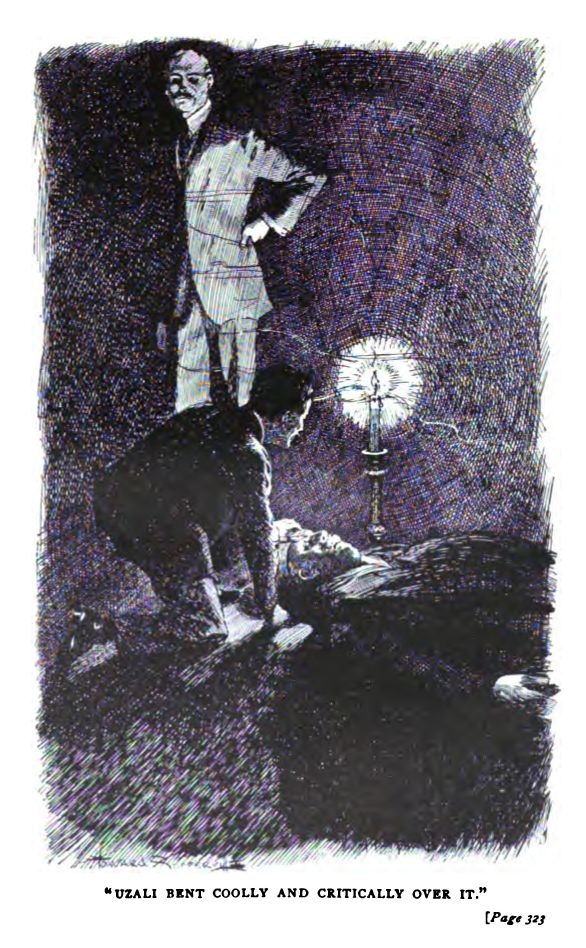
"UZALI BENT COOLLY AND CRITICALLY OVER IT."
"The last of the tragedies," he said.
"Jansen!" Russell exclaimed. "And stone dead beyond a doubt. But what is that strange bandage around his head?"
Jansen lay stiff and stark with his bloated face turned up to the light. Around his forehead was a white bandage so stiff and tight that it might have been made of solid metal. It was hard and hollow to the touch as Uzali's fingers drummed upon it.
"Here is the mystery of the five knots," he said. "Don't you see what has happened? Jansen attempted to make a dupe of my fellow-countrymen, but they were too cunning for him. They were not drugged when he left his lodgings; they were only shamming. They followed him here, must have travelled by the same train, and they tracked him to these vaults where I dare say they have been before. Directly he saw them he must have known his end was come; let him turn and twist as he liked, there was a finish to Jansen. Whilst one held him at bay the other lighted that scent you know of, and, as soon as the wretched man's senses failed, they bound that cloth about his forehead and the five deadly knots did their work. The thing is put on wet, but dries in a few moments with a tremendous pressure that gives the brain no chance whatever. It is practically impossible even for the cleverest surgeon to guess it is concussion of the brain, since there are no signs of violence. And yet, after the application of those terrible knots for an hour or so, no victim could recover. By pure good luck Mercer twice saved the life of Samuel Flower, for each time my fellow-countrymen were interrupted by him and managed to get away, leaving no trace of their secret. In Jansen's case it was different. We had cut off their avenue of escape and they had only themselves to think of. And they met their fate, too."
"But this is really worse than the other," Russell said with a shudder. "The whole story is bound to come out now. We cannot take this wretched man outside and throw him into a ditch."
"That is true," Uzali said grimly. "But we can remove all signs of the mischief. I know we are running a risk. I know we are placing ourselves within reach of the law, but I am going to take the chance all the same. Go to the dining-room and fetch me a decanter of water so that I can damp this bandage off. Besides, since no one knows Jansen or anything about him, it will be reasonable to assume that he was one of the burglars and that they had quarrelled with fatal results."
Russell was too upset by the events of the night to make any protest. He seemed to have hardly strength enough to attend to himself. In a dazed way he crept back from the dining-room with a decanter of water with which Uzali proceeded to remove the bandage until the remotest trace of the cause of death had disappeared.
"It is amazing," Russell murmured. "No wonder a doctor would be puzzled to give a certificate. He looks now as if he had died peacefully in his sleep."
"That is so," Uzali said coolly. "And now let us be convinced that he came here for some felonious purpose. I am certain I shall find housebreaker's tools in his possession. Ah, I told you so!"
From the breast-pocket of Jansen's coat Uzali produced a small but powerful jimmy along with a neat case of instruments which left no doubt of the purpose for which they were used. With the jimmy in his hand Uzali crossed the floor and made a deliberate attack on one of the big cases. Presently the lid came off with a resounding crash and a quantity of sacks were exposed to view. Under the sacking lay a number of wash-leather bags evidently of considerable weight, for Uzali had to exert all his strength to release two of them and lay them on the floor. He untied the knots which bound the sacks and plunged his hand inside. His fingers came out sparkling and shimmering in the candle-light.
"As I expected," he said. "With all your care and cunning Flower has been too many for you. The only man who guessed the truth was Jansen, and that is why he came down to-night. Take one of these bags in your hand and feel its weight. Isn't it heavy? It's so heavy that it can only be one metal. And see how it sparkles in your fingers."
"You mean it is gold dust," Russell cried.
"Nothing more nor less, my friend. This case is full of it, and when we come to open other cases I shall not be surprised to find treasures even more valuable. Flower must have brought them here by some extraordinary means and baffled all his party. We shall probably never know how he managed it. But we have yet to decide upon our plan of campaign. There is much to be done still."
CHAPTER XLV
ALADDIN'S CAVE
"And so all these things come from your part of Borneo?" Russell asked. "This, then, is the treasure which you have all been after?"
"I expect so," Uzali said with a smile. "Mind you, I don't want to affect a knowledge superior to your own and I admit that I have only had my suspicions lately. But I have been looking for Flower for some time and hardly expected to identify him with the prosperous ship-owner. When he was in Borneo he bore another name. But all that does not matter now. The first suspicion of the truth I had was when Miss Galloway sat by me on the night of the party at the theatre. She was wearing a certain ornament which you have heard of——"
"The diamond moth," Russell murmured, "oh, yes."
"Or a portion of it," Uzali went on. "The ornament attracted my attention immediately, because I knew there was only one spot in the world it could have come from and that was the palace where I and my ancestors were born. The jewel at one time had been a favourite ornament of a sister, long since dead, and I remember how it was broken. Nobody in our part of the island could mend it, and I promised that the next time I was in London I would see to the matter. That is how one part of it was in my possession, but for the life of me I could not tell what had become of the other half, till on the night of the party I began to feel my way. Nobody but one of the infamous crew who destroyed my birthplace could have the other half of my sister's jewel. I took the trouble to find out afterwards who this Samuel Flower was and what he was like. Then you came along and made things still plainer. I saw at once that Flower had outwitted his confederates and had conveyed the treasure of my people to England. Of course, all this was conjecture, but I had the solution of the problem pretty plainly before me. When I knew that that scoundrel Jansen was coming down here and how he had contrived to misguide my unfortunate fellow-countrymen not a doubt remained in my mind. In point of fact I came here to-night, not so much to catch Jansen red-handed as to denounce Flower as soon as he were well enough to listen to my charge. I never dreamt for a moment but that my countrymen were still in London, but when I knew they were here, I saw it was all over with Jansen. I would have tried to prevent the catastrophe, but, unfortunately, I did not know where to begin. Directly I heard that cry I knew whose it was. But don't you think we had better take your friend Mercer into our confidence. I am sorry in a way the thing has ended like this because it puts an end to your scheme——"
"For taking what belonged to somebody else," Russell laughed. "My dear sir, that is the fortune of war. I had intended to make a handsome thing out of this business, and I meant to put a large sum of money into Mercer's pocket at the same time."
"I am not sure that you haven't," Uzali said drily.
"But all this belongs to you," Russell protested.
"That is why I am not speaking without book," Uzali replied. "One thing is certain—if it hadn't been for Mercer and you I should never have found it. You will find that if anything happens to Flower and that scoundrel Cotter learns that Jansen is dead, he will lose no time in trying to lay a hand on the plunder. That, at least, is my theory, but the fact remains that, in the eye of the law, everything in this vault is mine and, with your permission, I'll put the key in my pocket till the proper time comes to claim possession."
So saying Uzali took up the candle and followed Russell out of the vault. He locked the door and together they made their way back to the dining-room. Tranquillity reigned throughout the mansion. No sound came from overhead until the closing of a window brought Mercer downstairs.
"What on earth has happened?" he asked. "I began to wonder if you were coming back."
"How is Flower getting on?" said Russell.
"He is in a very bad way," Wilfrid said gravely. "He has an exceedingly rapid pulse and his temperature has gone up in the most alarming fashion. It is extraordinary how that strange cry excited him. It seemed to penetrate to the well-spring of life and restore him to consciousness. One might have thought he was a man running away from some hideous doom. But now he is in a most critical state, and I should not be surprised if he did not last till morning. Not that I am disposed to waste sympathy on Samuel Flower. Goodness knows he has done me harm enough and to spare. And now if you will tell me what has been going on the last hour I shall be glad. As for Russell, he looks as if he had been face to face with tragedy."
Russell murmured that he had been a witness to no fewer than three. He told his grim story first, the detail being filled in by Uzali. The whole combined narrative was so amazing that it took Wilfrid some time to grasp it all.
"What are you going to do?" he asked.
"We shall do nothing," Uzali said calmly. "We shall notify the police in the morning of the finding of Jansen's body, and they can put their own construction on the rest. The authorities will regard the whole thing as a case of attempted burglary. Probably they will take no steps to have those packages in the vault examined, for the idea of treasure lying there would be beyond ordinary police imagination. What I wish is to avoid scandal. When the sensation has blown over, I think I can show a way to settle matters without raising unpleasant questions. Meanwhile I should like to sleep for an hour or so. I suppose one could manage that."
Uzali proved to be a tolerably correct prophet. There was a great commotion in the neighbourhood next day when it became known that burglars had made an attempt on Maldon Grange, and that the body of one had been found in the vaults under the house. The body had been discovered by two gentlemen from London who had come to see Mr. Flower on important business, not being aware that he was suffering from a severe illness. They had arrived at the house early in the morning in a motor-car, just in time to see two of the assassins leave the basement hurriedly. One of these gentlemen was known to a large circle as Prince Uzali, the other was a more obscure individual whose name had not yet been ascertained.
Uzali gave evidence at the inquest first. He was calm and collected and gave his testimony in a plausible and ingratiating manner. He told how the body had been discovered and confessed he thought the police theory of a quarrel amongst the thieves was the correct one. He could not account for the presence of the thieves in the vaults, unless on the supposition that they thought that to enter by the basement was the safest way to reach that portion of the house which was more worthy of their attention. Asked if he saw any valuables in the vaults, Uzali merely shrugged his shoulders and explained that the place was filled with packages which appeared to possess no special value. They were overland trunks and things of that kind. In any case, he should not imagine that Mr. Flower would keep valuables in a cellar.
Uzali stepped down from the witness-box presently, having created a favourable impression, and Russell followed. He spoke frankly enough of his pursuit of the two men and related how the would-be burglars had been smashed up by the express train. There was little more to say, save that the two men were mutilated out of all recognition and the police had only the faintest hopes of establishing their identity. They appeared to be Malay sailors or coolies and that was as far as the official theory could go. On the other hand, some one might come forward and claim Jansen for a relation, but Uzali had not much fear of that. Jansen's landlord was not the kind of man who studied the papers. It was long odds that he would never know of the tragedy at Maldon Grange and would conclude that his lodger had vanished as secretly as he had come.
As for the rest Uzali appeared to know exactly what to do. As he and Russell returned from the inquest after the verdict had been given, they met Dr. Shelton coming along the road towards Maldon Grange.
"How is Mr. Flower?" Russell asked. "I am a stranger to you but I took the liberty of stopping you——"
"It is only a matter of a day or two," Shelton said curtly. "I cannot tell you more than that."
CHAPTER XLVI
UZALI'S WAY OUT
Shelton's motor-car purred along again, leaving Uzali and Russell alone. Half way up the drive to the house they encountered Mercer. He, too, looked grave.
"How did it go?" he asked eagerly.
"It went just as I told you it would go," Uzali replied. "I fathered my theory on the police who came to regard it as their own. They are under the impression that those three men came to Maldon Grange with the intention of committing a burglary, and that they quarrelled after they got into the house. The only thing I was a bit doubtful of was the medical evidence on the body of Jansen. The absence of violence rather upset the local doctor and he seemed to think that death was due to a sudden fright which had affected the action of the heart. I forget the technical terms he used. At any rate, he satisfied the jury, and we have only to keep quiet and all scandal will be averted. I hope you see now that nothing would have been gained by allowing the whole truth to come out. Nobody would have been the wiser for it, and as certain as we are standing here now, before a month had passed we should have half a dozen cold-blooded murderers trying the same experiment on their victims. You never hear of a new crime, especially a new form of murder, without seeing it imitated within a few weeks. And murder would be more common than it is if criminals could only be convinced that they would never be found out. Be content to leave everything in my hands, and I promise you that beyond our three selves no one shall ever know of this. How is your patient?"
Flower was in a very bad way indeed. Wilfrid said that his conscience troubled him, inasmuch as he had not revealed the real state of affairs to Dr. Shelton. Perhaps, on the whole, his silence was wise. In time he might come to recognize that Uzali's policy was the correct one.
"I am going to fetch Miss Galloway," he said. "Now the danger is over I think she ought to be in the house till the end comes. Whatever Flower's faults his niece owes him much and I believe she would like it."
But Wilfrid was too late. When he reached Maldon Grange early in the afternoon with Beatrice the blinds were drawn and the servants were creeping quietly about the house. Mason came downstairs with a grave face saying that his patient had passed quietly away an hour before. This was the tidings that reached Uzali and Russell when they came back just before tea. Wilfrid had sent to Oldborough for his mother and gave Beatrice into her charge. The girl was terribly distressed and Wilfrid had made up his mind that she should never know the truth.
"I am glad to hear you say that," Uzali said. "Now you see how sound my advice was. Why should the poor girl know the truth? Why should anybody know it for the matter of that? Will you express my regrets to Miss Galloway and tell her how sorry I am for what has occurred? I am pleased there is some one in the house who can look after her. And now, Russell, if you don't mind we'll get back to London. Probably when we arrive there we shall find the news of Flower's death has preceded us. To-morrow morning we will go to the offices of the company and interview Cotter. He will be surprised to see us——"
"I shall be more surprised to see him," Russell said grimly.
"Not in the least, my dear fellow. Cotter has left the sinking ship right enough, but when he knows that his employer is dead and, what is far more to the point, that my fellow-countrymen are no more, he will return for the loaves and fishes fast enough. I dare say this will cost money, but I am anxious to keep up the credit of Flower's name and you know there have been strange rumours about him in the City lately."
It was wonderful how everything fell out exactly as Uzali seemed to expect. The death of Samuel Flower was the sensation in the City next day, and the offices were thronged with people when Uzali and his companion reached them. Uzali sent in his card and demanded to see Cotter at once on important business. Perhaps the peremptory command had its effect, or perhaps it was the name on the card, but a clerk came through the crowd of people with the information that Mr. Cotter would see Prince Uzali at once.
The little man sat in his master's office rubbing his hands nervously together. There was a half-malicious, half-frightened look in his eyes like that of a rat caught in a trap. Uzali closed the door and came straight to the point.
"Now you slimy scoundrel," he said, "we won't waste words, because you know who I am. It were weak to deny it. A few hours ago you had made up your mind to desert your master, but now you know he is dead, you think it is better policy to come back here. The death of three other persons has made your path a safer one, but we need not go into that. I believe that when matters are settled up Mr. Flower will prove to be deeply in debt. Now, I will send an accountant to go through the books with me and I will arrange to pay everybody. In return, I must have the first offer of Maldon Grange, which is bound to come into the market; indeed, to be quite candid, I mean to buy Maldon Grange as a residence. When this has been done you will be free to depart on the one condition that you never show your face to me again. It will not be the slightest use your coming to Maldon Grange, because you will find the vaults empty."
Cotter looked up with a puzzled expression on his face and Uzali learned what he wanted. The secret of the treasure in the vaults of Maldon Grange was not known to Cotter.
"Wonderful man, Flower," Uzali muttered as he walked away with Russell. "Extraordinary how he managed to hoodwink everybody. He must have contrived to remove everything of value from the city of my birth before he destroyed the town by blowing up the water dam. Well, he has gone to his last account, but he was the means of restoring my own, so I will not say more against him. And now you see what I am going to do. I shall save a scandal in the City. Flower's blackguardly business will cease to exist, and in a short time Maldon Grange will find its way into my possession. I have long been thinking of purchasing a country house, and Maldon will suit me very well. I shall count on your assistance in turning out those cases of priceless treasure. I shall sell what I don't want, and no curious tongues will be set wagging. On one thing I am determined and I will take no refusal. But for you and Mercer I should never have seen my family treasures again, and that is why I am going to divide that equivalent in value between the three of us. Don't protest, for already I have far more money than I know what to do with. I shall have all those things valued as soon as possible and I calculate there will be a cheque for a hundred thousand pounds for each of you when the business is finished. Now for a quiet lunch somewhere. I seem to need it."
* * * * *
To this day Beatrice cannot make out how events transacted themselves. That Samuel Flower had left nothing when his debts came to be paid she knew perfectly well. She also had to bewail the fact that she had not a single relative in the world. It was Uzali who, some time after he had taken possession of Maldon Grange, gave the plausible explanation of Wilfrid's sudden accession to fortune. He talked freely about concessions, of mineral wealth in his own country which he had shared with Russell and Mercer. He hinted at the marvellous way in which the venture had turned out.
"Prince Uzali says you have been speculating," Beatrice said with an attempt at sternness in her voice the next time she had an opportunity of being alone with Wilfrid. "Isn't that very dreadful of you? To have a husband who speculates——"
"I only speculated once in my lifetime," Wilfrid laughed, "and that was so far as you are concerned. And if one speculation only turns out as good as the other, I shall have no cause to be dissatisfied. But how much longer are you going to keep me waiting, Beatrice? We have a superfluity of this world's goods and there is nothing between us now. Besides, my mother has quite set her heart upon seeing you——"
"In that case," Beatrice said mischievously as she glanced up in her lover's face, "there is no more to be said. I should never dream of doing anything to annoy your mother."
And with that Wilfrid was content.
THE END.
* * * * * * * *
"Holds the Reader Spellbound"
THE NETHER MILLSTONE
By FRED M. WHITE
Author of "The Five Knots," "The Slave of Silence," "The Midnight Guest," etc.
Illustrated, 12mo. Cloth. $1.50
A tremendously interesting novel.—Boston Courier.
A strong story, one with a well-made plot. He holds his readers from start to finish.—Baltimore Sun.
A thrilling episode of courage and romance which sensationally opens the story.—Philadelphia North-American.
A stirring story of mystery and adventure. It fairly teems with complications and surprises.—St. Louis Republic.
For a spirited tale in which there is constant action, "The Nether Millstone" is ahead of anything published this year.—Boston Traveler.
Fred M. White is now regarded as a rival of Oppenheim.—New York Times.
A Capital and Ingenious Mystery Tale
THE SLAVE OF SILENCE
By FRED M. WHITE
Author of "The Crimson Blind," "The Corner House," etc.
Illustrated. 12mo. Cloth, $1.50
A combination of detective story, mystery, and romance that will interest even the most blasé of novel readers.—Springfield (Mass.) Union.
May be recommended to anyone who enjoys a swift, dramatic, and ingenious mystery story, with the interest of the reader gripped at the outset.—Buffalo Express.
Bubbles with intense interest from beginning to end. Fully as good a story as "The Crimson Blind."—Brooklyn Eagle.
The mysterious events which took place at the Royal Palace Hotel, London, and at the strange house in Audley Place, are unfolded in this absorbing story.—Washington Star.
There are times when a novel of the "shilling shocker" type is more to be desired than much fine writing. This is especially true if it is forcibly written and is well printed. "The Slave of Silence" is such a novel... For genuine entertainment one cannot do better than to read this book.—New York Times.
"A rattling good story"
LORD CAMMARLEIGH'S SECRET
By ROY HORNIMAN
12mo. Cloth. $1.50
A delightful book, it is so different.—Buffalo Express.
Highly successful, always amusing.—Life, New York.
A diverting comedy, with the most audacious modern hero in fiction.—Kansas City Star.
Extremely clever. Would not have discredited the late R. L. Stevenson.—Brooklyn Eagle.
It is interesting, almost breathlessly so. As fluctuating as Sherlock Holmes and stimulates the imagination.—Columbus Press Post.
One of the most ingenious stories ever written. The situation is full of humor and the dialogue capital.—Bookseller, Newsdealer and Stationer.
The plot is audacious, but Mr. Horniman carries it through with dash, with crisp dialogue, and with some admirable characterization.—Cleveland Leader.
Mr. Oppenheim's New Novel
THE GREAT SECRET
By E. PHILLIPS OPPENHEIM
Illustrated by C. D. Williams. Cloth, $1.50
In his latest novel Mr. Oppenheim deals with a stupendous international conspiracy in the same interest-compelling manner that characterizes his most popular stories. An American girl possessing both beauty and brains furnishes the author with a most captivating heroine. The book is replete with incident, all the characters are strongly drawn and humanly interesting, and the culmination of the plot is a tremendous international coup, dramatic to a degree never before reached by even so successful a story writer as Mr. Oppenheim.
A remarkable piece of writing.—Pall Mall Gazette.
The most fascinating story Mr. Oppenheim has written. In the telling of a tale of this description Mr. Oppenheim is without a rival.—Sheffield Telegraph.
The finest and most absorbing story of adventure that Mr. Oppenheim has ever written. It glows with feeling; it is curiously fertile in character, incident, and sensation, and it works its way outward to a remarkable climax.—The Standard, London.
Mr. Oppenheim is a past master in the management of exciting incidents, and in this novel he has excelled his former successes.—Dundee Advertiser.
LITTLE, BROWN, & CO., PUBLISHERS 254 WASHINGTON STREET, BOSTON