Front matter (continued 3)
Reading edition
"There was another discovery I made about the same time and that was a large amount of treasure which was hidden away in the chief's palace, I found it out by accident, too, though I feared at one time that the accident was going to cost me my life. I don't think I have ever seen a man so majestically angry as the chief was when he caught me gloating over his treasures.
"'The cause of all our troubles,' he said. 'But for those accursed things I should be master of this island from one side to the other. They bred greed and murder amongst my followers, they caused the shedding of blood. Base treachery followed wherever they went. No one knows they are here but myself. No one shall ever know but myself, for after my death there shall be no more chiefs of the clan, and gradually we shall fade away and die, as our brethren perished across the seas in Mexico. I will make a bargain with you, if you like. If I die first you shall have your freedom, you shall take six of my mules and six of my ponies, and you shall load them up with everything here that you most desire. With my seal upon them they will be safe from all men until you reach the coast.'
"There was nothing more to be said or done after that, only to wait my time and trust to fortune for a means of escape. So far as the chieftain's offer was concerned I thought no more about it, for he was a man in the prime of life and likely to last as long as I should.
"But one never knows. A week or two later came rumours from the mountains that certain white men had penetrated there and that they meant to make a raid on the town, accompanied by a gang of desperadoes whom they had bought over by promises of reward. We thought nothing of it, though it occurred to me once or twice that the chief looked grave and that he did not go quite so far afield as usual. It was late one afternoon when he came limping back into camp, and a messenger came to me post-haste to say that he had poisoned his foot with a prickly cactus. No sooner had the attendants left us alone than the chief turned to me eagerly.
"'I have deceived them all,' he whispered. 'It is no cactus which is the cause of the trouble. I was attacked in the woods this afternoon by a handful of natives who have hitherto been faithful. I managed to escape under cover of darkness, but not before I received this wound in my heel, which will be fatal.'
"I smiled at the chief's fears, but he shook his head with the utmost gravity.
"'I tell you I am right,' he said. 'I know the poison well. There is nothing in your box that can cure me, and when I am out of the way those people will swoop upon the town and not one of my followers will live to tell the tale. Say nothing to anybody about this, but gather my most faithful men about you and let them know what has happened, so that they may be ready when the times comes, but not to-night—wait till the morrow. Meanwhile, all I want to do is to be left alone to sleep.'
"There was nothing to be done but to obey the chief's commands and I went sorrowfully out. I did not return to the palace till the moon was high and the town asleep. The chief was slumbering peacefully, but his leg had swollen horribly, and it was evident that he had told me no more than the truth.
"Sick at heart and utterly undetermined in my mind what to do I climbed the moonlit street till at length I came to the majestic weir which bordered the lake and kept the tide back from flooding the town. It seemed to me as I stood there that I could hear whispered voices, and I hastened to hide myself behind a mimosa bush. Then a figure emerged into sight—a face and figure quite familiar to me. The light fell full upon his features and disclosed the last man I expected——"
"I know," Uzali cried, "Samuel Flower!"
CHAPTER XXI
A DOUBLE FOE
Russell smiled slightly in reply. Apparently he expected Uzali to make that guess, for he went on again unsurprised. Nor had Mercer time to show any astonishment.
"I am obliged to you for saving me so much trouble," Russell said. "It is so pleasant to have an appreciative audience. I don't mind admitting that at the time I was more surprised than Mr. Uzali appears to be now. Mind you, I knew Samuel Flower well enough. I had done a variety of work for him from time to time, some of it shady, but nothing that one could call positively dishonourable. But to see that man on that side of the globe came on me like a shock. I thought the blackguard was in London, engaged in his congenial occupation of sending coffin ships to sea and profiting by their wrecks. When I came to think of it, I remembered Flower once telling me that he had been pretty well all over the world in his youth, and now I guessed what he was doing in that out-of-way spot. I knew he was there with sinister designs upon my friendly host. I knew he must be at the head of the faction of natives who were bearing down upon the devoted city."
Russell paused and helped himself to a fresh cigarette.
"Mind you, I am not taking credit to myself for any philanthropy," he went on. "I admit those people were very good to me, but I wanted to get back to civilization nevertheless. And I am afraid I was thinking more about those jewels than anything else. If I could succeed in reaching the coast with them, why, then, my fortune was made. All these thoughts passed swiftly through my mind as I crouched behind the friendly shelter, watching Flower and his companions. There were two Europeans besides himself, and some half-a-dozen natives who stood at a distance waiting for orders. It puzzled me to know what they were doing up there, and it was some little time before I could make out. But gradually the thing began to appear plainer, for one of the Europeans came along with something in his hand which I made out to be an electric battery. This man silently paced along the whole length of the dam, then he proceeded to make pencil notes in a pocket-book. Flower seemed to be watching him carefully, as if waiting for a verdict.
"'No great difficulty,' said the man with the pocket-book by and by. 'On the whole the thing appears feasible. It only means removing a stone or two and applying a big charge of dynamite and the thing is done. I don't think we need take the trouble to keep our men here. The less people we have about us the better. We can easily find some excuse for sending them to the coast. It is by far the most expeditious plan, to say nothing of its absolute safety.'
"'And those places down there?' Flower asked.
"The man with the battery shrugged his shoulders.
"'What does it matter?' he asked. 'It will only make the game exciting afterwards—the finest game of hide-and-seek you ever had in your life. You leave it to me and I'll fix it all right. And the sooner it comes off the better.'"
Russell made another pause.
"I daresay you will think me stupid," he said, "but for the moment I could not make out what those fellows were doing. I knew there was mischief on foot. I knew that Samuel Flower would never come all that way for nothing. But, for the life of me, I couldn't see what they were driving at. I stayed there thinking the matter over long after Flower and his companions had gone, but the more I pondered the more muddled I grew. Still, I decided to go down presently and see how the chief was progressing. It only wanted a glance in the moonlight to see what had happened. The poor fellow was dead. He had told me the sober truth. He had fallen by a poisoned arrow shot by one of those miscreants who had guided Flower and his companions to that out-of-the-way corner of the world.
"But there was nothing for it but to wait for the morning. I went back to my own quarters sorrowfully enough, feeling that I had lost what little power I possessed, for since the chief was dead my reputation for surgery would vanish to nothing. I might alarm the natives in the morning and try to show them what was in store for them if they had not much faith in my diplomacy. I lay on my bed full of fears and none the less alarmed because I did not know in which quarter to look for the danger. I suppose I must have dozed off into a sort of sleep, when I was alarmed by a tremendous crash and boom overhead as if a mighty thunderstorm were in progress, and a moment later I heard the torrents of rain roaring down the flinty streets. Even then I did not connect this with the peril to come, though it was impossible to sleep for the noise of the rushing waters, and I sat up in bed. Presently I could see the yellow flood creeping into my room and almost before I knew where it was it was knee-deep on the floor.
"And then it flashed across me what had happened. The truth came too late. I saw once more in my mind's eye the man jotting down his calculations in a pocket-book. It came back to me with vivid force what he had said about the dynamite, and I knew. They had removed some of the heavy coping-stones from the top of the dam, then with the aid of their battery they had fired a mine of dynamite, and in the twinkling of an eye the dam was no more. The huge wall had been removed as if by a gigantic knife, and the great lake overhead was rushing on to the destruction of the city. In a few minutes every man, woman and child would perish, and the gigantic buildings be torn apart like so many packs of cards.
"I rose from my bed and rushed into the street where the torrent was already high. With a shudder I looked upwards and saw a huge wall of water bearing down upon me like some all-compelling cataract down an Alpine mountain side. I could hear a cry now and again as something human flashed by me, but I was powerless to give any assistance; I was even powerless to secure my own safety. A moment later and the water had me in its grip, tossing and turning me over as if I had been a chip. I remember sliding over a ledge of rock and finding myself pinioned by a great mass of bushes whilst the water slid over me, leaving me free to breathe, and indeed, the mass of rock forming a huge cascade as it did, saved my life.
"Goodness knows how long I was held there. It seemed that the night changed to day and the day to dusk again before the mighty roar ceased and I was free to creep from under the shelter of the rock and gaze on the destruction which had taken place around me. As to the city itself, it had vanished. The great stone buildings were gone, the mass of temples were no more, nothing remained to speak of what had been except a mighty jumble of stones at the foot of the valley. I was the sole survivor of that appalling calamity. It did not need any one to inform me that I witnessed one of the most awful tragedies of modern times. For the time being I could not even think.
"But gradually my strength and courage came back to me. I knew that I was not altogether alone. I knew now what Flower and his fellow-miscreants were after. They had not dared to meet the people of the granite city single-handed; they had taken this murderous way of sweeping life out of existence, so that they might recover the lost treasures of the city without interruption.
"This knowledge was my one chance of salvation. If I could keep on the track of those people without being seen, then it was just possible that I might make my way down to the coast. I could hang about the camp at night, for they would not be likely to keep a very close watch, so that I could help myself to what food I required. For the best part of three days I hid myself closely in the daylight and prowled about at night until I got on the track of those people. As I had expected, they were after plunder alone, and gradually began to collect a mass of loot. But with all my caution there was one thing I did not succeed in finding out, and that was, where the stuff was hidden. At the end of a week they appeared to be satisfied, and one morning they moved off towards the coast. It was only by a bit of sheer luck that I managed to keep up with them. You see, I had my life to think of, for all the treasure on the island was worthless to me without that. At the end of a week we began to see signs of civilization and I could afford to drop back and let Flower and his party go their own way. The strange part of the whole thing was this—when Flower reached the sea, save for one European he was alone. I don't insinuate anything, but I feel certain that not one of Flower's escort lived to tell the tale. I believe that every native who went with him as far as the granite city was murdered. Oh, that would be nothing to a man like Flower. It would be easy to make a present of a case of whisky to those natives and see that it was heavily drugged with poison. And now I think I have told you everything. Every word of it is true."
"Absolutely true," Uzali said. "I can confirm it if necessary. For the chief you spoke of just now was well known to me; in fact, I may say that he was my elder brother."
CHAPTER XXII
FROM EAST TO WEST
There was something almost pathetic in the way in which Uzali uttered the few words which passed his lips. His face was devoid of all trace of anger, his dark eyes had grown very sad.
"I am afraid you will hardly understand me," he said. "It is almost impossible for Western people to enter into the thoughts and ambitions of the East. You would hardly suppose, to see me sitting here in the heart of London, surrounded by these evidences of civilization, that I am a man who has set his heart upon the remaking of a nation. And yet, up to a few moments ago, that ambition was as strong and keen as ever. And now it has been dispelled like a dream. But, perhaps, I had better not talk in this poetic strain. Three or four years ago I came to England to see if I could come to terms with the Government. You see, both my brother and myself had been educated here, and we thought it was just possible that the British Government would take our province under their protection. We had talked it over scores of times, and at last I came to England to see what I could do. It is about three years since the news of the catastrophe came to me, and even then I learnt it through the medium of one of the newspapers. I suppose the Press did not think it worth more than a paragraph, which merely told of the disaster of the lake and how the tribe to which it belonged had been swept out of existence. Mind you, I did not think there was anything wrong. It seemed not unnatural that some great storm might sweep the dam away, and then the rest would have been a mere matter of minutes. But I was not satisfied. I went to Borneo to make inquiries, and eventually I found two survivors of the disaster. Then it was I discovered what had taken place. I can assure you, from that time to this I have done nothing but investigate and investigate till, by slow degrees, I have hit upon the right track. But tell me, gentlemen, how did you find me out?"
"We didn't find you out at all," Mercer said. "The thing was pure accident. We discovered that some of your tribe were bent upon wreaking their vengeance on Samuel Flower, and as my friend Russell was so mixed up in the matter he determined to see the thing through. It was the merest coincidence that we met you at the theatre to-night."
"I see," Uzali said. "Well, gentlemen, if you will help me I will promise to help you. But even as yet you don't quite appreciate where the danger lies. Everything is in the hands of those two clansmen of mine. If they are here on their own responsibility and I can gain speech with them, I may prevent murder. But if, on the other hand, these men are here as the emissaries of our priests, then it is little heed they will pay to me. If I were to sit here talking to you all night I could not impress upon you the influence which our priests exercised over our people. But at any rate, I can try. If you will both come with me to a place in the East End of London——"
"Impossible so far as I am concerned," Russell said curtly. "I have other and much more important work to do. But there is no reason why Mercer should be home before Saturday evening, and I daresay he will be glad to keep you company."
"Anything where I can oblige," Mercer said.
Uzali rose hurriedly to his feet.
"Then there is no more to be said for the present," he exclaimed. "I suppose Dr. Mercer knows where to find you if necessary. Now, if you will give me a few moments I will change my dress."
Russell had gone by the time Uzali came back. The latter had changed into a thick pilot suit with a blue cap which came well below his ears. A short clay pipe in his mouth gave him the aspect of the foreign type of seaman generally to be found loitering about the docks, and along the wharves about Limehouse.
"We are going into some queer company," he explained. "I had better give you a cap like my own to wear and a shabby overcoat. If we have any luck we shall be on the track of our friends before daylight. We can take a cab as far as Upper Thames Street and walk the rest of the journey."
Uzali chuckled to himself as the first passing cabman looked at him keenly and demanded to know where his fare was to come from. The sight of half a sovereign seemed to allay the cab-man's fears and he set his horse going somewhat sulkily. When the cab was dismissed there was a good step yet to go before Uzali turned down a side street with the air of a man who appears to be sure of his ground, and knocked three times at a doorway which was so far underground as to be more like the entrance to a cellar than anything else. A grating in the doorway was pushed cautiously back and a yellow, skinny face peeped through. It was the face of an elderly Chinaman scored and creased with thousands of lines, each line having the dirt ground into it, and the whole resembling an engraving after Rembrandt. It was an old, cunning, wicked face, too, so that even Mercer, accustomed to all sorts and conditions of men, recoiled at the sight.
Apparently the guardian of the door was satisfied, for he mumbled something in response to Uzali's question and opened the door. For a moment the atmosphere was unbearable. It smote Mercer with the strength of a blow. He had had many adventures in various sinks of iniquity on the four continents. He knew San Francisco and New York, Port Said and Cairo, but never before had he encountered anything quite so bad as this. He reeled to and fro and then sat down on the filthy door-step. As to Uzali, it seemed natural to him.
He was speaking a kind of pidgin English which Mercer could understand. He chinked some coins in his pocket which seemed to Mercer rather an imprudent thing to do, for the yellow face lit up and the dark almond eyes gleamed with cupidity.
"They are not here, illustrious one," the Chinaman said. "On my soul be it if I do not speak the truth."
"But they have been here," Uzali persisted.
The Chinaman bowed till his forehead touched the filthy floor. Apparently he was placing his den and all it contained at the disposal of his visitor. Uzali took a step forward and shook him violently. It seemed rather a dangerous thing to do, for the damp, stagnant floor of the room was littered with prostrate forms either in the full ecstasy of their opium, or drugged to a dreamless sleep by it. The Chinaman shook his head again.
"One, two, three, four, five," said Uzali counting on his fingers, "six, seven, eight, nine, ten sovereigns if you find them for me this evening. I have the gold in my pocket. More money than you could make in a week. Now wake up, exert yourself. Surely you could find some one who can tell me where they have gone."
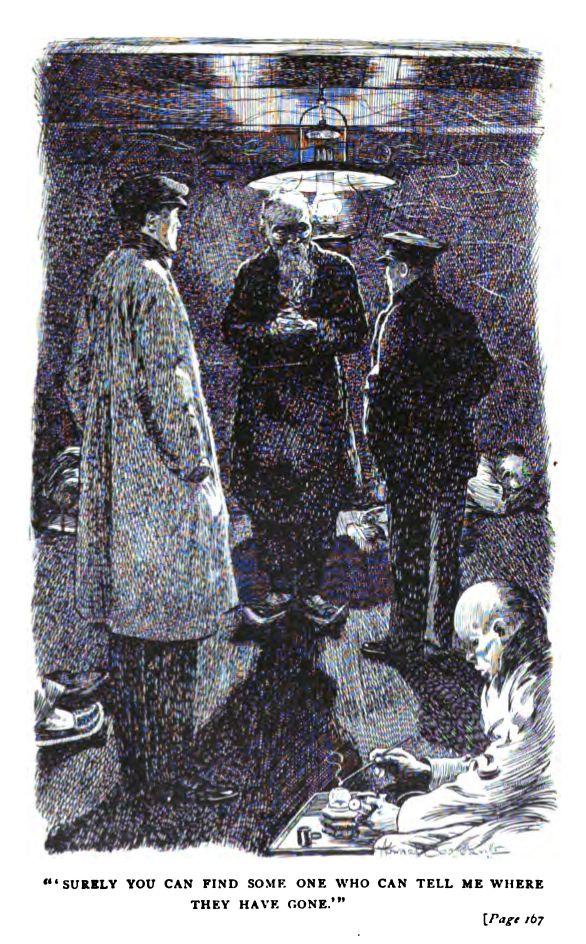
"'SURELY YOU CAN FIND SOME ONE WHO CAN TELL ME WHERE THEY HAVE GONE.'"
The Chinaman pondered a moment with his long fingers in his grey beard. Then, once more he bowed and excused himself a moment whilst he disappeared in the murky blackness at the back of the evil-smelling den.
"Dare you trust him?" Mercer asked.
"Bah, he would do anything for money," Uzali said contemptuously. "He could have told me in the first place if he liked."
"And your friends have been here to-night?"
"Yes, they have been here right enough, and I am rather glad of it for one thing. They would not be able to resist the opium, and when we do catch up with them they will be like children in our hands. We are not going to have our walk for nothing."
"I don't mind as long as we get outside this place," Wilfrid said. "It seems impossible that anybody could live in an atmosphere like this. I hope that Chinaman of yours isn't going to keep us here much longer."
After what seemed to be an interminable time the proprietor of the opium den returned, accompanied by a fellow-countryman almost as wrinkled and quite as dirty as himself. It was only from the alertness of his movements that the newcomer proclaimed the fact that he was much younger than the master of the ceremonies. His face was suspicious and sullen, and there was no sign of animation in his eyes till Uzali produced a sovereign from his pocket.
"Malays," he said curtly. "North Borneo men. There were two or three of them here this evening who have now gone. Show me where to find them and this piece of money is yours."
A transformation came over the cunning face of the listener. He held out a lean, yellow claw which trembled violently as the piece of gold was passed into it.
"You stay here, small piecie," he said, "and I go find. Maybe, small piecie be long piecie, and I find all le same."
"We had better go with him," Uzali suggested.
The Chinaman winked slightly and shook his head. Even the display of a second piece of money failed to shake his determination, though his eyes fairly watered at the sight of it.
"No, no, I not go at all," he said sulkily. "All same piecie gold, good thing, but life better still."
Uzali gave it up with a gesture of despair. There was nothing for it but to wait in that loathsome atmosphere till the messenger came back. The minutes dragged along; a quarter of an hour passed and then the messenger returned. He held up his hand as a sign for the others to follow.
CHAPTER XXIII
AN EXPECTED TROUBLE
It was good to be out in the open air, to breathe the pure atmosphere once more. For a long time the Chinaman stalked on ahead until the docks were passed and the Tower Bridge loomed high against the sky. It wanted little till daylight now, and already there was a red glow in the east. But the Chinaman went on and on till he came to the Strand and thence across into Leicester Square, to Oxford Street and behind Gower Street. There were gardens and trees looming ghostly in the morning mist, and before one of the gardens the Chinaman stopped and peered through the high gate. He stood for a moment or two as still as statue, then suddenly he grasped Uzali's arm.
"There," he whispered. "You see yourself."
Without another word he turned and sped silently down the road as if his feet were shod with india-rubber. On Uzali, peeping through the bars of the gate, this defection was lost. He was too intent upon some object which appeared to be creeping across the grass. In a low whisper he called Mercer's attention to it, but the latter could see nothing.
"I forgot you do not possess our eyesight," Uzali murmured. "But there is one of the men I am in search of. What they are doing here I don't know. That is what I mean to find out. Now give me a lift over this gate and stay till I come back. Oh, there is no danger."
In his heart of hearts Mercer did not feel so sure of it. But it was not for him to question Uzali's purpose. To lift the latter over the gate was easy, and a second or two later he was safe on the other side.
"One moment before I go," he said. "I am an utter stranger and have never seen this place before. So far as I can judge this is a fine square with a number of good houses round it. It is not difficult to guess that these fellow-countrymen of mine have their eye upon one of the residences. Now, do you think you could find out the names of some of the residents? Of course, I know it is rather a risky thing to try at this time of the morning, but you might hit upon some unsuspicious policeman who can give you all the information you want."
The request seemed ridiculous, almost farcical, but Mercer promised. Neither was he the less anxious to find out for himself, because a shrewd idea had come into his mind and he resolved to put it to the test. He strode off down the road as if on some important errand and presently he saw a policeman swinging silently along. There was an element of risk in what he was about to do, but Mercer did not hesitate.
"I have been looking for an officer for some time," he said. "I wonder if you could be of assistance to me."
The policeman pulled up hurriedly and flashed his lantern full on Mercer's face. He was not in the least disposed to be friendly. Evidently his suspicions were aroused.
"What can I do for you?" he asked curtly.
"Well, you see, I have just landed off a voyage," Mercer said, "and I have had the misfortune to mislay all my belongings. I could not think where to go until it struck me that I had, a friend who lived somewhere near here, a ship-owner by the name of Flower. Do you happen to know his name?"
The policeman shook his head slowly.
"I can't say as I do," he said. "You see, I haven't been on duty in these parts very long, and anyway, I don't suppose your friend would care to be knocked up at this time in the morning."
"Naturally enough," Wilfrid said coolly, "But, you see, I was not disposed to do that. If I can only find the house it will be easy to walk about till daylight."
Once more the policeman hesitated. His suspicions were not altogether lulled.
"You had better come with me and speak to my sergeant," he said. "I have got to meet him in five minutes at the top of Torrington Place. He will tell you about this Mr. Flower."
There was no help for it, so Mercer strode along carelessly by the side of the constable until the sergeant made his appearance. He seemed to be just as cold and suspicious as his colleague, but at the same time Wilfrid had the satisfaction of knowing that he had not drawn a bow at a venture altogether in vain, for at the mention of Samuel Flower's name the sergeant's face changed.
"Oh, yes, I know Mr. Flower well enough," he said. "He lives at number twenty-three on the other side of the square. For the most part he spends his time in the country. But the family is in town to-night, because I was passing the house when they came home from a party. But what do you want with Mr. Samuel Flower, young fellow? You don't look like the sort of company he generally keeps."
"Very likely not," Wilfrid said coldly. "But the fact remains that I was once in Mr. Flower's service as doctor on one of his boats. I am much obliged to you for your information, which will save me a great deal of trouble in the morning."
Wilfrid strolled away quite naturally and easily; indeed, he was so cool and collected that the sergeant allowed him to depart with a curt good-night. There was just the chance that the officer might change his mind, so that Mercer sped on rapidly back to Gower Street, nor did he breathe freely till he stood once more outside the gate over which he had helped Uzali to climb. It struck Wilfrid as being a good idea that he should climb the gate himself and stay till the square keeper came in the morning to unlock the gates. No sooner had this idea occurred to him than he proceeded to put it into operation. He dropped quietly on to the path on the other side and settled himself down to wait in patience for Uzali to reappear. Twice did he walk the circuit of the garden. Twice did he pass Samuel Flower's house; the brass numbers on the door shone so steadily under the street lamp that there was no mistaking it. The house appeared to be in darkness save one light in an upper room, which flickered every now and again as if a window had been opened and the draught had caused the gas to flare unsteadily. There was nothing for it but to wait with what patience he possessed, although Wilfrid was getting tired of his adventure. He was wondering if it would be safe to light a cigarette to pass the time away. He looked around him and saw in the centre of the garden a dense mass of bushes where he might conceal himself and smoke without the faintest chance of detection.
He made his way across the grass, and as he reached the shelter of the thicket he seemed to hear some one breathing stertorously. Shading the vesta in his hand he swept the shining blue flame over the grass. There was the outline of a figure lying on its back with a pale face turned up to the sky.
"Good Heavens!" Mercer cried, "why, it's Uzali!"
At the mention of his name the Malay opened his eyes and looked drearily about him. There was a nasty cut on the side of his head and a big black bruise under the left eye. It did not take Mercer long to discover that his companion was suffering from loss of blood, but so far as he could see no very great harm had come to him. A minute or two later Uzali staggered to his feet.
"How did it happen?" Wilfrid exclaimed.
Uzali put the question aside impatiently.
"Don't ask me now," he whispered. "Get me home as soon as you can. I will tell you about it in the morning. No, you are not to come home with me. You will put me in a cab and send me straight round to my flat. I can summon my own doctor by telephone and no one will be any the wiser. Now do you think you could manage to get me over that gate?"
There was something so imperious in Uzali's manner that Wilfrid asked no questions. By the great exertion of strength he managed to lift Uzali over the gate and deposit him on the coping-stones outside. A sleepy driver of a hansom cab came plodding along and Mercer summoned him without delay.
"My friend has had an accident," he said. "Here is his card and address. I want you to get him home as soon as possible and see him into his flat. You will have nothing more to do after that except to mind your own business and ask no questions. Come, my good man, I don't suppose you will mind earning a five-pound note like that. It isn't much for the money."
"I'll do it," the cabman said hoarsely. "I haven't earned ten shillings to-night. Now come on, sir."
Uzali was lifted bodily into the cab and as the driver reached the box the wounded man whispered a few, terse peremptory words to Wilfrid. A moment later the cab was out of sight. Wilfrid wondered what was going to happen next. He made his way back into the square again to the thicket of evergreens where he had dropped his cigarette case. He could see the houses opposite now. He could see that a flare of light had flashed upon the second floor in Samuel Flower's residence; quite plainly against the blinds were the shadows of two men struggling together. It was only for a moment, then all was thick darkness again. Wilfrid stood there rubbing his eyes in bewilderment.
CHAPTER XXIV
THE LONG DARK HOUR
Even had Wilfrid Mercer had a stronger head and a steadier nerve, he might still have been pardoned for a feeling of dread at that moment. He had been on the rack nearly an hour and was, besides, more worn out than he was aware. As the first faint glow of the dawn filled the eastern sky it was impossible to piece together the tangled puzzle. In the first place it was idle to imagine what had happened to Uzali, and who was responsible for the murderous attack upon him. And it seemed purposeless now to conjecture why he had been in such a hurry to get away without at least trying to explain the drift of events to Mercer.
He wondered if those strange kinsmen of Uzali's had had anything to do with it, but so far as they were concerned the victim had been so confident, so absolutely sure of them, that this theory appeared unlikely. There was nothing for it but to turn his attention to Samuel Flower's house and attempt to discover what had been going on there. Anything was better than standing still in the chilly dawn trying to solve a problem which was seemingly beyond human skill.
He must be up and doing. Mechanically he grabbed for the cigarette case and placed it in his pocket; then he crossed the grass and made his way over the railings of the square close to Samuel Flower's residence. The house was in pitch darkness. There was no sign of any trouble within. Wilfrid's first impulse had been to alarm the inhabitants and let them know what he had seen, but in cooler blood he dismissed this notion.
He stood in the uncertain shadow of the trees making up his mind what to do and letting precious moments slip, though, for all he knew, some terrible catastrophe might have taken place under his very nose. As he watched, doubting and hesitating, a figure crept along the other side of the square and entered Flower's house. The handle of the door was turned boldly and resolutely. It closed as firmly, but Wilfrid's ear caught not the slightest sound. Then he noticed that the light in the hall sprang up, followed by another light in one of the bedrooms at the top of the house.
"They are clever as they are daring," Wilfrid murmured. "Anybody passing would think the servants were up and about. I wonder what time it is."
At that moment an obliging clock struck the hour of five.
"Too early for town servants," Wilfrid muttered. "I have a good mind to try my own luck."
Wilfrid was by no means a timid man. He had gone through too many privations and dangers for that. With determined step, therefore, he crossed the road and laid his hand on the latch. He was not surprised to find that the catch was not down and that the door yielded to his pressure. A moment later and he was in the hall.
All the lights had been turned up. The place was flooded with a soft tender glow; pictures and flowers and statuary stood out and delighted the eye and pleased the senses. So far, whoever the intruders were, they had made hardly any attempt to disguise their presence. There was a festive air about the house, too, for the atmosphere was heavy with the smell of cigar smoke and the half-opened dining-room door showed that a snug supper party had recently met. It must have been within a few hours, for the dregs of the champagne still sparkled in the glasses. Wilfrid pressed on curious. He buttoned his overcoat about his throat in case of a surprise, and caught up an old-fashioned life-preserver from the hall table and slipped it into his pocket.
Yet nothing broke the silence; nothing indicated anything out of the common. No doubt, he surmised, there must be scores of similar scenes in the west end of London to-night, where people had come home and partaken of a hasty supper after the servants had gone to bed and then retired themselves, carelessly leaving the lights burning.
But in this particular case Wilfrid knew the lights had not been left burning. He had seen that sudden, mysterious gleam in the upper windows and the quick flash of the electrics as the whole turned to a sea of light. It was his plain duty to investigate the premises from top to bottom.
Wilfrid chose the basement, but nothing rewarded his search. All the rooms there were empty, as they were on the dining-room floor. Nor were there any strange coats or hats in the vestibule, excepting Flower's big fur wrap and soft hat, and some cloudy-looking material which Beatrice doubtless had discarded when she came in. He must look further afield and see what the next landing might reveal.
It was dangerous and difficult, but Wilfrid resolved to go through with it. He found the switches of the drawing-room lights and just turned them on long enough to enable him to see that the room was empty. He dared not try any strong illumination, for fear of arousing the suspicions of the police, who would know a great deal more about the servants' habits than he could. There appeared to be a large bedroom behind the drawing-room, looking out on the back of the house, and this Wilfrid tried cautiously. He felt sure some one was there because a long slit of light showed from under the door. The door was locked on the inside and no sound proceeded from the room save a gentle purring noise such as machinery will make when heard a long way off. Wilfrid likened it to the singing of a kettle rather than anything else. As he bent down and listened more intently he seemed to hear the murmur of voices and occasionally a suppressed groan as if from some one in pain, who was being quieted by the application of a powerful drug. A minute or two later Wilfrid knew that he was not mistaken, for from behind the locked door came a sound which was unmistakably a smothered laugh.
It was no business of his, of course, and he hesitated before he went farther. He might have paused until it was too late, had not his quickened hearing caught a sound overhead as if somebody had left the room on the next landing and was coming leisurely downstairs. Wilfrid crept back into the deep shadow of the drawing-room door and waited. It was somewhat difficult to see, for he had only the gleams of the light coming from the hall to guide him. Presently, as his eyes became more accustomed to the gloom, he saw that he was not mistaken. A man drew near with step noiseless and agile as a cat's. A peculiar perfume preceded him, a perfume which Wilfrid had not the least trouble in recognizing. It was the same strange scent he had smelt during the eventful night he had spent at Maldon Grange. He saw the stranger try the door of the bedroom; then suddenly all his restraint deserted him. His right hand shot out and he caught the little man by the throat.
"Get them to open that door," he said hoarsely. "Get them to open it at once or I'll choke the life out of you. Do you hear?"
Whether the man heeded or not he gave no sign. Wilfrid's grip was as tenacious as that of a bulldog, all his fighting instincts aroused. He felt the exhilarating sense of superior power. For the moment the man was as clay in his hands.
But only for a moment. Then in some strange way the little man managed to jerk himself free and two arms of wire and whipcord were around Wilfrid's throat till he was fain to bend and give under the pressure lest his neck should break. In all his adventures he had never encountered such a force as this. Try as he would he could not shake those arms off. He felt himself gradually being borne backwards until his head touched the ground and one of those relentless grips was relaxed for an infinitesimal space of time. The struggle was none the less tenacious and deadly because it was being fought out almost entirely in the dark, and Wilfrid temporarily lost his self-possession. Then he knew that if he could not fling the man off him his end was near. With a desperate effort he struggled to his knees and grasping his antagonist by the waist literally threw himself down the stairs.
Over and over they rolled, first one above and then the other, but making little or no noise as they slid down the velvet pile of carpet. No sound came from either and the ferocious struggle went on till they landed at length in the hall and Wilfrid was conscious of the cold marble under his head.
The time for the final struggle had arrived. Driving his knee upwards Wilfrid caught his antagonist fairly in the chest with a force that made him groan again, and as he felt the tense, rigid limbs relax, he knew that now or never was the time to save his life. A mist swam before his eyes; he turned faint and unconscious for a second or two; then when he looked about him again he saw that his assailant was gone and that some one was bending over him with tender solicitude.
"Beatrice," he murmured. "What is the meaning of this?"
"Hush," the girl whispered, "not a word. Thank goodness I have managed to get here in time to save your life."
CHAPTER XXV
THE DIAMOND MOTH AGAIN
Beatrice Galloway's feelings were strangely mixed as she drove along beside her uncle towards Gower Street. It seemed as if lately the whole world had gone astray, as if all happiness had ceased to be. For many months past she had felt the loss of Wilfrid Mercer; indeed, she had missed him even more than she cared to acknowledge to herself. And yet, no sooner had he crossed her path again than all this trouble had come back with him.
Of course, it was absurd to blame Wilfrid, but nevertheless, ever since he had shown his face at Maldon Grange there had been nothing but misery and mystery.
And why did Samuel Flower hate the young man so? Beatrice had been half ashamed to admit it when discussing the matter earlier in the evening with Wilfrid, but she knew that he spoke no more than the truth when he said that her guardian was an enemy of his. Beatrice was by no means suspicious, but this fact had been thrust upon her.
And yet Samuel Flower professed that Wilfrid was a perfect stranger to him. There was something here that Beatrice would have to get to the bottom of. Under the shadow of the darkness she could make out nothing of Samuel Flower's profile except that it was hard and set. She was glad enough when the drive came to an end and the house in the square was reached at length.
Cotter stood waiting in the hall. He appeared to be full of eagerness and the desire to speak, when Flower checked him with a malignant frown and a flash of his eyes.
"Presently, you fool," he muttered.
"It won't keep, sir, indeed, it won't," Cotter muttered. "Jansen has been here and must see you to-night. I told him you would not be back till late, but he went away saying he would call again."
Beatrice, glancing up casually at her guardian saw that once more the pale grey tinge had crept over his face. The malignant look had died from his eyes, giving way to a fear almost unspeakable. The girl had never heard this man's name before, and yet, quite by instinct, she coupled it with something disgraceful and underhanded. What was this new terror? She walked quietly into the dining-room and threw her wraps upon a chair by the side of the fire. As she laid her fan upon the mantelpiece an object in a small box fell to the floor. Beatrice picked it up carefully.
"I had almost forgotten," she murmured.
In a spirit of pure curiosity she raised the lid and the diamond moth flashed into view. Certainly it had been most careless of Uzali to leave the jewel on the supper-table after he had promised to get it repaired. Beatrice had taken it almost mechanically from the waiter who had brought it to her, and almost without thought carried it home. She took it casually from the box and ranged the two parts close together on the table so that the light might fall upon it. Really, it was a most lovely gem, one that any girl might be proud of, though Beatrice shrank from it as if it had been a thing of evil. In her mind it was associated with a series of dark tragedies, purple crimes and deeds of violence with which somehow her uncle was not unconnected. She laid her finger upon the jewel almost with loathing. She was still contemplating its sinister beauty when Flower entered the room and closed the door carefully behind him.
His mood had changed for the moment. He was by way of making himself agreeable.
"I hope you won't think I was rude to you just now," he said, "but I am greatly worried by business. Everything seems to have gone wrong lately, and if things don't mend before long I shall find myself very awkwardly situated. Like most successful men, I have enemies, and there is a conspiracy amongst them to drag me to the ground."
Beatrice murmured something sympathetic. Flower was telling her nothing new. She would have offered her assistance and advice had she thought it of the slightest use. She hardly heard what Flower was saying. She did not notice that he had broken off abruptly in his speech and that his gaze was concentrated upon the diamond moth.
"So that is what you were talking about?" he said. "Upon my word, it is exceedingly handsome. I should like to know the history of that jewel. But didn't it strike you as strange that an unknown man should have made you a present of the missing part of the ornament?"
"I don't know," Beatrice said indifferently. "Nothing strikes me as strange to-night. To begin with, it was such a remarkable gathering of people. Everything seemed to be so free and easy that I was bewildered. You may laugh at me as you like, but when Mr. Uzali produced the missing half, I was not in the least astonished."
Flower was about to ask a question when he altered his mind. He was leading up to a point cautiously.
"That being so," he said with assumed carelessness, "the man who made you this gift ought to have been rather an uncommon person to look at. What was he like? Did he resemble an adventurer or soldier of fortune? Was he a foreigner, or an actor, or what? As far as I could judge, though I was a long way off, he seemed a little insignificant man."
There was a forced gaiety in the speaker's voice which did not deceive Beatrice.
"You are right," she said. "Mr. Uzali is a little man, and very plain, with features not unlike those of a good-looking monkey, yellow face and hands more like a bird's claw than anything else."
"Ah!" Flower exclaimed. "And his speech?"
"His speech told me nothing. His English was as good as yours or mine. Mr. Uzali is a polished man of the world and as much at home in this country as in his own. But I thought it odd that his hand should be exactly like the one which I saw that night in the conservatory trying to find the latch of the door. But you need not be unduly curious. Indeed, I understood Mr. Uzali to express a wish to make your acquaintance."
"He wants to know me?" Flower murmured. "He is anxious to come here—the thing is preposterous. My dear child, you don't know what you are talking about."
Flower paused as if conscious that he was saying too much. The dark mood had come back upon him. He paced up and down the dining-room muttering. Then once more he realized that he was not alone, for he turned almost savagely to Beatrice and pointed to the clock on the mantel.
"I daresay we are making much ado about nothing," he said. "Don't you think you had better go to bed? I must finish some work before we return to Maldon Grange to-morrow."
"Are we going back to-morrow?" Beatrice asked.
"I think so," Flower said moodily. "On the whole, it is safer—I mean I prefer the country to London."
Beatrice gathered up her wraps and departed, the old sense of coming tragedy stealing upon her again. But she was too tired to think about anything but bed. She touched her guardian's cheek with her lips, but he did not seem conscious of her presence. No sooner had she gone than Cotter came into the room. He stood as if waiting for orders, his teeth chattering, his whole aspect one of ludicrous terror.
"Well, you blockhead," Flower cried, "why don't you speak? Why stand there in that ridiculous attitude? Anybody would think you a child frightened by a bogie. Where is your pluck, man? You used to have plenty of it."
"Never a man with more," Cotter said half defiantly. "But I have seen what I have seen and I know what I know, and I will never possess even the nerve of a rabbit. Oh, why didn't we leave well alone? Why couldn't we be satisfied with our ill-gotten gains? Surely you had more than enough. For years I have been dreaming about this danger. For years I have known that it was coming. Sooner or later it was bound to find us out. And the worst of it is, you can't fight it. It is miles away one day and the next it stands grinning at your elbow. It may be in the house at the present moment for all I know, just as it was at Maldon Grange."
"Drop that!" said Flower fiercely. "Drop that, you lily-livered coward, or I will do you a mischief. Is there nothing in the world worth speaking about except those yellow-faced devils who are after us now? Isn't it bad enough that Jansen should turn up at this moment?"
Flower paused as an electric bell in the basement purred loudly and a sort of muffled cry came from Cotter as if he had been listening to his death-knell. He stood gazing abjectly into Flower's face, his own white and sweat-bedabbled.
"Wake up, idiot," Flower said savagely. "Go and let him in. It is only Jansen."
CHAPTER XXVI
DR. JANSEN
Cotter seemed to feel his way to the door, as if he were blind, or the room had been suddenly plunged into intense darkness. He hardly dared to breathe till he had opened the front door and admitted a short, enormously stout man who beamed on him mildly behind a pair of huge silver-rimmed spectacles. There was nothing in the stranger to inspire terror in the heart of Cotter, but his manner was servile to a degree.
"You see, I have come back again," the foreigner said. "Did I not tell you that I should come back, my friend? And it is no use telling me that Mr. Flower is not in, because I saw him arrive with his beautiful niece. In fact, I stood on the pavement on the other side of the road and watched the carriage come. If it had been all night I had to wait, I should have remained there. You have told your master I am coming?"
"I have done that," Cotter whined, "and he will see you at once. Will you come this way, please?"
The Dutchman bustled into the dining-room and threw his hat and coat carelessly on a chair. Then he proceeded to wipe his spectacles on an immense red handkerchief which he produced from the tail pocket of his greasy frock-coat. Without ceremony he hustled Cotter to the door and closed it.
Flower stood moodily gazing into the fire-place without taking the least heed of his visitor. Not in the least disconcerted, the Dutchman wheeled a big armchair to the fire-place and made himself comfortable. Then from another capacious pocket he produced a villainous cigar with the fumes of which he began to poison the room. Helping himself liberally to brandy and soda, he sat down patiently waiting for Flower to speak. Despite the man's fatness and the jovial twinkle in his eyes, there was something about him which spoke of a grim and determined nature. Evidently, too, he was master of the situation and knew it. The tension grew until Flower could stand it no longer.
"Well, what the devil do you want?" he broke out passionately. "What are you doing here just at this time? Haven't I got worry enough without you turning up to blackmail me?"
The Dutchman waved the suggestion aside.
"There, my friend," he said coolly, "you are entirely wrong. I did not come here to blackmail you at all. You treated me very badly some years ago, and I have bided my time till I could get even with you. I don't know whether you are aware of it or not, but the time has come. I should like to know what you are going to do about it."
"Nothing," Flower said moodily. "I am going to let matters take their course. I am not afraid of you and the sooner you know it the better, and if you want money, well, you can't have it. For the last two years everything has gone wrong. People fight shy of me and only the smaller firms in the City will have any dealings with my firm. I am supposed to be rich and prosperous, to have made money in my own peculiar way, but I tell you I am a ruined, almost desperate man. Two years ago——"
"Ah, I know what you are going to say," the Dutchman chuckled. "You are going to tell me that everything has gone wrong with you since that trouble over the Guelder Rose. There was the Japonica, too, and the time has gone by when you could make money in coffin wood. Well, on the whole, you have been a lucky man. If I choose to find where young Dr. Mercer is, and if we put our heads together, we could tell a story about the Guelder Rose which would land Mr. Samuel Flower within the four walls of a gaol. Oh, you needn't look at me like that. I am not likely to do you any harm so long as I can make money out of you. I have waited long enough for this opportunity, knowing that you would find yourself in a corner sooner or later, and I have come here to-night to make a proposal. Why should you talk about being a ruined and desperate man when you have only to put out your hand and fill your pockets with treasure?"
Flower abandoned his place by the fire and began to walk up and down the room again. He was agitated.
"I will not be fool enough to pretend to misunderstand you," he said hoarsely. "I know what you are alluding to. You are speaking about that treasure which awaits us in North Borneo. I tell you I dare not. I cannot steel myself to go through that again. As for you, your case is different. Though you took a prominent part in that expedition you were wily enough to keep yourself in the background. Nobody could identify you with any of the men who fired that mine and washed a whole city to destruction. I used to marvel at your cunning——"
"I hope you admired it," Jansen chuckled. "Did you think that I was such a fool as to embark upon an enterprise like that without taking proper precautions? Did you suppose I didn't expect to be murdered on my way down to the coast? And didn't your native servants do their best, at your instigation, to put me away? Not that I bear you any malice. I daresay if things had been otherwise I should have tried to wipe you out, as they say in America. When the time came I discreetly disappeared, and it was generally imagined that I had perished miserably in the jungle. My dear, respected partner, I did nothing of the kind. I kept my head and by and by went back to the scene of the destruction to see what I could pick up for myself."
"You found nothing," Flower snarled.
"Absolutely nothing," the Dutchman said good-naturedly. "You had taken good care of that. But the stuff is there, and you know where it is to be found. That is why I am here to-night; why I want you to accompany me on a final voyage, after which neither of us will ever need to work again. The whole thing has blown over. There are no natives left to tell the tale, and we shall be rich men with a minimum expenditure of trouble. The key of the situation lies with us. You can do nothing without me and I am powerless without you. Let us make an offensive and defensive alliance and take out our own staff. What do you say?"
Jansen spread his hands cheerfully out to the blaze, his little eyes beaming with good-nature. He was not in the least like a man in the close proximity of his would-be murderer. He seemed to take everything for granted. Flower came to an abrupt halt by the fire and looked down at his companion.
"A very pretty programme," he sneered. "Quite an excellent programme. We are to fit out an expedition to North Borneo together. We are to recover all that priceless treasure—why, the marvellous china and engraved glass alone would be worth a fortune—then come home rich beyond the dream of avarice and live happily for ever afterwards. It sounds delightful, but there is one flaw. You are under the impression that the clan was destroyed root and branch when the city was washed away. You are mistaken. There were survivors, and at least two of them to my certain knowledge are in England at the present moment. Do you know that my life is not worth a moment's purchase? Do you know that one attempt has already been made upon it? The next may be successful. And when I am got rid of, that treasure will never be seen again by mortal eye. Besides, how do you know you are safe yourself? You took extraordinary precautions, I know. But we had men to deal with whose cunning and foresight were far greater than our own. Now, in view of what I tell you, are you still bent on going?"
The twinkle had died out of the Dutchman's eyes and his rubicund face had grown solemn. He sat for a long time gazing into the fire before he spoke.
"You are sure of this?" he asked. "You are certain there has been no mistake."
By way of response Flower took an envelope from his pocket and produced a five-knotted piece of string. He handed it gravely to his companion.
"Look at that," he said. "You know what it means. Now, that came to me in a registered letter posted by my agent Slater, in Borneo. Mind you, though Slater knows nothing about this trouble, my correspondence with him is always conducted in cypher. The letter was so private and confidential that it was written by Slater himself and posted by his own hand. And yet, when I come to open the letter, I find this inside. You are an easy-going sort, but I ask you, would not your flesh creep and your hair stand on end if you found a message like that inside of a confidential letter, written, sealed and posted by another person? I tell you the play is finished, the game is up, and I am doomed just as irrevocably as if I were the victim of some incurable malignant disease. Come, you are a clever man, Dr. Jansen, can you show me any way out of this?"
Jansen played thoughtfully with the string, but no words crossed his lips. He was baffled.
CHAPTER XXVII
NO FOE OF HERS
The house was quiet enough now. The whole place was plunged in darkness; even Cotter had forgotten his terror and was dreaming uneasily. As for Beatrice, she had thrown herself upon her bed, worn out with fatigue and anxiety and for some time she slept. Her room and the dressing-room beyond were not dark, seeing that they faced the front of the house and the street lamps shone upon the windows. She lay at first unconscious of her surroundings, but by and by she grew uncomfortable and awoke with a start. She could hear and see nothing beyond the dim shadows of the various objects in the room, until gradually her eyes began to grow accustomed to the gloom and she could distinguish her dressing-table in the small room beyond. She recollected hazily that she had placed her diamond moth with the rest of the jewelry on the table. In a drowsy sort of way she was chiding herself for her carelessness when she seemed to see a hand moving noiselessly over the toilet articles. For a moment Beatrice put the impression aside as a mere fancy, but kept her eyes fixed on the spot till she knew that she was no longer mistaken. Somebody was in the room and bending curiously over the diamond moth. A moment later a shadowy arm waved and a second figure joined the first. The two dim outlines stood with clasped hands gazing rapturously at the moth, much as some heathen might regard a precious idol. Beatrice could see the intruder's lips moving as if in prayer. Evidently they had found some talisman which was engrossing their attention and probably keeping them from more serious work.
The girl lay still and rigid, too terrified to move, and incapable of uttering a syllable. For the life of her she could not have screamed, she was so overcome with dread. How long this scene lasted it was impossible for Beatrice to say. She knew that danger sharp and horrible was here. Then it flashed into her mind that the peril was not for her. The thought nerved her to exertion. She dragged herself from her bed and threw a wrap over her shoulders.
A new wild courage was burning in her veins. Action was better than lying quaking and fearing the worst. With a firm step she crossed the floor and walked into the dressing-room. Then, before she had time to speak or move, unseen hands were laid upon her shoulders and she was dragged backwards, not with violence, not with anger, but with a considerate firmness that would brook no denial. An instant later and a small blue light flickered on the floor, throwing up a sweet fragrant incense which Beatrice found infinitely soothing to the senses. She seemed to rock and sway. She felt herself lifted from the floor, and then she dropped into a deep sleep and knew no more.
When she came to herself again her mind was wonderfully fresh and clear. Like a flash she saw everything that had happened. Like a flash it came to her that these intruders were no other than the strange visitors who had made themselves so much at home at Maldon Grange. Beatrice was not in the least afraid; at least, she had no fear for herself. Whatever those uncanny creatures were searching for, they had no quarrel with her; indeed, they had gone out of their way to save her from the consequences of her interference. But if the danger were not for her, for whom was it intended? The answer was obvious. Samuel Flower was the enemy. Samuel Flower was the victim whom these little men were tracking down in their relentless fashion. How long had she been asleep?
She looked at her watch, but there was nothing to learn from that. She partly dressed herself with a view to arousing the household. As she opened the door leading to the landing she heard sounds of a struggle outside. With unsteady hand she turned up the lights, and, locked in a deadly grip, almost at her feet, were one of the strangers and another man whom she did not recognize at the moment. As the two rolled headlong down the steps, Beatrice gave a sharp cry, for she had seen the white, set face of Wilfrid Mercer. The thing was all over almost before she realized that it was begun. One assailant had vanished, goodness only knew where, and Wilfrid lay on his back bruised, battered, and all but unconscious. Thoughts for his safety uppermost in her mind, Beatrice flung prudence to the winds. She flew downstairs and raised her lover's head just as he was opening his eyes. Nothing seemed to matter so that he were safe, and with unfeigned thankfulness Beatrice heard Wilfrid mutter her name.
"You are not hurt?" she asked anxiously.
"Not so very much, I think," Mercer said as he struggled to his feet. "But the man nearly choked the life out of me all the same."
"What has happened?" Beatrice asked. "How did you get here? What brings you in the house at this time in the morning?"
Wilfrid pressed his hands to his head. He was too dazed to reply coherently. Then as his mind cleared, events began to adjust themselves, and the strange panorama of the night unfolded itself slowly.
"I will tell you," he said. "I am here because I happen to know that your uncle is in imminent danger. How I got into the house doesn't much matter. I came here without ceremony, and I was making my way upstairs when I interrupted that man and had to fight for my life. But hadn't we better ascertain that your uncle is safe?"
"Oh, yes," Beatrice said eagerly. "I am afraid we shall not be able to get into his room. He always locks himself in and the door of his bedroom is lined with steel, as a precaution against burglars or something of that kind, so he said."
Wilfrid waited to hear no more. He was quite himself by this time. Followed by Beatrice he went quietly up the stairs until he came to the door of her uncle's room. He tried the lock, but it resisted all his efforts. It did not seem prudent to call out in case something terrible might be going on inside.
"Is there no other way?" Wilfrid whispered. "Is there no balcony at the back of the house, no creepers, or rain-pipes, or anything of that kind? Have no fear—forewarned, forearmed."
"There is a balcony running all the way along," Beatrice explained. "My uncle talks of having it removed, but he has not done so yet. I can help you through a bedroom window and you can creep along and see for yourself. But I implore you not to run into any danger."
"It is a case of life or death," Wilfrid said gravely. "I will be as prudent as I can. But we must not lose time."
Beatrice led the way into one of the back bedrooms and opened the window. Mercer crept along in the darkness cautiously until he came to a room both windows of which were lighted. One of the blinds was partly pulled up and one of the sashes raised a few inches. From beneath came a sweet, sickly scent which caused Mercer to reel as if a desire to sleep had suddenly seized him. It was only by holding his handkerchief to his mouth and nose that he was able to lie down on the balcony and peep under the blind. He could see Flower lying on his bed, apparently unconscious, with a white bandage around his forehead. He could see two figures flitting about the room, like doctors during an operation. For a moment Flower's two hands were raised above his head, then fell helplessly again by his side.
What infernal thing was going on? What black art was being practised by these miscreants? Flesh and blood could stand it no longer. Wilfrid forced the sash to its utmost capacity and dashed into the room. Seizing a chair he whirled it round his head and made a wild lunge at one of the would-be assassins. At the same time he cried out for others to follow him as if he had assistance at hand. Almost immediately the light was extinguished; there was a rustle of figures in the darkness and Wilfrid knew that he was alone. The sweat was pouring off his face with the horror of it all. He groped round the walls until he found the switch and flooded the place once more with the welcome rays. He could see the key was inside the door. He opened it widely and called for Beatrice. Then he turned to the figure on the bed. The white bandage was gone from Flower's head and he lay still and motionless. So far as Mercer could see he did not breathe. Beatrice entered full of anxiety.
"What is it?" she whispered. "Is he dead?"
"I don't know," Wilfrid said. "It is impossible to say. You must rouse the household at once and send for the nearest doctor or the nearest half-dozen for that matter. I want a brain specialist if he can be got. Will you go at once, please. Every moment is priceless."
CHAPTER XXVIII
BEYOND SURGERY
Wilfrid had to repeat his command more than once before Beatrice seemed to understand what he was saying. The girl was dazed with the horror of the thing. She stood looking at the white, still figure on the bed, marvelling what was going to happen next. And yet, at the back of her mind there was a glimmering of the truth. This was a vendetta and these relentless foes would never slack their efforts until Samuel Flower had paid the debt to the last penny. Many of these things Beatrice had read about in the pages of fiction. She had forgotten, perhaps, that there are stranger things in every-day life.
As for Wilfrid he was calm enough. His professional instincts came to his aid. Laying his hand gently upon Beatrice's shoulder he led her from the room.
"I want you to be brave and silent," he whispered. "I want you to help me all you can. It is possibly a selfish reflection, but your life is safe. If you would save your uncle, you must do what I tell you."
"I will try," Beatrice murmured. "What do you want me to do? Oh, I remember."
She departed without another word, leaving Wilfrid to do what he could with her uncle. This second attack was much more serious than the first, for Samuel Flower lay to all appearance dead. It was not difficult for Wilfrid to make an examination, for Flower had undressed and gone to bed before the attack. He lay on his back with his arms inert by his side, the deep purple of his cheeks had given way to a ghastly whiteness. Wilfrid could detect not the slightest trace of violence anywhere, nothing but one or two small indentations on the forehead and at the back of the head. Try as he would Wilfrid could make nothing of the case. And if he could trust to his trained knowledge, he felt sure that no explanation would ever come from Flower's lips, for surely the man was dead.
He could hear no murmur from the heart. By laying the glass of his watch on the murdered man's lips he could distinguish no moisture. He could only wait patiently until assistance came, and then tell the story as best he could. With almost a sensation of shame Wilfrid realized that Flower was harmless to do him further injury. He tried to put the matter out of his mind, but it recurred more than once, until he was fain to walk up and down the room in the growing light. He pulled up the blinds by and by and let in the flood of day. Even in the strong light he could detect no motion and no change in that awful figure on the bed. Inured as he was to these kind of tragedies, it was with a thrill of thankfulness that he heard steps coming up the stairs and saw a stranger enter the room. There was no reason for Wilfrid to ask if the new-comer were a doctor, for he carried his profession in every crease of his well-fitting frock-coat, in every line of his well-groomed hair.
"My name is Dr. Shelton," he said. "I am sorry to be so late, but I have only just got back to town. So this is your patient? What do you think he is suffering from? You have made an examination?"
"I haven't the remotest idea," Wilfrid said frankly. "I have never seen a case like it before. Mr. Flower lies there to all appearances dead. He does not breathe. There is not the slightest motion of the heart, and yet, rigor mortis has not set in. I should say it is some brain trouble."
Dr. Shelton stripped off his coat and turned up his shirt sleeves. For a long time he bent over the bed, but at last he stood upright drawing a long breath.
"Most extraordinary," he murmured. "Everything points to severe concussion of the brain, and yet there is not the slightest trace of violence; there is no suggestion of a blow, or fall, or anything of that kind. We must wait till the patient comes to himself as he will before long."
"He is not dead, then?" Wilfrid asked.
"No. It is a case of suspended animation. That the brain is seriously injured the congestion of the eyes proves beyond demonstration. But, surely, you can throw some light on this mystery. How came you to be called in?"
Wilfrid had been dreading the question for some time. He hardly knew how to explain matters to this polished man of the world whose lines had probably always fallen in conventional places.
"Well, it was like this," he began. "I have lately started a practice in Oldborough and Mr. Flower has a country house close by. I was called in to attend him for a trifling injury, and when I got to the house I discovered that Miss Galloway, Mr. Flower's niece, was an old friend; in fact, we had met in London some months ago. Miss Galloway had been under the impression that some one was trying to get into the house, but perhaps I had better tell you at length what really happened."
Wilfrid proceeded with his statement, purposely, however, saying nothing as to the mysteriously-knotted string, or the strange incantations which he had watched on the part of the Malays. These matters seemed to have nothing to do with the case, nor could they influence the opinion of Dr. Shelton. He told his story straightforwardly, how he had got into this house and what sort of reception had met him. Shelton raised his eyebrows incredulously.
"So you think this is a case of burglary?" he asked. "Mr. Flower has something in the house which these villains were after. You say you saw them in this room when you entered by the balcony?"
"I did," Wilfrid replied. He was feeling on safer ground now. "I suppose my presence frightened them and, you see, I had other things to think of. It is very singular that these fellows did Mr. Flower no violence."
"No violence whatever," Shelton said emphatically. "They hadn't gone as far as that, though their intentions might have been murderous. It seems to me, Dr. Mercer, that this is a case as much for the police as for the medical man. At any rate, I frankly own that I am as puzzled as yourself. It will be a great favour to me if you will remain here while I go to Harley Street, as I should like another opinion besides my own. If you stay in the house it will be sufficient. It will be some time before Mr. Flower regains consciousness."
Wilfrid expressed his willingness to do whatever was necessary and Dr. Shelton bustled away. The servants were moving about the house now. Wilfrid heard the clock strike the hour of eight, then; presently, an appetizing odour of cooking stole over the room. It was nearly an hour later before Beatrice came and asked the latest news. There was no change, for Flower lay as he had done three hours before.
"I have told the servants nothing," Beatrice whispered. "They have merely been informed that my uncle has had a slight seizure and that the house must be kept very quiet. But won't you come downstairs and have breakfast? It is ready in the dining-room. And if you could manage to stay here till Dr. Shelton returns——"
Wilfrid explained that he had already promised to do so. Despite the thrilling adventure of the night before, he was hungry and did ample justice to his meal. At the same time he could not forget his own affairs. It might be a security to feel that Flower lay upstairs beyond the reach of mischief, but Flower was not alone in this business. Beyond doubt the man Cotter had received his instructions. Beyond doubt the law was already in motion which was to deprive Wilfrid of his good name and his means of living. It was hard he should have to stay there doing nothing and keep watch and ward over a man who was intending to ruin him through another; but of this he could say nothing to Beatrice.
She sat at the foot of the table playing with a cup of tea and some toast; recent events had shaken her terribly. For some time she kept silent.
"I must speak to you, Wilfrid," she said presently. "I want to know if you have found out anything. I want to know if you have discovered anything that has been hidden from me. Tell me truthfully, is this the first attack of the kind which has been made upon my uncle? Didn't a very similar thing happen the night you were at Maldon Grange?"
"I am sorry you asked me that," Wilfrid said quietly, "because I cannot look you in the face and tell you a lie. Of course I can't say yet whether I was successful last night, but under Providence I most assuredly saved Samuel Flower's life on the occasion you speak of. Please don't ask me more. Try to be brave and patient, and all will be well."
Beatrice said no more, but it was evident she was putting a great strain upon her curiosity.
CHAPTER XXIX
A MESSAGE
The morning dragged slowly and Wilfrid began to think that Shelton had forgotten about his patient. It was maddening to wander about the house wasting precious time, when perhaps the blow had already fallen at Oldborough. More than once Wilfrid was tempted to make his way to the City where he could discuss his affairs with Russell and Uzali.
And what had happened to the latter? How was he getting on after his cruel treatment of the previous evening? And what was Russell doing all this time? Wilfrid was debating the matter seriously when, about midday, a motor car drove up and Dr. Shelton, accompanied by a colleague, got out. Shelton raised his brows interrogatively at Wilfrid, who shook his head.
"No change," the latter murmured. "He is just as you left him, hovering between life and death. I don't wish to be inconvenient but I shall be very glad if you will release me as soon as possible. I have urgent business in the City which is going to rack and ruin without me."
"Give us half an hour," Shelton said. "We are going to try an experiment—a desperate one I admit—but there seems nothing else to do in the circumstances. But, if you can get back by two o'clock to keep an eye upon things till the nurse I have written for arrives, I shall be greatly obliged."
Wilfrid yielded with as good grace as possible. He began to feel reckless and desperate. He paced up and down outside the house smoking one cigarette after another until Shelton appeared again.
"I don't think we need detain you any longer," the latter said. "Our operation has been partially successful and I am leaving Mr. Flower with my colleague at present. There has been serious brain trouble, and I very much doubt if my patient will ever be the same again. If you can manage to return by two o'clock for an hour, I think I shall then be able to dispense with your services."
Wilfrid waited to hear no more. He had already laid his plans. In the first place, he would call upon Fowler & Co., who had written regarding the bill, which threatened destruction to his home and future. He might perhaps obtain some information from them, though time was growing short and there remained barely a day and a half in which to satisfy these blood-suckers and breathe freely once more. A reference to the Post Office Directory gave Wilfrid the information he was in need of, and a hansom conveyed him to London Wall where the offices of Fowler & Co. were situated. The place was dingy, the office small and dirty. For a moment Wilfrid hesitated whether to go in or not, when he suddenly paused and looked into a shop-window as if fearful of being seen, for on the steps of the office stood Cotter in close conversation with a small, slight man, whose keen dark eyes bespoke a foreign origin. It was plain enough to Wilfrid now. Cotter had come down on business connected with the very security which was likely to be Wilfrid's ruin. The two men parted by and by and Wilfrid crossed the road, his mind fully made up what to do.
A shabby-looking clerk in the outer office announced the fact that Mr. Fowler was not engaged. Without waiting for any reply Wilfrid crossed to the inner office and opened the door. Surely enough, seated at a desk, was the little man with whom Cotter had been talking so earnestly a few minutes before.
"My name is Dr. Mercer," Wilfrid said bluntly. "You are Mr. Fowler, I understand. I came to see you in regard to a security which I gave to a firm called Darton & Co. for one hundred and seventy-five pounds. This security will fall due to-morrow and I am anxious to get it renewed."
The man shrugged his shoulders and took up his pen.
"My dear sir, I am very busy this morning," he said. "If you cannot meet the security, why, there is an end of it. I am sorry, but business is business, and of course you know the consequences if the bill is not taken up to-morrow."
"I am aware of that," Wilfrid said impatiently. "But what I want to know is, where do you come in? What connexion have you with Darton & Co.? And why should they turn over my liability to you? These are simple questions."
They were simple but Mr. Fowler had some difficulty in answering them. He changed colour slightly and his dingy hands fingered a bell on the table before him.
"Oh, you needn't be afraid," Wilfrid said contemptuously. "I am not going to do you any harm, but I came here for certain information and I mean to have it. Is my credit so good that you could afford to speculate in a bill of mine? But perhaps I had better come to the point. Where is the security?"
Mr. Fowler laughed somewhat unpleasantly. He was more at his ease. He pointed over his shoulder to a safe in the wall.
"The security is all right, sir," he said. "The point is, do you want to take it up? If you have the money with you the thing could be arranged quite amicably."
There was a sneer underlying these words which brought the blood into Wilfrid's face. The man was laughing at him. Here was a chance to test the truth of what Fowler was saying. Wilfrid took a bulky packet of letters from his pocket and laid them on the table before him.
"I didn't come here to offer you a cheque," he said, "because it occurred to me you might refuse it. But I suppose you have no objection to banknotes."
Fowler was taken aback. The grin died away from his cunning features.
"Oh, certainly," he muttered, "certainly."
"Then produce the security and let us have done with it."
Fowler arose reluctantly to his feet and rummaged among a mass of papers in the safe. But the security was not forthcoming, which was exactly what Wilfrid had foreseen. With some show of disappointment Fowler returned to his desk muttering that he had left the security at home. Wilfrid gravely restored the bundle of papers to his pocket. He was not displeased at having forced the money-lender to show his hand. His suspicions had become certainties. Cotter had come down on purpose to take the security away. He rose carelessly from his seat.
"Very well," he said, "it doesn't in the least matter, but you must understand I can't call again. You know my address in Oldborough. I shall be there to-morrow morning, and if you send a representative to meet me I shall be prepared to pay you off. I don't think I need detain you longer."
With a curt nod Wilfrid left the office and made his way to Uzali's flat. He was informed that the Malay was in bed, but had left instructions that if Dr. Mercer called he was to be shown up at once. He found Uzali propped up by the bedclothes and looking not much the worse for his adventure.
"Oh, I shall be right enough to-morrow," he said cheerfully. "It is very unfortunate that I should have got into trouble last night. I daresay you wonder what it is all about?"
"My dear sir, I am consumed with curiosity," Wilfrid said. "And when you have told me all your adventures I will tell you mine, which were thrilling enough in all conscience."
"That is a bargain," Uzali smiled. "But there is one thing you must tell me first. Is our friend Samuel Flower still alive? Did anything happen to him last night?"
"Oh, he is still alive," Wilfrid said dubiously. "But how long he is likely to last is another matter. And now, if you will promise not to get unduly excited, I will tell you everything that has happened since I put you in the cab. You will be interested."
Uzali listened with rapt attention to what Wilfrid had to say. He even expressed his satisfaction at the knowledge that things were no worse with Samuel Flower.
"So far, so good," he said. "And now, perhaps, I had better tell you my story. It is shorter than yours and not so dramatic. In the square I fell foul of those countrymen of mine, never doubting for a moment but that they would recognize me and my authority. Perhaps they took me for some imposter, perhaps they lost their heads in the darkness. Anyway, they attacked me in a most murderous fashion before I had the slightest chance of explaining; hence the fact that you found me in the square nearly done for. Mind you, if this had happened a week ago I would not have interfered, but have allowed matters to take their own course. But now things are different. They have changed altogether."
It was a long time before Uzali spoke again. He lay there with his eyes closed as if asleep or dreaming.
CHAPTER XXX
A SLIGHT MISUNDERSTANDING
Wilfrid walked slowly back to Bloomsbury, his own affairs uppermost in his mind. His morning had not been wasted. He had found out several things likely to be of use to him, but, on the other hand, the time was so short that it seemed almost impossible to save the situation. There was an outside chance that his friend Vardon might have been able to raise the money, but no information had come from him, and in such cases no news is bad news. The security had undoubtedly found its way into Cotter's hands and no time would be lost in making use of the weapon. The mere thought was maddening. Here was a man lying on his death-bed, yet ready to strike at another man, who, on two occasions had risked his life for him. It would have been better to allow those poisonous little Easterns to have their own way and remove a scoundrel like Flower altogether. Still, there was a chance yet, and Wilfrid meant to take advantage of it if he had the opportunity. He was not beaten.
Beatrice's pale white face glancing wearily through the drawing-room window recalled him to himself. There was better news, on the whole, than Wilfrid had expected. Shelton's operation had been partially successful, and he and his colleague were waiting for Wilfrid's return.
"You haven't very much to do," Shelton explained. "The nurse I have chosen will be here at any moment and she will take your place. You will find certain medicines upstairs which you will know what to do with."
Shelton departed hurriedly, after the manner of his kind, and Wilfrid made his way to the sick room. Beatrice followed him fearfully with a whispered request to be permitted to see how the injured man was, and Wilfrid had not the heart to refuse.
"It must be only a moment, then," he said. "I have no right to have stayed here so long. I ought to have been back in Oldborough hours ago. You must promise to be quiet and not speak a single word if I admit you into the sick room."
Beatrice gave the assurance and they crept into the bedroom silently together. Flower lay with his eyes wide open, gazing about the room in a strange, lack-lustre fashion. Evidently he had not the remotest notion where he was or what was taking place around him. He murmured from time to time a medley of things in which the shrewdness of a man and the innocence of a child were curiously mingled. Wilfrid seemed to hear sounds of some one moving in the dressing-room beyond, and he looked into the room, where he saw Cotter in the act of placing some papers in a desk. Flower's confidential clerk looked up guiltily as his glance met Wilfrid's eye.
"What are you doing here?" Wilfrid asked sternly. "Don't you know that nobody but the doctor and the nurse are allowed here? And why are you tampering with those papers?"
"I am not," Cotter stammered. "I swear I am not. I am only putting away a few documents which my master told me to fetch from the City this morning. I am very sorry, sir, but I won't come back again. Is he better?"
Wilfrid turned on his heel without reply. No sooner had Cotter left the dressing-room than Wilfrid was back in the bedroom intent on getting rid of Beatrice also. It was useless for the girl to stay, for she could do nothing except stand there with eyes full of tears of pity and sorrow. Wilfrid led her out to the landing.
"You must not come here again," he said. "I will leave directly the nurse arrives. I have to call upon a friend and then I must get back to Oldborough without delay."