THE FRENCH PEASANT, BEFORE AND SINCE THE REVOLUTION
Reading edition
THE first time we meet him, to my knowledge, is just about the end of the twelfth century. Who can forget the sombre figure that strides across the dainty scene of Aucassin et Nicolette? Aucassin, on his courser, dreamy and lost in thought, goes riding towards the greenwood to find his true love, Nicolette. At the edge of the forest he passes the little herdboys, sitting on their mantles on the grass, as they break bread at nones by the fountain’s edge. These are mere children. It is far later, when the sun is sinking, while the tears course down the callow cheeks of Aucassin at the thought of his poor strayed love still unfound, it is deep in the forest glades that he meets the real French peasant.
“Right down an old green path rode Aucassin. He looked before him and saw such a varlet as this. Tall was he and wondrous foul of feature; he had a great shock of coal-black hair; his eyes were a full palm’s breadth apart. Large was his jowl, flat his great nose, with a broad nostril, and his thick lips were redder than roast meat; yellow and unsightly were the teeth of him. Shod was he with hose and shoon of oxhide, gartered a little lower than the knee with swathes of lime bark; and he was wrapped in a great coarse cloak that seemed to have two wrong sides to it. He stood there, leaning on a club; and he was sore afraid when he marked Aucassin riding towards him.
“‘Now God be with you, fair brother,’ said Aucassin.
“‘God bless you,’ replied the peasant hind.
“‘And what do you here, for the love of God?’ said Aucassin.
“‘What’s that to you?’ said the other.
“‘Nothing,’ said Aucassin. ‘I spoke out of courtesy.’
“‘But you,’ said the peasant—‘why do you weep and go so sad and sorry? Were I as rich a man as you, naught in this world should make me shed a tear!’
“‘Bah! Do you know who I am?’ said Aucassin.
“‘Yes. You are Aucassin, the count’s son. And look here, an’ you’ll tell why you go thus a-weeping, I’ll tell you this business of mine.’
“‘Certes,’ said Aucassin; ‘gladly will I tell you. This morning I went a-hunting in the forest, having with me a certain white greyhound, the loveliest thing alive. I have lost it; so I go weeping.’
“‘Oho!’ cried the other. ‘By the heart in the Lord’s bosom, you go crying for a stinking hound! Bad scan to me if I think any the better of you for that! Fie, there’s not so rich a man in this land, but if your father besought him for a gift of ten, or fifteen, or twenty greyhounds, he would send them you right gladly. But I may weep, and have a cause for weeping.’
“‘Why, brother?’
“‘Sire; I will tell you. I was hired out to a rich peasant, and drove his plough with four oxen. And three days ago I had the misfortune to lose the best of my oxen, Roget, the pride of all my team, which still I go a-seeking. These four days past, neither bite nor sup has crossed my lips, for I dare not go near the town lest they put me in gaol.
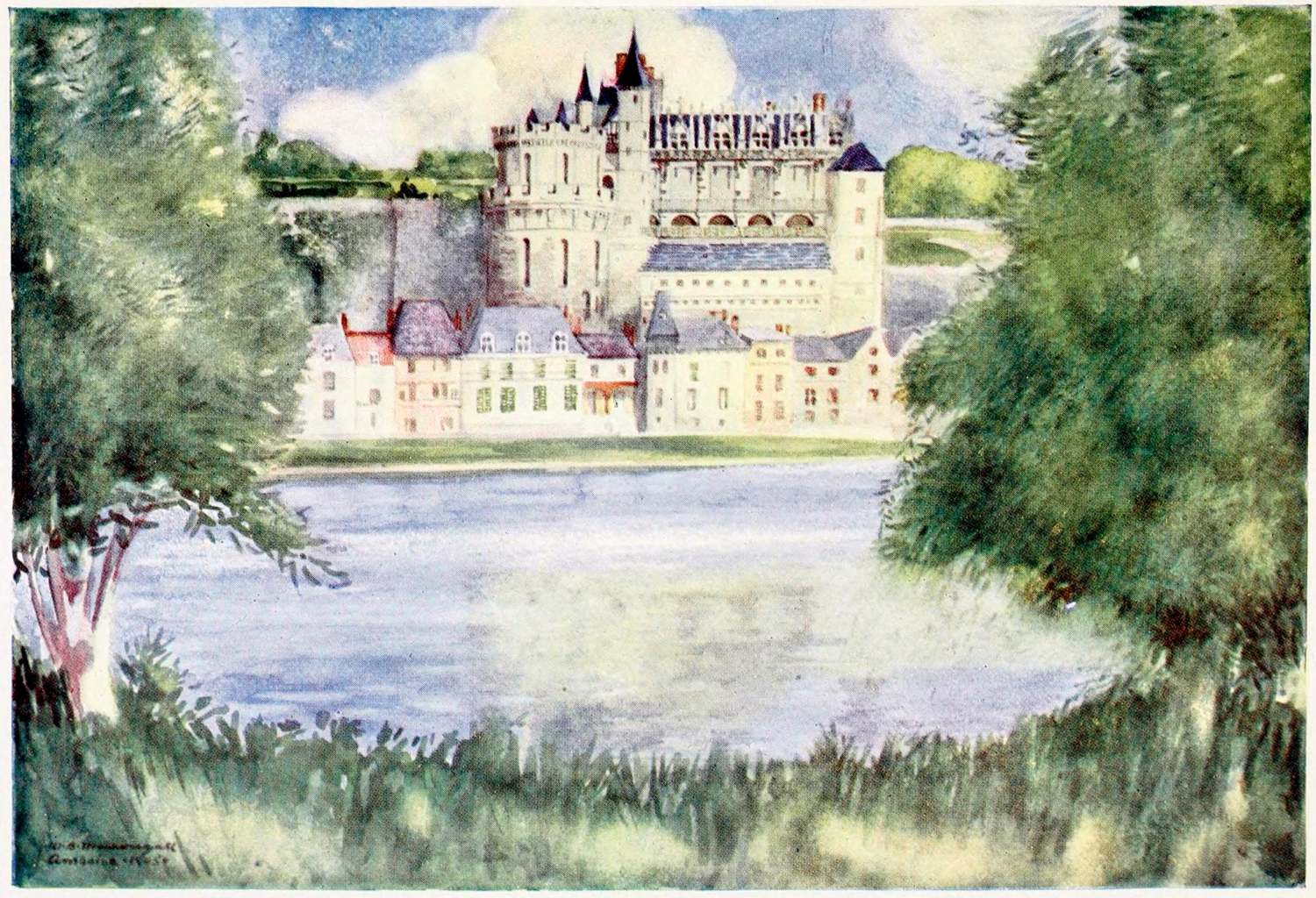
AMBOISE
Make good the loss I cannot, for I have nothing of my own save the clothes I stand up in. And a weary mother have I, and all she owned was a mattress, which they have taken from under her, so she lies on the bare straw. And that’s what irks me most of all! For havings come and go. To-day I’ve lost all. Some other day I might hope to win it back again, and pay for my lost ox, all in good time. I’ld not waste a tear on the business, were it not for my mother. And you weep for a stinking dog! Bad scan to me if I think any the better of ye for that.’
“‘Here is speech of good comfort, fair brother!’ said Aucassin. ‘Good luck to you. And how much might your ox be worth?’
“‘Sire, they ask twenty sols for the price of it, and I’ve not one farthing to the good.’
“‘Now look,’ said Aucassin; ‘here is the money in my purse; take it and pay the fine.’
“‘Sire, many thanks. And may you find the thing you go a-seeking——’”
Were I writing in French, I should make no apology for this long quotation; in French the poem of Aucassin is little known beyond the narrow circle of Romance philologists. Habent sua fata libelli. In England the magic touch of a man of genius has rested for one moment on this mediæval page, leaving it glorious and public. Of late, those gentlemen of learned leisure, who once translated Horace, then Dante, have divided their activity between the Rubaiyàt of Omar Khayyam and this same quaint chante-fable of Aucassin and Nicolette, of which there are several excellent English versions. But let the reader consider the passage we have roughly and literally rendered from Suchier’s edition, not as a literary exercise, but as a plain statement of fact: a portrait of the French peasant, grotesquely faithful, and even to-day a speaking likeness. Observe the shock of black curling hair, the large nose, the broad jowl, the lips thick and ruddy, the stalwart frame; just such may be seen at any fair in Southern or Central France. Doubtless the anonymous author did not draw from life; he lived in an age of convention, and simply took the canon of ugliness; since, to him and his contemporaries, beauty resided only in a tender fairness, slenderness to the point of tenuity, long narrow eyes, slim lips, a neat straight nose, and a delicate pallor flushed with pink. But this is merely removing the picture from reality by one degree. To the cantor’s world of the Middle Ages, the common was unclean, the vulgar ugly, the popular type a thing of repulsion. They confused the idea of comeliness and the idea of race. They admired only the rare. And this peasant had perforce to be all that our Prince Charming so obviously was not—swarthy, squat, red-lipped, hard-featured, rude, and a bit of a poltroon—so that he becomes a living image of his fellows employed in ploughing the glebe or hoeing the vineyard.
With what an airy touch our old poet has disengaged the different ideals of prince and peasant. They are as true to-day as yesterday. Aucassin, with his facile courtesy, his gentle grace, has none the less that fund of quiet reserve which marks distinction: “Certainly, good brother, I will tell you what I seek. I have lost my white greyhound, the loveliest thing alive.” He speaks in a parable, and the secret of his heart remains a fountain sealed: nothing is so vulgar as indiscretion. The peasant, on the contrary, is a churl, with all the quick suspicion of a churl. “Mind your own business,” is his first word of greeting. And yet how swiftly he slides into confidence and a free-and-easy camaraderie! He has none of Aucassin’s delicate dissembling. Each of these men is heart-broken for the sufferings of a woman dependent upon him. But Aucassin goes dreaming of his lost betrothed rapt in an ideal of disinterestedness, poetry, and chivalry; while the hind knows what it costs to bring up a child, and has often seen his mother go hungry in order to give him a second bowl of pottage, so that he cherishes the broken old woman who, for his sake, lies on the bare straw. “A weary mother had I” (une lasse mère avoie). Even to-day, in a French village, such an old, capable, worn-out mother is often the dearest romance of the peasant’s life.
The “vallet” of Aucassin was probably the ploughman of some métayer or peasant farmer on the system of half profits, equally divided between landlord and tenant. In such a case, the lost ox being part of the cheptel, or capital, of the farm, and so belonging to the landlord, would have to be immediately replaced; it was certainly undervalued at twenty sols—which, in purchasing power, represent about four pounds of our money. If the peasant cannot pay his fine, he must e’en take to the woods for an outlaw, like Robin Hood and his merry men. But probably he would not stay there long. From forest to forest, as stealthily as a weasel or a mole, he will put half the length of France between him and his disgrace, hire himself out to some other farmer, lay by, glean, go a-faggoting, and some day, when a good season has filled the barns, byres, vats, and pockets of all the country-side, he will offer his old master the price of his lost ox, and purchase of the king a free pardon, duly paid for. The Lettres de Rémission of Charles V. and Charles VI. are full of such instances.
The poetic gamut of the Middle Ages was restricted. Few things were deemed worthy of immortality in verse. The anger of Achilles and all worthy knights; heroic deeds by flood and field: or else the coming of spring; the revolt of young wives against their tyrant; love, especially unlawful; or strange adventures and the subtleties of dire enchantment; the dire revenge of the jaloux, the injured husband; or the foul end of the traitor in the camp. These are fit subjects for song and story, especially when they pass in a world above the common, a world where Aucassin, Lord of Beaucaire, and Nicolette, Princess of Carthage, belong, indeed, by right of birth, but where a mere swarthy peasant is out of place. The mediæval poets thought, with Dr. Johnson, that “in the case of a Countess, the imagination is more excited.” Once or twice a countryman lounges across the stage of some fabliau, generally in comic guise. In the “Lai de l’Oiselet,” for instance, we find a spirited caricature of the rich peasant, who has purchased house and lands; he inhabits, indeed, a gentleman’s ancient manor, but he has not been able to buy the title-deeds of gentlehood, in mien, and speech, and thought. The very birds in his boughs make mock of him, for the Middle Ages were ever bitter on that sore subject of new men and old acres. Besides these caricatures, we come across a few weaving songs for women, and certain caroles, or glees and catches for dancing in a ring, such as still enliven the songs and dances which have always been so pleasant a feature in the rural life of France. But save for such rare waifs and strays, we must let slip a century and a half ere, quitting Aucassin, we find again a mention of the peasant in French literature. And this time he stands before us redoubtable, insurgent, a murderer.
II
Be sure we see him at his worst, for his chronicler, Froissart, was somewhat intolerant of the common sort, and ever at heart a contemptor of the mob. He thought it “grand’ pitié et dommage quand méchantes gens sont au-dessus des vaillants hommes” (translate: “when the lower classes are set above their betters”), nor deemed that any provocation could warrant open mutiny. Yet even Froissart owns that the peasants’ rising was not without some sort of an excuse, while the Monk of St. Denis (a liberal soul) writes: “They could no longer support the ills which oppressed them, and seeing that their lords, far from defending them, used them worse than their enemies, the peasants thought they had a right to rebel, taking their vengeance into their own hands.” Here, as nearly always in the history of France, a tacit breach of contract is the root of revolution. Let the nobles live on their lands, defend them in wartime, cultivate them in time of peace, and the peasants will submit to tax, and corvée, to insult and injury, and scarcely murmur. But woe to the coward, and ’ware the absentee.
After the victory of the English at Poitiers, an outburst of patriotic anger and revolt (such as in our own days produced the Commune) brought about the Jacquerie. The peasant was born to plough and reap, he ploughed and reaped; the noble was made to fight and conquer; if he fought and could not conquer—worse still if he could not fight—he was a tare in the wheat, useless, noxious, to be cast to the burning. While the nobles of France were captive in the English camp, the defenceless country-sides of the North were pillaged and ruined. And the farmers and labourers rose in their wrath, declaring that their masters “honnissoient et trahissoient le royaume de France;” and so, says Froissart, they passed sentence of death upon them. A certain Guillaume Caillet led the mob; his nickname, Jacques Bonhomme, has stuck to the French peasant ever since. Soon he had a following of a hundred thousand men as fierce, ignorant, untrained as a hundred thousand gorillas, and great were their excesses. Froissart can scarce contain his horror, and still more his wonder, at the exploits of “les vilains, noirs and petits, et très mal armés.” It is true that, at the time, most of the men of the ruling class, of an age to fight, were absent. The Jacques made bonfires of more than sixty castles. Three hundred ladies and damsels—as pitiable as our own grandmothers at Delhi—escaped their loathly embraces, and fled across country into the town of Meaux, where they took refuge in the market. How the King of Navarre and the Count of Foix rode across France to their relief; killing the villainous Jacques “in great heaps, like beasts;” hunting them down, in a battue; driving them into the Marne to drown; burning wholesale them and their villages; and finally setting free unharmed the hapless, happy dames of Meaux:—All this, is it not written in the chronicles of Froissart?
III
Despite this direful vengeance at the end of it, the Jacquerie had left the French peasant conscious of his force. He had learned that nobles are mortal men and can perish by fire, scythe-cut, or blow of club as certainly as Jacques himself. Henceforth, let them respect his women and his horned cattle! Jacques Bonhomme is, on the whole, a patient fellow. Let the nobles do their duty, and keep their hands off his wife, his daughter and his herds, and it is astounding what he will submit to: exactions growing year by year, and corvées such as a decadent fancy may invent. He will beat the moats all night when my lady is lying in, lest the croaking of the frogs disturb her delicate slumbers. Only let my lord keep to his part of the bargain, and respect Jacques Bonhomme’s womankind and those two white oxen in his stall, those—
“Deux grands bœufs blancs marqués de roux,”
which (as Pierre Dupont, who knew him well, declares) the French peasant, although no bad husband, still holds a little dearer than his wife. The murders recorded in the Lettres de Rémission, as committed by the labourer upon the persons of his betters, are nearly always caused by rape or cattle raids. On such occasions these “misérables personnes et gens de labeur” have ever shown themselves capable of a desperate courage; on such occasions the “croquant” does not fear to raise his club of greenwood, and dust the embroidered jacket of his liege lord, even to risk of that noble life and damage of those seigneurial limbs, as it happened to François Rabault, Seigneur d’Ivay. Sometimes, more legally, he appeals to the justice of my Lord Governor of the province, drawing down condign punishment on the head of the noble offender; indeed, the ravisher of at least one village beauty was condemned to death by the Courts of Bordeaux. More than once, for such reasons, some Lovelace of a country gentleman has had his manor sacked or even burned; as may be seen in the vast manuscript treasure of the Lettres de Rémission; in those printed by the care of M. Douët d’Arcq; and in a new and charming volume: “Gentilhommes Campagnards de l’Ancienne France,” by M. Pierre de Vaissière.
The village Hampden flourishes in France, where Jacques has always had a keen sense of his rights. Ever since the Romans bent their stubborn shoulders, still unwilling, beneath the yoke, this same independent race of hardy crofters has never ceased to dream—if not of liberty, in the magnificent, imaginative, political sense—at least of freedom, of standing up in one’s own plot of ground (though not in one’s province) master of one’s fate. Centuries before the French Revolution, the first dim forebodings of it were already taking shape in the slow brains of these Croquants, Pastoreaux, Jacques, or Gauthiers. From the sands of Sologne or the plains of Brie, but more especially from the Celtic mountains of the Morvan and Auvergne, ever and anon they would rush in eruption, like an old volcanic force still untamed, destroying the superficial civilization of the aristocratic world. But more often the volcano slept in peace. The peasant asked for little here below.
On the whole, we may say that, from the end of the Hundred Years’ War till the middle of the sixteenth century, the peasant lived on excellent terms with his masters, fairly prosperous and passably content. The nobles of those times dwelt in their villages, dealing “basse et moyenne justice,” punishing petty offences, redressing minor wrongs, settling the quarrels of neighbours, sending a good soup to the sick, relieving the necessitous, cultivating their own lands, not themselves too far removed from the humble interests of the soil, and yet, none the less, examples of a broader life, an ampler culture to the poor at their gates. Even so in his manor dwelt Michel Eyquem, Lord of Montaigne; and if the ordinary country gentleman was more often as simple of spirit as noble of birth, and sometimes even brutal and violent, he appears on the whole to have been a fairly good landlord. Foreign visitors to France marvel at his attachment to the soil. “The nobles in France,” writes Soranzo, the Venetian ambassador in 1558,—“and this style of ‘noble’ comprises alike the gentry and the prince—do not dwell in the large towns, but in their villages, where their castles stand.”
Living on their lands and reaping the profit of them, the French gentry and their peasants under them became notable husbandmen. The end of the fifteenth and the sixteenth centuries saw endless forests reclaimed, marshes drained, and fields of wheat flourishing in place of the scrub oak and the rush. Claude de Seyssel estimates the land under cultivation, during the reign of Louis XII., at one-third of the kingdom; and, in 1565, J. Bodin writes: “Depuis cent ans on a défrichi un infini de forêts et de landes.” Peace reigned abroad, activity at home, masters and men were animated by the same interests; if one of our country gentlemen goes to war or to Court, be sure his letters will be full, not of details of the king’s glory, but rather of instructions to those at home that they forget not to gather the stones from the fields, hoe the barley, turn the hay, weed the kitchen garden, prune the trees, shear the sheep, and steep the hemp. And, as soon as possible, he rides home again, his head already full of the price he must pay his harvesters, of the coming cattle-fair, the building of the new barn by the five-acre field, and the salting of the pork he is wont to despatch for sale to a certain worthy Thomas Quatorze, in Paris. As yet the landed gentry and the peasants have the same interests and preoccupations.
The blot on the landscape is the excess of feudal rights. Even by the first years of the sixteenth century these had become excessive, and astounded the wisest traveller of that age. What does Erasmus say in his Adages?
“Open your purse and pay, for you enter a port; pay, for you cross a bridge; pay, for you need the ferry-boat. And what is the reason of all these taxes which pare down the poor man’s crust? There’s a tax for the carrying of the harvest, a tax when the corn goes to the mill, a tax on the baking of bread. Give half your vintage to my Lord for the right of putting the other half in cask. There’s no selling a colt or an ass without settling the rights of the fisc.” Erasmus, not given to mincing matters, calls the great nobles a set of disgraceful harpies, harpiis istis scelaratissimis.” And yet, despite the truth and blackness of this picture, owing to the force of a similar life and habits, owing also to a kindly social instinct in the race, the French country gentleman—and even the great noble—was a prosperous, honourable, and useful member of society, so long as he lived on his lands and served the State, within the boundaries of his own parish, as captain of militia and justice of the peace. He began to degenerate when the king, jealous of the authority of the landed gentry, invented a regular army, which soon usurped the place of the feudal volunteers; and established a regular magistrature, in which the country squire had neither part nor lot. Unaccustomed to his enforced idleness, he found provincial life intolerably dull, and soon began to sell a farm or two, and set out for Versailles. Quite early in the seventeenth century the rural exodus has begun, and the country cousins come trooping to Fontainebleau and Versailles from their deserted villages. The court, the army attract these noble sons of the soil as a candle the moth. The highly centralized government of the Kings Louis—XIII., XIV., XV., and XVI., of the name—draws to the court all the resources of France, and disposes at Versailles of all advancement and favour. St. Simon goes so far as to accuse the king of augmenting the splendour of his court with a view to sapping the independence of his nobles: “La cour devient un manège de la politique du despotisme—le roi vent épuiser tout le monde et le réduire peu à peu a dépendre entièrement de ses bienfaits.” So the old manors were forgotten; an agent took the rent that paid for the laced coats at court; the fields became marsh and forest again, and my lord thought no longer of shearing his sheep and hoeing his corn, but of serving his majesty in the army, or in the palace of Versailles. For here also—
“They also serve who only stand and wait.”
And no man in the kingdom was so unenviable as that honest country gentleman, faithful to his father’s fields, of whom, on mention of his name, the king would say, with cold disapproval: “Je ne le vois jamais.” In this connection, it is instructive to read the memoirs of that martinet of courtiers, St. Simon, and the letters of Madame de Sévigné (that admirable country squire), who wrote to her daughter: “J’aime mieux parfois lire un compte de fermier que les Contes de La Fontaine.”
Absolute monarchy was the ruin of the French peasant; or at least it was his moral ruin; for the absence of his lord, while depriving him of his one glimpse into a world a little larger than his own, was sometimes incidentally the occasion of enlarging Jacques Bonhomme’s narrow field. My lord spent a terrible deal at Versailles. Dress, play, an outfit for the wars, soon ran away with the income of parental inheritance. Often enough the agent had to sell (and pretty much for what it would fetch) a strip of meadow here, a spinney there. Now, while my lord was always spending, the peasant, on the other hand, was in a peculiarly favourable position for saving. Money scarcely ever left his horny grasp. He paid his rent chiefly in kind, stock, corvées, and quit-rents of one sort or another; but he sold his cattle and crops for coin, at the fair, and put the treasured sols and livres in some safe place behind the rafter or beneath the hearthstone. The corvée was the making of the peasant: pure profit, as he thought, since he only paid in sweat and sinew, instead of lessening his hoard of secret silver. He mowed his lord’s meadows, mended his roads, carried his grist, and wood, and fodder, lent his cart and horse for transport, worked on the estate so many days a month with nary a penny of wage, was harassed, hampered, overworked, if you like; but the corvée was a form of rent, and the form his soul preferred. In exchange he had his cot and his fields, the right to fatten his porkers in the oakwood, the right to pasture his cow on the grassy edges of the lane, the right of gleaning his master’s corn in the fields, his faggots in the forest, and also the dried beech-leaves which stuffed his bed, and foddered his kine. Every corvée brought him in some specific advantage; so that, while his masters were running a break-neck race to ruin at Court, Jacques Bonhomme was buying, out of their parental acres, here a strip of rye and there a cabbage-patch: inconsiderable snippets of land scattered here and there, up and down the country-side, presenting no importance to the eye, but representing a small estate increasing with every generation. Jacques’ grandson may be Georges Dandin, even as the great-grandsire of my Lord, perhaps, may have been the wealthy boor of the “Lai de l’Oiselet.” The seventeenth century has little but mockery for the peasant-parvenu who marries the squire’s daughter, yet their son, ennobled by the mother’s gentlehood (for there are many houses où le ventre anoblit), may carry arms and be a gentleman. Even without this maternal warrant, there are short cuts to rank; for the snob is of no generation or society, but pan-endemic, so to speak, in all highly civilized centres. Does not Madame de Sévigné paint for us a certain little Lord “who is all honey, especially to dukes and peers”? Does not Molière show us his Arnolphe, who ennobles himself with scant ado and calls himself M. de la Souche?
“Et d’un vieux tronc pourri de votre métairie Vous faites dans le monde un nom de seigneurie. . . . . . . Je sais un paysan qu’on appelait Gros-Pierre, Qui, n’ayant pour tout bien qu’un seul quartier de terre, Y fit tout à l’entour faire un fossé bourbeux Et de Monsieur de l’Isle en prit le nom pompeux.”
IV
While Molière shows us the peasant growing fat on the fruits of his master’s recklessness and absence, La Bruyère, with his profound and moral vision of things, reveals the other face of absenteeism: the diminished standard of virtue, decency, comfort, in the deserted villages; the peasants sinking almost to the condition of savages, spending nothing on themselves, and living only in one thought—how to save enough to buy another rood of land. Meanwhile the soil itself, ill cultivated, and prized by its absent owners merely as a game-preserve or an investment, was soon overgrown with rush and bramble, and returned to marsh or bog or forest, as of old. Few spectacles can have been more harrowing to the social or moral eye than the French villages of the seventeenth and eighteenth centuries.
“There be certain fierce and shy wild animals, male and female, which are scattered up and down our country-side. They are sunburned to a sort of dull black, and walk bent towards the earth they delve; on straightening themselves, they show, it is true, a human face, and, in fact, they are men and women; they withdraw from the fields at nightfall to their dens, where they sup on black bread, roots, and water. They spare their fellow-men the labours of seed-time and harvest, and do not deserve to lack the bread they sow.”
Could Swift have exhaled more generously his sæva indignatio? La Bruyère, the deepest and tenderest mind of his generation, was therefore a man of wrath. “Seizures for debt, and the bailiff’s man in the house, the removal of furniture distrained, prisons, punishment, tortures, all these things may be just and legal. But what I can never see without the renewal of astonishment is the ferocity of man to man.”
But especially was La Bruyère a man of wrath when his mind’s eye fell on rural France. The Italian and Spanish travellers of the fourteenth, fifteenth, and sixteenth centuries, who showed themselves so sensible to the charm of country life in France, would no longer, could they have revisited the scene, have found the least occasion for their praises. The nobles of France no longer dwelt in their castles, among their peasants, protecting the village at their gates; and our philosopher wonders how lords, who might have lodged at home in a spacious palace, with a suite for the summer planned to the north, and winter quarters open to the sun, should count themselves happy to lie in a miserable entresol at the Louvre, with scarce a closet for their wives to receive their guests in. During the eternal round from Paris to Versailles, Versailles to Marly, Marly to Fontainebleau, and thence to Paris, what time has my lord to think of the hundred poor households whose labours bring in his hundred thousand livres of revenue? An agent collects the rents; and if the peasant be too poor to light a fire in winter, within sight of my lord’s forests; if he go clad in a sheepskin or a ragged sack; if he go without bread to eat—be sure it’s not the fault of my lord Duke. He is the kindest soul alive. He has not the slightest wish to oppress his tenants. He has only forgotten them! “And is not all this a presage for the future?” breaks off La Bruyère.
Again and again he reiterates his warning, finding something unnatural and shocking in the complete divorce between town and country. Scarce a man at court could tell a flax plant from hemp, or wheat from barley—don’t speak to them of fallow fields or aftermath, of laying down a vine or of marking a young tree fit for the axe: “provignage” and “baliveau” are no longer French, it seems. If, once in a way, on the occasion of a hunting party or a Royal progress, my lord duke proceeds to the home of his ancestors, and decides to open his purse-strings and spend money on the place, be sure he has some fine scheme for an avenue right through the heart of the forest, or a terrace raised on arcades with an orangery, or a fountain with a piece of artificial water which he takes the village brooks to feed. But reclaim a marsh, clear a wood, rebuild the tenants’ cottages? Never! These be pursuits for rustics. Nay, cries La Bruyère, and we hear the tears in his prophetic voice: “Rendre un cœur content, combler une âme de joie, prévenir d’extrêmes besoins ou y remédier?—la curiosité des grands ne s’étend pas jusque là!”
Immured in the circle of their own delights and interests, the nobles of France had lost touch with the peasants. The country, to please them, must be all in moor and forest, good for game; and the fertile plains of Brie are less to their fancy than the wastes of Champagne. They would turn the crofters from a sheeprun to make room for the deer. The landlord’s house stands untenanted, though now and then he may use a shooting-box. And if in his old age (after twenty, thirty, forty years of hard service) the old soldier, the disgraced or disillusioned courtier, should haply retire to his paternal acres, too often he finds them weed-grown and desolate, the manor half in ruins, the turret and pigeon-cote tumbling about his ears. He no longer knows by sight the peasants on the estate; he has lost his taste for the land; and the first wet season sends him packing, if he can. Meanwhile, in his abandoned village, Jacques Bonhomme—whose landlord is no longer the friend, protector, justice of the peace, but just a tom-fool in a laced coat, who cannot tell a blade of wheat when he sees it—Jacques Bonhomme continues to starve, to sweat, to diddle my lord’s agent, to curb his back to the blow and his heart to the sod, to suffer, labour, spare, till his stocking is full of hard-earned pence and pounds; till his mind is a wilderness of savage and sordid squalor, without an idea, an ideal, nay, a hope or a feeling, beyond the land. What wonder if the son of the rich peasant be so often the vulgar parvenu we meet in Molière and Marivaux? Rather let us marvel that sometimes he turns out a capable man, soldier or statesman, who quits the glebe to save his country. But a Colbert, for instance, or even a Georges Dandin, is no longer a French peasant. Let us return to our sheep and their shepherds.
V
A hundred years later than La Bruyère, in 1787, another generous mind, another traveller of liberal views, less profound than the French philosopher, yet accurate, alert, and well-informed: brief, an English country gentleman—a
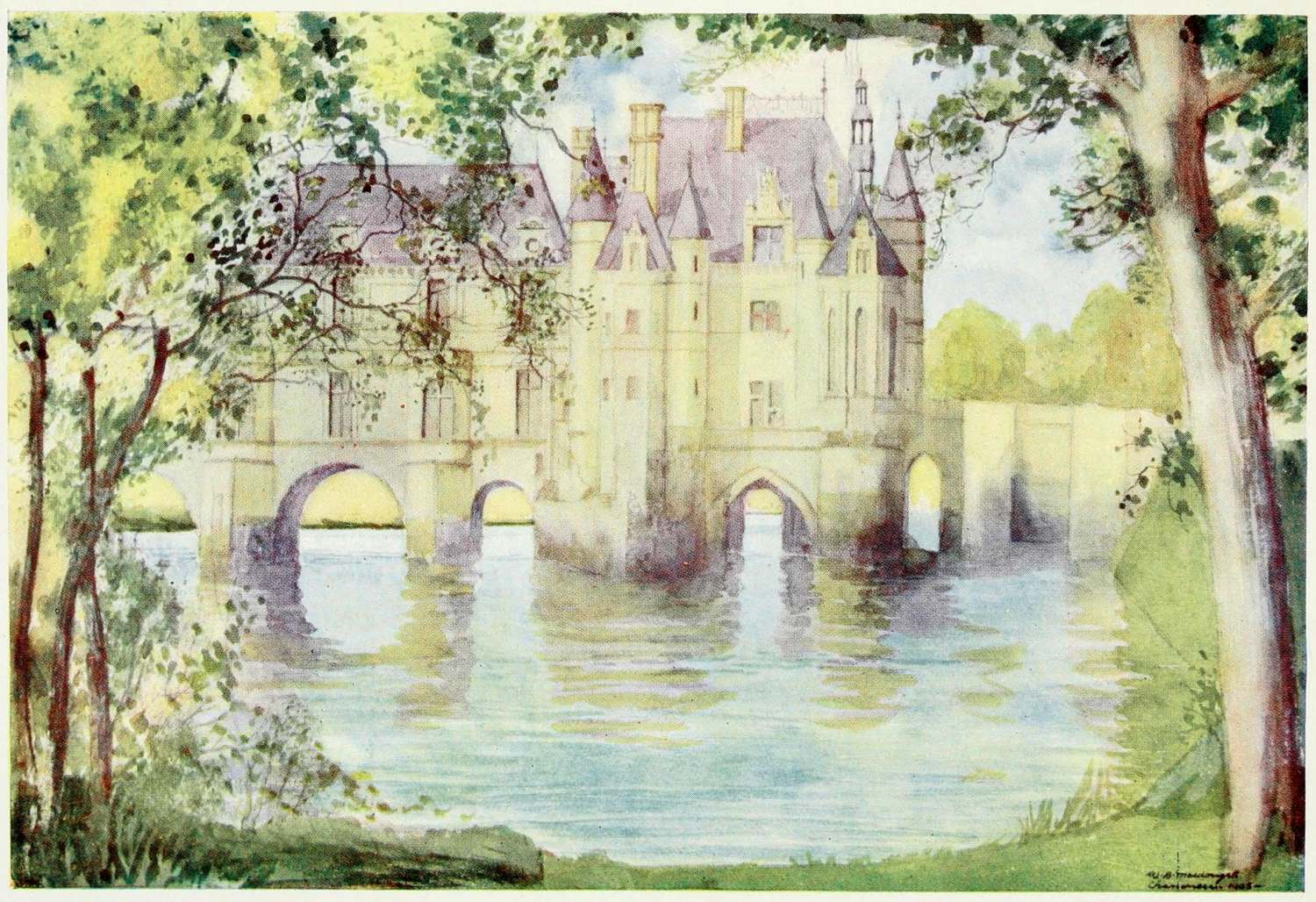
CHENONCEAUX
certain Mr. Arthur Young, of Bradfield Hall, Suffolk—was to visit the provinces of France and to give us his impressions of the French peasant. Arthur Young, like his forerunner, is a man of feeling. The social state of the poor preoccupies him no less than the condition of French agriculture, which was the original cause of his journey. Great is his wrath against the noble absentees who neglect the lands which their extravagance exhausts. For still Versailles, like some deep-rooted ulcer, absorbs and corrupts the forces of France; and the noble continues to spend the revenues of a farm on the lace and ribbons of a coat, or to turn out a country-side of crofters in order to enlarge a deer forest. Of late a new fashion had indeed revived the prestige of the long-neglected country-house. Two writers—Rousseau and the elder Mirabeau—had expressed perhaps, rather than directed, a movement of reaction; people began to think again of the life of the fields, of country pleasures, and country freedom. So Arthur Young shows us a France where many of the great nobles were agriculturists; the mode, says he, obliges the great of the earth to spend a summer month or two in rusticating at their rural seats; the Queen has a dairy-farm at Trianon; milkmaids and shepherds are the rage. The Duke of Larochefoucauld-Liancourt shares Young’s enthusiasm for turnips, and His Grace’s sister-in-law is no less passionate for luzern, of which, says Young, she grew more than any other person in Europe: “What was my surprise at finding this young Viscountess a great farmer!” No subject in France was then more modish than the rotation of crops. And no doubt even this superficial contact between the noble and Nature, the peasant and his landlord, was better than an absolute divorce; only it came too late. Both the noble and the peasant had deteriorated during the two centuries that they have lived apart. On the one hand, the careless selfishness of the cavalier; on the other, a rancorous squalor, a sordid if sometimes a servile disrespect. The “foppery and nonsense” of the country gentry struck Arthur Young no less painfully than the folly of those “glittering beings of Versailles,” to whose fine coats the well-being and decency of rural France were sacrificed. There were, no doubt, in the number of them a fair percentage of good landlords, just and coarse, proud and poor, such as M. Pierre de Vaissière shows us in his recent volume, “Les Gentilhommes Campagnards,” and a few great souls, like Liancourt. But an honourable and mediocre minority could not suffice to heal the breach, widened by centuries of absence, which divided peasant from landlord.
The new-fangled residence of the rich in their summer seats did, as a rule, but little to ameliorate the condition of their poorer neighbours. Too often, the peasants to them were as the pigs, for whom a sty is all sufficient. Our English gentleman-farmer pauses at Combourg, the old patrimonial hall of Chateaubriand, at that time a youth under twenty, occupied with his earliest literary efforts. This is how the historic manor of René’s father strikes the owner of Bradfield Hall:—
“One of the most brutal, filthy places that can be seen: mud houses, no windows, and a broken pavement. Yet here is a château, and inhabited. Who is this Mons. de Chateaubriand, the owner, that has nerves strung for a residence amidst such filth and poverty?... Below this hideous heap of wretchedness is a fine lake, surrounded by well-wooded inclosures.” Nor is this an isolated instance. Everywhere in France he tells the same tale—“the poor people seem poor indeed!”—“what a vice is it, and even a crime that the gentry, instead of being the cherishers and benefactors of their poor neighbours, should thus, by the abomination of feudal rights, prove mere tyrants.”
Thus the landlord’s summer residence on this estate was too often merely a convenience to himself and no advantage to the tenantry. He went home to wear out his old clothes, to consume the produce of his lands, to economize more or less sordidly for a forthcoming burst of splendour at Versailles. The only country luxury he cared for was the game-preserve or the deer-forest. In many districts the peasants might not weed or hoe their crops lest they disturb the young partridges; nor manure their lands near the forest, lest the flavour of the game be impaired; nor mow their hay before a certain date, however favourable the season; nor plough the stubble after harvest, lest they ruin the shelter of the young birds. Should the wild boar or the deer quit their native glades, and take to the fields, destroying the farmer’s crops, he might not shoot them or do them any injury. Such things, in any country, demand a revolution. Says Arthur Young: “Great lords love too much an environ of forest, boars, and huntsmen, instead of marking their residence by the accompaniment of neat and well-cultivated farms, clean cottages, and happy peasants.” Had the nobles planted turnips on the waste heaths and moors, there might (he thought) have been no Reign of Terror.
The feudal privileges of the French nobles seemed as shocking and unnatural to our free-born English squire as, early in the sixteenth century, they had appeared to Erasmus. The privileged classes were exempt from all taxation, of which the burden fell chiefly on the humbler sort. The corvées had originally been a convenient exchange of service between master and man—so much toil for so much land or so much protection, or so many specified perquisites and privileges; but they had degenerated into a tyrannous abuse, enforced with endless fines and quit-rents. The poor farmer or cotter had to manage countless payments of so many fowls, so much butter, so much corn, so much transport, due to the landlord; mend the manorial roads and weirs; pay death-duties and marriage-dues; submit to the servitude of employing only the manorial mill, the manorial winepress, the manorial baking-oven. Moreover, in addition to all this (which was, in fact, his rent paid in kind and labour), the peasant of the eighteenth century was abusively charged a fixed and heavy rent in coin. In this way he paid twice over for his miserable cabin and few acres of land; while, as time went on, fresh corvées—corvées by custom, corvées by usage of the fief, corvées by seigneurial decree, and servitudes of every sort, complicated his intolerable condition. No wonder that Jacques Bonhomme began to murmur and, in his dim slow way, to meditate the possibility of a change.
On the 12th of July, 1787, our kind apostle of turnips was walking up a long hill near Chalons in order to relieve his tired beast, and, so walking, was joined by a woman of the people, with whom he entered into conversation. She began, as is the manner of her sort, to complain of hard times, and said that France was indeed a most distressful country. This woman at no great distance might have been taken for sixty or seventy, so bent was her figure, her face so furrowed and roughened by labour in the fields. “Demanding her reasons, she said that her husband had but a morsel of land, one cow, and a poor little horse; yet they had a franchar of wheat (about 42 lbs.) and three chickens to pay as a quit-rent to one seigneur, and four franchars of oats, one chicken and a sol to pay to another, besides very heavy tailles and other taxes. She had seven children, and the cow’s milk helped to make the soup.
“‘But why, instead of a horse, do you not keep another cow?’
“‘Oh, her husband could not carry his produce so well without a horse, and asses are little used in the country. It was said at present’, she went on, ‘that something was to be done by some great folks for the poor, but she did not know how or who. But God send us better, car les tailles et les droits nous écrasent.’”
And these words recall to our minds another picture—that of the family of humble peasants whose furniture is seized, who are turned out of house and home by the king’s officers, in Laclos’ Liaisons Dangereuses “par ce qu’elle ne pouvoit payer la taille.” Valmont, that worse Don Juan, in order to seduce the chaste and lovely Présidente de Tourvel, essays the talisman of virtue. By stealth, to all appearance (and yet well aware that he is followed) he hurries to the rescue, reaching the woodland village at the very moment when the peasants, in silent yet indignant groups, witness their neighbour’s eviction.
“Je fais venir le Collecteur; et cédant à ma généreuse compassion, je paye noblement cinquante-six livres (about £2 4s.) pour lesquelles on réduisit cinq personnes à la paille et au désespoir. Quelles larmes de reconnaissance coulaient des yeux du vieux chef de cette famille et embellissaient cette figure de Patriarche qu’un moment auparavant l’empreinte farouche du désespoir rendait vraiment hideuse!... J’ai senti en moimême un mouvement involontaire mais délicieux; et j’ai été étonné du plaisir qu’on éprouve en faisant le bien.”
Here, good reader, is a companion picture to Aucassin and his driver of a team.
Yet, even before ’89, the French peasant was, most often, a merry lout. For, by nature, the blood of a Frenchman runs an alert and mirthful course, so that he takes advantage of the least excuse for cheerfulness. The Duke of Larochefoucauld-Liancourt, that virtuous Revolutionary, was exiled from his country by the Reign of Terror because, although a Revolutionary, he was a Duke; standing among the fields of free America in the harvest month of 1793, he marvelled at the mournfulness of that land of Liberty. These grim, gaunt Yankee farmers, counting their stooks of corn in silence, filled the good Gaul with something like dismay:
“Quelle différence du travail grave de ce peuple et de l’activité gaie, riante, chantante, des moissoneurs de mon pays. Tout le monde y était content!... Les rires, quoique perpétuels, ne dérangeaient pas le travail! Et les foins! Et les vendanges! Quel peuple au monde sait plus jouir du bonheur.”
VI
Young, with some slight exaggeration, rated one-third of the French territory as belonging to the peasant on the eve of the great Revolution. His editress, Miss Betham Edwards, has taken pains to verify this assumption, and in consequence assures us that not more than one-fourth of French land belonged to the labourer in 1787. Be sure that this quarter of the kingdom was the richest and the most highly cultivated. Here was no waste land, no marsh, no deer-forest, no game-preserve. Not far from Montpellier our traveller was struck with the luxuriant vegetation of a rocky district, a landslip composed for the chief part of huge boulders, yet enclosed and planted with the most industrious attention: “Every man has an olive, a mulberry, an almond or a peach tree scattered among the rocks, so that the whole ground is covered with the oddest mixture of these plants and bulging roots.... Such a knot of active husbandmen, who turn their rocks into scenes of fertility, because, I suppose, their own, would do the same by the wastes if animated by the same beneficent principle.” Again, one day, near Pau, he came across a scene “so new to me in France that I could scarce believe my eyes: a succession of many well-built, tight and comfortable farming cottages, built of stone and covered with tiles, each having its little garden enclosed by clipt thorn-hedges, with plenty of peach and other fruit trees, some fine oaks scattered in the hedges, and young trees nursed up with so much care that nothing but the fostering love of the owner could effect anything like it. An air of neatness, warmth and comfort breathes over the whole. It is all in the hands of little proprietors, without the farms being so small as to occasion a vicious and miserable population. Proprietorship is visible in the new-built houses and stables, the little gardens, the hedges, the courts before the doors, even in the crops for poultry and the sties for pigs.”
More than a hundred years after the Revolution we may pause and admire the picture of these little farmsteads, as they flourished on the very eve of that great upheaval, for we may consider the condition that they represent as the happiest and most favourable for a rural district.
While Arthur Young was visiting and graphically describing the villages of France, a man of considerable gifts, but always, in those days as in these, an obscure individual, without renown or influence, was actually living in one of these hamlets and constantly observing what went on before his eyes. Even to-day, even among the students of his period, few had heard the name of J. J. Gauthier, Curé de la Lande de Gul, when, in February, 1903, a young historian, M. Pierre La Lande, attracted, perhaps, by a similarity of name, exhumed his “Essai sur les Moeurs Champêtres,” and printed a series of extracts from it in the Revue Bleue. Published for the first time in 1787—the very year of Young’s travels—the essay of the Curé de la Lande never attained the least celebrity; the whirlwind of the Revolution caught it in its eddy, and engulfed it along with drift of more importance. The tiny book, preserved in one sole copy, existing in the Municipal Library of Alençon, has to-day more value and more interest than it could have possessed a hundred years ago. It is a series of rustic portraits in the taste of the time, but obviously drawn from life, and betraying in their lively unpractised touch the hand of the gifted amateur, who often has that knack of catching a likeness which escapes your heaven-born artist’s skill. We see the curé, himself a peasant—avaricious by nature and breeding, yet charitable by grace—as he tramps the windy downs at lambing-time to count his tithe, implacable in the assertion of his rights, were it merely to half a calf’s head or a dozen starveling pears, yet capable of sharing his food and dividing his last faggot with the poorest of his flock. He looks not much wealthier himself, as he strides across the scene, his stalwart limbs clad in an old patched cassock, with his summer soutane flung across his shoulders, to serve as a plaid, above a worn-out judge’s gown, picked up second-hand. From his rusty wig to his vast and heavy high-low shoes, the curé is as ill-accoutred as any peasant of his flock. And he is scarce possessed of a more liberal education; he exorcises the thunderbolt with bell and book, and sprinkles with holy water the unfertile field.
The curé’s parishioners are as superstitious as himself, but singularly devoid of any real religious feeling. “The farmer is Christian enough in outward things. The Holy Virgin has a niche over his door, and he lights a taper there on feast days. He goes to church on high days and holidays, and takes the communion at Easter. But he has no great opinion of his parish priest, who rates him for beating his wife and forbids him to place out his money at usury. And as for his morals ... he holds that an act is bad or good according to what you risk by it, so that, if he see no rope a-dangling as the consequence of the deed, he will suppose it good, or at least indifferent.... Yon farmer in the market-place is an honest man; he has not stolen the heifer he pushes before him. Only he knows the beastie’s weak points, and will contrive to sell it you before you find them out. He has fed it up, curled and combed it, chosen the propitious moment—be sure he will not acquaint you with anything which may not meet the eye.... The vet is more thought of than the doctor in our village. If a cow sickens, the farmer is anxious and worried, tries this drug and that, sends for the horse-leech. But if old Gaffer in the ingle droop and die, no one thinks of the doctor, nor would any one of the household stay at home in harvest-time to wait on his last hour.... There goes Goodman What’s-your-name! He is well-to-do, and has added field to field. But hear him talk, you’ld suppose him poorer than the very beggar in the church porch. He’s always grumbling. Corn for sowing costs a mint of money; times are hard; he never has the luck to make a bargain at the Fair. Tell him he is comfortably off, and you’ll offend him mortally. Call him a poor beggar as loud as you please; he will like you all the better.”
Well, such is our poor fallen human nature! We could make such thumbnail sketches in many a village anywhere to-day. What is peculiar to pre-Revolutionary France is the respective attitudes of rich and poor. The poorest of the rich are sustained by a proper pride, a sense of their superiority, inconceivable to-day. The poor gentleman may live in a tawdry manor, tumbling about his ears for lack of due repairs; in his sordid seclusion, with no betters and few equals to enlarge his mind by their society, one thing alone emerges from the squalid round of his privations, and that is his ancestral pride.
“He holds the art of writing a mere mechanical exercise” (says our curé), “and thinks he knows enough for a gentleman if he can sign his name. He has a high idea of his birth and his prerogatives, and keeps his painted coat of arms bright and fresh in the church porch. He treats his peasant like a despot, dispenses justice, extorts his manorial rights, exacts his thirteenth with rigour.... He is exempt from taxes. But his old manor has neither turret nor dovecot (the outward signs of noblesse), and he can boast neither of fiefs nor vassals. Still, he is none the less a noble. Madame is never seen without her Fontange (a lace head-dress), though she be busy with her housekeeping—nay, though we find her in the stable, milking the cows. There is no woman-servant at the manor-house; an odd-lad-about cooks and gardens, serves at table and rubs down the horse. Monsieur, in constant alarm lest he be taken for a commoner, goes, on Sunday mornings, not indeed to church, where he has no pew (another country gentleman having, probably, a vested right to that public preference known as les Honneurs de l’Eglise), but to the churchyard, where he sits during service, his hound and his gun beside him, careful that some pale beam of his superior rank may set off his condition in every circumstance.”
The pride and the poverty of the good old country gentleman struck many a disinterested observer. The French Revue (the late Revue des Revues) published, on May 15th, 1903, some most interesting letters, written from the little town of Fezensagnet between 1774 and 1776 by a Protestant lady, born in Germany, but French by race, and living in Gascony on the eve of the Revolution. The squalor, the sordid ways, the crass ignorance of the smaller rural gentry appalled this Madame Leclerc, though she has nothing but praise for the peasants and for the nobles of high rank. But these needy gentry, the shabby-genteel—the “half-sirs,” as they say in Ireland—are almost the only nobles to be met with in rural districts, “et je ne crois pas qu’il y ait rien d’aussi manant, d’aussi ignorant et d’aussi brute.” She finds the village peasants better dressed and better mannered as a class, with among them, here and there, individuals really superior: “il ne leur manquerait que de la pondre pour avoir l’air d’élégants,” barefoot though they be. The castle is shut up from time immemorial; its great solid walls and huge keep stand empty, save for the agent’s residence. My lord Duke, meanwhile, is at Versailles, and the French peasant never gives a thought to his absent Grace. Listen to the Curé of La Lande:—
“Came ye straight in descent from Bernard the Dane, or the faithful Osmond; though your ancestors were liege men of Merowig or Charlemagne, yet hope not, poor gentleman! that Hodge shall have any reverence for your rank and title. Wear your orders, gird on your sword, and go to the cattle fair; the best of you will meet with less respect than John the Burgess, with his good cloak and leather wallet stuffed with coin. I know not why, but this brutish herd has lost all confidence in the word of a man of rank, of old so much esteemed.” This stubborn and stalwart disrespect, this frank irreverence of the French peasant, struck more than one acute observer, on the eve of ’89. Mirabeau, in his L’Ami des Hommes has remarked the same trait, but not without supplying an explanation: “In my own lifetime” (he writes) “I have seen a great change in the relations of landlord and peasant. Our lords, always absent at court, are no longer of any use or service to their tenantry, and it is natural that, forgetting, they should also be forgot.”
VII
Then came the Revolution, an event so great that I cannot hope to give the faintest, smallest image of it in this tiny frame. A world perished, and rose anew from its ashes, purified of many abuses, deprived of some valuable relics. But the substance of that world, which is French society, reappeared, after seeming annihilation, not greatly changed, nor absolutely renovated.
Of this there are a cloud of witnesses. Among them let us choose Larochefoucauld-Liancourt, whom we left an exile in America. Restored to his native country in 1800, after some ten years’ absence, he notes the progress of agricultural reform. Large estates have given place to very small ones, which, as a rule, produce a yield at least one-fourth more abundant than the old. Everywhere cultivation is more intelligent, for the owner puts his mind into his tillage. The homes of the peasants are improved, more spacious and cleaner; the labourers themselves are certainly less ignorant than their fathers.
“Ils sont plus qu’eux en état de réfléchir, de combiner, un peu moins éloignés de toute innovation.”
So writes, disinterestedly, the dispossessed Duke, as he sets the plough in the stately lawns and avenues planted by Le Nôtre, content to farm a corner of his old estate, camped in the servant’s quarters of his ruined palace. We could not have a more able or a more conscientious authority. But these were but the beginnings of a general reform.
In 1815 another philosophic English traveller passing through France—one Thomas Hodgskin—was struck by the sordid misery of the French peasant. And, in fact, the Revolution is not over even yet.
The corvée is supposed to be extinct, but the smaller country roads are still mended by “prestation,” that is to say, by the personal labour of the farmer or his men, and he must find both the material and the means of transport. The feudal banalités were solemnly declared defunct in 1789—that is to say, the peasant no longer could be forced to grind his corn, or to press his wine, olives, and walnuts, in the seigneurial mills. Yet, to take one contemporary instance among many: the farmers of the Isle of Bouin in Vendée are compelled by contract to bring their sheaves to the thrashing machines of their landlord; the only difference being that this landlord is no longer a noble, but a great agricultural syndicate—the Société des Polders. In the same commune, the same society exacts the feudal rights of terrage—that is to say, it requires a sum of money, a yearly premium, paid in addition to the annual rent in kind—and it also levies a tax on the winepress, just as if the Revolution had never taken place. “C’est l’Ancien Régime à peine modifié,” writes M. Léon Dubreuil.[2]
At Olmet, our village in the Cantal, the farmers pay a quit-rent, or redevance, to their landlords in addition to the rent: so many brace of poultry, so many cheeses, so many pounds of butter; a special kind of cheese, the most delicate if the smallest, weighing from two to twenty kilos, is made for this purpose, and still bears its ancient name, the fromage de maître. To-day, even as six score years ago, the farmers of the Bourbonnais do all their landlord’s carrying—wood from the forest, corn to and from the mill, stones from the quarry, according to the mediæval corvée de transport; and here, too, the quit-rent flourishes undiminished: butter, fowls, turkeys, are exacted in tribute from the tenant. It may happen that he sell his milk straight from the cow to a dealer in Paris or to an hotel at Vichy; in this case, he must buy milk from his neighbours in order to churn the seigneurial butter, as nearly always he buys his turkeys, the birds being very delicate and difficult to rear. Here, also, reigns the right of terrage under the name of impôt colonique. And, in this part of the country, the game laws seem scarcely altered by the Revolution; the crops being often destroyed by the abundance of wild creatures, without any indemnity offered to the farmer.
But everywhere in rural France an eye educated in feudal custom sees the survival of the Elder Order. Readers of Zola’s novel, La Terre (scarcely, one would think, a treatise of seigneurial rights), will remember the telling scene when the old peasant, no longer able to cultivate his lands, cedes them to his children in return for a yearly rent of four and twenty pounds. “You’ll pay me the rent,” says he, “and then, besides, there’s the quit-rent: a barrel of wine per annum, a hundred faggots, and every week ten litres of milk, a dozen eggs and three cream cheeses.”
The children protest, but the village notary declares: “The wine, the faggots, the cheese and the eggs are objects of use and custom. People would point at you in the street if you did not pay the redevances en nature.”
Of all these survivals from the mediæval times the most frequent is the habit of letting farms en métayage, that is to say, paying the rent in kind, on the system of half profits. It is, I imagine, a very ancient and natural custom; for I read in the Talmud: “Four shares to the labourer, and four shares to the owner of the soil;” yet, for some mysterious reason, this arrangement, which seems on the face of it so fair and equitable, is as disastrous to the farmer, in hiring a farm, as it is to the author in publishing a book. In all the South of France,—in the Landes, Dordogne, Gironde, especially—a great part of the country still is cultivated in this sort of partnership. At the close of the eighteenth century, two-thirds of the soil of France—according to some authorities as much as five-sixths—were occupied in this fashion, for the labourers were, as a rule, too poor to rent their holdings in solid coin. Even to-day you may roughly gauge the prosperity of a district in this fashion: if the agricultural classes are prosperous, then they are farmers or peasant owners; if they are sunk in poverty, be sure they are métayers. Too often in this case the landlord is an absentee, and consequently careless of improvements; too often the colons are penniless and ill nourished, and so ignorant that the soil, perforce, is poorly tilled, the barns and stables ill repaired, the stock badly managed. For what is no one’s property is no one’s pride. The landlord gives the land, and the capital, or cheptel—which comprises the stock and barns, etc.; an inventory of these is taken when a tenant enters into possession, and he is compelled to keep them in repair. On his side, the peasant gives his work. And the harvest is divided, either in kind—grain, wine, olives, cattle, at the time of their maturity—or more often in money, when the peasant brings to his landlord half of the profits after the fair or market at which he has sold the produce. The arrangement is simple, and this is the chief argument in its favour and the only reason why it endures.... A farm hand and a dairymaid fall in love and marry; they have no capital, but they can work, and in a dozen years they hope that their children will aid their efforts; for a child of eight or ten can be of much use on a small farm. They hire an acre or two of land, which they undertake to cultivate à moitié fruits, hoping to economize enough to purchase little by little a freehold of their own. A man and his wife, both working in the fields, can cultivate about three acres of cornland; if they have the wherewithal to buy a cow they will probably add three or four acres of pasture, paying the rent in produce. With such poor farming as they can bestow,—scant labour, less knowledge, little manure,—their holding of six or seven acres may bring them in some twenty pounds a year. How can they save on such an income? For they must renew stock and tools, tide over a bad season, bring up their children, tend their sick, bury their dead. They will just scrape along, deeming themselves fortunate indeed if they lay by a small provision for their extreme old age. “In the isle of Bouin,” writes M. Dubreuil, “such is the fertility of the soil that landlords and farmers alike are certain of prosperity. Only the métayer languishes in poverty.”
But métayage is slowly and steadily dying out. It lingers in the west and south; it languishes in the centre. In France to-day, on an average, if you take a hundred farms, you may count some seventy landlords managing their own estates, a score of farmers, and only ten métayers. By the middle of this century it is probable that rural France will be divided between the large farmer and the small peasant owner.
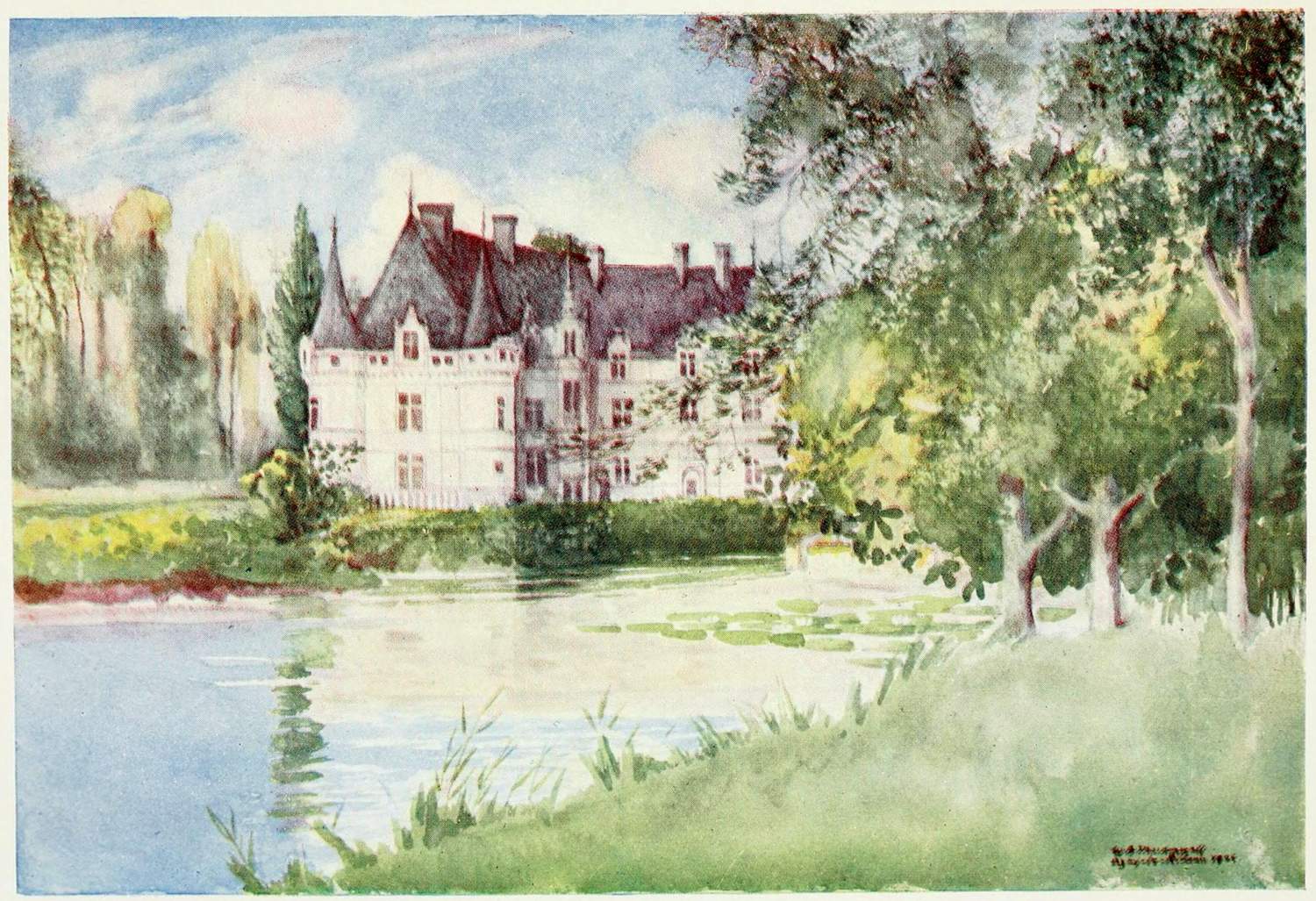
AZAY-LE-RIDEAU
VIII
When the Bourbons returned to France after Waterloo they had, as the phrase runs, learned nothing and forgotten nothing. The nobles took possession of the remains of their estates, and thought to restore the habits and privileges of their forefathers, or at least to adapt to modern manners the principles of the ancien régime. But they found in the peasant a sleepless suspicion, a silent energy and cunning, which thwarted all their efforts, and which, if they persisted, would often turn to violence, maintaining the rights of the people by the horrors of a Jacquerie. The first half of the nineteenth century witnessed more than one peasants’ revolt. And if some plot of the reactionaries should one day place again upon the throne of France a son of the House of Orleans, or a Bonaparte Pretender, be sure the croquants of the South, the Jacques of the North, would defend their liberties again as violently to-morrow.
Two fine novels, each a masterpiece, treat, from different points of view, this resistance of the peasant class, and the consequent disintegration of the great feudal domains. Jacquou le Croquant, by an almost unknown novelist, Eugène Le Roy, is the work of a man over sixty, a native of Périgord, working on the traditions of his native place and the tales of his grandfathers. Published in the last years of the nineteenth century, it gives an extraordinarily vivid picture of rural Southern France, as the author may have seen it in his earliest childhood, before 1848. The book is written from the peasants’ point of view, and full of enthusiastic Republican sentiment. Balzac’s Les Paysans hold a brief for the other side. One of Napoleon’s generals, the Comte de Montcornet, purchases in 1815 a feudal estate on the borders of Burgundy and the Morvan, and attempts to dwell there in the due state and pomp of a great noble. He preserves game, vows vengeance on poachers, protects his forest trees against the customary thefts of the village, and, like the farmer in Wordsworth’s ballad, forbids the old women to filch his faggots. And naturally he attracts the hatred and suspicion of the peasant. Even his own agent sides with them against him:—
“On veut vous forcer à vendre les Aigues. Sachez le: depuis Conches jusqu’à la Ville-aux-Fayes, il n’est pas de paysan, de petit bourgeois, de fermier, de cabaretier, qui n’ait son argent prêt pour le jour de la curée.”
And the book ends with the triumph of the peasants and the parcelling of the domain.
“Le pays n’était plus reconnaissable. Les bois mystérieux, les avenues du parc, tout avait été défriché; la campagne ressemblait à la carte d’échantillons d’un tailleur. Le paysan avait pris possession de la terre en vainqueur et en conquérant. Elle était déjà divisée en plus de mille lots et la population avait triplé entre Conches et Blangy.”
“Such is progress!” exclaims Emile Blondet, on an impulse of passionate irony.
It is not picturesque certainly. And yet I remember a magnificent picture of Sisley’s, representing just such a scene: small fields of cabbage, and strips of rye, with one bouquet of poplars, basking in the hot blue of a July noonday; and I know no finer landscape. Still, we will admit with Emile Blondet that the mysterious forest glades were infinitely lovelier. On one side, the utmost beauty and luxury reserved for one man; on the other, a thousand fields, and a tripled population living in tripled comfort. On which side is progress? On which side is the price too dear to pay? That is the question.
An old French lady, who could recall the ancien régime, was wont to say, when invited on a country visit: “No, I never go into the provinces, since they have turned all the castles into farms.” She had a prophetic eye. If the castles are to survive, they must be turned, more or less, into farms, and their owners are becoming increasingly aware of the fact.
Among the young gentlemen of France to-day there is a spirit of return to the land. The Institut Agronomique instructs every year a bevy of eager agriculturists, many of them belonging to the upper classes and possessing landed estates of their own. These young men at five and twenty are content to leave Paris and cultivate their acres in Normandy or Languedoc. For myself, I think them wise. I would be, if I could, a large farmer in a grass country, raising cattle and cheese (a crop less chancy than corn), with plenty of children, all employed on the estate, and a handsome wife, ever the first to rise and the last a-bed. Only the life of an inspector of forests (no one has ever said all that the Fables of La Fontaine owe to his employment as a Master of Waters and Forests), or that of a university don (which latter existence, indeed, much resembles my own), appear to me quite as pleasant as this. I know one or two such farmers, and think them aware of their good fortune; their neighbours eye them with envy, for such men are rare, since few of the farming class possess hereditary acres, while few can afford to pay the rent of a farm large enough to prosper—some £400 a year, for instance, such as my neighbour, Farmer Langeac, pays for Olmet. It is true that less land is needed to make a large income from cereal land or vineyards; but, when we come to crops, if the rent is less, the expenses of farming are much greater. The accounts of a farm in the isle of Bouin are lying on my writing-table: I find that when his rent is paid to the utmost farthing, the farmer must still reckon on spending some four guineas an acre on such necessary processes as ploughing, sowing, manuring, reaping, carrying, threshing, etc. Doubtless he may reap a considerable profit, for the polders of Vendée are among the most fertile fields of France. But only a man of substance can make so large a stake, or may afford to renew it annually, to tide over a bad season, keep his barns and machines in repair, and pay every week no paltry sum in wages.
IX
More frequent and less ample is the lot of the peasant owner. No fields are so prosperous as his, for no fields are tilled and dug with such untiring devotion: spade-culture forms the staple of his art on the tiny strips of land he is so proud to call his own. If, at the Revolution, one-fourth of the soil was in the hands of the peasant, the proportion to-day is certainly far greater; but the farms are smaller. In the plains of Beauce, round Orleans, the peasant freeholds compose more than three-fourths of the land, but the constant division of property by equal inheritance has reduced every little farm by multiplying its owners. The soil of this thickly populated district is so fertile that a farm in Beauce, however tiny, may be supposed sufficient to support a family; and in all rich and teeming countrysides, such as abound in France, the excessive division of property, consequent on the application of the Code Napoléon, has perhaps, up to the last twenty years or so, done more good than harm. An acre of strawberry gardens at Plougastel, of vegetables at Roscoff, of carnations at St. Remy de Provence, is still a valuable piece of property, an exceeding artistry and skill in cultivation compensating here the narrow limits of the field. But in such a case the soil, the climate, the economic conditions must all work for the farmer and conspire to crown his efforts. In ordinary pasture, in light soils too poor for wheat, too chilly for the vine, the peasant owner needs a larger glebe. Three acres and a cow are not sufficient to maintain a family in constant well-being, unless the circumstances be exceptionally favourable.
A small Socialist review, unusually well written and well informed, Pages Libres, has recently published a series of rural studies, each the monography of some small village in the provinces of France. In this way, the hamlet of Voulangis-en-Brie, the fertile polders of the Isle of Bouin, the villages of the Bourbonnais, so dear to the shades of Sterne and Arthur Young, each and all become known to us almost as if we had passed a summer there, for the schoolmaster, the large farmer, the local poet and archæologist, have each had a hand in these humble but not unimportant annals, and faithfully reproduce the various world before their eyes.
Voulangis, a village in Brie, counts five hundred inhabitants, almost all of them living on the land as farmers or agricultural labourers; the commune comprises 958 hectares. For clearer comprehension, let us say that it contains about 2700 English acres, of which a quarter are forest and woodland. Subtract again some three-score acres occupied by roads and lanes, and there remain 1750 acres devoted to practical agriculture. The odd thing is that these 1750 acres are divided into no less than 10,600 lots of land!
Few indeed are the peasant owners who have their scanty acres, so to speak, in a ring fence. No, with a strip here and a paddock there, according to the hazard of heritage or purchase, their tiny possessions are generally scattered over an area of several miles, thus greatly enhancing the fatigue and expense of the farmer. More than mere chance has presided at this minute dispersion. In all classes in France (and not only since the Revolution, but by a very ancient law and custom which dates back to the early Middle Ages), all the children inherit equally. Even in noble families, the law of primogeniture, as we understand it in England, has never obtained in France. In some rare cases, a majorat favoured the elder son; but as a rule he had nothing beyond the very modest privilege which awarded him the family chateau and the land immediately adjacent—the vol du chapon—the surroundings “as far as a cock can flutter.” As for the farming class, and even the class of country gentry, from time immemorial their lands have been divided between all their progeny alike. Suppose that a peasant farmer in Brie has so many acres of meadow, so many acres of forest, so many acres of rich arable land and a good-sized vineyard; do you imagine that on his death one son will take the pastures, another the cornland, and so forth? Not a bit of it! Each child will claim a slice of each sort of soil; and their children again will subdivide, till the strips of meadow, rye, cabbage, or vine, are not fields at all, but merely gardens. During the first seventy years or so of the nineteenth century, this morselling of the land suited well enough with the habits of agriculture in rural France. The plots of land were tilled with the tiny one-pronged araire, or Roman plough, just a tooth of wood tearing the fertile earth; more often they were not tilled at all, but merely worked with spade and hoe and pitchfork. Comparatively few peasant-farmers owned a horse—some weather-beaten patient ass or cow carried in panniers the wood from the forest, the manure from the stable, and the corn to the mill. The women and the children fed the beasts—there were but one or two of them in the byre—with handfuls of long grass, or leaves of trees, plucked by the roadsides or in the forest glades, and rolled to a bundle in their apron—even as Arthur Young remarked them of old, and thought it a great sign of poverty. No need, however, to grow much clover, or maize, or vetch or mangel-wurzel, for the cows in those days. These cows, fed on weeds and grass, these tiny plots turned over with spade and fork, afforded a considerable profit in times when the small farmer, owing to the difficulty of transport, had not to reckon with the products of the model-farm in a distant district. But railways and machines have changed all that. The plough, and especially the steam-plough, the thrashing-machine, the reaping-machine, are useless in these garden-grounds, while the expense of manual labour increases every year. A peasant-farmer now can only prosper where his holding is so small that he can cultivate it en famille. At Voulangis, for instance, a haymaker earns from 5 to 6 francs a day, a harvester from 7 to 10, while the thrashers, even in winter time, average 4 francs of daily wage. These prices are beyond the reach of small owners. And no less beyond their reach are the machines which do the same work so rapidly and cheaply. Yet they must sell their grain at the price set by the large farms where corn is sown, reaped, thrashed, and carried by steam labour. Moreover, the agricultural colleges and model-farms have raised the public standard, and buyers are no longer satisfied with the produce which contented an earlier generation; while transport is so easy that an establishment of repute can diffuse its fruits, milk, or butter, far and wide. At Olmet, for instance, I do not eat the butter of the farm, ill-churned and made from clotted cream, but that supplied by the Etablissement Agricole de Roche-sur-Loue, hundreds of miles away in Franche Comté.
Save for the middleman, who absorbs too large a proportion of the profits, the peasant owner might still make a living out of his orchard, his vegetable garden, and his poultry-yard. Was it not Gladstone who said to the English farmer: “If corn don’t pay, grow roses”? The flowers, eggs, and fruit of France are a source of incalculable riches, and are consumed not only at home, but sent in large quantities to England. Unfortunately, the peasant is, as a rule, intellectually idle, incapable of combination, suspicious, and impatient of new-fangled ideas; he finds it simpler to sell his goods to the buyer from Paris as his father did before him, than to combine with his neighbours in an agricultural syndicate or trade’s union. Let him once see, however, that his advantage lies in a peasants’ union, and he will soon find out the way. The principle of solidarity has scarcely penetrated as yet into rustic parts, but the need of resisting the low prices imposed by the large farms using machine labour will certainly, in time, teach the peasant many things. Let his mind once grasp the idea of a common prosperity—where Tom’s good luck is not ensured by the misfortunes of Dick and Harry, but where all are implicated in the well-being of each—let him forget to suspect and learn to combine; from that day forth his social future and well-being are assured. There are fewer middlemen in France than there were fifty years ago, and, oddly enough, this is a signal disadvantage to the peasant. Fifty years ago the crowd of buyers who thronged the markets every week in Brie, in Beauce, in all the fertile “home” provinces of the centre, bid one against the other for cheese, butter, fruit, and fodder, so that competition brought about a reasonable offer. To-day the railway has brought the farthest province within reach of the Paris market; and, in the capital, that market is directed, no longer by a number of shopkeepers, but by a few trusts or commission-merchants who dispose of every opening. These few middlemen, all acquainted, form a ring, and keep prices so low that the small farmer often makes little, sometimes no profit, on his bargain.
In the spring of 1902, the National schoolmaster of Voulangis-en-Brie, a certain M. Vaillant, felt his heart burn within him to see the buyers grow so rich and the peasants remain so poor. He resolved to found a Farmers’ Association for the sale of fruit to the Paris market; he started with seven or eight peasant proprietors and a buyer in Paris. The first stone fruit of the season is the damson, grown almost entirely for the English market. The syndicate made a “boom” on damsons and early pears, which are hard fruit, easy to pack and little injured by travel; owing to their inexperience in packing, they suffered some loss on their greengages; yet at the end of the autumn, so great were their profits, compared to those of their neighbours, that they determined to extend the scope of their operations. In place of selling fruit to Paris and London, they bought chemical manures from the factories and sold them to the farmers of Brie. Here, again, they scored a success; out of the profits they purchased an automatic seed-sifter. They hope in a few years to possess a complete set of sowing, thrashing, reaping, and carrying machines, steam-ploughs, and harrows, etc., which will remain at the disposal of the peasant-farmers who form the association.
X
If a small farmer fails and cannot pay his rent, he takes what remains of his stock and tools, when his debts are paid, and lets out these and his powers of labour in métayage to some landlord, who supplies the land and the seed for his part of the bargain. In many places, indeed, the landlord supplies stock and land and seed; but even so métayage is, as a rule, chiefly profitable to the landlord, who may make as much as from 12 to 15 per cent. on his capital. The tenant has generally no capital behind him, and in bad seasons is compelled to borrow at usurious interest, for no one will lend to a métayer, whose only stake lies in his arms, stock, and tools. These latter wear out, are broken, die, have to be renewed; if the cart-horse break his neck, or the cow die of anthrax, on the top of a bad harvest, his plight is scarce better than that of the poor hind whom Aucassin encountered in the greenwood; for, whichever party supply them, the landlord has a right to exact that stock and tools shall always correspond with the inventory drawn up when the tenant entered into possession. Thus, if a run of bad luck may soon bring a farmer’s noble to ninepence and transform him into a métayer, still more easy is the descent from the farmer à mi-fruits to the condition of farm servant or agricultural labourer. This is the lowest rung on the rural ladder.
Fifty years ago no class of labour was worse paid than that of farm servants. A small maid on a farm earned some four and twenty shillings a year—thirty francs!—her board, her clothes, her washing, and lodging. Nowadays, even children of twelve earn from four to six pounds a year—in addition to their keep and certain perquisites—while, after sixteen, their wages rise to three hundred francs (£12); and a full-grown man, besides his keep and perquisites, earns, as a rule, some twenty pounds a year.
Far rougher is the life of the labouring man, generally married, and living in a small cottage which, in most places, costs him as much as four pounds (100 francs) a year, though at Olmet, where I live, a very decent one-roomed cottage, with a loft, cellar, and garden-plot, may be rented for less than two pounds—forty-five francs. He has perhaps a little garden of his own, with a pig, some fowls, and a goat which his wife takes to feed in the lanes. Often he has no settled place, but labours first with this farmer, and then with that, always overworked; for an odd man is only called in at time of stress—hoeing time, or hay time, or for the harvest, or the thrashing, or hedging-and-ditching. But at least, in such seasons, in the sweat of his brow he earns his bread. All summer long he can count on two to four francs a day, rising to five or even seven at haymaking and harvest. It is not till November, when the thrashing is mainly finished, that his real troubles begin. If there be walls or roofs to repair, or a road to be set in order, here is a job for him, in case the neighbouring farmers be well enough off to unloose their purse-strings; or, again, he can serve in the quarries, when the farmer has to supply the stones for mending the high roads by a “prestation en nature:” a quarryman earns about fifteen pence a day, which is better than nothing in winter, when you have a family to feed. Often, too, the labourer turns wood-cutter or charcoal-burner at this season, walking many miles morning and evening, to and from his work, with a little osier basket hanging from his arm, which contains a cannikin of vegetable-soup, with a hunch of bread and cheese, and perhaps an onion.
In a little pamphlet, “En Bourbonnais,” published at the office of Pages Libres, a local novelist of the Allier district, M. Guillaumin, has added up the yearly receipts of a day labourer in good work, turn by turn haymaker and harvester, thrasher, wood-cutter, and so on. His annual earnings amount, in English coin, to twenty-one pounds twelve shillings. During the summer months, though he be fed abundantly at the farms where he works, his family must live, and he must feed himself all winter time. A quartern loaf a day is the least we can allow the little household, for bread will be the staple of their diet; bread and cabbage-soup, potato-soup and bread, will vary the menu, with an occasional stew of a little veal or bacon with carrots and onions. And bread is dear in France. A policy of protection has raised the price of the loaf, which is doubtless an excellent thing for the large farmer. But, out of his twenty-one pounds a year, Jacques Bonhomme, the day labourer, must pay no less than sixteen pounds for bread alone. No one would profit more than the French peasant by a cheapening of the price of corn. The cottage will cost another four pounds; and there remains one pound twelve shillings for school expenses, shoes, clothing, fuel, doctoring, and such indulgences as wine and tobacco. One pound twelve shillings for all the luxuries of life! Supplemented, no doubt, by the sale of the pig, and the kids, and the poultry; for the labourer of the Allier is too poor, as a rule, to put a fowl in his pot on Sundays, or to enjoy a rasher of his own bacon by his own fireside. True, in many parts of the country, the labourers, like the farm hands, pretend to certain perquisites. Here, in Olmet, for instance, the principal labourer on a farm receives seventeen pounds a year in money, with a sack of potatoes, a sack of chestnuts, and a sack of meal. Yet I cannot be as optimistic as Mrs. Tammas Glencairn in Mr. Barrie’s story. “My man,” says she, “has a good wage, and he’s weel worthy o’t. He gets three and twenty pound in the year, half a score o’ yowes, a coo’s grass, a bow o’ meal, a bow o’ pitatas, and as mony peats as he likes to cast and win and cairt.” The French peasant is much in the same case; but he doubts sometimes if all be for the best in the best possible world.
XI
Military service has shown him that people live otherwise in the towns. The spread of machines has lessened the necessary work of the fields; once out of work, the labourer, instead of seeking a fresh place on a farm, sets off on the road to Paris in quest of better days.
The rural exodus has become of late years a serious problem, affecting the very source of wealth and well-being in country districts. I think the village schools have been in some measure to blame for this.
Although the first Bill on rural education was passed as early as 1833, nothing was done, in fact, to instruct the mass of village children in France until the advent of the Second Empire, and very little indeed before 1871, when the matter was seriously taken in hand. In my Life of Renan, I have spoken of the general impulse towards a moral and intellectual reform which followed in France so closely on the disasters of the Franco-Prussian war. The Prussian schoolmaster, even more than the Prussian generals, was supposed to have directed the victorious armies of the enemy; and, in education, no less than in arms, the conquered country began to prepare her revanche, by raising for this purpose a generation of avengers.
The villages in 1871 were, in fact, almost as squalid, as narrow, as ignorant as before the revolution. The schoolmasters went to their posts in the spirit of missionaries prepared to civilize a tribe of savages, ignoring the ideal of the people among whom they dwelt, looking down on them with lofty benevolence, intending to concede nothing, but to convert, to quicken, and to change the heart. The first generation educated in the Primary Schools was treated even as a brand snatched from the burning. The children had learned from their masters to despise the animal ignorance, the brutish tastes, the sordid avarice that too often disfigured the habits of the village. And what they had learned to admire was something of which the village gave no conception.
For meanwhile in the towns the Socialist siren sang, “Come here, come here, and I will give you prosperity and peace.” And to the towns went the village youth. Wages were higher there; the standard of comfort suited better with a newly acquired ideal of refinement; above all, the smoky air was full of ideas. Ideas are a passion with the French, but with no class so absolutely as with the humbler ranks of Socialism. There reigned in those regions an instant hope in the approaching advent of a better world—a millennium, in fact, as living, as real as that which animated the first era of the Christian Church. The Socialist working man was somewhat in the position of the Christian convert of one of those great towns of ancient Asia Minor or Italy—a man with the secret of a New Hope—while the villages, Pagan now as then, slumbered in their contented ignorance. To go back would have been to apostatize, to renounce, not only the life-in-life
LUYNES
of an ideal, but also the means of education, the schools, the newspapers, the working-man’s club informally united round the zinc counter of the Marchand-de-vin, the Boulevards, the museums, the fêtes, the sense of beauty, the sense of politics, of science, of social solidarity. And if these parvenus in the moral and intellectual sphere were often crude, fanatical, harsh, intolerant, at least they were (what their rural fathers had not been) the heirs of all the ages. Every year the schools sent more and more young rustics to Paris, frotteurs and sellers of wood and coal from Auvergne, masons from the Creuse, old clo’ men from the Lozère, chimney-sweepers from Savoy. In Paris they found a clan of compatriots ready to welcome them, to show them how to earn their bread, and how, according to the newest gospel, to save their souls alive.
And still the drain continues. But trade of late years has not been so good in Paris. In many branches of industry there has been overproduction—mechanical engineers, for instance, and masons have less to do. And often the agricultural labourer, having tramped to town, may find no work ready to his hands. I read in the reports of the Société Nationale d’Agriculture of a certain farm in Brie, which has been bought by the Assistance Publique, in order to give work to those unhappy labouring men who have fallen into beggary among the unfriendly streets. Here, on the fields and furrows of La Chalmelle, they touch their mother earth again, like Antæus; thence they repair, sadder and wiser men, to such glebes or vineyards as are short of hire. In its humble capacity, the farm of La Chalmelle attempts to react against the mighty current ever streaming from the country to Paris, establishing a tiny counter-stream from Paris to the land. This rural exodus is a grave question. Indeed, all thoughtful persons must pause and fear when they come—as they may come, alas!—on a deserted village. For the fields are the source of our food and the fundamental riches of a nation. To forsake them for any cause, is to forsake the substance for the shadow. Therefore Reactionaries, such as the successors of Le Play, and Socialists, such as M. Vandervelde, are at one in attempting to stem the ominous tide. The State patronizes cattle-shows and subsidizes technical colleges; successful farmers are decorated no less than military heroes, and few orders are more esteemed than the Mérite Agricole. Here and there, manufacturers attempt, by using the water-power of a cascade or river, to give the rural workman employment, without drawing him from home. And it is probable that isolated factories employing the youth of country districts will become more and more frequent in the future, and increase the well-being of the landed labourer rather by lessening the hours of employment and leaving him his harvest than by raising the rate of wage. But all this is little enough, unless we have also that inner force which sways a period, a generation, and which sometimes inclines us more and more to Nature, reviving in our hearts the desire of the land. Still, it is a good sign that the very schoolmasters are nowadays less exclusively urban and literary in their standards. Science, indeed, is beginning to dethrone literature even in the National school, and what is Science but an Aspect of Nature? Science leads back to Nature, as more important than the classics.
Among the posthumous notes of that noble apostle of national education, M. Felix Pécaut, in the little book called “Quinze Ans d’Education,” which saw the light at the close of 1902, I find the following noteworthy passage:—
“They say that the National schools favour the village exodus. They say that, after six years of book-learning, the young rustic dreads the coarse habits, the hard work, the soil, the sweat, inseparable from the life of a farm-labourer.
“What is the remedy? First of all, teach the children to take an interest, not only in books, but in the life of the fields. Teach them gardening, and how to keep bees, the making of cheese and the management of a dairy. Show them the reason of these things, their cause, and the possible improvements. Above all, in educating your little rustics, do not impose an ideal from without; work your reform from within. Make your scheme of education deliberately rural; be sober, just; teach them courage, and the contempt of mere ease and well-being; give them a wholesome, ample way of looking at things; instil the taste for an active life, the delight in physical energy. Try and turn out, not a mandarin, but a man of the fields.”
XII
A generation corresponding to this ideal would yet need one or two reforms in the law of the land before the French peasant could reach his perfect development. First of all, let us admit that the nation has outgrown the Code Napoléon, which is a system of excessive centralization. As usual, the people are in advance of the law of the land; here as elsewhere, a fossilized system cramps and hinders the expansion of life. Even at some sacrifice of order, France would be more fortunate if she were decentralized, with more importance accorded to the country towns and rural districts. Have we not seen how, in the seventeenth and eighteenth centuries, this same vice of over-centralization was fatal to the country-sides of France, even as, in the closing years of the Roman Empire, it was fatal to the country-sides of Gaul? In this lovely land of France, over-centralization is a sort of endemic disease which we may combat, but scarcely, perhaps, eradicate. Let us do our best. It were well should the law, even if it continue the principle of equal inheritance, at least permit some laxity in practice (as an insertion of the thin edge of the wedge), allowing the estate, for instance, to remain intact in the hands of the son who farms it, though a proportion of the revenue be divided yearly among his brothers and sisters. Let us take from the Old Order what was best in it. Nothing was more frequent under the ancien régime than for a family to enjoy in common their paternal acres. To take a case in point:—when the great-grandfather of Ernest Renan died in 1732, his sons continued to dwell together in their old grey farm by the estuary of Ledano, without separating their shares of the estate. Gilles farmed the land; Alain, François, and Olivier manned the joint fishing-smack and salted their pilchards in common. This system of joint possession was usual in France, and suits the sociable French character. Even to-day, in some such way, the extremest results of the sub-division of property might be avoided. Thirdly, we would have every schoolmaster in France teach his children, instead of the names of the Merovingian kings, such elementary notions of physics and chemistry as explain or at least suggest the life of natural things: why the sea is salt; how the dew condenses; how the seed germinates in the earth; why such and such a soil best serves to produce such and such a crop, etc. When we see with what extraordinary swiftness the rural population of France has adopted the theories of Pasteur and their consequences, we feel that in this direction, at any rate, the rustic is not stupid. Let the peasants learn the meaning of the world in which they live; they will find it more interesting. A child who has learned to observe and reflect has the beginnings of a liberal education, and one that will not necessarily draw him from the land.