Part 2 — A LITTLE TOUR IN PROVENCE A LITTLE TOUR IN PROVENCE 1892
Reading edition
I
OUR first impression of Provence struck us just beyond Mondragon. For some miles we had traversed the romantic valley of the Rhone, which at this point might almost be the valley of the Rhine. The river is hedged in by tall cliffs covered with ruins as steep and as uninhabitable as the granite which supports them. Every mountain bears its castle and tells of feudal rule, of brigand oppression, with all the violence and picturesqueness of a mediæval tale by Sir Walter Scott. The train carried us through a narrow gully, with barely room in it, above the strangled river, for the ledge on which the rails are laid. Suddenly, at the other end of the gorge, the climate changes: the air is milder, the plain more fertile, the country widens into a great amphitheatre enclosed between the Alps of Dauphiné and the rounder hills of the Cévennes. And here, with the suddenness of magic, the first olives begin—no stripling trees, but gnarled and branching orchards, sunning their ancient limbs on every southern slope. In the twinkling of an eye we have come into the kingdom of the South. With a deep breath of the sharp-scented sunny air, we inhale the beauty of it, and understand—how intimately!—that horror of high mountains which has distinguished every race capable of appreciating beauty. Our recollection of the black gorge, the barren peaks, the swirling torrent, renders still keener our feeling for the fertile plain where the blood-red boughs of the Judas-tree make their deep southern blots of colour against the blue of the delicate, serrated hills behind. Among the fields the pollard mulberries gleam like baskets of golden filigree, in the splendour of their early April leaf. The tall pastures are white with starry jonquils, bending all one way in the wind. The hedges are sweet with hawthorn, great southern bloom, almost as big and plump as apple-blossom. And the same delicious contrast of delicacy and abundance which strikes us in the plain, surrounded by its peaks and barren hills, is repeated in the difference between this riot of blossom and the austerity of the foliage, much less green than in the north. The ilex spreads its cool grey shadow at the homestead door. Every little red-tiled farm, every vineyard, is screened by its tall hedge of cypress, a sheer wall of blackish green, planted invariably north-west of the building. For through those narrow gorges of Mondragon, where there seemed scarcely room for the train and the river, the Mistral also passes, like a blast from a giant’s bellows—the Mistral, the terrible north-western wind, that devastates these plains of Paradise.
II
Our first halting-place is Orange, a white and charming little town, filling up its ancient girdle with many an ample space of green garden and lush meadow. Few towns appear more provincial than this charming Orange, which gave William the Silent to the cause of the Reform, a dynasty to Holland, and a king to England. There were princes in Orange long before the Nassau: there was the House of Baux, with its pretensions to the Empire of the East; there was the House of Adhémar, which brought forth the noble Guillaume d’Orange, the peer of Charlemagne. Of all their glory naught remains save one meagre wall, one tumbling buttress surmounting the hill above the city. Compared with the beautiful amphitheatre beneath, still important and majestic as in the days of the Roman occupation, these remains of chivalry appear little more venerable than the ruins of the jerry-built villas of some demolished London suburb. Yet as we look at them an emotion awakes in our heart and a mist comes before our eyes that Roman antiquity does not evoke. For the monuments of the Middle Ages are other than of stone.
And we remember how, in the beautiful old romance of Guillaume d’Orange, the unhappy hero comes home to his castle wounded, after Roncesvalles, the only living knight of all his host, and sounds the horn that hangs before the castle gate. But the porter will not admit him: none may enter in the absence of the master, and no man of all his garrison recognizes the hero in this poor man, suddenly aged and pinched and grey, seated on a varlet’s nag, with nothing martial in his mien. Their discussion brings the Countess on to the battlements: “That—my husband! My husband is young and valiant. My husband would come a conqueror, leading tribes of captives, covered with glory and honour.” Then, seated still on his poor nag, outside his inaccessible castle, the Count of Orange tells the story of Roncesvalles, and how he alone escaped the carnage of that day. “Less than ever my husband!” cries the Countess. “My husband would not have lived when all those heroes died.” But at last he persuades her that he is in very truth himself, and she consents to take him and tend his wounds on his promise that, so soon as he can ride to battle, he will set forth again, to avenge the death of all his comrades.
“Le monde est vide depuis les Romains,” said St. Just. Beneath the ruins of that castle on the hill there stands, erect, eternal, built into the very frame-work of the cliff, the immense theatre of the Romans, still fit for service, resonant to every tone. Frequently, of late years, many thousands of people have gathered in the Amphitheatre, which serves on all great municipal occasions. But I prefer it as we saw it yesterday—its sweep of steps graciously mantled in long grass growing for hay, and full of innumerable flowers; its stage tenanted by bushes of red roses and white guelder roses; the blue empty circles of its wall-space outlined serenely against the flame-blue sky. Never have I seen the huge strength of Roman antiquity appear more sweetly venerable, more assimilable to the unshaken granite structure of the globe itself, than thus, decked and garlanded with the transitory blossoms of its eighteen-hundredth spring.
The front wall of the theatre is about one hundred feet in height, thirteen feet thick, and more than three hundred feet in length. The colony of Arausio was an important colony, remembered only now by the monuments of its pleasures and its triumph. When we shall have disappeared for near two thousand years, what will remain to tell our story? Our Gothic churches are immense and beautiful, but already, in their infancy of nine or seven centuries, they are falling into ruin. Our castles will go the way of the Castle of Orange; and of our pleasure-houses the oldest that I remember is the little flimsy seventeenth-century theatre of Parma, already quite a miracle of cardboard antiquity. We have built too high, or too thin, or too delicately. We have read too long in our prayer-books that here we have no abiding city. Our souls have no capacity to imitate that great solid souvenir of civic use, of pleasure, of triumph, which the Romans have left behind them in all their provinces. About ten minutes’ walk from the theatre, on the other side of Orange, stands the Roman Arch of Triumph, the most beautiful in Gaul. It is perfect in its great perspective, as it rises from the meadow-grass at the end of a shadowy avenue. On its sculptured sides the trophies of ancient battle are still clear, and on its frieze the violent struggle of men in battle—
“Et tristis summo captivus in arcu.”
The Romans have left behind them in Provence not only a series of unalterable monuments, but the type of their race. Up country, in the little farms, a Celtic strain prevails, but in every town we find the square-built Roman frame and classic features.
We end our afternoon by a long drive through the fertile plain of Orange, all the brighter for the severeness of its setting, for the spires and hedges of cypress, for the gaunt dim blue of the distant mountains. The spring is luxuriant and ample here. The hedges toss their fragrant boughs of may: the Japanese peonies are pink in every garden, the quince-orchards seem a bower of tiny roses, the purple flags are out by all the watercourses: but the prettiest sight of all is on the grass. Even in Italy I have never seen such hay-meadows, with their great golden trails of buttercups, their sheets of snow-white narcissus, springing innumerable and very tall above the grass. There are little children and boys, and tall young girls, grown women and men of all ages, in the fields gathering great posies of the delicious flowers. Never have I seen so bright a picture of the sheer joy of living, the mere gladness of the spring’s revival. It seems to us that we have driven by some happy byway into the Golden Age, into some idyl of old Greece.
III
Here the towns are set as close together as the jewels in a crown. We have scarcely left Orange before we see, beyond the green belt of the Rhone, the mediæval outline of the Palace of the Popes. L’Ile Sonnante, as Rabelais called it, rises out of the plain and the water like an island indeed, much as our own little Rye stands up out of the Sussex marshes. With its steeples and convents, its towers and buttresses, massed round the tremendous fortress on the central rock, girdled by an outer circle of crenelated ramparts, this fair town of Avignon appears the very sanctuary of the Middle Ages.
The great interest of Avignon is that it appears a town of one time—a flower of the fourteenth century still full of life and vigour. The tower of Philippe le Bel at Villeneuve dates from 1307; the great Palace of the Popes, the fortifications of the town, with their battlements and machicolations, and the vast round yellow fortress of St. André, massive against its background of olive-coloured hills—all these, and many smaller relics, belong to the second half of the fourteenth century. Even here in the South, few cities can show so many or such pure examples of the military architecture of the time.
The city wall of Avignon, since in part destroyed, had, when I saw it, a circumference of about fifteen thousand
THE PALACE OF THE POPES AT AVIGNON
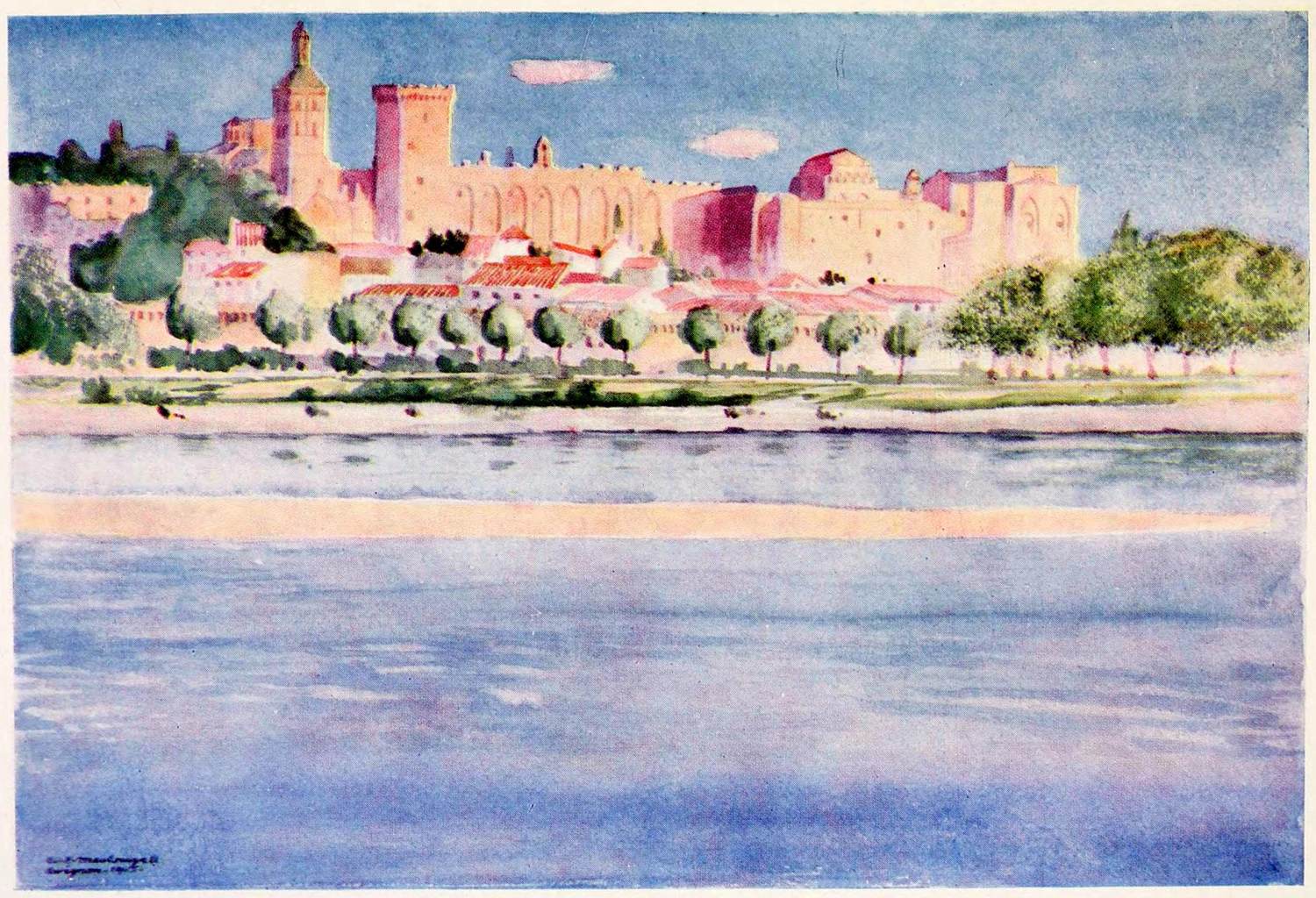
feet. It stood twelve metres in height. It had thirty-five towers, many turrets, was crowned with battlements, and pierced with machicolations. These last, as every one knows, are open spaces left between the wall and the frieze of arcades which supports the balcony intended for the garrison (the chemin de ronde), spaces which form great oblong holes in the flooring of the balcony, and through which boiling water, flaming tow, lighted oil, arrows, stones, and other missiles might be poured down on assailants engaged in undermining the foot of the wall. The walls of Avignon, substantial as they appeared, would have been but a phantasmal protection against a good mitrailleuse: the modern town wore them as an ornament, and not as armour. The gates, dismantled of their old portcullises, served for the collection of the toll, and the officials of the octroi lodged in the romantic gatehouses. One of these guardians, moved by our interest in his unusual dwelling, led us up through his kitchen and bedroom in the gate-tower, on to the balcony that crowns the wall. He left us there in company with his wife and several babies, whom I expected, at every instant, to tumble through the holes of the machicoulis; they showed, however, the address and ingenuity of true mediæval babyhood in avoiding these pitfalls, and appeared to find the superannuated battlements an admirable playground. Less adroit, we found the chemin de ronde very dizzy walking; and our interest in this relic of military architecture was chequered by the fear of being precipitated into space.
The walls of Avignon were less interesting than its vast central fortress. It is difficult to imagine a monument so irregular, so labyrinthine, such a mere sombre maze of towers and walls, of corridors and staircases. Not a tower is absolutely square, not an angle true, not a communication simple or direct. All is unexpected, dædal, disconcerting, in this gigantic relic of an era of confusion.
For the Palace of the Popes was not only a palace, but a stronghold. It was a necessary answer to the fortress which, in 1307, the King of France had built at Villeneuve across the Rhone; it was necessary also for defence against the troops of marauders who infested France after Crécy and after Poitiers. We remember how, in 1357, a knight, by name Sir Reynold of Cervole, commonly known as the Archpriest, scoured all Provence with a company of men-at-arms of all countries, who, since the King of France was captive and their arrears unpaid, turned brigands, and made a good thing of escalading castles, and ransoming rich and timid cities. Froissart has told us how the Archpriest and his men laid siege to Avignon, striking terror into the hearts of Innocent VI. and his cardinals. At last, the Papal Court agreed to pay forty thousand crowns to the company, as an inducement towards its withdrawal. The brigand-chief came to terms as regards the money, but he demanded certain small additions to the contract, for he remembered that he was not a mere marauder, but a person of good family, with other claims to consideration. He exacted, therefore, a free pardon for all his sins, and several invitations to dinner. The Pope and his cardinals “received him as reverently as if he had been the son of the King of France himself.” Then he consented to lead his followers elsewhere; and after his departure the Pope considerably improved the fortifications of Avignon.
By 1370 the city was strong enough to set such besiegers at defiance, and the palace had grown into the fortress we admire to-day. It is composed of seven huge corps de logis, separated by courts or quadrangles; and these are riveted to each other by seven immense and sombre towers. The whole forms a parallelogram of over twelve thousand square yards. It is an imposing, a tremendous pile—not beautiful, but unforgettable; conspicuous by the rare height of its walls and towers, and by the extraordinary upleap of its buttresses, which shoot right up the wall to the balcony, and form the great arcade which masks the largest machicoulis that I have ever seen. Not only pitch and Greek fire, but great beams and boulders could pass through these openings to crush the assailant underneath. Such a fortress appears impregnable to the eye: the height of the walls renders an escalade impossible; the garrison on the balcony atop is out of bowshot, and the huge buttresses defend the base against the sapper. At one-third of its height the wall supports a second balcony, whence the besieged could deal deadly damage on their assailants.
Within, the palace is disfigured by its present use as a barracks. The vast halls are ceiled over at mid-height and turned into dormitories. Nearly all the frescoes, painted in the melancholy, elegant manner of Simone Memmi and the Sienese, have been disfigured within this century. There is a party in Avignon naturally indignant at this defacement, which is all for buying the palace from the Government and turning it into a museum. This, however, would cost a great deal of money. And, as a mere impression, the great bare dædal building, gay with the crowded life of these youths of twenty, who race up and down stairs in noisy troops, or sit in the shadowy window-seats (picturesque figures in their white undress, black haversacks and deep-red caps), or fill the sombre quads with march and drill—yes, as a mere impression, it is certainly more appropriate as it is.
IV
“Sur le pont d’Avignon Tout le monde danse, danse; Sur le pont d’Avignon Tout le monde danse en rond.”
Many generations of children have doubtless wondered why. Make an effort to cross the Rhone when the wind is blowing, and you will arrive, at any rate, at one explanation. O masterly wind! Vent magistral, or mistral. With what a round, boisterous, over-mastering force you blow from the north-west! How you send the poor passengers of Avignon-bridge whirling in all directions, dancing to all tunes, battling comically and ineffectually against you! Men used to say that beautiful Provence were a Paradise, had it not suffered from three scourges: the Parliament, the Durance and the Mistral. The local Parliament exists no more (and we regret it), the Durance is no longer a curse, but a blessing, and serves to irrigate a thousand parched and fruitful southern fields. But the mistral remains. We ourselves were nearly blown from the hill-top at Villeneuve; yet I can cherish no rancour against the mistral, the tyrant, who sweeps us all out of his way as he rushes, wreathed in dust, towards the sea. ’Tis a good honest wind, like our west-country sou’-wester, and quite devoid of the sharp, thin, exasperating quality of the east wind of our isles. And, but for the mistral, they never would have planted those dark long screens of soaring cypress which streak so picturesquely the wide blue prospects of Provence.
V
There is something Athenian in the little literary class of Avignon, and in the evident pride and joy which all the citizens take in it. Our cabman stopped us in the street: “Look at that monsieur! Look at him. He’s a poet!” cried the good man in great excitement. It was M. Félix Gras. People waylay you to point out the name of Aubanel or Roumanille written over a bookshop. Every person of every degree treasures some little speech or anecdote concerning M. Mistral, the hero of the place. Doubtless the Félibrige, with the little extra romance and importance which it has given to the South, has much to do with this literary enthusiasm. In Provence, a taste for poetry is a form of patriotism, even as it was in Ireland in the days of the “Spirit of the Nation”—as it is again to-day. The sentiment, which is pretty and touching, appears quite genuine.
We had forgotten that Roumanille was dead (as was natural, since poets never die), and so we made a pilgrimage to his bookshop. We were greeted by a dark-eyed little lady; when we asked for the poet, the tears started into her fine black eyes, and we realized, with a tightening of the heart, the cruel carelessness of our question. But Mademoiselle Roumanille (for it was she), with the beautiful courtesy of her nation, would not let us depart in this unhappy mood. She talked sweetly and seriously of her brother’s latter days and of his death-bed, cheerful and courageous as the last pages of the “Phædo”: these Provençal poets have a classic temper in their souls! He would not let them wear a mournful face. “Life is a good thing,” said he; “chequered, no doubt, with melancholy moments, but none the less bright and excellent as a whole. We have come now to one of these melancholy passages, but, believe me, my friends, the sadness of death is greatly overrated! There is nothing cruel or tragic to lament about. Life has been very good, and now—at the end of it—death comes in its place, not unkind.”
So the good Félibre passed away, mindful, no doubt, of that passage in one of his poems where he says—but I have forgotten the words—
“Now let me depart in peace, For I have planted in Provence A tree that shall endure.”
If even the gay, the cordial Roumanille gave out at the last this savour of antique philosophy, the likeness of Mistral to the elder poets is far more striking. He is the Provençal Theocritus, and his poems, with their delightful literalness of touch, their unforced picturesqueness and natural simplicity, will probably endure when more striking monuments of our nineteenth-century literature are less read than remembered. We cannot imagine, at any distance of time, a Provence in which some posy of Mistral’s verses will not be treasured. He will be to the great province what Joachim du Bellay has been to Anjou. True, he has written too much, but posterity is an excellent editor, and reduces the most voluminous among us to a compendious handful. Mistral is the greatest of the Félibres, and perhaps the only one whose works will survive the charming Davidsbund of poets and patriots which so loudly fills the public ear to-day.
We went more than once to see the great man in his garden at Maillane, a pleasant place surrounding a cool, quiet villa, where the poet lives with his young wife. It is the only house of any pretensions in Maillane, and to the good people of the commune Monsieur Mistral is both the poet and the squire. He comes out to receive you—a strikingly handsome man with a beautiful voice; so much like the once-famous Buffalo Bill in his appearance that one day, when the two celebrities met by accident in a Parisian café, they stared at each other, bewildered for one moment, and then, rising, each advanced towards the other and shook hands! We talked of many things, and among others, of course, of Félibrige. I ventured to ask him the meaning of the name, which is a puzzle not to philologists alone. He confessed that it had no particular meaning; that on that day in May, in 1854, when he and Roumanille and the other five discussed their projected Provençal renaissance, one of them reminded the others of a quaint old song, still sung in out-of-the-way Provençal villages: a canticle in honour of certain prophets or wise men dimly spoken of as
“Les félibres de la Loi.”
No one knew precisely what the word designed—so much the greater its charm, its suggestiveness! The name was adopted by acclamation; and henceforth, at any rate, the meaning of Félibre is clear.
VI
We went the next day, in company with Mistral and his charming, intelligent wife, to see the races at St. Remy. “Regardez nos fillettes!” said the poet. “On dirait des statues Grecques.” A Greek statue is severer in its beauty; but certainly the girls of St. Remy might be the sisters of the statuettes of Tanagra: so dignified, so graceful, do they appear in the beautiful costumes of Arles. They were the great adornment of these mild provincial sports, as we watched them come in troops from Maillane and Tarascon, from Avignon, from Arles, all dressed in the plain-falling skirt, the fichu of pure fresh tulle, and the long pointed shawl, or “Provençale,” which recalls the graceful garb of the Venetian women. Sometimes the skirt is pale pink or apricot, with a dove-coloured shawl, or green with a lilac shawl; but, as a rule, the skirt and shawl alike are black, relieved only by the narrow muslin apron, which reaches to the hem of the skirt before, and by the abundant fulness of the white fichu across the breast. Every one who has been to a fancy ball recalls the charming coiffure which surmounts this costume—the thick wavy black tresses, parted in the middle of the brow, taken down either side of the face loosely, then suddenly raised from the nape of the neck high at the back of the head, coiled round there and fixed under a tiny band of white lace, and a large bow or sash of black ribbon. Few head-dresses are at once so irresistible and so dignified, and none could be better suited to the regular features, ample beauty, and melting eyes of the daughters of Provence.
We fell in love with St. Remy: we stayed there for a week, in the Hotel du Cheval Blanc, where the long dark convent-like corridors and the cypress-screens behind the house give one already, as it were, a waft of Italy. St. Remy is a delightful little place. All its streets are avenues of great zebra-trunked century-old plane-trees, garlanded in April with quaint little hanging balls, or else of wychelms, gay with pinkish-buff blossoms, and yet so gnarled and hollow that they might almost be those famous elms which Sully planted about the towns of France. “La Ville Verte” the people call it, and never was name better chosen. Even as at Orange, the town has shrunk within its ancient girdle, and has filled out its space with gardens, with
THE CASTLE OF BEAUCAIRE AT TARASCON
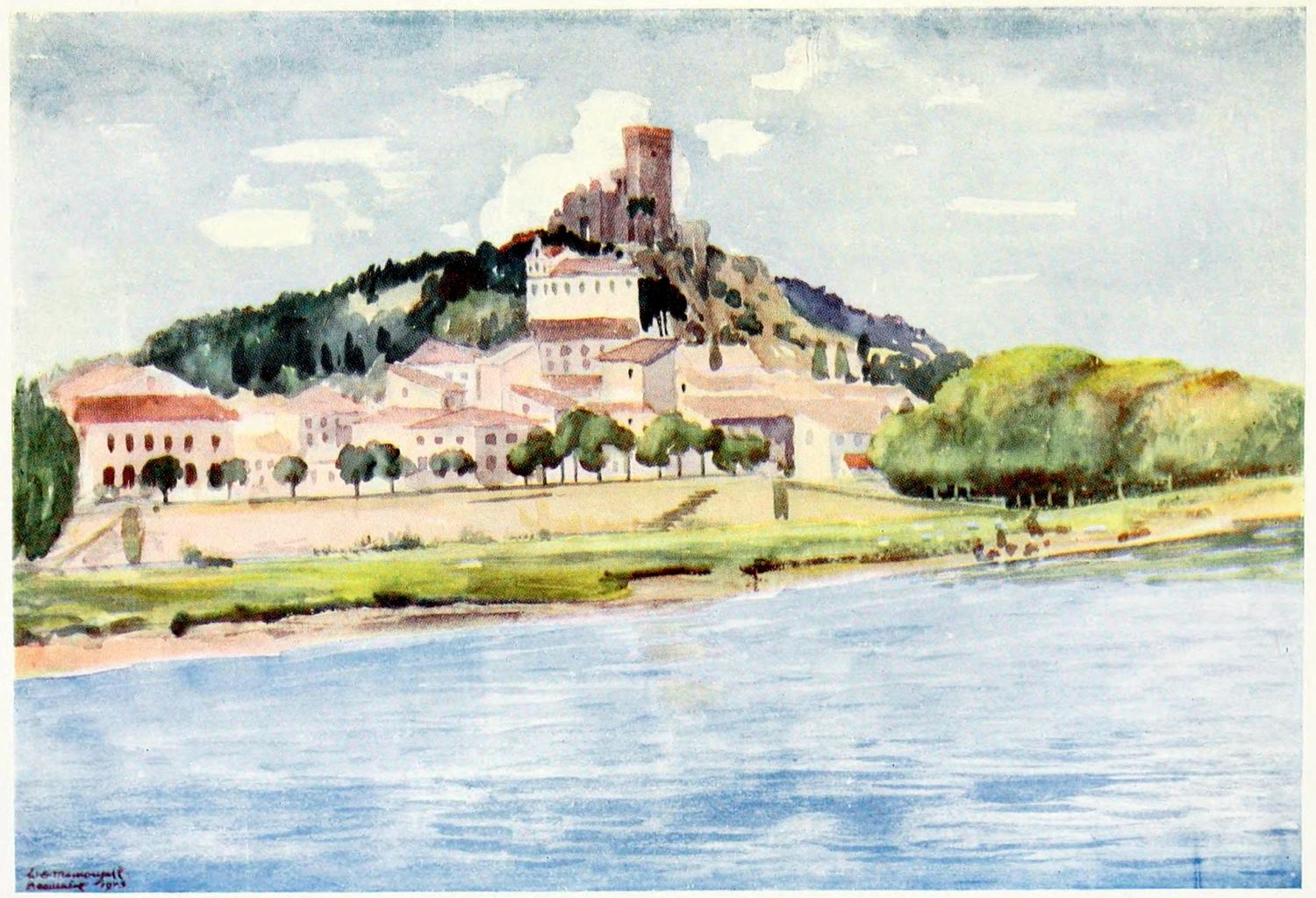
orchards, with hay-meadows. The gardens of St. Remy are the fortune of the place, and owe to their happy situation behind the range of the Alpines an earlier harvest of flowers and fruit than elsewhere, even in the sunny South. An acre of carnations of St. Remy is a fortune to a man, as profitable as an acre of asparagus at Monteuil or early peas at Plougastel. If the mountains behind us, so lovely in their lilac bareness, were duly forested and covered to the crown with pine and ilex, we could imagine no happier situation. But the hills of Provence are as unthrifty as they are beautiful. They absorb and retain no salutary moisture from the rare torrential rains of autumn, which dash down their ravined sides, ruining and tearing the friable soil, with not a kindly root to stay and store them. This reforesting of mountains is a great question, nothing being more important to a climate than its supply of woods and the distribution of its rains; the future of agriculture depends on it, especially in Provence, where, even more than elsewhere, the struggle for water is the struggle for life. In 1860, and for some years after, much planting was done; but then, alas! there came a slackening of zeal. Farmers everywhere think of the present rather than the future, and a plantation remains unproductive for a score of years; whereas these barren mountains serve as winter quarters to endless herds of sheep, who browse their rocky perfumed sides. In the year 1902 more than three hundred thousand sheep were pastured on the territory of Arles. Flocks of three thousand and four thousand beasts are common. In summer, when the native sheep are sent to feed upon the high fields of the Alps, the shepherds of Algeria bring their flocks across the sea to Arles; the patient Africans find sufficient pasturage in the rare but succulent plants that defy the ardours of the summer sun among the pebbles of Camargue and Crau, or on those rocky heights which, arid though they be, prove not unprofitable to the farmer who lets them out for hire. Talk to him of replanting! He fears to trouble a certain source of gain, and, knowing the span of life, prefers a small profit to-day to riches for to-morrow. But he sacrifices all the countryside. A forest has no enemy so deadly as the shepherd. It is he who burns the young wood, in order to have more grass; it is he who leads the sheep among the tender saplings, whose juicy shoots are dear to all the tribe of ovines, as the bird and the mouse to the cat, or the poultry-yard to the fox. The sheep must disappear if woods are to grow.
And unless the woods are planted, the climate of Provence will year by year turn harsher, dryer, more subject to the mistral. The delicate Alpilles will be worn by the force of torrents to a range of hillocks; the rivers will ruin the plains. From this, and more, the woods may deliver us. When men think of their children rather than of themselves—but when will that be?—the woods will be planted, and a generation will grow up to call these sheltered and sunny fields a Paradise. Even as it is, they are fertile and precocious in a rare degree. In the roomy inn-garden we wondered at the luxuriance of the spring, as we sat in the shadow of the blossoming guelder-rose bush, or picked great trails of rose and syringa. We gathered our first dish of strawberries on the 23rd of April. There are but two openings at St. Remy—miller or market-gardener: the two prettiest trades, suitable to this greenest, most pastoral of cities.
St. Remy is but gently raised above the plains; still low enough to nestle among the white-flowered hawthorn hedges by the runnels bordered with flowers. But, scarce two miles beyond, there rise the scarred, fantastic, sun-baked crags of the Alpille range—the Alpines, in modern guide-book parlance—a furthest prolongation of the Alps. These are true southern hills, barren and elegant, grey, lilac, blue, pink even, or purple against the sky; but never green. Walk thither along the upward road till, at the mountain’s feet, you come to a round knoll of fine turf, fringed with stone-pines, with, under every tree, a marble sarcophagus for a seat. Hence the view is beautiful across the wide blue valley to the snow-streaked pyramid of Mont Ventoux. But you will turn your back upon the view, for placed on the middle of this grassy mound is the pride of St. Remy: the Antiquities, sole relic of the prosperous town of Glanum Livii. Nowhere in Provence have we seen so beautiful a setting to monuments so perfect in their small proportions as the Triumphal Arch and the Mausoleum. Time has much ruined, it is true, the decorations of the Arch: the winged Victories are bruised and battered; only the feet of one warrior remain, the head and fighting arm of another; the chains of the slaves have fallen into pieces. But nothing has marred the style, the grace, the purity of the exquisite outline, Greek rather than Roman in its simple elegance. The Mausoleum is less correct in style, but more picturesque, more suggestive. A flight of steps leads to a sculptured pediment, from which there arises a crossed double arch, itself supporting a small round temple, roofed, but enclosed merely by a ring of columns, in the style of the Temple of Fortune at Rome. Within these columns stand two tall figures, robed in the ample toga of the Consul; they seem to lean forward as though they gazed across the valley to some ancient battlefield. Standing so high, and screened behind their wall of columns, the statues do not show the trace of the modern restorer. The opinion of archæologists is still, I believe, divided as to their identity, but the peasants have views of their own on the matter. Some of them aver the figures to be the portraits of those twin emperors, Julius and Cæsar; but most of them, with some show of reason, consider that they commemorate the victories of Caius Marius, the hero of all this countryside. The figures are twain, so the peasants have doubled the General; Caius and Marius look out towards the Fosses Mariennes. Others, aware of the individuality of their hero, have solved the difficulty by giving him his wife as a companion! One shepherd, however, offered me the best explanations.
“Those two figures,” said he, “represent the great Caius Marius and the Prophetess Martha, the sister of Lazarus, and the patroness of our Provence. They were, as you may say, a pair of friends.”
“Dear me!” said I. “I thought there was a hundred years or so between them.”
“Maybe,” said the good man; “that well may be, madame; but, none the less, they remained an excellent pair of friends.”
The facts of these good people were, as you see, a little incoherent. Yet, indistinct and fallacious though it be, their vision of a distant glorious past gives their spirit a horizon, their minds a culture, which I have never met in the provinces of the North, where ancient history begins with the French Revolution. Every ploughman, every shepherd, in the kingdom of Arles is aware that their country was to Rome, two thousand years ago, much what Nice and Cannes are to the Parisians of to-day. Their inheritance of so ancient a civilization, their contemplation of the vast and beautiful monuments of Latin triumph, have given them a certain dignity and sense of importance which may degenerate here and there into the noisy boastfulness of a Tartarin, but which far more frequently remain within the limits of an honest proper pride. Those whom I met, the peasants and shepherds at St. Remy and Les Baux, had each a theory of his own concerning the great campaign of Marius, and pointed me out—at varying quarters of the horizon—the line of the retreat of the barbarians. If I sometimes was made to feel that, from the height of their ancient glories, they looked down on me as on one of that defeated horde, yet their attitude was always that of the kindest, the most courteous superiority. They are citizens of Arles or Avignon, as one was a citizen of Rome when the greatest honour was to boast Civis Romanus sum.
VII
One day we drove across the plain to Tarascon, a cheerful little town beside a yellow river, overshadowed by a great yellow castle, the Château du Roi René, the painter-king. On the other bank of the river rises the Castle of Beaucaire, and the two old fortresses, whose enmity was once so cruel, glare at each other as harmlessly in our days as two china dogs across a village mantelpiece. Tarascon possesses a fine old church, whose porch would seem still finer were it not so near a neighbour of St. Trophime at Arles. We descended into the crypt to pay our reverence to the wonder-working tomb of St. Martha, sister of Lazarus, who, as every one (south of the Loire) is well aware, was cast ashore upon the coasts of Provence in company with the two holy Maries. She founded the city of Marseilles, and is buried under the church at Tarascon. As we picked our way underground we perceived in a dark recess of the staircase a second tomb, unvisited of pilgrims, but far more interesting to our eyes. A marble youth lies along the sarcophagus, dead. It is Jean de Calabre, the son and heir of King René, an old friend of ours, for we have followed him in many a Neapolitan campaign. But after all he did not gain his crown of Naples, the brilliant young pretender. He lies here, forgotten, in the mouldy vault of St. Martha.
When we emerged to the outer air from this underground sanctuary of saint and hero, we remembered modern times, and asked our guide for the latest news of M. Tartarin. She protested her ignorance, but with a certain subdued irritation (or so we thought), as of one weary of a scie that has lost its edge. We were more fortunate, however, when we asked for the Tarasque. She ran with us along a narrow street in great impatience until we reached a large stable. The door swung open, and we beheld a sort of huge long-tailed cardboard whale, green, with scarlet scales stuck all over with yellow spikes, like the almonds in a plum pudding. The creature has a half-human head with goggle eyes, a vulgar good-natured smile, and a drooping black moustache, with a long horsehair mane depending from its neck. It suggests a cavalry “sous-off” who has in some way got mixed up with his charger.
The eponymic monster of Tarascon is no longer led along the streets in glory once a year, accompanied by men and maidens, in commemoration of the day when St. Martha tamed the dragon by a prayer, and led him along in fraternal peace, tied in a leash of her slender neck ribbon. The recent law against processions has stopped all that. ’Tis a pity, for the monster is a pleasant, vivid, childish-looking monster, no more terrible than a devil by Fra Angelico. He made us remember the horrible Tarasque which is to be seen in Avignon Museum. This noble monster was excavated under the foundations of an Early-Christian chapel in the Church of Mondragon. He is a panther-like person; his fore-claws are dug deep into two half-scalped human heads. A portion of a human arm remains between his gruesome jaws. Flaxman himself never imagined a more hideous devil. “Progress is not an illusion, after all!” we sighed, as we looked at the amiable if vulgar Tarasque of Tarascon.
VIII
When people come to stay at St. Remy, it is nearly always in order to make the excursion to Les Baux; a more desolate one cannot well be imagined, nor one that places in stronger relief the contrast between the sane and beautiful relics of antiquity and the misery, the squalor of mediæval ruins. Who was the misguided man who first made it fashionable to admire barren mountains and ruins, and other such dismal monstrosities? I should like to quarter him to all eternity in a palace at Les Baux.
The road thither quits the lovely flowery plain, to rise among arid limestone mountains. Flocks of sheep are grazing there, but there are more herbs than grass, and as the poor beasts climb ever in search of a more succulent blade, they send out beneath their feet the exquisite fragrance of mountain thyme and lavender and myrtle. On the steeper scaurs, the pale mountain roses of the cystus are all a-flower, and shed a spring-like beauty about the desolate scene.
It soon becomes more desolate. We wind higher and higher up the barren flanks of the Alpilles. The wind-eaten crags of white friable stone defy even the mountain herbs. It is melancholy cinder-grey lunar landscape.
This white stone is the sole harvest of these regions. As we advance we find the mountain scarred and hacked into countless quarries. Here and there, the great pale slabs are piled into a tomb-like dwelling for the quarrymen. Far off, on the very crest of the mountain, we see, above all this desolation, an orchard of almond-trees, the only thing that betokens a human presence more happy than the slave-like labours of the quarry. Behind these trees there rises, as it seems, an uttermost wall of crags, yet more jagged, more desolate than the others. They are, as a matter of fact, the ruins of churches and palaces, the residue of the once princely city of Les Baux.
When at last we jog into the tiny Place of the city, we find a squalid village nestling in the centre of the former capital, like a rat in the heart of a dead princess. About three or four hundred poor creatures live here: God only knows what they find to live on! Slices of white stone, I suppose, and almond-shells.
They are, at any rate, eager for pence and human society. The carriage has not stopped before a guide pounces out upon us, and carries us up through a steep unspeakable wilderness of dead houses, deserted these three hundred years, and all falling most lamentably into dissolution. There is a poor Protestant temple, with its elegant delicate sixteenth-century carvings all in ruin. “Post tenebras Lux” is proudly carved above the dilapidated portals. All these ruins, varying over some two-and-twenty centuries, appear of the same age, the same dead-level of abjection. The “baums” of the cave-dweller, their cupboards and door-holes still perceptible, appear but little older than this or that mediæval palace. Ah, the place is terribly changed since I came here last with Jean Lefèvre, in 1382, to purchase for the Duke of Anjou the rights of the Seigneurs des Baux to the Empire of the East!
Under the crag-like tower of the castle there is a windswept mountain-top, whence you look down on the vast level of Camargue and Crau. From these coast-like summits the sad-coloured salt-marsh appears infinite; it is treeless, melancholy beyond words. Were these spendthrift, sterile mountains planted with kindly woods; were yonder brown morasses drained and irrigated—(and indeed this latter labour is very fairly begun)—on what a different and happy scene might we look down, in barely a score of years! That blue streak on the horizon is the Mediterranean. There the three Maries landed, and began their inland march. Their three effigies, carved by their own hands, are still perceptible yonder, on a stone at the very foot of the mountain where we stand. Apparently they were wise enough not to seek the inhospitable summits of Les Baux.
There was one thing I should like to have seen in the dead city, but when we were there the relic had departed to a barber’s shop at Aigues Mortes. Some time ago, the landlord of the tavern at Les Baux, digging in his garden, came on a slab which, being removed, exposed a mediæval princess, still young and, to all appearance, living. A moment after, she had crumbled into dust, all save her wonderful golden hair—yards of it, crisp, silky, and shining—which filled the stone coffin with its splendour. In this poetic treasure-trove the landlord saw an excellent opportunity. He changed the name of his inn, which forthwith became The Sign of the Golden Hair; and there, sure enough, on the parlour table, in a coffin of glass and plush, lay the thousand-year-old tresses of the dead princess. The curiosity attracted custom, and having made his fortune, the landlord sold his tavern of Les Baux and retired to shave the inhabitants of Aigues Mortes “at the sign of the Capello d’Or.”
The villagers of Les Baux spend most of their time in delving for similar treasure. No one else has found a coffin full of golden hair; but skeletons, coins of all periods, and armour, are every-day occurrences. I made a mistake in thinking that these people lived off freestone and almond-husks. They dine on Gaulish tibias, skulls of Roman soldiers, dead cats of the Stone Period, and a miscellaneous assortment of rusty iron. Not one of them but will sell you a human bone from a desecrated sepulchre as a souvenir of your visit to Les Baux.
IX
Les Baux is on the way to Arles, and you cannot do better than push on to that delicious city. Among our impressions of Provence, Orange gave us an exquisite sense of ancient peace, of dignity not uncheerful in its seemly ruin; and St. Remy, with its flowery paths, its lilac mountain scaurs towering above the Roman arch and temple on the pine-fringed knoll, has left in our memory as it were a perfume of poetry and grace. But for a profound and melancholy beauty we saw no place like Arles. In that tiny city every step calls up a new picture, an unforgettable recollection. How many of them arise before me as I write! The lovely ruined theatre, so perfect even in its abandonment, two columns still supporting the fragment of an antique fronton; the great arena where the bulls still fight on Sundays before an eager audience of stalwart Provençal men and large-eyed women in the solemn dress of Arles; St. Trophime, with its wonderfully living portal crowded with saints and prophets, with enigmatic Tarasques and dragons, with strange cat-like wild animals creeping stealthily about the basement. There is a poem of Mistral’s, called the Communion des Saints, telling the adventure of a little country
THE ALISCAMPS AT ARLES
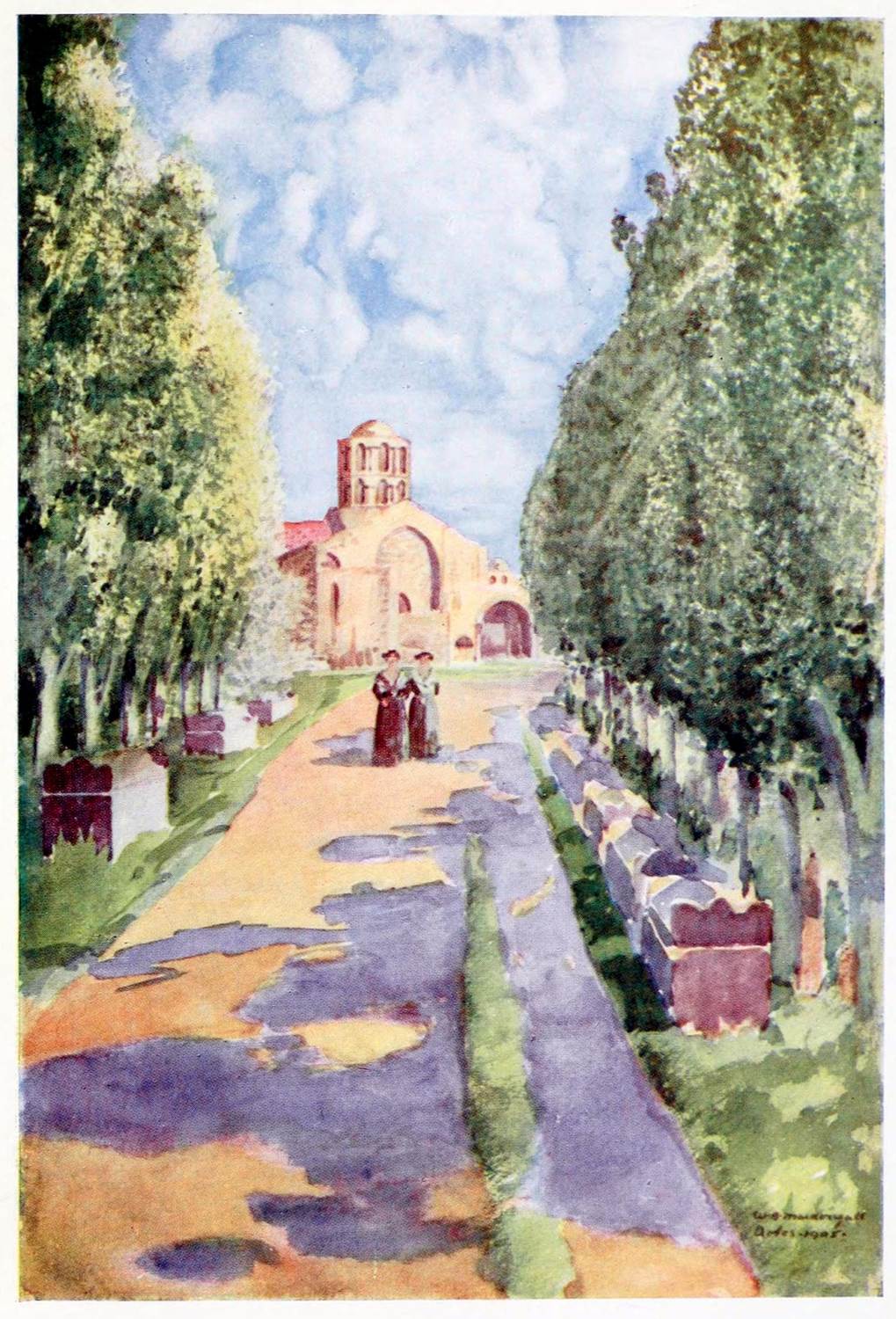
girl who, arriving too late at Arles to hear the mass at St. Trophime, cried herself to sleep in the porch. When she awoke it was moonlight, and lo! in order to console her, the carved saints came down out of the portal and said the mass for her. They are so living, those saints, that the fable seems the most natural thing in the world.
And the cloisters within, how melancholy in their peace! And then, across the way, the Museum, with its unparalleled sarcophagi. The finest was discovered—I think in 1890—in digging the new railway across the Camargue. Never have I felt so strongly as in this Museum, as rich in Early Christian as in Classic monuments, the difference between the Pagan and the Christian conception of death. The Roman tombs are carved all over with beautiful and cheerful images, some scene of daily life, some vine-gathering or olive-harvest, perfectly human and natural, as though they would have placed between the sealed eyes of the dead an abiding memory of the pleasantest things on earth. The figures on the Christian coffins have lost their early grace; but these large-headed, large-handed, awkward saints and mourners have an intensity of expression, a pathetic conviction in the reality of a Beyond, which we have not seen before. The Roman mourners look back, the Christian look forward; the vision of the one is all regret and beauty, the other is exalted by an ardent and a yearning faith.
We have not yet done with the tombs of Arles. It was the first of May when we walked through the Alyscamps, and the latest hawthorn bushes were abloom about the Sacred Way. To tell the truth, we were disappointed with the Alyscamps. The railway has come too near to these Elysian fields, sadly narrowing their proportions. The most beautiful sarcophagi are all in the Museum or in St. Trophime. The tombs no longer chequer all the fields beyond, as when Dante wandered among them and thought of Hell; no longer—
“ad Arli ove ’l Rodano stagna ... Fanno i sepolcri tutto ’l loco varo.”
There is left but one long alley, borders with antique tombs, mostly lidless, obviously empty, shaded by a fringe of plane trees which leads to the ancient church of St. Honorat. This is a quaint, damp, melancholy place, with the raised quire built over the crypt, as at San Miniato. Its round, short pillars, five feet thick, wear an air of sturdy age. Itself appears a tomb. There is a charm in this mouldering old Romanesque church, with its illustrious perspective of the Alyscamps. Yet for a last impression of Arles we would fain go a little further up the hill, through the lovely Public Gardens to the Roman Theatre. Here we will sit on the marble steps awhile, and gaze on the unchangeable elegance of its proportions, serene in ruin, unabated of their dignity, and no less beautiful in their decay.
Adieu, beautiful city! Gallula Roma of the ancients! How different had been the fate of all our western world if Constantine had realised his dream, making of Arles the centre of the Roman empire!