Front matter (continued 3)
Reading edition
He was brave as a lion, and gentle as a woman, as true knights are to this very day. The sound of his voice as he spake of his love stirred the Princess’ heart to a secret joy; but him, too, she sent away with but a glance from her blue-grey eyes. And though I, her Fairy Godmother, scolded her well and entreated her to say him yea, she would not be persuaded.
“Lowered herself from her window by means of a rope of pearls”
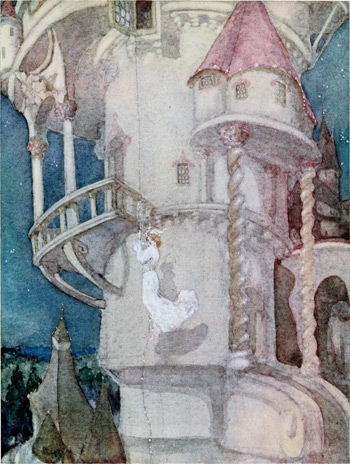
‘First I must see what lies hid in the land Beyond,’ she said, and that very night, when the Crystal Tower shone wanly in the moon-light, and all her ladies were sleeping, the Princess covered her snow-white robe with a gossamer cloak of clouded grey, and lowered herself from her window by means of a rope of pearls, passing through her gardens and into the forest, which lay between her and the land Beyond. All fearless in her virgin purity, she listened neither to the Goblins who eyed her hungrily from the shapeless trees and besought her to show them favour, nor to the warnings of compassionate Fays who bade her return to the Crystal Tower.
‘I seek the land Beyond,’ she cried, not knowing that she could never reach it except on spirit wings.
Now the Prince Fiola could not sleep for love of her, and this night he stayed his restless wanderings in the Palace grounds by the waters of a placid lake, for the fancy came to him that therein dwelt some kindly Sprite who, perchance, would give him counsel and further his suit. Clear shone the moon above, making the smooth surface into a fairy mirror which reflected the swaying trees and the mysteries of forest depths; and as he looked, the Prince descried the shape of a slim white form which seemed to be hurrying onward amidst a forest. The poise of the head was Fiorita’s; hers, too, was the queenly gait. But thinking her to be safely sleeping, the Prince believed that his eyes were cheating him, and moodily resumed his walk. When morning came, however, he hastened to the Crystal Tower. He found it in great commotion. Doors were opened and shut in rapid succession, and scared attendants ran in and out like ants.
‘The Princess is not in her chamber!’ her ladies told him, wringing their hands. ‘Her bed has not been slept on, and her silken wrapper is still in its broidered case.’
As the Prince stood bewildered, the King came up. The remembrance of his lack of love was heavy upon him, and he strove to stifle his remorse by loud threatenings of dire punishment to all if his daughter were not speedily recovered.
As he stood quietly aside in the midst of the commotion, Prince Fiola remembered the vision of the lake, and bidding a groom go fetch him a horse, he mounted and rode straightway to the forest. Two paths stretched out before him; his horse would have taken that on the right, but the Prince urged it along the other, for he thought that he caught a glimpse of his love’s white gown at the end of a woodland glade.
It was only the feather of a dove, however, and he pressed on, barely slackening his pace for hours. Darkness fell, but there was still no sign of Fiorita, and when he reached the borders of the forest, and yet had found no trace of her, his heart was sick at the thought of her peril. He could not stop, so with only the stars to guide him, he essayed to cross the waste that lay beyond, and at dawn was still riding wearily on. By the following noon both horse and rider were exhausted. The burning sun blazed down on their heads, smiting them as a sword, and though the Prince had no pity on himself, he grieved that his horse should suffer. Dismounting, he led it on until he came to a great rock, down the side of which flowed a stream of water. When he and his dumb companion had quenched their thirst, he took off its bridle and set it free, for he knew that the faithful creature could carry him no further.
‘Make your way home, good friend,’ he said, as he patted its glossy mane. ‘I cannot return without my Princess, though I fear me ’twill be many a day before I find her.’
And now began the most toilsome part of his journey. With the land Beyond always before him, he trudged on and on, turning aside for nothing; and so passed another day and night. Now the long road wound uphill; stones blocked his way, and thorns tore his hands and face; still he pressed on, for his love was stronger than hunger and thirst, and pain had no terrors for him. Nevertheless, he had lost all hope, when a turn in the path disclosed a sight which made him for the moment forget his trouble.
A bent old woman, crooked and frail, staggered beneath a load of sticks, and dancing along at either side of her, were two rough boys, who mocked at her lameness, calling her a Witch. The Prince overtook them with rapid strides, and knowing that the power of gentleness is more lasting than that of anger, he suppressed his wrath as he spoke to them, though withal he reproved them sternly.
‘Know you not,’ he said, ‘that only cowards persecute those who are weaker than themselves? ’Tis a woman whom you call ‘mother,’ and if only for this, you should hold all women in reverence. Now go—and remember what I have said. Here is something to purchase a gift for your parents. See that you are more worthy of their care.’ And with other words to the same effect, he gave each a silver coin.
Won alike by his kindness and the justice of his rebuke, the boys asked pardon for their rudeness, and scampered off with glowing faces, while the old woman blessed the Prince for thus befriending her. Disclaiming her thanks, he lifted her load to his own shoulders, when it immediately became as light as air. The next moment it fell from him altogether; and he turned in great astonishment to meet her serious gaze.
‘Bel giavone!’ she exclaimed, ‘I pray you think me not intrusive, but I know by your voice that your heart is heavy as the load I carried awhile ago. Tell me your grief, that if the Fates so will, I may in my turn help you.’
‘In truth, good mother,’ said the Prince, ‘no mortal can aid me now except by telling me where I may find the White Princess, whom I seek day and night in anguish, since she is my dear love.’
‘Even that can I do!’ cried the old woman, straightening her bent figure until she stood before him tall and queenly, her squalid rags changing into flowing robes of purple velvet. ‘I am the Witch Lucretia, and my spells are a match for those of the Sorcerer with the Seven Heads. You have travelled far from your White Princess, for the Sorcerer lurks in the forest through which you passed, and Fiorita is his prisoner. No man yet has entered his castle to leave it alive, but I will show you how this may be done, if you are willing to change your shape and become one of Earth’s humblest creatures.’
The Prince feared nothing so that he might once reach the side of Fiorita, and gladly submitted himself to the enchantments of the Witch. Lucretia lifted the silver wand that was hid in the fold of her gown, and at its touch the Prince became a cricket, just such another as the one which you lately restored to liberty.
‘You will find no difficulty now,’ she said, ‘in entering the Sorcerer’s castle, for the pitfalls he has prepared for man are as nought to they who traverse the air. And that you may be one of many, and so a match for his spells, I will summon my Witches and Fairies to protect you.’
Having muttered an incantation, she blew thrice on an opalescent shell which dangled from her waist upon a ruby chain; and troops of Fays and Witches came hurrying down the road. Some were slender and stately, with faces as fair as dreamland; some were twisted and bent, and some so small that a dozen could hide in the cup of a flower. With a second wave of her silver wand, Lucretia transformed them into a myriad crickets. Hailing Fiola as their king, she placed him at their head, and reminding him solemnly that persistence conquers where force must fail, bade him lead them back to the forest.
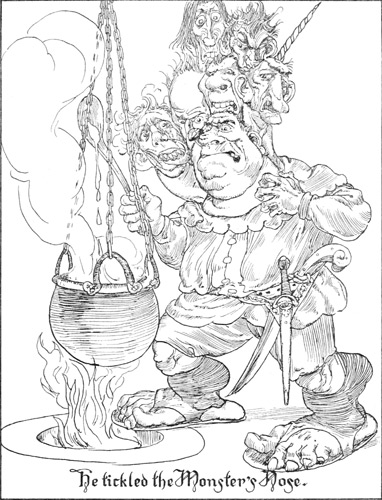
In an incredibly short time this aerial army arrived at the castle of the Sorcerer with the Seven heads. It stood in the midst of a dense thicket, surrounded by a moat, the lurking place of demons with long forked tongues, and eyes that shot evil fires. Undaunted by their snarls, the crickets flew over the draw-bridge, and finding a way into the castle through the close-barred windows, swarmed round the Sorcerer’s head. A cauldron swung from the domed ceiling, over a quenchless fire, and in this the wretch was even then concocting a potion by which he should overcome Fiorita. Her purity had hitherto protected her, and though he had bound her body with chains, he could not fetter her spirit.
‘How dare you disturb me?’ he roared, lunging at the crickets vainly with a long and glittering knife.
Fiola would fain have slain him where he stood, but when, forgetting his impotence, he hurled himself forward at the monster, he only tickled his nose.
‘Leave him to us!’ cried his cricket friends; and then they began their witch-song of ‘Cree-cree-cree.’
Now the Sorcerer having seven heads—Greed, Envy, Spite, Malice, Passion, Jealousy, and Despair, each of which would have instantly sprung forth again had Fiola been able to chop it off—he had naturally fourteen ears, and these were so extraordinarily sensitive to noise that he had destroyed all the woodpeckers in the forest that he might not hear their tap-tap on the trees as they searched the bark for insects. You can judge, then, of his disgust when on his refusal to obey Lucretia’s command, and break the bonds which held Fiorita, this host of crickets swarmed round his head, and filled the air with discord. Each pitched his voice in a different key, and the din of battle was as nothing to that which now pervaded the castle.
These were the words of the witch-song:
‘Cree-cree-cree-cree Set Fiola’s Princess free. Sorcerer thou, but Witches we— Cricket-Witches, from grass and ditches. Cree-cree-cree-cree! Peace thine ears no more shall know Till thou bidst the lady go. Cree-cree-cree-cree! Sorcerer, set the lady free!’[3]
Over and over again they chanted this lay, and every cricket, far and near, joined in the maddening chorus. They sang until the Sorcerer with the Seven Heads felt that his senses were leaving him; pallid with rage, he severed the White Princess’s chains. By the power of Lucretia, who had clearly foreseen his discomforture, the moment that the chains fell from her Fiorita immediately became a cricket also, and gladly did she fly to the side of the Prince, who greeted her with rapture.
All would now have been well had they straightway left the castle, for Lucretia waited outside to restore to them their human form. As Fiorita passed the great cauldron which still swung over the lamp, she could not resist the temptation to lean over and peep inside, and the fumes from the potion being very strong, she straightway fainted, falling into the midst of the blood-red liquid. Before it could wholly cover her, the Cricket King seized her wings in his mouth; he carried her thus into the open air, where she speedily revived. Great was Lucretia’s concern, however, when she heard from Fiola what had happened.
‘Alas,’ she sighed, ‘not even I, who am mistress of spells and enchantments, can avert from Fiorita the consequences of her delay. Since the Sorcerer’s potion touched her, for six months each year she must be a cricket, even as now; for the rest, she will be the White Princess, to dwell with you where you will.’
Then Fiorita was sad indeed, for she had lost her longing to see the land Beyond, and desired nothing better than to wed the Prince. But now that he knew she loved him, no spell could dampen Fiola’s joy.
‘While you are a cricket,’ he said, ‘I will be one too, for so long as you are beside me—what matters else?’ And the Fays and Witches, who reverence all true love, elected to share their banishment.
And so it was, and is to this present time. For half the year Fiola is the Cricket King, and Fiorita, more than content, his Queen. But as Ascension day comes round, the spell is broken, and they take their accustomed places at the Court. It is hard to say when they are the happier; for love is as much at home in the humblest corner of Mother Earth as it is in a lordly Palace.”
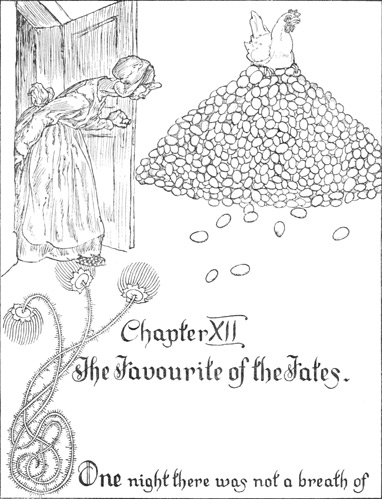
One night there was not a breath of air, and I could not sleep. I tossed this way and that for hours, and directly the birds began to twitter, I put on my things and slipped back the bolt of the grand hall door. Once outside, it was beautifully fresh and cool, and the clouds in the sky were like wreaths of pink flowers on a turquoise sea, arched over with gleaming gold. They changed every moment, and while I watched them I forgot to look where I was going. When I stopped at last I found myself in the middle of the market place, where I had been with Father the day before.
It was empty now, for no one was yet awake but me.
Among the quaint old wooden houses I noticed one that I had not seen before; at first it seemed to be indistinct, but the longer I stared at it, the clearer it grew. Over the door of the tiny shop was the figure of a hen cut into the stone, and while I was wondering who had carved it, the wings fluttered gently toward me. The bird moved its head, and its wings were lifted; it flew to the ground, and a lovely white hen was at my feet. It looked at me wistfully, and flew away; when I turned to the little house once again, it was not there. But beside me stood the Fairy Godmother.
“Come and sit in the shade,” she said, when I asked her what had become of the hen, “and I will tell you all about her. She is seeking Furicchia, whom she served so well, not knowing that she is a shadow too.”
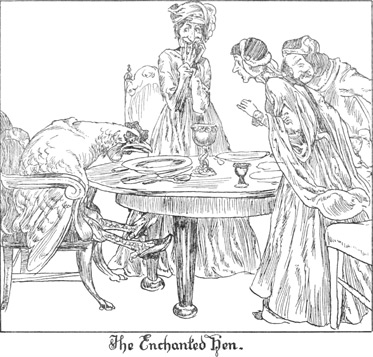
“Furicchia,” said the Fairy Godmother, “was a very poor woman who owned a hen which an innkeeper greatly coveted. The shape of the bird was perfect; it had a most melodious voice, and its feathers were glossy and white as snow.
‘Come now, good dame,’ the man cried, persuasively, ‘I will give you double the market value of your little hen, for I wish to make a present of her to the widow Ursula, whom I intend to espouse.’
‘But the widow might kill and eat her!’ said Furicchia, looking lovingly at the little hen, which she had brought up by hand from a tiny chick. It had slept beneath her best silk ’kerchief, and taken its food from her lips.
‘That is as may be,’ he replied. ‘Come, Furicchia, I make you a handsome offer. Give me the hen, and you shall fare well next feast day.’
But Furicchia would not listen, in spite of the sad fact that her cupboard was as empty as her netted purse. The little hen was dear to her, though as yet it had lain no eggs, and she would not sacrifice her to her needs.
Ere evening came, Coccodé was clucking gaily under the kitchen table, and Furicchia found, not one egg, but three, all a rich coffee brown, and polished like porcelain. Having joyfully exchanged one with a neighbour for a dish of broth, she broke the second into it, and prudently saving the third for next day, thankfully made a good meal. When morning came, she found eggs to the number of a round dozen strewn about her tiny room, and from being almost on the verge of starvation, she had plenty now and to spare. For Coccodé, the grateful creature, laid eggs by the score, and not only were they of exquisite flavour and very large, but it was noticed that if sick folk ate them, they straightway returned to health.
Furicchia was now a famous egg-wife, and the more eggs she sold, the more eggs Coccodé laid. The little hen was both willing and industrious, and loved her kind mistress so dearly that she was never so happy as when helping to make her fortune. Her pride in Furicchia’s first silk gown was comical to witness; she rustled her wings against its handsome folds, and clucked so loudly that the neighbours heard, and came to see what was the matter.
This silken gown it was that roused the anger of the Signora, a wealthy woman who had much, and knew no better than to want more. Hearing of the prodigious number of eggs which Furicchia supplied, though no one had ever seen her with other than a single hen, she set afoot much scandal concerning her, ending by declaring her to be an evil Witch. At this, Furicchia’s neighbours began to look askance at her; but the eggs were so good, and so moderate in price, that on second thoughts they decided to treat the Signora’s hints with the contempt which they deserved.
This made the lady still more angry; she resolved to find out Furicchia’s secret, and ruin her if she could, so that she might obtain her customers for her own eggs. Coccodé was quite aware of what was going on, and before her mistress went out one morning she bade her fetch certain herbs that grew on a corner of barren land, and put these on the fire in a pot of wine.
‘And now, dear mistress,’ she continued, when all had been done as she said, ‘do you go out and trust your luck to Coccodé.’
Furicchia had not long been gone, when the Signora’s crafty face peeped slyly round the door. Finding the room apparently empty, she hurried in, delighted at such an opportunity for prying. First she peered here, and then she peered there, ransacking Furicchia’s chests, and even turning over the leaves of her holy books, that she might see if an incantation to Witches had been written therein. Finally, she raised the latch of the inner chamber, where she had heard Coccodé clucking.
‘I have found out Furicchia’s secret now,’ she thought with glee. ‘Her little white hen is under a spell, and she and it shall be burnt as Witches.’
Coccodé was sitting on a pile of eggs that reached almost up to the ceiling, and even as she clucked she was laying more. The Signora drew close to her, and listened with all her ears, for she had distinguished words amidst her cluckings, and immediately jumped to the conclusion that Coccodé believed herself to be addressing her mistress. This is what she heard:
‘Coccodé! now there are nine! Bring me quickly the warm red wine. Coccodé! take them away Many more for thee will I lay. And thou shalt be a lady grand, As fine as any in the land, And should it happen that any one Drinks of the wine as I have done, Eggs like me she shall surely lay; This is the secret, this is the way, Coccodé! Coccodé!’[4]
‘Aha!’ said the Signora joyfully, ‘now I have it!’ And running back to the outer room, she lifted the wine off the fire and drank it, every drop, though it scalded her throat and made her choke. As it coursed through her veins she felt a most extraordinary sensation, and hurried home as quickly as she could. A meal was laid on the table, but she found great difficulty in taking her usual place, and could eat nothing but some brown bread, which she pecked at in a most curious manner. As the charm began to work, her legs grew thinner and thinner, and her feet so large that she had to cut off her boots. Next, her brown silk dress became a bundle of draggled feathers, while her nose turned into a beak, and her voice into a discordant cluck; in short, she was just a scraggy brown hen, and her friends held up their hands in horror. Eggs she laid by the score, but before she could sit on them they turned to mice and ran away. So she had nothing for all her trouble; and though she possessed a handsome house, she could only perch in a barn.
This is what comes of greed and envy, and of meddling with other people’s business.”
Just at this moment a girl darted out of a doorway opposite, followed by an elderly woman who loudly reproved her for refusing to do her share in some household task. Shrugging her shoulders, she came to a sudden end, as if she knew that her breath was wasted, and the girl disappeared with a peal of laughter.
“She is off to gossip instead of work,” said the Fairy Godmother disapprovingly. “She will pay for it later, will pretty Ursula, for the Fates are not likely to interfere on her behalf as they did for Pepita.”
I had to coax her to tell me this story, for she said she had much to do, and could not stay. But when she heard that the very next day Father and I were leaving Italy, she refused no more. We sat down on the step of a splendid church, and no one seemed to notice us.
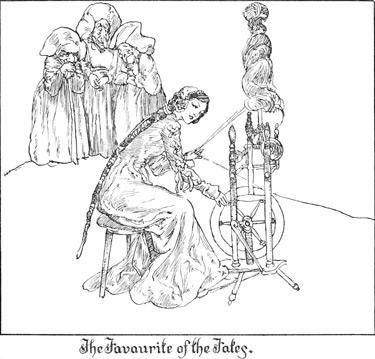
“Troubles rolled off Pepita as water from a duck’s back. So lighthearted and full of good humour was she that nought ever seemed to vex her, and no one living had ever heard an unkind word fall from her rosy lips. Even the three grim Fates, who rule over mortal destinies, relaxed their stern brows as they looked down on her, and smiled indulgently.
Pepita was slender as a swallow, with a warm red flush on her olive cheeks, and dainty hands that looked far too delicate and small for even the lighter household tasks. These, indeed, Pepita seldom attempted, singing instead from morn to eve, and charming her mother with soft caresses when she hardened her heart and tried to scold her.
But Pepita could spin. Ah yes, she could spin, and as no other maiden had ever been known to do since Arachne was changed into a spider. The snowy flax flew from under her fingers as though her distaff were enchanted; which, indeed, was the case, for the wayward Fates had bestowed upon her a magic gift, and having given her this, not even they could take it away from her.
Pepita’s mother was often wroth with her, for the dame had much work on her hands, and sighed that her only daughter should give her so little help. Were the maiden sent to wash clothes in the stream, ten chances to one they would go floating down the current while she twisted flowers in her hair. Were she set to make sweet little chestnut cakes, she would forget to put a cool green leaf at the bottom of each round baking dish, and when they were taken out of the ashes, behold, they would be all burnt!
‘You are a good-for-nothing!’ her mother would cry angrily; but this was not true, for Pepita could spin.
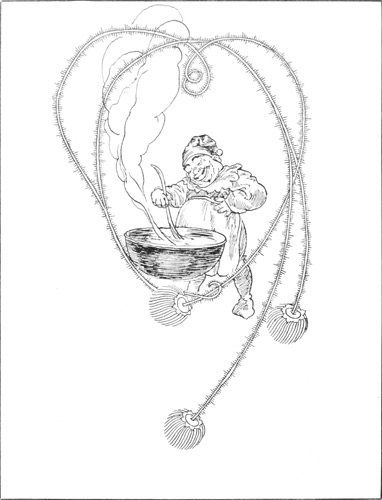
One feast day, while her mother went to the fair, she was told to watch the pentola, and to stir it carefully if it boiled too fast. It was made of rice and good fresh meat, with vegetables from the little garden; and it smelt so delicious that Pepita’s small nostrils quivered like the petals of a rose on a windy day.
‘I will taste it to see that all is well,’ she murmured, and drawing back the iron pot, she helped herself to a liberal portion.
The pentola was good; Pepita tasted it yet again, for she had been up early to go to Mass, and had sung herself hungry on the way home. Soon there was no meat left.
‘Ah, what shall I do?’ she sighed, ‘My mother will scold me terribly, and will tell the Padre that I am greedy.’
She was sighing still when her eyes fell on an old leather shoe which had been cast away behind the door. Her face all dimpled with mischief, Pepita soused this under a tap, and threw it into the soup.
‘They will but think that the meat is tough!’ she cried with a burst of laughter; but as the shoe fell into the boiling liquid her mother crossed the threshold.
‘What have you done?’ demanded she, peering into the pot. ’Madonnamia! Was ever an honest woman cursed with such a daughter?’ And breathing out angry hopes that an Ogre would come and take her, she drove Pepita out of the house.
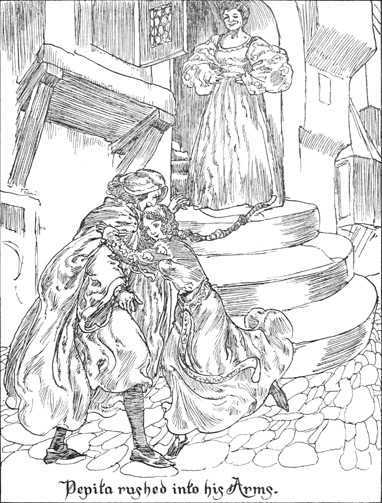
At that moment a rich young merchant was strolling by, and Pepita unwittingly rushed into his arms. A thing such as this had never happened to him before, and since he scarce knew what to do, he clasped her tightly while he considered. By the time he released her, Pepita’s face was pink as apple blossom, and the tears that sparkled on it were for all the world like dewdrops on the petals of a flower. Something stirred in his breast, and he blushed even more than she; for when a man falls suddenly in love he knows not where he stands. Looking from one to the other, the wrath of Pepita’s mother suddenly cooled.
‘Take her to wife,’ she said, ‘and you’ll not get a bad bargain. True, she is nought in the house, but she can spin. And with all her faults she is not a scold.’
‘One wants more in a wife than that!’ said the merchant shrewdly, though the last of her statements went far with him, since his mother had a tongue. Looking into Pepita’s eyes, which were heavenly blue, and sweet as an angel’s, he lost his last qualm of doubt, and lifted her hand to his lips. Then he turned once more to the elder woman. ‘I have vowed to my mother I will not wed without her free consent, but if your daughter meets with her approval, I will gladly do as you say.’
Guido’s mother was in her seventieth year, and though she had never beheld a face more winning than merry Pepita’s, it did not please her, and she gave her mind to finding a task which would prove beyond her powers.
‘The garden paths are green with weeds,’ she quavered; ‘they have been sadly neglected since Pietro fell ill. Take the hoe, and root them up; leave not a single one.’
‘Nay, mother! I seek not a gardener for my wife!’ her son protested hotly, for Pepita’s small hands could barely lift the hoe, and he had set his heart on her.
‘Unless the paths be clear of weeds ere the sun sets, I will not give thee my consent,’ said the old woman obstinately; and there was nothing left for Pepita to do but to hoe up the weeds as best she could.
No sooner had Guido’s mother ceased watching her from the window, than Pepita whistled gently, and swift at her call came the birds she had fed with crumbs when the fields were bare. Pointing to the weeds, she made signs to them to destroy them, and by the time the old mother awoke from her nap, not one was left behind. This vexed her instead of giving her pleasure, for she did not wish her son to marry, and telling her maids they might have a holiday, she commanded Pepita to prepare the evening meal.
The maiden was now in much perplexity, for she knew not how to cook, and her experience that morning with the pentola had taught her little. But the Brownies who dwelt behind the hearth, and love to see a fair young face bending over the pots and pans, bade her be not discouraged, for they would stand her friends.
Then the nimble little men flew hither and thither, fetching garlic and oil and meat and rice in just the proportions that Guido loved, and adding certain secret flavours of their own until the smell of the broth made the old woman’s mouth water, and she could not but praise Pepita’s cooking. When it came to the time to test her skill at spinning, she was completely reconciled to her son’s choice, and put no obstacles in the way of the wedding.
And now Pepita sang more blithely than ever, for though he was less well favoured, and slower of speech than many a young man who had wooed her, she adored her husband. She was as happy as the day was long until, wishing to have the biggest bank account as well as the prettiest wife in the neighbourhood, he took it into his head to turn her talent for spinning to account, and kept her beside her distaff from morn till eve.
‘I shall soon, at this rate, be richer even than the notary,’ he thought, as he looked delighted at his stores of flax; and Pepita besought him in vain to give her a little rest, for he could be as obstinate as his mother.
It was now that the Fates interfered on her behalf, though many more worthy than she are left to shift for themselves.
‘She has lost her bloom!’ sighed one grim sister.
‘Her cheeks are hollow!’ observed the second.
‘Her songs are sad ones!’ said the third with a dreadful frown. And then they put their heads together, and formed a plan whereby Guido might be outwitted.
As he sat in the doorway that evening while Pepita span, denying himself the sight of her in order that her work might not be disturbed, there came up the garden path a hideous old hag, who besought him to give her alms.
‘Look at me, Signor!’ she groaned, lifting her head so that he saw the wrinkled folds that lapped her chin. ‘Once I was fair as your Pepita, but I sat so long at my spinning wheel, that all my comeliness left me.’
Guido hastily gave her a coin, and urged her to begone; for he did not want Pepita to see her, or to hear what she had to say.
Next eve came a second old woman, uglier, if possible, than the last, and bent like some brutish beast. She had the same story to tell him of bygone loveliness, and Guido sped her down the hill with even more haste than before.
The next night a third old woman appeared, so dread of aspect that he was obliged to avert his gaze. Against his wish, he felt himself constrained to enquire the cause of her terrible affliction.
‘I sat at my wheel, good master,’ was the reply, ‘until beauty and sight both left me, and my skin became even as you see.’
Now thoroughly alarmed, he dismissed her quickly with a handful of coins, and calling Pepita to him, gazed at her long and searchingly. When the flush that his now unaccustomed touch had brought to her sweet face faded, he saw she was pale and thin. Her mouth drooped sadly, and purple shadows brooded round her eyes. With a cry of remorse he drew her to his breast, and kissed her tenderly.
‘You shall spin no longer, my Pepita,’ he said, ‘for I would rather have you as you are than be rich as Satan himself!’”
And this was the very last story I heard. We started for home next morning, and I went to school at the half term—a ripping school where there was any amount of cricket, and so many other games that I had no time to think of Fairies.
But some day I’m going to find the Peri, and those other wonderful Sprites and Goblins of which Titania told me when I met her in the wood that Christmas day.
Printed by W. W. Curtis, Ltd., Cheylesmore Press, Coventry.