Front matter (continued 2)
Reading edition
At length he was able to go home to his castle, and once more he roamed the forest. The songs of the birds were hushed by now, and the trees under which he used to rest were almost bare. It was autumn, for he had been long absent, and even yet his step was slow and his proud head bent with weakness. He was sick with longing for his gentle lady; ‘If I do not find her, I shall die!’ he cried.
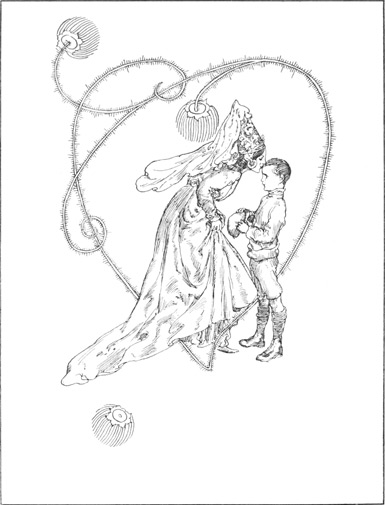
Presently he came to a glade where the naked boughs formed a splendid arch above his head, and he saw a troop of horsewomen riding toward him on snow-white steeds. In their midst was his Lady of the Woods, a bridal veil on her star-crowned hair, and myrtle at her breast. He awaited her approach in a trance of delight; nearer and nearer came the prancing horses, their skins of satin glinting in the sun. The cavalcade reached his side; the Queen of the Fées dismounted and stood beside him, while the ground at her feet became a bed of lilies. The Lord of Argouges threw himself on his knees amidst their fragrance, gazing up at her with enraptured eyes, as softly and shyly she bent toward him.
“The Lord of Argouges threw himself on his knees”
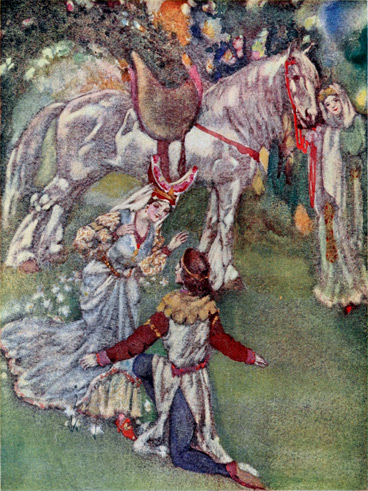
‘Once more I greet you, dear lord!’ she said, and as she touched his forehead with her lips, the birds still lingering in the forest burst into joyful song. When the knight found words to tell her of his great love, she plighted her troth to him, but only he heard her whispered promise that she would be his wife.
Once more she mounted her snow-white steed; he seated himself behind her, and thus they rode to the castle gates, accompanied by her maidens. Here the Lord of Argouges sprang to the ground; light as a wisp of thistledown, she floated into his arms, and to the amaze of the household, who had watched the approach of the procession from the castle windows, her horse, thrice neighing, changed into a bird, and fluttered sorrowfully away.
‘Farewell, sweet Queen!’ her maidens cried, and kissing their hands to her, rode swiftly back to the depths of the forest.
Then the Lord of the Argouges drew the Lady of the Woods across the threshold of the castle, and so queenly was her beauty and so gracious her demeanour, that even his aged mother, jealous of the son for whom she would have shed her life-blood, found no word to say against his choice.
‘My love for him is nought beside thine,’ the Fée Queen pleaded very sweetly, ‘for thou didst bring him into the world, and hast anguished for him as none else can. But I too have suffered on his behalf; I pray thee, let me love him too!’
Then his mother looked long and deeply into the eyes of the woman who had dethroned her from her dear son’s heart, and what she saw there filled her with peace. ‘Be it as thou wilt,’ she said, and that self-same night the Lord of Argouges wedded his Lady of the Woods in the castle chapel, which was decked with the fragrant lilies that sprang wherever her feet had trod. The rejoicings lasted for seven days, and the Lord of Argouges looked as one to whom the gates of Paradise had opened.
The Queen of the Fées was now to all seeming a mortal woman, and so far from regretting that she had laid aside her rank, each day found her more content in her husband’s love, and by every womanly art she knew she sought to please him. One favour only she asked of him—that never in her hearing would he mention the word ‘Death.’
‘If you do, you will lose me for ever,’ she told him fearfully, and he vowed by all that he held most sacred that this dread word should not cross his lips.
The years went on. The lovely Lady of the Woods bore him fair daughters and gallant sons, and all was well with the Lord of Argouges. But one thing grieved him; since the Fées’ sweet Queen had linked her lot with his, she too was subject to the laws of Time, and her beauty waned with increasing age. The gold of her hair was streaked with silver, and her face lost some of its soft pink bloom. Her lord spake no word of what was in his mind as he looked at her earnestly one bright spring morn, but she divined his regretful thoughts, and full sorrowful were her own.
The Fées could not help her, since she had left her fairy kindred to throw in her lot with mortal man, and so, with woman’s wit, she determined that at the forthcoming festival at the Court the splendour of her attire should make her lord forget Time’s changes. She therefore summoned to the castle the most skilful workers in silks and broideries, who toiled in her service day and night, that she might be richly adorned at the Royal Tournament.
Her gown was of azure satin, encrusted with many gems, and her long court train glittered and shone with gold and silver. Diamonds blazed at her breast and neck, while a circlet of rubies glowed in her hair. But their rich red lustre made her pale sweet face look paler than ever, and she still gazed wistfully at her glass though the Lord of Argouges waited below, wondering what delayed her. At length he sought her himself, and in spite of his impatience, he could but admire her resplendent attire.
‘You have robbed the sky of his morning glories!’ he told her gallantly. Then, as she lingered still, his impatience returned: ‘Fair spouse,’ he said, ‘it were well if Death should send you as his messenger, for you tarry long when you are bidden to haste!—Forgive me, Sweet! I should not have said that word!’
His remorse came too late, for the ominous sound had scarcely crossed his lips when with a cry of bitter anguish, his lady became once more a Fée, and vanished from his sight. Long and vainly did he seek her, for though her footmarks are still to be seen on the battlements of the Castle, and night after night she wandered round it clad in a misty robe of white, they two met on earth no more. She is pictured still in the crest of the house of Argouges, over its motto, ‘A la Fe!’”
I liked this story, but I wished that it had not ended quite so sadly. When I said so to Méllisande she turned her face away from me, and I think it was a tear drop that glittered on her hand.
“Then I will tell you neither of Pressina nor Melusina,” she said, “for both these Fées lived to rue the day when they put faith in the word of man. It was different with the fair Norina. She demanded no pledge, for doubt and distrust came not nigh her path, and her love brought her only gladness.”
The shadows lengthened; the wood dove flew off to rejoin her mate; and Méllisande’s lips began to smile as she thought of another story.
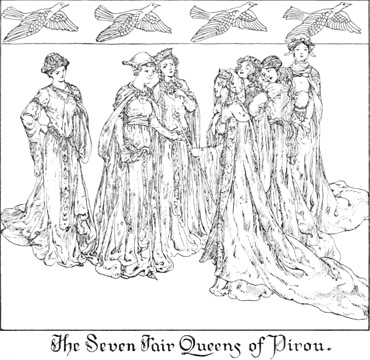
“Long, long ago,” she went on presently, “when our beautiful Normandy was known by another name, and formed part of the kingdom of Neustria, which was given to the Duke of Paris by Charles the Bald, there lived a wise and noble lord who was said to have magic powers. So gentle was he that the very birds would perch on his shoulder and twitter their joys to him, yet so brave and strong that the proudest knight cared not to provoke his wrath. He was skilled in the lore of plants and herbs, and by means of a slender hazel from the woods could tell where crystal waters flowed deep in the bowels of the earth. Full many a maid would have flown to him had he lifted his little finger, but though he was often lonely as he wandered beneath the stars, his heart went out to none, whether of high or low degree, and he preferred his own company to that of a mate whom he could not love.
One Mayday he was up at dawn, searching the fields for a tiny plant which had some special gift of healing. The grass was spangled with myriad flowers, but he passed them all till he came to the one he sought—a small pale blossom of faintest lilac, with perfume as sweet as a rose’s. While yet he held it in his hand he heard a cry; it was that of some creature in pain, and forcing his way through a prickly hedge, he found a pure white dove with a broken wing lying under a thornbush.
‘Poor bird!’ he exclaimed compassionately. ‘Who has dared to injure so fair a thing?’ With tender hands he set the broken wing, binding it to her side with three green leaves and some long-stemmed grass, and fed her with juice from the lilac flower as he soothed her with gentle words. When he had stilled her flutterings, he laid her on his breast, that he might bear her home and tend her until she could fly once more under the vault of heaven.
On he strode through the meadow, and high in the sky the larks trilled their pæans of joy. Never to him had seemed the earth so fair, and the morning sun tinged his cheek with gladness. Suddenly he felt the burden on his breast grow heavy, and stayed his footsteps in surprise. No longer did he hold a wounded dove against his bosom, but a beauteous maiden in pure white garb, with three green leaves bound about her arm with stems of grass.
He set her on her feet and stared at her in amaze; she met his enraptured gaze with eyes that shone like twin blue stars. Then her eyelids fell; she drooped beneath his glance as a fragile flower beneath the sun’s fierce wooing.
And as the wind sweeps over a field of corn when it is ripe for reaping, love took possession of him. Fée or woman, he swore, this beauteous maid should be his wife if she were willing, and he would guard her through good and ill while life should last.
‘Art thou mine?’ he asked her presently, hoarse for very joy.
‘I am thine!’ she said, for she had loved him long, and had but taken the form of a dove to try him. And taking her home to his castle, they were wedded by the holy priest.
No longer now was he lonely, no longer did he wander solitary beneath the stars, for the lovely Fée was as true and tender as mortal woman, and made him a faithful wife. Sons were denied them, but seven fair daughters came, and he called them after the seven gems that graced their mother’s diadem.
The maidens were of such supreme loveliness that as they grew up to womanhood they were known as the Seven Fair Queens; each was without rival in her own style of beauty. Pearl was fair as day, with a skin like milk; Ruby’s dark splendour was a gift from the Queen of Night, and her red, red mouth the bud of a perfect flower. The glorious hair of Amber fell round her shoulders in shimmering waves of light, and sunbeams lost themselves in her lashes. Sweet Turquoise had her mother’s eyes of blue forget-me-not, while Sapphire’s were of deeper hue, and Amethyst’s that of the violet. Chrysolite’s were a misty green, like the sky in the early morning, and no mermaid sang sweeter songs than she as she sat on the rocks at low tide.
There came a time when the father of the Seven Fair Queens fell very sick, and not all his potions could prolong his days. His call had come, and so closely were he and Norina united, that one eve at sunset her life went out with his. For awhile their orphaned daughters wept with grief as they paced the gardens, or sat by the crackling fire in the great hall. But youth cannot mourn for ever, and with a second spring, glad hopes came back to them, and once more they rode in the chase. Since they were rich as well as beautiful you may be sure they had many wooers, but all preferred to reign alone.
‘When we wed, it will be with Fées!’ they said disdainfully. This angered their lovers, and presently they were left in peace.
Full wisely did they use their parents’ wealth, improving the land and making sure provision for all dependant on their bounty. On the coast of the Cotentin they built the Castle of Pirou, which gave work to the poor for several succeeding years, and when it was finished they filled it with gorgeous tapestries and all the treasures of art they could collect. Here they lived in splendour, keeping open house; no passing wayfarer, however humble, need miss a welcome if he cared to claim it.
They were still in the first full bloom of their beauty when their fame reached the ears of one of the great sea pirates, the dreaded Vikings who rode the waves like giant birds of prey. North, South, East and West, from Norway and Sweden, and little Denmark, they sailed in search of plunder, and such was their love of fighting that they would, if need be, challenge each other rather than allow their swords to rust with disuse. Although they robbed, they were brave men, and believed themselves entitled to all they took. Their vessels were small, and light of draught, so they could penetrate many rivers, but the great chiefs chose the sea for their battle ground, and ravaged many a town and village on the coast of France.
When the mighty Siegmund heard of the Seven Fair Queens of Pirou, he resolved to storm their castle and take the loveliest for his bride. With this intent he set sail for the coast of Cotentin with a gallant fleet. The wind and the tide were with him; he reached it one soft spring morning when the sea was a sheet of blue.
As the vessel which bore him neared the shore, the Viking espied a bevy of maidens in a sheltered cove, where the sand lay in golden ripples. Ruby and Pearl, and the gentle Turquoise sported in a sun-kissed pool; while Sapphire and Amethyst wove wreaths of seaweed, and Amber was smoothing her shining hair with a slender shell of mother-of-pearl that the waves had thrown at her feet. Chrysolite sat on a dark rock, singing, and her soft clear notes rang over the waters, enchanting Siegmund with their music.
‘By Thor and Odin,’ he thundered, ‘our journey was well planned. Haste thee, my men, and get me to that rock! That maiden shall be my bride.’
The boat sped swiftly, with Siegmund sitting in the stern. His yellow locks streamed over his stalwart shoulders, and his face was like that of some eager god as he noted Chrysolite’s beauty. The maiden saw his approach; and now the glad notes of her exquisite song changed to a mournful rhythm. She was chanting the words that her mother had breathed to her seven daughters as she lay a’dying:
‘Women ye, my daughters fair (Cloudless spreads the sky); But when menace fills the air, Fées, as once was I. Slender arm shall change that day Into snow-white plume; Winged as birds, haste swift away From thy threatening doom!’
As the last words left her sorrowful lips, Chrysolite’s sisters gathered round her; the boat’s keel grated on the sand, and Siegmund sprang eagerly forward. At the same moment the Seven Fair Queens of Pirou raised their arms, and instantly these changed, before his eyes, to fluttering wings. High in the air mounted the maidens, and to the bewildered gaze of Siegmund they were nought but a line of snow-white birds flying westward in single file high up in the sky.
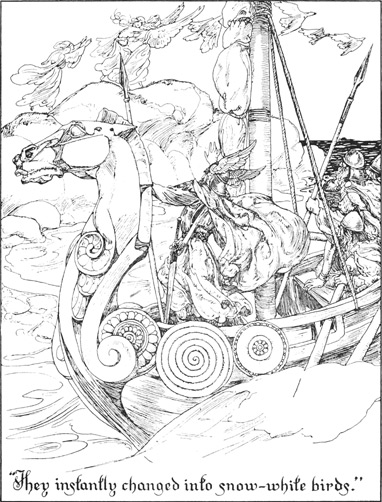
When Siegmund had somewhat recovered from his amazement, he and his followers sacked the castle, and pillaged the surrounding country; it did them but little good, for a storm blew up as they sailed back northward, and the ships that carried the stolen treasure were wrecked on the rocks. As for the Seven Fair Queens, they mated with Fées, and were glad as the morning. Every year as spring comes round, they return to Pirou with their numerous descendants, in the form of a flock of wild geese, and take possession of the nests which they have hollowed out in the crumbling walls. They also appear when a child is born to the house of Pirou; if it be a daughter, and Fate has destined her for a nun, one sits apart in a corner of the courtyard, and sighs as if in sore distress. If a son is born, the male birds display their plumage, and show by their mien that they rejoice.”
Méllisande rose from her throne of ferns, “It will be twilight soon,” she said, “and we must go. See! the mists are already rising in the valley, and the night-birds awake and call. Farewell, dear Christmas Child, farewell!”
And, stooping down, she kissed my forehead.
Now I knew that Germany was the very country for Dwarfs and Fairies, and when I heard that this was where we were going next I determined to be on the look out. I did not see them, though, for a long time after we arrived, for I was so tremendously interested in everything else. Even in the big cities where Father spent hours and hours in the hospitals, watching the wonderful things that the German doctors did, most of the children looked plump and rosy, and I didn’t see any so thin and pale as those we had left at home. One of the Herr Professors, with whom we stayed, said that this was because the State made so kind a Grandmother, but when I asked him what he meant, he only laughed.
I liked this professor best of all—he had such a nice way of talking, and he loved Fairies as much as I do. He said “Ach! So!” when I told him I was a Christmas Child, and smiled all over his kind old face. Then he put his hand on my shoulder, and told me that I must remember to do my part to make my birthday the gladdest day in the year for everyone around me.
“It is different in your country,” he went on, “but here, in the Fatherland, there is scarcely a cottage home which has not its Christmas tree, even if this is only a branch of fir stuck in a broken pot, and hung with oranges and golden balls. No child is so poor but has his Christmas presents of cakes and toys, for if his mother cannot provide them, she tells his teacher in good time, and the teacher sees that he is not forgotten.”
I thought this was a ripping plan, for it is horrid when Santa Claus forgets you, and your stockings hang all limp and flat, like mine did last year. And I made up my mind, then and there, that next Christmas there should be a tree for all the littlest and grubbiest children in my old home.
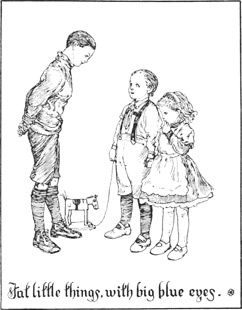
While Father was at the hospitals with the Herr Professor, I stayed with Rudolf and Gretchen, two of his grandchildren—fat little things with big blue eyes, who stared at me as if I had seven heads when I told them about the Korrigans. Gretchen believed in Fairies of all kinds, but Rudolf only in Dwarfs and Giants. He even said that Santa Claus was just his own father dressed up, and declared he had seen his old brown pipe peeping out of Santa Claus’ pocket the last time he paid them a visit. Gretchen said that if so, Santa Claus had taken away the old brown pipe to bring a lovely new one in its place, and Rudolf told her girls knew too much. They were both angry by this time, and their faces looked very red. So I thought we had better talk about Dwarfs and Giants.
“Grandfather says there are no Giants now,” Rudolph said seriously, “but there are plenty of Dwarfs in the hill which looks down on the forest. I saw one there myself last summer; he ran away and wouldn’t speak to me, as if he were afraid.”
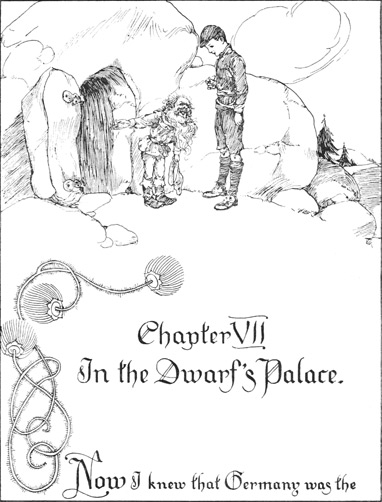
Without saying anything to Rudolf, who might have wanted to come too, I started for the hill directly after dinner, while he and Gretchen were arguing again over the pipe and Santa Claus. The Professor’s house was just at the end of the town, so I didn’t have far to go; but the hill took much longer to climb than I thought it would, and I was quite out of breath when I reached the top and sat down on a flat white stone. As I looked about me, I swung my foot, and it tapped against a biggish rock that was just in front. The third time that I did this, a little brown man hopped briskly out of a crevice and stood before me. He wore a bright red coat trimmed with green buttons, and carried in his hand a close-fitting cap of grey.
“Gently, gently, good child!” he cried. “One knock is enough, if we want to hear it, for our ears are as keen as we could wish. Why did you call me, and what would you have?”
“I would hear of you, and of your kinsmen, Master Dwarf!” I said. “I am a Christmas Child, and the Fairies are all my friends.”
At this he bowed, and said he was glad to meet me, nodding his head with a sort of grunt as I told him where I had met Titania.
“If it be your pleasure,” he said, looking round to see that no one was near but me, “I will take you within the hill, and introduce you to my wife. The ground whereon you stand is hollow, as you will soon perceive, and we are less than a stone’s throw from my palace.”
I told him that nothing would please me more than to pay him a visit, and muttering a word in some strange language, he rapped his knuckles on a cleft in the rock. It widened sufficiently to let us both through, and closed again with a thud.
The winding passage in which I found myself was lit by a soft red glow, coming from hundreds of rubies set deep in the walls, which seemed to be of oxidised silver. After several twists and turns, it ended in a wide hall, where I could just stand upright under the jewelled dome! As soon as my eyes grew accustomed to the blaze of light which came from the diamond stars set round it, I saw a sweet little creature in a frock of pale purple silk, cut short in the sleeves to show her pretty white arms, on which she wore many bracelets.
“My wife!” said the Dwarf proudly, and he explained to her who I was and what I wanted, and a great deal more about me that I was astonished he should know. My surprise amused him a good deal, and as his wife led the way to her boudoir he chuckled merrily.
“There are Kobolds, or House-Spirits in most old houses,” he remarked, “and it is more than two hundred years since the first stone was laid of the Herr Professor’s. I knew this noon that you were coming, and the Kobold spoke well of you, and said that you were not above taking advice from others wiser than yourself. Now, sir! What do you think of this?” And he opened a door with a great flourish, holding it back for me to enter.
“It’s grand!” I said, for so it was. The silver floor was inlaid with a gold scroll; the walls, of tinted mother-o’-pearl, were adorned with wreaths of forget-me-nots, each tiny turquoise flower having an amber centre. The furniture was of filigree silver, so fragile to look at that I was afraid to touch it, much less to sit down on one of the tiny chairs, even if I could have fitted myself in. The Dwarf invited me to be seated, and his small wife gave me a roguish smile as she brought a velvet cushion from an inner room, and placed this on the ground. I found afterwards that it was the Dwarfs own bed, and that his pillow was made of spun spider silk, filled with scented roseleaves and wild thyme.
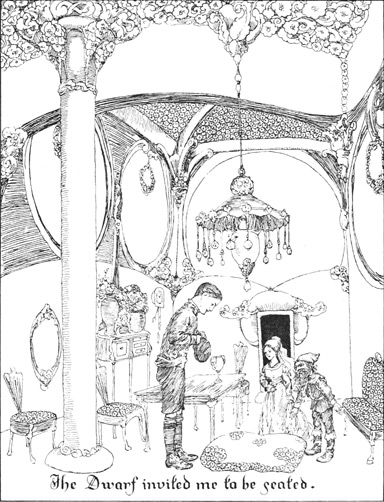
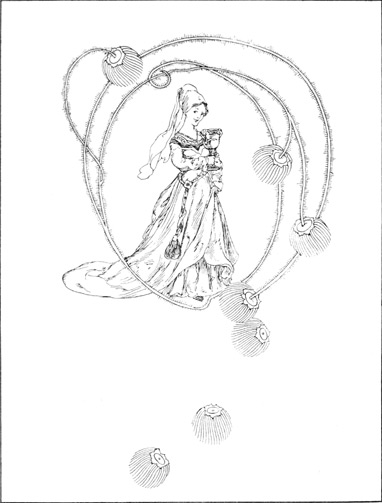
“When you are rested and refreshed,” said the Dwarf kindly, as his little spouse offered me a sip of nectar from a crystal goblet, “I will show you my palace. There is not much to see, for we are humble folk, and this hill comparatively a small one. The estates of some of our nobles extend for miles, and that of our Emperor runs through a range of mountains. In times gone by we welcomed mortals as our guests, for we were anxious to be their friends. But they grudged us even a handful of peas in return, and met our advances with jeers. Now we keep to our hills as far as possible, and when we desire to walk abroad, we are careful to wear our mist caps, which render us quite invisible.”
He sighed so deeply that the dainty lace cap poised on his wee wife’s hair was almost blown away, and then, straightening his bent shoulders, he took me to see his Banquet Hall. The curtains were all of filigree silver, fine as lace, and on the walls of the kitchen, where silent little men in big white aprons kneaded cakes on crystal slabs, shone ruby and sapphire butterflies.
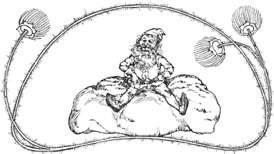
But this was nothing to what I saw in the long low vault where the Dwarf kept his treasures. At one end was a shimmering heap of pearls, some larger than pigeons’ eggs; at another, a conical mound of diamonds, which threw out marvellous lights as the Dwarf stirred them gently with one small hand.
“We know the properties of each stone,” he said; “how some give strength, and some wisdom and power to rule, while others still stir up strife and envy, and make men merciless as beasts of prey. That ruby you see has an evil history; a woman gave her soul for it, and thousands were slain in her cause.”
I picked up the beautiful, glowing gem, and fancied I saw the face of an evil demon grinning at me from its depths. Dropping it quickly, I looked instead at a pile of rings at the other side of the vault. One in particular drew my attention; it was of beaten gold, with a curious stone set deep in its centre. As I held it aloof and stared at it, I caught a glimpse of a waving meadow, with a tiny path leading past a brook.
“That is the ring which the Queen of Lombardy gave to her son, Otnit,” said the Dwarf. “Come with me to the Court of Rest, and you shall hear the story.”
This was the loveliest place which I had yet seen in the palace. A circle of orange trees in full bloom enclosed a space round a rippling fountain, where from the gleaming beak of an opal bird a stream of water splashed into an emerald basin. The invisible wind that stirred the petals of the orange blossom brought with it the swish of the sea, and somewhere, far off, a nightingale was singing.
The Dwarf seated himself on one of the velvet cushions strewn on the ground, and motioning me to take another, began his tale.
“Otnit, Emperor of Lombardy, was one of the greatest kings that ever lived. By force of wisdom more than by might, he subdued the surrounding nations, and his people looked up to him as to a god. When the time came for him to wed, no maid in his wide dominions pleased his fancy, for the wife he pictured in his dreams was sweet and simple, though of royal birth, and quite unspoiled by praise and flattery. He told his ministers this, and they shrugged their shoulders.
‘His Majesty desires the impossible!’ they whispered amongst themselves, and so it seemed until the Emperor’s Uncle Elias, the wild-bearded King of the Russians, told him of a highborn maid who was as good as she was beautiful, and had never yet been wooed by man.
‘She shines o’er other women as bright roses do!’ he cried, and Otnit vowed to win her.
On the eve of his departure for Syria, where she dwelt with her father the Soldan, Otnit’s mother gave him the ring you held, bidding him take his horse and ride toward Rome while gazing at the gem in the ring, that what he saw there might direct his path. The Emperor smiled, but wishing to humour her, did as she requested, and rode through the silver starlight thinking of his fair maid. At early dawn, when the welkin rang with the song of birds, he saw mirrored in the ring a narrow pathway trodden in the green grass. Making his way by this fragrant road, he reached a linden tree by a lake. Here he stayed his courser, and sprang to the ground, peering beneath its boughs.
‘Never yet from tree came so sweet-breathing a wind,’ he laughed; for lo! an infant lay on the grass, his fair white frock fringed with many gems. Otnit found it all he could do to lift him, in spite of his strength, but placing the little creature on the saddle, declared his intention of taking him to the palace, and putting him in his mother’s care.
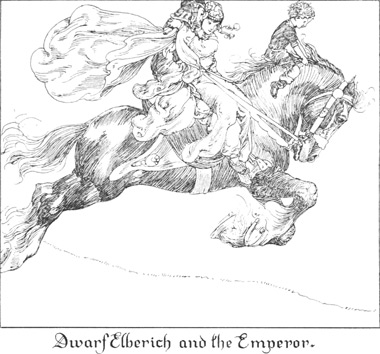
But this did not please Dwarf Elberich, who for his own purpose had taken the form of an innocent babe. He offered Otnit such splendid ransom of sword and shield to set him free, that the Emperor laid him down again, and even allowed him to hold the magic ring, by the wearing of which it had been possible for him to see what is usually hidden from mortal sight.
Now it was Elberich’s turn, and being once more invisible, he teased the Emperor to his heart’s content, dwelling on the anger of the Queen-Mother should she find that her gift was lost. Not until the Emperor was out of patience, and on the point of riding away did Elberich restore the ring to him.
‘And now, O Otnit,’ he said, ‘since I see you love well your mother, whom I loved long ere you saw the light, I will help you to gain your bride.’
And Otnit was glad, for he knew that the word of a Dwarf is ever as good as his bond.
In the spring of the year, ‘when all the birds were singing,’ the Emperor called his friends together and bade them embark their troops with his in the ships at anchor in the harbour. The waters of the bay gleamed as a field of gold as the stately vessels glided over them, and for long the carols of the birds on shore went with them on the breeze. Otnit’s hopes were high as he paced the deck, though he grieved that the Dwarf had not come to join him.
At length the fleet reached the Eastern coast of the Mediterranean, and there King Otnit beheld a haven full of ships, far more in number than his own. ‘I would that Elberich were here, for he is skilled in warfare,’ he murmured uneasily, for his men looked askance at the fleet before them. The words had barely left his lips when the sound of a laugh came from aloft, and straightway the Dwarf displayed himself. He had been in hiding amongst the rigging, and was now at hand to use his Fairy powers in Otnit’s service.
Elberich’s gift of a small round stone, which he bade him thrust into his cheek, conferred upon Otnit the gift of language, and enabled him to impersonate a rich merchant with so much success that his ship was allowed to drop anchor in the harbour. When dusk had fallen, and all was quiet, the Emperor disembarked, encamping with his troops among the rock-hewn burial places of the ancient Phœnicians, which abounded on that coast. Here he abode for three whole days, while Elberich sought the King of Syria, demanding his daughter’s hand in marriage for his royal master. It was refused point blank, and, more than this, the Soldan ordered his unwelcome visitor to be put to death. But the flashing blades of the guards cut the empty air, and Elberich jeered at them finely.
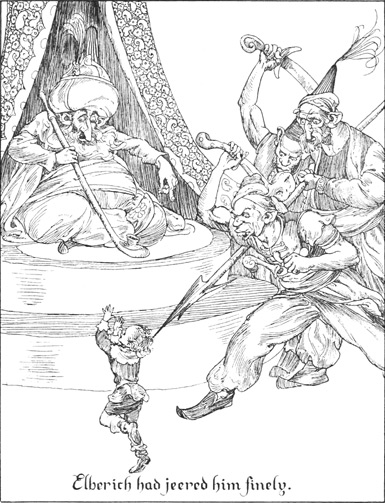
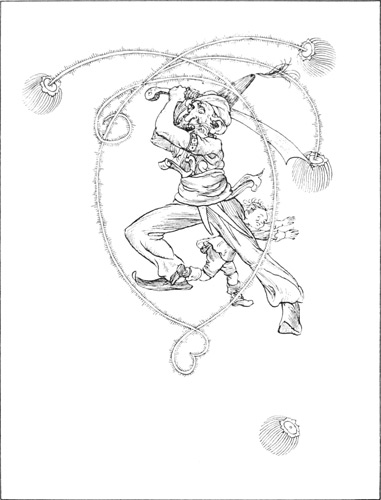
‘Your daughter shall go to my lord of her own free will,’ he cried to the Soldan, ‘and only so shall your skull be saved!’ He then returned to the Emperor, who bade his troops attack the city of Sidon.
A desperate battle with the heathen followed; for awhile the enemy’s numbers triumphed, but not for long. The Emperor’s charge swept all before him, and the Soldan’s soldiers fell like corn before the scythe. Then the Dwarf led the army to the Syrian capital; and red as had been the field of Sidon, it was as nothing to that of Muntabur, where men’s blood flowed as a crimson river.
While yet the battle was at its height, Elberich made his way, unseen, to an inner chamber of the Royal Palace, and though he had come to rate the Princess for her father’s obstinacy, words forsook him in her presence. So fair a maid he had never seen; her mouth ‘flamed like the rose,’ her flowing hair was the colour of rich red gold, and her lovely eyes had the radiance of the moon. Elberich drew her to the window, and by the aid of his power over space, showed her King Otnit in the thick of the fight. The sun fell full on his upturned face, as, seated on his white charger, he rallied his men for the final onslaught; he looked as brave a knight as the Princess had ever seen, and she lowered her glance as Elberich told her how she could save her father.
‘Death alone can wean King Otnit’s desire to wed you,’ he said. ‘His love for you passes the love of man, and is withal as tender as that of a woman for her child.’
Much more Elberich spake to her to the same purpose, and at close of day she allowed him to lead her where he would. Together they passed through a secret passage beneath the Palace, and so through the royal gardens, to a path which wound down to the field of battle.
Fighting had ceased for awhile, for the heathen had been sore smitten; and since his men had neither eaten nor slept for many long hours, the Emperor must needs let them rest until dawn. Full of impatience at the delay which kept him from storming the walls that held the lady of his love, he paced his tent, and turned to find her standing before him. Her mouth flamed red as the reddest rose; her eyes had the lustre of the harvest moon, and her red-gold hair framed a snowy brow that was white as the breast of a swan. Bending his knee, he touched with his lips the hem of her gown, and when the Princess gave him her exquisite hand, he could scarce breathe for rapture.
“‘She is yours, O Otnit!’ cried the Dwarf”
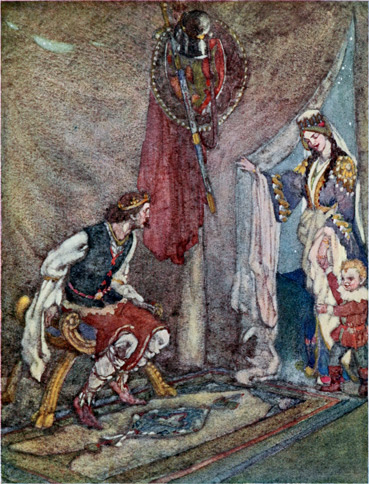
‘She is yours, O Otnit!’ cried the Dwarf; and the Emperor lifted her on to his charger, speaking to her with such tender and kindly words that her fears were stilled. With Elberich perched on the horse’s mane, they straightway rode to the coast, where the sails of the Emperor’s vessel swelled roundly in the wind. On the summer seas of the blue Mediterranean, they two were wed; and never had mortal man a sweeter wife, or maid a more gallant husband.”
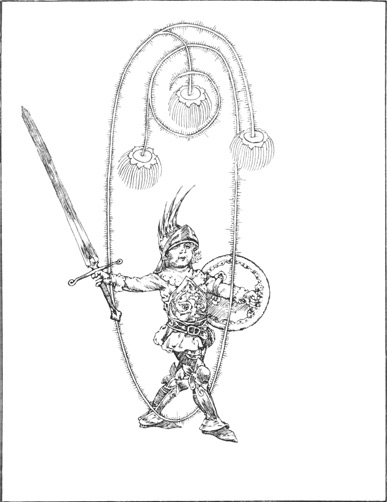
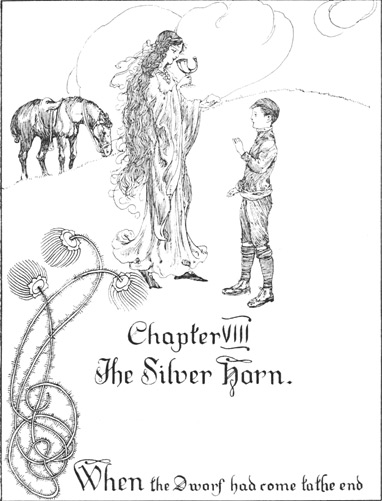
When the Dwarf had come to the end of his story, he very politely bade me goodbye, and bowed me out of his Castle. A week or two later we went to Saltzburg, and there I had a real adventure.
The Professor with whom we were staying hadn’t a single grandchild, and as all his books were old and dusty, to say nothing of being written in German, I should have found it rather dull if he had not lent me his nephew’s pony. I had learnt to ride as a little chap, when we lived in the country. It was lovely there, but no one was ever ill, and Father had so few patients that we could not stay.
The pony’s name was Heinrich. He knew his way everywhere, the Professor said, so Father didn’t mind my riding him alone, and I had a ripping time.
One day we went to the Wunderberg, a big hill on a wide bleak moor, which was supposed to be quite hollow, and the favourite haunt of Wild Women.
The ground was extremely bumpy, and several times I was almost thrown out of the saddle. At last I got off, for I thought I would rather walk.
It was a splendid morning, and I was glad that I wasn’t the Professor’s nephew, away at school, as I lay on my back and looked up at the sky.
A small black beetle crawled over my hand, but I was so comfortable that I scarcely stirred. It crossed my cuff and climbed a blade of grass; and as I watched it a shadow fell between me and the sunlight.
A slender woman in a white gown was standing close to me. Her face was thin, and very wistful, and over her shoulders, down to her very feet, fell a mantle of glistening yellow hair.
“Are you hungry, child?” she asked gently, holding out to me a slice of fine white bread.
“Not yet,” I answered, for we had had Sauerkraut for breakfast, and I felt that I should not want anything more to eat for a long time. She looked disappointed, and sighed as she threw the bread away. A bird flew down and pecked it, but after a taste or two he left it where it was.
“Then surely you are thirsty, and will drink from my horn?” she pleaded, showing me a silver vessel with curious scrolls and writings traced in gold, which had been hidden by her beautiful hair. I took a sip from its bevelled edge, and had scarcely swallowed the first drop when I felt myself sinking through the hill, the Wild Woman still beside me.
“At last! At last!” she cried, clapping her shadowy hands as we stood in a wide hall lit with amber light. “O sisters, rejoice with me! I have found a child, and his eyes, his eyes are crystal clear.”
She bent over me as she spoke, half smothering me with her silken tresses, and I was so afraid that those sisters of hers would hug me too, that I scrambled away and I took to my heels and ran.
But you couldn’t get far in that place. It was a miniature town, with silver streets and golden houses, and gorgeous palaces in between. Every turn I took led to a wide square filled with rose trees, where fountains of gold and silver water bubbled and sparkled in the mysterious pale green light. A flock of brilliant humming birds whirred their wings in my face so that I could not see where I was going, and the Wild Women formed a circle round me and began to sing:
“Only once did mortal child, By our silver horn beguiled, Find a way to leave us; Though they call us strange and wild, Thou shalt find us soft and mild. Stay, and do not grieve us.”
Their voices were very sweet, but when they had sung that verse twice over, I did not want to hear it again.
“I don’t mind staying with you for an hour or two,” I said, as they stopped singing, “but I shouldn’t care to live here. I am a Christmas Child, and there are other Fairy Folk I want to see.”
Then they looked at each other, and drew away.
“Since he is a Christmas Child,” said one, “we cannot keep him. You should have known better, Sister Snow-blossom, than to bring him here!”
“How could I tell,” wailed Snow-blossom. “He seemed like any other boy, and would just have fitted the green silk suit that I wove so long ago.”
“Alas, alas!” the others sighed. “The longer he stays, the more it will wring our hearts to part with him. Take him back to the hill at once, dear Snow-blossom, and bid him hasten home.”
But I didn’t want to go just yet, for now that they did not wish to hug me, I thought they were rather nice. Their faces were like pure marble, so still and pale, and their light green eyes were very gentle. So I asked if Snow-blossom might not show me round, as the Professors did Father when he came to a strange town. Her sisters still urged her to send me away at once, before she had time to grow fond of me, but she would not listen.
“What do you want with a mortal child?” I said, when I had been all over the empty golden houses, and had seen the tiny cathedral, the model of the one at Saltzburg, set with pearls and rubies, and many other precious stones of which I did not know the name.
“Because we are lonely,” she answered; “so lonely, child. Our only friends are the little people who guard our treasures in the centre of the earth, and we would fain have mortals to bear us company. Once, long ago, a goodly youth of noble birth was almost tempted to sip from our silver horn, and had he done so his home would have known him no more. Sweet Stella, the fairest Wild Woman who drew breath between the last faint pulse of the night time and the glowing dawn of day, waylaid him on the brow of the hill when he was heated in the chase, but although he craved the cooling draught she offered him, he would not drink from her hand; her exceeding beauty excited his suspicions, and he guessed that she was no mortal maid.
‘Let me see what your wine is like before I taste it!’ he said warily, taking the silver horn from her hands. He had no sooner grasped it, than he sprang to his horse and rode away. For many years the horn was kept amongst the treasures of the House of Oldenburg, to which he belonged, but at last, after many generations, it came back to us. No one but you and the little Karl has drunk from it since then.”
We were under the rose trees in the great square, and I had found a seat in a ruby and pearl pavillion, with queer golden faces staring down on me from each corner. Snow-blossom hid her face in her hands when I asked her who was Karl, and rocked herself to and fro; then she lifted her head and looked at me, and I saw that she was crying.
“I will tell you,” she said, “but first come close. For words have wings in the Wunderberg, and I would not have my sisters know I am grieving still.”
I sat down beside her, and then she began, speaking very softly and slowly, with deep sighs in between. The tears on her cheeks seemed to shine like pearls, and her hair gleamed more golden than ever.
“There was once a poor man named Henzel who should have been well content, for his girl-wife, Gretchen, was good and sweet, and the black bread he ate when his toil was over was pleasant to his taste. His bed was warm, and his sleep was sound. What could a man want more?
But Henzel was ever full of complainings. His neighbour, Johann, had married a rich woman, and now owned a well stocked farm with many herds. Each time that he met him, Henzel sighed.
‘I might have done better than he,’ he grumbled, even when he heard that Johann’s wife was a great scold, and did not allow her husband a moment’s peace. He looked askance at his gentle Gretchen, who bore with his rough moods tenderly, since once he had been her lover. But she grieved in secret, for never a good word had he for her now, and her flaxen hair lost its shimmer of satin, and her cheeks their dainty bloom.
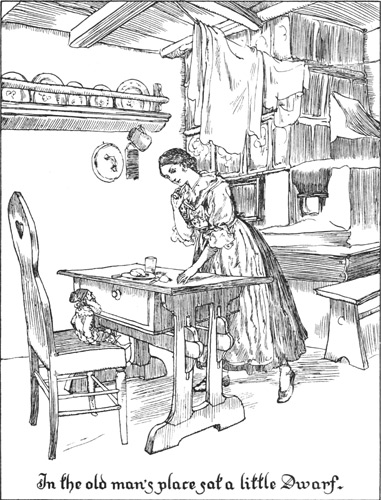
She was digging in the cottage garden, for Henzel would do no work at home, when a very old man toiled slowly up the hill. His clothes were dusty, and his staff was bent; he looked very weary, and his voice, as he bade her ‘Goodmorrow,’ was faint and low. Gretchen’s heart was filled with pity; she invited him to enter her tidy kitchen, and put before him the best she had. It was not much, but her strange guest thanked her gratefully. While he rested, she went to the forest, to cut him a strong oak sapling for a staff. The old man had vanished when she returned, and in his place sat a little Dwarf, not more than twelve inches high.
‘I perceive that you have a kind disposition, Gretchen, which is better than a rich dower,’ he said, waving his hand for her to be seated also. ‘You are already sufficiently blessed,’ he went on, ‘in being both virtuous and patient, but I am willing to grant you your dearest wish. Speak out, and tell me what you most desire.’
Gretchen bent her brows, and pondered deeply. If she asked the Dwarf for gold, Henzel would rejoice, but she had lived with him long enough to know that whatever he had, he would still want more. Should she ask for another husband, then, since the one she had, had ceased to love her, and threw her but scornful looks? Nay—that would be wrong, for whatever happened she was Henzel’s wife. And the flush on her girlish face became yet deeper, for a very sweet thought had fluttered across her mind. She would ask for a little child to lie on her breast, and bear her company through the long nights and days.
When the Dwarf heard her whispered request, he smiled on her very kindly.
‘You are a true woman,’ he said, and disappeared as Henzel crossed the threshold.
‘Who has been here?’ he asked, scowling at the empty cup and platter.
‘An old, old man, who was tired and hungry,’ Gretchen replied, and anxious to escape his further questioning, she turned to the newly-kindled fire, and put on a saucepan of broth for him. But Henzel was very curious, for strangers came that way but seldom, and before long he had drawn the whole story from Gretchen’s lips, with the exception of the Dwarf’s offer to grant her a wish.
‘Did he not speak of rewarding you for your hospitality?’ her husband persisted, guessing that something had been kept back from him. And Gretchen shyly told him for what she had asked.
Fierce was Henzel’s anger at her neglect of this opportunity to make him rich. He stormed and raved until poor Gretchen longed to hide, and when at last his rage had spent itself, he was sullen as winter clouds. She would have minded this more had it not been for the dear new hope that filled her bosom, and early in the spring a little son was born to her.
What cared she then for Henzel’s anger, so long as it did not touch her child? It was joy enough to feel the wee thing’s fingers straying over her face, to see his limbs grow round and dimpled, and to hear him laugh as she sang to him baby songs. Henzel went in and out, taking little notice of either of them; his thoughts were all absorbed in schemes for growing rich, for the love of money held him in its grip.
When little Karl was six years old his mother died. Instead of sorrowing for her, Henzel was glad, for now he could marry the elderly widow in the next town who was ready to exchange her wealth for a handsome husband.
So Henzel, too, had now a well-stocked farm, but this brought him small satisfaction. For his new wife was a greater scold even than Johann’s, and he dare not so much as cross the threshold without taking off his boots. As to Karl, he was sent to mind the cattle on the Kugelmill close by; the little lad was so ill-clad that his ragged tatters blew in the winter wind. He was hungry also, for his stepmother grudged him the simplest food, and but that he shared their berries with the birds, he must have starved.
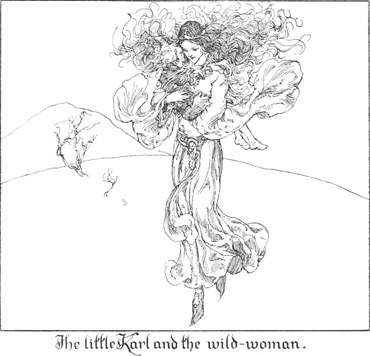
When the hawthorns were white with the snows of spring, and the daisies showed their golden centres on the grassy slopes, we heard him crying for his mother. Stella flew to his side, and gathered him in her arms. Her lovely hair covered his shivering limbs, and the desolate child clung close to her as she held the silver horn to his curved red lips. His soft embrace set her woman-love on fire, and veiling him in her golden tresses, she brought him here.
He was happy with us—as happy as the days were long. We wove for him garments of silken sheen, and taught him to call us by the sweet name of ‘Mother.’ … One day he begged us to let him play on the hill, so we took him thither, hiding close by, that we might guard him from harm. He was seen by some wood-cutters working near, and they took word to his father; but before he could fetch him, we had spirited him away. Karl never asked to play on the hill again, and all went well with us for many years, till he sprang into a gallant youth, with his mother’s eyes and a lordly will, unlike her yielding way.
And then? Ah me! His love for our beautiful Stella grew fierce and wild—the love of a mortal man for a maid. And since no Wild Woman may wed, one night he bore her away from our hill to the evening star, which is the sanctuary of lovers. Thence she sends glad dreams to motherless children, and to lonely women who pine for love.”
I did not stay much longer in the Wunderberg, for somehow the scented air seemed to have grown chilly. When I said to Snow-blossom that I must leave her, she wept again, and gave me a shining strand of hair to guide me back to the moor. It turned into gossamer when I reached the daylight, and floated softly away.
Heinrich was still munching at the short grass, and stared at me very hard when I caught his bridle. I suppose he thought I had been a long while gone.
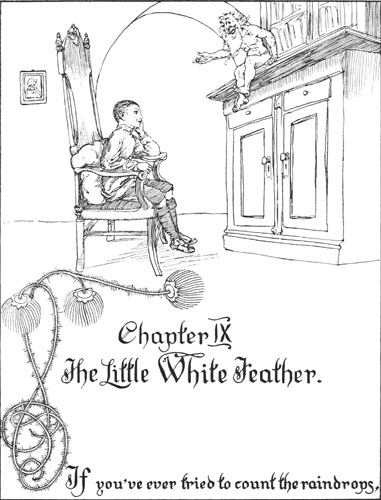
If you’ve ever tried to count the raindrops, you will know how I felt when for three whole days it poured in torrents. I was alone in the library, watching a hole in the wainscotting through which a mouse had just poked her head, when some one said “Guten Morgen” in a piping voice, and I knew this must be a Kobold. I was rather surprised that I had not met one of these House-Spirits before.
He was sitting on the edge of a bookcase—a little brown man with a wrinkled, good-natured face, and wearing no clothes. He chuckled when I said that I would rather speak English if he did not mind, and remarked that all languages were the same to him.
“I believe you have met some cousins of mine, the Brownies,” he went on affably, kissing his hand to the mouse, who popped back to her hole as if he had shocked her. “They are good little chaps, but quiet and humdrum. You always know what a Brownie will do, but as for us—mortals can never tell what a Kobold will be up to next. We make ourselves quite at home in their houses, and really own them, if the truth were known. But excuse me—I should not appear before you in this undress.”
In the twinkling of an eye the Kobold had changed himself into a curly haired boy, with smooth pink cheeks and a red silk coat, and knickerbockers of dark green velvet. “This is my best suit,” he explained proudly, turning himself from side to side. “I usually wear it when I play with children who were born, like yourself, at the blessed feast of Christmas-tide. It is only one of my many disguises, however, though I seldom allow myself to be seen at all. I can even hide in the cast-off coat of a harmless snake, and woe to him who lays stick upon me or seeks to drive me away. The Heinzelmänchen, as we are called, can be bitter foes as well as powerful friends, and ’twas an evil day for the city of Köln when we marched out of it. It has never prospered since.”
“Why——” I began, and the Kobold held up his hand to stop me, puckering his baby face into a dreadful frown.
“Why? Why? Why?” he mimicked. “How like the child of mortal man! Everything has to tell its reason—you rob the peach of its velvet bloom that you may find the secret of its ruddy splendour, and the fairy gems on the grass at dawn are to you but water distilled from earth! You would know how the tide finds a way to turn, why the light of the stars transcends your rush-lights! Elves and Fairies and such-like things are driven away by your curiosity, as the Heinzelmänchen were by Rosetta.”
I was going to ask who Rosetta might be, but I remembered just in time that this would be another question. The Kobold chose a more comfortable seat, and told me of his own accord.
“Toward the end of the eighteenth century,” he began, “the Heinzelmänchen, took up their abode in the city of Köln, where Johann Farina distilled the sweet-scented waters now famous all over the world. When first he blended the fragrant oils of bergamot, citron, orange and rosemary, it was we who whispered to him in what proportion he should mix them, and how to imprison their lasting perfume. Not only him did we help, but wherever we came across a worthy fellow who was poor but honest, we gave him a lift up; such was Rudolph the tailor, whom we found when a lad on the steps of the great Cathedral, without a pfennig in his pocket, and with a wolf inside him big enough to swallow a little pig. When we saw how readily he returned a thaler that rolled to his feet to the feeble old woman who had dropped it, though he might well have said he had not seen it fall, we took him to our hearts, and swore to befriend him.
‘So!’ we said, one to the other. ‘Rudolph is worthy to be our comrade. He is a good lad, and henceforth we will see that he does not want.’
The first thing to be done was to procure him decent clothing, for no one would employ him while he went in rags. We did this by pointing him out to the wife of a rich merchant, who fancied she saw in his pinched white face a likeness to the son she had lost long since.
Touched by the poor lad’s poverty, she gave him a suit of clothes which had lain by for many a day, and on finding he was an orphan, apprenticed him to a tailor. The lad worked well. We took it in turns to sit beside him, showing him just where to place his needle, so that his seams were always neat, and guiding his scissors so that he cut the cloth to the best advantage. So skilful did he become that, when his time was out, his master begged him to stay on with him as head assistant, and gave him a good wage.
A fine young spright was Rudolph now, with jet-black hair and eyes like coals. His master’s daughters, Euralie and Rosetta, both looked on him with favour, and for a time it seemed that he knew not which to choose. Euralie was small and slight, with eyes like a dove’s; Rosetta was tall and buxom, and had she been free from the vice of curiosity would have made him a model wife. She was clever and industrious as well as witty, and when Dark Rudolph passed by the gentle Euralie, and took Rosetta for his betrothed, it was only the Heinzelmänchen who shook their heads.
Never was grander wedding feast than his. While he and Rosetta where still in church, we brought to his house the finest drinking vessels that we could lay our hands on, and pots and pans of beaten copper that were the envy of every housewife bidden as a guest. There were fairy cakes in the silver dishes, and luscious fruits such as grew in no western lands; the wine in the ruby goblets was honeyed nectar, and though his friends quaffed deeply, their heads remained quite clear. A proud man was Rudolph as he drank to his bride, and she looked so happy and gay and bright, that we resolved to take her, too, under our protection.
And this we did. When her children came, we rocked the cradle and sang them lullabies while she baked and brewed, and when they slept we scrubbed and polished from garret to cellar, until her house was the pride of the street. Often she would ask to be allowed to see us, but we always refused, telling her to respect our wish, and be content. Still she would not rest, and nothing that Dark Rudolph could say to her would induce her to hold her peace.
He had now three shops instead of one, and counted lords and barons among his customers. No one could fit as he could, for we were always at hand to nip in here or let out there, and many a fine straight figure was the result of our cunning skill. His fame spread far through the neighbouring towns, and one spring a great noble travelled to Köln to order some rich apparel for himself and his suite. Our busy tailor was at his wit’s end how to get it finished in time, for all his assistants were working their hardest, and still they were behind.
‘Have no fear! Dark Rudolph,’ we cried, when we found him alone. ‘Send your men to rest, and leave it to us. When you wake in the morning you shall find all done.’
We lost not a moment that livelong night—it was as if our needles had wings. Just before cockcrow, the door of the workroom creaked softly open, and there stood Rosetta in her white nightgown, with her hair in two long plaits, peering round the corner to see if she could catch us at work. We were justly enraged, but since we heard her in time to render ourselves invisible, and also because we loved Dark Rudolph, we decided to give her one more chance.
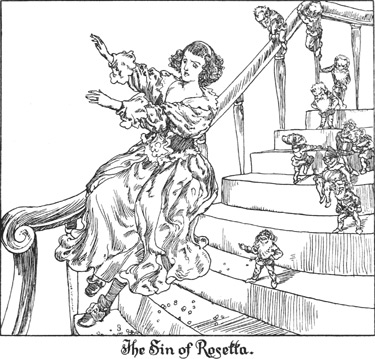
It was our custom to leave the lower part of the house at the hour of midnight, no matter what we might be doing, and climb the steep stairs that led to the bedrooms, to watch that the ghosts which were free to roam till cockcrow might not ruffle the children’s hair, or wake them with their long-drawn sighs. Rosetta knew this, for she had often heard us comforting the little Rudolph when his sleep was disturbed by a bad dream, and with gross ingratitude she tried to be-fool us. One night, she strewed dried peas on the top steps of the winding staircase, so that when we came up we should lose our footing and fall to the bottom, and thus she might see us struggling on the ground. We knew perfectly well, however, why she had bought the peas, and stayed below. When she rose next morning, she forgot the trap she had laid for us, and tumbled headlong down the stairs. While she groaned and moaned over her broken ankle, the Heinzelmänchen marched out of the town to stirring music, which was heard by all the citizens. We sailed down the Rhine in a phantom boat, which you may yet see floating on its waters if you look for it at the right time. And Dark Rudolph and his Rosetta sighed for our help in vain.”
The Kobold was a most entertaining little fellow, and stayed with me all the morning, telling me of well known House Spirits of days gone by. One of these tales was about
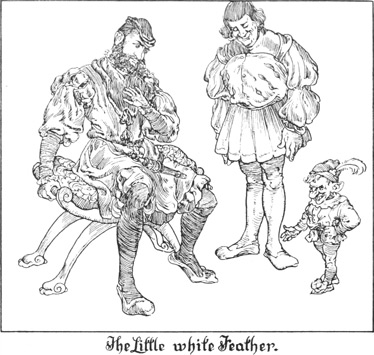
“Hinzelmann,” said the Kobold solemnly, “was a Spirit who haunted the castle of Hudemühlen, though it was not until late in the sixteenth century that those who lived there were aware of his presence. He seemed of so friendly a disposition that the servants became quite used to him. They never saw him, but he would often talk with them while they worked, telling them of what went on in the Underworld, and of the mighty Giants of bye-gone days who had been created in order to protect the Dwarfs from savage beasts, but had become themselves so savage in the course of the ages that they had to be done away with. In time the lord of the castle heard of his strange visitor, and sent him a message saying he desired his presence at a certain hour.
‘No need to wait until then, good Sir!’ laughed Hinzelmann over his shoulder. ‘I assist each morning at your lordship’s toilet, though you do not perceive me, and I blunt your razors when you are out of temper.’
This displeased the lord of the castle, for he thought it unseemly to be on terms of such familiar intimacy with a bodiless House-Spirit. When he rebuked him for his presumption, Hinzelmann laughed more loudly still. ‘Better men than you have to put up with my company, if I will!’ he cried, ‘and, believe me, I do not intend to leave you!’
The nobleman grew more and more uneasy, for it disturbed him to feel that he was never alone. Hinzelmann whistled and sang through the State rooms, and when his lordship expressed irritation this was the House-Spirit’s favourite song:
‘If thou here wilt let me stay, Good luck shalt thou have alway. But if hence thou dost me chase, Luck will ne’er come near the place.’[1]
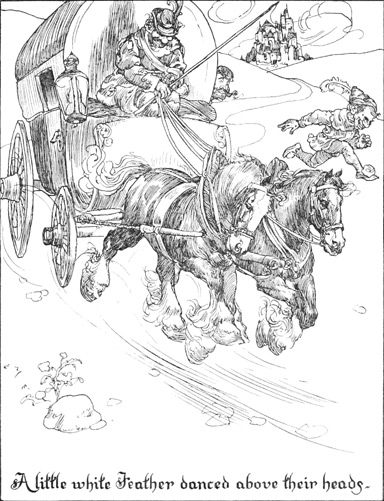
He hummed this morning, noon, and night, until the lord of the castle was sick of it. ‘Since I cannot drive this fellow away,’ he said at last, ‘I must e’en go myself;’ and telling no one of his intentions, he summoned his coach and set out for Hanover. On the way he noticed that no matter how fast his horses went, a little white feather danced above their heads. Although he wondered at this, he did not connect it with the House-Spirit, and when he arrived at his chosen Inn, sought his couch with a mind at ease.
‘Thank heaven,’ he muttered, as he turned him over and went to sleep, ‘I am free at last of this troublesome Hinzelmann. By the time I see fit to return home, he may have gone elsewhere.’
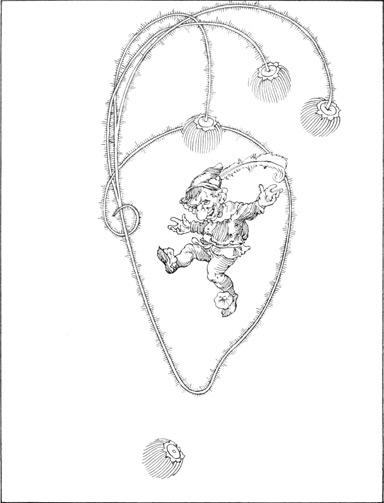
Next morning he missed his fine gold chain, which was an heirloom, and, greatly distressed, he haughtily demanded of the Innkeeper that his servants should be searched.
‘They have robbed me,’ he cried, ‘and they shall suffer for it! Cannot one sleep at your house without meeting with knaves and thieves?’
At this the Innkeeper was very angry. Instead of condoling with the nobleman on his loss, and offering to make it good, he roundly rebuked him for taking away the character of honest men without due proof. The noble was leaving the Inn in much haste when a soft voice asked him why he was troubled.
‘If it be on account of the bauble upon which you set such store,’ it continued, ‘look under your pillow and you will find it. You cannot get on without Hinzelmann after all!’
‘I would I had never known you, base spirit!’ stormed the nobleman. ‘You have put me greatly in the wrong with all these men, and my journey has been for nought, since you are here. If you do not quit me I will leave this country; it is not wide enough to hold us both.’
Then Hinzelmann spoke to him with much reason, pointing out that he wished him no harm, and that it was impossible to shake him off, since wherever the lord went, he could follow.
‘It was I who flew as a little white feather in front of your coach,’ he concluded. ‘You played the part of a poltroon when you fled from what you believed to be evil, instead of fighting it on your own ground. Come back with me, and if you give me your friendship, I will work but good to you and yours.’
So the nobleman went back to his castle, and Hinzelmann lived there with him. A little room was set aside for his use in an upper story, and here they placed, by the nobleman’s orders, a small round table, and a tiny bed. No one could ever make out if he slept on this, but once when the cook entered very quickly, to take him the dish of new milk and wheaten crumbs which was placed each morn on his table, she saw a shallow depression on the down pillow, as if something very small and soft had rested there.
When the time came for Hinzelmann to leave the castle, he presented its lord with three fairy gifts, the last of these being a leather glove richly wrought with pearls in a curious pattern of snails and scrolls. So long as this glove was in possession of his house, he told him, so long would his race flourish. And thus he requited the kindness which had been shown him. There is nothing that we like better than to help our friends.”
“I know,” I said, nodding my head. And the House Spirit smiled as if this pleased him.
“We need take no credit for this,” he remarked, “since the Dwarf King himself sets us the example. His rescue of the poor old couple at Schillingsdorf is but one of many instances of the way in which he gladly helps those who show hospitality to him or his.
Caught in a storm, he wandered from door to door, entreating each person who answered his knock to let him enter and warm himself. One and all they refused, for his green velvet garments were stained and draggled, and they had not the wit to see that in spite of his dripping clothes and dishevelled beard he was still every whit a king. At last he came to the hut of an ancient shepherd, whose little old wife was as thin as he, for food had been very scarce. The moment she saw the wanderer, her heart went out to him.
‘Come in and welcome, you poor little fellow!’ she said, setting wide her door. ‘Our fire is not much to boast of, but ’tis better than none on a night like this.’ And the shepherd hobbled to the inner room that he might bring his Sunday coat, and place this round their visitor’s shoulders while his own lay drying on the hearth. Then the old woman spread a white cloth on the table, and gave the Dwarf her share of the coarse black bread which was all her cupboard contained.
‘I thank you, my friends,’ he said, breaking the bread into two fragments. As he did so, one became a fine white loaf, and the other a noble cheese. The Dwarf laughed at the old couple’s amazement, and bade them feast to their heart’s content.
‘So long as you leave on the platter a crust of bread and an inch of cheese,’ he said, ‘so long will a fresh loaf and a fresh cheese spring from these fragments during the night; but if ever a beggar entreats your help, and you refuse him, they will turn to dust and ashes. Now I bid you farewell, but ere long we shall meet again.’
So saying, he went out in the rain, despite their entreaties that he would at least stay with them until the storm was over.
Little sleep did they have that night, for wind and rain swept through the valley. Torrents roared down the mountain side, flooding the wooden houses, and even worse befell at daybreak. An enormous rock snapped off from a topmost peak, and carrying with it great masses of stones and uprooted firs, crashed down on the little village. All living things were buried beneath its weight except the shepherd and his wife, whose cottage yet was spared. Tremblingly they stood on the threshold, for they thought their last hour had come.
‘Thou hast been a good wife, my dear one,’ breathed the shepherd, as he drew her frail form close to him.
‘It is well that we should go together, since thou hast lain by my side for nigh sixty years,’ she whispered, hiding her face against his breast.
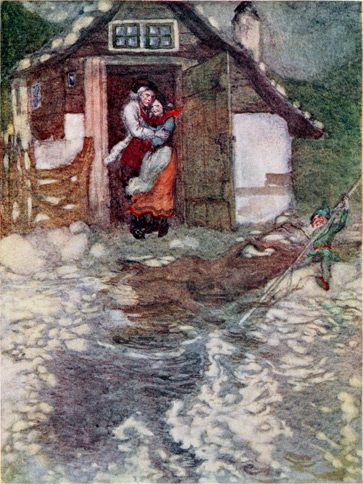
‘How now?’ cried a reassuring voice. ‘Dost despair so easily?’ And looking up they saw their friend the Dwarf riding on a rough raft in the centre of the stream, and steering before him the trunk of an immense pine. This he proceeded to fix crosswise in front of their little garden, so as to form a dam. The torrent now passed by the cottage, leaving it undisturbed, and the voice of the wind was hushed. The sun came out, and the birds sang; but the only people alive in Schillingsdorf were the shepherd and his old wife.”
“‘How now?’ cried a reassuring voice.”
The forest paths were dappled with sunlight as Father and I strolled down its winding glades, and all the wood things were chirping and chattering with joy. Now and then something brown and furry scuttled across our path, and once I all but trod on a tiny mouse, who had hidden herself under last year’s leaves.
“You clumsy boy!” said a tiny voice, and I turned in time to catch sight of a wee pink Elf as she sprang from the flower Father wore in his button hole upon a bright blue butterfly which had been hovering above her for some time, and now darted swiftly away.
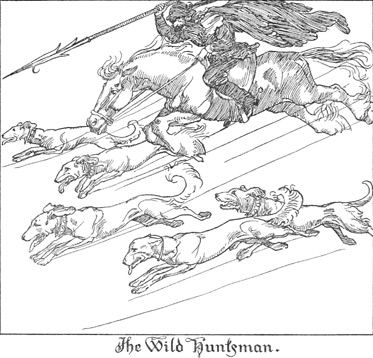
After a while we came to an open space where the woodmen had been felling timber. Several great trees still lay on the ground; one was particularly straight and round, and I noticed three wide crosses cut deep into the bark. I thought I would like to carve my name there too, for my knife had been most beautifully sharp since the Nain Rouge touched it, so when Father sat down soon afterward to read his letters, I went straight back to the spot. As I reached it I heard the distant baying of hounds; the sound came nearer and nearer, and mingling with it were shouts in a strange deep voice, which almost frightened me. As I looked up, my knife was jerked out of my hand by a little woman dressed in green, who pushed me breathlessly aside and sat down, sobbing bitterly, on the middle cross. I was still staring at her when there flashed through the air a huntsman on a fiery horse, followed by many hounds. Their hurrying feet knocked off my cap and rumpled all my hair. They had passed in a second, and next moment I heard their baying far away.
The little woman in green sobbed still, but she seemed to be growing calmer. Her hair and eyes were a soft light grey, and her frock was most prettily trimmed with tufts of moss.
“Aha!” I thought when I noticed this, “you are one of the Moss-women, I’ve no doubt.” For I knew that these were supposed to haunt the forests of Southern Germany.
“That was the Wild Huntsman,” said the little thing, looking at me trustfully. “But for the kindness of the woodcutters who make these marks in the trees they fell, I should have fallen to his bow and spear. When we can find three crosses we are safe, for he dare not touch us then.”
I waited to hear what else she would say, for I thought of the Kobold’s “Why? Why? Why?” and did not like to ask her questions. In a little while her lips were smiling, and swaying to and fro, as a tree sways in the wind, she began to sing. I knew I had heard that song before, but I could not think where until I remembered that the pines which rustled against the windows of my night nursery had often sung it when I was small.
“It’s the song of the wind,” she told me, “and the very first sound we hear. We are born in the roots of the tree which is to be our home, and when this dies, we must die too. So long as the sap runs through its branches, and the bark is not cut or injured, we are safe and sound in our snug recess, but at certain times we are bound to leave it, to seek for food, or to attend our lords. It is then that we are in such grave danger—and all because Elfrida tried her witcheries on a stranger.”
“What did she do?” I could not help asking.
“I will tell you,” said the Moss-woman sadly, “and then you will understand why even the youngest of us has now grey hair.”
“Elfrida was the fairest of our race,” she sighed, “and her palace the tallest and straightest pine that ever raised its boughs to Heaven. When she left its shelter at early dawn to bathe in some sparkling stream, or seek for sweet berries in the thickets, the Flower-Elves flocked to greet her; wild roses gave her their bloom for her oval cheeks, and the violets scented her sunny hair. Wherever she passed, the moss grew a brighter green, and she had but to breathe on a gnarled old trunk, and the softest feathery fronds came to hide its ugliness. The creatures of the forest were all her friends, and took pride, as we did, in her loveliness.
‘Have a care, Elfrida—a stranger comes!’ cried a squirrel one summer morning, staying his dancing feet to warn her. His up-cocked ears had caught the thud of some well-shod charger’s swift approach, and he guessed he would not be riderless.
‘Go back to thy palace, dear child!’ cooed a motherly pigeon who had reared many broods of snowy fledglings, and misdoubted the sparkle in Elfrida’s pale green eyes.
‘Haste thee home, Elfrida!’ cried the stream as it gurgled over the stones; ‘haste thee home, and hide thy face from the sunlight.’ But Elfrida pretended not to hear as she shook out the crystal drops from her gorgeous hair.
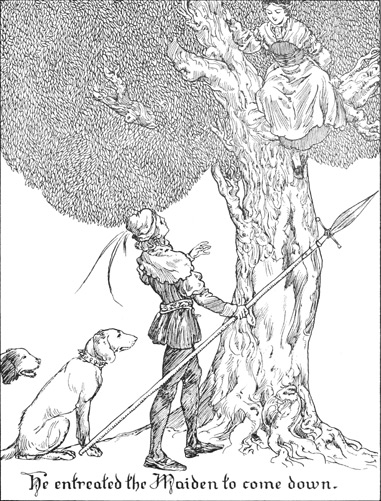
The horse and his rider were close to her now; the huntsman blew his golden horn, and in the excitement of the chase might have passed her by, unseeing, but for his hounds. In a moment they had surrounded her, baying like hungry wolves, and Elfrida sprang to a branch that overhung the water, where her white limbs gleamed against its green. The huntsman sent the dogs to heel, and dismounting from his horse, entreated the maiden to come down to him. Nothing loth, Elfrida coyly descended, and the huntsman was amazed anew at her perfect form. He sat at her feet through the hush of noonday, and at even he was there still. When the moon turned the glades to silver, Elfrida left him, but she promised to meet him again next day, and he could not sleep for thinking of her.
But although she smiled on him sweetly as she lay on the banks of the stream, and listened with languid pleasure to his fond fierce wooing, which passed for her many an idle hour, she would not consent to be his wife.
‘I like best the gems that I find on the lilies at daybreak,’ she said, when he vowed that the richest jewels that the earth could give should deck her fair white arms. ‘You must offer me something rarer than these if I am to forsake my kindred to go with you.’
Then the huntsman swore that he would give her all he had; only his honour would he hold back, for he was sick with love and longing.
Now behind Elfrida’s loveliness dwelt a spirit of malice and wanton cruelty, and though she loved not this wild Huntsman, and had no intention of being his bride, she wished to see how far her power over him could go. So she asked of him these three things: the crest of his House cut in the stone over his castle gates, where it had stood for centuries; the leaf from his dead mother’s Bible, whereon she had written the date of her marriage day, with the names of the children born to her; and his father’s sword.
‘Nay, Sweetheart!’ cried the Huntsman. ‘Ask me for aught else in the world, but not for these things, since they touch my honour!’
‘These will I have, and nothing less,’ said Elfrida wilfully, looking at him through her long gold lashes until his soul went out from him. His face was white as milk as he rode away, and the creatures of the forest cringed with shame. For they knew she had asked what was unseemly; and they ceased to attend her when she went to the stream at dawn.
When the moon was at her full the Huntsman returned with the three gifts, and now he thought to take Elfrida in his arms. But she thrust him from her with bitter words, tearing the leaf from the sacred Book into a thousand shreds, and tossing the crest and sword into the running stream.
‘What!’ she cried, and her scornful laugh rang through the woodland, ‘shall I, Elfrida, be the sport of a man who holds the honour of his house as something less than a maiden’s whim? I will have none of you—get you gone!’ And she flung out her arms to the strong North Wind, who caught her to him and bore her off. But not to her high pine palace did he take her, for he was angry because of her cruelty; and far away at the grim North Pole, she shivers yet under the thickest ice. Her green eyes shine through the frost-bound floes, and light the depths of the Northern seas.”
“And the Huntsman?” I questioned.
“He died in his rage, where Elfrida left him!” said the Moss-woman mournfully, “and his spirit seeks still to avenge his wrongs. To the last of our race it will pursue us, until none of our kindred lives.”
“Chris! Chris! where are you?”
It was Father’s voice, and the Moss-woman vanished. Father wanted to read me a funny letter from the Locust, who complained a lot of being called up at night by patients who had no money, and wouldn’t have paid him even if they had. This was the way they often treated Father, but he said “Poor beggars!” and then forgot it, while the Locust was very cross.
Next day I went back to the forest, hoping to find the Moss-woman again, but she was not there. I found instead an Elf who was almost too small to be seen. She told me that she and her sisters lived in the cells which make leaves so green, and mixed things they drew in from the air and sunlight with the water that came through the roots, turning these into sugar to feed the tree. It sounded like magic, and I was so much interested that I almost forgot to ask about the Moss-women.
“Poor little things!” said the Leaf-Elf kindly, when I said I had seen one. “It is well that the woodcutters are their friends, or they would fare badly. Many a meal did they have from them in past times, and even Hans the Unlucky never grudged them what he gave. They paid him back for it, never fear, for they do not forget a kindness.”
“Who was he?” I asked. And this is what she told me.
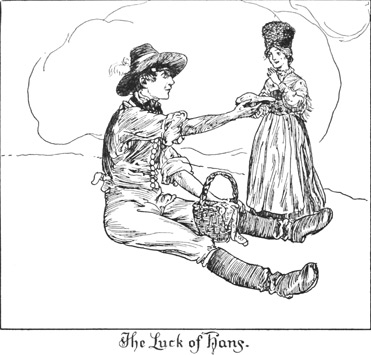
“Of all the unlucky mortals, Hans was surely the most to be pitied, for though he was honest and frugal, nothing he touched seemed to prosper. The farm had done well in his father’s lifetime, but after he died there was not one good season for three bad ones. Far from being idle, Hans was up before dawn, and still hard at work at sundown. His mother sent away her maids, since she could not pay them their wages, and kept the house straight herself; where could you find a worthier pair? But Hans’ affairs went from bad to worse, and when (at the busiest time of the year) his mother lost her sight and became quite blind it was clear he was born to be unlucky.
The farm went to rack and ruin, and there came a time when Hans was forced to go off to the forest to fell a tree that his poor old mother might have fuel to warm her. When the sun was high, he drew out his lunch, and a poor little Moss-woman stole out from the undergrowth to beg a few crumbs for her hungry children.
‘Take it all!’ he cried, thrusting his bread into her tiny hands. ‘It is waste of good food for a man to eat who is as unlucky as I.’
‘I cannot repay you in kind, friend Hans,’ said the Moss-woman, ‘but I will give you some good advice. In the house by the mill lives a sweet young girl, with a face tinged with pink like a daisy’s. She has loved you long, for you are her mate. Take her to wife, and your luck will turn.’
Hans flushed deep crimson beneath his tan, and the veins on his forehead grew tense and hard.
‘You—you—’ he stammered; ‘you must mean Elsa? And Elsa, you say, Elsa cares for me? It can’t—it can’t—be true.’
‘A woman’s heart goes where it will,’ answered the Moss-woman. ‘Try your luck, friend Hans, and lose no time. Life is short, and the days are flying.’
Hans went at once to the house by the mill, for had he not gazed at it time and again as the casket which held his treasure?
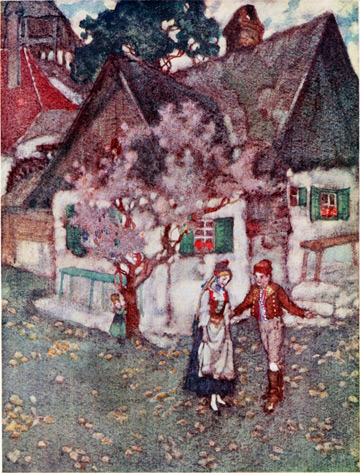
When Elsa saw him coming with that look upon his face, she twisted a ribbon, blue as her eyes, in the pale gold plait that crowned her head, and went shyly down to meet him.
“Went shyly down to meet him”
Hans said not a word, but he found a way to make her understand, and his eyes spoke, though his lips were dumb.
They were betrothed and married within the month, and little cared sweet Elsa that her friends marvelled at her choice. She comforted the sad blind dame, whose son was now her husband, as a happy woman comforts one who fears she has lost all, and behold! the old woman smiled again. As to Hans, the neighbours scarcely recognised him when they met him in the markets; she trimmed his beard, did Elsa, with her own hands, and mothered him as if he were a child of seven. His fields grew green, and then golden with harvest; his scanty flocks increased and multiplied.
‘Hans’ luck has changed!’ the neighbours said, and they scoffed at him no more.
But good luck itself does not last for ever, and after three years of plenty came a bad one for all in those parts. There was a long and unusual drought, followed by so much rain that the roots rotted in the ground, and sickness spread amongst sheep and oxen. Hans lost all that he had re-gained, and to add to his misfortunes, he chopped his hand instead of a log of wood, and could do no work for weeks. He was in despair, and the old blind woman beside his hearth wept and wailed from morn till eve.
‘I would I were dead,’ she moaned. ‘I am a useless burden, for I cannot even knit. My store of wool is exhausted, and we have no money to buy more.’
‘Dear Mother,’ said Elsa tenderly, ‘who has a greater right than you to the last penny that Hans possesses? You carried him on your breast when he was small and helpless, and have loved him faithfully all these years!’
But the mother turned her face to the wall and wrung her idle hands.
Then Elsa sold the ring that had been her lover’s gift in order to buy for her soft white bread and warming cordials, and wool wherewith to ply her needles. As she returned home with her basket, grieving to think of the pain of those she loved, a Moss-woman accosted her in the forest.
‘I have nought for my children to eat,’ she said. And Elsa, pitying her the more that she herself was hungry, gave her a share of what she had, even to a skein of the wool, that she might weave a coat for her crying babe.
‘Wait for me here!’ cried the Moss-woman earnestly, and Elsa leaned sadly against a tree, too weary to be surprised. In a moment or two the Moss-woman returned, carrying a grey ball of wool and some chips of wood.
‘Give the wool to the old crone who weeps by your hearth,’ said the little thing, ‘and the chips to Hans. He is lucky in his wife, if in nought else!’
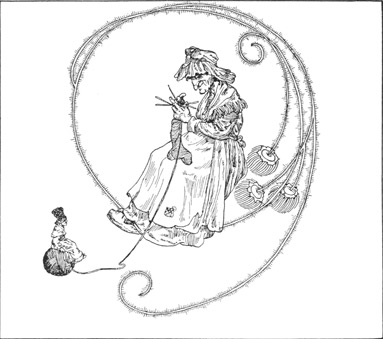
So saying, she disappeared, and Elsa went quickly home. Thinking to win a laugh from her husband, she opened her apron to show him the Moss-woman’s gifts, and, to her amazement, found that the chips had turned to yellow gold, and the little grey ball of wool into a large one of fleecy whiteness, so soft and thick that it felt like velvet! The golden chips stocked the farm again, for they were of pure metal, and weighty, and the ball of white wool was never exhausted during the old woman’s life time. She knitted away until her hundredth year, and when, long afterward, the summons came also for Hans and Elsa, in their turn, their children had good cause to bless the name of the Moss-woman.”
It was to Italy we travelled next, to stay with the Signor, who had lived in England once, and was a patient of Father’s.
It was fearfully hot when we arrived, and most English people had gone away; but Father and I could bear a lot of sunshine, and we did not go out in the middle of the day.
In the early mornings I went off to explore while Father was still asleep. Sometimes I made for the hills, but often I chose the city, for I liked to wander through the streets and make friends with the chattering children. They were jolly little beggars, with bare brown feet and thick dark hair that fell over their faces. My favourites were Giovanni and Mariannina; their mother worked for a grand Contessa who lived not far from the Signor. Giovanni was thin as a reed, but Mariannina, whose curly head did not reach her brother’s shoulders, was as plump as a partridge, and her cheeks were red instead of brown. Adelina, the Signor’s housekeeper, told me their names, and that Mariannina was the pride and torment of Giovanni’s life.
“He adores her,” she said, “but she is surely bewitched. She runs from him like a squirrel, and is an imp for mischief. Ah, the poor Giovanni—he has his hands full!”
After this I often met them, and if Mariannina were in a good humour she would smile at me through her lashes, while if she were cross she would frown like a Witch, and even shake her tiny fist. At this, Giovanni would look quite shocked, and would beg me in broken English not to be hurt at ‘la sorellina’s’ unkindness.
“She so ver’ small!” he pleaded wistfully, and this was always his excuse for her.
One day she took it into her head to run away from him, and darted into the middle of the road, almost under the heels of some prancing horses. I happened to be close by, and seized her red skirt just in time to drag her back. Panting with terror, Giovanni took her from me, and when he found she was not hurt, for the first time in his life he shook her. And then he tried to kiss my hands; I almost wished I had left Mariannina to be run over. Before I could get away from him, he had thrust upon me the small gilt cage he always carried about with him, and had but just now tossed on the ground. It held his cherished ‘grillo,’ or cricket, a curious pet of which all his playmates seemed very fond.
“It is yours, it is yours!” he cried, and seemed so grieved when I tried to give it back to him that I was obliged to keep it.
The cricket was a merry little creature, with a very loud voice for his size. “Cree-cree-cree!” he chirped, as I carried him to the villa, and he never once stopped all day. I believe that he sang the whole night through, for I heard him in my dreams; and when I woke I determined to set him free.
I carried the little gilt cage up the slope of a hill before I opened the door. No sooner had he hopped on the grass, when his “Cree-cree-cree” was taken up by hundreds of other crickets, who gathered round him in great excitement, chirping with all their might. As I put my fingers into my ears, a little old woman appeared from nowhere, and with a wave of her hand sent them all away.
“Many mouths make a small noise great,” she said, “and you are not the first to be wearied by the crickets’ song. The Sorcerer of the Seven Heads[2] liked it as little as you did, and the White Princess owes her happiness to this. I say what I know, for I am her Fairy Godmother.”
“Why, they told me there were no Fairies in Italy!” I cried. And then I was sorry that I had spoken, for the little old woman grew pale with rage.
“No Fairies?” she exclaimed. “Ah, foolish ones, worse than blind! Had you not believed them you had seen countless Witches and Fays ere this, for Ascension Day has come and gone, and they are all set free. Besides these, there are Goblins and Spirits, and fearsome Incubas, and shadowy Fates who sway men’s destinies. All these abound in our sunny Italy for those who have eyes to see; and there are also Fairy Godmothers, such as I. The maidens for whom I stand sponsor comb jewels out of their hair; diamonds and pearls, rubies, and shining turquoise. But the White Princess’ were always pearls; and pearls often turn to tears.”
Then, drawing close to me, as I sat in the long grass, she told me of
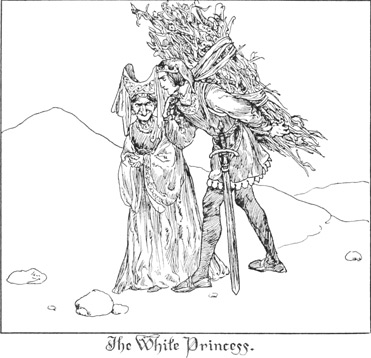
“The fates had dowered Queen Catherine with gifts; but though her husband was devoted to her, and the kingdom was blessed by a long spell of peace, she sighed unceasingly. One boon alone had been denied her, and without this she did not care to live.
‘Let her have her way!’ cried the Fates at last, weary of her complainings. So one summer dawn a babe was found in the bed of lilies beneath her window, and now her mourning was turned into joy. For a daughter had been her heart’s desire.
The little Princess was christened Fiorita, but from the day of her birth she was known as the White Princess. Her skin was as purely pale as the petals of her guardian flowers, and the yellow gold of their stamens was the colour of her hair. But out of her eyes looked a spirit that boded sorrow—the spirit that would fain know all.
The White Princess grew lovelier day by day, smiling but seldom, and staring for hours at the distant line of the far horizon, where the hills kept watch for ever over the land Beyond. The Queen looked on with delight at the unfolding of this tender blossom, but her happiness did not bring strength, and when in due time the sweet coral lips lisped the soft word ‘Mother,’ her soul broke the bonds which held it, and sped away.
Fiorita was now twice orphaned, for her father, the King, would scarcely look at her, since he connected her coming with the death of his beloved wife. In order that the sight of her might not continually remind him of his sorrow, he built a fine tower of gold and crystal, and here, surrounded by all her ladies, the White Princess grew into womanhood. Lovely as snow crystals, and cold as the arctic wastes, Fiorita made few friends, and spoke to none of her inmost thoughts. The Kings of the Earth who came to woo her were abashed by her strange white beauty, and only the Prince Fiola remained to ask her hand.