Chapter IV · SYMPATHY.
B. G. (Benjamin Guy) Babington translation
Imitation—compassion—sympathy, these are imperfect designations for a common bond of union among human beings—for an instinct which connects individuals with the general body, which embraces with equal force, reason and folly, good and evil, and diminishes the praise of virtue as well as the criminality of vice. In this impulse there are degrees, but no essential differences, from the first intellectual efforts of the infant mind, which are in a great measure based on imitation, to that morbid condition of the soul in which the sensible impression of a nervous malady fetters the mind, and finds its way, through the eye, directly to the diseased texture, as the electric shock is propagated by contact from body to body. To this instinct of imitation, when it exists in its highest degree, is united a loss of all power over the will, which occurs as soon as the impression on the senses has become firmly established, producing a condition like that of small animals when they are fascinated by the look of a serpent. By this mental bondage, morbid sympathy is clearly and definitely distinguished from all subordinate degrees of this instinct, however closely allied the imitation of a disorder may seem to be to that of a mere folly, of an absurd fashion, of an awkward habit in speech and manner, or even of a confusion of ideas. Even these latter imitations, however, directed as they are to foolish and pernicious objects, place the self-independence of the greater portion of mankind in a very doubtful light, and account for their union into a social whole. Still more nearly allied to morbid sympathy than the imitation of enticing folly, although often with a considerable admixture of the latter, is the diffusion of violent excitements, especially those of a religious or political character, which have so powerfully agitated the nations of ancient and modern times, and which may, after an incipient compliance[122], pass into a total loss of power over the will, and an actual disease of the mind. Far be it from us to attempt to awaken all the various tones of this chord, whose vibrations reveal the profound secrets which lie hid in the inmost recesses of the soul. We might well want powers adequate to so vast an undertaking. Our business here is only with that morbid sympathy, by the aid of which the dancing mania of the middle ages grew into a real epidemic. In order to make this apparent by comparison, it may not be out of place, at the close of this inquiry, to introduce a few striking examples:—
1. “At a cotton manufactory at Hodden Bridge, in Lancashire, a girl, on the fifteenth of February 1787, put a mouse into the bosom of another girl, who had a great dread of mice. The girl was immediately thrown into a fit, and continued in it, with the most violent convulsions, for twenty-four hours. On the following day, three more girls were seized in the same manner; and on the 17th, six more. By this time, the alarm was so great, that the whole work, in which 200 or 300 were employed, was totally stopped, and an idea prevailed that a particular disease had been introduced by a bag of cotton opened in the house. On Sunday the 18th, Dr. St. Clare was sent for from Preston; before he arrived three more were seized, and during that night and the morning of the 19th, eleven more, making in all twenty-four. Of these, twenty-one were young women, two were girls of about ten years of age, and one man, who had been much fatigued with holding the girls. Three of the number lived about two miles from the place where the disorder first broke out, and three at another factory at Clitheroe, about five miles distant, which last and two more were infected entirely from report, not having seen the other patients, but, like them and the rest of the country, strongly impressed with the idea of the plague being caught from the cotton. The symptoms were anxiety, strangulation, and very strong convulsions; and these were so violent as to last without any intermission from a quarter of an hour to twenty-four hours, and to require four or five persons to prevent the patients from tearing their hair and dashing their heads against the floor or walls. Dr. St. Clare had taken with him a portable electrical machine, and by electric shocks the patients were universally relieved without exception. As soon as the patients and the country were assured that the complaint was merely nervous, easily cured, and not introduced by the cotton, no fresh person was affected. To dissipate their apprehensions still further, the best effects were obtained by causing them to take a cheerful glass and join in a dance. On Tuesday the 20th, they danced, and the next day were all at work, except two or three, who were much weakened by their fits.”[123]
The occurrence here described is remarkable on this account, that there was no important predisposing cause for convulsions in these young women, unless we consider as such their miserable and confined life in the work-rooms of a spinning manufactory. It did not arise from enthusiasm, nor is it stated that the patients had been the subjects of any other nervous disorders. In another perfectly analogous case, those attacked were all suffering from nervous complaints, which roused a morbid sympathy in them at the sight of a person seized with convulsions. This, together with the supervention of hysterical fits, may aptly enough be compared to Tarantism.
2. “A young woman of the lowest order, twenty-one years of age, and of a strong frame, came on the 13th of January, 1801, to visit a patient in the Charité hospital at Berlin, where she had herself been previously under treatment for an inflammation of the chest with tetanic spasms, and immediately on entering the ward, fell down in strong convulsions. At the sight of her violent contortions, six other female patients immediately became affected in the same way, and by degrees eight more were in like manner attacked with strong convulsions. All these patients were from sixteen to twenty-five years of age, and suffered without exception, one from spasms in the stomach, another from palsy, a third from lethargy, a fourth from fits with consciousness, a fifth from catalepsy, a sixth from syncope, &c. The convulsions, which alternate in various ways with tonic spasms, were accompanied by loss of sensibility, and were invariably preceded by languor with heavy sleep, which was followed by the fits in the course of a minute or two; and it is remarkable, that in all these patients their former nervous disorders, not excepting paralysis, disappeared, returning, however, after the subsequent removal of their new complaint. The treatment, during the course of which two of the nurses, who were young women, suffered similar attacks, was continued for four months. It was finally successful, and consisted principally in the administration of opium, at that time the favourite remedy[124].”
Now, every species of enthusiasm, every strong affection, every violent passion, may lead to convulsions—to mental disorders—to a concussion of the nerves, from the sensorium to the very finest extremities of the spinal chord. The whole world is full of examples of this afflicting state of turmoil, which, when the mind is carried away by the force of a sensual impression that destroys its freedom, is irresistibly propagated by imitation. Those who are thus infected do not spare even their own lives, but, as a hunted flock of sheep will follow their leader and rush over a precipice, so will whole hosts of enthusiasts, deluded by their infatuation, hurry on to a self-inflicted death. Such has ever been the case, from the days of the Milesian virgins to the modern associations for self-destruction[125]. Of all enthusiastic infatuations, however, that of religion is the most fertile in disorders of the mind as well as of the body, and both spread with the greatest facility by sympathy. The history of the church furnishes innumerable proofs of this, but we need go no further than the most recent times.
3. In a Methodist chapel at Redruth, a man during divine service, cried out with a loud voice, “What shall I do to be saved?” at the same time manifesting the greatest uneasiness and solicitude respecting the condition of his soul. Some other members of the congregation, following his example, cried out in the same form of words, and seemed shortly after to suffer the most excruciating bodily pain. This strange occurrence was soon publicly known, and hundreds of people, who had come thither, either attracted by curiosity, or a desire, from other motives, to see the sufferers, fell into the same state. The chapel remained open for some days and nights, and from that point the new disorder spread itself, with the rapidity of lightning, over the neighbouring towns of Camborne, Helston, Truro, Penryn, and Falmouth, as well as over the villages in the vicinity. Whilst thus advancing, it decreased in some measure at the place where it had first appeared, and it confined itself throughout to the Methodist chapels. It was only by the words which have been mentioned that it was excited, and it seized none but people of the lowest education. Those who were attacked betrayed the greatest anguish, and fell into convulsions; others cried out, like persons possessed, that the Almighty would straightway pour out his wrath upon them, that the wailings of tormented spirits rang in their ears, and that they saw hell open to receive them. The clergy, when in the course of their sermons, they perceived that persons were thus seized, earnestly exhorted them to confess their sins, and zealously endeavoured to convince them that they were by nature enemies to Christ; that the anger of God had therefore fallen upon them; and that if death should surprise them in the midst of their sins, the eternal torments of hell would be their portion. The over-excited congregation upon this repeated their words, which naturally must have increased the fury of their convulsive attacks. When the discourse had produced its full effect, the preacher changed his subject; reminded those who were suffering, of the power of the Saviour, as well as of the grace of God, and represented to them in glowing colours the joys of heaven. Upon this a remarkable reaction sooner or later took place. Those who were in convulsions felt themselves raised from the lowest depths of misery and despair to the most exalted bliss, and triumphantly shouted out that their bonds were loosed, their sins were forgiven, and that they were translated to the wonderful freedom of the children of God. In the mean time, their convulsions continued, and they remained, during this condition, so abstracted from every earthly thought, that they staid two and sometimes three days and nights together in the chapels, agitated all the time by spasmodic movements, and taking neither repose nor nourishment. According to a moderate computation, 4000 people were, within a very short time, affected with this convulsive malady.
The course and symptoms of the attacks were in general as follows:—There came on at first a feeling of faintness, with rigour and a sense of weight at the pit of the stomach, soon after which the patient cried out, as if in the agonies of death or the pains of labour. The convulsions then began, first showing themselves in the muscles of the eyelids, though the eyes themselves were fixed and staring. The most frightful contortions of the countenance followed, and the convulsions now took their course downwards, so that the muscles of the neck and trunk were affected, causing a sobbing respiration, which was performed with great effort. Tremors and agitation ensued, and the patients screamed out violently, and tossed their heads about from side to side. As the complaint increased, it seized the arms, and its victims beat their breasts, clasped their hands, and made all sorts of strange gestures. The observer who gives this account remarked that the lower extremities were in no instance affected. In some cases, exhaustion came on in a very few minutes, but the attack usually lasted much longer, and there were even cases in which it was known to continue for sixty or seventy hours. Many of those who happened to be seated when the attack commenced, bent their bodies rapidly backwards and forwards during its continuance, making a corresponding motion with their arms, like persons sawing wood. Others shouted aloud, leaped about, and threw their bodies into every possible posture, until they had exhausted their strength. Yawning took place at the commencement in all cases, but as the violence of the disorder increased, the circulation and respiration became accelerated, so that the countenance assumed a swollen and puffed appearance. When exhaustion came on, patients usually fainted, and remained in a stiff and motionless state until their recovery. The disorder completely resembled the St. Vitus’s dance, but the fits sometimes went on to an extraordinarily violent extent, so that the author of the account once saw a woman, who was seized with these convulsions, resist the endeavours of four or five strong men to restrain her. Those patients who did not lose their consciousness were in general made more furious by every attempt to quiet them by force, on which account they were in general suffered to continue unmolested until nature herself brought on exhaustion. Those affected complained, more or less, of debility after the attacks, and cases sometimes occurred in which they passed into other disorders: thus some fell into a state of melancholy, which, however, in consequence of their religious ecstacy, was distinguished by the absence of fear and despair; and in one patient inflammation of the brain is said to have taken place. No sex or age was exempt from this epidemic malady. Children five years old and octogenarians were alike affected by it, and even men of the most powerful frame were subject to its influence. Girls and young women, however, were its most frequent victims[126].
4. For the last hundred years a nervous affection of a perfectly similar kind has existed in the Shetland Islands, which furnishes a striking example, perhaps the only one now existing, of the very lasting propagation by sympathy of this species of disorders. The origin of the malady was very insignificant. An epileptic woman had a fit in church, and whether it was that the minds of the congregation were excited by devotion, or that, being overcome at the sight of the strong convulsions, their sympathy was called forth, certain it is, that many adult women, and even children, some of whom were of the male sex, and not more than six years old, began to complain forthwith of palpitation, followed by faintness, which passed into a motionless and apparently cataleptic condition. These symptoms lasted more than an hour, and probably recurred frequently. In the course of time, however, this malady is said to have undergone a modification, such as it exhibits at the present day. Women whom it has attacked will suddenly fall down, toss their arms about, writhe their bodies into various shapes, move their heads suddenly from side to side, and with eyes fixed and staring, utter the most dismal cries. If the fit happen on any occasion of public diversion, they will, as soon as it has ceased, mix with their companions and continue their amusement as if nothing had happened. Paroxysms of this kind used to prevail most during the warm months of summer, and about fifty years ago there was scarcely a Sabbath in which they did not occur. Strong passions of the mind, induced by religious enthusiasm, are also exciting causes of these fits, but like all such false tokens of divine workings, they are easily encountered by producing in the patient a different frame of mind, and especially by exciting a sense of shame: thus those affected are under the control of any sensible preacher, who knows how to “administer to a mind diseased,” and to expose the folly of voluntarily yielding to a sympathy so easily resisted, or of inviting such attacks by affectation. An intelligent and pious minister of Shetland informed the physician, who gives an account of this disorder as an eye-witness, that being considerably annoyed, on his first introduction into the country, by these paroxysms, whereby the devotions of the church were much impeded, he obviated their repetition by assuring his parishioners, that no treatment was more effectual than immersion in cold water; and as his kirk was fortunately contiguous to a freshwater lake, he gave notice that attendants should be at hand, during divine service, to ensure the proper means of cure. The sequel need scarcely be told. The fear of being carried out of the church, and into the water, acted like a charm; not a single Naiad was made, and the worthy minister, for many years, had reason to boast of one of the best regulated congregations in Shetland. As the physician above alluded to was attending divine service in the kirk of Baliasta, on the Isle of Unst, a female shriek, the indication of a convulsion fit, was heard; the minister, Mr. Ingram, of Fetlar, very properly stopped his discourse, until the disturber was removed; and, after advising all those who thought they might be similarly affected, to leave the church, he gave out, in the meantime, a psalm. The congregation was thus preserved from further interruption; yet the effect of sympathy was not prevented, for as the narrator of the account was leaving the church, he saw several females writhing and tossing about their arms on the green grass, who durst not, for fear of a censure from the pulpit, exhibit themselves after this manner within the sacred walls of the kirk[127].
In the production of this disorder, which no doubt still exists, fanaticism certainly had a smaller share than the irritable state of women out of health, who only needed excitement, no matter of what kind, to throw them into the prevailing nervous paroxysms. When, however, that powerful cause of nervous disorders takes the lead, we find far more remarkable symptoms developed, and it then depends on the mental condition of the people among whom they appear, whether in their spread, they shall take a narrow or an extended range—whether confined to some small knot of zealots they are to vanish without a trace, or whether they are to attain even historical importance.
5. The appearance of the Convulsionnaires in France, whose inhabitants, from the greater mobility of their blood, have in general been the less liable to fanaticism, is, in this respect, instructive and worthy of attention. In the year 1727 there died, in the capital of that country, the Deacon Pâris, a zealous opposer of the Ultramontanists, division having arisen in the French church on account of the bull “Unigenitus.” People made frequent visits to his tomb, in the cemetery of St. Medard, and four years afterwards, (in September, 1731,) a rumour was spread, that miracles took place there. Patients were seized with convulsions and tetanic spasms, rolled upon the ground like persons possessed, were thrown into violent contortions of their heads and limbs, and suffered the greatest oppression, accompanied by quickness and irregularity of pulse. This novel occurrence excited the greatest sensation all over Paris, and an immense concourse of people resorted daily to the above named cemetery, in order to see so wonderful a spectacle, which the Ultramontanists immediately interpreted as a work of Satan, while their opponents ascribed it to a divine influence. The disorder soon increased, until it produced, in nervous women, clairvoyance, (Schlafwachen,) a phenomenon till then unknown; for one female especially attracted attention, who blindfold, and, as it was believed, by means of the sense of smell, read every writing that was placed before her, and distinguished the characters of unknown persons. The very earth taken from the grave of the Deacon, was soon thought to possess miraculous power. It was sent to numerous sick persons at a distance, whereby they were said to have been cured, and thus this nervous disorder spread far beyond the limits of the capital, so that at one time it was computed that there were more than eight hundred decided Convulsionnaires, who would hardly have increased so much in numbers, had not Louis XV. directed that the cemetery should be closed[128]. The disorder itself assumed various forms, and augmented, by its attacks, the general excitement. Many persons, besides suffering from the convulsions, became the subjects of violent pain, which required the assistance of their brethren of the faith. On this account they, as well as those who afforded them aid, were called by the common title of Secourists. The modes of relief adopted were remarkably in accordance with those which were administered to the St. John’s dancers and the Tarantati, and they were in general very rough; for the sufferers were beaten and goaded in various parts of the body with stones, hammers, swords, clubs, &c., of which treatment the defenders of this extraordinary sect relate the most astonishing examples, in proof that severe pain is imperatively demanded by nature in this disorder, as an effectual counter-irritant. The Secourists used wooden clubs, in the same manner as paviors use their mallets, and it is stated that some Convulsionnaires have borne daily from six to eight thousand blows, thus inflicted, without danger[129]. One Secourist administered to a young woman, who was suffering under spasm of the stomach, the most violent blows on that part, not to mention other similar cases, which occurred everywhere in great numbers. Sometimes the patients bounded from the ground, impelled by the convulsions, like fish when out of water; and this was so frequently imitated at a later period, that the women and girls, when they expected such violent contortions, not wishing to appear indecent, put on gowns, made like sacks, closed at the feet. If they received any bruises by falling down, they were healed with earth from the grave of the uncanonized saint. They usually, however, showed great agility in this respect, and it is scarcely necessary to remark that the female sex especially was distinguished by all kinds of leaping, and almost inconceivable contortions of body. Some spun round on their feet with incredible rapidity, as is related of the dervishes; others ran their heads against walls, or curved their bodies like rope-dancers, so that their heels touched their shoulders.
All this degenerated at length into decided insanity. A certain Convulsionnaire, at Vernon, who had formerly led rather a loose course of life, employed herself in confessing the other sex; in other places women of this sect were seen imposing exercises of penance on priests, during which these were compelled to kneel before them. Others played with children’s rattles, or drew about small carts, and gave to these childish acts symbolical significations[130]. One Convulsionnaire even made believe to shave her chin, and gave religious instruction at the same time, in order to imitate Pâris, the worker of miracles, who, during this operation, and whilst at table, was in the habit of preaching. Some had a board placed across their bodies, upon which a whole row of men stood; and as, in this unnatural state of mind, a kind of pleasure is derived from excruciating pain, some too were seen who caused their bosoms to be pinched with tongs, while others, with gowns closed at the feet, stood upon their heads, and remained in that position longer than would have been possible had they been in health. Pinault, the advocate, who belonged to this sect, barked like a dog some hours every day, and even this found imitation among the believers.
The insanity of the Convulsionnaires lasted, without interruption, until the year 1790, and during these fifty-nine years, called forth more lamentable phenomena than the enlightened spirits of the eighteenth century would be willing to allow. The grossest immorality found, in the secret meetings of the believers, a sure sanctuary, and, in their bewildering devotional exercises, a convenient cloak. It was of no avail that, in the year 1762, the Grands Secours was forbidden by act of parliament; for thenceforth this work was carried on in secrecy, and with greater zeal than ever; it was in vain, too, that some physicians, and, among the rest, the austere, pious Hecquet[131], and after him Lorry[132], attributed the conduct of the Convulsionnaires to natural causes. Men of distinction among the upper classes, as, for instance, Montgeron the deputy, and Lambert an ecclesiastic (obt. 1813), stood forth as the defenders of this sect; and the numerous writings[133] which were exchanged on the subject, served, by the importance which they thus attached to it, to give it stability. The revolution, finally, shook the structure of this pernicious mysticism. It was not, however, destroyed; for, even during the period of the greatest excitement, the secret meetings were still kept up; prophetic books, by Convulsionnaires of various denominations, have appeared even in the most recent times, and only a few years ago (in 1828) this once celebrated sect still existed, although without the convulsions and the extraordinarily rude aid of the brethren of the faith, which, amidst the boasted pre-eminence of French intellectual advancement, remind us most forcibly of the dark ages of the St. John’s dancers[134].
6. Similar fanatical sects exhibit among all nations[135] of ancient and modern times the same phenomena. An over-strained bigotry is, in itself, and considered in a medical point of view, a destructive irritation of the senses, which draws men away from the efficiency of mental freedom, and peculiarly favours the most injurious emotions. Sensual ebullitions, with strong convulsions of the nerves, appear sooner or later[136], and insanity, suicidal disgust of life, and incurable nervous disorders[137], are but too frequently the consequences of a perverse, and, indeed, hypocritical zeal, which has ever prevailed, as well in the assemblies of the Mænades and Corybantes of antiquity, as under the semblance of religion among the Christians and Mahomedans.
There are some denominations of English Methodists which surpass, if possible, the French Convulsionnaires; and we may here mention, in particular, the Jumpers, among whom it is still more difficult, than in the example given above, to draw the line between religious ecstacy and a perfect disorder of the nerves; sympathy, however, operates perhaps more perniciously on them than on other fanatical assemblies. The sect of Jumpers was founded in the year 1760, in the county of Cornwall, by two fanatics[138], who were, even at that time, able to collect together a considerable party. Their general doctrine is that of the Methodists, and claims our consideration here, only in so far as it enjoins them, during their devotional exercises, to fall into convulsions, which they are able to effect in the strangest manner imaginable. By the use of certain unmeaning words, they work themselves up into a state of religious frenzy, in which they seem to have scarcely any control over their senses. They then begin to jump with strange gestures, repeating this exercise with all their might, until they are exhausted, so that it not unfrequently happens that women, who, like the Mænades, practise these religious exercises, are carried away from the midst of them in a state of syncope, whilst the remaining members of the congregations, for miles together, on their way home, terrify those whom they meet by the sight of such demoniacal ravings. There are never more than a few ecstatics, who, by their example, excite the rest to jump, and these are followed by the greatest part of the meeting, so that these assemblages of the Jumpers resemble, for hours together, the wildest orgies, rather than congregations met for Christian edification[139].
In the United States of North America, communities of Methodists have existed for the last sixty years. The reports of credible witnesses of their assemblages for divine service in the open-air (camp meetings)[140], to which many thousands flock from great distances[141], surpass, indeed, all belief; for not only do they there repeat all the insane acts of the French Convulsionnaires and of the English Jumpers, but the disorder of their minds and of their nerves attains, at these meetings, a still greater height. Women have been seen to miscarry whilst suffering under the state of ecstacy and violent spasms into which they are thrown, and others have publicly stripped themselves and jumped into the rivers. They have swooned away[142] by hundreds, worn out with ravings and fits; and of the Barkers, who appeared among the Convulsionnaires only here and there, in single cases of complete aberration of intellect, whole bands are seen running on all fours, and growling[143] as if they wished to indicate, even by their outward form, the shocking degradation of their human nature. At these camp-meetings the children are witnesses of this mad infatuation, and as their weak nerves are, with the greatest facility, affected by sympathy, they, together with their parents, fall into violent fits, though they know nothing of their import, and many of them retain for life some severe nervous disorder, which, having arisen from fright and excessive excitement, will not afterwards yield to any medical treatment[144].
But enough of these extravagances, which, even in our own days, embitter the lives of so many thousands, and exhibit to the world, in the nineteenth century, the same terrific form of mental disturbance as the St. Vitus’s dance once did to the benighted nations of the middle ages.
APPENDIX.
I.
Petri de Herentals, Prioris Floreffiensis Vita Gregorii XI., in Stephan. Baluzii Vitæ Paparum Avenionensium. T. I. Paris, 1693. 4to. p. 483.
Ejus tempore, videlicet A. D. MCCCLXXV., mira secta tam virorum quam mulierum venit Aquisgrani de partibus Alamanniæ, et ascendit usque Hanoniam seu Franciam, cujus talis fuit conditio. Nam homines utriusque sexus illudebantur a dæmonio, taliter quod tam in domibus quam in plateis et in Ecclesiis se invicem manibus tenentes chorizabant et in altum saltabant, ac quædam nomina dæmoniorum nominabant, videlicet Friskes et similia, nullam cognitionem in hujusmodi chorizatione nec verecundiam sui propter astantes populos habentes. Et in fine hujus chorizationis in tantum circa pectoralia torquebantur, quod nisi mappulis lineis a suis amicis per medium ventris fortiter stringerentur, quasi furiose clamabant se mori. Hi vero in Leodio per conjurationes sumptas de illis quæ in catechismo ante baptismum fiunt, a dæmonio liberabantur, et sanati dicebant, quod videbatur eis quod in hora hujus chorizationis erant in fluvio sanguinis, et propterea sic in altum saltabant. Vulgus autem apud Leodium dicebat quod hujusmodi plaga populo contigisset eo, quod populus male baptizatus erat, maxime a Presbyteribus suas tenentibus concubinas. Et propter hoc proposuerat vulgus insurgere in clerum, eos occidendo et bona eorum diripiendo, nisi Deus de remedio providisset per conjurationes prædictas. Quo viso cessavit tempestas vulgi taliter quod clerus multo plus a populo fuit honoratus. De ista autem chorizatione seu secta talia extant rigmata:
Oritur in seculo nova quædam secta In gestis aut in speculo visa plus nec lecta. Populus tripudiat nimium saltando. Se unus alteri sociat leviter clamando. Frisch friskes cum gaudio clamat uterque sexus. Cunctus manutergio et baculo connexus. Capite fert pelleum desuper sertum. Cernit Mariæ filium et cœlum apertum. Deorsum prosternitur. Dudum fit ululatus. Calcato ventre cernitur statim liberatus. Vagatur loca varia pompose vivendo. Mendicat necessaria propriis parcendo. Spernit videre rubea et personam flentem. Ad fidei contraria crigit hic gens mentem. Noctis sub umbraculo ista perpetravit. Cum naturali baculo subtus se calcavit. Clerum habet odio. Non curat sacramenta. Post sunt Leodio remedia inventa, Hanc nam fraudem qua suggessit sathan est convictus. Conjuratus evanescit. Hinc sit Christus benedictus.
II.
Jo. Pistorii Rerum familiarumque Belgicarum Cbronicon magnum. Francof. 1654. fol. p. 319. De chorisantibus.
Item Anno. Dn. MCCCLXXIV. tempore pontificates venerabilis Domini Joannis de Arckel Episcopi Leodiensis, in mense Julio in crastino divisionis Apostolorum visi sunt dansatores scilicet chorisantes, qui postea venerunt Trajectum, Leodium, Tungrim et alia loca istarum partium in mense Septembri. Et cœpit hæc dæmoniaca pestis vexare in dictis locis et circumvicinis masculos et fœminas maxime pauperes et levis opinionis ad magnum omnium terrorem; pauci clericorum vel divitum sunt vexati. Serta in capitibus gestabant, circa ventrem mappa cum baculo se stringebant circa umbilicum, ubi post saltationem cadentes nimium torquebantur, et ne creparentur pedibus conculcabantur, vel contra creporem cum baculo ad mappam duriter se ligabant, vel cum pugno se trudi faciebant, rostra calceorum aliqui clamabant se abhorrere, unde in Leodio fieri tunc vetabantur. Ecclesias chorisando occupabant, et crescebant numerose de mense Septembri et Octobri, processiones fiebant ubique, litaniæ et missæ speciales. Leodii apud Sanctam crucem scholaris servitor in vesperis dedicationis, cœpit ludere cum thuribulo, et post vesperas fortiter saltare. Evocatus a pluribus, ut diceret Pater noster, noluit, et Credo respondit in diabolum. Quod videns capellanus, allata stola conjuravit cum per exorcismum baptizandorum, et statim dixit: Ecce inquit, scholaris recedit cum parva toga et calceis rostratis. Dic, tunc inquit, Pater noster et Credo. At ille utrumque dixit perfecte et curatus est. Apud Harstallium uno mane ante omnium Sanctorum, multi eorum ibi congregati consilium habuerunt, ut pariter venientes omnes canonicos, presbyteres et clericos Leodienses occiderent. Canonicus quidam parvæ mensæ minister Simon in claustro Leodiensi apud capellam Beatæ virginis, in Deo confortatus, scalam projecit in collum unius, dicens Evangelium: In principio erat verbum, super caput ejus, et per hoc fuit liberatus, et pro miraculo statim fuit pulsatum. Apud S. Bartolomæum Leodii, præsentibus multis, cuidam alii exorcisanti respondit dæmon: Ego exibo libenter. Expecta, inquit presbyter, volo tibi loqui. Et postquam aliquos alios curasset, dixit illi, loquere tu personaliter et responde mihi. Tum solus respondit dæmon: Nos eramus duo, sed socius meus nequior me, ante me exivit, habui tot pati in hoc corpore, si essem extra, nunquam intrarem in corpus Christianum. Cui presbyter: Quare intrasti corpora talium personarum? Respondit: Clerici et presbyteres dicunt tot pulchra verba et tot orationes, ut non possemus intrare corpora ipsorum. Si adhuc fuisset expectatum per quindenam vel mensem, nos intrassemus corpora divitum, et postea principum, et sic per eos destruxissemus clerum. Et hæc fuerunt ibi a multis audita et postea a multis narrata. Hæc pestis intra annum satis invaluit, sed postea per tres aut quatuor annos omnino cessavit.
III[145].
Die Limburger Chronik, herausgegeben von C. D. Vogel. Marburg, 1828, 8vo. s. 71.
Anno 1374 zu mitten im Sommer, da erhub sich ein wunderlich Ding auff Erdreich, und sonderlich in Teutschen Landen, auff dem Rhein und auff der Mosel, also dass Leute anhuben zu tantzen und zu rasen, und stunden je zwey gegen ein, und tantzeten auff einer Stätte einen halben Tag, und in dem Tantz da fielen sie etwan offt nieder, und liessen sich mit Füssen tretten auff ihren Leib. Davon nahmen sie sich an, dass sie genesen wären. Und lieffen von einer Stadt zu der andern, und von einer Kirchen zu der andern, und huben Geld auff von den Leuten, wo es ihnen mocht gewerden. Und wurd des Dings also viel, dass man zu Cölln in der Stadt mehr dann fünff hundert Täntzer fand. Und fand man, dass es eine Ketzerey war, und geschahe um Golds willen, das ihr ein Theil Frau und Mann in Unkeuschheit mochten kommen, und die vollbringen. Und fand man da zu Cölln mehr dann hundert Frauen und Dienstmägde, die nicht eheliche Männer hatten. Die wurden alle in der Täntzerey Kinder-tragend, und wann dass sie tantzeten, so bunden und knebelten sie sich hart um den Leib, dass sie desto geringer wären. Hierauff sprachen ein Theils Meister, sonderlich der guten Artzt, das ein Theil wurden tantzend, die von heisser Natur wären, und von andern gebrechlichen natürlichen Sachen. Dann deren war wenig, denen das geschahe. Die Meister von der heiligen Schrift, die beschwohren der Täntzer ein Theil, die meynten, dass sie besessen wären von dem bösen Geist. Also nahm es ein betrogen End, und währete wohl sechszehn Wochen in diesen Landen oder in der Mass. Auch nahmen die vorgenannten Täntzer Mann und Frauen sich an, dass sie kein roth sehen möchten. Und war ein eitel Teuscherey, und ist verbottschaft gewesen an Christum nach meinem Bedünken.
IV.
Die Chronica van der hilliger Stat van Coellen. A. D. MCCCLXXIV. fol. 277. Coellen, 1499. fol.
In dem seluen iair stonde eyn groisse kranckheit vp vnder den mynschen, ind was doch niet vill me gesyen dese selue kranckheit vur off nae ind quam van natuerlichen ursachen as die meyster schrijnen, ind noemen Sij maniam, dat is raserie off unsynnicheit. Ind vill lude beyde man ind frauwen junck ind alt hadden die kranckheit. Ind gyngen vyss huyss ind hoff, dat deden ouch junge meyde, die verliessen yr alderen, vrunde ind maege ind lantschaff. Disse vurss mynschen zo etzlichen tzijden as Sij die kranckheit anstiesse, so hadden Sij eyn wonderlich bewegung yrre lychamen. Sij gauen vyss kryschende vnd grusame stymme, ind mit dem wurpen Sij sich haestlich up die erden, vnd gyngen liggen up yren rugge, ind beyde man ind vrauwen moist men vmb yren buych ind vmp lenden gurdelen vnd kneuelen mit twelen vnd mit starcken breyden benden, asso stijff vnd harte als men mochte.
Item asso gegurt mit den twelen dantzten Sij in kyrchen ind in clusen ind vp allen gewijeden steden. As Sij dantzten, so sprungen Sij allit vp ind rieffen, Here sent Johan, so so, vrisch ind vro here sent Johan.
Item die ghene die die kranckheit hadden wurden gemeynlichen gesunt bynnen. VV. dagen. Zom lesten geschiede vill bouerie vnd droch dae mit. Eyndeyll naemen sich an dat Sij kranck weren. vp dat Sij mochten gelt dae durch bedelen. Die anderen vinsden sich kranck vp dat Sij mochten vnkuyschheit bedrijuen mit den vrauwen. jnd gyngen durch alle lant ind dreuen vill bouerie. Doch zo lesten brach idt vyss ind wurden verdreuen vyss den landen. Die selue dentzer quamen ouch zo Coellen tusschen tzwen vnser lieuen frauwen missen Assumptionis ind Natiuitatis.
V.
In the third volume of the Edinburgh Medical and Surgical Journal, p. 434, there is an account of “some convulsive diseases in certain parts of Scotland, which is taken from Sir J. Sinclair’s statistical account, and from which I have thought it illustrative of our author’s subject to make some extracts; the first that is noticed is peculiar to a part of Forfarshire, and is called the leaping ague, which bears so close an analogy to the original St. Vitus’s Dance, or to Tarantism, that it seems to want only the “foul fiend,” or the dreaded bite, as a cause, and a Scotch reel or strathspey as a cure, to render the resemblance quite complete. “Those affected with it first complain of a pain in the head, or lower part of the back, to which succeed convulsive fits, or fits of dancing, at certain periods. During the paroxysm they have all the appearance of madness, distorting their bodies in various ways, and leaping and springing in a surprising manner, whence the disease has derived its vulgar name. Sometimes they run with astonishing velocity, and often over dangerous passes, to some place out of doors, which they have fixed on in their own minds, or, perhaps, even mentioned to those in company with them, and then drop down quite exhausted. At other times, especially when confined to the house, they climb in the most singular manner. In cottages, for example, they leap from the floor to what is called the baulks, or those beams by which the rafters are joined together, springing from one to another with the agility of a cat, or whirling round one of them, with a motion resembling the fly of a jack. Cold bathing is found to be the most effectual remedy; but when the fit of dancing, leaping, or running comes on, nothing tends so much to abate the violence of the disease, as allowing them free scope to exercise themselves, till nature be exhausted. No mention is made of its being peculiar to any age, sex, or condition of life, although I am informed by a gentleman from Brechin, that it is most common before puberty. In some families it seems to be hereditary; and I have heard of one, in which a horse was always kept ready saddled, to follow the young ladies belonging to it, when they were seized with a fit of running. It was first observed in the parish of Kenmuir, and has prevailed occasionally in that and the neighbouring parishes, for about seventy years: but it is not now nearly so frequent as it was about thirty years ago. The history of this singular affection is still extremely imperfect: and it is only from some of the medical practitioners in that part of the country where it prevails, that a complete description can be expected.”
Our author has already noticed the convulsive disease prevalent in the Shetland Islands, and has quoted Hibbert’s account of it. The following, however, from a very valuable manuscript account of the Orkney and Shetland Islands, drawn up about 1774, by George Low, with notes, by Mr. Pennant, is given in the journal already cited, and will be read with interest. The facts were communicated to Mr. Low by the Rev. Wm. Archibald, parochial clergyman of Unst, the most northerly of the Shetlands.
“There is a most shocking distemper, which has of late years prevailed very much, especially among young women, and was hardly known thirty or forty years ago. About that period only one person was subject to it. The inhabitants give it the name of convulsion fits; and indeed, in appearance it something resembles epilepsy. In its first rise, it began with a palpitation of the heart, of which they complained for a considerable time; it at length produced swooning fits, in which people seized with it would lie motionless upwards of an hour. At length, as the distemper gathered strength, when any violent passion seized, or on a sudden surprise, they would all at once fall down, toss their arms about, with their bodies, into many odd shapes, crying out all the while most dismally, throwing their heads about from side to side, with their eyes fixed and staring. At first this distemper obtained in a private way, with one female, but she being seized in a public way, at church, the disease was communicated to others; but, whether by the influence of fear or sympathy, is not easy to determine. However this was, our public assemblies, especially at church, became greatly disturbed by their outcries. This distemper always prevails most violently during the summer time, in which season, for many years, we are hardly one sabbath free. In these few years past, it has not prevailed so extensively, and upon the whole, seems on the decline. One thing remarkable in this distemper is, that as soon as the fit is over, the persons affected with it are generally as lively and brisk as before; and if it happens at any of their public diversions, as soon as they revive, they mix with their companions, and continue their amusement as vigorously as if nothing had happened. Few men are troubled with this distemper, which seems more confined to women; but there are instances of its seizing men, and girls of six years of age. With respect to the nature of this disease, people who have made enquiry about it differ, but most imagine it hysterical; however, this seems not entirely the case, as men and children are subject to it; however, it is a new disease in Shetland, but whence imported, none can imagine.
“When the statistical account of this parish was published, this awful and afflicting disease was becoming daily less common. In the parishes of Aithsting, Sandsting, and Northmaven, in which it was once very frequent, it was now totally extinct. In the last of these the cure is said to have been effected by a very singular remedy, which, if true, and there seems no reason to doubt it, shows the influence of moral causes in removing, as well as in inducing convulsive disorders.” The cure is attributed to a rough fellow of a kirk officer, who tossed a woman in that state, with whom he had been frequently troubled, into a ditch of water. She was never known to have the disease afterwards, and others dreaded the same treatment.
“It, however, still prevails in some of the northern parishes, particularly in Delting, although, according to the description given of it, with some alteration in its symptoms.
“Convulsion fits of a very extraordinary kind seem peculiar to this country. The patient is first seized with something like fainting, and immediately after utters wild cries and shrieks, the sound of which, at whatever distance, immediately puts all who are subject to the disorder in the same situation. It most commonly attacks them when the church is crowded, and often interrupts the service in this and many other churches in the country. On a sacramental occasion, fifty or sixty are sometimes carried out of the church, and laid in the churchyard, where they struggle and roar with all their strength, for five or ten minutes, and then rise up without recollecting a single circumstance that happened to them, or being in the least hurt or fatigued with the violent exertions they had made during the fit. One observation occurs on this disorder, that, during the late scarce years it was very uncommon, and, during the two last years of plenty (1791), it has appeared more frequently.
“Similar instances of epidemical convulsions are already upon record; but the history of that which occurred in Anglesea, North Wales, is the most remarkable, as its progress was, in all probability, checked by the judicious precautions recommended by Dr. Haygarth.
“In 1796, on the estates of the Earl of Uxbridge and Holland Griffith, Esq., 23 females, from 10 to 25, and one boy, of about 17 years of age, who had all intercourse with each other, were seized with an unusual kind of convulsions, affecting only the upper extremities. It began with pain of the head, and sometimes of the stomach and side, not very violent; after which there came on violent twitchings or convulsions of the upper extremities, continuing with little intermission, and causing the shoulders almost to meet by the exertion. In bed the disorder was not so violent: but, in some cases at least, it continued even during sleep. Their pulse was moderate, the body costive, and the general health not much impaired. In general they had a hiccough; and, when the convulsions were most violent, giddiness came on, with the loss of hearing and recollection. During their convalescence, and they all recovered, the least fright or sudden alarm brought on a slight paroxysm.
“Dr. Haygarth, who was consulted on the means of relieving these unfortunate people, successfully recommended the use of antispasmodics; that all girls and young women should be prevented from having any communication with persons affected with those convulsions; and that those who were ill should be kept separate as much as possible.”
The same paper from which the above extracts have been taken, quotes a remarkable instance in which religious enthusiasm was the exciting cause of a convulsive disease analogous to those already noticed. The account is given by the Rev. Dr. Meik, at great length. It appears, that in January, 1742, about 90 persons in the parish of Cambuslang, in Lanarkshire, were induced to subscribe a petition to the minister, urging him to give them a weekly lecture, to which he readily assented. Nothing particular occurred at the first two lectures, but, at the third, to which the hearers had been very attentive, when the minister in his last prayer expressed himself thus, “Lord, who hath believed our report; and to whom is the arm of the Lord revealed?—where are the fruits of my poor labours among this people?” several persons in the congregation cried out publicly, and about fifty men and women came to the minister’s house, expressing strong convictions of sin, and alarming fears of punishment. After this period, so many people from the neighbourhood resorted to Cambuslang, that the minister thought himself obliged to provide them with daily sermons or exhortations, and actually did so for seven or eight months. The way in which the converts were affected, for it seems they were affected much in the same way, though in very different degrees, is thus described. “They were seized, all at once, commonly by something said in the sermons or prayers, with the most dreadful apprehensions concerning the state of their souls, insomuch that many of them could not abstain from crying out, in the most public and frightful manner, ‘bewailing their lost and undone condition by nature; calling themselves enemies to God, and despisers of precious Christ; declaring that they were unworthy to live on the face of the earth; that they saw the mouth of hell open to receive them, and that they heard the shrieks of the damned;’ but the universal cry was, ‘What shall we do to be saved?’ The agony under which they laboured was expressed, not only by words, but also by violent agitations of body; by clapping their hands and beating their breasts; by shaking and trembling; by faintings and convulsions; and sometimes by excessive bleeding at the nose. While they were in this distress, the minister often called out to them, not to stifle or smother their convictions, but to encourage them: and, after sermon was ended, he retired with them to the manse, and frequently spent the best part of the night with them in exhortations and prayers. Next day, before sermon began, they were brought out, and, having napkins tied round their heads, were placed all together on seats before the tents, where they remained sobbing, weeping, and often crying aloud, till the service was over. Some of those who fell under conviction were never converted; but most of those who fell under it were converted in a few days, and sometimes in a few hours. In most cases their conversion was as sudden and unexpected as their conviction. They were raised all at once from the lowest depth of sorrow and distress, to the highest pitch of joy and happiness; crying out with triumph and exultation, ‘that they had overcome the wicked one; that they had gotten hold of Christ, and would never let him go; that the black cloud which had hitherto concealed him from their view was now dispelled; and that they saw him, with a pen in his hand, blotting out their sins.’ Under these delightful impressions, some began to pray, and exhort publicly, and others desired the congregation to join with them in singing a particular psalm, which they said God had commanded them to sing. From the time of their conviction to their conversion, many had no appetite for food, or inclination to sleep, and all complained of their sufferings during that interval.”
The following account, which closes the paper whence the above quotations have been extracted, is taken from an Inaugural Essay on Chorea Sancti Viti, by Felix Robertson of Tennessee, 8vo. Philadelph. 1805.
“The Chorea, which is more particularly the subject of this dissertation, made its appearance during the summer of 1803, in the neighbourhood of Maryville, (Tennessee,) in the form of an epidemic. Previously to entering on its history, I think it necessary to premise a few cursory remarks on the mode of life of those amongst whom it originated, for some time before the appearance of the disease.
“I suppose there are but few individuals in the United States, who have not at least heard of the unparalleled blaze of enthusiastic religion which burst forth in the western country, about the year 1800; but it is, perhaps, impossible to have a competent idea of its effects, without personal observation. This religious enthusiasm travelled like electricity, with astonishing velocity, and was felt, almost instantaneously, in every part of the states of Tennessee and Kentucky. It often proved so powerful a stimulus, that every other entirely lost its effect, or was but feebly felt. Hence that general neglect of earthly things, which was observed, and the almost perpetual attendance at places of public worship. Their churches are, in general, small and every way uncomfortable; the concourse of people, on days of worship, particularly of extraordinary meetings, was very numerous, and hundreds who lived at too great a distance to return home every evening, came supplied with provisions, tents, &c., for their sustenance and accommodation, during the continuance of the meeting, which commonly lasted from three to five days. They, as well as many others, remained on the spot day and night, the whole or greater part of this time, worshipping their Maker almost incessantly. The outward expressions of their worship consisted chiefly in alternate crying, laughing, singing, and shouting, and, at the same time, performing that variety of gesticulation, which the muscular system is capable of producing. It was under these circumstances that some found themselves unable, by voluntary efforts, to suppress the contraction of their muscles; and, to their own astonishment, and the diversion of many of the spectators, they continued to act from necessity, the curious character which they had commenced from choice.
“The disease no sooner appeared, than it spread with rapidity through the medium of the principle of imitation; thus it was not uncommon for an affected person to communicate it to the greater part of a crowd, who, from curiosity or other motives, had collected around him. It is at this time, in almost every part of Tennessee and Kentucky, and in various parts of Virginia, but is said not to be contagious (or readily communicated) as at its commencement. It attacks both sexes, and every constitution, but evidently more readily those who are enthusiasts in religion, such as those above described, and females; children of six years of age, and adults of sixty, have been known to have it, but a great majority of those affected are from fifteen to twenty-five. The muscles generally affected are those of the trunk, particularly of the neck, sometimes those of the superior extremities, but very rarely, if ever, those of the inferior. The contractions are sudden and violent, such as are denominated convulsive, being sometimes so powerful, when in the muscles of the back, that the patient is thrown on the ground, where, for some time, his motions more resemble those of a live fish, when thrown on land, than any thing else to which I can compare them.
“This, however, does not often occur, and never, I believe, except at the commencement of the disease. The patients, in general, are capable of standing and walking, and many, after it has continued a short time, can attend to their business, provided it is not of a nature requiring much steadiness of body. They are incapable of conversing with any degree of satisfaction to themselves or company, being continually interrupted by those irregular contractions of their muscles, each causing a grunt, or forcible expiration; but the organs of speech do not appear to be affected, nor has it the least influence on the mind. They have no command over their actions by any effort of volition, nor does their lying in bed prevent them, but they always cease during sleep. This disease has remissions and exacerbations, which, however, observe no regularity in their occurrence or duration. During the intermission a paroxysm is often excited at the sight of a person affected, but more frequently by the common salute of shaking hands. The sensations of the patients in a paroxysm are generally agreeable, which the enthusiastic class often endeavour to express, by laughing, shouting, dancing, &c.
“Fatigue is almost always complained of after violent paroxysms, and sometimes a general soreness is experienced. The heart and arteries appear to be no further affected by the disease, than what arises from the exercise of the body; nor does any change take place in any of the secretions or excretions. It has not proved mortal in a single instance within my knowledge, but becomes lighter by degrees, and finally disappears. In some cases, however, of long continuance, it is attended with some degree of melancholia, which seems to arise entirely from the patient’s reflections, and not directly from the disease.
“The state of the atmosphere has no influence over it, as it rages with equal violence in summer and in winter; in moist and in dry air.”
In the above examples, nervous disorders bearing a strong resemblance to those of the middle ages, are shown to exist in an epidemic form, both in Europe and America, at the present time; but in these instances some general cause of mental excitement—and none is more powerful than religious enthusiasm—seems to have been requisite for their propagation. Their appearance, however, in single cases, is occasionally independent of any such origin, which leads to a belief, not without support in the experiments of modern physiologists, that they occasionally proceed from physical causes, and that it is therefore not necessary to consider them in all cases as the offspring of a disordered imagination.
A well marked case of a disease approximating to the original Dancing Mania, is related by Mr. Kinder Wood, in the 7th volume of the Medico-Chirurgical Transactions, p. 237. The patient, a young married woman, is described to have suffered from headache and sickness, together with involuntary motions of the eyelids, and most extraordinary contortions of the trunk and extremities, for several days, when the more remarkable symptoms began to manifest themselves, which are thus recorded:—
“February 26. Slight motions of the limbs came on in bed. She arose at nine o’clock, after which they increased, and became unusually severe. She was hurled from side to side of the couch-chair upon which she sat, for a considerable time, without intermission; was sometimes instantaneously and forcibly thrown upon her feet, when she jumped and stamped violently. She had headache; the eyelids were frequently affected, and she had often a sudden propensity to spring or leap upwards. The affection ceased about eleven o’clock in the forenoon, the patient being very much fatigued; but it returned about noon, and a third time in the afternoon, when she was impelled into every corner of the room, and began to strike the furniture and doors violently with the hand, as she passed near them, the sound of which afforded her great satisfaction. The fourth attack was at night; was very violent, and ended with sickness and vomiting. She went to bed at half-past eleven. Her nights were invariably good. The last three attacks were more violent than the former ones, but they continued only half an hour each.
“February 27. The attack commenced in bed, and was violent, but of short duration. When she arose about ten, she had a second attack, continuing an hour, except an interval of five minutes. She now struck the furniture more violently and more repeatedly. Kneeling on one knee, with the hands upon the back, she often sprang up suddenly and struck the top of the room with the palm of the hand. To do this, she rose fifteen inches from the floor, so that the family were under the necessity of drawing all the nails and hooks from the ceiling. She frequently danced upon one leg, holding the other with the hand, and occasionally changing the legs. In the evening, the family observed the blows upon the furniture to be more continuous, and to assume the regular time and measure of a musical air. As a strain or series of strokes was concluded, she ended with a more violent stroke or a more violent spring or jump. Several of her friends also at this time noticed the regular measure of the strokes, and the greater regularity the disease was assuming; the motions being evidently affected, or in some measure modified by the strokes upon the surrounding bodies. She chiefly struck a small slender door, the top of a chest of drawers, the clock, a table, or a wooden screen placed near the door. The affection ceased about nine o’clock, when the patient went to bed.
“February 28. She arose very well at eight. At half-past nine the motions recommenced; they were now of a more pleasant nature; the involuntary actions, instead of possessing their former irregularity and violence, being changed into a measured step over the room, connected with an air, or series of strokes, and she beat upon the adjacent bodies as she passed them. In the commencement of the attack, the lips moved as if words were articulated, but no sound could be distinguished at this period. It was curious indeed to observe the patient at this time, moving around the room with all the vivacity of the country dance, or the graver step of the minuet, the arms frequently carried, not merely with ease, but with elegance. Occasionally all the steps were so directed as to place the foot constantly where the stone flags joined to form the floor, particularly when she looked downwards. When she looked upwards, there was an irresistible impulse to spring up to touch little spots or holes in the top of the ceiling; when she looked around, she had a similar propensity to dart the forefinger into little holes in the furniture, &c. One hole in the wooden screen received the point of the forefinger many hundred times, which was suddenly and involuntarily darted into it with an amazing rapidity and precision. There was one particular part of the wall to which she frequently danced, and there placing herself with the back to it, stood two or three minutes. This by the family was called ‘the measuring place.’
“In the afternoon the motions returned, and proceeded much as in the morning. At this time a person present, surprised at the manner in which she beat upon the doors, &c., and thinking he recognised the air, without further ceremony began to sing the tune; the moment this struck her ears, she turned suddenly to the man, and dancing directly up to him, continued doing so till he was out of breath. The man now ceased a short time, when commencing again, he continued till the attack stopped. The night before this, her father had mentioned his wish to procure a drum, associating this dance of his daughter with some ideas of music. The avidity with which she danced to the tune when sung as above stated, confirmed this wish, and accordingly a drum and fife were procured in the evening. After two hours of rest, the motions again reappeared, when the drum and fife began to play the air to which she had danced before, viz. the ‘Protestant Boys,’ a favourite popular air in this neighbourhood. In whatever part of the room she happened to be, she immediately turned and danced up to the drum, and as close as possible to it, and there she danced till she missed the step, when the involuntary motions instantly ceased. The first time she missed the step in five minutes; but again rose, and danced to the drum two minutes and a half by her father’s watch, when, missing the step, the motions instantly ceased. She rose a third time, and missing the step in half a minute, the motions immediately ceased. After this, the drum and fife commenced as the involuntary actions were coming on, and before she rose from her seat; and four times they completely checked the progress of the attack, so that she did not rise upon the floor to dance. At this period the affection ceased for the evening.
“March 1. She arose very well at half-past seven. Upon my visit this morning, the circumstances of the preceding afternoon being stated, it appeared clear to me, that the attacks had been shortened. Slow as I had seen the effects of medicine in the comparatively trifling disease of young females, I was very willing that the family should pursue the experiment, whilst the medical means were continued.
“As I wished to see the effect of the instrument over the disease, I was sent for at noon, when I found her dancing to the drum, which she continued to do for half an hour without missing the step, owing to the slowness of the movement. As I sat counting the pulse, which I found to be 120, in the short intervals of an attack, I noticed motions of the lips, previous to the commencement of the dance, and placing my ear near the mouth I distinguished a tune. After the attack of which this was the beginning, she informed me, in answer to my inquiry, that there always was a tune dwelling upon her mind, which at times becoming more pressing, irresistibly impelled her to commence the involuntary motions. The motions ceased at four o’clock.
“At half-past seven the motions commenced again, when I was sent for. There were two drummers present, and an unbraced drum was beaten till the other was braced. She danced regularly to the unbraced drum, but the moment the other commenced she instantly ceased. As missing the time stopped the affections, I wished the measure to be changed during the dance, which stopped the attack. It also ceased upon increasing the rapidity of the beat, till she could no longer keep time; and it was truly surprising to see the rapidity and violence of the muscular exertion, in order to keep time with the increasing movement of the instrument. Five times I saw her sit down the same evening, at the instant that she was unable to keep the measure; and in consequence of this I desired the drummers to beat one continued roll, instead of a regular movement. She arose and danced five minutes, when both drums beat a continued roll: the motions instantly stopped, and the patient sat down. In a few minutes the motions commencing again, she was suffered to dance five minutes, when the drums again began to roll, the effect of which was instantaneous; the motions ceased, and the patient sat down. In a few minutes the same was repeated with the same effect. It appeared certain that the attacks could now be stopped in an instant, and I was desirous of arresting them entirely, and breaking the chain of irregular associations which constituted the disease. As the motions at this period always commenced in the fingers, and propagated themselves along the upper extremities to the trunk, I desired the drummers, when the patient arose to dance, to watch the commencement of the attack, and roll the drums before she arose from the chair. Six times successively the patient was hindered from rising, by attending to the commencement of the affection; and before leaving the house, I desired the family to attend to the commencement of the attacks, and use the drum early.
“March 2. She arose at seven o’clock, and the motions commenced at ten; she danced twice before the drummer was prepared, after which she attempted to dance again four several times; but one roll of a well-braced drum hindered the patient from leaving her seat, after which the attacks did not recur. She was left weakly and fatigued by the disease, but with a good appetite. In the evening of this day an eruption appeared, particularly about the elbows, in diffused patches of a bright red colour, which went off on the third day.”
Other cases might be adduced, (see 23d vol. of the Edinburgh Medical and Surgical Journal, p. 261; 31st vol. of ditto, p. 299; 5th vol. of the Medico-Chirurgical Transactions, pp. 1 to 23, &c.,) but as there is none more striking than this, they would unnecessarily swell this number of the Appendix, which has already extended to an undue length.
VI.
MUSIC FOR THE DANCE OF THE TARANTATI,
FROM
ATHAN. KIRCHER.
Magness. de Arte magnetica. Rom. 1654. fol. p. 591.—Repeated in Sam. Hafenreffer, Nosodochium, in quo cutis affectus traduntur. Ulm. 1660. 8vo. p. 485.
I. Primus modus Tarantella.
[Listen]
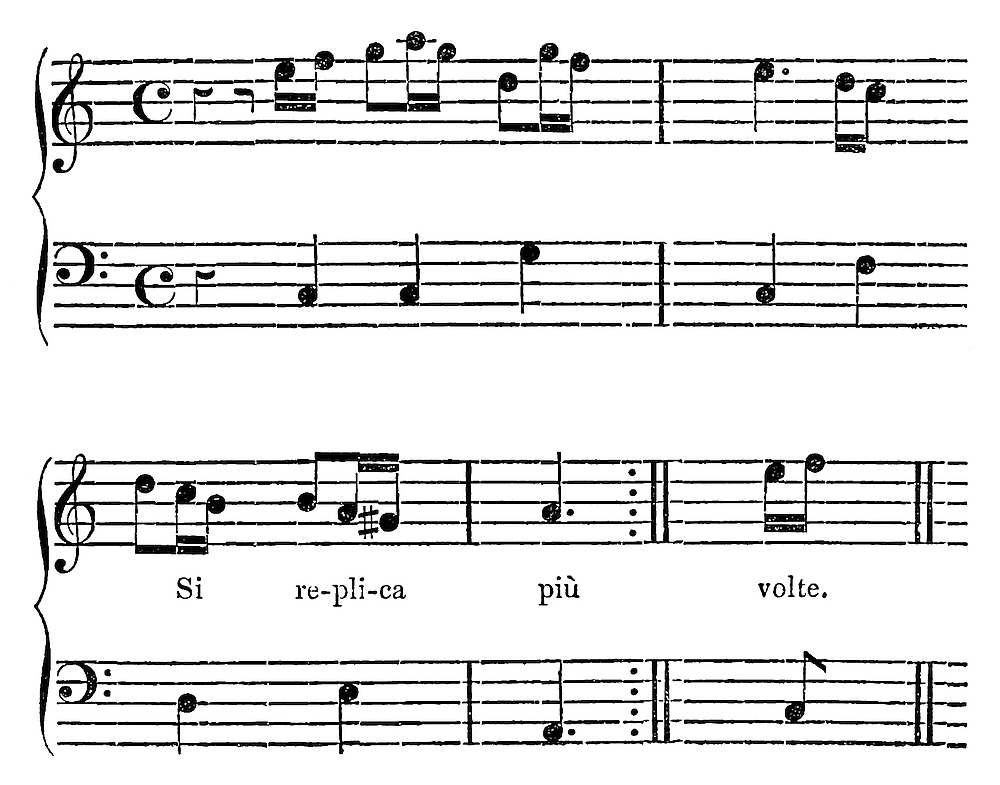
II. Secundus modus.
[Listen]
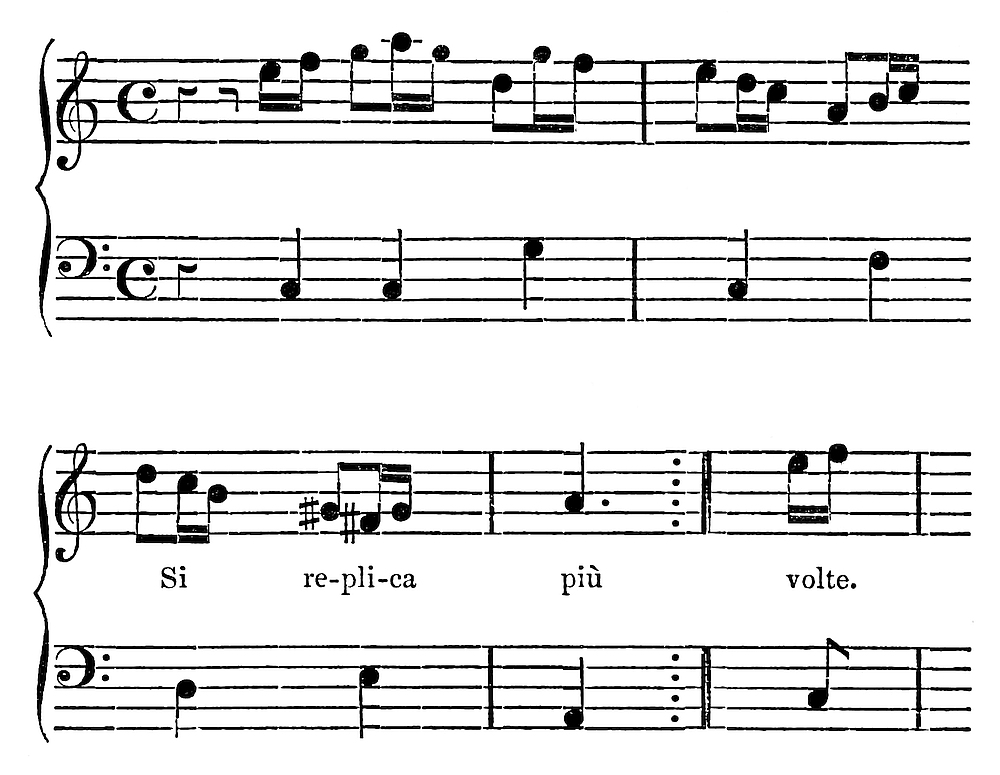
III. Tertius modus.
[Listen]
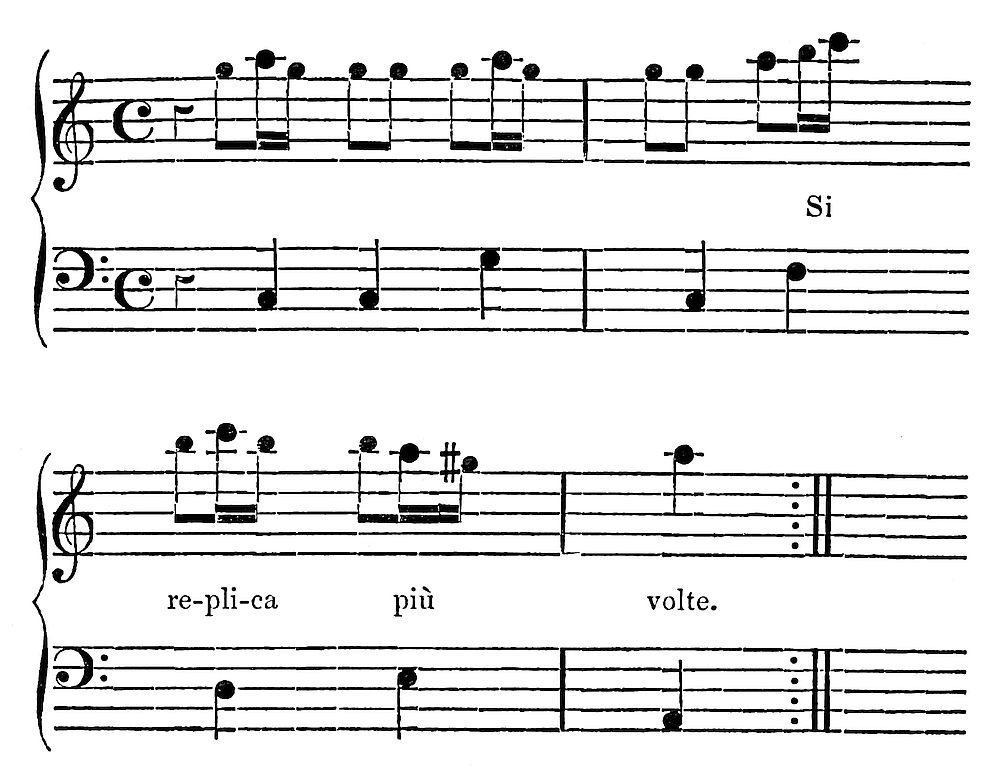
IV. Antidotum Tarantulæ.
[Listen]
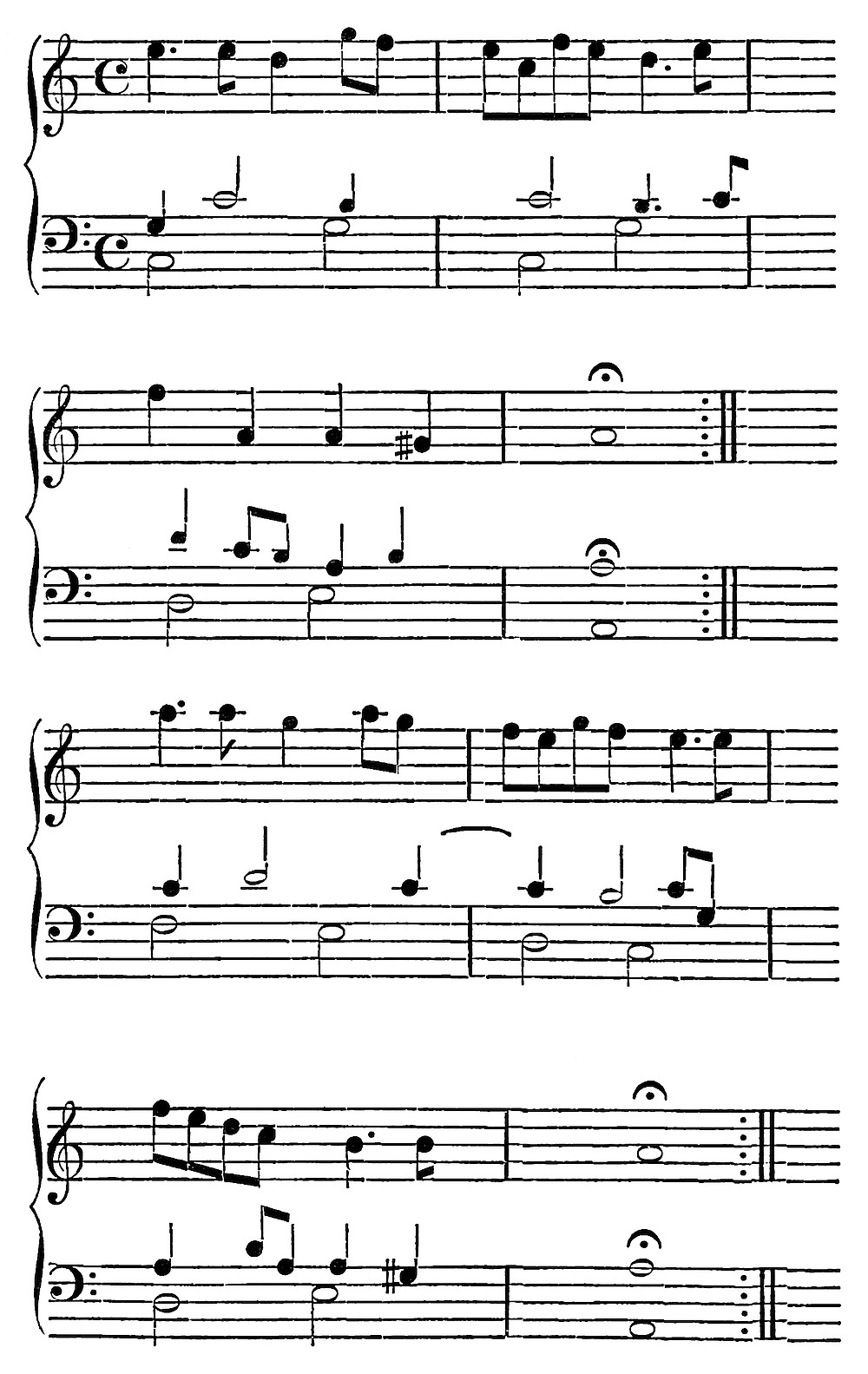
V.
[Listen]
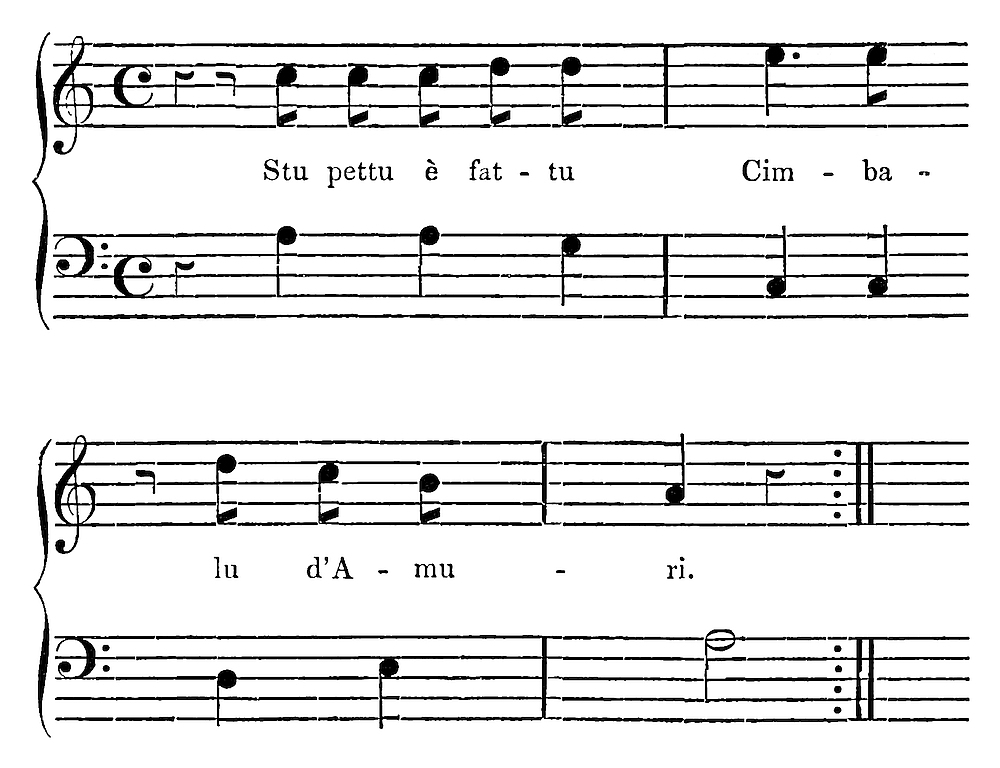
Stu pettu è fattu Cimbalu d’Amuri: Tasti li sensi mobili, e accorti: Cordi li chianti, sospiri, e duluri: Rosa è lu Cori miu feritu à morti: Strali è lu ferru, chiai so li miei arduri: Marteddu è lu pensieri, e la mia sorti: Mastra è la Donna mia, ch’à tutti l’huri Cantando canta leta la mia morti.
Some strophes, which are no longer extant, were usually sung between these and the following lines:—
Allu mari mi portati, Se voleti che mi sanati. Allu mari, alla via: Cosi m’ama la Donna mia. Allu mari, allu mari: Mentre campo, t’aggio amari.
VI. Tarantella.
[Listen]
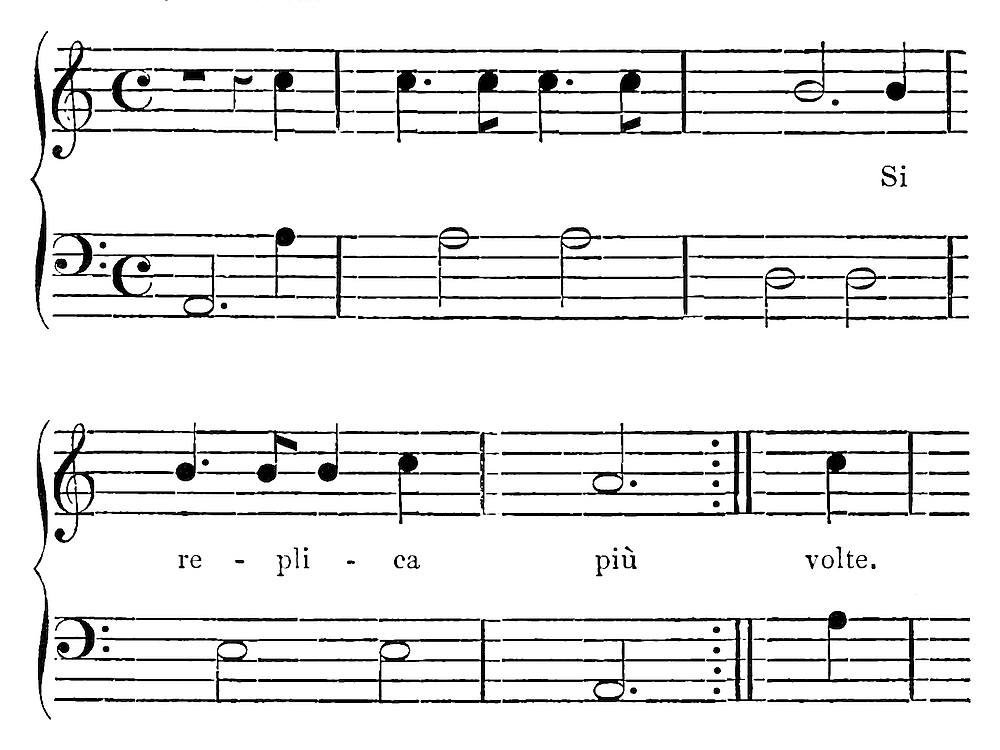
Ritornello.
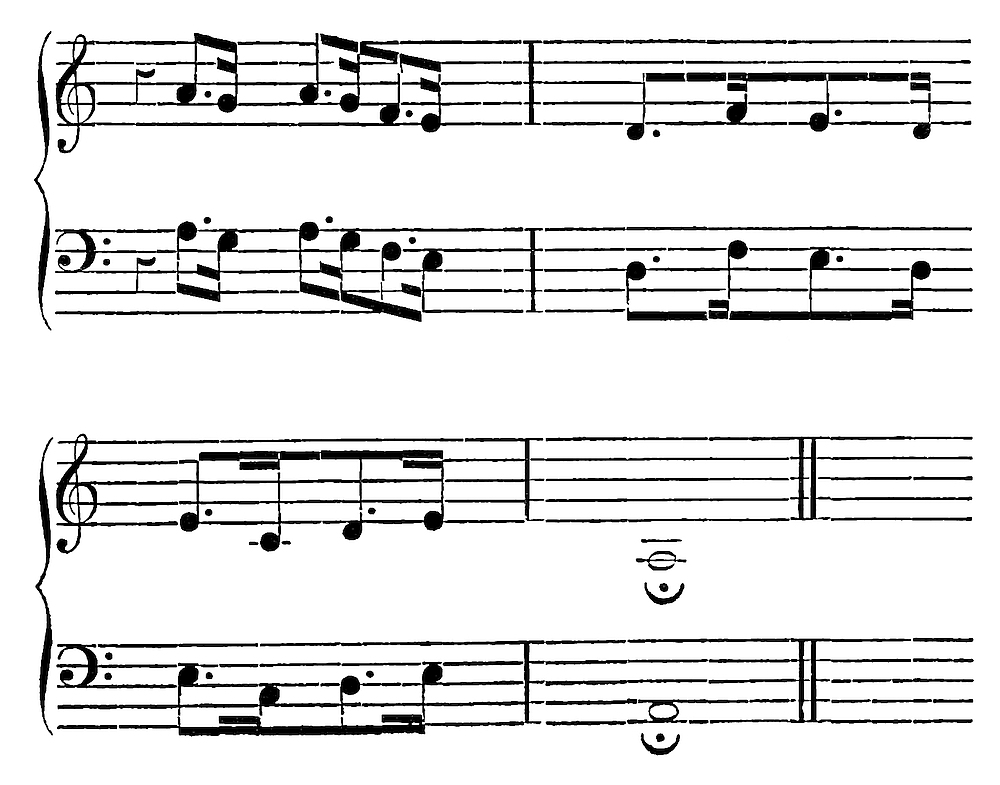
VII. Tono hypodorio.
[Listen]
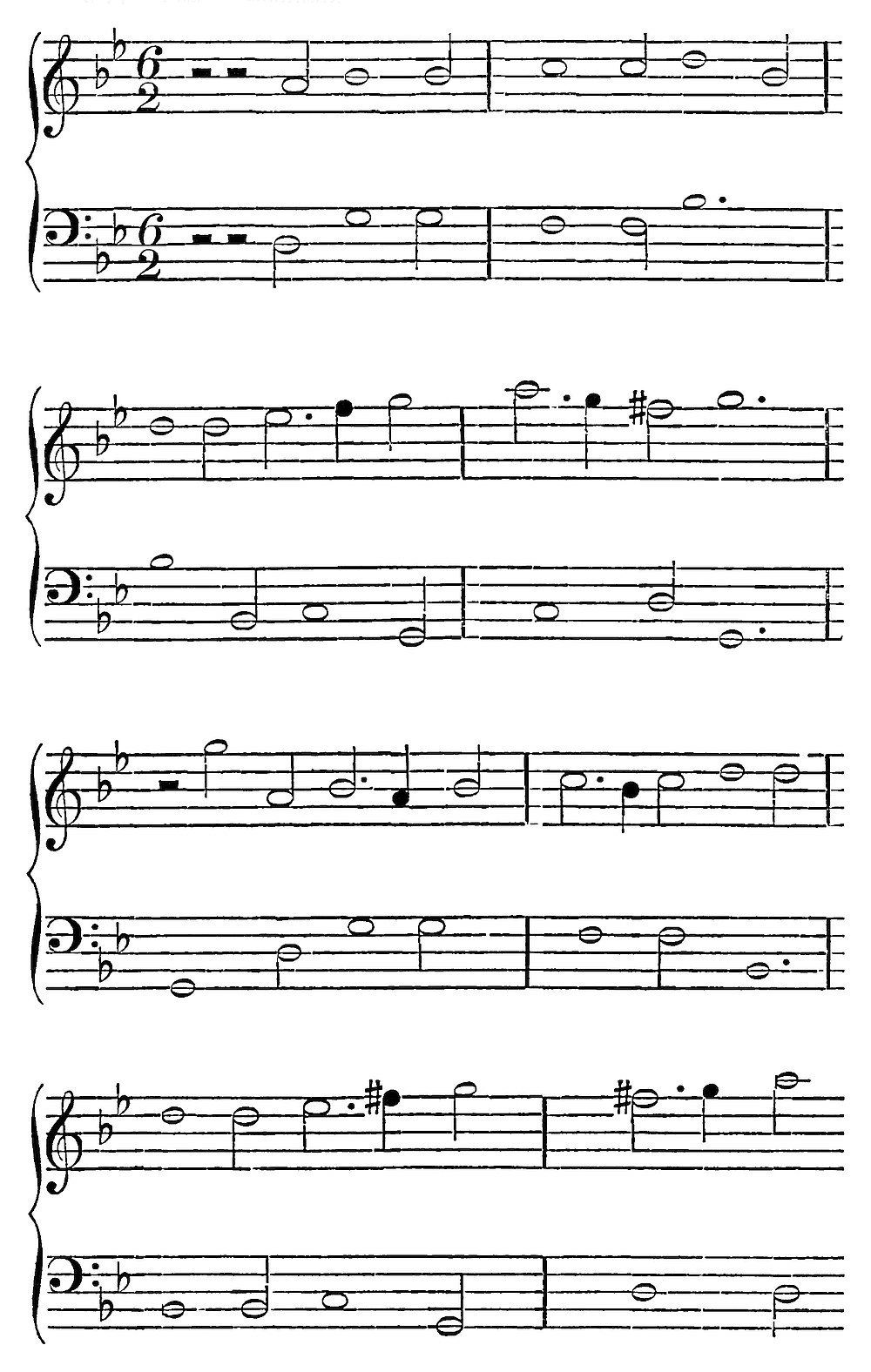
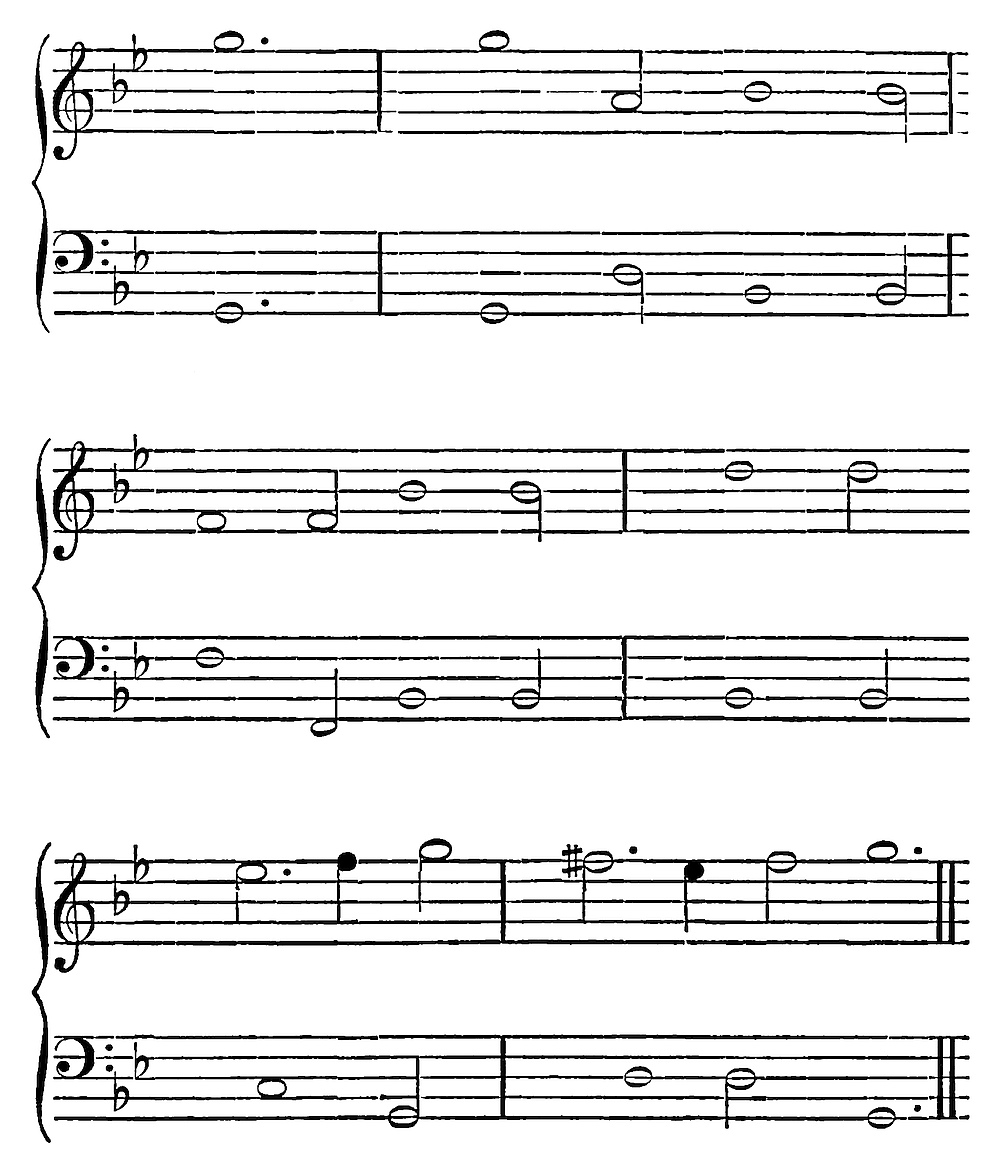
VIII. Alia clausula.
[Listen]
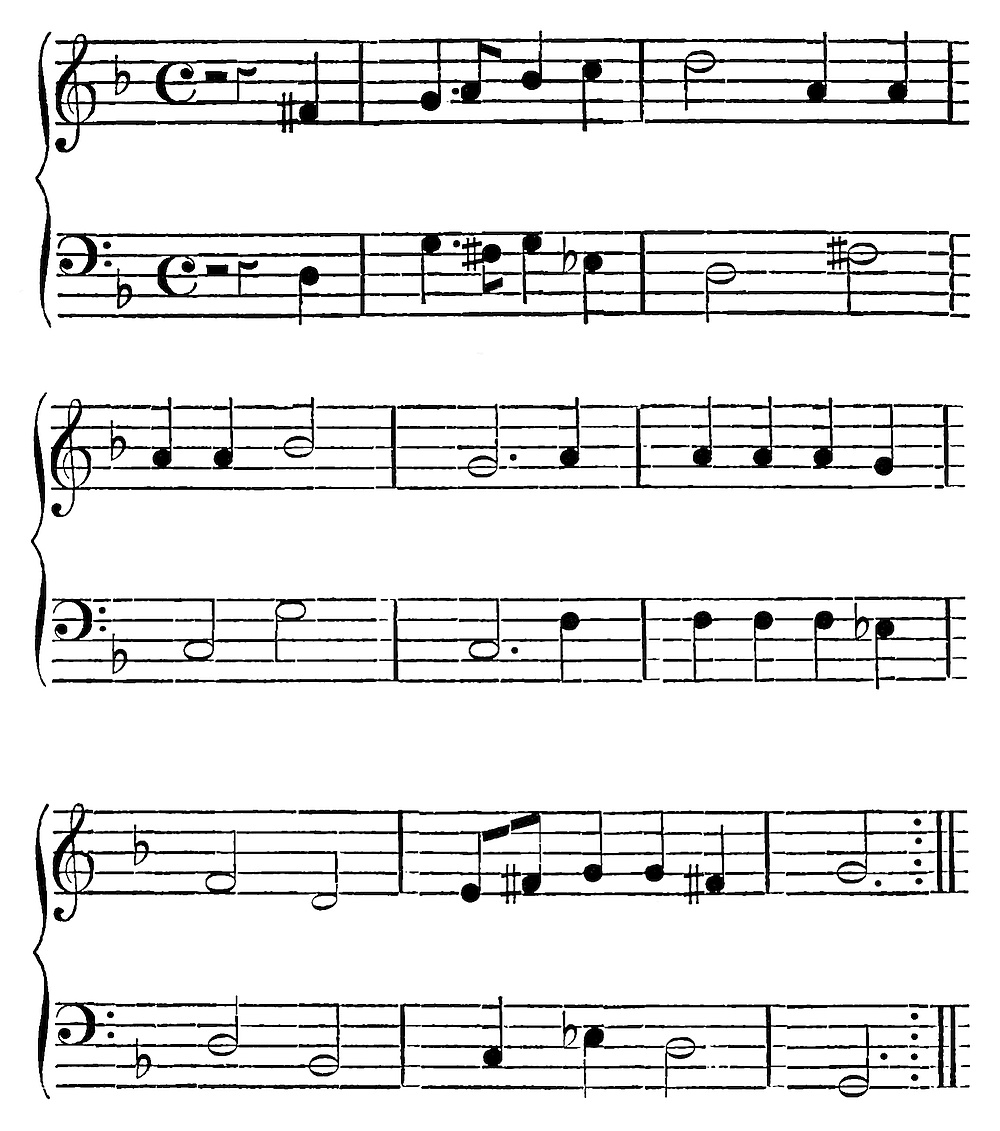
FOOTNOTES: