Volume 1 / Part 3 — CHAPTER XVI. OF MOTION ACCELERATED AND UNIFORM, AND OF MOTION BY CONCOURSE. (continued 2)
Reading edition
The proposition demonstrated in art. 2 confirmed from the elements of philosophy.
12. The truth of that proposition, which I demonstrated in art. 2, which is the foundation of all that has been said concerning deficient figures, may be derived from the elements of philosophy, as having its original in this; that all equality and inequality between two effects, that is, all proportion, proceeds from, and is determined by, the equal and unequal causes of those effects, or from the proportion which the causes, concurring to one effect, have to the causes which concur to the producing of the other effect; and that therefore the proportions of quantities are the same with the proportions of their causes. Seeing, therefore, two deficient figures, of which one is the complement of the other, are made, one by motion decreasing in a certain time and proportion, the other by the loss of motion in the same time; the causes, which make and determine the quantities of both the figures, so that they can be no other than they are, differ only in this, that the proportions by which the quantity which generates the figure proceeds in describing of the same, that 265is, the proportions of the remainders of all the times and altitudes, may be other proportions than those by which the same generating quantity decreases in making the complement of that figure, that is, the proportions of the quantity which generates the figure continually diminished. Wherefore, as the proportion of the times in which motion is lost, is to that of the decreasing quantities by which the deficient figure is generated, so will the defect or complement be to the figure itself which is generated.
An unusual way of reasoning concerning the equality between the superficies of a portion of a sphere and a circle.
13. There are also other quantities which are determinable from the knowledge of their causes, namely, from the comparison of the motions by which they are made; and that more easily than from the common elements of geometry. For example, that the superficies of any portion of a sphere is equal to that circle, whose radius is a strait line drawn from the pole of the portion to the circumference of its base, I may demonstrate in this manner. Let B A C (in fig. 7) be a portion of a sphere, whose axis is A E, and whose base is B C; and let A B be the strait line drawn from the pole A to the base in B; and let A D, equal to A B, touch the great circle B A C in the pole A. It is to be proved that the circle made by the radius A D is equal to the superficies of the portion B A C. Let the plain A E B D be understood to make a revolution about the axis A E; and it is manifest that by the strait line A D a circle will be described; and by the arch A B the superficies of a portion of a sphere; and lastly, by the subtense A B the superficies of a right cone. Now seeing both the strait line A B and the arch A B make 266one and the same revolution, and both of them have the same extreme points A and B, the cause why the spherical superficies, which is made by the arch, is greater than the conical superficies, which is made by the subtense, is, that A B the arch is greater than A B the subtense; and the cause why it is greater consists in this, that although they be both drawn from A to B, yet the subtense is drawn strait, but the arch angularly, namely, according to that angle which the arch makes with the subtense, which angle is equal to the angle D A B (for an angle of contingence adds nothing to an angle of a segment, as has been shown in chapter XIV, article 16.) Wherefore the magnitude of the angle D A B is the cause why the superficies of the portion, described by the arch A B, is greater than the superficies of the right cone described by the subtense A B.
Again, the cause why the circle described by the tangent A D is greater than the superficies of the right cone described by the subtense A B (notwithstanding that the tangent and the subtense are equal, and both moved round in the same time) is this, that A D stands at right angles to the axis, but A B obliquely; which obliquity consists in the same angle D A B. Seeing therefore the quantity of the angle D A B is that which makes the excess both of the superficies of the portion, and of the circle made by the radius A D, above the superficies of the right cone described by the subtense A B; it follows, that both the superficies of the portion and that of the circle do equally exceed the superficies of the cone. Wherefore the circle made by A D or A B, and 267the spherical superficies made by the arch A B, are equal to one another; which was to be proved.
How from the description of deficient figures in a parallelogram, any number of mean proportionals may be found out between two given strait lines.
14. If these deficient figures, which I have described in a parallelogram, were capable of exact description, then any number of mean proportionals might be found out between two strait lines given. For example, in the parallelogram A B C D, (in figure 8) let the three-sided figure of two means be described (which many call a cubical parabola); and let R and S be two given strait lines; between which, if it be required to find two mean proportionals, it may be done thus. Let it be as R to S, so B C to B F; and let F E be drawn parallel to B A, and cut the crooked line in E; then through E let G H be drawn parallel and equal to the strait line A D, and cut the diagonal B D in I; for thus we have G I the greatest of two means between G H and G E, as appears by the description of the figure in article 4. Wherefore, if it be as G H to G I, so R to another line, T, that T will be the greatest of two means between R and S. And therefore if itit be again as R to T, so T to another line, X, that will be done which was required.
In the same manner, four mean proportionals may be found out, by the description of a three-sided figure of four means; and so any other number of means, &c.
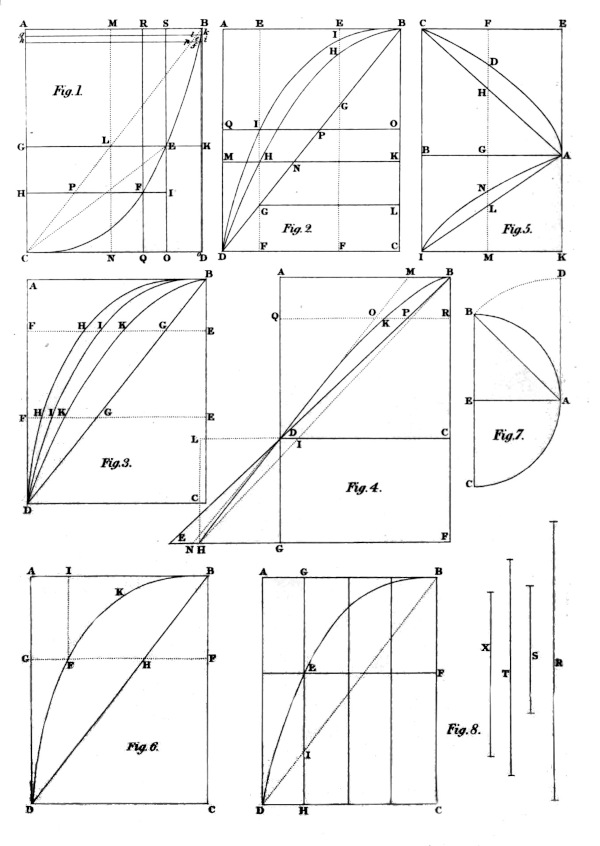
Vol. 1. Lat. & Eng. C. XVII. Fig. 1-8
Fig 1. Fig 2. Fig 3. Fig 4. Fig 5. Fig 6. Fig 7. Fig 8.
268