Volume 1 / Part 2 — CHAPTER XIII. OF ANALOGISM, OR THE SAME PROPORTION. (continued 2)
Reading edition
The subtenses of equal angles in different circles, as the strait lines B C and F E (in fig. 1), are to one another as the arches which they subtend. For (by art. 8) the arches of equal angles are to one another as their perimeters are; and (by art. 13) the perimeters as their semidiameters; but the subtenses B C and F E are parallel to one another by reason of the equality of the angles which they make with the semidiameters; and therefore the same subtenses, by the last precedent article, will be proportional to the semidiameters, that is, to the perimeters, that is, to the arches which they subtend.
By what fraction of a strait line the circumference of a circle is made.
15. If in a circle any number of equal subtenses be placed immediately after one another, and strait lines be drawn from the extreme point of the first 194subtense to the extreme points of all the rest, the first subtense being produced will make with the second subtense an external angle double to that, which is made by the same first subtense, and a tangent to the circle touching it in the extreme points thereof; and if a strait line which subtends two of those arches be produced, it will make an external angle with the third subtense, triple to the angle which is made by the tangent with the first subtense; and so continually. For with the radius A B (in fig. 7) let a circle be described, and in it let any number of equal subtenses, B C, C D, and D E, be placed; also let B D and B E be drawn; and by producing B C, B D and B E to any distance in G, H and I, let them make angles with the subtenses which succeed one another, namely, the external angles G C D, and H D E. Lastly, let the tangent K B be drawn, making with the first subtense the angle K B C. I say the angle G C D is double to the angle K B C, and the angle H D E triple to the same angle K B C. For if A C be drawn cutting B D in M, and from the point C there be drawn L C perpendicular to the same A C, then C L and M D will be parallel, by reason of the right angles at C and M; and therefore the alterne angles L C D and B D C will be equal: as also the angles B D C and C B D will be equal, because of the equality of the strait lines B C and C D. Wherefore the angle G C D is double to either of the angles C B D or C D B; and therefore also the angle G C D is double to the angle L C D, that is, to the angle K B C. Again, C D is parallel to B E, by reason of the equality of the angles C B E and D E B, and of the strait lines 195C B and D E; and therefore the angles G C D and G B E are equal; and consequently G B E, as also D E B is double to the angle K B C. But the external angle H D E is equal to the two internal D E B and D B E; and therefore the angle H D E is triple to the angle K B C, &c.; which was to be proved.
Coroll. I. From hence it is manifest, that the angles K B C and C B D, as also, that all the angles that are comprehended by two strait lines meeting in the circumference of a circle and insisting upon equal arches, are equal to one another.
Coroll. II. If the tangent B K be moved in the circumference with uniform motion about the centre B, it will in equal times cut off equal arches; and will pass over the whole perimeter in the same time in which itself describes a semiperimeter about the centre B.
Coroll. III. From hence also we may understand, what it is that determines the bending or curvation of a strait line into the circumference of a circle; namely, that it is fraction continually increasing in the same manner, as numbers, from one upwards, increase by the continual addition of unity. For the indefinite strait line K B being broken in B according to any angle, as that of K B C, and again in C according to a double angle, and in D according to an angle which is triple, and in E according to an angle which is quadruple to the first angle, and so continually, there will be described a figure which will indeed be rectilineal, if the broken parts be considered as having magnitude; but if they be understood to be the least that can be, that is, as so many points, then 196the figure described will not be rectilineal, but a circle, whose circumference will be the broken line.
Coroll. IV. From what has been said in this present article, it may also be demonstrated, that an angle in the centre is double to an angle in the circumference of the same circle, if the intercepted arches be equal. For seeing that strait line, by whose motion an angle is determined, passes over equal arches in equal times, as well from the centre as from the circumference; and while that, which is from the circumference, is passing over half its own perimeter, it passes in the same time over the whole perimeter of that which is from the centre, the arches, which it cuts off in the perimeter whose centre is A, will be double to those, which it makes in its own semiperimeter, whose centre is B. But in equal circles, as arches are to one another, so also are angles.
It may also be demonstrated, that the external angle made by a subtense produced and the next equal subtense is equal to an angle from the centre insisting upon the same arch; as in the last diagram, the angle G C D is equal to the angle C A D; for the external angle G C D is double to the angle C B D; and the angle C A D insisting upon the same arch C D is also double to the same angle C B D or K B C.
That an angle of contingence is quantity, but of a different kind from that of an angle simply so called; and that it can neither add nor take away anything from the same.
16. An angle of contingence, if it be compared with an angle simply so called, how little soever, has such proportion to it as a point has to a line; that is, no proportion at all, nor any quantity. For first, an angle of contingence is made by continual flexion; so that in the generation of it there is no 197circular motion at all, in which consists the nature of an angle simply so called; and therefore it cannot be compared with it according to quantity. Secondly, seeing the external angle made by a subtense produced and the next subtense is equal to an angle from the centre insisting upon the same arch, as in the last figure the angle G C D is equal to the angle C A D, the angle of contingence will be equal to that angle from the centre, which is made by A B and the same A B; for no part of a tangent can subtend any arch; but as the point of contact is to be taken for the subtense, so the angle of contingence is to be accounted for the external angle, and equal to that angle whose arch is the same point B.
Now, seeing an angle in general is defined to be the opening or divergence of two lines, which concur in one sole point; and seeing one opening is greater than another, it cannot be denied, but that by the very generation of it, an angle of contingence is quantity; for wheresoever there is greater and less, there is also quantity; but this quantity consists in greater and less flexion; for how much the greater a circle is, so much the nearer comes the circumference of it to the nature of a strait line; for the circumference of a circle being made by the curvation of a strait line, the less that strait line is, the greater is the curvation; and therefore, when one strait line is a tangent to many circles, the angle of contingence, which it makes with a less circle, is greater than that which it makes with a greater circle.
Nothing therefore is added to or taken from an angle simply so called, by the addition to it or 198taking from it of never so many angles of contingence. And as an angle of one sort can never be equal to an angle of the other sort, so they cannot be either greater or less than one another.
From whence it follows, that an angle of a segment, that is, the angle, which any strait line makes with any arch, is equal to the angle which is made by the same strait line, and another which touches the circle in the point of their concurrence; as in the last figure, the angle which is made between G B and B K is equal to that which is made between G B and the arch B C.
That the inclination of planes is angle simply so called.
17. An angle, which is made by two planes, is commonly called the inclination of those planes; and because planes have equal inclination in all their parts, instead of their inclination an angle is taken, which is made by two strait lines, one of which is in one, the other in the other of those planes, but both perpendicular to the common section.
A solid angle what it is.
18. A solid angle may be conceived two ways. First, for the aggregate of all the angles, which are made by the motion of a strait line, while one extreme point thereof remaining fixed, it is carried about any plain figure, in which the fixed point of the strait line is not contained. And in this sense, it seems to be understood by Euclid. Now it is manifest, that the quantity of a solid angle so conceived is no other, than the aggregate of all the angles in a superficies so described, that is, in the superficies of a pyramidal solid. Secondly, when a pyramis or cone has its vertex in the centre of a sphere, a solid angle may be understood to be the proportion of a spherical superficies subtending 199that vertex to the whole superficies of the sphere. In which sense, solid angles are to one another as the spherical bases of solids, which have their vertex in the centre of the same sphere.
What is the nature of asymptotes.
19. All the ways, by which two lines respect one another, or all the variety of their position, may be comprehended under four kinds; for any two lines whatsoever are either parallels, or being produced, if need be, or moved one of them to the other parallelly to itself, they make an angle; or else, by the like production and motion, they touch one another; or lastly, they are asymptotes. The nature of parallels, angles, and tangents, has been already declared. It remains that I speak briefly of the nature of asymptotes.
Asymptosy depends upon this, that quantity is infinitely divisible. And from hence it follows, that any line being given, and a body supposed to be moved from one extreme thereof towards the other, it is possible, by taking degrees of velocity always less and less, in such proportion as the parts of the line are made less by continual division, that the same body may be always moved forwards in that line, and yet never reach the end of it. For it is manifest, that if any strait line, as A F, (in the 8th figure) be cut anywhere in B, and again B F be cut in C, and C F in D, and D F in E, and so eternally, and there be drawn from the point F, the strait line F F at any angle A F F; and lastly, if the strait lines A F, B F, C F, D F, E F, &c., having the same proportion to one another with the segments of the line A F, be set in order and parallel to the same A F, the crooked line A B C D E, and the strait line F F, will be asymptotes, that is, they 200will always come nearer and nearer together, but never touch one another. Now, because any line may be cut eternally according to the proportions which the segments have to one another, therefore the divers kinds of asymptotes are infinite in number, and not necessary to be further spoken of in this place. In the nature of asymptotes in general there is no more, than that they come still nearer and nearer, but never touch. But in special in the asymptosy of hyperbolic lines, it is understood they should approach to a distance less than any given quantity.
Situation, by what it is determined.
20. Situation is the relation of one place to another; and where there are many places, their situation is determined by four things; by their distances from one another; by several distances from a place assigned; by the order of strait lines drawn from a place assigned to the places of them all; and by the angles which are made by the lines so drawn. For if their distances, order, and angles, be given, that is, be certainly known, their several places will also be so certainly known, as that they can be no other.
What is like situation; what is figure; and what are like figures.
21. Points, how many soever they be, have like situation with an equal number of other points, when all the strait lines, that are drawn from some one point to all these, have severally the same proportion to those, that are drawn in the same order and at equal angles from some one point to all those. For let there be any number of points as A, B, and C, (in the 9th figure) to which from some one point D let the strait lines D A, D B, and D C be drawn; and let there be an equal number of other points, as E, F, and G, and from some 201point H let the strait lines H E, H F, and H G be drawn, so that the angles A D B and B D C be severally and in the same order equal to the angles E H F and F H G, and the strait lines D A, D B, and D C proportional to the strait lines H E, H F, and H G; I say, the three points A, B, and C, have like situation with the three points E, F, and G, or are placed alike. For if H E be understood to be laid upon D A, so that the point H be in D, the point F will be in the strait line D B, by reason of the equality of the angles A D B and E H F; and the point G will be in the strait line D C, by reason of the equality of the angles B D C and F H G; and the strait lines A B and E F, as also B C and F G, will be parallel, because A D. E H :: B D. F H :: C D. G H are proportionals by construction; and therefore the distances between the points A and B, and the points B and C, will be proportional to the distances between the points E and F, and the points F and G. Wherefore, in the situation of the points A, B, and C, and the situation of the points E, F and G, the angles in the same order are equal; so that their situations differ in nothing but the inequality of their distances from one another, and of their distances from the points D and H. Now, in both the orders of points, those inequalities are equal; for A B. B C :: E F. F G, which are their distances from one another, as also D A. D B. D C :: H E. H F. H G, which are their distances from the assumed points D and H, are proportionals. Their difference, therefore, consists solely in the magnitude of their distances. But, by the definition of like, (chapter I. article 2) those things, which differ only in magnitude, are like. Wherefore the points A, B, and C, have to 202one another like situation with the points E, F, and G, or are placed alike; which was to be proved.
Figure is quantity, determined by the situation or placing of all its extreme points. Now I call those points extreme, which are contiguous to the place which is without the figure. In lines therefore and superficies, all points may be called extreme; but in solids only those which are in the superficies that includes them.
Like figures are those, whose extreme points in one of them are all placed like all the extreme points in the other; for such figures differ in nothing but magnitude.
And like figures are alike placed, when in both of them the homologal strait lines, that is, the strait lines which connect the points which answer one another, are parallel, and have their proportional sides inclined the same way.
And seeing every strait line is like every other strait line, and every plane like every other plane, when nothing but planeness is considered; if the lines, which include planes, or the superficies, which include solids, have their proportions known, it will not be hard to know whether any figure be like or unlike to another propounded figure.
And thus much concerning the first grounds of philosophy. The next place belongs to geometry; in which the quantities of figures are sought out from the proportions of lines and angles. Wherefore it is necessary for him, that would study geometry, to know first what is the nature of quantity, proportion, angle and figure. Having therefore explained these in the three last chapters, I thought fit to add them to this part; and so pass to the next.
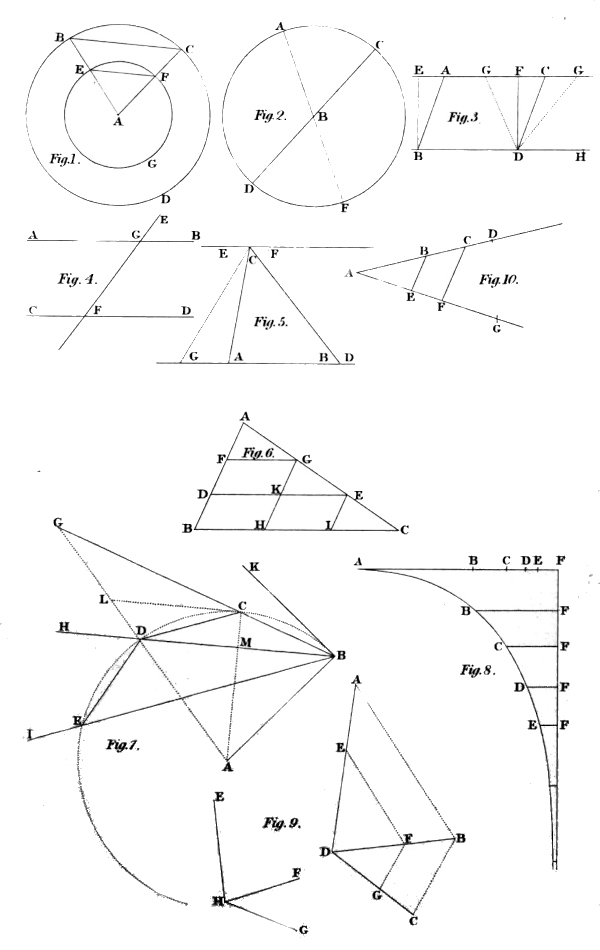
Vol. 1. Lat. & Eng. C. XIV. Fig. 1-10
Fig 1. Fig 2. Fig 3. Fig 4. Fig 5. Fig 6. Fig 7. Fig 8. Fig 9. Fig 10.
203