A SHORT ODE AT PARTING,
Reading edition
FROM HIS "SPIRIT IN THE CLOUDS"
TO THE ENGLISH SPY.
Prospero. Now does my project gather to a head; My charms crack not; my spirits obey: ——How's the day? Ariel. On the sixth hour; at which time, my lord, You said our work should cease. —Shakspkare's Tempest. So fare you well; I have left you commands. Ibid.—As you like it. "'Tis true, and pity 'tis, 'tis true," That though on fairest winds we flew, I in the clouds, beneath them you, We still must parted be; And that, e'en whilst the world still hung On what you wrote, and what I sung, Enamour'd of our double tongue, Exits my Bernard B——-. Well, all great actors must have pause, When toiling in a patriot cause, And ere another scene he draws, New characters to cast,
Secure of having played his part, As nature dictates, from the heart, 'Tis fair before another start, He brush up from the last. But how will humbugs of the age, (I don't mean Mr. B.'s dull page,) Crow that they scape satiric rage, And get off in whole skins; How will dramatic fools rejoice! No more is heard great Bernard's voice, And that, Heav'n knows, there is a choice, Their flummery begins.{1} But go your ways; it may be wise, To let these puny, pestering flies Buzz about people's ears and eyes, A season or two longer; There must be evil mixed with good, A bottom to the clearest flood, And let them stand where others stood, Till shown who is the stronger. Then, fortune-hunting squires of Bath, Fine as the Burmese jewell'd Rath,{2} Pray totter o'er your Bond-street path, A respite short is yours. 1 I speak of would-be actors (male and female), vain and incompetent managers, flippant and unequal critics, puffed and translating authors, in short, of all before and behind the curtain who have injured, or may injuro, the legitimate drama. Let the theatres, like our trade, be free, and monopoly thrive not, and for their success the Spirit will ever pray; at present, it is "a mad world, my masters;" and I am afraid Mr. Rayner with his long and set speeches, as chairman of Thomas's Shakspeareans, will not mend the matter. We note this to him in a friendly way; seeing, that he is a worthy fellow, and a clever Caliban, and really loves Shakspeare next to Newmarket and Doncaster. 2 The Burmese carriage is certainly a curious machine of Indian workmanship; but it is, we should fancy, mere outside—fine to look at, but a "rum one to go," like the be-togged, be-booted, be-spurred, furred, and cloaked half pays, fortune-hunters, gentlemen with the brogue, &c. that pay their court so assiduously to Mrs. Dolland's cheesecakes and Mr. Heaviside's quadrilles. But the world is often ornament caught.
And daughter-selling mothers, still Lure the young boys, their eyes may kill, To wed your flesh and blood, and fill Your purse, and pay your tours. Ye London blacks, ye Cheltenham whites,{3} Ye turners of the days to nights, Make, make the most of all your flights, Whilst I and Bernard doze; But still be sure, by this same token, We still shall sleep with one eye open{4} And the first hour our nap is broken, You'll pay for't through the nose. 3 There are indeed "black spirits and white spirits" of all sorts and sizes, at all times and places; and a well-cut coat and a white satin dress are frequently equally dangerous glossings to frail and cunning mortality within. To be sure, we have brought down the "tainted wethers of dame Nature's flock" with the double barrels of wit and satire, right and left; but like mushrooms or mole-hills, they are a breeding, increasing species, and it will be only a real battue of sharp-shooting that will destroy the coveys. Nevertheless, "I have a rod in pickle, Their—————————" I declare the Spirit is growing earthly. 4 The Bristol men "down along," sleep, they say, in this way and hence is it rare for Jew or Gentile, Turk or infidel, to get the blind side of them. Some of them, however, have ere now been done brown, and that too by being too fanciful and neat in their likings. These tales of the sleepers of an eye are too good to be lost; they shall be bound up in the volume of my brain, hereafter to be perused with advantage. At present, "I hear a voice thou canst not hear; I see a hand thou canst not see; It calls to me from yonder sphere, It points to where my brethren be."
When that time comes, and come it must, For what we say is not pie-crust, To yield to every trifling thrust, England shall see some fun. Like "eagles in a dove-cote," we Both rooks and pigeons will make flee, Whilst every cashless company Shall, laugh'd at, "cut and run." Thus telling painted folly's sect, What they're to look to, what expect, My farewell words I now direct To thee, migrating Spy; That done, deliver'd all commands, I man a cloud-ship with brave hands, And sail to (quitting mortal lands), My parlour in the sky. Bernard, farewell; may rosy health Companion'd by that cherub wealth, Be constant to you, like myself, Your own departing spirit. Not that you're going to die; no, no, You'll only take a nap or so; But yet I wish you, 'fore you go, These blessings to inherit. Bernard, farewell; pray think of me, When you ride earth, or cross the sea; On both, you know, I've been with thee, And sung some pretty things; Great Spy, farewell; when next you rise To make of fools a sacrifice, You'll hear, down-cleaving from the skies, The rustle of my wings. January, 1826.
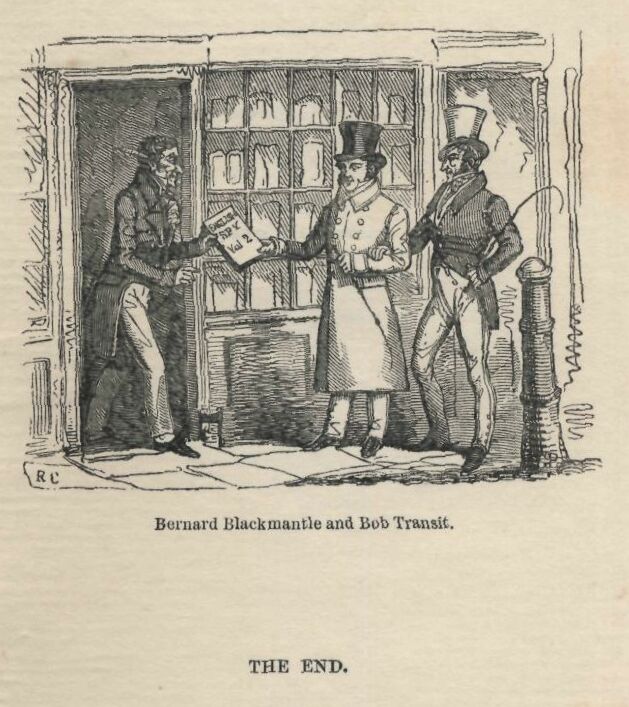
Bernard Blackmantle and Bob Transit,
THE END.