Front matter
Reading edition
The
Emily Emmins Papers
By
Carolyn Wells
With Illustrations by
Josephine A. Meyer
G. P. Putnam’s Sons
New York and London
The Knickerbocker Press
1907
Copyright, 1907
by
G. P. Putnam’s Sons
The Knickerbocker Press, New York
TO
EDITH MENDALL-TAYLOR
IN MEMORY OF
PICCADILLY
CHAPTERPAGE
I.A Ticket to Europe1
II.Crossing the Atlantic23
III.“In England—Now!”45
IV.Mayfair in the Fair Month of May67
V.A Hostess at Home86
VI.The Light on Burns’s Brow106
VII.Certain Social Uncertainties126
VIII.A Sentimental Journey146
IX.All in a Garden Fair167
X.“I Went and Ranged about to Many Churches”186
XI.Piccadilly Circus and its Environs208
XII.The Game of Going On230
XIII.A French Week-End252
Transcriber's Notes can be found at the end of this eBook.
The Emily Emmins Papers

It has always seemed to me a pity that nearly all of the people one meets walking in New York are going somewhere. I mean they have some definite destination. Thus they lose the rare delight, that all too little known pleasure, of a desultory stroll through the city streets. For myself, I know of no greater joy than an aimless ramble along the crowded metropolitan thoroughfares. Nor does ramble imply, as some might mistakenly suppose, a slow, dawdling gait. Not at all; the atmosphere of the city itself inspires a brisk, steady jog-trot; but the impression of a ramble is inevitable if the jog-trot have no intended goal.
I am a country woman,—that is, I live in a suburban town; but it is quite near enough to the metropolis for us to consider ourselves near-New Yorkers. And Myrtlemead is a dear little worth-while place in its own way. We have a Current Culture Club and a Carnegie library and several of us have telephones. I am not a member of the Club, but that must not be considered as any disparagement of my culture—or, rather, of my capacity for assimilating culture (for the Club’s aim is the disbursement of that desirable commodity). On the contrary, I was among the first invited to belong to it.
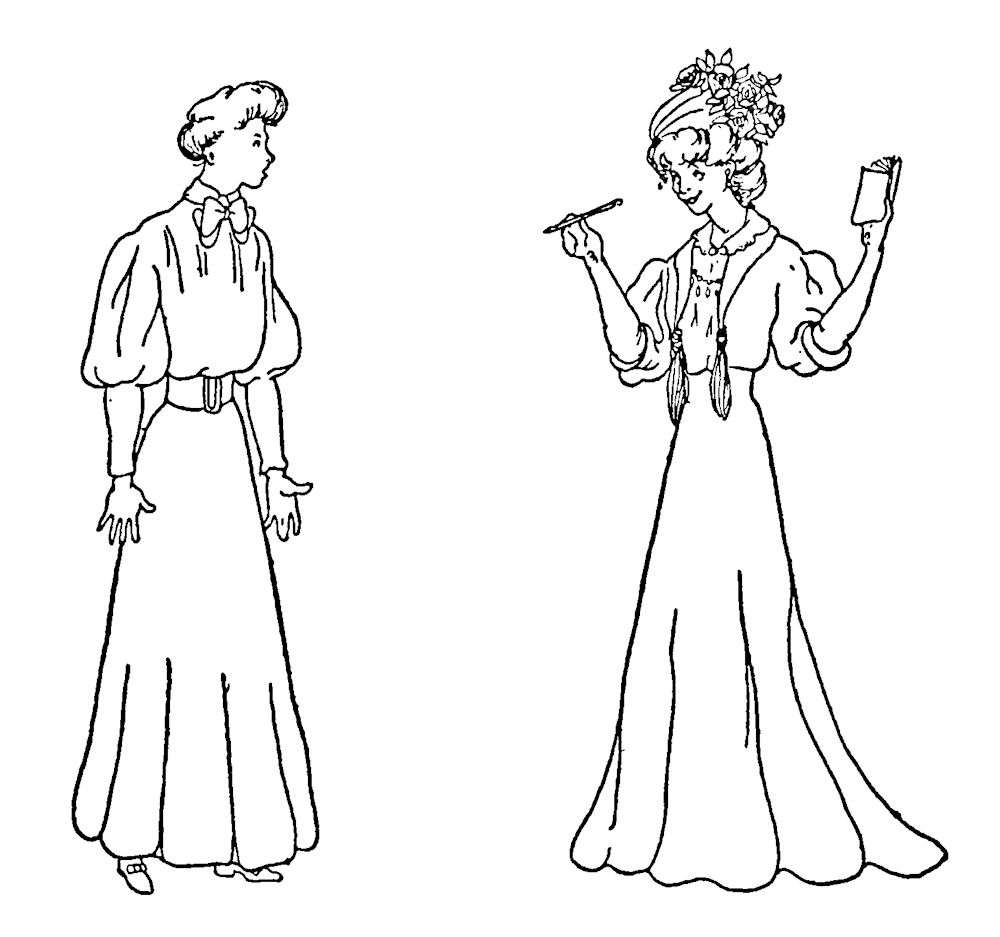
Oh! yes, you have temperament, she twittered.
“You must be a member, Miss Emmins,” said the vivacious young thing who called to lay the matter before me, “because you have so much temperament.”
This word was little used in Myrtlemead at this time (although, since, it has become as plenty as blackberries), and I simply said “What!” in amazement.
“Oh! yes, you have,” she twittered, “and you create an atmosphere. Don’t attempt to deny it,—you know you do create an atmosphere.” This was too much. I didn’t join the Club, although I occasionally look in on them at their cultured tea hour, which follows the more intellectual part of their programme. As they have delicious chicken-salad and hot rolls and coffee, I find their culture rather comforting than otherwise.
Living so near New York, I find it convenient to run into the city whenever I hear it calling.
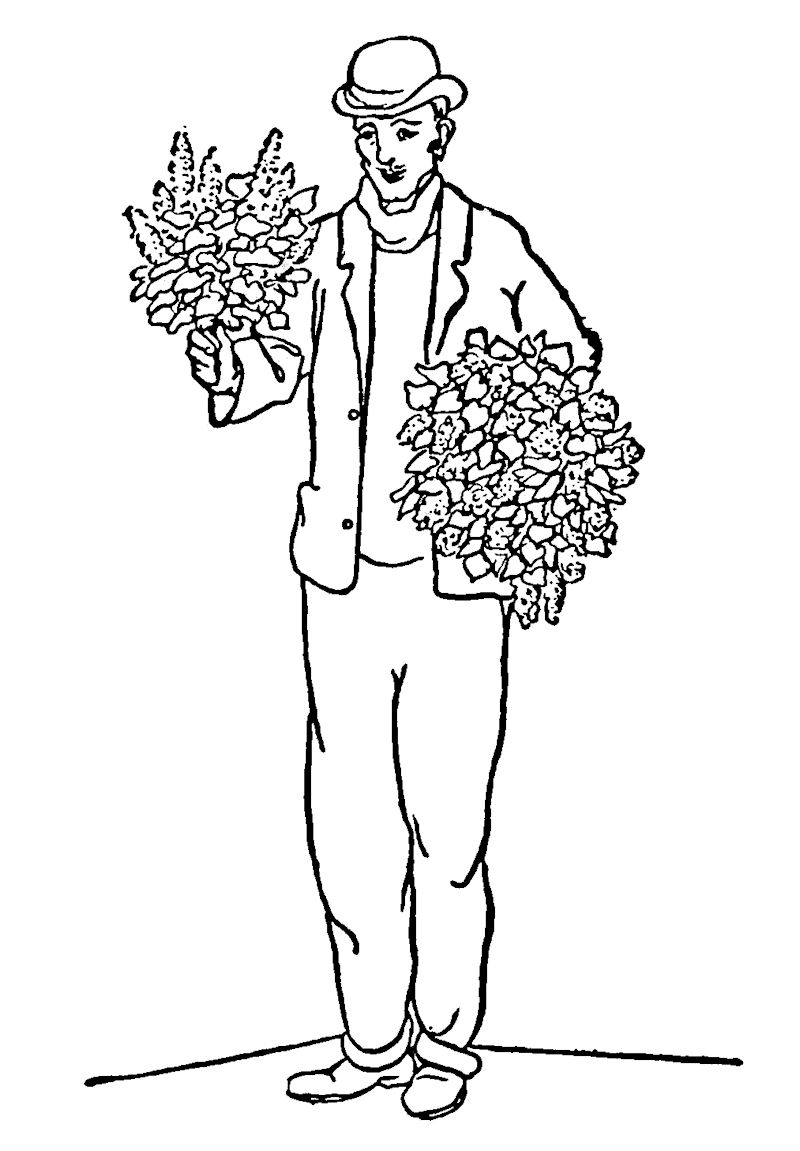
Lilacs blossom along the curb
In the spring its calls are especially urgent. I know popular sympathy leans toward springtime in the country, but for my part, as soon as March has blown itself away, and April comes whirling along the cleared path of the year, I hurry to keep my annual appointment to meet Spring in New York. The trees are budding in the parks, daffodils and tulips are blooming riotously on the street-corners, while hyacinths and lilacs blossom along the curb. A pearl-colored cloud is poised in that intense blue just above the Flatiron Building, and the pretty city girls smile as they prank along in their smart spring costumes behind their violet mows. The birds twitter with a sophisticated chirp, and the street-pianos respond with a brisk sharpness of tune and time. The very air is full of an urban ozone, that is quite different from the romantic lassitude of spring in the country.
Of course, all this is a matter of individual taste. I prefer walking in dainty boots, along a clean city pavement, while another equally sound mind might vote for common-sense shoes and a rough country road.
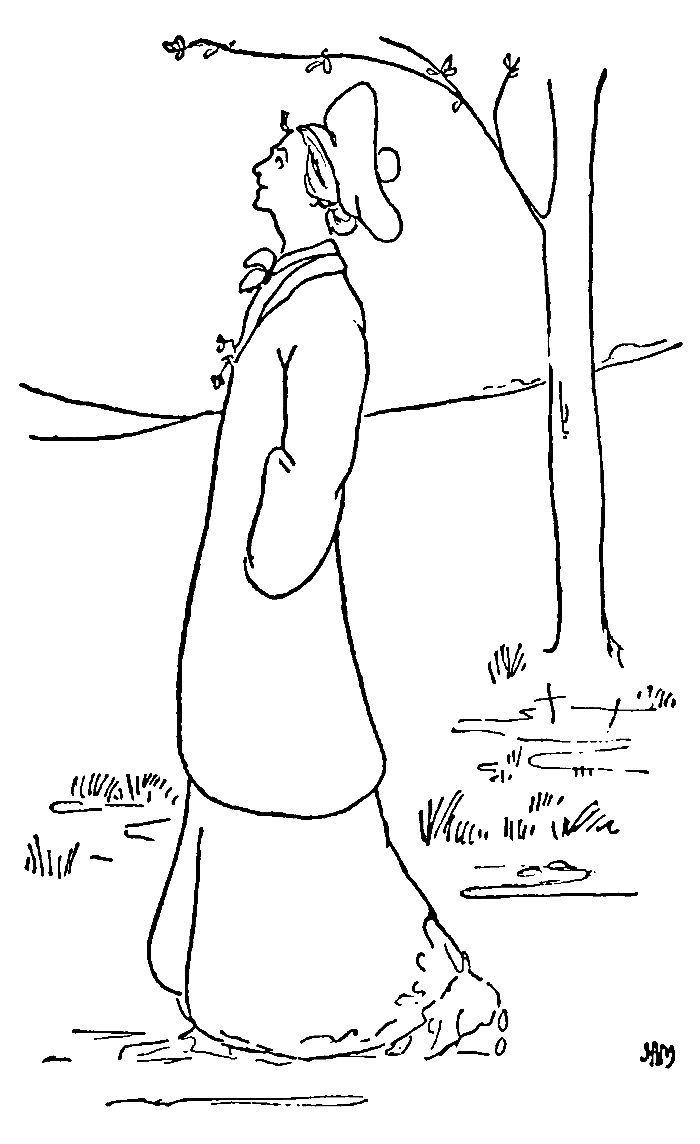
Common-sense shoes and a rough country road.
And so, as I, Emily Emmins, spinster, have the full courage of my own convictions, I found myself one crisp April morning walking happily along the lower portion of Broadway. Impulse urged me on toward the Battery, but, as often happens, my impulse was side-tracked. And all because of a woman’s smiling face. I was passing the offices of the various steamship companies, and I saw, coming down the steps of one of them, a young woman whose countenance was positively glorified with joy. I couldn’t resist a second glance at her, and I saw that both her hands were filled with circulars and booklets.
It required no clairvoyance to understand the situation; she had just bought her first ticket to Europe, and it was the glorious achievement of a lifelong desire. I knew, as well as if she had told me, how she had planned and economized for it, and probably studied all sorts of text-books that she might properly enjoy her trip, and make it an education as well as a pleasure. And as I looked at the gay-colored pamphlets she clutched, I was moved to go in and acquire a few for myself.
With Emily Emmins, to incline is to proceed; so I stepped blithely into the big light office and requested booklets. They were bestowed on me in large numbers, the affable clerk was most polite, and,—well, I’m sure I don’t know how it happened, but the first thing I knew I was paying a deposit on my return ticket to Liverpool.
I may as well confess, at the outset, that I am of a chameleonic nature. I not only take color from my surroundings, but reflect manners and customs as accurately and easily as a mirror. And so, in that great, business-like office, with its maps and charts and time-tables and steamer plans, the only possible thing to do seemed to be to buy my ticket, and I did so. But I freely admit it was entirely the influence of the ocean-going surroundings that made the deed seem to me a casual and natural one. No sooner had I regained the street, with its spring air and stone pavement, than I realized I had done something unusual and perhaps ill-advised. However, a chameleonic nature implies an ability to accept a situation, and after one jostled moment I walked uptown, planning as I went.
Two days later the postman brought me an unusually large budget of mail. The first letter I opened caused me some surprise, and a mild amusement. It began, quite cosily:
Miss Emily Emmins.
Dear Madam: Learning that you intend sailing from New York in the near future, I take the liberty of calling your attention to the Hotel Xantippe as a most desirable stopping place during your stay in this city.
The letter went on to detail the advantages and charms of the hotel, and gave a complete list of rates, which, for the comforts and luxuries promised, seemed reasonable indeed! But how in the world did the urbane proprietor of the Hotel Xantippe know that I contemplated a trip abroad? I hadn’t yet divulged my secret to my fellow-residents of Myrtlemead, and how an utter stranger could learn of it, was a puzzle to me. But the other letters were equally amazing. One from a dry-goods emporium besought me to inspect their wares before going abroad to buy. Another begged me to purchase their shoes, and gave fearful warnings of the shortcomings of English footgear. Another, and perhaps the most flattering, requested the honor of taking my photograph before I sailed. But one and all seemed not only cognizant of my recently formed plans, but entirely approved of them, and earnestly desired to assist me in carrying them out.
With my willingness to accept a situation, I at once assumed that somehow the news of my intended departure had crept into one or other of the New York daily papers. I couldn’t understand why this should be, but surely the only possible explanation was my own prominence in the public eye. This, I placidly admitted to myself, was surprising, but gratifying. To be sure, I had written a few nondescript verses, and an occasional paper on some foolish thing as a fine art, but I had not reached the point where my name was mentioned among “What Our Authors are Saying and Doing.”
However—alas for my vainglory!—a neighbor soon explained to me, that all up-to-date business firms procure lists of those who have bought steamship tickets, and send circular letters to each address. This was indeed a blow to my vanity, but so interesting were the letters which continued to pour in that I cared little for the reason of their sending. They pleased me mightily, because of their patronizing attitude, treating me as if I were either Josiah Allen’s wife or a Choctaw Indian. Invariably they assumed I had never been in the metropolis before, and would prove exceeding ignorant of its ways. Nor were they entirely mistaken.
One elaborate circular set forth the wonders of the city as viewed from the “Seeing [or Touring] New York Motor-Coach.” Now I had passed these great arks hundreds of times, but it had never occurred to me to enter one. And yet, so great is my susceptibility to suggestion, that I determined to take the trip before leaving my native land.
Another letter left me hesitating as to whether my proposed journey was advisable after all. This letter was from the Elsinore Travel Bureau, and explained how, by the purchase of a new-fangled stereoscope and innumerable sets of “views,” one could get far more satisfaction out of a European trip by staying at home than by going abroad. “So real are the scenes,” the circular assured me, “that one involuntarily stretches out a hand to grasp what isn’t there.” Surely, realism need go no farther than that; yet some over-exacting people might demand that the grasped-for thing should be there.
At least, that’s the way I felt about it; and besides, now that all Myrtlemead was stirred up over my going to Europe, I couldn’t decently abandon my project. That’s one of the delightful annoyances of life in a country village. Everybody belongs to everybody else, and your neighbors have a perfect right to be as interferingly helpful as they choose. My house was besieged by what I came to call the noble army of starters, for the kind-hearted ones brought me every imaginable help or hindrance to an ocean voyage.
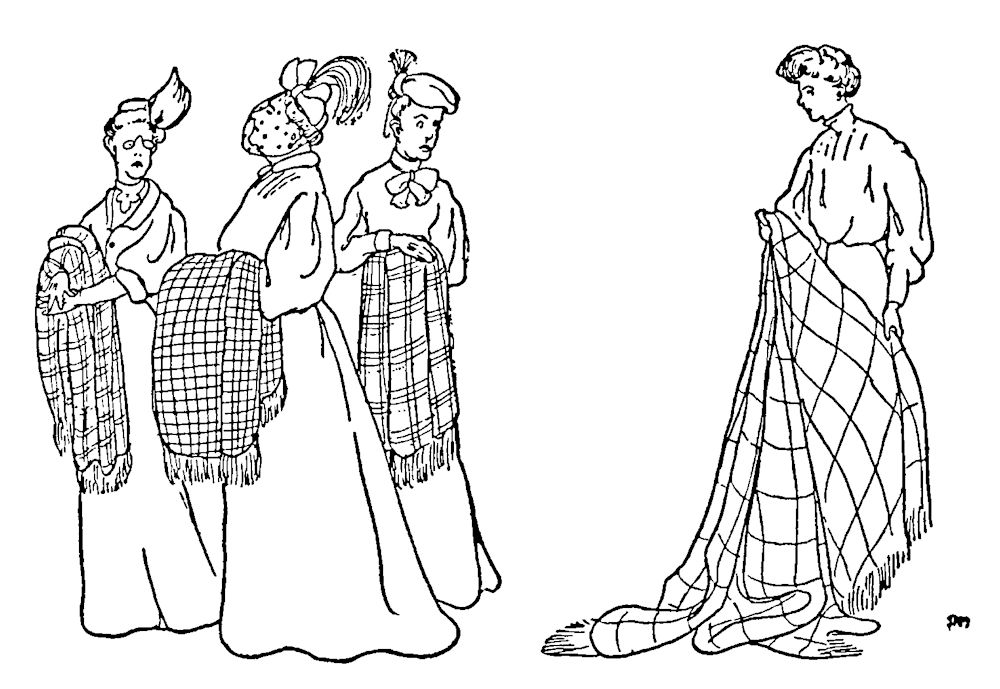
They walked away with their plaids in their arms and their heads in the air.
I had already bought myself a steamer rug, whose soft bright colors and silky texture delighted my soul; but none the less were steamer rugs brought me by dozens, as intended loans. It was with a slight air of resentment that my would-be benefactors received my humble apology for possessing a rug of my own, and walked away with their plaids in their arms and their heads in the air. Then came one who earnestly advised me not to take my lovely, silky rug, as it was sure to be ruined on the steamer, and after that to be devoured by moths during its summer in a steamer trunk. The best plan, she informed me, was to hire a rug from the steamship company, as I would hire my deck-chair, and leave my own rug at home, to be used as a couch robe. Being amiable by nature I agreed to this plan. Next came a neighbor who, having heard that I had concluded to hire a rug on the steamer, asked to borrow mine to take with her on a lake trip. Of course I lent it to her, but a few weeks later, when I tried to cuddle into one of the small harsh rugs that the steamship company provides, I almost regretted my amiability.
Then came friends with cushions—large, small, and double-jointed. Also, they brought air-pillows, and water-pillows, and patent contrivances for comfort, that were numerous and bulky, and adequately expressed their donors’ kind interest in my well-being at sea. Also came many sure and absolute remedies for sea-sickness, or preventives thereof. Had I taken them all with me, and had they made good their promise, not one of the cabin passengers, or the steerage, need have been ill for a moment. Interspersed among the more material gifts was much and various advice.
This was easily remembered, for taken as a whole it included every possible way of doing anything. Said one: “Pack your trunks very tightly, for clothing carries much better that way.” Said another: “Pack your trunks very loosely; for then you will have room to bring home many purchases and yet declare at customs only the same number of trunks as you took with you from America.” Said a third: “Let me help you pack, for if a trunk is crammed too tightly or filled too loosely, it makes all sorts of trouble.”
But, being amiable, I smiled pleasantly on all, agreed with each adviser, and held my peace. For, to me, preliminaries mattered little, and I knew that as soon as I was fairly at sea, or at least beyond the three-mile limit, I could make my own plans, and carry them out without let or hindrance.
My itinerary was, of course, arranged and rearranged for me, but usually the would-be arbiters of my destinations fell into such hot discussions among themselves that they quite forgot I was going away at all. But it mattered little to me whether they advised the Riviera by way of the North Cape, or the Italian lakes after the Cathedral tour; for my entire summer was irrevocably planned in my own mind. No “touristing” for me. No darting through Europe with a shirtwaist in a “suit” case, and a Baedeker in my other hand.
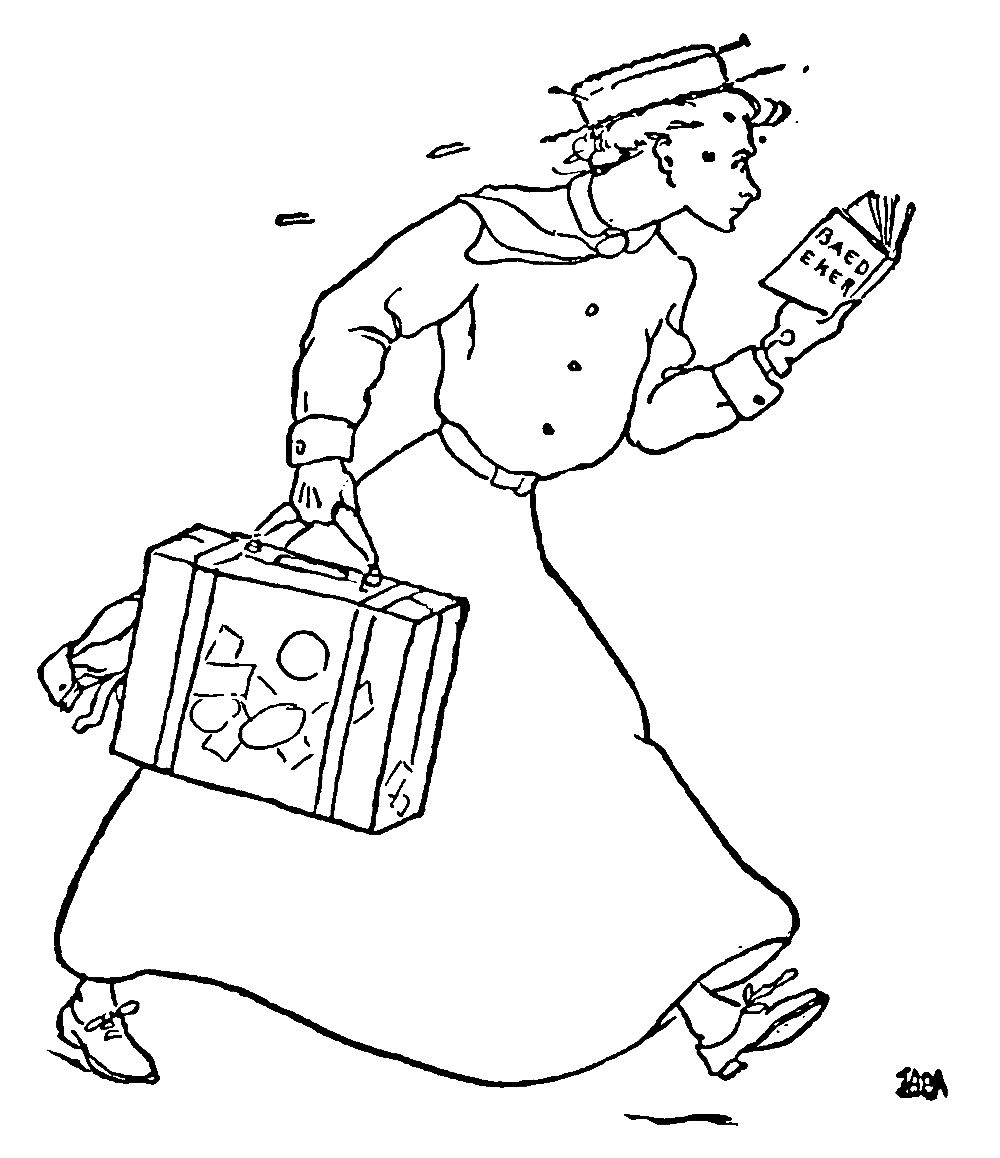
No “touristing” for me.
No, my “tour of extended foreign travel,” as our local newspaper persisted in calling it, was, on my part, an immutable resolve to go by the most direct route to London and remain there until the date of my return ticket to New York. This plan, being simple in the main, left me leisure to listen to my friends’ advices and recommendations. But, though I listened politely, I really paid little heed, and at last I sailed away with the advice, in a confused medley drifting out of my memory.
The only points that seemed to be impressed on my mind were that, in London parlance, “Thank you” invariably means either “Yes” or “No” (nobody seemed quite sure which), and that in England one must always call a telephone a lift.
The most remarkable effect of a sea-trip is, to my mind, its wonderful influence for amiability. I hadn’t passed Sandy Hook before I felt an affable suavity settling down upon me like a February fog. I am at all times of a contented and peaceful nature, but this lethargic urbanity was a new sensation, and, as I opined it was but the beginning of a series of new sensations, I gave myself up to it with a satisfied feeling that my trip had really begun.
And yet I was haunted by a vague uneasiness that it hadn’t begun right. I had planned to be most methodical on this voyage. I had resolved that when I came aboard I would go first to my stateroom and unpack my steamer trunk, arrange my belongings neatly in their proper portholes and bunkers, find my reserved deck-chair, and attach to it my carefully tagged rug and pillow. Then I meant to take off and pack away my pretty travelling costume, and array myself in my “steamer clothes,” these having been selected with much care and thought in accordance with numerous and conflicting advices.
Whereas, instead of all this, I had hurriedly looked into my stateroom, and only noted that it was a tiny white box, piled high with luggage, part of which I recognized as my own, and the rest I assumed belonged to my as yet unknown room-mate. Then I had drifted out on deck, dropped into some chair, I know not whose; and, still in my trig tailor-made costume and feathered hat, I watched the coast line fade away and leave the sea and sky alone together.
Suddenly it occurred to me that I was receiving “first impressions.” How I hated the term! Every one I knew, who had ever crossed the ocean before I did, had said to me, “And you’ve never been over before? Oh, how I envy you your first impressions!”
As I realized that about seventy-nine people were even then consumed with a burning envy of these first impressions of mine, I somehow felt it incumbent upon me to justify their attitude by achieving the most intensely enviable impressions extant.
And yet, so prosaic are my mental processes, or else so contrary-minded is my subconscious self, that the impression that obtruded itself to the exclusion of all others was the somewhat obvious one that the sea air would soon spoil my feathers. While making up my mind to go at once to my stateroom and save my lovely plumes from their impending fate, I fell to wondering what my room-mate would be like. I knew nothing of her save that her name was Jane Sterling. This, though, was surely an indication of her personality, for notwithstanding the usual inappropriateness of cognomens, any one named Jane Sterling could not be otherwise than well born, well bred, and companionable, though a bit elderly.
I seemed to see Jane Sterling with a gaunt face, hooked nose, and grizzled hair, though I admitted to myself that she might be a fragile, porcelain-like little old maid.
This conflict of possibilities impelled me to go to my stateroom and make Jane Sterling’s acquaintance, and, incidentally, put away my best hat.
So I started, and on my way received another of my “first impressions.”
This was a remarkable feeling of at-homeness on the steamer. I had never been on an ocean liner before, yet I felt as though I had lived on one for years. The balancing of myself on the swaying stairs seemed to come naturally to me, and I felt that I should have missed the peculiar atmosphere of the dining-saloon had it not assailed my senses.
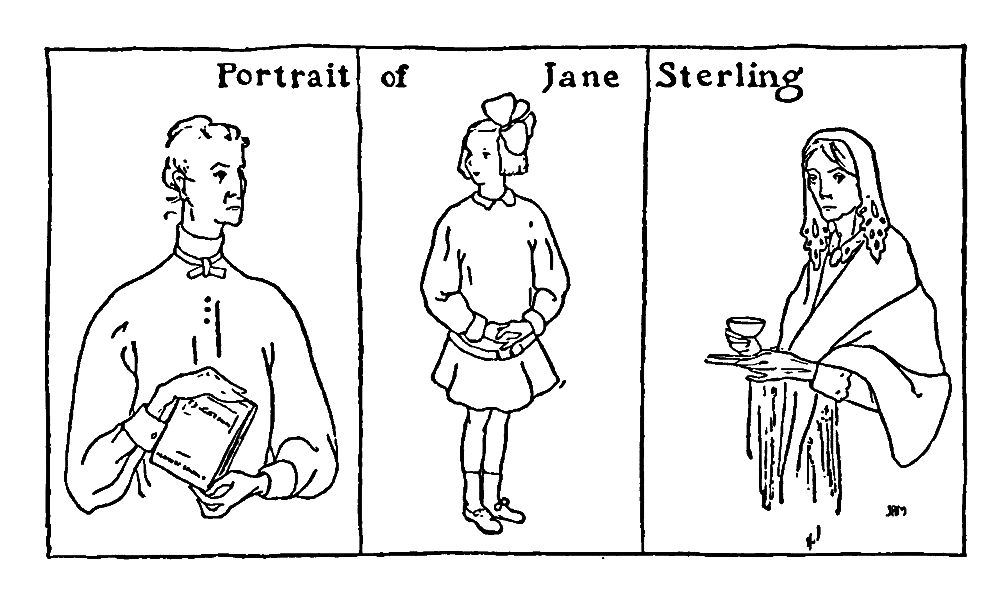
Portrait of Jane Sterling
As I entered Stateroom D, I found Jane Sterling already there. But as the physical reality was so different from the lady of my imagination, I sat down on the edge of my white-spread berth and stared at her.
Sitting on the edge of the opposite berth, and staring back at me, was a small child with big eyes. She wore a stiff little frock of white piqué, and her brown hair was “bobbed” and tied up with an enormous white bow. Her brown eyes had a solemn gaze, and her little hands were clasped in her lap.
It was quite needless to ask her name, for Jane Sterling was plainly and unmistakably written all over her, and I marvelled that the name hadn’t told me at once what she looked like.
“How old are you, Jane?” I asked.
“Seven,” she replied, with a little sigh, as of the weight of years.
Her voice satisfied me. She was one of those unusual children, whom some speak of as “queer,” and others call “old-fashioned.”
But they are neither. They are distinctly a modern variety, and their unusualness lies in the fact that they have a sense of humor.
“And is this your first trip abroad?” I went on.
“No, my seventh,” said Jane, with a delicious little matter-of-fact air.
“Indeed! Well, this is the first time I have crossed, so I trust you will take pity on my ignorance, and instruct me as to what I should do.”
I said this with an intent to be sociable, and make, the child feel at ease, but no such effort was necessary.
“There is nothing to do diffelunt,” she said, with a bewitching smile. “You just do what you would in your own house.”
It was the first really good advice I had had concerning my steamer manners, and I put it away among my other first impressions for future use.
Then Jane’s mother appeared, and I learned that she occupied the next stateroom, and that she hoped Jane would not annoy me, and that she was glad I liked children, and that she had three, and that they crossed every year, and that if I wanted anything at all I was to ask her for it. Then she put a few polite questions to me, and duly envied me my first impressions, and returned to her other babies.
Jane proved a most delightful roommate, and, as she was never intrusive or troublesome, I felt that I had drawn a prize in the ship’s lottery.
The morning of the second day I rose with a determination to get to work. I had no intention of dawdling, and, moreover, I had much to do. In the first place, I wanted to get settled in my deck-chair, in that regulation bent-mummy position so often pictured in summer novels, and study my fellow-passengers. I had been told that nothing was so much fun as to study people on deck. Then I had many letters to write and many books to read. I wanted to learn how to compute the ship’s log, and how to talk casually of “knots.” After all these had been accomplished, I intended to plan out my itinerary for the summer. This I wanted to do after I was out of all danger of advice from friends at home and before I made the acquaintance of any one on board who might attempt to advise me.
So determined was I to plan my own trip that I would have been glad to get out on a desert island and wait there for the next steamer, rather than have any assistance in the matter of laying out my route.
Immediately after breakfast, therefore, arrayed in correct steamer costume, and carrying rug, pillow, paper-covered novel, veil, fur boa, and two magazines, I went to my deck-chair and prepared to camp out for the morning. As the deck steward was not about, I tried to arrange my much desired mummy effect myself. Technique seemed lacking in my efforts, and, slightly embarrassed at my inability to manage the refractory rug, I looked up to see Jane watching me.
“You mustn’t put the rug over you,” she explained, in her kind little way. “You must put yourself over the rug.”
At her advice I got out of the chair, and she spread the rug smoothly in it.
“Sit down,” she said, briefly, and I obeyed.
Cleverly, then, she flung up the sides and tucked in the corners, until the rug swathed me in true seventeenth-trip fashion. Jane proceeded to arrange my pillow and the other odds and ends of comfort. She disapproved, however, of my reading-matter.
“Magazines won’t stay open,” she observed, “and paper books won’t, eever.”
Jane’s few mispronunciations were among her chiefest charms.
“But it won’t matter,” she added cheerfully. “You won’t read, anyhow.”
This reminded me that I had no intention of reading, being there for the purpose of studying my fellow-passengers.
I was still obsessed by that strange sensation of inanition.
Although beatifically serene and abnormally good-natured, I felt an utter aversion to exertion of any kind, mental, moral, or physical. Even the thought of studying my fellow-travellers seemed a task too arduous to contemplate.
And so I sat there all the morning and not a fellow-traveller was studied.
“This won’t do,” I said to myself, severely, after luncheon. “Here you are, not a hint of sea-sickness, the day is perfect, you know how to adjust your rug, and all conditions are favorable. You must study your fellow-travellers.”
But the afternoon showed little improvement on the morning. As a result of desperate effort, I scrutinized one lady and decided to call her the Lady with the Green Bag.
It wasn’t a very clever characterization, but it was, at least, founded on fact.
Another I conscientiously contemplated, and finally dubbed her the Lady Who Isn’t an Actress. This was rather a negative description, but I based it on the neatness of her vanity-bag and the carelessness of her belt, and I am sure it was true.
The Clucking Mother was easily recognized, and a pink-cheeked and white-handed young man, who attempted to talk to me, I snubbed, and then to myself I designated him as Simple Simon.
I wasn’t really rude to him, and I fully intended to make acquaintances among the passengers later on; but I am methodical, and after I had all my other tasks attended to, I hoped to have two or three days left for social intercourse.
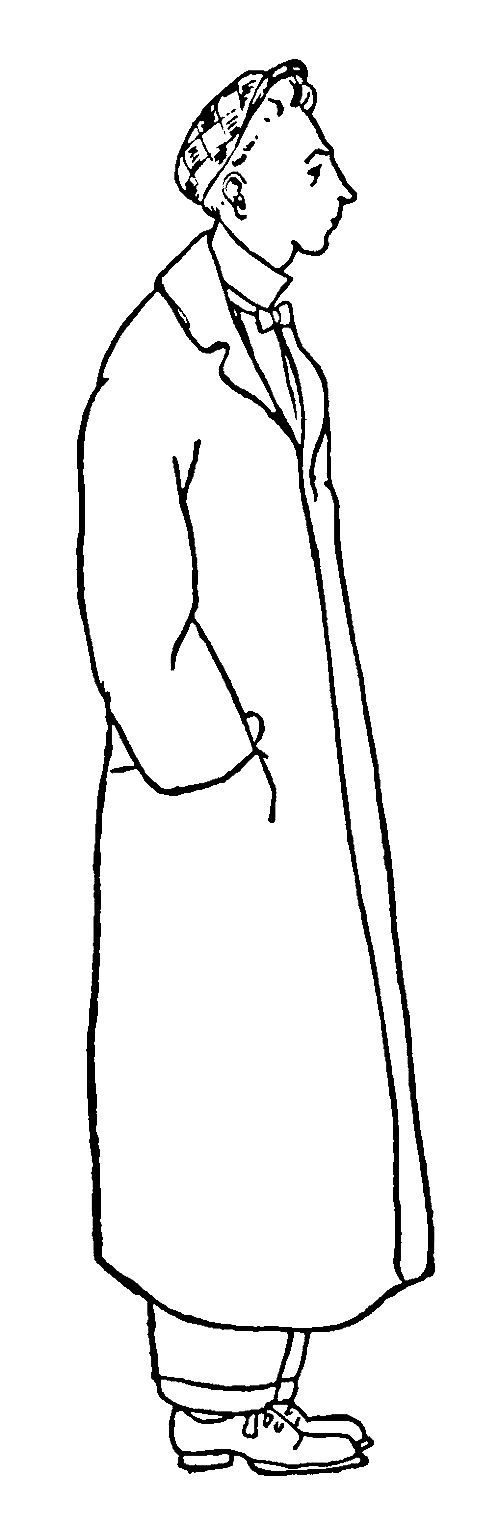
Simple Simon.
But after a time the chair next mine was left vacant, and then a laughing young girl seated herself in it.
Apparently it didn’t belong to her, and she sat down there with the express purpose of talking to me. My arduous study of my fellow-travellers had somewhat wearied me, and her sudden and uninvited appearance disturbed that serene calm which I had supposed unassailable, and so I angrily characterized her in my mind as a Bold-Faced Jig.
This name was so apt that it really pleased me, and I involuntarily smiled in appreciation of my appreciation of her.
So sympathetic was she (as I afterward discovered) that she smiled too, and then I couldn’t, in common decency, be rude to her. She chatted away, and before I knew it I was charmed with her. I didn’t change the name I had mentally bestowed on her, but, instead, I told her of it, and it delighted her beyond measure. I told her, too, how I intended to devote the next two days to planning my summer trip, then a day for writing letters, and after that I hoped to play bridge, or otherwise hobnob socially with certain people whom I had mentally selected for that purpose.
The Bold-Faced Jig laughed heartily at this.
“Haven’t you any idea where you’re going to travel?” she asked.
“Not the slightest.”
“Well, let me advise you——”
“Oh, please don’t!” I cried. “I left my planning until now in order to get away from all advisers. I must decide for myself. I know just what I want, and I can’t bear to be interfered with.”
The B.-F. J. looked amazed at first, and then she laughed.
“All right,” she said. “Now listen, Miss Emmins. I think you’re delightful, and I’m going to help you all I can by not advising you. But if you’ve not finished your itinerary plans in two days, mayn’t I tell you then what I was going to advise?”
“Yes,” I said, with dignity and decision, “if you will keep away from me for two days, and do all you can to keep others away.”
She promised, and it was more of a task than it might seem, for as I sat in my deck-chair, or, oftener, at a table in the library, surrounded by Baedekers, time-tables, maps, guide-books, and Hare’s Walks in London, many of the socially inclined or curious-minded paused to make a tentative remark. My replies were so coolly polite that they rarely ventured on a second observation, but I soon discovered that my laughing friend had told her comrades what I was doing, and they awaited the result.
It is strange what trivialities will interest the idle minds of those who dawdle about in the library of an ocean steamer.
Jane would occasionally come and stand by me, saying wisely, “Are you still making your itinnery?”
When I said yes, she sighed and smiled and ran away, being desirous not to bother.
The first morning I engaged in this work, I read interestedly of picture-galleries and architectural specialties. That afternoon my interest waned, and I studied time-tables and statistical information. The next morning I grew sick of the whole performance and, bundling the books and maps away, I went out to my deck-chair, and idled away the hours in waking dreams that never were on sea or land.
That afternoon the Bold-Faced Jig approached me.
“It’s all over,” I said. “I’ve capitulated. I make no plans while I’m on this blessed ocean. It’s wicked to do anything at all but to do nothing.”
“And don’t you want my advice?” she asked, laughing still.
“I don’t care,” I answered. “You can voice your advice if you choose. I sha’n’t listen to it, much less follow it.”
Her girlish laughter rang out again. “That was my advice,” she said. “I was going to tell you not to plan any trip while you are at sea. Just enjoy the days as they come and go; don’t count them; don’t do anything at all but just be.
“I’m not through yet,” she went on. “Don’t write any letters or read any books. Don’t study human nature, and of all things don’t voluntarily make acquaintances. If they happen along, as I did, chat a bit if you choose, and when they pass on, forget them.”
And so I took advice after all. I made no plans, I made no abstruse diagnoses of human character, I made no acquaintances save such as casually happened of themselves. And the days passed in a sort of rose-colored haze, as indefinite as a foggy sunrise, and as satisfying as a painted nocturne of Whistler’s. And so, my first impressions of my first ocean crossing are indeed enviable.
The trip from Liverpool to London I found to be a green glimpse of England in the shape of a biograph. But the word green, as we say it in our haste, is utterly inadequate to apply to the color of the English landscape. Though of varying shades, it is always green to the nth power; it is a saturated solution of green; it is a green that sinks into the eye with a sensation of indelibility. And as this green flew by me, I watched it from the window of a car most disappointingly like our own Pullmans.
I had hoped for the humorous absurdities of the compartmented English trains. I had almost expected to see sitting opposite me a gentleman dressed in white paper, and I involuntarily watched for a guard who should look at me through a telescope, and say “You’re travelling the wrong way.”
For my most definite impressions of English railway carriages had been gained from my “Alice,” and I was annoyed to find myself booked for a large arm-chair seat in a parlor car, with my luggage checked to its London destination on “the American plan”!
What, pray, was the use of coming abroad, if one was to have all the comforts of home?
As if to add to the unsatisfactoriness of my first impressions of English travel, I found myself sitting opposite a young American woman.
We faced each other across a small table, covered with what seemed to be green baize, but was more likely the reflection of the insistent landscape.
The lady was one of those hopeless, helpless, newly rich, that affect so strongly the standing of Americans in Europe.
She was blatantly pretty, and began to talk at once, apparently quite oblivious of the self-evident fact that I wanted to absorb in silence that flying green, to which her own nature was evidently quite impervious.
“Your first trip?” she said, though I never knew how she guessed it. “My! it must be quite an event in your life. Now it’s only an incident in mine.”
“You come often, then?” said I, not specially interested.
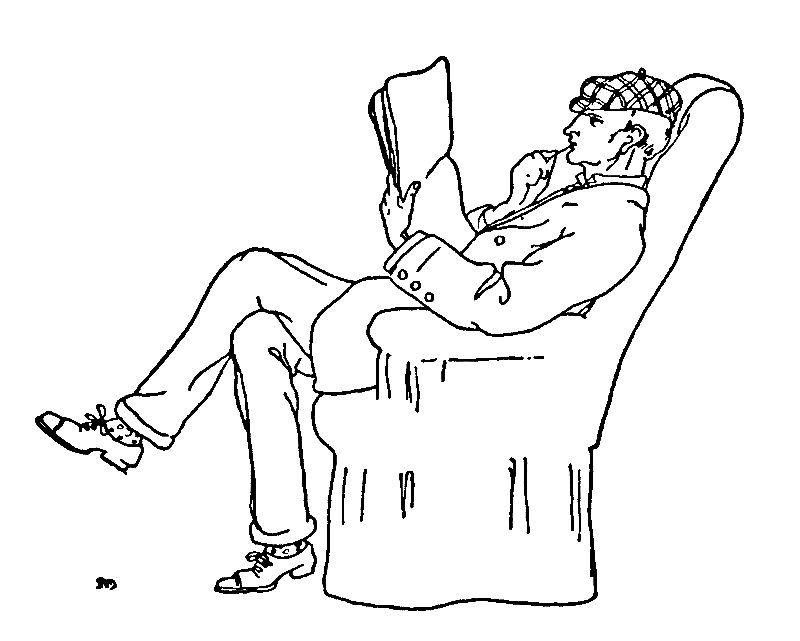
“The one with the plaid travelling-cap.”
“Yes; that is, we shall come every summer now. You see, he made a lot of money in copper,—that’s my husband over there, the one with the plaid travelling-cap,—so we can travel as much as we like. We’ve planned a long trip for this year, and we’ve got to hustle, I can tell you. I’m awfully systematic. I’ve bought all the Baedekers, and this year I’m going to see everything that’s marked with a double star. You know those are the ‘sights which should on no account be omitted.’ Then next year we’ll do up the single stars, and after that we can take things more leisurely.”
“You’ve never been over before, then?” I observed.
“No,” she admitted, a little reluctantly; “I went to California last year. I think Americans ought to see their own country first.”
I couldn’t help wishing she had chosen this year for her California trip, but the accumulation of green vision had somehow magicked me into a mood of cooing amiability, and I good-naturedly assisted her to prattle on, by offering an encouraging word now and then.
“He’s so good to me,” she said, nodding toward her husband. “He says he welcomes the coming and speeds the parting dollar. Isn’t that cute? He’s an awfully witty man.”
She described the home he had just built for her in Chicago, and it seemed to be a sort of Liberal Arts Building set in the last scene of a comic opera.
For a moment, I left the green to itself, while I looked at my unrefractive countrywoman with an emotion evenly divided between pity and envy. For had she not reached the ultimate happiness, the apotheosis of content only possible to the wealthy Nitro-Bromide? And what was I that I should depreciate such soul-filling satisfaction? And why should my carping analysis dub it ignorance? Why, indeed!
After a few more green miles, an important-mannered guard, who proved to be also guide, philosopher, and friend, piloted me to a dining-car which might have been a part of the rolling-stock of the Pennsylvania Railroad.
Nothing about it suggested the anticipated English discomfort, unless it might be the racks for the glasses, which, after all, relieved one of certain vague apprehensions.
But at dinner it was my good luck to sit in a quartet, the other three members of which were typical English people.
I suppose it is a sort of reflex nervous action that makes people who eat together chummy at once. The fact of doing the same thing at the same time creates an involuntary sympathy which expands with the effects of physical refreshment.
I patted myself on my mental shoulder as I looked at the three pleasant English faces, and I suddenly became aware that, though of a different color, they affected me with exactly the same sensation as the clean, green English scenery.
This, I conclude, was because English people are so essentially a part of their landscape, a statement true of no Americans save the aboriginal Indian tribes.
My table-mates were a perfect specimen of the British matron, her husband, and her daughter. I should describe them as well-bred, but that term seems to imply an effect of acquisition by means of outside influences. They were, rather, well-born, in a sense that implies congenital good-breeding.
Their name was Travers, and we slid into conversation as easily as a launching ship slides down into the water. Naturally I asked them to tell me of London, explaining that it was my first visit there, and I wished to know how to manage it.
“What London do you want to use?” asked Mr. Travers, interestedly. “You know there are many Londons for the entertainment of visitors. We can give you the Baedeker London, or Dickens’s London, or Stevenson’s London, or Bernard Shaw’s London, or Whistler’s London——”
“Or our own W. D. Howells’s London,” I finished, as he paused in his catalogue.
“I think,” I went on, “the London I want is a composite affair, and I shall compile it as I go along. You know Browning says ‘The world is made for each of us,’ and so I think there’s a London made for each of us, and we have only to pick it out from among the myriad others.”
“That’s quite true,” said Mrs. Travers. “You’ll be using, do you see, many bits of those Londons mentioned, but combining them in such a way as to make an individual London all your own.”
The prospect delighted me, and I mentally resolved to build up such a London as never was on land or sea.
“But,” I observed, “aside from an individually theorized London, there must be a practical side that is an inevitable accompaniment. There must be facts as well as opinions. I should be most glad of any hints or advices from experienced and kind-hearted Londoners.”
“Without doubt,” said Mr. Travers, “the question trembling on the tip of your tongue is the one that trembles on the tip of every American tongue that lands on our shores—‘What fee shall I give a cabman?’”
I laughed outright at this, for it was indeed one of my collection of tongue-tipped questions.
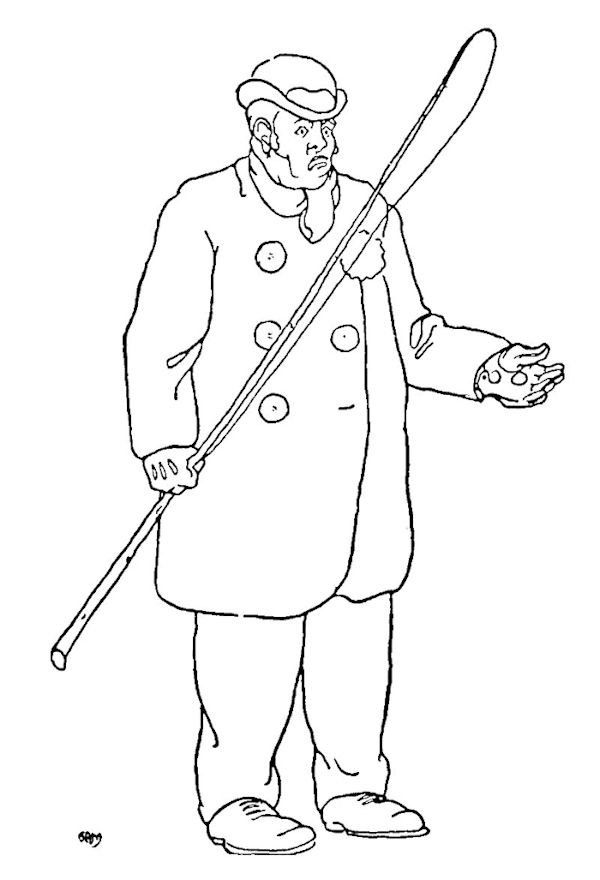
He treats you to his opinion of you in choice Billingsgate.
“But, sadly enough,” went on the Englishman, “it is a question that it is useless for me to answer you at present. An American must be in London for four years before he can believe the true solution of the cab-fee problem. The correct procedure is to give the cabby nothing beyond his legal fare. If you give him tuppence, he looks at you reproachfully; if you give him fourpence, he scowls at you fearfully; if you give him sixpence, he treats you to his verbal opinion of you in choice Billingsgate. Whereas, if you give him no gratuity, he assumes that you have lived here for four years, and lifts his hat to you with the greatest respect.”
“Why can’t I follow your rule at once?” I demanded.
“I do not know,” returned Mr. Travers. “Nobody knows; but the fact remains that you cannot. You think you believe the theory now, because you hear me set it forth with an air of authority; but it will take you at least four years to attain a true working knowledge of it. Moreover, you will ask every Englishman you meet regarding cab-fees, and so conflicting will be their advices that you will change your tactics with every hansom you ride in.”
“Then,” said I, with an air of independence, “I shall keep out of hansom-cabs, until I am fully determined what course to pursue in this regard.”
“But you can’t, my dear lady,” continued my instructor. “To be in London is to be in a hansom. They are inevitable.”
“Why not omnibuses?” I asked, eager for general information. “I have long wanted to ride in or on a London ’bus.”
Mr. Travers’s eyes twinkled.
“You have an American joke,” he said, “which cautions people against going into the water before they learn how to swim. I will give you an infallible rule for ’buses: never get on a London ’bus until you have learned to get on and off of them while they are in motion.”
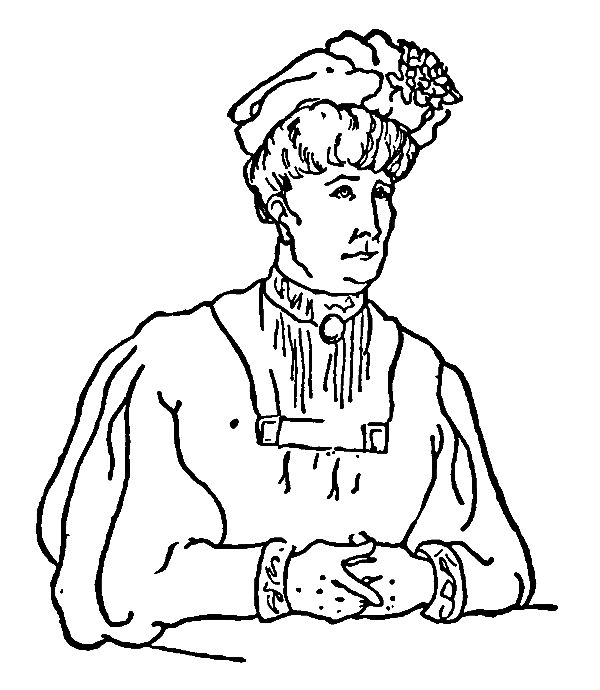
“What waggery,” observed Mrs. Travers.
“What waggery!” observed Mrs. Travers, in a calm, unamused tone, and I suddenly realized that I was in the midst of an English sense of humor.
The dinner progressed methodically through a series of specified courses, and when we had reached the vegetable marrow I had ceased to regard the green distance outside and gave my full attention to my lucky find of the Real Thing in English people.
Mr. Travers’s advice was always excellent and practical, though usually hidden in a jest of somewhat heavy persiflage.
We discussed the English tendency to elide letters or syllables from their proper names, falling back on the time-worn example of the American who complained that Englishmen spell a name B-e-a-u-c-h-a-m-p and pronounce it Chumley.
“But it’s better for an American,” said Mr. Travers, “to pronounce a name as it is spelled than to elide at his own sweet will. I met a Chicagoan last summer, who said he intended to run out to Win’c’s’le.”
“What did he mean?” I asked, in my ignorance.
“Windsor Castle,” replied Mr. Travers, gravely.
The mention of Chicago made me remember my companion in the parlor car, and I spoke of her as one type of the American tourist.
“I saw her,” said Mrs. Travers, with that inimitable air of separateness that belongs to the true Londoner; “she is not interesting. Merely a smart party who wears a hat.”
As this so competently described the lady from Chicago, I began to suspect, what I later came thoroughly to realize, that the English are wonderfully adept in the making of picturesque phrases.
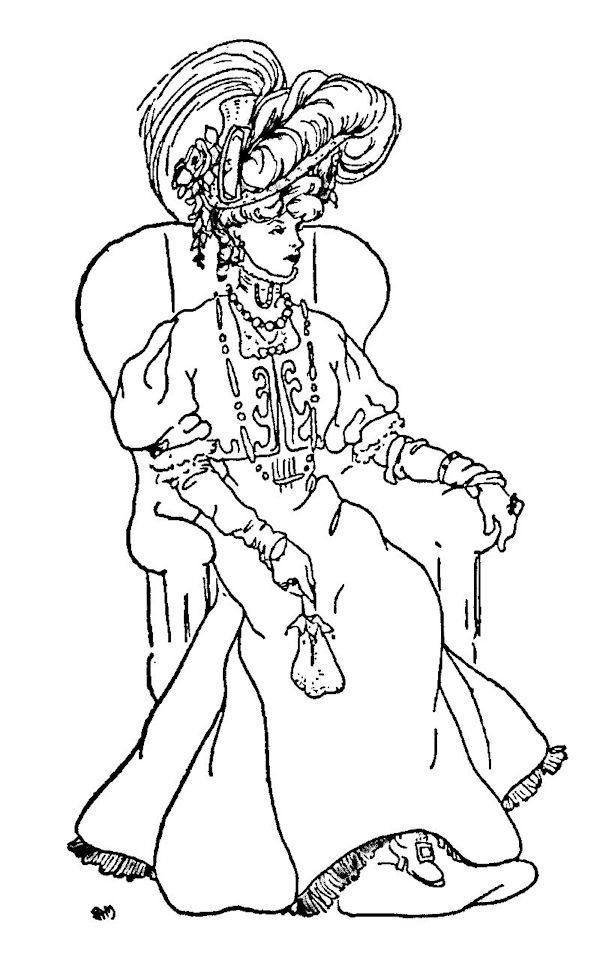
“Merely a smart party who wears a hat.”
During our animated conversation, Miss Travers had said almost nothing.
I had read of the mental blankness of the British Young Person, and was not altogether surprised at this.
But the girl was a delight to look at. By no means of the pink-cheeked, red-lipped variety immortalized in English novels, she was of a delicate build, with a face of transparent whiteness. Her soft light brown hair was carelessly arranged, and her violet eyes would have been pathetic but for a flashing, merry twinkle when she occasionally raised their heavy, creamy lids.
Remembering Mrs. Travers’s aptness in coining phrases of description, I tried to put Rosalind Travers into a few words, but was obliged to borrow from the Master-Coiner, and I called her “The Person of Moonshine.”
By the time I was having my first interview with real Cheddar cheese, the Traverses were inviting me to visit them, and I was gladly accepting their delightfully hospitable and unmistakably sincere invitation.
Scrupulously careful to bid good-bye to my Chicago friend before we reached London, alone I stepped from the train at Euston Station with a feeling of infinite anticipation.
Owing probably to an over-excited imagination, the mere physical atmosphere of the city impressed me as something quite different from any city I had ever seen. I felt as if I had at last come into my own, and had far more the attitude of a returning wanderer than a visiting stranger.
The hansom-cabs did not appear any different from the New York vehicles of the same name, but I climbed into one without that vague wonder as to whether it wouldn’t be cheaper to buy the outfit than to pay my fare.
My destination was a club in Piccadilly—a woman’s club, which I had joined for the sole purpose of using its house as an abiding-place.
The cab-driver was cordial, even solicitous about my comfort, but finally myself and my hand-luggage were carefully stowed away, the glass was put down, and we started.
It was after dark, and it was raining, two conditions which might appall an unescorted woman in a strange city. The rain was of that ridiculous English sort, where the drops do not fall, but play around in the air, now and then whisking into the faces of passers-by, but never spoiling their clothes. It was enough, though, to wet the asphalt, and when we swung into Piccadilly, and the flashing lights from everywhere dived down into the street, and rippled themselves across the wet blackness of the pavement, I suddenly realized that I was driving over one of the most beautiful things in the world.
I looked out through my hansom-glass darkly, at London. Unknown, mysterious, silent, but enticing with its twinkling eyes, it was like a masked beauty at a ball. Yet, beneath that mocking, elusive witchery, I was conscious of an implied promise, that my London would yet unmask, and I should know and love her face to face.
I suppose that the earliest thing that happens anywhere is the London dawn. In all my life, my waking hours had never reached three o’clock A.M., from either direction, and when, on the first morning after my arrival in London, I was awakened at that hour by a gently intrusive daybreak, I felt as if I had received a personal and intentional affront.
I rose, and stalked to the window, with an air of haughty reproach, intending to close the shutters tightly until a more seemly hour.
As there are only six window-shutters in the whole city of London, it is not surprising that none of these was attached to my window; but it really didn’t matter, for after reaching the window that morning I never thought of a shutter again until I returned to America.
My window, which was a large French affair in three parts, looked out upon Piccadilly. It opened on a small stone-railed balcony, and as I looked out three pigeons looked in. They were of the fat and pompous kind and they strutted along the railing, with a frankly sociable air, cocking their heads pertly in an endeavor to draw my attention to the glistening iridescence of their neck-feathers.
I liked the pigeons, and I told them so, but even better I liked the sight across the street.
Green Park at dawn is as solemnly impressive as the interior of Westminster Abbey. The trees sway and quiver, giving an occasional glimpse of the Clock Tower of Parliament House. From the throats of myriad birds comes a sound as of one blended twitter, and a strange, unreal radiance pervades the whole scene. With the rapidly increasing daylight definiteness ensues, and railings, benches, roadway, and other details of the Park add strength to the picture.
Having seen three o’clock in Green Park, I promptly forgot my errand with the shutters, and, hastily donning conventional morning costume, I prepared to watch four o’clock, and five, and six appear from the same direction.
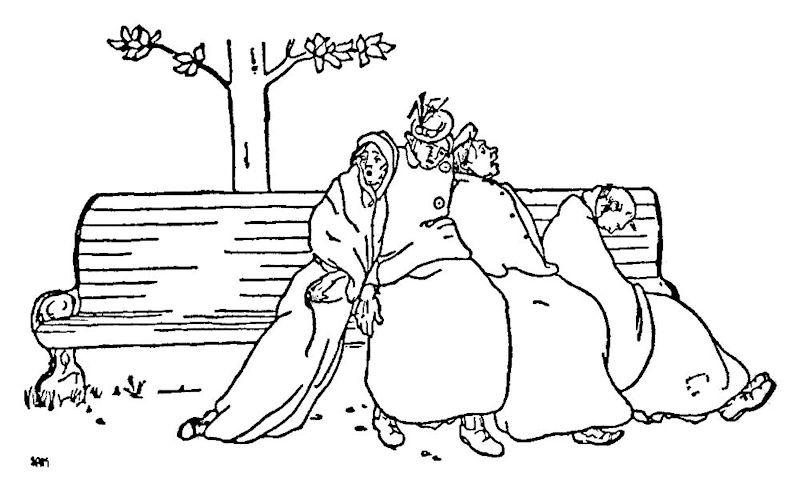
They were occupying the only earthly home they possessed.
As outlines became clearer I noticed a park bench directly opposite my window, on which sat four old women. All were garbed in black, and all were sleeping soundly. I was then unaware of the large proportion of the elderly feminine in London’s seamy side of population, and so casual was the aspect of the quartet that it did not occur to me they were occupying the only earthly home they possessed.
They seemed to me more like duplicate Mrs. Lecks and Mrs. Aleshines, who had paused for a time in Green Park instead of in mid-ocean.
But after I had seen the same women there at three o’clock on a dozen consecutive mornings I began to realize that they were part of the landscape.
Nor was I unduly sorry for them. They sat on that bench with the same air of voluntary appropriation that marked the birds in the trees, or the pigeons on the railing. And as the days went on I became accustomed to seeing them there, and ceased to feel any inclination to go out and try to persuade them to enter an old ladies’ home.
At about seven o’clock the omnibuses began to ply. I had never known before what was indicated by the verb to ply. But I saw at once that it is the only word that properly expresses the peculiar gait of an omnibus, which is a cross between a rolling lurch and a lumbering wobble. Fascination is a mild term for the effect these things had on me.
One omnibus might not so enthrall me. I don’t know; I have never seen one omnibus alone. But the procession of them along Piccadilly is the one thing on earth of which I cannot conceive myself becoming tired.
Their color, form, motion, and sound all partake of the primeval, and their continuity of effect is eternal.
My Baedeker tells me that the first omnibuses plying in London were “much heavier and clumsier than those now in use.” But of course this is a mistake, for they couldn’t have been.
I have heard that tucked away among the gay-colored advertisements that are patchworked all over these moving Mammoth Caves are small and neatly-lettered signs designating destinations. I do not know this. I have never been able to find them. But it doesn’t matter. To get to Hampstead Heath, you take a Bovril; to go to the City, take Carter’s Ink; and to get anywhere in a hurry, jump on a Horlick’s Malted Milk. There is also a graceful serpentine legend lettered down the back of each ’bus, but as this usually says “Liverpool Street,” I think it can’t mean much.
Personally, I never patronize one of the things. They are too uncanny for me, and their ways are more devious than those of our Seventeenth Street horse-cars.
Besides, I always feared that, if I got in or on one, I couldn’t see the rest of them as a whole. And it is the unbroken continuity that, after the coloring, is their greatest charm. I have spent many hours watching the Piccadilly procession of them, “like a wounded snake drag its slow length along,” and look forward to many hours more of the same delight. But the dawn, the daybreak, and the early morning slipped away, and all too soon my first day in London had begun.
My mail brought me difficulties of all sorts. There were invitations from people, whom well-meaning mutual friends had advised of my arrival. There were offers from friends or would-be friends to escort me about on shopping or sight-seeing tours. There were cards for functions of more or less formality, and there were circulars from tradesmen and professional people.
With a Gordian-knot-cutting impulse, I tossed the whole collection into my desk, and started out alone for a morning walk.
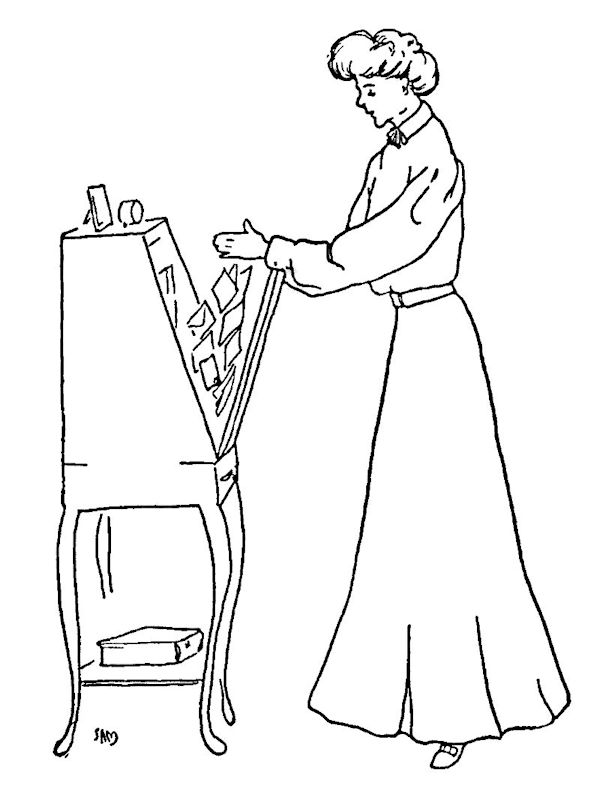
Tossed the whole collection into my desk.
Nor shall I ever forget that walk. Not only because it was a “first impression,” but because it was the most beautiful piece of pedestrianism that ever fell to my lot.
My clubhouse home was almost at the corner of Hamilton Place, and as I stepped from its portal out into Piccadilly I seemed to breathe the quintessence of London, past, present, and to come.
Meteorologically speaking, the atmosphere was perfect. The reputation for fogginess, that London has somehow acquired, is a base libel. Its air is marked by a dazzling clearness of haze that, more than anything else, “life’s leaden metal into gold transmutes.”
Thus exhilarated at the start, I began my stroll down Piccadilly, and at every step I added to my glowing sense of satisfied well-being. I turned north into Berkeley Street, and thus started on my first sight-seeing tour. And was it not well that I was by myself?
For the most kind and well-meaning cicerone would probably have said,
“Do you not want to see the house where Carlyle died?”
And how embarrassed would I have been to be obliged to make reply:
“No, not especially. But I do want to see where Tomlinson gave up the ghost in his house in Berkeley Square.”
Nor would my guide have been able to point out that perhaps mythical residence. But I had no trouble in finding it. Unerring instinct guided me along Berkeley Square, till I reached what I felt sure was the very house, and since I was satisfied, what mattered it to any one else?
This being accomplished, I next proceeded in a desultory and inconsequent fashion to explore Mayfair.
Aided, like John Gay, by the goddess Trivia, I knew I could
securely stray
Where winding alleys lead the doubtful way;
The silent court and opening square explore,
And long perplexing lanes untrod before.
And as I trod, I suddenly found myself in Curzon Street. This was a pleasant sensation, for did I not well know the name of Curzon Street from all the English novels I had ever read? Moreover, I knew that in one of its houses Lord Beaconsfield died, and in another the Duke of Marlborough lived. The detail of knowing which house was which possessed no interest for me.
I rambled on, marvelling at the suddenness with which streets met each other, and their calm disregard of all method or symmetry, till I began to feel like “the crooked man who walked a crooked mile.”
Attracted by the name of Half-Moon Street, I left Curzon Street for it. Shelley once lived in this street, and I selected three houses any one of which might have been his home. I went back, I traversed some delightful mewses (what is the plural of mews?), crossed Berkeley Square, and then, somehow or other, I found myself in Bond Street, and my mood changed. At first the shops seemed unattractive and I felt disappointment edging itself into my soul.
But like an ugly woman, possessed of charm, the crammed-full windows began to fascinate me, and I forgot the inadequate sidewalks and unpretentious façades in the absorbing displays of wares.
Bond Street shop-windows are hypnotic. Fifth Avenue windows stolidly hold their exhibits up to one’s view, without a trace of invitation, but Bond Street windows compel one to enter, by a sort of uncanny influence impossible to resist.
Though I expected to shop in London, there was only one article that I was really anxious to buy. This was a jade cube. For many years I had longed for a jade cube, and American experts had contented themselves with stating there was no such thing in existence. Time after time, I had begged friends who were going to the ends of the earth to bring me back a jade cube from one of the ends, but none had accomplished my errand.
I determined therefore to use every effort to secure a jade cube for myself, and forthwith began my quest.
A mineralogist on Bond Street showed more interest at once than any of my personal friends had ever evinced. Though he declared there was no such thing in existence, he further remarked his entire willingness to cut one for me from the best quality of Chinese jade.
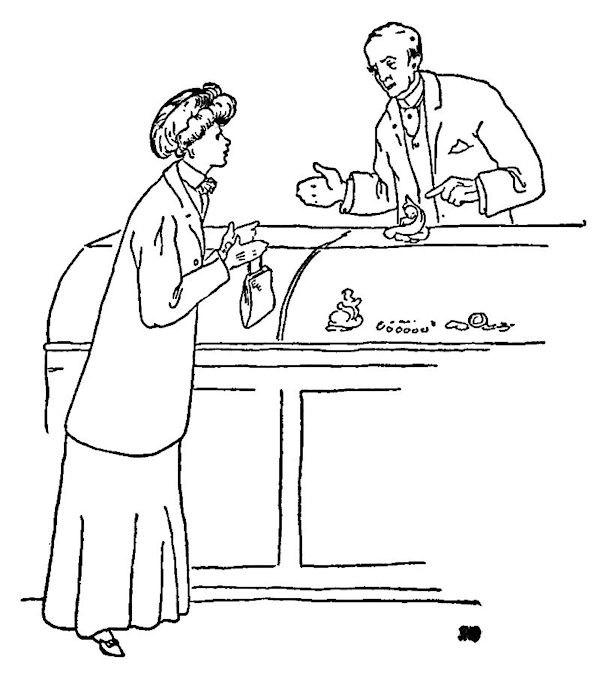
He was quite as interested.
He was quite as interested as I was myself, and, though it seemed inartistic to end so quickly what I had expected to be a long and difficult quest, I left the order.
The cube turned out a perfect success, and will always be one of my dearest and best-loved possessions. It has the same charm of perfection that characterizes a Japanese rock-crystal ball, and the added interest of being unique. There was, too, a charm in the interest shown in the cube by the old mineralogist, and also by his wife.
The day I went after the completed polished cube, the elderly madame came into the shop from a back room, to congratulate me on the attainment of my desire.
Incidentally, the good people endeavored (and successfully) to persuade me to buy further of their wares.
They had a bewildering assortment of semi-precious stones, curious minerals, and wrought metals and strange bits of handiwork from foreign countries. Beads, of course, in profusion, and fascinatingly ugly little idols. As all these things have great charm for me, and as I am always easily persuaded to buy, I bought largely, to the great satisfaction of the elderly shopkeepers. But, as I had learned a little of their tricks and their manners I offered them, a bit shamefacedly, a lower price in each instance than they asked. To my relief, they took this proceeding quite as a matter of course, and cheerfully accepted the smaller sum without demur.
But to return to that first morning, after my interview with the mild-mannered mineralogist I strolled along Old Bond Street back to Piccadilly.
The Tennyson’s Brook of omnibuses was still going on, and I stood on the corner to watch them again. From this point of view the effect is quite different from that seen from an upstairs window.
You cease to generalize about the procession, and regard the individual ’bus with a new awe.
The ocean may be wider,—the Flatiron Building may be taller,—but there’s nothing in all the world so big as a London omnibus.
An English telephone is a contradiction in terms. If it is in England, it isn’t a telephone. It is a thing that looks something like a broken ox-yoke, that is manipulated something like a trombone, and is about as effectual as the Keeley Motor.
A course of lessons is necessary to learn to use one, but the lessons are wasted, as the instrument is invariably out of order, and moreover, nobody has one, anyhow.
But one morning, before I had discovered all this, I was summoned to the telephone booth of the Pantheon Club, and blithely grasped the cumbersome affair, with its receiver on one end and its transmitter on the other. I ignorantly held it wrong end to, but that made no difference, as it wouldn’t work either way.
“Grawsp it stiffer, madame,” advised the anxious Buttons who engineered it. At length I discovered that this meant to press firmly on a fret, as if playing a flute, but by this time the party addressing me had been disconnected from the other end, and all attempts to regain communication were futile.
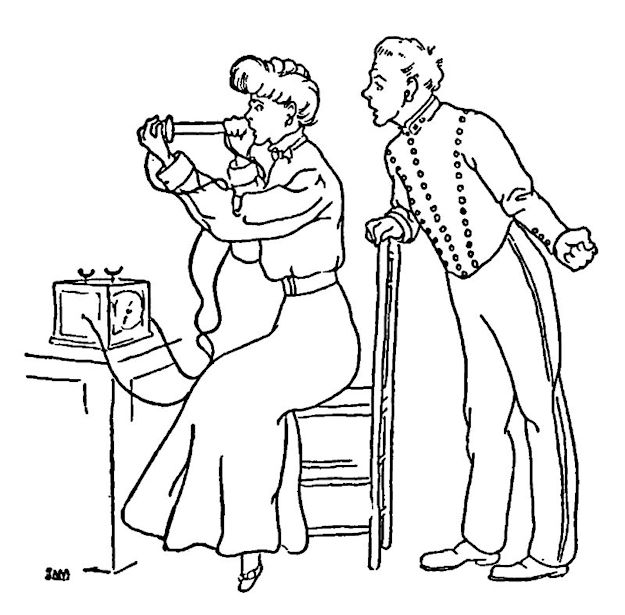
“Grawsp it stiffer, M’am.”
The boy took the instrument, and I have never seen a finer display of human ingenuity and patience than he showed for the next half-hour trying to hear that chord again. Then he gave it up, and, laying the horrid thing gently in its cradle, he nonchalantly informed me that if the party awrsked for me again, he’d send me naotice, and then demanded tuppence.
This I willingly paid, as I was always glad to get rid of those copper heavy-weights; and, too, it seemed a remarkably small price even for a telephone call,—until I suddenly remembered that I hadn’t made the call,—nor had I received it.
The call was repeated later, and after another distracting session of incoherent shouting, and painfully-cramped finger muscles, I learned that I was invited to an informal dinner that evening at Mrs. Marchbanks’s at seven-thirty.
I had not intended to plunge into the social whirl so soon, and had declined all the many invitations which had come to me by mail.
But somehow the telephone invitation took me unawares, and, too, I was so pleased to succeed in getting the message at all that it seemed ungracious and ungrateful to refuse. So, I took a fresh grip on the fretted monster, and, aiming my voice carefully at the far-away transmitter, I shouted an acceptance. I hoped it reached the goal, but as there was nothing but awful silence afterward, I had to take it on faith, and I went away to look over my dinner gowns.
The invitation had been classed as “informal,” but I knew the elasticity of that term, and so, though I did not select my very best raiment, I chose a pretty décolleté frock, that had “New York” legibly written on its every fold and pucker.
So late is the dusk of the London spring that I easily made my toilette by daylight, and was all ready at seven o’clock.
Carefully studying my Baedeker maps and plans to make sure of the distance, I stepped into my hansom just in time to reach my destination at a minute or two before half past seven, assuming that New York customs prevailed in England.
The door was opened to me by an amazed-looking maid, who seemed so uncertain what to do with me that I almost grew embarrassed myself.
Finally, she asked me to follow her up-stairs, and then ushered me into a room where my hostess, in the hands of her maid, was in the earliest stages of her toilette.
“You dear thing,” she said, “how sweet of you to come. Yes, Louise, that aigrette is right. Here is the key of my jewel case.”
“I fear I have mistaken the hour,” I said; “the telephone was a bit difficult,—but I understood half past seven.”
“Yes,” agreed Mrs. Marchbanks, studying the back of her head in a hand-mirror, “but in London seven-thirty means eight, you know.”
This was definite information, and I promptly stored it away for future use. Also, it was reliable information, for it proved true, and at eight the guests began to arrive.
Dinner was served at quarter to nine, and all was well.
Incidentally I had learned my lesson.
The half-hour in the drawing-room before dinner was an interesting “first impression” of that indescribable combination of warmth and frost known as a London Hostess.
Further experience taught me that Mrs. Marchbanks was a typical one.
The London hostess’s invariable mode of procedure is a sudden, inordinate gush of welcome, followed immediately by an icy stare. By the time you have politely responded to the welcome, your hostess has forgotten your existence. Nay, more, she seems almost to have forgotten her own. She is vague, self-absorbed, and quite oblivious of your existence. I have heard of a lady with a gracious presence. The London hostess is best described by a gracious absence.
But having adapted yourself to this condition, your hostess is likely to whirl about and dart a remark or a question at you.
On the evening under discussion, my hostess suddenly broke off her own greeting to another guest, to say to me, “Of course you’ll be wanting to buy some new clothes at once.”
This statement was accompanied by a deliberate survey, from berthe to hem, of my palpably American-made gown, and as the incident pleased my sense of humor, I felt no resentment, and amiably acquiesced in her decision.
Then, funnily enough, the conversation turned upon good-breeding.
“A well-bred Englishwoman,” my hostess dictatorially observed, “never talks of herself. She tactfully makes the person to whom she is talking the subject of conversation.”
“But,” said I, “if the person to whom she is talking is also well-bred, he must reject that subject, and tactfully talk about the first speaker. This must bring about a deadlock.” She looked at me, or rather through me, in a pitying, uncomprehending way, and went on:
“The well-bred Englishwoman never makes an allusion or an implication that could cause even the slightest trace of discomfiture or annoyance to the person addressed.”
This, of itself, seemed true enough, but again she turned swiftly toward me, and abruptly inquired, “Doesn’t the servility of the English servants embarrass you?”
This time, too, my sense of humor saved me from embarrassment, but I began to think serious-minded persons should not brave the slings and arrows of a well-bred Englishwoman.
Geniality and ingenuousness are alike unknown to the English hostess. It is a very rare thing to meet a charming Englishwoman. Good traits they have in plenty and many sterling qualities which Americans often lack, but magnetism and responsiveness are as a rule not among these qualities.
And I do not yet know whether it is through ignorance or with malice prepense that an English hostess greets you effusively, and then drops you with an air of finality that gives a “lost your last friend” feeling more than anything else in all the world.
This state of things is of course more pronouncedly noticeable at teas than at dinners. At an afternoon reception, the hostility of the hostess is beyond all words. Moreover, at English afternoon teas there are two rules. One is you may not speak to a fellow-guest without an introduction. The other is that no introduction is necessary between guests of the house. One of these rules is always inflexibly enforced at every tea; but the casual guest never knows which one, and so complications ensue.
English hostesses always seem to me very much like that peculiar kind of flowered chintz with which they cover their furniture—the kind that looks like oilcloth, and is very cold and shiny, very beautiful, very slippery, and decidedly uncomfortable.
But in inverse proportion to the conversational unsatisfactoriness of the English women are the entertaining powers of the English men. They are voluntarily delightful. They make an effort (if necessary) to be pleasantly talkative and amusing.
And, notwithstanding the traditional slurs on British humor, the English society man is deliciously humorous, and often as brilliantly witty as our own Americans.
At the dinner I have mentioned above, I was seated next to a somewhat insignificant-looking young man of true English spick-and-spanness, and with a delightful drawl, almost like the one written as dialect in international novels.
Perhaps in consideration of my probable American attitude toward British humor, he good-naturedly amused me with jokes directed against his national peculiarities.
He described graphically an Englishman who was blindly groping about in his brain for a good story which he had heard and stored away there. “Ah, yes,” said the supposed would-be jester; “the man was ill; and he said his physician advised that he should every morning take a cup of coffee and take a walk around the place.”
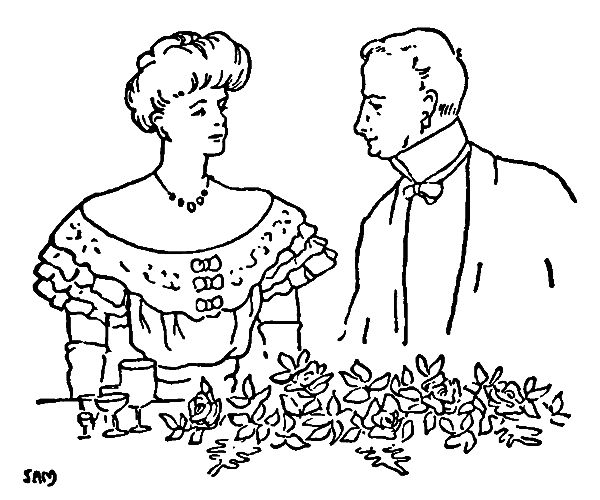
He amused me with jokes directed against his national peculiarities.
“He had missed the point, do you see,” explained my amusing neighbor, “and the joke should have been ‘take a cup of coffee, and take a walk on the grounds,’ do you see?”
So pleased was the young man with the whole story, that I laughed in sympathy, and he went on to say:
“But you Americans make just the same mistakes about our jokes. Now only last week Punch had a ripping line asking why the Americans were making such a fuss about Bishop Potter, and said any one would think he was a meat-potter. Now one of your New York daily papers borrowed the thing, and made it read, ‘What’s the matter with Bishop Potter? Any one would think he was a meat packer.’ ’Pon my honor, Miss Emmins, I know that for a fact!”
“Then I think,” I replied, “that we ought never again to throw stones at the British sense of humor.”
In the pause that followed, a bulky English lord across the table was heard denouncing the course taken by a certain political party. So energetic were his gestures, and so forceful his speech, that he had grown very red and belligerent-looking, and fairly hammered the table in his indignation.
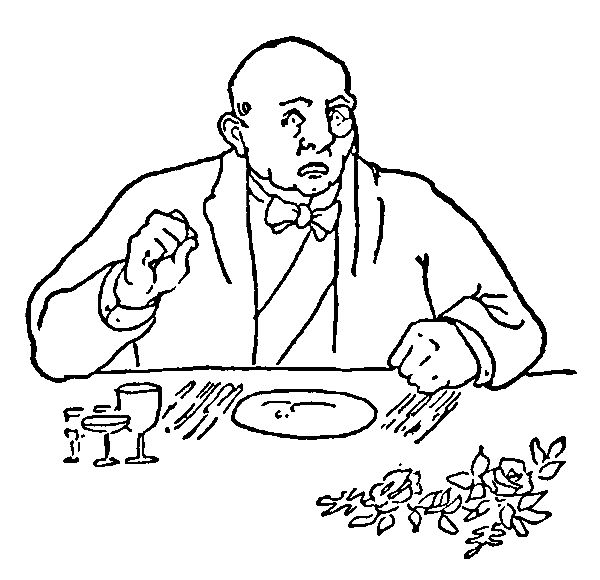
Denouncing the course taken by a certain political party.
The young man next to me looked at him, as an indulgent father might look at a naughty child. “Isn’t he the saucy puss?” said my neighbor, turning to me with such a roguish smile that his remark seemed the funniest thing I had ever heard.
I frankly told my attractive dinner partner that the men of London society were far more entertaining than the women. He did not seem surprised at this, but seemed to look upon it as an accepted condition.
I glanced across the table at a young Englishwoman. She was an “Honorable,” and possessed of a jointed surname. She was attired with great wealth and unbecomingness, and, to sum her up in a general way, she looked as if she did not write poetry.
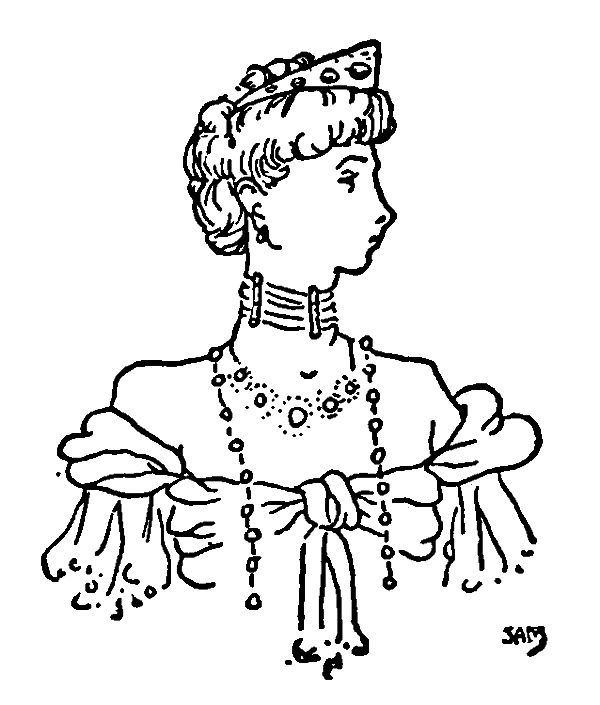
She was an “Honorable” and possessed of a jointed surname.
“Yes,” she was saying, “cabs are cheap with us, but if you ride a lot in a day, they count up.” This is a stock remark with London women and I was not surprised to hear it again.
I glanced at my young man. He too had heard, and he quickly caught my mental attitude.
“Yes,” he said, “Englishwomen and girls are very fit; they’re good form, accomplished, and all that. But, though they know a lot, somehow, er,—their minds don’t jell.”
As this exactly expressed my own opinion, I was delighted at his clever phrasing of it.
But if the Englishman is charming as a dinner guest, he is even more so when he is host, as he often is at afternoon tea. And though I attended many teas presided over by London men, all others fade into insignificance beside the one given me at the Punch office.
I was the only guest, the host was the genial and miraculously clever Editor of Punch.
The tea was of the ordinary London deliciousness, the cakes and thin bread-and-butter were, as always, over there, the best in the world; but it was served to us on the historic Punch table, the great table where every Friday night, since the beginning of that publication, its editorial staff has dined.
And as each diner at some time cut his monogram into the table, the semi-polished surface shows priceless memorials of the great British authors, artists, and illustrators.
I was informed by my kind host that I might sit at any place I chose. I hesitated between Thackeray’s and Mark Lemon’s, but finally by a sudden impulse I dropped into a chair in front of the monogram of George du Maurier.
The Editor of Punch smiled a little, but he only said, “You Americans are a humorous people.”
My own subjective London was achieving itself. I have always remembered pleasantly, how,
Without a bit of trouble,
Arabella blew a bubble,
and, with emulative ease, I blew a beautiful, impalpable, iridescent sphere and called it London.
To be sure, a single interrogation point from an earnest Tourist would have burst my bubble, for my whole London hadn’t a Tower or a British Museum in it.
Nor was this an oversight. Calling to my aid a moral courage that was practically a moral hardihood, I had deliberately concluded I would do no sightseeing. Not that I objected to seeing a sight, now and then, but the sight would have to put itself in my way, and the conditions would have to be such that I should prefer to go through the sight rather than around it.
Indeed, it was largely the word sightseeing that I took exception to. Such a very defective verb! Who would voluntarily put herself in a position to say, “I sightsaw the National Gallery yesterday,” or “I have sightseen the whole City,” and then have no proper parts of speech to say it with?
Moreover, I was not willing to go about my London carrying a Baedeker. In truth, my soul was possessed of conflicting emotions toward that little red book. As a directory it was invaluable. Never did I get an invitation to a place of mysterious sound, such as Kensington Gore, or Bird-in-Bush Road, but I ran to my Baedeker and quickly found therein the location, description, and directions for reaching the same. I soon mastered the pink and gray maps, with their clever contrivance of corresponding numbers, and with my Baedeker back of me I could have found the most obscure and bewildering address that even a Londoner is capable of devising.
But the pages devoted to “Sights which Should on No Account be Omitted,” and the kindly advice on “Disposition of Time for the Hurried Visitor,” I avoided with all the strength of my unsightseeing soul.
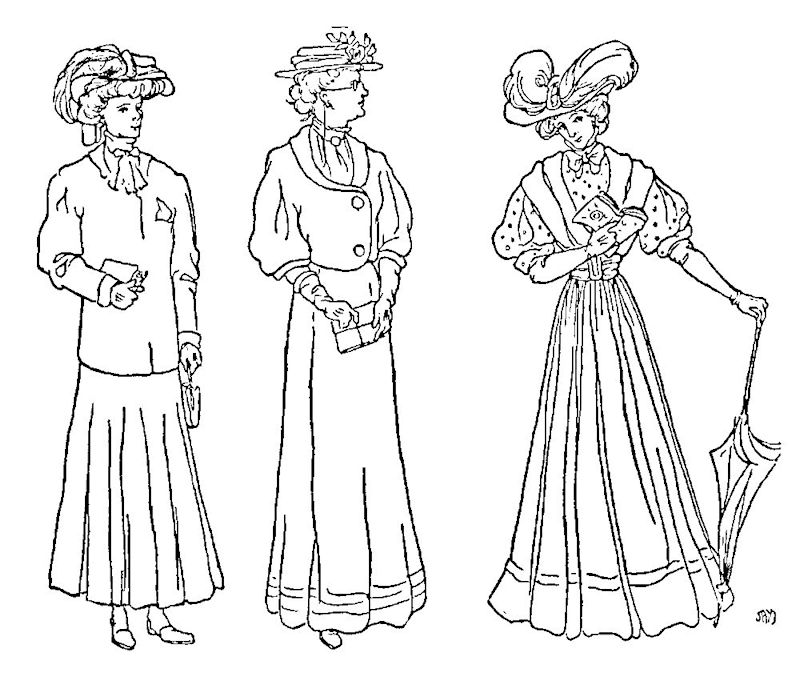
The ingenious efforts of tourists to disguise their Baedekers.
I was often amused at the ingenious efforts of tourists to disguise their Baedekers. One tailor-made American girl had hers neatly covered with bright blue paper, quite oblivious of the fact that the marbled edges and fluttering red and black tapes are unmistakable. Another, a pedagogic Bostonian, had hers wrapped in brown paper and tied with a string. Another had a leather case which exactly fitted the volume. And I thought that as the nude in art is far less suggestive than the semi-draped figure, so the uncovered red book was really less noticeable than these futile attempts at disguise.
Having, then, definitely decided that I should eventually return to America without having set foot in the Tower, the Bank or the Charter-house, I drew a long breath of content, and gave myself up to the delight of just living in the atmosphere of my own London.
And yet, I wanted to go to the Tower, the Bank, and the Charter-house. I wanted to go to Westminster Abbey and Saint Paul’s and the National Gallery. But I did not want to go for the first time. I wanted to revisit these places, and how could I do that when I had never yet visited them?
First impressions of Piccadilly or Hyde Park are all very well, but first impressions are incongruous in connection with Westminster Abbey. What has crude admiration to do with experienced sublimity? How absurd to let the gaze of surprise rest upon age-accustomed glory! What presumption to look at solemn ancient grandeur as at a novelty! I wished that I had been to Westminster Abbey many, many times, and that I could drift in again some lovely summer afternoon to revive old memories and renew old emotions.
But as this might not be, then would I keep away from it entirely, and study it from books as I had always done.
One day a departing caller carelessly left behind her a pamphlet entitled The Deanery Guide to Westminster Abbey. With a natural curiosity I picked it up and opened it.
That bore an advertisement of Rowland’s Macassar Oil!
But I got no farther than the first fly-leaf, for that bore an advertisement of Rowland’s Macassar Oil! I promptly forgot the existence of Westminster Abbey in the delight of finding that my London contained such a desirable commodity. Not that I wished to purchase the lotion, but I was absorbingly interested to learn that there really was such a thing. I had never heard of it before except in connection with the Aged, aged man, a-sitting on a gate, who manufactured Rowland’s Macassar Oil from mountain rills which he chanced to set ablaze. The remembrance of that dear old white-haired man, placidly going his ways, and content with the tuppence ha’-penny that rewarded his toil, filled my soul to the exclusion of all else, and he made a welcome addition to the census of my own London. It was pleasant, too, to reflect on the sound logic of the English people when they coined the word “anti-macassar.” How much more restrictedly definite than our word “tidy”!
Well, then next it came about that I went for a walk.
And, as was bound to happen sooner or later, I was strolling unthinkingly along, when I found myself with the Houses of Parliament on my right hand and Westminster Abbey on my left. I was fairly caught, and surrendered at discretion. The only question was which way to turn. As I had no choice in the matter, I should logically have gone, like John Buridan’s Ass, straight ahead, and so missed both; but the Abbey, with an almost imperceptible nod of invitation, compelled me to turn that way, and involuntarily, though not at all unwillingly, I entered.
Whereupon I made the startling discovery that I was in the Poets’ Corner! Now, I had definitely planned that if ever I did visit the Abbey, I would enter by the North Transept, and gradually accustom myself to the atmosphere of the place. I would go away after a short inspection, and return several times to revisit it, before I even approached the Poets’ Corner. And to find myself thus unexpectedly and somewhat informally introduced to an inscription attesting the rarity of Ben Jonson, took me unawares, and my eyes rested coldly on the words, and then passed on, still uninterestedly, to Spencer, Milton, and Gray.
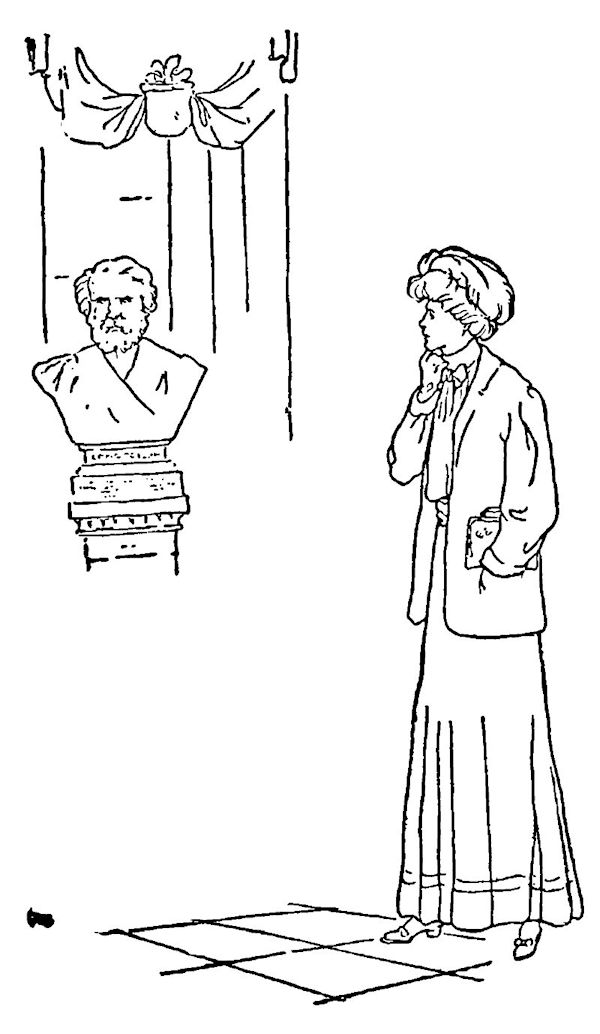
I took a few tentative steps, which brought me to the bust of our own Longfellow.
Uncertain whether to advance or retreat I took a few tentative steps, which brought me to the bust of our own Longfellow. The dignified and old-school New Englander is here represented as a plump-faced and jovial gentleman with very curly hair. The marble is excessively white and new-looking, and altogether the monument suggests the Longfellow who wrote “There was a little girl, who had a little curl,” rather than the author of Evangeline. But if not of poetic effect, the bust is satisfactory as a fine type of American manhood, so I smiled back at it, and passed on.
Then, by chance, I turned into the South Transept.
It was about five o’clock on a midsummer afternoon, the hour, as I have often since proved, when the spell of the Poets’ Corner is most potent—the hour when a prismatic shaft of sunlight strikes exactly on the marble forehead of Burns, and flickering sun-rays light up the face of Southey. There, above the mortal remains of Henry Irving, I stood, and as I looked up, I knew that at last Westminster Abbey and I were at one.
For I saw Shakespeare.
It was not the emotional atmosphere of the place, for that had not as yet affected me. It was not historic association, for I knew Shakespeare’s bones did not rest there. It was not the inherent, artistic worth of the sculptured figure, for I knew that it has never been looked upon as a masterpiece, and that Walpole, or somebody, called it “preposterous.” But it was Shakespeare, and from his eyes there shone all the wonder, the beauty, and the immortality of his genius.
I am told the whole monument is wrong in composition and in execution, but that is merely
A fault to pardon in the drawing’s lines,—
Its body, so to speak; its soul is right.
Or at least it was to me, and from that moment I felt at home in Westminster Abbey.
Without leaving the United States, I could have found a more magnificent statue of Shakespeare in our own Library of Congress, but no other representation of him, in paint or stone, has ever portrayed to my mind the personality of the poet as does the Abbey monument.
I invited emotions and they accepted with thanks. They came in crowds, rushing, and soon I was unqualifiedly certain that I would rather be dead in Westminster Abbey than alive out of it. Having reached this important decision, I broke off my emotions at their height and went home.
The next day, as the sunlight touched Burns’s uplifted brow, I was there again, and the next, and the next.
The first impressions being comfortably over, Shakespeare and I became very good friends, without the necessity for heaving breast and suppressed tears on my part.
I had affable feelings, too, toward many of the other great and near-great. It amused me to learn how many succeeded in getting into the Abbey by the mere accident of dying while there was plenty of room.
John Gay, they tell me, is one of the interlopers, and his epitaph,
Life is a jest and all things show it;
I thought so once, but now I know it,
is dubbed irreverent.
But to my mind the irreverence is not in the sentiment, but in the fact that it is placed upon his tomb, the responsibility therefore, even though Gay requested it, lying with his survivors. Surely the man who wrote Trivia is as much entitled to honor as many others whose virtues are set forth in stone.
But if any one is disturbed by Gay’s irreverence, he has only to step through the door which is close at hand, into the little chapel of St. Faith.
For some indefinable reason, this chapel breathes more the spirit of reverence and holiness than any other in the Abbey. There is no especial beauty of decoration here, but he who can enter the solemn little room without putting up the most fervent prayer of his life must be of an unresponsive nature indeed.
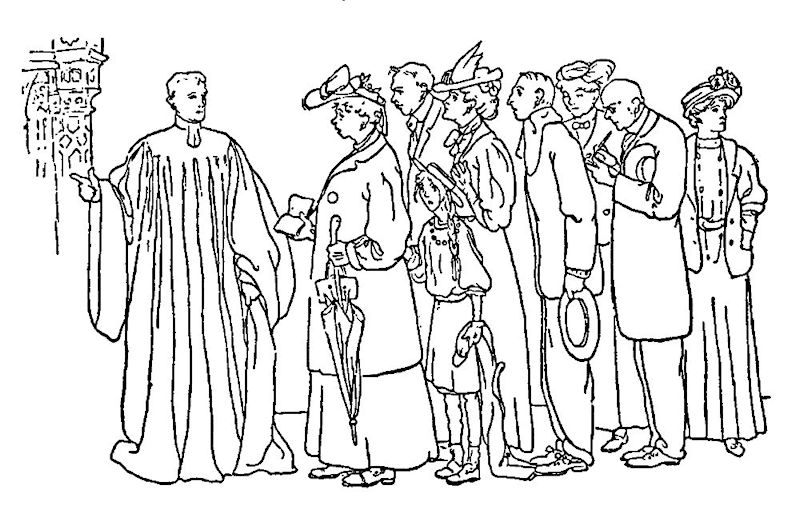
He so dominates the group of tourists he conducts that they often show signs of almost human intelligence.
It did not seem to me inharmonious to visit the Chapels of the Sanctuary in charge of a verger. The Abbey guide is also a philosopher and friend. His intoned information is pleasantly in keeping with the chiselled epitaphs, and his personality is invariably delightful; and he so dominates the group of tourists he conducts that they often show signs of almost human intelligence. The guide answers questions, not perfunctorily, but with an air of personal interest. To be sure, he passes lightly over many of the most impressive figures and proudly exhibits the fearsome Death who jabs a dart at Lady Nightingale, while her husband politely endeavors to protect her. But after becoming acquainted with the chapels one may return on free days and visit, unescorted, the tomb of Sir Francis Vere.
The Waxen Effigies greatly took my fancy. Hidden away in an upper room, they are well worth the extra fee which it costs to see them. The verger describes them with a show of real affection, and indeed, I felt strangely drawn to the ghastly puppets, which are, undoubtedly, very like the kings and queens they represent. William and Mary are easily lodged in a case by themselves, and their brocades and velvets and real laces are beautiful to look upon, though stiffened by age and dirt. Elizabeth is a terror, and Charles the Second a horror, but vastly fascinating in their weird dreadfulness. Again and again I returned to my waxen friends, and found that they gave me more historic atmosphere than their biographies or tombs.
Hanging round the outside of the Abbey, I one day stumbled into St. Margaret’s. The window is wonderful, of course, but I was more interested in remembering that here Mr. Pepys married the wife of whom he later naïvely chronicled:
“She finds, with reason, that in the company of other women that I love, I do not value her or mind her as I ought.”
Having seen the church where Pepys was married, I felt an impulse to visit the house where he died. But I was relieved rather than otherwise to learn that no trace of the house now remains.
And, anyway, the house where he died wasn’t the house where he made the pathetic entry in his Diary:
“Home, and, being washing day, dined upon cold meat.”
Londoners have no definiteness of any sort. Their most striking trait is, paradoxically, a vague uncertainty, and this is seen in everything connected with London, from the weather to the gauzy, undecided, wavering scarfs which the women universally wear.
Indeed I do not know of anything that so perfectly represents the mentality of an Englishwoman as these same uncertain morsels of drapery.
This state of things is doubtless founded on a logical topographical fact. Baedeker states that the city of London is built on a tract of undulating clay soil, and the foundation of the average Londoner’s mind seems to be of equal instability.
I have learned from the recent newspapers that, owing to these lamentable subsoil conditions, Saint Paul’s Cathedral is even now cracking and crumbling, and parallel cases may sometime be noted among the great minds of the Britons.
I trust this will not be mistakenly thought to mean any disparagement to the British mind, whether great or small. It is, I am sure, a matter of taste; and the English people prefer their waveringness of brain, as the Pisan Tower prefers to lean.
The result of this state of things is, naturally, a lack of a sense of proportion, and an absolute ignorance of values.
And it is this that makes it impossible, or at least improbable, to generalize about the manners and customs of London’s polite society; though indeed anything so uncertain as their society ways can scarcely be called customs.
I received one morning from Mrs. C. a hastily-written note of invitation to dine with her that same evening.
“Quite informally,” the note said, “and afterward,” it went on, “we will drop in at Lady Sutherland’s.”
As I had learned that “quite informally” meant anything its writer chose it to mean, I was uncertain as to the formality of the function, and, having no idea who Lady Sutherland might be, I asked information of a casual caller.
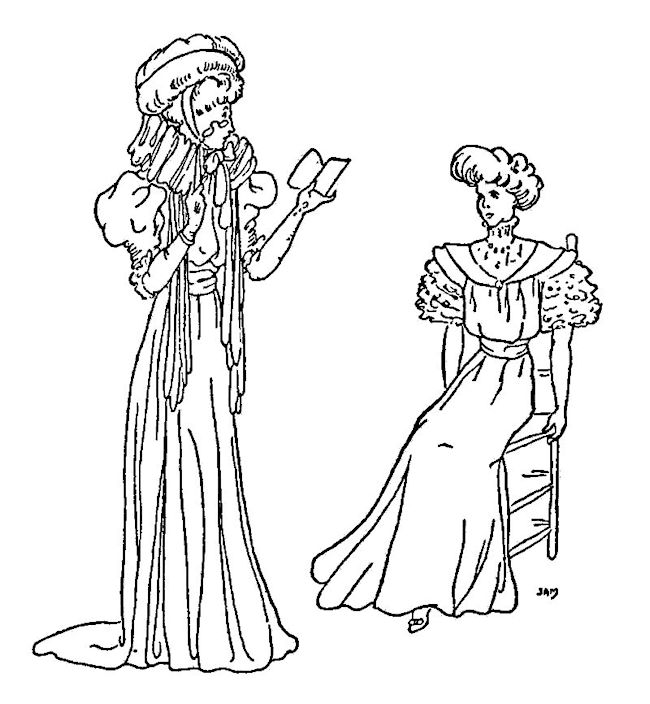
“Why, in social importance, she’s only next to the King!”
“Who is she?” was the response, “why, in social importance, she’s only next to the King! that’s all! She’s the Duchess of Sutherland. She lives in Stafford House. You may not be familiar with Stafford House, but it is on record that when Queen Victoria was there, calling on a former Duchess of Sutherland, she took her leave with the remark, ‘I will now go from your palace to my humble home,’ referring to her own residence in Buckingham.”
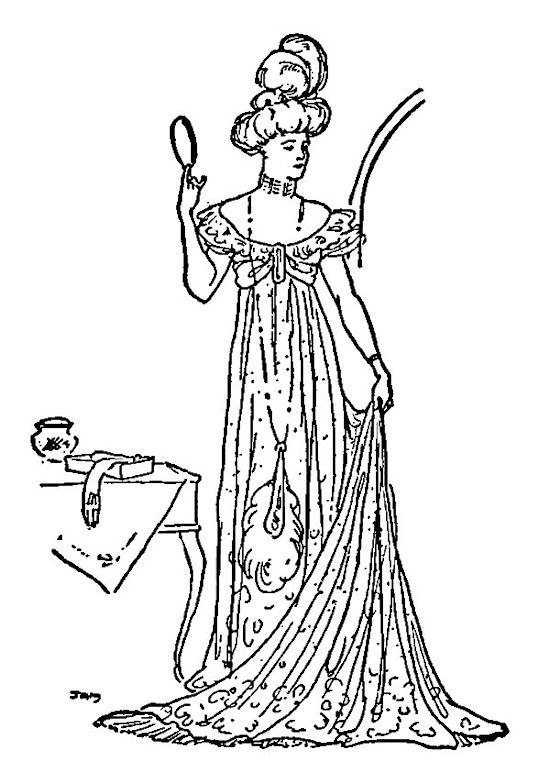
And so for the informal dinner I arrayed myself.
I was dumfounded! To be invited to Stafford House in that careless way, and to have the Duchess of Sutherland mentioned casually as Lady Sutherland,—well!
And so for the informal dinner I arrayed myself in the most elaborate costume in my wardrobe.
Nor was I overdressed. The informal dinner proved to be a most pompous function, and after it we were all whisked into carriages, and taken to the reception at Stafford House.
Once inside of the beautiful palace I ceased to wonder at Queen Victoria’s remark. Admitted to be the most beautiful of all English private mansions, Stafford House seemed to my American inexperience far more wonderful than Aladdin’s palace could possibly have been.
The magnificent Entrance Hall, with its branching staircase and impressive gallery, seemed an appropriate setting for the beautiful Duchess, who stood on the staircase landing to greet her guests. Robed in billows of white satin, and adorned with what seemed to me must be the crown jewels, the charming, gracious lady was as simple and unaffected of manner as any American girl. She greeted me with a sincerity of welcome that had not lost its charm by having already been accorded to thousands of others.
Then, a mere atom of the thronging multitude, I was swept on by the guiding hands of belaced and bepowdered lackeys, and, quite in keeping with the unexpectedness of all things in London, I found myself suddenly embarked on a sightseeing tour. But this was a sort of sightseeing toward which I felt no objection. To be jostled by thousands, all arrayed in costumes and jewels that were sights in themselves; to visit not only the great picture gallery of Stafford House, but the smaller apartments, rarely shown to visitors; to be treated by guests and attendants as an honored friend of the family and not as an intruder; all these things made me thoroughly enjoy what would otherwise have been a sightseeing bore.
It was a marvellous pageant, and to stand looking over the railing of the high balcony at the crush of vague-expressioned lights of London society, drifting slowly up the staircase in their own impassive way, was to me a “Sight Which Should on No Account be Omitted.”
With a sort of chameleonic tendency, I involuntarily acquired a similar air, and like one in a dream I was introduced to celebrities of all degrees. Authors of renown, artists of repute, soldiers of glorious record, all were presented in bewildering succession.
Their demeanor was invariably gracious, kindly, and charming; they addressed me as if intensely interested in my well-being, past, present, and future. And yet, combined with their warm interest, was that indefinite, preoccupied, waveringness of expression, that made me feel positive if I should suddenly sink through the floor the speaker would go on talking just the same, quite unaware of my absence.
The feast prepared for this grand army of society was on a scale commensurate with the rest of the exhibition.
Apparently, whoever was in charge had simply provided all there was in the world of everything; and a guest had merely to mention a preference for anything edible, and it was immediately served to him.
The Londoners of course, being quite unaware what they wanted to eat, vaguely suggested one thing or another at random; and the vague waiters, apparently knowing the game, brought them something quite different. These viands the Londoners consumed with satisfaction; but in what was unmistakably a crass ignorance of what they were eating.
All this fascinated me so that I greatly desired to try experiments, such as sprinkling their food thickly with red pepper or putting sugar in their wine. I have not the slightest doubt that they would have calmly continued their repast, without the slightest suspicion of anything wrong.
The air of the “passive patrician” of London society is unmistakable, inimitable, and absorbingly interesting; and never did I have a better opportunity to observe it than at the beautiful reception at Stafford House to which I was invited, “quite informally.”
In contrast to this, and as a fine example of the Londoner’s utter absence of a sense of proportion, listen to the tale of a lady who called on me one day.
I had met her before, but knew her very slightly. She was exceedingly polite, and well-bred, and of very formal manner.
The purpose of her call was to invite me to her house. She definitely stated a date ten days hence, and asked if I would enjoy a bread-and-milk supper. “For we are plain folk,” she said, “and do not entertain on an elaborate scale.”
I accepted with pleasure, and she went politely away.
But I was not to be fooled by intimations of informality. “Bread and milk,” indeed! that, I well knew, was a euphonious burlesque for a high tea if not a sumptuous dinner. I remembered that she had called personally to invite me; that she asked me ten days before the occasion; and that the hour, seven o’clock, might mean anything at all.
Therefore, when the day came, I donned evening costume, called a hansom, and started.
I had never been to the house before, and on reaching it found myself confronted by a high stone wall and a broad wooden door.
Pushing open the latter, I doubtfully entered, and seemed to be in a large and somewhat neglected garden filled with a tangle of shrubs, vines, and flowers. Magnificent old trees drooped their branches low over the winding paths; rustic arbors, covered with earwiggy vines, would have delighted Amy March; here and there a broken and weather-beaten statue of stone or marble poked its head or its headlessness up through the wandering branches.
I started uncertainly along the most promising of the paths, and at last came in sight of a house.
A picturesque affair it was. A staircase ran up on the outside, and a tree,—an actual tree—came up through the middle of the roof. It was like a small, tall cottage, almost covered with rambling vines, and surrounded by an irregular, paved court.
From an inconspicuous portal my hostess advanced to greet me. She wore a summer muslin, simply made, and I promptly felt embarrassed because of my stunning evening gown.
Her welcome was most cordial, and expressive of beaming hospitality.
“You must enter by the back door,” she explained, “as the vines have grown over the trellis, so that we cannot get around them to the front door to enter; though of course we can go out at it. But this side of the house is more picturesque, anyway. Do you not think it delightful?”
A bit bewildered, I was ushered into a room, strange, but most interesting. It contained a mantel and fireplace which had been originally in Oliver Goldsmith’s house, and which was a valuable gem, both intrinsically and by association. The other fittings of the room were quite in harmony with this unique possession, and showed experienced selection, and taste in arrangement. The next room, in the centre of the house, was the one through which the tree grew. Straight up, from floor to ceiling, the magnificent trunk formed a noble column, around which had been built a somewhat undignified table.
Another room was entirely furnished with wonderful specimens of old Spanish marquetry—such exquisite pieces that it seemed unfair for one person to own them all. Any one of them would have been a gem of any collection.
My friend was a charming hostess; and when her husband appeared, he proved not only a charming host, but a marvellous conversationalist.
So engrossed did we all become in talking, so quick were my friends at repartee, so interesting the tales they told of their varied experiences, that the time slipped away rapidly, and the quaint old clock, which was a gem of some period or other, chimed eight before any mention had been made of the evening meal.
“Why, it’s after supper-time!” exclaimed my hostess, “let us go to the dining-room at once.”
The dining-room was another revelation. One corner was occupied by a huge, high-backed angle-shaped seat of carved wood, which carried with it the atmosphere of a ruined cathedral or a Hofbrauhaus. The latter effect was perhaps due to the sturdy oaken table which had been drawn into the corner, convenient to the great settee.
After we were seated, a maid suddenly appeared. She was garbed in a gorgeous and elaborate costume which seemed to be the perfection of a peasant’s holiday attire. Huge gold earrings and strings of clinking beads were worn with a confection of bright-colored satin and cotton lace, which would have been conspicuous in the front row of a comic opera chorus.
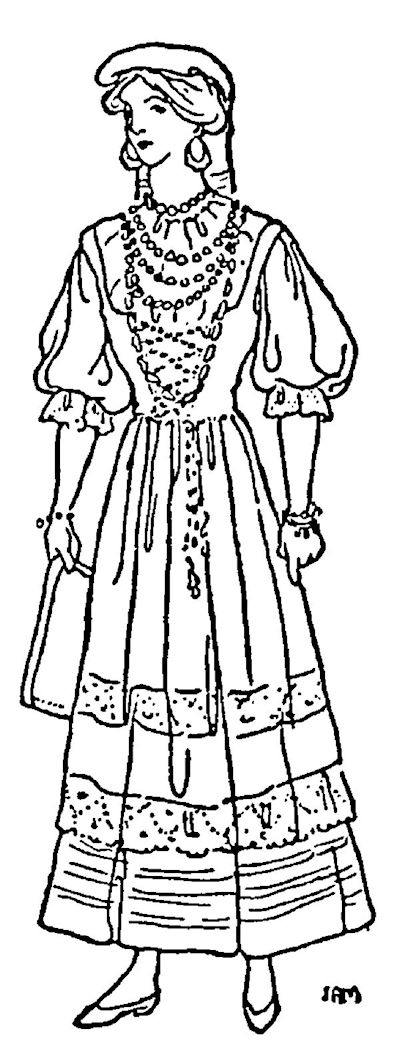
If you’ll believe me, that Gilbert and Sullivan piece of property brought in and served, with neatness and despatch, a meal which consisted solely of bread and milk!
The bowls were of Crown Derby, the milk in jugs of magnificent old ware, and the old silver spoons were beyond price.
Yet so accustomed had I become to unexpectedness, and so imbued was I with the spirit of surprise that haunted the whole place, that the proceeding seemed quite rational, and I ate my bread and milk contentedly and in large quantities.
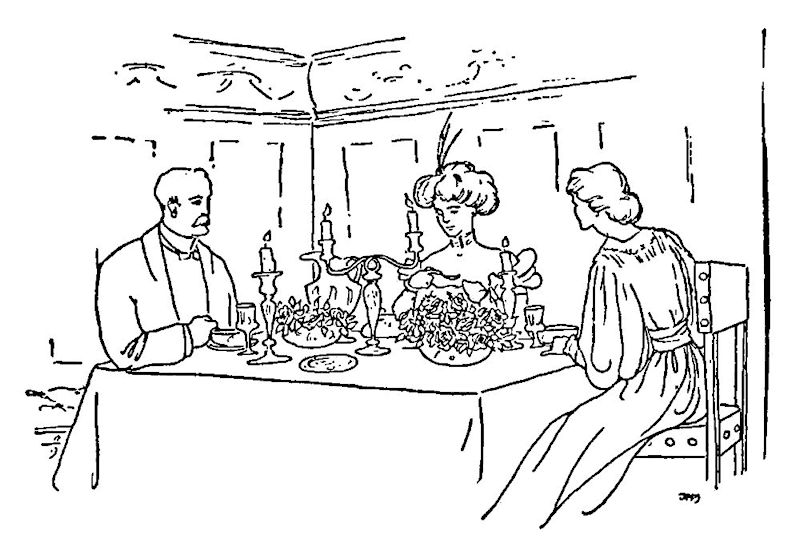
I ate my bread and milk contentedly and in large quantities.
There was no other guest, but I shall never forget the delight of that supper. Never have I seen a more innate and beautiful hospitality; never have I heard more delightfully witty conversation; never have I been so fascinated by an experience.
And so if Londoners choose to scribble a hasty note inviting one carelessly to a reception at Stafford House, and if they see fit to make a personal call far in advance to ask one to a bread-and-milk supper, far be it from me to object. But I merely observe, in passing, that they have no sense of proportion, at least in their ideas of the formality demanded by social occasions.
I suppose every one experiences sudden moments of self-revelation that come without rhyme or reason, like a thunderbolt out of a clear sky: revelations that make clear in one illuminative flash conditions and motives that have been tangled in a vague obscurity of doubt.
It was when such an instantaneous radiance of mental vision came to me I realized at once why I had come to England. It was simply and only that I might visit Stratford-on-Avon.
Nor was this pilgrimage to be lightly undertaken. Well I knew that the position Shakespeare occupied in my lists of hero-worship demanded that a fitting tribute of emotion be displayed at sight of such material memorials as were preserved at his birthplace.
Moreover, I knew that, whatever might be my sense of reverential homage, in me the power of emotional demonstration did not abound.
But it is ever my custom, when possible, to supply or amend such lacks as I may note in my nature, by any available means.
And what could be wiser than when going on such an important journey, and where I knew my own powers would fall short of an imperative requirement, to take with me some one who should adequately supplement my shortcomings?
Being of a methodical nature, I have my friends as definitely classified and as neatly pigeon-holed as my old letters. Mentally running over my collection of available companions, I stopped at Sentimental Tommy, knowing I need look no further.