Front matter (continued 2)
Reading edition
Of course Sentimental Tommy was not his real name, but it is my custom to bestow upon my friends such titles as seem to me appropriate or descriptive.
Sentimental Tommy, then, was the only man in the world, so far as I knew, who would make a perfect associate for a day in Stratford. His especial qualifications were a chameleonic power of adaptability, an instant and sympathetic comprehension of mood, an unbounded capacity for sentiment, and a genius for comradeship. He was also a man to whom one could say “come, and he cometh,” without any fuss about it.
The date being arranged, I turned to my Baedeker and was deeply delighted to discover that we must take a train from Euston Station. For it seemed that the wonderful columned façade of Euston was the only appropriate exit from London, when one’s destination was Stratford. I had hoped that our route might cause us to pass through Upper Tooting, as, next to Stratford, this was to me the most interesting name in my little red book. I know not why, but Upper Tooting has always possessed for me a strange fascination and, though it sounds merely like the high notes of a French horn, yet my intuition tells me that it is full of deep and absorbing interest.
Sentimental Tommy met me at Euston Station, and bought tickets for Stratford as casually as if it had been on the Pennsylvania Railroad. Tommy was in jubilant spirits that morning, with the peculiar kind of international triumph which comes only to an American who has attained some especial favour of the English. Gleefully he told me of his great luck: Only that morning he had been kicked by the King’s cat! An early stroll past Buckingham Palace and along Constitution Hill had resulted in an interview with the royal feline, and the above-mentioned honorable result had been achieved. My observation to the effect that I didn’t know that cats kicked, was met by the simple statement that this cat did,—and then we went on to Stratford.
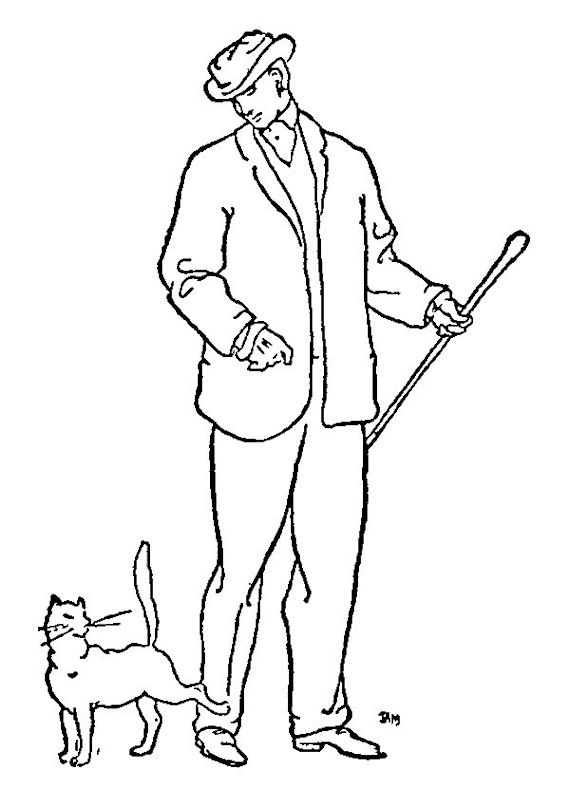
Kicked by the King’s cat.
The ride being in part through the same country that I had traversed when coming to London, I felt quite at home in my surroundings; and we chatted gayly of everything under the sun except the immortal hero of our pilgrimage.
That’s what I like about Tommy—he has such a wonderful intuitive sense of conversational values. And though his obsession by Shakespeare is precisely the same as my own, and though he is himself a Bartlett’s Concordance in men’s clothing, yet I knew, for a surety, that he would quote no line from the poet through the entire day.
As we had neither of us ever been in Stratford before, we left the train at the station and paced the little town with an anticipation that was like a blank page, to be written on by whatever might happen next.
Trusting to Tommy’s instinct, we asked no questions of guidance, and started off at random, on a nowise remarkable street. It was an affable August day, and our gait was much like that of a snail at full gallop; yet before we turned the first corner tears stood in my eyes,—though whether caused by the thrill of being on Shakespeare’s ground, or the reflection of Tommy’s discernibly suppressed emotion, I’ve no idea.
But for pure delightfulness of sensation it is difficult to surpass that aimless wandering through Stratford, with a subconsciousness of what was awaiting us.
In London, historical associations crop up at every step; but, though pointing backward, each points in a different direction, and so they form a great semicircular horizon which becomes misty and vague in the distance. This is restful, and gives one a mere sense of blurred perspective. But Stratford is definite and coherent. Everything in it, material or otherwise, points sharply back to the one figure, and the converging rays meet with a suddenness that is dazzling and well-nigh stunning.
Stratford is reeking with dramatic quality, and a sudden breath of its atmosphere makes for mental unbalance.
“Don’t take it so hard,” said Tommy, with his gentle smile; “this is really the worst of it,—except perhaps one other bit,—and it will soon be over.”
“Why, we haven’t begun yet,” said I, in astonishment.
“You’re thinking of the Birthplace, the Memorial, and the Church. You ought to know that we can see, absorb, and assimilate those things in just about one minute each. It is this that counts,—this, and the footpath across the fields to Shottery.”
“And the River,” I added.
“Yes, and the River.”
Following his unerring instincts, Tommy’s steps led us, though perhaps not by the most direct route, to the Shakespeare Hotel.
“You know,” he said, “intending visitors to Stratford are invariably instructed by returned visitors to go to the Red Lion Inn, or Red Bear, or Red something; but instinct tells me that this hostelry has a message for us.”
Nor was the message only that of the typical English luncheon which the dining-room afforded. There were many other points about that hotel which impressed me with peculiar delight, from the quaint entrance hall to the garden at the back.
Each room is named for one of Shakespeare’s plays, and has the title over its door. After hesitating between Hamlet and Twelfth Night, I finally concluded that should I ever spend a whole summer in Stratford, which I fully intend to do, I should take possession of the delightful, chintz-furnished Love’s Labour’s Lost.
The library was a continuation of fascination. A strange-shaped room whose length is half a dozen times its width, it seemed a place to enter but not to leave.
However, one does not visit Stratford for the delights of hotel-life, and, luncheon over, we again began our wanderings.
By good luck we chanced first upon the Memorial Theatre. The good luck lay in the fact that, having seen the outside of this Tribute to Genius, we had no desire to enter. It was remindful of a modern New England high school building, and, though we knew it contained authentic portraits and first folios, it had little to do with our Shakespeare.
We paused at the Monument, and commented on the cleverness of the happy thought that provided Philosophy to fill up the fourth side of Shakespeare’s genius.
And then we went on to Henley Street and the house where Shakespeare was born.
We entered the narrow door-way into the old house, which shows so plainly the frantic endeavor at preservation, and we climbed the stairs to the room where the poet was born. The air was smoky with memory and through it loomed the rather smug bust, its weight supported by a thin-legged, inadequate table.
With Tommy I was not troubled by the objectionable thought of “first impressions.” In the first moment we took in, with one swift glance, the fireplace, the walls, the windows, and the few scant properties, and after that our attitude was as of pilgrims returning to an oft-visited shrine.
In the room back of the Birthroom, the one that looks out over the garden, sat the old custodian of the place. He was a large handsome man with none of the doddering, mumbling effects of his profession.
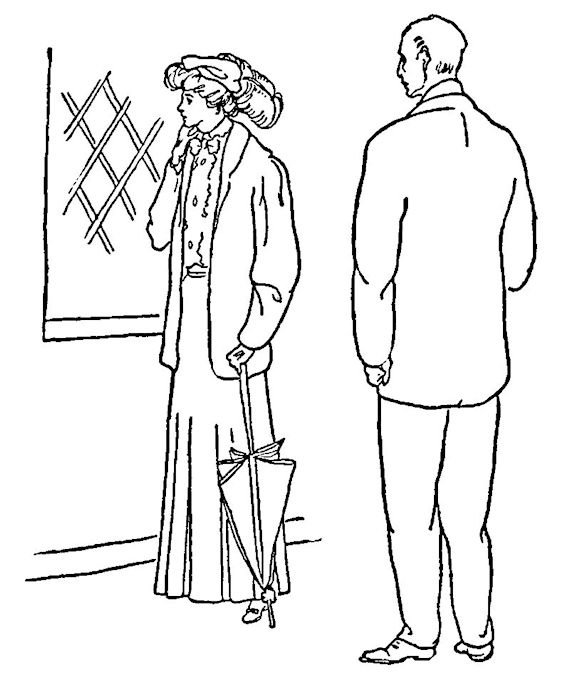
My thoughts all with Mary Arden.
He looked at me keenly, as I stood looking out of the back window, my thoughts all with Mary Arden, and he said, in a low voice, “You love him, too,” and I said, “Yes.”
A little shaken by the Birthplace, but of no mind to admit it, we went gayly through the Stratford streets, passing groups of Happy Villagers, and so suddenly did we meet the Avon, that we almost fell into it. We chanced upon two broad marble steps that seemed to be the terminal of a macadamized path to the river.
The Avon was using the lower of these two steps, so we sat on the upper one and watched the children sailing boats upon the Memorial Stream. This brought to my mind Mr. Mabie’s word picture of Shakespeare at four years old, and for a time the baby Shakespeare took precedence over the man poet.
It is scarcely fair that the Avon should be so beautiful of itself, for this, with its vicarious interests, makes it too blessed among rivers.
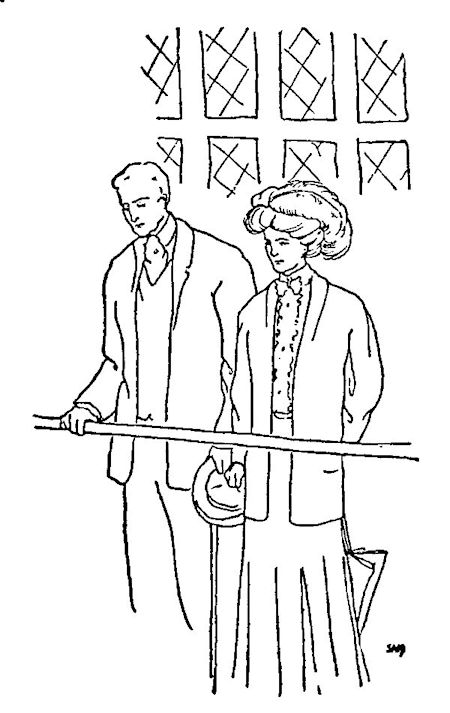
At the chancel.
Then we went to Holy Trinity. The approach, plain as way to parish church, seemed like a solemn ceremony, and, as Tommy afterward admitted, “it got on his nerves.”
Unbothered by verger or guide, oblivious to tourists, if any were there, we walked straight to the chancel, looked at Shakespeare’s grave,—and walked away.
It was fortunate for me at this moment that I had taken Sentimental Tommy with me; for, as his emotions are so much more available than mine, so he has them under much better control.
I had expected to look around the church a bit, but Tommy led me away, through the old graveyard, to the low wall by the river. And there, under the waving old trees, we sat until we could pick up our lost three hundred years.
Back through the town we went; and I must needs stop here and there at the little shops, which, with their modern attempts at quaintness, display relics and antiques, more or less genuine.
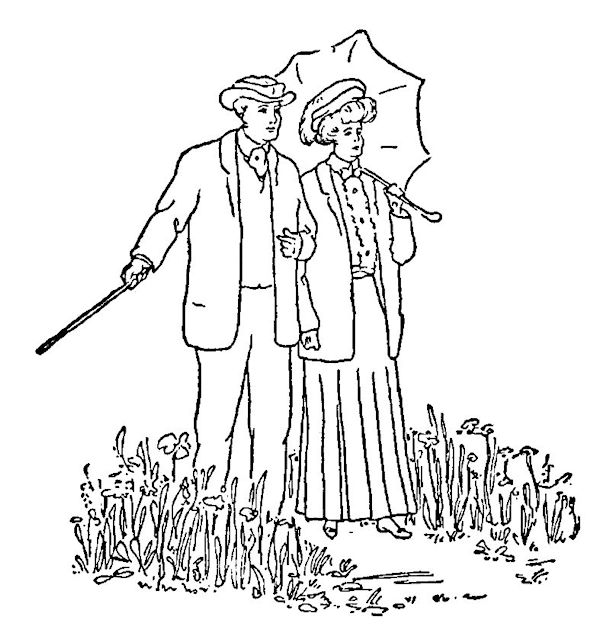
The footpath across the fields.
Few of their wares appealed to me, so I contented myself with a tiny celluloid bust of Shakespeare, which by chance presented the familiar features with an expression of real power and intellect. It was strange to find this poet face on a cheap trinket, and with deep thankfulness of heart I possessed myself of my one souvenir of Stratford.
It is directly opposed to all the instincts of Tommy’s nature to ask instructions in matters which he feels that he ought to know intuitively.
And so, upon his simple announcement, “This is the footpath across the fields to Shottery,—to Anne Hathaway’s Cottage,” we started.
As Tommy had hinted, during our walk from the station, there would be another bit of the real thing; and this was it. The walk across the fields was crowded with impulses that came perilously near emotional intensity. But from such appalling fate we were saved by our sense of humor. One cannot give way to emotion if one is conscious of its humorous aspect. And we agreed that as the path across the field had been here ever since Shakespeare trod it, and as it would in all probability remain for some time in the future, the mere coincidence that we were traversing it at this particular moment was nothing to be thrilled about.
And yet,—it was the path from Stratford to Shottery, and we were there!
But it was a longer path than we had thought, and the practicality which is one of the chief ingredients of Tommy’s sentiment moved him to look at his watch and announce that we would have to turn back at once, if we would catch the last train to London.
Not entirely disheartened at leaving Anne Hathaway’s cottage unvisited,—for we both well knew the value of the unattained,—we turned, and wandered back to the station just in time for the late afternoon train.
And that was why we didn’t discover until some time afterward that we had taken the wrong road across the fields; and that, as we imagined our faces turned toward it, Anne Hathaway’s cottage was getting further and further away to our left.
To be in London is to be in Society. Each invitation accepted brings two more, with an ultimate result like that of the old-fashioned “chain letter.”
Having thoughtlessly begun a social career, I suddenly found my London carpeted with crimson velvet. And by insidious processes, and by reason of the advance of summer, the velvet carpet magically transformed itself into country-house lawns, the only difference being that the green velvet carpet was of a richer pile.
I had determined to accept no country-house invitations. The somewhat ample length and breadth of London itself was all the England I desired, and this I absorbed as fast as I could; my only difficulty being that I could not live nimbly enough.
But, like the historic gentleman who “loved but was lured away,” I was invited to a Saturday afternoon garden party in the country, and, under pressure of argument by some cherished friends, I consented to go.
The Garden Party, unlike Sheridan, was seventy miles away; but I learned that it would be a typical English Garden Party of the three-volume sort, and though it necessitated a week-end stay, and concomitant luggage bothers, I stoically prepared to see it through.
I was to meet my cherished friends, who were none other than the Wag O’ The World and his Wife, at Victoria Station.
This, of itself, was a worth-while experience, for meeting friends at a London station is always exciting. To begin with, they are never there. You rush madly about from one ridiculous, inadequate ticket wicket to another,—from one absurd, inadequate waiting-room to another,—and then you think that after all they must have said Charing Cross.
Then you forget them, and become absorbed in watching the comic opera crowd of week-enders, in their neat travelling-suits of beflounced muslin, frilly lace scarfs, and stout boots.
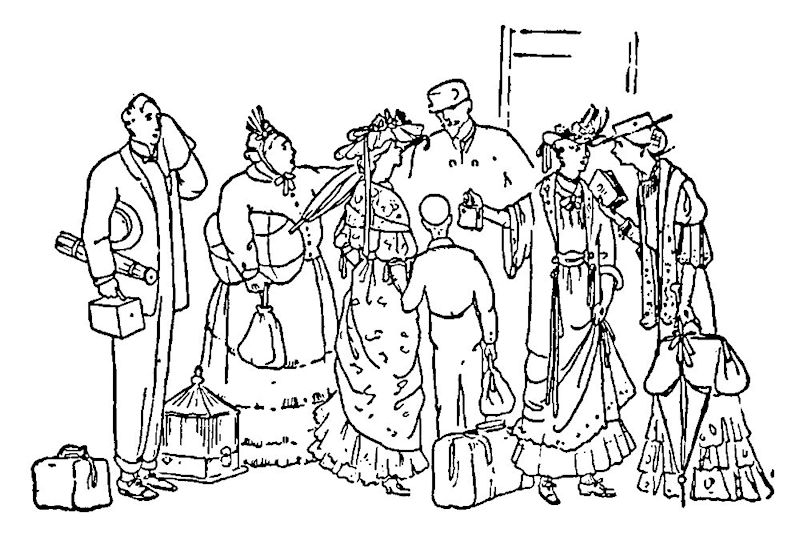
The comic opera crowd of week-enders.
Wandering about in the luggage-room, I suddenly chanced upon my friends calmly sitting on their own boxes, and looking as if they had been evicted for not paying their rent.
And such a multiplicity of luggage as they had! I had contented myself with one box of goodly proportions, but my cherished friends had no less than twelve pieces of the varying patterns of enamelled blackness and pig-skinned brownness which only England knows.
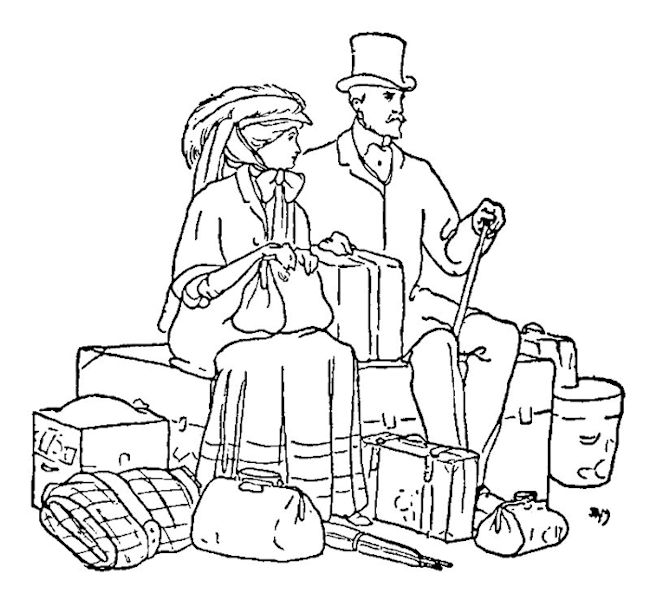
Looking as if they had been evicted for not paying their rent.
“Why sit ye here idle?” I demanded.
“We await the psychical moment,” responded the Wag O’ The World; “you see they won’t stick our luggage sooner than ten minutes before train time, and they’re not allowed to stick it later than five minutes before train time. The game is to catch a porter between those times.”
The game seemed not only difficult, but impossible, for the porters were not only elusive but for the most part invisible. Preoccupied-looking men strolled about with a handful of labels and a paste-pot, but could not be induced to decorate our luggage therewith.
“The principle is all wrong!” I declared. “It is absurd for one to be such a slave to one’s luggage. Somebody ought to invent a trunk with legs and intelligence, that would run after us,—instead of our running after it!”
“Even that would not be necessary,” responded the Wag O’ The World, in his mild way; “if somebody would only invent a porter with legs and intelligence, it would fulfil all requirements.”
Now this is the strange part.
Though there were more than a thousand people waiting to have their luggage stuck (i. e., labelled), and though there were but few of the invisible porters, yet everybody was properly stuck, and started when the train did!
The next entertainment was the securing of an entire compartment for our party of three. This is always accomplished in England, but by many devious and often original devices.
“I’ve thought of a good plan, which I’ve never tried yet,” observed the Wag O’ The World, “to get a compartment to one’s self. That is, to invent some collapsible rubber people,—like balloon pigs, you know,—that may be carried in the pocket, and blown up when necessary. Three or four of these, when blown up and placed in the various seats would fool any guard. And if one were shaped like a baby, with a crying arrangement that would work mechanically, the others would not be needed.”
This plan was ingenious, but, like everything else in England, unnecessary. It is one of the most striking characteristics of the English that nothing is absolutely necessary to their well-being or happiness. If anything is omitted or mislaid, it is not missed but promptly forgotten, and no harm done.
After an hour or two of pleasant travel through the hop-poled scenery of Southeastern England, we reached a place with one of those absurd names which always suggest Edward Lear’s immortal lyrics, where we must needs change cars.
My Cherished Friends strolled along the length of the platform to the luggage van, and judiciously selected such boxes as they cared to claim; though I am sure they did not get all of their own, and acquired a few belonging to other passengers. I easily picked out my own American trunk, and, surrounded by our spoil, we stood on the platform while the train wandered on.
After a long, but by no means tedious, wait there appeared on the other side of the platform a toy railroad train, so amateurish that it looked like one drawn by a child on a slate.
We were put into a box-stall, and locked in. The ridiculous little contraption bobbled along its track, and finally stopped in the middle of a beautiful landscape, and we jumped out to become part of it.
The barouche of our hostess awaited us, with still life in the shape of liveried attendants. A huge wagon awaited the luggage, which had mysteriously dumped itself out of the train, and we were whisked away to the Garden Party.
Partly to be polite, and partly because I couldn’t help it, I remarked on the marvellous beauty of the country.
The Wag O’ The World enthusiastically agreed with me. “But, Emily,” he said, “if you could only see this same country in the spring! These lanes are walled on either side with the pink bloom of the may,—and the wild flowers . . .”
Tears stood in the blue eyes of the Wag, at the mere thought of spring in Kent, and I realized at last why English poets have sometimes written poems about Spring.
We passed through the village, one of those tiny hamlets which acquire merit only by age and local tradition. The Happy Villagers stared at us with just the correct degree of bucolic curiosity, and we rolled on through the lodge gates, and along the winding, beautiful avenue to the house. In every direction stretched wide lawns of perfect grass, that probably acquired its uppish look when William the Conqueror trod it.
We were met by no humanity of our own stamp, but were shown to our room by benevolent-minded factotums, and gently advised to prepare for the Garden Party.
With the exception of entertainments of a public nature, I have never seen so beautiful and elaborate an affair. The guests, to the number of two hundred, came from all the country round; some in equipages dripping with ancestral glory, and some in motor-cars reeking with modern wealth.
The women’s costumes were of themselves a study. The English woman’s dress often inclines to the bizarre; and at a garden fête she lets herself loose in radiant absurdities, which she wears with the absolute self-satisfaction born of the knowledge that in the matter of feminine adornment England is the land of the free and home of the brave.
The Garden Party proceeded with the regularity of clock-work. The invitations read from four till six, and promptly at four the whole two hundred guests arrived. This occasioned no confusion, and the hostess greeted them with a neatness and despatch equalling that of our own Presidential receptions.
The guests then conversed in amiable groups on the lawn, while a band of musicians in scarlet and gold uniforms played popular airs.
All were then marshalled into a huge marquee, of dimensions exceeding our largest circus tent. Here, a Lucullian feast was served at small tables, and the country gentry, in their vague, involuntary way, amply satisfied their healthy English appetites.
After the feast, the assemblage was rounded up into a compact audience, to witness the performance of a troupe of Pierrots. The antics of these Mountebanks, with accompanying songs and dances, were appreciatively applauded, and then, as it was six o’clock, the assemblage dissolved and vanished, almost with the rapidity of a bursting bubble.
To my easily flustered American mentality, it all seemed like a feat of magic; and I looked in amazement at my hostess who, after the departure of the last guest, was as composed and serene as if she had entertained but a single guest. And like the insubstantial pageant faded, it left not a rack behind. More magic dissolved the tent, the band-stand, the Pierrots’ platform, and all other incriminating evidence, and then, with true English forgetfulness, the Garden Party was a thing of the past, and dinner was toward.
The house-party numbered forty, and, after exchanging the filmy finery of the garden garb for the more gorgeous regalia demanded by candle-light, the guests repaired to the stately dining-hall. Of course, repaired is the only verb of locomotion befitting the occasion.
Sunday passed like a beautiful daydream. The English have a great respect for the Sabbath day, and, perhaps as a reward for this, the weather on Sunday is usually perfect. It is not incumbent on guests to go to church, but it is considered rather nice of them to do so; especially if, as happened in this instance, the old church is on the estate where one is visiting. Nor is it any hardship to sit in an old carved high-backed pew, that has belonged to the family for ages.
Sabbath amusements are of a mild nature, one of the favorites being photography. English people have original ideas of posing, and any one who can invent a new mode of grouping his subjects is looked upon as a hero.
Aside from Lord Nelson’s declaration, if there is one thing that England expects, it is Tea; and tea she gets every day. But of all the various modes of conducting the function, the out-of-door Tea at a country house is probably the most delightful.
The appointments are the perfection of wicker, china, and silver, but it is the local color and surrounding that count most.
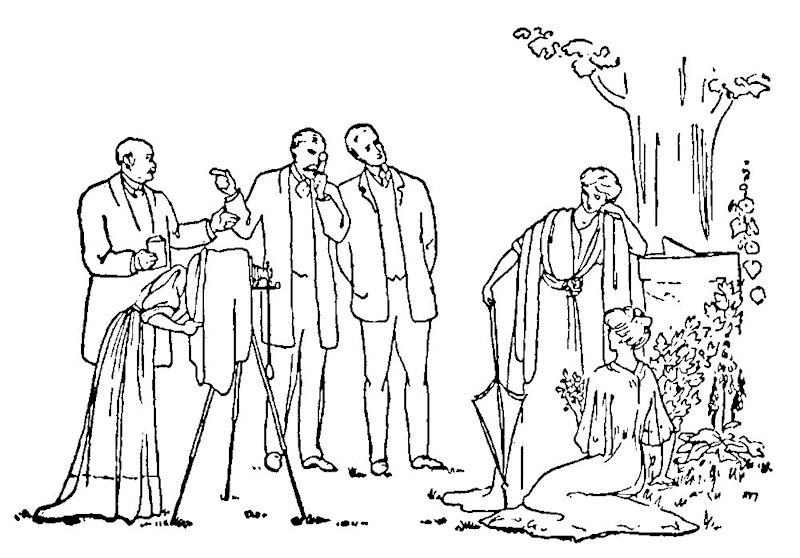
English people have original ideas of posing.
I cease to wonder that the English are only vaguely interested in their viands, for who could definitely consider the flavor of tea when in full view was a rising terrace leading to a magnificent old mansion of the correct and approved period of architecture, and covered with ivy that may have been planted by an Historical Character? or, looking in another direction, one could perceive a formal garden, with fountain and sun-dial; another turn of the head brought into view a unique rose orchard, unmatched even in England; while toward the only point of the compass left, rolled hills and dales that made many an English landscape painter famous.
Add to this the inconsequent and always delightful small-talk of English society, spiced here and there by their dreadful expletive, “My word!” and enlivened by the English humor, which is, to those who care for it, the most truly humorous thing on earth,—and I, for one, am quite ready to concede that these conditions combine to make Afternoon Tea a Spangle of Existence.
Miss Anna was certainly a godsend. It was due to her comprehension of the “human warious,” and her experienced knowledge of London, that I was enabled to revisit places I had never seen before.
When she calmly asked me to spend a day sightseeing in the “City,” I gasped. But when she reminded me that I ought to look once more on some of the old landmarks of London, I was flattered into a gracious acceptance.
One soft, purry August morning we started out. I was supposed to be absolutely under her direction, but when she remarked casually that we would take a ’bus, I rebelled.
“I have never been in or on the horrid things,” I protested, “and I never intend to!”
But she only said, “We’ll stand on the corner of Oxford Street, and wait for a City Atlas,” and somehow I immediately felt quite accustomed to City Atlases,—and intuitively knew it would be a blue one,—but it wasn’t.
Imitating Miss Anna’s air of habitual custom, I swung myself aboard of the moving monster, and laboriously climbed the curving companion-way at the back.
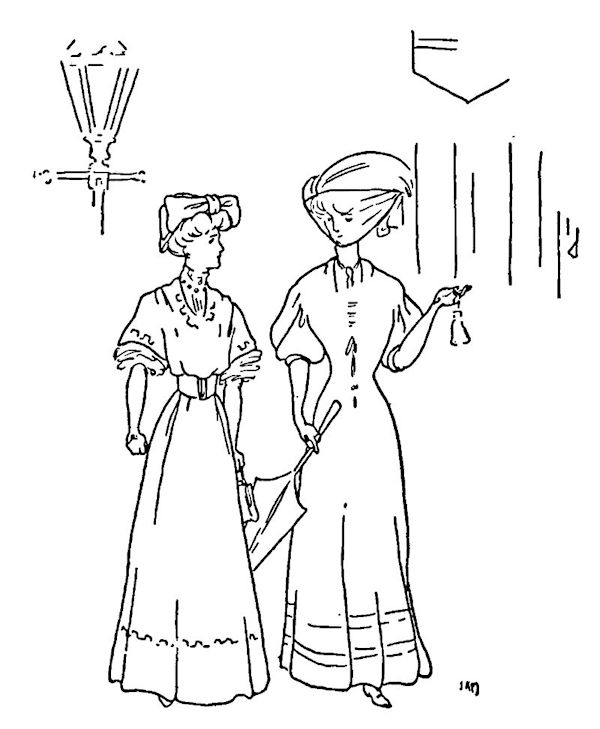
When she remarked casually that we would take a ’bus, I rebelled.
Once in our seats, it was not so bad; though very like riding the whirlwind, without being allowed to direct the storm.
Miss Anna drew my attention to points of interest as we passed them. In her tactful way she humored my idiosyncrasy. She never said, “On your right is the ‘Salutation and Cat,’ where Coleridge and Southey and Lamb used to congregate of a winter evening.” She said, instead, “Haven’t you always thought ‘Salutation and Cat’ the very dearest tavern in all London?”
Nor when we came to the half-timbered houses of Holborn did she say, “Here lived Lamb’s godfather, who was known to and visited by Sheridan.”
She said: “Don’t you like Hawthorne’s way of putting these things? You remember how he tells us that on his first visit to London he went astray in Holborn, through an arched entrance, in a court opening inward, with a great many Sunflowers in full bloom.”
All this pleased me, as did also Bumpus’s great book-shop, which is, I think, in this neighborhood.
Another delightful pastime was observing the signs over the shop doors. As the English are adept in the making of phrases, so are they especially happy in adjusting their callings to their names.
Lest I be considered frivolous, I shall mention only two; but surely there could not be more appropriate names for dentists than two whose sign-boards proudly announced Shipley Slipper, and, across the street from him, Mr. Strong-i’th’arm.
We went on, absorbed in our view of kaleidoscopic London, until Miss Anna decreed that we go down to the ground again. There was no elevator as in the Flatiron Building, so we tumbled down the back stairs, and were thrown off.
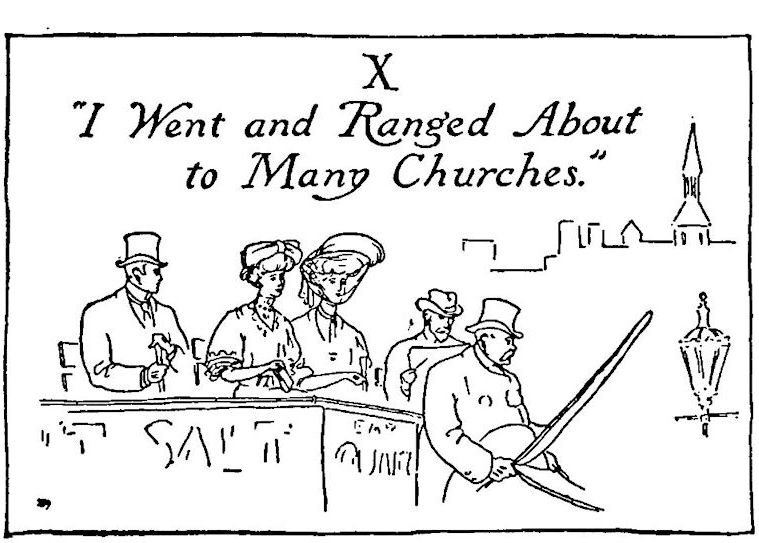
The sequence of the places we visited I do not remember, but they seemed to be mostly churches and taverns.
St. Paul’s was taken casually, as indeed it should be, being, like a corporation, without a soul.
Exteriorly, and from a goodly distance, St. Paul’s is perfection. From the river, or from Parliament Hill, it is sympathetic and responsive. But inside it is a mere vastness of mosaic and gilding, peopled with shiny marbles of heroic size. There is an impressive grandeur of art, but no message for the spirit. It is magnificent, but it is not church.
Miss Anna and I walked properly about the edifice, fortunately agreeing in our attitude toward it.
From here, I think, she led me across something, and through something and around something else, and then we were in St. Bartholomew’s church. Being the oldest church in London, St. Bartholomew’s is historically important, but it is interesting and delightful as well. The very air inside has been shut in there ever since the twelfth century, yet one breathes it normally, and enjoys the sudden backward transition. Had I the time, I could easily find an inclination to walk every day round its ancient triforium.
As we left the church, the Charter-house put itself in our way. Though other British subjects were educated at this school, it remains sacred to the memory of Thackeray. From here he wrote to his mother, “There are but three hundred and seventy boys in this school, and I wish there were only three hundred and sixty-nine.” But visitors to the Charter-house are glad that the three hundred and seventieth boy remained there, and stamped the whole place with his gentle memory. The atmosphere of the Charter-house is wonderfully calm; it does not connote boys, but seems tranquilly imbued with the later wisdom of the great men who spent their youthful days within its walls.
The stranger in London has a decided advantage over the resident, in that he can choose his heroes.
A friend of mine who lives in Chelsea proudly assured me that he could throw a stone from his garden into Carlyle’s! The point of his remark seemed to be not his superior marksmanship, but the proximity to the garden of a great man. Now, were I of the stone-throwing sex, there is many a dead hero at whose garden I should aim before I turned toward Carlyle’s. But of course this was because my friend lived in Chelsea. Therefore the non-resident, not being confined to a locality, can throw imaginary stones into any one’s garden.
A desultory discussion of this subject caused Miss Anna to propose that our next stone be aimed at the garden of Dr. Samuel Johnson.
So to the Cheshire Cheese we went.
The imposing personality of Dr. Johnson, and the antiquity of the famous tavern, led me to anticipate great things; and I was sorely disappointed (as probably most visitors are) at the plainly spread table, the fearfully hard seats, and the trying umbrella-rack filled with sawdust.
Of course we occupied the historic corner, where, according to the brass tablet, Dr. Johnson loved to linger; but two young American women whose tastes are not of the sanded floor and mulled ale variety cannot at a midday meal, whoop up much of the atmosphere that probably surrounded the smoke-wreathed midnights of Johnsonian revelry.
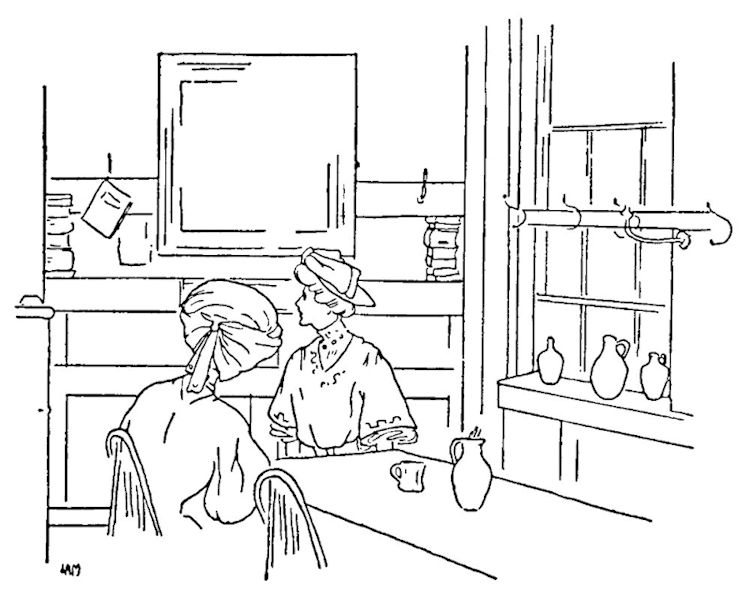
Of course we occupied the Historic Corner.
Not that we didn’t enjoy it, for we were of a mind to enjoy everything that day; but the appreciation was entirely objective. Methodically we climbed the stairs and viewed all the rooms of the old, old house, and on the top floor were duly shown by the guide the old arm-chair in which Dr. Johnson used to sit. A stout twine was tied across from arm to arm, that pilgrims might not further wear out the old cushion. When I, as an enormous jest, asked the guide to cut the string, that I might sit in the historic chair, he cheerfully did so, and I considered the fee well spent that allowed me to linger for a moment on the very dusty cushions of Dr. Johnson’s own chair.
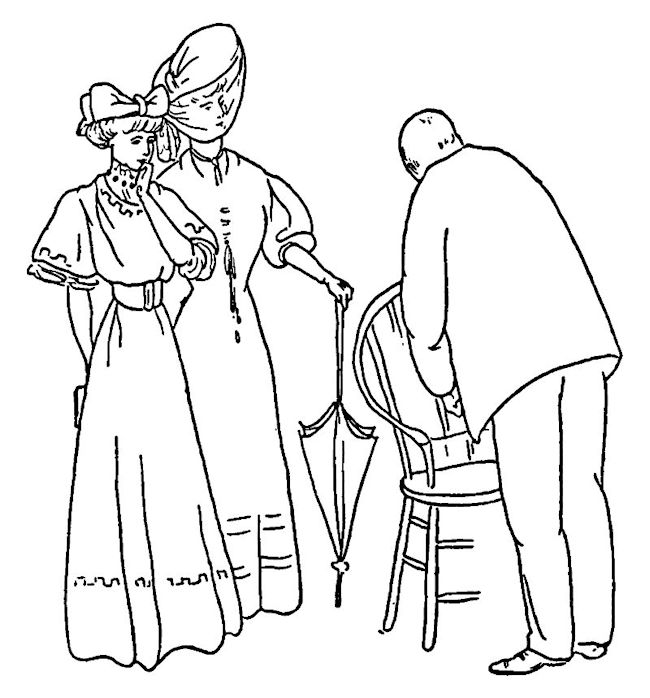
When I . . . asked the guide to cut the string . . . he cheerfully did so.
I afterward learned that the string business was a fraud, and was renewed and cut again for each curious visitor. I accept with equanimity this clever ruse, but I’m still wondering how they renew the dust.
While we were doing Early Restaurants Miss Anna said, “We must take in Crosby Place.”
This pleased me hugely, for I remembered how Gloucester, in Richard the Third was everlastingly repairing to Crosby Place, and I desired to know what was the attraction.
I found it interesting, but, lacking Gloucester, I shall not repair there often. To be sure, it is a magnificent house, Gothic, Perpendicular, and all that; the hangings and appointments are, probably, much as they used to be, but after all, I do not care greatly for eating among Emotions.
Whereupon Miss Anna cheerfully proposed that we visit the Tower.
“No,” said I, with decision; and then, my mind still on Richard the Third, I quoted: “I do not like the Tower, of any place.”
I’m not sure I should have been able so bravely to disclaim an interest in the Tower, had it not been that the night before I had heard a wise and prominent Londoner state the fact that he had never visited it.
“No Londoner has ever been to the Tower,” he declared. “We used to say that we intended to go some time or other, but now we don’t even say that.”
I was greatly relieved to learn this, for I’m positive that the Tower is hideous and uninteresting. As an alternative, I asked that we might visit the railway stations.
Aside from the romance that is indigenous to all railway stations, there are peculiar characteristics of the great London termini that are of absorbing interest. And so strong are the claims each puts forth for pre-eminence, it is indeed difficult to award a palm.
Euston has its columns, Charing Cross its Tribute to Queen Eleanor, St. Pancras a spacious roominess, and Victoria a wofully-crowded and limited space. Each station has its own sort of people, and, though indubitably they must mingle upon occasion, yet the type of crowd at each station is invariably the same.
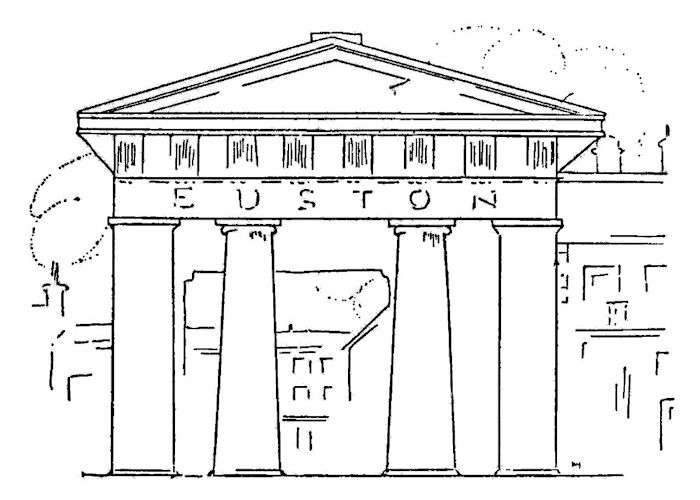
A mysterious influence which emanates from those wonderful columns.
And yet, after all, my heart goes back with fondest memories to Euston. Not the crowd, not even the atmosphere, but a mysterious influence which emanates from those wonderful columns. Not only the sight of them as you approach from London, but the queer, almost uncanny way in which they permeate the whole place. They follow you through the station and into the train, and not for many miles can you get out from under the presence of those perfect shapes.
Coming into London, Cannon Street is a good station to choose, if your route permit, but going out, Euston or Charing Cross should, if possible, be selected.
Before, after, or during, our station visits, we touched on a few more churches.
The Temple Church proved a delight because of the bronze Knights peacefully resting there. Miss Anna told me they were called Crusaders because they chose to lie with their legs crossed. This was probably true, for the position was maintained by all of them. Oliver Goldsmith is buried here, but I had no particular desire to throw a stone into his graveyard, and so we went on. Owing to a change of mood, we no longer rode on the ’buses, but took a hansom from one place to another. This was not as extravagant as it might seem, for, notwithstanding assertions to the contrary, one cannot ride enough in London cabs to make the bill of any considerable amount, at least as compared to a New York cab bill. And Shakespeare averred that “nothing is small or great but by comparison.”
As our cab bumpily threaded its way along the crammed Strand, the bright-colored mass of humanity and traffic seemed to me the pre-eminent London. I wanted no more sight-seeing, I wanted no more historical association, I merely wanted to continue this opportunity for feasting on real City London. I voraciously bit off large chunks of the atmosphere as we passed through it, which I am even yet digesting and assimilating.
As a complement to this view of London, we suddenly decided to call on a friend for a cup of tea. A personal, at-home tea would be a pleasant contrast to the publicity of our day.
Deciding upon the coziest and homeliest tea-dispenser, we drove to Mrs. Todd’s in Kensington.
It is a great satisfaction to know that the unpromising portal of a London house will positively lead eventually to a delightful back garden, and tea.
We were welcomed by our charming hostess in her pretty trailing summeriness, and were immediately transformed from whimsical sight-seers into sociable tea-drinkers.
Though it was by no means a special occasion, the garden was bright with flowers and people, and the tea and cakes were served under the inevitable marquee. It was Mrs. Todd’s weekly day at home, and the guests were all amiable and charming. A young woman with a phenomenal voice sang to us from the back parlor windows, and thereby gave a stimulus to the conversation. All was usual and orthodox. Everybody listened politely to everybody’s else chatter, and, apparently unhearing, answered at random, and quite often wrongly.
It seemed to me that even in this land of bright flowers the blossoming plants were of unusually brilliant hues. As I took my departure I commented on this, and my hostess responded with a superb indifference: “Really? yes, they are rather good ones. The nursery man fetched them early this afternoon, and after you are all gone, he will come and carry them away”; and, if you please, those ridiculous plants were in pots, sunk into the earth, and giving all the effect of a beautiful growing garden!
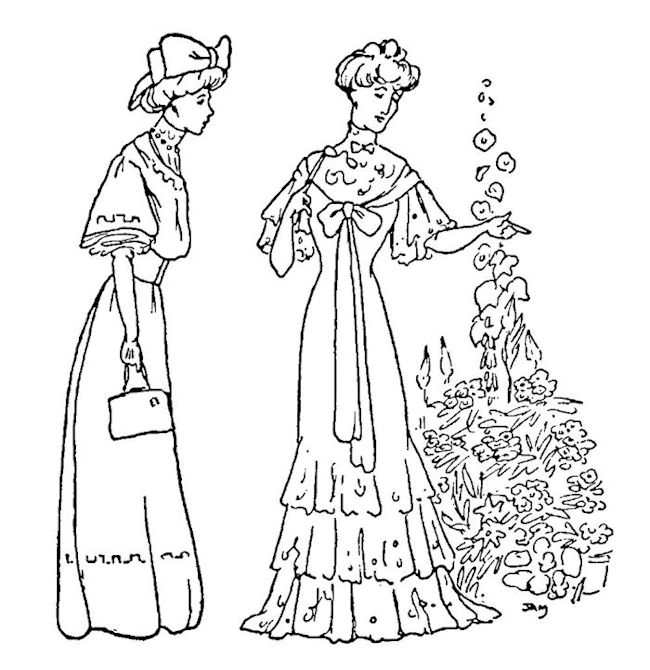
Really? yes, they are rather good ones.
This fable teaches that our English sisters are not above the small bluffs more often ascribed to American femininity.
A favorite game of mine in London was to walk until I became tired or lost or both, and then take a cab back home.
Oftenest, the bright beckoning of Piccadilly allured me, and I strolled along that Primrose Path from Park Lane to Piccadilly Circus, my mind laid open like a fresh blotting-book, to receive whatever impress London might carelessly leave upon it.
Such delightful people as I would see!
Ladies, tricked out in pink filminess of raiment, ever striving to clutch one more handful of their frou-frou, as it waggishly eluded their grasp, and dawdled along the pavement behind them.
Yet, strange to say, the flapping frilliness rarely becomes muddily bedraggled, as it would on a New York street; it merely achieves that palpable grayness which marks everything in London, from its palaces to its laundry work.
The headgear of these same ladies can be called nothing less than alarming.
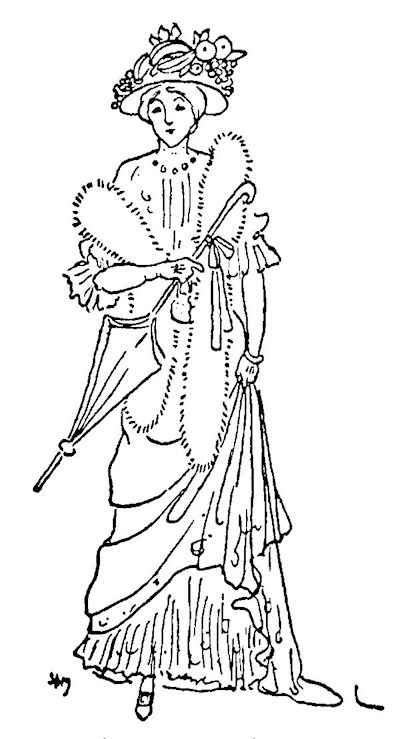
The headgear of these same ladies can be called nothing less than alarming.
During the summer of which I write, it was the whim to wear huge shapes of the mushroom or butter-bowl variety. These shapes, instead of being decorated with flowers or feathers, bore skilfully contrived fruits, that looked so like real ones I was often tempted to pluck them. Cherries and grapes were not so entirely novel, but peaches, pears, and in one instance a banana, seemed, at least, mildly ludicrous. I was rejoiced to learn that these fruits, being stuffed with cotton-wool, were not so weighty as they appeared; but they were indeed bulky, and crowded on to the hat in such quantities that it seemed more sensible to turn the butter-bowl the other side up to hold them.
Owen Seaman calls the English “the misunderstood people,” but how can one understand those who put fly-nets on the tops of their cabs instead of on their horses, and wear peaches on their heads?
As difficult to understand as their own handwriting (and more than that cannot be said!), after the solution is puzzled out the Londoners are the most delightful people in the world.
But you must accept the solution, and take them at their own valuation; for they are unadaptable, and very sure of themselves.
Now, Piccadilly is not like this. It is smiling, affable, charming, and very yielding and adaptable. It will respond to any of your moods and will give you an atmosphere of any sort you desire. On one side, as you walk along, are houses, more or less lately ducal, but all of a greatly worth-while air. Citified, indeed, with a wealthy width of stone pavement, and a noble height of stone frontage.
On the other side is Green Park, with its shining, softly-waving trees, its birds, and its grass.
But, passing the Hotel Ritz, both sides suddenly give way to shops and restaurants which rank among the most pretentious in all the world.
Many of the tradesmen are “purveyors to the King,” which magic phrase adds a charm to the humblest sorts of wares.
The book shops and the fruiterers’ shops are, to me, most enticing of all. It is a delight to make inquiries concerning a book that is, perhaps, not very well known, and, instead of the blank ignorance or the substitutive impulse often found in American book-shop clerks, to receive an intelligent opinion, quickly backed, if necessary, by intelligent reference to tabulated facts.
The unostentatious, yet almost invariably trustworthy, knowledge of London booksellers is a thing to be sighed for in our own country. Not even in Boston (outside of the Athenæum) is one sure of receiving bookish information when desired. But in London the bookseller takes a personal interest in your wants, and feels a personal pride in being able to gratify them.
And the heaps of second-hand books are mines of joy.
Among them you may find, as I did, real treasures at the price of trash.
I chanced upon an early edition of Byron’s poems—four little volumes, bound in soft, shiny green, with exquisite hand-tooling, and containing steel engraved book plates of old, scrolled design, which bore the name of somebody Gordon, whom I chose to imagine a near and dear relative of the late George Noel.
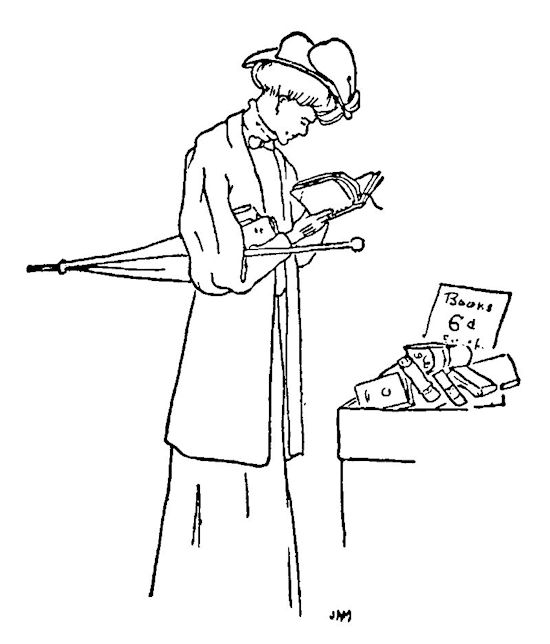
Among them you may find . . . . real treasures at the price of trash.
Also, I found a paper-covered copy of an Indian edition of Kipling’s early tales, and many such pleasant wares.
The fruit shops, too, have treasures both new and second-hand. This seemed strange to me, at first, and I learned of it by hearing a fellow-customer ask to hire a few pines.
After her departure I inquired of the shopman the meaning of it all.
He obligingly told me that many of his finest specimens of pineapples, canteloupes, Hamburg grapes, and other spectacular fruits, could be rented out for banquets night after night, with but slight wear and tear on their beauty and bloom. One enormous bunch of black grapes, as perfect as the colour studies of fruit that used to appear as supplements to the Art Amateur, he caressed fondly, as he told me it had been rented out for the last nine nights, and was yet good for another week’s work.
I then remembered the architectural triumphs of fruits that had graced many of the dinner tables I had smiled at, and I marvelled afresh at the English thrift.
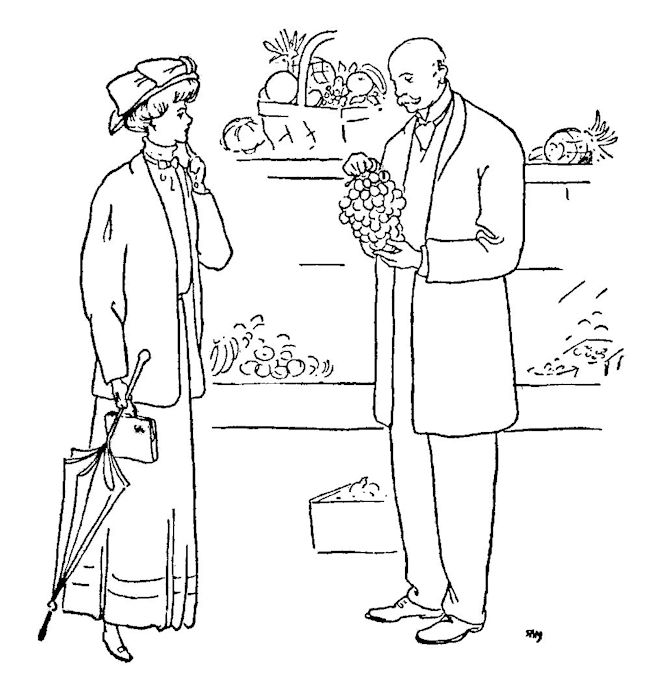
“He told me it had been rented out for the last nine nights.”
All shops, streets, theatres, and traffic merge and congest in a perfect orgy of noise, motion, and color at Piccadilly Circus.
The first humorous story I heard in London was of the man who, returning from a festal function, inquired of the policeman, “Is this Piccadilly Circus, or is it Tuesday?” That story seems to me the epitome of London humor, and also a complete description of Piccadilly Circus.
The first few times I visited it I found it bewildering, but after I had learned to look upon it as a local habitation and a name, I learned to love it.
By day or by night, it is a great, crazy, beautiful whirl. Everybody in it is trying to get out of it, and everybody out is trying to get in. This causes a merry game of odds, and the elegant policemen send glances of mild reproof after the newsboys who hurtle through the crowd, yelling “Dily Mile!”
The rush of traffic here is considered a sure road to battle, murder, or sudden death, and the Londoner who crosses Piccadilly Circus rarely expects to get through alive.
But to me London traffic seems child’s play compared to ours in New York. I sauntered safely through Piccadilly Circus, without one tenth part of the trepidation that always seizes me when I try to scurry across Broadway. The lumbering ’buses have no such desire to run over people, as that which burns in the hearts of our trolley-cars. The pedestrians are too deliberate of speed, and the traffic too gentle of motion, to inspire fear of jostlement.
Dawdling along, I paused to look in at Swan and Edgar’s windows. Rather, I attempted to look in; for, with a peculiar sort of short-sightedness, these drapers choose to be-plaster their window panes with large posters which comment favorably upon the wares that are presumably behind them, but which cannot be seen by peeping through the small spaces left between the posters.
Then across to the Criterion for tea. All of the great restaurants present a gay scene at tea hour, and the Criterion, with its “decorative painting by eminent artists,” and its crowds of guests both eminent and decorative is among the gayest.
But it is a gayety of correct and subdued tone. The ladies, in their flashing finery of raiment, are of a cool, reserved deportment, and the men drink their tea and munch sweet cakes with a gravity born of the seriousness of the occasion.
If one notices any conspicuous action or effect in a London restaurant, one may be sure it is perpetrated by a stranger,—probably a visiting American.
I recently saw in one of our finest Fifth Avenue restaurants a most attractive young woman, who came in accompanied by a well-set-up, and moreover an exceedingly sensible looking, young man.
With absolute savoir faire, and no trace of self-consciousness, the girl carried in her arm a large brown “Teddy bear.”
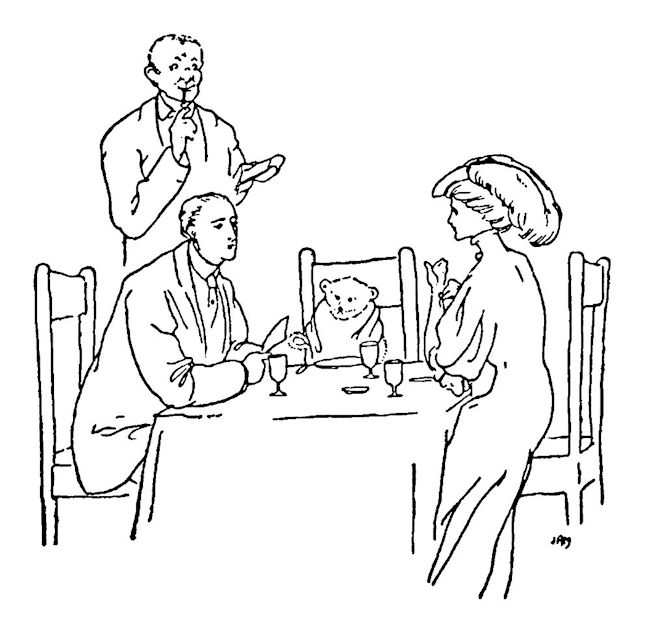
The couple sat at a table and ordered some luncheon.
The couple sat at a table and ordered some luncheon, and the bear was also given a seat, a napkin was tucked about his neck, and a plate placed before him. The girl’s face was sweet and refined; the man’s face was intelligent and dignified, and the bear’s face was coy and alluring. There was no attempt to attract attention, and, luncheon over, the young woman, who was at least twenty years old, tucked her pet under her arm, and they walked calmly out.
But such things are not done in London restaurants. And yet, these also have their peculiarities. At one small, but very desirable, restaurant in Old Compton Street it is the custom to steal the saltspoons as souvenirs. Not to possess one or more of these tiny pewter affairs, which are shaped like coal-shovels, is to be benighted indeed. So I stole one.
After my tea, I would, perhaps, trail along toward Trafalgar Square, by way of Regent Street and Pall Mall. After a long look at the black and white grayness of the National Gallery, I would slowly mount its steps, and from there take a long look at the wonderful façade of St. Martin’s-in-the-Field. Trafalgar Square is full of out-of-door delights, but if the mood served I would go into the National Gallery, and walk delicately, like Agag, among the pictures. I went always alone, for I did not care to look at certain pictures which I owned (by right of adoption of them into my London), in danger of hearing a companion say, “Note the delicate precision of the flesh tones,” or, “Observe the gradations of aerial perspective.” Nor did I want a “Hand-book,” that would assert, “Without a prolonged examination of this picture it is impossible to form an idea of the art with which it has been executed.”
Unhampered by mortal suggestion, I paused before the pictures that belonged to me, prolonging my examination or not, as I chose, and for my own reasons.
Some pictures I should have loved, but for an ineradicable memory of their narrowly black-framed reproductions that crowd the wall spaces of friends at home, who “just love Art.”
Other pictures I might have appropriated, but that a prolonged examination of them was impossible by reason of the massing in front of them of people who go out by the day sight-seeing.
And so I took my own where I found it, and happily wandered by A man with Fair Hair or Clouds at Twilight in a very bliss of art ignorance.
Then out-of-door London would call me again, and back I would go to Trafalgar Square, one of the lightest, brightest-colored bits of all England. From the asphalt to the welkin, from the Column to the Church, from the National Gallery to Morley’s Hotel, are the most beautiful blues, and greens, and whites, and reds, and grays that can be supplied by the combined efforts of Nature, Time, and modern pigments. A sudden impulse, perhaps, would make me think that I had immediate need of the Elgin Marbles, and, with a farewell nod to the northeast lion (which is my favorite of the four), I would jump into a hansom and jog over to the British Museum. But often the approach was so clogged by pompous and overbearing pigeons that I would make no attempt to enter. Instead, I would find another hansom, and take a long ride over to the Tate Gallery.
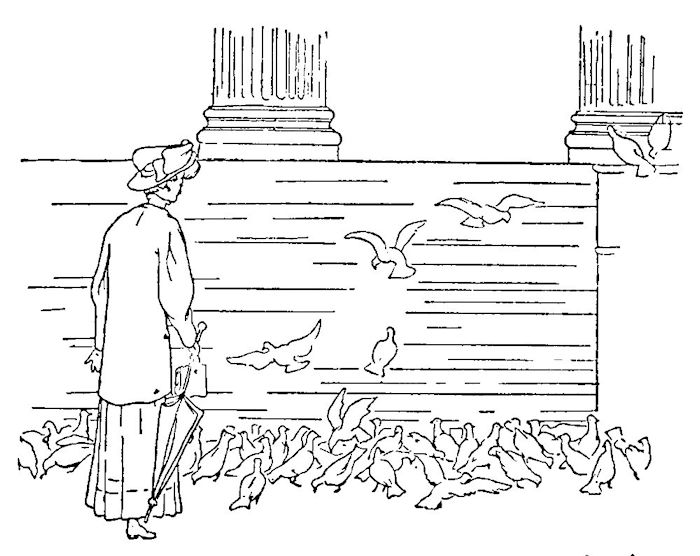
The approach was so clogged by pompous and overbearing pigeons.
As I bounced happily along, I would note many landmarks of historic interest. Some of these were real, and others made up by myself on the spur of the moment, to fit a passing thought.
For, if I saw an old building of picturesque interest, I could make myself more decently emotional toward the antiquity of it by assuring myself that that was where Sterne died, or where Pepys “made mighty merry.”
And, after all, facts are of little importance compared with “those things which really are—the eternal inner world of the imagination.”
It was from the outlook of a hansom cab that I could get some of the best views of my London. Every turn would bring new sorts of motion, sound, and color. And, birdseyed thus, it was all so beautiful that I wondered what Shelley meant by saying “Hell is a city very much like London,”—if, indeed, he did say it.
Once in the Tate Gallery, I would fall afresh under the spell of the lonely wistfulness of G. F. Watts’ Minotaur.
Then I would go to gaze long on Whistler’s wonderful notion of Battersea Bridge on a blue night, and then betake myself to the Turner collection.
Here I could spend hours, floundering in unintelligent delight among the pictures, sensitive to each apotheosis of color and beauty, and not caring whether its title might be Waves Breaking on a Flat Beach, or River Scene with Cattle.
But too much Turner was apt to go to my head, and just in time I would tear myself away, hop into a hansom, and make for the Wallace Collection to be brought back to a sense of human reality by a short interview with the Laughing Cavalier.
What a city it is, where cabs and picture-galleries are within the reach of all who desire them!
The appetite for the social life of London grows with what it feeds on. Although at first indisposed to be lured into the Social Vortex, I found it possessed a centripetal force which drew me steadily toward its whizzing centre.
Nor was it long before I became as avid as any Londoner to pursue the bewildering course known as “going on.”
There is a cumulative delight in whisking from Tea to Tea, and no two teas are ever alike.
It pleased me greatly to classify and note the difference in London Teas.
In New York all Teas are alike in quality—the only difference being in quantity. But in London one Tea differeth from another, not only in glory, but in size, shape, and color.
Yet all are enjoyable to one who understands going on. If the Tea be of the Glacial Period, there is no occasion to exert your entertaining powers. Simply assume an expression of bored superiority, and move about with a few murmured, incoherent, and not necessarily rational words.
There is a very amusing story, which I used to think an impossible exaggeration, but which I now believe to be true.
Thus runs the tale: A guest at an afternoon tea, when spoken to by any one, invariably replied, “I was found dead in my bed this morning.” As the responses to this were always, “Really?” or “Charmed, I’m sure,” or “Only fancy!” it is safe to assume that the remark was unheard or unheeded.
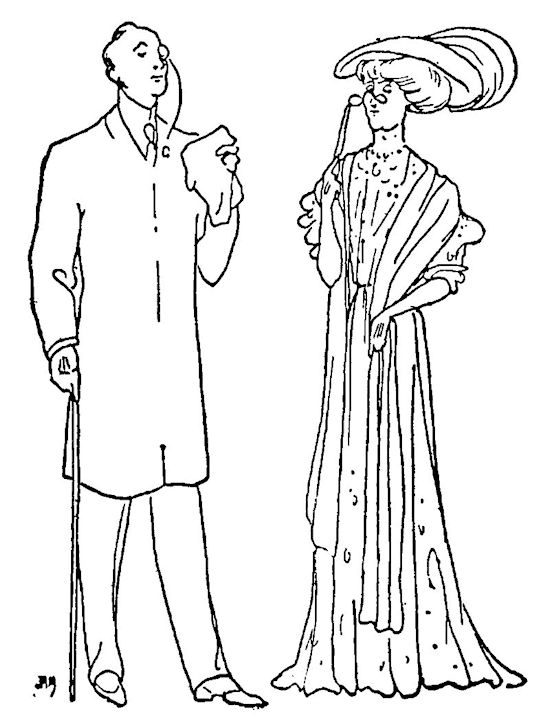
“I was found dead in my bed this morning.”
But this state of things is not certainly unpleasant, or to be condemned.
One does not go to a Tea to improve one’s mind, or to acquire valuable information. The remarks that are made are quite as satisfactory unheard as heard. We are not pining to be told the state of the weather; we deduce our friend’s good health from the fact of his presence; and it is therefore delightful to be left, unhampered, to pursue our own thoughts, and, if so minded, to make to ourselves our own analytic observations on the scene before us.
Again, if the Tea be of the Responsive Variety, and you are supposed to chat and be chatted to, then is joy indeed in store for you—for when Londoners do talk, they talk wonderfully well.
I went one afternoon to a Tea given for me by a well-known London novelist. The host, beside being an Englishman of the most charming type, and a clever writer, was of a genial, happy nature, which seemed to imbue the whole affair with a cosy gayety.
Though not a large Tea, many literary celebrities were present, and each gave willingly of his best mentality to grace the occasion.
Now, nothing is more truly delightful than the informal chatter of good-natured, quick-witted literary people. Their true sense of values, their quick sense of humor, their receptiveness, their responsiveness, and their instantaneous perception, combine to bring forth conversation like the words of which Beaumont wrote:
So nimble, and so full of subtle flame,
As if that every one from whom they came
Had meant to put his whole wit in a jest,
And had resolved to live a fool the rest
Of his dull life . . . Wit that might warrant be
For the whole city to talk foolishly
Till that were cancelled.
Nor are Teas of this sort rare or exceptional.
Given the entrée to London’s literary circles, occasions abound for meeting with these companions who do converse and waste the time together.
To my great regret, this is not to be said of America. A Literary Tea in New York means a lot of people, some, perhaps, bookishly inclined, invited to meet a Celebrity of Letters.
The Celebrity comes late, sometimes not at all, and he or she is often enveloped in a sort of belligerent shyness which does not make for coherent conversation of any sort. Moreover, Americans do not know how to give a Tea. We are learning, but we conduct our Teas in an amateurish, self-conscious way, and with a brave endurance born of our national do-or-die principles.
But to return to my going ons (which must by no means be confounded with goings-on).
From my Literary Tea, I went to a Musical Tea. This is distinctly a London function, and the music, while of the best, acts as a soaking wet Ostermoor laid on the feebly-burning vivacity of the occasion. The young girl sings, the long-haired gentleman plays a violin, the lady in the Greek gown plays the harp, and the guests arrive continuously, and escape as soon as possible.
But, like Kipling’s lovable tramp, I “liked it all,” and stood tranquilly holding my teacup, while I studied the Tussaud effects all about me.
Then, as it was Fourth of July, I betook myself to the reception at Dorchester House.
This is a most admirable institution. I mean the reception, not the house, though the statement really applies to both.
But it is a fine thing to celebrate our Independence Day in London. There is an incongruity about it that lends an added charm to what is in itself a stupendously beautiful affair.
Dorchester House, one of the finest residences in London, is now the home of our own ambassador, and is thrown open for a great reception on the afternoon of every Fourth of July.
As my hansom took its place in the long line of waiting carriages I glanced up at the noble old stone mansion, and was thrilled with a new sort of patriotism when I saw our own Stars and Stripes wave grandly out against the blue English sky. Our flag at home is a blessed, matter-of-fact affair; but our flag proudly topping our Embassy in another land is a thrilling proposition, and I suddenly realized the aptness of the homely old phrase “so gallantly streaming.”
Chiding myself for what I called purely emotional patriotism (but still quivering with it), I entered the marble halls of Dorchester House.
A compact, slowly-moving mass of people exactly fitted the broad and truly magnificent marble staircase.
Adjusting myself as part of this ambulatory throng, we moved on, mechanically, a step at a time, toward the top. On each landing, as the great staircase turned twice, were footmen in pink satin and silver lace, who looked like valentines. They are very wonderful, those English footmen, and sometimes I think I’d rather have one than a Teddy bear.
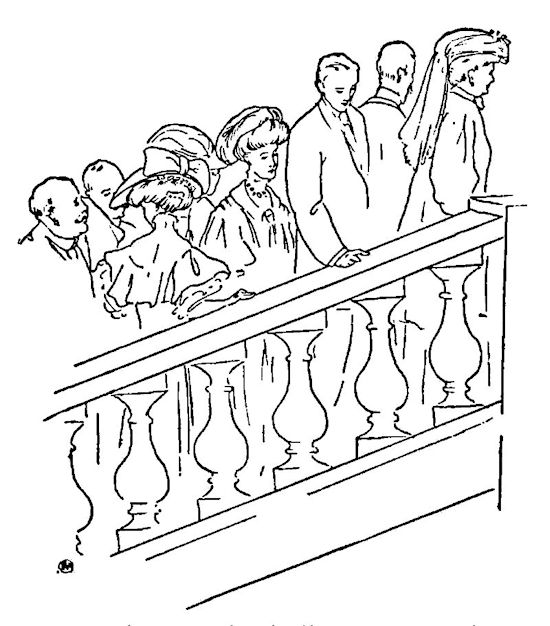
We moved on, mechanically, a step at a time.
At the top of the staircase our ambassador and his reception party greeted each guest with a cordial perfunctoriness, that exactly suited the occasion, and then an invisible force, assisted here and there by a very visible footman, gently urged us on.
Although the thought seems inappropriate to the splendor of the occasion, yet to me the marvel of the affair was the “neatness and despatch” with which it was managed. No crowding, no herding, no audible directions, yet the shifting thousands moved as one, and the route through the mansion, and down another staircase, was followed leisurely, by all. One might pause in any apartment to view the pictures or the decorations, or to chat with chance-met friends. By the admirable magic of the management, this made no difference in the manipulation of the throng. Eventually one came into a great marquee, built on terraces, and exquisitely draped inside with white and pale green. Here a sumptuous feast was served with the iron hand of neatness and despatch hidden in the velvet glove of suavity and elegant leisure. Here, again, one met hundreds of acquaintances, and made hundreds of new ones, the orchestra played national airs under two flags, and the scene was one of the brightest phases of kaleidoscopic London.
Then on, out into the great garden, full of delightful walks, seats, flowers, music, and rainbow-garbed humanity. More meetings of friends and strangers; more invitations for future going on; more introductions to kindly celebrities; more pleasant exchange of international compliment, and, above it all, the Stars and Stripes waving over Dorchester House!
From here I tore myself away to keep an engagement to Tea on the Terrace of the House of Commons.
This invitation had greatly pleased me, as it is esteemed a very worth-while experience, and, further, I was very fond of the genial M. P. and of his charming wife who had invited me. A bit belated, I reached the Lobby, where I was to meet my host, several minutes after the appointed time.
Unappalled by this disaster, because of my ignorance of its magnitude, I asked an official to conduct me to Mr. Member of Parliament.
“Impossible,” he replied, “Mr. Member has already gone to the Terrace, accompanied by his guests.”
“Yes,” said I, still not understanding; “I am one of his guests. Please show me the way to the Terrace.”
He looked at me pityingly.
“I’m sorry, madame; but it is impossible for you to join them now. No one may go there unless accompanied by a Member, and the Member you mention may not be sent for.”
This seemed ludicrous, but so final was his manner, that I became frightened lest I had really lost my entertainment.
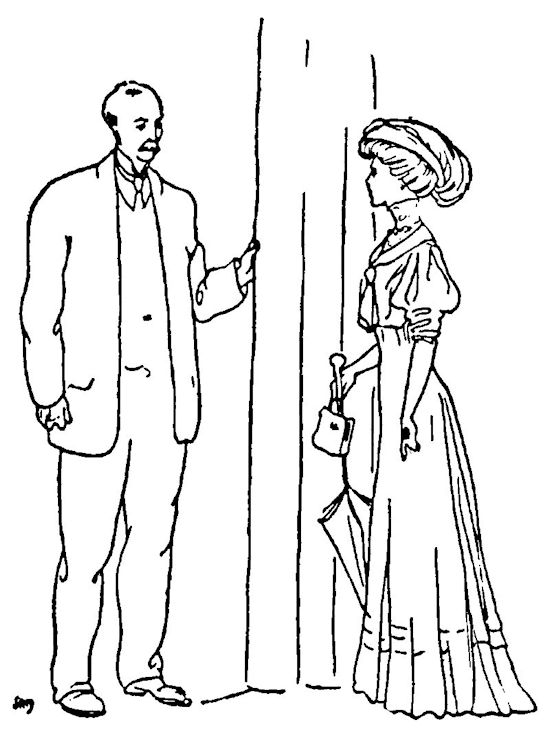
So final was his manner that I became frightened.
Whether my look of utter despair appealed to his better nature, or whether he feared I was about to burst into tears, I don’t know,—but I could see that he began to waver a little.
I thought of bribery and corruption, and wondered if so austere an individual ought to be approached along those lines. I remembered that an Englishman had spoken to me thus:
“I don’t know of anybody in London who would refuse a fee, except a club servant or the King, and,” he added reflectively, “I’ve never tried the King—personally.”
Assisted by this knowledge, I somehow found myself being led down dark and devious staircases which gave suddenly out upon the broad, light Terrace. My guide then disappeared like an Arab, and I happily sauntered along in search of Mr. and Mrs. M. P.
The scene was unique. The long Terrace, looking out upon the Thames at the very point of which Wordsworth wrote,
Earth has not anything to show more fair,
was filled with tea tables, at each of which sat a group of prominent London tea-drinkers and their friends. The background, the Perpendicular architecture of Parliament House, is crumbling in places, and I looked quickly away, with a feeling of apology for having viewed it so closely as to see its slight defects.
My host greeted me with an air of unbounded amazement.
“But how did you get down here?” he exclaimed.
“American enterprise,” I responded, but I learned that it had been an extraordinary and reprehensible act on the part of the official who had guided me.
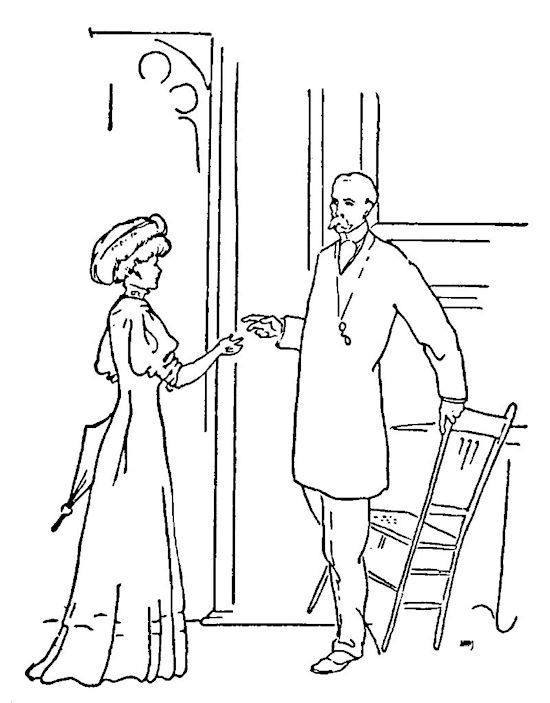
My host greeted me with an air of unbounded amazement.
I was sorry to learn this, but glad that I had persevered to success.
Twelve people were at table, and that Tea is among my fairest London recollections.
The very atmosphere of the Terrace is Parliamentarian, though, of course, not in a literal sense, and vague, unmeaning visions of woolsack and wig seem to mingle with the visible realities. On the one side the Thames, trembling with traffic; on the other the silent altitude of stone, that seems to grow hospitable and confidential as you sit longer at its feet. And between these, the tea-table, with its merry group, laughing at each other’s jests, and carelessly throwing about those precious invitations which keep one going on.
My right-hand neighbor proved to be a large-minded editor of delightful personality.
We talked of books, and he said quite casually: “Yes, I fancy Henry James’s works. And, moreover, he’s a charming man, personally. Would you care to go motoring down to Rye to-morrow, and spend the day at his place?”
While almost simultaneously on my other side a lady was saying, “Yes, indeed, I’ll be glad to send you a card to the Annual Dinner of the Women Authors of Great Britain.”
Truly, hospitality is the keynote of the Leaders of London Society. An apparent lack of warmth may sometimes be noticeable in their manner, but they deal out delightful invitations with a free and willing hand, the acceptance of which keeps one forever going on.
And, after all, one is too prone to generalize.
Hostesses are human beings, and, therefore, there are no two alike.
One may classify,—and the types fall easily into classes,—but one may not make sweeping assertions. And, too, in society, which the world over is a sham and purveyor of shams, are kind hearts always more than coronets?
And when one is gayly, perhaps flippantly, going on, one wants to see all sorts, and I went from my Terrace Tea to a private view of some paintings.
Then, after suitable robing, to a dinner; then to the opera, where the delicious incongruity of Madame Butterfly set to Italian grand opera music, was heightened by the dear baby who sat flat on the stage and waved the American flag into the very faces of the boxes full of English royalty.
And so, as Pepys would say, home, and to bed, feeling that there was certainly a fascinating exhilaration in London’s game of Going On.
In London I met an American friend, a busy New York man of letters.
“I come to London every season,” said he, “for six week-ends. These are spent at country-houses, and are planned for a long time ahead.”
At first, I wondered what he did between the week-ends, but I soon learned that what with getting to and from one country-place, and arranging to go to and from another, the insignificant Wednesday or Thursday in between is totally lost sight of.
Distance to a week-end Mecca is counted as nothing; and so, when I was invited to a house-party at a villa some twelve miles out of Paris, I prepared to go as casually as if my destination were within the Dominions of the Unsetting Sun.
There seemed to be several routes from London to Paris, and each was recommended to me as “the only possible way”; but I decided upon the Dover-Calais route, and left Victoria station on the special train.
A friend who came to “see me off” insisted on providing me with a put-up luncheon, saying the only preventive of Channel bothers was to take a bite before embarking.
So persistent was he, that I accepted his offer to put an end to his argument, and waited in my compartment while he ran for the “bite.”
He returned, followed by a porter, who wheeled on a truck a “put-up luncheon”! It was in a hamper, shaped like a large-sized wicker suit-case. This stupendous affair was pushed under the seat, and before I had time to remonstrate, my train started.
Impelled alike by hunger and curiosity, I finally opened the gigantic lunch-basket. Inside were carefully planned compartments containing several courses of a delicious cold luncheon. Ample provision of serviettes and oiled paper protected the viands from possible dust or cinders, and the array of flat silver was bewildering. Plates and cups fitted into their niches, and the whole collection was of a completeness beyond compare. This is as yet an untried field for American enterprise, but I suppose it will come.
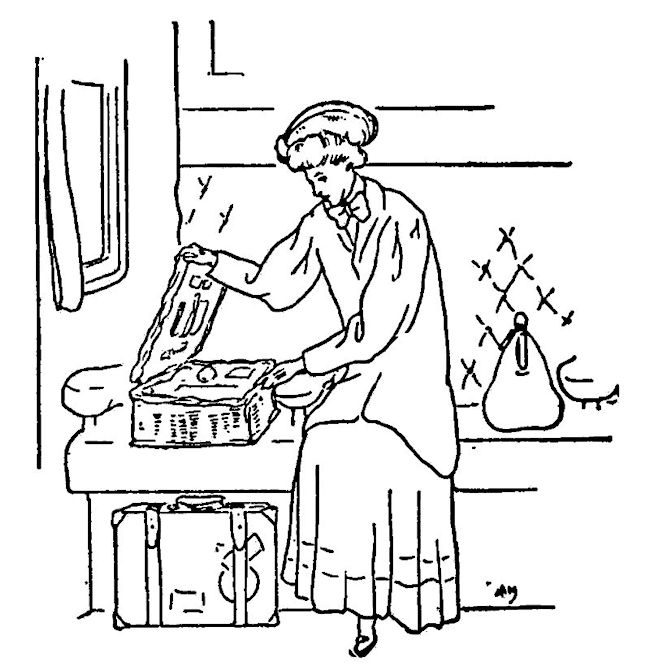
I finally opened this gigantic lunch basket.
The disposition of the emptied hamper was simply to restore it to its place under the seat, and leave it there. Apparently it had the instincts of a homing pigeon.
Leaving Dover was like backing away from a picture post-card. I have sometimes thought lithographed colors unnaturally bright, but the green and white and blue of receding Dover on a sunshiny day make aniline dyes seem dull by comparison.
The crossing on the Channel steamer was delightful, and I now know the dreadful tales I have heard of this experience to be mere peevish malignity. I sat on the deck of the dancing boat, and when the spray grew mischievous, kind-hearted attendants wrapped me in tarpaulin mackintoshes, or whatever may be the French for their queer raincoats.
I ruined my hat and feathers, but, in the exhilaration of that mad dash through the tumbling, rioting sea, who could think of personal economy?
All too soon we reached Calais, and here, again, a living, breathing picture confronted me. Unlike Dover, the harbor at Calais is like an exquisite aquarelle. The high lights and half-tones are marvellous, and the composition is a masterpiece. But (and here I made my two rules that should be invariably observed by the traveller from London to Paris) there is not a more fearful wild-fowl living than your French customs inspector.
Troubles of all sorts cropped up, and the porters and officials talked such strange French that they couldn’t understand mine!
But the troubles were all because of my luggage, which they divided into two classes. And hence my two rules:
(1) When crossing the English Channel, on no account take with you any luggage except hand-luggage.
(2) On no account take any hand-luggage.
These rules, carefully observed, will insure a happy, peaceful journey, for the accommodations for personal comfort are admirable.
The railroad train from Calais to Paris is a clean marvel of light gray upholstery, and white antimacassars sized like a pillow-sham. The cars are exceedingly comfortable and the whole ride a delight.
I reached the Gare du Nord about seven o’clock in the evening, and, after a maddening experience with criminally imperturbable officials, I took a cab to my hotel.
Accustomed, all my life, to the few scattering cabs of New York City, I had thought London possessed a great many cabs; but Paris contains as many as London and New York put together. The French capital is paved with cabs, and of such a cheapness of fare that I soon discovered it was more economical to stay in them than to get out.
I well knew I must fight against the insistence of “first impressions”; but after all it was Paris, and I had never been there before, and the ride from the station to the Place Vendôme might therefore be allowed to thrill me a little.
Some of the streets seemed rather horrid, but after we swung into the Boulevard and came at last to the Vendôme Column, with a pale little French moon just appearing above it, I was ready to admit that Paris might go to my head, even as London went to my heart.
My chosen hotel, The Ritz, was once the old palace of the Castiglione, and still retains much of the palatial manner.
Exquisite in the modernness of its appointments, it possesses an atmosphere of historic France, and the combination comes perilously near perfection. The urbane proprietor, who looked like the hero of a French play, personally conducted me to my rooms and was solicitous for my welfare in the best of English. From my windows I could see al fresco diners in a garden which looked like Marie Antoinette’s idea of Luna Park.
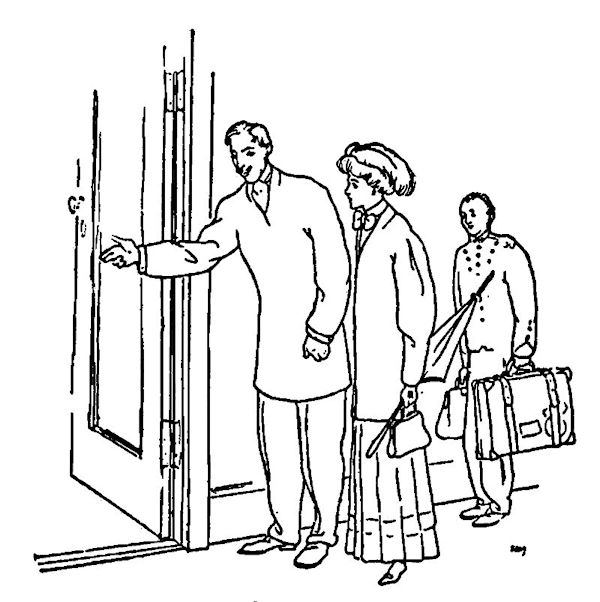
The urbane proprietor . . . personally conducted me to my rooms.
Noble old trees rose as high as the house, and from their branches hung great globes of vari-colored electric light. Statues guarded a fountain at one end, flower-beds surrounded the place, and at many tables gay humanity was toying with chef d’œuvres of French cooking.
The scene allured me. I hastily donned a dinner gown, and descended to take my seat at an attractively-placed table.
As I was alone, this might in New York have seemed indiscreet; in London, at least undiscreet; but in Paris, being a guest of the house, and under the protection of the august and benignant proprietor, it all seemed the most natural proceeding in the world.
The dinner was a dream; I mean, a sort of comic opera dream, where lights and flowers and gayety made a chimerical effect of happiness.
Of course, this pause over night at the hotel was part of my journey to the week-end party.
The next day my hostess would send for me, but these vicissitudes of travel were not at all unpleasant.
As I finished my dinner, and sauntered through the delicately ornate salons, callers’ cards were brought me, and I was delighted to welcome some English friends who were passing through Paris on a motor tour.
“Come with us,” they said; “our car is at the door, and we will go out and see ‘Paris by night’ in our own way.”
Incongruous this, for Emily Emmins!
But my adaptability claimed me for its own, and, with what I fancied a French shrug of my shoulders, I mispronounced a French phrase of acquiescence, and declared myself ready to go.
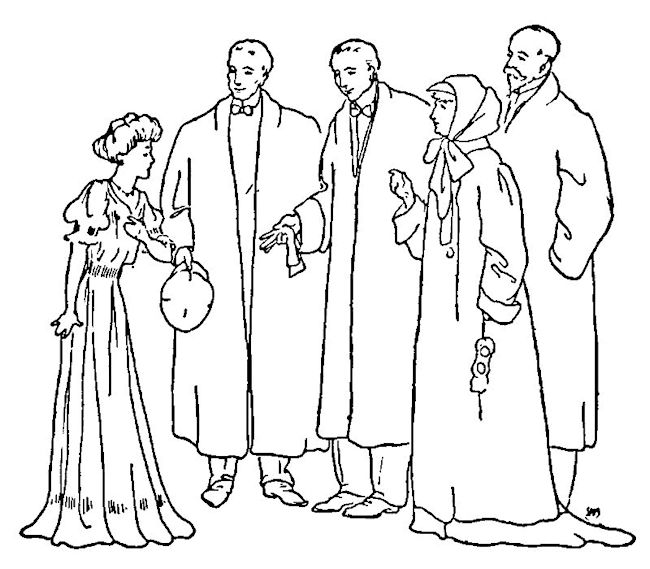
With what I fancied a French shrug of my shoulders I mispronounced a French phrase of acquiescence.
Three stalwart Englishmen, and the dignified wife of one of them, might seem a strange party with which to visit Montmartre by night; but it was an ideal way to go. In the motor-car we could whiz from one ridiculous “Cabaret Unique” to another. We could look in at the absurd illusions of “Le Ciel,” we could jeer at the flimsy foolishness of “L’Enfer,” and make fun of its attractions diaboliques, yet all the time we were seeing the heart of Parisian Folly, and a very gay, good-humored, harmless little heart it is. Evil there might be, but none was observable, and the foolish young French people sat around with much the same air as that of young Americans at Coney Island.
The “Cabaret du Neant” is supposed to be a fearsome place, where guests sit around coffins and see ghosts. But so like substantial tables were the coffins, and so sociable and human the ghosts, that awe gave place to amusement.
Home we whizzed, through the poorly lighted streets, which are indeed an anachronism in Gay Paris By Night.
Next day came the great touring-car of my week-end hostess, to take me to her villa, at St. Germain-en-Laye.
The villa being a fascinating old French mansion, self-furnished, the house party being composed of most delightful people, the host and hostess past grand masters in the art of entertaining, the visit was, as might have been expected, merely a kaleidoscope of week-end delights.
One absorbing entertainment followed another, but perhaps the picture that remains most clearly in my memory is the dinner on the terrace. A French country-house terrace is so much more frivolous than an English one. The outlook, over a formal garden, of modified formality; the splashing little fountains here and there; the decorated table on the decorated terrace; the shaded candles, flowers, and foreign service; the French moon, that has such a sophisticated paleness; the birds singing French songs in what are doubtless ilex trees—all go to make a peculiar charm that no other country may ever hope to attain.
The days were devoted to motoring to Versailles, Fontainebleau, and through Paris itself, and by this subtle method, one could sight-see without realizing it. To motor over to Chantilly, for the sole purpose of feeding the carp, is a different matter from seeing “sights which should on no account be omitted”; and to go with one’s host for a day’s run among the tiny French villages is a personally conducted tour with the sting entirely extracted.
The week-end over, I must needs pause a day or two in Paris, to rest myself on my journey back to London.
The shops offered wonderful attractions in the way of souvenirs to take to the dear ones at home. For the value of a foreign-bought “souvenir” lies in the fact of its non-existence in American shops, and such are hard to find, indeed. For the novelty in London to-day is the “reduced goods” in the New York department store to-morrow.
Moreover, the shops contained feminine raiment of wonderful glory! Only the fear of my “first impressions” of our American custom-house officers prevented my realizing my wildest dreams of extravagance.
Parisian clothes are marked by that quality which the London sales-people call “dynety”—they having no more idea of the meaning than of the pronounciation of the word.
But the Parisian woman, from the richest to the poorest, is first of all dainty; after that, correct, chic, modish—what you will.
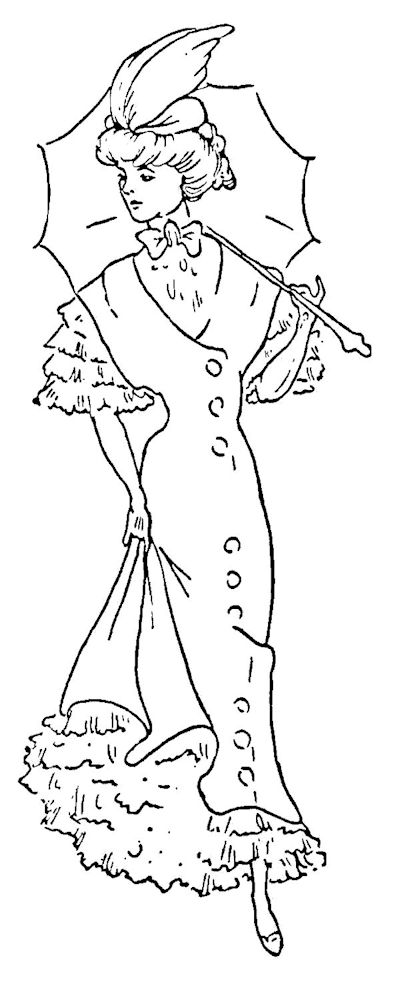
The Parisian woman . . . is first of all dainty.
And the French money is so easy to compute. My sovereign rule is to multiply by two. If the price be in francs multiply by two, shift a decimal point, and you have dollars. If centimes, multiply by two, decimal point again, and you have cents.
This simple rule made Paris shopping easy.
I had determined, as this time Paris was a means and not an end, being merely incidental to my week-end trip, I would not go into the galleries, and perhaps become unduly attached to something I might find there.
A casual visit to the Louvre let me go through several rooms of pictures and statues unmoved, when suddenly I met my Waterloo.
All unexpectedly I came upon the Venus of Milo. It was a revelation. The casts and photographs I had hitherto seen of it I now discovered to be no more like the original statue than the moon is like the sun.
The form, perhaps, is not so inadequately represented, but the face, as shown in cast or picture, is a sadly futile attempt at imitation.
The real Venus has the most marvellous face in the world. There is an ineffable beauty of feature, and an exquisite repose of expression, that betokens no one affection, but the glorification of all that is great and beautiful.
But the fascination is unexplainable. I only know that into that wonderful face I could gaze for hours; but never again do I want to see a reproduction of it, of any sort.
In the Louvre, too, I found the Mona Lisa. Here again I had been misled by photographs and “art prints,” and was all unprepared for the witchery of that baffling, bewildering smile. By a queer correlation of ideas, my mind reverted to the Laughing Cavalier, and I wondered if these two were smiling at the same thought.
Undesirous of seeing more at this time, I returned to my open, victoria-like cab. Those foolish Paris cabs! They seem so exactly like the vehicle in which Bella Wilfer elegantly sat, when she begged her parent, “Loll, ma, loll!”
But they are fine to see out of, and a city like Paris, made for show, should have cabs of wide outlook.
Paris is an achievement. Its coherent, consequent civic beauty ranks it among the seven beauties of the world. It is as systematically and methodically laid out as Philadelphia—but with a difference!
It is discreet and tactful, and ever puts its best foot foremost, the other probably being down at heel.
It is trim and tripping, where London is solidly lumbering,—but, give me London!
Paris is adorable; London is lovable. Paris is bewitching; London is satisfying.
Paris is to London as lime-light unto sunlight, and as absinthe unto wine. But as the very essence of Paris, is ephemeral, so the nature of London makes for perpetuity; and London is, of all things, a place to go back to.
“A collection of wholesome and
delightful tales”
The Folk Afield
By
Eden Phillpotts
Author of
“Children of the Mist,” “Sons of the Morning,” etc.,
Crown, 8vo. $1.50
The variety that characterizes
these stories is one of both
scene and character, containing
stories of love and adventure on sea
and land. The backgrounds, laid in
with vividness and opulence of color,
have for the most part the sunny luxuriance
of the South of France, of Italy,
and of North Africa. The types of
character—heroes, heroines, and
supernumeraries are as varied as the
settings of the stories. Mr. Phillpotts’
heroines are singularly attractive,
now by their beauty and their ardor,
now by their gentleness and purity.
G. P. PUTNAM’S SONS
New York London
A New Book by the Author of “Lavender
and Old Lace”
LOVE AFFAIRS OF LITERARY MEN
By MYRTLE REED
Author of “A Spinner in the Sun,” “The Master’s Violin,” etc.
The love affairs of literary men seem to have an unfailing hold upon the general sympathy, and a stronger hold, it might be said, than the sentimental experiences of any other class of people. In this book, Miss Reed has briefly retold the stories of the lovers of the group of writers who are assured, all of them, of immortal places in English literature. Here we may read of the mysterious, double love affair of Swift with Stella and Vanessa, of Pope’s almost grotesque attempts at the role of lover, of Dr. Johnson’s ponderous affections, of Sterne’s sentimental philanderings, and of Cowper’s relations with the fair sex. We are told too of the loves of Keats and Shelley, a story in the former case distressingly painful, in the latter a tale in which the tragic and the joyous are woven in a mingled web. Here, too, we meet Edgar Allan Poe as a lover; and we read of Carlyle’s wooing, and peruse the unpleasant, but not uninteresting, chronicle of his married life which resulted so unhappily for Mrs. Carlyle.
Crown 8vo, with 20 Portraits, printed in two colors. Cloth, gilt top, net $1.75. Full red leather, net $2.50. Antique Calf, net $3.00. Lavender Silk, net $4.00.
A complete descriptive circular of Miss Reed’s books sent on application.
G. P. PUTNAM’S SONS
New York London
“A Delightful and Dramatic Story”
Brown of Harvard
By
Rida Johnson Young and Gilbert P. Coleman
A delightful and dramatic story of modern college life based upon the successful play of the same name. It will be found true to both local color and spirit of the University where the scene is laid. A lively and stirring plot, with ingenious and surprising incidents and a striking denouement, seizes the reader’s attention at the start and holds it to the end.
With 8 Full-page Illustrations from Photographs
of the Play. Crown 8vo, $1.50
G. P. Putnam’s Sons
New York London
“A superb social satire.”
Illustrated London News
The Country House
By John Galsworthy
Author of “The Man of Property,” etc.
Crown, 8vo. $1.50.
“If there is any competition going on for the finest novel of the year, best drawn characters in modern fiction, or the coming novelist, my votes unhesitatingly go to The Country House, to Mr. Barter, to Mrs. Pendyce and to Mr. John Galsworthy.”
—London Punch.
“A book that exhibits wide sympathies, genuine observation, and a quiet humor of its own. Whatever Mr. Galsworthy writes possesses an irresistible appeal for the readers of cultivated tastes.”
—London Standard.
G. P. Putnam’s Sons
New York London
Transcriber’s Notes:
Hyphenation and archaic spellings have been retained as in the original. Punctuation and type-setting errors have been corrected without note.