THE EMERALD CATHERINE THE GREAT (continued 3)
Reading edition
"My men, Mr. Dee Boe Hun? Why, them men I ordered to come and 'elp me with this job. They're at the Lion now, waiting."
And without asking his host's leave, he sat down squarely at the little table by the telephone and rang up the Lion. When he had given his message, he waited, head in air, hands clasped behind his back, a monument of Induction and Deduction.
"Do I understand you to say," groaned Mr. de Bohun miserably, "that you mean to pull up the floor to-night?"
"That's it," nodded Mr. Collop. "That's right. And open the furniture. Only just enough to see it's not in any of the cracks. Then," he added, looking critically at the fine Empire looking-glass upon the wall, "we must have things down, of course. You never know what may lie concealed lurking behind."
"Really, Mr. Collop, really," groaned the Home Secretary, clasping and unclasping his hands, "I should think that ..."
"Job must be done thorough," frowned Mr. Collop, wagging his head. "I'd never undertake the responsibility of searching individuals till I'd made sure 'twasn't in the room where 'twas lost."
Even as he spoke there came an honest bang upon the outer door; shortly after another, still more honest, upon the door of the room, and the shuffling of many feet. Once more dispensing with the formality of consulting his host, the great Collop unbolted the door, and with a Napoleonic gesture introduced his merry men.
They were a sight, they were! Six of them seemed to have been chosen rather for strength than for intellectual power. Two staggered under an enormous iron tripod with heaven knows what contraption poised on its summit, and a cylinder of gas. Three more bore with them sundry instruments. And of all this little army Mr. Collop, with fine decision, took immediate charge.
"Now, then, lads!" he said; "hearty! The job's got to be done quick. All the rugs first, please. You two with the light, stand off! Stand on the window-sill. Then you won't be in the way." So they did, the marks of their heavy boots contrasting finely with the delicate woodwork of that Jane Austen room.
"Rugs all rolled?" said Mr. Collop. "Yes! That's right! Shake 'em first, yes! That's right! Pile 'em up on that other window. Now then, tables out of it! Smart!"
He opened the door, and behold! half a dozen willing pairs of hands pushed the small table, the middle table, the big desk, the little table, and the what-not, one after the other, vigorously into the hall—and the door was shut again.
"Now, me boys! up with the Austrians!"
His heart was in his work, and he inspired his command as all great leaders can. The sundry instruments so useful in work of this kind did their rapid work, lifting one large square after another, while the owner of the same danced with astonishing agility from spot to spot, remaining at last on one isolated island, which he was courteously bidden to abandon; taking refuge then upon the remaining low window-sill, while the five large lounge chairs in the room were laid carefully on their backs across the joists as the work proceeded.
"That's the style!" said Mr. Collop, cheerfully. "Pile 'em up, lads! Pile 'em up!"
And those sham-ancient polished parquet squares, their very base modern pitch pine reverse pitifully exposed—but, as Mr. Collop proudly pointed out, not one of them broken—were carefully laid against the wall, nicely missing the Cox and the Morland, but threatening in some degree, should they shift or slip, the large picture of Paulings in the early eighteenth century, which was the place's pride—and so it ought to be! Paulings belonged to gentlemen then. Two of them were to be seen riding horses which had done nothing but eat for years and yet walked on their hind legs. They were followed by four dogs....
But to my tale....
The two citizens with the tripod set it down between the old dusty joists upon which the floor boards had rested, and of a sudden a most abominable glare, like the white heat from molten iron, shot in a shaft upon a corner in the uncovered lower flooring. It was brilliant beyond the dreams of avarice. It revealed like remorse. Mr. Collop with an agility surprising in a man of his build, leaped down that little distance, and kept on shouting directions.
"That's right now! Sweep it along! Sweep it along! Sweep it along!" The blinding shaft of light slowly traversed the edges of the shallow void from end to end, from left to right. "Now back again!" said Mr. Collop. "Now back again!"
The intense beam travelled back in another band, slightly nearer, from right to left; and all the while the detective followed with keen eyes every patch which it successively illuminated.
It was not a long process. Three or four minutes at the most. And while it continued, the Home Secretary, perched in security on his window-sill, was interested in spite of himself: new science is always a toy.... And that was how they searched for the jewels in the flooring of the West Room.
Mr. Collop's hand went up, and the blinding shaft of light disappeared as suddenly as it had come.
"That'll do, lads!" he said. "We know one thing now, any'ow. It didn't get down through the flooring; that's certain. Now then, if you please, we'll open the furniture."
Mr. de Bohun did not please.
"Surely, surely it can be spared," he begged. "It's Victorian."
"Now, sir," protested Collop firmly, "I'll be responsible for nothing unless I'm pursuing my own method."
The Home Secretary sighed and surrendered. With deft fingers two of the three extras began picking out the stitching of the chairs after every loose cushion had been lifted, shaken, and put aside.
It was beautiful to see such expert work; at least, it was beautiful in Mr. Collop's eyes; but the Home Secretary almost shed tears. Those chairs were his father's! The Great Peal, the immortal Benjamin Israel, had graced them. And again—who was going to pay for all this? All the edges of the leather stood out; the secret places were revealed. There was no emerald.
Mr. Collop beamed with satisfaction.
"That, sir," he said triumphantly, "is the end of what we've called our Negative process. Hey! Number One!" And he ticked off on his thumb, as he had done before.
"We are now assured," he boomed, tucking his thumbs into the armholes of his waistcoat, "that wherever the Em'rald may be, it's not in this room. Stay a moment! I'd forgotten! The pictures down, please!"
Again the owner gave tongue. "Do you really think, Mr. Collop ..."
"Yes, I do," answered Mr. Collop with decision. "Come. Smartly, lads!"
No harm was done to the pictures; they knew their work. The Cox was lifted down and now leaned at a secure angle. The Morland turned its back canvas to the ceiling, pushed on a capsized armchair. I wish I could say as much for the Napoleonic looking-glass.
It was just too high for one of the men's hands; he slipped, and down it came: an omen of ill-fortune, smashed upon the floor—round gilded frame, Eagle of the Legions, and all.
"Well, well!" said Mr. Collop cheerfully. "No battle without losses, ye know—hey?"
"I really think...." urged the Home Secretary, with something as near anger as his temperament allowed.
"Never you fuss, sir," thrust in Mr. Collop genially. "It's all right now. We've proved our point. That's the 'sential. I say again, the Negative part is accomplished," and he smiled upon his chief with all the satisfaction of genius. "The em'rald's not in this room where it was lost. That's a cert. What's the conclusion? Why, sir, the conclusion is that it's somewhere else. And when I say somewhere else, what do I mean?"
"You mean...." began the Home Secretary nervously, stepping down gingerly from his perch and trying to make his way across the joists—"you mean that you must now consider which, if any, of my guests ..."
Again Mr. Collop's hand went up.
"Now, sir; pardon me! That's not the scientific spirit. I shall send these men back to the Lion, with your leave"—it was the first time he had asked it, and it was granted with enthusiasm—"and then I shall ask you, sir, to give me details, and I shall make notes. After that we'll sleep on it.... Before you go, men, get the Austrians down again. Hammer the clamps down: hammer 'em down good and strong at the corners; whang 'em in! You know how these Austrians buckle! We'll 'ave everything right again in a jiffy"—to his host—"and then we'll sleep sound on it. Like 'Ogs."
With clamouring echo which shook those ancient walls, square after square of Austrian antique was thrown back into its place; with Cyclopean noise the clamps were driven into their former holes, and the shattering bangs of the heavy iron hammers sounded like thunder through the silent night. Twenty yards away, in the small smoking-room, Victoria Mosel and Tommy Galton had remained to exchange a few insults after the others had gone off to bed. They started at the unusual din; she very slightly, he with a jerk.
"What are they doing?" said he suspiciously.
"Making your scaffold," shot Vic decidedly: then, more doubtfully. "It's a damned shame! For I don't suppose you did take it after all, Tommy? Eh?"
"If I thought there was room on you for that bloody stone," began Tommy viciously....
"Oh, search me!" said Vic, without sincerity.
"No, but, Vic, what are they doing?"
"Shifting the scenery, Tommy. Summoning the dead. Christ knows!" She yawned, to the peril of her agglutinative cigarette, but it held nobly. "It can't go on forever. I'm going to bed. By the time they've stopped I'll be asleep. So long! I'll come and look you up at Wormwood Scrubbs, never fear!" And the Virgin departed.
"Not while you're still in Holloway," fired the puller of horses after her as he got up in his turn, and went out to get his candle for bed.
A few moments later, when the Master of the House peeped out into the hall, he found all dark and deserted. He was pleased to think that his guests had suspected nothing.
When everything was accomplished, and the little army of Scotland Yard men had fallen back upon its billets at the Lion (Humphrey de Bohun himself let them out at the front door, on tiptoe and with agonised whispers entreating caution. He himself had locked and bolted these doors); when, I say, all this affair was over Mr. Collop, first making quite sure that his seat was secure, took out a notebook, shot a blot of ink on to the re-established polar bear, and gave tongue.
"Now, sir, fire away!"
"What do you want me to do?" said de Bohun doubtfully.
"Why, just give me details of what those coves 've been doing of," said Mr. Collop, relapsing into the vernacular.
"You mean my guests?" said the Home Secretary rather stiffly.
"That's right," said Mr. Collop cheerfully, "the toffs."
"Well, really.... I haven't played the spy on my guests, Mr. Collop."
"Oh, I'm looking after that," said Mr. Collop with another of his healthy winks. "Now, just you tell me all they did. I've got my first notes here. These three men what I've just met at dinner—and one of them's young McTaggart—I know 'im—they went down on their knees and they looked for it in that rug. Well and good. Then they got up, and they all swore they hadn't got it."
"McTaggart was the last," said de Bohun, defending the interests of the family.
"Ar? ... I didn't know that!" mused the modern Napoleon deeply. And he noted it down. "Well, what next?"
"Why, to tell you the truth—the full truth, and I beg you to keep it private—my cousin, Lord Galton, has told me that he has seen the emerald—seen it with his own eyes—in the Professor's hands."
"Ar!" said Mr. Collop again. "That's important, that is!" and down it went. "Saw it with 'is own eyes: where and 'ow?"
"Wait a moment, Mr. Collop, wait a moment. Not long after, the Professor told me he had infallible scientific proof that it was in McTaggart's pocket. He showed me the very instrument wherewith he had been able to discover its presence through the thickness of the coat."
"That's important too!" murmured Mr. Collop, intelligently noting it down. "An' what does McTaggart say?"
"McTaggart ..." The Home Secretary was about to blurt out the truth and tell him what McTaggart had singularly announced. But he checked himself. To insult his last remaining prop would be fatal. "Oh, McTaggart?" he evaded. "Why, McTaggart said he hadn't got it."
"Ar! just so. 'E did, did 'e? Now, that's very important," affirmed Mr. Collop, and he noted that down also.
"Now here," he continued, slipping an elastic band over the notebook and putting it back into his pocket—"here, Mr. Dee Boe Hun, we 'ave got three 'ypothetics." He again began ticking them off on the thumb and fingers of the left hand. "First 'ypothetic: Lord Galton stole the em'rald. Second 'ypothetic: Old Giglamps stole the em'rald ... Tortoise-shell specs, I mean: the schoolmaster," and he winked again. "Third 'ypothetic: McTaggart stole the em'rald. Now these three 'ypothetics," he went on, "lead to three totally different conclusions. Each of 'em has its conjunctions and conjugations. Mr. Dee Boe Hun," he concluded, rising and assuming hieratic tones, "I shall not sleep to-night." (There is many a true word spoken in lying.) "I shall bend all the energies of me mind in the ensuing hours of darkness, and on the morrow you shall 'ave my conclusions.... I'll trouble you, sir, to leave me a syphon and a drop o' something. Helps me to concentrate."
"I'm afraid," said the Home Secretary, "the servants will have cleared the drinks away from the library, and they have all gone to bed." Then, terrified lest the lack of sustenance should imperil victory, he added hurriedly: "Don't move! Pray don't move! I think I know where to find it."
He was away some time, going on tiptoe in the offices. When he returned it was with an unopened bottle of whiskey, a syphon and a glass. "I'm afraid I have no corkscrew," he apologised.
"I 'ave," said the imperturbable Collop, who had sat royally in his chair to receive this tribute. He pulled out the cork, smelt the brand, approved of it, poured himself out a dope and a most miserable little splash from the syphon.
"Here's luck!" he said. "Cheerio! Now you leave me to it!"
And de Bohun left him to it, ardently praying with what was left of his childhood's faith to a God in whom he still vaguely believed, that never again in the remaining years of his declining life should he be compelled to harbour under the roof of Paulings any unit from the mighty Secret Service which he commanded, and inwardly deciding that he would relinquish that command for India, Paris, South Africa—nay, New Zealand—anything rather than bear such a burden again.
CHAPTER THIRTEEN
It is a fascinating occupation to watch a powerful human brain at work upon some great problems—the face alive with mind, the tension of the muscles, the frowning eyes; and to feel behind it all that driving, compelling power of the intelligence wherein man is God-like.
But no one would have seen this sight in the case of Mr. Collop had he remained. What he would have seen was a hand pouring out whiskey for itself over and over again and adding smaller and smaller splashes of soda; and at last an obese body attempting sleep in the lounge chair which it filled.
He had comfortably made up his mind. He was going to stay in the West Room and sleep as he could, leaving his bed untouched by way of giving the impression of a long night's intellectual wrestling. Next morning he would take every one of the three in turn, tell each separately that he was from the Yard, tax them brutally with the theft, and terrify and bully the culprit, whichever of the three it might turn out to be, into confession. So decided, he chose a good chair among the mutilated victims, wheeled it close to the electric switches by the fire, settled himself down, turned off the light and shut his eyes for sleep.
Now it is paradoxically true of the substantial more than it is of the insufficient, that they must shift and turn to find that posture in which their persons can best repose, especially in chairs. Nor could Mr. Collop at once and easily fall into the arms of Morpheus. He shifted and turned, and wedged in and re-wedged in and out, and moved again and replaced those various muscles and anatomical names of which escape me—or rather I never knew them, though the things themselves I know well enough—when all of a sudden he gave a loud and piercing cry and leapt up broad awake. Something had stuck into him—something abominably sharp. His reaction had been instantaneous. He struck a match. He switched on the light.
He groped in the offending tail-coat pocket and—not the first to do so!—stared at what he found in his hand—the emerald! Its brooch setting was unclasped, the wicked steel pin of it was pointing at a challenging angle in the air. He glared viciously at the offending point which had wounded his innocent person; then his eyebrows relaxed into a stupefied stare at the stone itself.
"Great God!" he said three times, "Great God! Great God!"
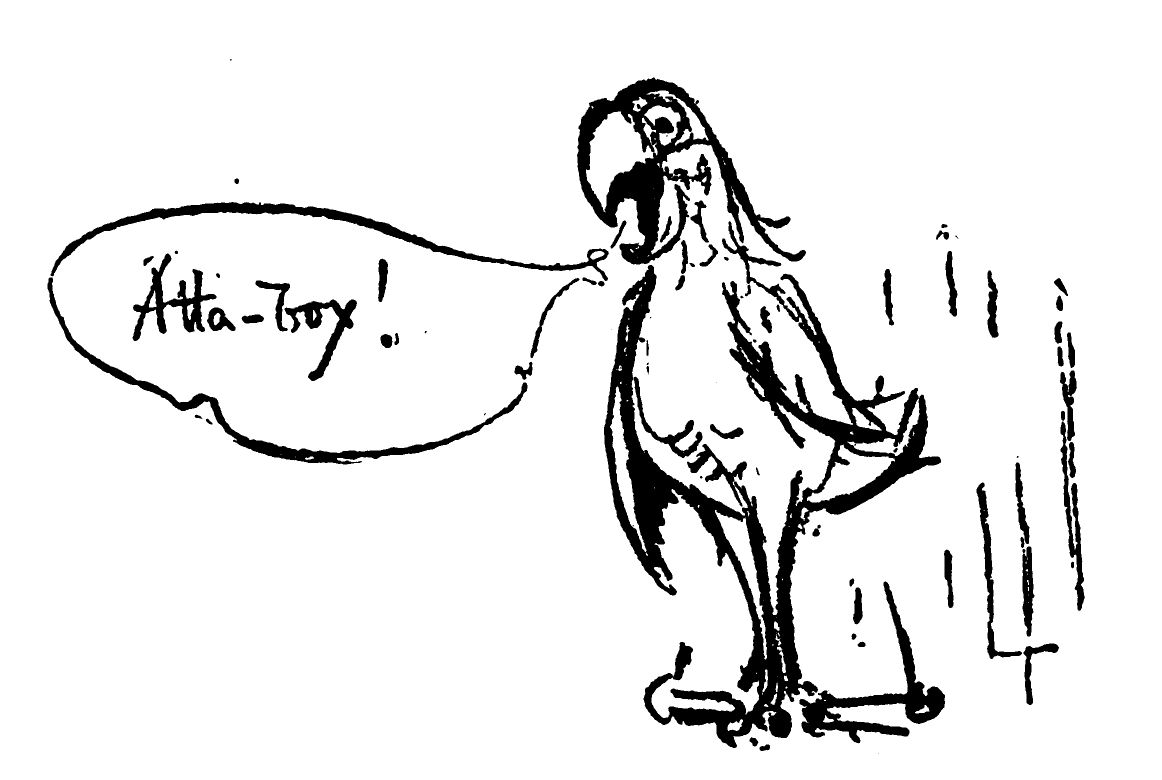
Birds of the Empire. I.—The Parrot Attaboy, in action.
There is a current impression, taken I think from the great spate of detective stories upon which we are all fed, that your professional detective has no brains whatsoever and would be no match for the sloth of the Andes, or the sluggish waddle-duck of Australian and Imperial fame. It is an error. They are men as we are and their intelligences, such as they are, work more or less under the spur of prospective advantage. Within three minutes Mr. Collop had grasped the fact that fame, security, promotion, a permanent, good, appreciated, livelihood lay in his outstretched palm. Had he not found the emerald? How he had found it, why it was there at all, he knew not. But he had quickly seen how its possession might be used.
"There you are, you great blighter," he murmured, addressing the charming gem. "Damn your green eyes! I'll make you work, I will! William, my boy, here's something that's got to be thought out!"
For the first time for many months, Mr. Collop thought, really thought; "concentrated" as he would have put it.
He would have done it better perhaps if he had not been so full of whiskey. But shock is a powerful stimulus. And he was already three-quarters sober and coming to conclusions.
For a long time the effect of this unusual exercise was a blank and a confusion of mind; then there broke in upon the silence a sound which startled him horribly. A voice, somewhat muffled, uncertain, had spoken in that silence where none but him could be. He had heard it! Or was he mad?
"Attaboy!"
Was it a divine command? Had some dear wraith of the dead—his sainted mother perhaps, who could tell—come to comfort him in this dread hour of his fate? All was dead still. His hand trembled a little as he pulled out his watch. It was a quarter past two, and the silence was enormous.
Most awfully it came again.
"Attaboy!"
He hardly dared to look around. Look round he did and there he saw what he had not before grasped—that the dome of black cloth, suspended, covered a cage; thence it was that once again, but this time in a failing, drowsy manner, came the unearthly summons:
"Attaboy!"
A revelation burst upon his mind. It was a revelation indeed! The whole scheme blazed suddenly before him.
He walked boldly to the cage, took off the cover and saw what may very properly be called the blinking bird, for the sudden light had dazzled it.
"Attaboy!" croaked the parrot again in a rather peevish fashion.
"I'll Attaboy you!" hissed Mr. Collop through his teeth.
He made his preparations to capture that innocent accomplice; his scheme was now fully developed.
He had heard that this kind of fowl was of a very fierce and dangerous sort; but the plan must be pursued at all risks. He took his handkerchief from his pocket—a large bandanna of the noblest—and with a decision worthy of a better cause, whipped it round the gaudy coloured neck after the fashion of a cravat. A muffled protest proceeded from that insulted organ.
"You wait!" muttered Mr. Collop vindictively, as though the poor bird were his enemy. He looked about him. There was a large square of black cloth on his host's writing-table. With that he made a second deadener, hoodlike, entirely covering the animal's head, and tied it securely on; all that now penetrated from within was a faint, varying sound which one had to be in the closest neighbourhood to hear. Next he cut off a piece of tape from the coil neatly disposed by the side of the official papers, and bound the fierce talons securely. Then with infinite precaution he slipped off the chain from its ring, and held the exotic biped firmly in both hands.
The clipped wings fluttered a little, but they were contained by strong hands. Mr. Collop made for the window. He laid his living parcel down, where it struggled in vain; opened the shutters with infinite precautions for avoiding sound—above, Aunt Amelia, happily deaf, was deep in slumber; pulled up the sash so slowly that it seemed an age; went back on tiptoe, extinguished the light and—a stroke of genius—went noisily upstairs, bearing the parrot, to give full warning to anyone who might be still awake that he had gone to bed, after all. He tumbled his bed about. He returned.
He came down gingerly in shoeless feet, and stepped out into the night.
The stillness was awful, but all propitious to his plan. The thin snow lay even and spotless on the grass on either side of the avenue. The nearer trees were clear in the half light. The gravel walk, though well swept and clear of snow, leaving no trace of his passage, was bitterly cold to his thinly clad feet—for his socks were of silk, I am glad to say.
There was a wintry mist and beyond it the white suffused radiance of the moon.
He looked up cautiously. There was not a chink of light in any window. All slept, and the Holy One presided in the heavens above, beyond the fog in her blurred aureole of light. It was the hour for great deeds. And a great deed was done.
Mr. Collop, with infinite precautions, lifted up his captive and planted its two talons firmly upon the snow to the side of the swept alleyway and pointing at a small, most aged and somewhat stunted oak about thirty yards ahead of him on the edge of the swept path. He himself kept crouching on the swept gravel and holding poor Attaboy to the side above the snow. Then, still creeping noiselessly along, he planted the bird's claws down again about six inches further. And so on, hop by hop.
It was merciful in Providence to have spared that tropical exile any too sensitive nerves in its claws; but it protested. It thought the march an indignity, and it was abominably cold. The parrot squirmed. The parrot resisted. But the parrot was for it.
Six inches by six inches the double imprint of the claws appeared in a lengthening chain upon the thin snow until they had come to within ten feet of the oak. Then did Mr. Collop most cautiously rise from his stoop and, taking the bird under his left arm and standing upon tiptoe, stretch his right hand up to a small hollow in the stump of a branch that had decayed long ago: he felt its concavity. It would do. He carefully felt for the emerald in (now) his waistcoat pocket. It was safe. He turned back swiftly towards the great dark house in the moonlight.
The thing was accomplished.
As stealthily as he had come, but far more rapidly, thanking Heaven that still no light showed through any cranny of the mansion, he loped back, shut the window down again with infinite precautions and even then dreaded a slight sound, put his dumb confederate back, released it of its bandages, slipped on the cover of the cage, and crept up to bed.
* * * * * * *
So true it is that once in every man's life comes an opportunity and that in every man some talent, however unsuspected, lurks.
CHAPTER FOURTEEN
Sunday morning had dawned brilliant, had grown in splendour. The mist had gone. A low but clear and even glorious sun flashed heaven athwart the snowy levels and transfigured the winter sky.
The Home Secretary came down to breakfast late, and no wonder! Marjorie came down to breakfast late, and no wonder! Tommy and Vic came down late, and no wonder! The Professor and Aunt Amelia had met at the table before anyone else was about. If she expected a flirtation, she was disappointed. If he expected a quiet reading of the Sunday newspaper, he was more bitterly disappointed still. The advent of the late comers was a relief.
Last of all drifted in, heavy-eyed but big with mastery achieved, the Collop.
At that breakfast very little was said. McTaggart was getting used to the rich. He lit a pipe. But he stood mum.
Victoria Mosel and Tom Galton met in Marking Room.
"Vic," said Tommy Galton, "who do you think has got it?" He lounged back in the absurdly low, fat chair, letting himself go all loose, as is the habit of your hard-riding man—especially those who pull horses—and looking down at her calves after the admirable breeding of our day.
"You haven't, anyhow, Tommy!" lisped Victoria Mosel, in spite of the hanging cigarette. "I've got that much!"
"Thank God for that! Spread it!" said Galton.
"Thank me, too," said Vic.
"All right. Thank you, too. Damn you! Who's got it?"
Victoria Mosel turned round, spat the fragment of the cigarette into the fire, and lit another one.
"I'm thinking," she said.
"The natural thing," said Galton, shutting his eyes, "would be that putrid fellah McTaggart: the journalist fellah!"
"He hasn't got it," said Vic decidedly. "And he's not so putrid, either. Nothin' like as putrid as you are!"
"That's neither here nor there. He's putrid, all right. Shall I tell you who's got it?"
"You don't know," said Vic. "Lie away."
"Old Footle's got it," said Tommy, with decision. "Cousin Bill. It may be sewn into his sagging skin: but he's got it."
Victoria Mosel looked at him curiously through her half-closed buttonhole eyes.
"Go on!" she said.
"I saw him take it," said Galton. "I saw him with my own eyes."
"And you told the chief, I suppose?" said Vic, with a sneer.
"Yes, I told him," answered Tommy determinedly.
"More fool you!" said Vic, sighing. "He hasn't. Old Bill hasn't got it, Tommy.... I've been watching you all since Collop came under this accursed roof. The Don's not oppressed. It's not with him. He hasn't got it."
"Well, then, who has, Vic? Damn it, who has?" savagely.
Then did Victoria Mosel open her eyes wide, as wide as cigar-shaped eyes can open, and look at the questioner; next she folded her lids into a most natural slit of repose, and turned her gaze to the ceiling, saying:
"Look here, Tommy, I've told you already that you haven't got it, and that ought to be enough for you. You ought to be grateful. In fact, you were grateful just now. Only gratitude's short-lived."
"I believe you've got the stinking brooch, Vic," said her cousin (by marriage) surlily.
"You said that before—and I said, search me! I wish to Christ I had," said Vic. "I'd hand it on through Baba to the van Burens next time Archie went to Amsterdam. They'd know what to do with it! I should get it back in four pieces. They'd keep the fifth—but I'd net a bellyful!"
The young man got up from his lounge and stood surlily with his hands in his pockets.
"It's got to be found!" he said.
"It'll be found all right," assured Vic deliberately. "And who'll be relieved then, my boy?" And she dug a lean elbow with maidenly modesty under his fifth rib.
"Go to hell!" shouted the goaded Tommy. He intended to convey, after his fashion, that the conversation was closed.
He sauntered out of the room and Victoria Mosel, who always liked a warm chair in winter, sank back into the seat he had abandoned. She lit her third cigarette, the fifteenth of that morning, and shut her eyes to think over the matter fully. She had been up late the night before and Sunday morning is a good time for repose. She fell into a lounging little self-sufficient sleep, and snored in a gentle fashion, not unmusical ... dear Victoria!
And that was the end of the judgment passed by one select—and small—section of the governing classes upon a problem so closely concerning them all.
* * * * * * *
But the moment of revelation had come. Mr. Collop dared not stay, lest sure steps should obliterate the unwilling traces of Attaboy across the snow.
"None of 'em going to church, I hopes?" said he to his host after breakfast.
"Surely! Surely some one," was all the Victorian could say.
"Well," brutally, "none of 'em can. They've all got to be here together. We want every witness, sir; every one.... I've found the emerald!"
"What? Eh! What!" staggered Humphrey de Bohun.
"I've found the emerald!" repeated the policeman enormously. "... Leastways, I've found where it is."
"What am I to do?" begged the statesman, all of a flutter. "What are your plans? It's urgent! Innocent men must be cleared!"
"Orl in good time!" pronounced the majestic Collop. "Orl in good time! First tell 'em there's no church this morning. Go and tell 'em that. Soak into 'em all. I've got to 'ave my witnesses—and you'll be glad, too, when it's over."
In his heart the Victorian relic, bleeding though he was from such a manner, felt that he would.... Anything to get it over!
"I've got a word to say to you, Sir Humphrey"—it was no longer "My lord"—"afore we summons 'em, and then you shall see what you shall see. Meanwhile, you go and tell 'em to stand by. I'll bide 'ere."
And he bided, while the far wealthier and therefore greater man trotted round on his errand.
"I'm sorry," he said to each couple, as he ferreted it out, "but I must ask you not to go out. The emerald's found; at least ... you'll see. Only wait where you are just a moment. I'll send for you all."
He repeated that phrase three times and fixed them to their stations; then he ran back to the deliverer.
He found the deliverer at the door of the West Room.
"Come in here, Mr. Dee Boe Hun," he said. "Look round, Sir Humphrey—what do you perceive?"
"Nothing," said the Home Secretary. Then he found the manhood to add, "Hurry up!"
"Ar! 'Urry up, is it?" said the masterful policeman deliberately. "Now there's a little point to be settled first." He compressed his lips, as though for a reprimand to an inferior. "The first thing that's got to be proved—and that's simple—is, was there a winder left open here the night o' the great disaster?"
"You mean on Friday night? The day before yesterday? The night the jewel was dropped?"
"Yep!" answered Mr. Collop. "I do."
"A window?" repeated the statesman, remembering the shutters, the curtains, the fire, all the scene.
"A winder was left open," insisted bovinely Mr. Collop. "I'll lay to that. And if you'll settle that p'int you'll see 'ow the rest'll follow. I tell you I 'ave me clue; it's more than a clue; it's a find. Ye'll see!"
The mechanism of a great house (delightful thought!) involves a hierarchy. The Home Secretary rang, and asked for the butler. An underling sought Mr. George Whaley, and Mr. George Whaley arrived. There was that in his eye which might have alarmed or warned the Head of the de Bohuns; but the Head of the de Bohuns was passing weary in the head just now, and he noted nothing.
"Oh!" he said, "I wanted you, Whaley ... to ask you—er—whether ... yes, to ask you who it is who does the room here in the early morning? Who, for instance, would be in the room here, say, well, before anybody else?"
George Whaley coughed discreetly.
"By rights, sir," he said, "it ought to be Annie. But it is possible, of course, that the Boy——"
"Ah! yes," said the Home Secretary. "The Boy. Of course!" He had vaguely heard that the Boy was the servant of the servants of the gods. "Well then, you think it would be the Boy? Send me the Boy!"
"Very good, sir," said George Whaley. But as there had been that in his eyes, so there was now that in his more manly gesture, as he turned round to pass majestically through the door, which might have warned once more, his master that he, George Whaley, had acquired new powers. There was a sense of approaching equality with the Great in George Whaley's waddle as he went through the door. From the mere dependent he was attaining the higher and political rank of blackmailer. But all these indications fell without effect upon the jaded de Bohun.
The Boy appeared. He stood at attention, after a fashion he had seen at the pictures. He stared with gooseberry eyes at his employer. The head of the de Bohuns was kind to him.
"Look here, boy," he said. "Look here. I've got to ask you something. Did you open a window in this room, or leave it open, or find it open, yesterday, Saturday morning—eh? Were you here before anybody else—eh? You understand what I mean. Did you open a window, or any window, or find one open—eh?"
The boy Ethelbert, standing as stiff as a poker and on the verge of tears, gave tongue.
"I ain't done nuthin'!" he said. "Don't yer say I took that em'ral'! I never did! I never set eyes on it. Don't you say that. It ain't true. I knows no more about it than the child unborn, what's in the Good Book."
The Head of the House was annoyed.
"Who's saying you did, you little fool? All I want to know is, whether the window was open?"
"I never touched it!" complained the youth more loudly still, and stiffer than ever, but with tears already gathering in his eyes. "I never did! So 'elp me Gawd! I couldn't tell it from a chunk o' cheese. I don't know what it looks like. I wish I may die. I wish I may drop down dead 'ere an' now!"
Collop, the policeman, took charge.
"Look 'ere, me lad," he said in the fine bullying voice of his noble trade, "none o' that! Did yer leave the window open, or 'ave yer seen it open?"
"Oo're you?" perked Ethelbert, stunned to boldness by terror, though still at attention. "Mr. de Bones 'e's my master; not you!" Then turning to that master, he continued, "I tell you, sir, straight honest from the shoulder, I'm a British lad, I am, so help me Gawd as made me own sweet self and little apples, I swear I never seen the thing."
"Look here, child," said Mr. de Bohun in a final sort of fashion, "was there a window open or was there not?"
"No, sir, there was nawt."
"Why the hell couldn't you say that before?" muttered the politician. "You're sure there was not?" he added. "Was there a catch undone?"
"Never mind about the catch," broke in Collop. "Time'll show that doesn't matter."
"There wasn't a window open, sir, at all, till I opened one, sir," said the Boy, "to let in Gawd's fresh air—which is orders."
"Oh, you did open one then?" said his master.
"Yes, sir!" said Ethelbert, still at attention.
"Ah! Now we're getting on!" said Collop. "That's what I always said. A winder was opened! Eh? A winder was opened! Now you mark me," he went on, turning to his host and tapping the palm of his round left hand with the stubby forefinger of his right. "That's another clue. A winder was open."
"Don't you dare say I touched it!" from the distraught Ethelbert.
"You shut yer mouth, boy," answered Collop without courtesy. "Tell him to shut his mouth, sir—tell him plain. He's distracting me."
"But there's some on us," went on Ethelbert desperately, refusing to shut that mouth, "as might speak if we knew...."
"Ah, now," said de Bohun eagerly. "Do you hear that, Mr. Collop? Do you hear that? The Boy may reveal ..."
Collop stepped in between. "Pay no attention, Mr. Dee Boe Hun. I got my clue, and we mustn't 'ave no cross scents. You take me?"
"Well," said his host, legitimately nettled, "I don't see any harm in getting whatever evidence we can."
"Ah, and you're right there," said young Ethelbert, still at attention. "And what's that sime hevidence, eh? That's what I say, sir. Hevidence—as clear as daylight, from them as knows. There's some as could speak if they would, and some as knows what others doesn't know. It isn't always them as needs things most as pinches 'em. And maybe, times, it's them as needs 'em least as pinches 'em!" He lowered his voice and mysteriously added, "The 'ighest!"
"Look here, Boy," said de Bohun, fatigued with such recitals: "if you've got anything to say, say it. Mr. Collop and I are pressed."
"What I've got to say," answered Ethelbert, with a solemnity beyond his years, "is plain enough, I tike it. 'Oo's to blame? Mum's the word. But there's some in this house that's 'igher than others. And 'oo's the 'ighest? A lord, I tike it?"
"Do you mean Lord Galton, child?" said the peer's cousin, sharply. "Are you saying Lord Galton took the Emerald?"
"I've named no names," said Ethelbert, trembling between fear and importance. "But this I do say, and it is ..."
"Have you any evidence against Lord Galton?"
"Now, Mr. Dee Boe Hun," urged Mr. Collop with decisive hands. "Now, please don't let's 'ave a cross scent."
The Home Secretary waved him aside. The family was concerned.
"What have you got against—or about—Lord Galton? Say what you have to say, and let's have it over."
"What I've got to say," said the Boy, "is what is but my plain duty to say. I names no names. I asks no questions and I don't get told no lies!"
"Upon my word!" cried his master angrily, almost moved to action. The boy Ethelbert at the end of so long a tension gave a loud cry of terror and suddenly whipped round and fled through the open door.
They were disconcerted.
"Well, Mr. Collop," said Mr. de Bohun on the child's vanishing, "that's another complication. It's Lord Galton now!" and he sank into a chair. Things were becoming too much for him.
"Don't you believe 'im," said Mr. Collop firmly. "What I say is, no cross scents. What do 'ounds do when they find a cross scent?"
Mr. de Bohun would have been only too happy to tell him, but he had never hunted.
"Why, they miss the right one. That's wot they do. And do they catch the fox? No. A thousand times, no! Now," said he, again tapping that palm of his with that forefinger of his. "You mark! Forget all about Lord Galton. It's servant's romancing. I told you I already 'ad one clue. And 'ere I've gone and got another clue! An' they both fit in.... And now," he added peculiarly, gazing out of the window as though he would admire the wintry morning with its clear scintillating skies, "I'd have you note another clue. Look there," he said—and with the gesture of Hannibal pointing out the plains of Italy, Mr. Collop extended his left arm and directed his somewhat too thick forefinger towards the avenue and the sheets of snow on either side of the great gravel walk. "What have we there?" he said.
De Bohun, weary after his sleepless night, had to get up again from his chair and look where he was bidden. "I ... I don't see anything, Mr. Collop," he said.
"No," said Mr. Collop indulgently. "You wouldn't. It wants a trained eye. Now, you'll excuse me, sir, but if you 'ad been in the Yard as I 'ave, and as long as I 'ave, you'd see something. It's only a fine indication, like, but your mind would leap to it. At least mine 'as. Do you notice any marks on that snow?"
Mr. de Bohun honestly said he could not—nor could any man have seen any from where he stood.
"I certainly see no footprints," he said.
"Footprints o' wot?" answered Mr. Collop. "Footprints o' 'uman beings? Man and woman? Leastways boots? Nah!" and he shook his head. "You want ... you want your eyes better skinned than that in our trade, if you'll excuse me saying it. Shall I tell you what's there? I can see it."
His host was justly irritated. "Well, I can't," he exploded. "What is there?"
Mr. Collop leant over, made a shell of his hand and whispered in a voice to wake the dead:
"Footprints of a fowl! Leastways," he added hurriedly, "not a domestic fowl, I mean. But a bird. A bird's been there!" he added, nodding solemnly.
"Well, what of it?" said the last of the de Bohuns, still more irritated.
"Ah! You'll see!" said Mr. Collop, in a tone of great equality.
He stepped back, pulled his waistcoat down over his paunch, passed his hand cavalierly over his abominable moustache, and gave an order—as though he were master—for he now felt himself securely in the saddle.
"Summon 'em here," he said, with a large wave of his right hand, "summon 'em all. It's accomplished!"
"Summon who?"
"Me feller guests," said Mr. Collop. "They shall witness the daynoumong and their souls shall be eased."
"Mr. Collop," said the harassed Home Secretary, "what need is there for this?"
"Witnesses! Mr. Dee Boe Hun!" royally. "Record! You'll be astonished."
"Very well, Mr. Collop, if you require them."
He made a gesture as though again to ring; then thought better of it and went out himself, looking at his watch as he moved to the door. He had seen no one go out. It was not yet half past ten o'clock: no one would yet have started for church. He remembered with pleasure that for once in her life Victoria Mosel had come to breakfast. He ferreted them all out, McTaggart cowering as usual—and very sad—in the old smoking-room; Galton and Vic, whom he surprised in the very act of repeating the word "putrid," he found in the library, already stale with smoke; Aunt Amelia he dragged out, almost by force, from the corner of the little morning-room where she was sitting, half somnolent, like the good mutton she was, her knitting laid aside on the Holy Day and wondering by the clock whether it was time for her to put on her bonnet (help!) for church. The Professor he had the good luck to catch at the very last moment as he was making for the glass doors of the hall, all ready muffled up for a walk. As for Marjorie, he had to go and find her in her room where she was desperately locked in, miserable.
"Mr. Collop has got something to tell us, my dear. Won't you come down?"
"Blast him!" came in tearful, broken tones from within.
"No, my dear, but please do come down. He really wants us all."
"I don't believe it's any use—no use at all, the rotter!" broke out that tearful voice.
"Marjorie, dear, please come."
"Very well"—with a grunt from within—"but it's no use!"
So the shepherd got his flock together. He was in a strange mood that the occasion was ceremonial, and he felt a fool. He almost counted heads as he roped in his little herd. They were all there. They filtered into the West Room, expecting little, and annoyed in their various ways; Marjorie hideous with recent tears, Aunt Amelia almost baa-a-ing, the Professor inept, McTaggart desperately out of place, the puller of horses more sullen than ever, and ah! the triumphant Victoria Mosel, cool as the woodland goddess of old songs—but smoking.
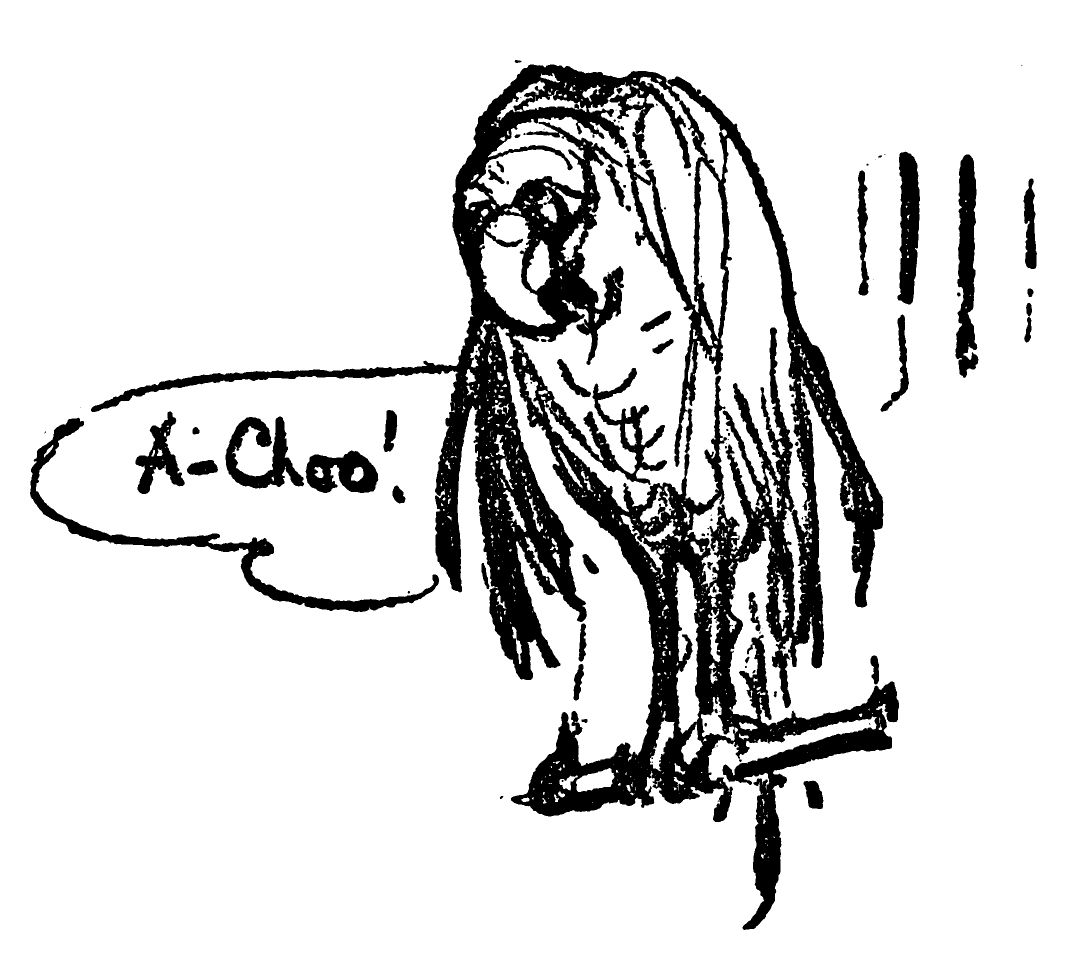
Birds of the Empire. II.—The Parrot Attaboy, out of action.
They stood huddled in the West Room under that Sunday morning light, looking on the ravaged furniture, the staring pink circle where the now demolished glass had saved the paper from fading, the Parrot's cage—but gazing above all on the immortal Collop and awaiting his great news.
In that solemn and expectant silence—the chimes for church were ringing—the parrot sneezed three times, with a grievance, and very hoarsely muttered "Attaboy!" and shivered. It had a cold in the head.
Nor did Lord Galton wince—though that parrot had suddenly revealed to him a world of things about his cousin's conversations when his back was turned.
CHAPTER FIFTEEN
Mr. Collop was standing dramatically in the midst of that large apartment, a squat tower of triumphant modesty and unassailable success.
"I asked His Honour, Mr. Dee Boe Hun, to bring you all in," he said, as though they were a school, "so's ye might see how things like this are done. It's the end of what's been troubling you all; what's been biting you! Oh! I know your distress," he added kindly, fixing Galton with his eye first, then the Professor. "But first and to start with, I 'ave a confession to make, I 'ave. Ye thought me His Majesty's representative in Bogotar, just returned." He smiled genially. "Ar! ye thought that, and nat'rally enough. Well, now, I'm free to tell ye the truth. An' in my trade," he went on, crossing his arms boldly, "that's not too often, Gawd helping us! Now 'oo am I? I'm from the Yard. In plain English, I'm what they call a detective. Now don't start!" he added, releasing his left hand and holding it up. Nor had any of them started, least of all Aunt Amelia, who had not clearly heard the last words. "There's no 'arm done, there's none o' you to blame. There's none o' you suspect. You'll none o' you have the darbies on," he added, with kindly jocularity. "Oo's done it?"
"I'm sure, I'm sure, I'm sure ..." began the Professor with ready tongue.
"You'll excuse me, Professor," said Mr. Collop with dignity, "but I must continue. Ah! 'oo's done it, I arsk? The question we 'ave all on us been asking. And now"—with mysterious dignity—"ye shall see. If any of ye is for wrapping up before ye go out of doors say so. It's only a little turn."
No one was for wrapping up before going out of doors. They were getting intrigued.
"Foller me," said Mr. Collop after the fashion of the great leaders of mankind. He threw open the window towards the avenue and heavily straddled himself out. The Professor's long legs followed; young Lord Galton, a good deal bored, with his hands in his pockets, took it at a stride; Marjorie's short skirts negotiated it; McTaggart tried to jump it, hit his head on the sash, rubbed it, and then more sensibly walked across. As for Vic, she put a bony hand upon the sill and vaulted lightly over. Poor Aunt Amelia stood looking after them in vain, like the women of Ithaca when first the king sailed away to the gathering of the chiefs and of whom it is written:
"This is the hall where all the women spinning Sang of the Kings who sailed away to Troy."
She could not vault; she could not even stride. Lastly, the Home Secretary himself hooked a lean shank over and stood with the shivering group. Outside they all came on to the swept gravel of the avenue, with its row of bare trees and its border of broad snow on either side. Mr. Collop with a gesture still more majestic than any he had yet assumed, pointed with iron hand and arm at the light snow which covered the grass upon the right. There, sure enough, was the mark of a bird's claw. And side by side with it, the other triple mark of the bird's other claw.
"A bird 'ops," pontificated Mr. Collop, significantly. "'E don't run—'cept ostriches and such like. 'E 'ops. Foller me!"
His left hand slightly clenched, with his right he pointed down continuously to the border of the snow, whence, at short intervals, those two triple marks appeared and reappeared.
"Mark you," said Mr. Collop, facing the group—the now half-frozen group. "I said, a bird 'ops. What 'opped 'ere? A bird!"
They approached the fatal tree.
"And 'ere," said Mr. Collop in the tone of a guide conducting a party of tourists, "our marks are lost. And for why? 'E takes the air! Whither will 'e take the air? Put ye'self in his place. Whither would a bird take the air from hence, seeing what fatal burden 'e bore in 'is beak?" He half waved, half pointed, with his left hand at the hollow-branched stump just higher than their heads and some ten feet away. "Foller me," he said again.
They followed him—but not to the point of going on the snow, which Mr. Collop did with great courage and resolution. He stood on tiptoe by the trunk and stretched his clenched left hand upward, groped with it hidden to the wrist in the hollow of the rotten branch, lifted it out again high between them and the frosty January sky. There held between the thumb and forefinger, unmistakable, recovered, was the Emerald.
"What did I tell yer?" he waved triumphantly in that keen air, "Brains, gentlemen ... ladies and gentlemen, I mean.... Brains! Induction." And he calmly slipped the gem into his pocket.
Had they been in a warm room they would have applauded: it was so exactly like the best tricks. But they were cold. They huddled back. It was only twenty or thirty yards; they would be in the warmth again in a moment.
I know very well that there ought to have been a shock of surprise. A cheer. Excitement. What you will. But, Lord! it was so cold!
One by one they clambered, straddled, strode, vaulted, crawled and shambled over the low window ledge and back into the room. Mr. Collop came last, and slammed the window down behind him: and Aunt Amelia welcomed them as might the old nurse of Ulysses when he returned at last from so much wandering. As the warm air revived them they began to feel him, very rightly, a hero.
"Now," said he, "shall I show ye all 'ow these things are done? Step by step, unbeknownst to others? Ah! It's worth knowing! Look 'ere," and he began, their interest rising as their blood began to move again: "You mayn't see it, but I see it, here on this parky floor." He stooped down and tapped it with his finger. "Little marks. Little marks."
There were no little marks—but no matter. He had done his best to suggest them. The Professor greatly helped them by his folly.
"Yes! I see! Oh! Yes! Most interesting! I see them now!"
"And where does they lead? Why, to the winder. Then what did I say to myself? I ses, 'A bird! A daw!' And mark you, gentlemen—ladies and gentlemen, I mean—I didn't come to that blindly, either. For you'll pardon me, but I know what you'd all said."
The guests looked—or at least, most of them did—at their host. But he was modestly regarding the carpet.
"I know as 'ow you 'ad, all or most of you, felt suspected like and might well enough think you could each o' ye be certain which o' ye it was. And ye were wrong," he continued, wagging his head solemnly. "Orl wrong! It was but an innocent bird. Or a thievish bird. Any'ow—a bird. That's what it was—a bird. When I 'eard of your confusion from our good host here"—and again Mr. de Bohun looked anyhow—"I says to meself, 'They're innocent, they are!' That was my first clue. Orl innocent," he emphasized cheerily, nodding in a nice heartening way to McTaggart, the Professor and young Galton, the last of whom said, almost audibly, to Vic, "The stinker!" and to whom Vic whispered back, "Well, he found it, anyhow!"
"Orl innocent," went on Mr. Collop. "Orl as white as the driven snow. And 'oo set things right and proved you so? Why, yours truly.... First, arter I'd thought 'ard orl night, I looks by the first white o' morning at the parky—and sure enough I sees them faint prints on the wax, like: an' them near the winder. What are the birds as thieves? Why, daws! Now, ladies and gentlemen, daws 'as claws; talons, ye may call 'em, of a 'ighly partic'lar kind. It's our business in my trade to know orl we can—and I can tell a daw's claws from any other claws, or paws ... any other in the wide world.
"So wot does I do? In this same early morning, afore any one of ye were up—at any rate, afore any of yer had showed themselves, I was out trailing. Sure enough, there I found where the bird had gone, for I marked his prints on the snow. When I found where the bird 'ad 'opped to, I follered to where he'd sat on the air. When I found where he'd taken the air, what does I do? Did I say to myself, ''E 'as flown far, far away; give up the search, William Collop? You are proven right, but the hem'rald will not be seen again by mortal eye.' Did I despair thus? No, not I! I thinks to myself, knowing the habits of birds better than most—we 'ave to know such things in our trade—he 'as put it near by, so's to be able to come and gloat on it. They love to go and gloat on what they 'ave taken, do daws. Then I noted that rotten stump o' branch just convenient to the bird where he took the air, and I says 'Yureeker,' which is, being interpreted, 'Found.' But I didn't touch that bole; no, I trusted to my induction. I was as sure it was there as though I'd seen it, and I wanted to lead up to it step by step so's ye might be witness to the discovery. Weren't I right?
"That's why I asked you all to be brought 'ere. That's why I took you all out and made the thing clear to you before your own eyes; William Collop said he'd find the hem'rald where his induction told him it would be. And there he found it!"
His face was irradiated with no common glory.
"An' now," he said, at the end of this harangue, and plunging his hand into his coat pocket to fish out the gem, "now I restore it—'Ullo!" he frowned; the groping of his hand in his pocket looked like some small animal fighting in a bag. "'Ullo!" he repeated and still he groped. "'Ullo—'ullo! Wot's this!" His face grew black. He eyed successively with some disfavour the Professor, McTaggart and Galton. "You were all close together," he said suspiciously, "as we came through that winder!" Then suddenly, "Ah! 'ere it is! Smother me if it 'adn't gone through a hole in the lining. That's my missus, that is. She's that careless." And turning the receptacle inside out he gingerly picked the jewel from the tear between the sateen, with threads still attached to its setting.
"There now! Wot was I saying? I restore it to its rightful owner!" And with a bow, unlike that of Lord Chesterfield's dancing master, he handed it to Marjorie.
"Oh, thank you, Mr. Collop, thank you!" said Marjorie. "Thank you a thousand times. I don't know how to thank you!"
"It's really very remarkable, Mr. Collop, very remarkable indeed. Very remarkable," said the Home Secretary. He went so far as to wring his subordinate by the hand. "We are infinitely obliged to you."
The guilty three were less enthusiastic; but they murmured as though they would be polite—though Galton's murmur, overheard by Vic, was, "I believe he pinched it himself!" And Vic answered in a second whisper, "Fat-head!"—a chosen epithet delivered with such real contempt in the slit of a dark eye as made the poor horse-puller wince.
Then Aunt Amelia bleated:
"I don't quite understand. Who does Mr. Collop say stole the emerald?"
"Amelia! Amelia!" protested her brother severely.
"But I want to know," began poor Aunt Amelia pathetically. "I didn't hear properly. I want to know who it is has been found to have stolen the ..."
Her brother interrupted desperately.
"I'm so sorry," he cried, turning to the others, but directing his remarks particularly and courteously to McTaggart, as the stranger. "You must excuse my sister. She does not always hear."
"I must thank you myself, personally and warmly, Mr. Collop," said Marjorie, the ancient courtesy of the Bohuns strong in her veins. "We'd all got lousy with worry, and you've hit the cocoanut."
"Thank you, Miss, I'm sure," said Mr. Collop, bowing again in the manner aforesaid.
And they all drew apart to various rooms, but Victoria Mosel, lingering for a moment, whispered in Mr. Collop's ear, "I saw it in your hand before the tree!" The detective started. "For Gawd's sake!" he pleaded under his breath.
"All right, I don't give people away." She nodded reassuringly and slipped away.... Hence for so many years the devoted service of Mr. Collop whenever Victoria cared to summon him.
The Home Secretary had detained McTaggart, catching his arm as he turned to go, and had said, "Wait a moment, Mr. McTaggart, wait a moment. Mr. Collop, I think it is only just to say in your presence that I had repeated to this young gentleman—not my suspicions—they were not my suspicions—but what I had been told were the suspicions of others."
Mr. Collop bowed again in the aforesaid manner.
"Mr. McTaggart," the Home Secretary continued, "I'm going to ask Mr. Collop to let us have a few words together alone. Mr. Collop, where may I see you in five minutes?"
"Where you will," said Mr. Collop with chivalry. "I'll be looking at the old paintings in the 'all. The ancestors, I've seen them in the ball room already," he added, nor was there any irony in his innocent soul.
When he had shut the door behind him, the poor old Home Secretary put an almost fatherly hand on McTaggart's shoulder.
"My dear young sir," he said, "what can I do? How can I apologise? It is not enough to ask you to forgive me. May I ask to communicate with you when we reach town?"
The mind of McTaggart was not alert, but even he foresaw the possibilities. Politicians have not very great power nowadays save in patronage; that they still do retain; of public money there are some odd millions every year at the disposal of the politicians. It is only fair to say that most of them are content with moderate pickings for themselves and their connections.
Therefore did McTaggart answer with a natural prescience of coming advantage. "It is very good of you, sir. May I call at the Home Office?"
"Yes, yes. Shall we say Thursday at noon?" De Bohun marked it in a little pocket book and then joined Collop in the hall, as McTaggart walked off.
"Mr. Collop," he said, "won't you come back and talk to me a moment in private?"
They returned together. And exactly the same scene was rehearsed, except that he dared not put a hand on the shoulder of such a being as Collop.
"Mr. Collop," he said, "you know that the Department of which I am the head is proud of you."
"Thank you, sir," said Mr. Collop sedately. "Thank you very much." He then added: "I have only done my duty...." But I am glad to say that he did not add "as a man is bound to do," for if he had done that de Bohun, whose nerves were already on edge, might have had a fit. However, he meant something of that kind. So let it be credited to him.
"Mr. Collop," went on the Home Secretary, "when I go to the office to-morrow, Monday, I hope you will allow me to make a particular point of seeing you. Men of your kind must not be wasted."
"Thank you, sir," said Collop again, in a tone which showed a full sense of his worth. "I shall always be at your orders."
And so, you will say, the great thing ended.
Wrong again.
De Bohun had sunk back into his chair, now at last at rest. There were still inexplicable things drifting through his mind. He had vague memories of Galton accusing his cousin the Professor, and the Professor accusing McTaggart, and McTaggart spotting Collop; of himself accusing McTaggart; of the boy Ethelbert accusing Galton. He even had confused recollections of their actually swearing to things they had seen which they could not have seen. But he sighed with deep content at the solution of it all, and he thought of his daughter's relief. He decided to worry himself with contradictions no more. The emerald had been found; a bird had taken it, and no one was to blame. That man Collop had genius.... Marjorie would be in a better temper now. He shut his tired eyes. He was on the point of falling into a short sleep after so much strain when there was a knock at the door, and he saw as he opened his eyes again, not too pleased at being wakened, the august, the discreet, the considerable figure of George Whaley.
CHAPTER SIXTEEN
"I beg your pardon, sir! May I have the honour of a moment's confidential word with you?"
The refined, the courteous phrase, was followed by a discreet cough. The cough was a trifle mechanical, the words a little too rapidly spoken, as is (alas!) the common fate of words learned by heart for a set piece, whether by front benchers or perjuring policemen. What followed was marred by the same slight defect, but it was at least clear. It rattled out—to quote a noble simile from the Wallet of Kai Lung—"like a stream of pearls dropped into a bowl of jade."
"There has come to my knowledge sir which would grieve my 'eart to distraction and breaking were it not overcome by the more powerful emotion of gratitude for so many happy years passed under this 'ere roof at Paulings I mean this roof at Paulings and formerly when we had a town house if I may make so bold in one hundred and twelve Curzon Street Mayfair moved by this my 'eart would not let me keep silent. Oh! sir. I know the dread secret and if I come to speak of it it is from loyal affection and no other cause and here and now I put at your service as in duty bound all that has come" ... here Mr. Whaley suddenly clasped a fat right hand against his chest: He ought to have done it at the word "heart," but the brakes had slipped and he had run past the station ... "all that has come to the knowledge of these poor humble ears of mine which would rather have been closed in death than have suffered the agony of them fatal news but told it shall not be to other human soul nor yet only to you for the respect I bear to that 'igh name of Deeboon which saving your honour sir ..."
Humphrey de Bohun put his lean hands on his lean knees, sat up, and stared at this high-geared human gramophone on speed.
"What on earth ..." he began. "Look here, Whaley, have you been drinking? ... Now, mark me, Whaley!" Humphrey de Bohun could speak with astonishing decision when he felt quite secure that the person spoken to was unable to answer back. "I've always made one absolute rule in this house. Any servant of mine who is found the worse for liquor—I don't care where," and he swept his feeble head down to the southwest, "I don't care how"—he swept it again—"I don't ... damn it, I don't even care on what! leaves me there and then!" He leaned back again, somewhat exhausted.
"You wound me, sir," said George Whaley with dignity. "Ah, sir! you wound me! Indeed you do!"
"Wound your what?" said the Home Secretary, without sufficient consideration.
"My honour, sir," said George Whaley. "And a loyal heart."
This time he remembered the connection of the word "heart" with the appropriate gesture, and he planked his hand on his merrythought with the noise of a distant 9.2.
The Home Secretary remembered the lessons of his youth, the high traditions of the de Bohuns.
"I owe you an apology, Whaley," he said, in the appropriate faded-earnest manner. "But the truth is, I can't pretend to follow what you were saying. I don't suggest that you spoke too quickly.... I was in a reverie when you came in. The fault is mine. Proceed."
And in his turn George Whaley proceeded—but the chain was broken; he was thrown back upon impromptu too; and a native terseness, not to say inhibition of speech, returned to him.
"Well, sir," and he coughed, "I'm afraid it's rather a delicate matter," and he looked at the nails of his fingers. "Perhaps I ought to plunge in medias res." He sighed. "I've 'eard it's usually the wiser plan in cases like these."
He stood for some fifteen seconds, his bold head with its fringe of grey hair slightly on one side, and gazing at the exalted culprit with infinite compassion. Then did George Whaley begin to shake that head, and there escaped him words unusual to his daily life, but native to his reading of fiction and to his experience on the stage.
"Ah me! Ah me!" he said.
"Look here, Whaley," said his master smartly. "What's the matter? Are you ill? Are you mad? Have you"—in a softer voice—"have you perhaps suffered some sudden bereavement?"
"Only the bereavement of a loyal heart deceived, bewildered," moaned George Whaley, quoting textually from The Waifs of the Whirlwind. He linked his hands before his ample waistcoat and hung his saddened head.
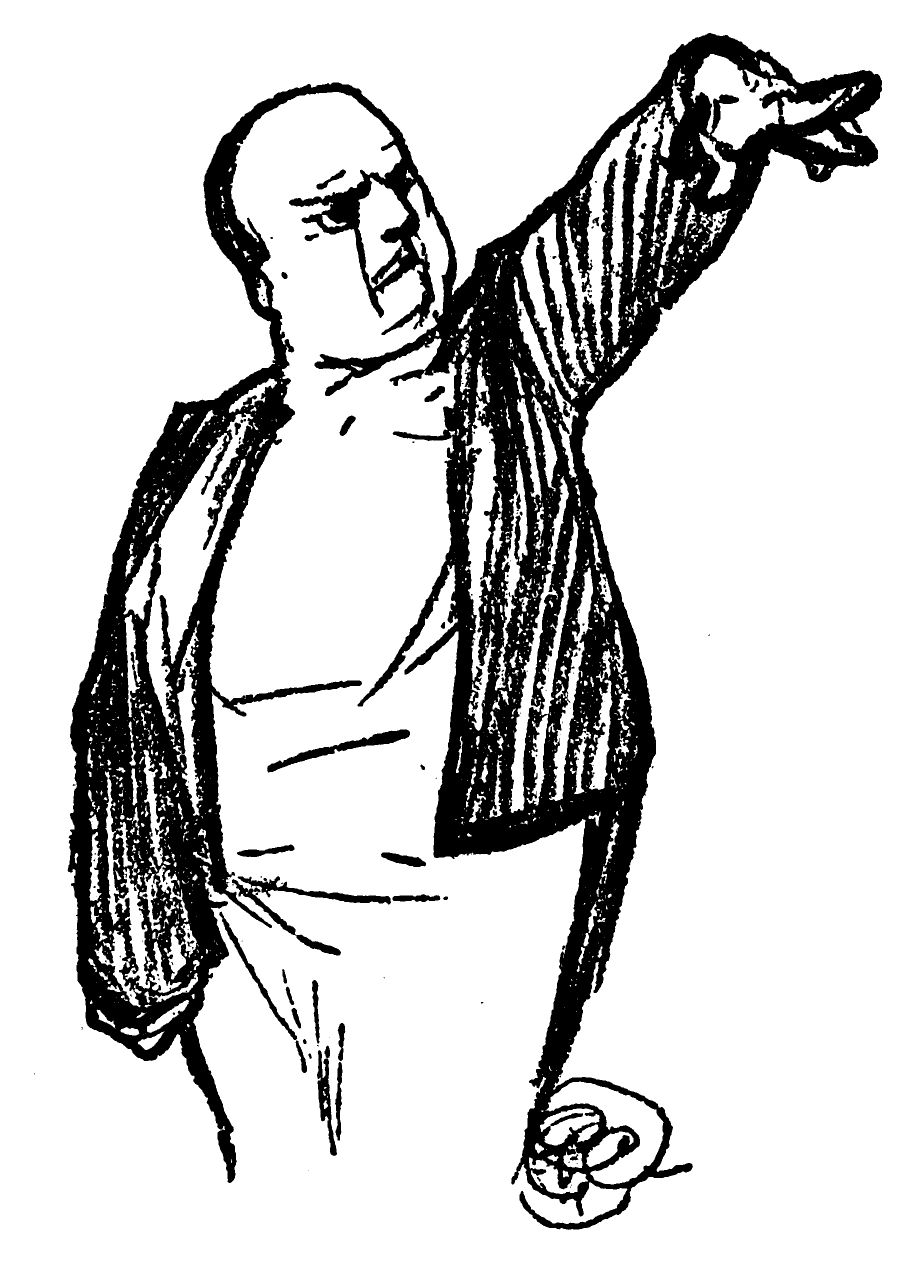
The Home Secretary's Butler taking the liberty to observe: "Thou art the man."
"Upon my word!" cried Humphrey de Bohun, moved to unexpected energy by an intolerable boredom, "this kind of thing's got to stop. Speak out, man, and don't make a fool of yourself!" He pulled out his watch. "I've not got all the time there is! Hurry up, now! Surely you can speak plainly!"
"I can," said George Whaley, in tones of gloom, and moved by a mighty resolution. He was standing upright now; he fixed his employer with a steady glance, and each hand was half clenched at his side. "The emerald, sir!"
And he waited for his effect.
"Oh, damn the emerald!" shouted Humphrey de Bohun. "If you think this is the time, after all these two days ..."
"It is the time," said George Whaley firmly, with a reminiscence of the worthy mother who had brought him up in the Countess of Huntingdon's connection and under all the discipline of the Jacobean Scriptures. "Yea, now is the acceptable time."
"By God!" shouted the now inflamed minister, "this has got to stop! I'll have you certified! I'll ... I'll ..."
But he got the thing full in the face. In a key nearly an octave lower than that he had been using for the purposes of the great interview, George Whaley stretched out a rigid solemn arm towards his master and spoke the words of doom.
"I know all... Thou art the man! It is you, sir, that have on you the lost emerald!"
Let me not do Humphrey de Bohun injustice. He had never yet in his life taken an initiative. He had never tackled any one of the human species. But there is a god latent in us all, and his name is Pan.
"The emerald!" he shrieked. "Blackmail, eh, you damned lousy son of a ——!" He sprang at the astonished servitor, seized him round the neck—a dangerous gambit between elderly men, for it leads to strokes on both sides—shook him madly from side to side, then dug his right hand into his collar behind, swerved him round, and gave him one of those enormous kicks which form epochs in the history of Britain. Savagely did the unrestrained elder statesman, all the repressed manhood of half a century bursting forth, plant his foot upon what should properly be called the person of his unfortunate dependant and with a second gesture sent him sprawling through the open door into the hall.
"The emerald!" he kept on shouting, as George Whaley, groaning, pulled himself up miserably, like a wounded sea lion. "When the hell am I to hear the last of the emerald ... you and your emerald! ... all of you and your emeralds! ... I wish to God! ..." A blasphemy was almost on his lips; he had almost said that he wished the emerald had been strangled at birth, and by such a phrase would he have forfeited the luck of the Boneses.
"Get out!" he continued, in a somewhat milder because exhausted tone, as the ill-treated Good Samaritan hobbled towards the door which led to the offices, rubbing the affected portions of his frame. "Out! Out! Out! Never let me see your face again!"
And they parted to meet no more. The conclusion of their mutual relations was concluded by correspondence.
* * * * * * *
It is not with impunity that men between fifty and sixty, especially if they have lived under constant self-repression—which doesn't apply to colonels—let their angry passions rise. The Home Secretary was badly blown. He felt groggy. His exertion was already beginning to make him a little stiff. He halted towards the dining-room and groped for a pint of champagne which he knew to stand by. He pulled the cork with his last strength. He took a mighty draught. He felt better. He took another. Then he saw the world sanely, and he saw it whole—such is the power of the god. There was hardly a drain left. He glanced over his shoulder, found himself alone, put the neck of the bottle to his lips and sucked it down.
"Ah!" said the arbiter of Wormwood Scrubbs and Lord of Pentonville. "That's better."
He felt almost genial—normal, anyhow, at last. Even a trifle super-normal. With sprightlier step he regained that comfortable chair wherein he had been relaxing his overstrained mind when George Whaley had so imprudently intruded.
It was not once in a blue moon that Humphrey de Bohun thought tobacco a boon, but the occasion called for it. For the matter of that, it was not once in a blue moon that he drank more than half a glass of wine at a sitting—let alone of a Sunday morning during church time—and bubbling wine in plenty leads to smoking: hence the fortunes made by Greeks and Egyptians in their sales of hay cigarettes to the young bloods. Humphrey de Bohun groped in his daughter's open box for a cigarette, tapped it, with a surprisingly modern gesture, on his thumbnail, and as he lit it sank back into the chair he had left and wondered whether indeed he had reached repose.
Was there anyone left, he thought drowsily, who could come with yet another story of the blasted gem? He was already half asleep, but there passed before his drooping eyes what seemed a regiment: Galton had been sure of it—he had seen it, seen it on Bill; Bill had been sure of it—he had tested it, tested it on McTaggart; McTaggart had been sure of it—he had got it by second sight, and was absolutely certain of Collop; and Collop—oh well! God bless Collop! For after all he had produced it—snatched from the talons of a fowl. The elderly gentleman's head drooped and nodded; the cigarette fell from his lax fingers; it set fire to the Aubusson carpet, which smouldered in faint wreaths, but did no harm, and soon went out. Thus did the adventure of the Emerald of Catherine the Great end, as all things end, in smoke.
* * * * * * *
Far, far, in the less pretentious but roomy apartments of the East Wing, George Whaley, suffering untold things, sought for and found the Boy, the culprit, Ethelbert.
They met in the passage that leads from the servants' hall to the Yard; but when I say met, I rather mean that their visages encountered the one the other at the turn of a corner separated by a space of some five yards.
The countenance of George Whaley at that moment was not one to inspire confidence in the young. There was blood on his cheek-bone. His collar was torn, and all adrift upon the starboard side; his tie was under his ear; there was a gaping tear in his coat.
"Ow! You young dose of poison!" bawled the injured man, as he lunged forward upon his prey, and with a loud cry Ethelbert fled. He fled through the open door into the coal yard, George Whaley limping after. There stood against the wall of the yard, leaning to its summit, a crazy old ladder. The light boy Ethelbert nipped up it, and at its foot stood the unhappy and ponderous victim of his misleading confidences, shaking an impotent fist.
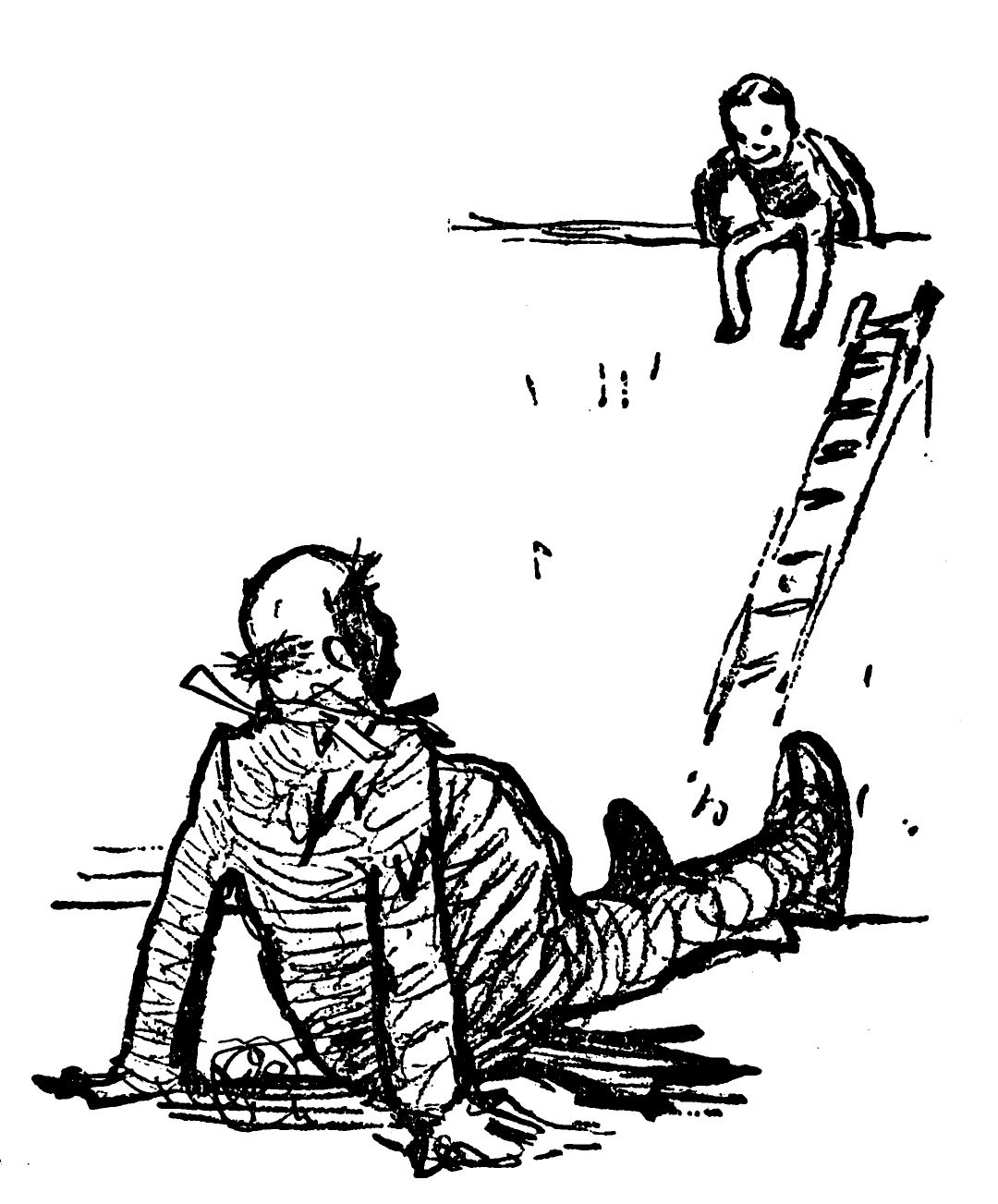
Dialogue between the Boy Ethelbert and his fallen superior.
Security lent courage to the youth.
"You look hot," he said kindly.
"You come down!" hissed Whaley, clenching his teeth, "and I'll flay you alive—slowly—inch by inch!"
"Sounds good," grinned Ethelbert; with thoughtful prevision he kicked the ladder down. Its rotten wood smashed into a dozen pieces as it fell, and the youth was delighted to note that a flying fragment had caught his superior a fine smack on the side of the jaw.
For to him that hath, more shall be added.
Ethelbert feared not the future; his judgment told him, not insecurely, that the butler's powers were at an end.
"Been havin' a scrap?" continued Ethelbert, by way of making conversation. "'Ow's the other man?"
George Whaley's cup was full. "Come down," he groaned stupidly. "Come down!"
"Me come down?" answered his former subaltern with an air. "Why, what can you be thinking of? It's only just over church time yet. You can hear the sweet bells ringing—'ark!" and he lifted an ecstatic forefinger with heavenward-lifted eyes.
The butler put his hand upon the old red brick wall. His adventures were beginning to tell upon him. He felt sick.
"It's all along o' you!" he said thickly, spat, to see whether his lungs were injured, was pleased to find they were not; then, still suffering, repeated, "It's all along o' you! What," he added in a higher key of tragic indignation, "what the burning hell did yer mean by telling me the boss had pinched the emerald?"
"I tell you the boss had pinched the emerald?" sneered Ethelbert from his high place. "Oh, chase me, Ananias!"
"Yes, yer did!" came again from the uplifted purple face. "Yer told me with yer own lips that you knew yerself it was in the 'ands of the 'ighest."
"I never! You dare say I did!" cried the indignant whelp. "Liar! What I may have thought was that his lordship ..."
"His lordship?" groaned the suffering man, a light breaking in upon him.
"Yes, mubbe! Don't you dare go to say as I said so. Otherwise I'll have the lor on yer! So mind your fat feet! I'll be treading on 'em. I never said nuffing. I didn't. 'Sides which, it's all one now. The emerald's been found."
"Found?" gasped Whaley with a stare.
"Yes, found," nodded Ethelbert, from his dominion of vantage loftily.
"Then ..." groaned his unfortunate elder, "I'm done!"
"That's true, anyways! Congrats!"
Whaley had already picked up half a brick, but his tormenter had seen the gesture, and had dropped on the far side of the wall to the high bank below, and was off to rejoin his quarters. He knew that the mighty had fallen and would trouble him no more.
So ends the saga.
TALE-PIECE
It was the custom of our grandfathers and grandmothers—when they had any of them been fool enough to write a novel—to wind it up with a description of what the various characters in the beastly thing were doing at the moment when the book appeared—that is, supposedly, in a future some little while after the closing of the tale.
Those of you who still read the novels of my own youth—and I for one read no others—will remember that they are invariably concerned with a well-to-do young woman of exquisite beauty who marries a manly young fellow of her own status, after various ups and downs. Then the book goes on to tell you that they have twenty-six boys and girls with long curly hair, all gold. And then the band plays.
It is not easy for me to give you an appendix of this kind, because I have always thought it prudent to throw my own novels into the future, lest I should be sent to gaol for insulting the rich. Moreover, even if I did describe the final fate of my characters, I cannot make it a very pleasant one without treason to the realities of human life and the flattering of fools: and rather than flatter fools let me be torn to pieces by wild horses after the fashion of the Merovingian queens.
However, I propose to give you some idea of how the various people you have come across in these pages continued their not too significant lives.
When Marjorie had divorced Galton—having got married to him by way of preliminary—she was herself divorced by Pemberton—who had no further use for Lady Meinz—and then married—only last year—an extraordinarily fleshy man called (at the moment) Henry Munster. They are still happy—at least, she is. The child of the first union—if I may so describe it—is a girl; so that's the end of the Galton peerage.
Aunt Amelia is dead: and high time.
Her brother, the former Home Secretary, has in the interval developed astonishing talents which have fitted him for the Colonial Office, the India Office, and the Treasury, in rapid succession—and would doubtless have fitted him for the Foreign Office but for the determined opposition of the permanent officials. During the four years in which it had been arranged to let the other batch of professional politicians have a suck at the salaries, he acted as President (at £2,500) of the Commission for the Second Reduction of Wages, wrote a book of reminiscences (£3,000 Gubbins & Gubbins 42s.). He was badly stoned during the progress of the fifth General Strike—some call it the seventh, but I follow the usual numeration. He had been taken by the mob for Henry Gaston, a man nearly forty years younger and twenty times as able—which only shows how important it is to educate the poor, and also, by the way, how important it is not to print in the papers pictures of people taken hundreds of years before the date of their appearance.
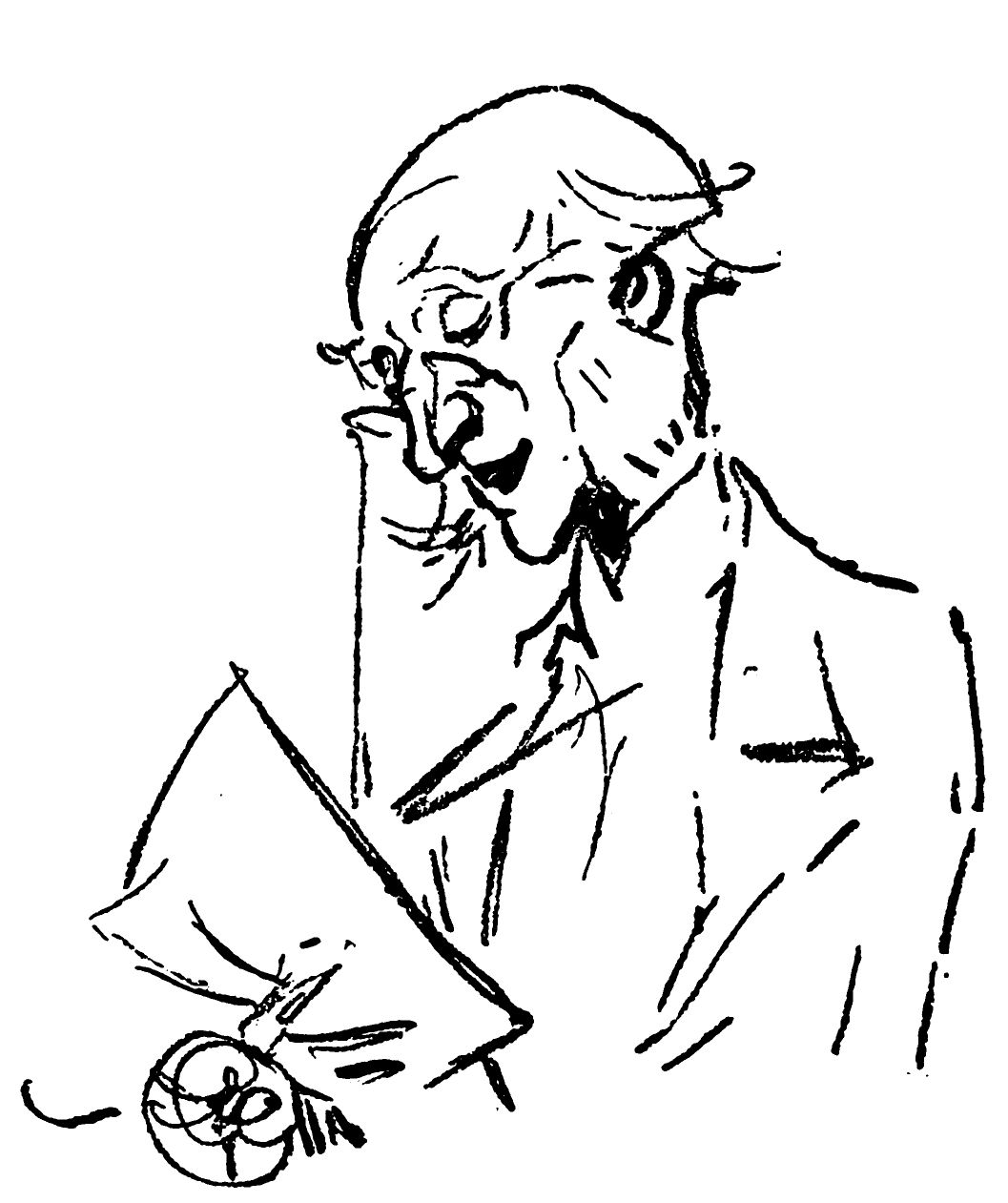
Last portrait of Professor de Bohun, a sketch reproduced in the "Figures Modernes" of Berne (Switzerland).
William de Bohun is still Professor of Crystallography in the University, where he has still further attained a European reputation. He is now mentioned not only in Swiss papers, but occasionally in German ones. He is not more than seventy-nine, and there is every chance of his retaining the position for a few more years. He has not made it up with the reader in Crystallogy, Mr. Bertran Leader.
I am sorry to say that these two distinguished men actually had a fight in the main street of their academic town, their weapons being umbrellas. Nor would the victory of the younger champion, Mr. B. Leader, have been for a moment doubtful had it not been that the umbrella of the elder, Professor de Bohun, was suddenly blown open by a gust of wind, affording him a sure and certain shield against the frenzied blows of his opponent.
McTaggart has gone under for good. It seems shameful, considering the excellent position on the British Intelligence into which he had been put on a weekly contract at fifteen pounds by the influence of the Home Secretary, who thought some reparation due to him, and still more by the influence of Victoria Mosel, who had squeezed Lord Bernstein's hand. On the other hand it hurts nobody but himself. He is still unmarried.
George Whaley, with his accumulated savings, purchased immediately upon his leaving the service of Humphrey de Bohun, the good will of the Bohun Arms, which I need hardly tell you does not belong to the family, but to a limited company. The pub stands at the gate of the park. Therein he regales the countryside with comic stories of his former employers; the rich middle-class motorists with scandal of the Great; the upper classes who deign to halt there on their way north in their superb cars with obsequience and silence, at a profit of about 30s. the bunch. He has done very well indeed, because it is a convenient lunching place for people motoring out from London to the north. His son is in this year's Oxford eight, but his daughter, I very much regret to say, has published, a book of verse—in Chelsea!
Ethelbert, a bright lad of nineteen, ordered by his master into the special constabulary during the third General Strike—I use the conventional numeration—was so unfortunate as to crack smartly upon the head a high dignitary of the Church of England, and was thereupon put in prison at the instance of Lady Sophia—the eminent cleric's wife—who would take no denial. Upon release, the General Strike being still in progress—it was the first of the really long General Strikes, as you will remember, he joined the regular police force, which is ever ready to welcome men of varied experience and initiative. But he never developed the intelligence required for the agent provocateur, in which capacity such members of the service as have had personal experience of the cells are commonly employed. He is now past thirty and doing clerical work in the Lost Property Department.
What else remains? The horse, Attaboy, is dead, worn out in faithful labours at the stud. He was the sire of Get-On out of Get-Out. Get-Out, I need hardly tell you, was the sire of Success by Morning Star. Success was the sire of Repetition by Raseuse; and that is how Tabouche won the Oaks. I always did say the little filly would do well, for I have followed the strain—as, long ago, the form—of Attaboy, who now sleeps with his fathers—I means, sires, let alone dams.
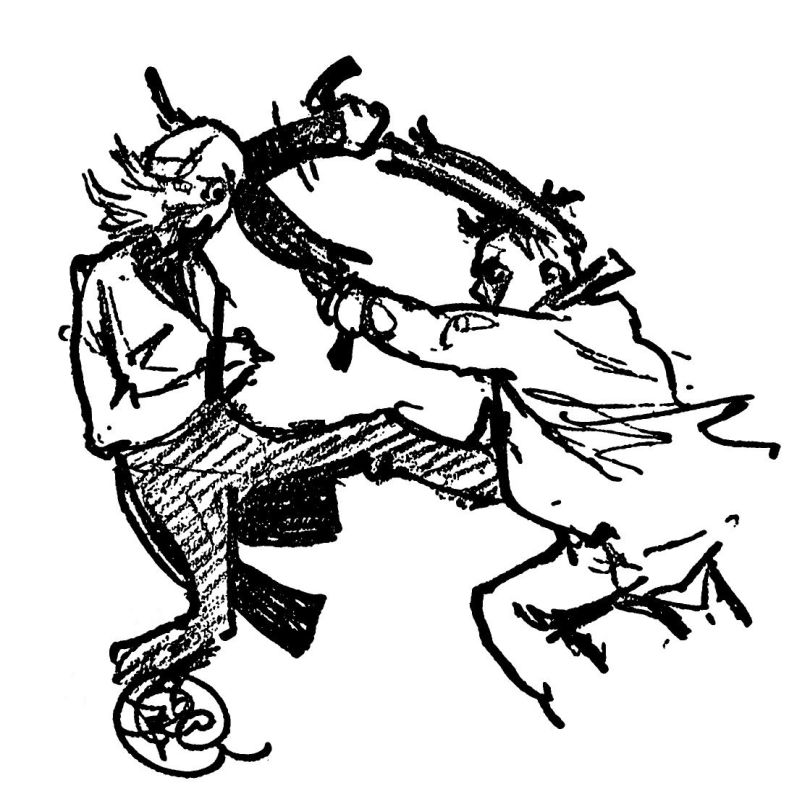
Controversy conducted with umbrellas between a Professor (of Crystallography) and a Reader (in Crystallogy) to the University.
As for the parrot, whom I may call the second Attaboy, he is still the cherished, the beloved, of that constant heart, Marjorie; Mrs. Munster, née de Bohun, sometime Lady Galton, as also Mrs. Pemberton—yes, Pemberton. So far as I can remember, she is nothing else—so far. Such a charming woman! Touching upon the lovely confines of middle age with large bulges under rather weary eyes. But her father provides handsomely.
As for that father, the head of the family, Humphrey de Bohun—pronounced Deboon—he looks no older. It would be odd if he could. He feels no older—that would be impossible. But he is inclined to colds in the head. He now tells the same story over and over again, the story of the Emerald. And it always ends, "Now guess who it was?" They do not murder him, they give it up; and he dodders out, "Why! It was a jackdaw!"
Victoria Mosel has, since the date of the great discovery of the Emerald, spent week-ends at Basingthorpe, Prawley, Hammerton, Gainger, Bifford, then again at Hammerton, then again at Gainger, after that at Little Wackham. Then at Bifford again, then at Gainger, and, of course, at Prawley. She also stayed at the Breitzes' place in Silesia for three months, where she shot the bailiff's dog—by accident. May I tell you that she has spent six weeks in every year on the Riviera? Can I deny that, at this very moment of writing, she is stopping at Hammerton, having passed the last week-end at Gainger and purposing to go on to Bifford?
The years leave no mark upon her temporal frame, for the skin was ever tight upon her bones. But she knows that she is getting on—and not in the City sense of that term either. She already envisages the tomb. I am fond of her. I think she will save her soul.
One great asset which endears her to the rich of her circle. Sir William Collop is always ready and even eager to come at her bidding to any country house, and there she puts him through his paces, to the enormous joy of the assembled hosts and guests. But she is a good girl—I use the word of a woman now nearing sixty—and she does him no harm. Only, she does make him dance. And why not?
After dinner, in the palaces of the rich, Sir William Collop is compelled to tell quaint stories of the other rich over whom his position in Scotland Yard gives him insight. Nor is he unwilling. They all call him a good fellow, by which they mean that his accent is as thick as cheese. He will be Collop till he dies. His original name is drowned ten fathoms deep; he is just coming into his pension, and he is an O. B. E. of the third crop.
And the emerald? Ah, my friends! My brothers! I will tell you what happened to the emerald!
When Mrs. Pemberton, formerly Lady Galton, then Mrs. Munster[1] née de Bohun, was making the straddle between the Pemberton and the Munster connections—what we call joining the slats—she needed five hundred pounds. It sounds ridiculous. But she did. One often does. She had outrun the constable. She did not want to bother her father, and for the very good reason that he had just got damnably knocked in the Hungarian Phosphates on the erroneous advice of that silly man Mowlem. Well, she had taken the emerald to the man who, Vic had told her, was the best expert in London—Mr. Marlovitch, Junior—and (behold!) he had proved to her by infallible tests that it was paste. What is more, he had given her proof out of learned books that no emerald of such size ever had existed, or could exist.
The Bohuns had patriotism in their blood. Marjorie gave the famous trinket to the State—let me say to England!—under very easy conditions which earned her, I am glad to say, the entry of her daughter into Parliament. These conditions were modest: the emerald was to be permanently exhibited, in a very large case all by itself, in the British Museum, with a tablet engraved at the expense of England—I mean the State—describing it as the largest Emerald in the world—which it would have been if it had been an emerald—and assuring the honest public that it had been given by Catherine the Great to that member of the ancient family of de Bohuns who had served the interests of the State—or rather, let me say, of England—at the Court of All the Russias, in those days when the Semiramis of the North was the admiration of Europe.
"What!" you'll exclaim (it's just like you!), "would that regal woman, that generous if somewhat demanding lady, that broad German strong in her nobility, that Monarch of the Snows, Empress of all the Russias, have fallen to deceiving handsome Bill Bones with a piece of paste?"
Not a bit of it. You little understood the nature of those who serve power. She had given her emerald—and an emerald it was—to a man in whom she had the fullest confidence; she had given it him with the order to bestow it at once upon the English captain. But her messenger had preferred his own interest and had substituted that larger and false one round which all this dance has been led.
And, as the Prime Minister said of his colleague on the front bench who got into trouble over the insurance shares, who shall blame him?
Not I.