THE EMERALD CATHERINE THE GREAT (continued 2)
Reading edition
It was in the Professor's conception of things that when one is deceiving a fellow being one must talk the whole time. He is not the only one to suffer from that delusion.
He talked all the way to the billiard-room; he talked while McTaggart was pulling off the cloth; he talked while McTaggart was putting on the lights to see clearly on that dim January day; he talked while McTaggart was chalking his cue and thoughtfully placing the three balls in position.
The torrent of rapid words—all dealing with excellency at billiards, all squeaky—was interrupted only at one moment. It was the moment when McTaggart did what he had been expected to do—the moment when he took off his coat and threw it on the leather cushions by the side of his newly-made and slightly eccentric friend.
The sight of that coat so thrown immediately by his side, and subject to his hand, almost choked the senile conspirator with joy. But he recovered himself, and still poured out a torrent of repeated words as the young fellow walked slowly round the table, getting absorbed in a continuous break. The Professor interrupted that verbal spate only now and then to gaze with a murderous keenness at a projected stroke and to mutter "Marvellous!" two or three times; but all the while his heart was failing him. It was not the only mean thing he had done in his life by a long chalk. He had spent the whole of his life doing nothing but mean things; but it was the first actively and perhaps dangerously wrong thing the old booby had ever dared to do: for he did not count the Mullingar Diamond—that was in the cause of Science, and in the cause of Science you can do anything.
But the Devil chose his moment for him; it was a moment of silence when young McTaggart was waiting long and breathlessly to be certain of a stroke that would bring his break over the hundred. His back was turned to the Professor; he was intent upon his play.
The old bony hand, with the gesture of one that takes rather than gives, put the emerald into a side pocket of the coat, where lay he knew not what—but in point of fact, a tobacco pouch, a pipe, a pencil, and a piece of chocolate—of all things in the world!—no longer clean. Nor had the Emerald ever been in such society before, from the day when it had started life in the splendid court of Moscovy to these last evil days of ours.
McTaggart had brought off his shot: his break was 102, and the spot and the red lay perfect for a cannon and red in the pocket.
But you exaggerate the diplomatic value of the Professor if you think that he had the wit to continue his stream of gabble after the deed was done.
It was lucky for him that he was dealing with the candour of youth, or that abrupt retreat of his from the scene of his crime would have brought suspicion. For, his deed accomplished, he simply got up with a jerk, dropped all attention to the play, looked at his watch, muttered the time of day with an exclamation, and sidled out of the room, leaving his companion marooned ... and with him, full of success, went the Lesser Devil.
McTaggart could do without him; he went on playing for another ten minutes or so, till the break ended, and had reached the pretty figure of 151. Then he in turn looked at his watch in his waistcoat pocket, found it would be time for luncheon in a few minutes, put up his cue, and sadly resumed his coat.
Had he been of those who smoke all day he would have pulled out his pipe, and ten to one would have found the thing lurking there next his tobacco; but he thought of the meal coming on, and much more did he think with dread that it would be breaking some mysterious etiquette of country houses if he were to smoke a pipe. He would not dare to do it till he saw some one of his betters at the same work. For the same reason, after he had heard them going towards the dining-room and had joined them, he was too nervous to put his hands in his pockets in a gesture of repose. He kept them dangling in his extreme anxiety to commit no solecism. He moved nervously about amid the sullen silence of the rest and wondered a little why the burst of geniality upon the part of the man of gems should have dried up so suddenly. For not a word more did the Professor speak to him; and all through luncheon McTaggart sat there in the same terror and the same misfortune of soul, never daring to speak some artificial word during the rare moments when anyone broke the silence.
They had not yet risen from table; he was still wondering what one did at the end of luncheon in the houses of the great—at what point one got up, whether immediately after one's host or simultaneously with one's host; whether the women went out first, as he knew they did at dinner; whether it was his duty to open the door for them—when Lord Galton pulled out his pipe, filled it deliberately enough, and lit it. After the easy manners of our happy times he slowly and with deliberation blew a cloud of smoke across the board which wreathed itself, not ungracefully, about the venerable head of Aunt Amelia. So natural an action was followed by his host, who in turn thoughtfully pulled out his own pipe and lit it, as he rose to fetch himself wine: he mixed tobacco and wine, did Humphrey de Bohun.
"Then," thought McTaggart to himself, in an agony of desire for tobacco, "it seems this kind of thing can be done,"—and he felt for his pipe, and pulled out his pouch.
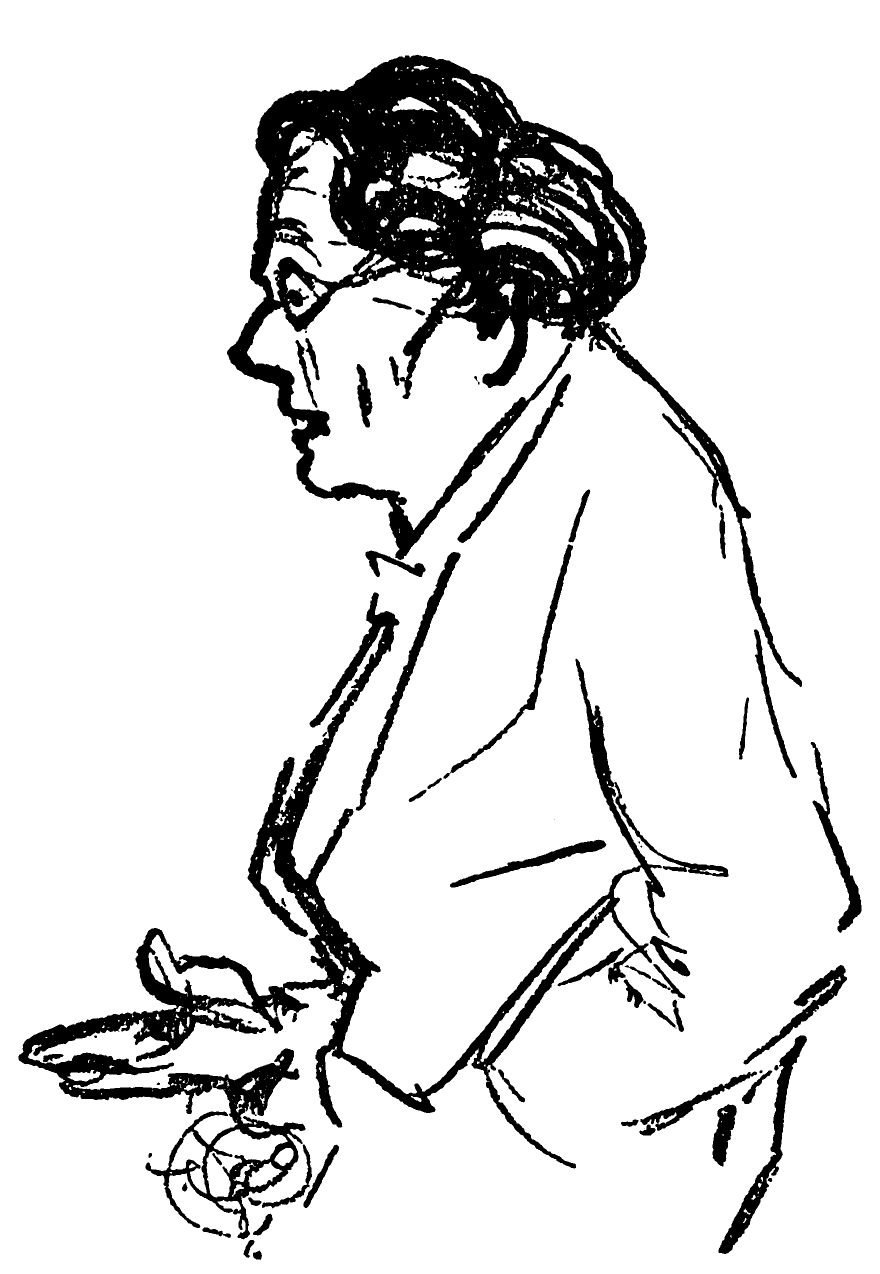
Mr. McTaggart discovers the Emerald.
Now there happened to be in the room at that moment an Angel. He had come to Paulings express to counteract the Devil who had been putting in such strong work on the Professor, and the Angel saved the quill driver, whom, for his poverty, he loved. For that innocent, finding something that felt like his slab of chocolate in among his tobacco, and knowing himself to be well capable of having put it there, was just about to pull it out, and was already speculating on what sort of flavour chocolate gave to Bondman—or Bondman to chocolate—when the Angel seized his wrist and pinned it. He did not know the Angel was doing this—we never know our luck—he could not have told you what happened, except that he hesitated, and being of the opposite sex, was not lost. But for the Angel, he would have pulled out the thing before them all, and said, "Hallo, what's this?" and there would have been an end of McTaggart. Instead of which the Angel, with angelic swiftness, put a thought into his head.
"Don't pull out that lump of chocolate! It will make you look a fool. The great don't eat chocolate, except out of large expensive wooden boxes with Japanese pictures outside; elaborate boxes. The rich do not carry half-broken slabs of chocolate in their pockets—still less in their tobacco pouches!"
Therefore was it that McTaggart did not take out the lump, whatever it was; he grasped a fingerful of tobacco and peered down with one eye into the recesses of the pouch. When he saw what was there, his heart stopped beating! For a moment he felt faint and giddy.... But the angel firmly put the pouch back again, leaving the tobacco in his fingers, and with shaking hand he filled his pipe, and with shaking hand he lit it!
What the devil?
How on earth ...?
The unfortunate boy actually examined his own mind to see whether he could possibly have done such a thing, and then forgotten it—have done it inadvertently. Then he thought it had fallen into his coat when Marjorie had let it drop. Then he remembered that he had not been wearing that coat, that he had been in evening dress. Then he thought that the universe was made in some way that he did not understand. He looked at his coat, and fingered it. It was all right. His mind would not work properly again until he had satisfied himself beyond a doubt not once, but many times. He allowed—through terror—too long a time to pass lest he should seem in haste; strolled, looking as careless as he could, towards the library, looked round to make sure that no one had noticed him, leaped upstairs to his room, locked the door, took out his pouch and that which was within. He gazed at it for something like half a minute, putting it down on his dressing-table in the strong light to make sure.
There was no doubt at all. Either he was mad, or that was the emerald. He remembered some odiously vivid dreams that he had had as a child during the air raids—but he was certain this was no dream. He was McTaggart all right, a miserable young journalist against whom fate had woven some hellish plot; and there was the Emerald.
Next he tortured himself as to what he should do; obviously he must keep it upon him; he dared not secrete it anywhere. If one secretes things one can be traced. Conscience for one moment bade him go and tell his host, and risk all; but unfortunately the Angel had been called away at that very moment to tackle the Devil again, who had settled in the Vicarage; and in lack of such heavenly aid McTaggart fell, as any one of us would have fallen. He put the emerald into the inner pocket of his coat, pinned three pins round it carefully to make certain that it should not escape; and then went down with leaden heart to mix with his fellow beings and to trust to time.
CHAPTER SIX

The boy Ethelbert was suffering; not from contrition—which, I need hardly tell one of your learning, is the pure sorrow for sin—but from attrition—which, I need hardly tell one of your learning, is the sorrow for sin only in so far as one considers its unpleasant consequences to oneself.
The boy Ethelbert clearly appreciated that in attempting to save himself from one danger he had run himself into another far greater. He had put a valuable jewel into a nobleman's pocket and that might be, in legal terms, for all he knew, embezzlement, malversation or even a compound and chronic felony of malice prepense; perhaps a misdemeanour—with which word he was familiar through the fate of an uncle of his called John.
He was in great agony, was the boy Ethelbert; in agony of that sort which youth cannot endure until it has relieved itself by communion. But how should he speak? His duty was to his natural lord, the Butler. The glorious, the remote Mr. Whaley: God of the Underworld. Should he confess to the Butler? It would be madness. Yet he must speak: he must unburden his mind.
The innocent child was not long in finding a plan. He would go to his true superior and, naming no names, mentioning no-one-like, he would give a nod as good as a wink to a blind horse, and them as understood could follow if they chose, and if they asked no questions they wouldn't be told no lies. And mum's the word. Such, in rapid succession, were the Napoleonic thoughts of Ethelbert.
It was shortly after luncheon that he sought the room in which the dignified O.C. of the household of Paulings was wont to repose from his labours: and never more thoroughly than after luncheon.
Midday sleep is unknown to the young, at least after they are very, very young. Those of young Ethelbert's age have no use for it and cannot understand what a boon it may be to others. Foolishly, therefore, did young Ethelbert knock at the door of the holy of holies, thereby suddenly awakening the sacred being within, who jerked into a startled gasp. He pulled a handkerchief from his face, thought for a moment that the house was on fire, expected to see an angry master perhaps; was on his feet with labouring breath, purple, expectant; when there entered the Boy.
A fine and hearty curse greeted the youth and almost blasted him from the room, but what he had to say was of such moment that he just stood his ground.
"Oh, sir!" he said, "I thought I'd come and tell you..."
"Come and tell me what? You young devil!" roared Mr. Whaley with a lack of dignity which I should have thought impossible had I not myself once spied upon him in his more relaxed moments, when he thought that none could observe. "I've a mind to have you larroped! Damned if I don't larrop you myself!" He made a vicious dash at the Boy, who was only spurred by such terror to the arresting cry of.
"Ho, sir! The Hemerald....!"
"The Emerald ..." gulped Mr. Whaley in a very changed tone. And then, almost meekly: "Well, what about the Emerald, young Bert? What about it?" The fierceness had gone out of him altogether; he sat down. "Anyone been saying who took it?" For conscience that makes cowards of us all makes us most cowardly when we are innocent—especially in a trade with perquisites.
Ethelbert recovered some little of his composure, and there came into his eyes a look of simple cunning.
"There's some," he said, nodding mysteriously, "what might speak if they chose."
"Oh! Is there?" said Mr. Whaley. "Well then, speak, you little rat!"
"I didn't say it was me as knew," answered Ethelbert a little plaintively. "But don't you think, sir, that when the clothes are brushed and all, him as brushes finds out what's in the pockets—yes" (mysteriously) "even in them of the 'ighest?"
"'Oo'd be fool enough to leave such a thing in their pocket?" said Mr. Whaley contemptuously. "And 'oo do you mean by the 'ighest?"
Ethelbert nodded with a superior air.
"Ah!" he answered doggedly, "all I said was, 'there's some could speak if they chose.' And there's things that may be left in the pockets even of the 'ighest."
"Look 'ere, young Bert," said Mr. Whaley, rising again ponderously, and with a new threat in his face: "I'm not going to have any of that." Then shaking a considerable sausage of a forefinger at the lad, he added, "When you say 'the 'ighest' that's enough! Don't let me 'ear you speak again: leastways not on jewels and such like. There's only one name that it can mean you're driving at"—and there rose up within his mind the majesty of the master, Humphrey de Bohun.
"I'm driving at no one," said the Boy, struck suddenly again with terror. He had not dreamed that the upper servants felt so strongly upon the immunity of lords such as he in whose pocket the gem, to Ethelbert's certain knowledge, reposed—for he had put it there.
"You've been a-brushing the clothes, young lad, have yer? Yes, of course you have; that's your place; and setting 'em out as they should be set. And you say you found something in the pocket of the 'ighest, did you?"
"I never ..." began Ethelbert, almost on the point of howling.
"You shut your dangerous young mouth," shouted Mr. Whaley. "It's talking like that against your betters as 'as put many and many a lad in prison."
"Oh, sir!" said the unfortunate Bert.
"Now look here, my Boy," went on Mr. Whaley, in his heaviest manner, slowly transforming himself into the distant Superior and pronouncing divine moral judgment and guidance, as it were, for the very young. "You listen to me, and listen solemn. This may be a turning point in your life, it may. Talk like this among the lower servants, let alone a little bastard not yet sixteen, 'as been the ruin of some—aye, of many. So I tell ye. The gaols are full of 'em. Now, you mark what I say, young Ethelbert"—it was the first time he had ever used the entire name, but the occasion demanded it—"one word from your lips, and you're ruined. It's well you come to one like me, that might be your father like, and that has a care for your future, my lad. Remember that! One word from your lips, and you're ruined. It's not for you to be piecing this and that together. Gentlemen 'ave got ways o' their own, and, anyhow, I'm slow to believe you. There may be a game about all this, and, anyhow, not a word from your lips. Mark, my lad!" he went on, his voice booming, "ye're lost if ye speak. Have you taken that?" he ended, almost shouting again.
"Oh, yes, sir!" said the miserable Ethelbert, trembling. "Oh, sir, I meant no harm...."
"Well, then, you go and do no harm," concluded Mr. Whaley, and waved the infant away.
* * * * * * *
Mr. Whaley rose to his full height and girth and stretched. He looked in a little square looking-glass, one of his necessaries of life, thought his tie doubtful, carefully and gingerly put on a new one, worthy of the occasion. His boots—he glanced down at them—yes, his boots would do. His trousers were just what they should be. The fringe of hair round the majestic dome of his head never needed attention less than now.
It was a solemn moment in history. He, George Whaley, a man of weight and years, possessed, moreover, now of a sufficient competence, but not undesirous of making it larger still, was in possession of the dread secret. The head of the de Bohuns, one of His Majesty's principal Secretaries of State, had fallen, fallen, fallen! Humphrey de Bohun had pinched his own daughter's emerald. The Emerald of Catherine the Great. The fortune of the de Bohuns lay concealed by his master's hand, awaiting the receiver's gold. Oh, horror! In what embarrassment the unfortunate man had committed the fatal act Mr. Whaley knew not: could so good a man have been blackmailed by scoundrels? Why should he need money—and money at such risk? Alas! who can plumb the depths of the human heart? thought George Whaley—indeed, he almost spoke the words aloud, so apposite did they seem, and so often had he read them in his book of devotions. Yet was it so! And ever, in the least expected places, thought George Whaley again, lies the solution of a mystery. He shot his cuffs, drew himself up, coughed a little, and rehearsed the scene.
"I beg your pardon, sir, may I have the honour of a moment's confidential word with you?" And then another discreet cough.
Then how to put it? He thought long and deeply. He must put it with sympathy—almost as a friend. He must not forget that he was talking to a superior. It would need very skilful handling; but what are butlers for if they cannot skilfully handle? It is the very core of buttling!
He had handled other situations in his other situations, had Mr. Whaley: none quite so delicate as this, but still, some of 'em pretty delicate. Yes; he must talk to Humphrey as a friend. Respectfully, but as a friend: and above all firmly. It was clear that such a service would merit some reward.
God knows, there would be no tone of menace! Oh, no! Whatever honorarium might accrue to George Whaley as a reward for such revelation should be the gift of a grateful heart alone: and, said Mr. George Whaley to his own conscience, why not? He would be doing his master a very great service. Indeed, he would be doing a double service—nay, a treble one. For he would be rescuing the Home Secretary of England from his lower self; that was a moral service. He would be preventing him from inevitable discovery; that was a material service. He would be serving him faithfully as an honest domestic should; and that was a service of loyalty.
Was it to be wondered at (the whole scene rose vividly before his eyes as it was to be—as it certainly would be), was it to be wondered at that the grateful man should, on an impulse, seize the honest servitor's hand, grasp it warmly, and then, with a catch in his voice, cry aloud, "Whaley, you have served me well!" The rest would follow. Not less, he took it, than five hundred pounds.
Should he go further? Should he offer his services for taking back the gem discreetly and seeing that it should be laid, through means he could command, upon the dressing-table of the culprit's daughter—no one should know whence?
Time must show; the opportunity would develop; the details of the drama would be filled in. But the main lines were clear. George Whaley would save the head of the family of de Bohun; he would save the soul—and, incidentally, the more earthly reputation—of the head of the family of de Bohun. He would receive the little spontaneous, heartfelt reward due to so honest a liegeman of the de Bohuns. Ah! Chivalry was not dead....
But nothing must be done on impulse. He glanced at his watch. It was only just past three. He must watch the poor tortured soul until there had developed in it, as inevitably there would through the effect of time, a false security—a false security brought by suspicions and counter-suspicions among the guests, who could never dream the real truth. Upon such a mood the revelation would fall with tenfold effect.
Then, and then only—he would watch his moment—would George Whaley unburden himself of the curse of the de Bohuns and turn that curse into a blessing; moral to his master, and to himself material.
Such was the plan of George Whaley. Once more he recited, but in an undertone, a whisper, the words of which could not be heard by another, the very phrases he was to use, the gestures proper to the great moment when it should come. So discreetly did he rehearse that young Ethelbert without, his ear glued to the keyhole, heard nothing but a murmur of monologue within, and feared in one wild moment that the awful revelation about Lord Galton had driven the butler mad.
CHAPTER SEVEN

Marjorie had insisted upon seeing her father alone, and she had worked it easily enough.
The Professor in his relief from the accursed emerald had fallen into a sprightly mood. He had compelled young Galton to take a second walk, and therein had bored the turfist to agonies; which only shows that God is just, and that we are punished in that by which we sinned; in Galton's case, the avenue. During that walk the crystallographist volubly explained his exciting experiences in the past as an amateur detective. His large prattling mouth discoursed of marvellous sleuth-deeds in the past. But he did not go too far. He said nothing of emeralds. He kept the tit-bit, the great revelation, for his host—and he knew at what time to deliver it.
As for McTaggart, there was no difficulty in getting rid of him. All he desired was to be alone. He wandered off all solitary. Victoria Mosel, left with no one but Aunt Amelia, fled; and Aunt Amelia, once in her chair, was safe to remain there for the rest of the afternoon. Therefore was Marjorie safe to tell her father what should be done.
Her temper was at breaking point; she was in that mood when women will blame whatever is nearest at hand and most defenseless; and what more admirable butt than a widowed parent?
"Papa," she said, "there's only one thing to be done. You must get a detective! At once!"
"My dear child! My dear child!" said the shocked politician, all the traditions of the de Bohuns rising in his blood, "a detective at Paulings!"
"Oh, stuff and nonsense!" said the dutiful daughter. "I'm sick of all that. Considering the kind of people you do have in Paulings—gaol birds like Tommy, and that damned old fool Cousin Bill, who steals diamonds ..."
"Hush! My dear, hush!" begged the appalled and terrified Home Secretary. He had noticed an open door, and hurriedly shut it. "Besides which, apart from being overheard, really, one must not say such things!"
"Say what?" retorted Marjorie sharply. "Oh, papa, for Heaven's sake don't talk any more nonsense, but do get that detective!"
"I can hardly telephone on such a thing as that," hesitated the poor man weakly. "Everything I say over the telephone is known at the exchange. And we know what happened that time when they were paid by The Howl. As for letting one of the servants do it ..."
"Oh! Good heavens, papa!" said Marjorie. "Isn't there a car? Go up in the car! Tell Morden all about it."
"Morden can hold his tongue," mused de Bohun thoughtfully.
"Of course he can!" snapped Marjorie.
"But ..." hesitated her father, again, "I don't see how ... what with the guests ... and I wouldn't have them suspect for worlds...."
And as he said this he saw out of the corner of his eye his two cousins coming back towards the house, close at hand; the elder one was gesticulating in fine fury in his new-found happiness, and the other paced sombrely fierce at the end of his torture. Before they could open the front door ...
"Oh, damn!" said Marjorie—and she nearly added "you." "I'll telephone to you from my room. I'll give you an excuse to say the Home Office is calling." And she flew upstairs.
She was safely at her telephone before the two cousins had passed the front door. She gave them time to get into her father's presence, or for her to guess, at any rate, that one of them would be in the library. Then, with the promptitude of the young and the modern, she did the trick. The basement had put her through, and the bell on the big desk rang smartly. Galton and the Professor, sitting there in the room with the Home Secretary, looked up as quickly as did their host. He was on the receiver with a nervous rapidity; and the conversation was of a simple sort which I almost blush to recall.
"Now, papa, just tell them you've got to go to town because there is a hurried summons in London. Tell them you'll be back in a couple of hours."
"Who's on?" said Lord Galton.
"Yes! Yes!" said de Bohun. "All right! Yes! The Home Office? Ah! Yes? Tell me the details," knitting his brows a little; then turning to his two cousins, "It seems they want me at Whitehall."
The Telephone: "Hurry up, papa; it's all got to be fitted in pretty damn close, you know; they've got to get the man, and he's got to be got here by this afternoon, and got somehow!"
The Home Secretary: "Ah? Yes!" Frowning, "Oh! that's serious—well! You want me at once? All right! It's Saturday afternoon you know! Is Morden there? Tell him I'll be up within the hour." Then he turned to his guests. "Yes, they want me at once, it seems. Most urgent. But they say it won't take long." He spoke into the receiver in his turn: "Do you think I can get back here by five or a little after in the car? ... Yes," turning round and nodding at his guests thoughtfully, "they say I can get back by five—or a little after, in the car. What a business it is! I have often wondered," he added sententiously as he hung up the receiver on its hook and rang the bell to order the car—"I have often wondered what makes men take office. It's a tradition," he sighed, "Some one must serve the State! But it's a weary business." All this for the benefit of his two cousins, as though they had been a public meeting. "I'll get back at once; my man can do it in forty minutes from here if he takes the cut by Muffler's Lane, and there's not much traffic after the first two hours of a Saturday afternoon."
The car was round promptly enough. It was stopped within five miles for the great man to telephone back—from a local box—to Paulings for something he had forgotten to leave word of. But he did not telephone to Paulings. He telephoned to the Home Office, of which he was the chief. To such abasement do modern contrivances drive us. He called up the invaluable Morden and discovered to his enormous relief that the invaluable Morden, though it was a Saturday and already a quarter to four, was working away.
Within twenty minutes more the great statesman was in his official palace of Whitehall. Morden was there all right, as the telephone had told him. Morden was there! Oh invaluable Morden! have you not earned those directorships and that sinecure in the Engrossing Department? By God! you have.
"Morden," said the Home Secretary.
"Aye, aye," answered Mr. Morden wittily.
"You know Scotland Yard?"
Morden did not turn a hair. Did he know Scotland Yard? Did he? He, Morden of the Home Office! The man who laid the traps for the scapegoats ... the man who worked the parks.
So young—not forty—he had already seen pass before him a long troop of politicians, and he was ready to take any folly from them, short of physical violence. So when he was asked whether he, the junior brain of the Home Office, knew the place and institution called Scotland Yard, he said that he did; and he said it as naturally as though he had been asked for some information on Thibet.
"Now who do you think," said the Home Secretary musingly, as he rose from his chair and paced up and down the enormous room, his brows tortured with deep thought—"who do you think there would be—connected with Scotland Yard, mind you!—who would undertake a private inquiry, and be rigidly secret?"
"They are all rigidly secret," said Morden simply.
The Home Secretary wagged his long head with a weary simulation of cunning, and a would-be sly smile illuminated—or at least undimmed—his eye.
"That's all right for the public, Morden," he said. "But you'll see what I mean in a moment. Could they find some one even more rigidly secret than the rest? Eh?"
"I could," said Morden. "I can tell you his name. A man called Brailton, close over sixty, but very good indeed. He was the man we used when there was that trouble about the death in Lady Matcham's house just before her administration went out of office."
"Oh, was he?" cried the Home Secretary eagerly. "Was he?" Then with great satisfaction in his voice: "In that case he is all right. It was certainly astonishing, the way that was kept back....You see, Morden, it's something of the same case here. The trouble is in my own house ... Paulings."
For once Morden was genuinely taken aback. He was silent. "I see," he at last murmured gravely. "Your house—and the safe side?—Of course!"
"It's in my own house—and the safe side? Good God, yes!" The Home Secretary spoke firmly. Then after a pause he added, "When they find out who has done it ..."
"Done what?" said Morden.
"Never mind," answered his courteous chief. "You're bound to know all about it in good time. Well, as I was saying, when they know who's done it, it might turn out to be some one of whom not a soul in the Press must know that he has done it. I mean, if he has done it, nobody must know that it was he who did it, outside the few who know that he has. Have I made myself quite, quite clear?" he asked anxiously.
"Perfectly," said Morden.
"Now this man Brailton. When could he get down to Paulings?"
"He could come at an hour's notice," said Morden. "He got back from Yorkshire last night, and he's got nothing on for the moment."
"Ring him up," said the Home Secretary.
It was at six removes, and took just over ten minutes. The man in the outer room rang up the department, which told the section, which sent for the controller, who gave the order to the third floor, which got hold of the group, and the group had the good fortune to find Brailton at the end of a wire. Brailton would take whatever train he was told, and was waiting.
The Home Secretary meditated.
"I am going down by car now," he said. He looked at his watch. "It takes well under the hour by train—it's not seventeen miles. I shall be home by half past five, and I'll tell Marjorie. The best train is the six-thirty from St. Pancras. It gets down in forty minutes. I'll have him met and brought straight to Paulings. He'd be in time for dinner.... By the way," he added suddenly, as a thought struck him, "he'll be all right, will he? Go down?"
"Perfectly," said Morden eagerly. "Perfectly."
"No one'll suspect anything?" persisted his chief anxiously.
"Oh, no, no, no!" assured Morden airily. "I know the man like an uncle. Quiet, silver, rather too refined, silent, tall. Dresses—if anything—a little too carefully. At Lady Matcham's he passed for a Don working in Egypt who hadn't come to London for months. And in this last Yorkshire case he passed as a Times correspondent just back in England from the east after some years. All you have to do is to make up good reasons for people not having seen him before. He passes perfectly."
"The accent?" said the Home Secretary, knitting his brows again. "Is—well—you know what I mean?"
"Oh, perfectly. It's beautiful; it's remarkably smooth—yet not conspicuous," said Morden. Then, "You knew old Dickie Hafton?" he added suddenly.
"Of course I knew old Dickie Hafton!" answered the indignant Home Secretary. "He was my mother-in-law's first cousin—went to the Lords in 1895 and to the Lord in 1910. Fond o' women." And there rose before his mental eye the image of that aged peer, thin, aquiline, too proud, too careful of his dress, a man of exquisite voice a trifle thin in tone, but how precise! with the old, not uncharming habit of a few French words here and there. A public figure to the last, famous for his activities in the evangelical world.
"Well," answered Morden, "old Brailton's the startling image of Dickie Hafton. You'll like him. He goes down."
"All right," said the Home Secretary, hugely satisfied. "That's settled! I'm off; I leave it to you to make arrangements. The six-thirty."
But to make his chief quite at ease, Morden whispered something in his ear.
"Really?" said the Home Secretary, as he struggled into his coat—and he said it very loudly, so that everyone could hear it in the next room, to Morden's horror. "Not old Dickie's son? There wouldn't be time for it!"
Morden nodded mysteriously, and whispered again: "Yes, there is! He was only eighteen.... It was the housemaid at his grandmother's." And the Home Secretary went out bemused and marvelling at the strange revelations of this pur world.
CHAPTER EIGHT
Many of our most important modern inventions have been forestalled by the Chinese, for whom we should have the greater regard in that they are not Christians. Gunpowder, False Money, the art of Printing, Diplomacy, Propaganda, Prison Fortunes, Taximeters and the Strike—all these are of the extreme Orient. But what have I to do with all these? It is of the Mariner's Compass that I sing—which also was first spotted by the Chink.
Now of the various forms of Mariner's Compass there is one with which some few of my readers may be acquainted. It is used in certain scientific experiments which have nothing to do with pointing to the North, but with the measurement of delicate electrical hints. The needle swings on a jewelled pivot, very nicely balanced, encased in a small round box about an inch across, covered in with glass so that no dust can affect the very sensitive affair; and at the side there is a little stud on a spring which you press with your finger when you want to fix and register the pointing of the needle. So long as you press the stud the needle stands firm. When you release the stud the needle trembles again.
All very interesting. But what of it?
Wait a moment. Retain this clearly in your mind, and I will proceed to the second point.
It has been remarked by the less stupid of psychologists—and that is not saying much—that cunning and intelligence are not often combined. Conversely, as Dr. Nancy Neerly shrewdly remarked, when her assistant at the Hospital for Nervous Diseases, gonophed her microscope, extreme incompetence is often accompanied by cunning. Nothing is more cunning than your half-wit.
Getting that principle firmly into your head, you will appreciate that when Professor de Bohun slunk out in the evening after his cousin's departure for town, into the neighbouring suburban villas of Bakeham (which, for one thing, fringed the Park—the de Bohuns had long ago screened it by a dense row of quickly-growing timber—and for another, provided the Home Secretary with a considerable part of his insufficient income) his action was not unconnected with that upon which his mind had been exercised for now nearly twenty-four hours.
He sought a policeman, and said with a sudden squeak which made that high official jump:
"Oh! Can you tell me if anyone round here sells scientific instruments? Optical instruments? Electrical instruments? ... Instruments?"
"Wot?" said the policeman.
"Let us say ... ah, for instance," went on the squeaky voice, "clinometers.... Shall we say Clinometers? Clinometers? ... Yes! Clinometers!"
"Pass along!" said the policeman. "Pass along!" And there was that in his eye of a man who hesitates between a verdict of lunacy and arrest for leg-pull.
"But, Constable ..." pleaded the unfortunate cadet of an ancient house.
"Pass on! Pass on!" boomed the tyrant, and as there was a difference of at least three octaves between the two men's voices, the unfortunate Professor obeyed the double bass, crossed the street at the risk of his life, and wandered inanely past the shop windows.
But there is a Providence for such as he, as also for drunkards and babes; and there, right before him, was an ancient bow window of bottle-glass panes; the name of the shop in old Georgian script; the information that it had been founded in 1805; and, behind the glass, two telescopes, a microscope, a clock, several watches, and a sextant of immense age.
The Professor went in.
"What I want ... ah!" he said. Then his eye fell upon the very thing he desired. It lay there in a glass case, and the owner of the shop, no younger than his customer, brought it out with a palsied hand.
"That's it," said the Professor, nodding genially. "That's it. That's what I want. That's it." Slipping it into his pocket, he made for the door, nodding good day.
"Hi! Mister! That'll be five guineas," said the ancient. Oh! vileness of avaricious age! He had seen his client coming out by the garden gate by the Great House, he had noted guilty haste, he had noted academic idiocy, and he charged accordingly.
"Oh, yes! Of course ... ah! What! Five guineas? ... five guineas! FIVE GUINEAS!"
It was a sickener. But the wages of Sin is Death. He must have it—or something of the sort. And he must have it now, before Humphrey got home. Sin will not wait.
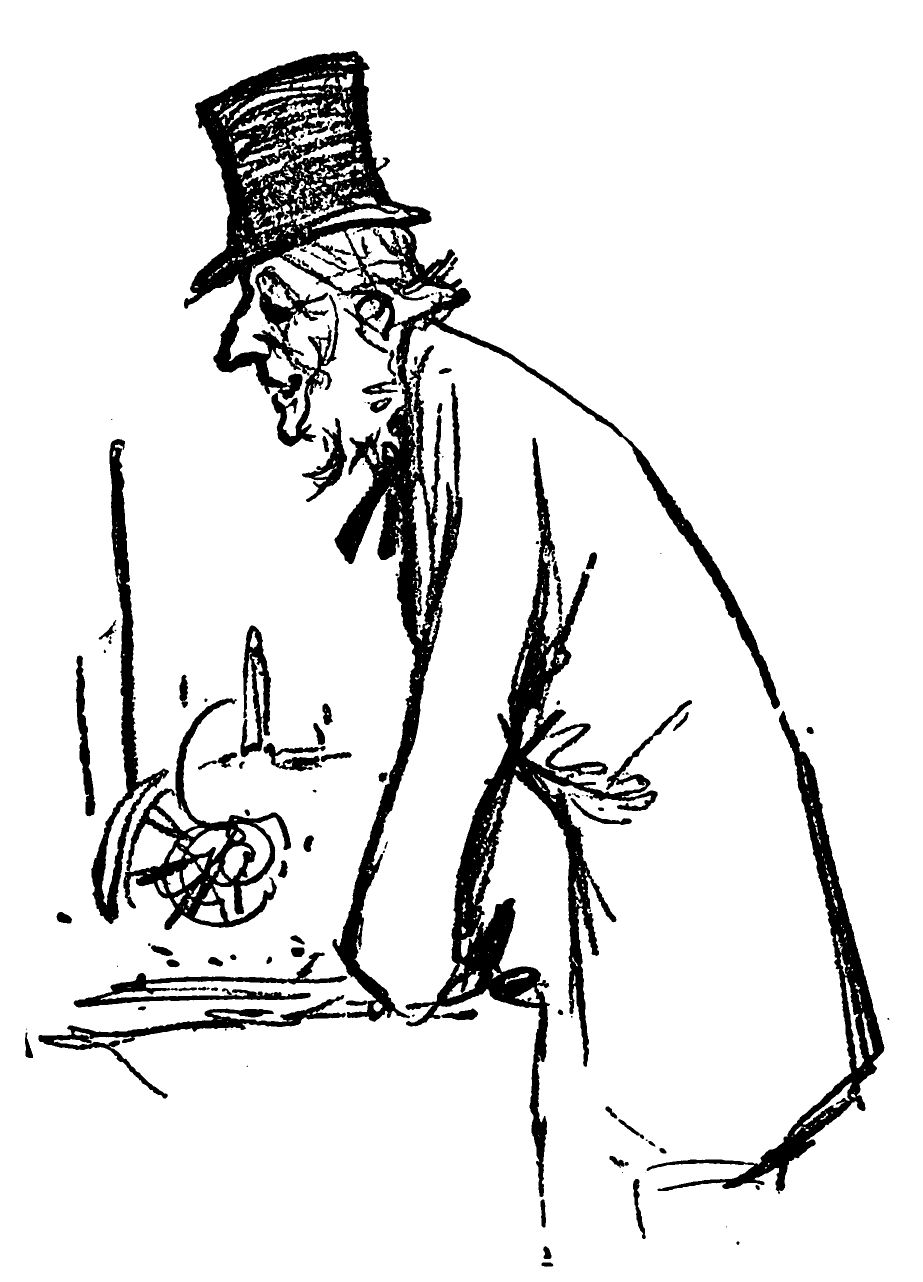
Deplorable moral lapse of Professor de Bohun (pronounced Boon).
Believe me or not, but there was positively a flush upon the yellow cheek of the hoary intriguer, a flush that contrasted charmingly with his straggling white whiskers, as he parted with two half crowns and a note. It was a severe struggle. To comfort himself he pressed the stud again. Yes, it worked all right. He toddled back, and got in at the very moment when his cousin's car was buzzing up the drive, back from London.
Professor de Bohun was determined to lose no time. He got rid of his overcoat and his hat with surprising agility, and met the master of the house at the door as though he had been in for hours.
But his was not a temperament to introduce a subject with finesse. He went blindly at it.
"Humphrey," he said, ere ever the Home Secretary was across the step, "I want to see you. I want to see you now ... yes, now ... rather urgently.... I want to see you now."
The Man of Little Peace nodded wearily.
"Come along," he said.
His mind jumped back to the false scent of the morning. He suddenly wondered whether, after all, Cousin Bill was going to confess? Galton's statement had been clear enough. He had said in so many words that he had seen an emerald in the Professor's hand. And the head of the family would have believed anything, almost of the Professor in the way of such follies since the great Mullingar affair.
"What is it, Bill?" he said, as he shut the door of his study.
"Ah!" said the Ancient, almost archly. "What do you think? The E-M-E-R-A-L-D! Eh? Eh?"
He searched in his pocket. Humphrey de Bohun looked to see the jewel appear. Not at all. What appeared was a little round brass box, glass cased, and in it a trembling needle, that shook and shivered like a gossamer in a breeze.
"Now, my dear Humphrey," said the Professor, "let us take two chairs; yes ... two chairs ... two chairs. Ah! yes, two chairs." They took two chairs. "And let me pull up this little table...." He had become almost businesslike, not to say sprightly, in concentrating upon what he was about to do.
"Now, then; here we are, we two on these two chairs as it were, are we not? Yes! And here you see this little instrument, do you not? Yes! And do you know what it does ... what it is? What it is ...? It's a talcometer."
"A what?" said the Home Secretary.
"A talcometer," said Professor de Bohun, lying freely, and puffing slightly after the effort. "Now, Humphrey, I want you to watch something. To watch something, eh! Ah! yes. You have, I take it—ah!—or Marjorie has, or some one has a jewel—sure to have one. A diamond, say. Any stone—crystal. A stone, at any rate...."
"I don't know," began Humphrey de Bohun, wondering what was to be. "Will this do?" he asked, leaning over towards his writing table and pulling off it the little crystal Chinese god which was used to weight down the papers which he had abandoned there so many days.
Anything would do for the deceitful pedant. He nodded cheerfully.
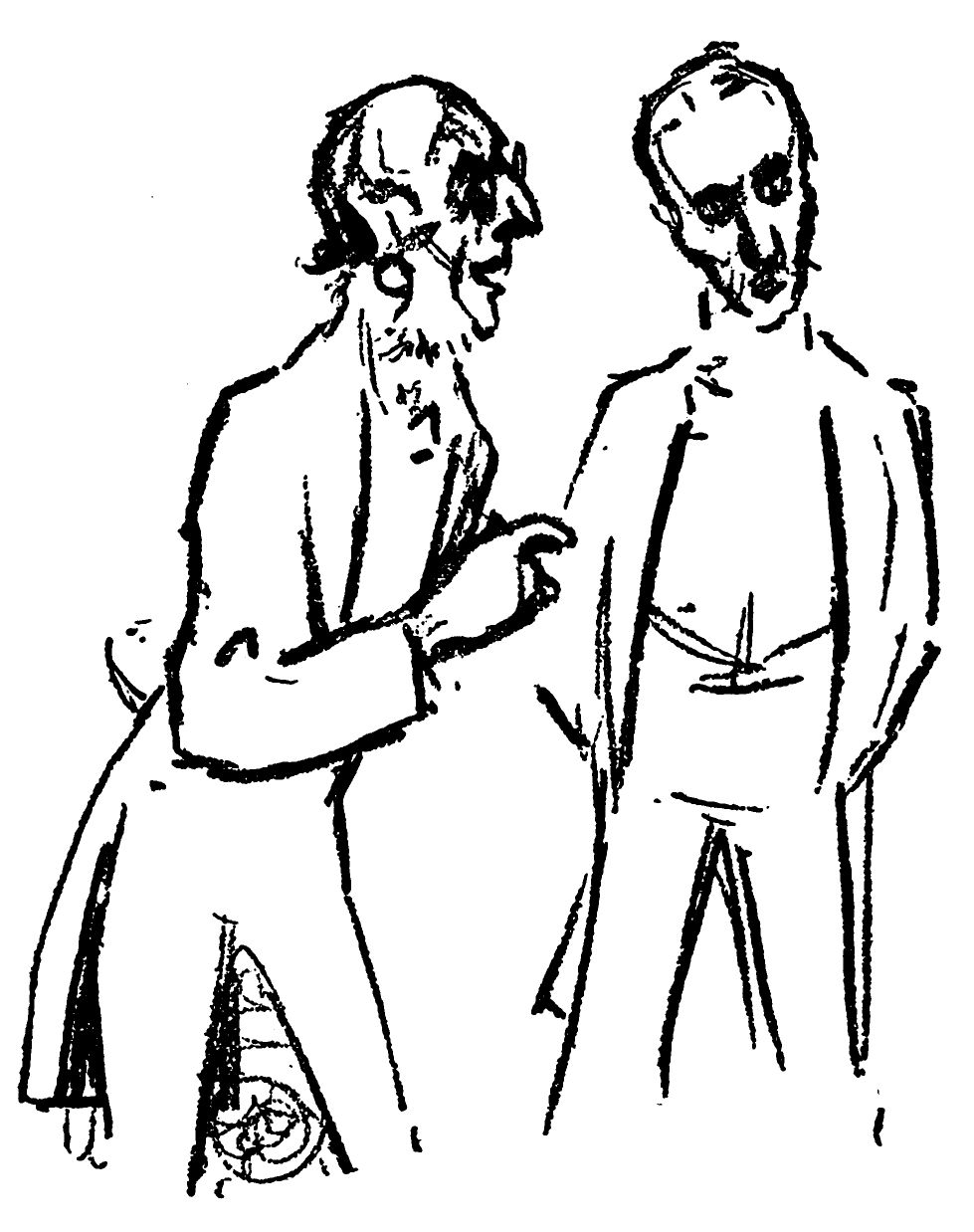
Professor de Bohun explains to the head of the family his theory—or rather, certitude—upon the whereabouts of the Great Emerald.
"Yes," he said, "so long as it's crystal. Anything crystal. Crystal." Then he added, "Now, Humphrey, watch. Here," holding the little round brass disk with its trembling needle, "I have our talcometer. Now here," moving the Chinese god into line with the axis round which the tiny filament of metal trembled, "here we have this talcometer, and the crystal. Eh! And the crystal.... Now watch, Humphrey!"
Holding the little round brass case with his left finger and thumb, he gradually with his right hand approached the heathenish idol, sliding the False God slowly along the polished table-top towards the instrument. It came closer and closer. It was at 9 inches, 6 inches, 3 inches, ... but there was as yet no apparent effect, when, suddenly, with the Pot-bellied Dwarf Deity at about 2 inches off, or a little less, the needle behaved like a pointer: it stood immovable, held rigidly by some strange force. The stud, dear friends, but how could Humphrey de Bohun know that?
"There! You see that? See that? See that?" squeaked the Professor triumphantly. "Now I want you to test it for yourself. Move the little devil away! Move it yourself! Humphrey, move it yourself!"
Humphrey de Bohun very slowly pushed back the crystal, and almost immediately the needle trembled again.
"There!" said the Professor in happy confidence, leaning back. "There! What did I tell you?"
"Well, what of it, Bill?" said the harassed master.
"What of it?" answered his cousin. "The Emerald. Ah! the Emerald!" and he rubbed his hands together.
"I don't understand a word you're saying," said poor Humphrey.
The Professor leaned forward and tapped his cousin twice upon the shoulder with that knotted forefinger.
"That instrument," he said, as solemnly as such a voice can say anything, "tells a crystal close at hand. According to the cube of the distance. I have to use it perpetually. Very well known. German, you know—wonderful people, the Germans. It was Meitz's idea," he went on, adding verisimilitude by the effective use of detail. "But he couldn't have done it without Speitzer. Often like that in research work. Any doubt about a crystal's character. Even amorphous—put that thing close enough, and it points at once. Now do you see? Eh! Now do you see?"
"Not exactly," said Humphrey de Bohun.
"Why, it's plain enough! I hadn't thought of it. It suddenly occurred to me. It suddenly came to me while you were off to London. Here I had what could solve all our troubles. I put it first here, then there. Everywhere I could. Went on for an hour—all over the room! All over the rug where it dropped. Then one of your guests came in. I didn't want to be seen at it. I was putting it back into my pocket when my hand came close by the side of his coat. Bless my heart! It pointed!"
He leant forward again and tapped his cousin more solemnly still, this time on the chest. "Mark my words! That young man's got it!"
"Which young man?" said Humphrey, remembering what counter accusation the Professor would naturally make, and thinking at once of Galton.
"That young writing fellow," said Cousin Bill. "That newspaper chap McTaggart. McTaggart, McTaggart, McTaggart, McTaggart, McTaggart."
Humphrey de Bohun hesitated. "My dear Bill," he said, "you never know. He might have had something else in his pocket—also crystal, or—I don't know ... something."
The Professor wagged his head with all the dignity of a goat.
"Won't work, Humphrey!" he said. "Won't work! One can always tell the size by the distance. It wasn't some ring or small thing of that kind. Besides which, he wouldn't have such a small thing of his own in his pocket. No, the Emerald's there all right. And I'll tell you something that makes me surer still. I took occasion to brush up against him—there was a hard slab in that pocket, Humphrey. In that pocket. A small, hard slab! Slab! ... Hard slab! ..."
An awful task arose in the conscience of Humphrey de Bohun. He must play the spy again. He must mistrust yet another guest.
But wait! Should he tell the great detective when he arrived? No. It would be only fair to seek the young man first and warn him. But he hesitated and he put it off. He would wait till dinner time, or nearly dinner, when the poor fellow was changing. He would make it quite clear that there would be no consequences—only, he must confess and restore. Then he suddenly thought of what would happen if he drew blank, as he had in the case of the strange being before him. But he was in some agony.
CHAPTER NINE
The Home Secretary was in his study before a pleasing fire. The Professor had left him. His daughter was with him. There was no one else in the room. He had asked her to come down a little earlier that he might explain things to her. There was yet a quarter of an hour before they need dress for dinner, and the dread stranger from the Yard might be with them at any moment. He had warned each of his guests that a distinguished diplomat had asked to run down to see him at short notice. The F.O. had sent him on to the Home Office. The matter concerned both departments. The distinguished diplomat would dine. They must excuse his retirement with that official, later in the evening, to discuss high affairs of State.
Such was the fairy tale Humphrey de Bohun had pitched; he hoped it had gone down. And now he was alone again to discuss the matter with his only confidant, his daughter.
"Marjorie," he said, "that man Brailton was to come by the six-thirty. It must be late. I have told them to show him in here at once. It is exceedingly important you should know all about it, and that nobody else should. We must hear from him, very briefly, some essential points: for instance, his assumed name."
"He's all right, papa?" asked Marjorie anxiously.
"Perfectly, my dear, perfectly. Morden assures me ... in fact, Morden told me that he is actually ..." and then checked himself. He was still Victorian, was poor Humphrey de Bohun. He didn't like to talk to the bastards of his own class, and to a daughter at that. "At any rate he's all right. Elderly, distinguished—what they call cavalier, I'm told, yes, cavalier.... I've already told Aunt Amelia and Tommy that he's a diplomat—a fellow I've got to see after dinner.... It's all exact. Which room did you say?"
"Senlac, papa. Crécy's being repapered."
The Home Secretary nodded solemnly.
"Senlac will do all right. But you must remember, my dear, that this Mr.—ah!—Brailton, that is the name, Brailton, is somewhat advanced in years—and ... and ... I needn't insist ... but a refined man and on his father's side, of good blood! He will be sensitive."
There was a silence—but not for long. The door was solemnly flung open with a majesty worthy of the occasion, and the Master of the Ceremonies—if I may so call him—George Whaley announced in a controlled but oily voice:
"Mr. Collop!"
Collop? Collop? What was this? The disguise for Brailton?
The father rose to his feet, somewhat painfully, the daughter looked round. And behold! a man sturdy, broad-shouldered, short, clad, not in some soft clinging stuff, but in stout Scotch tweed, which—as to his upper part—was a roomy coat with poachers' pockets, and—as to his lower—plus-fours. His stockings were thick and ribbed, as fashion in a certain world demanded at that moment; but his boots were of that unmistakable sort provided by the Government of the King for his police. The hair was short, coarse, and thick; the face broad and determined; the eyes straightforward, grey and far too bold. What the mouth might really be like only its Creator knew, for it was thatched by a moustache so bristling, curt, aggressive and sprouting-out that the eye of the onlooker was fascinated and could not note the ugly lips below.
"Evenin'!" said the Apparition in a powerful voice of low pitch; and as he said it he bobbed the head and shoulders of him towards the man who—for a year or two—controlled the peace—and police—of England.
"Evenin', ma'am," added the Apparition with the same jerk of the head and shoulders towards the Lady of the House. "Cold evenin'? Good fire, I see!" he added with a charming familiarity. "Pleasant thing evenin's the likes o' this, a good fire is."
And as he thus delivered himself with all the natural grace and charm of long experience, his two staggered victims waited for their breaths.
There was but one reply, and the Home Secretary made it pompously and, I am afraid, a little distantly.
"Good evening, Mr....?"
"Collop," said the stranger, decisively.
"Collop. Ah, yes, Collop. I should have remembered. Mr. Collop, my dear," he said, bending his head towards his daughter, who stared astonished and had not yet recovered herself. "Collop. Yes. Mr. Collop.... Mr. Collop. I understand fully. We are to call you Mr. Collop."
"Rather!" said that solid individual. "That's my name here," and he winked. "What my name may be elsewhere we both know, eh?" and he winked again.
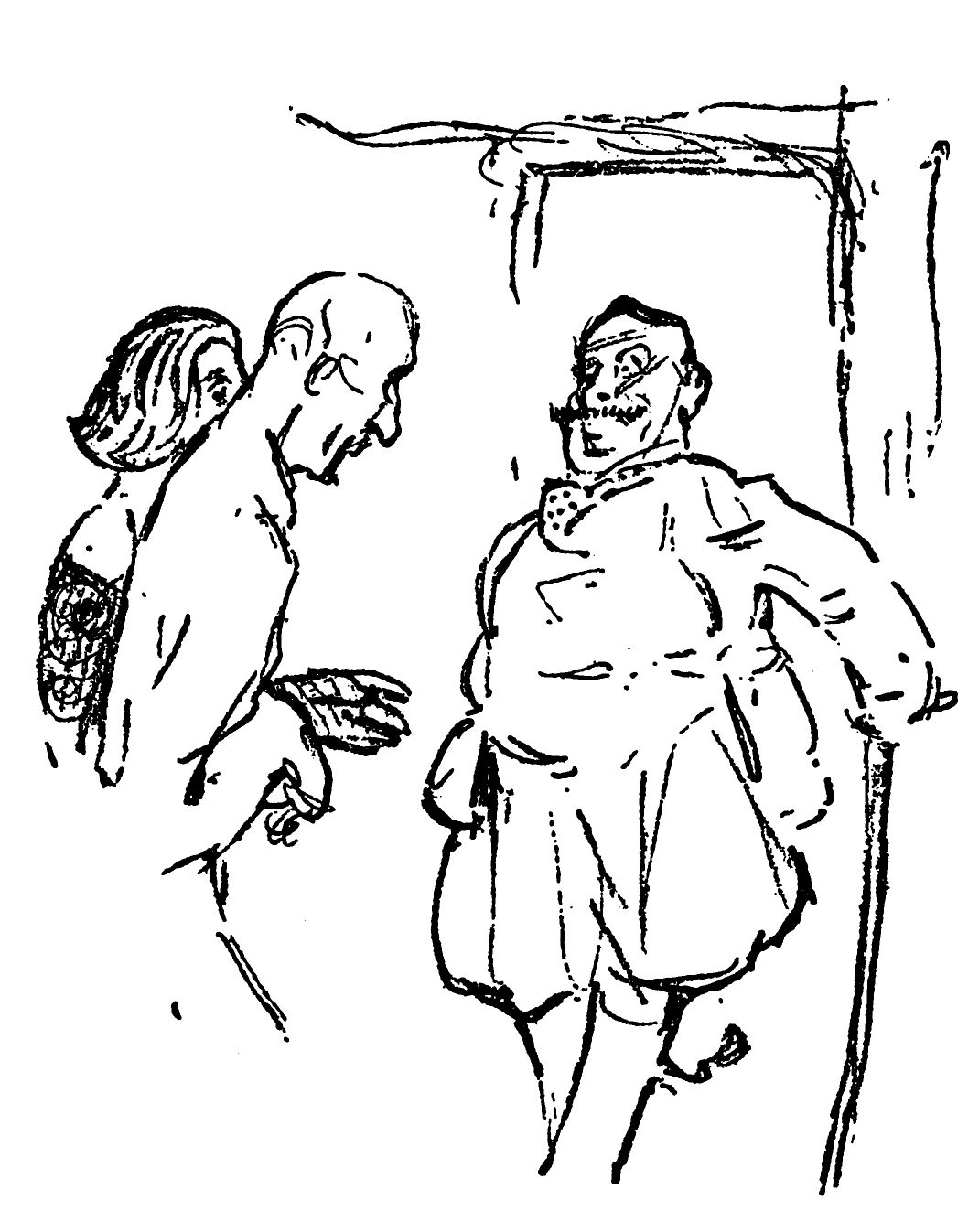
Sudden Entry of Mr. Collop.
"Ah, Mr. Collop—it is to be Mister, is it not?"
"Yes, Mister," answered the gentleman solemnly, "not Miss nor Master. Who ye're kidding?" He did not say it insolently. He knew his place. He knew he was talking to the Home Secretary. He said, "Who ye're kidding?" by way of a respectful jest.
"Mr. Collop.... Yes.... Mr. Collop...." stuttered the Home Secretary like a man half stunned. "We expected ... ah! ... you will pardon me? ... a Mr. Brailton; yes, a Mr. Brailton.... Eh? Shall I ... ah! ... if by any accident there should be a mistake?"
"There's no mistake," said the genial Collop, "old Brailton 'twas to be! You're right there, mister! But he was that sick he asked me to run down. ''Tis only a suburb job,' says he. So here I am!"
The Home Secretary whispered to his daughter in an agony: "Can't we stop it? Shall we telephone?"
"Too late now—before dressing," said the despairing girl. "I'll tell you when I hear."
Her father knew she was right. They must make the best of it. "Put dinner on in twenty minutes," he whispered to her in an aside; then aloud to his guest, "What ... ah ... what shall we ... to put it plainly, Mr. Collop, what shall we say you are?"
"Ah, I've got that all fixed," said Mr. Collop, his voice bravely riding the air. "Old Brailton told me what he was and I'm that. I'm a diplomat, I am. Tokio the last four years."
The call on Marjorie's intelligence woke her to action.
"It won't do," she said sharply.
"Why not? Eh?" said Mr. Collop, with less ceremony than might have been expected from so recent an acquaintance.
"Because," replied the young lady, a little acidly, "one of our guests, Miss Victoria Mosel, has just come back from Japan. She was there in September staying with our Ambassadress at Tokio."
"Ah!" said Mr. Collop. "That makes it awkward like."
"I think," began the Home Secretary timidly ... but the stronger will prevailed.
"Make it Bogotar?" was Mr. Collop's suggestion.
Time, which destroys love itself, and brings mighty states to ruin, the implacable master of ephemeral man, caught the unfortunate father and daughter in his iron grip. There was not a moment to spare. And it was as Mr. Collop, just back from his long but patriotic exile in "Bogotar," that the welcome stranger was led out and ritually introduced to the guests in the next room. There is no need to introduce a guest at such an hour, but this guest! Oh, yes!
As the master of the house and his daughter were making that introduction their cup of agony was full.
What made it worse was that McTaggart, being less of a man of the world, as the saying goes, than the rest of the prisoners, was quite openly startled, and instead of looking at Mr. Collop's determined face, his eyes at once fell to the plus-fours, and he said to himself, as his eyes fell lower still, "Thank God, he hasn't put on those brown boots with funny little tabs to them! But really! For a detective...." Then he looked up at the face—and he, of Fleet Street, knew his man.
Lord Galton stared at the Apparition. He could make neither head nor tail of it. He was not of the Horse Pulling, privileged world. Then he remembered that your professional politicians had to herd with all manner of cattle and he shrugged his mental shoulders so violently that his physical shoulders perceptibly heaved. He turned his back upon the company and examined a picture until the nervous strain was over.
Victoria Mosel was vastly pleased. It was as good as the Zoo—and she loved the Zoo. She promised herself an unholy feast and whispered to Marjorie to put her next the Diplomat at dinner. She was not a woman of gesture, or of external expression; but she very nearly clapped her hands for joy. She had seen some funny things in the diplomatic service in the time of her teeth, which were no longer short, but the like of this she had never seen; and she thought, as many a contemporary has thought since Queen Victoria's death, "We're getting on!"
Then she began to speculate within her own clear mind as to how this monster had got into the diplomatic service at all. But she remembered certain odd accidents during the war and other people than he who had suddenly popped up in embassies at the F.O.—quite out of nature; and just as she had all but clapped her hands, so she now all but whistled. However, she in fact did neither. Only she looked upon Mr. Collop with a happy, happy face, and felt that here, at last, was not a wasted day.
The Professor was vastly interested. He said "Bogotar" three times, beamed, nodded, and then for a fourth time he said "Bogotar" lingeringly, as though he loved it, and then whispered again, "Ah, yes, of course. Bogotar." And put his head a little on one side and left it there.
As for Aunt Amelia, her failing eyes did not distinguish the Apparition, but her ears distinguished the accent, and the type of English; and she marvelled feebly that things had changed so much since the days of the Great Lord Salisbury and Peace with Honour. But of one thing she was sure. That if the type of man used for delicate missions abroad might have changed, the policy of Britain was still secure in the hands of whomever the Secretary for Foreign Affairs might choose to entrust with that mighty task; and Bogotar (she imagined) was the capital of Ormuzd and of Ind; barbaric, splendid, and in fee to the British Crown.
"Ah! Shall I show you to your room—eh?" said the Home Secretary courteously, putting an end to what could not be prolonged. "Ah, let me show you to your room."
He went so far as to take the terrible thing by the elbow and actually conduct it out; ... after an interval sufficient, but not too long, McTaggart followed. He would again be alone. He could not bear to remain with the rich longer than he was compelled, and now that there was a detective in the house he would be discovered. Well, let it be so; let the end come soon.
Now there stood, awaiting McTaggart in the hall, that Devil and that Angel who had been off duty for a few hours, and were now back again, fresh and keen, and bickering, as is the wont of such opposed beings of the other world.
The Angel, seeing his human friend and ward, made him a suggestion at once:
"You ass!" he blew into McTaggart's ear. "Put it in the Rozzer's pocket." The Devil began to object violently.
"You shut up!" said the Angel, turning to him annoyed. "I'll come back and talk to you about it later!" Then he turned again to McTaggart, and pumped brilliant thoughts into his same ear with such violence that the young man's soul was all irradiated and full and he suddenly thought himself a genius. Such is the vanity of man! So little do we recognise inspiration from on high!
"It's as easy," prompted the Angel, "as falling off a log. All you've got to do is to say you've met him, and tell him who you are. He'll know you're from the Press—you look like it—and he'll think he's met you. Then slip it into his pocket, bully boy! Slip it into his pocket!"
And all the time McTaggart was saying within his own soul: "That's a brilliant idea! Now I don't suppose anyone else would have an idea like that! But, there! I'm always getting good ideas at the right time!"
He stalked his host and Collop round the top of the stairs and down the long passage above.
He saw the door open; he heard the Home Secretary say cheerfully, "There's a bath through that door. Have you got everything you want? I hope they've unpacked your things?"
He heard the cheerful voice of Collop reply: "Right-o! Everything in the garden's lovely!"
He saw the Home Secretary go off with a very changed expression in the gloom of the passage. He flattened himself in a deep doorway, a little angry that he should be playing the spy—but necessity drove him. He waited till he had heard his host go down the stairs; then he knocked at the detective's bedroom door. Full of angelic inspiration—which human pride mistook for genius—he entered in.
"Mr. Collop," he said without hesitation, "you know me? Hamish McTaggart—the Daily Sun? ... You'll excuse me for not using your real name?" And he smiled.
"Why, Mr. McTaggart, I've heard of you often enough. Where did we meet? And as for the real name"—he winked—"less said the better! I'm in the Foreign Office just now. I'm from Bogotar ... How come? When did we meet?"
"In the Savoy bar," hushed the Angel hurriedly into McTaggart's ear.
"In the Savoy bar," said McTaggart, aloud.
"Not during the Bullingdon case?" said the delighted but indiscreet Mr. so-called Collop, stretching out both his hands.
"Wink!" pumped the Angel; and Hamish McTaggart winked—for the first time in his life.
It was a clumsy wink, rather like that of the hippopotamus when he comes out of the water, in which element the huge pachyderm so serenely sleeps. But it was good enough for the Secret Service.
"Ah! Mr. McTaggart, Mr. McTaggart!" said Collop, shaking both the journalist's hands up and down like pump handles. "Well met! Now then, you'll make a feature of this in the paper, won't you?"
"I'm not here for that," said McTaggart modestly. "I'm only a guest; but of course I can see that The Howl ..."
"Ah! That's the style, laddie! You'll do!" said the Man of Mystery, bringing down a palm like a Westphalian ham on the wincing shoulder of the youth. "A few kind words on the discreet agent, eh? The Bosses'll note 'em down!" He dived into a pocket. "I've got a flask here!" he said, and winked in his turn. "What I call my good old prohibition! We'll drink to it, eh? To think of meeting the likes of you in a 'ouse like this!"
This last remark wounded McTaggart's pride; but the Angel stood by him, and they that have angels at their side are firm.
Mr. Collop's dress clothes lay beautifully aligned upon a couch, a shirt by the side of them; but the owner's brow clouded as he said:
"Where the devil did I put that flask? Curse them slaveys! I do 'ate 'avin' things done for me on these toff jobs!" He buried his head in the large kit-bag which he had been assured was the proper receptacle or container to bring to the Palaces of the Rich.
And even as he therein delved and groped, with head hidden in the kit-bag, the Angel brought it off!
"Attaboy!" urged the Angel to Hamish. "Slip it into the tail-coat pocket! QUICK!"
And before you could have breathed a silent prayer the Emerald was in the tail-coat pocket of Mr. Collop's evening tail coat, lying there on the couch all innocent.
Up came Mr. Collop's head out of the kit-bag, very red and puffy.
"I thought as much, my 'earty," he said. "Dirty tykes! ... There it was...." And he brought out a gigantic flask holding perhaps a quart of the detestable beverage. The bottom of it was a silver cup fitted to the glass, and inscribed, "In grateful memory of the Bullingdon Burglary, August, 1928" and with the initials B.F. Mr. Collop solemnly half filled the receptacle, smelt it with delicate bonhomie, and handed it to his guest, who sipped it with the resolution in which a man must face whatever torture has to be endured.
"Thank you," said Mr. McTaggart, gasping, from his flayed throat.
"Cheerio!" said the Collop man, and he tossed off all that remained—enough, you would have thought, to have felled an elephant in stupor!—down his own more acclimatized gullet. Then he brought out a large tongue, licked his lips, and smacked them.
"Ah, that's something like!" he said. He put the flask and the silver cup belonging to it down on his table with a happy grunt.
"Well, boy, I've got to dress," he said. "So long! We meet again in the Khyber Pass, i.e., at his Nobship's groaning board!" And he laughed heartily at his own wit.
McTaggart remembered something essential. "I say, they mustn't know that I know you!"
"No fear!" said the redoubtable Collop, winking again. "I don't give you away, nor myself away, nor no one away." He had already taken off his tweed coat and waistcoat. "You run off and dress, laddie ... You keep mum. Same here!" And he dug a podgy finger into McTaggart's staggering chest. And they parted.
* * * * * * *
From her room, interrupting the induing of those three pieces which formed all her raiment, shaking shorn hair, Marjorie telephoned in a fever regardless. "The Home Office.... Yes, the Home Office ... No reply? Oh! Nonsense! ... What, our line gone wrong? D'you mean to say we can't get London? ... Oh! hell!"
She banged down the receiver ... There's a schlemozzle! Telephone broken down! Saturday night—the Monster in the Home! And no redress, no aid.
Had she had tears she would have wept. What would come of all this?
CHAPTER TEN
Mr. Collop came out, dressed, he was surprised to find his host waiting for him, not to say waylaying him, in the passage outside.
"I thought ..." began the politician nervously—"I thought I ought to have a word with you, Mr. Collop, before we ..."
"That's right!" roared Mr. Collop. "That's my style too. Always think of everything!"
"Not so loud! Not so loud!" implored his agonized host. He took the detective aside into yet another room with yet another fire. It looked like some little nursery or schoolroom, and Mr. Collop, used as he was to the houses of the great, marvelled at so many rooms, so many fires ... an empty room all ready, and with so many pictures in it, though on a bedroom floor.
"Mr. Collop," said the Home Secretary hurriedly when he had shut the door, "I thought I ought to tell you privately, and alone, before we go down to dinner what the circumstances are. The jewel was dropped by my daughter—last night after dinner. My three guests went down on the floor at once to look for it—it was upon the polar-bear rug which you will see in the West Room later. We shall go there together after all have retired. When they got up it had not been found ... they said it had not been found ... they all said it had not been found.... There is suspicion naturally, Mr. Collop.... You understand me?"
"There's always suspicion when vallybles are missing," said Mr. Collop, after some thought.
"Yes, Mr. Collop, exactly! Precisely!" said the Home Secretary. "But of course, you know, I must be told when you come to any clue.... I blame no one. I suspect no one.... But the emerald is missing. And what's more," he added with the firmness of a newly stuffed pillow, "I shall not spare the culprit."
"No, of course not," said Mr. Collop sympathetically. "I'll get it for you, never fear."
His manner, though hearty, was respectful enough in such privacy, for he knew that though his promotion depended principally upon permanent officials, a good word from one of the fleeting politicians was not without its value at the Home Office. Therefore did he forbear to lay a hand upon the Home Secretary's shoulder; and therefore—still more—did he forbear to slap it as nature would have seemed to demand.
"Thank you, Mr. Collop," said the Home Secretary gratefully, as though he had been given a considerable sum of money. "I trust you. I trust you implicitly."
"You may trust me implicitly and explicitly," declared Mr. Collop in solemn religious tones.
"Thank you, oh! Ah! Thank you! Thank you again! Thank you most warmly!" said his host more and more nervously. "Really you know, we must not be seen together. Pray take your time, Mr. Collop; the ladies are always late coming down."
"Ah, that's their sort, ain't it? Girls are the devil nowadays, aren't they?" said Mr. Collop in his friendliest tones; and with that farewell in his ears the master of the house slipped out.
The Home Secretary's next action was to go straight to McTaggart's room. It was an act of decision and initiative that you would hardly have expected in so well-bred a man. But suffering is a powerful tonic. He knew what he was after. He had to speak. He would come boldly, directly and simply. He would tell the young man of what he was accused, and ask him straightforwardly and at once to clear himself—or at any rate to say "yes" or "no." He knocked on the door; he went in; and he began thus:
"Ah, Mr. McTaggart! Mr. McTaggart! I'm afraid I am interrupting you in your dressing. It is really very rude of me! I wish ... But the fact is ... It's rather important.... I want to put it to you as clearly as I can, and you'll understand me when I say that time presses after a fashion ... so to speak...."
McTaggart was at the last stage when the male brushes the hair before he puts on the coat; all the rest of the detestable ritual was accomplished, including the sacrosanct tie. He stood gaping with his round face, a brush in either hand. Then he said:
"Yes, certainly, sir, if you please." He rapidly brushed his disordered hair into a shape yet more disordered, struggled into his coat, and then, with an odd reminiscence of manner elsewhere, said, "Won't you sit down," feeling that he was a temporary host, as it were, a host within his host's house; a nest of Chinese boxes.
"Thank you," said the Home Secretary. "Thank you. Thank you very much. Thank you." And he sank his long, lean and therefore gentlemanly body into the only armchair. He crossed his long, lean and therefore gentlemanly legs, poised his two hands together like a steep Norwegian roof, and said:
"Mr. McTaggart, you will think it very odd of me, this invasion of your ... er, your, ah ... privacy? Yes, your privacy, er! If I may say so. But there is something very important I must say to you before we go down to dinner."
"Yes, sir," said McTaggart, still expectant, as he slowly filled his pockets with the various things which journalists carry about with them, even among the great, and which destroy the shape of their clothes.
"Mr. McTaggart ..." began the Home Secretary desperately, now leaning forward with his elbow on his knee and his forehead in his hand. "What I have to say is not very easy, but it is best to get these difficult things over at once. Don't you think so?"
"Yes, certainly," said McTaggart.
"I mean," said the Home Secretary, "it would be a great pity to waste a moment in beating about the bush. There's no sense in mere verbiage and slow approach to the essentials. Moreover, my time is short: I mean our time is short.... I mean there's not much time before dinner, and to tell the truth, that's why I came in here, so apparently suddenly.... What was I saying?"
Then, looking up and leaning back again in the chair: "But we need not go into all that. As I say, the great thing is to come to the point at once, isn't it?"
McTaggart was tired of standing up. He sat down in another chair, and said "Yes," with a look of expectancy not quite unmixed with approaching boredom.
"Well, Mr. McTaggart," went on the great statesman at last desperately, like a man who has determined to take a plunge. "You will excuse my being quite blunt and straightforward, won't you?"
"Of course," said McTaggart.
"I mean, we have already agreed that wasting time in preliminaries over a matter of this kind ..."
"But a matter of what kind?" said McTaggart, now roused—though his guilty soul told him well what was coming.
"Well, the fact is, Mr. McTaggart," said the Home Secretary, suddenly uncoiling himself and straightening out the joints until he stood up above the younger man—he felt it gave him a kind of moral advantage, and he needed it—"the fact is, it's only fair to tell you ... only the difficulty is how to put it. But one must be straightforward, mustn't one?"
And once more Mr. McTaggart said "Yes." But certain ancient traditions of the middle class were stirring in his blood and he very nearly added, "You doddering old fool."
"Why then, Mr. McTaggart, to put it quite plainly, ... well, now, perhaps I ought to say this first. You know my cousin William? The Professor?"
"Yes," said Mr. McTaggart, for the sixth time and with a touch of savagery in his voice, "I do. I have been in this house with him for over twenty-four hours."
"He tells me, Mr. McTaggart," began the Home Secretary seriously and half an octave lower—"mind you, I don't say I believe it!"
"No?" said McTaggart, "Well, go on."
"He tells me he has proof, scientific proof— Mind you, I don't say I believe him! I'm only saying what he said."
"Yes," said McTaggart, for the seventh time, and with more patience.
"Scientific proof, I say—not personal, you understand. No personal insinuation whatever—only scientific proof that the emerald is or was—shall I say, has been, upon your—damn it all!—person."
McTaggart started up. The issue was joined. He behaved very well.
"Mr. de Bohun," he said, in a slow but frank and straightforward way, "you are not bound to believe me. But not only have I not the emerald, but I will not even take the trouble to swear I have not got it. I have not got the Emerald. Is that clear?"
"Yes," said his unfortunate host. With a world of apology in his voice and stretching forth a deprecating hand! "Oh, yes, Mr. McTaggart! Yes, quite clear!"
"Not only have I not got the emerald," McTaggart went on with painfully clear diction, "but I know who has."
"Oh! Lord," thought the Home Secretary, "another of 'em!" Then he said aloud: "Ah? Oh! most interesting! Who?"
The other phrases he had heard during the last twenty-four hours crowded upon him, and he felt slightly faint.
"Yes," said McTaggart, continuing in a virile intonation, "I know who has it. Mr. Collop has it!"
"What?" shouted the Home Secretary, startled into a lucid interval of terseness. "Think what you are saying, young man! Collop! He wasn't in the house when it was lost! He's only just come."
"That's true," hesitated the journalist, slowly turning over in his own mind how he should get out of this mess. "But I tell you what, I tell you he's got it.... It's only an instinct," he added with sudden humility. "I have these odd feelings sometimes—and they are usually right. My mother was a Highland woman, and I am the seventh son of a seventh son. I don't pretend to any proof. All I say is"—more firmly—"Mr. Collop has got the emerald." He gathered confidence. He struck his left open palm with his right fist and said: "Mr. de Bohun, Mr. Collop has got the emerald ... and as for me, you may go through my pockets, here and now, you may have me searched, here and now if you will, and all my clothes and all the drawers in the room and every corner in the room, and anything else you will. And what's more," he said, as he saw still further weakness in that weak old face, "I mean to stay in this house till the emerald appears. I owe that to my honour."
"Oh, Mr. McTaggart," said the Home Secretary imploringly, and even as he spoke, he heard steps on the stairs and knew that they must be going down, "don't misunderstand me! I am not accusing you! I wouldn't accuse you for a moment! I am only saying ... I am only repeating to you what was told to me. Indeed, I should be treating you very ill had I not done so. Don't you agree?" and he actually seized the young man's hand.
McTaggart accepted the gesture.
"I am grateful, sir," he said simply. "I quite understand that a man in my position would be naturally suspected."
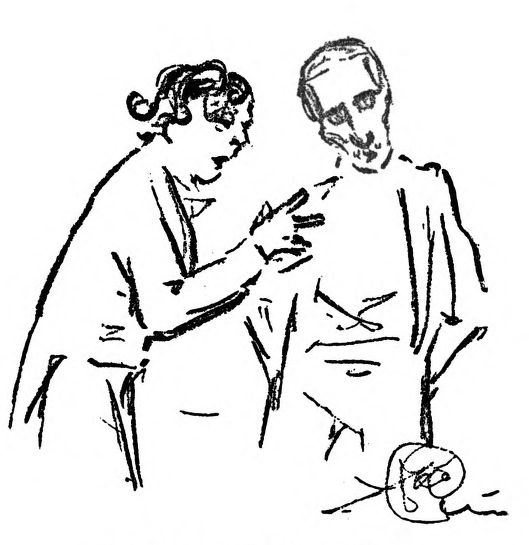
Mr. McTaggart explains to the Great Statesman his theory—or rather, certitude—upon the whereabouts of the Great Emerald.
"Don't say that, Mr. McTaggart"—all the gentleman in him arising to patronize poverty—"don't say that!"
"I say I can understand that a man in my position should be suspected. But you will see; mark my words, you will see after no long space of time that I was right. I have an instinct in such things."
"But damn it all! Mr. McTaggart! Collop? Damn it all, think!"
"No," said Mr. McTaggart, moving towards the door, "I tell you I am sure, for I had it in a dream." And he and his bewildered host went downstairs.
The Home Secretary, as he moved by the young man's side towards the big drawing-room where they were all to assemble, felt in his mind something like a kaleidoscope or like the music in the drunken scene of "The Master Singer," or like a Wiggle-Woggle or like the Witching Waves.... Galton had seen Cousin William with the emerald. He had seen it with his own eyes—or else he lied. Cousin William had worked an infallible scientific test, and the Emerald had certainly been on McTaggart or else he lied. And yet McTaggart had not got it—or else he lied. The Home Secretary's powerful mind kept on returning to the central point, "How the hell could they all have it, and least of all how could Collop have it? That must be nonsense! ... Anyhow, Collop was there, that was a relief. It was his business to find out." Had Mr. de Bohun been in the habit of prayer he would have prayed fervently that Collop would track down the real man.
But side by side with that relief rose an immense wave of apprehension, for he remembered what manner of deep-sea beast Collop was, and he sickened at the coming ordeal of the dinner.
Nor was he wrong.
* * * * * * *
In the hall the Devil and the Angel were having a most furious row.
"What I want to bring home to you," said the Devil, pressing a red-hot forefinger upon a smoking palm, "is that you've intruded. You've done something I only had the right to do. It was my place to suggest McTaggart passing the Emerald on!"
"It was nothing of the sort," said the Angel angrily. "You're like all devils; you won't listen to reason." Then he began to count off on the larger feathers of his wing. "Firstly, it's up to me to protect the young man. Secondly, it does no sort of harm if the 'tec finds that stone; why, it's all the better for him! It relieves a lot of honest and dishonest men from suspicion. Thirdly"— Here he hesitated, as theologians often do upon thirdly, thinking what he could scrape up. But the Devil interrupted him.
"Never mind your 'thirdly.' It's a dirty trick, slipping jewels into people's pockets! And dirty tricks are my stunts, not yours. Wasn't it me," he added with a rising grievance in his voice, "that made the old Don stick it into his pocket to begin with?"
Then the Angel played the trick which I am sorry to say is always being played upon poor devils: he played the trick of the superior person.
"Well," he said, "you may be right. I can't bother about it. I've got something else to do, and you can go back to hell."
The Devil, stung beyond endurance, grappled and closed. They wrestled magnificently and it was fifty-fifty—as it always is with devils and angels in this world—when the Angel began to get the worst of it. The Devil, though shorter, was in far better training—humanity had seen to that—and he was pressing the Angel down, when the Angel, without scruple, began to increase his size and strength prodigiously, till he towered above the poor Devil like a giant and half broke his back.
"You're cheating!" gasped the Devil. "You're working a miracle!"
"Anything's fair with devils!" said that most unjust Angel.
With which words he transferred himself into the sixth dimension, and the Devil, snubbed, angered, disappointed, impotent to revenge himself, burning to be eased by some ill deed, flew through the night to the Duchess's—it was only four miles—and inspired her with the odious thought that she should start yet another league for bothering the poor. After such beastly solace he went back for the moment to his own place.
CHAPTER ELEVEN

During dinner Mr. Collop was not silent. In vain did the Home Secretary indicate to his servant by a grimace that Mr. Collop's wine should be spared. Mr. Collop had all the assurance of his breeding, and when he wanted more wine he asked for it. It added, if that were possible, to his remarkable courage.
That night was forever memorable to all those present for the instructive lecture which he delivered upon the habits of the people of Bogotar. They all inwardly suffered, or chuckled, as their temperaments demanded. Vic ignored Marjorie's eyes and shamefully stayed on at table as late as possible to carry the torture forward.
The men did not stop long over their wine—for by that name I deign to call the beverage. The evening passed as on a rack for most, while Mr. Collop roared busily of Bogotar, with many a droll tale and many a gesture of large effect to underline it. Once more Vic stuck it out. She was in heaven. She egged the Startler on. She asked question after question on the famous oil-town of the Pearson Contracts. She even asked about the women's love affairs and the British prospectors' entanglements in that ill-known resort.
The Master of the House had to force the situation.
"I am going to ask you," said the Home Secretary, rather pompously, "to excuse me for the rest of the evening. I have to talk of very important matters with Mr. Collop. We shall be closeted together, I fear, till the small hours of the morning; and I beg that you will not think me discourteous."
The only one of the clot to whom this public speech could possibly be addressed—all the rest were of the Family—was the lately unfortunate, but now radiant, McTaggart. But it is a politician's habit to be pompous whenever he gets the least excuse, and McTaggart was the excuse.
"On official business connected with the ... ah, with the ... well ... it would not be to the public interest to say precisely."
McTaggart looked very carefully from under his eyelashes at his nearest neighbour; Victoria Mosel darted a corner look at Galton, and Galton grimly smiled at Marjorie. Aunt Amelia did not hear properly. Only the Professor rose to the occasion, carolling:
"Certainly, Humphrey, certainly. By all means, Humphrey, by all means." Then he squeezed his bony hands together, as though he had made a joke.
The women dropped out of the room. Marjorie waited above with her door ajar till she should know the way was clear. Then she was to come down.
"Shall we go into my study?" said the Home Secretary to his latest guest, when the women had gone.
"Thank you, I would not give ye that trouble, I wouldn't," said Mr. Collop heartily. "I'd as soon talk 'ere. I think better like in large rooms." And as he said that, the three men went out—perforce. But Galton went not to bet but to the small smoking-room, and Victoria Mosel did the same. Collop filled himself a whiskey and soda. And without giving his employer time to open the ball, he entered on the plan engendered by his mighty brain.
As he began to speak, Marjorie, following the sound of voices, slipped in. Mr. Collop stared at her, said "'Ullo?" but returned to his business.
"First of all," he said, with a good gulp at the spirits, "ye want a plan made of this here West Room, as ye call it. Now mark me," he insisted, as the Home Secretary half opened his never-quite-shut mouth, "that plan'll 'ave to be in not less than five colours—and I'll tell you for why. In a case of this kind, you 'ave got to distinguish between materials. Remember what ye're looking for! Ye're looking for a object that might be called transparent in a manner o' speaking."
"Mr. Collop," broke in the Home Secretary desperately, "how long will it take to make such a plan?"
"If there's a harchitect 'andy, it needn't take three days. I've 'ad dozens. And next," said Mr. Collop, as loudly as before, "we 'ave to 'ave measurements. We don't need regular surveys and we don't need to fill the garden wi' standards nor flags, but just measurements."
"And how long will these take?" asked the Home Secretary, a fabulous sum mounting up before his eyes, and the impossibility of keeping his guests forever.
"You will observe," said Mr. Collop, clearing his throat as for a speech, and addressing the lady—"you will observe, Miss, that what two men can do in one time, four men can do in arf the time, and eight men—why, eight men in a quarter of the time. And sixteen men," he continued, turning to her progenitor, "they'd take arf as much again. While they're making the plan in one room, if you 'ave enough men with chains in the grounds. Then there's the probing."
"The what?" asked de Bohun.
"The probing," answered his guest briefly. "That's a longer job, 'specially as I noticed that there's stone floors about. Now 'ere's another matter. Look at this carpet. That's Aubusson, that is. Ah, I notice everything! Aubusson—that's what it is."
"Mr. Collop," broke in Marjorie, in her suffering....
"Now, Miss," said Mr. Collop with command, "don't you interrupt me. Let me put the necessaries before you. When you get all this done, sir, what are you to do, then? What are you to do next? Why, I'll tell you. You'll have all the shutters shut: I noticed you 'ad shutters: and those curtains pulled. Then you'll put what they call Marlin's New Irridiant up. That's the light we work by. And I'll tell you for why. You 'ave plain electrics in the room and they casts shadows. Don't they, Miss?" he appealed to his hostess. But before she could agree, he went on, like a mighty river in flood:
"Now, casting shadows, you might miss a small object. That's how objects do get missed. You've got to think of these things. Artificial light that is distributed high and in the corners...."
The Home Secretary could bear no more. "Yes, yes, yes," he said. "Where does one get the stuff?"
"You'll see!" said Mr. Collop tartly, but with pardonable pride. "It's expensive, mind you," he added honestly. "But you got to do this job well or not at all."
"But, Mr. Collop," said poor Marjorie, who could hardly bear another moment, "before all this expense couldn't we ..."
"No, Miss," said the redoubtable Collop, shaking his head firmly. "Not to be thought on! I wouldn't undertake the responsibility, I wouldn't. And mind you, this ain't the first job of the sort I've tackled; not by thousands it ain't." (An exaggeration—due, I am afraid, to the whiskey.) "I wouldn't undertake the responsibility! I'll put no man under a cloud till I've made certain that it's not lost and hiding of its own. If it's not found, why then it'll be time to begin."
It was Marjorie who found the decision to break off the battle. She got up suddenly.
"Good night, Mr. Collop," she said. "I understand all about it now. We leave it to you."
"Thanks, Miss," said Mr. Collop. "That's the right spirit! You leave it to the perfessional man, and you'll never regret it! Is it good night to you, sir?" he added in a voice as loud as ever, stretching out a firm hand and seizing that of the Home Secretary. He crushed it in an iron grip, so that the poor old gentleman winced with pain.
"No, Mr. Collop! ... No, pray ... I must see you again in a moment, indeed I must ... but will you excuse me a moment?" He rose. "My daughter and I must have a private word together I think...."
"It's my place to retire, my lord," said Mr. Collop all in the grand manner, weak in the distinctions. "I'll be in the library, and when you want me, why, come and cop me," and out he went.
Without a moment's warning, Marjorie threw herself upon a sofa, crossed her arms upon the back of it, and began crying and sobbing in a storm. Her father was enormously distressed.
"There, there, my dear," he said, "you are quite overwrought; you are tired. Get to bed. It can't be helped. We must go through with it."
"Oh, papa," she sobbed, "it's intolerable. I can't help thinking! Just think what they'll all think!"
"Yes, my dear; I was thinking that they would be thinking what you say they will be thinking. I'm afraid some of them must have been thinking already."
"Perhaps," moaned poor Marjorie, half consoled by the relief of tears, "that b-b-b-loody b-b-beast will find the b-b-b-b-b-bloody thing after all."
"Yes, my dear, yes. I hope he will. I'm sure he will. I am indeed!"
She dried her eyes, sighed wearily, kissed her father good night, and went off to bed. It was nearly one o'clock. The poor man, as he heard her step go slowly up the great stairs, retained his daughter's despairing voice vividly in his ears. It reminded him of his wife's—only the vocabulary had somewhat changed since the days when Queen Victoria gave so admirable an example to the ladies of the land.
* * * * * * *
He rose wearily, feeling fevered, and the worry on him increasingly intolerable. He stepped out into the hall; it was still fully lit. He rang, and when the servant came he asked him whether the offices were shut up. He was told that all had gone to bed but the man who had come at his summons. He bade him go in his turn, and put out all the lights. Then he himself switched out the bulbs in the hall and stared at the great window beside the door. It was singularly light outside, and the air was oppressive within. Cold as was the weather, he needed to feel the open. He thrust up the sash and drank in the rush of freezing air.
The moon must have just risen, but a slight mist was ascending. Half an hour's light fall of snow had again marked off the lawn, but evidently hours before, since the paths were swept round the house and along up the avenue to the left. He shut down the sash again, a little refreshed, but still most ill at ease.
With a sigh he turned towards the door of the library, within which room, alone, crouched the nightmare policeman. He forced himself in, and found the fellow there.
"We must go into the West Room, Mr. Collop," he said. "My daughter has gone to bed; the house is all shut up, and we can discuss matters undisturbed. It is in the West Room that the thing happened. Come."
CHAPTER TWELVE

In the West Room the Home Secretary opened fire on his guest.
"All these schemes of yours, Mr. Collop," he said firmly, "you must discard. Time is essential. I ask you for some immediate action. This very night. Mr. Collop, I beg you to proceed."
Mr. Collop needed no further invitation. Proceeding was his passion—I might almost say, his vice.
"Got to be done express?" he asked. "Right-o! Now I'll tell ye my way. I divide it," he continued, roaring powerfully, "into three heads." Then, much more loudly, "Head number one."
"Pray, pray, Mr. Collop," agonised the Home Secretary, with outstretched hands. "A little lower, please! We must not be overheard!"
"I'll tell you my express method—since ye want it express," said Mr. Collop, speaking now no louder than your ordinary street orator, railways guard or the cabinet minister at election. "First, to establish what I call negative evidence. This term," he added sententiously, "I will make clear in a moment. Two"—he ticked them off on his podgy fingers—"what I call the search, comparable to the experiment conducted by men of science; with no hypothetic bless you, none at all! Just random like. Now then, in the midst of that we shall find a clue. What then? Then number three. The hypothetic is formed, modified, readjusted, co-ordinated, and leads infallibly to the inevitable conclusion."
He coughed and spat in the fire. It was perhaps the thirty-seventh time in the last ten years that he had recited that piece. It had been written out for him by his nephew, who, he was proud to say, attended lectures at Manchester University, and he had it typewritten on a now rather dirty sheet of paper which he carried about with him all over England.
"So what do we do now?" he continued heartily. "Why, we begin by establishing our negative evidence. Chrm! Chrm! And how do we do that? Why, we make sure that it is not in this room."
"But how can one make sure of that?" said the Home Secretary, puzzled.
"Why, plain and straightforward, sir. I 'ave brought down my men and my apparatus. We'll want the floor taken up. But that won't take long."
"What?" said the Home Secretary, in alarm.
"The floor, sir. The floor," said Mr. Collop magisterially. "And I say again, it won't take long. My men will prise it up before you can say 'Sir Garnet'! And afore we do that another set of 'em will cut the furniture open to see if it's not in the cracks. Then I have got two with the new white light."
"What?" said the Home Secretary again.
"Why, this new dazzle I told you on," said Mr. Collop proudly.
"But my dear sir, my dear sir, when you say your men, what do you mean?"