Part 2 — CHAPTER XV OXIDATION AND REDUCTION. II. OXIDATION BY OXYGEN, PERMANGANATES, ETC.; OXIDATION OF ORGANIC COMPOUNDS
Reading edition
[p277] TOC
We will turn now to the consideration of the question, how the principles of the theory of electric oxidation and reduction may be applied to the most important oxidizing agent, oxygen, and to such vigorous and common oxidizing agents as permanganates, dichromates, nitric acid, and similar substances.
Oxidation of Hydrogen by Oxygen.
—The oxidation of hydrogen by oxygen may be first considered, as representing a typical and, in some respects, the most important case of oxidation by oxygen. Hydrogen, like copper, zinc, and other elements, has a certain tendency to form its ion, H
+
, and the latter, in turn, has a tendency to be reduced to hydrogen. We may put H
2
⇄ 2 H
+
and the condition for equilibrium, at a given temperature, will be
[H+]2 / [H2] = KH+, Hydrogen.
In this equation [H2] represents the concentration of the hydrogen in contact with the electrode (see below) and with the solution, and [H+] represents the concentration of hydrogen-ion in the solution bathing the electrode. The ionization of hydrogen, at a given temperature, depends, according to this equation, on two variables, the concentration, or pressure, of the gas and the concentration, or osmotic pressure, of the hydrogen-ion in a given solution.
If platinum gauze, coated with platinum black, is charged with hydrogen, then, the greater the pressure of the gas, the more soluble the hydrogen will be in the platinum (p. 121). Such a charged gauze may be used as a hydrogen electrode (Fig. 13, p. 281), the concentration of the hydrogen in which is proportional to the concentration, or pressure, of the hydrogen gas surrounding it; the platinum will allow of the ready transmission of electric charges from and to the hydrogen dissolved in it. [p278]
The value of the constant553 KH+, Hydrogen = [H+]2 / [H2], at 18°, is found to be 5.55E−9, and hydrogen, at 18°, under atmospheric pressure, is directly in equilibrium with hydrogen-ion of the concentration [H+] = 1.52E−5.
If such an electrode, in contact with hydrogen of atmospheric pressure, is dipped into the solution of some neutral salt, say sodium chloride, in which the concentration of the hydrogen-ion, formed by the ionization of water, at 18°, is 0.9E−7, which is less than 1.5E−5, the hydrogen in the electrode must tend to ionize more rapidly than it is formed from the ion, and the electrode must receive a negative charge, exactly as in the case of zinc, placed in a zinc sulphate solution.
For oxygen similar relations may be developed.554 We have: O2 ⇄ 2 O2− and
[O2−]2 / [O2] = K1.
(1)
If we use the relation of the oxide-ion, O2−, to the more stable hydroxide-ion, HO−, we also have:555 [p279]
[HO−]4 / [O2] = K2 = KHO−, Oxygen
(2)
The value of the constant KHO−, Oxygen is 8.2E49 at 18°, and oxygen of atmospheric pressure at this temperature should be in equilibrium with solutions containing hydroxide-ion at a concentration556 of 1.36E12.
An electrode of platinum gauze, charged with oxygen under atmospheric pressure, when dipped into the solution of a neutral salt, acquires a very strong positive charge, the minute concentration of hydroxide-ion, 0.9E−7, being very much smaller than the value required by the constant, and the oxygen ionizing very much more rapidly, in consequence, than it is formed by the discharge of hydroxide ions (see p. 259). [p280]
When we combine the hydrogen and the oxygen electrodes, dipping into a solution of sodium chloride, we find a current is, in fact, established (the apparatus discussed on p. 281 is used), and it flows in the direction anticipated from the above development, the positive current entering the voltmeter from the oxygen electrode.557
The potential of the hydrogen electrode, for a constant pressure of hydrogen, is dependent on the concentration of hydrogen-ion in the solution surrounding the electrode, exactly as the potential of a copper plate, against a solution of cupric-ion, depends on the concentration, or osmotic pressure, of cupric-ion in the solution in which the plate is immersed. The concentration of hydrogen-ion, in the present instance, is very small (0.9E−7, at 18°), the solution being practically neutral; but the addition of an alkali must reduce its concentration far below even this value, since for water the product of the concentrations of hydrogen-ion and hydroxide-ion is a constant (p. 176) and the increase in the concentration of hydroxide-ion, produced by the addition of alkali, must decrease the concentration of the hydrogen-ion proportionally. We would expect, then, that the potential of the hydrogen electrode must increase, when we add alkali to the solution surrounding it, the hydrogen now ionizing against a much smaller concentration of its ion. Such is in fact the case (exp.), and the increase is found to be subject to a logarithmic function for the relation between potential and the concentration of the ion, similar to that found to hold for copper and its ion.558 In the same way, the potential of the oxygen electrode must depend on the concentration559 of the hydroxide-ion in the solution bathing it. The addition of a strong acid, like sulphuric acid, to this solution, by suppressing the hydroxide-ion, small as its concentration is, should increase the potential of the [p281] electrode and the total potential of the cell. This, in fact, is the case (exp.); the cell working under these conditions shows us the largest potential yet observed.560
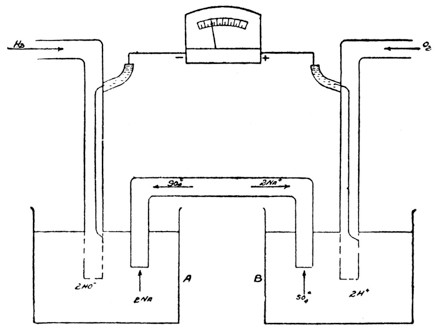
Fig. 14.
The arrangement of the apparatus and the course of the current are shown in Fig. 14. The glass tube of the hydrogen electrode is connected with a hydrogen generator, the tube of the oxygen electrode with a cylinder or gasometer filled with oxygen. The hydrogen electrode is connected with the negative post of the voltmeter, the oxygen electrode with the positive post. Since the hydrogen ionizes, under the conditions used, more rapidly than it is formed from the small concentration of the hydrogen ions surrounding the hydrogen electrode, hydrogen ions pass from the electrode into solution A, leaving a negative charge on the electrode; there is a migration of sodium ions through the salt bridge (see p. 254) to solution B, and the hydrogen ions formed combine with hydroxide ions and produce water. In a similar way, oxygen passes into solution B in the form of hydroxide ions and these combine with hydrogen ions of the sulphuric acid, forming water; SO42− ions migrate from the solution B through the salt bridge toward solution A and thus prevent polarization (p. 254). While water is an actual product of the action of the cell, working under these conditions, the essential feature of the oxidation of hydrogen is its ionization—H2 → 2 H+; it would be in the same condition of oxidation if the hydrogen ions combined with any negative ions other than HO−, or if they remained ions (as they would, if sodium chloride surrounded the hydrogen electrode). Similarly, the essential feature of the reduction of oxygen is its ionization in the form of HO− ions; in the present [p282] instance, these actually combine with hydrogen ions and form water, but the reduction of oxygen would also be accomplished, if the hydroxide ions remained ionized (as they would, if sodium chloride bathed the oxygen electrode). The formation of water is the result of a union of ions, following the oxidation-reduction reaction, which may be expressed in the following condensed form:
2 H2 ⥂ 4 H+ 2 HOH + O2 ⥂ 4 HO− 4 HO− ⥂ 4 H2O
Summary.
—We thus find that the oxidation of hydrogen by oxygen may be used to develop an electric current, exactly in the same way as the other oxidation and reduction reactions, which we have discussed, are found available for the same purpose. And at a given temperature, the oxidation is subject to the influence of analogous factors,—the solution-tension
constants, the concentrations of the corresponding ions
in the solutions surrounding the electrodes, and the
concentrations
of the
gases
.
Interpretation of Oxidation-Reduction Reactions in Terms of the Oxygen-Hydrogen Gas Cell.
—It is possible to interpret all classes of reversible oxidations and reductions, carried out in
aqueous
solutions, in terms of this so-called "oxygen-hydrogen gas cell," if the assumption is made that
each oxidizing agent
, such as nitric acid, permanganate, dichromate, etc.,
has a tendency to liberate
, either from its own molecules or by its action on water,
oxygen of a definite concentration or pressure
, and that
each reducing agent
, in turn,
has a tendency to liberate hydrogen
, from water,
of a definite pressure or concentration
. The potential of the oxygen-hydrogen cell is dependent on the concentrations of the gases with which the electrodes are in contact:
561
therefore, each oxidation and reducing agent, yielding its own characteristic concentration of oxygen or hydrogen, respectively, would have
a characteristic constant
, corresponding to the solution-tension constants of the elements and measuring its oxidizing or reducing power. This interpretation of oxidation-reduction reactions has received extended attention and recognition. The study, just made, of the oxidation of hydrogen by oxygen, sufficiently suggests the treatment of oxidation and reduction from this viewpoint.
Interpretation of Oxidation-Reduction Reactions in Terms of Direct Transfers of Electric Charges.
—In the study of the
[p283]
oxidation of zinc by cupric-ion, Zn ↓ + Cu
2+
⥂ Cu ↓ + Zn
2+
, of the oxidation of iodides and sulphides by ferric salts, 2 Fe
3+
+ 2 I
−
⥂ 2 Fe
2+
+ I
2
, and 2 Fe
3+
+ S
2−
⥂ 2 Fe
2+
+ S↓, and of similar actions, it has been possible to represent the oxidation-reduction actions as the result of
direct transfers of electric charges
between atoms and their ions.
562
In the following discussions, the attempt will be made to interpret, in the same terms, the oxidizing power of the most important remaining oxidizing agents, which include such compounds as nitric, permanganic, chromic, arsenic and similar oxygen acids. The interpretation will avoid the assumption of the liberation of oxygen and hydrogen, under hypothetical,
563
and, sometimes, enormous pressures, as
intermediate products
in the actions.
Arsenic Acid as an Oxidizing Agent.
—Arsenic acid is occasionally used as an oxidizing agent (
e.g.
in the aniline-dye industry), and, although it is not a very powerful one, its study is of theoretical interest. If to a solution of potassium arseniate some potassium iodide is added, practically no iodine is liberated (
exp.
). If dilute hydrochloric acid, in excess, is added to this mixture, iodine is slowly liberated (
exp.
). But the addition of concentrated hydrochloric acid causes iodine to be liberated at once in very large amounts (
exp.
). We may ask in what way the
[p284]
addition of the concentrated acid causes such a decided difference in the ease and speed with which arsenic acid oxidizes the iodide-ion to free iodine and is reduced, in turn, to arsenious acid and its derivatives.
564
We may recall the fact that a solution of potassium arseniate, to which dilute hydrochloric acid has been added, will remain clear for some time when the mixture is saturated with hydrogen sulphide (exp.). If a considerable excess of concentrated hydrochloric acid is added to this mixture, hydrogen sulphide immediately forms a dense precipitate (exp.) of arsenic pentasulphide—presumably through the union of quinquivalent arsenic-ion with the sulphide-ion: 2 As5+ + 5 S2− ⇄ As2S5 ↓ (see p. 247). This behavior suggested that arsenic acid, although a moderately strong acid, might nevertheless be somewhat amphoteric, might have slight basic properties, as well as its ordinary acid functions. The relation is expressed in the equations:565
3 H+ + AsO43− ⇄ (HO)3AsO (HO)3AsO + HOH ⇄ As(OH)5 ⥃ As5+ + 5 HO−.
Since oxidations by arsenic acid involve its reduction to arsenious acid, containing trivalent,566 in place of quinquivalent arsenic, one might well suspect, that the oxidizing component is the quinquivalent arsenic-ion, As5+, the discharge of two of whose positive charges would cause oxidation (e.g. of iodide-ion), exactly as the discharge of positive charges at the positive pole of an electric current causes oxidation (p. 252): As5+ + 2 I− ⥂ As3+ + I2. [p285]
In a solution of potassium arseniate, we would have only the faintest trace of the ion As5+, since the addition of an alkali to the system, expressed in the above equations, would carry the reversible reactions towards the left. The addition of dilute hydrochloric acid to the system must carry the reactions towards the right and increase the concentration of As5+; the addition of concentrated acid must increase the concentration of As5+ very much more. Even if the concentration of As5+ remained minute, the oxidizing power would be increased proportionally to the ratio of the concentrations in the first and the last solutions. A millionfold increase in concentration, even when we are dealing with very small numbers, would imply a millionfold increase in the activity of the solution. If, then, the oxidizing component of arsenic acid is the quinquivalent ion, As5+, which would tend to discharge two of its positive (oxidizing) charges, arsenic acid should be a much more powerful oxidizing agent in strong acid solution than in alkaline or neutral solutions.
We thus arrive at the conclusion that the addition of hydrochloric acid to a mixture of arseniate and iodide may be effective, in bringing about the reduction of the arseniate and the oxidation of the iodide, primarily because of its action on arsenic acid, perhaps by facilitating its ionization as a base, and that it is not effective through any action on the iodide, for instance by producing free hydroiodic acid, as is often assumed. This conclusion may easily be tested with the aid of the chemometer (see p. 253): potassium arseniate against potassium iodide gives only the faintest possible current, barely perceptible with the aid of a very sensitive voltmeter.567 The addition of hydrochloric acid to the beaker containing the potassium iodide does not increase the potential (it rather decreases it somewhat), whereas the addition of the concentrated acid to the potassium arseniate solution produces a most decided increase in the potential568 (exp.). It is evident, therefore, that the addition of the acid is primarily and directly intended to increase the oxidizing power of the arsenic acid, rather than to increase the reducing power of the iodide. [p286]
The more common methods of expressing oxidation-reduction reactions of this type are illustrated in the following equations:
Na3AsO4 + 2 HI ⇄ Na3AsO3 + H2O + I2
(1)569
and AsO43− + 2 H+ + 2 I− ⇄ AsO33− + H2O + I2.
(2)
Both of these forms of expression give the net results of the action correctly. Neither attempts to interpret the interesting and important fact that the reduction of arsenic acid is facilitated by the presence of acids (of hydrogen-ion). It is, at least, also permissible to consider As5+ ions to be present and to express the oxidation-reduction reaction with the aid of this conception,570 as has been done in the previous discussion. In the final analysis, this method seems to have the advantage of showing directly the changes of the valences571 (electric charges) of the atoms involved in the oxidation-reduction, and it also expresses, clearly and definitely, the relation of the hydrogen-ion to the action.571 The following case furnishes an illustration as to how the new point of view works out from the standpoint of a quantitative study of an oxidation-reduction reaction of this type572: uranyl salts, such as the sulphate UO2SO4, are oxidizing reagents, which are readily reduced, particularly in acid solutions, to uranous salts (e.g. to the sulphate, U(SO4)2). The potential of a mixture of uranyl and uranous salts is found573 to depend on the action expressed in the equation UO22+ + 4 H+ + 2 ⊖ ⇄ U4+ + 2 H2O. For the condition of equilibrium (zero potential), it follows that
[UO22+] × [H+]4 / [U4+] = Kequil.
(3)
The value of this constant, at 18°, is found, by calculation,574 to be approximately 1 / 1024. Now, the uranyl-ion UO22+ may be assumed to have the power of ionizing, with the aid of water, to a very slight degree into ions U6+ and HO−, according to
UO22+ + 2 H2O ⇄ U(OH)42+ ⥃ U6+ + 4 HO−.
(4)
For the ionization of an extremely weak base of this character, we have, further, [U6+] × [HO-]4 / [UO22+] = kbase. And, since [HO−] = KHOH / [H+], we also find, by substitution and by solving for U6+,
[U6+] = [UO22+] × [H+]4 × kbase / (KHOH)4.
(5)
[p287]
In other words, we may substitute [U6+] and a constant factor KHOH4 / kbase for [UO22+] × [H+]4 in the first term (numerator) of the oxidation-reduction equation (3), derived from Luther's quantitative work. We thus obtain:
[U6+] / [U4+] = Kequil. × kbase / KHOH4 = K,
(6)
which must agree just as well with the quantitative data,575 as does the original equilibrium equation (3). It follows, that we may write the chemical equation, for the action in acid solutions, simply U6+ ⇄ U4+, exactly as we have Fe3+ ⇄ Fe2+ (p. 269). [U6+] cannot be measured, as yet, but in the analogous case of Fe3+ ⇄ Fe2+, where both terms of the equilibrium equation are accessible to direct measurement, the experimental evidence distinctly favors576 the views expressed.577
Permanganic Acid, Chromic Acids, etc., as Oxidizing Agents.
—We may extend the same views to the oxidizing power of such important agents as permanganic, dichromic, and nitric acids. In each case we may assume that the oxidizing component is a highly charged positive ion,
e.g.
in the case of KMnO
4
a septavalent manganese-ion, Mn
7+
, whose oxidizing power will depend on its tendency to discharge part of its heavy positive electrical charge and whose efficiency, in accordance with the law of equilibrium, will also be proportional to the concentration, in which the highly charged ion is present. Permanganate is used as a favorite oxidizing agent in the laboratory, for instance, in the oxidation of ferrous to ferric salts in quantitative analysis; the action proceeds quantitatively and rapidly in acid solution, and the end of the action is recognized by the fact that the intense pink color of the permanganate is not destroyed (
exp.
).
[p288]
If we bring permanganate, against potassium iodide, into the beakers of the chemometer (p. 253), we find that it is a much more vigorous oxidizing agent than is arsenic acid, and again we find that the addition of acid (sulphuric) to the permanganate solution enormously increases the potential (exp.) and therefore its oxidizing power. The addition of an acid would, obviously, enormously increase the concentration of a positive septavalent ion, if permanganic acid is assumed to be, to a slight extent, base forming and therefore amphoteric:
H+ + MnO4− ⇄ (HO)MnO3 (HO)MnO3 + 3 HOH ⇄ Mn(OH)7 ⥃ Mn7+ + 7 OH−.
Similar experiments may be made with ferrous sulphate against permanganate.
The oxidation of ferro-ion, or of iodide-ion, may be represented, most simply, by the equations:
2 Mn7+ + 10 Fe2+ → 2 Mn2+ + 10 Fe3+
and
2 Mn7+ + 10 I− → 2 Mn2+ + 5 I2.
Each heptavalent manganese ion is derived from a salt, such as MnX′7 or Mn2Y″7, and, consequently, when two manganese ions Mn7+ are reduced, ten univalent negative ions X′, or five bivalent ions Y″, are liberated and become available for salt formation with the ferric ions, produced, or with the hydrogen ions (from hydroiodic acid) set free by the oxidation of the iodide ions to iodine.
Thus, the oxidation of ferrous sulphate by permanganate, in the presence of sulphuric acid, may be represented, in greater detail, by the equations:
2 KMnO4 + H2SO4 ⇄ K2SO4 + 2 HMnO4
(1)
2 HMnO4 + 7 H2SO4 ⇄ Mn2(SO4)7 + 8 H2O
(2)
Mn2(SO4)7 ⇄ 2 Mn7+ + 7 SO42−
(3)
2 Mn7+ + 7 SO42− + 10 Fe2+ + 10 SO42− ⇄ 2 Mn2+ + 1 OFe3+ + 17 SO42−
(4)
⇄ 2 MnSO4 + 5 Fe2(SO4)3
(5)
Analogous results are obtained with potassium chromate or dichromate against potassium iodide, ferrous sulphate, hydrogen sulphide, and other reducing agents.
Nitric Acid.
—It is characteristic of nitric acid that, ionized as an acid, it is not a powerful oxidizing agent; that is, the nitrate-ion, NO
3
−
, is not the oxidizing component. For instance, a nitrate, such as potassium nitrate, in aqueous solution, does not appreciably oxidize ferro-ion or iodide-ion (
exp.
). Concentrated nitric acid, or a mixture of a large excess of concentrated
[p289]
sulphuric acid with a nitrate, are far more effective in oxidizing the substances mentioned, as shown by experiments with the chemometer and with the mixtures described. It is significant that, in concentrated nitric acid, and in the presence of concentrated sulphuric acid,
the basic ionization of nitric acid
H+ + NO3− ⇄ (HO)NO2 (HO)NO2 + 2 HOH ⇄ N(OH)5 ⥃ N5+ + 5 HO−
would be facilitated by the high concentration of hydrogen-ion.
Summary.
—In every instance, then, we find that it is possible to produce an electric current by using one of these common, powerful oxidizing agents in aqueous solution, just as it is possible with oxygen and with the simpler agents discussed earlier. Whatever the theory of the formation of the current, whether we are dealing, in the last cases considered, with acids which have the capacity to ionize minimally as bases, forming highly charged positive ions, whose discharge involves an oxidation of the substance receiving the discharged electricity, or whether we accept the view that oxygen is liberated by them in exceedingly concentrated form and tends to form in aqueous solutions the hydroxide-ion, HO
−
, unquestionably the closest possible relation has been established between oxidation-reduction reactions and electrical relations, as formulated on the basis of the theory of ionization. In all cases, at a constant temperature, as demanded by the law of mass action, the net result of an action will depend on
constant factors
, measuring the tendencies of atoms to assume or lose electric charges (electrons), and on
variable factors
, the concentrations of the reacting components.
Oxidation of Organic Compounds.
—In conclusion, it may be asked whether
the oxidation of organic compounds
may also be brought into relation with electrical charges and interpreted on the basis of the theory which has been presented. For this purpose we may study the oxidation of one of the simplest of organic compounds, formaldehyde CH
2
O, which forms the active component in solutions of
formalin
. Formaldehyde is also intimately related to some of the most important food products, the carbohydrates, whose oxidation is utilized in the animal economy. It is formed
578
in the green leaves of plants by the
[p290]
reduction of carbon dioxide, absorbed from the atmosphere, with the aid of the energy of the sun's light: CO
2
+ H
2
O → CH
2
O + O
2
. It is readily condensed, forming glucose (6 CH
2
O → C
6
H
12
O
6
), cane sugar C
12
H
22
O
11
, and still more complex carbohydrates, such as starch.
Formaldehyde, like other aldehydes, is readily oxidized. A favorite reagent, used in oxidizing it, is an ammoniacal solution of silver nitrate (exp.), the separation of silver from such a solution being a characteristic reaction of aldehydes. The reagent is rendered still more sensitive by the addition of sodium or potassium hydroxide.579 We may ask how we would interpret, from the point of view of the electric theory of oxidation and reduction, the oxidation of formaldehyde and the reduction of silver nitrate to silver, under these conditions. According to the theory, the oxidizing agent in silver nitrate is the silver-ion, the discharge of which gives positive electricity, which the oxidized substance, the formaldehyde, must absorb. But in a silver nitrate solution there is a far larger concentration of the silver-ion than in an ammoniacal solution (p. 220), containing the same total concentration of silver. The complex silver-ammonium-ion Ag(NH3)2+, it may be recalled, is a rather stable one,580 and, consequently, the addition of ammonia to silver nitrate should decidedly weaken its oxidizing power. Still, the practical use of ammonia, especially in combination with sodium hydroxide, is found to be most effective. We are led to suspect that, in spite of the untoward effect of ammonia on the oxidizing power of the silver compound, an alkaline solution is desirable for the sake of the effect of the alkali on formaldehyde, the reducing substance involved. To follow up this conclusion, we must next consider, in some detail, the nature of formaldehyde; we shall presently find that the conclusion, which we have just reached, as to the probably favorable effect of alkali on the reducing power of formaldehyde, will be verified by experiments, which the consideration of formaldehyde will suggest.
The oxidation of formaldehyde may most clearly be formulated on the basis of views, developed by Nef, on the formation of methylene581 derivatives, containing bivalent carbon atoms. A solution [p291] of formalin contains formaldehyde in a variety of forms, in a very complex condition of equilibrium. Of these compounds, the aldehyde, CH2O, probably exists in two forms, which have the same composition and molecular weight, but which differ in the arrangement of the atoms in the molecules (in the structure of the molecules); we probably have CH2═O ⥃ CH(OH), the former of which (CH2═O) is, most likely, by far the more stable and the chief one of these two substances, present under ordinary conditions. The second compound CH(OH) may be present in traces only. One difference, we note, lies in the position of one of the hydrogen atoms in the respective molecules; the second form contains a hydroxide group (OH), which gives it the properties of an acid and renders it capable of forming salts CH(OMe) with bases. But the molecule of this second form also would contain a carbon atom, only two of whose valences are satisfied (by H and OH), two of the ordinary four valences of a carbon atom being thus left free or unsaturated. We may indicate the two free carbon valences in the formula ═CH(OH). Such an unsaturated, bivalent carbon atom ═C would be particularly sensitive to oxidation.582
Besides these two forms, a formalin solution also contains a polymerized form, probably (CH2O)2, which in dilute solution, or under the influence of heat, slowly breaks down into formaldehyde, (CH2O)2 ⇄ 2 CH2O.
The addition of alkali to the mixture probably leads to the formation of the salt ═CH(OMe), thus disturbing all the conditions of equilibrium and leading to the transformation of a very much larger part of the aldehyde into a compound containing the characteristic unsaturated (bivalent) carbon, than was originally present. The aldehyde will thus become more susceptible to oxidation as a result of the enormous increase in the concentration of the oxidizable component. We may assume this to be either the salt, ═CH(OMe), or its negative ion, ═CH(O−), or both, or some analogous derivative. Further, the two free valences of a bivalent carbon atom may be considered to consist of a positive and a negative charge of electricity, either actual or potential,583 and the oxidation will consist [p292] primarily in the absorption of two positive charges, from the oxidizing agent, to convert the negative charge on the carbon atom, say in ±CH(ONa), into a positive charge.584 If the oxidizing agent is alkaline silver nitrate solution, we may formulate the successive actions as follows:
(NaO)HC± + 2 Ag+ → (NaO)HC2+ + 2 Ag ↓.
The two positive silver ions correspond to two negative ions, e.g. hydroxide ions HO−, which are set free by the discharge of the silver ions, and which, in turn, will combine with the oxidized carbon atom holding the two positive charges:
(NaO)HC2+ + 2 HO− → (NaO)HC(OH)2 → (NaO)HC:O + H2O.
The salt formed, HCO2Na, is sodium formate, which is the first isolated product of the oxidation of formaldehyde.
It would appear, from this point of view, that the alkaline nature of the silver nitrate mixture is advantageous primarily because a base is required by the formaldehyde, the reducing agent, to convert it into some readily oxidizable form. And the proved efficiency of the alkaline mixture (see above) makes it appear probable that the advantage gained by this result more than offsets the loss in oxidizing power, suffered by the silver nitrate following the suppression of its real oxidizing component, the silver-ion, when, in the presence of ammonia, the latter is converted largely into the ion, Ag(NH3)2+. Ammonia, in turn, is employed in the oxidizing mixture, essentially with the object of preventing the precipitation of the silver-ion, as silver oxide, by the hydroxide-ion of an alkaline mixture. These conclusions, as well as, in particular, the main conception that in the oxidation of formaldehyde there is an actual transfer of electrical charges, may be fully confirmed with the aid of the chemometer.585
Exp. A small beaker, containing a platinum electrode, which is connected with the positive post of the voltmeter, is half filled with a solution of silver and sodium nitrates. A similar small beaker, containing a platinum electrode leading to the negative post of the voltmeter, is charged with a solution of sodium nitrate (to render the solution a good conductor) and with some formalin. The solutions in the two beakers are connected by means of a salt-bridge containing sodium nitrate. [p293]
Only a very slight current is produced under these conditions; the potential between silver nitrate and formaldehyde is found to be extremely small. If, now, sodium hydroxide is added to the formalin mixture, an enormous increase in potential is observed, proving, unmistakably, that the addition of the alkali to the formalin solution enormously increases the concentration of the reacting, oxidizable component.586
When some ammonia is added to the silver nitrate mixture, we find, as anticipated, that the oxidizing power of the silver solution is greatly reduced, the silver-ion being converted into the complex ion, Ag(NH3)2+; but the potential is still very much greater than the potential between silver nitrate and formalin without any alkali—which shows that the advantage of using alkali with the formaldehyde greatly outweighs the disadvantage of using ammonia with the silver nitrate.
An electric current may also be readily obtained by combining alkaline formaldehyde with other oxidizing agents—for instance with an oxygen electrode (p. 279). We find (exp.) that the oxidation proceeds with remarkable ease under these conditions. Permanganate, dichromate, etc., may be substituted for oxygen, with the same general result.
Summary.
—It is clear, then, that the oxidation of an
organic substance
may readily be interpreted as consisting, ultimately, in a transfer of electrical charges, of exactly the same nature, as is found in the other oxidation reactions which we have considered,
[p294]
and that the conditions for producing a maximum current, as investigated with the aid of the chemometer, give us, again, important guidance in following the course of the reactions. It is needless to say that the oxidation of other organic compounds, such as glucose, alcohol, etc., may be profitably studied from the same point of view.
It also follows, from the conclusions reached, that, under proper experimental conditions, electricity, in the form of a current, must be capable of effecting the oxidation, or the reduction, of organic as well as inorganic compounds (p. 252). Extended investigations have, indeed, shown that electric currents belong to the most important and efficient agents for this purpose, because the oxidation, or the reduction, of the organic compound becomes susceptible to the most exact control through the regulation of the potentials used.587
Tables and Summaries.
—In the first table the equilibrium (solution-tension) constants of a number of metals and non-metallic elements are given. The table is followed by brief explanations of its meaning and a summary of some of its more important applications.
TABLEA OF EQUILIBRIUM (SOLUTION-TENSION) CONSTANTS (IN MOLAR TERMS) AND OF POTENTIAL DIFFERENCES BETWEEN ELEMENTS AND THEIR IONS IN UNIMOLAR AQUEOUS SOLUTIONS.
Element, Ion. E.P.El.,Ion. KIon.
K, K+ B (−2.92) 6E50
Na, Na+ C −2.44 2.5E42
Ba, Ba2+ (−2.54) 2.1E88
Sr, Sr2+ (−2.49) 4.0E86
Ca, Ca2+ (−2.28) 2.0E79
Mg, Mg2+ (−2.26) 4.1E78
Al, Al3+ D −0.999 ? 1.3E52
Mn, Mn2+ −0.798 5.7E27
Zn, Zn2+ −0.493 1.4E17
Cd, Cd2+ −0.143 9.5E4
Fe, Fe2+ E −0.122 ? 1.8E4
Co, Co2+ F +0.0138 ? 0.3314
Ni, Ni2+ G +0.108 ? 1.8E−4
Sn, Sn2+ <+0.085 <1.1E−3
Pb, Pb2+ +0.129 3.3E−5
H2, H+ H +0.277 1.52E−5
Cu, Cu2+ +0.606 8.3E−22
As, As+++ <+0.570 <2.7E−30
Bi, Bi3+ <+0.668 <1.4E−35
Sb, Sb3+ <+0.743 <1.7E−39
Hg, Hg+ +1.027 1.38E−18
Ag, Ag+ +1.048 6E−19
Pt, Pt4+ <+1.140 5E−80
Au, Au3+ <+1.356 <1.8E−71
F3, F− H (+2.24) 9.0E88
Cl2, Cl− H +1.694 3.16E29
Br2, Br− +1.270 1.23E22
I2, I− +0.797 ? 7.26E13
O2, HO− I +0.698 1.36E12
The potential differences, given in the table, are based on the assumption that the absolute zero of potential is at such a point, that the so-called standard normal calomel electrode has a value of +0.56 volt relative to this zero (cf. Ostwald, Z. phys. Chem., 36, 97 (1901)). The exact determination of this value is a very difficult matter. Recently Palmaer (ibid., 59, 129 (1907)), located the absolute zero at a point 0.04 volt more positive than the above, making the absolute potential of the normal calomel electrode, approximately, +0.52 volt. To refer potentials, given in this book, to this new zero, one would subtract 0.04 volt from all positive potentials and add 0.04 to the numbers representing negative potentials (e.g. E. P.Zn,Zn2+ would become −0.569 in place of −0.529 volt). Since the equilibrium (solution-tension) constants are calculated from the potential differences referred to the absolute zero (p. 259), any change in the zero involves corresponding changes in the values of the equilibrium constants, as calculated for this book. However, it should be noted that all potential differences would be corrected by the same constant quantity (0.04 volt for Palmaer's zero): all the equilibrium constants for univalent metallic ions would be increased proportionally to a constant factor c (c is very nearly equal to 5, for Palmaer's zero), the equilibrium constants for bivalent metallic ions would be increased proportionally to c2, etc. The equilibrium ratio for two metals and their ions would in no wise be changed by these alterations: e.g. for the equilibrium between zinc and copper and [p296] their ions (p. 267), Kequil. = KZn2+ / KCu2+; the factor c2 would be introduced into both terms of the ratio and would not affect the value of the latter. For the condition of equilibrium between silver and copper and their ions (p. 267) Kequil. = KAg+2 / KCu2+, and since (c)2 = c2, this equilibrium ratio would also not be affected. For elements, which produce negative ions, the corresponding correction factors would be 1 / c, 1 / c2, etc., and the equilibrium relations between two such elements and their ions likewise would remain unchanged. Since these equilibrium relations are the significant ones in this work, and since our conclusions have been based on them, it is clear that a change in the absolute zero would not affect the conclusions reached.
On account of the uncertainty attaching to the determination of the absolute zero of potential, it is preferred, in practice, to report the experimentally determined potentials as measured against a constant, well-defined electrode (such as the calomel electrode or a hydrogen electrode) and thus to eliminate the variation, which a change in the determination of the zero potential would make necessary. However, for an elementary discussion of oxidation-reduction reactions, from the same viewpoint as is used in considering all other reversible chemical actions, the idea of the absolute potential has certain advantages, making a uniform treatment possible.
1. Meaning of KIon. Under KIon is given, for each element, the concentration of its ion, with which the element would be directly in equilibrium at the ordinary temperature (see p. 258). The constants for gaseous elements represent the constants of the gases under atmospheric pressure.
2. The Condition for Equilibrium between Two Elements and Their Ions. The condition of equilibrium in a system of two elements and their ions may be found with the aid of the constants KIon, as follows: For Zn ↓ + Cu2+ ⥂ Zn2+ + Cu ↓ we have for the condition of equilibrium (see p. 267)
[Zn2+] / [Cu2+] = K and K = KZn2+ / KCu2+ = 1.4E17 / 8.3E−22 = 1.7E38.
Zinc-ion must be present in enormous excess in the condition of equilibrium and zinc will precipitate copper from solutions of cupric salts until this relation is established. The suppression of the cupric-ion—by precipitation in the form of insoluble salts or by conversion into very stable complex ions—makes [Cu2+] exceedingly small and makes it increasingly difficult for zinc to precipitate copper, and, under certain conditions, the ordinary course of the action may be reversed (p. 268).
For Cu ↓ + 2 Ag+ ⥂ Cu2+ + 2 Ag ↓, we have (p. 267)
[Cu2+] / [Ag+]2 = K and K = KCu2+ / KAg+2 = 8.3E−22 / (6E−19)2 = 2.3E15.
3. Potential Differences Calculated with the Aid of KIon. For metallic elements, which send out positive ions, in contact with an aqueous solution containing the ion in concentration [C], the potential difference is (see p. 261)
εMe, Ionv = (0.0575 / v) log([C] / KIon) volts,
[p297]
and for elements which form negative ions (see footnote 1, p. 261),
εElem., Ionv = (−0.0575 / v) log([C] / KIon) volts.
In these equations v represents the valence of the ion. It is clear that for the condition of equilibrium, in which [C] = KIon, the potential is 0. Further, for the potential difference between copper and a cupric salt solution in which [Cu2+] = 1, we would have
εCu, Cu2+ = (0.0575 / 2) log(1 / 8.3E−22) = 21.08 × 0.0575 / 2 = +0.606 volts.
4. Meaning of E.P.Element, Ion. Under E.P.Element, Ion the table gives the potential difference in volts, calculated for the element named and an aqueous solution of its ion in unit concentration (one gram-ion per liter). For instance, for zinc and [Zn2+] = 1 (65.4 grams zinc-ion per liter), we have a potential E.P.Zn, Zn2+ = −0.493. The signs used, in accordance with the convention adopted (p. 261), indicate the character of the charge on the element electrode (which is named first in the subscript to E.P.). For instance, zinc in a solution in which [Zn2+] = 1 would acquire a negative charge (p. 266), the potential difference E.P.Zn, Zn2+ being −0.493 according to the table; silver, immersed in a solution in which [Ag+] = 1, would acquire a positive charge, the potential difference E.P.Ag, Ag+ = +1.048.
The potentials given for the gaseous elements represent the potentials of the gases under 760 mm. pressure.
5. Potential Differences Calculated with the Aid of E.P.Element, Ion. The potential corresponding to any concentration [C] of a metal ion may be found from the equation588
εEl., Ionv = E.P.El., Ion + (0.0575 / v) log[C] volts,
and the potential for any concentration [C] of the ions of elements forming negative ions is found588 according to
εEl., Ionv = E.P.El., Ion − (0.0575 / v) log[C] volts.
6. The Condition for Equilibrium between Two Metals and Their Ions, Calculated with the Aid of E.P.Element, Ion. The condition for equilibrium in a system of two metals and their ions is determined by the fact that the potential of the system must be 0 when equilibrium is established. We have, for instance for the two metals zinc and copper and their ions, Zn2+ and Cu2+, for Zn ↓ + Cu2+ ⇄ Cu ↓ + Zn2+ the condition for equilibrium that εCu, Cu2+ − εZn, Zn2+ = 0. According to the equation given in § 5, we have, then, for the condition of equilibrium,
E.P.Cu, Cu2+ + (0.0575 / 2) log[Cu2+] − E.P.Zn, Zn2+ + (0.0575 / 2) log[Zn2+] = 0.
[p298]
Then
(0.0575 / 2) log([Zn2+] / [Cu2+]) = E.P.Cu,Cu2+ − E.P.Zn,Zn2+ = +0.606 − (−0.493) = 1.099.
From the last relation we find log([Zn2+] / [Cu2+]) = 38.2261, and therefore, for the condition of equilibrium, [Zn2+] / [Cu2+] = 1.7E38.
7. Equilibrium Constants for Elements with Variable Concentration. The concentration of a pure metal at a given temperature may be considered a constant, except in the case of extremely thin films of the metal (p. 258). The concentration of hydrogen, and of the non-metallic elements given in the table, is variable, and KIon has a definite value only when the concentration of the element is defined (see the preceding table, footnotes 3, 4, p. 295). For certain estimations the equilibrium constants, which show the relation between the two variables, namely the concentration of the element and that of its ion, are very helpful (see pp. 274 and 275). In the following table some of the more important equilibrium constants of this nature are given.
TABLE OF EQUILIBRIUM CONSTANTS.
Element. Kequil..
Hydrogen: [H+]2 : [H2] 5.6E−9
Oxygen: [HO−]4 : [O2] 8.2E49
Chlorine: [Cl−]2 : [Cl2] 2E60
IodineA: [I−]2 : [I2] 5.6E29
The significance of the constants is indicated by the ratios given in the table. The relation of these constants to those given in the first table may be seen from the following illustration. For hydrogen we have H2 ⇄ 2 H+. The first table tells us that hydrogen, at 18° under atmospheric pressure, is in equilibrium with its ion when the concentration of hydrogen-ion is 1.52E−5 (under KIon). Now, a mole of hydrogen at 18° occupies 22.4 × 291 / 273 = 23.9 liters under atmospheric pressure, and its concentration (per liter) is therefore 1 / 23.9 mole. Then equilibrium exists, when [H2] = 1 / 23.9 and [H+] = 1.52E−5 and Kequil. = [H+]2 : [H2] = (1.52E−5)2 × 23.9 = 5.6E−9.