Chapter I
Reading edition
OF THE MATERIALS WHICH COMPOSE THE CRUST OF THE EARTH.
SECTION I.—ELEMENTARY SUBSTANCES.
There are about sixty substances known to the chemist which are considered as elementary; but most of them are rarely met with, and only in minute quantities. A few of them are, however, so abundant, in the composition of the crust of the earth, as to render some attention to them necessary.
Oxygen is more widely diffused than any other substance. It is an ingredient of water and of the atmosphere, the former containing eighty-eight per cent., and the latter twenty-one. Nearly all rocks contain oxygen in combination with the metallic and metalloid bases, and the average proportion of oxygen which they contain is about forty-five per cent.; so that it will not differ much from the truth to consider the oxygen in the earth’s crust as equal in weight to all the other substances which enter into its composition.
Hydrogen occurs in nature principally in combination with oxygen, forming water. It is also an ingredient in bitumen and bituminous coal.
Nitrogen is confined almost entirely to the atmosphere, of which it forms four-fifths. It enters into the composition of some varieties of coal, and is sparingly diffused in most fossiliferous rocks.
One of the most important substances in nature is carbon. It constitutes the principal part of all the varieties of coal, as well as of graphite, peat and bituminous matter. A much larger amount of carbon exists in the carbonic acid which is combined with the oxides of the metalloids and metals. The most abundant of these compounds is limestone, which contains about twelve per cent, of carbon.
In the neighborhood of volcanoes sulphur is found pure and in a crystalline form. It is a constant ingredient in volcanic rocks, and in several of the most important ores, particularly those of lead, copper and iron. The most abundant sulphate is gypsum, which contains twenty-six per cent, of sulphur. In small quantities it is widely diffused in rocks, and in the waters of the ocean.
Chlorine is found principally as an ingredient of rock-salt, which contains sixty per cent, of it, and of sea-water, which contains one and a half per cent.
Fluorine is found, though very sparingly, in nearly all the unstratified rocks. It forms nearly half of the mineral known as Derbyshire spar.
Of the metals, Iron is the only one that is found abundantly. It enters into the composition of nearly all mineral substances. It is generally combined with oxygen, and occurs less frequently as a carbonate or sulphuret. Of volcanic rocks it forms about twenty per cent. Its ores are sometimes found in the form of dikes or seams, having been injected from below; at other times, in the form of nodules or stratified masses, like other rocks of mechanical origin.
Manganese is likewise extensively diffused, but in very small quantity. The other metals are often met with, but their localities are of very limited extent.
Of the metallic bases of the earths and alkalies, Silicium is the most abundant. It generally occurs in the form of silex, which is an oxide of the metal. There are but few rocks in which it is not found in considerable amount.
Aluminium generally occurs as an oxide, in which form it is alumina. It is the base of the different varieties of clay and clay-slate. It is also a constituent of felspar and mica.
Potassium is an ingredient of felspar and mica, and hence is found in all the primary and in most of the volcanic rocks, as well as in the stratified rocks derived from them.
Sodium is a constituent of a variety of felspar which is somewhat abundant in volcanic rocks. Its principal source is the extensive beds of rock-salt, and the same substance in a state of solution in the waters of the ocean.
Calcium constitutes about forty per cent, of limestone, and is an ingredient in nearly all igneous rocks. This metal, in the state of an oxide, is lime.
Magnesium is somewhat abundant, but less so than calcium. It is one of the bases of dolomite and magnesian limestone, and is an ingredient of talc and all talcose rocks.
The substances now enumerated constitute nearly the entire mineral mass of the crust of the earth. They may be arranged in the following order:—
I. NON-METALLIC SUBSTANCES.
Oxygen. Carbon. Hydrogen. Sulphur. Fluorine. Nitrogen. Chlorine.
II. METALS.
Iron. Manganese.
III. METALLIC BASES OF THE EARTHS AND ALKALIES.
Silicium. Sodium. Aluminium. Calcium. Potassium. Magnesium.
These substances, chemically combined, form Simple Minerals.
SECTION II.—SIMPLE MINERALS.
All substances found in the earth or upon its surface, which are not the products of art or of organic life, are regarded by the mineralogist as simple minerals. About four hundred mineral species are known, and the varieties are much more numerous; but only a small number of them are so abundant as to claim the attention of the geologist. An acquaintance with the following species is, however, necessary.
Quartz is probably the most abundant mineral in nature. It is composed wholly of silex. Its specific gravity is 2.65. It is the hardest of the common minerals, gives sparks with steel, scratches glass, and breaks into irregular angular fragments under the hammer. When crystallized, its most common form is that of a six-sided prism, terminated by six-sided pyramids. When pure, it is transparent or translucent, and its lustre is highly vitreous. The transparent variety is called rock crystal. When purple, it is amethyst. When faint red, it is rose quartz. When its color is dark brown, or gray, and it has a conchoidal fracture, it is flint. When quartz occurs in white, tuberous masses, of a resinous lustre and conchoidal fracture, it is opal. The precious opal is distinguished by its lively play of colors. Jasper is opaque, and contains a small per cent, of oxide of iron, by which it is colored dull red, yellowish red or brown. The light-colored, massive, translucent variety is chalcedony. The flesh-colored specimens are carnelian. When composed of layers of chalcedony of different colors, it becomes agate. Several of the varieties of quartz, such as amethyst, opal, carnelian and agate, are used to considerable extent in jewelry.
Felspar is composed of silex, alumina and potassa. It resembles quartz, but it is not as hard, cleaves more readily, and is not generally transparent. Its specific gravity is 2.47. Its lustre is feebly vitreous, but pearly on its cleavage faces. Its color is sometimes green, but generally dull white, and often inclined to red or flesh-color.
Mica is composed of the same ingredients as felspar, together with oxide of iron. Its specific gravity is nearly three. It is often colorless, but frequently green, smoky, or black. It may be known by its capability of division into exceedingly thin, transparent, elastic plates.
Hornblende is composed of silex, alumina and magnesia. Its specific gravity is a little above three. Its color is generally some shade of green. When dark green or black, whether in a massive or crystalline state, it is common hornblende. When light green, it is actinolite. The white variety is tremolite. When it is composed of flexible fibres, it is asbestus; and when the fibres have also a silky lustre, it is amianthus.
Augite or Pyroxene has, till recently, been considered as a variety of hornblende. Its specific gravity is slightly different; its composition is the same, and in general appearance it is not easily distinguished from hornblende. It has, however, been made a distinct species, because its crystalline form is different.
Hypersthene is composed of silex, magnesia and oxide of iron. Its specific gravity is 3.38. It closely resembles hornblende. The lustre of its cleavage faces is metallic pearly. Its color is grayish or greenish black.
Talc is composed of silex and magnesia. Its specific gravity is 2.7. It resembles mica in its general appearance and in its lamellar structure, but it is easily distinguished from it by its plates being not elastic, and by its soapy feel. Its color is generally some shade of green. Soapstone is an impure variety of talc, of a light gray color, earthy texture, and is unctuous to the touch. Chlorite, another impure variety, is a dark green rock, massive, easily cut with a knife, and unctuous to the touch.
Serpentine is composed of silex and magnesia. Its specific gravity is 2.55. It is generally massive, unctuous to the touch, and of a green color. It is often variegated with spots of green of different shades. With a mixture of carbonate of lime it forms the verd antique marble.
Carbonate of Lime, or common limestone, is composed of carbonic acid and lime. Its specific gravity is 2.65. It presents a great variety of forms. In a crystalline state it is generally transparent, and when so, possesses the property of double refraction. It may be distinguished from every other common species by its rapid effervescence with acids. It readily cleaves parallel to all the faces of the primary form, which is a rhombohedron.
Sulphate of Lime, or Gypsum, is composed of sulphuric acid and lime. Its specific gravity is 2.32. When crystalline, it has a pearly lustre, is transparent, and goes under the name of Selenite. Common Gypsum resembles the other earthy limestones, but it is softer, and may be readily distinguished by its not effervescing with acids.
To the minerals now enumerated may be added the following, which are of frequent occurrence, but not in great quantities; namely, carbonate of magnesia, oxide of iron, iron pyrites, rock-salt, coal, bitumen, schorl and garnet.
These simple minerals, either in separate masses or mingled more or less intimately together, compose almost wholly the earth’s crust.
SECTION III.—THE MINERAL MASSES WHICH FORM THE CRUST OF THE EARTH.
That portion of the structure of the earth which is accessible to man is called the crust of the earth.
The mineral masses which compose it, whether in a solid state, like granite and limestone, or in a yielding state, like beds of sand and clay, are called rocks.
The unstratified rocks are Granite, Hypersthene rock, Limestone and Serpentine, and the Trappean and Volcanic rocks.
Granite is a rock of a light gray color, and is composed of quartz, felspar and mica, in variable proportions, confusedly crystallized together. The felspar is generally the predominant mineral. It is sometimes of a very coarse texture, the separate minerals occurring in masses of a foot or more in diameter. At other times it is so fine-grained that the constituent minerals can scarcely be recognized by the naked eye; and between these extremes there is every variety. The term granite is not, however, confined to an aggregate of these three minerals. In some instances the felspar so predominates as almost to exclude the other minerals, when it is called felspathic granite. When the quartz appears in the form of irregular and broken lines, somewhat resembling written characters, in a base of felspar, it is called graphic granite. When talc takes the place of mica, it is talcose granite. When hornblende takes the place of mica, it is syenite. Granite or any rock becomes porphyritic when it contains imbedded crystals of felspar.
There is a rock of crystalline structure, like granite, but of a darker color, which is called hypersthene rock. It is composed of Labrador felspar and hypersthene. The mineral species serpentine and limestone often occur unstratified in considerable quantities.
Volcanic rocks consist of the materials ejected from the craters of volcanoes. They are composed of essentially the same minerals as trap rocks. When the material has been thrown out in a melted state, it is called lava. Lava, at the time of its ejection, contains a large amount of watery vapor at a high temperature. Under the immense pressure to which it is subjected in the volcanic foci, it may exist in the form of water; but when the lava is thrown out at the crater, the pressure cannot much exceed that of the atmosphere. The particles of water at once assume the gaseous form. As lava possesses considerable viscidity, the steam does not escape, but renders the upper portion of the mass vesicular. This vesicular lava is called scoriæ. By the movement of the stream of lava, these vesicles become drawn out into fine capillary tubes, converting the scoriæ into pumice-stone.
A large part of the materials ejected from volcanoes is in the form of dust, cinders and angular fragments of rock. These soon become solidified, forming volcanic tuff, or volcanic breccia. In submarine eruptions these fragments are spread out by the water into strata, upon which other materials, not volcanic, are afterwards deposited. These interposed strata are called volcanic grits.
The trappean rocks are composed of felspar, mingled intimately and in small particles with augite or hornblende. They also contain iron and potassa. They are often porphyritic. When they contain spherical cavities, filled with some other mineral, such as chlorite, carbonate of lime or agate, they are called amygdaloidal trap.
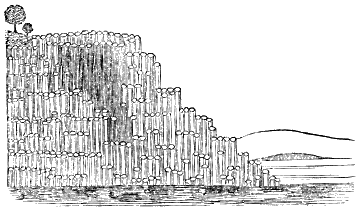
The principal varieties of trappean rock are basalt, green stone, and trachyte. In basalt, augite, or, in some cases, hornblende, is the predominant mineral. It is a heavy, close-grained rock, of a black or dark brown color. Greenstone differs from basalt in containing a much larger proportion of felspar. Its structure is more granular, and frequently it assumes so much of the crystalline form as to pass insensibly into syenite or granite. It is a dark colored rock, with a slight tinge of green. Both green stone and basalt are disposed to assume the columnar form, the columns being arranged at right angles to the faces of the fissure into which the trap is injected. When it is spread out into broad horizontal masses, the columns are vertical. (Fig. 1. Trachyte is composed principally of felspar, is of a grayish color, and rough to the touch.
Fig. 1.
Of the stratified rocks the following are the most important:
Gneiss is a rock closely resembling granite. It is an aggregate of the same minerals, but the proportion of mica is somewhat greater. The only distinction between them is that the gneiss is stratified, but the stratification is often so indistinct that it passes insensibly into granite. Generally, however, the stratification is so distinct as to present a marked difference.
Mica slate is such a modification of gneiss that the mica becomes the predominant mineral, with a small intermixture of quartz and felspar. Consequently the stratification becomes very distinct, so as sometimes to render the mass divisible into thin sheets. The stratification is often wavy, and sometimes much contorted.
Sandstone consists of grains or fragments of any other rock, but more frequently of siliceous rocks. The fragments are consolidated, sometimes without any visible cement, but often by a paste of argillaceous or calcareous substance. The color varies with that of the rock from which it was derived. Generally, however, it is either drab or is colored red by oxide of iron. The fragments are sometimes so minute as scarcely to give the rock the appearance of sandstone. When they are of considerable size and rounded, the rock is called conglomerate. When they are angular, it is called breccia. Greensand is a friable mixture of siliceous and calcareous particles, colored by a slight intermixture of green earth or chlorite.
Limestone is a very abundant rock, and occurs in many different forms. In transparent crystals it is Iceland spar. When white and crystalline, it is primary limestone, saccharine limestone, or statuary marble. When sub-crystalline it is generally more or less colored. It is often clouded with bands or patches of white in a ground of some dark color. When its texture is close, and the crystallization scarcely apparent, it is compact limestone. The white, earthy variety is chalk. A variety of limestone composed of small spheres is called oölite. Lias is the name given to an impure argillaceous variety of a brown or blue color. Any rock which contains a considerable proportion of carbonate of lime, and which rapidly disintegrates on exposure to the atmosphere, is called marl. Limestone sometimes contains carbonate of magnesia. It is then magnesian limestone, or dolomite.
Clay consists of a mixture of siliceous and aluminous earth. It is tough, highly plastic, and generally of a lead blue color. It is always stratified, and often divided into very thin laminæ, which are separated by sprinklings of sand only sufficient to keep them distinct.
Clay slate, or argillaceous schist, is composed of the same materials as clay, and differs from it only in having become solidified. Its color is gray, dark brown or black. In some beds it is purple. Shale is the same material in a state of partial solidification. On exposure to the weather, it soon disintegrates, and is finally reconverted into clay. All the varieties of argillaceous rock are easily distinguished by a peculiar odor which they emit when breathed upon.
Argillaceous slate sometimes takes into its composition portions of some other mineral, such as talc, mica, or hornblende. When any of these minerals becomes so abundant as to constitute a considerable part of the mass, the rock becomes talcose, micaceous, or hornblende slate. Sometimes this last variety loses all appearance of a fissile structure, and is composed almost wholly of hornblende. It is then called hornblende rock.
Diluvium is the name applied to masses of sand, gravel, and large rocks, called boulders, heaped confusedly together on the surface of the earth. It is also called drift.