ELEMENTS OF DRAWING. (continued 4)
Reading edition
Now this kind of bridge, sympathizing, as it does, with the spirit of the river, and marking the nature of the thing it has to deal with and conquer, is the ideal of a bridge; and all endeavors to do the thing in a grand engineer's manner, with a level roadway and equal arches, are barbarous; not only because all monotonous forms are ugly in themselves, but because the mind perceives at once that there has been cost uselessly thrown away for the sake of formality.[57]
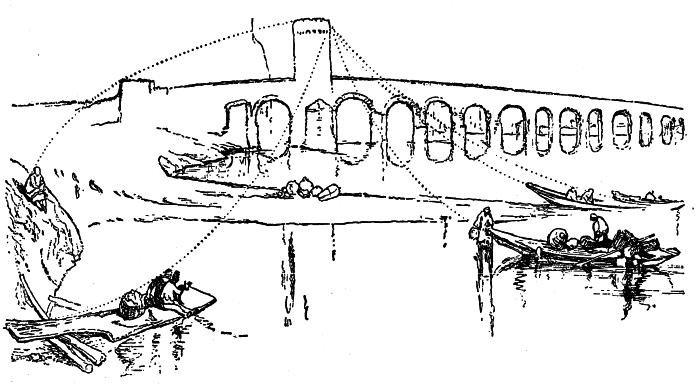
Fig. 34.
204. Well, to return to our continuity. We see that the Turnerian bridge in Fig. 32 is of the absolutely perfect type, and is still farther interesting by having its main arch crowned by a watch-tower. But as I want you to note especially what perhaps was not the case in the real bridge, but is entirely Turner's doing, you will find that though the arches diminish gradually, not one is regularly diminished—they are all of different shapes and sizes: you cannot see this clearly in Fig. 32, but in the larger diagram, Fig. 34, over leaf, you will with ease. This is indeed also part of the ideal of a bridge, because the lateral currents near the shore are of course irregular in size, and a simple builder would naturally vary his arches accordingly; and also, if the bottom was rocky, build his piers where the rocks came. But it is not as a part of bridge ideal, but as a necessity of all noble composition, that this irregularity is introduced by Turner. It at once raises the object thus treated from the lower or vulgar unity of rigid law to the greater unity of clouds, and waves, and trees, and human souls, each different, each obedient, and each in harmonious service.
4. THE LAW OF CURVATURE.
205. There is, however, another point to be noticed in this bridge of Turner's. Not only does it slope away unequally at its sides, but it slopes in a gradual though very subtle curve. And if you substitute a straight line for this curve (drawing one with a rule from the base of the tower on each side to the ends of the bridge, in Fig. 34, and effacing the curve), you will instantly see that the design has suffered grievously. You may ascertain, by experiment, that all beautiful objects whatsoever are thus terminated by delicately curved lines, except where the straight line is indispensable to their use or stability; and that when a complete system of straight lines, throughout the form, is necessary to that stability, as in crystals, the beauty, if any exists, is in color and transparency, not in form. Cut out the shape of any crystal you like, in white wax or wood, and put it beside a white lily, and you will feel the force of the curvature in its purity, irrespective of added color, or other interfering elements of beauty.
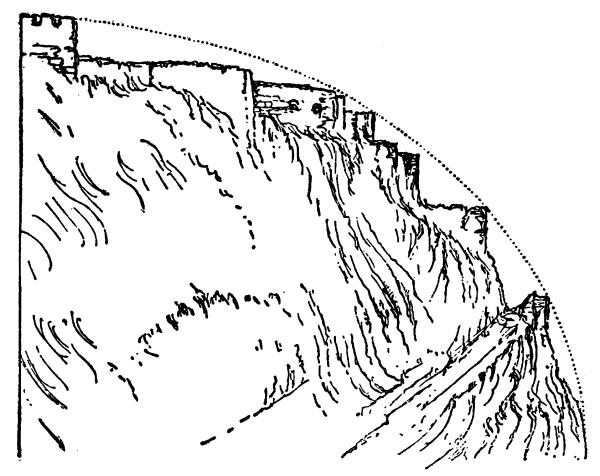
Fig. 35.
206. Well, as curves are more beautiful than straight lines, it is necessary to a good composition that its continuities of object, mass, or color should be, if possible, in curves, rather than straight lines or angular ones. Perhaps one of the simplest and prettiest examples of a graceful continuity of this kind is in the line traced at any moment by the corks of a net as it is being drawn: nearly every person is more or less attracted by the beauty of the dotted line. Now, it is almost always possible, not only to secure such a continuity in the arrangement or boundaries of objects which, like these bridge arches or the corks of the net, are actually connected with each other, but—and this is a still more noble and interesting kind of continuity—among features which appear at first entirely separate. Thus the towers of Ehrenbreitstein, on the left, in Fig. 32, appear at first independent of each other; but when I give their profile, on a larger scale, Fig. 35, the reader may easily perceive that there is a subtle cadence and harmony among them. The reason of this is, that they are all bounded by one grand curve, traced by the dotted line; out of the seven towers, four precisely touch this curve, the others only falling hack from it here and there to keep the eye from discovering it too easily.
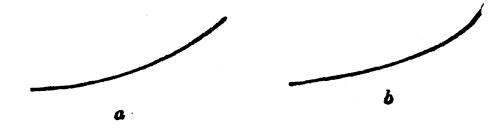
Fig. 36.
207. And it is not only always possible to obtain continuities of this kind: it is, in drawing large forests or mountain forms, essential to truth. The towers of Ehrenbreitstein might or might not in reality fall into such a curve, but assuredly the basalt rock on which they stand did; for all mountain forms not cloven into absolute precipice, nor covered by straight slopes of shales, are more or less governed by these great curves, it being one of the aims of Nature in all her work to produce them. The reader must already know this, if he has been able to sketch at all among mountains; if not, let him merely draw for himself, carefully, the outlines of any low hills accessible to him, where they are tolerably steep, or of the woods which grow on them. The steeper shore of the Thames at Maidenhead, or any of the downs at Brighton or Dover, or, even nearer, about Croydon (as Addington Hills), is easily accessible to a Londoner; and he will soon find not only how constant, but how graceful the curvature is. Graceful curvature is distinguished from ungraceful by two characters; first in its moderation, that is to say, its close approach to straightness in some part of its course;[58] and, secondly, by its variation, that is to say, its never remaining equal in degree at different parts of its course.
208. This variation is itself twofold in all good curves.
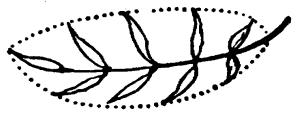
Fig. 37.
A. There is, first, a steady change through the whole line, from less to more curvature, or more to less, so that no part of the line is a segment of a circle, or can be drawn by compasses in any way whatever. Thus, in Fig. 36, a is a bad curve because it is part of a circle, and is therefore monotonous throughout; but b is a good curve, because it continually changes its direction as it proceeds.
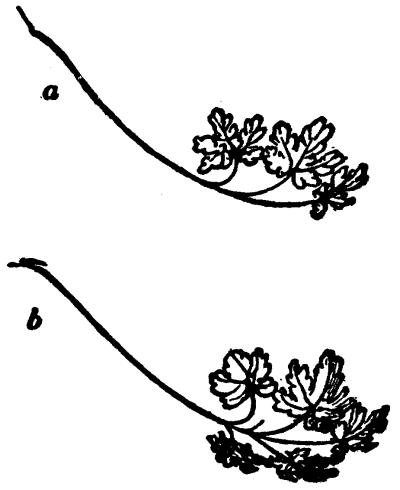
Fig. 38.
The first difference between good and bad drawing of tree boughs consists in observance of this fact. Thus, when I put leaves on the line b, as in Fig. 37, you can immediately feel the springiness of character dependent on the changefulness of the curve. You may put leaves on the other line for yourself, but you will find you cannot make a right tree spray of it. For all tree boughs, large or small, as well as all noble natural lines whatsoever, agree in this character; and it is a point of primal necessity that your eye should always seize and your hand trace it. Here are two more portions of good curves, with leaves put on them at the extremities instead of the flanks, Fig. 38; and two showing the arrangement of masses of foliage seen a little farther off, Fig. 39, which you may in like manner amuse yourself by turning into segments of circles—you will see with what result. I hope however you have beside you, by this time, many good studies of tree boughs carefully made, in which you may study variations of curvature in their most complicated and lovely forms.[59]
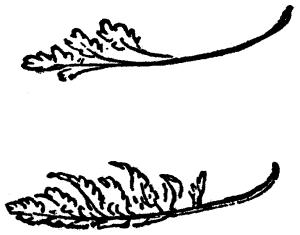
Fig. 39.
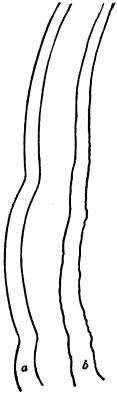
Fig. 40.
209. B. Not only does every good curve vary in general tendency, but it is modulated, as it proceeds, by myriads of subordinate curves. Thus the outlines of a tree trunk are never as at a, Fig. 40, but as at b. So also in waves, clouds, and all other nobly formed masses. Thus another essential difference between good and bad drawing, or good and bad sculpture, depends on the quantity and refinement of minor curvatures carried, by good work, into the great lines. Strictly speaking, however, this is not variation in large curves, but composition of large curves out of small ones; it is an increase in the quantity of the beautiful element, but not a change in its nature.
5. THE LAW OF RADIATION.
210. We have hitherto been concerned only with the binding of our various objects into beautiful lines or processions. The next point we have to consider is, how we may unite these lines or processions themselves, so as to make groups of them.
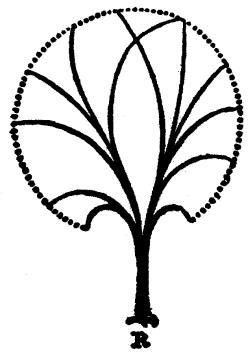
Fig. 41.
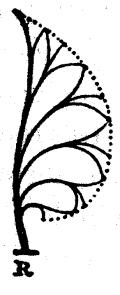
Fig. 42.
Now, there are two kinds of harmonies of lines. One in which, moving more or less side by side, they variously, but evidently with consent, retire from or approach each other, intersect or oppose each other; currents of melody in music, for different voices, thus approach and cross, fall and rise, in harmony; so the waves of the sea, as they approach the shore, flow into one another or cross, but with a great unity through all; and so various lines of composition often flow harmoniously through and across each other in a picture. But the most simple and perfect connection of lines is by radiation; that is, by their all springing from one point, or closing towards it; and this harmony is often, in Nature almost always, united with the other; as the boughs of trees, though they intersect and play amongst each other irregularly, indicate by their general tendency their origin from one root. An essential part of the beauty of all vegetable form is in this radiation; it is seen most simply in a single flower or leaf, as in a convolvulus bell, or chestnut leaf; but more beautifully in the complicated arrangements of the large boughs and sprays. For a leaf is only a flat piece of radiation; but the tree throws its branches on all sides, and even in every profile view of it, which presents a radiation more or less correspondent to that of its leaves, it is more beautiful, because varied by the freedom of the separate branches. I believe it has been ascertained that, in all trees, the angle at which, in their leaves, the lateral ribs are set on their central rib is approximately the same at which the branches leave the great stem; and thus each section of the tree would present a kind of magnified view of its own leaf, were it not for the interfering force of gravity on the masses of foliage. This force in proportion to their age, and the lateral leverage upon them, bears them downwards at the extremities, so that, as before noticed, the lower the bough grows on the stem, the more it droops (Fig. 17, p. 67); besides this, nearly all beautiful trees have a tendency to divide into two or more principal masses, which give a prettier and more complicated symmetry than if one stem ran all the way up the center. Fig. 41 may thus be considered the simplest type of tree radiation, as opposed to leaf radiation. In this figure, however, all secondary ramification is unrepresented, for the sake of simplicity; but if we take one half of such a tree, and merely give two secondary branches to each main branch (as represented in the general branch structure shown at b, Fig. 18, p. 68), we shall have the form Fig. 42. This I consider the perfect general type of tree structure; and it is curiously connected with certain forms of Greek, Byzantine, and Gothic ornamentation, into the discussion of which, however, we must not enter here. It will be observed, that both in Figs. 41 and 42 all the branches so spring from the main stem as very nearly to suggest their united radiation from the root R. This is by no means universally the case; but if the branches do not bend towards a point in the root, they at least converge to some point or other. In the examples in Fig. 43, the mathematical center of curvature, a, is thus, in one case, on the ground, at some distance from the root, and in the other, near the top of the tree. Half, only, of each tree is given, for the sake of clearness: Fig. 44 gives both sides of another example, in which the origins of curvature are below the root. As the positions of such points may be varied without end, and as the arrangement of the lines is also farther complicated by the fact of the boughs springing for the most part in a spiral order round the tree, and at proportionate distances, the systems of curvature which regulate the form of vegetation are quite infinite. Infinite is a word easily said, and easily written, and people do not always mean it when they say it; in this case I do mean it: the number of systems is incalculable, and even to furnish anything like a representative number of types, I should have to give several hundreds of figures such as Fig. 44.[60]
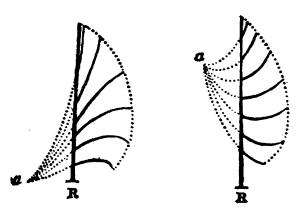
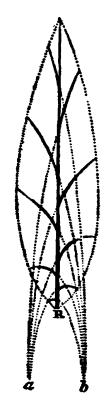
Fig. 43. Fig. 44.
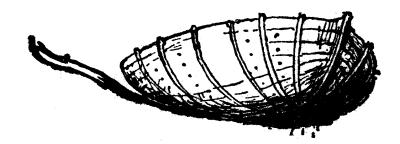
Fig. 45.
211. Thus far, however, we have only been speaking of the great relations of stem and branches. The forms of the branches themselves are regulated by still more subtle laws, for they occupy an intermediate position between the form of the tree and of the leaf. The leaf has a flat ramification; the tree a completely rounded one; the bough is neither rounded nor flat, but has a structure exactly balanced between the two, in a half-flattened, half-rounded flake, closely resembling in shape one of the thick leaves of an artichoke or the flake of a fir cone; by combination forming the solid mass of the tree, as the leaves compose the artichoke head. I have before pointed out to you the general resemblance of these branch flakes to an extended hand; but they may be more accurately represented by the ribs of a boat. If you can imagine a very broad-headed and flattened boat applied by its keel to the end of a main branch,[61] as in Fig. 45, the lines which its ribs will take, supposing them outside of its timbers instead of inside, and the general contour of it, as seen in different directions, from above and below, will give you the closest approximation to the perspectives and foreshortenings of a well-grown branch-flake. Fig. 25 above, p. 89, is an unharmed and unrestrained shoot of healthy young oak; and, if you compare it with Fig. 45, you will understand at once the action of the lines of leafage; the boat only failing as a type in that its ribs are too nearly parallel to each other at the sides, while the bough sends all its ramification well forwards, rounding to the head, that it may accomplish its part in the outer form of the whole tree, yet always securing the compliance with the great universal law that the branches nearest the root bend most back; and, of course, throwing some always back as well as forwards; the appearance of reversed action being much increased, and rendered more striking and beautiful, by perspective. Fig. 25 shows the perspective of such a bough as it is seen from below; Fig. 46 gives rudely the look it would have from above.
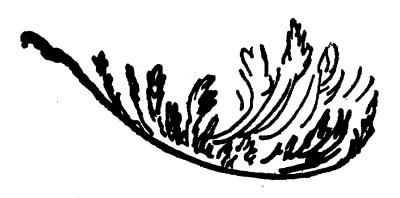
Fig. 46.
212. You may suppose, if you have not already discovered, what subtleties of perspective and light and shade are involved in the drawing of these branch-flakes, as you see them in different directions and actions; now raised, now depressed: touched on the edges by the wind, or lifted up and bent back so as to show all the white under surfaces of the leaves shivering in light, as the bottom of a boat rises white with spray at the surge-crest; or drooping in quietness towards the dew of the grass beneath them in windless mornings, or bowed down under oppressive grace of deep-charged snow. Snow time, by the way, is one of the best for practice in the placing of tree masses; but you will only be able to understand them thoroughly by beginning with a single bough and a few leaves placed tolerably even, as in Fig. 38, p. 149. First one with three leaves, a central and two lateral ones, as at a; then with five, as at b, and so on; directing your whole attention to the expression, both by contour and light and shade, of the boat-like arrangements, which, in your earlier studies, will have been a good deal confused, partly owing to your inexperience, and partly to the depth of shade, or absolute blackness of mass required in those studies.
213. One thing more remains to be noted, and I will let you out of the wood. You see that in every generally representative figure I have surrounded the radiating branches with a dotted line: such lines do indeed terminate every vegetable form; and you see that they are themselves beautiful curves, which, according to their flow, and the width or narrowness of the spaces they inclose, characterize the species of tree or leaf, and express its free or formal action, its grace of youth or weight of age. So that, throughout all the freedom of her wildest foliage, Nature is resolved on expressing an encompassing limit; and marking a unity in the whole tree, caused not only by the rising of its branches from a common root, but by their joining in one work, and being bound by a common law. And having ascertained this, let us turn back for a moment to a point in leaf structure which, I doubt not, you must already have observed in your earlier studies, but which it is well to state here, as connected with the unity of the branches in the great trees. You must have noticed, I should think, that whenever a leaf is compound,—that is to say, divided into other leaflets which in any way repeat or imitate the form of the whole leaf,—those leaflets are not symmetrical, as the whole leaf is, but always smaller on the side towards the point of the great leaf, so as to express their subordination to it, and show, even when they are pulled off, that they are not small independent leaves, but members of one large leaf.
214. Fig. 47, which is a block-plan of a leaf of columbine, without its minor divisions on the edges, will illustrate the principle clearly. It is composed of a central large mass, A, and two lateral ones, of which the one on the right only is lettered, B. Each of these masses is again composed of three others, a central and two lateral ones; but observe, the minor one, a of A, is balanced equally by its opposite; but the minor b 1 of B is larger than its opposite b 2. Again, each of these minor masses is divided into three; but while the central mass, A of A, is symmetrically divided, the B of B is unsymmetrical, its largest side-lobe being lowest. Again, in b 2, the lobe c 1 (its lowest lobe in relation to B) is larger than c 2; and so also in b 1. So that universally one lobe of a lateral leaf is always larger than the other, and the smaller lobe is that which is nearer the central mass; the lower leaf, as it were by courtesy, subduing some of its own dignity or power, in the immediate presence of the greater or captain leaf, and always expressing, therefore, its own subordination and secondary character. This law is carried out even in single leaves. As far as I know, the upper half, towards the point of the spray, is always the smaller; and a slightly different curve, more convex at the springing, is used for the lower side, giving an exquisite variety to the form of the whole leaf; so that one of the chief elements in the beauty of every subordinate leaf throughout the tree is made to depend on its confession of its own lowliness and subjection.
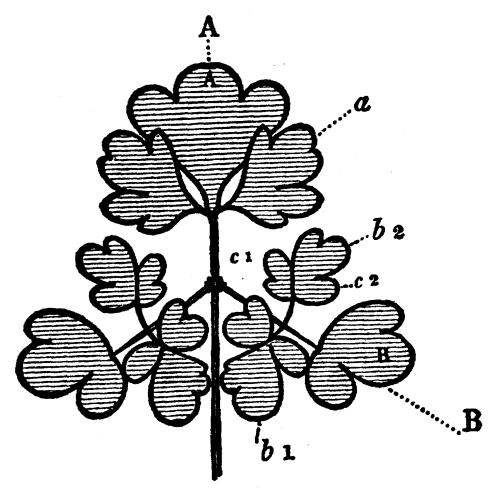
Fig. 47.
215. And now, if we bring together in one view the principles we have ascertained in trees, we shall find they may be summed under four great laws; and that all perfect[62] vegetable form is appointed to express these four laws in noble balance of authority.
1. Support from one living root.
2. Radiation, or tendency of force from some one given point, either in the root or in some stated connection with it.
3. Liberty of each bough to seek its own livelihood and happiness according to its needs, by irregularities of action both in its play and its work, either stretching out to get its required nourishment from light and rain, by finding some sufficient breathing-place among the other branches, or knotting and gathering itself up to get strength for any load which its fruitful blossoms may lay upon it, and for any stress of its storm-tossed luxuriance of leaves; or playing hither and thither as the fitful sunshine may tempt its young shoots, in their undecided states of mind about their future life.
4. Imperative requirement of each bough to stop within certain limits, expressive of its kindly fellowship and fraternity with the boughs in its neighborhood; and to work with them according to its power, magnitude, and state of health, to bring out the general perfectness of the great curve, and circumferent stateliness of the whole tree.
216. I think I may leave you, unhelped, to work out the moral analogies of these laws; you may, perhaps, however, be a little puzzled to see the meaning of the second one. It typically expresses that healthy human actions should spring radiantly (like rays) from some single heart motive; the most beautiful systems of action taking place when this motive lies at the root of the whole life, and the action is clearly seen to proceed from it; while also many beautiful secondary systems of action taking place from motives not so deep or central, but in some beautiful subordinate connection with the central or life motive.
The other laws, if you think over them, you will find equally significative; and as you draw trees more and more in their various states of health and hardship, you will be every day more struck by the beauty of the types they present of the truths most essential for mankind to know;[63] and you will see what this vegetation of the earth, which is necessary to our life, first, as purifying the air for us and then as food, and just as necessary to our joy in all places of the earth,—what these trees and leaves, I say, are meant to teach us as we contemplate them, and read or hear their lovely language, written or spoken for us, not in frightful black letters nor in dull sentences, but in fair green and shadowy shapes of waving words, and blossomed brightness of odoriferous wit, and sweet whispers of unintrusive wisdom, and playful morality.
217. Well, I am sorry myself to leave the wood, whatever my reader may be; but leave it we must, or we shall compose no more pictures to-day.
This law of radiation, then, enforcing unison of action in arising from, or proceeding to, some given point, is perhaps, of all principles of composition, the most influential in producing the beauty of groups of form. Other laws make them forcible or interesting, but this generally is chief in rendering them beautiful. In the arrangement of masses in pictures, it is constantly obeyed by the great composers; but, like the law of principality, with careful concealment of its imperativeness, the point to which the lines of main curvature are directed being very often far away out of the picture. Sometimes, however, a system of curves will be employed definitely to exalt, by their concurrence, the value of some leading object, and then the law becomes traceable enough.
218. In the instance before us, the principal object being, as we have seen, the tower on the bridge, Turner has determined that his system of curvature should have its origin in the top of this tower. The diagram Fig. 34, p. 145, compared with Fig. 32, p. 137, will show how this is done. One curve joins the two towers, and is continued by the back of the figure sitting on the bank into the piece of bent timber. This is a limiting curve of great importance, and Turner has drawn a considerable part of it with the edge of the timber very carefully, and then led the eye up to the sitting girl by some white spots and indications of a ledge in the bank; then the passage to the tops of the towers cannot be missed.
219. The next curve is begun and drawn carefully for half an inch of its course by the rudder; it is then taken up by the basket and the heads of the figures, and leads accurately to the tower angle. The gunwales of both the boats begin the next two curves, which meet in the same point; and all are centralized by the long reflection which continues the vertical lines.
220. Subordinated to this first system of curves there is another, begun by the small crossing bar of wood inserted in the angle behind the rudder; continued by the bottom of the bank on which the figure sits, interrupted forcibly beyond it,[64] but taken up again by the water-line leading to the bridge foot, and passing on in delicate shadows under the arches, not easily shown in so rude a diagram, towards the other extremity of the bridge. This is a most important curve, indicating that the force and sweep of the river have indeed been in old times under the large arches; while the antiquity of the bridge is told us by a long tongue of land, either of carted rubbish, or washed down by some minor stream, which has interrupted this curve, and is now used as a landing-place for the boats, and for embarkation of merchandise, of which some bales and bundles are laid in a heap, immediately beneath the great tower. A common composer would have put these bales to one side or the other, but Turner knows better; he uses them as a foundation for his tower, adding to its importance precisely as the sculptured base adorns a pillar; and he farther increases the aspect of its height by throwing the reflection of it far down in the nearer water. All the great composers have this same feeling about sustaining their vertical masses: you will constantly find Prout using the artifice most dexterously (see, for instance, the figure with the wheelbarrow under the great tower, in the sketch of St. Nicholas, at Prague, and the white group of figures under the tower in the sketch of Augsburg[65]); and Veronese, Titian, and Tintoret continually put their principal figures at bases of pillars. Turner found out their secret very early, the most prominent instance of his composition on this principle being the drawing of Turin from the Superga, in Hakewell's Italy. I chose Fig. 20, already given to illustrate foliage drawing, chiefly because, being another instance of precisely the same arrangement, it will serve to convince you of its being intentional. There, the vertical, formed by the larger tree, is continued by the figure of the farmer, and that of one of the smaller trees by his stick. The lines of the interior mass of the bushes radiate, under the law of radiation, from a point behind the farmer's head; but their outline curves are carried on and repeated, under the law of continuity, by the curves of the dog and boy—by the way, note the remarkable instance in these of the use of darkest lines towards the light—all more or less guiding the eye up to the right, in order to bring it finally to the Keep of Windsor, which is the central object of the picture, as the bridge tower is in the Coblentz. The wall on which the boy climbs answers the purpose of contrasting, both in direction and character, with these greater curves; thus corresponding as nearly as possible to the minor tongue of land in the Coblentz. This, however, introduces us to another law, which we must consider separately.
6. THE LAW OF CONTRAST.
221. Of course the character of everything is best manifested by Contrast. Rest can only be enjoyed after labor; sound to be heard clearly, must rise out of silence; light is exhibited by darkness, darkness by light; and so on in all things. Now in art every color has an opponent color, which, if brought near it, will relieve it more completely than any other; so, also, every form and line may be made more striking to the eye by an opponent form or line near them; a curved line is set off by a straight one, a massy form by a slight one, and so on; and in all good work nearly double the value, which any given color or form would have uncombined, is given to each by contrast.[66]
In this case again, however, a too manifest use of the artifice vulgarizes a picture. Great painters do not commonly, or very visibly, admit violent contrast. They introduce it by stealth, and with intermediate links of tender change; allowing, indeed, the opposition to tell upon the mind as a surprise, but not as a shock.[67]
222. Thus in the rock of Ehrenbreitstein, Fig. 35, the main current of the lines being downwards, in a convex swell, they are suddenly stopped at the lowest tower by a counter series of beds, directed nearly straight across them. This adverse force sets off and relieves the great curvature, but it is reconciled to it by a series of radiating lines below, which at first sympathize with the oblique bar, then gradually get steeper, till they meet and join in the fall of the great curve. No passage, however intentionally monotonous, is ever introduced by a good artist without some slight counter current of this kind; so much, indeed, do the great composers feel the necessity of it, that they will even do things purposely ill or unsatisfactorily, in order to give greater value to their well-doing in other places. In a skillful poet's versification the so-called bad or inferior lines are not inferior because he could not do them better, but because he feels that if all were equally weighty, there would be no real sense of weight anywhere; if all were equally melodious, the melody itself would be fatiguing; and he purposely introduces the laboring or discordant verse, that the full ring may be felt in his main sentence, and the finished sweetness in his chosen rhythm.[68] And continually in painting, inferior artists destroy their work by giving too much of all that they think is good, while the great painter gives just enough to be enjoyed, and passes to an opposite kind of enjoyment, or to an inferior state of enjoyment: he gives a passage of rich, involved, exquisitely wrought color, then passes away into slight, and pale, and simple color; he paints for a minute or two with intense decision, then suddenly becomes, as the spectator thinks, slovenly; but he is not slovenly: you could not have taken any more decision from him just then; you have had as much as is good for you: he paints over a great space of his picture forms of the most rounded and melting tenderness, and suddenly, as you think by a freak, gives you a bit as jagged and sharp as a leafless blackthorn. Perhaps the most exquisite piece of subtle contrast in the world of painting is the arrow point, laid sharp against the white side and among the flowing hair of Correggio's Antiope. It is quite singular how very little contrast will sometimes serve to make an entire group of forms interesting which would otherwise have been valueless. There is a good deal of picturesque material, for instance, in this top of an old tower, Fig. 48, tiles and stones and sloping roof not disagreeably mingled; but all would have been unsatisfactory if there had not happened to be that iron ring on the inner wall, which by its vigorous black circular line precisely opposes all the square and angular characters of the battlements and roof. Draw the tower without the ring, and see what a difference it will make.
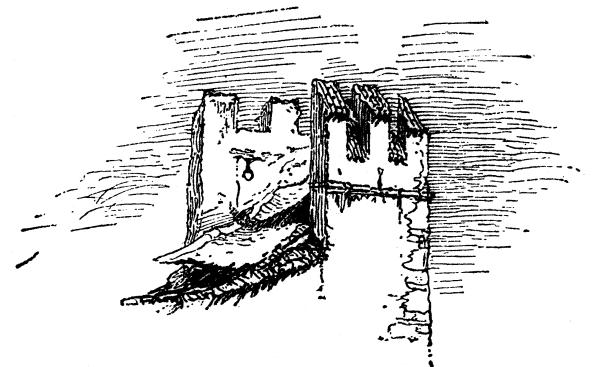
Fig. 48.
223. One of the most important applications of the law of contrast is in association with the law of continuity, causing an unexpected but gentle break in a continuous series. This artifice is perpetual in music, and perpetual also in good illumination; the way in which little surprises of change are prepared in any current borders, or chains of ornamental design, being one of the most subtle characteristics of the work of the good periods. We take, for instance, a bar of ornament between two written columns of an early fourteenth century MS., and at the first glance we suppose it to be quite monotonous all the way up, composed of a winding tendril, with alternately a blue leaf and a scarlet bud. Presently, however, we see that, in order to observe the law of principality, there is one large scarlet leaf instead of a bud, nearly half-way up, which forms a center to the whole rod; and when we begin to examine the order of the leaves, we find it varied carefully. Let A stand for scarlet bud, b for blue leaf, c for two blue leaves on one stalk, s for a stalk without a leaf, and R, for the large red leaf. Then, counting from the ground, the order begins as follows:
b, b, A; b, s, b, A; b, b, A; b, b, A; and we think we shall have two b's and an A all the way, when suddenly it becomes b, A; b, R; b, A; b, A; b, A; and we think we are going to have b, A continued; but no: here it becomes b, s; b, s; b, A; b, s; b, s; c, s; b, s; b, s; and we think we are surely going to have b, s continued, but behold it runs away to the end with a quick b, b, A; b, b, b, b![69] Very often, however, the designer is satisfied with one surprise, but I never saw a good illuminated border without one at least; and no series of any kind was ever introduced by a great composer in a painting without a snap somewhere. There is a pretty one in Turner's drawing of Rome with the large balustrade for a foreground in the Hakewell's Italy series: the single baluster struck out of the line, and showing the street below through the gap, simply makes the whole composition right, when otherwise it would have been stiff and absurd.
224. If you look back to Fig. 48 you will see, in the arrangement of the battlements, a simple instance of the use of such variation. The whole top of the tower, though actually three sides of a square, strikes the eye as a continuous series of five masses. The first two, on the left, somewhat square and blank, then the next two higher and richer, the tiles being seen on their slopes. Both these groups being couples, there is enough monotony in the series to make a change pleasant; and the last battlement, therefore, is a little higher than the first two,—a little lower than the second two,—and different in shape from either. Hide it with your finger, and see how ugly and formal the other four battlements look.
225. There are in this figure several other simple illustrations of the laws we have been tracing. Thus the whole shape of the walls' mass being square, it is well, still for the sake of contrast, to oppose it not only by the element of curvature, in the ring, and lines of the roof below, but by that of sharpness; hence the pleasure which the eye takes in the projecting point of the roof. Also, because the walls are thick and sturdy, it is well to contrast their strength with weakness; therefore we enjoy the evident decrepitude of this roof as it sinks between them. The whole mass being nearly white, we want a contrasting shadow somewhere; and get it, under our piece of decrepitude. This shade, with the tiles of the wall below, forms another pointed mass, necessary to the first by the law of repetition. Hide this inferior angle with your finger, and see how ugly the other looks. A sense of the law of symmetry, though you might hardly suppose it, has some share in the feeling with which you look at the battlements; there is a certain pleasure in the opposed slopes of their top, on one side down to the left, on the other to the right. Still less would you think the law of radiation had anything to do with the matter: but if you take the extreme point of the black shadow on the left for a center, and follow first the low curve of the eaves of the wall, it will lead you, if you continue it, to the point of the tower cornice; follow the second curve, the top of the tiles of the wall, and it will strike the top of the right-hand battlement; then draw a curve from the highest point of the angled battlement on the left, through the points of the roof and its dark echo; and you will see how the whole top of the tower radiates from this lowest dark point. There are other curvatures crossing these main ones, to keep them from being too conspicuous. Follow the curve of the upper roof, it will take you to the top of the highest battlement; and the stones indicated at the right-hand side of the tower are more extended at the bottom, in order to get some less direct expression of sympathy, such as irregular stones may be capable of, with the general flow of the curves from left to right.
226. You may not readily believe, at first, that all these laws are indeed involved in so trifling a piece of composition. But, as you study longer, you will discover that these laws, and many more, are obeyed by the powerful composers in every touch: that literally, there is never a dash of their pencil which is not carrying out appointed purposes of this kind in twenty various ways at once; and that there is as much difference, in way of intention and authority, between one of the great composers ruling his colors, and a common painter confused by them, as there is between a general directing the march of an army, and an old lady carried off her feet by a mob.
7. THE LAW OF INTERCHANGE.
227. Closely connected with the law of contrast is a law which enforces the unity of opposite things, by giving to each a portion of the character of the other. If, for instance, you divide a shield into two masses of color, all the way down—suppose blue and white, and put a bar, or figure of an animal, partly on one division, partly on the other, you will find it pleasant to the eye if you make the part of the animal blue which comes upon the white half, and white which comes upon the blue half. This is done in heraldry, partly for the sake of perfect intelligibility, but yet more for the sake of delight in interchange of color, since, in all ornamentation whatever, the practice is continual, in the ages of good design.
228. Sometimes this alternation is merely a reversal of contrasts; as that, after red has been for some time on one side, and blue on the other, red shall pass to blue's side and blue to red's. This kind of alternation takes place simply in four-quartered shields; in more subtle pieces of treatment, a little bit only of each color is carried into the other, and they are as it were dovetailed together. One of the most curious facts which will impress itself upon you, when you have drawn some time carefully from Nature in light and shade, is the appearance of intentional artifice with which contrasts of this alternate kind are produced by her; the artistry with which she will darken a tree trunk as long as it comes against light sky, and throw sunlight on it precisely at the spot where it comes against a dark hill, and similarly treat all her masses of shade and color, is so great, that if you only follow her closely, every one who looks at your drawing with attention will think that you have been inventing the most artificially and unnaturally delightful interchanges of shadow that could possibly be devised by human wit.
229. You will find this law of interchange insisted upon at length by Prout in his Lessons on Light and Shade: it seems of all his principles of composition to be the one he is most conscious of; many others he obeys by instinct, but this he formally accepts and forcibly declares.
The typical purpose of the law of interchange is, of course, to teach us how opposite natures may be helped and strengthened by receiving each, as far as they can, some impress or reflection, or imparted power, from the other.
8. THE LAW OF CONSISTENCY.
230. It is to be remembered, in the next place, that while contrast exhibits the characters of things, it very often neutralizes or paralyzes their power. A number of white things may be shown to be clearly white by opposition of a black thing, but if we want the full power of their gathered light, the black thing may be seriously in our way. Thus, while contrast displays things, it is unity and sympathy which employ them, concentrating the power of several into a mass. And, not in art merely, but in all the affairs of life, the wisdom of man is continually called upon to reconcile these opposite methods of exhibiting, or using, the materials in his power. By change he gives them pleasantness, and by consistency value; by change he is refreshed, and by perseverance strengthened.
231. Hence many compositions address themselves to the spectator by aggregate force of color or line, more than by contrasts of either; many noble pictures are painted almost exclusively in various tones of red, or gray, or gold, so as to be instantly striking by their breadth of flush, or glow, or tender coldness, these qualities being exhibited only by slight and subtle use of contrast. Similarly as to form; some compositions associate massive and rugged forms, others slight and graceful ones, each with few interruptions by lines of contrary character. And, in general, such compositions possess higher sublimity than those which are more mingled in their elements. They tell a special tale, and summon a definite state of feeling, while the grand compositions merely please the eye.
232. This unity or breadth of character generally attaches most to the works of the greatest men; their separate pictures have all separate aims. We have not, in each, gray color set against somber, and sharp forms against soft, and loud passages against low: but we have the bright picture, with its delicate sadness; the somber picture, with its single ray of relief; the stern picture, with only one tender group of lines; the soft and calm picture, with only one rock angle at its flank; and so on. Hence the variety of their work, as well as its impressiveness. The principal bearing of this law, however, is on the separate masses or divisions of a picture: the character of the whole composition may be broken or various, if we please, but there must certainly be a tendency to consistent assemblage in its divisions. As an army may act on several points at once, but can only act effectually by having somewhere formed and regular masses, and not wholly by skirmishers; so a picture may be various in its tendencies, but must be somewhere united and coherent in its masses. Good composers are always associating their colors in great groups; binding their forms together by encompassing lines, and securing, by various dexterities of expedient, what they themselves call "breadth:" that is to say, a large gathering of each kind of thing into one place; light being gathered to light, darkness to darkness, and color to color. If, however, this be done by introducing false lights or false colors, it is absurd and monstrous; the skill of a painter consists in obtaining breadth by rational arrangement of his objects, not by forced or wanton treatment of them. It is an easy matter to paint one thing all white, and another all black or brown; but not an easy matter to assemble all the circumstances which will naturally produce white in one place, and brown in another. Generally speaking, however, breadth will result in sufficient degree from fidelity of study: Nature is always broad; and if you paint her colors in true relations, you will paint them in majestic masses. If you find your work look broken and scattered, it is, in all probability, not only ill composed, but untrue.
233. The opposite quality to breadth, that of division or scattering of light and color, has a certain contrasting charm, and is occasionally introduced with exquisite effect by good composers.[70] Still it is never the mere scattering, but the order discernible through this scattering, which is the real source of pleasure; not the mere multitude, but the constellation of multitude. The broken lights in the work of a good painter wander like flocks upon the hills, not unshepherded, speaking of life and peace: the broken lights of a bad painter fall like hailstones, and are capable only of mischief, leaving it to be wished they were also of dissolution.
9. THE LAW OF HARMONY.
234. This last law is not, strictly speaking, so much one of composition as of truth, but it must guide composition, and is properly, therefore, to be stated in this place.
Good drawing is, as we have seen, an abstract of natural facts; you cannot represent all that you would, but must continually be falling short, whether you will or no, of the force, or quantity, of Nature. Now, suppose that your means and time do not admit of your giving the depth of color in the scene, and that you are obliged to paint it paler. If you paint all the colors proportionately paler, as if an equal quantity of tint had been washed away from each of them, you still obtain a harmonious, though not an equally forcible, statement of natural fact. But if you take away the colors unequally, and leave some tints nearly as deep as they are in Nature, while others are much subdued, you have no longer a true statement. You cannot say to the observer, "Fancy all those colors a little deeper, and you will have the actual fact." However he adds in imagination, or takes away, something is sure to be still wrong. The picture is out of harmony.
235. It will happen, however, much more frequently, that you have to darken the whole system of colors, than to make them paler. You remember, in your first studies of color from Nature, you were to leave the passages of light which were too bright to be imitated, as white paper. But, in completing the picture, it becomes necessary to put color into them; and then the other colors must be made darker, in some fixed relation to them. If you deepen all proportionately, though the whole scene is darker than reality, it is only as if you were looking at the reality in a lower light: but if, while you darken some of the tints, you leave others undarkened, the picture is out of harmony, and will not give the impression of truth.
236. It is not, indeed, possible to deepen all the colors so much as to relieve the lights in their natural degree, you would merely sink most of your colors, if you tried to do so, into a broad mass of blackness: but it is quite possible to lower them harmoniously, and yet more in some parts of the picture than in others, so as to allow you to show the light you want in a visible relief. In well-harmonized pictures this is done by gradually deepening the tone of the picture towards the lighter parts of it, without materially lowering it in the very dark parts; the tendency in such pictures being, of course, to include large masses of middle tints. But the principal point to be observed in doing this, is to deepen the individual tints without dirtying or obscuring them. It is easy to lower the tone of the picture by washing it over with gray or brown; and easy to see the effect of the landscape, when its colors are thus universally polluted with black, by using the black convex mirror, one of the most pestilent inventions for falsifying Nature and degrading art which ever was put into an artist's hand.[71] For the thing required is not to darken pale yellow by mixing gray with it, but to deepen the pure yellow; not to darken crimson by mixing black with it, but by making it deeper and richer crimson: and thus the required effect could only be seen in Nature, if you had pieces of glass of the color of every object in your landscape, and of every minor hue that made up those colors, and then could see the real landscape through this deep gorgeousness of the varied glass. You cannot do this with glass, but you can do it for yourself as you work; that is to say, you can put deep blue for pale blue, deep gold for pale gold, and so on, in the proportion you need; and then you may paint as forcibly as you choose, but your work will still be in the manner of Titian, not of Caravaggio or Spagnoletto, or any other of the black slaves of painting.[72]
237. Supposing those scales of color, which I told you to prepare in order to show you the relations of color to gray, were quite accurately made, and numerous enough, you would have nothing more to do, in order to obtain a deeper tone in any given mass of color, than to substitute for each of its hues the hue as many degrees deeper in the scale as you wanted, that is to say, if you wanted to deepen the whole two degrees, substituting for the yellow No. 5 the yellow No. 7, and for the red No. 9 the red No. 11, and so on: but the hues of any object in Nature are far too numerous, and their degrees too subtle, to admit of so mechanical a process. Still, you may see the principle of the whole matter clearly by taking a group of colors out of your scale, arranging them prettily, and then washing them all over with gray: that represents the treatment of Nature by the black mirror. Then arrange the same group of colors, with the tints five or six degrees deeper in the scale; and that will represent the treatment of Nature by Titian.
238. You can only, however, feel your way fully to the right of the thing by working from Nature.
The best subject on which to begin a piece of study of this kind is a good thick tree trunk, seen against blue sky with some white clouds in it. Paint the clouds in true and tenderly gradated white; then give the sky a bold full blue, bringing them well out; then paint the trunk and leaves grandly dark against all, but in such glowing dark green and brown as you see they will bear. Afterwards proceed to more complicated studies, matching the colors carefully first by your old method; then deepening each color with its own tint, and being careful, above all things, to keep truth of equal change when the colors are connected with each other, as in dark and light sides of the same object. Much more aspect and sense of harmony are gained by the precision with which you observe the relation of colors in dark sides and light sides, and the influence of modifying reflections, than by mere accuracy of added depth in independent colors.
239. This harmony of tone, as it is generally called, is the most important of those which the artist has to regard. But there are all kinds of harmonies in a picture, according to its mode of production. There is even a harmony of touch. If you paint one part of it very rapidly and forcibly, and another part slowly and delicately, each division of the picture may be right separately, but they will not agree together: the whole will be effectless and valueless, out of harmony. Similarly, if you paint one part of it by a yellow light in a warm day, and another by a gray light in a cold day, though both may have been sunlight, and both may be well toned, and have their relative shadows truly cast, neither will look like light; they will destroy each other's power, by being out of harmony. These are only broad and definable instances of discordance; but there is an extent of harmony in all good work much too subtle for definition; depending on the draughtsman's carrying everything he draws up to just the balancing and harmonious point, in finish, and color, and depth of tone, and intensity of moral feeling, and style of touch, all considered at once; and never allowing himself to lean too emphatically on detached parts, or exalt one thing at the expense of another, or feel acutely in one place and coldly in another. If you have got some of Cruikshank's etchings, you will be able, I think, to feel the nature of harmonious treatment in a simple kind, by comparing them with any of Richter's illustrations to the numerous German story-books lately published at Christmas, with all the German stories spoiled. Cruikshank's work is often incomplete in character and poor in incident, but, as drawing, it is perfect in harmony. The pure and simple effects of daylight which he gets by his thorough mastery of treatment in this respect, are quite unrivaled, as far as I know, by any other work executed with so few touches. His vignettes to Grimm's German stories, already recommended, are the most remarkable in this quality. Richter's illustrations, on the contrary, are of a very high stamp as respects understanding of human character, with infinite playfulness and tenderness of fancy; but, as drawings, they are almost unendurably out of harmony, violent blacks in one place being continually opposed to trenchant white in another; and, as is almost sure to be the case with bad harmonists, the local color hardly felt anywhere. All German work is apt to be out of harmony, in consequence of its too frequent conditions of affectation, and its willful refusals of fact; as well as by reason of a feverish kind of excitement, which dwells violently on particular points, and makes all the lines of thought in the picture to stand on end, as it were, like a cat's fur electrified; while good work is always as quiet as a couchant leopard, and as strong.
240. I have now stated to you all the laws of composition which occur to me as capable of being illustrated or defined; but there are multitudes of others which, in the present state of my knowledge, I cannot define, and others which I never hope to define; and these the most important, and connected with the deepest powers of the art. I hope, when I have thought of them more, to be able to explain some of the laws which relate to nobleness and ignobleness; that ignobleness especially which we commonly call "vulgarity" and which, in its essence, is one of the most curious subjects of inquiry connected with human feeling. Others I never hope to explain, laws of expression, bearing simply on simple matters; but, for that very reason, more influential than any others. These are, from the first, as inexplicable as our bodily sensations are; it being just as impossible, I think, to show, finally, why one succession of musical notes[73] shall be lofty and pathetic, and such as might have been sung by Casella to Dante, and why another succession is base and ridiculous, and would be fit only for the reasonably good ear of Bottom, as to explain why we like sweetness, and dislike bitterness. The best part of every great work is always inexplicable: it is good because it is good; and innocently gracious, opening as the green of the earth, or falling as the dew of heaven.
241. But though you cannot explain them, you may always render yourself more and more sensitive to these higher qualities by the discipline which you generally give to your character, and this especially with regard to the choice of incidents; a kind of composition in some sort easier than the artistical arrangements of lines and colors, but in every sort nobler, because addressed to deeper feelings.
242. For instance, in the "Datur Hora Quieti," the last vignette to Rogers's Poems, the plow in the foreground has three purposes. The first purpose is to meet the stream of sunlight on the river, and make it brighter by opposition; but any dark object whatever would have done this. Its second purpose is, by its two arms, to repeat the cadence of the group of the two ships, and thus give a greater expression of repose; but two sitting figures would have done this. Its third and chief, or pathetic, purpose is, as it lies abandoned in the furrow (the vessels also being moored, and having their sails down), to be a type of human labor closed with the close of day. The parts of it on which the hand leans are brought most clearly into sight; and they are the chief dark of the picture, because the tillage of the ground is required of man as a punishment: but they make the soft light of the setting sun brighter, because rest is sweetest after toil. These thoughts may never occur to us as we glance carelessly at the design; and yet their under current assuredly affects the feelings, and increases, as the painter meant it should, the impression of melancholy, and of peace.
243. Again, in the "Lancaster Sands," which is one of the plates I have marked as most desirable for your possession: the stream of light which falls from the setting sun on the advancing tide stands similarly in need of some force of near object to relieve its brightness. But the incident which Turner has here adopted is the swoop of an angry sea-gull at a dog, who yelps at it, drawing back as the wave rises over his feet, and the bird shrieks within a foot of his face. Its unexpected boldness is a type of the anger of its ocean element, and warns us of the sea's advance just as surely as the abandoned plow told us of the ceased labor of the day.
244. It is not, however, so much in the selection of single incidents of this kind, as in the feeling which regulates the arrangement of the whole subject, that the mind of a great composer is known. A single incident may be suggested by a felicitous chance, as a pretty motto might be for the heading of a chapter. But the great composers so arrange all their designs that one incident illustrates another, just as one color relieves another. Perhaps the "Heysham," of the Yorkshire series, which, as to its locality, may be considered a companion to the last drawing we have spoken of, the "Lancaster Sands," presents as interesting an example as we could find of Turner's feeling in this respect. The subject is a simple north-country village, on the shore of Morecambe Bay; not in the common sense a picturesque village; there are no pretty bow-windows, or red roofs, or rocky steps of entrance to the rustic doors, or quaint gables; nothing but a single street of thatched and chiefly clay-built cottages, ranged in a somewhat monotonous line, the roofs so green with moss that at first we hardly discern the houses from the fields and trees. The village street is closed at the end by a wooden gate, indicating the little traffic there is on the road through it, and giving it something the look of a large farmstead, in which a right of way lies through the yard. The road which leads to this gate is full of ruts, and winds down a bad bit of hill between two broken banks of moor ground, succeeding immediately to the few inclosures which surround the village; they can hardly be called gardens: but a decayed fragment or two of fencing fill the gaps in the bank; a clothes-line, with some clothes on it, striped blue and red, and a smock-frock, is stretched between the trunks of some stunted willows; a very small haystack and pig-sty being seen at the back of the cottage beyond. An empty, two-wheeled, lumbering cart, drawn by a pair of horses with huge wooden collars, the driver sitting lazily in the sun, sideways on the leader, is going slowly home along the rough road, it being about country dinner-time. At the end of the village there is a better house, with three chimneys and a dormer window in its roof, and the roof is of stone shingle instead of thatch, but very rough. This house is no doubt the clergyman's: there is some smoke from one of its chimneys, none from any other in the village; this smoke is from the lowest chimney at the back, evidently that of the kitchen, and it is rather thick, the fire not having been long lighted. A few hundred yards from the clergyman's house, nearer the shore, is the church, discernible from the cottages only by its low two-arched belfry, a little neater than one would expect in such a village; perhaps lately built by the Puseyite incumbent:[74] and beyond the church, close to the sea, are two fragments of a border war-tower, standing on their circular mound, worn on its brow deep into edges and furrows by the feet of the village children. On the bank of moor, which forms the foreground, are a few cows, the carter's dog barking at a vixenish one: the milkmaid is feeding another, a gentle white one, which turns its head to her, expectant of a handful of fresh hay, which she has brought for it in her blue apron, fastened up round her waist; she stands with her pail on her head, evidently the village coquette, for she has a neat bodice, and pretty striped petticoat under the blue apron, and red stockings. Nearer us, the cowherd, bare-footed, stands on a piece of the limestone rock (for the ground is thistly and not pleasurable to bare feet);—whether boy or girl we are not sure: it may be a boy, with a girl's worn-out bonnet on, or a girl with a pair of ragged trousers on; probably the first, as the old bonnet is evidently useful to keep the sun out of our eyes when we are looking for strayed cows among the moorland hollows, and helps us at present to watch (holding the bonnet's edge down) the quarrel of the vixenish cow with the dog, which, leaning on our long stick, we allow to proceed without any interference. A little to the right the hay is being got in, of which the milkmaid has just taken her apronful to the white cow; but the hay is very thin, and cannot well be raked up because of the rocks; we must glean it like corn, hence the smallness of our stack behind the willows; and a woman is pressing a bundle of it hard together, kneeling against the rock's edge, to carry it safely to the hay-cart without dropping any. Beyond the village is a rocky hill, deep set with brushwood, a square crag or two of limestone emerging here and there, with pleasant turf on their brows, heaved in russet and mossy mounds against the sky, which, clear and calm, and as golden as the moss, stretches down behind it towards the sea. A single cottage just shows its roof over the edge of the hill, looking seawards: perhaps one of the village shepherds is a sea captain now, and may have built it there, that his mother may first see the sails of his ship whenever it runs into the bay. Then under the hill, and beyond the border tower, is the blue sea itself, the waves flowing in over the sand in long curved lines slowly; shadows of cloud, and gleams of shallow water on white sand alternating—miles away; but no sail is visible, not one fisher-boat on the beach, not one dark speck on the quiet horizon. Beyond all are the Cumberland mountains, clear in the sun, with rosy light on all their crags.
245. I should think the reader cannot but feel the kind of harmony there is in this composition; the entire purpose of the painter to give us the impression of wild, yet gentle, country life, monotonous as the succession of the noiseless waves, patient and enduring as the rocks; but peaceful, and full of health and quiet hope, and sanctified by the pure mountain air and baptismal dew of heaven, falling softly between days of toil and nights of innocence.
246. All noble composition of this kind can be reached only by instinct; you cannot set yourself to arrange such a subject; you may see it, and seize it, at all times, but never laboriously invent it. And your power of discerning what is best in expression, among natural subjects, depends wholly on the temper in which you keep your own mind; above all, on your living so much alone as to allow it to become acutely sensitive in its own stillness. The noisy life of modern days is wholly incompatible with any true perception of natural beauty. If you go down into Cumberland by the railroad, live in some frequented hotel, and explore the hills with merry companions, however much you may enjoy your tour or their conversation, depend upon it you will never choose so much as one pictorial subject rightly; you will not see into the depth of any. But take knapsack and stick, walk towards the hills by short day's journeys,—ten or twelve miles a day—taking a week from some starting-place sixty or seventy miles away: sleep at the pretty little wayside inns, or the rough village ones; then take the hills as they tempt you, following glen or shore as your eye glances or your heart guides, wholly scornful of local fame or fashion, and of everything which it is the ordinary traveler's duty to see, or pride to do. Never force yourself to admire anything when you are not in the humor; but never force yourself away from what you feel to be lovely, in search of anything better; and gradually the deeper scenes of the natural world will unfold themselves to you in still increasing fullness of passionate power; and your difficulty will be no more to seek or to compose subjects, but only to choose one from among the multitude of melodious thoughts with which you will be haunted, thoughts which will of course be noble or original in proportion to your own depth of character and general power of mind; for it is not so much by the consideration you give to any single drawing, as by the previous discipline of your powers of thought, that the character of your composition will be determined. Simplicity of life will make you sensitive to the refinement and modesty of scenery, just as inordinate excitement and pomp of daily life will make you enjoy coarse colors and affected forms. Habits of patient comparison and accurate judgment will make your art precious, as they will make your actions wise; and every increase of noble enthusiasm in your living spirit will be measured by the reflection of its light upon the works of your hands.—Faithfully yours,
J. Ruskin.
APPENDIX.
I.
ILLUSTRATIVE NOTES.
247. I am sorry to find a notion current among artists, that they can, in some degree, imitate in a picture the effect of the stereoscope, by confusion of lines. There are indeed one or two artifices by which, as stated in the text, an appearance of retirement or projection may be obtained, so that they partly supply the place of the stereoscopic effect, but they do not imitate that effect. The principle of the human sight is simply this:—by means of our two eyes we literally see everything from two places at once; and, by calculated combination, in the brain, of the facts of form so seen, we arrive at conclusions respecting the distance and shape of the object, which we could not otherwise have reached. But it is just as vain to hope to paint at once the two views of the object as seen from these two places, though only an inch and a half distant from each other, as it would be if they were a mile and a half distant from each other. With the right eye you see one view of a given object, relieved against one part of the distance; with the left eye you see another view of it, relieved against another part of the distance. You may paint whichever of those views you please; you cannot paint both. Hold your finger upright, between you and this page of the book, about six inches from your eyes, and three from the book; shut the right eye, and hide the words "inches from," in the second line above this, with your finger; you will then see "six" on one side of it, and "your," on the other. Now shut the left eye and open the right without moving your finger, and you will see "inches," but not "six." You may paint the finger with "inches" beyond it, or with "six" beyond it, but not with both. And this principle holds for any object and any distance. You might just as well try to paint St. Paul's at once from both ends of London Bridge as to realize any stereoscopic effect in a picture.
248. It ought to have been farther observed, that the inclosure of the light by future shadow is by no means the only reason for the dark lines which great masters often thus introduce. It constantly happens that a local color will show its own darkness most on the light side, by projecting into and against masses of light in that direction; and then the painter will indicate this future force of the mass by his dark touch. Both the monk's head in Fig. 11 and dog in Fig. 20 are dark towards the light for this reason.
249. I have not quite insisted enough on the extreme care which is necessary in giving the tender evanescence of the edges of the reflections, when the water is in the least agitated; nor on the decision with which you may reverse the object, when the water is quite calm. Most drawing of reflections is at once confused and hard; but Nature's is at once intelligible and tender. Generally, at the edge of the water, you ought not to see where reality ceases and reflection begins; as the image loses itself you ought to keep all its subtle and varied veracities, with the most exquisite softening of its edge. Practice as much as you can from the reflections of ships in calm water, following out all the reversed rigging, and taking, if anything, more pains with the reflection than with the ship.
250. For this reason it often happens that if the water be shallow, and you are looking steeply down into it, the reflection of objects on the bank will consist simply of pieces of the bottom seen clearly through the water, and relieved by flashes of light, which are the reflection of the sky. Thus you may have to draw the reflected dark shape of a bush: but, inside of that shape, you must not draw the leaves of the bush, but the stones under the water; and, outside of this dark reflection, the blue or white of the sky, with no stones visible.
251. I have hardly said anything about waves of torrents or waterfalls, as I do not consider them subjects for beginners to practice upon; but, as many of our younger artists are almost breaking their hearts over them, it may be well to state at once that it is physically impossible to draw a running torrent quite rightly, the luster of its currents and whiteness of its foam being dependent on intensities of light which art has not at its command. This also is to be observed, that most young painters make their defeat certain by attempting to draw running water, which is a lustrous object in rapid motion, without ever trying their strength on a lustrous object standing still. Let them break a coarse green-glass bottle into a great many bits, and try to paint those, with all their undulations and edges of fracture, as they lie still on the table; if they cannot, of course they need not try the rushing crystal and foaming fracture of the stream. If they can manage the glass bottle, let them next buy a fragment or two of yellow fire-opal; it is quite a common and cheap mineral, and presents, as closely as anything can, the milky bloom and color of a torrent wave: and if they can conquer the opal, they may at last have some chance with the stream, as far as the stream is in any wise possible. But, as I have just said, the bright parts of it are not possible, and ought, as much as may be, to be avoided in choosing subjects. A great deal more may, however, be done than any artist has done yet, in painting the gradual disappearance and lovely coloring of stones seen through clear and calm water.
Students living in towns may make great progress in rock-drawing by frequently and faithfully drawing broken edges of common roofing slates, of their real size.
252. I heard it wisely objected to this statement, the other day, by a young lady, that it was not through economy that Nature did not color deep down in the flower bells, but because "she had not light enough there to see to paint with." This may be true; but it is certainly not for want of light that, when she is laying the dark spots on a foxglove, she will not use any more purple than she has got already on the bell, but takes out the color all round the spot, and concentrates it in the middle.
253. The reader may perhaps recollect a very beautiful picture of Vandyck's in the Manchester Exhibition, representing three children in court dresses of rich black and red. The law in question was amusingly illustrated, in the lower corner of that picture, by the introduction of two crows, in a similar color of court dress, having jet black feathers and bright red beaks.
254. Since the first edition of this work was published, I have ascertained that there are two series of engravings from the Bible drawings mentioned in the list at p. 50. One of these is inferior to the other, and in many respects false to the drawing; the "Jericho," for instance, in the false series, has common bushes instead of palm trees in the middle distance. The original plates may be had at almost any respectable printseller's; and ordinary impressions, whether of these or any other plates mentioned in the list at p. 50, will be quite as useful as proofs: but, in buying Liber Studiorum, it is always well to get the best impressions that can be had, and if possible impressions of the original plates, published by Turner. In case these are not to be had, the copies which are in course of publication by Mr. Lupton (4 Keppel Street, Russell Square) are good and serviceable; but no others are of any use.—[Note of 1857.]
I have placed in the hands of Mr. Ward (Working Men's College) some photographs from the etchings made by Turner for the Liber; the original etchings being now unobtainable, except by fortunate accident. I have selected the subjects carefully from my own collection of the etchings; and though some of the more subtle qualities of line are lost in the photographs, the student will find these proofs the best lessons in pen-drawing accessible to him.—[Note of 1859]
II.
THINGS TO BE STUDIED.
255. The worst danger by far, to which a solitary student is exposed, is that of liking things that he should not. It is not so much his difficulties, as his tastes, which he must set himself to conquer: and although, under the guidance of a master, many works of art may be made instructive, which are only of partial excellence (the good and bad of them being duly distinguished), his safeguard, as long as he studies alone, will be in allowing himself to possess only things, in their way, so free from faults, that nothing he copies in them can seriously mislead him, and to contemplate only those works of art which he knows to be either perfect or noble in their errors. I will therefore set down, in clear order, the names of the masters whom you may safely admire, and a few of the books which you may safely possess. In these days of cheap illustration, the danger is always rather of your possessing too much than too little. It may admit of some question, how far the looking at bad art may set off and illustrate the characters of the good; but, on the whole, I believe it is best to live always on quite wholesome food, and that our enjoyment of it will never be made more acute by feeding on ashes; though it may be well sometimes to taste the ashes, in order to know the bitterness of them. Of course the works of the great masters can only be serviceable to the student after he has made considerable progress himself. It only wastes the time and dulls the feelings of young persons, to drag them through picture galleries; at least, unless they themselves wish to look at particular pictures. Generally, young people only care to enter a picture gallery when there is a chance of getting leave to run a race to the other end of it; and they had better do that in the garden below. If, however, they have any real enjoyment of pictures, and want to look at this one or that, the principal point is never to disturb them in looking at what interests them, and never to make them look at what does not. Nothing is of the least use to young people (nor, by the way, of much use to old ones), but what interests them; and therefore, though it is of great importance to put nothing but good art into their possession, yet, when they are passing through great houses or galleries, they should be allowed to look precisely at what pleases them: if it is not useful to them as art, it will be in some other way; and the healthiest way in which art can interest them is when they look at it, not as art, but because it represents something they like in Nature. If a boy has had his heart filled by the life of some great man, and goes up thirstily to a Vandyck portrait of him, to see what he was like, that is the wholesomest way in which he can begin the study of portraiture; if he loves mountains, and dwells on a Turner drawing because he sees in it a likeness to a Yorkshire scar or an Alpine pass, that is the wholesomest way in which he can begin the study of landscape; and if a girl's mind is filled with dreams of angels and saints, and she pauses before an Angelico because she thinks it must surely be like heaven, that is the right way for her to begin the study of religious art.
256. When, however, the student has made some definite progress, and every picture becomes really a guide to him, false or true, in his own work, it is of great importance that he should never look, with even partial admiration, at bad art; and then, if the reader is willing to trust me in the matter, the following advice will be useful to him. In which, with his permission, I will quit the indirect and return to the epistolary address, as being the more convenient.
First, in Galleries of Pictures:
1. You may look, with trust in their being always right, at Titian, Veronese, Tintoret, Giorgione, John Bellini, and Velasquez; the authenticity of the picture being of course established for you by proper authority.
2. You may look with admiration, admitting, however, question of right and wrong,[75] at Van Eyck, Holbein, Perugino, Francia, Angelico, Leonardo da Vinci, Correggio, Vandyck, Rembrandt, Reynolds, Gainsborough, Turner, and the modern Pre-Raphaelites.[76] You had better look at no other painters than these, for you run a chance, otherwise, of being led far off the road, or into grievous faults, by some of the other great ones, as Michael Angelo, Raphael, and Rubens; and of being, besides, corrupted in taste by the base ones, as Murillo, Salvator, Claude, Gaspar Poussin, Teniers, and such others. You may look, however, for examples of evil, with safe universality of reprobation, being sure that everything you see is bad, at Domenichino, the Carracci, Bronzino, and the figure pieces of Salvator.
Among those named for study under question, you cannot look too much at, nor grow too enthusiastically fond of, Angelico, Correggio, Reynolds, Turner, and the Pre-Raphaelites; but, if you find yourself getting especially fond of any of the others, leave off looking at them, for you must be going wrong some way or other. If, for instance, you begin to like Rembrandt or Leonardo especially, you are losing your feeling for color; if you like Van Eyck or Perugino especially, you must be getting too fond of rigid detail; and if you like Vandyck or Gainsborough especially, you must be too much attracted by gentlemanly flimsiness.
257. Secondly, of published, or otherwise multiplied, art, such as you may be able to get yourself, or to see at private houses or in shops, the works of the following masters are the most desirable, after the Turners, Rembrandts, and Dürers, which I have asked you to get first:
1. Samuel Prout.[77]
All his published lithographic sketches are of the greatest value, wholly unrivaled in power of composition, and in love and feeling of architectural subject. His somewhat mannered linear execution, though not to be imitated in your own sketches from Nature, may be occasionally copied, for discipline's sake, with great advantage: it will give you a peculiar steadiness of hand, not quickly attainable in any other way; and there is no fear of your getting into any faultful mannerism as long as you carry out the different modes of more delicate study above recommended.
If you are interested in architecture, and wish to make it your chief study, you should draw much from photographs of it; and then from the architecture itself, with the same completion of detail and gradation, only keeping the shadows of due paleness,—in photographs they are always about four times as dark as they ought to be,—and treat buildings with as much care and love as artists do their rock foregrounds, drawing all the moss, and weeds, and stains upon them. But if, without caring to understand architecture, you merely want the picturesque character of it, and to be able to sketch it fast, you cannot do better than take Prout for your exclusive master; only do not think that you are copying Prout by drawing straight lines with dots at the end of them. Get first his "Rhine," and draw the subjects that have most hills, and least architecture in them, with chalk on smooth paper, till you can lay on his broad flat tints, and get his gradations of light, which are very wonderful; then take up the architectural subjects in the "Rhine," and draw again and again the groups of figures, etc., in his "Microcosm," and "Lessons on Light and Shadow." After that, proceed to copy the grand subjects in the "Sketches in Flanders and Germany;" or "in Switzerland and Italy," if you cannot get the Flanders; but the Switzerland is very far inferior. Then work from Nature, not trying to Proutize Nature, by breaking smooth buildings into rough ones, but only drawing what you see, with Prout's simple method and firm lines. Don't copy his colored works. They are good, but not at all equal to his chalk and pencil drawings; and you will become a mere imitator, and a very feeble imitator, if you use color at all in Prout's method. I have not space to explain why this is so, it would take a long piece of reasoning; trust me for the statement.
2. John Lewis.
His sketches in Spain, lithographed by himself, are very valuable. Get them, if you can, and also some engravings (about eight or ten, I think, altogether) of wild beasts, executed by his own hand a long time ago; they are very precious in every way. The series of the "Alhambra" is rather slight, and few of the subjects are lithographed by himself; still it is well worth having.
But let no lithographic work come into the house, if you can help it, nor even look at any, except Prout's, and those sketches of Lewis's.
3. George Cruikshank.
If you ever happen to meet with the two volumes of "Grimm's German Stories," which were illustrated by him long ago, pounce upon them instantly; the etchings in them are the finest things, next to Rembrandt's, that, as far as I know, have been done since etching was invented. You cannot look at them too much, nor copy them too often.
All his works are very valuable, though disagreeable when they touch on the worst vulgarities of modern life; and often much spoiled by a curiously mistaken type of face, divided so as to give too much to the mouth and eyes and leave too little for forehead, the eyes being set about two thirds up, instead of at half the height of the head. But his manner of work is always right; and his tragic power, though rarely developed, and warped by habits of caricature, is, in reality, as great as his grotesque power.
There is no fear of his hurting your taste, as long as your principal work lies among art of so totally different a character as most of that which I Have recommended to you; and you may, therefore, get great good by copying almost anything of his that may come in your way; except only his illustrations, lately published, to "Cinderella," and "Jack and the Bean-stalk," and "Tom Thumb," which are much overlabored, and confused in line. You should get them, but do not copy them.
4. Alfred Rethel.
I only know two publications by him; one, the "Dance of Death," with text by Reinick, published in Leipsic, but to be had now of any London bookseller for the sum, I believe, of eighteen pence, and containing six plates full of instructive character; the other, of two plates only, "Death the Avenger," and "Death the Friend." These two are far superior to the "Todtentanz," and, if you can get them, will be enough in themselves to show all that Rethel can teach you. If you dislike ghastly subjects, get "Death the Friend" only.
5. Bewick.
The execution of the plumage in Bewick's birds is the most masterly thing ever yet done in wood-cutting; it is worked just as Paul Veronese would have worked in wood, had he taken to it. His vignettes, though too coarse in execution, and vulgar in types of form, to be good copies, show, nevertheless, intellectual power of the highest order; and there are pieces of sentiment in them, either pathetic or satirical, which have never since been equaled in illustrations of this simple kind; the bitter intensity of the feeling being just like that which characterizes some of the leading Pre-Raphaelites. Bewick is the Burns of painting.
6. Blake.
The "Book of Job," engraved by himself, is of the highest rank in certain characters of imagination and expression; in the mode of obtaining certain effects of light it will also be a very useful example to you. In expressing conditions of glaring and flickering light, Blake is greater than Rembrandt.
7. Richter.
I have already told you what to guard against in looking at his works. I am a little doubtful whether I have done well in including them in this catalogue at all; but the imaginations in them are so lovely and numberless, that I must risk, for their sake, the chance of hurting you a little in judgment of style. If you want to make presents of story-books to children, his are the best you can now get; but his most beautiful work, as far as I know, is his series of Illustrations to the Lord's Prayer.
8. Rossetti.
An edition of Tennyson, lately published, contains wood-cuts from drawings by Rossetti and other chief Pre-Raphaelite masters. They are terribly spoiled in the cutting, and generally the best part, the expression of feature, entirely lost;[78] still they are full of instruction, and cannot be studied too closely. But observe, respecting these wood-cuts, that if you have been in the habit of looking at much spurious work, in which sentiment, action, and style are borrowed or artificial, you will assuredly be offended at first by all genuine work, which is intense in feeling. Genuine art, which is merely art, such as Veronese's or Titian's, may not offend you, though the chances are that you will not care about it; but genuine works of feeling, such as "Maud" or "Aurora Leigh" in poetry, or the grand Pre-Raphaelite designs in painting, are sure to offend you: and if you cease to work hard, and persist in looking at vicious and false art, they will continue to offend you. It will be well, therefore, to have one type of entirely false art, in order to know what to guard against. Flaxman's outlines to Dante contain, I think, examples of almost every kind of falsehood and feebleness which it is possible for a trained artist, not base in thought, to commit or admit, both in design and execution. Base or degraded choice of subject, such as you will constantly find in Teniers and others of the Dutch painters, I need not, I hope, warn you against; you will simply turn away from it in disgust; while mere bad or feeble drawing, which makes mistakes in every direction at once, cannot teach you the particular sort of educated fallacy in question. But, in these designs of Flaxman's, you have gentlemanly feeling, and fair knowledge of anatomy, and firm setting down of lines, all applied in the foolishest and worst possible way; you cannot have a more finished example of learned error, amiable want of meaning, and bad drawing with a steady hand.[79] Retzsch's outlines have more real material in them than Flaxman's, occasionally showing true fancy and power; in artistic principle they are nearly as bad, and in taste, worse. All outlines from statuary, as given in works on classical art, will be very hurtful to you if you in the least like them; and nearly all finished line engravings. Some particular prints I could name which possess instructive qualities, but it would take too long to distinguish them, and the best way is to avoid line engravings of figures altogether.[80] If you happen to be a rich person, possessing quantities of them, and if you are fond of the large finished prints from Raphael, Correggio, etc., it is wholly impossible that you can make any progress in knowledge of real art till you have sold them all,—or burnt them, which would be a greater benefit to the world. I hope that, some day, true and noble engravings will be made from the few pictures of the great schools, which the restorations undertaken by the modern managers of foreign galleries may leave us; but the existing engravings have nothing whatever in common with the good in the works they profess to represent, and, if you like them, you like in the originals of them hardly anything but their errors.
258. Finally, your judgment will be, of course, much affected by your taste in literature. Indeed, I know many persons who have the purest taste in literature, and yet false taste in art, and it is a phenomenon which puzzles me not a little; but I have never known any one with false taste in books, and true taste in pictures. It is also of the greatest importance to you, not only for art's sake, but for all kinds of sake, in these days of book deluge, to keep out of the salt swamps of literature, and live on a little rocky island of your own, with a spring and a lake in it, pure and good. I cannot, of course, suggest the choice of your library to you: every several mind needs different books; but there are some books which we all need, and assuredly, if you read Homer,[81] Plato, Æschylus, Herodotus, Dante,[82] Shakspeare, and Spenser, as much as you ought, you will not require wide enlargement of shelves to right and left of them for purposes of perpetual study. Among modern books avoid generally magazine and review literature. Sometimes it may contain a useful abridgment or a wholesome piece of criticism; but the chances are ten to one it will either waste your time or mislead you. If you want to understand any subject whatever, read the best book upon it you can hear of: not a review of the book. If you don't like the first book you try, seek for another; but do not hope ever to understand the subject without pains, by a reviewer's help. Avoid especially that class of literature which has a knowing tone; it is the most poisonous of all. Every good book, or piece of book, is full of admiration and awe; it may contain firm assertion or stern satire, but it never sneers coldly, nor asserts haughtily, and it always leads you to reverence or love something with your whole heart. It is not always easy to distinguish the satire of the venomous race of books from the satire of the noble and pure ones; but in general you may notice that the cold-blooded, Crustacean and Batrachian books will sneer at sentiment; and the warm-blooded, human books, at sin. Then, in general, the more you can restrain your serious reading to reflective or lyric poetry, history, and natural history, avoiding fiction and the drama, the healthier your mind will become. Of modern poetry, keep to Scott, Wordsworth, Keats, Crabbe, Tennyson, the two Brownings, Thomas Hood, Lowell, Longfellow, and Coventry Patmore, whose "Angel in the House" is a most finished piece of writing, and the sweetest analysis we possess of quiet modern domestic feeling; while Mrs. Browning's "Aurora Leigh" is, as far as I know, the greatest poem which the century has produced in any language. Cast Coleridge at once aside, as sickly and useless; and Shelley, as shallow and verbose; Byron, until your taste is fully formed, and you are able to discern the magnificence in him from the wrong. Never read bad or common poetry, nor write any poetry yourself; there is, perhaps, rather too much than too little in the world already.