ELEMENTS OF DRAWING. (continued 2)
Reading edition
84. The consequence of all this is, that except now and then by chance, the form of a complete leaf is never seen; but a marvelous and quaint confusion, very definite, indeed, in its evidence of direction of growth, and unity of action, but wholly indefinable and inextricable, part by part, by any amount of patience. You cannot possibly work it out in facsimile, though you took a twelvemonth's time to a tree; and you must therefore try to discover some mode of execution which will more or less imitate, by its own variety and mystery, the variety and mystery of Nature, without absolute delineation of detail.
85. Now I have led you to this conclusion by observation of tree form only, because in that the thing to be proved is clearest. But no natural object exists which does not involve in some part or parts of it this inimitableness, this mystery of quantity, which needs peculiarity of handling and trick of touch to express it completely. If leaves are intricate, so is moss, so is foam, so is rock cleavage, so are fur and hair, and texture of drapery, and of clouds. And although methods and dexterities of handling are wholly useless if you have not gained first the thorough knowledge of the form of the thing; so that if you cannot draw a branch perfectly, then much less a tree; and if not a wreath of mist perfectly, much less a flock of clouds; and if not a single grass blade perfectly, much less a grass bank; yet having once got this power over decisive form, you may safely—and must, in order to perfection of work—carry out your knowledge by every aid of method and dexterity of hand.
86. But, in order to find out what method can do, you must now look at Art as well as at Nature, and see what means painters and engravers have actually employed for the expression of these subtleties. Whereupon arises the question, what opportunity you have to obtain engravings? You ought, if it is at all in your power, to possess yourself of a certain number of good examples of Turner's engraved works: if this be not in your power, you must just make the best use you can of the shop windows, or of any plates of which you can obtain a loan. Very possibly, the difficulty of getting sight of them may stimulate you to put them to better use. But, supposing your means admit of your doing so, possess yourself, first, of the illustrated edition either of Rogers's Italy or Rogers's Poems, and then of about a dozen of the plates named in the annexed lists. The prefixed letters indicate the particular points deserving your study in each engraving.[18] Be sure, therefore, that your selection includes, at all events, one plate marked with each letter. Do not get more than twelve of these plates, nor even all the twelve at first; for the more engravings you have, the less attention you will pay to them. It is a general truth, that the enjoyment derivable from art cannot be increased in quantity, beyond a certain point, by quantity of possession; it is only spread, as it were, over a larger surface, and very often dulled by finding ideas repeated in different works. Now, for a beginner, it is always better that his attention should be concentrated on one or two good things, and all his enjoyment founded on them, than that he should look at many, with divided thoughts. He has much to discover; and his best way of discovering it is to think long over few things, and watch them earnestly. It is one of the worst errors of this age to try to know and to see too much: the men who seem to know everything, never in reality know anything rightly. Beware of handbook knowledge.
87. These engravings are, in general, more for you to look at than to copy; and they will be of more use to you when we come to talk of composition, than they are at present; still, it will do you a great deal of good, sometimes to try how far you can get their delicate texture, or gradations of tone: as your pen-and-ink drawing will be apt to incline too much to a scratchy and broken kind of shade. For instance, the texture of the white convent wall, and the drawing of its tiled roof, in the vignette at p. 227 of Rogers's Poems, is as exquisite as work can possibly be; and it will be a great and profitable achievement if you can at all approach it. In like manner, if you can at all imitate the dark distant country at p. 7, or the sky at p. 80, of the same volume, or the foliage at pp. 12 and 144, it will be good gain; and if you can once draw the rolling clouds and running river at p. 9 of the Italy, or the city in the vignette of Aosta at p. 25, or the moonlight at p. 223, you will find that even Nature herself cannot afterwards very terribly puzzle you with her torrents, or towers, or moonlight.
88. You need not copy touch for touch, but try to get the same effect. And if you feel discouraged by the delicacy required, and begin to think that engraving is not drawing, and that copying it cannot help you to draw, remember that it differs from common drawing only by the difficulties it has to encounter. You perhaps have got into a careless habit of thinking that engraving is a mere business, easy enough when one has got into the knack of it. On the contrary, it is a form of drawing more difficult than common drawing, by exactly so much as it is more difficult to cut steel than to move the pencil over paper. It is true that there are certain mechanical aids and methods which reduce it at certain stages either to pure machine work, or to more or less a habit of hand and arm; but this is not so in the foliage you are trying to copy, of which the best and prettiest parts are always etched—that is, drawn with a fine steel point and free hand: only the line made is white instead of black, which renders it much more difficult to judge of what you are about. And the trying to copy these plates will be good for you, because it will awaken you to the real labor and skill of the engraver, and make you understand a little how people must work, in this world, who have really to do anything in it.
89. Do not, however, suppose that I give you the engraving as a model—far from it; but it is necessary you should be able to do as well[19] before you think of doing better, and you will find many little helps and hints in the various work of it. Only remember that all engravers' foregrounds are bad; whenever you see the peculiar wriggling parallel lines of modern engravings become distinct, you must not copy; nor admire: it is only the softer masses, and distances, and portions of the foliage in the plates marked f, which you may copy. The best for this purpose, if you can get it, is the "Chain bridge over the Tees," of the England series; the thicket on the right is very beautiful and instructive, and very like Turner. The foliage in the "Ludlow" and "Powis" is also remarkably good.
90. Besides these line engravings, and to protect you from what harm there is in their influence, you are to provide yourself, if possible, with a Rembrandt etching, or a photograph of one (of figures, not landscape). It does not matter of what subject, or whether a sketchy or finished one, but the sketchy ones are generally cheapest, and will teach you most. Copy it as well as you can, noticing especially that Rembrandt's most rapid lines have steady purpose; and that they are laid with almost inconceivable precision when the object becomes at all interesting. The "Prodigal Son," "Death of the Virgin," "Abraham and Isaac," and such others, containing incident and character rather than chiaroscuro, will be the most instructive. You can buy one; copy it well; then exchange it, at little loss, for another; and so, gradually, obtain a good knowledge of his system. Whenever you have an opportunity of examining his work at museums, etc., do so with the greatest care, not looking at many things, but a long time at each. You must also provide yourself, if possible, with an engraving of Albert Dürer's. This you will not be able to copy; but you must keep it beside you, and refer to it as a standard of precision in line. If you can get one with a wing in it, it will be best. The crest with the cock, that with the skull and satyr, and the "Melancholy," are the best you could have, but any will do. Perfection in chiaroscuro drawing lies between these two masters, Rembrandt and Dürer. Rembrandt is often too loose and vague; and Dürer has little or no effect of mist or uncertainty. If you can see anywhere a drawing by Leonardo, you will find it balanced between the two characters; but there are no engravings which present this perfection, and your style will be best formed, therefore, by alternate study of Rembrandt and Dürer. Lean rather to Dürer; it is better, for amateurs, to err on the side of precision than on that of vagueness: and though, as I have just said, you cannot copy a Dürer, yet try every now and then a quarter of an inch square or so, and see how much nearer you can come; you cannot possibly try to draw the leafy crown of the "Melancholia" too often.
91. If you cannot get either a Rembrandt or a Dürer, you may still learn much by carefully studying any of George Cruikshank's etchings, or Leech's wood-cuts in Punch, on the free side; with Alfred Rethel's and Richter's[20] on the severe side. But in so doing you will need to notice the following points:
92. When either the material (as the copper or wood) or the time of an artist does not permit him to make a perfect drawing,—that is to say, one in which no lines shall be prominently visible,—and he is reduced to show the black lines, either drawn by the pen, or on the wood, it is better to make these lines help, as far as may be, the expression of texture and form. You will thus find many textures, as of cloth or grass or flesh, and many subtle effects of light, expressed by Leech with zigzag or crossed or curiously broken lines; and you will see that Alfred Rethel and Richter constantly express the direction and rounding of surfaces by the direction of the lines which shade them. All these various means of expression will be useful to you, as far as you can learn them, provided you remember that they are merely a kind of shorthand; telling certain facts not in quite the right way, but in the only possible way under the conditions: and provided in any after use of such means, you never try to show your own dexterity; but only to get as much record of the object as you can in a given time; and that you continually make efforts to go beyond such shorthand, and draw portions of the objects rightly.
93. And touching this question of direction of lines as indicating that of surface, observe these few points:
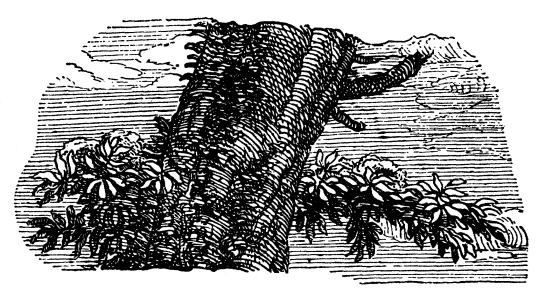
Fig. 10.
If lines are to be distinctly shown, it is better that, so far as they can indicate anything by their direction, they should explain rather than oppose the general character of the object. Thus, in the piece of wood-cut from Titian, Fig. 10, the lines are serviceable by expressing, not only the shade of the trunk, but partly also its roundness, and the flow of its grain. And Albert Dürer, whose work was chiefly engraving, sets himself always thus to make his lines as valuable as possible; telling much by them, both of shade and direction of surface: and if you were always to be limited to engraving on copper (and did not want to express effects of mist or darkness, as well as delicate forms), Albert Dürer's way of work would be the best example for you. But, inasmuch as the perfect way of drawing is by shade without lines, and the great painters always conceive their subject as complete, even when they are sketching it most rapidly, you will find that, when they are not limited in means, they do not much trust to direction of line, but will often scratch in the shade of a rounded surface with nearly straight lines, that is to say, with the easiest and quickest lines possible to themselves. When the hand is free, the easiest line for it to draw is one inclining from the left upwards to the right, or vice versâ, from the right downwards to the left; and when done very quickly, the line is hooked a little at the end by the effort at return to the next. Hence, you will always find the pencil, chalk, or pen sketch of a very great master full of these kind of lines; and even if he draws carefully, you will find him using simple straight lines from left to right, when an inferior master would have used curved ones. Fig. 11 is a fair facsimile of part of a sketch of Raphael's, which exhibits these characters very distinctly. Even the careful drawings of Leonardo da Vinci are shaded most commonly with straight lines; and you may always assume it as a point increasing the probability of a drawing being by a great master if you find rounded surfaces, such as those of cheeks or lips, shaded with straight lines.
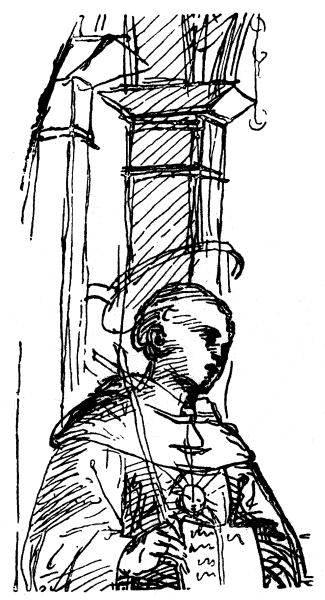
Fig. 11.
94. But you will also now understand how easy it must be for dishonest dealers to forge or imitate scrawled sketches like Fig. 11, and pass them for the work of great masters; and how the power of determining the genuineness of a drawing depends entirely on your knowing the facts of the objects drawn, and perceiving whether the hasty handling is all conducive to the expression of those truths. In a great man's work, at its fastest, no line is thrown away, and it is not by the rapidity, but the economy of the execution that you know him to be great. Now to judge of this economy, you must know exactly what he meant to do, otherwise you cannot of course discern how far he has done it; that is, you must know the beauty and nature of the thing he was drawing. All judgment of art thus finally founds itself on knowledge of Nature.
95. But farther observe, that this scrawled, or economic, or impetuous execution is never affectedly impetuous. If a great man is not in a hurry, he never pretends to be; if he has no eagerness in his heart, he puts none into his hand; if he thinks his effect would be better got with two lines, he never, to show his dexterity, tries to do it with one. Be assured, therefore (and this is a matter of great importance), that you will never produce a great drawing by imitating the execution of a great master. Acquire his knowledge and share his feelings, and the easy execution will fall from your hand as it did from his: but if you merely scrawl because he scrawled, or blot because he blotted, you will not only never advance in power, but every able draughtsman, and every judge whose opinion is worth having, will know you for a cheat, and despise you accordingly.
96. Again, observe respecting the use of outline:
All merely outlined drawings are bad, for the simple reason, that an artist of any power can always do more, and tell more, by quitting his outlines occasionally, and scratching in a few lines for shade, than he can by restricting himself to outline only. Hence the fact of his so restricting himself, whatever may be the occasion, shows him to be a bad draughtsman, and not to know how to apply his power economically. This hard law, however, bears only on drawings meant to remain in the state in which you see them; not on those which were meant to be proceeded with, or for some mechanical use. It is sometimes necessary to draw pure outlines, as an incipient arrangement of a composition, to be filled up afterwards with color, or to be pricked through and used as patterns or tracings; but if, with no such ultimate object, making the drawing wholly for its own sake, and meaning it to remain in the state he leaves it, an artist restricts himself to outline, he is a bad draughtsman, and his work is bad. There is no exception to this law. A good artist habitually sees masses, not edges, and can in every case make his drawing more expressive (with any given quantity of work) by rapid shade than by contours; so that all good work whatever is more or less touched with shade, and more or less interrupted as outline.
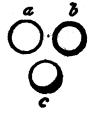
Fig. 12.
97. Hence, the published works of Retzsch, and all the English imitations of them, and all outline engravings from pictures, are bad work, and only serve to corrupt the public taste. And of such outlines, the worst are those which are darkened in some part of their course by way of expressing the dark side, as Flaxman's from Dante, and such others; because an outline can only be true so long as it accurately represents the form of the given object with one of its edges. Thus, the outline a and the outline b, Fig. 12, are both true outlines of a ball; because, however thick the line may be, whether we take the interior or exterior edge of it, that edge of it always draws a true circle. But c is a false outline of a ball, because either the inner or outer edge of the black line must be an untrue circle, else the line could not be thicker in one place than another. Hence all "force," as it is called, is gained by falsification of the contours; so that no artist whose eye is true and fine could endure to look at it. It does indeed often happen that a painter, sketching rapidly, and trying again and again for some line which he cannot quite strike, blackens or loads the first line by setting others beside and across it; and then a careless observer supposes it has been thickened on purpose: or, sometimes also, at a place where shade is afterwards to inclose the form, the painter will strike a broad dash of this shade beside his outline at once, looking as if he meant to thicken the outline; whereas this broad line is only the first installment of the future shadow, and the outline is really drawn with its inner edge.[21] And thus, far from good draughtsmen darkening the lines which turn away from the light, the tendency with them is rather to darken them towards the light, for it is there in general that shade will ultimately inclose them. The best example of this treatment that I know is Raphael's sketch, in the Louvre, of the head of the angel pursuing Heliodorus, the one that shows part of the left eye; where the dark strong lines which terminate the nose and forehead towards the light are opposed to tender and light ones behind the ear, and in other places towards the shade. You will see in Fig. 11 the same principle variously exemplified; the principal dark lines, in the head and drapery of the arms, being on the side turned to the light.
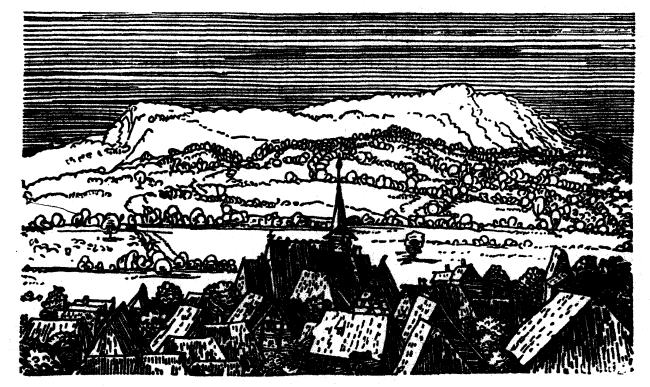
Fig. 13.
98. All these refinements and ultimate principles, however, do not affect your drawing for the present. You must try to make your outlines as equal as possible; and employ pure outline only for the two following purposes: either (1.) to steady your hand, as in Exercise II., for if you cannot draw the line itself, you will never be able to terminate your shadow in the precise shape required, when the line is absent; or (2.) to give you shorthand memoranda of forms, when you are pressed for time. Thus the forms of distant trees in groups are defined, for the most part, by the light edge of the rounded mass of the nearer one being shown against the darker part of the rounded mass of a more distant one; and to draw this properly, nearly as much work is required to round each tree as to round the stone in Fig. 5. Of course you cannot often get time to do this; but if you mark the terminal line of each tree as is done by Dürer in Fig. 13, you will get a most useful memorandum of their arrangement, and a very interesting drawing. Only observe in doing this, you must not, because the procedure is a quick one, hurry that procedure itself. You will find, on copying that bit of Dürer, that every one of his lines is firm, deliberate, and accurately descriptive as far as it goes. It means a bush of such a size and such a shape, definitely observed and set down; it contains a true "signalement" of every nut-tree, and apple-tree, and higher bit of hedge, all round that village. If you have not time to draw thus carefully, do not draw at all—you are merely wasting your work and spoiling your taste. When you have had four or five years' practice you may be able to make useful memoranda at a rapid rate, but not yet; except sometimes of light and shade, in a way of which I will tell you presently. And this use of outline, note farther, is wholly confined to objects which have edges or limits. You can outline a tree or a stone, when it rises against another tree or stone; but you cannot outline folds in drapery, or waves in water; if these are to be expressed at all, it must be by some sort of shade, and therefore the rule that no good drawing can consist throughout of pure outline remains absolute. You see, in that wood-cut of Dürer's, his reason for even limiting himself so much to outline as he has, in those distant woods and plains, is that he may leave them in bright light, to be thrown out still more by the dark sky and the dark village spire: and the scene becomes real and sunny only by the addition of these shades.
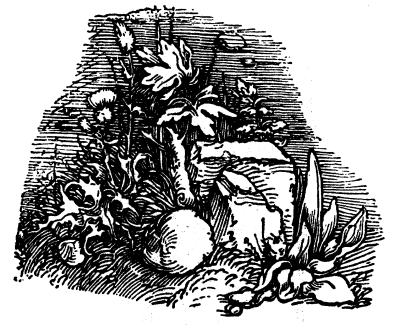
Fig. 14.
99. Understanding, then, thus much of the use of outline, we will go back to our question about tree-drawing left unanswered at page 48.
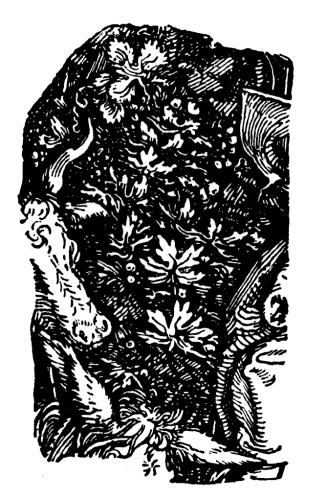
Fig. 15.
We were, you remember, in pursuit of mystery among the leaves. Now, it is quite easy to obtain mystery and disorder, to any extent; but the difficulty is to keep organization in the midst of mystery. And you will never succeed in doing this unless you lean always to the definite side, and allow yourself rarely to become quite vague, at least through all your early practice. So, after your single groups of leaves, your first step must be to conditions like Figs. 14 and 15, which are careful facsimiles of two portions of a beautiful wood-cut of Dürer's, the "Flight into Egypt." Copy these carefully,—never mind how little at a time, but thoroughly; then trace the Dürer, and apply it to your drawing, and do not be content till the one fits the other, else your eye is not true enough to carry you safely through meshes of real leaves. And in the course of doing this, you will find that not a line nor dot of Dürer's can be displaced without harm; that all add to the effect, and either express something, or illumine something, or relieve something. If, afterwards, you copy any of the pieces of modern tree drawing, of which so many rich examples are given constantly in our cheap illustrated periodicals (any of the Christmas numbers of last year's Illustrated News or others are full of them), you will see that, though good and forcible general effect is produced, the lines are thrown in by thousands without special intention, and might just as well go one way as another, so only that there be enough of them to produce all together a well-shaped effect of intricacy: and you will find that a little careless scratching about with your pen will bring you very near the same result without an effort; but that no scratching of pen, nor any fortunate chance, nor anything but downright skill and thought, will imitate so much as one leaf of Dürer's. Yet there is considerable intricacy and glittering confusion in the interstices of those vine leaves of his, as well as of the grass.
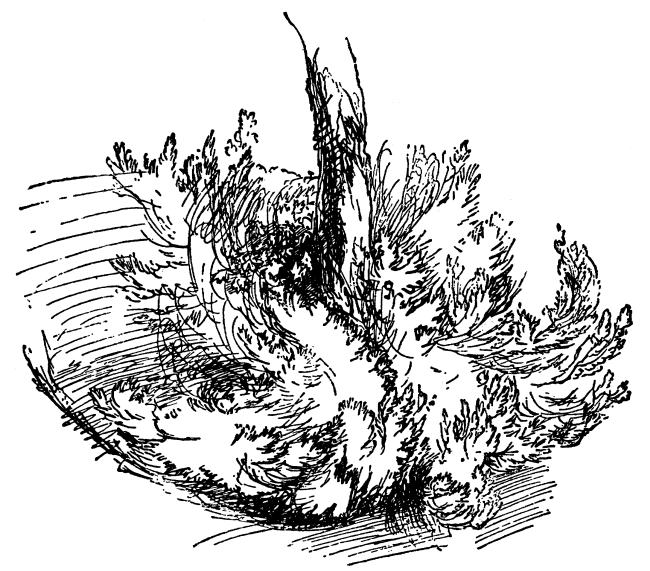
Fig. 16.
100. When you have got familiarized to his firm manner, you may draw from Nature as much as you like in the same way; and when you are tired of the intense care required for this, you may fall into a little more easy massing of the leaves, as in Fig. 10 (p. 55). This is facsimilëd from an engraving after Titian, but an engraving not quite first-rate in manner, the leaves being a little too formal; still, it is a good enough model for your times of rest; and when you cannot carry the thing even so far as this, you may sketch the forms of the masses, as in Fig. 16,[22] taking care always to have thorough command over your hand; that is, not to let the mass take a free shape because your hand ran glibly over the paper, but because in Nature it has actually a free and noble shape, and you have faithfully followed the same.
101. And now that we have come to questions of noble shape, as well as true shape, and that we are going to draw from Nature at our pleasure, other considerations enter into the business, which are by no means confined to first practice, but extend to all practice; these (as this letter is long enough, I should think, to satisfy even the most exacting of correspondents) I will arrange in a second letter; praying you only to excuse the tiresomeness of this first one—tiresomeness inseparable from directions touching the beginning of any art,—and to believe me, even though I am trying to set you to dull and hard work,
Very faithfully yours,
J. Ruskin.
The perception of solid Form is entirely a matter of experience. We see nothing but flat colors; and it is only by a series of experiments that we find out that a stain of black or gray indicates the dark side of a solid substance, or that a faint hue indicates that the object in which it appears is far away. The whole technical power of painting depends on our recovery of what may be called the innocence of the eye; that is to say, of a sort of childish perception of these flat stains of color, merely as such, without consciousness of what they signify,—as a blind man would see them if suddenly gifted with sight.
For instance: when grass is lighted strongly by the sun in certain directions, it is turned from green into a peculiar and somewhat dusty-looking yellow. If we had been born blind, and were suddenly endowed with sight on a piece of grass thus lighted in some parts by the sun, it would appear to us that part of the grass was green, and part a dusty yellow (very nearly of the color of primroses); and, if there were primroses near, we should think that the sunlighted grass was another mass of plants of the same sulphur-yellow color. We should try to gather some of them, and then find that the color went away from the grass when we stood between it and the sun, but not from the primroses; and by a series of experiments we should find out that the sun was really the cause of the color in the one,—not in the other. We go through such processes of experiment unconsciously in childhood; and having once come to conclusions touching the signification of certain colors, we always suppose that we see what we only know, and have hardly any consciousness of the real aspect of the signs we have learned to interpret. Very few people have any idea that sunlighted grass is yellow.
Now, a highly accomplished artist has always reduced himself as nearly as possible to this condition of infantine sight. He sees the colors of nature exactly as they are, and therefore perceives at once in the sunlighted grass the precise relation between the two colors that form its shade and light. To him it does not seem shade and light, but bluish green barred with gold.
Strive, therefore, first of all, to convince yourself of this great fact about sight. This, in your hand, which you know by experience and touch to be a book, is to your eye nothing but a patch of white, variously gradated and spotted; this other thing near you, which by experience you know to be a table, is to your eye only a patch of brown, variously darkened and veined; and so on: and the whole art of Painting consists merely in perceiving the shape and depth of these patches of color, and putting patches of the same size, depth, and shape on canvas. The only obstacle to the success of painting is, that many of the real colors are brighter and paler than it is possible to put on canvas: we must put darker ones to represent them.
These remarks, however, do not apply to the lines used in shading, which, it will be remembered, are to be made as quickly as possible. The reason of this is, that the quicker a line is drawn, the lighter it is at the ends, and therefore the more easily joined with other lines, and concealed by them; the object in perfect shading being to conceal the lines as much as possible.
And observe, in this exercise, the object is more to get firmness of hand than accuracy of eye for outline; for there are no outlines in Nature, and the ordinary student is sure to draw them falsely if he draws them at all. Do not, therefore, be discouraged if you find mistakes continue to occur in your outlines; be content at present if you find your hand gaining command over the curves.
a stands for architecture, including distant grouping of towns, cottages, etc.
c clouds, including mist and aërial effects.
f foliage.
g ground, including low hills, when not rocky.
l effects of light.
m mountains, or bold rocky ground.
p power of general arrangement and effect.
q quiet water.
r running or rough water; or rivers, even if calm, when their line of flow is beautifully marked.
From the England Series.
a c f r. Arundel. a f p. Lancaster.
a f l. Ashby de la Zouche. c l m r. Lancaster Sands.*
a l q r. Barnard Castle.* a g f. Launceston.*
f m r. Bolton Abbey. c f l r. Leicester Abbey.
f g r. Buckfastleigh.* f r. Ludlow.
a l p. Caernarvon. a f l. Margate.
c l q. Castle Upnor. a l q. Orford.
a f l. Colchester. c p. Plymouth.
l q. Cowes. f. Powis Castle.
c f p. Dartmouth Cove.* l m q. Prudhoe Castle.
c l q. Flint Castle.* f l m r. Chain Bridge over Tees.*
a f g l. Knaresborough.* m q. Ulleswater.
m r. High Force of Tees.* f m. Valle Crucis.
a f q. Trematon.
From the Keepsake.
m p q. Arona. p. St. Germain en Laye.
l m. Drachenfels.* l p q. Florence.
f l. Marly.* l m. Ballyburgh Ness.*
From the Bible Series.
f m. Mount Lebanon. c l p q. Solomon's Pools.*
m. Rock of Moses at Sinai. a l. Santa Saba.
a l m. Jericho. a l. Pool of Bethesda.
a c g. Joppa.
From Scott's Works.
p r. Melrose.* c m. Glencoe.
f r. Dryburgh.* c m. Loch Coriskin.*
a l. Caerlaverock.
From the Rivers of France.
a q. Château of Amboise, with large bridge on right. f p. Pont de l'Arche.
l p r. Rouen, looking down the river, poplars on right.* f l p. View on the Seine, with avenue.
a l p. Rouen, with cathedral and rainbow, avenue on left. a c p. Bridge of Meulan.
a p. Rouen Cathedral. c g p r. Caudebec.*
LETTER II.
SKETCHING FROM NATURE.
102. My dear Reader,—The work we have already gone through together has, I hope, enabled you to draw with fair success either rounded and simple masses, like stones, or complicated arrangements of form, like those of leaves; provided only these masses or complexities will stay quiet for you to copy, and do not extend into quantity so great as to baffle your patience. But if we are now to go out to the fields, and to draw anything like a complete landscape, neither of these conditions will any more be observed for us. The clouds will not wait while we copy their heaps or clefts; the shadows will escape from us as we try to shape them, each, in its stealthy minute march, still leaving light where its tremulous edge had rested the moment before, and involving in eclipse objects that had seemed safe from its influence; and instead of the small clusters of leaves which we could reckon point by point, embarrassing enough even though numerable, we have now leaves as little to be counted as the sands of the sea, and restless, perhaps, as its foam.
103. In all that we have to do now, therefore, direct imitation becomes more or less impossible. It is always to be aimed at so far as it is possible; and when you have time and opportunity, some portions of a landscape may, as you gain greater skill, be rendered with an approximation almost to mirrored portraiture. Still, whatever skill you may reach, there will always be need of judgment to choose, and of speed to seize, certain things that are principal or fugitive; and you must give more and more effort daily to the observance of characteristic points, and the attainment of concise methods.
104. I have directed your attention early to foliage for two reasons. First, that it is always accessible as a study; and secondly, that its modes of growth present simple examples of the importance of leading or governing lines. It is by seizing these leading lines, when we cannot seize all, that likeness and expression are given to a portrait, and grace and a kind of vital truth to the rendering of every natural form. I call it vital truth, because these chief lines are always expressive of the past history and present action of the thing. They show in a mountain, first, how it was built or heaped up; and secondly, how it is now being worn away, and from what quarter the wildest storms strike it. In a tree, they show what kind of fortune it has had to endure from its childhood: how troublesome trees have come in its way, and pushed it aside, and tried to strangle or starve it; where and when kind trees have sheltered it, and grown up lovingly together with it, bending as it bent; what winds torment it most; what boughs of it behave best, and bear most fruit; and so on. In a wave or cloud, these leading lines show the run of the tide and of the wind, and the sort of change which the water or vapor is at any moment enduring in its form, as it meets shore, or counter-wave, or melting sunshine. Now remember, nothing distinguishes great men from inferior men more than their always, whether in life or in art, knowing the way things are going. Your dunce thinks they are standing still, and draws them all fixed; your wise man sees the change or changing in them, and draws them so,—the animal in its motion, the tree in its growth, the cloud in its course, the mountain in its wearing away. Try always, whenever you look at a form, to see the lines in it which have had power over its past fate and will have power over its futurity. Those are its awful lines; see that you seize on those, whatever else you miss. Thus, the leafage in Fig. 16 (p. 63) grew round the root of a stone pine, on the brow of a crag at Sestri near Genoa, and all the sprays of it are thrust away in their first budding by the great rude root, and spring out in every direction round it, as water splashes when a heavy stone is thrown into it. Then, when they have got clear of the root, they begin to bend up again; some of them, being little stone pines themselves, have a great notion of growing upright, if they can; and this struggle of theirs to recover their straight road towards the sky, after being obliged to grow sideways in their early years, is the effort that will mainly influence their future destiny, and determine if they are to be crabbed, forky pines, striking from that rock of Sestri, whose clefts nourish them, with bared red lightning of angry arms towards the sea; or if they are to be goodly and solemn pines, with trunks like pillars of temples, and the purple burning of their branches sheathed in deep globes of cloudy green. Those, then, are their fateful lines; see that you give that spring and resilience, whatever you leave ungiven: depend upon it, their chief beauty is in these.
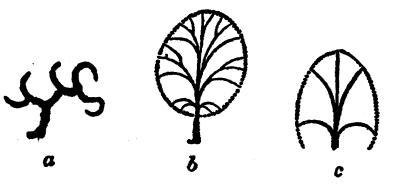
Fig. 17.
105. So in trees in general, and bushes, large or small, you will notice that, though the boughs spring irregularly and at various angles, there is a tendency in all to stoop less and less as they near the top of the tree. This structure, typified in the simplest possible terms at c, Fig. 17, is common to all trees that I know of, and it gives them a certain plumy character, and aspect of unity in the hearts of their branches which are essential to their beauty. The stem does not merely send off a wild branch here and there to take its own way, but all the branches share in one great fountain-like impulse; each has a curve and a path to take, which fills a definite place, and each terminates all its minor branches at its outer extremity, so as to form a greater outer curve, whose character and proportion are peculiar for each species. That is to say, the general type or idea of a tree is not as a, Fig. 17, but as b, in which, observe, the boughs all carry their minor divisions right out to the bounding curve; not but that smaller branches, by thousands, terminate in the heart of the tree, but the idea and main purpose in every branch are to carry all its child branches well out to the air and light, and let each of them, however small, take its part in filling the united flow of the bounding curve, so that the type of each separate bough is again not a, but b, Fig. 18; approximating, that is to say, so far to the structure of a plant of broccoli as to throw the great mass of spray and leafage out to a rounded surface. Therefore beware of getting into a careless habit of drawing boughs with successive sweeps of the pen or brush, one hanging to the other, as in Fig. 19. If you look at the tree-boughs in any painting of Wilson's you will see this structure, and nearly every other that is to be avoided, in their intensest types. You will also notice that Wilson never conceives a tree as a round mass, but flat, as if it had been pressed and dried. Most people in drawing pines seem to fancy, in the same way, that the boughs come out only on two sides of the trunk, instead of all round it: always, therefore, take more pains in trying to draw the boughs of trees that grow towards you than those that go off to the sides; anybody can draw the latter, but the foreshortened ones are not so easy. It will help you in drawing them to observe that in most trees the ramification of each branch, though not of the tree itself, is more or less flattened, and approximates, in its position, to the look of a hand held out to receive something, or shelter something. If you take a looking-glass, and hold your hand before it slightly hollowed, with the palm upwards, and the fingers open, as if you were going to support the base of some great bowl, larger than you could easily hold; and sketch your hand as you see it in the glass with the points of the fingers towards you; it will materially help you in understanding the way trees generally hold out their hands: and if then you will turn yours with its palm downwards, as if you were going to try to hide something, but with the fingers expanded, you will get a good type of the action of the lower boughs in cedars and such other spreading trees.
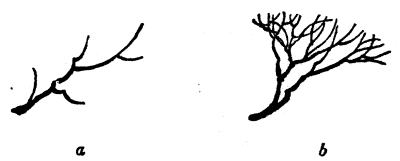
Fig. 18.
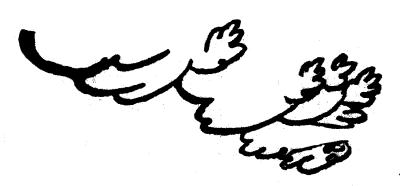
Fig. 19.
106. Fig. 20 will give you a good idea of the simplest way in which these and other such facts can be rapidly expressed; if you copy it carefully, you will be surprised to find how the touches all group together, in expressing the plumy toss of the tree branches, and the springing of the bushes out of the bank, and the undulation of the ground: note the careful drawing of the footsteps made by the climbers of the little mound on the left.[23] It is facsimilëd from an etching of Turner's, and is as good an example as you can have of the use of pure and firm lines; it will also show you how the particular action in foliage, or anything else to which you wish to direct attention, may be intensified by the adjuncts. The tall and upright trees are made to look more tall and upright still, because their line is continued below by the figure of the farmer with his stick; and the rounded bushes on the bank are made to look more rounded because their line is continued in one broad sweep by the black dog and the boy climbing the wall. These figures are placed entirely with this object, as we shall see more fully hereafter when we come to talk about composition; but, if you please, we will not talk about that yet awhile. What I have been telling you about the beautiful lines and action of foliage has nothing to do with composition, but only with fact, and the brief and expressive representation of fact. But there will be no harm in your looking forward, if you like to do so, to the account, in Letter III. of the "Law of Radiation," and reading what is said there about tree growth: indeed it would in some respects have been better to have said it here than there, only it would have broken up the account of the principles of composition somewhat awkwardly.
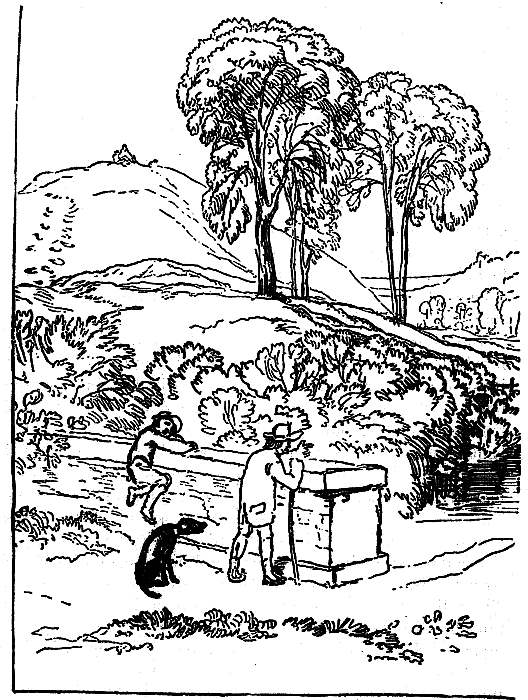
Fig. 20.
107. Now, although the lines indicative of action are not always quite so manifest in other things as in trees, a little attention will soon enable you to see that there are such lines in everything. In an old house roof, a bad observer and bad draughtsman will only see and draw the spotty irregularity of tiles or slates all over; but a good draughtsman will see all the bends of the under timbers, where they are weakest and the weight is telling on them most, and the tracks of the run of the water in time of rain, where it runs off fastest, and where it lies long and feeds the moss; and he will be careful, however few slates he draws, to mark the way they bend together towards those hollows (which have the future fate of the roof in them), and crowd gradually together at the top of the gable, partly diminishing in perspective, partly, perhaps, diminished on purpose (they are so in most English old houses) by the slate-layer. So in ground, there is always the direction of the run of the water to be noticed, which rounds the earth and cuts it into hollows; and, generally, in any bank or height worth drawing, a trace of bedded or other internal structure besides. Figure 20 will give you some idea of the way in which such facts may be expressed by a few lines. Do you not feel the depression in the ground all down the hill where the footsteps are, and how the people always turn to the left at the top, losing breath a little, and then how the water runs down in that other hollow towards the valley, behind the roots of the trees?
108. Now, I want you in your first sketches from Nature to aim exclusively at understanding and representing these vital facts of form; using the pen—not now the steel, but the quill—firmly and steadily, never scrawling with it, but saying to yourself before you lay on a single touch,—"that leaf is the main one, that bough is the guiding one, and this touch, so long, so broad, means that part of it,"—point or side or knot, as the case may be. Resolve always, as you look at the thing, what you will take, and what miss of it, and never let your hand run away with you, or get into any habit or method of touch. If you want a continuous line, your hand should pass calmly from one end of it to the other without a tremor; if you want a shaking and broken line, your hand should shake, or break off, as easily as a musician's finger shakes or stops on a note: only remember this, that there is no general way of doing any thing; no recipe can be given you for so much as the drawing of a cluster of grass. The grass may be ragged and stiff, or tender and flowing; sunburnt and sheep-bitten, or rank and languid; fresh or dry; lustrous or dull: look at it, and try to draw it as it is, and don't think how somebody "told you to do grass." So a stone may be round or angular, polished or rough, cracked all over like an ill-glazed teacup, or as united and broad as the breast of Hercules. It may be as flaky as a wafer, as powdery as a field puff-ball; it may be knotted like a ship's hawser, or kneaded like hammered iron, or knit like a Damascus saber, or fused like a glass bottle, or crystallized like hoar-frost, or veined like a forest leaf: look at it, and don't try to remember how anybody told you to "do a stone."
109. As soon as you find that your hand obeys you thoroughly, and that you can render any form with a firmness and truth approaching that of Turner's or Dürer's work,[24] you must add a simple but equally careful light and shade to your pen drawing, so as to make each study as complete as possible; for which you must prepare yourself thus. Get, if you have the means, a good impression of one plate of Turner's Liber Studiorum; if possible, one of the subjects named in the note below.[25] If you cannot obtain, or even borrow for a little while, any of these engravings, you must use a photograph instead (how, I will tell you presently); but, if you can get the Turner, it will be best. You will see that it is composed of a firm etching in line, with mezzotint shadow laid over it. You must first copy the etched part of it accurately; to which end put the print against the window, and trace slowly with the greatest care every black line; retrace this on smooth drawing-paper; and, finally, go over the whole with your pen, looking at the original plate always, so that if you err at all, it may be on the right side, not making a line which is too curved or too straight already in the tracing, more curved or more straight, as you go over it. And in doing this, never work after you are tired, nor to "get the thing done," for if it is badly done, it will be of no use to you. The true zeal and patience of a quarter of an hour are better than the sulky and inattentive labor of a whole day. If you have not made the touches right at the first going over with the pen, retouch them delicately, with little ink in your pen, thickening or reinforcing them as they need: you cannot give too much care to the facsimile. Then keep this etched outline by you in order to study at your ease the way in which Turner uses his line as preparatory for the subsequent shadow;[26] it is only in getting the two separate that you will be able to reason on this. Next, copy once more, though for the fourth time, any part of this etching which you like, and put on the light and shade with the brush, and any brown color that matches that of the plate;[27] working it with the point of the brush as delicately as if you were drawing with pencil, and dotting and cross-hatching as lightly as you can touch the paper, till you get the gradations of Turner's engraving.
110. In this exercise, as in the former one, a quarter of an inch worked to close resemblance of the copy is worth more than the whole subject carelessly done. Not that in drawing afterwards from Nature you are to be obliged to finish every gradation in this way, but that, once having fully accomplished the drawing something rightly, you will thenceforward feel and aim at a higher perfection than you could otherwise have conceived, and the brush will obey you, and bring out quickly and clearly the loveliest results, with a submissiveness which it would have wholly refused if you had not put it to severest work. Nothing is more strange in art than the way that chance and materials seem to favor you, when once you have thoroughly conquered them. Make yourself quite independent of chance, get your result in spite of it, and from that day forward all things will somehow fall as you would have them. Show the camel's hair, and the color in it, that no bending nor blotting is of any use to escape your will; that the touch and the shade shall finally be right, if it costs you a year's toil; and from that hour of corrective conviction, said camel's hair will bend itself to all your wishes, and no blot will dare to transgress its appointed border. If you cannot obtain a print from the Liber Studiorum, get a photograph[28] of some general landscape subject, with high hills and a village or picturesque town, in the middle distance, and some calm water of varied character (a stream with stones in it, if possible), and copy any part of it you like, in this same brown color, working, as I have just directed you to do from the Liber, a great deal with the point of the brush. You are under a twofold disadvantage here, however; first, there are portions in every photograph too delicately done for you at present to be at all able to copy; and, secondly, there are portions always more obscure or dark than there would be in the real scene, and involved in a mystery which you will not be able, as yet, to decipher. Both these characters will be advantageous to you for future study, after you have gained experience, but they are a little against you in early attempts at tinting; still you must fight through the difficulty, and get the power of producing delicate gradations with brown or gray, like those of the photograph.
111. Now observe; the perfection of work would be tinted shadow, like photography, without any obscurity or exaggerated darkness; and as long as your effect depends in anywise on visible lines, your art is not perfect, though it may be first-rate of its kind. But to get complete results in tints merely, requires both long time and consummate skill; and you will find that a few well-put pen lines, with a tint dashed over or under them, get more expression of facts than you could reach in any other way, by the same expenditure of time. The use of the Liber Studiorum print to you is chiefly as an example of the simplest shorthand of this kind, a shorthand which is yet capable of dealing with the most subtle natural effects; for the firm etching gets at the expression of complicated details, as leaves, masonry, textures of ground, etc., while the overlaid tint enables you to express the most tender distances of sky, and forms of playing light, mist, or cloud. Most of the best drawings by the old masters are executed on this principle, the touches of the pen being useful also to give a look of transparency to shadows, which could not otherwise be attained but by great finish of tinting; and if you have access to any ordinarily good public gallery, or can make friends of any printsellers who have folios either of old drawings, or facsimiles of them, you will not be at a loss to find some example of this unity of pen with tinting. Multitudes of photographs also are now taken from the best drawings by the old masters, and I hope that our Mechanics' Institutes and other societies organized with a view to public instruction, will not fail to possess themselves of examples of these, and to make them accessible to students of drawing in the vicinity; a single print from Turner's Liber, to show the unison of tint with pen etching, and the "St. Catherine," photographed by Thurston Thompson from Raphael's drawing in the Louvre, to show the unity of the soft tinting of the stump with chalk, would be all that is necessary, and would, I believe, be in many cases more serviceable than a larger collection, and certainly than a whole gallery of second-rate prints. Two such examples are peculiarly desirable, because all other modes of drawing, with pen separately, or chalk separately, or color separately, may be seen by the poorest student in any cheap illustrated book, or in shop windows. But this unity of tinting with line he cannot generally see but by some special inquiry, and in some out of the way places he could not find a single example of it. Supposing that this should be so in your own case, and that you cannot meet with any example of this kind, try to make the matter out alone, thus:
112. Take a small and simple photograph; allow yourself half an hour to express its subjects with the pen only, using some permanent liquid color instead of ink, outlining its buildings or trees firmly, and laying in the deeper shadows, as you have been accustomed to do in your bolder pen drawings; then, when this etching is dry, take your sepia or gray, and tint it over, getting now the finer gradations of the photograph; and, finally taking out the higher lights with penknife or blotting paper. You will soon find what can be done in this way; and by a series of experiments you may ascertain for yourself how far the pen may be made serviceable to reinforce shadows, mark characters of texture, outline unintelligible masses, and so on. The more time you have, the more delicate you may make the pen drawing, blending it with the tint; the less you have, the more distinct you must keep the two. Practice in this way from one photograph, allowing yourself sometimes only a quarter of an hour for the whole thing, sometimes an hour, sometimes two or three hours; in each case drawing the whole subject in full depth of light and shade, but with such degree of finish in the parts as is possible in the given time. And this exercise, observe, you will do well to repeat frequently, whether you can get prints and drawings as well as photographs, or not.
113. And now at last, when you can copy a piece of Liber Studiorum, or its photographic substitute, faithfully, you have the complete means in your power of working from Nature on all subjects that interest you, which you should do in four different ways.
First. When you have full time, and your subject is one that will stay quiet for you, make perfect light and shade studies, or as nearly perfect as you can, with gray or brown color of any kind, reinforced and defined with the pen.
114. Secondly. When your time is short, or the subject is so rich in detail that you feel you cannot complete it intelligibly in light and shade, make a hasty study of the effect, and give the rest of the time to a Düreresque expression of the details. If the subject seems to you interesting, and there are points about it which you cannot understand, try to get five spare minutes to go close up to it, and make a nearer memorandum; not that you are ever to bring the details of this nearer sketch into the farther one, but that you may thus perfect your experience of the aspect of things, and know that such and such a look of a tower or cottage at five hundred yards off means that sort of tower or cottage near; while, also, this nearer sketch will be useful to prevent any future misinterpretation of your own work. If you have time, however far your light and shade study in the distance may have been carried, it is always well, for these reasons, to make also your Düreresque and your near memoranda; for if your light and shade drawing be good, much of the interesting detail must be lost in it, or disguised.
115. Your hasty study of effect may be made most easily and quickly with a soft pencil, dashed over when done with one tolerably deep tone of gray, which will fix the pencil. While this fixing color is wet, take out the higher lights with the dry brush; and, when it is quite dry, scratch out the highest lights with the penknife. Five minutes, carefully applied, will do much by these means. Of course the paper is to be white. I do not like studies on gray paper so well; for you can get more gradation by the taking off your wet tint, and laying it on cunningly a little darker here and there, than you can with body-color white, unless you are consummately skillful. There is no objection to your making your Düreresque memoranda on gray or yellow paper, and touching or relieving them with white; only, do not depend much on your white touches, nor make the sketch for their sake.
116. Thirdly. When you have neither time for careful study nor for Düreresque detail, sketch the outline with pencil, then dash in the shadows with the brush boldly, trying to do as much as you possibly can at once, and to get a habit of expedition and decision; laying more color again and again into the tints as they dry, using every expedient which your practice has suggested to you of carrying out your chiaroscuro in the manageable and moist material, taking the color off here with the dry brush, scratching out lights in it there with the wooden handle of the brush, rubbing it in with your fingers, drying it off with your sponge, etc. Then, when the color is in, take your pen and mark the outline characters vigorously, in the manner of the Liber Studiorum. This kind of study is very convenient for carrying away pieces of effect which depend not so much on refinement as on complexity, strange shapes of involved shadows, sudden effects of sky, etc.; and it is most useful as a safeguard against any too servile or slow habits which the minute copying may induce in you; for although the endeavor to obtain velocity merely for velocity's sake, and dash for display's sake, is as baneful as it is despicable; there are a velocity and a dash which not only are compatible with perfect drawing, but obtain certain results which cannot be had otherwise. And it is perfectly safe for you to study occasionally for speed and decision, while your continual course of practice is such as to insure your retaining an accurate judgment and a tender touch. Speed, under such circumstances, is rather fatiguing than tempting; and you will find yourself always beguiled rather into elaboration than negligence.
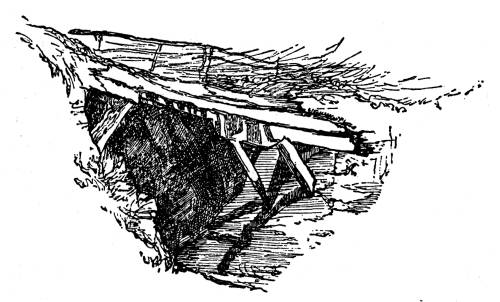
Fig. 21.
117. Fourthly. You will find it of great use, whatever kind of landscape scenery you are passing through, to get into the habit of making memoranda of the shapes of shadows. You will find that many objects of no essential interest in themselves, and neither deserving a finished study, nor a Düreresque one, may yet become of singular value in consequence of the fantastic shapes of their shadows; for it happens often, in distant effect, that the shadow is by much a more important element than the substance. Thus, in the Alpine bridge, Fig. 21, seen within a few yards of it, as in the figure, the arrangement of timbers to which the shadows are owing is perceptible; but at half a mile's distance, in bright sunlight, the timbers would not be seen; and a good painter's expression of the bridge would be merely the large spot, and the crossed bars, of pure gray; wholly without indication of their cause, as in Fig. 22 a; and if we saw it at still greater distances, it would appear, as in Fig. 22 b and c, diminishing at last to a strange, unintelligible, spider-like spot of gray on the light hill-side. A perfectly great painter, throughout his distances, continually reduces his objects to these shadow abstracts; and the singular, and to many persons unaccountable, effect of the confused touches in Turner's distances, is owing chiefly to this thorough accuracy and intense meaning of the shadow abstracts.
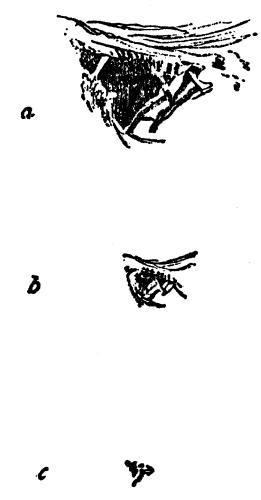
Fig. 22.
118. Studies of this kind are easily made, when you are in haste, with an F. or HB. pencil: it requires some hardness of the point to insure your drawing delicately enough when the forms of the shadows are very subtle; they are sure to be so somewhere, and are generally so everywhere. The pencil is indeed a very precious instrument after you are master of the pen and brush, for the pencil, cunningly used, is both, and will draw a line with the precision of the one and the gradation of the other; nevertheless, it is so unsatisfactory to see the sharp touches, on which the best of the detail depends, getting gradually deadened by time, or to find the places where force was wanted look shiny, and like a fire-grate, that I should recommend rather the steady use of the pen, or brush, and color, whenever time admits of it; keeping only a small memorandum-book in the breast-pocket, with its well-cut, sheathed pencil, ready for notes on passing opportunities: but never being without this.
119. Thus much, then, respecting the manner in which you are at first to draw from Nature. But it may perhaps be serviceable to you, if I also note one or two points respecting your choice of subjects for study, and the best special methods of treating some of them; for one of by no means the least difficulties which you have at first to encounter is a peculiar instinct, common, as far as I have noticed, to all beginners, to fix on exactly the most unmanageable feature in the given scene. There are many things in every landscape which can be drawn, if at all, only by the most accomplished artists; and I have noticed that it is nearly always these which a beginner will dash at; or, if not these, it will be something which, though pleasing to him in itself, is unfit for a picture, and in which, when he has drawn it, he will have little pleasure. As some slight protection against this evil genius of beginners, the following general warnings may be useful:
120. (1.) Do not draw things that you love, on account of their associations; or at least do not draw them because you love them; but merely when you cannot get anything else to draw. If you try to draw places that you love, you are sure to be always entangled amongst neat brick walls, iron railings, gravel walks, greenhouses, and quickset hedges; besides that you will be continually led into some endeavor to make your drawing pretty, or complete, which will be fatal to your progress. You need never hope to get on, if you are the least anxious that the drawing you are actually at work upon should look nice when it is done. All you have to care about is to make it right, and to learn as much in doing it as possible. So then, though when you are sitting in your friend's parlor, or in your own, and have nothing else to do, you may draw anything that is there, for practice; even the fire-irons or the pattern on the carpet: be sure that it is for practice, and not because it is a beloved carpet, or a friendly poker and tongs, nor because you wish to please your friend by drawing her room.
121. Also, never make presents of your drawings. Of course I am addressing you as a beginner—a time may come when your work will be precious to everybody; but be resolute not to give it away till you know that it is worth something (as soon as it is worth anything you will know that it is so). If any one asks you for a present of a drawing, send them a couple of cakes of color and a piece of Bristol board: those materials are, for the present, of more value in that form than if you had spread the one over the other.
The main reason for this rule is, however, that its observance will much protect you from the great danger of trying to make your drawings pretty.
122. (2.) Never, by choice, draw anything polished; especially if complicated in form. Avoid all brass rods and curtain ornaments, chandeliers, plate, glass, and fine steel. A shining knob of a piece of furniture does not matter if it comes in your way; but do not fret yourself if it will not look right, and choose only things that do not shine.
(3.) Avoid all very neat things. They are exceedingly difficult to draw, and very ugly when drawn. Choose rough, worn, and clumsy-looking things as much as possible; for instance, you cannot have a more difficult or profitless study than a newly painted Thames wherry, nor a better study than an old empty coal-barge, lying ashore at low tide: in general, everything that you think very ugly will be good for you to draw.
(4.) Avoid, as much as possible, studies in which one thing is seen through another. You will constantly find a thin tree standing before your chosen cottage, or between you and the turn of the river; its near branches all entangled with the distance. It is intensely difficult to represent this; and though, when the tree is there, you must not imaginarily cut it down, but do it as well as you can, yet always look for subjects that fall into definite masses, not into network; that is, rather for a cottage with a dark tree beside it, than for one with a thin tree in front of it, rather for a mass of wood, soft, blue, and rounded, than for a ragged copse, or confusion of intricate stems.
(5.) Avoid, as far as possible, country divided by hedges. Perhaps nothing in the whole compass of landscape is so utterly unpicturesque and unmanageable as the ordinary English patchwork of field and hedge, with trees dotted over it in independent spots, gnawed straight at the cattle line.
Still, do not be discouraged if you find you have chosen ill, and that the subject overmasters you. It is much better that it should, than that you should think you had entirely mastered it. But at first, and even for some time, you must be prepared for very discomfortable failure; which, nevertheless, will not be without some wholesome result.
123. As, however, I have told you what most definitely to avoid, I may, perhaps, help you a little by saying what to seek. In general, all banks are beautiful things, and will reward work better than large landscapes. If you live in a lowland country, you must look for places where the ground is broken to the river's edges, with decayed posts, or roots of trees; or, if by great good luck there should be such things within your reach, for remnants of stone quays or steps, mossy mill-dams, etc. Nearly every other mile of road in chalk country will present beautiful bits of broken bank at its sides; better in form and color than high chalk cliffs. In woods, one or two trunks, with the flowery ground below, are at once the richest and easiest kind of study: a not very thick trunk, say nine inches or a foot in diameter, with ivy running up it sparingly, is an easy, and always a rewarding subject.
124. Large nests of buildings in the middle distance are always beautiful, when drawn carefully, provided they are not modern rows of pattern cottages, or villas with Ionic and Doric porticoes. Any old English village, or cluster of farmhouses, drawn with all its ins and outs, and haystacks, and palings, is sure to be lovely; much more a French one. French landscape is generally as much superior to English as Swiss landscape is to French; in some respects, the French is incomparable. Such scenes as that avenue on the Seine, which I have recommended you to buy the engraving of, admit no rivalship in their expression of graceful rusticity and cheerful peace, and in the beauty of component lines.
In drawing villages, take great pains with the gardens; a rustic garden is in every way beautiful. If you have time, draw all the rows of cabbages, and hollyhocks, and broken fences, and wandering eglantines, and bossy roses; you cannot have better practice, nor be kept by anything in purer thoughts.
Make intimate friends with all the brooks in your neighborhood, and study them ripple by ripple.
Village churches in England are not often good subjects; there is a peculiar meanness about most of them and awkwardness of line. Old manor-houses are often pretty. Ruins are usually, with us, too prim, and cathedrals too orderly. I do not think there is a single cathedral in England from which it is possible to obtain one subject for an impressive drawing. There is always some discordant civility, or jarring vergerism about them.
125. If you live in a mountain or hill country, your only danger is redundance of subject. Be resolved, in the first place, to draw a piece of rounded rock, with its variegated lichens, quite rightly, getting its complete roundings, and all the patterns of the lichen in true local color. Till you can do this, it is of no use your thinking of sketching among hills; but when once you have done this, the forms of distant hills will be comparatively easy.
126. When you have practiced for a little time from such of these subjects as may be accessible to you, you will certainly find difficulties arising which will make you wish more than ever for a master's help: these difficulties will vary according to the character of your own mind (one question occurring to one person, and one to another), so that it is impossible to anticipate them all; and it would make this too large a book if I answered all that I can anticipate; you must be content to work on, in good hope that Nature will, in her own time, interpret to you much for herself; that farther experience on your own part will make some difficulties disappear; and that others will be removed by the occasional observation of such artists' work as may come in your way. Nevertheless, I will not close this letter without a few general remarks, such as may be useful to you after you are somewhat advanced in power; and these remarks may, I think, be conveniently arranged under three heads, having reference to the drawing of vegetation, water, and skies.
127. And, first, of vegetation. You may think, perhaps, we have said enough about trees already; yet if you have done as you were bid, and tried to draw them frequently enough, and carefully enough, you will be ready by this time to hear a little more of them. You will also recollect that we left our question, respecting the mode of expressing intricacy of leafage, partly unsettled in the first letter. I left it so because I wanted you to learn the real structure of leaves, by drawing them for yourself, before I troubled you with the most subtle considerations as to method in drawing them. And by this time, I imagine, you must have found out two principal things, universal facts, about leaves; namely, that they always, in the main tendencies of their lines, indicate a beautiful divergence of growth, according to the law of radiation, already referred to;[29] and the second, that this divergence is never formal, but carried out with endless variety of individual line. I must now press both these facts on your attention a little farther.
128. You may, perhaps, have been surprised that I have not yet spoken of the works of J. D. Harding, especially if you happen to have met with the passages referring to them in Modern Painters, in which they are highly praised. They are deservedly praised, for they are the only works by a modern[30] draughtsman which express in any wise the energy of trees, and the laws of growth, of which we have been speaking. There are no lithographic sketches which, for truth of general character, obtained with little cost of time, at all rival Harding's. Calame, Robert, and the other lithographic landscape sketchers are altogether inferior in power, though sometimes a little deeper in meaning. But you must not take even Harding for a model, though you may use his works for occasional reference; and if you can afford to buy his Lessons on Trees,[31] it will be serviceable to you in various ways, and will at present help me to explain the point under consideration. And it is well that I should illustrate this point by reference to Harding's works, because their great influence on young students renders it desirable that their real character should be thoroughly understood.
129. You will find, first, in the titlepage of the Lessons on Trees, a pretty wood-cut, in which the tree stems are drawn with great truth, and in a very interesting arrangement of lines. Plate 1 is not quite worthy of Mr. Harding, tending too much to make his pupil, at starting, think everything depends on black dots; still, the main lines are good, and very characteristic of tree growth. Then, in Plate 2, we come to the point at issue. The first examples in that plate are given to the pupil that he may practice from them till his hand gets into the habit of arranging lines freely in a similar manner; and they are stated by Mr. Harding to be universal in application; "all outlines expressive of foliage," he says, "are but modifications of them." They consist of groups of lines, more or less resembling our Fig. 23 below; and the characters especially insisted upon are, that they "tend at their inner ends to a common center;" that "their ends terminate in [are inclosed by] ovoid curves;" and that "the outer ends are most emphatic."
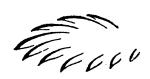
Fig. 23.
130. Now, as thus expressive of the great laws of radiation and inclosure, the main principle of this method of execution confirms, in a very interesting way, our conclusions respecting foliage composition. The reason of the last rule, that the outer end of the line is to be most emphatic, does not indeed at first appear; for the line at one end of a natural leaf is not more emphatic than the line at the other: but ultimately, in Harding's method, this darker part of the touch stands more or less for the shade at the outer extremity of the leaf mass; and, as Harding uses these touches, they express as much of tree character as any mere habit of touch can express. But, unfortunately, there is another law of tree growth, quite as fixed as the law of radiation, which this and all other conventional modes of execution wholly lose sight of. This second law is, that the radiating tendency shall be carried out only as a ruling spirit in reconcilement with perpetual individual caprice on the part of the separate leaves. So that the moment a touch is monotonous, it must be also false, the liberty of the leaf individually being just as essential a truth, as its unity of growth with its companions in the radiating group.
131. It does not matter how small or apparently symmetrical the cluster may be, nor how large or vague. You can hardly have a more formal one than b in Fig. 9, p. 47, nor a less formal one than this shoot of Spanish chestnut, shedding its leaves, Fig. 24; but in either of them, even the general reader, unpracticed in any of the previously recommended exercises, must see that there are wandering lines mixed with the radiating ones, and radiating lines with the wild ones: and if he takes the pen, and tries to copy either of these examples, he will find that neither play of hand to left nor to right, neither a free touch nor a firm touch, nor any learnable or describable touch whatsoever, will enable him to produce, currently, a resemblance of it; but that he must either draw it slowly or give it up. And (which makes the matter worse still) though gathering the bough, and putting it close to you, or seeing a piece of near foliage against the sky, you may draw the entire outline of the leaves, yet if the spray has light upon it, and is ever so little a way off, you will miss, as we have seen, a point of a leaf here, and an edge there; some of the surfaces will be confused by glitter, and some spotted with shade; and if you look carefully through this confusion for the edges or dark stems which you really can see and put only those down, the result will be neither like Fig. 9 nor Fig. 24, but such an interrupted and puzzling piece of work as Fig. 25.[32]
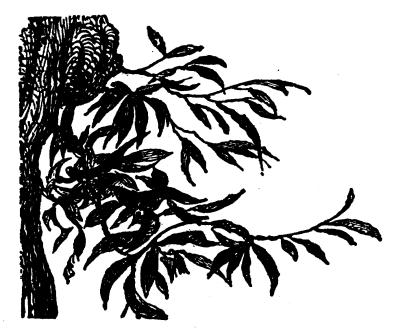
Fig. 24.
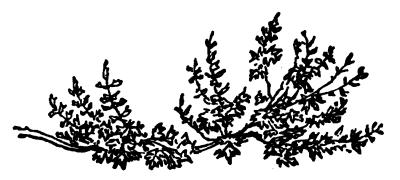
Fig. 25.
132. Now, it is in the perfect acknowledgment and expression of these three laws that all good drawing of landscape consists. There is, first, the organic unity; the law, whether of radiation, or parallelism, or concurrent action, which rules the masses of herbs and trees, of rocks, and clouds, and waves; secondly, the individual liberty of the members subjected to these laws of unity; and, lastly, the mystery under which the separate character of each is more or less concealed.
I say, first, there must be observance of the ruling organic law. This is the first distinction between good artists and bad artists. Your common sketcher or bad painter puts his leaves on the trees as if they were moss tied to sticks; he cannot see the lines of action or growth; he scatters the shapeless clouds over his sky, not perceiving the sweeps of associated curves which the real clouds are following as they fly; and he breaks his mountain side into rugged fragments, wholly unconscious of the lines of force with which the real rocks have risen, or of the lines of couch in which they repose. On the contrary, it is the main delight of the great draughtsman to trace these laws of government; and his tendency to error is always in the exaggeration of their authority rather than in its denial.
133. Secondly, I say, we have to show the individual character and liberty of the separate leaves, clouds, or rocks. And herein the great masters separate themselves finally from the inferior ones; for if the men of inferior genius ever express law at all, it is by the sacrifice of individuality. Thus, Salvator Rosa has great perception of the sweep of foliage and rolling of clouds, but never draws a single leaflet or mist wreath accurately. Similarly, Gainsborough, in his landscape, has great feeling for masses of form and harmony of color; but in the detail gives nothing but meaningless touches; not even so much as the species of tree, much less the variety of its leafage, being ever discernible. Now, although both these expressions of government and individuality are essential to masterly work, the individuality is the more essential, and the more difficult of attainment; and, therefore, that attainment separates the great masters finally from the inferior ones. It is the more essential, because, in these matters of beautiful arrangement in visible things, the same rules hold that hold in moral things. It is a lamentable and unnatural thing to see a number of men subject to no government, actuated by no ruling principle, and associated by no common affection: but it would be a more lamentable thing still, were it possible, to see a number of men so oppressed into assimilation as to have no more any individual hope or character, no differences in aim, no dissimilarities of passion, no irregularities of judgment; a society in which no man could help another, since none would be feebler than himself; no man admire another, since none would be stronger than himself; no man be grateful to another, since by none he could be relieved; no man reverence another, since by none he could be instructed; a society in which every soul would be as the syllable of a stammerer instead of the word of a speaker, in which every man would walk as in a frightful dream, seeing specters of himself, in everlasting multiplication, gliding helplessly around him in a speechless darkness. Therefore it is that perpetual difference, play, and change in groups of form are more essential to them even than their being subdued by some great gathering law: the law is needful to them for their perfection and their power, but the difference is needful to them for their life.
134. And here it may be noted in passing, that, if you enjoy the pursuit of analogies and types, and have any ingenuity of judgment in discerning them, you may always accurately ascertain what are the noble characters in a piece of painting by merely considering what are the noble characters of man in his association with his fellows. What grace of manner and refinement of habit are in society, grace of line and refinement of form are in the association of visible objects. What advantage or harm there may be in sharpness, ruggedness, or quaintness in the dealings or conversations of men; precisely that relative degree of advantage or harm there is in them as elements of pictorial composition. What power is in liberty or relaxation to strengthen or relieve human souls; that power precisely in the same relative degree, play and laxity of line have to strengthen or refresh the expression of a picture. And what goodness or greatness we can conceive to arise in companies of men, from chastity of thought, regularity of life, simplicity of custom, and balance of authority; precisely that kind of goodness and greatness may be given to a picture by the purity of its color, the severity of its forms, and the symmetry of its masses.
135. You need not be in the least afraid of pushing these analogies too far. They cannot be pushed too far; they are so precise and complete, that the farther you pursue them, the clearer, the more certain, the more useful you will find them. They will not fail you in one particular, or in any direction of inquiry. There is no moral vice, no moral virtue, which has not its precise prototype in the art of painting; so that you may at your will illustrate the moral habit by the art, or the art by the moral habit. Affection and discord, fretfulness, and quietness, feebleness and firmness, luxury and purity, pride and modesty, and all other such habits, and every conceivable modification and mingling of them, may be illustrated, with mathematical exactness, by conditions of line and color; and not merely these definable vices and virtues, but also every conceivable shade of human character and passion, from the righteous or unrighteous majesty of the king to the innocent or faultful simplicity of the shepherd boy.
136. The pursuit of this subject belongs properly, however, to the investigation of the higher branches of composition, matters which it would be quite useless to treat of in this book; and I only allude to them here, in order that you may understand how the utmost noblenesses of art are concerned in this minute work, to which I have set you in your beginning of it. For it is only by the closest attention, and the most noble execution, that it is possible to express these varieties of individual character, on which all excellence of portraiture depends, whether of masses of mankind, or of groups of leaves.
137. Now you will be able to understand, among other matters, wherein consists the excellence, and wherein the shortcoming, of the tree-drawing of Harding. It is excellent in so far as it fondly observes, with more truth than any other work of the kind, the great laws of growth and action in trees: it fails,—and observe, not in a minor, but in the principal point,—because it cannot rightly render any one individual detail or incident of foliage. And in this it fails, not from mere carelessness or incompletion, but of necessity; the true drawing of detail being for evermore impossible to a hand which has contracted a habit of execution. The noble draughtsman draws a leaf, and stops, and says calmly,—That leaf is of such and such a character; I will give him a friend who will entirely suit him: then he considers what his friend ought to be, and having determined, he draws his friend. This process may be as quick as lightning when the master is great—one of the sons of the giants; or it may be slow and timid: but the process is always gone through; no touch or form is ever added to another by a good painter without a mental determination and affirmation. But when the hand has got into a habit, leaf No. 1 necessitates leaf No. 2; you cannot stop, your hand is as a horse with the bit in its teeth; or rather is, for the time, a machine, throwing out leaves to order and pattern, all alike. You must stop that hand of yours, however painfully; make it understand that it is not to have its own way any more, that it shall never more slip from one touch to another without orders; otherwise it is not you who are the master, but your fingers. You may therefore study Harding's drawing, and take pleasure in it;[33] and you may properly admire the dexterity which applies the habit of the hand so well, and produces results on the whole so satisfactory: but you must never copy it; otherwise your progress will be at once arrested. The utmost you can ever hope to do would be a sketch in Harding's manner, but of far inferior dexterity; for he has given his life's toil to gain his dexterity, and you, I suppose, have other things to work at besides drawing. You would also incapacitate yourself from ever understanding what truly great work was, or what Nature was; but, by the earnest and complete study of facts, you will gradually come to understand the one and love the other more and more, whether you can draw well yourself or not.
138. I have yet to say a few words respecting the third law above stated, that of mystery; the law, namely, that nothing is ever seen perfectly, but only by fragments, and under various conditions of obscurity.[34] This last fact renders the visible objects of Nature complete as a type of the human nature. We have, observe, first, Subordination; secondly, Individuality; lastly, and this not the least essential character, Incomprehensibility; a perpetual lesson, in every serrated point and shining vein which escapes or deceives our sight among the forest leaves, how little we may hope to discern clearly, or judge justly, the rents and veins of the human heart; how much of all that is round us, in men's actions or spirits, which we at first think we understand, a closer and more loving watchfulness would show to be full of mystery, never to be either fathomed or withdrawn.
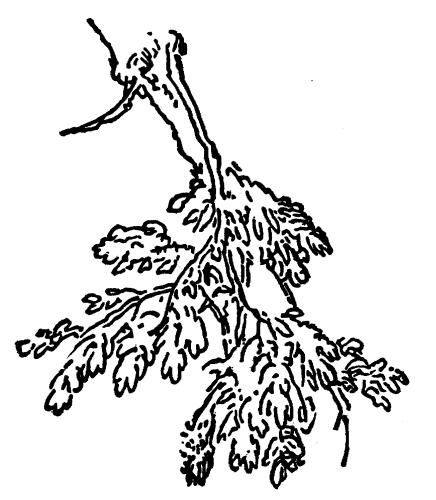
Fig. 26.
139. The expression of this final character in landscape has never been completely reached by any except Turner; nor can you hope to reach it at all until you have given much time to the practice of art. Only try always when you are sketching any object with a view to completion in light and shade, to draw only those parts of it which you really see definitely; preparing for the after development of the forms by chiaroscuro. It is this preparation by isolated touches for a future arrangement of superimposed light and shade which renders the etchings of the Liber Studiorum so inestimable as examples, and so peculiar. The character exists more or less in them exactly in proportion to the pains that Turner has taken. Thus the Æsacus and Hesperie was wrought out with the greatest possible care; and the principal branch on the near tree is etched as in Fig. 26. The work looks at first like a scholar's instead of a master's; but when the light and shade are added, every touch falls into its place, and a perfect expression of grace and complexity results. Nay, even before the light and shade are added, you ought to be able to see that these irregular and broken lines, especially where the expression is given of the way the stem loses itself in the leaves, are more true than the monotonous though graceful leaf-drawing which, before Turner's time, had been employed, even by the best masters, in their distant masses. Fig. 27 is sufficiently characteristic of the manner of the old wood-cuts after Titian; in which, you see, the leaves are too much of one shape, like bunches of fruit; and the boughs too completely seen, besides being somewhat soft and leathery in aspect, owing to the want of angles in their outline. By great men like Titian, this somewhat conventional structure was only given in haste to distant masses; and their exquisite delineation of the foreground, kept their conventionalism from degeneracy: but in the drawings of the Carracci and other derivative masters, the conventionalism prevails everywhere, and sinks gradually into scrawled work, like Fig. 28, about the worst which it is possible to get into the habit of using, though an ignorant person might perhaps suppose it more "free," and therefore better than Fig. 26. Note also, that in noble outline drawing, it does not follow that a bough is wrongly drawn, because it looks contracted unnaturally somewhere, as in Fig. 26, just above the foliage. Very often the muscular action which is to be expressed by the line runs into the middle of the branch, and the actual outline of the branch at that place may be dimly seen, or not at all; and it is then only by the future shade that its actual shape, or the cause of its disappearance, will be indicated.
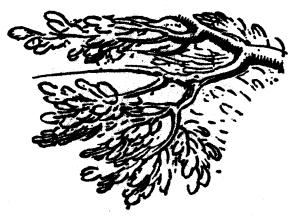
Fig. 27.
140. One point more remains to be noted about trees, and I have done. In the minds of our ordinary water-color artists a distant tree seems only to be conceived as a flat green blot, grouping pleasantly with other masses, and giving cool color to the landscape, but differing no wise, in texture, from the blots of other shapes which these painters use to express stones, or water, or figures. But as soon as you have drawn trees carefully a little while, you will be impressed, and impressed more strongly the better you draw them, with the idea of their softness of surface. A distant tree is not a flat and even piece of color, but a more or less globular mass of a downy or bloomy texture, partly passing into a misty vagueness. I find, practically, this lovely softness of far-away trees the most difficult of all characters to reach, because it cannot be got by mere scratching or roughening the surface, but is always associated with such delicate expressions of form and growth as are only imitable by very careful drawing. The penknife passed lightly over this careful drawing will do a good deal; but you must accustom yourself, from the beginning, to aim much at this softness in the lines of the drawing itself, by crossing them delicately, and more or less effacing and confusing the edges. You must invent, according to the character of tree, various modes of execution adapted to express its texture; but always keep this character of softness in your mind, and in your scope of aim; for in most landscapes it is the intention of Nature that the tenderness and transparent infinitude of her foliage should be felt, even at the far distance, in the most distinct opposition to the solid masses and flat surfaces of rocks or buildings.
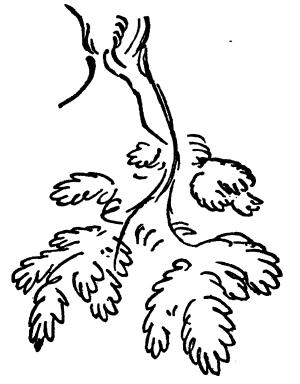
Fig. 28.
141. II. We were, in the second place, to consider a little the modes of representing water, of which important feature of landscape I have hardly said anything yet.
Water is expressed, in common drawings, by conventional lines, whose horizontality is supposed to convey the idea of its surface. In paintings, white dashes or bars of light are used for the same purpose.