AMEN CORNER, E.C. 4. 1922. (continued 3)
Reading edition
o o o
o° o o o o o o o o o o o o o o o
° o° ° o° o° o°
X o o o ° ° ° ° °

o° o o o o
° o o
Which summes yf you do adde together into one summe, you shal perceaue that it wyll be ye same yt appeareth of ye other working before, so that 123 b. *bothe sortes are to one entent, but as the other is much shorter, so this is playner to reason, for suche as haue had small exercyse in this arte. Not withstandynge you maye adde them in your mynde before you sette them downe, as in this example, you myghte haue sayde 5 tymes 300 is 1500, and 5 tymes 60 is 300, also 5 tymes 5 is 25, whiche all put together do make 1825, which you maye at one tyme set downe yf you lyste. But nowe to go forth, I must remoue the hand to the nexte counters, whiche are in the second lyne, and there must I take vp those 4 counters, settynge downe for them my multiplyer 4 tymes, whiche thynge other I maye do at 4 tymes seuerally, or elles I may gather that hole summe in my mynde fyrste, and then set it downe: as to saye 4 tymes 300 is 1200: 4 tymes 60 are 240: and 4 tymes 5 make 20: yt is in all 1460, yt shall I set downe also: as here you se.
°
o o o o o
X o°o o o o o
o o o ° o°
o°

° o o
124 a. *whiche yf I ioyne in one summe with the formar nombers, it wyll appeare thus.
°
o°
o o
o o o o
o°
° o o
Then to ende this multiplycation, I remoue the fynger to the lowest lyne, where are onely 2, them do I take vp, and in theyr stede do I set downe twyse 365, that is 730, for which I set 124 b. *one in the space aboue the thyrd lyne for 500, and 2 more in the thyrd lyne with that one that is there all redye, and the reste in theyr order, and so haue I ended the hole summe thus.
°
o°
o o
o o o o°o o
o° o o o
°
Wherby you se, that 1542 (which is the nomber of yeares syth Ch[r]ystes incarnation) beyng multyplyed by 365 (which is the nomber of dayes in one yeare) dothe amounte vnto 562830, which declareth ye nomber of daies sith Chrystes incarnation vnto the ende of 15421 yeares. (besyde 385 dayes and 12 houres for lepe yeares).
S. Now wyll I proue by an other example, as this: 40 labourers (after 6 d. ye day for eche man) haue wrought 28 dayes, I wold 125 a. *know what theyr wages doth amount vnto: In this case muste I worke doublely: fyrst I must multyplye the nomber of the labourers by ye wages of a man for one day, so wyll ye charge of one daye amount: then secondarely shall I multyply that charge of one daye, by the hole nomber of dayes, and so wyll the hole summe appeare: fyrst therefore I shall set the summes thus.
o o o o
o°
Where in the fyrste space is the multyplyer (yt is one dayes wages for one man) and in the second space is set the nomber of the worke men to be multyplyed: then saye I, 6 tymes 4 (reckenynge that second lyne as the lyne of vnites) maketh 24, for whiche summe I shulde set 2 counters in the thyrde lyne, and 4 in the seconde, therfore do I set 2 in the thyrde lyne, and let the 4 stand styll in the seconde lyne, thus.* 125 b.
o o
o o o o
So apwereth the hole dayes wages to be 240d’. that is 20 s. Then do I multiply agayn the same summe by the nomber of dayes and fyrste I sette the nombers, thus.
o o
o o o o o o
o°o o
Then bycause there are counters in dyuers lynes, I shall begynne with the hyghest, and take them vp, settynge for them the multyplyer so many tymes, as I toke vp counters, yt is twyse, then wyll ye summe stande thus.
°
o°
o o o o
Then come I to ye seconde lyne, and take vp those 4 counters, settynge for them the multiplyer foure tymes, so wyll the hole summe appeare thus.* 126 a.
o°
o°o
o o
So is the hole wages of 40 workemen, for 28 dayes (after 6d’. eche daye for a man) 6720d’. that is 560 s. or 28 l’i.
Division on the Counting Board.
Diuision. M. Now if you wold proue Multiplycation, the surest way is by Dyuision: therfore wyll I ouer passe it tyll I haue taught you ye arte of Diuision, whiche you shall worke thus. Fyrste sette downe the Diuisor for feare of forgettynge, and then set the nomber that shalbe deuided, at ye ryghte syde, so farre from the diuisor, that the quotient may be set betwene them: as for example: Yf 225 shepe cost 45 l’i. what dyd euery shepe cost? To knowe this, I shulde diuide the hole summe, that is 45 l’i. by 225, but that can not be, therfore must I fyrste reduce that 45 l’i. into a lesser denomination, as into shyllynges: then I multiply 45 by 20, and it is 900, that summe shall I diuide by the nomber of 126 b. *shepe, whiche is 225, these two nombers therfore I sette thus.
o o o°o o o
o o
°
Then begynne I at the hyghest lyne of the diuident, and seke how often I may haue the diuisor therin, and that maye I do 4 tymes, then say I, 4 tymes 2 are 8, whyche yf I take from 9, there resteth but 1, thus
o o o
o o
° o o o o
And bycause I founde the diuisor 4 tymes in the diuidente, I haue set (as you se) 4 in the myddle roume, which 127 a. *is the place of the quotient: but now must I take the reste of the diuisor as often out of the remayner: therfore come I to the seconde lyne of the diuisor, sayeng 2 foure tymes make 8, take 8 from 10, and there resteth 2, thus.
||
o o
o o o o
° o o o o
Then come I to the lowest nomber, which is 5, and multyply it 4 tymes, so is it 20, that take I from 20, and there remayneth nothynge, so that I se my quotient to be 4, whiche are in valewe shyllynges, for so was the diuident: and therby I knowe, that yf 225 shepe dyd coste 45 l’i. euery shepe coste 4 s.
S. This can I do, as you shall perceaue by this example: Yf 160 sowldyars do spende euery moneth 68 l’i. what spendeth eche man? Fyrst 127 b. *bycause I can not diuide the 68 by 160, therfore I wyll turne the poundes into pennes by multiplicacion, so shall there be 16320 d’. Nowe muste I diuide this summe by the nomber of sowldyars, therfore I set them in order, thus.
o
|| o°
o o o o
o° o o
Then begyn I at the hyghest place of the diuidente, sekynge my diuisor there, whiche I fynde ones, Therfore set I 1 in the nether lyne.
M. Not in the nether line of the hole summe, but in the nether lyne of that worke, whiche is the thyrde lyne.
S. So standeth it with reason.
M. Then thus do they stande.* 128 a.
||
o o o o o
o° o o
Then seke I agayne in the reste, how often I may fynde my diuisor, and I se that in the 300 I myghte fynde 100 thre tymes, but then the 60 wyll not be so often founde in 20, therfore I take 2 for my quotient: then take I 100 twyse from 300, and there resteth 100, out of whiche with the 20 (that maketh 120) I may take 60 also twyse, and then standeth the nombers thus,
||
o o
o°
o o
128 b. *where I haue sette the quotient 2 in the lowest lyne: So is euery sowldyars portion 102 d’. that is 8 s. 6 d’.
M. But yet bycause you shall perceaue iustly the reason of Diuision, it shall be good that you do set your diuisor styll agaynst those nombres from whiche you do take it: as by this example I wyll declare. Yf ye purchace of 200 acres of ground dyd coste 290 l’i. what dyd one acre coste? Fyrst wyl I turne the poundes into pennes, so wyll there be 69600 d’· Then in settynge downe these nombers I shall do thus.
o o o°
X o°o o o
o °
Fyrst set the diuident on the ryghte hande as it oughte, and then 129 a. *the diuisor on the lefte hande agaynst those nombers, from which I entende to take hym fyrst as here you se, wher I haue set the diuisor two lynes hygher then is theyr owne place.
S. This is lyke the order of diuision by the penne.
M. Truth you say, and nowe must I set ye quotient of this worke in the thyrde lyne, for that is the lyne of vnities in respecte to the diuisor in this worke. Then I seke howe often the diuisor maye be founde in the diuident, and that I fynde 3 tymes, then set I 3 in the thyrde lyne for the quotient, and take awaye that 60000 from the diuident, and farther I do set the diuisor one line lower, as yow se here.
|| o o o°o o o
o o o °o
129 b. *And then seke I how often the diuisor wyll be taken from the nomber agaynste it, whiche wyll be 4 tymes and 1 remaynynge.
S. But what yf it chaunce that when the diuisor is so remoued, it can not be ones taken out of the diuident agaynste it?
M. Then must the diuisor be set in an other line lower.
S. So was it in diuision by the penne, and therfore was there a cypher set in the quotient: but howe shall that be noted here?
M. Here nedeth no token, for the lynes do represente the places: onely loke that you set your quotient in that place which standeth for vnities in respecte of the diuisor: but now to returne to the example, I fynde the diuisor 4 tymes in the diuidente, and 1 remaynynge, for 4 tymes 2 make 8, which I take from 9, and there resteth 1, as this figure sheweth:
|| o o o
o o o o°
o o o o
and in the myddle space for the quotient I set 4 in the seconde lyne, whiche is in this worke the place of vnities.* 130 a. Then remoue I ye diuisor to the next lower line, and seke how often I may haue it in the dyuident, which I may do here 8 tymes iust, and nothynge remayne, as in this fourme,
||
o o o o o
o o o o
o°o o
where you may se that the hole quotient is 348 d’, that is 29 s. wherby I knowe that so moche coste the purchace of one aker.
S. Now resteth the profes of Multiplycation, and also of Diuision.
M. Ther best profes are eche 130 b. *one by the other, for Multyplication is proued by Diuision, and Diuision by Multiplycation, as in the worke by the penne you learned.
S. Yf that be all, you shall not nede to repete agayne that, yt was sufficyently taughte all redye: and excepte you wyll teache me any other feate, here maye you make an ende of this arte I suppose.
M. So wyll I do as touchynge hole nomber, and as for broken nomber, I wyll not trouble your wytte with it, tyll you haue practised this so well, yt you be full perfecte, so that you nede not to doubte in any poynte that I haue taught you, and thenne maye I boldly enstructe you in ye arte of fractions or broken nomber, wherin I wyll also showe you the reasons of all that you haue nowe learned. But yet before I make an ende, I wyll showe you the order of commen castyng, wher in are bothe pennes, shyllynges, and poundes, procedynge by no grounded reason, but onely by a receaued 131 a. *fourme, and that dyuersly of dyuers men: for marchauntes vse one fourme, and auditors an other:
Merchants’ Casting Counters.
Merchants’ casting. But fyrste for marchauntes fourme marke this example here,
o o o o o
o
o o o o
o
o o o o o
o
o o o o o
in which I haue expressed this summe 198 l’i.2 19 s. 11 d’. So that you maye se that the lowest lyne serueth for pennes, the next aboue for shyllynges, the thyrde for poundes, and the fourth for scores of poundes. And farther you maye se, that the space betwene pennes and shyllynges may receaue but one counter (as all other spaces lyke wayes do) and that one standeth in that place for 6 d’. Lyke wayes betwene the shyllynges and the poundes, one counter standeth for 10 s. And betwene the poundes and 20 l’i. one counter standeth for 10 poundes. But besyde those you maye see at the left syde of shyllynges, that one counter standeth alone, and betokeneth 5 s. 131 b. *So agaynste the poundes, that one counter standeth for 5 l’i. And agaynst the 20 poundes, the one counter standeth for 5 score poundes, that is 100 l’i. so that euery syde counter is 5 tymes so moch as one of them agaynst whiche he standeth. Auditors’ casting. Now for the accompt of auditors take this example.
o o o o o o
o o o o o o o o o o o o
o o o o
where I haue expressed ye same summe 198 l’i. 19 s. 11 d’. But here you se the pennes stande toward ye ryght hande, and the other encreasynge orderly towarde the lefte hande. Agayne you maye se, that auditours wyll make 2 lynes (yea and more) for pennes, shyllynges, and all other valewes, yf theyr summes extende therto. Also you se, that they set one counter at the ryght ende of eche rowe, whiche so set there standeth for 5 of that roume: and on 132 a. *the lefte corner of the rowe it standeth for 10, of ye same row. But now yf you wold adde other subtracte after any of both those sortes, yf you marke ye order of yt other feate which I taught you, you may easely do the same here without moch teachynge: for in Addition you must fyrst set downe one summe and to the same set the other orderly, and lyke maner yf you haue many: but in Subtraction you must sette downe fyrst the greatest summe, and from it must you abate that other euery denomination from his dewe place.
S. I do not doubte but with a lytell practise I shall attayne these bothe: but how shall I multiply and diuide after these fourmes?
M. You can not duely do none of both by these sortes, therfore in suche case, you must resort to your other artes.
S. Syr, yet I se not by these sortes how to expresse hundreddes, yf they excede one hundred, nother yet thousandes.
M. They that vse such accomptes that it excede 200 132 b. *in one summe, they sette no 5 at the lefte hande of the scores of poundes, but they set all the hundredes in an other farther rowe and 500 at the lefte hand therof, and the thousandes they set in a farther rowe yet, and at the lefte syde therof they sette the 5000, and in the space ouer they sette the 10000, and in a hygher rowe 20000, whiche all I haue expressed in this example,
o o o o
o
o o o
o o o o
o o o
o o o o o
o
o o
o
o o o
o o
o
which is 97869 l’i. 12 s. 9 d’ ob. q. for I had not told you before where, nother how you shuld set downe farthynges, which (as you se here) must be set in a voyde space sydelynge beneth the pennes: for q one counter: for ob. 2 counters: for ob. q. 3 counters: and more there can not be, for 4 farthynges 133 a. *do make 1 d’. which must be set in his dewe place.
Auditors’ Casting Counters.
And yf you desyre ye same summe after audytors maner, lo here it is.
o o o o o o
o o o o o o o o o o o o o o o o o o o
o oo o
o
But in this thyng, you shall take this for suffycyent, and the reste you shall obserue as you maye se by the working of eche sorte: for the dyuers wittes of men haue inuented dyuers and sundry wayes almost vnnumerable. But one feate I shall teache you, whiche not only for the straungenes and secretnes is moche pleasaunt, but also for the good commoditie of it ryghte worthy to be well marked. This feate hath ben vsed aboue 2000 yeares at the leaste, and yet was it neuer comenly knowen, especyally in Englysshe it was neuer taughte yet. This is the arte of nombrynge on the hand, with diuers gestures of the fyngers, expressynge any summe conceaued in the 133 b. *mynde. And fyrst to begynne, yf you wyll expresse any summe vnder 100, you shall expresse it with your lefte hande: and from 100 vnto 10000, you shall expresse it with your ryght hande, as here orderly by this table folowynge you may perceaue.
¶ Here foloweth the table of the arte of the hande


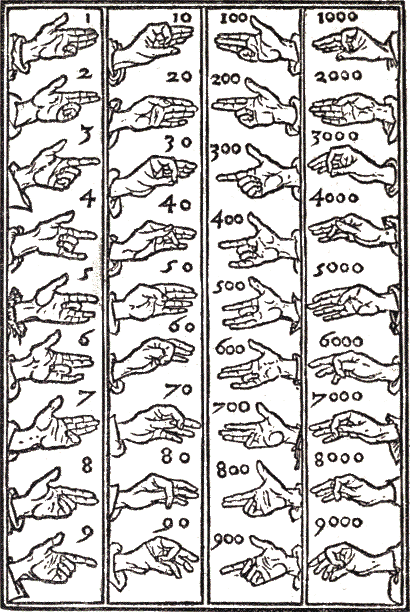
1 134 b. *In which as you may se 1 is expressed by ye lyttle fynger of ye lefte hande closely and harde croked.
2 32 is declared by lyke bowynge of the weddynge fynger (whiche is the nexte to the lyttell fynger) together with the lytell fynger.
3 3 is signified by the myddle fynger bowed in lyke maner, with those other two.
4 4 is declared by the bowyng of the myddle fynger and the rynge fynger, or weddynge fynger, with the other all stretched forth.
5 5 is represented by the myddle fynger onely bowed.
6 And 6 by the weddynge fynger only crooked: and this you may marke in these a certayne order. But now 7, 8, and 9, are expressed with the bowynge of the same fyngers as are 1, 2, and 3, but after an other fourme.
7 For 7 is declared by the bowynge of the lytell fynger, as is 1, saue that for 1 the fynger is clasped in, harde and 135 a. *rounde, but for to expresse 7, you shall bowe the myddle ioynte of the lytell fynger only, and holde the other ioyntes streyght.
S. Yf you wyll geue me leue to expresse it after my rude maner, thus I vnderstand your meanyng: that 1 is expressed by crookynge in the lyttell fynger lyke the head of a bysshoppes bagle: and 7 is declared by the same fynger bowed lyke a gybbet.
M. So I perceaue, you vnderstande it.
8 Then to expresse 8, you shall bowe after the same maner both the lyttell fynger and the rynge fynger.
9 And yf you bowe lyke wayes with them the myddle fynger, then doth it betoken 9.
10 Now to expresse 10, you shall bowe your fore fynger rounde, and set the ende of it on the hyghest ioynte of the thombe.
20 And for to expresse 20, you must set your fyngers streyght, and the ende of your thombe to the partition of the 135 b. *fore moste and myddle fynger.
30 30 is represented by the ioynynge together of ye headdes of the foremost fynger and the thombe.
40 40 is declared by settynge of the thombe crossewayes on the foremost fynger.
50 50 is signified by ryght stretchyng forth of the fyngers ioyntly, and applyenge of the thombes ende to the partition of the myddle fynger and the rynge fynger, or weddynge fynger.
60 60 is formed by bendynge of the thombe croked and crossynge it with the fore fynger.
70 70 is expressed by the bowynge of the foremost fynger, and settynge the ende of the thombe between the 2 foremost or hyghest ioyntes of it.
80 80 is expressed by settynge of the foremost fynger crossewayes on the thombe, so that 80 dyffereth thus from 40, that for 80 the forefynger is set crosse on the thombe, and for 40 the thombe is set crosse ouer ye forefinger.
90 136 a. *90 is signified, by bendynge the fore fynger, and settyng the ende of it in the innermost ioynte of ye thombe, that is euen at the foote of it. And thus are all the nombers ended vnder 100.
S. In dede these be all the nombers from 1 to 10, and then all the tenthes within 100, 11, 12, 13, 21, 22, 23 but this teacyed me not how to expresse 11, 12, 13, etc. 21, 22, 23, etc. and such lyke.
M. You can lytell vnderstande, yf you can not do that without teachynge: what is 11? is it not 10 and 1? then expresse 10 as you were taught, and 1 also, and that is 11: and for 12 expresse 10 and 2: for 23 set 20 and 3: and so for 68 you muste make 60 and there to 8: and so of all other sortes.
100 But now yf you wolde represente 100 other any nomber aboue it, you muste do that with the ryghte hande, after this maner.
You must expresse 100 in the ryght hand, with the lytell fynger so bowed as you dyd expresse 1 in the left hand.
200 136 b. *And as you expressed 2 in the lefte hande, the same fasshyon in the ryght hande doth declare 200.
300 The fourme of 3 in the ryght hand standeth for 300.
400 The fourme of 4, for 400.
500 Lykewayes the fourme of 5, for 500.
600 The fourme of 6, for 600. And to be shorte: loke how you did expresse single vnities and tenthes in the lefte hande, so must you expresse vnities and tenthes of hundredes, in the ryghte hande.
900 S. I vnderstande you thus: that yf I wold represent 900, I must so fourme the fyngers of my ryghte hande, as I shuld do in my left hand to expresse 9, 1000 And as in my lefte hand I expressed 10, so in my ryght hande must I expresse 1000.
And so the fourme of euery tenthe in the lefte hande serueth to expresse lyke nomber of thousandes, 4000 so ye fourme of 40 standeth for 4000.
8000 The fourme of 80 for 8000.
9000
137
a
.
*And the fourme of 90 (whiche is the greatest) for 9000, and aboue that I can not expresse any nomber. M. No not with one fynger: how be it, with dyuers fyngers you maye expresse 9999, and all at one tyme, and that lac keth but 1 of 10000. So that vnder 10000 you may by your fyngers ex- presse any summe. And this shal suf- fyce for Numeration on the fyngers. And as for Addition, Subtraction, Multiplication, and Diuision (which yet were neuer taught by any man as farre as I do knowe) I wyll enstruct you after the treatyse of fractions. And now for this tyme fare well, and loke that you cease not to practyse that you haue lear ned. S. Syr, with moste harty mynde I thanke you, bothe for your good learnyng, and also your good counsel, which (god wyllyng) I truste to folow.
Finis.
APPENDIX I.

[From a MS. of the 14th Century.]
To alle suche even nombrys the most have cifrys as to ten. twenty. thirtty. an hundred. an thousand and suche other. but ye schal vnderstonde that a cifre tokeneth nothinge but he maketh other the more significatyf that comith after hym. Also ye schal vnderstonde that in nombrys composyt and in alle other nombrys that ben of diverse figurys ye schal begynne in the ritht syde and to rekene backwarde and so he schal be wryte as thus—1000. the sifre in the ritht side was first wryte and yit he tokeneth nothinge to the secunde no the thridde but thei maken that figure of 1 the more signyficatyf that comith after hem by as moche as he born oute of his first place where he schuld yf he stode ther tokene but one. And there he stondith nowe in the ferye place he tokeneth a thousand as by this rewle. In the first place he tokeneth but hymself. In the secunde place he tokeneth ten times hymself. In the thridde place he tokeneth an hundred tymes himself. In the ferye he tokeneth a thousand tymes himself. In the fyftye place he tokeneth ten thousand tymes himself. In the sexte place he tokeneth an hundred thousand tymes hymself. In the seveth place he tokeneth ten hundred thousand tymes hymself, &c. And ye schal vnderstond that this worde nombre is partyd into thre partyes. Somme is callyd nombre of digitys for alle ben digitys that ben withine ten as ix, viii, vii, vi, v, iv, iii, ii, i. Articules ben alle thei that mow be devyded into nombrys of ten as xx, xxx, xl, and suche other. Composittys be alle nombrys that ben componyd of a digyt and of an articule as fourtene fyftene thrittene and suche other. Fourtene is componyd of four that is a digyt and of ten that is an articule. Fyftene is componyd of fyve that is a digyt and of ten that is an articule and so of others . . . . . . But as to this rewle. In the firste place he tokeneth but himself that is to say he tokeneth but that and no more. If that he stonde in the secunde place he tokeneth ten tymes himself as this figure 2 here 21. this is oon and twenty. This figure 2 stondith in the secunde place and therfor he tokeneth ten tymes himself and ten tymes 2 is twenty and so forye of every figure and he stonde after another toward the lest syde he schal tokene ten tymes as moche more as he schuld token and he stode in that place ther that the figure afore him stondeth: lo an example as thus 9634. This figure of foure that hath this schape 4 tokeneth but himself for he stondeth in the first place. The figure of thre that hath this schape 3 tokeneth ten tyme himself for he stondeth in the secunde place and that is thritti. The figure of sexe that hath this schape 6 tokeneth ten tyme more than he schuld and he stode in the place yer the figure of thre stondeth for ther he schuld tokene but sexty. And now he tokeneth ten tymes that is sexe hundrid. The figure of nyne that hath this schape 9 tokeneth ten tymes more than he schulde and he stode in the place ther the figure of 6 stondeth inne for thanne he schuld tokene but nyne hundryd. And in the place that he stondeth inne nowe he tokeneth nine thousand. Alle the hole nombre of these foure figurys. Nine thousand sexe hundrid and foure and thritti.
APPENDIX II.

[From a B.M. MS., 8 C. iv., with additions from 12 E. 1 & Eg. 2622.]
Hec algorismus ars presens dicitur1; in qua Talibus Indorum2 fruimur his quinque figuris. 0. 9. 8. 7. 6. 5. 4. 3. 2. 1. Prima significat unum: duo vero secunda: 4 Tercia significat tria: sic procede sinistre Donec ad extremam venies, qua cifra vocatur; 3[Que nil significat; dat significare sequenti.] Quelibet illarum si primo limite ponas, 8 Simpliciter se significat: si vero secundo, Se decies: sursum procedas multiplicando.4 [Namque figura sequens quevis signat decies plus, 12 Ipsa locata loco quam significet pereunte: Nam precedentes plus ultima significabit.] 5Post predicta scias quod tres breuiter numerorum Distincte species sunt; nam quidam digiti sunt; 16 Articuli quidam; quidam quoque compositi sunt. [Sunt digiti numeri qui citra denarium sunt; Articuli decupli degitorum; compositi sunt Illi qui constant ex articulis digitisque.] 20 Ergo, proposito numero tibi scribere, primo Respicias quis sit numerus; quia si digitus sit, 5[Una figura satis sibi; sed si compositus sit,] Primo scribe loco digitum post articulum fac 24 Articulus si sit, cifram post articulum sit, [Articulum vero reliquenti in scribe figure.] Quolibet in numero, si par sit prima figura, Par erit et totum, quicquid sibi continetur; 28 Impar si fuerit, totum sibi fiet et impar. Septem6 sunt partes, non plures, istius artis; Addere, subtrahere, duplare, dimidiare; Sexta est diuidere, set quinta est multiplicare; 32 Radicem extrahere pars septima dicitur esse. Subtrahis aut addis a dextris vel mediabis; A leua dupla, diuide, multiplicaque; Extrahe radicem semper sub parte sinistra. 36 Addition. Addere si numero numerum vis, ordine tali Incipe; scribe duas primo series numerorum Prima sub prima recte ponendo figuram, Et sic de reliquis facias, si sint tibi plures. 40 Inde duas adde primas hac condicione; Si digitus crescat ex addicione priorum, Primo scribe loco digitum, quicunque sit ille; Si sit compositus, in limite scribe sequenti 44 Articulum, primo digitum; quia sic iubet ordo. Articulus si sit, in primo limite cifram, Articulum vero reliquis inscribe figuris; Vel per se scribas si nulla figura sequatur. 48 Si tibi cifra superueniens occurrerit, illam Deme suppositam; post illic scribe figuram: Postea procedas reliquas addendo figuras. Subtraction. A numero numerum si sit tibi demere cura, 52 Scribe figurarum series, vt in addicione; Maiori numero numerum suppone minorem, Siue pari numero supponatur numerus par. Postea si possis a prima subtrahe primam, 56 Scribens quod remanet, cifram si nil remanebit. Set si non possis a prima demere primam; Procedens, vnum de limite deme sequenti; Et demptum pro denario reputabis ab illo, 60 Subtrahe totaliter numerum quem proposuisti. Quo facto, scribe supra quicquit remanebit, Facque novenarios de cifris, cum remanebis, Occurrant si forte cifre, dum demseris vnum; 64 Postea procedas reliquas demendo figuras. Proof. 7[Si subtracio sit bene facta probare valebis, Quas subtraxisti primas addendo figuras. Nam, subtractio si bene sit, primas retinebis, 68 Et subtractio facta tibi probat additionem.] Duplation. Si vis duplare numerum, sic incipe; solam Scribe figurarum seriem, quamcumque voles que Postea procedas primam duplando figuram; 72 Inde quod excrescet, scribens, vbi iusserit ordo, Juxta precepta que dantur in addicione. Nam si sit digitus, in primo limite scribe; Articulus si sit, in primo limite cifram, 76 Articulum vero reliquis inscribe figuris; Vel per se scribas, si nulla figura sequatur: Compositus si sit, in limite scribe sequenti Articulum primo, digitum; quia sic jubet ordo: 80 Et sic de reliquis facias, si sint tibi plures. 8[Si super extremam nota sit, monadem dat eidem, Quod tibi contingit, si primo dimidiabis.] Mediation. Incipe sic, si vis aliquem numerum mediare: 84 Scribe figurarum seriem solam, velud ante; Postea procedens medias, et prima figura Si par aut impar videas; quia si fuerit par, Dimidiabis eam, scribens quicquit remanebit; 88 Impar si fuerit, vnum demas, mediare, Nonne presumas, sed quod superest mediabis; Inde super tractum, fac demptum quod notat unum; Si monos, dele; sit ibi cifra post nota supra. 92 Postea procedas hac condicione secunda:9 Impar10 si fuerit hic vnum deme priori, Inscribens quinque, nam denos significabit Monos prædictam: si vero secunda dat vnam, 96 Illa deleta, scribatur cifra; priori Tradendo quinque pro denario mediato; Nec cifra scribatur, nisi inde figura sequatur: Postea procedas reliquas mediando figuras, 100 Quin supra docui, si sint tibi mille figure. 11[Si mediatio sit bene facta probare valebis, Duplando numerum quem primo dimidiasti.] Multiplication. Si tu per numerum numerum vis multiplicare, 104 Scribe duas, quascunque volis, series numerorum; Ordo tamen seruetur vt vltima multiplicandi Ponatur super anteriorem multiplicantis; 12[A leua relique sint scripte multiplicantes.] 108 In digitum cures digitum si ducere, major Per quantes distat a denis respice, debes Namque suo decuplo tociens delere minorem; Sicque tibi numerus veniens exinde patebit. 112 Postea procedas postremam multiplicando, Juste multiplicans per cunctas inferiores, Condicione tamen tali; quod multiplicantis Scribas in capite, quicquid processerit inde; 116 Set postquam fuerit hec multiplicata, figure Anteriorentur seriei multiplicantis; Et sic multiplica, velut istam multiplicasti, Qui sequitur numerum scriptum quicunque figuris. 120 Set cum multiplicas, primo sic est operandum, Si dabit articulum tibi multiplicacio solum; Proposita cifra, summam transferre memento. Sin autem digitus excrescerit articulusque, 124 Articulus supraposito digito salit ultra; Si digitus tamen, ponas illum super ipsam, Subdita multiplicans hanc que super incidit illi Delet eam penitus, scribens quod provenit inde; 128 Sed si multiplices illam posite super ipsam, Adiungens numerum quem prebet ductus earum; Si supraimpositam cifra debet multiplicare, Prorsus eam delet, scribi que loco cifra debet, 132 12[Si cifra multiplicat aliam positam super ipsam, Sitque locus supra vacuus super hanc cifra fiet;] Si supra fuerit cifra semper pretereunda est; Si dubites, an sit bene multiplicando secunda, 136 Diuide totalem numerum per multiplicantem, Et reddet numerus emergens inde priorem. Mental Multiplication. 13[Per numerum si vis numerum quoque multiplicare Tantum per normas subtiles absque figuris 140 Has normas poteris per versus scire sequentes. Si tu per digitum digitum quilibet multiplicabis Regula precedens dat qualiter est operandum Articulum si per reliquum vis multiplicare 144 In proprium digitum debebit uterque resolvi Articulus digitos post per se multiplicantes Ex digitis quociens teneret multiplicatum Articuli faciunt tot centum multiplicati. 148 Articulum digito si multiplicamus oportet Articulum digitum sumi quo multiplicare Debemus reliquum quod multiplicaris ab illis Per reliquo decuplum sic omne latere nequibit 152 In numerum mixtum digitum si ducere cures Articulus mixti sumatur deinde resolvas In digitum post hec fac ita de digitis nec Articulusque docet excrescens in detinendo 156 In digitum mixti post ducas multiplicantem De digitis ut norma docet sit juncta secundo Multiplica summam et postea summa patebit Junctus in articulum purum articulumque 160 14[Articulum purum comittes articulum que] Mixti pro digitis post fiat et articulus vt Norma jubet retinendo quod egreditur ab illis Articuli digitum post in digitum mixti duc 164 Regula de digitis ut percipit articulusque Ex quibus excrescens summe tu junge priori Sic manifesta cito fiet tibi summa petita. Compositum numerum mixto sic multiplicabis 168 Vndecies tredecem sic est ex hiis operandum In reliquum primum demum duc post in eundem Unum post deinde duc in tercia deinde per unum Multiplices tercia demum tunc omnia multiplicata 172 In summa duces quam que fuerit te dices Hic ut hic mixtus intentus est operandum Multiplicandorum de normis sufficiunt hec.] Division. Si vis dividere numerum, sic incipe primo; 176 Scribe duas, quascunque voles, series numerorum; Majori numero numerum suppone minorem, 15[Nam docet ut major teneat bis terve minorem;] Et sub supprima supprimam pone figuram, 180 Sic reliquis reliquas a dextra parte locabis; Postea de prima primam sub parte sinistra Subtrahe, si possis, quociens potes adminus istud, Scribens quod remanet sub tali conditione; 184 Ut totiens demas demendas a remanente, Que serie recte ponentur in anteriori, Unica si, tantum sit ibi decet operari; Set si non possis a prima demere primam, 188 Procedas, et eam numero suppone sequenti; Hanc uno retrahendo gradu quo comites retrahantur, Et, quotiens poteris, ab eadem deme priorem, Ut totiens demas demendas a remanenti, 192 Nec plus quam novies quicquam tibi demere debes, Nascitur hinc numerus quociens supraque sequentem Hunc primo scribas, retrahas exinde figuras, Dum fuerit major supra positus inferiori, 196 Et rursum fiat divisio more priori; Et numerum quotiens supra scribas pereunti, Si fiat saliens retrahendo, cifra locetur, Et pereat numero quotiens, proponas eidem 200 Cifram, ne numerum pereat vis, dum locus illic Restat, et expletis divisio non valet ultra: Dum fuerit numerus numerorum inferiore seorsum Illum servabis; hinc multiplicando probabis, Proof. 204 Si bene fecisti, divisor multiplicetur Per numerum quotiens; cum multiplicaveris, adde Totali summæ, quod servatum fuit ante, Reddeturque tibi numerus quem proposuisti; 208 Et si nil remanet, hunc multiplicando reddet, Square Numbers. Cum ducis numerum per se, qui provenit inde Sit tibi quadratus, ductus radix erit hujus, Nec numeros omnes quadratos dicere debes, 212 Est autem omnis numerus radix alicujus. Quando voles numeri radicem querere, scribi Debet; inde notes si sit locus ulterius impar, Estque figura loco talis scribenda sub illo, 216 Que, per se dicta, numerum tibi destruat illum, Vel quantum poterit ex inde delebis eandem; Vel retrahendo duples retrahens duplando sub ista Que primo sequitur, duplicatur per duplacationem, 220 Post per se minuens pro posse quod est minuendum. 16Post his propones digitum, qui, more priori Per precedentes, post per se multiplicatus, Destruat in quantum poterit numerum remanentem, 224 Et sic procedens retrahens duplando figuram, Preponendo novam donec totum peragatur, Subdupla propriis servare docetque duplatis; Si det compositum numerum duplacio, debet 228 Inscribi digitus a parte dextra parte propinqua, Articulusque loco quo non duplicata resessit; Si dabit articulum, sit cifra loco pereunte Articulusque locum tenet unum, de duplicata resessit; 232 Si donet digitum, sub prima pone sequente, Si supraposita fuerit duplicata figura Major proponi debet tantummodo cifra, Has retrahens solito propones more figuram, 236 Usque sub extrema ita fac retrahendo figuras, Si totum deles numerum quem proposuisti, Quadratus fuerit, de dupla quod duplicasti, Sicque tibi radix illius certa patebit, 240 Si de duplatis fit juncta supprima figura; Radicem per se multiplices habeasque Primo propositum, bene te fecisse probasti; Non est quadratus, si quis restat, sed habentur 244 Radix quadrati qui stat major sub eadem; Vel quicquid remanet tabula servare memento; Hoc casu radix per se quoque multiplicetur, Vel sic quadratus sub primo major habetur, 248 Hinc addas remanens, et prius debes haberi; Si locus extremus fuerit par, scribe figuram Sub pereunte loco per quam debes operari, Que quantum poterit supprimas destruat ambas, 252 Vel penitus legem teneas operando priorem, Si suppositum digitus suo fine repertus, Omnino delet illic scribi cifra debet, A leva si qua sit ei sociata figura; 256 Si cifre remanent in fine pares decet harum Radices, numero mediam proponere partem, Tali quesita radix patet arte reperta. Per numerum recte si nosti multiplicare 260 Ejus quadratum, numerus qui pervenit inde Dicetur cubicus; primus radix erit ejus; Nec numeros omnes cubicatos dicere debes, Est autem omnis numerus radix alicujus; Cube Root. 264 Si curas cubici radicem quærere, primo Inscriptum numerum distinguere per loca debes; Que tibi mille notant a mille notante suprema Initiam, summa operandi parte sinistra, 268 Illic sub scribas digitum, qui multiplicatus In semet cubice suprapositum sibi perdat, Et si quid fuerit adjunctum parte sinistra Si non omnino, quantum poteris minuendo, 272 Hinc triplans retrahe saltum, faciendo sub illa Que manet a digito deleto terna, figuram Illi propones quo sub triplo asocietur, Ut cum subtriplo per eam tripla multiplicatur; 276 Hinc per eam solam productum multiplicabis, Postea totalem numerum, qui provenit inde A suprapositis respectu tolle triplate Addita supprimo cubice tunc multiplicetur, 280 Respectu cujus, numerus qui progredietur Ex cubito ductu, supra omnes adimetur; Tunc ipsam delens triples saltum faciendo, Semper sub ternas, retrahens alias triplicatas 284 Ex hinc triplatis aliam propone figuram, Que per triplatas ducatur more priori; Primo sub triplis sibi junctis, postea per se, In numerum ducta, productum de triplicatis: 288 Utque prius dixi numerus qui provenit inde A suprapositis has respiciendo trahatur, Huic cubice ductum sub primo multiplicabis, Respectumque sui, removebis de remanenti, 292 Et sic procedas retrahendo triplando figuram. Et proponendo nonam, donec totum peragatur, Subtripla sub propriis servare decet triplicatis; Si nil in fine remanet, numerus datus ante 296 Est cubicus; cubicam radicem sub tripla prebent, Cum digito juncto quem supprimo posuisti, Hec cubice ducta, numerum reddant tibi primum. Si quid erit remanens non est cubicus, sed habetur 300 Major sub primo qui stat radix cubicam, Servari debet quicquid radice remansit, Extracto numero, decet hec addi cubicato. Quo facto, numerus reddi debet tibi primus. 304 Nam debes per se radicem multiplicare Ex hinc in numerum duces, qui provenit inde Sub primo cubicus major sic invenietur; Illi jungatur remanens, et primus habetur, 308 Si per triplatum numerum nequeas operari; Cifram propones, nil vero per hanc operare Set retrahens illam cum saltu deinde triplata, Propones illi digitum sub lege priori, 312 Cumque cifram retrahas saliendo, non triplicabis, Namque nihil cifre triplacio dicitur esse; At tu cum cifram protraxeris aut triplicata, Hanc cum subtriplo semper servare memento: 316 Si det compositum, digiti triplacio debet Illius scribi, digitus saliendo sub ipsam; Digito deleto, que terna dicitur esse; Jungitur articulus cum triplata pereunte, 320 Set facit hunc scribi per se triplacio prima, Que si det digitum per se scribi facit illum; Consumpto numero, si sole fuit tibi cifre Triplato, propone cifram saltum faciendo, 324 Cumque cifram retrahe triplam, scribendo figuram, Preponas cifre, sic procedens operare, Si tres vel duo serie in sint, pone sub yma, A dextris digitum servando prius documentum. 328 Si sit continua progressio terminus nuper Per majus medium totalem multiplicato; Si par, per medium tunc multiplicato sequentem. Set si continua non sit progressio finis: 332 Impar, tunc majus medium si multiplicabis, 333 Si par per medium sibi multiplicato propinquum.
INDEX OF TECHNICAL TERMS1
algorisme, 33/12; algorym, augrym, 3/3; the art of computing, using the so-called Arabic numerals.
The word in its various forms is derived from the Arabic al-Khowarazmi (i.e. the native of Khwarazm (Khiva)). This was the surname of Ja’far Mohammad ben Musa, who wrote a treatise early in the 9th century (see p. xiv).
The form algorithm is also found, being suggested by a supposed derivation from the Greek ἀριθμός (number).
antery, 24/11; to move figures to the right of the position in which they are first written. This operation is performed repeatedly upon the multiplier in multiplication, and upon certain figures which arise in the process of root extraction.
anterioracioun, 50/5; the operation of moving figures to the right.
article, 34/23; articul, 5/31; articuls, 9/36, 29/7,8; a number divisible by ten without remainder.
cast, 8/12; to add one number to another.
‘Addition is a casting together of two numbers into one number,’ 8/10.
cifre, 4/1; the name of the figure 0. The word is derived from the Arabic sifr = empty, nothing. Hence zero.
A cipher is the symbol of the absence of number or of zero quantity. It may be used alone or in conjunction with digits or other ciphers, and in the latter case, according to the position which it occupies relative to the other figures, indicates the absence of units, or tens, or hundreds, etc. The great superiority of the Arabic to all other systems of notation resides in the employment of this symbol. When the cipher is not used, the place value of digits has to be indicated by writing them in assigned rows or columns. Ciphers, however, may be interpolated amongst the significant figures used, and as they sufficiently indicate the positions of the empty rows or columns, the latter need not be indicated in any other way. The practical performance of calculations is thus enormously facilitated (see p. xvi).
componede, 33/24; composyt, 5/35; with reference to numbers, one compounded of a multiple of ten and a digit.
conuertide = conversely, 46/29, 47/9.
cubicede, 50/13; to be c., to have its cube root found.
cubike nombre, 47/8; a number formed by multiplying a given number twice by itself, e.g. 27 = 3 × 3 × 3. Now called simply a cube.
decuple, 22/12; the product of a number by ten. Tenfold.
departys = divides, 5/29.
digit, 5/30; digitalle, 33/24; a number less than ten, represented by one of the nine Arabic numerals.
dimydicion, 7/23; the operation of dividing a number by two. Halving.
duccioun, multiplication, 43/9.
duplacion, 7/23, 14/15; the operation of multiplying a number by two. Doubling.
i-mediet = halved, 19/23.
intercise = broken, 46/2; intercise Progression is the name given to either of the Progressions 1, 3, 5, 7, etc.; 2, 4, 6, 8, etc., in which the common difference is 2.
lede into, multiply by, 47/18.
lyneal nombre, 46/14; a number such as that which expresses the measure of the length of a line, and therefore is not necessarily the product of two or more numbers (vide Superficial, Solid). This appears to be the meaning of the phrase as used in The Art of Nombryng. It is possible that the numbers so designated are the prime numbers, that is, numbers not divisible by any other number except themselves and unity, but it is not clear that this limitation is intended.
mediacioun, 16/36, 38/16; dividing by two (see also dimydicion).
medlede nombre, 34/1; a number formed of a multiple of ten and a digit (vide componede, composyt).
medye, 17/8, to halve; mediete, halved, 17/30; ymedit, 20/9.
naturelle progressioun, 45/22; the series of numbers 1, 2, 3, etc.
produccioun, multiplication, 50/11.
quadrat nombre, 46/12; a number formed by multiplying a given number by itself, e.g. 9 = 3 × 3, a square.
rote, 7/25; roote, 47/11; root. The roots of squares and cubes are the numbers from which the squares and cubes are derived by multiplication into themselves.
significatyf, significant, 5/14; The significant figures of a number are, strictly speaking, those other than zero, e.g. in 3 6 5 0 4 0 0, the significant figures are 3, 6, 5, 4. Modern usage, however, regards all figures between the two extreme significant figures as significant, even when some are zero. Thus, in the above example, 3 6 5 0 4 are considered significant.
solide nombre, 46/37; a number which is the product of three other numbers, e.g. 66 = 11 × 2 × 3.
superficial nombre, 46/18; a number which is the product of two other numbers, e.g. 6 = 2 × 3.
ternary, consisting of three digits, 51/7.
vnder double, a digit which has been doubled, 48/3.
vnder-trebille, a digit which has been trebled, 49/28; vnder-triplat, 49/39.
w, a symbol used to denote half a unit, 17/33.
GLOSSARY
Words whose first appearance is earlier than the page cited in the Glossary are identified in supplementary notes, and both occurrences are marked in the main text.
ablacioun, taking away, 36/21
addyst, haddest, 10/37
agregacioun, addition, 45/22. (First example in N.E.D., 1547.)
a-ȝenenes, against, 23/10
allgate, always, 8/39
als, as, 22/24
and, if, 29/8;
&, 4/27;
& yf, 20/7
a-nendes, towards, 23/15
aproprede, appropriated, 34/27
apwereth, appears, 61/8
a-risyȝt, arises, 14/24
a-rowe, in a row, 29/10
arsemetrike, arithmetic, 33/1
ayene, again, 45/15
bagle, crozier, 67/12
bordure = ordure, row, 43/30
borro, inf. borrow, 11/38;
imp. s. borowe, 12/20;
pp. borwed, 12/15;
borred, 12/19
boue, above, 42/34
caputule, chapter, 7/26
certayn, assuredly, 18/34
clepede, called, 47/7
competently, conveniently, 35/8
compt, count, 47/29
contynes, contains, 21/12;
pp. contenythe, 38/39
craft, art, 3/4
distingue, divide, 51/5
egalle, equal, 45/21
excep, except, 5/16
exclusede, excluded, 34/37
excressent, resulting, 35/16
exeant, resulting, 43/26
expone, expound, 3/23
ferye = ferþe, fourth, 70/12
figure = figures, 5/1
for-by, past, 12/11
fors; no f., no matter, 22/24
forseth, matters, 53/30
forye = forþe, forth, 71/8
fyftye = fyftþe, fifth, 70/16
grewe, Greek, 33/13
haluendel, half, 16/16;
haldel, 19/4;
pl. haluedels, 16/16
hayst, hast, 17/3, 32
hast, haste, 22/25
heer, higher, 9/35
here, their, 7/26
here-a-fore, heretofore, 13/7
heyth, was called, 3/5
hole, whole, 4/39;
holle, 17/1;
hoole, of three dimensions, 46/15
holdyþe, holds good, 30/5
how be it that, although, 44/4
lede = lete, let, 8/37
lene, lend, 12/39
lest, least, 43/27
lest = left, 71/9
leue, leave, 6/5;
pr. 3 s. leues, remains, 11/19; First used in 10/40
leus, 11/28;
pp. laft, left, 19/24
lewder, more ignorant, 3/3
lust, desirest to, 45/13
lyȝt, easy, 15/31
lymytes, limits, 34/18;
lynes, 34/12;
lynees, 34/17;
Lat. limes, pl. limites.
maystery, achievement;
no m., no achievement, i.e. easy, 19/10
me, indef. pron. one, 42/1 First used in 34/16
mo, more, 9/16
moder = more (Lat. majorem), 43/22
most, must, 30/3 First used in 3/12
multipliede, to be m. = multiplying, 40/9
mynvtes, the sixty parts into which a unit is divided, 38/25
myse-wroȝt, mis-wrought, 14/11
nether, nor, 34/25
nex, next, 19/9
noȝt, nought, 5/7 First used in 4/8
note, not, 30/5
oo, one, 42/20; o, 42/21 First used in 34/27 (oo); 33/22 (o)
omest, uppermost, higher, 35/26;
omyst, 35/28
omwhile, sometimes, 45/31 First used in 39/17
on, one, 8/29
opyne, plain, 47/8
or, before, 13/25
or = þe oþer, the other, 28/34
ordure, order, 34/9;
row, 43/1 Word form is “order”
other, or, 33/13, 43/26; Note also “one other other” in 35/24
other . . . or, either . . . or, 38/37 First used in 37/5
ouerer, upper, 42/15
ouer-hippede, passed over, 43/19
recte, directly, 27/20 First used in 26/31
remayner, remainder, 56/28
representithe, represented, 39/14
resteth, remains, 63/29 First used in 57/29
rewarde, regard, 48/6
rew, row, 4/8
rewle, row, 4/20, 7/12;
rewele, 4/18;
rewles, rules, 5/33
s. = scilicet, 3/8
sentens, meaning, 14/29
signifye(tyf), 5/13. The last three letters are added above the line, evidently because of the word ‘significatyf’ in l. 14. But the ‘Solucio,’ which contained the word, has been omitted.
sithen, since, 33/8
some, sum, result, 40/17, 32 First used in 36/21
sowne, pronounce, 6/29
singillatim, singly, 7/25
spices, species, kinds, 34/4First used in 5/34
spyl, waste, 14/26
styde, stead, 18/20
subtrahe, subtract, 48/12;
pp. subtrayd, 13/21
sythes, times, 21/16
taȝt, taught, 16/36
take, pp. taken;
t. fro, starting from, 45/22
taward, toward, 23/34
thouȝt, though, 5/20
trebille, multiply by three, 49/26
twene, two, 8/11 First used in 4/23
þow, though, 25/15
þowȝt, thought;
be þ., mentally, 28/4
þus = þis, this, 20/33
vny, unite, 45/10
wel, wilt, 14/31
wete, wit, 15/16;
wyte, know, 8/38;
pr. 2 s. wost, 12/38
wex, become, 50/18
where, whether, 29/12
wher-thurghe, whence, 49/15
worch, work, 8/19; First used in 7/35
wrich, 8/35;
wyrch, 6/19;
imp. s. worch, 15/9; First used in 9/6
pp. y-wroth, 13/24
write, written, 29/19; First used in 4/5
y-write, 16/1
wryrchynge = wyrchynge, working, 30/4
wt, with, 55/8
y-broth, brought, 21/18
ychon, each one, 29/10
ydo, done, added, 9/6 First used in 8/37
ylke, same, 5/12
y-lyech, alike, 22/23
y-myȝt, been able, 12/2
y-nowȝt, enough, 15/31;
ynovȝt, 18/34
yove, given, 45/33
yt, that, 52/8
y-write, v. write.
y-wroth, v. worch.