EAGLE'S SHADOW (continued 3)
Reading edition
ear-tickling jingle. And while it is true that scientists have any
number of plausible and interesting explanations for this same
feeling, I am sorry to say I have forgotten them.
I am compelled, then, to fall back upon those same unreliable,
irresponsible rhymesters, and to insist with them that a maid waiting
in the springtide for the man she loves is necessarily happy and very
rarely puzzles her head over the scientific reason for it.
XXI
But ten minutes later she saw Mr. Woods in the distance striding
across the sunlit terraces, and was seized with a conviction that
their interview was likely to prove a stormy one. There was an ominous
stiffness in his gait.
"Oh, dear, dear!" Miss Hugonin wailed; "he's in a temper now, and
he'll probably be just as disagreeable as it's possible for any one
to be. I do wish men weren't so unreasonable! He looks exactly like a
big, blue-eyed thunder-cloud just now--just now, when I'm sure he has
every cause in the
world
to be very much pleased--after all
I've done for him. He makes me awfully tired. I think he's
very ungrateful
. I--I think I'm rather afraid."
In fact, she was. Now that the meeting she had anticipated these
twelve hours past was actually at hand, there woke in her breast an
unreasoning panic. Miss Hugonin considered, and caught up her skirts,
and whisked into the summer-house, and there sat down in the darkest
corner and devoutly wished Mr. Woods in Crim Tartary, or Jericho, or,
in a word, any region other than the gardens of Selwoode.
Billy came presently to the opening in the hedge and stared at the
deserted bench. He was undeniably in a temper. But, then, how becoming
it was! thought someone.
"Miss Hugonin!" he said, coldly.
Evidently (thought someone) he intends to be just as nasty as
possible.
"Peggy!" said Mr. Woods, after a little.
Perhaps (thought someone) he won't be
very
nasty.
"Dear Peggy!" said Mr. Woods, in his most conciliatory tone.
Someone rearranged her hair complacently.
But there was no answer, save the irresponsible chattering of the
birds, and with a sigh Billy turned upon his heel.
Then, by the oddest chance in the world, Margaret coughed.
I dare say it was damp in the summer-house; or perhaps it was caused
by some passing bronchial irritation; or perhaps, incredible as it may
seem, she coughed to show him where she was. But I scarcely think so,
because Margaret insisted afterward--very positively, too--that she
didn't cough at all.
XXII
"Well!" Mr. Woods observed, lengthening the word somewhat.
In the intimate half-light of the summer-house, he loomed prodigiously
big. He was gazing downward in careful consideration of three fat
tortoise-shell pins and a surprising quantity of gold hair, which was
practically all that he could see of Miss Hugonin's person; for that
young lady had suddenly become a limp mass of abashed violet ruffles,
and had discovered new and irresistible attractions in the mosaics
about her feet.
Billy's arms were crossed on his breast and his right hand caressed
his chin meditatively. By and bye, "I wonder, now," he reflected,
aloud, "if you can give any reason--any possible reason--why you
shouldn't be locked up in the nearest sanatorium?"
"You needn't be rude, you know," a voice observed from the
neighbourhood of the ruffles, "because there isn't anything you can do
about it."
Mr. Woods ventured a series of inarticulate observations. "But why?"
he concluded, desperately. "But why, Peggy?--in Heaven's name, what's
the meaning of all this?"
She looked up. Billy was aware of two large blue stars; his heart
leapt; and then he recalled a pair of gray-green eyes that had
regarded him in much the same fashion not long ago, and he groaned.
"I was unfair to you last night," she said, and the ring of her odd,
deep voice, and the richness and sweetness of it, moved him to faint
longing, to a sick heart-hunger. It was tremulous, too, and very
tender. "Yes, I was unutterably unfair, Billy. You asked me to marry
you when you thought I was a beggar, and--and Uncle Fred
ought
to
have left you the money. It was on account of me that he didn't, you
know. I really owed it to you. And after the way I talked to you--so
long as I had the money--I--and, anyhow, its very disagreeable and
eccentric and
horrid
of you to object to being rich!" Margaret
concluded, somewhat incoherently.
She had not thought it would be like this. He seemed so stern.
But, "Isn't that exactly like her?" Mr. Woods was demanding of his
soul. "She thinks she has been unfair to me--to me, whom she doesn't
care a button for, mind you. So she hands over a fortune to make up
for it, simply because that's the first means that comes to hand! Now,
isn't that perfectly unreasonable, and fantastic, and magnificent, and
incredible?--in short, isn't that Peggy all over? Why, God bless her,
her heart's bigger than a barn-door! Oh, it's no wonder that fellow
Kennaston was grinning just now when he sent me to her! He can afford
to grin."
Aloud, he stated, "You're an angel, Peggy that's what you are. I've
always suspected it, and I'm glad to know it now for a fact. But in
this prosaic world not even angels are allowed to burn up wills for
recreation. Why, bless my soul, child, you--why, there's no telling
what trouble you might have gotten into!"
Miss Hugonin pouted. "You needn't be such a grandfather," she
suggested, helpfully.
"But it's a serious business," he insisted. At this point Billy began
to object to her pouting as distracting one's mind from the subject
under discussion. "It--why, it's----"
"It's what?" she pouted, even more rebelliously.
"Crimson," said Mr. Woods, considering--"oh, the very deepest,
duskiest crimson such as you can't get in tubes. It's a colour was
never mixed on any palette. It's--eh? Oh, I beg your pardon."
"I think you ought to," said Margaret, primly. Nevertheless, she had
brightened considerably.
"Of course," Mr. Woods continued with a fine colour, "I can't take the
money. That's absurd."
"Is it?" she queried, idly. "Now, I wonder how you're going to help
yourself?"
"Simplest thing in the world," he assured her. "You see this match,
don't you, Peggy? Well, now you're going to give me that paper I see
in that bag-thing at your waist, and I'm going to burn it till it's
all nice, soft, feathery ashes that can't ever be probated. And then
the first will, which is practically the same as the last, will be
allowed to stand, and I'll tell your father all about the affair,
because he ought to know, and you'll have to settle with those
colleges. And in that way," Mr. Woods submitted, "Uncle Fred's last
wishes will be carried out just as he expressed them, and there
needn't be any trouble--none at all. So give me the will, Peggy?"
It is curious what a trivial matter love makes of felony.
Margaret's heart sank.
However, "Yes?" said she, encouragingly; "and what do you intend doing
afterward?--"
"I--I shall probably live abroad," said Billy. "Cheaper, you know."
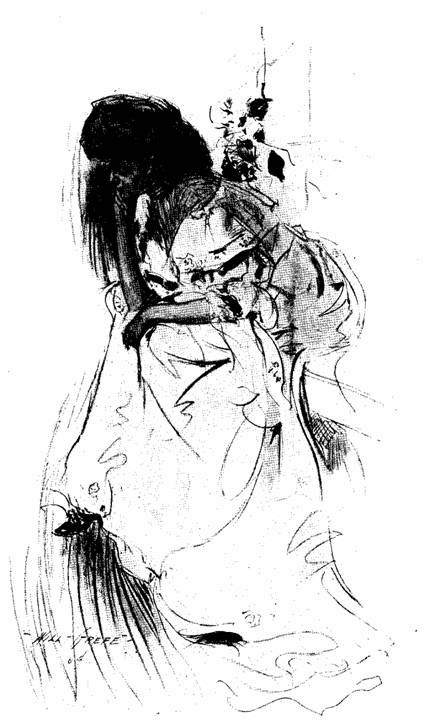
[Illustration: "Miss Hugonin pouted. 'You needn't be such a
grandfather,' she suggested, helpfully"]
And here (he thought) was an excellent, an undreamed-of opportunity to
inform her of his engagement. He had much better tell her now and have
done. Mr. Woods opened his mouth and looked at Margaret, and closed
it. Again she was pouting in a fashion that distracted one's mind.
"That would be most unattractive," said Miss Hugonin, calmly. "You're
very stupid, Billy, to think of living abroad. Billy, I think you're
almost as stupid as I am. I've been very stupid, Billy. I thought I
liked Mr. Kennaston. I don't, Billy--not that way. I've just told him
so. I'm not--I'm not engaged to anybody now, Billy. But wasn't it
stupid of me to make such a mistake, Billy?"
That was a very interesting mosaic there in the summer-house.
"I don't understand," said Mr. Woods. His voice shook, and his hands
lifted a little toward her and trembled.
Poor Billy dared not understand. Her eyes downcast, her foot tapping
the floor gently, Margaret was all one blush. She, too, was trembling
a little, and she was a little afraid and quite unutterably happy; and
outwardly she was very much the tiny lady of Oberon's court, very much
the coquette quintessentialised.
It is pitiable that our proud Margaret should come to such a pass. Ah,
the men that you have flouted and scorned and bedeviled and mocked at,
Margaret--could they see you now, I think the basest of them could
not but pity and worship you. This man is bound in honour to another
woman; yet a little, and his lips will open--very dry, parched lips
they are now--and he will tell you, and your pride will drive you mad,
and your heart come near to breaking.
"Don't you understand--oh, you silly Billy!" She was peeping at him
meltingly from under her lashes.
"I--I'm imagining vain things," said Mr. Woods. "I--oh, Peggy, Peggy,
I think I must be going mad!"
He stared hungrily at the pink, startled face that lifted toward his.
Ah, no, no, it could not be possible, this thing he had imagined for a
moment. He had misunderstood.
And now just for a little (thought poor Billy) let my eyes drink in
those dear felicities of colour and curve, and meet just for a little
the splendour of those eyes that have the April in them, and rest just
for a little upon that sanguine, close-grained, petulant mouth; and
then I will tell her, and then I think that I must die.
"Peggy----" he began, in a flattish voice.
"They have evidently gone," said the voice of Mr. Kennaston; "yes,
those beautiful, happy young people have foolishly deserted the very
prettiest spot in the gardens. Let us sit here, Kathleen."
"But I'm not an eavesdropper," Mr. Woods protested, half angrily.
I fear Margaret was not properly impressed.
"Please, Billy," she pleaded, in a shrill whisper, "please let's
listen. He's going to propose to her now, and you've no idea how
funny he is when he proposes. Oh, don't be so pokey, Billy--do let's
listen!"
But Mr. Woods had risen with a strange celerity and was about to leave
the summer-house.
Margaret pouted. Mrs. Saumarez and Mr. Kennaston were seated not
twenty feet from the summer-house, on the bench which Miss Hugonin had
just left. And when that unprincipled young woman finally rose to her
feet, it must be confessed that it was with a toss of the head and
with the reflection that while to listen wasn't honourable, it would
at least be very amusing. I grieve to admit it, but with Billy's
scruples she hadn't the slightest sympathy.
Then Kennaston cried, suddenly: "Why, you're mad, Kathleen! Woods
wants to marry
you
! Why, he's heels over head in love with Miss
Hugonin!"
Miss Hugonin turned to Mr. Woods with a little intake of the breath.
No, I shall not attempt to tell you what Billy saw in her countenance.
Timanthes-like, I drape before it the vines of the summer-house. For
a brief space I think we had best betake ourselves outside,
leaving Margaret in a very pitiable state of anger, and shame, and
humiliation, and heartbreak--leaving poor Billy with a heart that
ached, seeing the horror of him in her face.
XXIII
Mrs. Saumarez laughed bitterly.
"No," she said, "Billy cared for me, you know, a long time ago. And
this morning he told me he still cared. Billy doesn't pretend to be
a clever man, you see, and so he can afford to practice some of the
brute virtues, such as constancy and fidelity."
There was a challenging flame in her eyes, but Kennaston let the stab
pass unnoticed. To do him justice, he was thinking less of himself,
just now, than of how this news would affect Margaret; and his face
was very grave and strangely tender, for in his own fashion he loved
Margaret.
"It's nasty, very nasty," he said, at length, in a voice that was
puzzled. "Yet I could have sworn yesterday----" Kennaston paused and
laughed lightly. "She was an heiress yesterday, and to-day she is
nobody. And Mr. Woods, being wealthy, can afford to gratify the
virtues you commend so highly and, with a fidelity that is most
edifying, return again to his old love. And she welcomes him--and the
Woods millions--with open arms. It is quite affecting, is it not,
Kathleen?"
"You needn't be disagreeable," she observed.
"My dear Kathleen, I assure you I am not angry. I am merely a little
sorry for human nature. I could have sworn Woods was honest. But
rogues all, rogues all, Kathleen! Money rules us in the end; and now
the parable is fulfilled, and Love the prodigal returns to make merry
over the calf of gold. Confess," Mr. Kennaston queried, with a smile,
"is it not strange an all-wise Creator should have been at pains to
fashion this brave world about us for little men and women such as
we to lie and pilfer in? Was it worth while, think you, to arch the
firmament above our rogueries, and light the ageless stars as candles
to display our antics? Let us be frank, Kathleen, and confess that
life is but a trivial farce ignobly played in a very stately temple."
And Mr. Kennaston laughed again.
"Let us be frank!" Kathleen cried, with a little catch in her voice.
"Why, it isn't in you to be frank, Felix Kennaston! Your life is
nothing but a succession of poses--shallow, foolish poses meant
to hoodwink the world and at times yourself. For you do hoodwink
yourself, don't you, Felix?" she asked, eagerly, and gave him no time
to answer. She feared, you see, lest his answer might dilapidate the
one fortress she had been able to build about his honour.
"And now," she went on, quickly, "you're trying to make me think you a
devil of a fellow, aren't you? And you're hinting that I've accepted
Billy because of his money, aren't you? Well, it is true that I
wouldn't marry him if he were poor. But he's very far from being poor.
And he cares for me. And I am fond of him. And so I shall marry him
and make him as good a wife as I can. So there!"
Mrs. Saumarez faced him with an uneasy defiance. He was smiling oddly.
"I have heard it rumoured in many foolish tales and jingling verses,"
said Kennaston, after a little, "that a thing called love exists in
the world. And I have also heard, Kathleen, that it sometimes enters
into the question of marriage. It appears that I was misinformed."
"No," she answered, slowly, "there is a thing called love. I think
women are none the better for knowing it. To a woman, it means to take
some man--some utterly commonplace man, perhaps--perhaps, only an idle
poseur
such as you are, Felix--and to set him up on a pedestal, and
to bow down and worship him; and to protest loudly, both to the world
and to herself, that in spite of all appearances her idol really
hasn't feet of clay, or that, at any rate, it is the very nicest clay
in the world. For a time she deceives herself, Felix. Then the idol
topples from the pedestal and is broken, and she sees that it is all
clay, Felix--clay through and through--and her heart breaks with it."
Kennaston bowed his head. "It is true," said he; "that is the love of
women."
"To a man," she went on, dully, "it means to take some woman--the
nearest woman who isn't actually deformed--and to make pretty speeches
to her and to make her love him. And after a while--" Kathleen
shrugged her shoulders drearily. "Why, after a while," said she, "he
grows tired and looks for some other woman."
"It is true," said Kennaston--"yes, very true that some men love in
that fashion."
There ensued a silence. It was a long silence, and under the tension
of it Kathleen's composure snapped like a cord that has been stretched
to the breaking point.
"Yes, yes, yes!" she cried, suddenly; "that is how I have loved you
and that is how you've loved me, Felix Kennaston! Ah, Billy told me
what happened last night! And that--that was why I--" Mrs. Saumarez
paused and regarded him curiously. "You don't make a very noble
figure, just now, do you?" she asked, with careful deliberation. "You
were ready to sell yourself for Miss Hugonin's money, weren't you? And
now you must take her without the money. Poor Felix! Ah, you poor,
petty liar, who've over-reached yourself so utterly!" And again
Kathleen began to laugh, but somewhat shrilly, somewhat hysterically.
"You are wrong," he said, with a flush. "It is true that I asked Miss
Hugonin to marry me. But she--very wisely, I dare say--declined."
"Ah!" Kathleen said, slowly. Then--and it will not do to inquire too
closely into her logic--she spoke with considerable sharpness: "She's
a conceited little cat! I never in all my life knew a girl to be quite
so conceited as she is. Positively, I don't believe she thinks there's
a man breathing who's good enough for her!"
Kennaston grinned. "Oh, Kathleen, Kathleen!" he said; "you are simply
delicious."
And Mrs. Saumarez coloured prettily and tried to look severe and
could not, for the simple reason that, while she knew Kennaston to be
flippant and weak and unstable as water and generally worthless, yet
for some occult cause she loved him as tenderly as though he had been
a paragon of all the manly virtues. And I dare say that for many of us
it is by a very kindly provision of Nature that all women are created
capable of doing this illogical thing and that most of them do it
daily.
"It is true," the poet said, at length, "that I have played no heroic
part. And I don't question, Kathleen, that I am all you think me. Yet,
such as I am, I love you. And such as I am, you love me, and it is I
that you are going to marry, and not that Woods person."
"He's worth ten of you!" she cried, scornfully.
"Twenty of me, perhaps," Mr. Kennaston assented, "but that isn't the
question. You don't love him, Kathleen. You are about to marry him for
his money. You are about to do what I thought to do yesterday. But you
won't, Kathleen. You know that I need you, my dear, and--unreasonably
enough, God knows--you love me."
Mrs. Saumarez regarded him intently for a considerable space, and
during that space the Eagle warred in her heart with the one foe
he can never conquer. Love had a worthless ally; but Love fought
staunchly.
By and bye, "Yes," she said, and her voice was almost sullen; "I love
you. I ought to love Billy, but I don't. I shall ask him to release me
from my engagement. And yes, I will marry you if you like."
He raised her hand to his lips. "You are an angel," Mr. Kennaston was
pleased to say.
"No," Mrs. Saumarez dissented, rather forlornly; "I'm simply a fool.
Otherwise, I wouldn't be about to marry you, knowing you as I do for
what you are--knowing that I haven't one chance in a hundred of any
happiness."
"My dear," he said, and his voice was earnest, "you know at least that
what there is of good in me is at its best with you."
"Yes, yes!" Kathleen cried, quickly. "That is so, isn't it, Felix?
And you do care for me, don't you? Felix, are you sure you care for
me--quite sure? And are you quite certain, Felix, that you never cared
so much for any one else?"
Mr. Kennaston was quite certain. He proceeded to explain his feelings
toward her at some length.
Kathleen listened with downcast eyes and almost cheated herself into
the belief that the man she loved was all that he should be. But at
the bottom of her heart she knew he wasn't.
I think we may fairly pity her.
Kennaston and Mrs. Saumarez chatted very amicably for some ten
minutes. At the end of that period, the twelve forty-five express
bellowing faintly in the distance recalled the fact that the morning
mail was in, and thereupon, in the very best of humours, they set
out for the house. I grieve to admit it, but Kathleen had utterly
forgotten Billy by this, and was no more thinking of him than she was
of the Man in the Iron Mask.
She was with Kennaston, you see; and her thoughts, and glances, and
lips, and adoration were all given to his pleasuring, just as her life
would have been if its loss could have saved him from a toothache. He
strutted a little, and was a little grateful to her, and--to do
him justice--received the tribute she accorded him with perfect
satisfaction and equanimity.
XXIV
Margaret came out of the summer-house, Billy Woods followed her, in a
very moist state of perturbation.
"Peggy----" said Mr. Woods.
But Miss Hugonin was laughing. Clear as a bird-call, she poured forth
her rippling mimicry of mirth. They train women well in these matters.
To Margaret, just now, her heart seemed dead within her. Her lover was
proved unworthy. Her pride was shattered. She had loved this clumsy
liar yonder, had given up a fortune for him, dared all for him, had
(as the phrase runs) flung herself at his head. The shame of it was a
physical sickness, a nausea. But now, in this jumble of miseries, in
this breaking-up of the earth and the void heavens that surged about
her and would not be mastered, the girl laughed; and her laughter was
care-free and half-languid like that of a child who is thinking of
something else. Ah, yes, they train women well in these matters.
At length Margaret said, in high, crisp accents: "Pardon me, but I
can't help being amused, Mr. Woods, by the way in which hard luck
dogs your footsteps. I think Fate must have some grudge against you,
Mr. Woods."
"Peggy----" said Mr. Woods.
"Pardon me," she interrupted him, her masculine little chin high in
the air, "but I wish you wouldn't call me that. It was well enough
when we were boy and girl together, Mr. Woods. But you've developed
since--ah, yes, you've developed into such a splendid actor, such a
consummate liar, such a clever scoundrel, Mr. Woods, that I scarcely
recognise you now."
And there was not a spark of anger in the very darkest corner of
Billy's big, brave heart, but only pity--pity all through and through,
that sent little icy ticklings up and down his spine and turned his
breathing to great sobs. For she had turned full face to him and he
could see the look in her eyes.
I think he has never forgotten it. Years after the memory of it would
come upon him suddenly and set hot drenching waves of shame and
remorse surging about his body--remorse unutterable that he ever hurt
his Peggy so deeply. For they were tragic eyes. Beneath them her
twitching mouth smiled bravely, but the mirth of her eyes was
monstrous. It was the mirth of a beaten woman, of a woman who has
known the last extreme of shame and misery and has learned to laugh at
it. Even now Billy Woods cannot quite forget.
"Peggy," said he, brokenly, "ah, dear, dear Peggy, listen to me!"
"Why, have you thought of a plausible lie so soon?" she queried,
sweetly. "Dear me, Mr. Woods, what is the use of explaining things? It
is very simple. You wanted to marry me last night because I was rich.
And when I declined the honour, you went back to your old love. Oh,
it's very simple, Mr. Woods! It's a pity, though--isn't it?--that all
your promptness went for nothing. Why, dear me, you actually managed
to propose before breakfast, didn't you? I should have thought that
such eagerness would have made an impression on Kathleen--oh, a most
favourable impression. Too bad it hasn't!"
"Listen!" said Billy. "Ah, you're forcing me to talk like a cad,
Peggy, but I can't see you suffer--I can't! Kathleen misunderstood
what I said to her. I--I didn't mean to propose to her, Peggy. It was
a mistake, I tell you. It's you I love--just you. And when I asked you
to marry me last night--why, I thought the money was mine, Peggy.
I'd never have asked you if I hadn't thought that. I--ah, you don't
believe me, you don't believe me, Peggy, and before God, I'm telling
you the simple truth! Why, I hadn't ever seen that last will, Peggy!
It was locked up in that centre place in the desk, you remember.
Why--why, you yourself had the keys to it, Peggy. Surely, you
remember, dear?" And Billy's voice shook and skipped whole octaves as
he pleaded with her, for he knew she did not believe him and he could
not endure the horror of her eyes.
But Margaret shook her head; and as aforetime the twitching lips
continued to laugh beneath those tragic eyes. Ah, poor little lady of
Elfland! poor little Undine, with a soul wakened to suffering!
"Clumsy, very clumsy!" she rebuked him. "I see that you are accustomed
to prepare your lies in advance, Mr. Woods. As an extemporaneous liar
you are very clumsy. Men don't propose by mistake except in farces.
And while we are speaking of farces, don't you think it time to drop
that one of your not knowing about that last will?"
"The farce!" Billy stammered. "You--why, you saw me when I found it!"
"Ah, yes, I saw you when you pretended to find it. I saw you when you
pretended to unlock that centre place. But now, of course, I know it
never was locked. I'm very careless about locking things, Mr. Woods.
Ah, yes, that gave you a beautiful opportunity, didn't it? So, when
you were rummaging through my desk--without my permission, by the way,
but that's a detail--you found both wills and concocted your little
comedy? That was very clever. Oh, you think you're awfully smooth,
don't you, Billy Woods? But if you had been a bit more daring, don't
you see, you could have suppressed the last one and taken the money
without being encumbered by me? That was rather clumsy of you, wasn't
it?" Suave, gentle, sweet as honey was the speech of Margaret as she
lifted her face to his, but her eyes were tragedies.
"Ah!" said Billy. "Ah--yes--you think--that." He was very careful in
articulating his words, was Billy, and afterward he nodded his head
gravely. The universe had somehow suffered an airy dissolution like
that of Prospero's masque--Selwoode and its gardens, the great globe
itself, "the cloud-capped towers, the gorgeous palaces, the solemn
temples" were all as vanished wraiths. There was only Peggy left--
Peggy with that unimaginable misery in her eyes that he must drive
away somehow. If that was what she thought, there was no way for him
to prove it wasn't so.
"Why, dear me, Mr. Woods," she retorted, carelessly, "what else could
I think?"
Here Mr. Woods blundered.
"Ah, think what you will, Peggy!" he cried, his big voice cracking and
sobbing and resonant with pain. "Ah, my dear, think what you will, but
don't grieve for it, Peggy! Why, if I'm all you say I am, that's no
reason you should suffer for it! Ah, don't, Peggy! In God's name,
don't! I can't bear it, dear," he pleaded with her, helplessly.
Billy was suffering, too. But her sorrow was the chief of his, and
what stung him now to impotent anger was that she must suffer and he
be unable to help her--for, ah, how willingly, how gladly, he would
have borne all poor Peggy's woes upon his own broad shoulders.
But none the less, he had lost an invaluable opportunity to hold his
tongue.
"Suffer! I suffer!" she mocked him, languidly; and then, like a
banjo-string, the tension snapped, and she gave a long, angry gasp,
and her wrath flamed.
"Upon my word, you're the most conceited man I ever knew in my life!
You think I'm in love with you! With you! Billy Woods, I wouldn't wipe
my feet on you if you were the last man left on earth! I hate you, I
loathe you, I detest you, I despise you! Do you hear me?--I hate you.
What do I care if you
are
a snob, and a cad, and a fortune-hunter,
and a forger, and--well, I don't care! Perhaps you haven't ever
forged anything yet, but I'm quite sure you would if you ever got an
opportunity. You'd be delighted to do it. Yes, you would--you're just
the sort of man who
revels
in crime. I love you! Why, that's the
best joke I've heard for a long time. I'm only sorry for you, Billy
Woods--
sorry
because Kathleen has thrown you over--sorry, do you
understand? Yes, since you're so fond of skinny women, I think it's a
great pity she wouldn't have you. Don't talk to me!--she
is
skinny.
I guess I know. She's as skinny as a beanpole. She's skinnier than I
ever imagined it possible for anybody--
anybody
--to be. And she
pads and rouges till I think it's disgusting, and not half--not
one-half
--of her hair belongs to her, and that half is dyed. But,
of course, if you like that sort of thing, there's no accounting for
tastes, and I'm sure I'm very sorry for you, even though personally I
don't
care for skinny women. I hate 'em! And I hate you, too, Billy
Woods!"
She stamped her foot, did Margaret. You must bear with her, for her
heart is breaking now, and if she has become a termagant it is because
her shamed pride has driven her mad. Bear with her, then, a little
longer.
Billy tried to bear with her, for in part he understood.
"Peggy," said he, very gently, "you're wrong."
"Yes, I dare say!" she snapped at him.
"We won't discuss Kathleen, if you please. But you're wrong about the
will. I've told you the whole truth about that, but I don't blame you
for not believing me, Peggy--ah, no, not I. There seems to be a curse
upon Uncle Fred's money. It brings out the worst of all of us. It has
changed even you, Peggy--and not for the better, Peggy. You've become
distrustful. You--ah, well, we won't discuss that now. Give me the
will, my dear, and I'll burn it before your eyes. That ought to show
you, Peggy, that you're wrong." Billy was very white-lipped as he
ended, for the Woods temper is a short one.
But she had an arrow left for him. "Give it to you! And do you think
I'd trust you with it, Billy Woods?"
"Peggy!--ah, Peggy, I hadn't deserved that. Be just, at least, to me,"
poor Billy begged of her.
Which was an absurd thing to ask of an angry woman.
"Yes, I
do
know what you'd do with it! You'd take it right off and
have it probated or executed or whatever it is they do to wills, and
turn me straight out in the gutter. That's just what you're
longing
to do this very moment. Oh, I know, Billy Woods--I know what a temper
you've got, and I know you're keeping quiet now simply because you
know that's the most exasperating thing you can possibly do. I
wouldn't have such a disposition as you've got for the world. You've
absolutely
no
control over your temper--not a bit of it. You're
vile
, Billy Woods! Oh, I
hate
you! Yes, you've made me cry, and I
suppose you're very proud of yourself.
Aren't
you proud? Don't stand
staring at me like a stuck pig, but answer me when I talk to you!
Aren't you
proud
of making me cry? Aren't you? Ah, don't talk to
me--don't talk to
me
, I tell you! I don't wish to hear a word you've
got to say. I
hate
you. And you shan't have the money, that's flat."
"I don't want it," said Billy. "I've been trying to tell you for the
last, half-hour I don't want it. In God's name, why can't you talk
like a sensible woman, Peggy?" I am afraid that Mr. Woods, too, was
beginning to lose his temper.
"That's right--swear at me! It only needed that. You do want the
money, and when you say you don't you're lying--lying--
lying
, do you
understand? You all want my money. Oh, dear,
dear
!" Margaret wailed,
and her great voice was shaken to its depths and its sobbing was the
long, hopeless sobbing of a violin, as she flung back her tear-stained
face, and clenched her little hands tight at her sides; "why
can't
you let me alone? You're all after my money--you, and Mr. Kennaston,
and Mr. Jukesbury, and all of you! Why
can't
you let me alone? Ever
since I've had it you've hunted me as if I'd been a wild beast. God
help me, I haven't had a moment's peace, a moment's rest, a, moment's
quiet, since Uncle Fred died. They all want my money--everybody wants
my money! Oh, Billy, Billy, why
can't
they let me alone?"
"Peggy----" said he.
But she interrupted him. "Don't talk to
me
, Billy Woods! Don't you
dare
talk to me. I told you I didn't wish to hear a word you had to
say, didn't I? Yes, you all want my money. And you shan't have it.
It's mine. Uncle Fred left it to me. It's mine, I tell you. I've got
the greatest thing in the world--money! And I'll keep it. Ah, I hate
you all--every one of you--but I'll make you cringe to me. I'll make
you
all
cringe, do you hear, because I've got the money you're ready
to sell your paltry souls for! Oh, I'll make you cringe most of all,
Billy Woods! I'm rich, do you hear?--rich--
rich
! Wouldn't you be
glad to marry the rich Margaret Hugonin, Billy? Ah, haven't you
schemed hard for that? You'd be glad to do it, wouldn't you? You'd
give your dirty little soul for that, wouldn't you, Billy? Ah, what a
cur you are! Well, some day perhaps I'll buy you just as I would any
other cur. Wouldn't you be glad if I did, Billy? Beg for it, Billy!
Beg, sir! Beg!" And Margaret flung back her head again, and laughed
shrilly, and held up her hand before him as one holds a lump of sugar
before a pug-dog.
In Selwoode I can fancy how the Eagle screamed his triumph.
But Billy's face was ashen.
"Before God!" he said, between his teeth, "loving you as I do, I
wouldn't marry you now for all the wealth in the world! The money has
ruined you--ruined you, Peggy."
For a little she stared at him. By and bye, "I dare say it has," she
said, in a strangely sober tone. "I've been scolding like a fishwife.
I beg your pardon, Mr. Woods--not for what I've said, because I meant
every
word
of it, but I beg your pardon for saying it. Don't come
with me, please."
Blindly she turned from him. Her shoulders had the droop of an old
woman's. Margaret was wearied now, weary with the weariness of death.
For a while Mr. Woods stared after the tired little figure that
trudged straight onward in the sunlight, stumbling as she went. Then a
pleached walk swallowed her, and Mr. Woods groaned.
"Oh, Peggy, Peggy!" he said, in bottomless compassion; "oh, my poor
little Peggy! How changed you are!"
Afterward Mr. Woods sank down upon the bench and buried his face in
his hands. He sat there for a long time. I don't believe he thought
of anything very clearly. His mind was a turgid chaos of misery; and
about him the birds shrilled and quavered and carolled till the air
was vibrant with their trilling. One might have thought they choired
in honour of the Eagle's triumph, in mockery of poor Billy.
Then Mr. Woods raised his head with a queer, alert look. Surely he had
heard a voice--the dearest of all voices.
"Billy!" it wailed; "oh, Billy,
Billy
!"
XXV
For at the height of this particularly mischancy posture of affairs
the meddlesome Fates had elected to dispatch Cock-eye Flinks to serve
as our
deus ex machina
. And just as in the comedy the police turn
up in the nick of time to fetch Tartuffe to prison, or in the tragedy
Friar John manages to be detained on his journey to Mantua and thus
bring about that lamentable business in the tomb of the Capulets, so
Mr. Flinks now happens inopportunely to arrive upon our lesser stage.
Faithfully to narrate how Cock-eye Flinks chanced to be at Selwoode
were a task of magnitude. That gentleman travelled very quietly; and
for the most part, he journeyed incognito under a variety of aliases
suggested partly by a fertile imagination and in part by prudential
motives. For his notions of proprietary rights were deplorably vague,
and his acquaintance with the police, in consequence, extensive. And
finally, that he was now at Selwoode was not in the least his fault,
but all the doing of an N. and O. brakesman, who had in uncultured
argument, reinforced by a coupling-pin, persuaded Mr. Flinks to
disembark from the northern freight on the night previous.
Mr. Flinks, then, sat leaning against a tree in the gardens of
Selwoode, some thirty feet from the wall that stands between Selwoode
and Gridlington, and nursed his pride and foot, both injured in that
high debate of last evening, and with a jackknife rounded off the top
of a substantial staff designed to alleviate his present lameness.
Meanwhile, he tempered his solitude with music, whistling melodiously
the air of a song that pertained to the sacredness of home and of a
white-haired mother.
Subsequently to Cock-eye Flinks (as the playbill has it), enter a
vision in violet ruffles.
Wide-eyed, she came upon him in her misery, steadily trudging toward
an unknown goal. I think he startled her a bit. Indeed, it must be
admitted that Mr. Flinks, while a man of undoubted talent in his
particular line of business, was, like many of your great geniuses, in
outward aspect unprepossessing and misleading; for whereas he looked
like a very shiftless and very dirty tramp, he was as a matter of fact
as vile a rascal as ever pawned a swinish soul for whiskey.
"What are you doing here?" said Margaret, sharply. "Don't you know
this is private property?"
To his feet rose Cock-eye Flinks. "Lady," said he, with humbleness,
"you wouldn't be hard on a poor workingman, would you? It ain't my
fault I'm here, lady--at least, it ain't rightly my fault. I just
climbed over the wall to rest a minute--just a minute, lady, in the
shade of these beautiful trees. I ain't a-hurting nobody by that,
lady, I hope."
"Well, you had no business to do it," Miss Hugonin pointed out, "and
you can just climb right back." Then she regarded him more intently,
and her face softened somewhat. "What's the matter with your foot?"
she demanded.
"Brakesman," said Mr. Flinks, briefly. "Threw me off a train. He
struck me cruel hard, he did, and me a poor workingman trying to make
my way to New York, lady, where my poor old mother's dying, lady, and
me out of a job. Ah, it's a hard, hard world, lady--and me her only
son--and he struck me cruel, cruel hard, he did, but I forgive him for
it, lady. Ah, lady, you're so beautiful I know you're got a kind, good
heart, lady. Can't you do something for a poor workingman, lady, with
a poor dying mother--and a poor, sick wife," Mr. Flinks added as a
dolorous afterthought; and drew nearer to her and held out one hand
appealingly.
Petheridge Jukesbury had at divers times pointed out to her the evils
of promiscuous charity, and these dicta Margaret parroted glibly
enough, to do her justice, so long as there was no immediate question
of dispensing alms. But for all that the next whining beggar would
move her tender heart, his glib inventions playing upon it like a
fiddle, and she would give as recklessly as though there were no
such things in the whole wide world as soup-kitchens and organised
charities and common-sense. "Because, you know," she would afterward
salve her conscience, "I
couldn't
be sure he didn't need it, whereas
I was
quite
sure I didn't."
Now she wavered for a moment. "You didn't say you had a wife before,"
she suggested.
"An invalid," sighed Mr. Flinks--"a helpless invalid, lady. And six
small children probably crying for bread at this very moment. Ah,
lady, think what my feelings must be to hear 'em cry in vain--think
what I must suffer to know that I summoned them cherubs out of Heaven
into this here hard, hard world, lady, and now can't do by 'em
properly!" And Cock-eye Flinks brushed away a tear which I, for one,
am inclined to regard as a particularly ambitious flight of his
imagination.
Promptly Margaret opened the bag at her waist and took out her purse.
"Don't!" she pleaded. "Please don't! I--I'm upset already. Take this,
and please--oh,
please
, don't spend it in getting drunk or gambling
or anything horrid," Miss Hugonin implored him. "You all do, and it's
so selfish of you and so discouraging."
Mr. Flinks eyed the purse hungrily. Such a fat purse! thought Cock-eye
Plinks. And there ain't nobody within a mile of here, neither. You are
not to imagine that Mr. Flinks was totally abandoned; his vices were
parochial, restrained for the most part by a lively apprehension of
the law. But now the spell of the Eagle was strong upon him.
"Lady," said Mr. Flinks, twisting in his grimy hand the bill she had
given him--and there, too, the Eagle flaunted in his vigour and
heartened him, "lady, that ain't much for you to give. Can't you do a
little better than that by a poor workingman, lady?"
A very unpleasant-looking person, Mr. Cock-eye Flinks. Oh, a
peculiarly unpleasant-looking person to be a model son and a loving
husband and a tender father. Margaret was filled with a vague alarm.
But she was brave, was Margaret. "No," said she, very decidedly, "I
shan't give you another cent. So you climb right over that wall and go
straight back where you belong."
The methods of Mr. Flinks, I regret to say, were somewhat more crude
than those of Mesdames Haggage and Saumarez and Messieurs Kennaston
and Jukesbury.
"Cheese it!" said Mr. Flinks, and flung away his staff and drew very
near to her. "Gimme that money, do you hear!"
"Don't you dare touch me!" she panted; "ah, don't you
dare
!"
"Aw, hell!" said Mr. Flinks, disgustedly, and his dirty hands were
upon her, and his foul breath reeked in her face.
In her hour of need Margaret's heart spoke.
"Billy!" she wailed; "oh, Billy,
Billy
!"
* * * * *
He came to her--just as he would have scaled Heaven to come to her,
just as he would have come to her in the nethermost pit of Hell if she
had called. Ah, yes, Billy Woods came to her now in her peril, and
I don't think that Mr. Flinks particularly relished the look upon
Billy's face as he ran through the gardens, for Billy was furiously
moved.
Cock-eye Flinks glanced back at the wall behind him. Ten feet high,
and the fellow ain't far off. Cock-eye Flinks caught up his staff, and
as Billy closed upon him, struck him full on the head. Again and again
he struck him. It was a sickening business.
Billy had stopped short. For an instant he stood swaying on his feet,
a puzzled face showing under the trickling blood. Then he flung out
his hands a little, and they flapped loosely at the wrists, like
wet clothes hung in the wind to dry, and Billy seemed to crumple up
suddenly, and slid down upon the grass in an untidy heap.
"Ah-h-h!" said Mr. Flinks. He drew back and stared stupidly at that
sprawling flesh which just now had been a man, and was seized with
uncontrollable shuddering. "Ah-h-h!" said Mr. Flinks, very quietly.
And Margaret went mad. The earth and the sky dissolved in many
floating specks and then went red--red like that heap yonder. The
veneer of civilisation peeled, fell from her like snow from a shaken
garment. The primal beast woke and flicked aside the centuries' work.
She was the Cave-woman who had seen the death of her mate--the brute
who had been robbed of her mate.
"Damn you!
Damn
you!" she screamed, her voice high, flat, quite
unhuman; "ah, God in Heaven damn you!" With inarticulate bestial cries
she fell upon the man who had killed Billy, and her violet fripperies
fluttered, her impotent little hands beat at him, tore at him. She was
fearless, shameless, insane. She only knew that Billy was dead.
With an oath the man flung her from him and turned on his heel. She
fell to coaxing the heap in the grass to tell her that he forgave
her--to open his eyes--to stop bloodying her dress--to come to
luncheon...
A fly settled on Billy's face and came in his zig-zag course to the
red stream trickling from his nostrils, and stopped short. She brushed
the carrion thing away, but it crawled back drunkenly. She touched it
with her finger, and the fly would not move. On a sudden, every nerve
in her body began to shake and jerk like a flag snapping in the wind.
XXVI
Some ten minutes afterward, as the members of the house-party sat
chatting on the terrace before Selwoode, there came among them a mad
woman in violet trappings that were splotched with blood.
"Did you know that Billy was dead?" she queried, smilingly. "Oh, yes,
a man killed Billy just now. Wasn't it too bad? Billy was such a nice
boy, you know. I--I think it's very sad. I think it's the saddest
thing I ever knew of in my life."
Kathleen Saumarez was the first to reach her. But she drew back
quickly.
"No, ah, no!" she said, with a little shudder. "You didn't love Billy.
He loved you, and you didn't love him. Oh, Kathleen, Kathleen, how
could
you help loving Billy? He was such a nice boy. I--I'm rather
sorry he's dead."
Then she stood silent, picking at her dress thoughtfully and still
smiling. Afterward, for the first and only time in history, Miss
Hugonin fainted--fainted with an anxious smile.
Petheridge Jukesbury caught her as she fell, and began to blubber like
a whipped schoolboy as he stood there holding her in his arms.
XXVII
But Billy was not dead. There was still a feeble, jerky fluttering in
his big chest when Colonel Hugonin found him. His heart still moved,
but under the Colonel's hand its stirrings were vague and aimless as
those of a captive butterfly.
The Colonel had seen dead men and dying men before this; and as he
bent over the boy he loved he gave a convulsive sob, and afterward
buried his face in his hands.
Then--of all unlikely persons in the world--it was Petheridge
Jukesbury who rose to meet the occasion.
His suavity and blandness forgotten in the presence of death, he
mounted with confident alacrity to heights of greatness. Masterfully,
he overrode them all. He poured brandy between Billy's teeth. Then he
ordered the ladies off to bed, and recommended to Mr. Kennaston--when
that gentleman spoke of a clergyman--a far more startling destination.
For, "It is far from my intention," said Mr.
Jukesbury, "to appear lacking in respect to the cloth, but--er--just
at present I am inclined to think we are in somewhat greater need of a
mattress and a doctor and--ah--the exercise of a little common-sense.
The gentleman is--er--let us hope, in no immediate danger."
"How dare you suggest such a thing, sir?" thundered Petheridge
Jukesbury. "Didn't you see that poor girl's face? I tell you I'll be
damned if he dies, sir!"
And I fancy the recording angel heard him, and against a list of wordy
cheats registered that oath to his credit.
It was Petheridge Jukesbury, then, who stalked into Mrs. Haggage's
apartments and appropriated her mattress as the first at hand, and
afterward waddled through the gardens bearing it on his fat shoulders,
and still later lifted Billy upon it as gently as a woman could have.
But it was the hatless Colonel on his favourite Black Bess ("Damn your
motor-cars!" the Colonel was wont to say; "I consider my appearance
sufficiently unprepossessing already, sir, without my arriving in
Heaven in fragments and stinking of gasoline!") who in Fairhaven town,
some quarter of an hour afterward, leaped Dr. Jeal's garden fence, and
subsequently bundled the doctor into his gig; and again yet later it
was the Colonel who stood fuming upon the terrace with Dr. Jeal on his
way to Selwoode indeed, but still some four miles from the mansion
toward which he was urging his staid horse at its liveliest gait.
Kennaston tried to soothe him. But the Colonel clamoured to the
heavens. Kennaston he qualified in various ways. And as for Dr. Jeal,
he would hold him responsible--"personally, sir"--for the consequences
of his dawdling in this fashion--"Damme, sir, like a damn' snail with
a wooden leg!"
"I am afraid," said Kennaston, gravely, "that the doctor will be of
very little use when he does arrive."
There was that in his face which made the Colonel pause in his
objurgations.
"Sir," said the Colonel, "what--do--you--mean?" He found articulation
somewhat difficult.
"In your absence," Kennaston answered, "Mr. Jukesbury, who it
appears knows something of medicine, has subjected Mr. Woods to an
examination. It--it would be unkind to deceive you----"
"Come to the point, sir," the Colonel interrupted him. "What--do
you--mean?"
"I mean," said Felix Kennaston, sadly, "that--he is afraid--Mr. Woods
will never recover consciousness."
Colonel Hugonin stared at him. The skin of his flabby, wrinkled old
throat was working convulsively.
Then, "You're wrong, sir," the Colonel said. "Billy
shan't
die. Damn
Jukesbury! Damn all doctors, too, sir! I put my trust in my God, sir,
and not in a box of damn' sugar-pills, sir. And I tell you, sir,
that boy is not going to die
."
Afterward he turned and went into Selwoode defiantly.
XXVIII
In the living-hall the Colonel found Margaret, white as paper, with
purple lips that timidly smiled at him.
"Why ain't you in bed?" the old gentleman demanded, with as great an
affectation of sternness as he could muster. To say the truth, it was
not much; for Colonel Hugonin, for all his blustering optimism, was
sadly shaken now.
"Attractive," said Margaret, "I was, but I couldn't stay there. My--my
brain won't stop working, you see," she complained, wearily. "There's
a thin little whisper in the back of it that keeps telling me about
Billy, and what a liar he is, and what nice eyes he has, and how
poor Billy is dead. It keeps telling me that, over and over again,
attractive. It's such a tiresome, silly little whisper. But he is
dead, isn't he? Didn't Mr. Kennaston tell me just now that he was
dead?--or was it the whisper, attractive?"
The Colonel coughed. "Kennaston--er--Kennaston's a fool," he declared,
helplessly. "Always said he was a fool. We'll have Jeal in presently."
"No--I remember now--Mr. Kennaston said Billy would die very soon. You
don't like people to disagree with you, do you, attractive? Of course,
he will die, for the man hit him very,
very
hard. I'm sorry Billy is
going to die, though, even if he is such a liar!"
"Don't!" said the Colonel, hoarsely; "don't, daughter! I don't know
what there is between you and Billy, but you're wrong. Oh, you're very
hopelessly wrong! Billy's the finest boy I know."
Margaret shook her head in dissent.
"No, he's a very contemptible liar," she said, disinterestedly, "and
that is what makes it so queer that I should care for him more than I
do for anything else in the world. Yes, it's very queer."
Then Margaret went into the room opening into the living-hall, where
Billy Woods lay unconscious, pallid, breathing stertorously. And the
Colonel stared after her.
"Oh, my God, my God!" groaned the poor Colonel; "why couldn't it have
been I? Why couldn't it have been I that ain't wanted any longer?
She'd never have grieved like that for me!"
And indeed, I don't think she would have.
For to Margaret there had come, as, God willing, there comes to every
clean-souled woman, the time to put away all childish things, and all
childish memories, and all childish ties, if need be, to follow one
man only, and cleave to him, and know his life and hers to be knit up
together, past severance, in a love that death itself may not affright
nor slay.
XXIX
She sat silent in one corner of the darkened room. It was the bedroom
that Frederick R. Woods formerly occupied--on the ground floor of
Selwoode, opening into the living-hall--to which they had carried
Billy.
Jukesbury had done what he could. In the bed lay Billy Woods, swathed
in hot blankets, with bottles of hot water set to his feet. Jukesbury
had washed his face clean of that awful red, and had wrapped bandages
of cracked ice about his head and propped it high with pillows. It
was little short of marvellous to see the pursy old hypocrite going
cat-footed about the room on his stealthy ministrations, replenishing
the bandages, forcing spirits of ammonia between Billy's teeth,
fighting deftly and confidently with death.
Billy still breathed.
The Colonel came and went uneasily. The clock on the mantel ticked.
Margaret brooded in a silence that was only accentuated by that
horrible wheezing, gurgling, tremulous breathing in the bed yonder.
Would the doctor never come!
She was curiously conscious of her absolute lack of emotion.
But always the interminable thin whispering in the back of her head
went on and on. "Oh, if he had only died four years ago! Oh, if he had
only died the dear, clean-minded, honest boy I used to know! When that
noise stops he will be dead. And then, perhaps, I shall be able to
cry. Oh, if he had only died four years ago!"
And then
da capo
. On and on ran the interminable thin whispering as
Margaret waited for death to come to Billy. Billy looked so old now,
under his many bandages. Surely he must be very, very near death.
Suddenly, as Jukesbury wrapped new bandages about his forehead, Billy
opened his eyes and, without further movement, smiled placidly up at
him.
"Hello, Jukesbury," said Billy Woods, "where's my armour?"
Jukesbury, too, smiled. "The man is bringing it downstairs now," he
answered, quietly.
"Because," Billy went on, fretfully, "I don't propose to miss the
Trojan war. The princes orgulous with high blood chafed, you know, are
all going to be there, and I don't propose to miss it."
Behind his fat back, Petheridge Jukesbury waved a cautioning hand at
Margaret, who had risen from her chair.
"But it is very absurd," Billy murmured, in the mere ghost of a voice,
"because men don't propose by mistake except in farces. Somebody told
me that, but I can't remember who, because I am a misogynist. That is
a Greek word, and I would explain it to Peggy, if she would only give
me a chance, but she can't because she has those seventeen hundred
and fifty thousand children to look after. There must be some way to
explain to her, though, because where there's a will there is always
a way, and there were three wills. Uncle Fred should not have left so
many wills--who would have thought the old man had so much ink in him?
But I will be a very great painter, Uncle Fred, and make her sorry for
the way she has treated me, and
then
Kathleen will understand I was
talking about Peggy."
His voice died away, and Margaret sat with wide eyes listening for it
again. Would the doctor never come!
Billy was smiling and picking at the sheets.
"But Peggy is so rich," the faint voice presently complained--"so
beastly rich! There is gold in her hair, and if you will look very
closely you will see that her lashes were pure gold until she dipped
them in the ink-pot. Besides, she expects me to sit up and beg for
lumps of sugar, and I
never
take sugar in my coffee. And Peggy
doesn't drink coffee at all, so I think it is very unfair, especially
as Teddy Anstruther drinks like a fish and she is going to marry him.
Peggy, why won't you marry me? You know I've always loved you, Peggy,
and now I can tell you so because Uncle Fred has left me all his
money. You think a great deal about money, Peggy. You said it was the
greatest thing in the world. And it must be, because it is the only
thing--the
only
thing, Peggy--that has been strong enough to keep
us apart. A part is never greater than the whole, Peggy, but I will
explain about that when you open that desk. There are sharks in it.
Aren't there, Peggy?--
aren't
there?"
His voice had risen to a querulous tone. Gently the fat old man
restrained him.
"Yes," said Petheridge Jukesbury; "dear me, yes. Why, dear me, of
course."
But his warning hand held Margaret back--Margaret, who stood with big
tears trickling down her cheeks.
"Dearer than life itself," Billy assented, wearily, "but before God,
loving you as I do, I wouldn't marry you now for all the wealth in the
world. I forget why, but all the world is a stage, you know, and they
don't use stages now, but only railroads. Is that why you rail at me
so, Peggy? That is a joke. You ought to laugh at my jokes, because I
love you, but I can't ever, ever tell you so because you are rich. A
rich man cannot pass through a needle's eye. Oh, Peggy, Peggy, I love
your eyes, but they're so
big
, Peggy!"
So Billy Woods lay still and babbled ceaselessly. But through all his
irrelevant talk, as you may see a tributary stream pulse unsullied
in a muddied river, ran the thought of Peggy--of Peggy, and of her
cruelty, and of her beauty, and of the money that stood between them.
And Margaret, who could never have believed him in his senses,
listened and knew that in his delirium, the rudder of his thoughts
snapped, he could not but speak truth. As she crouched in the corner
of the room, her face buried in an arm-chair, her gold hair half
loosened, her shoulders monotonously heaving, she wept gently,
inaudibly, almost happily.
Almost happily. Billy was dying, but she knew now, past any doubting,
that he loved her. The dear, clean-minded, honest boy had come
back to her, and she could love him now without shame, and there was
only herself to be loathed.
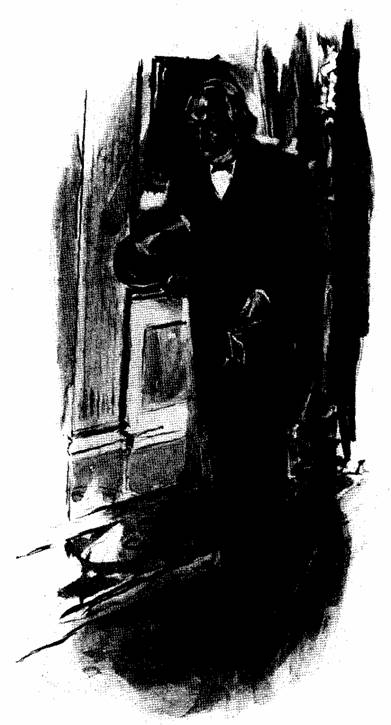
[Illustration: "Regarded them with alert eyes."]
Then the door opened. Then, with Colonel Hugonin, came Martin Jeal--a
wisp of a man like a November leaf--and regarded them from under his
shaggy white hair with alert eyes.
"Hey, what's this?" said Dr. Jeal. "Eh, yes! Eh--yes!" he meditated,
slowly. "Most irregular. You must let us have the room, Miss Hugonin."
In the hall she waited. Hope! ah, of course, there was no hope! the
thin little whisper told her.
By and bye, though--after centuries of waiting--the three men came
into the hall.
"Miss Hugonin," said Dr. Jeal, with a strange kindness in his voice,
"I don't think we shall need you again. I am happy to tell you,
though, that the patient is doing nicely--very nicely indeed."
Margaret clutched his arm. "You--you mean----"
"I mean," said Dr. Jeal, "that there is no fracture. A slight
concussion of the brain, madam, and--so far as I can see--no signs of
inflammation. Barring accidents, I think we'll have that young man out
of bed in a week. Thanks," he added, "to Mr.--er--Jukesbury here whose
prompt action was, under Heaven, undoubtedly the means of staving off
meningitis and probably--indeed, more than probably--the means
of saving Mr. Woods's life. It was splendid, sir, splendid! No
doctor--why, God bless my soul!"
For Miss Hugonin had thrown her arms about Petheridge Jukesbury's neck
and had kissed him vigorously.
"You beautiful child!" said Miss Hugonin.
"Er--Jukesbury," said the Colonel, mysteriously, "there's a little
cognac in the cellar that--er--" The Colonel jerked his thumb across
the hallway with the air of a conspirator. "Eh?" said the Colonel.
"Why--er--yes," said Mr. Jukesbury. "Why--ah--yes, I think I might."
They went across the hall together. The Colonel's hand rested
fraternally on Petheridge Jukesbury's shoulder.
XXX
The next day there was a general exodus from Selwoode, and Margaret's
satellites dispersed upon their divers ways. Selwoode, as they
understood it, was no longer hers; and they knew Billy Woods well
enough to recognise that from Selwoode's new master there were no
desirable pickings to be had such as the philanthropic crew had
fattened on these four years past. So there came to them, one and all,
urgent telegrams or insistent letters or some equally unanswerable
demand for their presence elsewhere, such as are usually prevalent
among our guests in very dull or very troublous times.
Miss Hugonin smiled a little bitterly. She considered that the scales
had fallen from her eyes, and flattered herself that she was by way of
becoming a bit of a misanthrope; also, I believe, there was a note
concerning the hollowness of life and the worthlessness of society in
general. In a word, Margaret fell back upon the extreme cynicism and
world-weariness of twenty-three, and assured herself that she despised
everybody, whereas, as a matter of fact, she never in her life
succeeded in disliking anything except mice and piano-practice, and,
for a very little while, Billy Woods; and this for the very excellent
reason that the gods had fashioned her solely to the end that she
might love all mankind, and in return be loved by humanity in general
and adored by that portion of it which inhabits trousers.
But, "The rats always desert a sinking ship," said Miss Hugonin, with
the air of one delivering a particularly original sentiment. "They
make me awfully tired, and I don't care for them in the least. But
Petheridge Jukesbury is a
dear
, and I may be poor now, but I
did
try to do good with the money when I had it, and
anyhow
, Billy is
going to get well."
And, after all, that was the one thing that really mattered, though of
course Billy would always despise her. He would be quite right, too,
the girl thought humbly.
But the conventionalities of life are more powerful than even youthful
cynicism and youthful heart-break. Prior to devoting herself to a
loveless life and the commonplaces of the stoic's tub, Miss Hugonin
was compelled by the barest decency to bid her guests Godspeed.
And Adèle Haggage kissed her for the first time in her life. She had
been a little awed by Miss Hugonin, the famous heiress--a little
jealous of her, I dare say, on account of Hugh Van Orden--but now she
kissed her very heartily in farewell, and said, "Don't forget you are
to come to us as soon as
possible
," and was beyond any question
perfectly sincere in saying it.
And Hugh Van Orden almost dragged Margaret under the main stairway,
and, far from showing any marked abhorrence to her in her present
state of destitution, implored her with tears in his eyes to marry him
at once, and to bring the Colonel to live with them for the rest of
his natural existence.
For, "It's damned impertinent of me, of course," Mr. Van Orden readily
conceded, "and I suppose I ought to beg your pardon for mentioning it,
but I
do
love you to a perfectly unlimited extent. It's playing the
very deuce with my polo, Miss Hugonin, and as for my appetite--why,
if you won't have me," cried Hugh, in desperation, "I--I really, you
know, I don't believe I'll
ever
be able to eat anything!"
When Margaret refused him--for the sixth time, I think--I won't swear
that she didn't kiss him under the dark stairway. And if she did, he
was a nice boy, and he deserved it.
And as for Sarah Ellen Haggage, that unreverend old parasite brought
her a blank cheque signed with her name, and mentioned quite a goodly
sum as the extent to which Margaret might go for necessary expenses.
"For you'll need it," she said, and rubbed her nose reflectively.
"Moving is the very deuce for wasting money, because so many little
things keep cropping up. Now, remember, a quarter is quite enough to
give
any
man for moving a trunk. And there's no earthly sense in
your taking a cab, Margaret--the street-car will bring you within a
block of our door. These little trifles count, dear. And don't let
Célestine pack your things, because she's abominably careless. Let
Marie do it--and don't tip her. Give her an old hat. And if I were
you, I would certainly consult a lawyer about the legality of that
idiotic will. I remember distinctly hearing that Mr. Woods was very
eccentric in his last days, and I haven't a doubt he was raving mad
when, he left all his money to a great, strapping, long-legged young
fellow, who is perfectly capable of taking care of himself. Getting
better, is he? Well, I suppose I'm glad to hear it, but he'd much
better have stayed in Paris--where, I remember distinctly hearing, he
led the most dissipated and immoral life, my dear--instead of coming
over here and upsetting everything." And again Mrs. Haggage rubbed her
nose--indignantly.
"He
didn't
!" said Margaret. "And I
can't
take your money,
beautiful! And I don't see how we can possibly come to stay with you."
"Don't you argue with me!" Mrs. Haggage exhorted her. "I'm not in any
temper to be argued with. I've spent the morning sewing bias
stripes in a bias skirt--something which from a moral-ruining and
resolution-overthrowing standpoint simply knocks the spots off Job.
You'll take that money, and you'll come to me as soon as you can,
and--God bless you, my dear!"
And again Margaret was kissed. Altogether, it was a very osculatory
morning for Miss Hugonin.
Mr. Jukesbury's adieus, however, were more formal; and--I am sorry to
say it--the old fellow went away wondering if the rich Mr. Woods might
not conceivably be very grateful to the man who had saved his life and
evince his gratitude in some agreeable and substantial form.
Mrs. Saumarez and Mr. Kennaston, also, were somewhat unenthusiastic in
their parting. Kennaston could not feel quite at ease with Margaret,
brazen it as he might with devil-may-carish flippancy; and Kathleen
had by this an inkling as to how matters stood between Margaret and
Billy, and was somewhat puzzled thereat, and loved the former in
consequence no more than any Christian female is compelled to love the
woman who, either unconsciously or with deliberation, purloins her
ancient lover. A woman rarely forgives the man who has ceased to care
for her; and rarelier still can she pardon the woman who has dared
succeed her in his affections.
And besides, they were utterly engrossed with one another, and utterly
happy, and utterly selfish with the immemorial selfishness of lovers,
who cannot for a moment conceive that the whole world is not somehow
benefited by their happiness and does not await with breathless
interest the outcome of their bickerings with the blind bow-god, and
from this providential delusion derive a meritorious and comfortable
glow. So Mrs. Saumarez and Mr. Kennaston parted from Margaret with
kindness, it is true, but not without awkwardness.
And that was the man that almost she had loved! thought Margaret, as
she gazed on the whirl of dust left by their carriage-wheels. Gone
with a few perfunctory words of sympathy!
And for my part, I think that the base Indian who threw a pearl away
worth more than all his tribe was, in comparison with Felix Kennaston,
a shrewd and long-headed man. If you had given
me
his chances,
Margaret ... but this, however, is highly digressive.
The Colonel, standing beside her, used language that was unrefined.
His aspirations as to the future of Mr. Kennaston and Mr. Jukesbury,
it appeared, were both lurid and unfriendly.
"But why, attractive?" queried his daughter.
"May they be qualified with such and such adjectives!" desired the
Colonel, fervently. "They tried to lend me money--wouldn't hear of
my not taking it! In case of necessity.' Bah!" said the Colonel, and
shook his fist after the retreating carriages. "May they be qualified
with such and such adjectives!"
How happily she laughed! "And you're swearing at them!" she pouted.
"Oh, my dear, my dear, how hard you are on all my little friends!"
"Of course I am," said the Colonel, stoutly. "They've deprived me of
the pleasure of despising 'em. It was worth double the money, I tell
you! I never objected to any men quite so much. And now they've gone
and behaved decently with the deliberate purpose of annoying me! Oh!"
cried the Colonel, and shook an immaculate, withered old hand toward
the spring sky, "may they be qualified with such and such adjectives!"
And that, so far as we are concerned, was the end of Margaret's
satellites.
My dear Mrs. Grundy, may one point the somewhat obvious moral? I thank
you, madam, for your long-suffering kindness. Permit me, then, to
vault toward my moral over the shoulders of a greater man.
Among the papers left by one Charles Dickens--a novelist who is
obsolete now because he "wallows naked in the pathetic" and was
frequently guilty of a very vulgar sort of humour that actually made
people laugh, which, as we now know, is not the purpose of humour--a
novelist who incessantly "caricatured Nature" and by these inartistic
and underhand methods created characters that are more real to us than
the folk we jostle in the street and (God knows!) far more vital and
worthy of attention than the folk who "cannot read Dickens"--you will
find, I say, a note of an idea which he never afterward developed,
running to this effect: "Full length portrait of his lordship,
surrounded by worshippers. Sensible men enough, agreeable men enough,
independent men enough in a certain way; but the moment they begin
to circle round my lord, and to shine with a borrowed light from
his lordship, heaven and earth, how mean and subservient! What a
competition and outbidding of each other in servility!"
And this, with "my lord" and "his lordship" erased to make way for the
word "money," is my moral. The folk who have just left Selwoode were
honest enough as honesty goes nowadays; kindly as any of us dare
be who have our own way to make among very stalwart and determined
rivals; generous as any man may venture to be in a world where
the first of every month finds the butcher and the baker and the
candlestick-maker rapping at the door with their little bills: but
they cringed to money. It was very wrong of them, my dear lady, and in
extenuation I can only plead that they could no more help cringing to
money than you or I can help it.
This is very crude and very cynical, but unfortunately it is true.
We always cringe to money; which is humiliating. And the sun always
rises at an hour when sensible people are abed and have not the least
need for its services; which is foolish. And what you and I, my dear
madam, are to do about rectifying either one of these vexatious
circumstances, I am sure I don't know.
We can, at least, be honest. Let us, then, console ourselves at will
with moral observations concerning the number of pockets in a shroud
and the difficulty of a rich man's entering into the kingdom of
Heaven; but with an humble and reverent heart, let us admit that, in
the world we know, money rules. Its presence awes us. And if we are
quite candid we must concede that we very unfeignedly envy and admire
the rich; we must grant that money confers a certain distinction on a
man, be he the veriest ass that ever heehawed a platitude, and that we
cannot but treat him accordingly, you and I.
You are friendly, of course, with your poor cousins; you are delighted
to have them drop in to dinner, and liberal enough with the claret
when they do; but when the magnate comes, there is a magnum of
champagne, and an extra lamp in the drawing-room, and--I blush to
write it--a far more agreeable hostess at the head of the table. Dives
is such good company, you see. And speaking for my own sex, I defy any
honest fellow to lay his hand upon his waistcoat and swear that it
doesn't give him a distinct thrill of pleasure to be seen in public
with a millionaire. Daily we truckle in the Eagle's shadow--the shadow
that lay so heavily across Selwoode. With the Eagle himself and with
the Eagle's work in the world--the grim, implacable, ruthless work
that hourly he goes about--our little comedy has naught to do;
Schlemihl-like, we deal but in shadows. Even the shadow of the Eagle
is a terrible thing--a shadow that, as Felix Kennaston has told you,
chills faith, and charity, and independence, and kindliness, and
truth, and--alas--even common honesty.
But this is both cynical and digressive.
XXXI
Dr. Jeal, better than his word, had Billy Woods out of bed in five
days. To Billy they were very long and very dreary days, and to
Margaret very long and penitential ones. But Colonel Hugonin enjoyed
them thoroughly; for, as he feelingly and frequently observed, it is
an immense consolation to any man to reflect that his home no longer
contains "more damn' foolishness to the square inch than any other
house in the United States."
On all sides they sought for Cock-eye Flinks. But they never found
him, and to this day they have never found him. The Fates having
played their pawn, swept it from the board, and Cock-eye Flinks
disappeared in Clotho's capacious pocket.
All this time the young people saw nothing of one another. On this
point Jeal was adamantean.
"In a sick-room," he vehemently declared, "a woman is well enough, but
the
woman is the devil and all. I've told that young man plainly,
sir, that he doesn't see your daughter till he gets well--and, by
George, sir, he'll get well now just in order to see her. Nature is
the only doctor who ever cures anybody, Colonel; we humans, for
all our pill-boxes and lancets, can only prompt her--and devilish
demoralising advice we generally give her, too," he added, with a
chuckle.
"Peggy!"
This was the first observation of Mr. Woods when he came to his
senses. He swore feebly when Peggy was denied to him. He pleaded. He
scolded. He even threatened, as a last resort, to get out of bed and
go in immediate search of her; and in return, Jeal told him very
affably that it was far less difficult to manage a patient in a
straight-jacket than one out of it, and that personally nothing would
please him so much as a plausible pretext for clapping Mr. Woods into
one of 'em. Jeal had his own methods in dealing with the fractious.
Then Billy clamoured for Colonel Hugonin, and subsequently the Colonel
came in some bewilderment to his daughter's rooms.
"Billy says that will ain't to be probated," he informed her, testily.
"I'm to make sure it ain't probated till he gets well. You're to give
me your word you'll do nothing further in the matter till Billy gets
well. That's his message, and I'd like to know what the devil this
infernal nonsense means. I ain't a Fenian nor yet a Guy Fawkes,
daughter, and in consequence I'm free to confess I don't care for all
this damn mystery and shilly-shallying. But that's the message."
Miss Hugonin debated with herself. "That I will do nothing further in
the matter till Billy gets well," she repeated, reflectively. "Yes, I
suppose I'll have to promise it, but you can tell him for me that I
consider he is
horrid
, and just as obstinate and selfish as he can
possibly
be. Can you remember that, attractive?"
"Yes, thank you," said the Colonel. "I can remember it, but I ain't
going to. Nice sort of message to send a sick man, ain't it? I don't
know what's gotten into you, Margaret--no, begad, I don't! I think
you're possessed of seventeen devils. And now," the old gentleman
demanded, after an awkward pause, "are you or are you not going to
tell me what all this mystery is about?"
"I can't," Miss Hugonin protested. "It--it's a secret, attractive."
"It ain't," said the Colonel, flatly--"it's some more damn
foolishness." And he went away in a fret and using language.
XXXII
Left to herself, Miss Hugonin meditated.
Miss Hugonin was in her kimono.
And oh, Madame Chrysastheme! oh, Madame Butterfly! Oh, Mimosa San, and
Pitti Sing, and Yum Yum, and all ye vaunted beauties of Japan! if you
could have seen her in that garb! Poor little ladies of the Orient,
how hopelessly you would have wrung your henna-stained fingers! Poor
little Ichabods of the East, whose glory departed irretrievably when
she adopted this garment, I tremble to think of the heart-burnings and
palpitations and hari-karis that would have ensued.
It was pink--the pink of her cheeks to a shade. And scattered about it
were birds, and butterflies, and snaky, emaciated dragons, with backs
like saw-teeth, and prodigious fangs, and claws, and very curly tails,
such as they breed in Nankeen plates and used to breed on packages of
fire-crackers--all done in gold, the gold of her hair. Moreover, one
might catch a glimpse of her neck--which was a manifest favour of the
gods--and about it mysterious, lacy white things intermingling with
divers tiny blue ribbons. I saw her in it once--by accident.
And now I fancy, as she stood rigid with indignation, her cheeks
flushed, it must have been a heady spectacle to note how their
shell-pink repeated the pink of her fantastic garment like a chromatic
echo; and how her sunny hair, a thought loosened, a shade dishevelled,
clung heavily about her face, a golden snare for eye and heart; and
how her own eyes, enormous, cerulean--twin sapphires such as in the
old days might have ransomed a brace of emperors--grew wistful like a
child's who has been punished and does not know exactly why; and how
her petulant mouth quivered and the long black lashes, golden at the
roots, quivered, too--ah, yes, it must have been a heady spectacle.
"
Now
," she announced, "I see plainly what he intends doing. He is
going to destroy that will, and burden me once more with a large and
influential fortune. I don't want it, and I won't take it, and he
might just as well understand that in the very beginning. I don't care
if Uncle Fred did leave it to me--I didn't ask him to, did I? Besides,
he was a very foolish old man--if he had left the money to Billy
everything
would have been all right. That's always the way--my
dolls are invariably stuffed with sawdust, and I
never
have a dear
gazelle to glad me with his dappled hide, but when he comes to know me
well he falls upon the buttered side--or something to that effect. I
hate poetry, anyhow--it's so mushy!"
And this from the Miss Hugonin who a week ago was interested in the
French
decadents
and partial to folk-songs from the Romaic! I think
we may fairly deduce that the reign of Felix Kennaston is over. The
king is dead; and Margaret's thoughts and affections and her very
dreams have fallen loyally to crying, Long live the king--his Majesty
Billy the First.
"Oh!" said Margaret, with an indignant gasp, what time her eyebrows
gesticulated, "I think Billy Woods is a meddlesome
piece
!--that's
what I think! Does he suppose that after waiting all this time for the
only man in the world who can keep me interested for four hours on
a stretch and send my pulse up to a hundred and make me feel those
thrilly thrills I've always longed for--does he suppose that now
I'm going to pay any attention to his silly notions about wills and
things? He's abominably selfish! I shan't!"
Margaret moved across the room, shimmering, rustling, glittering like
a fairy in a pantomime. Then, to consider matters at greater ease, she
curled up on a divan in much the attitude of a tiny Cleopatra riding
at anchor on a carpeted Cydnus.
"Billy thinks I want the money--bless his boots! He thinks I'm a
stuck-up, grasping, purse-proud little pig, and he has every right
to think so after the way I talked to him, though he ought to have
realised I was in a temper about Kathleen Saumarez and have paid no
attention to what I said. And he actually attempted to reason with
me! If he'd had
any
consideration for my feelings, he'd have simply
smacked me and made me behave--however, he's a man, and all men are
selfish, and
she's
a skinny old thing, and I
never
had any use for
her. Bother her lectures! I never understood a word of them, and I
don't believe she does, either. Women's clubs are
all
silly, and I
think the women who belong to them are
all
bold-faced jigs! If
they had any sense, they'd stay at home and take care of the babies,
instead of messing with philanthropy, and education, and theosophy,
and anything else that they can't make head or tail of. And they call
that being cultured! Culture!--I hate the word! I don't want to be
cultured--I want to be happy."
This, you will observe, was, in effect, a sweeping recantation of
every ideal Margaret had ever boasted. But Love is a canny pedagogue,
and of late he had instructed Miss Hugonin in a variety of matters.
"Before God, loving you as I do, I wouldn't marry you for all the
wealth in the world," she repeated, with a little shiver. "Even in his
delirium he said that. But I
know
now that he loves me. And I know
that I adore him. And if this were a sensible world, I'd walk right in
there and explain things and ask him to marry me, and then it wouldn't
matter in the least who had the money. But I can't, because it
wouldn't be proper. Bother propriety!--but bothering it doesn't do
any good. As long as I have the money, Billy will never come near me,
because of the idiotic way I talked to him. And he's bent on my taking
the money simply because it happens to belong to me. I consider that
a very silly reason. I'll
make
Billy Woods take the money, and
I'll make him see that I'm
not
a little pig, and that I trust him
implicitly. And I think I'm quite justified in using a little--we'll
call it diplomacy--because otherwise he'd go back to France or some
other objectionable place, and we'd both be
very
unhappy."
Margaret began to laugh softly. "I've given him my word that I'll
do nothing further in the matter till he gets well. And I won't.
But
----"
Miss Hugonin rose from the divan with a gesture of sweeping back her
hair. And then--oh, treachery of tortoise-shell! oh, the villainy of
those little gold hair-pins!--the fat twisted coils tumbled loose
and slowly unravelled themselves, and her pink-and-white face,
half-eclipsed, showed a delectable wedge between big, odourful,
crinkly, ponderous masses of hair. It clung about her, a heavy cloak,
all shimmering gold like the path of sunset over the June sea. And
Margaret, looking at herself in the mirror, laughed, and appeared
perfectly content with what she saw there.
"But," said she, "if the Fates are kind to me--and I sometimes think
I
have
a pull with the gods--I'll make you happy, Billy Woods, in
spite of yourself."
The mirror flashed back a smile. Margaret was strangely interested in
the mirror.
"She has ringlets in her hair," sang Margaret happily--a low,
half-hushed little song. She held up a strand of it to demonstrate
this fact.
"There's a dimple in her chin"--and, indeed, there was. And a dimple
in either cheek, too.
For a long time afterward she continued to smile at the mirror. I am
afraid Kathleen Saumarez was right. She was a vain little cat, was
Margaret.
But, barring a rearrangement of the cosmic scheme, I dare say maids
will continue to delight in their own comeliness so long as mirrors
speak truth. Let us, then, leave Miss Hugonin to this innocent
diversion. The staidest of us are conscious of a brisk elation at
sight of a pretty face; and surely no considerate person will deny its
owner a portion of the pleasure that daily she accords the beggar at
the street-corner.
XXXIII
We are credibly informed that Time travels in divers paces with divers
persons--the statement being made by a lady who may be considered to
speak with some authority, having triumphantly withstood the ravages
of Chronos for a matter of three centuries. But I doubt if even the
insolent sweet wit of Rosalind could have devised a fitting simile for
Time's gait at Selwoode those five days that Billy lay abed. Margaret
could not but marvel at the flourishing proportion attained by the
hours in those sunlit spring days; and at dinner, say, her thoughts
harking back to luncheon, recalled it by a vigorous effort as an
affair of the dim yester-years--a mere blurred memory, faint and vague
as a Druidical tenet or a Merovingian squabble.
But the time passed for all that; and eventually--it was just before
dusk--she came, with Martin Jeal's permission, into the room where
Billy was. And beside the big open fireplace, where a wood fire
chattered companionably, sat a very pallid Billy, a rather thin Billy,
with a great many bandages about his head.
You may depend upon it, Margaret was not looking her worst that
afternoon. By actual count, Célestine had done her hair six times
before reaching an acceptable result.
And, "Yes, Célestine, you may get out that pale yellow dress. No,
beautiful, the one with the black satin stripes on the bodice--because
I don't want my hair cast completely in the shade, do I? Now, let me
see--black feather, gloves, large pompadour,
and
a sweet smile. No,
I don't want a fan--that's a Lydia Languish trade-mark. And
two
silk
skirts rustling like the deadest leaves imaginable. Yes, I think that
will do. And if you can't hook up my dress without pecking and pecking
at me like that, I'll probably go stark,
staring
crazy, Célestine,
and then you'll be sorry. No, it isn't a bit tight--are you perfectly
certain there's no powder behind my ears, Célestine? Now,
please
try
to fasten the collar without pulling all my hair down. Ye-es, I think
that will do, Célestine. Well, it's very nice of you to say so, but I
don't believe I much fancy myself in yellow, after all."
Equipped and armed for conquest, then, she came into the room with a
very tolerable affectation of unconcern. Altogether, it was a quite
effective entrance.
"I've been for a little drive, Billy," she mendaciously informed him.
"That's how you happen to have the opportunity of seeing me in all my
nice new store-clothes. Aren't you pleased, Billy? No, don't you dare
get up!" Margaret stood across the room, peeling off her gloves and
regarding him on the whole with disapproval. "They've been starving
you," she pensively reflected. "As soon as that Jeal person goes away,
I shall have six little beefsteaks cooked and see to it personally
that you eat every one of them. And I'll cook a cherry pie--quick as
a cat can wink her eye--won't I, Billy? That Jeal person is a decided
nuisance," said Miss Hugonin, as she stabbed her hat rather viciously
with two hat-pins and then laid it aside on a table.
Billy Woods was looking up at her forlornly. It hurt her to see the
love and sorrow in his face. But oh, how avidly his soul drank in the
modulations of that longed-for voice--a voice that was honey and gold
and velvet and all that is most sweet and rich and soft in the world.
"Peggy," said he, plunging at the heart of things, "where's that
will?"
Miss Hugonin kicked forward a little foot-stool to the other side of
the fire, and sat down and complacently smoothed out her skirts.
"I knew it!" said she. "I never saw such a one-idea'd person in my
life. I knew that would be the very first thing you would ask for,
Billy Woods, because you're such an obstinate, stiffnecked
donkey
.
Very well!"--and Margaret tossed her head--"here's Uncle Fred's will,
then, and you can do
exactly
as you like with it, and
now
I hope
you're satisfied!" And Margaret handed him the long envelope which lay
in her lap.
Mr. Woods promptly opened it.
"That," Miss Hugonin commented, "is what I term very unladylike
behaviour on your part."
"You evidently don't trust me, Billy Woods. Very well! I don't care!
Read it carefully--very carefully, and make quite sure I haven't been
dabbling in forgery of late--besides, it's so good for your eyes, you
know, after being hit over the head," Margaret suggested, cheerfully.
Billy chuckled. "That's true," said he, "but I know Uncle Fred's fist
well enough without having to read it all. Candidly, Peggy, I
had
to
look at it, because I--well, I didn't quite trust you, Peggy. And
now we're going to burn this interesting paper, you and I." "Wait!"
Margaret cried. "Ah, wait, just a moment, Billy!"
He glanced up at her in surprise, the paper still poised in his hand.
She sat with head drooped forward, her masculine little chin thrust
out eagerly, her candid eyes transparently appraising him.
"Why are you going to burn it, Billy?"
"Why?" Mr. Woods, repeated, thoughtfully. "Well, for a variety of
reasons. First is, that Uncle Fred really did leave his money to you,
and burning this is the only way of making sure you get it. Why, I
thought you wanted me to burn it! Last time I saw you--"
"I was in a temper," said Margaret, haughtily. "You ought to have seen
that."
"Yes, I--er--noticed it," Mr. Woods admitted, with some dryness; "but
it wasn't only temper. You've grown accustomed to the money. You'd
miss it now--miss the pleasure it gives you, miss the power it gives
you. You'd never be content to go back to the old life now. Why,
Peggy, you yourself told me you thought money the greatest thing in
the world! It has changed you, Peggy, this--ah, well!" said Billy, "we
won't talk about that. I'm going to burn it because that's the only
honourable thing to do. Ready, Peggy?"
"It may be honourable, but it's
extremely
silly," Margaret
temporised, "and for my part, I'm very, very glad God had run out of a
sense of honour when He created the woman."
"Phrases don't alter matters. Ready, Peggy?"
"Ah, no, phrases don't alter matters!" she assented, with a quick lift
of speech. "You're going to destroy that will, Billy Woods, simply
because you think I'm a horrid, mercenary, selfish
pig
. You think I
couldn't give up the money--you think I couldn't be happy without it.
Well, you have every right to think so, after the way I've behaved.
But why not tell me that is the real reason?"
Billy raised his hand in protest. "I--I think you might miss it," he
conceded. "Yes, I think you would miss it."
"Listen!" said Margaret, quickly. "The money is yours now--by my act.
You say you--care for me. If I am the sort of woman you think me--I
don't say I am, and I don't say I'm not--but thinking me that sort of
woman, don't you think I'd--I'd marry you for the asking if you kept
the money? Don't you think you're losing every chance of me by burning
that will? Oh, I'm not standing on conventionalities now! Don't you
think that, Billy?"
She was tempting him to the uttermost; and her heart was sick with
fear lest he might yield. This was the Eagle's last battle; and
recreant Love fought with the Eagle against poor Billy, who had only
his honour to help him.
Margaret's face was pale as she bent toward him, her lips parted a
little, her eyes glinting eerily in the firelight. The room was dark
now save in the small radius of its amber glow; beyond that was
darkness where panels and brasses blinked.
"Yes," said Billy, gravely--"forgive me if I'm wrong, dear, but--I
do think that. But you see you don't care for me, Peggy. In the
summer-house I thought for a moment--ah, well, you've shown in a
hundred ways that you don't care--and I wouldn't have you come to me,
not caring. So I'm going to burn the paper, dear."
Margaret bowed her head. Had she ever known happiness before?
"It is not very flattering to me," she said, "but it shows that
you--care--a great deal. You care enough to--let me go. Ah--yes. You
may burn it now, Billy."
And promptly he tossed it into the flames. For a moment it lay
unharmed; then the edges caught and crackled and blazed, and their
heads drew near together as they watched it burn.
There (thought Billy) is the end! Ah, ropes, daggers, and poisons!
there is the end! Oh, Peggy. Peggy, if you could only have loved me!
if only this accursed money hadn't spoiled you so utterly! Billy was
quite properly miserable over it.
But he raised his head with a smile. "And now," said he--and not
without a little, little bitterness; "if I have any right to advise
you, Peggy, I--I think I'd be more careful in the future as to how I
used the money. You've tried to do good with it, I know. But every
good cause has its parasites. Don't trust entirely to the Haggages and
Jukesburys, Peggy, and--and don't desert the good ship Philanthropy
because there are a few barnacles on it, dear."
"You make me awfully tired," Miss Hugonin observed, as she rose to her
feet. "How do you suppose I'm going to do anything for Philanthropy or
any other cause when I haven't a penny in the world? You see, you've
just burned the last will Uncle Fred ever made--the one that left
everything to me. The one in your favour was probated or proved or
whatever they call it a week ago." I think Billy was surprised.