EAGLE'S SHADOW (continued 2)
Reading edition
"Oh, Hugh, Hugh!" she said, contritely, "I was unpardonably rude. I'm
sorry, dear, but it's quite impossible. You are a dear, cute little
boy, and I love you--but not that way. So let's shake hands, Hugh, and
be friends! And then you can go and play with Adèle." He raised her
hand to his lips. He really was a nice boy.
"But, oh, dear!" said Margaret, when he had gone; "what horrid
creatures men are, and what a temper I'm in, and what a vexatious
place the world is! I wish I were a pauper! I wish I had never been
born! And I wish--and I wish I had those League papers fixed! I'll
do it to-night! I'm sure I need something tranquillising, like
assessments and decimal places and unpaid dues, to keep me from
screaming
. I hate them all--all three of them--as badly as I do
him!
"
Thereupon she blushed, for no apparent reason, and went to her own
rooms in a frame of mind that was inexcusable, but very becoming. Her
cheeks burned, her eyes flashed with a brighter glow that was gem-like
and a little cruel, and her chin tilted up defiantly. Margaret had a
resolute chin, a masculine chin. I fancy that it was only at the last
moment that Nature found it a thought too boyish and modified it with
a dimple--a very creditable dimple, by the way, that she must have
been really proud of. That ridiculous little dint saved it, feminised
it.
Altogether, then, she swept down upon the papers of the Ladies' League
for the Edification of the Impecunious with very much the look of a
diminutive Valkyrie--a Valkyrie of unusual personal attractions, you
understand--
en route
for the battle-field and a little, a very
little eager and expectant of the strife.
Subsequently, "Oh, dear,
dear
!" said she, amid a feverish rustling
of papers; "the whole world is out of sorts to-night! I never
did
know how much seven times eight is, and I hate everybody, and I've
left that list of unpaid dues in Uncle Fred's room, and I've got to go
after it, and I don't want to! Bother those little suitors of mine!"
Miss Hugonin rose, and went out from her own rooms, carrying a bunch
of keys, across the hallway to the room in which Frederick R. Woods
had died. It was his study, you may remember. It had been little
used since his death, but Margaret kept her less important papers
there--the overflow, the flotsam of her vast philanthropic and
educational correspondence.
And there she found Billy Woods.
XII
His back was turned to the door as she entered. He was staring at a
picture beside the mantel--a portrait of Frederick R. Woods--and his
eyes when he wheeled about were wistful.
Then, on a sudden, they lighted up as if they had caught fire from
hers, and his adoration flaunted crimson banners in his cheeks, and
his heart, I dare say, was a great blaze of happiness. He loved her,
you see; when she entered a room it really made a difference to this
absurd young man. He saw a great many lights, for instance, and heard
music. And accordingly, he laughed now in a very contented fashion.
"I wasn't burglarising," said he--"that is, not exactly. I ought to
have asked your permission, I suppose, before coming here, but I
couldn't find you, and--and it was rather important. You see," Mr.
Woods continued, pointing to the great carved desk. "I happened to
speak of this desk to the Colonel to-night. We--we were talking of
Uncle Fred's death, and I found out, quite by accident, that it hadn't
been searched since then--that is, not thoroughly. There are secret
drawers, you see; one here," and he touched the spring that threw
it open, "and the other on this side. There is--there is nothing of
importance in them; only receipted bills and such. The other drawer is
inside that centre compartment, which is locked. The Colonel wouldn't
come. He said it was all foolishness, and that he had a book he wanted
to read. So he sent me after what he called my mare's nest. It isn't,
you see--no, not quite, not quite," Mr. Woods murmured, with an odd
smile, and then laughed and added, lamely: "I--I suppose I'm the only
person who knew about it."
Mr. Woods's manner was a thought strange. He stammered a little in
speaking; he laughed unnecessarily; and Margaret could see that his
hands trembled. Taking him all in all, you would have sworn he was
repressing some vital emotion. But he did not seem unhappy--no, not
exactly unhappy. He was with Margaret, you see.
"Oh, you beauty!" his meditations ran.
He had some excuse. In the soft, rosy twilight of the room--the study
at Selwoode is panelled in very dark oak, and the doors and windows
are screened with crimson hangings--her parti-coloured red-and-yellow
gown might have been a scrap of afterglow left over from an unusually
fine sunset. In a word, Miss Hugonin was a very quaint and colourful
and delectable figure as she came a little further into the room. Her
eyes shone like blue stars, and her hair shone--there must be pounds
of it, Billy thought--and her very shoulders, plump, flawless,
ineffable, shone with the glow of an errant cloud-tatter that is just
past the track of dawn, and is therefore neither pink nor white, but
manages somehow to combine the best points of both colours.
"Ah, indeed?" said Miss Hugonin. Her tone imparted a surprising degree
of chilliness to this simple remark.
"No," she went on, very formally, "this is not a private room; you owe
me no apology for being here. Indeed, I am rather obliged to you, Mr.
Woods, for none of us knew of these secret drawers. Here is the key to
the central compartment, if you will be kind enough to point out the
other one. Dear, dear!" Margaret concluded, languidly, "all this is
quite like a third-rate melodrama. I haven't the least doubt you will
discover a will in there in your favour, and be reinstated as the
long-lost heir and all that sort of thing. How tiresome that will be
for me, though."
She was in a mood to be cruel to-night. She held out the keys to
him, in a disinterested fashion, and dropped them daintily into his
outstretched palm, just as she might have given a coin to an unusually
grimy mendicant. But the tips of her fingers grazed his hand.
That did the mischief. Her least touch was enough to set every nerve
in his body a-tingle. "Peggy!" he said hoarsely, as the keys jangled
to the floor. Then Mr. Woods drew a little nearer to her and said
"Peggy, Peggy!" in a voice that trembled curiously, and appeared to
have no intention of saying anything further.
Indeed, words would have seemed mere tautology to any one who could
have seen his eyes. Margaret looked into them for a minute, and her
own eyes fell before their blaze, and her heart--very foolishly--stood
still for a breathing-space. Subsequently she recalled the fact
that he was a fortune-hunter, and that she despised him, and also
observed--to her surprise and indignation--that he was holding her
hand and had apparently been doing so for some time. You may believe
it, that she withdrew that pink-and-white trifle angrily enough.
"Pray don't be absurd, Mr. Woods," said she.
Billy caught up the word. "Absurd!" he echoed--"yes, that describes
what I've been pretty well, doesn't it, Peggy? I
was
absurd when I
let you send me to the right-about four years ago. I realised that
to-day the moment I saw you. I should have held on like the very
grimmest death; I should have bullied you into marrying me, if
necessary, and in spite of fifty Anstruthers. Oh, yes, I know that
now. But I was only a boy then, Peggy, and so I let a boy's pride come
between us. I know now there isn't any question of pride where you
are concerned--not any question of pride nor of any silly
misunderstandings, nor of any uncle's wishes, nor of anything but just
you, Peggy. It's just you that I care for now--just you."
"Ah!" Margaret cried, with a swift intake of the breath that was
almost a sob. He had dared, after all; oh, it was shameless, sordid!
And yet (she thought dimly), how dear that little quiver in his voice
had been were it unplanned!--and how she could have loved this big,
eager boy were he not the hypocrite she knew him!
She'd
show him! But somehow--though it was manifestly what he
deserved--she found she couldn't look him in the face while she did
it.
So she dropped her eyes to the floor and waited for a moment of tense
silence. Then, "Am I to consider this a proposal, Mr. Woods?" she
asked, in muffled tones.
Billy stared. "Yes," said he, very gravely, after an interval.
"You see," she explained, still in the same dull voice, "you phrased
it so vaguely I couldn't well be certain. You don't propose very well,
Mr. Woods. I--I've had opportunities to become an authority on such
matters, you see, since I've been rich. That makes a difference,
doesn't it? A great many men are willing to marry me now who wouldn't
have thought of such a thing, say--say, four years ago. So I've had
some experience. Oh, yes, three--three
persons
have offered to marry
me for my money earlier in this very evening--before you did, Mr.
Woods. And, really, I can't compliment you on your methods, Mr. Woods;
they are a little vague, a little abrupt, a little transparent, don't
you think?"
"Peggy!" he cried, in a frightened whisper. He could not believe, you
see, that it was the woman he loved who was speaking.
And for my part, I admit frankly that at this very point, if ever in
her life, Margaret deserved a thorough shaking.
"Dear me," she airily observed, "I'm sure I've said nothing out of the
way. I think it speaks very well for you that you're so fond of your
old home--so anxious to regain it at
any
cost. It's quite touching,
Mr. Woods."
She raised her eyes toward his. I dare say she was suffering as much
as he. But women consider it a point of honour to smile when they
stab; Margaret smiled with an innocence that would have seemed
overdone in an angel.
Then, in an instant, she had the grace to be abjectly ashamed of
herself. Billy's face had gone white. His mouth was set, mask-like,
and his breathing was a little perfunctory. It stung her, though, that
he was not angry. He was sorry.
"I--I see," he said, very carefully. "You think I--want the money.
Yes--I see."
"And why not?" she queried, pleasantly. "Dear me, money's a very
sensible thing to want, I'm sure. It makes a great difference, you
know."
He looked down into her face for a moment. One might have sworn this
detected fortune-hunter pitied her.
"Yes," he assented, slowly, "it makes a difference--not a difference
for the better, I'm afraid, Peggy."
Ensued a silence.
Then Margaret tossed her head. She was fast losing her composure.
She would have given the world to retract what she had said, and
accordingly she resolved to brazen it out.
"You needn't look at me as if I were a convicted criminal," she said,
sharply. "I won't marry you, and there's an end of it."
"It isn't that I'm thinking of," said Mr. Woods, with a grave smile.
"You see, it takes me a little time to realise your honest opinion
of me. I believe I understand now. You think me a very hopeless
cad--that's about your real opinion, isn't it, Peggy? I didn't know
that, you see. I thought you knew me better than that. You did once,
Peggy--once, a long time ago, and--and I hoped you hadn't quite
forgotten that time."
The allusion was ill chosen.
"Oh, oh,
oh
!" she cried, gasping. "
You
to remind me of that
time!--you of all men. Haven't you a vestige of shame? Haven't you
a rag of honour left? Oh, I didn't know there were such men in the
world! And to think--to think--" Margaret's glorious voice broke, and
she wrung her hands helplessly.
Then, after a little, she raised her eyes to his, and spoke without
a trace of emotion. "To think," she said, and her voice was toneless
now, "to think that I loved you! It's that that hurts, you know. For I
loved you very dearly, Billy Woods--yes, I think I loved you quite as
much as any woman can ever love a man. You were the first, you see,
and girls--girls are very foolish about such things. I thought you
were brave, and strong, and clean, and honest, and beautiful, and
dear--oh, quite the best and dearest man in the world, I thought you,
Billy Woods! That--that was queer, wasn't it?" she asked, with a
listless little shiver. "Yes, it was very queer. You didn't think of
me in quite that way, did you? No, you--you thought I was well enough
to amuse you for a while. I was well enough for a summer flirtation,
wasn't I, Billy? But marriage--ah, no, you never thought of marriage
then. You ran away when Uncle Fred suggested that. You refused
point-blank--refused in this very room--didn't you, Billy? Ah,
that--that hurt," Margaret ended, with a faint smile. "Yes, it--hurt."
Billy Woods raised a protesting hand, as though to speak, but
afterward he drew a deep, tremulous breath and bit his lip and was
silent.
She had spoken very quietly, very simply, very like a tired child;
now her voice lifted. "But you've hurt me more to-night," she said,
equably--"to-night, when you've come cringing back to me--to me, whom
you'd have none of when I was poor. I'm rich now, though. That makes
a difference, doesn't it, Billy? You're willing to whistle back the
girl's love you flung away once--yes, quite willing. But can't you
understand how much it must hurt me to think I ever loved you?"
Margaret asked, very gently.
She wanted him to understand. She wanted him to be ashamed. She prayed
God that he might be just a little, little bit ashamed, so that she
might be able to forgive him.
But he stood silent, bending puzzled brows toward her.
"Can't you understand, Billy?" she pleaded, softly. "I can't help
seeing what a cur you are. I must hate you, Billy--of course, I must,"
she insisted, very gently, as though arguing the matter with herself;
then suddenly she sobbed and wrung her hands in anguish. "Oh, I can't,
I can't!" she wailed. "God help me, I can't hate you, even though I
know you for what you are!"
His arms lifted a little; and in a flash Margaret knew that what she
most wanted in all the world was to have them close about her, and
then to lay her head upon his shoulder and cry contentedly.
Oh, she did want to forgive him! If he had lost all sense of shame,
why could he not lie to her? Surely, he could at least lie? And,
oh, how gladly she would believe!--only the tiniest, the flimsiest
fiction, her eyes craved of him.
But he merely said "I see--I see," very slowly, and then smiled.
"We'll put the money aside just now," he said. "Perhaps, after a
little, we--we'll came back to that. I think you've forgotten, though,
that when--when Uncle Fred and I had our difference you had just
thrown me over--had just ordered me never to speak to you again?
I couldn't very well ask you to marry me, could I, under those
circumstances?"
"I spoke in a moment of irritation," a very dignified Margaret pointed
out; "you would have paid no attention whatever to it if you had
really--cared."
Billy laughed, rather sadly. "Oh, I cared right enough," he said. "I
still care. The question is--do you?"
"No," said Margaret, with decision, "I don't--not in the
least
."
"Peggy," Mr. Woods commanded, "look at me!"
"You have had your answer, I think," Miss Hugonin indifferently
observed.
Billy caught her chin in his hand and turned her face to his. "Peggy,
do you--care?" he asked, softly.
And Margaret looked into his honest-seeming eyes and, in a panic, knew
that her traitor lips were forming "yes."
"That would be rather unfortunate, wouldn't it?" she asked, with a
smile. "You see, it was only an hour ago I promised to marry Mr.
Kennaston."
"Kennaston!" Billy gasped. "You--you don't mean that you care for
him
, Peggy?"
"I really can't see why it should concern you," said Margaret,
sweetly, "but since you ask--I do. You couldn't expect me to remain
inconsolable forever, you know."
Then the room blurred before her eyes. She stood rigid, defiant.
She was dimly aware that Billy was speaking, speaking from a great
distance, it seemed, and then after a century or two his face came
back to her out of the whirl of things. And, though she did not know
it, they were smiling bravely at one another.
"--and so," Mr. Woods was stating, "I've been an even greater ass than
usual, and I hope you'll be very, very happy."
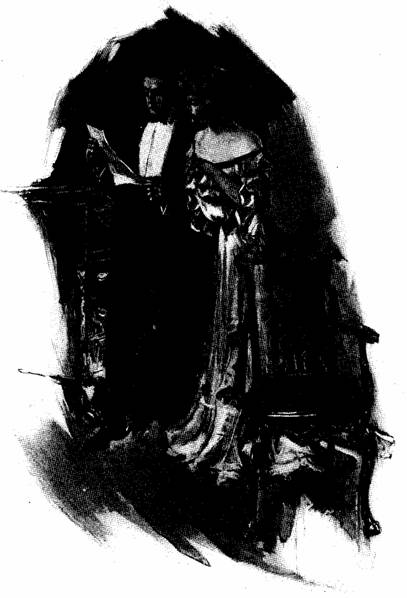
[Illustration: "Billy unfolded it slowly, with a puzzled look growing
in his countenance."]
"Thank you," she returned, mechanically, "I--I hope so."
After an interval, "Good-night, Peggy," said Mr. Woods.
"Oh--? Good-night," said she, with a start.
He turned to go. Then, "By Jove!" said he, grimly, "I've been so busy
making an ass of myself I'd forgotten all about more--more important
things."
Mr. Woods picked up the keys and, going to the desk, unlocked the
centre compartment with a jerk. Afterward he gave a sharp exclamation.
He had found a paper in the secret drawer at the back which appeared
to startle him.
Billy unfolded it slowly, with a puzzled look growing in his
countenance. Then for a moment Margaret's golden head drew close to
his yellow curls and they read it through together. And in the most
melodramatic and improbable fashion in the world they found it to be
the last will and testament of Frederick R. Woods.
"But--but I don't understand," was Miss Hugonin's awed comment. "It's
exactly like the other will, only--why, it's dated the seventeenth
of June, the day before he died! And it's witnessed by Hodges and
Burton--the butler and the first footman, you know--and they've never
said anything about such a paper. And, then, why should he have made
another will just like the first?"
Billy pondered.
By and bye, "I think I can explain that," he said, in a rather
peculiar voice. "You see, Hodges and Burton witnessed all his papers,
half the time without knowing what they were about. They would hardly
have thought of this particular one after his death. And it isn't
quite the same will as the other; it leaves you practically
everything, but it doesn't appoint any trustees, as the other did,
because this will was drawn up after you were of age. Moreover, it
contains these four bequests to colleges, to establish a Woods chair
of ethnology, which the other will didn't provide for. Of course, it
would have been simpler merely to add a codicil to the first will,
but Uncle Fred was always very methodical. I--I think he was probably
going through the desk the night he died, destroying various papers.
He must have taken the other will out to destroy it just--just before
he died. Perhaps--perhaps--" Billy paused for a little and then
laughed, unmirthfully. "It scarcely matters," said he. "Here is the
will. It is undoubtedly genuine and undoubtedly the last he made.
You'll have to have it probated, Peggy, and settle with the colleges.
It--it won't make much of a hole in the Woods millions."
There was a half-humorous bitterness in his voice that Margaret noted
silently. So (she thought) he had hoped for a moment that at the last
Frederick R. Woods had relented toward him. It grieved her, in a dull
fashion, to see him so mercenary. It grieved her--though she would
have denied it emphatically--to see him so disappointed. Since he
wanted the money so much, she would have liked for him to have had it,
worthless as he was, for the sake of the boy he had been.
"Thank you," she said, coldly, as she took the paper; "I will give it
to my father. He will do what is necessary. Good-night, Mr. Woods."
Then she locked up the desk in a businesslike fashion and turned to
him, and held out her hand.
"Good-night, Billy," said this perfectly inconsistent young woman.
"For a moment I thought Uncle Fred had altered his will in your
favour. I almost wish he had."
Billy smiled a little.
"That would never have done," he said, gravely, as he shook
hands; "you forget what a sordid, and heartless, and generally
good-for-nothing chap I am, Peggy. It's much better as it is."
Only the tiniest, the flimsiest fiction, her eyes craved of him. Even
now, at the eleventh hour, lie to me, Billy Woods, and, oh, how gladly
I will believe!
But he merely said "Good-night, Peggy," and went out of the room. His
broad shoulders had a pathetic droop, a listlessness.
Margaret was glad. Of course, she was glad. At last, she had told him
exactly what she thought of him. Why shouldn't she be glad? She was
delighted.
So, by way of expressing this delight, she sat down at the desk and
began to cry very softly.
XIII
Having duly considered the emptiness of existence, the unworthiness of
men, the dreary future that awaited her--though this did not trouble
her greatly, as she confidently expected to die soon--and many other
such dolorous topics, Miss Hugonin decided to retire for the night.
She rose, filled with speculations as to the paltriness of life and
the probability of her eyes being red in the morning.
"It will be all his fault if they are," she consoled herself.
"Doubtless he'll be very much pleased. After robbing me of all faith
in humanity, I dare say the one thing needed to complete his happiness
is to make me look like a fright. I hate him! After making me
miserable, now, I suppose he'll go off and make some other woman
miserable. Oh, of course, he'll make love to the first woman he meets
who has any money. I'm sure she's welcome to him. I only pity any
woman who has to put up with
him
. No, I don't," Margaret decided,
after reflection; "I hate her, too!"
Miss Hugonin went to the door leading to the hallway and paused.
Then--I grieve to relate it--she shook a little pink-tipped fist in
the air.
"I detest you!" she commented, between her teeth; "oh, how
dare
you
make me feel so ashamed of the way I've treated you!"
The query--as possibly you may have divined--was addressed to Mr.
Woods. He was standing by the fireplace in the hallway, and his tall
figure was outlined sharply against the flame of the gas-logs that
burned there. His shoulders had a pathetic droop, a listlessness.
Billy was reading a paper of some kind by the firelight, and the black
outline of his face smiled grimly over it. Then he laughed and threw
it into the fire.
"Billy!" a voice observed--a voice that was honey and gold and velvet
and all that is most sweet and rich and soft in the world.
Mr. Woods was aware of a light step, a swishing, sibilant, delightful
rustling--the caress of sound is the rustling of a well-groomed
woman's skirts--and of an afterthought of violets, of a mere
reminiscence of orris, all of which came toward him through the
dimness of the hall. He started, noticeably.
"Billy," Miss Hugonin stated, "I'm sorry for what I said to you. I'm
not sure it isn't true, you know, but I'm sorry I said it."
"Bless your heart!" said Billy; "don't you worry over that, Peggy.
That's all right. Incidentally, the things you've said to me and about
me aren't true, of course, but we won't discuss that just now. I--I
fancy we're both feeling a bit fagged. Go to bed, Peggy! We'll both
go to bed, and the night will bring counsel, and we'll sleep off all
unkindliness. Go to bed, little sister!--get all the beauty-sleep you
aren't in the least in need of, and dream of how happy you're going to
be with the man you love. And--and in the morning I may have something
to say to you. Good-night, dear."
And this time he really went. And when he had come to the bend in the
stairs his eyes turned back to hers, slowly and irresistibly, drawn
toward them, as it seemed, just as the sunflower is drawn toward the
sun, or the needle toward the pole, or, in fine, as the eyes of young
gentlemen ordinarily are drawn toward the eyes of the one woman in the
world. Then he disappeared.
The mummery of it vexed Margaret. There was no excuse for his looking
at her in that way. It irritated her. She was almost as angry with him
for doing it as she would have been for not doing it.
Therefore, she bent an angry face toward the fire, her mouth pouting
in a rather inviting fashion. Then it rounded slowly into a sanguine
O, which of itself suggested osculation, but in reality stood for
"observe!" For the paper Billy had thrown into the fire had fallen
under the gas-logs, and she remembered his guilty start.
"After all," said Margaret, "it's none of my business."
So she eyed it wistfully.
"It may be important," she considerately remembered. "It ought not to
be left there."
So she fished it out with a big paper-cutter.
"But it can't be very important," she dissented afterward, "or he
wouldn't have thrown it away."
So she looked at the superscripture on the back of it.
Then she gave a little gasp and tore it open and read it by the
firelight.
Miss Hugonin subsequently took credit to herself for not going into
hysterics. And I think she had some reason to; for she found the paper
a duplicate of the one Billy had taken out of the secret drawer, with
his name set in the place of hers. At the last Frederick R. Woods had
relented toward his nephew.
Margaret laughed a little; then she cried a little; then she did both
together. Afterward she sat in the firelight, very puzzled and very
excited and very penitent and very beautiful, and was happier than she
had ever been in her life.
"He had it in his pocket," her dear voice quavered; "he had it in his
pocket, my brave, strong, beautiful Billy did, when he asked me to
marry him. It was King Cophetua wooing the beggar-maid--and the beggar
was an impudent, ungrateful, idiotic little
piece
!" Margaret hissed,
in her most shrewish manner. "She ought to be spanked. She ought to go
down on her knees to him in sackcloth, and tears, and ashes, and all
sorts of penitential things. She will, too. Oh, it's such a beautiful
world--
such
a beautiful world! Billy loves me--really! Billy's a
millionaire, and I'm a pauper. Oh, I'm glad, glad,
glad
!"
She caressed the paper that had rendered the world such a goodly place
to live in--caressed it tenderly and rubbed her check against it. That
was Margaret's way of showing affection, you know; and I protest it
must have been very pleasant for the paper. The only wonder was that
the ink it was written in didn't turn red with delight.
Then she read it through again, for sheer enjoyment of those
beautiful, incomprehensible words that disinherited her. How
lovely
of Uncle Fred! she thought. Of course, he'd forgiven Billy; who
wouldn't? What beautiful language Uncle Fred used! quite prayer-booky,
she termed it. Then she gasped.
The will in Billy's favour was dated a week earlier than the one they
had found in the secret drawer. It was worthless, mere waste paper. At
the last Frederick R. Woods's pride had conquered his love.
"Oh, the horrid old man!" Margaret wailed; "he's left me everything he
had! How
dare
he disinherit Billy! I call it rank impertinence in
him. Oh, boy dear, dear,
dear
boy!" Miss Hugonin crooned, in an
ecstacy of tenderness and woe. "He found this first will in one of the
other drawers, and thought
he
was the rich one, and came in a great
whirl of joy to ask me to marry him, and I was horrid to him! Oh, what
a mess I've made of it! I've called him a fortune-hunter, and I've
told him I love another man, and he'll never, never ask me to marry
him now. And I love him, I worship him, I adore him! And if only
I were poor--"
Ensued a silence. Margaret lifted the two wills, scrutinised them
closely, and then looked at the fire, interrogatively.
"It's penal servitude for quite a number of years," she said. "But,
then, he really
couldn't
tell any one, you know. No gentleman would
allow a lady to be locked up in jail. And if he knew--if he knew I
didn't and couldn't consider him a fortune-hunter, I really believe he
would--"
Whatever she believed he would do, the probability of his doing it
seemed highly agreeable to Miss Hugonin. She smiled at the fire in the
most friendly fashion, and held out one of the folded papers to it.
"Yes," said Margaret, "I'm quite sure he will."
There I think we may leave her. For I have dredged the dictionary,
and I confess I have found no fitting words wherewith to picture this
inconsistent, impulsive, adorable young woman, dreaming brave dreams
in the firelight of her lover and of their united future. I should
only bungle it. You must imagine it for yourself.
It is a pretty picture, is it not?--with its laughable side, perhaps;
under the circumstances, whimsical, if you will; but very, very
sacred. For she loved him with a clean heart, loved him infinitely.
Let us smile at it--tenderly--and pass on.
But upon my word, when I think of how unreasonably, how outrageously
Margaret had behaved during the entire evening, I am tempted to
depose her as our heroine. I begin to regret I had not selected Adèle
Haggage.
She would have done admirably. For, depend upon it, she, too, had
her trepidations, her white nights, her occult battles over Hugh Van
Orden. Also, she was a pretty girl--if you care for brunettes--and
accomplished. She was versed in I forget how many foreign languages,
both Continental and dead, and could discourse sensibly in any one of
them. She was perfectly reasonable, perfectly consistent, perfectly
unimpulsive, and never expressed an opinion that was not countenanced
by at least two competent authorities. I don't know a man living,
prepared to dispute that Miss Haggage excelled Miss Hugonin in all
these desirable qualities.
Yet with pleasing unanimity they went mad for Margaret and had the
greatest possible respect for Adèle.
And, my dear Mrs. Grundy, I grant you cheerfully that this was all
wrong. A sensible man, as you very justly observe, will seek in a
woman something more enduring than mere personal attractions; he will
value her for some sensible reason--say, for her wit, or her learning,
or her skill in cookery, or her proficiency in Greek. A sensible man
will look for a sensible woman; he will not concern his sensible head
over such trumperies as a pair of bright eyes, or a red lip or so, or
a satisfactory suit of hair. These are fleeting vanities.
However--
You have doubtless heard ere this, my dear madam, that had Cleopatra's
nose been an inch shorter the destiny of the world would have been
changed; had she been the woman you describe--perfectly reasonable,
perfectly consistent, perfectly sensible in all she said and
did--confess, dear lady, wouldn't Antony have taken to his heels and
have fled from such a monster?
XIV
I regret to admit that Mr. Woods did not toss feverishly about his bed
all through the silent watches of the night. He was very miserable,
but he was also twenty-six. That is an age when the blind bow-god
deals no fatal wounds. It is an age to suffer poignantly, if you will;
an age wherein to aspire to the dearest woman on earth, to write her
halting verses, to lose her, to affect the
clichés
of cynicism, to
hear the chimes at midnight--and after it all, to sleep like a top.
So Billy slept. And kind Hypnos loosed a dream through the gates of
ivory that lifted him to a delectable land where Peggy was nineteen,
and had never heard of Kennaston, and was unbelievably sweet and dear
and beautiful. But presently they and the Colonel put forth to sea--on
a great carved writing-desk--fishing for sharks, which the Colonel
said were very plentiful in those waters; and Frederick R. Woods
climbed up out of the sea, and said Billy was a fool and must go to
college; and Peggy said that was impossible, as seventeen hundred and
fifty thousand children had to be given an education apiece, and they
couldn't spare one for Billy; and a missionary from Zambesi Land came
out of one of the secret drawers and said Billy must give him both
of his feet as he needed them for his working-girls' classes; and
thereupon the sharks poked their heads out of the water and began, in
a deafening chorus, to cry, "Feet, feet, feet!" And Billy then woke
with a start, and found it was only the birds chattering in the dawn
outside.
Then he was miserable.
He tossed, and groaned, and dozed, and smoked cigarettes until he
could stand it no longer. He got up and dressed, in sheer desperation,
and went for a walk in the gardens.
The day was clear as a new-minted coin. It was not yet wholly aired,
not wholly free from the damp savour of night, but low in the east the
sun was taking heart. A mile-long shadow footed it with Billy Woods
in his pacings through the amber-chequered gardens. Actaeon-like, he
surprised the world at its toilet, and its fleeting grace somewhat
fortified his spirits.
But his thoughts pestered him like gnats. The things he said to the
roses it is not necessary to set down.
XV
After a vituperative half-hour or so Mr. Woods was hungry. He came
back toward Selwoode; and upon the terrace in front of the house he
found Kathleen Saumarez.
During the warm weather, one corner of the terrace had been converted,
by means of gay red-and-white awnings, into a sort of living-room.
There were chairs, tables, sofa-cushions, bowls of roses, and any
number of bright-coloured rugs. Altogether, it was a cosy place,
and the glowing hues of its furnishings were very becoming to Mrs.
Saumarez, who sat there writing industriously.
It was a thought embarrassing. They had avoided one another
yesterday--rather obviously--both striving to put off a necessarily
awkward meeting. Now it had come. And now, somehow, their eyes met for
a moment, and they laughed frankly, and the awkwardness was gone.
"Kathleen," said Mr. Woods, with conviction, "you're a dear."
"You broke my heart," said she, demurely, "but I'm going to forgive
you."
Mrs. Saumarez was not striving to be clever now. And, heavens (thought
Billy), how much nicer she was like this! It wasn't the same woman:
her thin cheeks flushed arbutus-like, and her rather metallic voice
was grown low and gentle. Billy brought memories with him, you see;
and for the moment, she was Kathleen Eppes again--Kathleen Eppes in
the first flush of youth, eager, trustful, and joyous-hearted, as he
had known her long ago. Since then, the poor woman had eaten of the
bread of dependence and had found it salt enough; she had paid for it
daily, enduring a thousand petty slights, a thousand petty insults,
and smiling under them as only women can. But she had forgotten now
that shrewd Kathleen Saumarez who must earn her livelihood as best she
might. She smiled frankly--a purely unprofessional smile.
"I was sorry when I heard you were coming," she said, irrelevantly,
"but I'm glad now."
Mr. Woods--I grieve to relate--was still holding her hand in his.
There stirred in his pulses the thrill Kathleen Eppes had always
wakened--a thrill of memory now, a mere wraith of emotion. He was
thinking of a certain pink-cheeked girl with crinkly black-brown
hair and eyes that he had likened to chrysoberyls--and he wondered
whimsically what had become of her. This was not she. This was
assuredly not Kathleen, for this woman had a large mouth--a humorous
and kindly mouth it was true, but undeniably a large one--whereas,
Kathleen's mouth had been quite perfect and rather diminutive than
otherwise. Hadn't he rhymed of it often enough to know?
They stood gazing at one another for a long time; and in the back of
Billy's brain lines of his old verses sang themselves to a sad little
tune--the verses that reproved the idiocy of all other poets, who had
very foolishly written their sonnets to other women: and yet, as the
jingle pointed out,
Had these poets ever strayed
In thy path, they had not made
Random rhymes of Arabella,
Songs of Dolly, hymns of Stella,
Lays of Lalage or Chloris--
Not of Daphne nor of Doris,
Florimel nor Amaryllis,
Nor of Phyllida nor Phyllis,
Were their wanton melodies:
But all of these--
All their melodies had been
Of thee, Kathleen.
Would they have been? Billy thought it improbable. The verses were
very silly; and, recalling the big, blundering boy who had written
them, Billy began to wonder--somewhat forlornly--whither he, too,
had vanished. He and the girl he had gone mad for both seemed rather
mythical--legendary as King Pepin.
"Yes," said Mrs. Saumarez--and oh, she startled him; "I fancy they're
both quite dead by now. Billy," she cried, earnestly, "don't laugh
at them!--don't laugh at those dear, foolish children! I--somehow, I
couldn't bear that, Billy."
"Kathleen," said Mr. Woods, in admiration, "you're a witch. I wasn't
laughing, though, my dear. I was developing quite a twilight mood over
them--a plaintive, old-lettery sort of mood, you know."
She sighed a little. "Yes--I know." Then her eyelids flickered in a
parody of Kathleen's glance that Billy noted with a queer tenderness.
"Come and talk to me, Billy," she commanded. "I'm an early bird this
morning, and entitled to the very biggest and best-looking worm I can
find. You're only a worm, you know--we're all worms. Mr. Jukesbury
told me so last night, making an exception in my favour, for it
appears I'm an angel. He was amorously inclined last night, the tipsy
old fraud! It's shameless, Billy, the amount of money he gets out of
Miss Hugonin--for the deserving poor. Do you know, I rather fancy he
classes himself under that head? And I grant you he's poor enough--but
deserving!" Mrs. Saumarez snapped her fingers eloquently.
"Eh? Shark, eh?" queried Mr. Woods, in some discomfort.
She nodded. "He is as bad as Sarah Haggage," she informed him, "and
everybody knows what a bloodsucker she is. The Haggage is a disease,
Billy, that all rich women are exposed to--'more easily caught than
the pestilence, and the taker runs presently mad.' Depend upon it,
Billy, those two will have every penny they can get out of your
uncle's money."
"Peggy's so generous," he pleaded. "She wants to make everybody
happy--bring about a general millenium, you know."
"She pays dearly enough for her fancies," said Mrs. Saumarez, in a
hard voice. Then, after a little, she cried, suddenly: "Oh, Billy,
Billy, it shames me to think of how we lie to her, and toady to her,
and lead her on from one mad scheme to another!--all for the sake of
the money we can pilfer incidentally! We're all arrant hypocrites, you
know; I'm no better than the others, Billy--not a bit better. But
my husband left me so poor, and I had always been accustomed to the
pretty things of life, and I couldn't--I couldn't give them up, Billy.
I love them too dearly. So I lie, and toady, and write drivelling
talks about things I don't understand, for drivelling women to
listen to, and I still have the creature comforts of life. I pawn my
self-respect for them--that's all. Such a little price to pay, isn't
it, Billy?"
She spoke in a sort of frenzy. I dare say that at the outset she
wanted Mr. Woods to know the worst of her, knowing he could not fail
to discover it in time. Billy brought memories with him, you see; and
this shrewd, hard woman wanted, somehow, more than anything else in
the world, that he should think well of her. So she babbled out the
whole pitiful story, waiting in a kind of terror to see contempt and
disgust awaken in his eyes.
But he merely said "I see--I see," very slowly, and his eyes were
kindly. He couldn't be angry with her, somehow; that pink-cheeked,
crinkly haired girl stood between them and shielded her. He was only
very, very sorry.
"And Kennaston?" he asked, after a little.
Mrs. Saumarez flushed. "Mr. Kennaston is a man of great genius," she
said, quickly. "Of course, Miss Hugonin is glad to assist him in
publishing his books--it's an honour to her that he permits it. They
have to be published privately, you know, as the general public isn't
capable of appreciating such dainty little masterpieces. Oh, don't
make any mistake, Billy--Mr. Kennaston is a very wonderful and very
admirable man."
"H'm, yes; he struck me as being an unusually nice chap," said Mr.
Woods, untruthfully. "I dare say they'll be very happy."
"Who?" Mrs. Saumarez demanded.
"Why--er--I don't suppose they'll make any secret of it," Billy
stammered, in tardy repentance of his hasty speaking. "Peggy told me
last night she had accepted him."
Mrs. Saumarez turned to rearrange a bowl of roses. She seemed to have
some difficulty over it.
"Billy," she spoke, inconsequently, and with averted head, "an honest
man is the noblest work of God--and the rarest."
Billy groaned.
"Do you know," said he, "I've just been telling the roses in the
gardens yonder the same thing about women? I'm a misogynist this
morning. I've decided no woman is worthy of being loved."
"That is quite true," she assented, "but, on the other hand, no man is
worthy of loving."
Billy smiled.
"I've likewise come to the conclusion," said he, "that a man's love is
like his hat, in that any peg will do to hang it on; also, in that the
proper and best place for it is on his own head. Oh, I assure you,
I vented any number of cheap cynicisms on the helpless roses! And
yet--will you believe it, Kathleen?--it doesn't seem to make me feel a
bit better--no, not a bit."
"It's very like his hat," she declared, "in that he has a new one
every year." Then she rested her hand on his, in a half-maternal
fashion. "What's the matter, boy?" she asked, softly. "You're always
so fresh and wholesome. I don't like to see you like this. Better
leave phrase-making to us phrase-mongers."
Her voice rang true--true, and compassionate, and tender, and all that
a woman's voice should be. Billy could not but trust her.
"I've been an ass," said he, rather tragically. "Oh, not an unusual
ass, Kathleen--just the sort men are always making of themselves. You
see, before I went to France, there was a girl I--cared for. And I let
a quarrel come between us--a foolish, trifling, idle little quarrel,
Kathleen, that we might have made up in a half-hour. But I was too
proud, you see. No, I wasn't proud, either," Mr. Woods amended,
bitterly; "I was simply pig-headed and mulish. So I went away. And
yesterday I saw her again and realised that I--still cared. That's
all, Kathleen. It isn't an unusual story." And Mr. Woods laughed,
mirthlessly, and took a turn on the terrace.
Mrs. Saumarez was regarding him intently. Her cheeks were of a deeper,
more attractive pink, and her breath came and went quickly.
"I--I don't understand," she said, in a rather queer voice.
"Oh, it's simple enough," Billy assured her. "You see, she--well, I
think she would have married me once. Yes, she cared for me once. And
I quarreled with her--I, conceited young ass that I was, actually
presumed to dictate to the dearest, sweetest, most lovable woman on
earth, and tell her what she must do and what she mustn't. I!--good
Lord, I, who wasn't worthy to sweep a crossing clean for her!--who
wasn't worthy to breathe the same air with her!--who wasn't worthy to
exist in the same world she honoured by living in! Oh, I
was
an ass!
But I've paid for it!--oh, yes, Kathleen, I've paid dearly for it,
and I'll pay more dearly yet before I've done. I tried to avoid her
yesterday--you must have seen that. And I couldn't--I give you my
word, I could no more have kept away from her than I could have spread
a pair of wings and flown away. She doesn't care a bit for me now; but
I can no more give up loving her than I can give up eating my dinner.
That isn't a pretty simile, Kathleen, but it expresses the way I feel
toward her. It isn't merely that I want her; it's more than that--oh,
far more than that. I simply can't do without her. Don't you
understand, Kathleen?" he asked, desperately.
"Yes--I think I understand," she said, when he had ended. "I--oh,
Billy, I am almost sorry. It's dear of you--dear of you, Billy, to
care for me still, but--but I'm almost sorry you care so much. I'm not
worth it, boy dear. And I--I really don't know what to say. You must
let me think."
Mr. Woods gave an inarticulate sound. The face she turned to him
was perplexed, half-sad, fond, a little pleased, and strangely
compassionate. It was Kathleen Eppes who sat beside him; the six years
were as utterly forgotten as the name of Magdalen's first lover. She
was a girl again, listening--with a heart that fluttered, I dare
say--to the wild talk, the mad dithyrambics of a big, blundering boy.
The ludicrous horror of it stunned Mr. Woods.
He could no more have told her of her mistake than he could have
struck her in the face.
"Kathleen--!" said he, vaguely.
"Let me think!--ah, let me think, Billy!" she pleaded, in a flutter of
joy and amazement. "Go away, boy dear!--Go away for a little and
let me think! I'm not an emotional woman, but I'm on the verge of
hysterics now, for--for several reasons. Go in to breakfast, Billy!
I--I want to be alone. You've made me very proud and--and sorry, I
think, and glad, and--and--oh, I don't know, boy dear. But please go
now--please!"
Billy went.
In the living-hall he paused to inspect a picture with peculiar
interest. Since Kathleen cared for him (he thought, rather forlornly),
he must perjure himself in as plausible a manner as might be possible;
please God, having done what he had done, he would lie to her like a
gentleman and try to make her happy.
A vision in incredible violet ruffles, coming down to breakfast, saw
him, and paused on the stairway, and flushed and laughed deliciously.
Poor Billy stared at her; and his heart gave a great bound and then
appeared to stop for an indefinite time.
"Good Lord!" said Mr. Woods, in his soul. "And I thought I was an ass
last night! Why, last night, in comparison, I displayed intelligence
that was almost human! Oh, Peggy, Peggy! if I only dared tell you what
I think of you, I believe I would gladly die afterward--yes, I'm sure
I would. You really haven't any right to be so beautiful!--it isn't
fair to us, Peggy!"
But the vision was peeping over the bannisters at him, and the
vision's eyes were sparkling with a lucent mischief and a wonderful,
half-hushed contralto was demanding of him:
"Oh, where have you been, Billy boy, Billy boy?
Oh, where have you been, charming Billy?"
And Billy's baritone answered her:
"I've been to seek a wife--"
and broke off in a groan.
"Good Lord!" said Mr. Woods.
It was a ludicrous business, if you will. Indeed, it was vastly
humorous--was it not?--this woman's thinking a man's love might by any
chance endure through six whole years. But their love endures, you
see; and the silly creatures have a superstition among them that love
is a sacred thing, stronger than time, victorious over death itself.
Let us laugh, then, at Kathleen Saumarez--those of us who have learned
that love is only a tinkling cymbal and faith a sounding brass and
fidelity an obsolete affectation: but for my part, I honour and
think better of the woman who through all her struggles with the
world--through all those sordid, grim, merciless, secret battles where
the vanquished may not even cry for succour--I honour her, I say, for
that she had yet cherished the memory of that first love which is the
best and purest and most unselfish and most excellent thing in life.
XVI
Breakfast Margaret enjoyed hugely. I regret to confess that the fact
that every one of her guests was more or less miserable moved this
hard-hearted young woman to untimely and excessive mirth. Only Mrs.
Saumarez puzzled her, for she could think of no reason for that lady's
manifest agitation when Kathleen eventually joined the others.
But for the rest, the hopeless glances that Hugh Van Orden cast toward
her caused Adèle to flush, and Mrs. Haggage to become despondent and
speechless and astonishingly rigid; and Petheridge Jukesbury's vaguely
apologetic attitude toward the world struck Miss Hugonin as infinitely
diverting. Kennaston she pitied a little; but his bearing toward
her ranged ludicrously from that of proprietorship to that of
supplication, and, moreover, she was furious with him for having
hinted at various times that Billy was a fortune-hunter.
Margaret was quite confident by this that she had never believed
him--"not really, you know"--having argued the point out at some
length the night before, and reaching her conclusion by a course of
reasoning peculiar to herself.
Mr. Woods, as you may readily conceive, was sunk in the Slough of
Despond deeper than ever plummet sounded. Margaret thought this very
nice of him; it was a delicate tribute to her that he ate nothing;
and the fact that Hugh Van Orden and Petheridge Jukesbury--as she
believed--acted in precisely the same way for precisely the same
reason, merely demonstrated, of course, their overwhelming conceit and
presumption.
So sitting in the great Eagle's shadow, she ate a quantity of
marmalade--she was wont to begin the day in this ungodly English
fashion--and gossiped like a brook trotting over sunlit pebbles. She
had planned a pulverising surprise for the house-party; and in due
time, she intended to explode it, and subsequently Billy was to
apologise for his conduct, and then they were to live happily ever
afterward.
She had not yet decided what he was to apologise for; that was his
affair. His conscience ought to have told him, by this, wherein he had
offended; and if his conscience hadn't, why then, of course, he would
have to apologise for his lack of proper sensibility.
After breakfast she went, according to her usual custom, to her
father's rooms, for, as I think I have told you, the old gentleman was
never visible until noon. She had astonishing news for him.
What time she divulged it, the others sat on the terrace, and Mr.
Kennaston read to them, as he had promised, from his "Defense of
Ignorance." It proved a welcome diversion to more than one of the
party. Mr. Woods, especially, esteemed it a godsend; it staved off
misfortune for at least a little; so he sat at Kathleen's side in
silence, trying desperately to be happy, trying desperately not to see
the tiny wrinkles, the faint crow's feet Time had sketched in her face
as a memorandum of the work he meant to do shortly.
Billy consoled himself with the reflection that he was very fond of
her; but, oh (he thought), what worship, what adoration he could
accord this woman if she would only decline--positively--to have
anything whatever to do with him!
I think we ought not to miss hearing Mr. Kennaston's discourse. It is
generally conceded that his style is wonderfully clever; and I have
no doubt that his detractors--who complain that his style is mere
word-twisting, a mere inversion of the most ancient truisms--are
actuated by the very basest jealousy. Let us listen, then, and be duly
edified as he reads in a low, sweet voice, and the birds twitter about
him in the clear morning.
"It has been for many years," Mr. Kennaston began, "the custom of
patriotic gentlemen in quest of office to point with pride to the fact
that the schoolmaster is abroad in the land, in whose defense they
stand pledged to draw their salaries and fight to the last gasp
for reelection. These lofty platitudes, while trying to the lungs,
doubtless appeal to a certain class of minds. But, indeed, the
schoolmaster is not abroad; he is domesticated in every village in
America, where each hamlet has its would-be Shakespeare, and each
would-be Shakespeare has his 'Hamlet' by heart. Learning is rampant in
the land, and valuable information is pasted up in the streetcars so
that he who rides may read.
"And Ignorance--beautiful, divine Ignorance--is forsaken by a
generation that clamours for the truth. And what value, pray, has this
Truth that we should lust after it?"
He glanced up, in an inquiring fashion. Mr. Jukesbury, meeting his
eye, smiled and shook his head and said "Fie, fie!" very placidly.
To do him justice, he had not the least idea what Kennaston was
talking about.
"I am aware," the poet continued, with an air of generosity, "that
many pleasant things have been said of it. In fact, our decade has
turned its back relentlessly upon the decayed, and we no longer read
the lament over the lost art of lying issued many magazines ago by
a once prominent British author. Still, without advancing any Wilde
theories, one may fairly claim that truth is a jewel--a jewel with
many facets, differing in appearance from each point of view.
"And while 'Tell the truth and shame the Devil' is a very pretty
sentiment, it need not necessarily mean anything. The Devil, if there
be a personal devil--and it has been pointed out, with some show of
reason, that an impersonal one could scarcely carry out such enormous
contracts--would, in all probability, rather approve than otherwise of
indiscriminate truth-telling. Irritation is the root of all evil; and
there is nothing more irritating than to hear the truth about one's
self. It is bad enough, in all conscience, to be insulted, but the
truth of an insult is the barb that prevents its retraction. 'Truth
hurts' has all the pathos of understatement. It not only hurts, but
infuriates. It has no more right to go naked in public than any one
else. Indeed, it has less right; for truth-telling is natural to
mankind--as is shown by its prevalence among the younger sort, such as
children and cynics--and, as Shakespeare long ago forgot to tell us, a
touch of nature makes the whole world embarrassed."
At this point Mrs. Haggage sniffed. She considered he was growing
improper. She distrusted Nature.
"Truth-telling, then, may safely be regarded as an unamiable
indiscretion. In art, the bare truth must, in common gallantry, be
awarded a print petticoat or one of canvas, as the case may be, to
hide her nakedness; and in life, it is a disastrous virtue that we
have united to commend and avoid. Nor is the decision an unwise one;
for man is a gregarious animal, knowing that friendship is, at best,
but a feeble passion and therefore to be treated with the care due an
invalid. It is impossible to be quite candid in conversation with a
man; and with a woman it is absolutely necessary that your speech
should be candied.
"Truth, then, is the least desirable of acquaintances.
"But even if one wished to know the truth, the desire could scarcely
be fulfilled. Francis Bacon, Lord Verulam, a prominent lawyer of
Elizabeth's time, who would have written Shakespeare's plays had his
other occupations not prevented it, quotes Pilate as inquiring, 'What
is Truth?'--and then not staying for an answer. Pilate deserves all
the praise he has never received. Nothing is quite true. Even Truth
lies at the bottom of a well and not infrequently in other places. No
assertion is one whit truer than its opposite."
A mild buzz of protest rose about him. Kennaston smiled and cocked his
head on one side.
"We have, for example," he pointed out, "a large number of proverbs,
the small coin of conversation, received everywhere, whose value no
one disputes. They are rapped forth, like an oath, with an air of
settling the question once and forever. Well! there is safety in
quotations. But even the Devil can cite Shakespeare for his purpose.
'Never put off till to-morrow what you can do to-day' agrees ill with
'Sufficient unto the day is the evil thereof'; and it is somewhat
difficult to reconcile 'Take care of the pence, and the pounds will
take care of themselves' with the equally familiar 'Penny-wise,
pound-foolish.' Yet the sayings are equally untrue; any maxim is,
perforce, a general statement, and therefore fallacious, and therefore
universally accepted. Art is long, and life is short, but the
platitudes concerning them are both insufferable and eternal. We must
remember that a general statement is merely a snap-shot at flying
truth, an instantaneous photograph of a moving body. It may be the way
that a thing is; but it is never the way in which any one ever saw
that thing, or ever will. This is, of course, a general statement.
"As to present events, then, it may be assumed that no one is either
capable or desirous of speaking the truth; why, then, make such
a pother about it as to the past? There we have carried the
investigation of truth to such an extreme that nowadays very few of us
dare believe anything. Opinions are difficult to secure when a quarter
of an hour in the library will prove either side of any question.
Formerly, people had a few opinions, which, if erroneous, were at
least universal. Nero was not considered an immaculate man. The Flood
was currently believed to have caused the death of quite a number of
persons. And George Washington, it was widely stated, once cut down
a cherry-tree. But now all these comfortable illusions have been
destroyed by 'the least little men who spend their time and lose their
wits in chasing nimble and retiring truth, to the extreme perturbation
and drying up of the moistures.'"
Kennaston looked up for a moment, and Billy Woods, who had counted
seven wrinkles and was dropping into a forlorn doze, started
violently. His interest then became abnormal.
"There are," Mr. Kennaston complained, rather reproachfully, "too many
inquiries, doubts, investigations, discoveries, and apologies. There
are palliations of Tiberius, eulogies of Henry VIII., rehabilitations
of Aaron Burr. Lucretia Borgia, it appears, was a grievously
misunderstood woman, and Heliogabalus a most exemplary monarch; even
the dog in the manger may have been a nervous animal in search of
rest and quiet. As for Shakespeare, he was an atheist, a syndicate, a
lawyer's clerk, an inferior writer, a Puritan, a scholar, a
nom de plume
, a doctor of medicine, a fool, a poacher, and another man of
the same name. Information of this sort crops up on every side. Even
the newspapers are infected; truth lurks in the patent-medicine
advertisements, and sometimes creeps stealthily into the very
editorials. We must all learn the true facts of history, whether we
will or no; eventually, the writers of historical romance will not
escape.
"So the sad tale goes. Ignorance--beautiful, divine Ignorance--is
forsaken by a generation that clamours for the truth. The
earnest-minded person has plucked Zeus out of Heaven, and driven the
Maenad from the wood, and dragged Poseidon out of his deep-sea palace.
The conclaves of Olympus, it appears, are merely nature-myths;
the stately legends clustering about them turn out to be a rather
elaborate method of expressing the fact that it occasionally rains.
The heroes who endured their angers and jests and tragic loves are
delicately veiled allusions to the sun--surely, a very harmless topic
of conversation, even in Greece; and the monsters, 'Gorgons and Hydras
and Chimæras dire,' their grisly offspring, their futile opponents,
are but personified frosts. Mythology--the poet's necessity, the
fertile mother of his inventions--has become a series of atmospheric
phenomena, and the labours of Hercules prove to be a dozen weather
bulletins.
"Is it any cause for wonder, that under this cheerless influence our
poetry is either silent or unsold? The true poet must be ignorant, for
information is the thief of rhyme. And it is only in dealing with--"
Kennaston paused. Margaret had appeared in the vestibule, and behind
her stood her father, looking very grave.
"We have made a most interesting discovery," Miss Hugonin airily
announced to the world at large. "It appears that Uncle Fred left all
his property to Mr. Woods here. We found the will only last night. I'm
sure you'll all be interested to learn I'm a pauper now, and intend to
support myself by plain sewing. Any work of this nature you may
choose to favour me with, ladies and gentlemen, will receive my most
earnest
attention."
She dropped a courtesy. The scene appealed to her taste for the
dramatic.
Billy came toward her quickly.
"Peggy," he demanded of her, in the semi-privacy of the vestibule,
"will you kindly elucidate the meaning of this da--this idiotic
foolishness?"
"Why, this," she explained, easily, and exhibited a folded paper. "I
found it in the grate last night."
He inspected it with large eyes. "That's absurd," he said, at length.
"You know perfectly well this will isn't worth the paper it's written
on."
"My dear sir," she informed him, coldly, "you are vastly mistaken. You
see, I've burned the other one." She pushed by him. "Mr. Kennaston,
are you ready for our walk? We'll finish the paper some other time.
Wasn't it the strangest thing in the world--?" Her dear, deep, mellow
voice died away as she and Kennaston disappeared in the gardens.
Billy gasped.
But meanwhile, Colonel Hugonin had given the members of his daughter's
house-party some inkling as to the present posture of affairs. They
were gazing at Billy Woods rather curiously. He stood in the vestibule
of Selwoode, staring after Margaret Hugonin; but they stared at him,
and over his curly head, sculptured above the door-way, they saw the
Eagle--the symbol of the crude, incalculable power of wealth.
Mr. Woods stood in the vestibule of his own house.
XVII
"By gad!" said Colonel Hugonin, very grimly, "anybody would think
you'd just lost a fortune instead of inheriting one! Wish you joy of
it, Billy. I ain't saying, you know, we shan't miss it, my daughter
and I--no, begad, for it's a nice pot of money, and we'll miss it
damnably. But since somebody had to have it, I'd much rather it was
you, my boy, than a set of infernal, hypocritical, philanthropic
sharks, and I'm damn' glad Frederick has done the square thing by
you--yes, begad!"
The old gentleman was standing beside Mr. Woods in the vestibule of
Selwoode, some distance from the other members of the house-party,
and was speaking in confidence. He was sincere; I don't say that
the thought of facing the world at sixty-five with practically
no resources save his half-pay--I think I have told you that the
Colonel's diversions had drunk up his wife's fortune and his own like
a glass of water--I don't say that this thought moved him to hilarity.
Over it, indeed, he pulled a frankly grave face.
But he cared a deal for Billy; and even now there was balm--soothing,
priceless balm--to be had of the reflection that this change in
his prospects affected materially the prospects of those cultured,
broad-minded, philanthropic persons who had aforetime set his daughter
to requiring of him a perusal of Herbert Spencer.
Billy was pretty well aware how monetary matters stood with the old
wastrel; and the sincerity of the man affected him far more than the
most disinterested sentiments would have done. Mr. Woods accordingly
shook hands, with entirely unnecessary violence.
"You're a trump, that's what you are!" he declared; "oh, yes, you are,
Colonel! You're an incorrigible, incurable old ace of trumps--the
very best there is in the pack--and it's entirely useless for you to
attempt to conceal it."
"Gad----!" said the Colonel.
"And don't you worry about that will," Mr. Woods advised. "I--I can't
explain things just now, but it's all right. You just wait--just wait
till I've seen Peggy," Billy urged, in desperation, "and I'll explain
everything."
"By gad----!" said the Colonel. But Mr. Woods was half-way out of the
vestibule.
Mr. Woods was in an unenviable state of perturbation.
He could not quite believe that Peggy had destroyed the will; the
thing out-Heroded Herod, out-Margareted Margaret. But if she had,
it struck him as a high-handed proceeding, entailing certain
vague penalties made and provided by the law to cover just such
cases--penalties of whose nature he was entirely ignorant and didn't
care to think. Heavens! for all he knew, that angel might have let
herself in for a jail sentence.
Billy pictured that queen among women! that paragon! with her glorious
hair cropped and her pink-tipped little hands set to beating hemp--he
had a shadowy notion that the lives of all female convicts were
devoted to this pursuit--and groaned in horror.
"In the name of Heaven!" Mr. Woods demanded of his soul, "what
possible
reason could she have had for this new insanity? And in the
name of Heaven, why couldn't she have put off her
tête-à-tête
with
Kennaston long enough to explain? And in the name of Heaven, what does
she see to admire in that putty-faced, grimacing ass, any way! And in
the name of Heaven, what am I to say to this poor, old man here? I
can't explain that his daughter isn't in any danger of being poor, but
merely of being locked up in jail! And in the name of Heaven, how
long does that outrageous angel expect me to remain in this state of
suspense!"
Billy groaned again and paced the vestibule. Then he retraced his
steps, shook hands with Colonel Hugonin once more, and, Kennaston or
no Kennaston, set out to find her.
XVIII
But when he came out upon the terrace, Sarah Ellen Haggage stopped
him--stopped him with a queer blending of diffidence and resolve in
her manner.
The others, by this, had disappeared in various directions, puzzled
and exceedingly uncertain what to do. Indeed, to congratulate Billy
in the Colonel's presence would have been tactless; and, on the other
hand, to condole with the Colonel without seeming to affront the
wealthy Mr. Woods was almost impossible. So they temporised and
fled--all save Mrs. Haggage.
She, alone, remained to view Mr. Woods with newly opened eyes; for
as he paused impatiently--the sculptured Eagle above his head--she
perceived that he was a remarkably handsome and intelligent young man.
Her motherly heart opened toward this lonely, wealthy orphan.
"My dear Billy," she cooed, with asthmatic gentleness, "as an old,
old friend of your mother's, aren't you going to let me tell you how
rejoiced Adèle and I are over your good fortune? It isn't polite, you
naughty boy, for you to run away from your friends as soon as they've
heard this wonderful news. Ah, such news it was--such a manifest
intervention of Providence! My heart has been fluttering, fluttering
like a little bird, Billy, ever since I heard it."
In testimony to this fact, Mrs. Haggage clasped a stodgy hand to an
exceedingly capacious bosom, and exhibited the whites of her eyes
freely. Her smile, however, remained unchanged and ample.
"Er--ah--oh, yes! Very kind of you, I'm sure!" said Mr. Woods.
"I never in my life saw Adèle so deeply affected by
anything
," Mrs.
Haggage continued, with a certain large archness. "The sweet child
was always so fond of you, you know, Billy. Ah, I remember distinctly
hearing her speak of you many and many a time when you were in that
dear, delightful, wicked Paris, and wonder when you would come back
to your friends--not very grand and influential friends, Billy, but
sincere, I trust, for all that."
Mr. Woods said he had no doubt of it.
"So many people," she informed him, confidentially, "will pursue you
with adulation now that you are wealthy. Oh, yes, you will find that
wealth makes a great difference, Billy. But not with Adèle and
me--no, dear boy, despise us if you will, but my child and I are not
mercenary. Money makes no difference with us; we shall be the same to
you that we always were--sincerely interested in your true welfare,
overjoyed at your present good fortune, prayerful as to your brilliant
future, and delighted to have you drop in any evening to dinner. We do
not consider money the chief blessing of life; no, don't tell me that
most people are different, Billy, for I know it very well, and many is
the tear that thought has cost me. We live in a very mercenary world,
my dear boy; but
our
thoughts, at least, are set on higher things,
and I trust we can afford to despise the merely temporal blessings of
life, and I entreat you to remember that our humble dwelling is always
open to the son of my old, old friend, and that there is always a jug
of good whiskey in the cupboard."
Thus in the shadow of the Eagle babbled the woman whom--for all her
absurdities--Margaret had loved as a mother.
Billy thanked her with an angry heart.
"And this"--I give you the gist of his meditations--"this is Peggy's
dearest friend! Oh, Philanthropy, are thy protestations, then, all
void and empty, and are thy noblest sentiments--every one of 'em--so
full of sound and rhetoric, so specious, so delectable--are these,
then, but dicers' oaths!"
Aloud, "I'm rather surprised, you know," he said, slowly, "that you
take it just this way, Mrs. Haggage. I should have thought you'd have
been sorry on--on Miss Hugonin's account. It's awfully jolly of you,
of course--oh, awfully jolly, and I appreciate it at its true worth, I
assure you. But it's a bit awkward, isn't it, that the poor girl will
be practically penniless? I really don't know whom she'll turn to
now."
Then Billy, the diplomatist, received a surprise.
"She'll come with me, of course," said Mrs. Haggage.
Mr. Woods made an--unfortunately--inaudible observation.
"I beg your pardon?" she queried. Then, obtaining no response, she
continued, with perfect simplicity: "Margaret's quite like a daughter
to me, you know. Of course, she and the Colonel will come with us--at
least, until affairs are a bit more settled. Even afterward--well, we
have a large house, Billy, and I don't see that they'd be any better
off anywhere else."
Billy's emotions were complex.
"You big-hearted old parasite," his own heart was singing. "If you
could only keep that ring of truth that's in your voice for your
platform utterances--why, in less than no time you could afford to
feed your Afro-Americans on nightingales' tongues and clothe every
working-girl in the land in cloth of gold! You've been pilfering from
Peggy for years--pilfering right and left with both hands! But you've
loved her all the time, God bless you; and now the moment she's in
trouble you're ready to take both her and the Colonel--whom, by the
way, you must very cordially detest--and share your pitiful, pilfered
little crusts with 'em and--having two more mouths to feed--probably
pilfer a little more outrageously in the future! You're a
sanctimonious old hypocrite, you are, and a pious fraud, and a
delusion, and a snare, and you and Adèle have nefarious designs on me
at this very moment, but I think I'd like to kiss you!"
Indeed, I believe Mr. Woods came very near doing so. She loved Peggy,
you see; and he loved every one who loved her.
But he compromised by shaking hands energetically, for a matter of
five minutes, and entreating to be allowed to subscribe to some of her
deserving charitable enterprises--any one she might mention--and so
left the old lady a little bewildered, but very much pleased.
She decided that for the future Adèle must not see so much of Mr.
Van Orden. She began to fear that gentleman's views of life were not
sufficiently serious.
XIX
Billy went into the gardens in pursuit of Margaret. He was almost
happy now and felt vaguely ashamed of himself. Then he came upon
Kathleen Saumarez, who, indeed, was waiting for him there; and his
heart went down into his boots.
He realised on a sudden that he was one of the richest men in America.
It was a staggering thought. Also, Mr. Woods's views, at this moment,
as to the advantages of wealth, might have been interesting.
Kathleen stood silent for an instant, eyes downcast, face flushed. She
was trembling.
Then, "Billy," she asked, almost inaudibly, "do--do you still
want--your answer?"
The birds sang about them. Spring triumphed in the gardens. She looked
very womanly and very pretty.
To all appearances, it might easily have been a lover and his lass met
in the springtide, shamefaced after last night's kissing. But Billy,
somehow, lacked much of the elation and the perfect content and the
disposition to burst into melody that is currently supposed to seize
upon rustic swains at such moments. He merely wanted to know if at
any time in the remote future his heart would be likely to resume the
discharge of its proper functions. It was standing still now.
However, "Can you ask--dear?" His words, at least, lied gallantly.
The poor woman looked up into Billy's face. After years of battling
with the world, here for the asking was peace and luxury and wealth
incalculable, and--as Kathleen thought--a love that had endured since
they were boy and girl together. Yet she shrunk from him a little and
clinched her hands before she spoke.
"Yes," Kathleen faltered, and afterward she shuddered.
And here, if for the moment I may prefigure the Eagle as a sentient
being, I can imagine his chuckle.
"Please God," thought poor Billy, "I will make her happy. Yes, please
God, I can at least do that, since she cares for me."
Then he kissed her.
"My dear," said he, aloud, "I'll try to make you happy. And--and you
don't mind, do you, if I leave you now?" queried this ardent lover.
"You see, it's absolutely necessary I should see--see Miss Hugonin
about this will business. You don't mind very much, do you--darling?"
Mr. Woods inquired of her, the last word being rather obviously an
afterthought.
"No," said she. "Not if you must--dear."
Billy went away, lugging a heart of lead in his breast.
Kathleen stared after him and gave a hard, wringing motion of her
hands. She had done what many women do daily; the thing is common and
sensible and universally commended; but in her own eyes, the draggled
trollop of the pavements was neither better nor worse than she.
At the entrance of the next walkway Billy encountered Felix
Kennaston--alone and in the most ebulliently mirthful of humours.
XX
But we had left Mr. Kennaston, I think, in company with Miss Hugonin,
at the precise moment she inquired of him whether it were not the
strangest thing in the world--referring thereby to the sudden manner
in which she had been disinherited.
The poet laughed and assented. Afterward, turning north from the front
court, they descended past the shield-bearing griffins--and you may
depend upon it that each shield is adorned with a bas-relief of the
Eagle--that guard the broad stairway leading to the formal gardens
of Selwoode. The gardens stretch northward to the confines of Peter
Blagden's estate of Gridlington; and for my part--unless it were that
primitive garden that Adam lost--I can imagine no goodlier place.
On this particular forenoon, however, neither Miss Hugonin nor Felix
Kennaston had eyes for its comeliness; silently they braved the
griffins, and in silence they skirted the fish-pond--silver-crinkling
in the May morning--and passed through cloistral ilex-shadowed walks,
and amphitheatres of green velvet, and terraces ample and mellow
in the sunlight, silently. The trees pelted them with blossoms;
pedestaled in leafy recesses, Satyrs grinned at them apishly, and the
arrows of divers pot-bellied Cupids threatened them, and Fauns piped
for them ditties of no tone; the birds were about shrill avocations
overhead, and everywhere the heatless, odourful air was a caress; but
for all this, Miss Hugonin and Mr. Kennaston were silent and very
fidgetty.
Margaret was hatless--and the glory of the eminently sensible spring
sun appeared to centre in her hair--and violet-clad; and the gown,
like most of her gowns, was all tiny tucks and frills and flounces,
diapered with semi-transparencies--unsubstantial, foam-like, mere
violet froth. As she came starry-eyed through the gardens, the
impudent wind trifling with her hair, I protest she might have been
some lady of Oberon's court stolen out of Elfland to bedevil us poor
mortals, with only a moonbeam for the changeable heart of her, and
for raiment a violet shadow spirited from the under side of some big,
fleecy cloud.
They came presently through a trim, yew-hedged walkway to a
summer-house covered with vines, into which Margaret peeped and
declined to enter, on the ground that it was entirely too chilly
and gloomy and
exactly
like a mausoleum; but nearby they found a
semi-circular marble bench about which a group of elm-trees made a
pleasant shadow splashed at just the proper intervals with sunlight.
On this Margaret seated herself; and then pensively moved to the other
end of the bench, because a slanting sunbeam fell there. Since it
was absolutely necessary to blast Mr. Kennaston's dearest hopes,
she thoughtfully endeavoured to distract his attention from his own
miseries--as far as might be possible--by showing him how exactly like
an aureole her hair was in the sunlight. Margaret always had a kind
heart.
Kennaston stood before her, smiling a little. He was the sort of man
to appreciate the manoeuver.
"My lady," he asked, very softly, "haven't you any good news for me on
this wonderful morning?"
"Excellent news," Margaret assented, with a cheerfulness that was
not utterly free from trepidation. "I've decided not to marry you,
beautiful, and I trust you're properly grateful. You see, you're very
nice, of course, but I'm going to marry somebody else, and bigamy is
a crime, you know; and, anyhow, I'm only a pauper, and you'd never be
able to put up with my temper--now, beautiful, I'm quite sure you
couldn't, so there's not a bit of use in arguing it. Some day you'd
end by strangling me, which would be horribly disagreeable for me, and
then they'd hang you for it, you know, and that would be equally
disagreeable for you. Fancy, though, what a good advertisement it would
be for your poems!"
[Illustration: "'My lady,' he asked, very softly, 'haven't you any
good news for me on this wonderful morning?'"]
She was not looking at him now--oh, no, Margaret was far too busily
employed getting the will (which she had carried all this time) into
an absurd little silver chain-bag hanging at her waist. She had no
time to look at Felix Kennaston. There was such scant room in the bag;
her purse took up so much space there was scarcely any left for the
folded paper; the affair really required her closest, undivided
attention. Besides, she had not the least desire to look at Kennaston
just now.
"Beautiful child," he pleaded, "look at me!"
But she didn't.
She felt that at that moment she could have looked at a gorgon, say,
or a cockatrice, or any other trifle of that nature with infinitely
greater composure. The pause that followed Margaret accordingly
devoted to a scrutiny of his shoes and sincere regret that their owner
was not a mercenary man who would be glad to be rid of her.
"Beautiful child," spoke the poet's voice, sadly, "you aren't--surely,
you aren't saying this in mistaken kindness to me? Surely, you aren't
saying this because of what has happened in regard to your money
affairs? Believe me, my dear, that makes no difference to me. It
is you I love--you, the woman of my heart--and not a certain, and
doubtless desirable, amount of metal disks and dirty paper."
"Now I suppose you're going to be very noble and very nasty about it,"
observed Miss Hugonin, resentfully. "That's my main objection to
you, you know, that you haven't any faults I can recognise and feel
familiar and friendly with."
"My dear," he protested, "I assure you I am not intentionally
disagreeable."
At that, she raised velvet eyes to his--with a visible effort,
though--and smiled.
"I know you far too well to think that," she said, wistfully. "I
know I'm not worthy of you. I'm tremendously fond of you, beautiful,
but--but, you see, I love somebody else," Margaret concluded, with
admirable candour.
"Ah!" said he, in a rather curious voice. "The painter chap, eh?"
Then Margaret's face flamed in a wonderful glow of shame and happiness
and pride that must have made the surrounding roses very hopelessly
jealous. A quaint mothering look, sacred, divine, Madonna-like,
woke in her great eyes as she thought--remorsefully--of
how unhappy Billy must be at that very moment and of how big he was
and of his general niceness; and she desired, very heartily, that this
fleshy young man would make his scene and have done with it. Who was
he, forsooth, to keep her from Billy? She wished she had never heard
of Felix Kennaston.
Souvent femme varie
, my brothers.
However, "Yes," said Margaret..
"You are a dear," said Mr. Kennaston, with conviction in his voice.
I dare say Margaret was surprised.
But the poet had taken her hand and had kissed it reverently, and then
sat down beside her, twisting one foot under him in a fashion he had.
He was frankly grateful to her for refusing him; and, the mask of
affectation slipped, she saw in him another man.
"I am an out-and-out fraud," he confessed, with the gayest of smiles.
"I am not in love with you, and I am inexpressibly glad that you are
not in love with me. Oh, Margaret, Margaret--you don't mind if I call
you that, do you? I shall have to, in any event, because I like you so
tremendously now that we are not going to be married--you have no idea
what a night I spent."
"I consider it most peculiar and unsympathetic of my hair not to have
turned gray. I thought you were going to have me, you see."
Margaret was far to much astonished to be angry.
"But last night!" she presently echoed, in candid surprise. "Why, last
night you didn't know I was poor!"
He wagged a protesting forefinger. "That made no earthly difference,"
he assured her. "Of course, it was the money--and in some degree the
moon--that induced me to make love to you. I acted on the impulse of
the moment; just for an instant, the novelty of doing a perfectly
sensible thing--and marrying money is universally conceded to come
under that head--appealed to me. So I did it. But all the time I was
in love with Kathleen Saumarez. Why, the moment I left you, I began to
realise that not even you--and you are quite the most fascinating and
generally adorable woman I ever knew, Margaret--I began to realise, I
say, that not even you could ever make me forget that fact. And I
was very properly miserable. It is extremely queer," Mr. Kennaston
continued, after an interval of meditation, "but falling in love
appears to be the one utterly inexplicable, utterly reasonless thing
one ever does in one's life. You can usually think of some more or
less plausible palliation for embezzlement, say, or for robbing a
cathedral or even for committing suicide--but no man can ever explain
how he happened to fall in love. He simply did it."
Margaret nodded sagely. She knew.
"Now you," Mr. Kennaston was pleased to say, "are infinitely more
beautiful, younger, more clever, and in every way more attractive than
Kathleen. I recognise these things clearly, but it does not appear,
somehow, to alter the fact that I am in love with her. I think I have
been in love with her all my life. We were boy and girl together,
Margaret, and--and I give you my word," Kennaston cried, with his
boyish flush, "I worship her! I simply cannot explain the perfectly
unreasonable way in which I worship her!"
He was sincere. He loved Kathleen Saumarez as much as he was capable
of loving any one--almost as much as he loved to dilate on his own
peculiarities and emotions.
Margaret's gaze was intent upon him. "Yet," she marvelled, "you made
love to me very tropically."
With unconcealed pride, Mr. Kennaston assented. "Didn't I?" he said.
"I was in rather good form last night, I thought."
"And you were actually prepared to marry me?" she asked--"even after
you knew I was poor?"
"I couldn't very well back out," he submitted, and then cocked
his head on one side. "You see," he added, whimsically, "I was
sufficiently a conceited ass to fancy you cared a little for me. So,
of course, I was going to marry you and try to make you happy. But how
dear--oh, how unutterably dear it was of you, Margaret, to decline
to be made happy in any such fashion!" And Mr. Kennaston paused to
chuckle and to regard her with genuine esteem and affection.
But still her candid eyes weighed him, and transparently found him
wanting.
"You are thinking, perhaps, what an unutterable cad I have been?" he
suggested.
"Yes--you are rather by way of being a cad, beautiful. But I can't
help liking you, somehow. I dare say it's because you're honest
with me. Nobody--nobody," Miss Hugonin lamented, a forlorn little
quiver in her voice, "
ever
seemed to be honest with me except you,
and now I know you weren't. Oh, beautiful, aren't I ever to have any
real friends?" she pleaded, wistfully.
Kennaston had meant a deal to her, you see; he had been the one
man she trusted. She had gloried in his fustian rhetoric, his glib
artlessness, his airy scorn of money; and now all this proved mere
pinchbeck. On a sudden, too, there woke in some bycorner of her heart
a queasy realisation of how near she had come to loving Kennaston. The
thought nauseated her.
"My dear," he answered, kindly, "you will have any number of friends
now that you are poor. It was merely your money that kept you from
having any. You see," Mr. Kennaston went on, with somewhat the air of
one climbing upon his favourite hobby, "money is the only thing
that counts nowadays. In America, the rich are necessarily our only
aristocracy. It is quite natural. One cannot hope for an aristocracy
of intellect, if only for the reason that not one person in a thousand
has any; and birth does not count for much. Of course, it is quite
true that all of our remote ancestors came over with William the
Conqueror--I have sometimes thought that the number of steerage
passengers his ships would accommodate must have been little short of
marvellous--but it is equally true that the grandfathers of most of
our leisure class were either deserving or dishonest persons--who
either started life on a farm, and studied Euclid by the firelight and
did all the other priggish things they thought would look well in a
biography, or else met with marked success in embezzlement. So money,
after all, is our only standard; and when a woman is as rich as you
were yesterday she cannot hope for friends any more than the Queen
of England can. You could have plenty of flatterers, toadies,
sycophants--anything, in fine, but friends."
"I don't believe it," said Margaret, half angrily--"not a word of it.
There
must
be some honest people in the world who don't consider
that money is everything. You know there must be, beautiful!"
The poet laughed. "That," said he, affably, "is poppycock. You are
repeating the sort of thing I said to you yesterday. I am honest now.
The best of us, Margaret, cannot help being impressed by the power of
money. It is the greatest power in the world, and we cannot--cannot
possibly--look upon rich people as being quite like us. We must
toady to them a bit, Margaret, whether we want to or not. The Eagle
intimidates us all."
"I
hate
him!" Miss Hugonin announced, with vehemence.
Kennaston searched his pockets. After a moment he produced a dollar
bill and showed her the Eagle on it.
"There," he said, gravely, "is the original of the Woods Eagle--the
Eagle that intimidates us all. Do you remember what Shakespeare--one
always harks back to Shakespeare to clinch an argument, because not
even our foremost actors have been able to conceal the fact that he
was, as somebody in Dickens acutely points out, 'a dayvilish clever
fellow'--do you remember. I say, what Shakespeare observes as to this
very Eagle?"
Miss Hugonin shook her little head till it glittered in the sunlight
like a topaz. She cared no more for Shakespeare than the average woman
does, and she was never quite comfortable when he was alluded to.
"He says," Mr. Kennaston quoted, solemnly:
"The Eagle suffers little birds to sing,
And is not careful what they mean thereby,
Knowing that with the shadow of his wing
He can at pleasure still their melody."
"That's nonsense," said Margaret, calmly. "I haven't the
least
idea
what you're talking about, and I don't believe you have either."
He waved the dollar bill with a heroical gesture. "Here," he asserted,
"is the Eagle. And by the little birds, I have not a doubt he meant
charity and independence and kindliness and truth and the rest of the
standard virtues. That is quite as plausible as the interpretation of
the average commentator. The presence of money chills these little
birds--ah, it is lamentable, no doubt, but it is true."
"I don't believe it," said Margaret--quite as if that settled the
question.
But now his hobby, rowelled by opposition, was spurred to loftier
flights.
"Ah, the power of these great fortunes America has bred is monstrous,"
he suddenly cried. "And always they work for evil. If I were ever to
write a melodrama, Margaret, I could wish for no more thorough-paced
villain than a large fortune." Kennaston paused and laughed grimly.
"We cringe to the Eagle!" said he. "Eh, well, why not? The Eagle is
very powerful and very cruel. In the South yonder, the Eagle has
penned over a million children in his factories, where day by day he
drains the youth and health and very life out of their tired bodies;
in sweat-shops, men and women are toiling for the Eagle, giving their
lives for the pittance that he grudges them; in countless mines and
mills, the Eagle is trading human lives for coal and flour; in
Wall Street yonder, the Eagle is juggling as he will with life's
necessities--thieving from the farmer, thieving from the consumer,
thieving from the poor fools who try to play the Eagle's game, and
driving them at will to despair and ruin and death: look whither you
may, men die that the Eagle may grow fat. So the Eagle thrives, and
daily the rich grow richer and the poor grow poorer, and the end----"
Kennaston paused, staring into vacancy. "Eh, well," said he, with a
smile and a snap of his fingers, "the end rests upon the knees of
the gods. But there must need be an end some day. And meanwhile, you
cannot blame us if we cringe to the Eagle that is master of the world.
It is human nature to cringe to its master; and while human nature
is not always an admirable thing, it is, I believe, rather widely
distributed."
Margaret did not return the smile. Like any sensible woman, she never
tolerated opinions that differed from her own.
So she waved his preachment aside. "You're trying to be eloquent," was
her observation, "and you've only succeeded in being very silly and
tiresome. Go away, beautiful. You make me awfully tired, and I don't
care for you in the least. Go and talk to Kathleen. I shall be
here--on this very spot," Margaret added, with commendable precision
and an unaccountable increase of colour, "if--if any one should happen
to ask."
Then Kennaston rose and laughed merrily.
"You are quite delicious," he commented. "It will always be a
grief and a puzzle to me that I am not mad for love of you. It is
unreasonable of me," he complained, sadly, and shook his head, "but I
prefer Kathleen. And I am quite certain that somebody will ask where
you are. I shall describe to him the exact spot--"
Mr. Kennaston paused, with a slight air of apology.
"If I were you," he suggested, pleasantly, "I would move a
little--just a little--to the left. That will enable you to obtain to
a fuller extent the benefit of the sunbeam which is falling--quite
by accident, of course--upon your hair. You are perfectly right,
Margaret, in selecting that hedge as a background. Its sombre green
sets you off to perfection."
He went away chuckling. He felt that Margaret must think him a devil
of a fellow.
She didn't, though.
"The
idea
of his suspecting me of such unconscionable vanity!" she
said, properly offended. Then, "Anyhow, a man has no business to know
about such things," she continued, with rising indignation. "I believe
Felix Kennaston is as good a judge of chiffons as any woman. That's
effeminate, I think, and catty and absurd. I don't believe I ever
liked him--not really, that is. Now, what would Billy care about
sunbeams and backgrounds, I'd like to know! He'd never even notice
them. Billy is a
man
. Why, that's just what father said yesterday!"
Margaret cried, and afterward laughed happily. "I suppose old people
are right sometimes--but, dear, dear, they're terribly unreasonable at
others!"
Having thus uttered the ancient, undying plaint of youth, Miss Hugonin
moved a matter of two inches to the left, and smiled, and waited
contentedly. It was barely possible some one might come that way; and
it is always a comfort to know that one is not exactly repulsive in
appearance.
Also, there was the spring about her; and, chief of all, there was a
queer fluttering in her heart that was yet not unpleasant. In fine,
she was unreasonably happy for no reason at all.
I believe the foolish poets call this feeling love and swear it
is divine; however, they will say anything for the sake of an