THE ENCHANTING OF DOIRENN (continued 2)
Reading edition
“Take your evils from this place,” he cried out. “Have I fought the demons of woman-temptings for naught? Seven times seven days in the spring of the year did I pray in water of ice to my armpits. Nine times nine prayers have I likewise made to that end, for youth is still on me! Is it from the King of Hell you are come to bring temptings of women who breed the evils of carnal loves?”


Ruadan stared at him as at a wild dog he would throttle, and then let fall the sack, looking at the wasted form and the wild eyes. He tried to see where her human youth of the verses was hidden behind the grievous mask, and could not.
“I need teaching to tell me that love is of Hell,” he said. “In a swoon of half death in a forest I had a vision of love with a difference. It was a radiant love, bearing healing for human ills—yes-and it shrank not from soiled hands, or blood-stained hands, in the service—that was my vision. You, monk that you are, have had more than vision: As children, Doirenn and you have gone with clasped hands and no wall between you. She has heart-love for the remembering of that time and she has come the hard way for your help above all men. You look not so much to me, but the priests tell us you are made in God’s image. No god of a man can be a coward, and we may have enemies to overcome ere we get her to safety, but I am here to help, and that is my message.”
“Go you hence with your sacrilege. Holiness does no battle,” said Geroid wildly. “Go you hence to your bloody wars for women and cattle and the things of the world. Leave me in peace with my God, and the saving of my soul.”
Ruadan listened and laughed.
“To save your own soul? By the Elements! I have belief in no man, and in no god of a man who hides in safe sanctuary when white innocence flees from the ravisher. To sanctuary here has come Doirenn who deems you holy. If you cast her out, she has only Ruadan as safety. And all Erinn can tell you Ruadan boasts no holiness.”
“Get you gone! Your ways are bloody and fearful and your ways are evil.”
“Not less evil than the weight of my hand on you if you hearken not,” said Ruadan darkly. “Two holy gifts have I borne to you through much danger, for the cell of a monk would seem best hiding place. One is this,” and he emptied on the floor of the cell the gold and gem-set things of the altar, “the other is a human soul in a fair body, which, O praying monk, is the holier thing for your shelter. This is the time for the choice of a man.”
The monk lifted the jeweled chalice and gloated over the golden monstrance with each ray of the sun set in crimson and rose and yellow gem.
“The man who wrought this work had help of the angels of God,” he whispered, and made the sacred sign as he lifted each treasure.
“What of the handiwork of angels in the creation of the stray maid of warm life, and music of voice and eyes of pureness?” asked Ruadan. “Look at this hand of mine. It has been a craftman’s hand in the work you adore there; it has been a bloody hand in the work you hide from here, the work of the world! It is a strong hand and not yet a conquered hand. Yet it shakes, as my soul shakes at thought of that fair creation when God spoke Doirenn into this world of ours. Make your choice of the holier thing, O monk she deems holy! This is the time for your choice as a man—and by your choice and hers, Ruadan abides.”
“Get you gone from holy ground with your sacrilege of creation and Hell’s vision of carnal loves!” screamed Geroid, and held the monstrance of red gold between his own body and Ruadan. “The things of holy altars I will hold at God’s will, but name no name of woman in the ears of God’s chosen—they drive out the music of angels’ wings!”
Then a cry came to them—the cry of a woman, and close, and Geroid fell on his knees in terror, and gathered close the glittering jewels, and Ruadan unslung the short spear from his back.
“It is the time for the choice of a man,” he said, and sped as a cat along the narrow path to the turn where he had last looked down on her.
But a man on a black stallion waited there instead, and the face was the face of Amlaf, brother of Ota the queen!

He looked up and laughed, and the thing he laughed at was Doirenn, who stood on the narrow ledge waiting Ruadan, and in her hand was his dagger.
“You were so keen for his choosing that your heart could not wait that I save your feet this hardship?” said Ruadan, darkly mocking.
And the monk in the cave, and the prince on the black stallion, were as far from them both as was fear, when she looked in his eyes.
“I followed, O Ruadan, lest he do you harm for your life as a man of sin. And I listened, O Ruadan, that your dagger might in truth drink deep if you made me his portion—and you going elsewhere,” and his dagger was held with the book, in love, against her breast.
“To my heart!” he said, and circled her with his arm, and she was borne along the path by him while his eyes searched below for glitter of spears or followers of the prince.
Amlaf fitted an arrow to his bow and waited the turn where Ruadan would be fair target without hurt to the coveted maid of beauty.
But the hand of Ruadan, thrilled by the love of her, was strong and steady. His spear had been sharpened at the altar place of the old gods, and the cast of it took Amlaf in the throat as he looked up laughing. After that he laughed no more on earth but went to his own Norse gods of the summer sailors.
Ruadan stripped him of his warrior garb, and weighted the body with stone, and cast it in the waters of Lough Dearg, while Doirenn stood on the shore holding the quivering steed, alert at the presence of Death.
Ruadan looked about him, and looked at the girl, whose face was a drooping flower, and whose hair was a golden veil.
“Look up, O Doirenn,” said Ruadan, “for this is the end of the dream! This is the shore on which I saw you with Bronach—washer of raiment for the dead. Beyond this all is dark to me on the road.”
“Not so,” she said. “We have walked together through the nights of the evil star, but now the light is ours.”
He caught her to him, and kissed and mocked her.
“This is all your prayers and your glittering book served you against enchantings,” he said.
“They served me well,” she made answer staunchly. “In the sickness of the wound I prayed for your life. Here, where you left me, I prayed that Geroid might take into sanctuary the altar jewels but leave me free for always to walk with you.”

Among the Danes, that wood by Lough Dearg gained weird tales of Irish enchantings, and the reason was that Amlaf the prince had ridden along the marge for his pleasure one summer day, and never came again into the sight of mortals.
Belief it was in these enchantings and in the powers of the mystic books of Christ’s men that went far to lead the invaders, also by this time weary of their raiding, back to their own shores.

Far north in Connaught a youth in dress of the northmen was seen with Ruadan riding a black steed with royal chains of silver in his furnishings. The cropped hair of the youth was the color of the sun, and Latin was his only speech. He was named Angus and called a prince of the foreigners, but heart-companion to Ruadan. Not while Ota and Turgesius held sway in Deasmond did Ruadan go south out of Connaught, or let the youth see the lands of the south.
And when he went again into his own domain of Ardsolais a woman of mystery rode beside him, and for her radiance of beauty she was thought a fairy mistress such as men of olden time had met at some edge of the mortal world.
He called her Brighde the Beautiful, and all the people were calling her that, and she was his wife, and the cattle of Ruadan stayed on his own hills after she came.

Because of the vanishing of Amlaf the prince no Danes climbed again to the cell of the solitary monk, and after the weakening of the Danes the stories of enchantment there went abroad far and wide, and it was a place to shun both day and night, and no one was remembering the young monk who, in that year of the fearful star of Turgesius, had climbed that hard way for holiness.
But in after years, a strange harmless babbler appeared one day among a herd of cattle in Thomond, shouting to them of heavenly crowns and wings of angels.
He had no clear speech to men, and was called the “Nameless” for the reason that no clan knew him, and he knew no mortal and no home.
His dress was of skins, and his hair and beard were his only mantle to the middle. Neither in Gaelic nor in Latin could his life be learned, but no door was closed on him nor food denied him, for gods and saints were known to come under secret and lowly guise to the abodes of men.
And on a fair day, after seven years, Doire, the childling of Ruadan, divided a cake with the Nameless on the green, and then led him, as a child with a new playmate, through all the garden and to the grianan where the wife of Ruadan sat with her maids and discoursed of the day when the master of Ardsolais would come again from the wars.
All said, “God save you, and Mhoirre bless you,” to the visitor from the wilderness, and food was given and the child watched in wonder that a mortal could feed as the hounds fed.
“The name of me is Doire, son of Ruadan, who is lord of the mountain,” said the boy. “You have eaten my cake and come in my gate; tell to me now whose son are you?”
But the Nameless stared vacant and seeking, and made mutterings, and all they could hear from him was “Ruadan? Ruadan—Ruadan?”
Then the wife of Ruadan, who was called Brighde the Beautiful, called to her son Doire, and whispered in his ear a secret saying, and the lad ran back and spoke.
“May it be that you were once the son of Kineath? And that your name was once Geroid?”
At which saying the Nameless stood up in fear as if for flight, and cried out, “Kineath—and Geroid—and Ruadan! Ruadan and she who was weighed in the balance with the jeweled chalice? Call you your druids, or your priests of wisdom, that I uncover the place of that hiding! Go you in haste ere the mist again covers the knowing!”
In haste they did go—all the maids aflutter, and the wife of Ruadan sat in the shadow ordering all things, speaking no word aloud.
And Fergus, her cleric, came in haste from the oratory, and made prayer, and hearkened, and the Nameless spoke in good Latin, and said:
“Take with you this childling who lifted the mist from me. Go you to the cave in the mountain over the Lough of Dearg; to the cell of Senan the Saint find you the way; and in the stone trough of the bed there find you the jeweled chalice, and the golden treasures. They were the bribe of Hell to bring temptings of the world. Let them be weighed; let them be put in the scales against my name and my soul in the Day of days!”
“Against whose name will I write it for that day?” asked Fergus, “and against whose soul?”
But at the question the Nameless turned away and shook his head. The mist had again fallen, and he wandered again to the fields babbling of crowns and wings.
“He is but a strange innocent,” said Fergus, “and has no likeness to owners of golden service and jeweled treasures. It would be as search for the many-colored palaces of the magical Danaans under the hills about us.”
But the wife of Ruadan had a different thought.
“What the search may uncover rests with God and Mhoirre,” she said. “But a sign has been sent to the son of Ruadan, and to him the honor will be if precious things or holy things are in that cell of a hermit. Take horses and take men, and take Doire, our son, to that place of the cliff on the shore of Dearg, and take well-cured skins and ink for the record and witness. Every jewel write you down as count is made, and every other thing of treasure. If it be that they are holy things of Senan the Saint, their blessings may descend upon another altar.”
Thus it was done, and great glory went to the son of Ruadan, who uncovered the jeweled chalice, and wondrous other golden altar service buried under moss, and shells of eggs, and bones of animals.
Legends grew up about that finding, for after they were blest by the cleric that no evil thing might leave smirch on their beauty, they were placed with prayer in the oratory, and on the altar beside them was found in the morning a jeweled book of holiness, thick set with amber and pearl. No book had been found in the stone cell, and Fergus, the priest, had never before seen or heard of it. Many viewed it, and all thought it had, without doubt, belonged to Senan the Saint, and after two hundred years of death he had come back to gather together the things once precious to him on earth as a proof to pious souls.
This was the thought of Fergus, who had a pride in the holy honors sent to the roof where he was sheltered.
And when Ruadan came back victorious from battle with the Danes, it was Fergus who discoursed to him of a great church as their shrine. He made clear that the wife and son of Ruadan had strange gifts and powers of knowledge. If they were christian gifts it was well for their souls, but if the power was of pagan strength, then fastings and prayers should lift the last doubt. He reminded Ruadan that his own peace with the church was not yet accomplished, and that there were strange tales of how the mother of his son had ridden out of the wilderness on a black stallion and no clan and no country had been named for her claiming. The trappings of her steed were those of a king, and she wore coat of mail like a young warrior of the sea gods, riding out of the waves. No word to her confessor told of her life before that day, and there were times when the soul of Fergus was troubled over these mysteries, and was craving more altars to the saints at Ardsolais.
“That is well enough,” said Ruadan. “She shall have a temple of her own fashion for the housing of her sacred things—women and priests have hunger for such. Guard you the souls by prayers in the temple, Fergus, and my spearman will guard the temple if our shields are lucky. That is the task of the man.”
And with his wife, the Beautiful, in her bower, he laughed, and stroked her white shoulder, and mocked as was his wont.
“Thus I pay for temples to guard your soul from enchantments,” he said, “for Fergus the priest finds you in a grievous way.”

She mounted the black steed and rode beside Ruadan with Doire, their son, and sought a fair level on a green height where huge stone slabs stood upright with other slabs resting on them like high altars. It was the place of ancient fires and for that was called the Hill of Lights.
“Here, by this circle, are the hearts of the people,” she said, “for at new moon they are coming, and at the rise of sun they are coming in certain summer days. Why build the new altar in another place?”
She paced with her child the great space where the new temple would be built for sinners, and the eyes of Ruadan looked their love on her, and on the son she had borne him.
And in the edge of the wild field where the forest came down from the mountains, the cattle lifted their heads as a man, hairy and clad in skins, strode among them with proud authority shouting to them of crowns and wings.
“Whose is the voice?” asked Ruadan.
And his “heart-companion” of the wilderness touched his shoulder and spoke low and awed.
“That is the voice of the man who saw no holiness in battle to protect the helpless—it is the voice of the man who saw in love only the mating of beasts—and his reward is his.”

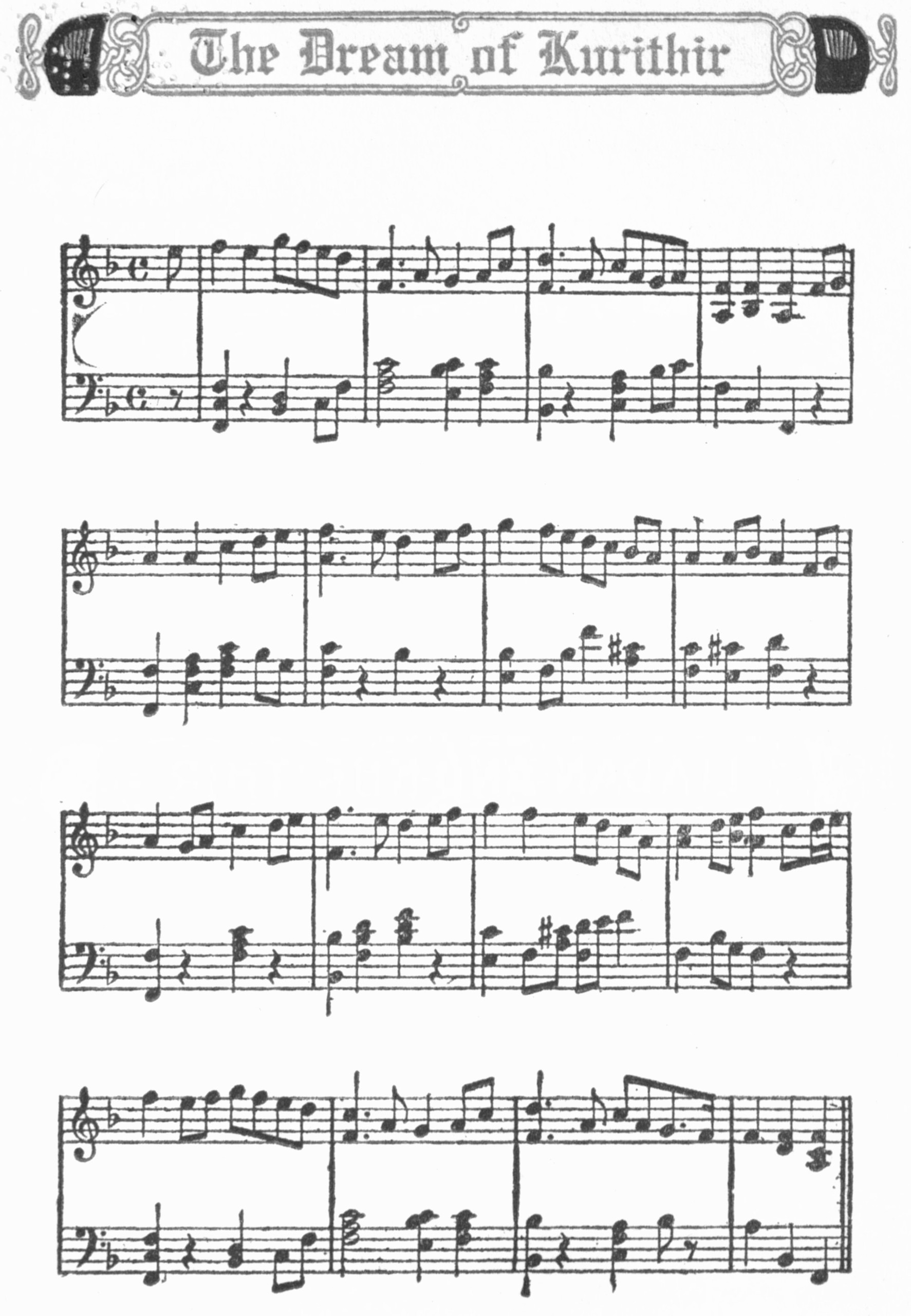
The Dream of Kurithir
Audio content is not currently supported on your device. [MusicXML]