DERVAIL NAN CIAR (continued 2)
Reading edition
He sat thinking these things, and knowing that all the beauty of all of them could not equal the beauty of Dervail. It was seemly enough that her fame might indeed grow great as she hoped, and her name be widely known among the rulers of Erinn.
So deep was his dreaming of it that he kept no count of his silence, or her curious looks.
“Of what are your thoughts when you stare past me as if there was naught between yourself and the skins on the wall?” she asked, and he roused and looked at her.
“I am thinking there was never your equal for beauty in all the wide world, Dervail,” he said simply, “neither them that are living, nor them who are gone the Way.”
“You are the same Ardan,” and her smile was strange.
“You think I fail to make note of beauty because I do not play the sighing champion for your favor,” he said, “but you read me wrong. As ward of Murtagh of Meath, and foster child of Donough of Orielle it is a pretty puzzle to me why each king was not striving to make best marriage for you with ally of his own. They shut you in high walls for life without choice of yours—and would have forgot you were living if—”
“If the Son of the Night had not made the key to come to my cell!”
“What would you say?”
“Three new moons was his work to help it to come that way,” she whispered. “He made secret prayers for that thing—to the four ways he was sending that call for the man—and Tiernan was the man to hear it, and to come there, and Tiernan was the key!”
“More like it was that Tiernan sent your master of druid lore to spy out the wealth of Clonard! You were part of that wealth, Dervail.”
“I have wonder if that be true,” she mused, and her eyes were looking sideways in thought, but the red-rose lips curved over the white little teeth of her, and the blue eyes had laughing pride.
“Even if it be so, the rule of Tiernan is over with that man, and mine is the rule,” she said. “He pins his life to my service. Tiernan is now but a man on our chessboard. And you are wrong in one thing: Tiernan knows nothing of Duffagan’s hidden wisdom; no, Tiernan has dread of such learning, for he was born at Whitsuntide, and it was foretold that by a man and a woman of druid craft would his downfall be if he followed their steps. That is why, after every hosting, or every great killing he makes faithful pilgrimage to the shrine of Phadraig. Great and rich gifts he will be leaving there to prove he is christian surely. No—Ardan, Tiernan of Breffni has fear, and has horror of all ‘Old Wisdom,’ and the life of Mac Knea would go out like a rushlight in the wind if Tiernan knew.”
“And you! Is there no fear on you?”
“At first there was fear—and great fear—but not now. The strength of the stars is with us, and that lifts and bears me above the fear. The ‘Old Wisdom’ has made me Queen of Breffni and that, Ardan, is my first move in the game, and it is a great game.”
“If someone should be telling Tiernan O’Ruarc?”
“I would kill that one, Ardan, and you alone have my secret.”
“Suppose I tell it to Diarmod?”
She looked at him, and thought a bit and laughed in silence.
“That would be favor to me,” she decided. “He has no love for me—yet; though he has much thought of me. That telling would give him more thought, for I will spend one secret night on Tara with the man whose name will go down the centuries with mine! Take that saying to Diarmod for me, Ardan; it will tell him that no pale-blooded nun has come north to rule in Breffni. Let him give dreams to a night in Tara!”
“Tara has been desolate these many generations.”
“Yet his fathers did rule there, Ardan, and it may be my own did! It is the place for Ard-Ri of Erinn, and it may be a great rule will yet be built on its ruins.”
“It is a dream, Dervail.”
“Duffagan is saying all great things of life have been grown from dreams, and that the moon and the stars govern our dreams.”
“I would see this priest of the forbidden ere I journey south, and tomorrow is the latest I may linger. It is no wish of mine to see Tiernan of Breffni, whose plunder is sacred things of altars.”
“Yet are you loyal to Diarmod.”
“What then? Diarmod gives endless wealth to holy houses. His own gold has built monasteries and churches for the glory of saints.”
“Ardan,” said Dervail, gently smiling, “all this is truth, yet there are other truths of him; when a lord of the south refused his daughter to Diarmod in the days of Diarmod’s youth, he gathered spears and took her with the veil and the vows of a nun on her! In amorous fellowship she was held in his castle and wedded there to a lord of his choosing. That is the custom of a king who has power, Ardan! He takes what he wants! I hear much of the power of Diarmod of Leinster. He has their hate, but their tales are tales of praise to me, for they tell of his strength.”
“Their hate may build untruths against him. When was this ravaging?”
“In Kildare, and her name was Dhira. Her house was the house of Cahsadhe, and one hundred and seventy lives were sent back to God in her capture. She lived a hidden woman after that time, but the story could not be hidden. That was before your birth, or mine, Ardan.”
“Dall Clairineach surely had knowing of that if it was a true thing, Dervail, yet yours is the first word of it I am hearing.”
“It is not for nothing Diarmod founds monasteries and religious houses! You have been bred in them, Ardan, and it is a place for holding secret things.”
Kauth slipped through the arras to tell them the cocks were crowing and the old day was gone. She looked strangely at Ardan, and to Dervail, when alone, she said the youth had much of beauty, too much for such distance of converse as was his custom.
“True enough,” said Dervail, unbraiding the pearls in her hair. “But there are other men for other uses, and this one has such honestness he would be useless to me except in his own spirit. Because I tell him much, he thinks I tell him all; and in his prayers my name will not be forgotten.”


Kauth, who had been lay sister of Clonard, was given higher place than the place of a serving-woman in the castle of O’Ruarc, and her dress held three colors. She rode abroad with Dervail when the days were fine, and ever stood between when man or woman made approach to the hall of the queen.
Thus she rode obedient with the glad riders of the springtime in the forest, and with adroitness found way to lose herself with the queen and Ardan, and all three rode in the edge of the great wood, and looked out on the moor where women with their young were gathering gorse bloom and marsh marigold to keep luck in the house when hung over the door on May Eve. Others were plucking primrose for the doorstep, and youths were seen bearing holly and rowan and a young tree of the yew for the circle dance of the many stars around the Still Star of the north.
“It would seem a strange nightfall to be out in the wilderness,” said Ardan. “All christians are together elsewhere on the eve of Beltain.”
“Duffagan Mac Knea gives me word that the prayers are the same, and only the difference is that saints’ worship is given instead of druid. The dance does not change, and the harp music does not change, and the faith does not change. I have spoken at every chance with these people concerning all things, and not yet has Duffagan told me anything not of easy proof.”
“But the castle cleric, Cineath, has he no reproof?”
“He knows Duffagan only as student and scribe, who has gone into the foreign world to the shores of the Nile, and tells no cleric of the deeper things learned there.”
They had reached a hill of three circles, and Kauth, who rode apart, came close and slipt from her horse.
“No animal must press foot up above,” she said. “So said Duffagan to me. Since the end of yesterday has he been here, and fasting. It is new moon, and Beltain.”
Dervail sat on her white horse and looked up at the steep sides of the hill, and looked beside her at a huge square stone, pierced, and once rudely carven, but now covered with lichen gray and green and russet. It was high as her own head and she on the back of the horse. Other stones of the same bigness were seen as if standing guard around the circle of a great earth temple.
“There were great men in the world when that thing was done,” she said. “It was not two or three people who were coming here then to take note of the sky and the clouds over the new moon.”
Ardan said no word. He saw Kauth take from under her cloak a white pigeon wound about with white and saffron bands. She placed it in the hands of Dervail and pointed upward.
“Not empty-handed must you go there,” she said. “Pluck a rowan or a holly branch for the hand of your friend. I have my happiness in lack of knowledge, and will be your guard of the horse below.”
A dim path went up through the wood clothing the steep, and at the first terrace they saw other tall stones like sentinels circling the hill. Ardan felt as if he had passed some strange dread portal into an ancient life; far above he saw that which he had heard of in Gaul but never dreamed to see in Erinn.
It was a temple in the open with the sky for roof. Great squared pillars arose in a circle, and to the east a sanctuary was made by a huge slab overhead and two uprights on either side. An altar was there on a raised floor of stone, and Duffagan the silent, in white robe and saffron bands, stood there watching the sinking sun, and striking flint on flint craftily where the silken strands of the wild flax made tinder.
A tiny spiral of smoke curled and drifted along the stone slab above him, and the two at the edge of the circle stood still and spoke no word.
A curious hoop of hazel wands was beside the altar, and two balls suspended at either side—one of yellow, one white; twigs of rowan were there, and twigs of yew.
The priest lifted the hoop and whirled it sunwise through the smoke, and Ardan knew it was symbol of sun and moon circling thus through the smoke of the earth altar.
As the last fire of the sun went beyond the great sea of mystery, the blaze of the temple leaped up—it was as if stolen out of the western sky!
Dervail thrust spray of holly into the hand of Ardan, and went forward with her offering.
Ardan could hear the low murmur of a prayer or incantation as water from a shallow cup in the stone was sprinkled in a circle about the slender blaze.
Sun and Sky, Moon and Earth, Fire and Water, Living Green!
As the priest lifted his eyes, Dervail went forward with her strange offering. Without fear she walked, yet with a look of question. And Ardan knew it was for the first time.
“As Life I make my offer,” said Dervail.
“As Life I give it again to the elements by which life endures.”
The voice of the man had a sweet singing note in it by which Ardan was won in surprise. He had expected roughness or harshness in an un-christian priest, yet Duffagan, who was also “Son of the Night,” was gentle beyond belief.
So amazed was he at this that he scarce noted the firm, quick stroke of the flint knife until the wings fluttered once, and then were held close and steady while the blood trickled from the slit throat to the altar where the fire was.
Dervail stood, serene, yet pale of face, for it was a place of curious imaginings. Ardan saw her cast quick look over her shoulder, and knew that, like him, she felt the movement, or the very breathing of a multitude circling that high place of ancient mysteries. Once he thought he heard the sound of shrill singing far off, to the tramp of thousands of feet, but in another moment he knew it was a distant shepherd’s pipe, and the wind hurtling through the forest below.
Wind caught the flame and blew it against the hazel hoop of the symbols. Dervail led Ardan forward.
“Once I was to come to this place where you read the stars, Duffagan,” she said. “I am here to keep faith, and I bring my one friend who makes offer beside me.”
Ardan’s hand held out the branch of holly, and Duffagan stripped the leaves, and let them fall one by one on the blaze. His watching of each new flame was curious. He did not speak until there were left only red embers of the twigs.
“Good it is that your soul is strong in faith, O Queen,” spoke the strange, gentle, even voice. “The trial times of life will call for much strength of yours, and it is well to prove faiths. I have fasted and prayed here, and have read the sky at this new time of the moon, but this is not a moon in which change will come to you. It is a moon for patience. Your friend who has come as a new star in your sky is safest if his going is soon. There are watchful eyes in the head of the cleric of Breffni. Take you leave as if careless of time, but ride for life when you have turned a hill!”
“Cineath the cleric?” mused Dervail. “He is a ferret for Tiernan. I will provide for you extra horse on the way, Ardan.”
Ardan gave curious glances to the man whose words she heeded, and made promise to act on. Dark he was, as his name denoted—dark, and small, and gentle—and his dark eyes had a strange, withdrawn look as if looking at the two mortals, yet listening to unseen things!
“The Great Bear of the stars points again to the east at fall of night,” he said. “It is the mid-sign between heat and cold, and is the time for searching. The old learning has been lost for the reason that no royal protector dare stand against the craft of the saints and their followers. But many, Dervail, will have your name in their speech, and you will cause much wonder in the minds of many. That is a thing I read in all castings for you, and it may come to pass that you will be the royal one who dares openly sanction that ancient hidden wisdom to which each simple heart makes secret prayer.”
“With aid from you, and guided by the powers unseen, I have brought here in secret my vow offering,” said Dervail. “That is my pledge—a fair white pledge—not to go backward on the road we are walking. In one year—two years—a thousand men and women will face sunwise about the circle where we alone stand now. You will be the honored priest of divinings, the thousands will give you their strength when their fear is lifted—and lifted it will be if you show me the time and the road for Tara.”
“That will come—and strife will come—and terrors. Great hostings will come, and kings will fall; but you will live through all, and your name—your name—it is a name whispered secretly now, but in days to come there will be shouting of that name—Dervail—Dervail—Dervail!”
His speech was half whispered, and he said her name as if repeating echoes of it afar off. A faint smile was on his lips and his face serene.
For the first time Ardan spoke.
“For what reason is Tara the key to any greatness when Tara itself was cursed by Ruadan the saint, and is deserted ground, and crumbling walls in our day?”
Duffagan did not at once make reply. It was as if he had drawn out of hearing. Then he came back and spoke.
“Tara even in desolation is a word of power. Images of greatness belong in that place—and some mortals see them! Tara is the mid-court of dominion, and the Ard-Ri should face the sunrise from that center. Tara is a symbol, as are these things before me symbols of the heavens and the earthly life. By symbols spirit is caught in the silence and held, breathless, for the union with knowledge. Tara holds a message for the woman or man who would rule Erinn—and the message cannot be carried to another. Each finds there that which his own soul can circle. Dervail has made record that it is the rule desired by her. My task is to study stars, and phases of the moon, and find the safe time for such journey.”
“Will he, my friend, be beside me?” asked Dervail, and Duffagan peered at her in the falling twilight.
“He will not be there. His road touches yours strangely, and a veil between! Is he of your kindred?”
“I have no kindred,” said Ardan.
“I think that is not true,” said Duffagan, “for I see you bear shadows or burdens of kindred.”
“Where do you see these things?”
“I read it in the leaves of your holly when the flame curled them into shapes before burning; if not kindred to Dervail, it is to some mortal close to Dervail.”
“We are going, Duffagan,” she said. “The dark will be coming, and the spies of Tiernan on the road. I come to the sunset of Beltain because of your prayers here, and in other days many will follow me.”
“They will,” he said. “I hear the voices of many calling your name.”
He held his hands out over her head in blessing, and made gesture of the way they should circle the altar and the path of descent. He did not look at them again, and as they passed without the great circle they looked back. He was holding at arms’ length the hoop of the hazel, and looking through it at the faint silver line of the new moon against the dark purple of the western sky.
Dervail drew near to Ardan, and laid her hand on his as if to know a mortal beside her, for red light from the sun long gone reflected itself on a cloud in midheaven and fell on Duffagan. It turned his robe and the stones about him into soft light of flame—and left a strange image.
“It is as if a furnace of fire had opened at his feet, lighting him only, and leaving all the other pillars in cold gray,” said Ardan, as he watched the light fade again.
“Strange signs follow Duffagan, or, does his thought compel them? He has fasted since set of last night’s sun, and will have no feast until tomorrow. All this he does for the craft he follows.”
“His belief is strong as though his birth had been in Phadraig’s day, and not in this,” said Ardan. “It is a strange end to my last day with you, Dervail.”
She pressed his arm and walked beside him into the shadows of the wood.
“Make me a song of this place, Ardan. A song of the old, old days when sharp edges were yet on these great stones, and this hill was saffron and white with the robes of Ancient Faith people.”
“That is far to go for a song, Dervail. I have made you songs most of my years, but this is not the place I would seek for songs of you, lest they be sad songs.”
The wife of Tiernan peered at him from under her golden mane.
“Is it fear on you, Ardan?”
“I think it is not fear, but this mystic hill is not a place to seek lightly on the eve of Beltain.”
“What could come to us?” she asked and clung to his arm. “Ardan—many times you have come close in my thoughts of old in my dreams. But the words of Duffagan of the veil between—what meant he by that? Look, Ardan, what other man would not turn warm when my warm hand touched him? Yet you are cold; what is it, Ardan? Did some veil indeed fall between at that altar? See, my hand did not touch you as we went up; yet were we more close than now, Ardan.”
“Duffagan has given you dreams and fears, and it is best not to speak of them now in this place,” he said.
“What could come to us?” she repeated.
“What could not? Is that altar jewel you wear so holy that it is strong enough to guard you in all places?”
She drew away and stared at him, and drew her robe more closely over her breast.
“Have you ‘the sight,’ Ardan? Times are when I think it. You know that great jewel of white diamond and red ruby?”
“I heard of it at Armagh. It was the wondrous star of Clonard, and strange wealth to wear riding the forest.”
She laughed at that, and shook forward the gold of her hair over her breast. They were again near to Kauth, who stood with the horses.
“Tiernan forbade that the altar jewels see the light of day in his absence,” she confessed. “But what use has a pilgrim of penitence with gems of richness?”
He did not answer, but helped her on the horse. The question of the jewel had changed the momentary love-light in her eyes, or the claim of warmth for warmth. He knew she had been touched by fear in the druid circle, and it had driven her to his arms if he would have her there.
Kauth looked at them as they came down, but had no question. Though drawn to Duffagan as a mate for his comfort, she had no wish to know the secret things of his dark delvings.
They rode hard and fast until in sight of the castle, and then Ardan spoke.
“I will carry your message south, Dervail, and I will go tonight instead of on the morrow. I have seen your hopes and your dark road to them.”
“And your thoughts are baleful and apart from me!”
“No. Call on me for that which I dare to serve you. But you have taken yourself out of the world we know together. It may be I cannot follow. Your strange Duffagan says there is a veil between our roads of life—and neither of us can prove that this day. But take deep thought to what you do, Dervail. Duffagan spoke of symbols, and I saw one when you offered the white-feathered thing there for the altar knife.”
“Ardan, what did you see?” and he knew she was thinking of that strange crowded feeling within the circle. The unlaid ghosts of the centuries swept to the altar at the call of blood.
“I saw the white bird of a boy’s dream of beauty in a cloister. I saw the caged bird I rode north to seek sight of, and to lead spears of aid to—and I saw a queen who offered that bird as token for ambitions of earth power. It was only a symbol, Dervail, but you placed all in one under the knife there! Your white bird was a symbol instead of the children other women, in other ages, have borne up to that druid rath for sacrifice.”
“Ardan!” and her white hands were flung out toward him. “That will be the veil between, and I will be a lone woman—terribly lone.”
“You will be queen of beauty and power, Dervail. But put your all of white dreams and of heart-love on that altar, and you will then indeed be alone in life and in death!”
She drooped there, her hair a veil about her in the gloaming, and her hands clasped over her knee.
Two kerns ran out the castle gate and stood with lights at either side to light her entrance. She straightened and tossed back her hair, and rode forward in pride.
“Yet the dream of Tara is a great dream for a life,” she said.

The harvest of the year was not yet garnered when the pearl of Dervail went south to Diarmod of Leinster by the hand of Duffagan.
It found him flushed with the victory of Moanmore against Turlough O’Brian, and strong with the thought that O’Conor of Connaught owed him and owed Meath too much of grace to lift sword or spear if the sacking of Clonard Abbey by O’Ruarc was avenged at last by the lords of Leinster.
In every secret way Diarmod and Malachi, Prince of Meath, had gathered strength and made bonds in friendship for that hosting when the time came, and the messenger of Dervail told the day O’Ruarc was going north on a hosting of his own against a rebellious sub-chief who had taken sides with O’Lochlainn of Ulster in his claims to the rule of Ard-Ri of Erinn as against Turlough O’Conor, whose word was the most weighty in all but the northlands.
The days of going and the days of return had been reckoned with care by Duffagan, and there were plenty for the task.
As to a joyous fair rode the men of the spears of Diarmod, and he, kingly in pride, in the midst of them. Years sat light on him, for the message of Dervail had brought back his youth. It had come at a time when the music of life was dulled by the discords of rule, and the watchful eyes of Conor, the heir-apparent. But the dream of the forbidden maid brought deep longings, and her secret call to him brought again the fairy songs of youth to his soul.
Fierce was the assault on Breffni, and lightning quick the conquest of the castle where Kauth had seen to it that every lock was loosed.
No woman was touched but the wife of O’Ruarc, who was bidden forth with her chosen woman, as hostage to Diarmod of Leinster.
In garb royal, clad in the cloak of seven colors, walked Dervail out from under the roof of the prince who had been her Key!
The men of Leinster and Meath gave long looks to her as she walked between the rows of them to the champing racer straining on his bit, and their eyes turned to each other, dazzled by the brilliant beauty of her. No such hostage had ever been given from prince to king in Erinn.
It was the hand of Diarmod touched her foot in the mounting, and they two were speechless as their hands met. It was the wild dream coming true, and the stars read by Duffagan had all her faith in that moment!
Kauth mounted her horse, and among her goods fastened to the saddle was the gift-cup given by hand of Diarmod in the castle of Donough. The sight of it helped Dervail to her voice.
“It has not been drunk from under that roof,” she said, “but now we will be drinking from it again—and at the well of Nemnach in Tara we will drink.”
“Your word is the word—and will be,” said Diarmod the king.


Murtagh, King of Meath, knew nought of the hosting until the spears of Leinster were north of Ath-Luain, and there was none for comfort but Donough of Orielle—and him only with the hope that Dervail would seek shelter from all men in the abbey of Mellifont.
But Malachi, Prince of Meath, rode back the richer for the plundering of Breffni, and spoke his content at the sisterhood claimed for Dervail.
“No queen so queenly in Erinn,” he made boast, “and it is a foolish thing to hide, as you have hid—her daughterhood! Take pride that she is of our line, even though a shadow is on her dam—whom no one is knowing! She will yet be queen for Diarmod—and our house remembered because of her name.”
“That has been a long, dark, fear of mine!” said Murtagh the king.
But Malachi had no knowledge of the secret held by the older man, and thought it a foolish saying.
“Meath has been made strong for us by this act,” he boasted. “The troubles of yours with the clerics will be at an end, for Diarmod has made pledges for Meath. From Clonard to the Shannon you are to be protected by hostage; from Clonard eastward to the sea I am to divide the rule. This makes stronger the border; thus much of gain already for your tie—whatever it be—with the wife of Breffni.”
Murtagh frowned at the words and walked apart, deep in thought ere he spoke.
“I wish death in peace,” he said, “and I can have that best by forgetting the tie. Pray God she makes choice of a cloister!”
But she made choice of a different thing; from the rath of Malachi, whom she now called “brother,” she went for some secret thing to the ancient rath of the Kings at Tara on Midsummer’s Eve. There went Diarmod to keep tryst with her, and drink from the well of Nemnach.
Until the morning star shone over the plain to the east they were alone on the height where his forefathers had been high kings through the centuries, and the look on his face was a look of entrancement when he came down from that place, and Dervail beside him.
“She is my mate, and no woman before has been that to me,” he said to Malachi. “The clerics must find a way for it, for she is queen to me.”
Yet, because of fear for her at the hands of Conor, the son of Mor, who was moving toward death, he took her not among his own children at Ferns, but in gorgeousness and much comfort placed her in the castle of O’Faelain in Kildare with a loyal guard, and the hostages of a princess claimed for her safety from Rhudri, lord of the castle.
Thus came the daughter of Dyveke south into the region where the Danes had their holdings under Leinster, and where her mother had cursed the land, and all kings and all clans of Erinn!
Great wealth had been taken out of Breffni by Leinster—not only her own dower wealth, but rich plunderings of Clonard, and the droves of cattle taken were the wonder of the country in crossing.
Like fire in the forest after falling of the leaves ran the story of that hosting, and of the vengeance on Breffni for the sacking of Clonard. Murtagh of Meath, and Donough of Orielle, and Duighal the prior went into prayer and deep converse over it. All things within human power had been done by them for the hiding of Dervail—yet had she ridden free and set their world afire!
But prayers of piety could do naught to stem the flood of rage unloosed by her ambitions and the pillaging of Breffni. Turlough O’Conor, the high king, took sides with O’Ruarc. Erinn was divided in the struggle. The enemies made by Diarmod in his proud domination turned their spears against him, and annihilation threatened on every side. Turlough, the High King, sent a priest to deliver the doom of Leinster unless Dervail and her dower were returned to O’Ruarc of Breffni. And troops of Breffni followed the messenger.
Diarmod raged like a wounded bull.
“My men will die for her, though they may not save her,” he said. “I cannot be the one to make choice; that is hers to make. But the army of Turlough and Breffni have crossed the Shannon.”
Rhudri of O’Faelain came riding a foaming steed, and stumbled, dazed and spent, before Diarmod.
“My plea is to serve you in some other way,” he begged. “More than my troops are needed in the guarding of Queen Dervail for you. Her name has carried on the wind to strange places, even to the cells of monks in the wilderness. One of them, old and blind, and housed for charity in my hall, made his way in secret to her chair, an evil knife under his monk’s robe, and—”
“Harm to Dervail?” thundered Diarmod, and the speaker quailed—“the lives of your household will answer!”
“No harm has come to her beyond the baleful deed done under her eyes. Her dark friend, Duffagan, gave his blood instead of hers, and wounded the monkish murderer to the death. But the dying monk said some things of horror for her ears, and all who lavished courtesies on that fair lady now flee from her! It is a mystery—like rats seeking holes, they scatter as I turn my back. To save her there in life and dignity is beyond the power of man without guards—without servants.”
“What is their fear?”
“They will not voice it. May happen it is the death of the monk, or his words not heard by me. It may be the death of Duffagan of whom they had great awe. At her feet it is he died, and her own robe red with the blood of them both, yet there was no shrinking of her and no scream.”
“She is a fitting queen, and royal her daring,” muttered Leinster, “and it is a baleful task to speak any going backward on the road for her! There is none to bear that word but one friend, and he would be loth, though constant. You, Donall, send to Glendalough for Ardan, the fosterling of Donough.”
The lord of O’Faelain put out his hand to stay the son of Diarmod.
“That message has gone on swift feet,” he said. “It was the first request of Queen Dervail.”
“Gone? And for what purpose?”
Donall the Illegitimate looked at him and gave quiet but scornful laughter.
“Ardan has a good shape and good looks,” he said.
The great hand of Diarmod smote him on the mouth, and the dirk of Diarmod was out.
Conor, the heir-apparent, caught his arm and was flung aside, and Rhudri of O’Faelain stepped between.
“Take time with you in counsel, Diarmod, ere you slay a son for sake of a hostage you will be forced to return.”
“Hostage?” said Diarmod, glowering.
“Is not that word the right word?” asked Rhudri. “It is the only one used for our queen guest in our keep. Connaught and Breffni are moving their troops to win her return, for the loss of Dervail is a greater blow to the pride of O’Ruarc than the loss of Longford and Leitrim. Is not hostage the wise word? Hostages are ever to be given back again, and in safety.”
“She was hostage of Destiny to me, and not to be given back ever in life,” said Diarmod.
Conor got Donall, with his bleeding mouth, out of the hall, and Diarmod sat steeped in gloom, turning over in his mind the attack on the life of Dervail. The word “hostage” as applied to her to cover her flight was a bitter word and—heavier than all—the thought of her going again out of his life, and she the glory of his dream of kingship over Erinn!
He arose, frowning, and with set jaws.
“No other must tell her since it must be told. I ride with you.”
Ardan was first at the castle of O’Faelain, and there was sickness on his soul for what he met in that place.
Herdsmen and kern, ploughman and smith, raged like a sea of storm about the walls of Faelain, and the name of Dervail was shouted in hate heard even at a distance. At times it would die away to a murmur, and then some wild voice would shrill aloud and the wave of sound would again roll upward—“Dervail the Shadow! Dervail of dark crafts! Dervail, the curse of Leinster!”
At sight of the scholar’s robe of Ardan and the foam-wet steed, the mob made way, and held parley.
“Be our spokesman to the white slut who is harlot of two kingdoms,” they said, “and we will let you pass safely. You are of the cells—they will let you speak. Tell the woman, and tell the governor, that none of our men will fight to hold her for Diarmod. The High King of Erinn is against him, and much of Leinster is against him. A free road to her if she takes the Breffni way; and death on her if she makes a stand in Kildare! A holy man is done to death in there by her dark comrade, and the curse of all saints is against her forever for that! Dervail! Dervail, the malediction of men!”
They let him pass, and inside the gates white, stricken faces turned to him. The guard held spear and battle-axe against a rush of the crazed household. They pointed dumbly within when he spoke the name of Dervail. Only one man of the guard led the way, and he halted at the portal of her chamber.
A horrid weeping was heard within, quivering sobbing and choking. It was the woman Kauth, who had seen Duffagan dragged into the court below, and there hung in ghastly manner against the castle wall for the killing of Kieran Dall.
But the more ghastly thing was that Kieran had not yet died. He was coming out of a swoon of pain, and was prodded by Dervail, who sat beside him, dagger in hand, and steadily, in a dull, weary tone, making question.
“You lie, monk, but I would have you damn your soul with other lie at the last breath! What reason to ban my race more than the race of another? What reason to ban my mother? Speak ere I rack your wounds! What reason—blind monk?”
“The reason—the reason—Dyveke—is—proving—itself—in you! Your hand gave death—to him—to the father of your child, ere you went to your lover Thorold, fierce Dyveke!”
“Again you lie yourself to hell! The name Dyveke is a name I never heard; I am a queen—Dervail the queen! Speak again the name of the race of the father of Dervail—speak!”
The woman Kauth never ceased the dreary, smothered keione of despairing, but neither Dervail nor the man with the black wounds gave heed. He had again sunk half out of life, and the breath of him was a hollow rattle.
“Speak, monk!” And again the prick of the knife was in his flesh. “You said it; say it again! The race of ancient kings? The branch sanctified in secret ways? It exalts me, that blood—and you shall speak! I am Dervail—I would know of that race. Speak! Speak again!”
There was a struggle, a twitching of the body, and a whisper.
“The race—dies out! Hark you! I hear wild waves on the shore; they are shouting curses—hark you! Dervail—Dervail! Dervail! The world rocks with that name of evil—
For eric in breaking - - - - A thousand years’ yoke On the bent neck - - of Erinn! A - - thousand years’ tribute of blood - - - Inis Fair!”
Then there was only the rattle—and after that no whisper, and his head lolled sideways and was pricked by the dagger to no good. And Ardan made the sign of the cross at sight of the thing she did, and caught her hand in horror.
“Dervail! He has gone to God—and was a holy man!” “He has gone to hell—and was a liar! Also he was a cheat! He died too soon, not telling all—only fragments of his hate for me. He brought death to Duffagan, and he brought that pack of wolves howling below—and without Duffagan the road I crave is a dark way for me! Is Diarmod dead that these things are?”
It had been a long night and a morning she had sat there with her blind victim, and she viewed his dead face with disdain. And from weariness she was as in a daze. She looked at the blackened dagger, and again at Kieran Dall.
“Who was he that a place was made for him at the table of a noble?” she asked. “Who was he that he was filled with hate against me in the lands of Leinster?”
“He was a prince whose name was hidden under the robe, Dervail.”
“Learn all for me and tell me! He made speech of things to madden my soul! I want Diarmod, and I want you to go to him! Hearken to the cries down there! It has been since sunrise—and ever more coming. Hearken to my name! Dervail! Dervail!”
“That is the thing prophesied by Duffagan, whom they call your ‘Dark Comrade.’ He told you in Breffni he heard the echoes of your name in countless voices on the winds.”
“That is true,” and she crouched there looking over her shoulder at him in a strange and fearful way; “but—but Ardan—this calling is in hate! They are not human beings down there—they are a hunting pack, howling for victim!”
“They are mortals, indeed, Dervail, but they are made mad by fear. An army of men are bearing shields against Leinster for the sake of you, and there is only one road of life and safety open for your feet.”
“And that road, Ardan?”
“That road is north into Breffni.”
“No! Not with Diarmod for my safety; not with his words of bondage still sounding in my ear!”
She rose to her feet as if the very words gave strength to her, and her eyes looked proud even while her face went pale at the louder screams of fierceness down below.
“Dervail, that dream has died with your Dark Comrade; such is my thought. Diarmod is no longer safety for you. His own life he may not be saving. Between you two, all Leinster and Meath can be made desolate.”
“What then? When he is triumphant, more than Leinster may be his. His vows to me were made in Tara, and who more fit than he to rule again in the ancient place of the great kings? No! The dreams did not end with Duffagan—they endure! Beside Diarmod I will ride to find them!”
Ardan turned to Kauth.
“Bring cover for the dead,” he said, “and robe your queen for a dreary journey—and a speedy one.”
Kauth covered the dead face of Kieran and then backed, sullen and defiant, against the wall.
“I have no queen in this place,” she said. “Because of her, Duffagan is beheaded, and his head on a pike below. I saw what I saw done on that holy man who is dead, and I hear what you hear below in the shoutings. I think it is truth they tell down there in their cries—she is a malediction! Death to all is her one thought, so that she walks safe—that is her thought. In thrall to her was held Tiernan and Duffagan—they were a bridge for her feet. But I am no longer in thrall to her! I have seen unholy and unlucky things, and the words of dead Kieran are a curse against Dervail for always. If you, Lord Ardan, are brave to walk beside her now—you are the only man brave enough for it.”
“Madness has fallen on her,” said Dervail. “The death of her man took her little wit.”
“Not all of it,” said Kauth, who had a most evil look with her red eyes and swollen face, and her grin of malice. “This is the one man who never took the gift of you at your offer—and he is the only one of all your lovers to brave your enemies to reach you this day of your days.”
“Go!” screamed Dervail in white fury. “Scullion, whom I lifted and strove to make human! Join your mates below ere I have you thrown to them from the battlements!”
The woman slunk to the far end of the room of shadows, but cowered there, fearful of going down to the screaming mob. Dervail turned away and covered her ears with white, jeweled hands to shut out the clamor.
“Ardan,” she whispered, “it is not all a lie she tells. They have scurried away from me like rats after a singeing! Rhudri of the Faelain has gone, and every woman of them is out of sight.”
“I know the truth of that,” he said, “for the men of the woodland are bearing brush and straw and great timbers. They will smoke you out unless you take the Breffni road with me, and the choice must be now.”
“The choice?” she muttered, and walked wildly from window to window looking down on the horrid, waiting, upturned faces. “The choice? Ardan—soul of me always! Yours was the choice for me, and mine the rebellious heart! Yours was the true vision, for the vision of Duffagan has led me here to this trap! Yours was the hand I should have held to; yours was the white way for me, Ardan, the white way of the sun; and I am at last saying it!”
She flung herself on his shoulder, and her tears of self-pity touched his hand as he took her in gentleness toward the seat by the window.
But the seat was not reached, for the reason that Diarmod and O’Faelain came into the room at that minute, and Diarmod, in a rush of rage, caught the shoulder of Dervail and flung her until she stumbled and fell across the dead body of Kieran.
“The shouts below are the shouts of the prophets,” he said, “O royal harlot, who, in making choice, passes no man by!”
Ardan turned toward the king with lifted hand of protest, and Diarmod whipped out his dirk at that moment and thrust downward a mighty blow.
“You to the white way of your choice!” he said. “You to your white road—the two of you!”
Ardan fell under the weight of the blow, and blood stained his white garment, but a strange thing chanced at his falling, for the dagger was caught and wrested from the king’s hand.
“A deep stroke, Diarmod, and an unlucky one. The youth is under misjudgment; my faith on that!” said O’Faelain, lifting Ardan and tearing open the white undergarment.
He crossed himself at what he saw there—and it was strange enough.
The slender blade of the king did not go deep for the reason that the point was bedded in a golden ring, and the ring on a golden flat chain fastened around the neck of Ardan.
O’Faelain undid the chain and handed it to Diarmod with the dagger pendant.
“God and Mary have no wish that you do murder or vengeance for this woman—and the sign of it is here,” he said.
Ardan struggled to his feet—bloodstained and pale, his hand staunching the wound.
“You have robbed me of a thing precious,” he said. “To a king and a lord of Erinn it can have little worth, but as for me, if it is my time to die, I would wish to go into death with that token.”
Diarmod looked from the gold ring on which there was graven a circled star and words in ogham and as his eyes met Ardan’s eyes, he was more blanched than Ardan, and his voice was husky and strange.
“How is this precious to you—this thing more ancient than you can know?” he asked.
“It was on the breast of my mother at her death, and more than that I do not know. Dall Clairineach bade me use it as a token to any king of Leith Mogh if danger threatened me. For myself I would not use it—but if it has virtue I will use it that Dervail the queen rides safe.”
“She will ride free,” said Diarmod in a dull, strange way. “Look, Rhudri—see my punishment.”
O’Faelain looked, and crossed himself, and lifted the hand of Ardan to his lips.
“O perfect prince—and the first born,” he said, “you are a grace, and no punishment.”
Dervail leaned forward, breathless at the words and at the look of Diarmod: she was forgotten by him and by O’Faelain. Their eyes saw only Ardan.
“You knew your mother?” asked Diarmod.
“I did not know her. Death took her. Dall Clairineach alone knew my blood, and he gave me no word. I am of his clan—so I am thinking.”
“You are of the race of Conaire Mor, and your mother was Dhira of the Dark Hair whom they forced from me and hid away—a veiled woman! None told me there was a son, but her son could be only mine. You are the heir of my youth.”
“Dhira!” said Dervail, her head thrust forward like a golden-headed serpent with its stroke of poison. “That, Ardan, was the nun he took from sanctuary—that was the thing of which I told—and the thing you would not give your faith to—and you the living witness!”
Ardan looked at Diarmod in frowning question, and it was the eyes of Diarmod that wavered and fell.
“This is between these walls,” said Ardan, and reached his hand for ring and chain. “Beyond the portal it is never to be spoke. If the token brings me fealty of a guard I will make use of it to lead this queen back in safety to her kingdom.”
“See to it, Rhudri,” said Diarmod. “All that he asks of Leinster is his. You had my love, boy, and today I am knowing that her eyes were ever looking out on me from your own.”
Ardan made no reply. He was staunching the blood with linen torn in strips by O’Faelain.
“Diarmod,” spoke Dervail, “has an old love weakened you to pleading for crumbs? Is it true that Turlough O’Conor and Tiernan of Breffni have cast the shadow of their spears against you and weakened your courage? You hear Ardan say he will guard me out of your kingdom, and you speak no word of protest? Did I then ride south beside you for only a holiday or a fair?”
“You came, a stolen queen as hostage,” said Diarmod, “that is the tale to tell. The hours are past for words of that: you must go with the prince if you would keep life in you; the spears of two armies are already across our border to force your return to Breffni. I will have vengeance for the loss of you but that will be on another day—on this one there is only flight in all haste for you.”
Thus he spoke, but his eyes were on Ardan and she saw it.
“You are not Diarmod the king this day,” she said. “You are only a man in a trance who has the looks of Diarmod. This dead monk had devil’s words of you, and of me. He called me ‘Dyveke the Dove’ and said you were under geis to hold no white birds under snare. He had lies of old magic, and a curse for me in all of them. Are you knowing that baleful rune he mouthed? Know you that he met his death striving to do murder on me?”
“It is known, and it is a sorrow,” said Diarmod, “and his is the first death of the many ere the end comes; thus has his life paid for his prophecy. Ulster will join me to war against Turlough and O’Ruarc; in another year Leinster will have allies and strength, and you will again ride south to rule.”
“Your lips speak,” said Dervail coldly. “You are not the king of the night on Tara.”
Rhudri returned with a frightened maid and the cloak of Dervail.
“I pledge myself to send your goods on a morrow,” he said; “it cannot be now. While the humor of the mob gives sanction to your going, is the time to go.”
The smile of Dervail was bitter and dreary as she looked at the three men. She was no longer the first thought in any mind there. Ardan the prince, and the first-born of Diarmod, was suddenly most wonderful and pleasing in the eyes of the two men. Even the disdain of Ardan gave them pride in him.
“You to have royal rule when it means naught to you!” she said, looking at him, “and I to be robbed of it when it is breath of life to me!”
“I claim no rule—nor will I,” said Ardan. “My mother died in sanctuary, and thus will I. Enough sons are in Leinster to divide the spoils. Cover well your head in the veil, for rain is falling. Give extra cloak to the maid, and I ask grace for her, and comfort if her courage lasts through the trials of the way.”
“She shall have honor that she heeds your word, and the children of her shall have honor after her, O prince,” said Rhudri O’Faelain.
It was an awkward moment and strange, as Dervail stood, veiled and gray, beside the body of Kieran, waiting to go.
“The curse came when he came,” she said, looking down on him. “It seems a thousand years past—and it was but yesternight.”
Smoke drifted up on the heavy air, and curled blue-white through the windows. Some of the mob, impatient of delays, had fired brush, and the falling rain drowned it, yet it bore its warning!
There was a lull in the shouting as the guard of the king formed without—and then the great gate of the castle opened and a horse was seen with woman’s furnishings, and a roar went up.
“Dervail! Dervail! Dervail, the accursed of Leinster!”
Dervail stooped and picked up the dagger let fall when she ceased the torture of Kieran.
“Dervail, there will be another day for us,” said Diarmod the king.
“Your lips speak, O king!” said Dervail.
She felt sullenly that the dark-eyed nun—long dead—had thrust herself between them at the end—and in a strange way she felt that the monk who had saved his last breath for curses had some way brought all this evil to be when he sunk his knife in Duffagan: that, and his words of mystic things, had changed the world for her.
He had caught her imagination and enthralled her soul by the mystic things he left in shadow, and the shadow and fear remained on her like a heavy cloak of gray.
Suddenly she turned to Ardan.
“Use your new strength—do not let the king show himself beside me. I do not choose he should hear the wild beasts and their hate of me.”
“It is their fear of you, Dervail.”
“To the blind monk the thanks for that; but do not let him come.”
So, in the gray rain, drearily falling, she rode out beside Ardan in the center of twice sixty of the king’s guard. Her name was echoed by them a thousand times with all the terms of evil they could invent or remember, and more than once a bowman sent an arrow hurtling overhead as a warning to haste.
Once she looked back, thinking to see Diarmod on the wall, but she saw only Kauth staring down over the gateway on which the head of Duffagan was spiked.
It was the first day of the deaths of the prophecy, the “thousand years’ tribute of blood,” for Dervail of the Shadow!
Many souls were sent for judgment in the slaughter done by Diarmod—and done against him in his revenges for the shame of losing her again to Breffni.
So great was the rage against her that even the castle of O’Ruarc was no safety. Widows and the children of slaughtered soldiery cried out against the curse of her beauty for which men died, and she became a secret woman in the sanctuary of Cluain-mac-noise from which great wealth went out through her hands for holy walls and holy vessels, and endless prayer.
And ever, for the rest of her life, on the sweet spring nights of Beltain, she knelt on the cold stone of the chapel floor to undo the false magic of Duffagan on the hill of the druids. He had seen truly there, yet his reading of what he saw was not true; and the proof of it was the bridge she had built for evil to cross on.
It was not that she doubted the magic of druidcraft, but it is an ill and unlucky thing to go to the old gods after the saints have rung bells against them. Even the true things are twisted after that.
Her beauty was still on her, and the dreams of Tara were not dead.
But the fear of the words of Kieran remained as the shadow of a gray ghost, sending her to frightened prayer.
The curse of the blind monk was too heavy to be cast aside even by penance, and she walked veiled and dreamed of a day when Diarmod would again be chief of victories and change the gray cloak of dread to the royal robe of seven colors.
When the word came of his solemn banishing out of Erinn by vote of the Irish nobles, she brooded, and reckoned the wealth still hers, and waited message.
When he came again, with his English allies and the curst name “Diarmod of the Foreigners” on him, her step was light with hope, for the soldiers out of England would make him king indeed over all the proud nobles who had banished him away! The dream of Tara was still a sweet, yet fearful dream.
But when the death of Diarmod was come to him in horror, and the head of Tiernan O’Ruarc was sent to England, while his body was hung by the feet on the north wall of Dublin, then again did wild rage of the Irish burn high against the name of Dervail of the Shadow.
It was sung in songs linking her ever with the hated invaders. Even through convent walls that hatred came—hatred against her and against the arch-traitor who had brought the English enemy to help win the throne of Erinn, because of her beauty and her daring dream.
In secret and in darkness, she was guarded to Mellifont and a new name given her for safety, and among the nuns she was never known to have worn the royal colors of a queen. And the dream of Tara was a gray horror—yet it had been told by Duffagan that kings who battled for her would sink in death, while she alone survived—and it was so.
But a monk whispered her name in the sunny walk of the garden one day in spring, and she looked again into the dark eyes of Ardan, who should be King of Leinster.
He held out to her a pearl and a ring she knew.
“These were to go back to you, and I made promise,” he said. “I was with him at the last, when no one else was with him.”
“Did his blessing come with them?” she asked. “It is said he died as Kieran died—cursing Dervail.”
“They should not have told you that.”
“Nay, none are telling me; it is on the air wherever the invading enemy are known and hated—Diarmod and Dervail, Dervail and Diarmod of the Foreigners! In my dreams I am hearing the curses on the two names!”
“Duffagan made such prophecy of your name and its echoes in the druid circle.”
“He did. Give the pearl to some altar and wear you the ring of your father. They are tokens of fear to me—fear of what I dared in my days of daring.”
“There are other sons to wear the ring. Mine is now the monk’s robe. I am a builder and a carver of stone. If the churches rise against the invading English, I will be a soldier to help undo the curse of Diarmod.”
“And the curse of Dervail,” she said, and wept.
He made no answer.
“Ardan,” she said, “Kieran the monk said, a thousand years’ bondage on Erinn for me, a thousand years of the yoke—the yoke on the bent neck of Erinn! You have had the true vision all our lives; you were the only true thing, Ardan. Can you read the days to come, and tell me the end of that curse? For the yoke is on Erinn, Ardan.”
“I dare not read, or make prophecy, Dervail.”
“A white road to you! The bell of vesper sounds, and it is Beltain—and a time of fear to me! Ardan, I have long had a thought unspoken. A tomb will be mine some restful night. I would that your hand had the carving of that bed. Your hand, comrade, will carve the tomb? It will be the end of the flight of the bird, Ardan.”
“I will do that: I saw the form of it when we rode out through the smoke and the furious pack there at the castle in Kildare.”
“And it will be—?”
“The circled cross—and a gray falcon there with broken, trailing wings, Dervail.”

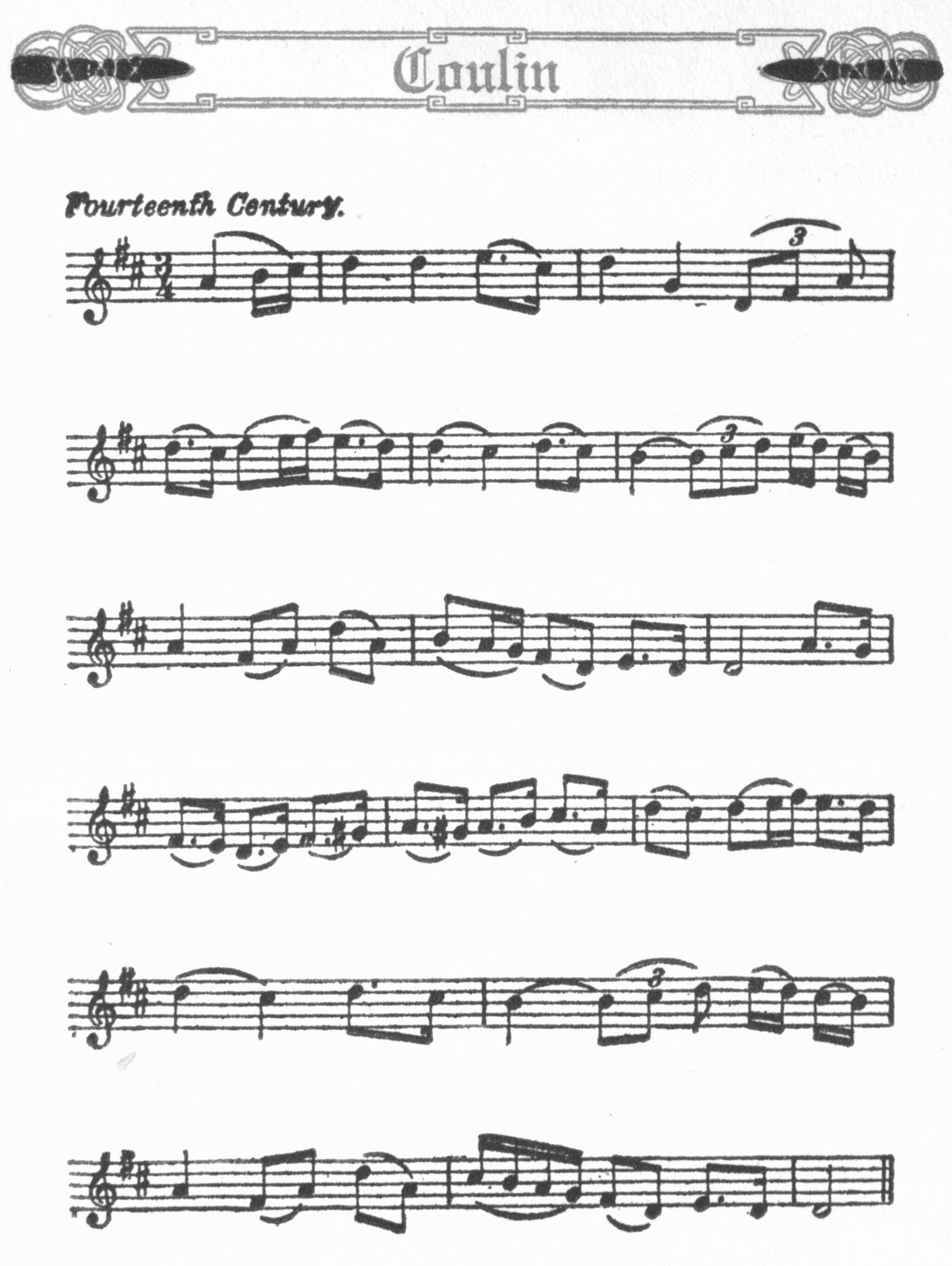
Coulin
Fourteenth Century.
Audio content is not currently supported on your device. [MusicXML]