Act 3 — CHAPTER X THE DRAMATIZATION OF NEW TESTAMENT PARABLES
Reading edition
Many of the New Testament parables present interesting problems for dramatization. The selection should be limited to those which involve dramatic situations and unity of structure. The simplicity and conciseness of words and actions in many of the parables are qualities which call forth a ready and free response from children.
Among the parables which have been worked out by the dramatic club are The Good Samaritan, The Wise and Foolish Virgins, The Great Supper, The Talents, The Prodigal Son.
In the case of these short parables the story was not told first, but the parable was read to the children directly from the Bible. There was no discussion as to the truths supposed to be taught, the emphasis being placed entirely upon the story element involved. The customs of the times and the division of the story into scenes were discussed as fully as was done with other stories. Usually one or two meetings were all that were necessary for working one of these parables into dramatic form. When it was completed, the result was not a finished product, as the words and action had been interpreted with slight variations each time. The children learned the story by heart, as it is given in the Bible. This influenced their words when they were dramatizing.
Several parables were given together at the meeting when parents and friends were invited. One child recited the Bible version just before the play was given. This feature added interest and dignity to the occasion.
The parables were given in the following order:
THE WISE AND FOOLISH VIRGINS
[Ten virgins with their lamps are waiting for the bridegroom.]
First Virgin: The bridegroom tarries; let us rest here awhile.
Other Virgins: Yea, let us rest.
[They all sit down and go to sleep.]
A Cry Without: Behold, the bridegroom cometh! Go ye out to meet him!
[All the virgins get up hurriedly. The five wise ones, with oil in their lamps, stand in readiness. The five foolish ones are in great confusion.]
First Foolish Virgin: We have no oil! Our lamps are gone out!
Second Foolish Virgin [speaking to the five wise virgins]: Give us of your oil—we have none.
First Wise Virgin: Not so, lest there be not enough for ourselves and for you. But go ye rather to them that sell, and buy for yourselves.
[The foolish virgins hasten away.]
A Cry Without: Behold, the bridegroom cometh! Go ye out to meet him!
[The Bridegroom comes in, followed by a few attendants. He walks by, and the five wise virgins follow him. They go in a door which is closed after them. The foolish virgins come hurriedly back and rush to the door. They beat on it and call out several times.]
Foolish Virgins: Lord, Lord, open unto us!
[The door opens and the Bridegroom stands there.]
Bridegroom: Depart, I know you not!
End
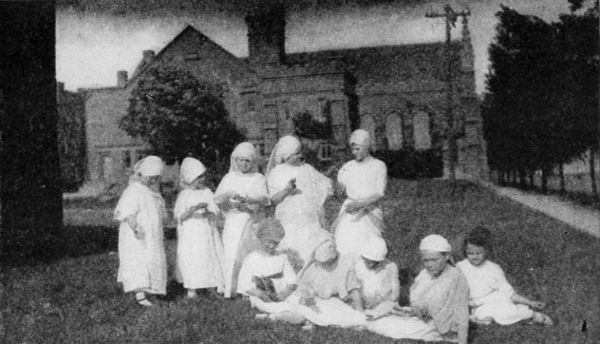
During the work on this play the question arose as to the kind of lamps that were used at the time of the story. The children looked up pictures and descriptions, and from these they made themselves lamps out of plasticene or clay. Fig. 8 is a photograph of one of the scenes taken out of doors. The lamps can be seen, also the simple costumes which the children worked out.
THE GREAT SUPPER
[The Master of the feast stands in his door and speaks to his servant.]
The Master: Go, bid my friends come to the supper, for all things are now ready!
[The servant bows; the Master goes into the house. The servant walks down the street, and as he meets people he delivers his Master's message.]
Servant [to the men as they come by]: My Master bids thee come to his feast, for all things are now ready!
Fig. 8.—The wise and foolish virgins
First Man: Say to thy Master that I have bought a piece of land and must needs go and see it. I pray thee have me excused.
[The servant bows and the man passes on. The servant delivers the message to the second man.]
Second Man: I have bought five yoke of oxen; I must go to prove them. I pray thee have me excused.
Third Man: I have married a wife, and therefore I cannot come.
[The servant goes back to his Master's house; the Master comes out to meet him.]
Servant [falls on his knees before his Master]: O sir, I did as thou commandedst, but one by one they made excuse, and would not come to thy supper. One man had just bought a piece of land and must go to see it; another had bought five yoke of oxen, and was on his way to prove them; and another had just married a wife. All begged that thou excuse them.
Master [shows great anger]: What! They that are bidden refuse to come to my feast! Go out quickly into the streets and lanes of the city, and bring in hither the maimed, and the halt, and the blind!
[The Master goes into his house, and the servant again walks down the street.]
Servant [as he meets the lame, the halt, and the blind]: Come! My Master invites you to a great supper, which is now prepared at his house!
[Each person, or group of persons, bows and thanks him with such remarks as]—
Maimed, Halt, Blind: We thank thee; we will be there. We gladly accept this invitation.
[The Master stands in the door to receive his guests as they come. When they are all in, the servant comes back to his Master.]
Servant: Lord, it is done as thou hast commanded, and yet there is room.
Master: Go out into the highways and hedges, and compel them to come in, that my house may be filled. For I say unto you that none of those men that were bidden shall taste of my supper!
[The servant bows; the Master goes in.]
End