THE DOG’S MEDICAL DICTIONARY (continued 4)
Reading edition
Poisons:
Strychnine:
Symptoms: It all depends how the agent has been administered how quickly it acts. If in a liquid form, the symptoms may commence in ten minutes, or quicker; but if it has been given in a piece of meat, it may be an hour or so before any signs appear. Then the animal becomes restless; the limbs are stiff, and the dog walks with difficulty, and with the hind legs stretched apart. Occasionally there is a violent twitching or jerk of all the muscles of the body, as if the dog had a galvanic shock, and then he suddenly falls to the ground, often in a forward direction, and in acute tetanic spasm. The limbs are extended, and as stiff as pieces of iron, the fore ones in a slightly forward direction, and the hind legs in a backward direction. The head is drawn back, and the back arched and the tail extended and stiff; the eyes protrude, the mouth firmly closed, and the pulse extremely quick. Respiration during the spasm, which lasts about half a minute or so, entirely ceases. At the end of the attack the dog gives a few heavy sighs, and then commences to pant hard. The least movement or touch, or even a noise, will cause a return of the convulsions, which continue at frequent intervals, unless the dog is relieved by some suitable antidote, or until death occurs, which generally takes place during a paroxysm. In some cases, though the acute symptoms may have been checked by treatment, the dog afterwards dies from the effect of the exhaustion.
Treatment: In all cases of poisoning, more especially when due to strychnine, prompt action is required, and means should at once be taken to make the dog disgorge what has been swallowed. An emetic that will act well and quickly must be at once administered; for this there is nothing better than a dose of hydrochlorate of apomorphia. This medicine acts in two ways: it is the quickest and surest emetic; and besides, it relieves the spasms. The dose is the twelfth of a grain for small dogs, and about a quarter of a grain for large ones, given in a teaspoonful of water; but the best way of administering it is by injecting it under the skin with a hypodermic syringe; then from three[1] to ten minims of the one in fifty solution is to be given. I always advise persons who keep a number of valuable dogs to have a solution of apomorphia by them ready for emergency, for whilst it is being obtained the patient may die, and if huntsmen would always carry a small bottle of the solution with them many a valuable hound’s life might be saved. When this medicine is not at hand, some other emetic must be given. Ordinary table salt can always be quickly procured, and from one teaspoonful[1] to a tablespoonful should be given in warm water. If the dose does not act freely, repeat it in a few minutes; or instead, give from five[1] to twenty grains of powdered ipecacuanha, or from half[1] to three grains of tartar emetic. Either of these may be shaken dry on the tongue. The dog must be made to vomit somehow; but anything like salt, requiring a quantity of water, is difficult to administer, as the dog’s mouth is often tightly clenched, and trying to open it induces paroxysm, during which time it is impossible to give anything by the mouth; and here the advantage of the subcutaneous injection of apomorphia comes in. This may also be repeated in a quarter of an hour, if the vomiting has not been free. Besides the emetic, some medicine is necessary to relieve the spasms. For this there is nothing better than chloral and bromide of potassium. From fifteen[1] grains to two scruples of each may be given in from one[1] to three tablespoonfuls of water, if the dog can be made to swallow; and half the quantity of each may be given again in twenty or thirty minutes, and repeated, if necessary, in half an hour. When the dog is unable to swallow, from two[1] to six minims of nitrite of amyl, held to the nose on a pocket-handkerchief, is useful. This may be repeated in a quarter of an hour, or chloroform may be given. Also, inject into the rectum from one[1] half to two drachms of laudanum in from one[1] to four tablespoonfuls of water, which repeat in a quarter of an hour, and again in another fifteen minutes if the paroxysms continue.
After the severe symptoms have passed, and the dog is weak and prostrate, from a quarter[1] to two teaspoonfuls of brandy added to some milk may be administered, and repeated every half hour for a time.
Arsenic:
Symptoms: The dog, shortly after taking the poison, becomes restless. Violent sickness soon commences, the vomited matter being mixed with blood. There is also acute diarrhœa, accompanied by severe straining, and a good deal of blood is often passed with the motions. The dog is extremely thirsty, has an anxious countenance, showing evident signs of great pain, and breathes heavily. There may be severe convulsions, followed by paralysis, collapse, and death.
Treatment: The vomiting at first should be encouraged by giving an emetic, as three[1] to ten drops of the one in fifty solution of apomorphia with a hypodermic syringe. If this is not at hand, give from the twelfth[1] to a quarter of a grain of the same medicine in a teaspoonful of water. Failing the apomorphia, give from five[1] to twenty grains of sulphate of zinc in a little warm water, or even salt and water. The vomiting may be kept up by getting the dog to drink warm water. Besides endeavouring to free the stomach of all the arsenic, an antidote is required to remedy the ill effect of the poison. For this there is nothing better than dialysed iron given in large doses, as from half[1] a teaspoonful to a tablespoonful every half hour until several doses have been given. This may be followed by a large dose of castor oil. About an hour afterwards some carbonate of bismuth should be given, shaken dry on the tongue, from ten[1] grains to a drachm, which may be repeated every hour or two. When there is great prostration, stimulants, as brandy, are required, and when the patient is unable to swallow or retain it in the stomach, from one[1] half to a drachm may be injected under the skin frequently. If the body is cold wrap the dog up in hot blankets, and place hot-water bottles around him. As improvement takes place, milk thickened with arrowroot, barley, or rice water may be given. If the dog appears in much pain after the acute stage has passed, small doses of laudanum may be given, and hot linseed poultices applied to the stomach.
In chronic cases of poisoning by arsenic—a not uncommon occurrence, as this is a favourite remedy for skin diseases, and too much is often given, or the medicine is given too long—the dog loses appetite and condition, becomes very weak and emaciated, frequently vomiting a white, frothy mucus as well as food.
There is often severe diarrhœa, and blood is passed with the motions. There are signs of tenderness on pressure over the region of the stomach, and excessive thirst. The membrane (conjunctiva) lining internal surface of eyelids is red and congested.
Treatment: Discontinue the use of the arsenic immediately, give tonics, as reduced iron, from one[1] to three grains made into a pill with an extract of gentian. If the sickness continues, give from three[1] to ten grains of carbonate of bismuth, shaken dry on the tongue, every three or four hours.
For food, lean raw mutton, in small quantities, every three or four hours, and milk to drink. If the latter is not retained, try it peptonised with Fairchild’s powders, which can be obtained at most chemists. When the sickness is very severe, Brand’s beef essence is recommended, given in jelly form, in small quantities frequently.
Phosphorus:
Symptoms: There is vomiting, but not to the same extent as is seen in cases of arsenic poisoning. The vomited matter, when taken into the dark, is generally luminous, and it gives off that well-known odour of phosphorus which resembles the smell of garlic; the same perfume may be detected in the breath. If the dog survives the acute stage, in the course of a few days the symptoms of jaundice may develop; there is also a tendency to hæmorrhage from the nose. Poisoning by phosphorus is often followed by convulsions, but sometimes coma; in other cases noisy delirium.
Treatment: In treating cases of poisoning by phosphorus, oils and other greasy substances must be always avoided, as it easily dissolves in anything of an oily nature, and when such occurs greater mischief happens. An emetic of sulphurate of zinc, from five[1] to twenty grains in warm water, should be given as quickly as possible, and repeated in ten minutes. If it has not acted, salt and water or ipecacuanha wine may be given instead of the zinc, when the latter cannot be obtained.
After the sickness has ceased, administer a free dose of Epsom salts, and keep the dog’s strength up with Brand’s beef-tea jelly; also give barley or rice water to drink.
Carbolic Acid:
Symptoms: The dog shows signs of great pain, and is violently sick; the lips, mouth, and tongue are white, swollen, and hard. There is great prostration and signs of collapse, the lips and ears being cold. The urine is of a dark brown colour, sometimes even black, or it may be altogether suppressed. When a fatal dose has been taken, the pupils are contracted, the dog soon becomes comatosed, breathing difficult, and death follows. It is rather characteristic of carbolic acid poisoning that the patient, a short time before death, often seems to rally, making one (even persons of experience) think that the worst has passed, and that he is going to get better. But a sudden collapse often occurs, and death takes place unexpectedly. All cases do not run this acute course; the membrane of the tongue and mouth may be badly burnt, which peels off, leaving a large raw surface, which ulcerates. The same may occur in the throat, and even in the stomach and bowels; and the dog gradually dies from exhaustion, or even blood poisoning, a week or ten days after the accident has happened.
Treatment: Give a large dose of Epsom salts at once, to be followed a few minutes afterwards by an emetic, the apomorphia being the best—from one[1] to two teaspoonfuls of one grain to two ounces of water solution. Failing this, salt and water, or from five[1] to twenty grains of sulphate of zinc in water; also give the white of an egg or olive oil to relieve the burning irritation in the stomach. If symptoms of collapse occur, give stimulants, as brandy and ether. When the patient is very bad, these are more beneficial if injected under the skin; wrap the body in hot blankets and apply hot-water bottles. The ulcers that form in the mouth, the result of the caustic action of the acid, are often very troublesome, and the discharge from them is most offensive. When such is the case, keep the parts clean by sponging them frequently with a saturated solution of chlorate of potash.
Mercury:
Symptoms: There are signs of pain, violent vomiting, accompanied by profuse purging, the evacuations being mixed with blood; the lips, tongue, and mouth are swollen and white. The patient soon shows signs of collapse. The lips and ears become deadly cold; the breathing is heavy and difficult; the secretion of urine is suppressed; coma and convulsions follow, then death occurs.
Treatment: Encourage the sickness by giving warm water; also administer large quantities of raw white of egg, flour and water and barley water. Give brandy or ether subcutaneously, if signs of collapse occur.
In cases where slow poisoning by mercury occurs, caused by the injudicious use of some of the preparations of this agent for the skin, especially that called blue ointment, I have seen this salve applied as freely all over a dog as one would use lard, with the result I need not mention. Then there is the green iodide of mercury—a favourite remedy of the late Stonehenge. This is a valuable preparation for old wounds, for chronic eczema, and other skin diseases, used sparingly, and not over a large surface. Then, again, repeated doses of calomel act very injuriously.
Symptoms: Diarrhœa, the evacuations being stained with blood; loss of appetite, sickness, great wasting; profuse flow of saliva from the mouth; gums at first red and inflamed, subsequently become ulcerated—the breath being horribly foul; a rash often appears on the skin, pustules form and break, giving forth a fœtid discharge, and the hair falls off in patches. These cases usually terminate fatally, the result of exhaustion, though occasionally a patient may be saved when the case is taken in time.
Treatment: At first, give a mild dose of castor oil, with from three[1] to ten drops of laudanum; the oil, etc., may be repeated in a couple of days. Large and frequent doses of subnitrate of bismuth should also be given. When the diarrhœa is very profuse, and there is much blood being passed, tannic acid is useful, given in the following formula:—
Recipe: The Pills:
Tannic Acid, ½ to 4 drachms.[1]
Powdered Opium, 2 to 12 grains.
Ex. cip., q.s.
Mix and divide into 12 pills.
Dose: One pill to be given every four or six hours, according to the severity of the diarrhœa.
The mouth and gums should be kept clean by being frequently sponged with a saturated solution of boracic acid.
Keep the strength up with strong beef-tea, thickened with isinglass, and each time the dog is fed, give from half[1] to a teaspoonful of port wine. Let the patient have milk with white of an egg added, or barley water to drink.
A warm bath and a free application of some soap is beneficial. This is more particularly the case when the attack is due to absorption of the poison through the application of some ointment containing a mercurial compound.
If the skin is very moist, apply to the parts freely some finely powdered Fuller’s earth.
When the dog has become convalescent, some iron or bark tonic will assist the patient to regain strength. Raw meat should also be given in small quantities five or six times a day.
Iodine and its Compounds, as Iodide of Soda or Potash, etc.:
Symptoms: A person can take ten times as much iodide of potassium as a dog, without any bad result. The tincture of iodine is often used to reduce tumors or swellings. It seldom has any beneficial results, except in cases of goitre, when it is sometimes useful; and if the application is continued too long, or the preparation is applied over too large a surface, sufficient becomes absorbed to cause severe constitutional disturbance. If a large quantity of pure iodine or the tincture is given to a dog, the mouth and tongue will be found discoloured (dark brown); there is great pain in the throat and stomach; severe purging and vomiting—the vomited matter may be yellow or brown from the iodine, or blue, if there is any starchy matter in the stomach; and the breath has that peculiar unmistakably iodine odour. Dogs very seldom, indeed, are poisoned with iodine in this way, though it is not at all an uncommon occurrence for dogs to be slowly poisoned with iodide of potassium, or in some cases by the pure iodine, through absorption into the system by the skin. The latter should never be given, and only the former in small doses, say from half[1] to two grains, and even this quantity should not be continued too long. When it is, or large doses are given, the dog soon loses flesh; he has an almost unquenchable thirst, the result of gastric catarrh. Vomiting is frequent, especially after taking a large quantity of fluid; diarrhœa may be present; the tongue is of a dark brick-red colour; saliva flows freely from the mouth, and there is no desire for food.
Treatment: In cases of acute poisoning, if the patient does not vomit freely, an emetic should be given, as from five[1] to twenty grains of sulphate of zinc in water or some ipecacuanha wine; give starch and water, also white of egg, and water in large quantities, and allow milk ad libitum.
If there is great prostration, inject ether or brandy under the skin. In cases of chronic or slow poisoning by iodide of potassium, the medicine must, of course, be instantly stopped; and diluted hydrochloric acid, from two[1] to six drops in a dessertspoonful[1] to two tablespoonfuls of water given three times a day. If this does not stop the sickness and great thirst, the subnitrate of bismuth may be tried, in doses from five[1] to twenty grains, shaken dry on the tongue, every three or four hours. The dog must not have any water to drink, as it only increases the sickness; but plenty of ice placed in a perforated dish to lick, also iced barley or rice water. As there is often great weakness in these cases, nourishing food of an easily digested nature is required—Brand’s beef essence, given in jelly form; milk peptonised, or thickened with Benger’s food. As the case improves, lean raw meat in small quantities may be allowed.
Tartar Emetic:
Symptoms: The proper dose varies from a quarter[1] of a grain to one and a half grains. The symptoms, the result of a large dose, are continued sickness, with violent retching, and often diarrhœa; great thirst; coldness of lips, ears, and limbs, with severe depression and weak pulse, difficult breathing, collapse, and death. Sometimes just before dying the patient may be much convulsed.
In cases of poisoning by tartar emetic, there is generally an absence of blood in the vomited matter and bowel evacuations, which is not the case in poisoning by arsenic, as blood is passed freely both ways.
Treatment: Give a copious draught of warm water, with the idea of washing the stomach out; this, of course, is almost immediately brought up. A few minutes afterwards give from five[1] to thirty grains of gallic acid in water, which repeat every time the dog is sick, and let the animal have barley water or white of egg beaten up in water to drink. If there is great collapse, inject brandy or ether, from fifteen[1] minims to one drachm, under the skin with a hypodermic syringe; keep the patient warm, and as quiet as possible. When large doses of tartar emetic have been given, there is very little hope of recovery.
Turpentine is rather a favourite antithelmintic, though it is not so much given for this purpose now as it used to be; but it is still a good deal used by some keepers, and when not carefully and sparingly administered often proves fatal, especially in young patients.
Symptoms: Convulsions; coma; heavy stertorous breathing, with pupils contracted. A great assistance in the diagnosing of these cases is the smell of the turpentine in the breath; the bladder is very irritable; the urine has the odour of violets, and is passed frequently.
Treatment: Give an emetic as soon as possible. The best in these cases, as in many others, is the apomorphia, from two[1] to five drops of the one in fifty solution, injected under the skin, or double the quantity poured down the throat. Failing this, give from five[1] to twenty grains of sulphate of zinc, in water, or some powdered ipecacuanha. When the effect of the emetic has passed, a full dose of sulphate of soda, from one[1] drachm to one ounce, in water, should be given. The dog may be allowed to drink milk or white of egg, with water or rice water.
When there is much pain about the abdomen, a morphia suppository inserted into the bowel gives relief.
Oxide of Zinc, either in the form of lotion, ointment, or the powder, is a household remedy, and an exceedingly good one, too, for many forms of non-contagious skin disease; but like almost everything else, when applied to the dog’s skin, he makes it his business to remove it with the tongue as quickly as possible. A small quantity does no harm; but when the ointment or lotion is applied over a large surface, and the dog licks a large quantity off, serious disturbances of the system often follow. Acute cases of this kind are not so fatal, as a rule, as chronic ones—that is, as in those cases of long-standing skin trouble when the zinc has been in daily use for some time, and the animal has been systematically licking it. In these cases the ill effects of the zinc are first noticed by the dog vomiting after food.
Symptoms: There is great thirst and loss of condition; soon the dog refuses food altogether, the sickness increases, and becomes very frequent. If the mouth is examined, the inside of the lips and tongue will be noticed extremely pale—in fact, quite blanched—and the membrane of the eyes is in a similar condition. The dog is very cold and dejected. Diarrhœa often comes on, which adds to the weakness.
Treatment: In treating these cases, the application of the oxide zinc in any form, of course, should be immediately discontinued. A purge should be given; for this, from two[1] to fifteen grains of jalapin is as good as anything. This should be repeated in two or three days. Medicine to strengthen the system and stop the sickness should be given, as the following mixture:—
Recipe: The Mixture:
Dialysed Iron, 2 to 8 minims.[1]
Solution of Arsenic (Fowler’s), ½ to 2 minims.
Bicarbonate of Soda, 3 to 10 grains.
Compound Tincture of Gentian, 5 to 20 minims.
Water, from one[1] to four teaspoonfuls. Repeat three or four times a day.
Strong beef-tea in jelly form, either home-made or Brand’s beef essence, should be given in small quantities frequently. Milk with soda water, if it does not induce vomiting, may be allowed.
When there is great prostration, stimulants, as brandy, are necessary, and should be given in small quantities frequently; and scraped lean raw meat is very beneficial in these cases, when the patient may be induced to take it.
Santonine is a most useful remedy for expelling round worms, especially in young puppies, but very often too much is given. As a result, violent convulsions are induced, which in many cases terminate fatally. Full-grown dogs will stand a good dose without any bad effects, but young puppies are particularly susceptible to its action.
Treatment: The patient should be made to vomit as quickly as possible, but this cannot be done whilst the convulsions continue. However, directly the dog is able to swallow, a dose of ipecacuanha should be administered, from two[1] to ten grains (in a little water). This may be repeated in a few minutes, if it has not acted. If the convulsions are very severe, an injection of ether and laudanum should be given—from fifteen[1] to sixty drops of the former, and from seven[1] to twenty drops of the latter diluted freely with water. The injection should be repeated in half an hour, if the symptoms continue. A warm bath is sometimes useful.
Whilst on this subject, I may mention the proper doses of this medicine. For small puppies, toys, fox-terriers, etc., when five or six weeks old, a quarter of a grain in a teaspoonful of salad oil; collies, St. Bernards, and other big puppies, half a grain in a couple of teaspoonfuls of oil. The dose may be repeated twice a week.
Lead is another poison which is occasionally the cause of death. Many dogs are poisoned by this agent, but it is only an exceptional case that terminates fatally. I have known the acetate or sugar of lead to be given in mistake for Epsom salts, and I have also known puppies and even full-grown dogs to pick up and swallow pieces of white lead (carbonate of lead). I have also seen dogs very ill through licking their feet after walking on wet paint, and I have heard it mentioned that some dogs will deliberately go and lick a place that has been newly painted. However, I can scarcely believe this; but everyone knows a dog will try to clean his coat of whatever may get on it. Dogs will sometimes get a bad attack of vomiting by remaining in a house where painting is going on, just from the smell.
Symptoms: Vomiting, colic, pain sometimes being acute; diarrhœa often at first, followed by constipation. The muscles of the stomach feel hard and rigid. There is great thirst, and in some bad cases paralysis of the hind legs and convulsions.
Treatment: Encourage the sickness by giving a dose of sulphate of zinc or ipecacuanha wine. Stimulate the action of the bowels with free doses of Epsom salts; give milk to drink, with white of egg added. If the pain is very severe, an enema of laudanum and ether will soothe. When there is great prostration, Brand’s essence may be given—a teaspoonful or so every hour.
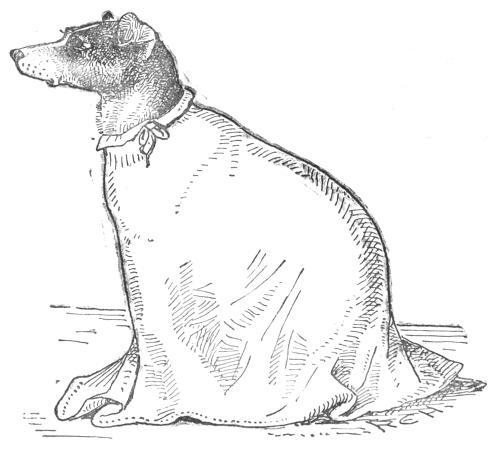
A dog in a bag which is very useful when it is necessary to keep his tongue and teeth away from a wound or when some poisonous dressing has been applied
Prepuce Orifice, Too Small:
Puppies are occasionally born with the opening in the prepuce too small, so that the penis is unable to be protruded.
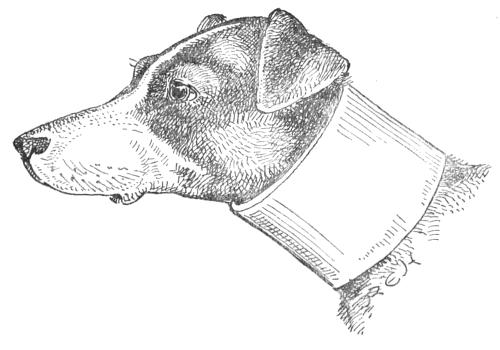
A wide leather collar to prevent a dog from turning his head round
Treatment: The difficulty is removed by a small operation—that is, by increasing the opening by making a small incision, and then sewing the skin to the mucous membrane. It is best not to do this operation until the puppy is three or four months old, and care must be taken during the healing that the wound is not licked. This is best done by making the puppy wear a wide collar, or keeping him in a sack for a few days, with the head only protruding as depicted in the illustration.
Prepuce Orifice, Too Large:
Occasionally puppies are born with the opening in the prepuce so large that the penis is always protruding.
Treatment: The opening may be partly closed by scarifying the edges of the skin, and then sewing it up. Care must be taken that the dog does not lick the part during the healing.
Prostate Gland, Enlargement of:
Symptoms: Difficulty in passing water—straining; also difficulty in passing a motion—constipation. When very large, they may be felt by manipulation of back part of abdomen (the pubic region) just in front of the thighs.
Treatment: If dog unable to urinate properly, the water must be drawn off with a small-sized catheter. The bowels must be kept in a semi-relaxed condition by mixing with the food, twice a day, from half to a dessertspoonful[1] of salad oil. Also, give twice a day, from a quarter[1] to two grains of iodide of potassium in a little water. The extract of prostate gland may be tried—dose, from half a grain to two grains.[1] An operation for enlarged prostate gland in the dog is not satisfactory, but castrating a dog suffering from this disease often has a good effect.
Prostatitis (Inflammation of Prostate Gland):
Symptoms: Increased frequency of passing water, and straining after emptying bladder, when a few drops of blood are often passed. Big dogs are more subject to the disease than small ones.
Treatment: Do not take the dog for long walks; feed principally on milk, with biscuits, bread, toast, rice, etc. Fish may also be given, but avoid meat. Give aperient medicine, castor oil is the best, also tonic medicine, as the following pills:—
Recipe:
Powdered Nux Vomica, 1 to 6 grains.[1]
Reduced Iron, 12 to 30 grains.
Extract Gentian, q.s.
Mix.
Divide into 12 pills—one to be given twice a day after food.
Pruritus Ani (Inflammation of Skin about Anus):
Symptoms: The skin around anus is red and inflamed, and very irritable; the dog draws himself along the ground on the back parts, and is also frequently trying to lick himself.
This condition is often associated with a swollen and congested state of the anal glands.
Treatment: Try the ointment recommended for external piles, or bathe parts with following lotion—
Recipe:
Carbolic Acid, 1 drachm.
Glycerine, 2 drachms.
Water to 8 ounces.
Mix.
If the anal glands are distended, empty by squeezing. (See Anal Glands.)
In medicine, give from two[1] to fifteen grains of milk of sulphur twice a day.
In feeding, avoid much meat.
Psoriasis:
Symptoms: A dry and scaly condition of the skin, with small red spots here and there, particularly when the elbows, knees, and hocks are affected, which are the parts more often attacked.
Treatment: When the disease is spread more or less all over the dog, a dressing made of cocoanut oil six parts, and glycerine one part, well mixed together and applied all over the dog, and repeated once in four days, is beneficial. The dressing should be washed off after a week, using sulphur soap, and then the dog should have two or three times a week, for a time, a sulphur bath made by dissolving one ounce of sulphurated potash in a pail of tepid water.
When the disease affects only the joints, apply the following dressing twice a day:—
Recipe:
Methylated Spirits, } Of each one ounce.
Green Soft Soap, }
Oil of Cade, }
Mix.
Give the dog worm medicine, also a course of arsenic, from one[1] to six drops of liquor arsenicalis P. B. in water twice a day after food. The dose may be doubled a week later. This medicine should be continued for about a fortnight, but should it cause vomiting, diarrhœa, or loss of appetite, it is at once to be discontinued.
Puerperal Fever:
Symptoms: It may occur three or four days after pupping—commences with an attack of shivering—the temperature rises probably to 105, the pulse is quiet and weak. There is great thirst and vomiting, and perhaps diarrhœa. The discharge from vagina ceases, and the secretion of milk stops. The abdomen is distended and painful.
Treatment: Give a large dose of salicylate of quinine, from two[1] to ten grains made into a pill, or put in a cachet. Apply hot linseed-meal poultices to abdomen. Well wash the womb out with a solution of perchloride of mercury, 1 in 2,000—that is, one grain to about every four ounces of warm water. Of this solution use about two ounces for a small bitch, and half a pint for a large one. About two minutes after injecting the solution of mercury, wash the womb well out with plain warm water, using from four[1] ounces to a pint. The syringing may be repeated in twelve hours. When the mercury is not at hand, a saturated solution of boracic acid may be used, or one of permanganate of potash, one grain to each ounce of water.
To wash the womb out properly, a clean Higson’s enema syringe should be used, and the long insertion tube well vaselined passed up the passage as far as it will go.
Diet: Should be light, as milk with Vichy water to drink, also Brand’s beef essence, or Valentine’s meat juice, given with Vichy water.
If the vomiting is very troublesome, give the mixture recommended for gastritis, and keep up the bitch’s strength with nutritive enemas and peptonised meat suppositories.
Pulse:
A dog’s pulse varies in the number of beats per minute, according to his size. The number is less in a big dog than a small one. A St. Bernard’s pulse, for instance, beats about 70 times per minute, and a small dog’s, say, like a toy terrier, 100 times per minute, and a dog’s pulse is often intermittent in its beat.
In disease, the pulse, in most cases, is increased in frequency. It might be for big dogs 100 to 120, and for small dogs from 120 to 150 or 160 times a minute.
In some instances, as in some cases of heart disease, or in pneumonia, when the heart is affected, the pulse is very slow indeed. A big dog may go down to 50, and a small dog to 70. A very slow pulse is more serious than a fast one. In such cases, some such mixture as the following should be given:—
Recipe:
Tincture Digitalis, 2 drachms.
Tincture Nux Vomica, 1 drachm.
Simple Syrup, 1 ounce.
Water to 6 ounces.
Doses: From one teaspoonful to a tablespoonful[1] every four or six hours.
The pulse not only varies in number of beats per minute during illness, but also in character—for instance, after great exertion the pulse is full and fast, and in cases of internal inflammation it is small and wiry as well as fast.
In some diseases of the nervous system the pulse is very slow. During a prolonged illness, or after a severe illness, the pulse can scarcely be felt; it is then said to be weak, and stimulants and tonics are indicated.
The pulse is always quicker in young dogs and old ones than it is in those in the prime of life. The best place for taking the heart-beats or pulse is at the femoral artery, just as it crosses the inside of the thigh-bone.
Pupping:
To discover whether a bitch is in pup, let her be placed upon a table, and her fears or excitability banished by caresses; then lay her upon her side, and with the fingers gently manipulate the abdomen. If the womb is impregnated, the person, directing his attention first to the situation the uterus occupies, near to the rim of the pelvis, and inferior to the rectum, will there detect round smooth bodies, like little eggs. These may not be perceptible if the bladder be loaded; but if the catheter be employed to draw off the urine, they will surely be felt. If the rectum be full of faeces, it serves as an admirable guide to the position of the uterus, though he who is acquainted with anatomy needs no such assistance. Some globular substance being detected, the fingers are advanced; and if more than one pup be conceived, another similar to it will speedily impinge upon the touch; then another, and so on, until the whole of the promised family have been thus announced. The last is the most difficult to discover; for should there be more than two or three, it may, and will generally, occupy the extremity of a horn, and in that situation may escape observation. There are to the womb of this animal a pair of horns, which are long, and extend to the region of the kidneys. Both cannot be traced at the same time, and there is a chance of the two being confounded; therefore it is not well to be positive as to the precise number of young the bitch will bring forth. And I never presume to speak confidently upon the point; for though, in the majority of cases, my opinion may have been corroborated, nevertheless I have often known a pup more than I supposed the uterus contained to have been delivered. From the end of the fourth week, the litter, as it were, go away, or are lost; but when the sixth week arrives, the contents of the abdomen may be plainly detected; and if the bitch be taken upon the lap, and her belly supported with the hand, they at this period will be felt to move, and the motion even of their limbs is clearly recognised.
Milk appears in the teats about the middle of the eighth week, and sometimes sooner, and occasionally later.
For a bitch to be in proper condition at the time of parturition, she requires some attention during pregnancy. One or two hours’ walking exercise daily is essential during the early part of the time; but when the bitch becomes very heavy, as is often the case the last fortnight, then half an hour slowly walking is enough, unless the bitch is inclined to take more. During the first five weeks it is not necessary to make any alteration in the diet. If the bitch is in the habit of being fed only once a day, so let it continue; but after the time mentioned, food should be given twice a day, and should be of good nourishing kind, as soaked biscuits with a little under-cooked meat—three parts of the former to one of the latter. When she is delicate, and has a poor appetite, extra meat may be allowed; and in some cases, especially towards the last, if she is disinclined to take her ordinary food, meat, raw or cooked, alone may be given two or three times a day.
Spratt’s small special cod-liver oil biscuits, which contain 10 per cent. of the oil, make first-class food for bitches of poor condition. They may be given dry, also broken up small, soaked in soup, and mixed with meat in the proportion as previously stated. The principal thing is to feed regularly, and not to give too much at a time.
Bitches when in pup are best without a lot of medicine; but I consider it a good plan, about three weeks after service, and when all signs of heat have quite disappeared, to give a vermifuge, not with the idea of preventing the puppies becoming infested with worms, as that is impossible, before birth; but no bitch can be in good health, which is so essential at this time, if the bowels are full of worms. I do not advise a strong drastic dose, but one of medium strength, and it should be repeated the following week. It is very important to examine the bitch’s skin from time to time, so as to check any cutaneous disorder early; for if the bitch has any skin disease when the puppies are born, they are sure to contract it, and nothing thwarts their growth more than an irritable skin, for it prevents rest, when plenty of sleep is so essential for a puppy’s welfare; so if there are symptoms of mange, have her at once dressed all over with some mild preparation like sulphur ointment made with vaseline, which should be repeated two or three times in the course of a week, and after a few days washed off. In case of eczema, a bath in Pearson’s fluid diluted eighty times with water, or after the seventh week sponging all over with a solution of the same, will in most cases be all that is necessary. In some cases of eczema, at these times a little cooling medicine is useful, as an occasional dose of syrup of buckthorn and castor oil, or a small dose every day for a week of some alterative powders, as the following:
Cream of Tartar, } Equal parts.
Powdered Magnesia, }
Bicarbonate of Potash, }
Milk of Sulphur, }
Dose: From sufficient to cover a sixpence to a dessertspoonful.[1]
If a bitch has been in the habit of being regularly washed, this may be continued as usual, when the heat has passed, until about the seventh week, when it is not advisable to put the bitch right into warm water in case abortion might be induced.
While on the subject of abortion, I may mention that a bitch ought never to be sent on a journey by train during the last two weeks, for a shaking of this kind is more likely to cause premature confinement than anything else I know.
It is very important that the bitch should be quite clean at the time of parturition, and it is a good plan to wash the stomach and breast, also the vulva and surrounding parts, with a strong warm solution of Pearson’s fluid, about one in forty. Some treatment of this kind is more likely to prevent young puppies from having worms soon after birth than anything else. It is a common custom, and I think a very good one, to give a bitch in pup a dose of castor oil about three days before she is due. In many cases, especially when the bitch is a bit gross, it is advisable to give a dose of the oil a week before her time is up, and again in three or four days.
Bitches, as a rule, have their puppies on the sixty-second or sixty-third day, the day of service being included; but some will pup on the sixtieth day, or even a day or so earlier, and the puppies may be fairly strong; but when born before the fifty-seventh day they seldom live. On the other hand, many, especially those of the larger breeds, will go two or three days over the specified time without inconvenience; and I have known one to go as long as seventy-three days, and then to have a litter of strong, healthy puppies, but this does not often occur when there is a large litter.
One who is accustomed to dogs can tell within a few hours when a bitch is going to pup. There is disinclination for food, the vulva is swollen, and there is a discharge of thick mucus from the vagina, and, as a rule, she seeks a quiet spot to be alone.
At this time, after making the bitch comfortable with a nice clean straw bed—there is nothing better than straw, which should not be supplied too plentifully—she should be left by herself for a time. As the labour pains come on, she becomes restless, and pants; is frequently looking around, and licking herself. When such occurs, labour in earnest may be considered to have commenced; and if all is going well, one or more puppies should be born in the course of an hour or so. If after two hours there are no signs of a puppy appearing, it is well to examine the bitch; but if a bladder (fœtal membrane) is protruding from the vagina, there is no hurry to interfere, as this is a sign, as a rule, that matters are taking a normal course, and that more time is required; and the bitch, after being offered some milk, may be left again for another hour or two. Bitches at their first pupping should always be given more time than one which has had two or three litters, and this is more especially the case when she is three or four years old, or even older. I have known bitches when over nine years of age to have a litter of puppies for the first time, and, as may be expected, it often goes very hard with them, though with care they may live through it. Once the membrane protrudes, which the bitch generally ruptures by biting, the first puppy, if everything is all right, soon makes its appearance; and, as a rule, by the time the cord is divided, and she has attended to the young arrival’s toilet, another youngster is nearly born, and in the course of an hour the bitch may have given birth to three or four puppies; then, perhaps, if there are any more, there is an interval of two or three hours, which gives the bitch time to recover her strength, and take some refreshment in the way of thin oatmeal gruel or plain milk, and in most cases this is quite sufficient; but if there are signs of exhaustion, some Brand’s essence, or the white of an egg beaten up with milk, and a small quantity of brandy, may be given. After this, in cases of the smaller breeds, when the average number is four or five, the last of the puppies soon makes its appearance; this also refers to terriers, though they may have five or six, or even more puppies, as they are such strong dogs compared to toy spaniels, pugs, etc.
Very often a bitch will have all her puppies but one with the greatest ease (for it is seldom a bitch cries out whilst pupping after the first litter), when the pains seem to cease altogether, and do not return for many hours afterwards, perhaps not until the next day. In such cases, a dose of some medicine to excite the action of the uterus is necessary, but this will be dealt with later on.
Bitches of the larger breeds which have big litters of twelve, fourteen, sixteen, and more puppies, invariably take all day, even in normal cases; but after twelve some assistance and great care are required, for by this time the mother is getting exhausted. Good gruel should be offered, and about every three hours the white of an egg beaten up with a teacupful of milk and a dessertspoonful of brandy should be given.
Bitches that have had their puppies easily do not require much food during the next twenty-four hours, the fœtal envelopes, which are always eaten, affording a certain amount of nourishment; therefore, if some thin oatmeal gruel or Benger’s food made with milk be offered, it is sufficient. Plain milk may also be given to drink. The same diet does for the following two days, with the addition of some soup or sheep’s-head broth with bread or crushed dog biscuits, a small quantity twice a day. After the third day a more liberal diet may be allowed; boiled fish, as fresh haddock, with bread, also the meat from a sheep’s head, and bread or broken biscuit soaked soft in the soup. By degrees the quantity and quality of the food may be increased, for after a fortnight, when there is a large litter, a good deal of nourishment is required, if the bitch is to be kept strong and the puppies fat.
Very often, two or three days after parturition, the bitch has diarrhœa. As a rule, it is not severe, and passes off in the course of twenty-four hours. Should it continue after this time, a dose of castor oil and laudanum may be given. In small bitches, as toys, a teaspoonful of the oil with three drops of laudanum; for terriers, a dessertspoonful of the former and five drops of the latter; collies, etc., a tablespoonful, and ten drops of tincture of opium; and large bitches, two tablespoonfuls and ten drops. The dose should be repeated in six hours. If the diarrhœa continues after the oil has worked off, from five[1] to twenty grains of bismuth may be given three or four times a day, shaken dry on the tongue. During the diarrhœa, the milk should be thickened with arrowroot, and the soup be given with rice instead of bread or biscuit.
Some bitches, when due to pup, and though in good health and fairly strong, have not sufficient labour pains to bring forth their young; the water-bag may break and there is the usual green-coloured discharge, but the throes are so slight as to be of little use. Of course, once the fœtal membrane is broken, and the fluid escapes, the puppy soon dies if not born; therefore, it is necessary to use means to stimulate the contraction of the womb—in other words, to induce labour pains—and for this there is nothing better than ergotine, which is a strong extract of ergot of rye. Until recently the latter was used, the seed being coarsely powdered, and from ten[1] to sixty grains administered in warm milk or coffee, the dose being repeated every two or three hours until several had been given. There are other preparations of ergot, as the ammoniated liquid extract, and ammoniated tincture. The former is the next best preparation to ergotine, and should be used when ergotine cannot be obtained. The dose varies from ten minims to one drachm,[1] which may be given with water, or in a little milk, and repeated every two hours until the pains have been induced, or six doses given; but these preparations are not so good as ergotine, for not only does the latter act with more certainty, but there is another advantage in its administration, and that is, it may be injected under the skin, and consequently the stomach is not irritated and perhaps the bitch made sick, which often happens when these medicines are given by the mouth. The dose of ergotine is from one[1] to three grains, given in from ten[1] to forty minims of brandy. There is no advantage, as is often recommended, in injecting it deeply into the muscles in the region of the pelvis, as it is quite sufficient to introduce it just under the skin. I generally do so behind one of the shoulders on the side of the chest, where the skin is loose. The action of the drug, when given in this way, may generally be observed within a quarter of an hour, and the dose, if necessary, may be repeated in a couple of hours.
It is not an uncommon occurrence, as before observed, in cases of parturition, for bitches that have large litters, to give birth to all the puppies quickly, and with a certain amount of ease, until the last, and in some instances two puppies. Then the pain seems to cease, and the bitch appears fairly comfortable for some hours, and it is often thought by the attendant she has finished, and there is no further cause for anxiety; but in about twelve hours, or perhaps the next day, the bitch becomes restless again, refuses her food, and is inclined to neglect her pups, and is constantly wanting to go out, and after passing water, sits and strains for a few moments. When these symptoms are noticed, the bitch should be immediately examined, and if it is found there are more puppies, and that the foremost one is not unnaturally situated, a dose of ergotine should be at once given, and some nourishment also administered, as milk and brandy, or Brand’s beef essence, or even a little scraped lean raw meat.
Breeders should make it a regular practice to examine a bitch when it is thought she has finished pupping, by gently manipulating the abdomen, also by passing carefully a well-oiled finger into the vagina, for it is often impossible to tell for certain, without examination, if there is only one left, more especially in cases when the mother has had a large litter. Many a valuable bitch is lost through this not being regularly done. Because the pups, when left behind, if not already dead, die, and quickly decompose and set up blood-poisoning, which invariably terminates fatally within twenty-four hours.
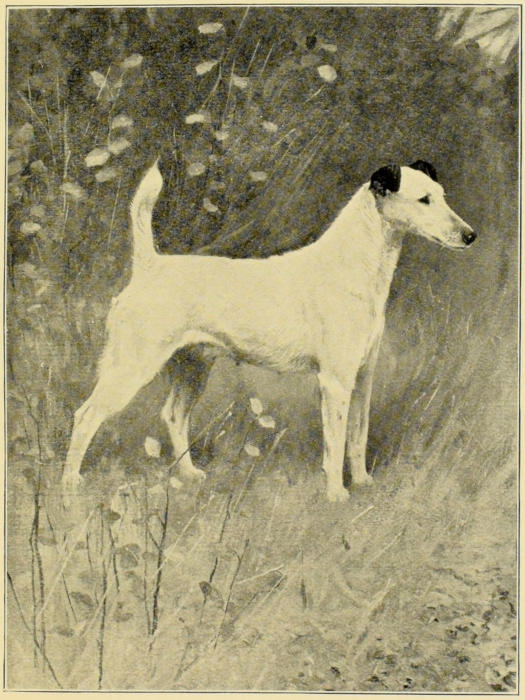
Smooth Fox Terrier, Champion Donna Fortuna, K.C.S.B. 869 b. Sire Ch. Dominie, K.C.S.B. 24,044, Dam Ch. Dame Fortune K.C.S.B. 38,153. Described by Mr. J. C. Tinne as “absolutely the best Fox Terrier of all time.” The property of Mr. Francis Redmond, Whetstone House, Totteridge, N.
[face p. 248.
Considering the number of young a bitch has, and the variety of size the puppies often are, I think it is wonderful they get through their trouble as well as they do, more especially when it is taken into consideration the artificial life dogs generally live. There are some breeds which are always a source of anxiety to their owners, especially the toys, as spaniels and griffons, which have frequently a habit of throwing back to the size of their ancestors, which were no doubt much larger dogs than the modern specimens. The same remarks refer to Yorkshire terriers as well as to the other small breeds, but the fault very often lies with the owner in trying to breed from very small bitches. Bull-bitches, again, often have difficulty in bringing their puppies into the world, and this is in a great measure due to the modern dogs having such large heads.
In addition to the difficulty mentioned, this breed is no doubt of a naturally weak constitution, and their organs of reproduction are very liable to disease. Of course there are many of what one may call accidental cases, as when a fox-terrier or dachshund has puppies by a dog the size of a collie. I have known many cases of this kind, and, as may be expected, the bitch has trouble in giving birth to such youngsters, though sometimes they are born without any difficulty at all. Then there are other cases of difficult parturition, due to stricture of the vaginal passage, the result of injury to the pelvic bones, as when a bitch has been run over across the hips, or as the result of congenital deformity of these parts. There is nothing to be done in these cases but to have the Cæsarean operation performed, when some of the puppies may be saved and the bitch too, if the operation is done in good time.
There is another form of stricture of the vagina, and it is generally found just inside the vulva. It is due to a strong band of mucous membrane, which refuses to dilate as the surrounding parts do at this time, and in some cases it is so strong that one is not able to dilate it in the ordinary way; therefore, the only thing to do is to cut through it with a blunt-pointed knife (bistoury), which I generally do at the side, and always with good result.
Difficulties arise at parturition in consequence of the unnatural position of the fœtus; a puppy should come with the head first, the nose extended, and the fore legs placed one on either side of the neck. Another easy position for birth is when the hind legs come first, but in these cases, unless the puppy is delivered quickly, it dies from asphyxia.
From some unaccountable reason a fœtus frequently assumes a wrong position, which renders its birth extremely difficult. In such cases it is useless giving ecbolics or medicines to stimulate the labour pains, but means must be taken to place the puppy, if possible, in a proper position, and then a dose of ergotine is useful. Perhaps the most common malposition is when both fore legs are thrown in a backward direction, causing the shoulder to project, thus inducing a mechanical impediment to birth. These are not very troublesome cases, as a rule, for the legs, by means of a blunt-pointed round hook, may be drawn forward; if there is nothing better at hand, a long button-hook will answer the purpose.
This accomplished, the puppy should come away easily; but if the bitch is weak from long straining, it is advisable to remove the puppy entirely, especially if it is thought there are more to come. I may mention here when one has to use instruments of any kind to assist the patient, the puppy is generally in some way injured, so that if it does not die at the time, it usually does very soon after; but after all, this is of little consequence compared with the life of the mother.
In some instances the puppy presents itself at the mouth of the womb with the top of the head foremost, the nose being pressed down against the chest; if it is at all large, birth is very difficult in this position. In such cases, one should try and elevate the nose with the point of the finger; when the bitch is not a large one this is often possible, but when she is, it is necessary to employ a crotchet or crook—as mentioned before, a button-hook with a long handle does very well—and, if possible, it should be fixed in the mouth and the nose drawn up; this is rendered more easy, if one can, by means of the finger of the other hand, press the neck backwards towards the body of the bitch. It is, however, often impossible to raise the head, and the only thing to be done is to seize the neck firmly with a pair of forceps, and by traction at each time of straining, extract the puppy. Care must be taken not to injure the bitch, or inflammation, which may prove fatal, will occur.
In other cases the head may be bent in a backward direction, the front of the neck presenting. These cases, though somewhat more difficult, require similar treatment to the previous kind. When all other means have failed, the neck may be divided and the head removed by forceps; the body will then generally come away by itself.
The fœtus assumes numerous other positions besides those mentioned—as, for instance, lying transversely, the puppy’s side presenting to the mouth of the womb, and when the labour pains are strong, no amount of manipulation will put the body in a normal position. Rather than let the bitch waste her strength uselessly, the puppy should be divided or broken up by means of a sharp-cutting hook, and removed by means of forceps.
When a fore and a hind leg are presented into the vagina, the former should be pushed back into the womb, and the hind leg seized with forceps and made fast with a piece of tape. (It is easy to distinguish one leg from the other by feeling for the hock-joint in the hind limb.) When this is done, the other back leg should now be felt for, and when its position is ascertained, it should, if possible, by means of a small pair of forceps (ordinary dressing forceps answer very well for this purpose) or crotchet, be drawn into the vagina, or made fast with tape like its fellow, and then by gentle traction on both limbs the puppy is delivered.
It occasionally happens, in cases of head presentation, that the hind legs are bent forward on the body, which renders the delivery difficult, and unless the passage is large, and the pains are very strong, the bitch cannot bring forth the pup without assistance. This is best rendered by grasping the puppy across the hips with a small pair of thin-bladed parturition forceps, and gently pulling the puppy during each throe.
It frequently occurs that though a puppy may lie in a normal position, the mother is unable to give birth to it in consequence of its being too large. The nose may be just inside the vagina, and there become fixed in spite of the bitch’s straining for hours. I have seen hundreds of such cases. It is a mistake to leave the bitch in this condition too long, thinking matters will come all right, as it is wasting time and the mother’s strength; and if there are other puppies to come, she probably will not have strength either to expel them herself or help anyone who may try to assist her. In this instance, the head is so firmly fixed in the mouth of the womb that it is impossible to take hold of it with forceps, however small or thin the blades may be, but the hook of the crotchet may generally be passed into the mouth of the puppy, and by fixing it well into the palate a good hold is obtained, and the puppy drawn through the passage by main force. If care be taken, it is astonishing what amount of force may be used in promoting delivery without at all injuring the bitch, but it is best not to pull on the puppy except during the labour pains, if there are any.
It is the custom of some veterinary surgeons to give the bitch, during labour, a hot bath if the parts are not considered sufficiently relaxed, or if the pains are dull; at the proper time the tissues always become sufficiently dilated, providing the parts are in a normal state—that is, bar a stricture in the vagina, or something of the kind—and if there is any abnormal condition, a warm or hot bath, in my opinion, does more harm than good by often checking the pains.
Sometimes when the ergot fails to induce or stimulate the throes, I have applied with advantage to the abdomen an ice-bag; but what I find the best of all, when one or two subcutaneous injections of ergotine have not worked satisfactorily, is to put the bitch in some vehicle and give her a drive, and if nothing else will induce the labour pains this shaking up will do so in most cases.
The worst of all, are those cases when the bitch is due to pup, the parts are relaxed, and there are no labour pains to expel the fœta. Examined per vaginum, no puppy can be felt, and no amount of excitement of the parts by passing a cold instrument into the passage, or injections of ergot, causes contraction of the womb. If the patient seems all right, it is best to wait some hours, during which time everything should be done to try and excite contraction of the parts. If the means taken do not succeed, then there is nothing to be done except the Cæsarean operation, as it is not safe to attempt delivery with forceps or the crotchet when the puppies cannot be felt with the finger.
The best forceps for using, in my opinion, in cases of parturition, are those made by Messrs. Krohne & Sesemann, of Duke Street, Manchester Square, London. They are made after the pattern of Will’s ovariotomy forceps, of very fine hard steel; the blades are extremely thin and small, and deeply serrated, so that when a puppy is taken hold of they do not easily slip off. My crotchet was also made by the same firm, and, if care is used when working with it, it is a most valuable little instrument. When from causes due to mechanical impediment either on the part of the bitch or puppies, or from want of proper labour pains, it is impossible to obtain the birth of the puppies through the proper channel, the abdomen should be opened. If the operation is done in good time (that is, before the bitch has become weak), and proper antiseptic precautions taken, there is a chance, though the operation is a dangerous one, of saving the mother’s life. At any rate, some of the puppies can be almost certainly brought forth alive; whilst if the operation is not undertaken in these circumstances, one knows that not only the bitch but all the puppies are sure to die.
Prolapsus, or inversion of the womb or uterus, into the vagina, sometimes, but very rarely, occurs during parturition, due to very severe straining, or as the result of too much force being used to remove a puppy with forceps, or by other artificial means. Care must be taken in these cases not to mistake protrusion of the uterus for prolapsus of the vagina or a polypus. The latter may be recognised as a solid, pear-shaped body with a narrow neck, whilst a prolapsed vagina is generally a large, solid, oval body, which almost fills the vaginal canal, if it does not protrude externally. It has a broad base, and rises at the back part of the passage, just in front of the meatus or opening to the bladder. The uterus is soft, reducible, and rough, and tubular in shape, besides showing dark-coloured patches where the placenta has been attached.
After the womb has been cleansed by being sponged with a weak, tepid solution of permanganate of potash, it should, if possible, be returned by gentle pressure on the fundus of the uterus with a piece of whalebone, with the point covered with a sponge. The returning is assisted if the hind legs are raised—in fact, by the bitch being held upside down. Care must be taken not to use undue force, or the uterus may be ruptured. After the return, it is a good plan to inject a quantity of cold water into the vagina to act as an astringent.
When the protruding uterus shows signs of having been injured, or is much congested, or decomposition has set in, amputation is advisable. This is best done by drawing the part gently out and applying a strong silk ligature as high up as possible, and cutting off the free portion.
The bitch, when she has finished pupping, requires little attention beyond a change of bed and a fair supply of nutritive food. She does best when least noticed; but it is well to see that she takes sufficient exercise. On the following day she should be taken out two or three times for a few minutes to relieve herself, and every day after that she ought to be about pretty much as before. Some bitches, however, are such devoted mothers as to sacrifice health, and occasionally life itself, to enjoy the pleasure of being with their young ones. This excess of affection must be controlled, for, if not checked, it will seriously injure both parent and offspring. All animals, however, are not thus distinguished. Some bitches cannot be induced to suckle the pups they have given birth to; and others, though less frequently, will eat their progeny. The disposition to desert or destroy their young seems to prevail among the parentage of this world. In the female of the dog the maternal instinct is most powerful, but under certain conditions of the animal’s body the natural impulse seems to be perverted, and she takes the life she would else have perished to preserve.
Some persons entertain a notion that the bitch which has once devoured her litter will ever after retain the disposition. This is a false idea. On the next occasion, if properly treated—that is, if not persecuted, chastised, alarmed, and annoyed, but properly dieted—she may prove, and most likely will prove, an excellent mother, the very excitability which, when over-stimulated, induced her unnatural impulse, making her, when tranquil, the more alive to the instincts of her nature.
For the first week the bitch is, as a rule, very attentive to her family, and as it gives her pain when one is taken up, it is better not to handle the pups more than is absolutely necessary. She should be well fed; not crammed, but nourished; and she will require more food than formerly, for there are many mouths to feed through hers. The quantity of support she needs may be conjectured from the rapid growth of the pups.
A small bitch of my own had a litter of four. The mother weighed seven pounds six ounces, and between the second and fourth week the young ones daily added one ounce and a half each to their bulk. It would require some amount of milk to supply such a quantity of flesh; and we have also to remember that, during the rapid growth, the process of consolidation is simultaneously going forward. Good nourishing food, sufficient in bulk, is absolutely imperative; for if the pups be stinted, the dogs will assuredly be weak.
A strong bitch may be able to bring up five or six young ones, though I have known some instances where a bitch has reared successfully as many as ten; but the animals of the smaller or choice breeds are seldom possessed of such capabilities. The very diminutive will not generally rear two pups without suffering; and four are a very heavy drag upon the majority of the animals kept as pets, even though they be in no way remarkable on account of size.
If anything happens to the bitch, and she is unable to rear her puppies, either a foster-parent must be found (and a cat will rear a small pup very tenderly), or the litter must in part be brought up by hand.
This last is more troublesome than difficult to do. The pups want to be fed early and late, consequently they must be taken into the bedroom; and when the feeding-time arrives, the soundest sleeper will be reminded of his duty. A bottle, such as is used for infants of the human kind, must have a sort of nipple made of wash-leather fitted to it. The leather is to be pricked all over with a fine needle, and within it is to be placed a small piece of sponge to give substance and form to it. There is need to do that, because the pup, when it sucks, wraps the tongue round the teat, and unless the body it thus grasps has bulk, it cannot extract the liquid. This, therefore, being attended to, the little creatures very soon learn their lesson, and all that is subsequently to be done will be to hold them to the bottle and the bottle to them. Each pup occupies from ten to fifteen minutes at a meal; and they may be allowed to decide the quantity that will do them good, unless one should obviously be morbidly gluttonous, when the indulgence of its appetite should be restrained.
The best food for such young puppies is to give artificially prepared bitches’ milk, made by adding cream, etc., to cows’ milk. (See article on Milk.)
There is only one circumstance needed to be pointed out when pups are brought up by hand. The sponge and leather of the false nipple are apt to become sour; and therefore, after they have been used, they should be kept in water rendered slightly alkaline with the carbonate of soda.
If the puppies are strong, one may commence to wean them when between five and six weeks old; but when they are weakly or delicate, it is best to wait another week before commencing to take them away from their mother; and under any circumstance it must be done gradually for the mother’s sake. For the first three days separate the bitch from the puppies all day except for half an hour, middle day; then keep her away entirely during the day, only allowing her to be with them at night; and then, after a few days later, only allow her to visit her puppies for a short time night and morning. This must continue so long as the bitch has any desire to go to the little ones, or so long as she has any milk.
As to feeding the puppies, see the article on Feeding in the Appendix.
Purgative Medicine:
A dose of purgative medicine, judiciously administered, is a good remedy for many minor complaints, and often makes what looks like being a very sick dog into a healthy one.
Castor oil is a good household remedy, but causes constipation afterwards; but in cases of diarrhœa, when it is necessary to clear the bowel of any irritating matter, there is nothing better than castor oil. The dose varies from half a teaspoonful to two tablespoonfuls.[1] When the dog is showing signs of abdominal pain, from three[1] to fifteen drops of laudanum may be added to the dose.
The following is a mild aperient mixture, and does not bind afterwards:—
Recipe:
Castor Oil, } Equal parts.
Syrup of Buckthorn, }
Salad Oil, }
Well mixed.
Doses: From half a teaspoonful[1] to two tablespoonfuls, fasting, in the morning.
For little dogs suffering from constipation, salad oil mixed daily with the food answers well. Give from a half[1] to a teaspoonful once or twice a day.
Some dogs refuse to take their food with oil in it. In these cases, fluid magnesia is a nice mild laxative; and one,[1] two, or three teaspoonfuls may be given with a little milk at breakfast-time. A little gingerbread cake, given at night, keeps a small dog’s bowels very regular; besides, it is appreciated.
For a purge for small dogs, one or two of the following pills may be given:—
Recipe:
Extract Colocynth, 12 grains.
Extract Jalap, 6 ”
Septandrin, 3 ”
Extract Gentian, 6 ”
Podophyllum, 3 ”
Gingerine, 1½ ”
Mix.
Divide into 12 pills.
Sometimes it is difficult to give a dog a pill. In these cases, a powder may be administered, as jalapin. Two grains is the dose for a very small dog, and twelve grains for a big one like a great Dane or St. Bernard. It may be just shaken dry on the tongue or mixed with a little thick gruel.
The following is a good cathartic pill for dogs varying in size from a fox-terrier to the biggest kind:—
Recipe:
Barbadoes Aloes, 24 grains.
Gamboge, 12 ”
Jalap, 24 ”
Colocynth, 12 ”
Powdered Soap, 12 ”
Calomel, 12 ”
Gingerine, 3 ”
Excip. sufficient.
Mix.
Divide into 12 pills—one, two, three, or four[1] to be give on an empty stomach.
In cases of skin disease, when purgative medicine is necessary, Epsom salts is the best. The dose varies from fifteen grains to one ounce,[1] given in some sweetened milk.
Purpura:
Symptoms: Extravasation of blood into the skin in very small pin-like spots, or may be in large patches. They are first bright red, then turn darker, and afterwards become brown in colour. The same symptoms may occur on the tongue, also the cheek, and on the white parts of the eye, and they occur also on the internal organs.
Treatment: When the spots are very small and few in number, no notice need be taken of them; but when there are large patches of extravasated blood, give from half a grain[1] to two grains of ergotine with double the quantity of reduced iron, made into a pill, two or three times a day. After a few days, commence a course of arsenic, give from one[1] to six drops of liquor arsenic (P.B.) three times a day in water after food.
In these cases, avoid giving much meat.
Pyæmia:
Symptoms: This is an uncommon disease in dogs, but when it does occur it usually runs a rapid course, death often taking place in a few days. It generally results from some severe internal operation, though it may not come on until some months after the operation has taken place, then a large abscess forms in the liver. The attack commences, as a rule, by severe shivering, the temperature rises 3 or 4 or more degs. above normal; the pulse is very quick, often going up to 150. The dog refuses all food, is very thirsty, frequently vomits, and loses condition quickly. If the abscess bursts in the abdomen, peritonitis follows, and death soon takes place; but if it dries up (becomes caseated), then the dog gets better for a time, but other abscesses are almost sure to form, if not in the liver, kidneys, or lymphatic glands, they may in the lungs, when there is a recurrence of all the symptoms previously described.
Treatment: There is little to be done in these cases; a large dose of salicylate of quinine, say from two to ten grains,[1] should be given, and repeated once in six hours. If no improvement takes place by the following day, it is worth while to see what a surgical operation will do, though the chances of a cure by this mode of treatment are never very bright.
The dog’s strength should be maintained with good strong beef-tea, also Plasmon with milk, and nutritive suppositories and enemas. Brandy, too, should be freely given.
Pyrosis:
Symptoms: The rejection from the stomach of a quantity of watery fluid. This is generally preceded by discomfort and restlessness, and rumbling in the stomach.
Treatment: Put dog on a milk diet for a few days; it may be given with Benger’s food, Plasmon, or Spratt’s invalid food, or toast; also three or four times a day, about a quarter of an hour before food, give from two[1] to ten grains of subnitrate of bismuth. Do not give any meat.
Rabies:
Symptoms: As in all illnesses, this one commences with a loss of appetite, and a rise of temperature from 2 to 3 degs. above normal. The dog may be constantly licking himself at one particular spot, which is probably the place where he was bitten and inoculated.
The dog’s disposition entirely changes, the cheerful one becomes morose and sullen, the quiet one is restless, and the good-tempered dog quarrelsome, and there is an inclination to hide in dark corners, though when called by his owner he comes forward and is very affectionate, licking the hand and even the person’s face if allowed.
A rabid dog is generally depicted with a quantity of frothing saliva flowing from the mouth, like one suffering from epilepsy. This is a mistake, the mouth may certainly be a little moister than usual at first, but it soon becomes dry and of a dark red colour. The rabid dog is much inclined to attack others, the small, timid pet will, without provocation, bite both small and large dogs, and it is generally done cunningly, for he will often go quietly up to his victim and smell him, in the usual doggy way, and then suddenly bite him, and perhaps give a sort of howl immediately afterwards.
A rabid dog’s voice is quite altered, and it is very characteristic of the disease, but it is rather difficult to describe on paper; it is half a bark and half a howl; it commences with a bark and finishes up with a dismal howl. A rabid dog is much disposed to wander if he can only get his liberty, and once he gets out he often goes for miles on a sort of jog-trot, with head and tail down, going out of his way to attack other dogs, but not so much people, unless they get directly in his way, or interfere with him. He may wander for hours, or perhaps a day and a night, and then return home. A rabid dog, though he refuses good food, will gnaw and eat all sorts of foreign substances; for instance, if he is in a kennel, he will gnaw and eat the woodwork; if behind railings or chained up, the ironwork, even to the extent of breaking his teeth. If confined in a room, he will gnaw the door, legs of chairs, carpets, curtains, etc. I have known one to eat his way through a two-inch door in a couple of hours. A rabid dog is not afraid of water; in fact, he drinks a good deal at first, before the symptoms are fully developed, and even during the latter stages, though he is unable to swallow, he will thrust his muzzle into a basin of water and try to drink.
As the disease advances, he becomes weak in the back legs, and ultimately quite paralysed, and if not killed, dies within four or five days; but some have been known to live as long as seven days.
In dumb rabies, so called, the lower jaw is dropped in the early stages through paralysis, and the dog is unable to close the mouth. This is sometimes rather deceiving, as a person may think, perhaps, there is a bone fixed on the teeth, and opening the mouth to see, may get wounded by the teeth.
It is not often a rabid dog will attack his owner unless the person tries to restrain him; but he will generally go for a stranger without hesitation or provocation. Rabies cannot arise spontaneously, or from any other cause whatever but inoculation by a bite from a dog suffering from the disease. The inoculative period varies from a fortnight to six weeks; it has been known to extend for three months. There is no doubt that the saliva from a rabid dog’s mouth, going into the eye of another dog, would in all probability induce the disease.
Treatment: There is no cure for this disease. Directly it is established, the dog should at once be destroyed, and shooting is the best and safest way of destroying such an animal.
I wish to dispel the idea which so many people have, that if a dog bites another, or even a person, and that dog should ever go mad, the dog and also the person will go mad too; such a thing is impossible, even though the disease may be lying latent in the dog the time he inflicted the bites. Pasteur, who was a great authority on rabies, used to say that a bite from a dog, even two days before there were any visible symptoms of the disease observed, was not dangerous.
Ranula:
Symptoms: A large, bladder-like swelling under the tongue, which prevents the dog eating properly. Saliva, as a rule, flows freely from the mouth, and in some cases the dog is unable to close the teeth together. The cause, in some cases, is due to some blockage of the duct of the gland which is situated under the front part of the tongue.
Treatment: A probe passed through the duct generally allows the accumulated fluid to escape, but in some cases the fluid in the swelling has become so thick that it cannot escape through the natural passage, even though cleared with a probe; then the sac should be freely opened, and after squeezing out its contents, the cavity should be syringed well out with a solution of boracic acid—a teaspoonful of the acid to half a pint of warm water.
Redness of Skin:
Symptoms: A flushed or red condition of the skin often occurs in white dogs. It is particularly noticed on the inside of the flaps of the ears, the inner side of the thighs and skin of the belly, or it may be general. The redness disappears on pressure, but returns when pressure is removed.
Treatment: Dust the part over three or four times a day with finely-powdered boracic acid. Treat dog for worms, and give some tonic medicine, as following pills:—
Recipe:
Sulphate of Iron, 6 to 24 grains.[1]
Sulphate of Quinine, 3 to 18 ”
Confection of doses, q.s.
Mix.
Divide into 12 pills—one to be given twice a day.
A mild saline aperient should be given once a week.
Respiration (Artificial):
When a dog has been nearly drowned, before resorting to artificial respiration he should be held upside down for a few moments, to drain the lungs of water, and then placed on his back with head extended, and after drawing the tongue slightly forward between the teeth, so as to keep throat quite clear, apply pressure to the chest (just where it joins the abdomen) with the open hand, in a forward and downward direction, so as to expand the chest—this should be repeated from eighteen to thirty times a minute, according to the size of the dog. After pressure, the hand should be removed quickly, that the walls of the chest may assume their normal position. Whilst this is going on, another person should inject brandy under the skin, and rigorously work the legs so as to try and promote circulation. As soon as possible put hot-water bottles around the dog.
Rheumatic Gout:
Symptoms: There is no doubt that dogs do occasionally suffer from this disease, it affecting generally the knees and hocks, but other joints may be attacked. The dog is very lame, the joint swells and is very tender, and there is a difficulty in bending it. Even after the inflammation has dispersed, the joint remains thickened and stiff for some time, in some cases permanently.
Treatment: Give a brisk purge, and also from two to fifteen grains[1] of salicylate of soda three times a day in water after food. If joint very painful, use following lotion:—
Recipe:
Tr. Opium, 4 drachms.
Water to 6 ounces.
Soak a strip of lint in the lotion, which wind round the joint; cover entirely over with oil-silk and bandage; change every six hours. When the inflammation and pain is less, cut the hair closely off over the joint, and paint with strong tincture of iodine, which repeat once in twenty-four hours. The iodine must not be applied to flexure side of joint.
When the joint remains enlarged and stiff for some time, a course of iodide of potassium, say from a quarter[1] to two grains, may be given three times a day in a little water after food.
Rheumatism:
Symptoms: This disease may affect almost any part of dog, and also dogs of all ages, though old ones are no doubt more liable to it. When it attacks the muscles of the neck, it often assumes a spasmodic form, and the pain is sometimes very acute; the dog is unable to move his head in any direction, the muscles, from contraction, appear swollen, are very tender to the touch, and the dog cries with the pain. The attack generally lasts some hours, then it gradually subsides, and the dog seems all right for a while, when it may come on again. Then, rheumatism often affects the shoulders, and when it does, it is called “Chest Founder”. The parts are painful and stiff, and the dog walks with difficulty, dragging the fore feet along the ground. Bitches, when in low condition after rearing a litter of puppies, often suffer from this form. Then the loins, again, are the frequent seat of this disease, and when it affects this part it is called lumbago. The dog walks with arched back, and very stiffly—and as when the other parts of the body are affected, there is a good deal of pain. As the result of lumbago, a dog often loses the use of the hind legs for a time, and in fact becomes quite paralysed.
The disease is not confined only to these parts mentioned, as the joints of the fore and hind legs are liable, and a very characteristic symptom of rheumatism is its changing about quickly from one part to another, which is unlike any other disease. For instance, one day the dog may be going dead lame in one of the back legs, the next day the other hind leg may be affected, and the one that was bad the previous day quite free of pain, or the disease may leave the hind parts and go to one of the fore limbs. But this is not always the case, as the disease may settle in a joint, or some muscles, say of the loins, and remain stationary for a long time.
Treatment: This is practically the same at first, at any rate, whatever part may be affected. The thing is to try and get the disease out of the system. It is always a good plan to commence with a good purge; after this has worked off, give a course of salicylate of soda, from two to fifteen grains[1] three times a day, either in tabloid form, put up in cachets, or even dissolved in a little water. If this medicine does not give relief in twenty-four hours, try aspirin or salicine, the doses are the same. When the muscles of the neck are affected, the pain is often very acute, as mentioned before. In such cases it is frequently necessary to administer some sedative medicine, and for this I find there is nothing better than giving, subcutaneously, from the twentieth to the eighth of a grain[1] of acetate of morphia, with from ⅟₃₀₀th to ⅟₁₅₀th of a grain[1] of sulphate of atropine, the two to be dissolved in from five[1] to ten minims of water. The dose should be repeated night and morning for a few days. At first these injections may cause vomiting, but this soon ceases.
In cases of chest founder, or rheumatism in bitches in a weak condition, which occurs after rearing puppies, salicylate of quinine is often the best medicine to give, in doses from half to three grains[1] (made into a pill), three times a day.
Dogs suffering from rheumatism should be kept quiet, the affected parts covered over with a thick layer of thermogen wool, and bandaged or rubbed with some liniment, as the following:—
Recipe:
Methylated Chloroform, 4 drachms.
Laudanum, 4 drachms.
Spirits of Camphor, 1 ounce.
Soap Liniment, 1 ounce.
Well mix.
Apply with friction night and morning.
Diet: Unless the patient is in poor health, should be light, red meat being avoided; and so should meat extracts and soups to a great extent.
When the disease has assumed a chronic form, and settled in some joint, like the knee—a favourite place—strong tincture of iodine should be painted over the front and on each side of the joint every day for three days, or a strong blister applied, and iodide of potassium, in from half to two-grain[1] doses, be given two or three times a day.
Rickets:
Symptoms: A disease affecting puppies; if it does not commence before six months of age, it is not likely to occur. In some puppies it commences before they have left the nest, but, as a rule, it does not show itself before the puppy is two months old. The joints, especially the knees and hocks, become enlarged and irregular in shape; the pasterns weak, the puppy walks on the backs of his legs; the arms are bowed, the stifles enlarged and standing out, whilst the hocks turn inwards, giving a “cow-hock” appearance. The bones of the face may be swollen, and there may be a curvature of the spine.
The puppy, when suffering from rickets, is always dwarfed in growth, very thin and miserable-looking, with pot belly, and always more or less in pain. The cause of rickets is improper feeding, want of sufficient fresh air, light, and liberty; also worms.
Treatment: Puppies suffering from this disease, when much below their normal size and weight, and badly crippled, should be destroyed. When it is decided to treat a case, give worm medicine, also some chemical food, from ten drops[1] to a teaspoonful twice a day after eating, either in water or mixed with cod-liver oil. Bathe the limbs with sea water, or a solution of sea salt twice a day; but if very weak, bandage with strips of adhesive plaster, applied so that it does not interfere with the bending of the joints. The puppy should live out of doors, in a big gravelled yard if possible, and where there are people about to attract attention and to encourage movement. Give plenty of raw meat on a bone, if possible—the act of gnawing it off much improves the digestion; also give Spratt’s malt and cod-liver oil biscuits, dry, as well as soaked in good soup. The puppy may have milk to drink instead of water. No treatment is of any use without fresh air, sunshine, and liberty.
Ringworm:
Symptoms: Almost bare and nearly circular patches of skin, which is rough and scaly, and sometimes there are a few small red pimples on the places and a few short stumps of broken hair. The disease is very contagious to other animals, and also to people. Rats and mice are very subject to ringworm, and frequently infect dogs.
Treatment: Dress all the spots daily with sulphurated calcium lotion, applied with a brush. After a week, dress the spots daily with borate of glycerine.
Rupture:
Symptoms: A swelling in the groin, navel, scrotum perineum, etc.; and it may occur at any part of the abdomen, the result of an injury, when it is called ventral hernia. The swelling may be round or elongated; it is generally broader at its free extremity than at its point of connection with the abdominal surface. It becomes enlarged when the dog strains, or when constipated, and it also has a tendency to increase in size as the dog gets older.
Treatment: Navel rupture, which is generally congenital, has a tendency to become smaller as the puppy gets older; and often by the time he or she is a year old it may have quite disappeared. Trusses are useless in the treatment of hernia in dogs, they fidget the animal so; but a radical cure can be effected in most cases, with every chance of success, by a surgical operation, which is not a dangerous one. (See Hernia.)
Scalds:
Symptoms: Skin inflamed and red, and very painful; blisters appear, which break, and matter forms. Unhealthy wounds are the result, which take a long time to heal. Hair removed, the result of a burn or scald, never grows again.
Treatment: To remove the pain and inflammation, dab the parts freely with a dressing made of lime-water one part, linseed-oil two parts, mixed together. Later apply boracic ointment on lint and bandage. The wounds must be kept clean by being occasionally sponged with warm boracic lotion.
Sea Sickness:
Symptoms: Depression, loss of appetite and vomiting. Some dogs, when on a voyage or living on a yacht, the first few days appear very listless and dejected in spirits; and although there may be no sickness, food is refused, and they get very thin and miserable-looking.
Treatment: It is not a serious matter, as a rule, for the nausea generally soon passes off, and the dog starts to eat; but if it continues more than a couple of days, a small dose of bromide of potassium, say from two[1] to ten grains, may be given in a little water three or four times a day, and the dog encouraged to take Vichy water and milk in equal parts; and some tempting food, as a little chicken and stale bread-crumbs, or stewed rabbit with rice, may be offered. Once the dog commences to eat, he generally quickly regains his former condition.
Seton, How to put in a:
Clip the hair closely over the parts of the skin for about the size of half-a-crown where the needle is to enter the skin, and also where it is to pass out; then wash with warm water and soap, and dry. The needle should be slightly curved and sharp-pointed, and threaded with a piece of half-inch tape, which should be smeared over with a little turpentine ointment for about two inches in the centre, which is the part that is to be left under the skin. The dog being muzzled, a fold of skin from an inch and a half to four inches[1] should be well raised between the forefinger and thumb from the muscles underneath; then the point of the needle should be passed quickly through the raised skin where the hair has been removed; then draw the needle right through, and detach the tape. A knot should be tied at each end of the tape, about half an inch from the wounds, to prevent the seton coming out. The ends of the seton must be drawn backwards and forwards twice daily to allow the discharge to escape, and a little turpentine ointment rubbed on the tape every day for three or four days. The wounds must be kept very clean. A seton may be allowed to remain in from one to four weeks.
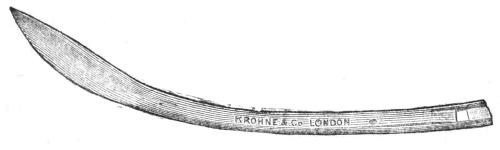
Seton
A seton placed on the back of the neck, running from just behind the back of one ear to the other, is a useful form of counter irritant in cases of chronic epilepsy, also for distemper fits.
In cases of general paralysis, when all four legs are affected, a seton placed on either side of the neck, running along the course of the spine, often do good; and so they do when placed in the loins, one on either side of the spine, in paraplegia or paralysis of the hind quarters.
In pneumonia a seton may be placed in front of the chest, running from the inside of one shoulder-joint to the other.
Troublesome cysts that are difficult to disperse, like those found in the flaps of the ear, may often be cured by running a seton through it, and keeping it there for a few days.
A small seton placed in the throat, just in front of the larynx, is useful in cases of chronic cough.