THE DOG’S MEDICAL DICTIONARY (continued 2)
Reading edition
The worst complications of all in distempers are those affecting the nervous system; the brain and its membranes may become inflamed, and fits follow, or the spinal cord and its membranes attacked, and paralysis or chorea, or perhaps both, occur. These complications of the nervous system may often be prevented by not letting the dog out too soon after distemper. The temperature should be regularly taken, and the patient not allowed to go out of doors or be excited in any way until the temperature has been normal at least ten days. Sometimes suddenly changing the diet from liquid to solid food will induce fits.
Occasionally in distemper a crop of pustules appears on the inside of the legs and over the stomach—in fact, in some cases all over the body. This is rather a good sign than otherwise, for they seem to relieve the system of the distemper poison.
To treat distemper successfully, good nursing and dry, warm, comfortable quarters for the patient are the two essential things. For outdoor dogs, a loose box in a stable makes a capital place, and in cold weather the temperature should be kept as near 55 deg. F. as possible. Dogs who are in the habit of living indoors should be put in a well-ventilated room, and the temperature kept up between 60 and 65 deg. F. It is a good plan to cover the floor with sawdust, which should be changed at least once a day, and oftener when necessary. The dog should not be let out of the box or warm room for anything. Very often at first there are difficulties with very clean dogs, but it can generally be overcome with perseverance. Sometimes a little soiled straw from a kennel thrown down in the room is useful. Some dogs may be taught to use a tray or box filled with sawdust or mould. Directly a dog shows signs of distemper he should be sewn up in a flannel coat to keep the chest warm.
As to diet, if it is only a slight case, a light meal of bread or crushed biscuit with gravy or milk may be given three or four times a day.
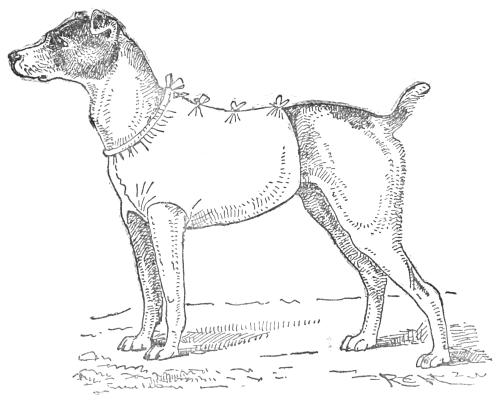
A coat covering the chest; useful in cases of distemper to keep the chest warm, especially when lung affected
For a change, a little well-boiled fish with rice, or sheep’s head broth and rice, or bread. Milk may be given freely to drink.
In all cases of distemper it is important to keep the eyes free of discharge by cleaning or bathing them frequently with some warm boracic lotion, made by dissolving half a teaspoonful of boracic acid in half a pint of warm water. When the discharge is very free and continues, in addition to keeping them clean with this lotion a little of the following may be run on to the eyes, especially on the inside of the lower lid:—
The Lotion for Eye:
Chinosol, 3 grains.
Water to 6 ounces.
To be applied three times a day after cleansing with the boracic.
In severe cases where the discharge is very profuse and offensive, a little powdered iodoform may be dusted over the front of the eye two or three times a day. If ulcers form they are to be treated the same way: and if the eyes are very painful, add to every half-pint of boracic lotion four grains of hydrochlorate of cocaine.
As the dog recovers from distemper, and the discharge ceases, if there is any opacity of the corners left, the following ointment should be used:—
The Ointment for Eyes:
Yellow Oxide of Mercury, 1 grain.
Vaseline, 1 drachm.
Mix.
A small piece should be placed between the lids, and then gently rub the upper eyelid over the eye for one minute so as to work the ointment in. Repeat twice a day. In some cases the opacity is very obstinate, and cannot be removed by the ointment, then the following drops may be tried:—
Divine Stone, 2 grains.
Solution Sulphate Atropine, 12 maximum.
Distilled Water to ½ ounce.
One or two drops to be placed in the eye twice a day.
The dog should be held for a few minutes after this lotion has been applied or he may rub the eye.
After distemper, eczema often follows as the result of weakness; tonics should be given and the disease treated in the ordinary way.
Some dogs during distemper, especially in bad cases, discharge a thin, purulent, offensive matter or pus from the skin around the mouth, head, under the neck, and inside of ears. This condition, which is more often seen in bloodhounds than other dogs, is a very bad sign.
The parts should be thoroughly cleansed once a day by being washed with Pearson’s Antiseptic diluted eighty times with warm water, carefully dried with soft cloths, and then freely dusted with some absorbent powder, as anylyform, or with the following:—
Powdered Burnt Alum, 1 ounce.
Powdered Boracic Acid, 1 ounce.
Powdered Starch, 6 ounces.
Mixed together.
Tonics, especially quinine, are indicated during this condition, as the discharge is very weakening.
When the appetite is very bad, the patient may be tempted with some giblet soup or a little well-stewed rabbit and bread, or rice. Very often, in bad cases, the dog absolutely refuses all food; he must then be drenched with strong meat tea, or with milk thickened with Benger’s food. When there is an inclination to diarrhœa, the beef tea and milk should be thickened with cornflour or arrowroot. One of the best ways of making meat tea is with beef, mutton, and veal, say half a pound of each cut up very fine; this should be gently simmered with a pint of water for three or four hours, and then strained off. Of this, from a tablespoonful[1] to a small teacupful may be given every three or four hours alternately with the milk food. In addition to this, if the dog will drink raw beef tea, which they will often do, it may be given freely. This is best made as follows: Half a pound of lean raw meat passed through a sausage machine; to this add half a pint of water, and place in an earthenware jar in front of a fire for two or three hours, stirring occasionally; then strain off through a cloth. Some pressure is required to get all the juice out of the meat. It requires to be made fresh every day. When the patient is very weak and exhausted, feeding is necessary every hour or two, as only very small quantities of food can be retained. Then strong meat extracts are required. Plasmon may also be tried mixed with milk, and Valentine’s meat juice with milk. Of this latter from fifteen[1] drops to a teaspoonful, with one[1] to four teaspoonfuls of milk. Invalid Bovril may be given instead of Valentine’s for a change in the same proportions, but fresh meat juice from raw meat is as strong as anything. As to stimulants, there is no doubt, when the dog is very low and the pulse weak, from ten[1] drops to a teaspoonful of brandy does good. When the dog is eating all right himself, it may be given in a little water after food, but when one is drenching the food it should be mixed with it.
There is no doubt that dogs who continue with a good appetite through distemper do much better, and have a better chance of recovering, no matter how severe the attack may be, than those bad feeders who refuse food and have to be drenched. A little food taken voluntarily does much more good than a lot forced upon the dog; therefore I advise tempting the patient with a variety of diet, so as to get him to eat something himself—of course, given in small quantities, particularly when the case is bad. I always commence with soup and milk alternately, mixed with bread, biscuits, or rice; as the dog gets tired of these, I add a little meat, say from a sheep’s head or stewed neck of mutton; for a change some fish, boiled tripe, or stewed rabbit, and if the dog goes off these I try scraped raw meat. I never commence forcing food if I can help it, for I find, once this is started, there is always a difficulty in getting the dog to eat anything himself.
As to medicine, the more experience one gets the more one finds this is quite secondary in treating distemper. I do not believe in specifics, and, do what one may, the disease under the best circumstances will run a certain course. In simple cases, where the temperature is not very high, an occasional mild dose of syrup of buckthorn and castor oil is often all that is required. This is necessary, as the dog cannot go out and take exercise; therefore the bowels often get constipated, and if this is neglected troublesome diarrhœa may occur. After the temperature is normal and remains so for a few days, and the dog does not feed well, then some tonic is useful, as the following:—
Recipe: The Pills:
Salicylate of Quinine, 12 grains.
Extract of Gentian, 30 ”
Mix, and divide into 24 pills.
Dose: From half to two pills[1] to be given three times a day.
Quinine does not suit all dogs, for in some cases, instead of improving the appetite, for which it is given, it has the opposite effect, when the following mixture may be tried instead:—
Recipe: The Mixture:
Tincture Nux Vomica, 40 minims.
Diluted Nitro-hydrochloric Acid, 1 drachm.
Compound Tincture Gentian, 5 drachms.
Simple Syrup, 1 ounce.
Water to 6 ounces.
Dose: From one teaspoonful to a tablespoonful three times a day.[1]
It is not necessary to take notice of a relaxed condition of the bowels so long as the motions are not very frequent, but diarrhœa (frequent watery motions) must not be allowed to go on. As a rule, a small dose of castor oil—say from one teaspoonful[1] to a tablespoonful—will usually stop it by removing the cause. If it continues after the oil has acted, give, shaken dry on the tongue, from 3[1] to 15 grains of salicylate of bismuth three or four times, or oftener, a day. Thicken the food with cooked arrowroot, and give boiled rice with soup and meat if the latter is being given.
If bismuth does not stop the diarrhœa, try the pills as per prescription below:—
Recipe: The Pills for Diarrhœa:
Powdered Extract of Kino, 1 drachm.
Powdered Ipecacuanha, 8 grains.
Powdered Opium, 6 ”
Mix, and divide into 12 pills.
Dose: From half to two pills to be given three or four times a day.[1]
In complications affecting the lungs, as soon as they are noticed the chest should be sewn up in gamgee wool covered over with flannel. I have no faith in ordinary liniments; and poultices, unless they are applied by a professional hand, often do more harm than good. In very acute cases the hair may be closely cut off over a small patch on each side of the chest, and strong liniment of iodine applied with a camel’s-hair brush. This may be repeated in four hours, and again four hours later, if the application has not made the skin inflamed and swollen. Of course, the size of the patch must vary according to the size of the dog—from a five-shilling piece to the palm of the hand.
No very special medicine is required unless the heart is affected, which is often the case, when the following mixture is useful:—
Recipe: The Mixture:
Tincture Digitalis, 1 drachm.
Tincture Nux Vomica, 1 drachm.
Concentrated Solution of Acetate of Ammonia, 2 drachms.
Water to 6 ounces.
From one[1] to four teaspoonfuls to be given every four or six hours, according to the severity of the symptoms. If the fever is very high, from two[1] to ten grains of bicarbonate of potash may be added to each dose. Some brandy may also be given with advantage, from ten[1] drops to a dessertspoonful every two or three hours, given as previously recommended.
When the nervous system becomes affected during distemper, or just afterwards, it is always a serious matter; in fact, when the brain is attacked and fits are the result, the case is practically hopeless, and if the fits are very severe and frequent it is better to destroy the dog at once, rather than waste time and money in continuing the treatment. When the disease attacks the spinal cord, St. Vitus’s dance (chorea) generally follows. This is also practically an incurable disease, and in severe cases it is best to put the dog out of its misery, for if it lives it will always be a hopeless cripple. Slight cases improve with time and judicious treatment, but the twitching never entirely disappears, though the dog may recover sufficiently to be shown, and also to be bred from. The disease is not hereditary, though I have sometimes thought that puppies of parents suffering from chorea are more disposed to the disease than others. Again, as the result of distemper, the patient may become paralysed to a more or less extent in different parts of the body or limbs—generally the back legs, though occasionally the fore ones are affected, and sometimes all four legs become useless. I have seen some cases when only the tail has been affected, the dog not being able to move it in the least. In other instances the eyes are the seat of the mischief, and amaurosis is the result. Unfortunately, treatment is quite useless in this latter case; in fact, I never saw a dog recover. The blindness may not be complete at first, but this paralysis of the eyes is a progressive disease which no treatment seems able to stop. I may here mention in amaurosis that the eye remains clear and bright, and to the casual observer there is nothing to be seen except a widely dilated blue pupil, which ordinary light does not cause to contract, though exposure to the strong rays of the sun will do so slowly. If the owner of a patient thus affected is anxious to try some treatment, then I suggest the following:—
Recipe: The Lotion:
Sulphate of Eserine, 1 grain.
Distilled Water to 1 ounce.
One drop to be placed into each eye three times a day.
For medicine, give nux vomica as the following:—
Recipe: The Mixture:
Tincture Nux Vomica, 1 drachm.
Water to 6 ounces.
Doses: From one[1] teaspoonful to a tablespoonful three times a day after food.
Later, the following mixture may be tried:—
Recipe: The Mixture:
Iodide of Potassium, 36 grains.
Water to 6 ounces.
Doses: From one[1] teaspoonful to a tablespoonful three times a day.
A seton may also be placed in the back of the neck just behind the ears, and galvanism may also be tried.
As to the treatment of distemper fits, if they are noticed at the commencement, before they have become severe, something may be done. Large and frequent doses of bromide of strontia should be administered, from 3 to 15 grains,[1] in from a teaspoonful[1] to a tablespoonful of water every three or four hours at first, or so long as there are any fits; when they cease, give the medicine less often—say, every six hours, or four times a day. After a few days, three times a day will be often enough for the medicine, and later twice a day. If there is no diarrhœa, give aperient medicine, and feed on a very light and sloppy food, as bread, with soup or milk, Benger’s food, egg and milk, etc. Keep the dog absolutely quiet, and in the dark as much as possible.
When the bromide in large doses is continued for some time, one often notices weakness or partial paralysis of the limbs; this passes off when the medicine is discontinued.
As to the treatment of chorea, I know of no specific; in fact, medicine has little or no effect over this disease at all. Strong doses of medicine like nux vomica or Easton’s syrup do more harm than good during the early stages, whereas later small doses of these drugs are beneficial. Directly the twitching is noticed the bromide of strontia should be given, from two[1] to ten grains three times a day. In the course of a week, if the twitching does not increase, some arsenic may be added to the bromide, as from one[1] to five drops of Fowler’s solution to each dose. Later, in about a month or so, when all inflammatory symptoms have passed, the eyes clear, and the temperature has been normal for some time, some nerve tonic is useful, but it must be given with caution, or the twitching will increase. Easton’s syrup is as good as anything—for very small dogs like Japanese spaniels five drops three times a day in a teaspoonful of water is enough; after a week, six drops may be given; and a week later, seven drops for a dose. The dose for toy spaniels weighing about eight pounds is eight drops; full-sized fox terriers, ten drops; collies, etc., fifteen drops; St. Bernards, etc., twenty drops. In each case the dose may be gradually increased. If the dog is in very poor condition, petroleum emulsion may be given with the Easton’s syrup instead of water. In any case, it is a matter of months before any improvement is noticed. In ordinary paralysis as the result of the distemper, when there is an absence of twitching, bromide in any form does more harm than good. In these cases some preparation of nux vomica is required, and the following pills I have found useful:—
Recipe: Compound Nux Vomica Pills:
Powdered Nux Vomica, 2 to 8 grains.[1]
Ergotine, 5 to 18 grains.
Reduced Iron, 12 to 60 grains.
Ex. cip. q.s. Mix.
Divide into twelve pills, one to be given three times a day.
If there is no improvement after a short time, a blister applied to both sides of the neck in cases of paralysis of the forelegs is often useful, and in chronic cases of paralysis of the back legs a blister should be applied to the loins. The blister may be repeated in a fortnight, if necessary.
Galvanism is also useful in cases when of long standing.
The bowels should be kept open with mild aperients, and vermifuge medicine given if there are any signs of worms. Dogs suffering from paralysis, the result of distemper, generally recover with time and care.
Docking:
Puppies should be docked when three or four days old, and the operation should be done with a pair of sharp scissors. The skin should be drawn well forward before severing the tail, then afterwards it slips back and well overlaps the bone. There is, as a rule, little or no bleeding; at any rate, not sufficient to be of any importance. Should there be, it can easily be stopped by the application of a little tincture of perchloride of iron, or of Friar’s balsam. It is well after docking a puppy to keep the mother away for half an hour or so.
Different breeds of dogs have their tails docked at different lengths. The fox terrier should have three-fifths of his tail left. Irish and Airedale terriers rather less than half. Spaniels, about two-fifths of the tail should be left, and griffons about a third.
Doses:
In consequence of the difference in the sizes of dogs, it is always difficult when giving a general prescription suitable for dogs of all breeds to make the doses quite clear for dogs of different sizes. However, to make it as clear as possible, I have divided dogs into eight different sizes, as for instance, griffons and others, 4 or 5 pounds weight. I call No. 1 size, spaniels, pugs, etc., weighing 10 or 12 pounds. No. 2 size, fox terriers, Irish terriers, etc., weighing from 18 to 25 pounds. No. 3 size, bull dogs, field spaniels, etc., weighing about 40 pounds. No. 4 size, collies, retrievers, greyhounds, etc. No. 5 size, bloodhounds, etc., and other dogs weighing about 80 pounds. No. 6 size, great Danes, etc., weighing about 120 pounds. No. 7 size, bigger dogs, like St. Bernards. No. 8 size, mastiffs, etc. Therefore, if the dose advised is from half a teaspoonful to a tablespoonful, it is intended for No. 1 size, half a teaspoonful; No. 2, a teaspoonful; No. 3, a teaspoonful and a half; No. 4, two teaspoonfuls; No. 5, two teaspoonfuls and a half; No. 6, three teaspoonfuls; No. 7, three teaspoonfuls and a half; and No. 8, four teaspoonfuls or a tablespoonful. When pills or powders are prescribed, they are to be divided in the same way.
Dosing:
People who are not in the habit of administering medicine to dogs often have a difficulty in giving it. Liquid is best given out of a bottle. The person about to give it should stand on the right hand side of the dog, place the left hand around the muzzle, then slightly raise the head, and place the neck of the bottle inside the cheek, and pour a small quantity of the fluid at a time into the pouch formed by the cheek. If the muzzle is held tightly with the left hand, there is no danger of the dog biting the bottle. If the reader is afraid to use a bottle, the fluid may be given with a spoon, but then a second person is required to hold the dog’s head, and with the finger pull out the side of the cheek so as to form a pouch in which the medicine should be poured. This is by far a better plan than forcing the dog’s mouth open, and pouring the fluid right on his tongue.
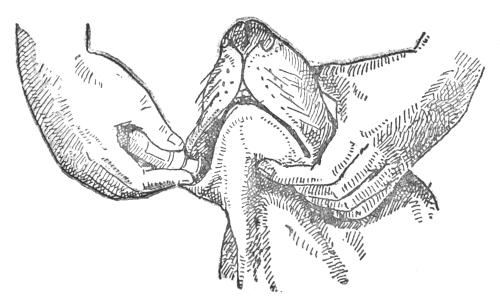
How to give fluid medicine or liquid nourishment to a dog
To give a pill, stand on the right hand side of the dog’s head, with the left hand placed over the muzzle, forcing the dog’s mouth open by pressing the cheek between the teeth, then he cannot bite you. Slightly raise the head, and drop the pill into the back of the mouth, and then with the forefinger of the right hand just push it into the throat. Close the mouth quickly, and the dog will swallow it.
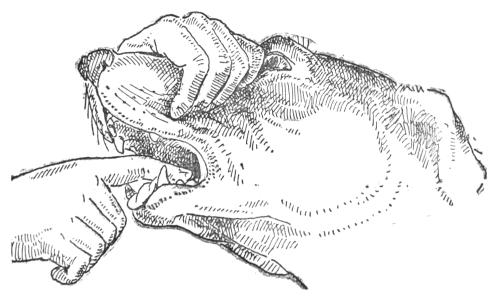
Giving a pill
Dropsy:
Symptoms: In dropsy, the result of heart or kidney disease, the limbs often become swollen, as well as the abdomen becoming enlarged and pendulous. The fluid may be detected for certain in the abdomen by placing a hand on one side of the stomach, and then gently tapping the other side of the abdomen, and if fluid is present, an undulating motion will be felt like striking a bladder full of water. In dropsy, no matter from what cause, the dog becomes thin about the neck and chest, and the muscles of the limbs waste. As the fluid increases, the size of the abdomen increases; the breathing becomes distressed, and the dog walks with difficulty. In many cases, when relief is not obtained, the dropsy extends to the chest, which of course increases the difficulty of breathing.
Many cases of ascites are due to diseased liver, which may become much enlarged, but the condition of the liver may simply be due to defective circulation.
Treatment: Unless the patient is very old, relief may generally be given with the following mixture, continued for some time:—
Recipe: The Mixture:
Acetate Potash, 3 drachms.
Tr. Digitalis, 1 drachm.
Tr. Nux Vomica, ½ drachm.
Spirits of Nitre, 2 drachms.
Water to 6 ounces.
Doses: From one teaspoonful to two tablespoonfuls[1] three times a day. Also give three times a day in water, after food, from fifteen drops[1] to two teaspoonfuls of Hollands gin. Once or twice a week a dose of purgative medicine should be given, as from three to fifteen grains[1] of jalapine. When the liver is affected, give from two[1] to eight grains of grey powder once or twice a week, instead of the jalapine. In severe cases of dropsy tapping is necessary, but as a rule, in ascites it only gives temporary relief.
Dysentery:
Symptoms: Frequent liquid motions, consisting principally of mucus and blood, accompanied by severe straining. The abdomen is very tender, there is often vomiting and great thirst.
Treatment: Give at once a dose of castor oil and laudanum, from half to a tablespoonful[1] of oil mixed with from three[1] to fifteen drops of the latter. About six hours afterwards, commence to give carbonate bismuth from five to twenty grains[1] every three or four hours, also two or three times a day give an enema of thick boiled starch (from one[1] to four teaspoonfuls), mixed with from three[1] to twenty drops of laudanum. The enema should be just warm, given very slowly, and the dog should be kept quiet for a short time afterwards, to prevent his ejecting it.
The following mixture may be tried, if the symptoms continue in spite of the bismuth:—
Recipe:
Chlorodyne, 2 drachms.
Prepared Chalk, 4 drachms.
Tr. Catechu, 4 drachms.
Sol. Gum Acacia, 4 drachms.
Water to 6 ounces.
Doses: From one teaspoonful to a tablespoonful[1] every three or four hours.
Diet: Feed on milk thickened with arrowroot (boiled), also give white of egg beaten up with water to drink, or barley water; no solid food should be given whilst there are any signs of blood with motions.
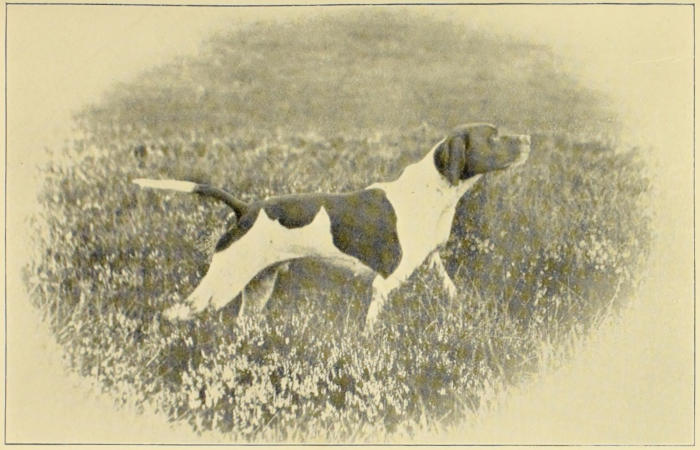
Pitchford Ranger. Winner of 10 prizes at the Field Trials.
Pedigree of Pointer, Pitchford Ranger, the property of Colonel Cotes, Pitchford, Shrewsbury.
[face p. 90.
Dyspepsia:
Symptoms: Distention and discomfort after food, which is not eaten with usual relish. Action of bowels variable, sometimes constipated, at other times loose; occasionally vomiting after food. Tongue, instead of being of a nice pink colour, is brick-red. Dog drinks more than usual. There is loss of spirits and condition, and a disinclination to exercise.
Treatment: First give a purge as from 2 to 10 grains[1] of jalapine. Repeat dose in a week; also give following mixture:—
Recipe:
Bicarbonate of Soda, 2 drachms.
Tr. Rhubarb, 3 ”
Tr. Gentian, 4 ”
Tr. Nux Vomica, 1 drachm.
Liquor Bismuth, 1 ounce.
Water to 6 ounces.
Doses: One teaspoonful to one tablespoonful[1] three time a day half an hour before food. After food give from one to 5 grains[1] of ingluvin after each meal.
Dogs suffering from dyspepsia should be treated for worms.
Diet: In bad cases, for a few days give milk with Benger’s food, also milk mixed with equal parts Vichy water to drink; later feed entirely on lean raw meat for a time, given three times a day; if it is refused quite raw, try it lightly grilled. Well-boiled tripe, or sheep’s brains boiled in milk, may also be offered.
Dysuria:
Symptoms: Frequent passing of water, which is generally of a clear water colour, the dog at times passing it unconsciously whilst standing. In some cases the urine may be cloudy or even tinged with blood, when there is a stone in the bladder or kidney.
Treatment: When due to simple irritation of the kidneys or bladder, and there is an absence of stone, small doses of opium should be given, from an eighth to a grain[1] three times a day. When the symptoms are the result of calculus, the cause must be removed by operation. In dysuria the supply of water should be limited, or barley water or skimmed milk given instead of plain water.
Ear-ache:
Symptoms: Shaking of the head, which is often held on one side; pain on pressure. There is generally an absence of discharge as in canker of the ear.
Treatment: Steaming the ear with hot poppy-head tea gives relief, or a few drops of laudanum may be poured into the ear. The application of a hot salt bag is relieving.
Ear Canker:
Symptoms: Dogs of all kinds, especially those with long ears, are subject to this disease. The dog shakes and scratches his ear; the parts are inflamed; he often holds the head on one side, and in most cases there is a thick brownish discharge. In many cases it assumes the form of eczema, and dogs subject to this disease more often have attacks in the spring and autumn than at any other time.
Treatment: The following lotion should be applied two or three times a day with a camel’s-hair brush to all the red parts, and also down into the ear as far as it will go. After a day or two the ear should be cleaned out with some medicated wool twisted around the point of a bodkin or anything of that kind.
Recipe:
Oxide of Zinc Ointment, 2 drachms.
Almond Oil, 1 ounce.
Well mix.
In addition to using the lotion, give the dog some cooling medicine, as from 3 grains[1] to one scruple of sulphate of magnesia, and half the quantity of bicarbonate of potash, twice a day with the food. The lotion and medicine should be continued as long as the dog shows any irritation of the ear.
In neglected cases of canker, ulcers form low down in the ear, causing a mattery, offensive discharge. In these cases different treatment is required. The ear should be syringed night and morning with a tablespoonful of methylated spirits added to half a tumbler of tepid water, and then after letting the dog shake his head, the ear should be thoroughly dried with some medicated wool twisted around a bodkin, and then be filled with some finely powdered boracic acid. This is best done by the means of a quill attached to an indiarubber tube, the quill being filled up by being dipped into the powder, and then inserted into the ear, and deposited there by means of blowing through the tube.
Some of these cases are difficult to cure, but with perseverance they get all right in time.
There is another form of canker due to an insect, which I call psoroptes auricularis canis. This is a very minute insect, which collects in large numbers in the canal of the ear, causing the dog to shake his head frequently, and scratch the ear. The canal of the ear looks as if it were full of dry grey powder, but if looked at carefully it will be noticed to be full of very small insects, the size of tiny cheese mites, and they will be seen running about as they are very active. This form of canker is contagious.
Treatment: Syringe the ear thoroughly with a teaspoonful of Pearson’s fluid added to six ounces of tepid water, then carefully dry, and anoint with the following ointment.
The syringing should be repeated about twice a week, and the ointment applied night and morning for a time.
Recipe: The Ointment:
Salicylic Acid, 10 grains.
Vaseline, 1½ drachms.
Carefully mix. Apply with camel’s-hair brush.
As it is very difficult to destroy the eggs of these parasites, it is advisable, even after the irritation has ceased, to continue the ointment two or three times a week for some time, so as to destroy the parasites as they hatch.
Ear, Cyst in the Flap of:
Symptoms: Dogs with long ears are more subject to this complaint than others. It is generally caused by a bruise of some kind. A swelling forms on the inside of the flap of the ear, often extending all over the surface. It is very painful, and the dog will hold the head on one side, and cry out when touched.
Treatment: Often, if attended to immediately after it occurs, the swelling may be dispersed by hot poppy-head fomentations, made by boiling a couple of crushed poppy-heads in a quart of water for ten minutes, and then straining. If the swelling does not disappear in a couple of days, it should be freely opened on the inside at the lowest part—that is towards the point of the flap. The wound must be kept open by being plugged by a piece of lint, or inserting a small tube, which should be fixed in with a stitch. The wound must be kept open for some days, or else the fluid will collect again.
It is advisable in these cases to make the dog wear a cap as depicted in the illustration, and if the inside of the ear sweats at all, dust it freely with powdered boracic acid three or four times a day.
Ear, Growths in:
Symptoms: Cartilaginous growths occasionally form in the canal of the ear, quite blocking up the passage. They cause great pain. The dog holds his head on one side, and is constantly scratching his ear, and crying.
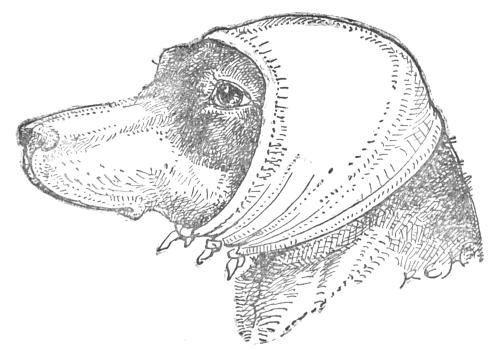
A cap to keep the ears at rest when required. It should not be put on in cases of canker.
Treatment: The only treatment is to remove the growths by operation, which should be done as follows: Chloroform having been given, the growth should be cut out as low down as possible with the points of probe-pointed scissors. Then the roots should be thoroughly scraped with a curette, and afterwards thoroughly cauterised with the thermocautery. The dog suffers a good deal of pain for some days after the operation, but it may be relieved by pouring a few drops of the following lotion, which should be slightly warmed, into the ear three or four times a day.
Recipe: The Lotion:
Laudanum, 1 drachm.
Carbolic Acid, 20 drops.
Almond Oil, 1 ounce.
Carefully mix.
Ear, Polypus in:
Symptoms: This is a small pear-shaped growth with the pedunculated root attached in the canal of the ear.
Treatment: This growth is best removed by torsion, as follows: Seize the growth with a pair of forceps, and twist it round and until it comes off. No further treatment is required, except keeping the ear clean for a few days with some boracic acid lotion.
Ear-Flap, Scurfiness of:
Symptoms: Very often dogs, especially those kept in kennels, suffer from a very scaly or scurfy condition of the edges of the flaps of the ears, which causes the hair to fall off, and the dog to shake his head frequently.
Treatment: Apply a little of the following dressing to the parts once or twice a day. This will remove the scurfiness, and stimulate the growth of the hair. Once a week wash the ears thoroughly with Cook’s 3% mercurial soap.
Recipe: The Dressing:
Resorcin, 1 scruple.
Cyllin, 15 minims.
Almond Oil, 1 ounce.
Mix.
Ecthyma:
Symptoms: A skin disease, characterised by the formation of a number of small pustules, which the dog generally breaks by licking or scratching, and a running sore is produced.
Treatment: The part should be cleaned with a weak solution of Pearson’s disinfectant fluid, or with a teaspoonful boracic acid in half a pint of water, then gently dried with a soft cloth, and the following lotion applied and repeated often:—
Recipe:
Prepared Chalk, 2 ounces.
Wright’s Solution Coal Tar, ½ ounce.
Lime Water to 8 ounces.
Well shake before using.
Treat dog for worms, and give following pills:—
Recipe:
Arsenious Acid, ½ grain.
Reduced Iron, 40 grains.
Sulphate Quinine, 12 grains.
Extract Gentian, q.s.
Mix.
Divide into 12, 24, 36, or 48 pills.[1] One to be given twice a day, after food.
Dog suffering from Ecthyma should be given some meat every day mixed with other food.
Eczema:
A non-contagious skin disease.
Symptoms: Skin irritable; dog frequently scratching, also licking and biting himself. Clusters of fine vesicles appear at different parts; the skin afterwards becomes dry and scaly, unless the dog by constantly licking himself makes the parts sore and raw. Parts principally attacked around eyes, the lips, outside and inside of ears, along top of back, root of tail; but any part may become affected.
Treatment: Bathe affected parts often with following lotion:—
Recipe:
Wright’s Solution Coal Tar, 1 ounce.
Goulard’s Extract of Lead, 1 drachm.
Glycerine Boracis, 1 ounce.
Distilled or Rain Water to 8 ounces.
Mix.
Or, apply following ointment twice a day:—
Recipe:
Resorcin, 1 scruple.
Cieolin, 20 minims.
Almond Oil, 1 drachm.
Lanoline, 1 ounce.
Mix.
Apply night and morning.
When skin very sore and raw, dust the affected places often with following powder:—
Best Powdered Starch, 4 parts.
Boracic Acid Powder, 1 part.
Mix.
When the eczema is general—that is, more or less all over the dog—give every four days a bath in Pearson’s disinfectant fluid diluted eighty times with tepid water; that is, four tablespoonfuls to a gallon of water.
Internal Remedies.—Treat for worms, and give the following powders:—
Reduced Iron, 6 grains to 36 grains.[1]
Sulphate Magnesia, ½ drachm to ½ ounce.
Mix.
Divide into 12 powders—one to be given twice a day with food.
When the dog is in poor condition, or when the skin is very dry and scurfy, try the following pills after the powders have been given for a time:—
Recipe:
Arsenious Acid ⅛ grain to ½ grain.[1]
Reduced Iron, 6 grains to 36 grains.
Ext. Gentian, q.s.
Mix.
Make 12 pills—one to be given twice a day.
Elbow, Capped:
Symptoms: The point of the elbow is hard, swollen, and tender, causing the dog to go lame, or at any rate rather stiff. It is generally the result of an injury.
Treatment: At first try hot fomentations, which continue three or four times daily for some days; then apply the following lotion, dabbed on frequently:—
Recipe:
Goulard’s Extract of Lead, 1 drachm.
Laudanum, 1 ”
Spirits of Wine, 4 drachms.
Water to 8 ounces.
Later, if the swelling continues, rub gently into the swollen part a little colourless tincture of iodine or iodine vasogen once a day. It is essential in these cases to keep a good soft bed under the dog.
Emaciation:
Symptoms: Loss of condition and spirits, paleness of the mouth and conjunctivæ membrane.
Treatment: First give medicine to remove worms; also cod-liver oil, from half a teaspoonful[1] to a tablespoonful two or three times a day after food, and from one to eight grains[1] saccharated iron two or three times a day.
Diet: Feed liberally, allowing plenty of meat, mixed with Spratt’s malt and cod-liver oil biscuits; also give plenty of milk to drink.
Emetics:
The most effectual one is hydrochlorate of apomorphia; dose, from one-twentieth to one-sixth of a grain[1] in a teaspoonful of water. When given injected under the skin, it acts almost instantaneously.
Tartar emetic, from a quarter[1] to one and a half grains, shaken dry on the back of the tongue. If vomiting should not be induced in about ten minutes, a few spoonfuls of warm water should be given.
Ipecacuanha wine, from half a teaspoonful to a tablespoonful[1]; repeated in ten minutes if vomiting not induced, and again ten minutes later if necessary.
In cases of emergency, common salt may be given, from sufficient to cover a sixpence to a teaspoonful[1] in warm water.
Emissions:
This nuisance is, as a rule, more troublesome amongst puppies than adult dogs, for generally after they are a year old the bad habit ceases.
Treatment: A course of bromide is sometimes useful, but if the habit continues after the dog is two years old castration is the only thing that is of any use. This operation, which can be done under chloroform, does not alter a dog’s nature as much as many people think, and when he is only required as a pet there is nothing to be said against it.
Emphysema:
Symptoms: The whole body may swell through a small puncture in the skin, which often cannot be found when a clog’s coat is thick. The emphysema may be confined to the body or to the head, or even to one or more limbs. In bad cases the dog swells out of all recognition. He is unable to move, or does so with great difficulty; and when the head is affected, the eyes are closed, the ears perhaps an inch thick, and breathing is difficult. The swelling is soft, pits on pressure, and at the same time a crackling noise is made.
When affecting the lungs, the breathing is heavy and laboured, and on auscultating the chest a distinct loud, crackling noise is heard. The heart is generally affected, its action, as a rule, being very weak; and there is a chronic, husky cough.
Treatment: In cases of general emphysema, if the swelling is not large it may be left alone, for it will gradually disperse of its own accord; but when it is large, the original wound, if it can be found, should be dilated, or one or more fresh ones made, and the air which has accumulated under the skin pressed out. The wound should afterwards be cleaned with a solution of some disinfectant like Pearson’s fluid or boracic acid, dried, then covered over with some antiseptic gauze, and a bandage or coat applied. Stimulants, as brandy, should be administered.
Treatment of emphysema of the lung is not very satisfactory, especially when the patient is very old, which is generally the case; but some relief may often be given by careful dieting. No food to distend the stomach should be allowed, as pressure on the chest from a distended stomach always increases the difficulty in breathing, therefore a concentrated food like meat should be given, and it is best raw. It should be given in small quantities three times a day.
Sedative medicine, unless the cough is very troublesome, is best avoided, but some such mixture as the following may be tried:—
Recipe:
Tr. Digitalis, 1 drachm.
Tr. Nux Vomica, 1 drachm.
Ipecacuanha Wine, 2 drachms.
Water to 6 ounces.
From half a teaspoonful to a tablespoonful[1] three times a day one hour after food.
Inhalation of steam gives relief.
The bowels should be kept well opened by occasional doses of aperient medicine.
Enema:
Enemas are necessary in cases of stoppage of the bowels; they are also very useful to relieve constipation; and for dogs that are very ill it is much better to give a small enema rather than a dose of purgative medicine, which often causes sickness, which one particularly wants to avoid when the patient is weak.
Just to cause an action of the bowels in cases of constipation, only a small enema is required as, say for a little dog like a griffon, half a teaspoonful of glycerine mixed with a couple of tablespoonfuls of warm water. For dogs the size of fox terriers double the quantity may be given. For collies, etc., four times the quantity; and for dogs like a St Bernard half as much again of both the glycerine and water. Instead of glycerine, soapy water may be used.
In cases of real obstruction of the bowels, give double the quantities as advised in cases of simple constipation, and the enema should be repeated in these cases three or four times a day. Very often in cases of obstruction of the bowels, it is a very good plan to give an occasional enema consisting of warm oil, or even from five grains to half a drachm[1] of ox gall dissolved in hot water.
For little dogs a glass ear-syringe may be used which can be bought to hold half an ounce or an ounce. For bigger dogs one of Higson’s enema syringes are the best. The bone point, before inserting into the bowel, should be well vaselined, and then it can be safely passed into the rectum its whole length, which is about two inches. Care should be taken when giving enema not to pump a lot of air into the bowel.
Another way of relieving constipation, when one wishes to avoid giving medicine by the mouth, is to pass a suppository made of glycerine and gelatine into the rectum. These have their advantage over enema, as they do not wet the dog when the bowels operate, which is important in cases of paralysis when dogs cannot stand whilst passing a motion. Failing a glycerine suppository, a piece of yellow soap cut the shape of one answers the purpose.
Enteritis (Inflammation of the Bowels):
Symptoms: Attack often commences with vomiting. There is generally slight rise of temperature and a quickened pulse, pain on pressure of abdomen; there may be constipation or diarrhœa, but in any case mucus is generally passed with the motion. The dog seems ill, lies about, and is disinclined to move. There is loss of appetite, and the thirst is generally excessive.
Chronic enteritis is a more common complaint; there is no temperature as a rule, and the pulse is quiet, though it generally becomes very weak as the disease advances. The appetite is not entirely gone, but is very bad, and what is taken is often vomited, mixed with a quantity of frothy mucus. When the food eaten is solid, and it is not vomited, then it generally passes through the patient in an undigested state with some mucus. The motions are copious and frequent, sometimes there is diarrhœa, at other times the motions are formed and hard. There is pain on pressure of the abdomen, and the coils of intestines may easily be felt as the coats of the bowels are generally much thickened—the result of the chronic inflammation. The patient becomes very anæmic and wasted, the breath is foul, ulcers may form in the mouth, and the tongue is of a rusty red colour.
Treatment: In the acute form a small dose of castor oil mixed with from two to fifteen drops of laudanum,[1] and repeated in two or three days if necessary. If there is diarrhœa, give from three[1] to fifteen grains of carbonate of bismuth three or four times a day; also from two to ten drops of chlorodyne[1] in water three or four times a day; when there is much pain hot linseed meal poultices may be applied to the abdomen. The diet should consist principally of milk—plain or with Benger’s food—a little meat juice may be added. Later, scraped lean raw meat may be given.
The treatment of chronic cases is tedious, a cure is often difficult, and under the best circumstances it takes many weeks of careful dieting before improvement occurs.
The following powders to be given with or after food:—
Recipe:
Ingluvin, 1 drachm.
Carbonate Bismuth, 2 drachms.
Powdered Nux Vomica, 6 grains.
Mix.
Divide into 12, 24, or 48 powders[1]—one to be given three times a day.
The diet should consist principally of unboiled milk, given plain or with Benger’s food, or beaten up with the white of an egg, and the quantity of course must vary according to the size of the dog, say from half[1] a pint to two quarts a day. Later, when the motions seem normal and the condition of the tongue improves, scraped lean raw meat may be given in small quantities.
Epilepsy:
Symptoms: An attack generally occurs quite suddenly; dog falls uttering perhaps a loud cry, is violently convulsed, champs his jaws, and froths at the mouth, and is unconscious. The attack generally lasts about half a minute, when the dog looks around him in a sort of dazed condition, and then often bolts off, not knowing where he is going to. Often one attack is followed by more, so it is important that the dog should be put in a place of security as quickly as possible, a good sized hamper is as good as anything. During the convulsions of epilepsy or just after, the patient unknowingly will bite his owner or anyone else, but there is no danger from such a bite.
Treatment: During the convulsions, it is best to leave the dog alone, unless one attack is being quickly succeeded by another, in which case two[1] or three drops of nitrite of amyl held to the nose, on a piece of blotting paper, lessens the severity of the convulsions. Chloroform similarly applied answers the same purpose. Directly the patient is able to swallow, give a dose of hydrated chloral and bromide of potassium, from three[1] to twenty grains of each, in from two teaspoonfuls[1] to two tablespoonfuls of water. This may be repeated in one, two, three, or four hours, according to the necessity, and under any circumstance the bromide alone should be given three or four times a day for a week or so after the attack. When a dog has had a succession of fits, a long course of bromide of potassium will often effect a cure.
Diet: Should be light, and consist principally of milk.
In all these cases, free purging does good.
Epistaxis (Bleeding from the Nose):
Symptoms: When the blood comes from one nostril, the trouble is generally local. When from both nostrils, it is more likely to be due to some lung mischief.
Treatment: If the hæmorrhage is not severe, nothing is necessary except keeping the dog quiet for a time, as it will soon discontinue. However, should the bleeding persist, syringe up the nostril a saturated solution of alum, or a teaspoonful of tincture perchloride of iron, mixed with a tablespoonful of water. In very severe case, the local application of adrenalin should be tried, and from half to two grains[1] of ergotine, given subcutaneously, dissolved in a few drops of brandy. This may be repeated every three or four hours. In some cases it is necessary to plug the nostrils with strips of lint. When bleeding is severe, stimulants should be freely given, and also scraped lean raw meat.
Erysipelas:
Uncommon in dogs, but occasionally seen.
Symptoms: Temperature quickly rises, and may go up to 106 or 107 degs. F., and even higher—dog constantly shivering—total loss of appetite, but as a rule thirst very great. Skin becomes thick, tense, and shiny—at first red, and then perhaps of a purple colour; blisters may form; affected parts much swollen.
Treatment: Give from two to fifteen grains[1] of chlorate potash every four hours; dust parts with powdered boracic acid, mixed with three parts of powdered starch.
Erythema:
Symptoms: Red and inflamed condition of the skin, the redness temporarily disappearing on pressure. Condition often noticed on inside of flaps of ears, inside of thighs and arms. It is accompanied sometimes by a good deal of burning and irritation which makes the dog lick and bite himself.
Treatment: Dust over with boracic powder often, or bathe parts with thymol lotion. Treat for worms and give sulphate of magnesia, from five[1] grains to one scruple, and reduced iron, from half[1] to four grains, twice a day with food.
Diet: Meat may be given with other food in this case.
When the Erythema is spread more or less all over the body, a bath every day or every other day made as follows gives relief:—
Recipe: Borax, two tablespoonfuls; fine oatmeal, eight tablespoonfuls; tepid water, three gallons.
It is a good plan when the dog is wet to rub the yolks of three or four eggs into the coat, which cleanses it, besides removing the dandruff from the skin.
Exhaustion (Result of great Exertion):
Symptoms: The dog is very languid, and perhaps unable to stand; breathes heavily, pulse quick and weak. If very bad, the tongue and membrane of the eye may be of a dark blue colour, the result of defective circulation.
Treatment: Rest and stimulants, as from ten drops to two teaspoonfuls[1] of brandy in a little water, which repeat every half hour. When dog very bad and unable to swallow, the brandy may be injected under the skin. As the dog comes round, Valentine’s meat juice or scraped raw meat in small quantities may be given.
Eye, Dislocation of:
Symptoms: This is not an uncommon occurrence with dogs with prominent eyes, such as pugs, Japanese and Pekingese spaniels, as well as King Charles spaniels, and other such dogs. Generally it is caused by fighting, or from some sudden blow just at the back of the side of the eye.
Treatment: If attended to immediately the eye is easily returned, especially if a little castor oil be poured over the front of the eye, and then with gentle pressure with the fingers it slips back into its place, and the eyesight is uninjured; but if left for some time, even for an hour, the eye becomes distended, and then it is impossible to return it without dilating the orifice. This must be done by making a small slit at the outer corner where the eyelids meet, say about one eighth of an inch long, and then pour a few drops of castor oil over the eye, and with pressure return it. Afterwards carefully sew up the incision made, and either put a couple of stitches through the lids, so as to keep the eyelids closed, or else put a piece of lint double thickness, soaked in boracic lotion, over the eye, and apply a bandage; but it is much safer to put a couple of stitches through the lids, which may be removed twenty-four hours later. The eye is sure to be inflamed and very painful for a few days, but this may be relieved by hot poppy-head fomentation made by boiling a couple of crushed poppy-heads in a quart of water for ten minutes, and then straining through fine muslin.
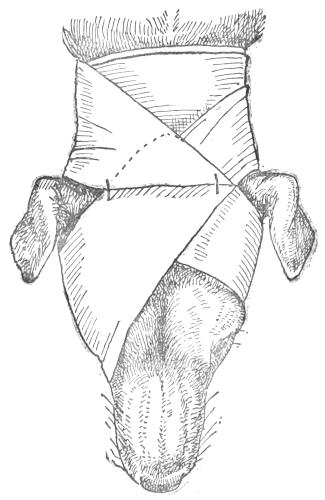
How to apply a bandage to cover one eye
After the eye has been out for an hour or two, one cannot tell for some days whether the sight has been destroyed or not. As a rule it is.
Eye, Haw of, Growth on:
Symptoms: A small red swelling appears in the inner corner of one or both eyes. It is particularly common in bull puppies, pugs, and young bloodhounds.
Treatment: The only treatment consists in excising the swelling in the following way: Paint the little red body several times with a 6 per cent. solution of hydrochlorate of cocaine, then after waiting a few minutes the swelling should be gently drawn out with forceps, or by passing a thread through it with a needle, and then it should be quickly snipped off with a pair of curved scissors. The bleeding will stop of itself in a few minutes, and no further treatment is required.
Eyelids, Sore:
Symptoms: The membrane of the eye is much congested, and freely discharges white matter; the skin around eye is swollen, inflamed, and raw, which sometimes makes it difficult to see the eye.
Treatment: Apply following lotion often:—
Recipe:
Goulard’s Extract of Lead, ½ drachm.
Hydrochlorate of Cocaine, 6 grains.
Distilled Water to 3 ounces.
Apply frequently with a piece of absorbent wool. When the skin is dry and inflammation less, anoint the lids three or four times a day with following ointment:—
Recipe:
Hydrochlorate of Cocaine, 3 grains.
Water, 1 drachm.
Lanoline, 2 drachms.
Almond Oil, 1 drachm.
Mix.
Give a dose of purgative medicine, also some cooling medicine with food, as from three to twenty grains[1] each of bicarbonate of potash and sulphate of magnesia.
Fainting:
Dogs subject to asthma often have a weak heart, and when the cough is severe frequently fall down in a faint, but as a rule it only lasts for a few moments, and the dog soon seems all right.
Symptoms: When due to loss of blood, the dog lies in an apparently lifeless condition, the mouth is white and clammy, the membranes of the eyes are bloodless, the pulse is quick and weak, and the breathing slow and laboured. The same condition occurs as the result of shock after an accident, as a dog being run over, even when there is no internal bleeding.
Treatment: In the first instances, when a dog faints as the result of heart disease, the application of smelling salts to nose is generally sufficient at the time, but the condition that causes it requires attending to, and a course of some heart tonic should be given as the following:—
Recipe:
Tincture Digitalis 1 drachm.
Tincture Convallaria (Maj.) 1 drachm.
Water to 6 ounces.
From one teaspoonful to a tablespoonful[1] to be given three times a day.
It is also a good plan to give a few drops of brandy in water after each meal, and the best food in these cases is under-done meat. In the second instance, as the result of hæmorrhage, let the animal lie perfectly quiet on his right side; if he can swallow, give small quantities of brandy and milk frequently; if this cannot be taken, inject under the skin from ten drops[1] to a teaspoonful of brandy, in which has been dissolved from half[1] to two grains of ergotine; repeat in an hour. To make up for the loss of blood, inject slowly into the bowel from a tablespoonful to half a tumblerful[1] of warm peptonised milk, which may be repeated in an hour. If very cold, place hot-water bottles to back. As soon as dog is able to swallow give Valentine’s meat juice with water, alternately with milk and brandy, later small quantities of scraped lean raw meat.
In the third instance, viz., fainting as the result of shock, without hæmorrhage, it is certainly difficult at first to know whether there is any internal bleeding or not going on, but in the absence of this the dog soon recovers. Brandy should be given as previously recommended, and smelling salts held to the nose.
False Conception:
Bitches sometimes after being properly served, though not in pup, become big and hard, and behave in every respect as if they were going to have a large litter, and at the end of the period of the supposed gestation, nothing but a little discharge comes away, and the bitch gradually gets smaller. There is an accumulation of milk, but this is a common occurrence seven or eight weeks after heat, even in maiden bitches.
Favus (Form of Ringworm):
Symptoms: This is a form of ringworm which dogs often suffer from. It is frequently caught from rats. It is recognised by circular patches covered with yellow sulphur-coloured crusts. As a rule, there is not much irritation of the skin, but the disease is very contagious, even to people.
Treatment: The part should be painted daily with sulphurated calcium lotion. The lotion should not only be applied to the parts, but half an inch round the outer circumference of the patch. This should be continued for about a fortnight. Then dress the place daily for another week with a lotion of equal parts of methylated spirits, green soft soap, and oil of cade.
Feeding:
See Appendix.
Feet, Cracked:
Symptoms: The pads of some dogs are constantly cracking, especially in hot, dry weather. As a consequence, the feet become very tender, and in some cases the dog is quite lame when exercising on hard roads.
Treatment: Rub well into the pads night and morning some borate of glycerine. The loose horn should be removed with scissors. Give the dog cooling medicine, from three[1] to twenty grains of sulphate of magnesia, also from two[1] to ten grains of bicarbonate of potash twice a day with the food. Exercise the dog for a time on grass.
Feet (Swelling between Toes):
Symptoms: A swelling often suddenly forms between the toes, which makes the dog go exceedingly lame, and in fact, he is often unable to put the foot to the ground. As the swelling increases in size, it soon becomes soft, and as a rule quickly breaks.
Treatment: Directly the swelling is noticed, a hot bread poultice should be applied, and repeated two or three times until the swelling is quite soft, and then it should be freely opened and the parts scraped out. The wound should be kept open for two or three days by packing it with a little boracic wool or carbolic gauze, otherwise if it heals too quickly it gathers again. The dog should have a dose of purgative medicine, and in chronic cases when the swelling keeps reappearing first in one foot and then in another, a course of arsenic should be given, as from one[1] to eight drops of liq. arsenicalis in from one[1] to four teaspoonfuls of water. Repeat the medicine twice a day, and give after food. Dogs subject to this complaint should be fed principally on dog biscuits.
Fever:
This is a condition of the body characterised by an increase of temperature, shivering, lassitude, and loss of appetite; and, as a rule, is a symptom of some specific disease; but on some occasions it occurs as a result of some unascertainable cause, and generally in such cases the rise of temperature, which may go up to as much as 104 degs. F., is only temporary. This is more particularly the case in young puppies. This condition also occurs in dogs after exertion, especially when not in condition, as after a long walk on a hot day; but when due to such causes, the temperature soon drops, and is normal in a couple of hours, without any treatment. But if a dog, from whatever cause, ascertainable or not, continues feverish, say over twenty-four hours, some medicine should be given to relieve it, such as from two[1] to ten grains of salicylate of soda, or from one-half[1] to five grains of phenacetin; but this latter medicine should never be given to a dog in a low condition, as there is always a danger of causing collapse by inducing heart failure. Either of these medicines may be repeated every four hours, but if after twenty-four hours the temperature still keeps more than two degrees above normal, then salicylate of quinine should be tried: doses, from one[1] to five grains given in a cachet, or made into a pill, and repeated once in six hours. There are occasions when no medicine seems to have any permanent effect upon the temperature, and in such cases the application of an ice-bag to the head for an hour or so may be often applied with great advantage. A sheep’s bladder makes a capital bag for small dogs. The ice should be broken in small pieces, and the temperature taken from time to time whilst the bag is on, so that one can see whether the temperature is going down or not, as it is not advisable to reduce it below normal.
Fistula of Anus:
Symptoms: A small wound running from the side of the anus in an inward direction, and in many cases opening into the bowel. There is generally some discharge from the wound, and a good deal of irritation, which keeps the dog constantly licking the parts.
Treatment: The quickest and surest cure is to have the sinus freely laid open, and afterwards foment and keep the wound clean with hot boracic lotion—1 drachm to eight ounces of water.
Fits:
See Epilepsy, Convulsions, etc.
Flatulence:
Symptoms: Dogs, especially large ones, become occasionally distended with gas in the stomach. The abdomen becomes enormously swollen and hard; dog breathes with difficulty; is much distressed, being in great pain. This is a very fatal disease, as the stomach frequently ruptures as a result of over-distention.
Treatment: Give stimulants freely, as brandy; and to disperse the gas, give in a cachet from three[1] to fifteen grains of naphthol beta. This may be repeated in an hour. In some cases the gas may be evacuated by passing a tube down the throat into the stomach. (See also Wind in the Stomach.)
Poodle, Champion Orchard Admiral. The property of Mrs. Crouch, The Orchard, Swanley Village, Kent.
Thos. Fall, photo.] [face p. 120.
Flatulence (Simple):
Symptoms: Dogs occasionally, as a result of indigestion, suffer from simple flatulence after eating. He is uncomfortable and restless, and there are eructations of wind from time to time. The dog may also vomit, and suffer from diarrhœa.
Treatment: A course of the following mixture is useful:—
Recipe:
Tincture of Rhubarb, 4 drachms.
Bicarbonate of Soda, 2 drachms.
Tincture Nux Vomica, 1 drachm.
Liquor Bismuth, 4 drachms.
Water to 6 ounces.
Doses: From one half to four teaspoonfuls[1] two or three times a day after food. A little charcoal, say sufficient to cover a sixpence[1] to a teaspoonful, may also be mixed with the food twice a day.
Fractures:
Fractures of the different bones of the limbs, also of the body and head, are very common in the dog, especially of the first mentioned parts.
Symptoms: The symptoms of a fractured part are deformity, pain and swelling at the seat of fracture, with crepitus or grating together of the broken ends of the bone when the parts are moved. There are three kinds of fractures. Simple, when one or more bones are broken in two pieces, as in fracture of the two bones—radius and ulna—of the fore leg or arm, and an absence of serious injury to the skin. Compound, when besides fracture of the bones, the skin and other tissues are torn, exposing the bones; and comminutive, when a bone is crushed into several pieces. It is, of course, possible to have a compound comminutive fracture. There is a false form of fracture that occasionally occurs in puppies, especially of the larger breeds, more particularly when affected with rickets; that is, the separation of the epiphyses from the shaft of the bone. The epiphyses are the ends of the long bones, and in young animals they are joined to the main shaft by cartilage, later this becomes ossified or converted into bone.
Fracture of the Metacarpal and Metatarsal Bones: They are the bones running from the knee and hock to the toes respectively; one or more of these bones may be broken at a time.
Treatment: With the fingers bring the broken ends of bones together, and in the case of the fore leg apply a thin wood splint to the front of the leg, from just above the toes to an inch or more above the knee, according to the size of the dog. The splint should be made of thin wood, the same as is put to the back of pictures, and the part coming next to the leg should be padded with a thick layer of wool which is best kept in its place by winding a piece of bandage round it. In cases of fracture of the metatarsal bones, the splint should be taken from the foot to the point of the back of the hock. In either case, the splint must be kept in its place by the application of a thin bandage, wound several times round the leg, commencing (always) from the foot and working it upwards and then downwards several times.
In treating fractures, it is important to get them set and bandaged before the parts have had time to swell, otherwise in a few days when the swelling has disappeared, the bandage will be found loose and perhaps come off, necessitating resetting and bandaging. When the setting has been properly carried out, there is no occasion to remove the bandages in cases of simple fracture, at any rate for a month; but if the splints have not been properly padded, they may rub the prominent parts of the joints or bones, causing bad wounds. When such is occurring, the dog is restless, and shows unmistakable signs of discomfort by constantly licking the parts; then the splints and bandages must be removed, and the sores washed and dressed by sprinkling the wound over with powdered iodoform before applying the splints and bandages again. The wound may require dressing every other day, or even daily if it is a bad and deep one; in these cases a pad of some antiseptic gauze, as carbolic gauze, should be applied.
Fracture of the Radius and Ulna: It is very seldom indeed that one of these bones alone are broken; if one goes, the other does. They form the arm; that is, the fore leg from elbow to the knee.
Treatment: In these cases four padded splints should be applied—one on each side, and one at the back, and one in front of the leg. The one in front must be shorter than the side ones, so as not to rub the front of the elbow joint or the toes, and the one on the inside of the leg should be slightly shorter than the one on the outside. One, two, or three six-yard thin bandages must be fairly firmly applied, commencing right down at the foot and carried up over the elbow joint.
It is a good plan to apply a few strips of Mead’s plaister over the bandage; it keeps it from slipping.
Fracture of the Lower Extremity of the Shoulder Bone, and Humerus: These fractures in the elbow joint almost always consist of a breaking off of the inner condyle of the humerus, and as a consequence the limb becomes shortened.
Treatment: These cases cannot be cured, and it is best not to bandage them; in fact, they are best left to Nature, for whatever is done, the dog remains always lame, but after a time he adapts himself to circumstances, and makes good use of the shortened leg.
Fracture of the Humerus: This bone may be fractured through the shaft.
Treatment: it is a somewhat difficult bone to set, as it is situated so close to the body that it is not easy to put a bandage round; but a splint made of poro-plaister may be moulded to the bone, and kept in its place with one-inch wide strips of Mead’s plaister. They should be cut about six inches long.
Fracture of Scapula or Blade Bone:
Treatment: These fractures should be treated by fixing with hot pitch an oval piece of thin, pliable leather, large enough to just more than cover over the bone.
Fracture of Hock: Sometimes, as the result of being run over, the bones of the hock become broken, and as a consequence a stiff joint results.
Treatment: A similar splint as illustrated, the same that is recommended for fracture of the tibia, should be applied.
Fracture of Tibia: This bone extends from the stifle joint to the hock, and is often broken when a dog is run over across the hind leg.
Treatment: A splint made of thin zinc, as depicted in illustration, is the most suitable for these cases; it must be well padded. When the patient is a big dog, it is advisable to have two splints, one on either side of the leg. They should extend from the foot to the stifle joint or just above.
The illustration shows a joint in the centre of the splint, but this is not absolutely necessary, though it has its advantages. One is, the joint does not become so stiff, as it allows just slight movement.
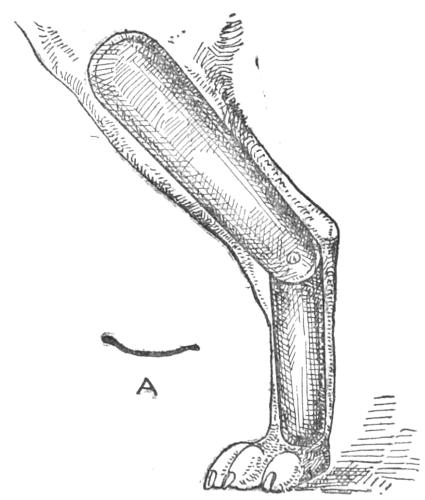
A splint with a joint for fractures of the back leg
Over the bandage a few strips of Mead’s plaister should always be used to prevent the bandage shifting.
Fracture of Femur (Thigh Bone):
Treatment: Except in cases of fracture of the lower extremity, these cases are difficult to treat, in consequence of the shape of the leg, for one thing; and for another, the limb is so close to the body that a bandage cannot with advantage be put round. Under these circumstances, it is always best in cases of broken thigh, except when it occurs at the lowest extremity—that is, just above the stifle joint—to leave it to Nature, who, as a rule, makes a very good cure, except that the leg as a result may be a little shorter than its fellow. The muscles around the bone are so thick and strong that they take the place of bandages, and keep the bone in its place; whereas when a bandage is applied, it does harm, and as a consequence the bone seldom unites. At the lower extremity it is different; the muscles here are not so thick, and the application of a splint and bandage supports the broken bone. The best form of splint is one similar to the kind recommended for fracture of the tibia, but made to extend nearly to the top of the thigh. To fix this splint in its place, an ordinary bandage should be applied nearly up to the stifle joint, and then above this the splint is to be kept in its place by means of strips of Mead’s plaister, as a simple bandage cannot be kept on the thigh in consequence of its shape and position.
Fracture of the head of the femur occurs sometimes, especially in puppies, which is often mistaken for dislocation of the hip joint, of which I have never seen a case. The part that is really broken is the neck of the ball of the head of the femur, which fits in the cup of the pelvis that goes to form the hip joint. In these cases great pain is caused by pulling the leg back or abducting it, and distinct crepitation may be felt and heard when moving the limb. If there is any doubt about the case, the exact condition of the parts can always be plainly seen with the assistance of the X-rays.
After fracture of the neck of the head of the thigh bone, the top of it—namely, the trochanter—sticks up higher than it did before, and this will be particularly noticed if the injured joint is compared with the corresponding one on the other side.
Treatment is useless in these cases, for the broken bone will never unite again; but in time a false joint is formed, and though the limb will for ever afterwards be shorter than its fellow, yet after a time it becomes a very useful member, and the dog scarcely walks lame at all, except perhaps after some unusual exertion, but the muscles never develop to the same extent on the injured side as they do on the sound one.
In treating small dogs with fracture of the legs, it is very important that the bandages should be as thin and light as possible. In these cases have bandages made of thin muslin or butter cloth about one and a half inches wide and four yards long, which soak in a thick solution of gum acacia. This is put straight on the broken leg after it has been set straight. A good many layers may be put on, and over this four thin unpadded splints are adapted, and then a few layers of ordinary bandage to keep the splints in their place, and they with the outside bandage may be removed in a couple of days, by which time the gum has dried and set firmly.
Pelvis, Fracture of: Different parts of the pelvis become fractured as the result of accident, generally from a dog being run over.
Symptoms: The dog goes very lame, in many cases with straddled legs, and often for a time may not be able to walk at all. There is a good deal of pain on manipulation and swelling of the fractured parts.
Treatment: The dog for a month or so must be kept very quiet, and a jacket placed on the hinder parts assists in keeping them together.
In all cases of fracture, it is most important that the dog be kept absolutely quiet for the first three weeks; if the dog must go out for certain purposes, then he should be carried to a garden and back again. If this is not attended to, the broken bone will not unite, and as a consequence there is what is called a false joint formed—that is, a soft union between the two broken ends of the bone—and as a result the dog is never able to bear weight on the limb, and it is never straight.
In cases of comminutive fracture, the same treatment is required as for simple fracture, but more time must be given for union to take place.
Compound Fracture is more difficult to treat as the limb cannot be set up permanently, as it is necessary to dress the wound daily, or at any rate every other day for a time, and this disturbs the leg and interferes with the mending of the bone. Before setting the limb in these cases, the wound must be thoroughly cleaned with some antiseptic solution as Pearson’s fluid, one in eighty parts of tepid water, or a solution of chinosol, one grain to the ounce of water. All pieces of exposed loose bone must be removed, and pieces of bone sticking through the wound that cannot be put back must be sawn, or nipped off with bone forceps. Then the limb, after being put in a natural straight position, should be enveloped in several layers of some antiseptic gauze, before applying the padded splints in the usual way. It is advisable, if possible, not to place a splint over the wound, then by cutting a hole through the bandages so as to expose the wound in the skin, which can be done when it is small, it can be daily dressed without removing the whole of the bandages every day, though it is necessary to do so once a week, as the dressing becomes soiled with the discharge. The hole made in the bandages must be kept packed with disinfectant gauze, as iodoform or carbolic gauze, and be changed daily.
Fracture of Bones of the Tail are best treated by setting up the tail with strips of Mead’s adhesive plaister. Many layers must be applied so as to keep the parts at rest. Adhesive plaister is advised, as it is almost impossible to keep a bandage on the tail unless pitch or some other such material is used, and this makes the dressing so heavy and uncomfortable for the patient.
Green Stick Fracture: That is when a bone is broken, and the parts are not displaced.
Symptoms: These cases are sometimes difficult to diagnose, however, the parts are swollen and painful, and the dog is unable to put the foot to the ground. With the aid of the X-rays the fracture is easily discernible. The bone which I find by experience most liable to this form of fracture is the radius or fore arm.
Treatment: The same as for cases of simple fracture, and it soon unites, and the leg becomes strong again.
Broken Back, which occurs sometimes as the result of a dog being run over, the part that generally breaks is across the loins—lumbar vertebræ—well forward close to the dorsal vertebræ.
Symptoms: Acute pain at the part, some swelling of the soft tissues covering the injured vertebræ, and loss of power and feeling of the parts behind the injury.
Treatment: Useless; it is much the best to have the dog at once put out of his misery.
Fracture of the Cervical Vertebræ or Bones of the Neck may occur from a dog being run over across the neck. Death, as a rule, quickly occurs. There is nothing to be done.
Fracture of Ribs: This is not an uncommon occurrence.
Symptoms: Pain at the seat of injury, and some local swelling. The fractured rib can easily be felt, and there is some crepitation when manipulated. The broken ends of the rib are inclined to turn inwards.
Treatment: Place a fairly wide linen bandage, or, what is better still, some wide strips of Mead’s adhesive plaister, round the chest. Union, as a rule, of the broken rib soon takes place.
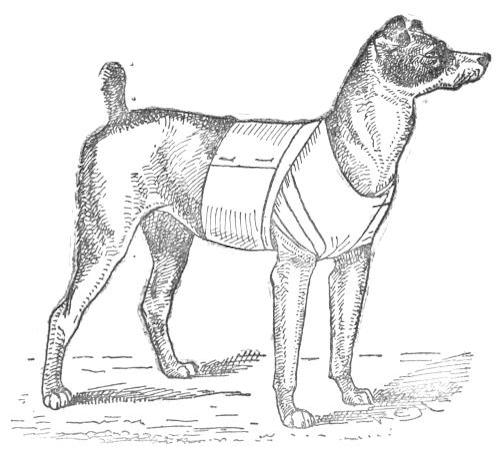
Showing how to bandage a dog’s chest for fracture of ribs and other injuries to the chest
Fracture of the Bones of the Skull, especially those of the forehead, occasionally occur.
Symptoms: The broken bone will be generally found depressed; the part is very painful, and swelling soon occurs. This injury is often accompanied by a good deal of acute congestion of the brain, the result of concussion, and as a result the dog often becomes unconscious soon after the accident. This may continue for days, or until the pressure, the result of the fractured bone on the brain, is relieved by operation. The dog, of course, during the unconscious condition is quite paralysed in all four limbs. After the pressure is removed, the dog soon regains consciousness, and strength to the limbs gradually returns.
Treatment: In these cases it is important to keep the dog absolutely quiet; to feed on liquid food, carefully given with a spoon or bottle, in small quantities often. When the patient is very restless, an ice-bag may be applied to the forehead, and small doses of bromide of potassium given every four hours mixed with the food. When the fractured bone is depressed, and is pressing on the brain, the sooner this is relieved by operation the better. Of course, for some time afterwards the dog must be kept very quiet.
Fracture of the Upper Jaw: This occasionally occurs as the result of a blow, as the kick of a horse; also from being run over.
Treatment: A bandage cannot be easily applied here to any advantage. If the mucus membrane has been torn, and the bone exposed, all loose pieces must be removed, also broken and loose teeth; and the mouth should be thoroughly washed out three or four times a day with a teaspoonful of borax to half a pint of water, and the dog fed on sloppy food for a time.
These cases, as a rule, do very well.
Fracture of Lower Jaw: This is not an uncommon occurrence, as the result of the same causes as fracture of the upper jaw.
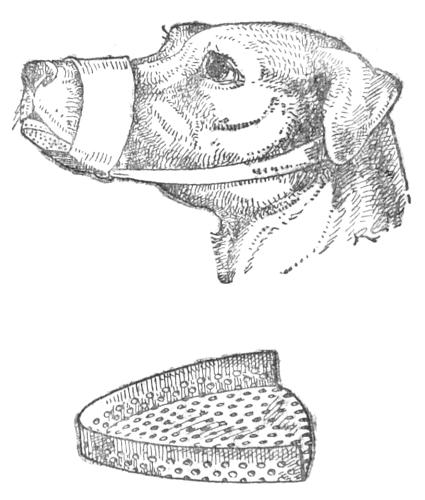
A splint for fracture of bottom jaw
Treatment: The removing of loose bone and teeth is to be carried out the same as recommended in cases of broken upper jaw; but here a splint can be applied, and is necessary, as there is not the same natural support as there is in the upper jaw. Of course, there is some difficulty in applying a splint and bandage in these cases to dogs with a very short face, especially when the patient is very small—as, for instance, a griffon—and moreover, it is not quite so necessary, as there is more natural support in a short jaw than a long one, like a terrier’s or greyhound’s. The splint should be made of perforated zinc, and of the shape as depicted in the illustration, and be applied as well as the bandages, as depicted in the illustration. The bandages must be put on sufficiently tight, so that the dog cannot open the mouth. There are cases when a dog will not tolerate a splint and bandages; in such instances, the broken ends of the bone must be brought firmly together with a strong silver wire suture, and fastened by twisting. The dog’s strength in these cases must be kept up with milk and raw eggs, beaten up together; also milk and Benger’s food or sanatogen, as well as beef tea, as it is necessary that the splint and bandages be kept on for at least three weeks, and even after this nothing but sloppy food must be allowed for a time.
Gall-stones:
Symptoms: Acute abdominal pain, great tenderness of the abdomen, and if relief is not soon given jaundice follows.
Treatment: To relieve the pain, give five[1] drops to a teaspoonful of laudanum in a teaspoonful[1] to two tablespoonfuls of water. If pain continues, the medicine may be repeated in an hour, and again an hour later if necessary. Hot linseed meal poultices should be applied to the abdomen. If jaundice follows, give from three[1] to ten grains of the Homœopathic preparation of Merc: Sol: 3 × every three hours for three or four days. Under the best circumstances treatment can only have but temporary benefit.
Gangrene:
Symptoms: This may follow improper treatment of a severe wound, also the result of a too tightly bandaged leg in a case of fracture, or as I have seen, from an elastic band being placed on the leg, or in some cases on a dog’s tail. The parts are at first very swollen, painful and red, later skin turns blue or even black. Skin oozing very offensive blood-coloured fluid, later the pain disappears from the part, and it becomes cold and clammy, and turns green; in fact, becomes putrid.
Treatment: If from the too tight application of a bandage, or from an indiarubber band, it should at once be removed. Hot linseed meal poultices, dusted over freely with charcoal, applied every four hours, and then the parts should be freely washed with a warm saturated solution of boracic acid; carefully dried and wrapped in carbolic gauze, and a bandage lightly applied. As a rule, there is a good deal of constitutional disturbance in these cases, and it is advisable to give some medicine such as salicine, say from three[1] to fifteen grains every six hours, either in tabloid or cachet, also stimulants as brandy.
Gastric Ulcer:
Symptoms: Dogs suffering from this disease are occasionally seen bringing up their food, sometimes tinged with blood, which is generally of a bright red colour. The quantity of blood varies. Sometimes there are streaks mixed with vomited matter, or there may be quite a quantity, causing great exhaustion. They also lose condition, become anæmic and languid.
Treatment: The principal thing in these cases is diet, which should be light and of an easily digested nature, as milk with the white of egg, or milk thickened with Benger’s food. When the dog is very weak, a little Valentine’s meat juice should be added with each lot, but nothing solid. When the bleeding is severe give ergotine, a half[1] to two grains every two or three hours, in a teaspoonful[1] to a tablespoonful of water; but when it is very slight the styptics are not necessary, but give the dog each time a quarter of an hour before food from two[1] to ten grains of carbonate of bismuth, and immediately after food from one[1] to five grains of ingluvin. It is necessary in these cases to keep the dog absolutely quiet. Do not allow the dog to drink a lot of water; if very thirsty, give Vichy water and milk in equal parts to drink, as plain water increases the vomiting.
Gastritis (Acute):
Symptoms: Frequent and violent vomiting, also diarrhœa. The attack is accompanied by great thirst.
Treatment: Keep the dog quiet, and prevent his drinking water. If he is very thirsty, give Vichy water and milk to drink in equal parts, or ice to lick. Give every four hours from three[1] to ten grains of carbonate of bismuth shaken dry on the tongue. If this does not stop the sickness, give the mixture as recommended for Specific Gastritis. In some cases the sickness is so acute that if every care is not taken the dog dies from exhaustion. In such instances the dog’s stomach should be given absolute rest, the dog not being allowed to drink even water, or have ice, say for six to twelve hours. To keep the dog’s strength up, give a peptonised beef suppository every three or four hours. If there is any diarrhœa, give an enema of a dessertspoonful to two tablespoonfuls[1] of milk, thickened with starch, with from five[1] to twenty drops of laudanum added, every four or six hours. When the sickness has stopped, food must be given very sparingly by the mouth, and should consist of peptonised milk or milk and Vichy, and just a small quantity of Brand’s, every hour or so. After a couple of days, if the dog is doing well, a little scraped lean raw mutton may be offered.
Gastritis (Chronic):
Symptoms: In this complaint the dog occasionally vomits, bringing up his food, is very thirsty, and loses condition. The tongue, instead of being a nice pink colour, is brick-red colour and dry, and occasionally diarrhœa occurs.
Treatment: For this a diet of raw meat for a time will put the dog right, a small quantity three times a day; and an hour before each meal give from three[1] to fifteen grains of carbonate of bismuth. In very obstinate case, small doses of arsenic, as from half[1] a drop to two drops of Fowler’s solution, with from two[1] teaspoonfuls to two tablespoonfuls of water, and given before food, does good.
Gastritis (Specific):
Symptoms: This is a contagious disease which has been prevalent amongst dogs of late years. It is sometimes called German distemper, and often terminates fatally. The dog generally commences with vomiting, and rise of temperature; the breath becomes very offensive, teeth highly furred; ulcers often form on the tongue, along the edge of gums, and inside the cheeks. There is great wasting. As the disease progresses, the vomiting increases, the dog often bringing up blood or coffee-coloured, offensive fluid; also dysentery is present. Unlike ordinary gastritis, there are generally two or three degrees of fever, but the temperature soon falls below normal, and the pulse from the commencement is rapid, whereas in ordinary gastritis you seldom get any rise in temperature or alteration in the number of the pulse-beats. A very characteristic symptom of this disease is a very congested condition of the eyes.
Treatment: The dog must be kept exceptionally quiet, and prevented from drinking any water, as it only irritates the stomach. A liquid diet is absolutely necessary, such as Vichy water and milk in equal parts to drink, milk and white of egg or Benger’s food, and occasionally a little Brand’s beef essence. For medicine, give from one[1] to five drops of cyllin, which is best given in a gelatine capsule, three times a day. If the vomiting is very severe, the following mixture can be given:—
Recipe:
Diluted Hydrocyanic Dil., 24 drops.
Liq. Bismuth, 3 drachms.
Water to 3 ounces.
Doses: From a half[1] to two teaspoonfuls every three or four hours.
It is very important to keep the mouth scrupulously clean. For this a lotion of permanganate of potash may be used, five grains to a tumbler of tepid water. If ulcers form, apply sparingly night and morning 5 per cent. solution of bromic acid. There is always a danger of relapse in these cases if a solid diet is permitted too soon. The liquid diet should be continued for at least a week after the dog seems apparently well.
Glandular Enlargement:
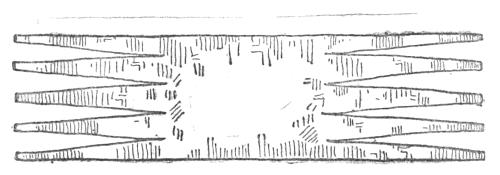
A many-tailed bandage. A useful way of applying a poultice or dressing to the upper part of the neck
Symptoms: The glands about the throat are subject to swelling from cold; also they may become enlarged when some injury resulting in inflammation has taken place in the neighbourhood of the neck. The lymphatic gland, situated at the lower part of the neck, just in front and to the inside of the shoulder-joint, is much subject to enlargement and the formation of tumour. Another favourite situation for similar enlargements or growths to occur is the lower part of the abdomen (pubes), between the hind legs, just above and on each side of the sheath of the penis. Enlargements of the lymphatic gland, on the inside of the elbow-joint, occur in cases of cancer of the breast.
Treatment: When from a cold, as enlargement of the throat glands, use following liniment:—
Recipe:
Colourless Tincture of Iodine, 4 drachms.
Spirits of Camphor, 1 ounce.
Soap Liniment to 3 ounces.
A little to be gently rubbed into the swelling night and morning.
When enlargement of the sympathetic glands, the result of some inflammation going on in the neighbourhood, no special treatment is required, as the condition will cease as the inflammation subsides. The tumefied glands, when situated near the front of shoulder, also under arm or in the pubic region, may be treated with iodine vasogen for a time, but any treatment except an operation is unlikely to be successful.
Glandular Enlargement (Lymphadenoma):
Symptoms: This is a serious disease, and often affects all the lymphatic glands of the system, they becoming much swollen and painful. Those glands under the jaw are generally the first to show the disease, and they often increase from a bean (normal size) to a walnut in size. The disease extends to the other glands, as those in front of the shoulders; also those under the arms. Those at each side of the penis, the back of the hind legs, and even the gland situated in the abdomen are affected; in fact, the dog is all lumps and bumps, and is a wretched object.
Treatment: Is seldom attended with success; but occasionally large doses of iodide of potassium, from one to ten grains,[1] well diluted with water, seems to retard the progress of the disease for a time. Removing the diseased glands by operation is not of any use.
Glaucoma:
Symptoms: The white of the eye is very red, and the ball is distended and painful on pressure. The eye loses clearness. Disease usually begins in one eye, but the other often gets affected later.
Treatment: Foment frequently with hot poppy-head tea, made by boiling for a few minutes in a quart of water two crushed poppy-heads and then strain through fine muslin. The tea should be applied as hot as the dog can comfortably bear it. Also apply the following drops:—
Recipe:
Dionin, 2 grains.
Pilocarpine, 1 grain.
Sulphate Eserine, ½ grain.
Distilled Water to 4 drachms.
Two drops to be placed in the eye three or four times a day.
Glaucoma often requires surgical treatment, as puncturing the eye just where the schlerotic coat joins the cornea. Sometimes it is necessary to remove the eyeball, and this often has the advantage of preventing the other eye becoming affected.
Gleet:
See Balanitis.
Goitre:
Symptoms: A swelling, varying in size from a pigeon’s to a goose’s egg, situated low down in the neck, due to enlargement of the thyroid gland. Almost always both lobes of the gland are affected, and there is a swelling at both sides of the neck, though one may be slightly larger than the other. As a rule, the condition does not cause much inconvenience unless the glands are very big, or the patient very young—say six weeks of age—when the breathing is often difficult, and death takes place.
Treatment: When the patient is not very young, the hair over the swellings should be cut short, and tincture of iodine applied every day for three or four days; then, after waiting a week, the iodine may be repeated if the swellings remain. When the patient is very young, say a few weeks old—and the disease is rather common amongst pointers at this age—the case is best treated with the homœopathic preparation of iodide of potassium 3 x; dose, three grains thrice daily. Afterwards, when the swellings are reduced, give cod-liver oil or malt.
Gripping:
See Colic.
Gum, Growth on:
Symptoms: A hard, irregular-shaped growth of a red colour, which is somewhat constricted; occasionally grows on the gum, or rather from the periosteum of the jaw-bone. It is called an epulis. It is more common in old than young dogs, and it is difficult to cure. When the growth assumes large proportions, it pushes the teeth quite out of the regular line, and causes them to become loose.
Treatment: When possible, the application of a ligature of strong silk tied tightly round the neck of the growth, and as close as possible to the gum, is the best way of removing it. Sometimes this is not practical, as the base is large. In such cases, the growth should be cut off close to the gum, and the roots scraped down to the bone.
Gumboil:
Symptoms: A painful, swollen gum, generally the result of a bad tooth, or may arise from cold.
Treatment: Extract tooth; wash mouth out after with a drachm of chlorate of potash dissolved in a tumblerful of warm water. Give a dose of purgative medicine.
Gums, Bleeding:
Symptoms: Occasionally the gums will bleed very freely, particularly in old dogs, and often apparently without any reason, and in some cases the bleeding is very difficult to stop.