THE DOG’S MEDICAL DICTIONARY
Reading edition
Abrasions:
Symptoms: The outer skin or epidermis is rubbed off, leaving a raw surface.
Treatment: Clean thoroughly with hot boracic lotion, made by dissolving a teaspoonful of boracic acid in half a pint of hot water; carefully dry, and apply boracic ointment; bandage the part, and prevent the dog from licking.
Abscesses:
Symptoms: Swellings, the result of the formation of pus—commonly called matter—accompanied by fever.
Treatment: Apply hot linseed meal poultices, over which should be placed a piece of oil silk to keep in the heat. Repeat poultices often. When swelling quite soft, it should be freely opened, all matter carefully squeezed out, and the cavity washed out with warm boracic lotion. The wound should afterwards be covered over with a few layers of boracic or carbolic gauze, and a bandage applied. Keep wound open two or three days.
Acidy, or Gastric Catarrh:
Symptoms: Great thirst, occasional sickness, loss of condition, and the passing of a quantity of clear-coloured urine.
Treatment: For few days give following mixture:—
Recipe:
Bicarbonate Soda, 1 scruple to 2 drachms.
Tincture of Rhubarb, 1 drachm to 4 drachms.
Tincture Nux Vomica, 12 minims to 1 drachm.
Tincture of Gentian, ½ drachm to 3 drachms.
Liquor Bismuth, 2 drachms to 1 ounce.
Water to 1½ ounces to 6 ounces.
Dose: Half a teaspoonful to one tablespoonful[1] three or four times a day one hour before food.
Diet: Underdone mutton or veal mixed with Spratt’s charcoal biscuits, or stale bread or toast, broken up small, and mixed with a little soup. Avoid fatty or starchy food, and give no sugar.
Acne:
Symptoms: Small red spots about the body, head, and limbs. There is not much irritation. More often noticed in the spring and autumn.
Treatment: Apply following lotion frequently:
Recipe:
Milk of Sulphur, 1 ounce.
Glycerium Boracis, 1 ”
Liquor Bismuth, 1 ”
Water to 8 ounces.
Give following powders twice a day with food:—
Recipe:
Reduced Iron, 6 grains to 2 scruples.[1]
Bicarbonate Potash, 1 scruple to 2 drachms.
Sulphate Magnesia, ½ drachm to 4 ”
Mix.
Divide into 12 powders—one to be given twice a day with food.
Diet: Some meat mixed with green food (boiled dandelion leaves), and bread or biscuits.
Albuminaria:
Symptoms: Though the dog may be very hungry, and eats well, he loses condition; is generally very thirsty; coat staring; passes water frequently and often; and misbehaves in the house, especially at night. If some of the urine is boiled, a thick white sediment forms, due to coagulation of the albumen.
Treatment: Limit the quantity of water supplied to dog. Barley water or skimmed milk is better than plain water. Give from one to six grains[1] of ammoniated citrate of iron in water three times a day. In some cases, when symptoms very acute, from the tenth to a grain[1] of powdered opium three times a day is useful.
Diet: Underdone mutton or veal, with toast or ship biscuits; also boiled fresh fish.
Alopecia:
Symptoms: Loss of hair; baldness, the skin being clear and free of irritation.
Treatment: The Lotion:
Tr. Cantharides, 2 drachms.
Oil Rosemary, 2 ”
Glycerine, 4 ”
Water to 8 ounces.
Mix.
Apply twice a day. Avoid the parts near eyes. Or the application of kerosene, just dabbed on, may be tried.
In obstinate cases a single painting over the bare parts with liquor epipasticus is useful. This remedy should only be applied to a small part of the skin at one time.
Amaurosis:
Symptoms: A disease of the eyes attended with a diminution or total loss of sight—result, paralysis of nerves of the eye. The eyes are clear, with pupils largely dilated, which do not contract when exposed to strong light.
Treatment: Generally incurable. Following lotion may be tried:—
Recipe:
Sulphate Eserine, ½ grain.
Distilled Water to 1 ounce.
One or two drops to be placed in the eye three times a day.
Tincture nux vomica, from one[1] to five drops, should be given in water three times a day after food.
A blister or seton may be tried at the back of the head (pole).
Anæmia:
Symptoms: Mouth and eyes pale, caused by deficiency in quantity and quality of the blood. Loss of condition, often great thirst, constipation. The dog is very languid.
Treatment: Good food—plenty of under-done or raw meat, also milk. The arsenic and iron pills recommended for eczema. If there is constipation, add from two to twelve grains of rhubarb to each dozen pills. When the stomach is very irritable, from a half to three grains[1] of reduced iron may be tried alone. The dose should be given three times a day with the food.
Anæsthetics:
The best way to administer chloroform is by one of Krohne & Sesemann’s inhalers. When this is used, it is almost impossible to have any bad results, as the chloroform is given so slowly. Failing one of these appliances, it may be given on a napkin folded so as to make a pouch in which the nose should be put; but it is necessary to muzzle the dog before commencing, otherwise he will be sure to bite the operator. In giving chloroform it is necessary to commence with very small quantities; about twenty[1] drops to half a drachm should be poured inside the pouch formed in the napkin, and then placed over the dog’s nose. This should be repeated every two or three minutes until the dog lies quietly, and the eye is insensible to the touch. When a dog is under the influence of chloroform it is most important to watch the breathing, and if it becomes very slow, discontinue giving the chloroform immediately. If the breathing stops, remove the muzzle, draw the tongue out as far as it will come, and hold to the nose, on a piece of lint, a few drops of strong ammonia, and resort to artificial respiration. Dogs always struggle very much against taking chloroform, therefore one should always be prepared with one or more assistants to hold the dog securely whilst it is being administered.
If the patient is an old one, instead of giving pure chloroform, give a mixture consisting of equal parts of chloroform, ether, and alcohol mixed together, given in the same way as chloroform, or pure ether may be given. In this case it is necessary to give this anæsthetic very freely, the dog being muzzled. A dessertspoonful, or tablespoonful, should be poured on a napkin, and held tightly over the dog’s nose. This quantity should be repeated every few minutes until the dog is insensible.
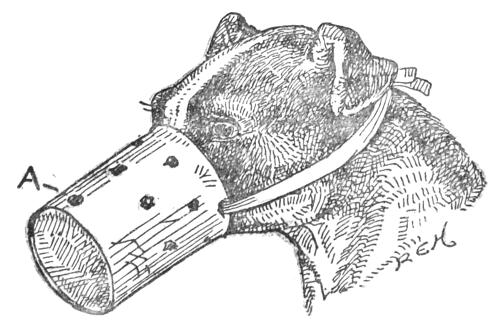
A Simple Way of giving Chloroform
Cocoa, coffee, or other cans with holes punched round and tied over muzzle. A—Hole in the upper part of can to pour anæsthetic.
Another good way of giving chloroform, or the compound mixture mentioned, when a proper apparatus is not at hand, is out of a round tin canister, perforated round the sides to allow plenty of air to be mixed with the chloroform. At the bottom of the canister a piece of sponge or lint should be fixed, on which the chloroform should be poured. More of the anæsthetic as required may be syringed through one of the lower holes. The tin can be fastened on the nose by tapes, which should be passed behind the ears and tied.
Cocaine, a Substitute for Chloroform: Cocaine is an alkaloid extracted from the leaves of the Erythroxylon Coca, which grows as a kind of shrub in Bolivia and Peru.
The hydrochlorate of cocaine is the preparation mostly used, as it is more soluble in water.
Cocaine is equal in its effects to chloroform in many operations where the parts to be removed are not very deep-seated; besides, its use is much more economical, as not only is the drug itself of less expense, but when operating it is not necessary to have a separate attendant to administer it, as is the case when chloroform is given. Then it is much more easily given (by a hypodermic syringe), and the dog does not resist it at all; whereas, chloroform is resisted by the patient with all its strength. In some cases three or four assistants are required to hold a big dog whilst it is being administered, and I have known some dogs to struggle so violently against taking chloroform that one has been obliged to discontinue giving it, for to have persevered would have endangered the dog’s life. This alone is sufficient reason to make cocaine a more favourable anæsthetic than chloroform.
Then as to the danger, there is no comparison between the two. I have only once had any bad results from the use of cocaine; but with chloroform, sometimes, in spite of every care and precaution, the dog will, when under its influence, suddenly collapse. Besides, when a dog, in a case such as I have just described, struggles very much against receiving the chloroform, it takes longer to get him under the influence of the drug than one taking it quietly; and then, often as a consequence, the dog at last becomes exhausted, and if the chloroform is persevered with, it takes too strong effect—the heart’s action becomes weak, the breathing heavy, and collapse may occur—the result is, one is obliged to leave off the operation to administer restoratives to save the patient’s life.
In many operations, as the excising of tumours (even large ones, weighing six or seven pounds), removing thorns from the eye, sewing and dressing painful wounds, cocaine is equal to chloroform in its effects, for it completely deadens for a time the parts to which it is applied, though the animal retains complete consciousness.
It is particularly valuable when removing mammary growths, so frequently seen in bitches. On many occasions I have removed a growth of this kind weighing, in some instances, seven to eight pounds, without subjecting the dog to the least pain; and I may here remark that the application of cocaine does not in any way retard the healing process.
Cocaine for most purposes is best used dissolved in water; the quantity of the solution required depends upon the size of the growth that is going to be removed. For small tumours, say the size of a large walnut, a four per cent. solution is generally sufficient. Of this about twelve minims should be injected under the skin, say three drops at each corner of the growth, then in the course of about ten minutes the parts will be completely insensible to pain and ready for operation. The same strength of solution is also strong enough for eye operations, including the removal of growths on the haw. In such cases the solution of cocaine must be dropped into the eye. About five or six drops is all that is required; one drop to be placed into the eye every minute until the quantity required is given, then wait ten minutes for the cocaine to take effect. In cases of operation for inverted eyelid, the use of cocaine is invaluable.
When removing large growths, a five per cent. solution is necessary, giving the same quantity—about twelve minims—injecting one minim just under the skin all around the tumour, and where the skin is going to be cut.
There are other local anæsthetics as eucaine, which is said to be safer than cocaine; but in my opinion it is not nearly so good, at any rate with dogs, and the latter is perfectly safe when used in proper doses.
Eucaine is also used in conjunction with adrenalin, which has a wonderful power of preventing and stopping bleeding; but in my experience, when injected under the skin previous to an operation, the wound does not heal so readily, in consequence, I consider the bloodless condition of the skin, which continues for some time after, due to the application of this drug.
Anal Glands, Congestion and Irritation of:
Symptoms: Dragging themselves along the ground, which is often supposed to be due to worms, frequently licking the anus, suddenly looking round behind and tucking the tail in as if there was something pricking. In these cases there is a small swelling on each side of the anus due to an accumulation of the natural secretion of these glands. Occasionally a painful abscess forms.
Treatment: In simple cases all that is required is to squeeze the glands and evacuate the contents, and this, as a rule, gives immediate relief. In some dogs these glands require attention every three or four weeks. If an abscess forms, the swelling should be fomented with hot water, and when soft freely opened, the contents evacuated, and the cavity syringed out with a warm saturated solution of boracic acid. The wound should be kept open for a few days. In troublesome cases it is best to have the glands removed altogether by operation, and so save further inconvenience to the dog.
Aneurism:
Symptom: Dilation of an artery. Difficult to detect in a dog.
Treatment consists in ligaturing the artery.
Angina Pectoris:
Symptoms: Acute pain in chest, fainting, pallid tongue, difficult breathing, limbs feel very cold.
Treatment: Hold to nose, on a piece of blotting-paper doubled in shape of a funnel, from one[1] to five minims of nitrite amyl. Repeat in half an hour if necessary.
Diet: For a day or so after attack feed on Brand’s beef or chicken essence and Benger’s food with milk. After a day or two put patient on a raw meat diet, which continue for some time.
Anthrax:
Uncommon disease in the dog.
Symptoms: A carbuncular swelling, commencing as a pimple accompanied by high temperature. Disease runs a quick course and is generally fatal.
Treatment: Free opening and scraping of the affected part. Apply hot linseed meal poultices, which should be freely dusted over with powdered charcoal, and give stimulants, as brandy or whisky, freely. If temperature over 105 degs. F., from one[1] to ten grains of phenacetin may be given as well as the stimulants. Repeat medicine once in four hours.
Anus, Prolapsus of:
A complaint often seen in young puppies, though it may occur in full-grown dogs. It is generally the result of straining caused by diarrhœa.
Symptoms: The lower bowel or rectum protrudes for an inch or more from the body, which, if not relieved, becomes inflamed and swollen, and the patient is constantly straining.
Treatment: Return the protruding part as quickly as possible. This is best done by holding the dog up with the hind legs, and then after vaselining the part, applying firm pressure with the fingers, and the prolapsus will slip in. This is very simple and easy, but the difficulty is to keep it in. There are several ways of trying to do this, but first of all give a small enema, from one[1] to four teaspoonfuls of thick boiled starch, with from five[1] to twenty drops of laudanum to stop the straining. In a recent case this may have the desired effect, and the prolapsus not return; if it does, then it must be put back as before, and to keep the bowel in, a couple of strong sutures should be placed through the anus, one from above downward, and the other crossways, or what is called a purse-string suture may be inserted. Another way is by inserting and fixing in the bowel by means of tapes the lower insertion portion of an enema tube, the tapes should be passed across the outside of the thighs, then crossed under the belly and tied over the back. But often, in spite of every care and treatment, the dog will keep straining and force the bowel out time after time. In such cases, the only thing to do is to remove the prolapsus by operation. This operation requires a considerable amount of care, or fatal hæmorrhage may occur, or the peritoneal cavity may be opened and peritonitis set up.
Apoplexy:
Symptoms: Generally affects old dogs. Suddenly falling to the ground, convulsions, loss of consciousness. Tongue generally turns dark in colour, eyes prominent and congested. May be in an unconscious state for some time. Paralysis to a more or less extent may follow. Sometimes the head is only held on one side from muscles of neck being paralysed: blindness may result.
Treatment: Free purge from one[1] teaspoonful to four tablespoonfuls castor oil, mixed with half the quantity of syrup buckthorn. Put dog in hot bath and apply ice to head. If convulsions are severe, give bromide of potassium and hydrated chloral. From two grains to one scruple of the former, and half the quantity of the latter, with water. Repeat every three or four hours until convulsions cease. Do not attempt to force anything down the dog’s throat whilst in convulsions or unconscious, and if this continues some time, give double dose of the medicines by enema.
Diet: Liquid food, milk with bread or Sanatogen, and light soup with bread or toast.
Appendicitis:
This disease, strictly speaking, does not occur in the dog as there is no appendix to the cæcum—but they do occasionally suffer from inflammation of this part.
Symptoms: Tenderness or pain over the seat of the cæcum, which is about the centre of the abdomen; vomiting and diarrhœa, or even dysentery; sometimes bowels constipated. Temperature often rises two or three degrees. Loss of appetite. In some cases the cæcum may be easily felt, and is generally hard and swollen when inflamed.
Treatment: Rest and free administration of laudanum, from two[1] to fifteen drops, given in water every four or six hours.
In cases due to the impaction of some foreign body, as a stone, coin or key, etc., in the cæcum, which may easily be detected by means of the Röntgen rays, an operation is necessary.
The cæcum may be removed with a certain amount of safety.
Appetite, Want of:
Treatment: When not the result of actual disease, but to want of tone of stomach, often seen in delicate dogs, try following mixture:—
Recipe:
Bicarbonate Soda, 12 grains to 1 drachm.[1]
Spirits of Nitre, 1 to 4 drachms.
Tincture Nux Vomica, 6 minims to ½ a drachm.
Water to 1½ to 6 ounces.
Dose: One teaspoonful to a tablespoonful[1] three times a day one hour before food. Try a change of food, as raw meat. For little dogs, grilled chicken’s liver or kidneys, with stale bread crumbs; also stewed rabbit with rice.
Appetite, Morbid:
Symptoms: Picking up and eating all kinds of rubbish and filth, stones, coal, and when out in the streets, horse dung, etc.
Treatment: Always give worm medicine in these cases. Dust over anything you know the dog will pick up with some cayenne pepper. In many cases one is obliged to resort to a muzzle, and make the dog wear one when out. Very often when this is persisted in for some weeks, the dog gets out of the habit.
Arthritis, Inflammation of a Joint:
Symptoms: The joint is swollen and very painful; dog is very lame, and in some cases unable to put the foot to the ground.
Treatment: During acute inflammation rest is necessary, soothing remedies should be applied, hot poppy-head tea fomentations, or the following lotion:—
Recipe:
Laudanum, 2 drachms.
Goulard’s Extract of Lead, 1 drachm.
Water to 6 ounces.
A piece of lint, large enough to cover and go round the joint, should be saturated with the lotion and applied. This should be covered entirely over with a piece of oil silk, and a bandage applied to keep dressing in place. Change the dressing three times a day.
A dose or two of aperient medicine should be given.
When acute inflammation has ceased, the joint should be massaged, and later, if the joint remains stiff, the dog should be made to swim.
Asphyxia:
Symptom: Interruption to breathing, from drowning and other causes.
Treatment: Dash hot and cold water alternately over the head, and inject stimulants, as ether or brandy, under skin—from ten[1] to twenty drops of either.
Artificial Respiration: When the condition is due to partial drowning, hold the dog up, with his head downwards for a minute that the water may escape from the lungs, then place the dog on his back, draw the tongue out, and with the hand placed on the lower part of the chest—that is just where the chest and abdomen join—press downwards and forwards with some little force, then suddenly raise the hand to allow the chest to expand. This should be repeated every three or four seconds. Do not attempt to make the dog swallow whilst in an unconscious state.
Asthma:
Symptoms: Heavy breathing, troublesome cough. If the ear is applied to the chest a crackling noise will be heard with each inspiration. The heart is weak and the pulse irregular.
Treatment: Aperient medicine should be given, and be repeated once or twice a week, also the following mixture:
Recipe:
Liquor Morphia, ½ to 3 drachms.[1]
Hoffman’s Spirit, ½ to 3 drachms.
Paregoric, 1 to 4 drachms.
Syrup of Squills, 2 to 8 drachms.
Water to 1½ to 6 ounces.
Doses: One teaspoonful to a tablespoonful three or four times a day, or from ten drops to a teaspoonful of glyco-heroin in a little water may be given three or four times a day.[1]
When the condition is the result of heart disease, which is often the case, give the following mixture:—
Recipe:
Tincture Digitalis, 20 drops to 1½ drachms.[1]
Tincture Nux Vomica, 12 drops to 1½ drachms.
Compound Sulphuric Ether, ½ to 3 drachms.
Syrup, 2 drachms to 1 ounce.
Water to 1½ to 6 ounces.
Mix.
Doses: From one[1] teaspoonful to one tablespoonful three times a day after food. Aperient medicine should be frequently given.
Diet: Raw or very tender-cooked meat, given in small quantities, three times a day. No other food.
Back (injuries to):
See Appendix.
Bad Breath:
Symptoms: General result of a diseased condition of teeth, the accumulation of tartar on the teeth, and as the result, ulcers form on the gums and cheeks. Bad breath may also arise from a disordered condition of the stomach, or as a result of some disease of the lungs, or the membrane lining nasal passages.
Treatment: Remove the cause. If it arises from the condition of the teeth, remove the tartar by scaling, and clean mouth and teeth twice daily, using a small soft tooth-brush and the following wash:—
Recipe:
Salol, 1 drachm.
Tr. Myrrh, 2 drachms.
Spirits of Wine, 10 drachms.
Formalin, 1 drachm.
Mix.
Half a teaspoonful to be added to half a tumblerful tepid water. If the breath remains offensive after the mouth has been made healthy, give a pill three times a day containing from a quarter[1] to two grains of permanganate of potash, or twice a day give from two to ten grains of salol.[1]
When the condition is the result of some disease affecting the lungs, suitable remedies for this must be administered; or if the result of an offensive discharge from the nose, a dessertspoonful to two tablespoonfuls[1] of the following lotion should be syringed up each nostril once or twice a day:—
Recipe:
Chinosol, 6 grains.
Water to 8 ounces.
Mix.
Balanitis:
Symptoms: Purulent discharges from prepuce.
Treatment: After thoroughly cleaning prepuce out with tepid water pumped into sac with syringe, syringe twice a day into the passage from one to four[1] tablespoonfuls following lotion:—
Recipe:
Chinosol, 6 grains.
Water to 8 ounces.
Mix.
Sometimes this complaint is very obstinate. In such cases the base of the penis should be exposed and painted with a four per cent. solution of nitrate silver. Repeat twice a week.
Baldness:
See Alopecia.
Bed-sores:
Symptoms: Dogs, after severe illness, when they have become very thin, often have large, unhealthy-looking, offensive-smelling wounds, or ulcers form on the hips, points of the buttocks, shoulder, and other parts.
Treatment: Well foment and thoroughly clean parts with a warm saturated solution of boracic acid or Pearson’s fluid diluted sixty times with warm water two or three times daily. Gently dry and then freely dust over with powdered boracic acid or amyloform powder. Take pressure off wound by encircling it with a ring of thick felt fixed with some adhesive material. In obstinate cases powdered iodoform may be used to dust (sparingly) over wound instead of boracic.
Baths: A tepid bath should register about 90 deg. F., a warm bath 100 deg. F. A soothing bath for an irritable and red skin can be made by adding to three gallons of tepid water, one ounce of borax, eight tablespoonfuls of fine oatmeal, in which the dog should be immersed for ten or fifteen minutes, and repeated two or three times a week. When the dog is dirty he may be cleaned whilst in the bath by rubbing the yolks of three or four eggs into the skin and coat, and then rinsing off with the oatmeal water.
A suitable bath for the treatment of eczema and to destroy insects on the skin, may be made by adding three tablespoonfuls of Pearson’s disinfectant fluid to a gallon of tepid water.
Sulphur Baths: A valuable remedy for skin diseases. Are made by dissolving one ounce of sulphurated potash in a pail of tepid water, in which the dog may be immersed for ten minutes.
Biliousness:
Symptoms: Severe vomiting, great thirst, occasionally diarrhœa, refusal of food. In bad cases the skin, eyes, and mouth turn yellowish.
Treatment: First give dose castor oil, say half teaspoonful to two tablespoonfuls,[1] with from two[1] to ten drops of laudanum, or a pill containing from a quarter to two grains of calomel, with the eighth to one grain of powdered opium. Later, if sickness is persistent, give from three to ten grains of carbonate of bismuth shaken dry on the tongue, or the following mixture may be tried:—
Recipe:
Diluted Hydrocyanic Acid, 20 drops.
Liquor Bismuth, 1 ounce.
Water to 6 ounces.
From one[1] teaspoonful to a tablespoonful every three or four hours.
To keep strength up give occasionally every hour, from a quarter[1] to a teaspoonful Brand’s beef essence, allow Vichy water and milk in equal parts to drink—no plain water—but the patient may have some ice to lick. When sickness is very persistent, the stomach should be given complete rest for about twelve hours, and the dog’s strength kept up during this time with peptonised meat suppositories (B and W), one being given every three or four hours. When these cannot be obtained, an enema of peptonised milk with from five[1] drops to one teaspoonful of brandy, may be given every three hours. Hot linseed meal poultices to the stomach are sometimes useful.
Bites:
A deep punctured wound caused by the bite of a dog, if allowed to scab over, usually results in the formation of an abscess; so the wound should be kept open for a few days by being fomented often with a warm solution of boracic acid lotion. When not fomenting, the wound should be covered over with a piece of lint (once doubled) soaked in a solution of boracic lotion; this should be entirely covered with a piece of oil silk, and a bandage applied. This treatment may be continued until the wound has healed. When the wound consists of a tear of the skin, after thoroughly cleansing the parts with some disinfectant—as a solution of Pearson’s fluid—the wound may be sewn up, a few layers of carbolic gauze laid over the wound, and a bandage applied. It is best to renew the dressing daily in these cases, as there is always a danger of suppuration, and if such occurs, two or three stitches should be removed at the lowest part to allow the pus to escape. After an abscess has formed, the parts require keeping very clean, and should be kept covered with carbolic or other gauze. A dog should not be allowed to lick a wound.
Bladder, Irritable:
Symptoms: Constantly straining to pass water even when indoors; urine high-coloured and often cloudy, strong smelling. Blood may be mixed with the water, or come in drops after the passing of water. These symptoms must not be confounded with those the result of a cystic calculus (stone), for in these latter cases the dog strains continuously, and if a small calculus happens to pass from the bladder into the passage (urethra), it generally becomes fixed in the canal just behind the bone in the penis, and the dog is unable to micturate at all, or only in drops. When a dog is seen to be frequently straining, he requires careful watching to see the kind of urine passed, or whether any is being passed at all.
Treatment: If there is much pain, give every three or four hours from two[1] to fifteen drops of tincture of hyoscyamus in water; if there is not much pain, a course of hyposulphite of soda is all that is required, and should be continued for some time.
Dose: From three grains to half a drachm[1] in water, and a careful diet of milk, with bread or Spratt’s biscuits, or Force, milk puddings, etc. Milk and barley water may be given to drink. When the irritation is due to calculus urgent surgical assistance is required.
Bladder, Paralysis of:
Symptoms: The dog at first is unable to pass water, later it dribbles from him. May be the result of general paralysis caused by injury to spine, or brain, or to the abdomen; it may also be the result of stone in the bladder.
It sometimes occurs in dogs of very clean habits as the result of being shut up for a long time, and the bladder becomes over distended, and can be felt in the back part of the abdomen as a large ball.
Treatment: Relieve the bladder. If there is no mechanical obstruction as from a stone in the canal, the bladder can be emptied by pressure on the walls of the abdomen over the seat of the bladder; if this fails, a catheter must be passed.
Speaking of catheters, for very small dogs 0.0 size is required. For terriers, No. 1 size in diameter, and about fourteen or sixteen inches long. For dogs size of collies, etc., No. 2 size, and about eighteen or twenty inches long, and for larger dogs one about four inches longer is necessary. If there is a small stone or gravel in the passage, there is sometimes difficulty in passing the catheter, but with care a passage may generally be made with a fine grooved silver probe.
When there is an absence of mechanical obstruction and inflammation in these cases, to improve the tone of the bladder give from one to seven[1] minims of tincture nux vomica three times a day, in water and after food. In chronic cases iron (ammoniated citrate) may be added to the medicine. Nux vomica must not be given when there are any signs of convulsions.
Bleeding, From Stomach:
Symptoms: Vomiting of blood, sometimes of a bright red colour, at other times dark red or venous blood; and when it has been retained in the stomach some time, it comes up liquid of a coffee colour.
Treatment: Give the following mixture:—
Recipe:
Tincture Thalaspi, 24 drops.
Liquor Bismuth, ½ ounce.
Water to 3 ounces.
Doses: One teaspoonful to a tablespoonful[1] every three or four hours.
Diet: Milk, also Benger’s food with milk, kreochyle with Vichy water. Brand’s essence and milk, either peptonised or plain, is the best food. When sickness is very severe, stomach should be rested for twenty-four hours, and the dog fed with nutritive enema, say from one[1] to six tablespoonfuls peptonised milk every three hours alternately, with a beef suppository (B and W). These may be purchased in different sizes.
Blindness, Amaurosis:
Symptoms: Eyes clear and bright, pupils large, with a greenish look. Loss of colour to eye—as the iris is so dilated, cannot be seen or scarcely seen. Sometimes follows distemper; a result of fits; great excitement or exertion, as violent vomiting. Pupil will not contract when exposed to light, except very strong sunlight.
Treatment: Disease seldom curable. Try following eye drops:—
Recipe:
Sulphate Eserine, ½ grain.
Water to 1 ounce.
One drop to be placed in the eye three or four times a day. Give one[1] to seven drops tincture nux vomica three times a day in water after food. Blisters or seton to back of neck can be tried; also galvanism.
Blisters:
Collection of blood, water, or serum under first skin; result of a burn as a rule.
Treatment: Cut blister, squeeze out contents, apply boracic ointment on lint, and bandage.
Blisters, To Apply:
It is somewhat difficult to raise a good blister on a dog—much more so than on a horse, or even a person; but a fluid called liquor epipasticus will do so if properly applied. The hair should at first be cut off closely from the part where it is intended to apply the blister; the skin should be then thoroughly washed with warm water and soap, and afterwards well dried. Then the blister should be rubbed on with a piece of wool tied around a stick for about five minutes. The person applying the blister should be careful not to get any of it on his fingers, as it may make them very sore. Over the blister put a piece of either grease-proof paper or brown paper, and apply a bandage. This blister is very poisonous, and the dog must not be allowed to lick it on any account. The next day, if the skin is not well blistered, rub in for two or three minutes a little red blister ointment. Forty-eight hours after the first application of the blister it may be washed off, the parts carefully dried with a soft cloth, and then anointed with boracic ointment.
Blood Poisoning:
Symptoms: Rise of temperature, 104 deg. F. and over; shivering, vomiting, congested eye, thirst. If complaint goes on for some time, ulcers form in mouth, and breath becomes very fœtid. Often caused by retention of a dead puppy, or urine, diseased kidneys, also inflammation of womb (metritis) from bitch taking cold when on heat. May follow severe and deep bites.
Treatment: Remove the cause. If an abscess, open freely at once, evacuate contents, and syringe cavity out with solution Condy’s Fluid, one teaspoonful to half-pint water. Give large dose salicylate quinine one[1] to ten grains; repeat in six hours; give brandy somewhat freely. If patient cold, apply hot-water bottle to back and feet.
Boils:
Small red swellings, which suppurate and break. Situated, as a rule, on inside of thighs, arms, and belly, but may appear all over dog. Sometimes seen in cases of distemper; also seen in young puppies, especially on inside of thighs and belly, when suffering from worms.
Treatment: If accompanied by distemper, no special treatment required; if very painful and sore, anoint with Balsam Peru ointment. When affecting young puppies, give worm medicine; afterwards small doses of chemical food.
Bowels, Inflammation of, Colic:
Symptoms: Pain in abdomen; patient restless, and, if a puppy, whines and cries; generally diarrhœa, and quantity mucus passed; may be constipation; vomiting a frequent symptom. Seldom a rise of temperature without case very acute, though the pulse is often much quickened. Often caused by worms and indigestion, and may be result of chill.
Treatment: As a rule, a dose of castor oil, say half a teaspoonful[1] to two or more tablespoonfuls, with from two[1] to fifteen drops of laudanum, is the best treatment at first. After this has worked off, if pain continues, give following mixture:—
Recipe:
Laudanum, 1 drachm.
Chloric Ether, 2 drachms.
Liquor Bismuth, 4 drachms.
Water to 3 ounces.
Dose: One[1] teaspoonful to a tablespoonful every two, three, or four hours until pain relieved. Apply hot salt bags continuously to belly. Later, worms should be removed by suitable remedies.
Bowels, Intussusception of:
Symptoms: This is a disease that more often attacks young puppies than adult dogs. It may be caused by worms; it also results from eating stones and other hard substances, and may be due to colic as a result of indigestion. The pain is very acute, the dog constantly crying and whining. During the early stages there may be vomiting; there is also diarrhœa, and the passing of mucus tinged with blood. If the abdomen be manipulated with the fingers, a long hard swelling will be felt, due to one portion of the bowel telescoping into another.
Treatment: Give fairly large doses of laudanum, say for a fox terrier puppy two or three months old, five drops every four hours with a dessertspoonful of water. Give nothing but liquid food as milk or Benger’s food, or beef tea. If no better in twenty-four hours, the puppy should be relieved by operation. If the operation is postponed too long, it is as a rule not successful, but when done during the early stages there is every chance of effecting a cure, and giving the puppy immediate relief. Besides, the operation, when done early, is much easier, for then, as a rule, the intussusception can be reduced by pulling on the bowel.
After such an operation no food should be given for twenty-four hours; and then liquids only for a few days.
Breast, Inflammation of:
Symptoms: Gland is swollen hard, red and very painful. There is a rise of temperature which shows pus is forming. After two or three days the swelling becomes softer, points, and breaks and freely discharges.
Treatment: Hot poppy-head fomentations, and the application of hot linseed meal poultices frequently changed. Lance abscess directly soft. Give aperient medicine. Sometimes it is necessary to remove puppies, when milk should be drawn off two or three times a day.
Breathing, Difficulty in Bulldogs:
Many bulldogs, especially those with a very short face, have a chronic difficulty in breathing. Each inspiration is performed with an effort; the sides heaving, and the dog is constantly bringing up quantities of white frothy mucus, especially when first let out.
In some instances, especially of toy bulldogs, the inspirations are so difficult that if a dog gets much excited it may fall over partly asphyxiated. In these cases the heart is always weak.
Treatment: The principal thing to do in these cases is to give a diet composed entirely of raw meat, cut up in small pieces, given three times a day, so as not to overload the stomach at any time. Also after each meal give from one[1] to seven drops of tincture nux vomica, according to the size of the dog, in a little water, immediately after food, or for a change, from three[1] to six grains of lacto-peptin.
In some cases I have attempted to relieve these distressing symptoms by an operation, that is by removing the false palate, but it has not been altogether a success, though I have sometimes thought it has given some relief. Of course an operation of this kind must be done under the influence of chloroform.
Bronchitis:
Symptoms: Severe and frequent coughing, difficult breathing, rattling of phlegm in windpipe. In bad cases, dog unable to lie down.
Treatment: Place in fairly warm room, and keep a kettle going to moisten air. When breathing very difficult and the throat seems full of phlegm, give an emetic.
Recipe:
Hydrochlorate of Apomorphia, ½ grain.
Water to 1 ounce.
Dose: Half[1] to two teaspoonfuls; repeat in one hour if it has not caused vomiting. When sickness stopped, commence following mixture:—
Recipe:
Liq. Morphia, 1 drachm.
Hoffmann’s Spirits, 2 drachms.
Paregoric, 1½ drachms.
Ipecacuanha Wine, 1 drachm.
Syrup of Squills, 1 ounce.
Water to 3 ounces.
Dose: One teaspoonful to a tablespoonful[1] every four or six hours. Apply hot linseed meal poultices to throat and front of chest. Give aperient medicine. The emetic, if the cough and breathing remain bad, may be repeated in two days. When the active symptoms have passed and the cough better, petroleum emulsion may be given. During early stages light diet should be given; later meat.
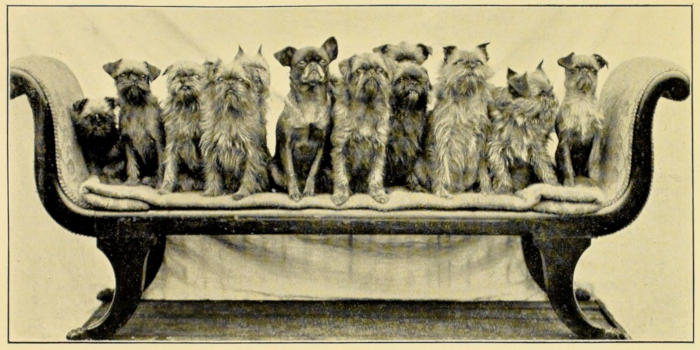
The Copthorne Brussels Griffons. Including the well-known Champions: Copthorne Talk-of-the-Town, Copthorne Lobster, Copthorne Wiseacre, Copthorne Treasure, and Copthorne Seiglinde, the property of Mrs. Handley Spicer, The Glen, Kingsbury, N. W.
[face p. 30.
Bronchitis (Chronic Husk):
Symptoms: Though the dog may appear very well, with good appetite, there is a frequent dry, hard cough, which is generally worse at night and early morning, but any exertion or excitement induces a fit of coughing. After each attack, the dog retches as if he had something in his throat, and was going to vomit.
Treatment: Give aperient medicine occasionally, and the following mixture:—
Recipe:
Tinct. Nux Vomica, 24 drops.
Ipecacuanha Wine, 1 drachm.
Water to 3 ounces.
Doses: One teaspoonful to a tablespoonful[1] three times a day. When cough is very troublesome give a dose of the mixture recommended for acute bronchitis at night, or from fifteen[1] drops to one teaspoonful of Smith’s glyco-heroin in a little water.
Diet: The diet in these cases is very important, and I find under-done meat the best possible food, as it nourishes the dog well without distending the stomach and causing pressure on the chest.
Bruises:
Symptoms: Discoloration of the skin from effusion of blood under result of injury.
Treatment: Apply following lotion often:—
Recipe:
Goulard’s Extract Lead, 1 drachm.
Liquor Opium, 1 drachm.
Distilled Water to 8 ounces.
When in a suitable part, so that a bandage may be applied, the lotion is more efficacious if applied on lint, which should be covered over with a piece oil silk, and then a bandage.
Give aperient medicine, and keep dog at rest for a few days.
Burns:
Symptoms: The skin may be scorched and the coat frizzled, but the roots not destroyed; or the skin may be destroyed and a large blister form, which sooner or later suppurates. Burns, the result of boiling water, are practically as severe as those of fire, for in either case the hair never grows afterwards.
Treatment: When the skin only is scorched, apply lime water and linseed oil. One part of the former, mixed with two parts of the latter, should be dabbed on two or three times a day. In severe burns the part may be smeared over with boracic ointment, and when the blister has broken the same ointment should be applied on lint, which must be kept in its place with a bandage or coat. Repeat dressing two or three times a day.
Calculi (Stones in the Kidney):
Symptoms: Blood, and also in many cases pus, is passed with the urine. The dog at times seems very ill, the temperature may go up to 103 or 104. Pain on pressure over the loins, sickness, loss of condition, and great wasting. In severe cases there is collapse, and death follows the result of uræmia poisoning.
Treatment: Open the bowels freely. Apply hot fomentations or poultices to the loins, and give following medicine:—
Recipe:
Bicarbonate of Potash, 1 drachm.
Boro-citrate of Magnesia, 1 ounce.
Mix.
Give from sufficient to cover a sixpence to a teaspoonful,[1] two or three times a day, mixed with food or milk.
Diet: Give plenty of milk mixed with equal parts Vichy water. Also Benger’s food with milk, tripe, and fresh boiled fish, with well-cooked rice. Avoid red meat.
Calculi in Bladder:
Symptoms: In the dog the stones are generally small, varying in size from a millet seed to a pea, though occasionally one does find a large one. In bitches the stone is generally not discovered until it has become a good size, and set up irritation of the bladder. In the dog, when the stones are small they, as a rule, do not seem to do any harm or cause inconvenience until one or more escape from the bladder, pass into the urinary passage or urethra, and become lodged in the canal just behind the bone in the penis where the passage is smallest. If the stone is quite round—which, fortunately, is not always the case—it acts like a cork in a bottle, and the dog is unable to pass any water. He stands or stoops like a bitch, and keeps straining; but nothing comes away, except, perhaps, a single drop occasionally of blood-stained urine. If the stone happens to be not quite round, then he is able to pass a small quantity of highly-coloured water by great effort. To ascertain for certain if these symptoms are the result of gravel or stone, a small sound or catheter should be passed; and if there is any blockage in the passage it is easily ascertained, for in that case it will be impossible to pass the instrument for more than a few inches instead of from 6 to 24 inches, according to the size of the dog; and besides, the hard piece of gravel or small stone will be felt. In some cases when the stone is not quite round the instrument will pass to the side of it, and then one can easily feel the grating of the stone against the instrument as it passes, more especially as it is withdrawn.
Treatment: Medicines are of little use, though a sedative like hyoscyamus will sometimes relieve the spasm of the parts, and enable the patient to pass a little water when the passage is not completely blocked; when it is, the stone may sometimes be pushed back to where the passage is larger, and thus enable the dog to relieve himself; but in all these cases arrangements should be immediately made for an operation, which is the only cure.
In bitches the symptoms of a calculus in the bladder are somewhat similar to those shown by the male: she is constantly straining to micturate, even after the bladder is emptied of water; the urine is high-coloured and smells strong, and often a few drops of blood are passed at the end of micturition, or the water may be blood-stained.
Treatment: Operation. Dogs once suffering from calculi are always liable to a recurrence. This may sometimes be prevented by giving occasionally a course of the following:—
Bicarbonate of Potash, 2 drachms.
Boro-citrate of Magnesia, 2 ounces.
Mix.
Doses: From sufficient to cover a sixpence to one teaspoonful[1] twice a day with food or given in water, and continued for a long time. Avoid meat as much as possible with the food.
Cancer:
Symptoms: A tumour which usually sooner or later ulcerates, emitting an offensive-smelling discharge mixed with blood. The animal loses condition and becomes very weak. A cancer may form anywhere, but the most frequent parts affected are: the mouth, inside of the throat, milk glands, the rectum, and the organs in the abdomen.
Treatment: An early operation is the only chance of effecting a cure; once suppuration has commenced, the case is practically hopeless.
Caries:
Symptoms: Ulceration of bone—generally result of some injury. Abscesses form, resulting in unhealthily discharging wounds which are difficult to heal. If the parts be probed, roughened exposed bone may generally be felt, which after a time separates from the healthy structure and escapes with the discharge.
Treatment: These cases must always be given time for the dead bone to separate from the healthy bone. Hot linseed meal poultice, dusted freely over with powdered charcoal, should be applied, and repeated two or three times a day, and as soon as the dead structure is loose, the wound, if not large enough, should be dilated with a knife and the dead bone removed. If this is successfully done, the wound generally heals quickly. In some cases when a limb is affected, and the inflammation has been very extensive, amputation may be necessary. Dogs do very well with three legs.
If after the dead bone has been removed the wound does not heal, syringe into it every other day about half a drachm of tincture calendula, and apply boracic ointment on lint and bandage. Wounds in cases of caries require keeping very clean with some disinfectant, as a saturated solution of boracic acid, or a solution of Pearson’s fluid; Condy’s fluid is also useful.
Cataract:
Symptoms: The formation of an opaque spot in the lens or pupil of the eye. In young dogs, when it occurs, which is not frequent, the whole pupil seems to be involved at once, but in old dogs it generally commences as a small speck, and gradually increases. The cornea or front of the eye generally remains clear. Of course there is loss of vision of the affected eye to a more or less extent, according to the size and density of the cataract.
Treatment: The following drops improve the sight when the cataract does not affect the whole pupil:—
Recipe:
Sol. Sulphate of Atropine, 10 drops.
Sulphate Zinc, ¼ grain.
Distilled Water to 1 ounce.
Operation, except for improving the appearance of the eye, is useless in the dog, as wearing of spectacles is impracticable.
Catarrh of the Nose:
Symptoms: Generally follows a chill from exposure to cold or from careless washing; shivering and sneezing, thin mucous discharge from nose, which is not sticky as in distemper; water discharge from eyes; a husky cough. The dog is dull for a few days, and perhaps off his food, but as a rule there is no rise of temperature as in distemper, and the teeth do not become discoloured as in the latter disease.
Treatment: Keep quiet in a dry, warm room for a few days, and give the following mixture:—
Recipe:
Tr. Aconite, 24 drops.
Spirits of Nitre, 2 drachms.
Concentrated Solution of Acetate of Ammonia, 1 drachm.
Water to 3 ounces.
Doses: From half a teaspoonful to a tablespoonful[1] three times a day. Give sloppy food for two or three days, and then the ordinary diet and cod-liver oil.
Catheter, How to Pass:
The passage (called the urethra) to the bladder is very small in the dog in consequence of there being a bone in the penis. It is also very long. The best kind of catheters are made of gutta-percha, and for small dogs the size called 0 is large enough. For dogs the size of terriers No. 1 size is required; for collies, etc., No. 2 size; and for larger dogs No. 3. These numbers refer to the diameter. As to length, they must, of course, vary also according to size of the dog—10 inches, 12 inches, 18 inches, and 2 feet respectively. Before being passed, the catheter must be well smeared over with vaseline, and the wire left in. The dog should be placed on his left side, with the right hind leg well drawn forward; the penis should be exposed for some inches, and held by means of a soft cloth; the catheter may then be gently passed. After going a short distance, that is to where the penis bends round, it will stop going in, or, at any rate, at this point it will be found a little more force is required to pass the instrument. When this part is reached, the wire should be drawn out for one or two inches, according to the size of the dog, then it will be found the catheter will pass on easily again; and when the bladder is reached, if it is full of water, it will commence to drip or dribble away—it never runs away fast, as the orifice in the catheter is small. Let the catheter remain in so long as urine continues to flow, and then gently withdraw it.
A catheter should never be passed more than twice a day. The instrument, when not in use, should, without the wire, be kept in a basin of saturated solution of boracic acid. The wire should be thoroughly cleaned and vaselined, and be put into the catheter just before being used.
Cerebral Congestion:
Symptoms: Often seen in distemper. The dog may be dull and heavy, or he may be very excited; eyes very congested; temperature high, 104 to 105° F.; constant working of the temporal muscles. Dogs in this condition are often ravenous for food, and diarrhœa may be present. If relief is not given, convulsions usually follow.
Treatment: Keep dog absolutely quiet in a darkened room. If bowels constipated, give purgative medicine, also give from three grains to one scruple of bromide of strontia[1] in water three or four times a day. Apply ice in a waterproof sponge bag or sheep’s bladder to forehead for fifteen minutes or so at a time several times a day.
Diet: Liquid food should only be given, as milk with Benger’s food, egg and milk—the yolk of the egg should not be given if there is much diarrhœa; some mutton broth or Brand’s essence may be allowed occasionally. In severe cases a blister or seton at the back of the neck should be applied.
Chalky Stones:
Symptoms: Affects principally the knees, hocks, and stifle joints occasionally of old dogs—the result of the deposit of urates.
Treatment: From a quarter to two grains of iodide of potassium three times a day, or from five[1] grains to two scruples of the boro-citrate of magnesia in water thrice daily. This medicine may be given with the food. Vichy water to drink instead of plain water.
Choking:
Symptoms: Dogs frequently choke themselves when eating bones, especially chop or cutlet bones; also occasionally with a large piece of meat which may become impacted in the gullet. But this is not so serious, as it can easily be pushed down into the stomach if it cannot be pulled upwards. When an offending bone or other matter becomes lodged in the back of the throat the dog coughs and retches violently, and may even die from asphyxia. But as a rule the bone does not stop there, but passes down until the gullet passes over the heart, where it is rather smaller, and then the bone is stopped, which causes the dog great distress. He keeps gulping as if trying to swallow, and occasionally retches. In a day or two the distress passes off and the patient seems fairly well and often ready to eat, but if any solid food is taken directly it reaches the part where the obstruction is it is brought up, and this continues to happen so long as the obstruction remains, but the dog as a rule is able to swallow liquids as milk, egg and milk, beef teas, etc.
Dogs, especially puppies, often swallow needles and pins, which generally become embedded in the back of the tongue, but sometimes they reach the gullet and pass through, causing a bad abscess to form in the throat just behind the angle of the jaw.
Treatment: When the bone or meat or other matter becomes lodged in the back of the throat, it is generally easily removed with the finger. Failing this, forceps must be used; but the symptoms are often very distressing, and prompt relief is necessary. When the bone has passed far down in the gullet and become fixed just over the heart, relief is much more difficult. Sometimes if the dog can be induced to take a few pieces of meat it will force it on. If this fails, forceps must be tried, and if the bone cannot be removed with them, then one must try to push it downwards into the stomach with a probang. Too much force must not be used or the gullet may be ruptured, which is fatal. If it cannot be removed, the dog must be fed on liquid food, and in time the points of the bone may become dissolved, and then it will be easier to push it down with a probang.
In removing needles from the back of the tongue or fauces, which is best done with forceps, care must be taken not to break them. The tongue should be drawn well forward out of the mouth by taking hold of it with a cloth so as to bring into view the back of the tongue and fauces.
Chorea, St. Vitus’s Dance:
Symptoms: Irregular contraction of the muscles. Almost any part of the body may be affected, and even the tongue, the dog poking it out of the mouth constantly. But the disease more often affects the limbs, perhaps one fore leg and one hind leg, or the muscles of the shoulder and neck; occasionally the muscles of the abdomen, the dog always appearing to be suffering from hiccough. The temporal muscle is a common seat of chorea, and in such cases the dog is constantly snapping his teeth together. It is almost invariably the result of distemper.
Treatment: In bad cases the disease is incurable, though often with time—in the course of months—the twitching becomes less, but never entirely disappears. There is no specific for chorea; what appears to do one case good seems to do harm in another. Small doses of arsenic with bromide is sometimes a useful remedy, as the following mixture:—
Recipe:
Bromide of Strontia, 1 drachm.
Fowler’s Solution of Arsenic, 48 minims.
Water to 3 ounces.
Dose: From half a teaspoonful to a tablespoonful[1] three times a day after food.
In other cases Easton’s syrup answers better.
Dose: From three or four drops to half a drachm,[1] in a little water, three times a day after food. Later, especially if there is much wasting, cod-liver oil should be given.
Coins, etc., Swallowing of:
Symptoms: The dog has a big swallow, and it is astonishing what can pass down his throat into the stomach. I have known small dogs as fox terriers to swallow coins the size of a penny, and smaller dogs still to swallow brooches, ear-rings, and finger-rings, and also keys, without even seeing any bad results to the dog, though the owner has been much alarmed as to what was going to happen; but corks are dangerous, as they block up the intestines, and so are big round stones, but small stones dogs swallow with impunity. Dogs, even small ones like pups, swallow occasionally meat skewers, but even such things as these do not always prove fatal. I recently had under my care a small puppy who swallowed a hat-pin ten and a half inches long, the head passed into the stomach all right, but the puppy was too small to take the whole length of pin, and the point, piercing some of the vital parts of the throat, killed him.
As a rule, a dog does not show much discomfort after swallowing things like coins, bones, small stones, etc., when they once have reached the stomach, though with young puppies the latter often cause severe colic; but large round stones and corks often cause serious mischief by blocking up the bowels, inducing inflammation, which, if not relieved by operation, soon causes death. Skewers and long hat-pins when swallowed seldom pass beyond the stomach, where they often remain for some considerable time, but sooner or later the point generally pierces the stomach, and peritonitis follows, which quickly terminates fatally; but sometimes the sharp point passes direct from the stomach through the walls of the abdomen and skin, and it may be seen sticking out and can be removed. The dog seems none the worse after a few days, as the wound soon heals.
It is often difficult by manipulation to detect things that have been swallowed, for as a rule, as before mentioned, they remain in the stomach for a considerable time before passing into the intestines. I have known coins to remain there for five or six months before being passed; however, with the Röntgen rays coins, keys, jewellery, stones, etc., can always be detected.
Treatment: Unless the foreign body swallowed is doing the dog visible harm, it is best left alone. Feed on solid food as suet puddings, rice, bread, meat and such like foods, so as to distend the bowels as much as possible and to cause big motions, and the foreign body, in all probability, will pass out safely; do not give purgative medicines, which only cause contraction of the bowels and do harm, but if there is pain give from two[1] to ten drops of laudanum in a little water, three or four times a day, or oftener.
When the substance swallowed causes real obstruction in the bowel, the laudanum may be given a trial for two or three days, but as a rule an operation becomes necessary, which consists in opening the abdomen, finding where obstruction is, and opening the bowel and removing the offending matter. It is an operation requiring aseptic precaution and some care, and the sewing up the incision made into the bowel wants carefully doing or a stricture may result.
Cold in the Head:
See Catarrh.
Colic:
Symptoms: Generally affects puppies from eating rubbish, but may also affect adult dogs, especially after receiving strong medicine as worm medicine. Restlessness, crying and whining, or even howling when pain very severe; abdomen tucked up and muscles feel hard and rigid. The attack may be accompanied by severe vomiting and diarrhœa.
Treatment: Give immediately, if there is no diarrhœa, a dose castor oil, which should be followed by an enema if it does not operate in about an hour. The enema may consist of half[1] to two teaspoonfuls of glycerine, mixed with one[1] to eight tablespoonfuls of warm water. Also, give following mixture:—
Recipe:
Chloric Ether, 1½ drachms.
Laudanum, 1½ drachms.
Water to 3 ounces.
Doses: From half a teaspoonful to a tablespoonful[1] every two, three, or four hours until pain relieved.
Collapse:
Symptoms: The dog lies in a semi-unconscious condition; the body feels cold; the membranes are pallid, eyes glassy; the breathing slow and heavy; pulse weak. This condition may arise from shock, and is often seen in dogs after being run over. It may also occur as the result of hæmorrhage.
Treatment: Allow the dog to lie perfectly quiet on his right side. Give stimulants, as brandy, with from one[1] to ten drops of tincture nux vomica if given by the mouth, but only half if injected under skin. If this cannot be done, give an enema of milk and brandy, or strong black coffee. If body very cold, put hot-water bottles round it.
Coma:
Symptoms: Entire loss of consciousness, heavy breathing, pupils dilated, etc. This condition may result from injuries to head; sometimes follows a severe attack of epilepsy, apoplexy, and it is the last stage previous to death of many illnesses.
Treatment: This entirely depends on the cause. If as the result of epilepsy, the patient is best left quite alone for many hours; if the body becomes cold, hot-water bottle may be placed under it and also to the back. After some time, if there are no signs of return to consciousness, the body and limbs may be well hand-rubbed, and brandy injected subcutaneously. If the result of injuries to head, should the skull be fractured an operation may be necessary; but if there is simply concussion of the brain, you must give the animal time—the condition may last three or four days, and yet the dog may recover. Besides quietness, there is not much to do. Should the dog be very restless, apply an ice-bag to head; and to maintain strength give about every four hours an enema of peptonised milk, from one tablespoonful to a cupful,[1] or one or two meat suppositories. When coma is the result of the last stage of illness, there is little to be done. The inhalation of oxygen may be tried; brandy or strychnine, ⅟₃₀₀th to ⅟₁₀₀th of a grain[1] may be injected under the skin, and an enema of strong black coffee given.
Condylomata:
See Warts.
Conjunctivitis (Sore and Weak Eyes):
Symptoms: The conjunctival membrane lining the inside of the eyelids is much congested, and of a dark red colour, there is a constant flow of watery discharge; in bad cases there is a discharge of white pus which causes the lids to adhere together. The hair falls off around the lids, and the cornea, or front of the eye, may become cloudy and ulcerate.
Treatment: In simple cases an application of boracic lotion, made by dissolving half a teaspoonful of boracic acid in half a pint of water, which should be applied often, is generally sufficient to effect a cure. In bad cases when the discharge is purulent, the following should be used:
Recipe:
Chinosol, 3 grains.
Water to 6 ounces.
Apply several times a day, letting a little run on the inside of the lower lids. Iodoform dusted on the inside of the lower lid is also useful.
The edges of the eyelids should be kept smeared with vaseline to prevent them from sticking together.
Constipation:
Symptoms: The motions are big, hard, and dry, and difficult to pass; and instead of having an action at least once a day, the dog may only have one every two or three days.
Treatment: A good deal can be done by diet. Spratt’s biscuits have a tendency to keep the bowels open and regular; for small dogs the Pet-Dog biscuits should be given, and for large dogs the big biscuits. They should be broken up and soaked in some soup, and mixed with a little meat and some green vegetable added; this makes a very good principal meal. For a second or evening meal the biscuit may be given dry. For a change of diet give meat, brown bread, and green vegetables in equal parts moistened with soup. In obstinate cases some laxative may be necessary. Milk of sulphur answers very well; from sufficient to cover a threepenny-piece to half a teaspoonful[1] may be given daily for a fortnight, or a teaspoonful[1] to two tablespoonfuls of Dinneford’s fluid magnesia may be given every morning in a little milk. In some cases salad oil answers best, from half a teaspoonful to a tablespoonful[1] mixed daily with the food. In chronic cases a course of the following pills is useful:—
Recipe:
Ext. Belladona, 1 to 6 grains.[1]
Powdered Rhubarb, 3 to 18 ”
Reduced Iron, 4 to 24 ”
Powdered Nux Vomica, 1 to 6 ”
Mix.
Divide into 12 pills—one to be given twice a day after food.
Consumption:
Symptoms: A rare disease in dogs. At first a dry cough, later becoming looser with expectoration of phlegm; wasting, though appetite may at first be fairly good; the patient gradually becoming very weak, and occasionally having diarrhœa. There is always present one or more degrees of fever, and the temperature is generally higher at night. If the phlegm be examined with a microscope the tubercle bacilli will be found if it is a case of consumption. In bad cases there is bleeding from the lungs, the blood coming as a rule through both nostrils.
Treatment: Seldom curable, but the best chances of a recovery are obtained by letting the dog live out of doors and giving cod-liver oil. Feed liberally, giving plenty of meat, also fish, milk, raw eggs, and cream.
The patient should be kept away from other dogs, and certainly should not be allowed to sleep in a room where there are people.
Convulsions in Puppies:
Symptoms: Young puppies, generally as the result of worms or during second dentition, often have convulsions. The immediate cause of the attack is generally due to excitement, more particularly on a hot day. The puppy, which may be apparently quite well, suddenly tumbles over on its side, kicks violently with its legs, champs the jaws, and froths at the mouth. In a minute it gets up, and looks about in a dazed manner; then, if not restrained, gallops off barking, not knowing where it is going. Sometimes one attack may follow another in quick succession until it dies from exhaustion.
Treatment: The puppy should be held to prevent it knocking itself about. (I may here remark that there is not the least danger from a bite of a dog when suffering from fits of any kind.) As soon as the puppy can swallow, a dose of the following mixture must be given:—
Recipe:
Bromide of Potassium, 1 drachm.
Hydrated Chloral, 1 drachm.
Water to 3 ounces.
Dose: From a teaspoonful to a tablespoonful[1] to be given every two, three, or four hours, according to the severity of the symptoms. If the puppy is unable to swallow, double the quantity should be injected into the bowel, mixed with equal quantity of tepid water. In severe cases a hot bath is beneficial; also ice may be applied to the head. Keep the puppy in a dark room for some hours after the attack. To prevent a recurrence of the convulsions, treat puppy for worms. Feed on a milk diet for a few days.
Corns:
Horny elevations which form on the pads of the feet.
Treatment: They may be removed by cutting, or destroyed. The best way is by the application of a solution of chromic acid, one in four. It should be applied sparingly to the part with a glass rod about twice a week.
Coughs:
Symptoms: May arise from many causes; but a simple cough, the result of some irritation of the larynx caused by cold, is of a common occurrence during the winter and spring when the winds are cold.
Treatment: Give following mixture:—
Recipe:
Liquor Morphia, 2 drachms.
Syrup of Squills, 1 ounce.
Syrup of Lemon, 1 ounce.
Water to 3 ounces.
Dose: From half a teaspoonful to a dessertspoonful three or four times a day.[1] When it is difficult to give a mixture, the following pills may be tried:—
Recipe:
Hydrochlorate of Morphia, ¼ to 1 grain.[1]
Powdered Ipecacuanha, 1 to 6 grains.
Powdered Rhubarb, 2 to 12 grains.
Compound Squill Pill, 6 to 20 grains.
Mix and divide into twelve pills, one to be given night and morning. A dose of aperient medicine should occasionally be given.
Cuts.
Symptoms: Division of structure, generally described as a solution of continuity; there is generally more or less bleeding.
Treatment: Thoroughly cleanse the cut with a warm solution of boracic acid, Condy’s fluid well diluted, or one per cent. solution of Pearson’s disinfectant fluid. Stop bleeding by applying pressure with fingers, or a pad of absorbent boracic wool, and bandage. When very severe, apply a ligature to the vessel above the part.
After cleaning the wound and stopping the bleeding, the edges of the cut should be brought together with a few stitches, about a sixth of an inch apart; a pad of some disinfectant gauze applied, also a bandage. If no swelling or discharge, the dressing need not be disturbed for about six days, when the stitches can be removed. Afterwards re-bandage for another day to protect the part from dog’s tongue.
Cystitis:
See Bladder, Irritable.
Cysts:
Symptoms: A sac containing fluid or semi-fluid substances, or even hair and other foreign substances. A form of cyst often seen in flap of the ear.
Treatment: Cysts can only be removed by cutting. In the case of the ear, it should be freely opened at the most depending part and a tube inserted, or at any rate the wound should be kept open for a few days, otherwise fluid will collect again. No other treatment required except keeping the parts clean. The dog must not wear a collar.
Dandruff (Scurf):
Symptoms: Dryness of the skin and hair, and the rising of branny greyish-white scales from the former, and mixing with the coat.
Treatment: As a rule, a thorough wash once a week, using a tar soap like Sherley’s shampoo, and putting a little borax in the rinsing water, with daily brushing of the coat, will effect a cure in mild cases; but in bad cases greasing the dog all over with some such preparation as the following is necessary:—
Recipe:
Oil of tar, 1 drachm.
Almond Oil, ½ pint.
Mix.
To be thoroughly worked into the skin twice a week, and after a few days washed off, using the soap mentioned. A course of arsenic is useful; give from one[1] to eight drops in water twice a day for two or three weeks, but it must be discontinued if it causes sickness or diarrhœa.
Deafness:
Symptoms: In many cases, especially in white dogs, as bull terriers, it may be congenital. In ordinary cases it is often due to an accumulation of hard wax, or from growths in the canal of the ear. In old dogs it may be due to thickening of the drum of the ear.
Treatment: When congenital it is incurable. If result of growths in the ear, these must be removed by operation. When caused by accumulation of hard wax, a little warm almond oil should be poured into the ear, and the next day the ear should be thoroughly syringed with five ounces of tepid water in which has been dissolved a scruple of carbonate of soda. When the deafness is due to a thickening of the drum of the ear, which is often seen in old dogs, there is nothing to be done.
Debility:
Symptoms: May be due to constitutional causes, as is often seen in highly-bred puppies, or it may result from severe illness, particularly after distemper. The pulse is quick and weak, loss of appetite, and disinclination for exercise, poor condition, and membranes pale.
Treatment: For puppies, Sherley’s chemical tablets answer well. When result of illness, the following tonic may be given:—
Recipe:
Ammoniated Citrate of Iron, ½ drachm.
Tincture Nux Vomica, 40 minims.
Tincture Gentian, 3 drachms.
Water to 3 ounces.
From half a teaspoonful to a tablespoonful[1] three times a day one hour before food.
Deformities, Congenital:
These are numerous in the dog. Inverted eyelids: puppies are sometimes born without eyes, squinting small eyes, eyelashes growing in. Hare lip, cleft palate, pig jaw, deformities of the feet and limbs: particularly the stifle joint, the patella being out of its place, and the leg contracted or drawn up. Deformities of the chest: this condition is common in Japs, but seems to do no harm. Puppies are sometimes born without tails; though a good feature in schipperke and bob-tail sheep dogs, one does not like to see a pug or a dachshund without a tail, and when he is good in all other points, it is disappointing. A screw tail is objectionable in all breeds except the bulldog, and some people object to it in these dogs. Absence of one or both testicles.
Treatment: Many cases of deformity may be remedied by operation, but in others there is nothing to be done. Inverted eyelids can be cured by operation, an elliptical piece of skin and also the muscle underneath being cut out immediately under the lower eyelid, when that one is affected, or immediately over the upper eyelid, if it is that one that is turned. The cutting is best done with curved scissors, and should extend nearly the whole length of the lid. As the wound made heals, it draws the lid out.
In-growing eyelashes must be plucked out with forceps from time to time. Very often as the puppy grows older and stronger, the lashes assume a normal position, and cease to be a trouble, but if they continue to turn in after the dog is twelve months old, a similar operation as for inverted eyelids is recommended, but in these latter cases it is not necessary to divide the muscle, but only the skin. Squinting may be cured by operation, but it is not recommended, as the defect does no harm, and with Japanese spaniels, who often squint, it rather adds to their quaintness.
In cases of unnatural small eyes, which often occur in fox terrier puppies, an operation is not of any use; but with time, it may be months, perhaps a year, the condition often improves. Matters are helped by giving the puppy affected something to stare at, as, for instance, placing his food for a time behind some railings, so that he can see it, but cannot get at it. Anything, in fact, that attracts attention, and causes the puppy to stare. A stuffed cat behind the railings does for a change, a lump of raw meat or a bone. Hare lip can be cured by operation, but in consequence of the position, it is difficult to keep the edges of divided lip together after sewing them, as the puppy will rub his nose on the ground if he has a chance, besides constantly licking at the stitches. The operation should not be undertaken before the puppy is three months old, and then just before operation a good square meal of meat should be given; this will take some time to digest, and will satisfy the puppy for a long while; at any rate, nothing more should be given for twenty-four hours, by which time the healing has made good progress, and for some days after the operation the puppy should be fed from the fingers, piece by piece, certainly no dish should be given for him to rub his nose in.
As to the operation, the edges of the split lip should be freely scarified, and also be loosened from the gum by cutting through the mucus membrane, then the two edges of the lip should be brought firmly together with pin sutures, and a few layers of collodion painted over the external part, and dusted over sparingly with powdered iodoform. It is not necessary to give chloroform for an operation of this kind, a few drops of a 4% solution of cocaine injected into each side of the divided lip is sufficient.
There is no cure for cleft palate, and a puppy born with this condition should be destroyed.
Pig jaw is incurable.
As to deformities affecting the feet, a dog may be born without toes, or with only two or three toes; in such cases, of course, nothing can be done, but sometimes there may be an extra toe. If a show dog, it spoils the appearance of his foot, and interferes with his gait, and so must be removed.
Dew-claws are not a deformity, but they are a useless appendage, and should be cut off close to the leg about three days after birth; if left they are a constant nuisance, either through being frequently broken, or torn off at the quick, or else turning and growing into the flesh, which causes a good deal of pain.
Nothing can be done for deformity of the stifle joint, it causes no pain, though it renders the leg useless; but if the subject is a bitch, and well bred, she may be kept for breeding purposes. A screwed tail may be remedied, if not too badly twisted, by breaking, setting it straight, and applying an adhesive bandage.
In cases of absence of one or both testicles in the scrotum, there is nothing to be done. A dog with both testicles absent is useless for getting stock, though he is able and will serve a bitch, but in cases where only one is missing, it does not prevent such a dog being useful for stud purposes.
Delirium:
Symptoms: Restlessness, constantly howling and barking. Dogs in this state lose flesh very rapidly. Delirium is seen in some bad cases of distemper.
Treatment: Unsatisfactory; bromide of strontia may be tried; from two[1] to sixteen grains in water three or four times a day. Ice bags should be applied to head.
Diet: Give easily digested food—as Benger’s with milk, kreochyle with water, and well-boiled tripe or fish, with rice or stale bread.
Destroy Dogs, How to:
There is no doubt that the quickest and most painless way of killing a dog is by shooting, providing it is done properly, and the man is a good shot and can be relied on. The best place to hit a dog is either behind the ear, or in the middle of the forehead; but there are many people who don’t like an old favourite destroyed in this way. Personally, I don’t like it. I consider a large dose of morphia, and then chloroform, is better. At any rate, it does not seem such a harsh way of taking an old favourite’s life.
To destroy a dog with morphia and chloroform, from half to two grains of acetate of morphia[1] should be injected under the skin; then after waiting until the dog is in a heavy sleep, chloroform should be slowly administered. It is necessary to do it very slowly indeed, or else the dog will wake up. In this case don’t place anything over the dog’s nose at first, but pour a trifle on a handkerchief or napkin, and hold it from six to eight inches away from the dog’s nose, then gradually get nearer and nearer until at last you cover the dog’s nose over with the cloth. The chloroform must be continued until the dog has stopped breathing for five minutes.
The administering of half[1] to a dram of prussic acid is also a very sudden and quick way of destroying a dog, but it is a debatable point whether this causes acute pain. At any rate, the dog invariably cries out loudly after it has been administered a few moments, and so he often does when going under the influence of chloroform. However, death by freshly prepared and strong prussic acid is very certain and sudden.
When administering this acid, one should be very careful never to stand in front of a dog, for if he coughs while it is in his mouth, and some goes into the eye of the person giving it, the consequences may be serious, as it is most deadly.
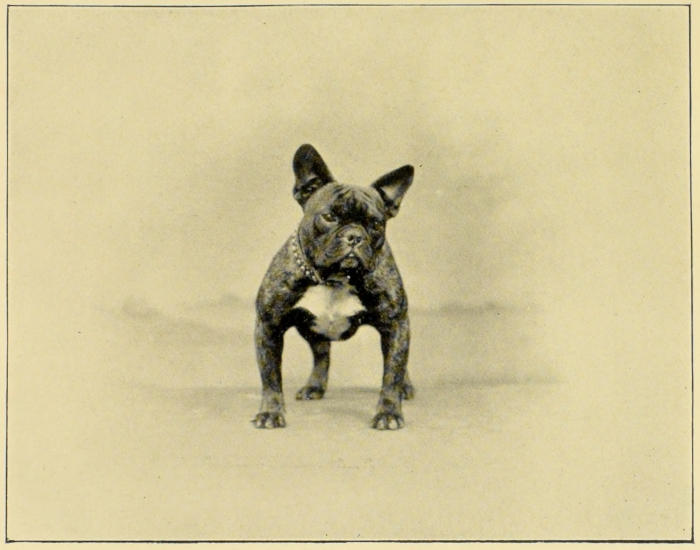
French Bulldog, Champion Sanspareil. Winner of 2 Firsts and 8 Specials. The property of the Countess Sponneck Mayer.
Photo. by T. Fall, 9, Baker Street] [face p. 60.
Diabetes Insipidus:
Symptoms: Increased secretion of urine of a watery nature—great thirst. For a time the dog’s condition does not alter, but if the disease is not checked then he loses condition, the muscles waste, the legs become thin, the ribs prominent, and the abdomen distended as the result of the large quantity of water taken. This is a disease to which old dogs are particularly liable.
Treatment: Limit the quantity of water given the dog to drink; for a small dog, say half a tumblerful[1] to a couple of pints for a large dog. Feed on dry food. For medicine, give from half a drop[1] to two drops of Fowler’s solution of arsenic in water three times a day before food. If this does not benefit the case, give from an eighth[1] to a grain of powdered opium twice a day in the form of a pill. Treatment is often unsatisfactory.
Diabetes Mellitus:
Symptoms: Large quantities of urine containing sugar are passed; great thirst, voracious appetite, and gradual wasting of body. The tongue is dry and parched, and is of a red-brick colour; coat stares, and the dog looks generally unhealthy.
Treatment: Food containing sugar or starch must be avoided; meat given nearly or quite raw is the best diet. As to medicine, though it is practically an incurable disease, codeine does in some cases mitigate the symptoms. Of this medicine, give from a twelfth[1] to half a grain three times a day. After a fortnight or so the dose may be doubled.
Diarrhœa:
Symptoms: Frequent watery motions, which may vary in colour—white, slate, brown, black, and sometimes green—accompanied very often by great thirst and loss of appetite.
Treatment: In most cases a small dose of castor oil at the commencement of the attack does good, and in many cases effects a cure. Should the symptoms continue after the effects of the oil have passed off, give from five[1] to twenty grains of carbonate of bismuth three or four times a day before food, or the following mixture:—
Recipe: The Mixture for Diarrhœa:
Laudanum, 1 drachm.
Tincture of Rhubarb, 4 drachms.
Peppermint Water to 4 ounces.
From one teaspoonful to two tablespoonfuls[1] three times a day. Or the following pills may be tried:—
Recipe: Pills for Diarrhœa:
Extract of Kino, 1 drachm.
Powdered Ipecacuanha, 12 grains.
Powdered Opium, 6 ”
Ex. cip. q.s.
A sixth, fourth, half, or the whole[1] may be mixed and divided into twelve pills. One to be given three or four times a day. If the motions are very offensive, from two[1] to ten grains of salol may also be given three or four times a day.
Diet: At first liquid, as milk, thickened with equal parts of arrowroot and Benger’s food; after two or three days, raw beef cut up very fine may be given alone or mixed with equal parts well-boiled rice; rice water to drink. In chronic diarrhœa a liquid diet should be given for some time, and in addition to the milk diet previously mentioned, home-made beef-tea (with all fibrine removed) may be given slightly thickened with isinglass, and the following mixture tried:—
Recipe:
Diluted Sulphuric Acid, 2 drachms.
Laudanum, 1 drachm.
Water to 8 ounces.
Dose: From a teaspoonful to two tablespoonfuls[1] three times a day. When there is much straining accompanying the diarrhœa, it is a good plan to give an enema consisting of one teaspoonful to two tablespoonfuls[1] of thick-boiled starch, with from three[1] to fifteen drops of laudanum mixed. When the diarrhœa is due to disordered liver, which is generally the case when the motions are white or grey, from one[1] to six grains of grey powder may be given at first instead of castor oil.
Diarrhœa in Puppies:
Symptoms: Very often the result of worms, but may be due to indigestion, the result of improper or too much food. Motion liquid and frequent, generally of a yellowish colour.
Treatment: If worms are suspected give Sherley’s worm tablets for puppies, otherwise first give a small dose of castor oil, and after it has worked off give from two[1] to six grains of carbonate of bismuth every four hours. If the diarrhœa is accompanied by colicky pains give also from two[1] to ten drops of paregoric in a little water three or four times a day.
Diet: If the patient has been kept on a milk food, discontinue this, and give scraped lean raw meat, a small quantity four times a day; but when a meat diet has been given and the diarrhœa continues, then give milk with Benger’s food or Plasmon. In very obstinate cases from a quarter[1] to one grain of grey powder once or twice a day for three days is often useful.
Discharge from Ear (Canker):
Symptoms: The canal of the ear is red, inflamed, and painful; in slight cases there is often a brownish discharge; in chronic and severe cases the discharge is fœtid and generally purulent, and may be tinged with blood. In these cases the ears are very painful, and the dog cries when he shakes his head.
Treatment: In very mild cases cleaning the ears daily with a weak solution of Condy’s fluid will often effect a cure; but if the ears are inflamed after cleaning them the canal should be painted twice a day with the following lotion:—
Recipe: Lotion for Ears:
Benzoated Oxide of Zinc Ointment, 2 drachms.
Almond Oil, 1 ounce.
Well mixed.
Each time before dressing the ears they should be carefully wiped out with medicated cotton wool.
In bad cases, when the discharge is purulent, the ears should be syringed morning and evening with two tablespoonfuls of methylated spirits added to half-a-pint tepid water, and after letting the dog shake his head, wipe the ears out as dry as possible with absorbent cotton wool, and then fill with powdered boracic acid by the aid of a quill and a piece of indiarubber tube attached. If this treatment does not cure, then wash the ears out night and morning with peroxide of hydrogen—x vols.
Some cases of canker are very obstinate.
Dislocations:
Toe, Dislocation of:
Symptoms: The dog is very lame—in fact, cannot put the foot to the ground; the joint is swollen, and painful to manipulate. If the injured toe is compared with a sound one, it will be found that the lower bone which assists in forming the joint that is dislocated sticks up much more than is natural.
Treatment: As a rule, especially in a recent case, the reduction is not difficult. The toe should be pulled straight with the fingers of one hand, and with those of the other the projecting bone should be pressed into its place. In some cases it may be necessary to give chloroform. A padded splint extending from the back of the knee or hock to just below the foot should be put on, and a bandage applied to prevent the foot being used for a few days.
Knee, Dislocation of:
Symptoms: This generally occurs in conjunction with fracture of the radius, but it may happen alone. The dislocation generally occurs sideways, and the foot either turned outwards or inwards. The parts are very painful, and soon swell.
Treatment: The reduction should be attempted as quickly as possible after the accident, otherwise it will be necessary to wait until the swelling is reduced, and this can be helped by the application of crushed ice placed in a woollen bag and applied right round the joint.
It is best to give the patient chloroform before attempting the reduction of a dislocated knee; and when the dog is well under the influence of the anæsthetic the foot should be seized with one hand and pulled in straight direction from above downwards, and with the fingers of the other hand, during the pulling, the joint should be pressed into their place. As a rule, in dislocation of the knee the ligaments of the joint are often much injured, therefore when the reduction has been completed padded splints and bandages should be applied, as is recommended for fracture of the radius or arm, and be kept on for about three weeks.
Elbow, Dislocation of:
This does not often occur in adult dogs, but is not uncommon in delicate puppies as the result of some violence.
Symptoms: Lameness, and if the dog attempts to put weight on the leg, the elbow turns out. The joint as the result of the dislocation is wider than the one on the other side, but there is not much pain on pressure, as is the case of fracture at the elbow when the inner condyle of the shoulder bone (humerus) is broken off.
Treatment: In reducing this dislocation chloroform is not necessary. The arm should be flexed on the shoulder, and then by bearing pressure on the head of the bone and a twist of the head of the bone inwards the reduction is completed. The joint is to be afterwards fixed in its place with strips of adhesive plaister applied as depicted in the illustration annexed. If the bones cannot be kept in their place with the plaister, a splint cut out of thin zinc and of the shape of the elbow joint must be applied. The inside of the splint should be slightly concave to fit the leg, and of course well padded before being put on.
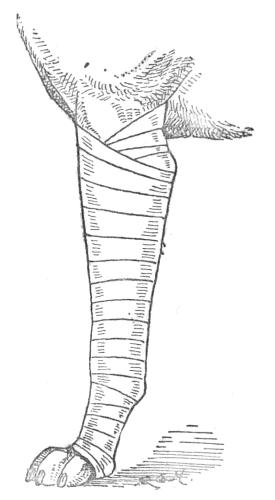
How to bandage the foreleg for fractures and other injuries
Shoulder Joint, Dislocation of:
Symptoms: Lameness; pain at the seat of injury, which is increased by putting leg forward; and some slight swelling, and the leg is perceptibly shortened. When there is any difficulty in diagnosing the case, all doubt is removed by making the dog stand evenly on both fore legs and comparing the sound shoulder with the injured one.
Treatment: In all cases I have seen of dislocation of the shoulder joint the head of the shoulder bone, which fits in a cup at the bottom of the blade bone, shoots upwards—of course only to a slight extent, as the bone is held in its position by strong muscles and tendons as well as by the capsule of the joint. Chloroform having been given, an attendant must hold the dog firmly by clasping his hands between the fore legs in front of the chest, or by fixing a towel in a similar position; and then the operator, seizing the paw with one hand, must pull the limb in a forward and downward direction, and at the same time with the fingers of the other hand press the head of the shoulder bone into its position. It is well afterwards to put a wide bandaging on round the chest over the shoulder joint, and keep the dog quiet for a few days.
Hock, Dislocation of:
This does not often occur except in conjunction with fracture at this part.
Symptoms: The dislocation occurs generally sideways, and may be either outwards or inwards, the foot being placed almost at right angles. The joint quickly swells, and is very painful.
Treatment: The reduction is carried out in a similar way as advised for reducing a dislocated elbow; afterwards the same kind of splints as recommended for treating fracture of the tibia are to be applied with bandages, and should be allowed to remain on for at least three or four weeks, and even after this it may be necessary to support the joint with a few strips of plaister for a time.
Patella, Dislocation of:
Symptoms: The patella is a small bone situated in front of the stifle joint, and is more liable to dislocation than any other part, especially in small dogs. With some dogs it is constantly slipping out of its place when running along, and then after a few steps it goes back again of its own accord. The bone almost always becomes displaced towards the inside of the leg, the dog in some cases being unable to put his foot to the ground; if he does attempt to put any weight on the leg, the stifle joint bends outwards. There is little or no pain caused by this dislocation.
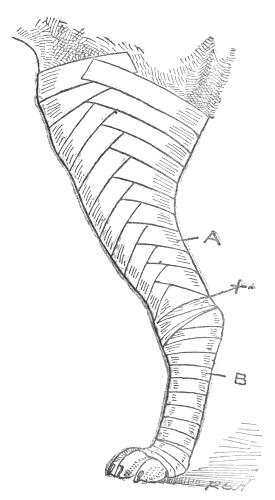
How to bandage the hind leg for fractures and injuries to the stifle, &c.
A—Sticking-plaister Bandage
B—Linen Roller Bandage
Treatment: The patella is easily returned to its place, but as often as not it slips out again. The best way of reducing this dislocation is to straighten the leg and draw the foot towards the elbow of the same side, and then with the fingers of the other hand push the patella into its place; afterwards, to keep it there, bind the joint with several layers of Mead’s plaister as depicted in the illustration. The plaister should be continued for some distance above the joint.
Distemper:
The first symptom of distemper is a rise of temperature—if a dog is dull and off his food, take the temperature. It is best to take it in the rectum, where the normal is 101 degs. to 101½ degs. F.; if taken under the arm or inside of the thigh it is 1 deg. lower. If the thermometer registers 2 or 3 degs. of temperature above normal, you may be sure there is something wrong, and the dog should be isolated at once; and by doing this the infection may often be prevented spreading. If the disease is distemper, other symptoms will soon develop, as a husky cough, loss of appetite and condition, and occasionally vomiting. The eyes are weak and sensitive to light, and there is often a little gummy discharge which collects along the edges of the lids; the breath is offensive, and the teeth become furred. Diarrhœa may, or may not, occur. If the illness is only some passing ailment, the temperature will soon be normal, and the dog assume his usual condition. But the temperature, even in distemper, after two or three days, may go down to normal; but do not be deceived by this, and think the dog is all right, but look out for some of the other symptoms mentioned, and if the dog is in for that disease they are sure to appear, and the fever will return again in a couple of days or so.
People often think a dog cannot have distemper unless there is a discharge from the nose; this is a mistake, but it certainly does occur in most cases, though it does not appear as a rule until the dog has been ill for some time. If the lungs become affected, the breathing is short and quick, not panting with the mouth open; the chest is tender on pressure. At first there is no cough, but after two or three days there is a suppressed painful cough, with retching. The pulse is often much accelerated, the beats varying from 110 to 140 per minute. In some cases the pulse is very slow, and may only be 48 to the minute; of course, this refers to a big dog. A pulse of this kind is worse than a fast one with pneumonia. When it is between 60 and 70 in a small dog, it is also serious with lung complications. The heart’s action in dogs is very frequently intermittent even in health. The eyes during distemper are often a source of anxiety, and in those dogs with prominent orbits, as spaniels, pugs, etc., there is always an inclination for ulcers to form, which are extremely painful.