THE DOG’S MEDICAL DICTIONARY (continued 5)
Reading edition
Sexual Excitement:
Symptoms: Some dogs are constantly worrying themselves, getting on people’s feet and legs, and working their body, which is, to say the least, most disagreeable. Very often any amount of chastising fails to stop the disagreeable habit, but if the dog is young, there are always hopes that he will improve with time, for, as a rule, when he is a year old the disagreeable habit ceases; but there are dogs who continue to misbehave themselves whenever an opportunity occurs the whole of their lives, and the only cure is to have them castrated, which is a certain cure. This operation does not seem to affect a dog’s health or spirits.
Shaking Palsy:
Symptoms: Trembling of the limbs, particularly the back ones, when standing, although when walking the dog may go with a normal gait. It is a condition that is more often seen in big dogs than small ones, particularly those with straight hocks and stifle joints. It may also occur as the result of advanced age even in small dogs.
Treatment: Medicine is seldom of any use, although sometimes a course of Nux Vomica appears to do some good, and is worth a trial, unless there is some physical defect. The dose is from one to eight drops,[1] given in water after food, and repeated two or three times a day.
Shock:
Symptoms: The dog is generally in a semi-comatose or unconscious condition, lying on the side; the breathing is feeble and slow; the pulse almost, if not quite, imperceptible; the mouth and also the membranes of the eyes are quite white; the limbs are cold, and if the temperature be taken, it is often 5 or 6 degs. below normal. This condition may be due to loss of blood or the result of internal injury, as after an accident—for instance, being run over with some vehicle.
Treatment: Place the dog on his right side, and keep the head low; give stimulants, as brandy, from ten drops to a couple of teaspoonfuls[1] in a little water. If the dog is unable to swallow, inject from ten[1] to sixty drops under the skin. This may be repeated in half an hour, if necessary. Also apply hot-water bottles to the back, and well hand-rub the limbs.
Snake Bite:
Symptoms: Swelling, redness, and great pain at the part bitten. The breathing becomes heavy and laborious; paralysis sets in; and later, convulsions and death.
Treatment: A ligature applied as tightly as possible above the part bitten, and the application of a saturated solution of permanganate of potash (Condy’s fluid undiluted) to the wound. Give stimulants, as brandy or sal volatile, freely, the latter well diluted with water.
Snoring:
Symptoms: This condition is particularly noticed in old, fat dogs, especially pugs, and other dogs with a short nose.
Treatment: When a dog has naturally an exceptionally short nose, there is little to be done. Sometimes when the snoring is worse than usual, a dose of purgative medicine gives some relief. When the dog is very fat, take means to make him thinner. (See article on Stoutness.)
Snorting:
Symptoms: The dog stands with all four legs outstretched and nose extended, and draws the air sharply through his nose as if trying to remove some obstruction in the nasal passages or throat. It may occur at any time, but more often when first going out of doors into the cool air. Snorting often occurs after a cold or distemper. It is also a symptom of a polypus in the nose, and worms in the nasal passages; and dogs suffering from stomach disorders often snort.
Treatment: When the result of some simple obstruction of mucus, as from cold or distemper, syringing the nose thoroughly with a solution of common salt (five grains to each ounce of water) gives relief. If the irritation proceeds from the fauces or throat, an emetic should be given, and purgative medicine is indicated if the stomach be deranged. When the condition is due to a polypus, a surgical operation is necessary. Parasites in the nose are difficult to dislodge, but sometimes an ounce of a solution of Pearson’s disinfectant fluid (one in a hundred) syringed up each nostril has the desired effect. I may add that worms in the nostrils of dogs living in England are of rare occurrence.
Spaying:
This is an operation occasionally performed on bitches to prevent breeding. Though it succeeds in this respect, it seldom prevents the bitch operated upon coming into heat to a more or less extent, and being troublesome with male dogs. For this and other reasons, the operation is not recommended.
Sprains:
Symptoms: Pain and swelling of the injured parts, followed, as a rule, by discolouration, lameness.
Treatment: If where a bandage can be applied, the following lotion on lint is recommended:—
Recipe:
Goulard’s Extract of Lead, 1 drachm.
Laudanum, 2 drachms.
Water to 6 ounces.
Mix.
A piece of lint should be soaked in the lotion, placed over or around the injured part; this should be covered with a piece of oil-silk, taking care that it entirely covers the lint, and then a bandage applied. Repeat every eight hours. If the injury has occurred where a bandage cannot easily be applied, the following liniment is recommended:—
Recipe:
Chloroform, 4 drachms.
Tincture Hyoscyamus, 4 drachms.
Spirits of Camphor, 1 ounce.
Soap Liniment, 2 ounces.
Mix.
Apply with gentle friction twice a day.
In cases of sprains, keep the dog quiet for a week or so, and then give gentle exercise, swimming, for preference, if the weather is suitable, and the dog takes quietly to the water.
In these cases, a free dose of purgative medicine, given as soon after the accident as possible, is beneficial.
Stifle Joint, Injury to:
This joint appears to be a particularly weak one in dogs, and is very liable to injury, due from slipping, or twisting of the leg.
Symptoms: The dog is very lame, and often carries the leg. If he puts it down, he stands with only the points of the toe touching the ground, and placed just behind the other leg. The joint becomes swollen, more particularly on the inside, and is very painful.
Treatment: These cases are always long ones, and a bad injury to this joint means the dog being lame very often for two or three months. If the case is taken in hand at once, hot poppy-head fomentation is the best application, which should be applied two or three times a day. After three or four days, the following liniment may be applied night and morning all around the joint, but particularly on the inside, where the principal swelling is:—
Recipe: The Liniment:
Chloroform, 4 drachms.
Tincture Hyoscyamus, 4 drachms.
Spirits of Camphor, 1 ounce.
Soap Liniment, 2 ounces.
When the inflammation has passed, the dog often continues to go lame for some time, due to the joint being stiff. This condition is relieved by rubbing the swelling, which will be found on the inside of the joint, daily with colourless tincture of iodoform.
In all cases of injury of the stifle joint, the dog should be, for the first two or three weeks, kept absolutely quiet, and then gentle walking exercises may be given, and later, it is a good plan to give the dog swimming exercise.
Stings:
Symptoms: Pain, swelling and redness of the part. A dog sometimes gets stung on the tongue with a wasp, and the swelling which afterwards occurs is often serious.
Treatment: When possible, extract the sting, and apply a solution of ammonia; ammoniated tincture of quinine is one of the best preparations for this purpose. When the tongue has been stung, after extracting the sting and applying the ammonia sparingly, ice should be applied to reduce the swelling.
Stoutness:
Symptoms: A general increase of the fatty constituents of the body; the neck becomes thick and seems shorter; the body is enlarged, especially the abdomen, which is hard and distended. The dog walks with difficulty, is constantly panting, and often has an asthmatical cough. The heart’s action is generally weak and feeble.
Treatment: More good is to be done by dieting in these cases than medicine, and often great benefit is derived by feeding sparingly and entirely on lean raw meat. As to quantity, this, of course, must depend on the size of the dog, but if half the quantity in bulk is given to what the dog has been in the habit of having, this should be about the right amount. Feed twice a day. Also give, at least once a week, a dose of purgative medicine, and make the dog take some exercise, which should be gradually increased. Do not allow the dog to drink much water.
Stye:
Symptoms: A small hard red swelling on the edge of the eyelid. This condition sometimes occurs in dogs during or after distemper.
Treatment: It can often be cured at once during the early stages by extracting the eyelash around the roots of which the stye has formed. If treated later, the parts should be fomented with hot poppy-head tea, with the addition of boracic acid. This should be made by boiling for ten minutes two crushed poppy-heads in a quart of water, then strain through fine muslin and add a dessertspoonful of boracic acid. Apply with piece of absorbent wool for ten or fifteen minutes as hot as can comfortably be borne. Repeat three or four times a day.
Suffocation:
Symptoms: Those of interruption to breathing. May be the result of partial drowning, also from a piece of food or some foreign body being fixed in the fauces or throat. The dog gasps for breath; the eyes are staring and prominent; the mouth is generally fixed open, and the tongue is of a dark blue colour.
Dogs are often suffocated in hot weather whilst travelling, through being shut up in a too small or badly-ventilated box. As a rule, such cases are not found out until the dog arrives at his destination, when the box is opened, and he is found lying dead at the bottom of it. Sometimes the dog is not quite dead, though unconscious. The breathing is very slow and shallow; the pulse imperceptible. The body is cold, and the tongue a dark blue colour.
Treatment: At once remove the cause if possible. If some foreign body or food is lodged in the throat, it must be removed—brought up or pushed down. If no forceps are at hand, one can often remove the substance with the finger, bent in the form of a hook. If it cannot be brought up, it must be pushed down, so that the breathing may be relieved as quickly as possible. If the dog is unconscious, dash cold and hot water alternately on the face; slap the body hard with the hand. If the suffocation is due to partial drowning, artificial respiration is necessary. (See article on that subject.)
In cases, the result of insufficient air, take the dog out into the open, that he may have as much air as possible. Hold from one to three drops[1] of nitrate of amyl upon a piece of blotting-paper or handkerchief to the nose; repeat in ten or fifteen minutes. Well hand-rub and work the limbs to promote circulation; and if not soon better, bleed rather freely from the jugular vein if possible; if not, then from both ears.
Sunstroke:
See Appendix.
Superfluous Hair:
Symptoms: The only place that I have seen this occur in a dog is on the cornea of the eye, which causes a constant watery discharge; and there is a tendency to keep the eye closed.
Treatment: Nothing but an operation is of any use. This consists in carefully cutting off the small piece of skin on which the hair grows. There is little or no blemish the result of the operation. Afterwards, for a few days, bathe the eye occasionally with boracic lotion, half a drachm to six ounces of water.
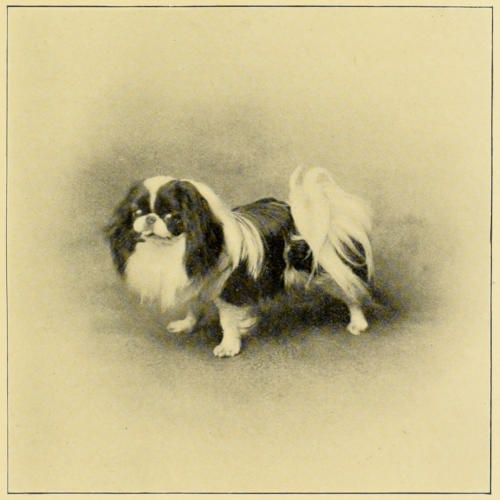
Toy Spaniel, Champion Windfall. Winner of 6 Championships, 24 Firsts and 25 Cups, Gold Medals and Special Prizes. The property of the Hon. Mrs. Lytton, Crabbet Kennels, Poundhill, Crawley.
[face p. 286.
Synovitis (Inflammation of a Joint):
Symptoms: Great lameness, the dog probably not being able to put the leg to the ground at all. The joint is much swollen, very painful, and red. It is generally the result of an injury.
Treatment: Give at once a dose of purgative medicine, and use the following lotion:—
Recipe:
Goulard’s Extract of Lead, 1 drachm.
Laudanum, 2 drachms.
Distilled Water to 6 ounces.
Saturate a piece of lint sufficiently wide to cover the joint, and long enough to go round it; cover over entirely with oil-silk, and apply a bandage. The lotion should be repeated every four or five hours.
If, after the pain and inflammation has passed, the joint remains swollen, rub sparingly into the part once a day a liniment made with equal parts of colourless tincture of iodine and soap liniment. Should the joint become stiff and callous, it may be necessary to apply a mercurial blister.
Tail, Sores at the Tip of:
Symptoms: Big dogs with long tails, especially great Danes, and those confined in kennels, frequently suffer from a sore at the tip of the tail, which, in many cases, is most difficult to cure.
Treatment: Thoroughly cleanse the wound with a solution of chinosol lotion, ten grains to eight ounces of water, and when well dried, dust over with powdered iodoform and cover the sore with a few layers of gauze, and as it is impossible to keep a bandage on, several layers of Mead’s plaster should be placed over the end of the tail, which prevents further bruising. In some cases it is necessary to make the dog wear a leather bag over the tail. This should be fastened around the loins. The part covering the tip should be of double thickness.
When well, it is a good plan when a dog is always banging his tail about, to pad his kennel with sacks stuffed with straw, to prevent his injuring it again, for once a tail has been hurt, it remains tender, and is more liable to injury.
Teats (Crack in):
Symptoms: A bitch, when nursing puppies, often suffers from the teats cracking; the parts become swollen, inflamed, and very painful.
Treatment: Keep clean with boracic lotion, and anoint night and morning with boracic ointment. A few grains of bicarbonate of potash, mixed with the food, cools the blood.
Teeth:
Dogs, like most other mammals, have two sets of teeth. The first are temporary, and, from their whiteness, they are often called the milk teeth; they are twenty-eight in number. The second set are permanent, and therefore not deciduous; they are forty-two, and sometimes forty-four, in number.
A set of teeth consists of three different kinds. Those situated in front or anterior part of the mouth are called the incisors, and those placed immediately behind the incisors are called the tusks or canines, and behind those are the molars.
Each tooth is divided into three parts. The free, or part that is seen when looking into the mouth, is called the crown; then there is the neck or constricted part, which is encircled by the gum, and divides the crown from the fang or root, which is inserted in a cavity (the Alveolus) in the jaw-bone.
Each tooth is made up of three different structures. The external, or enamel, which gives the new tooth its beautiful white appearance, and consists only of a somewhat thin layer, and covers the crown of the tooth only. Immediately underneath the enamel, is situated the ivory or dentine, of which the tooth, including the fang, principally consists. In the centre of the fang is a foramen, or small cavity, containing the pulp, consisting of a membrane nerve and small blood-vessels to supply nourishment, etc., to the tooth.
The incisors, twelve in number, both in the temporary as well as in the permanent set, are for distinction divided into nippers, which are the two centre ones; the intermediates are those situated between the nippers and corners, the latter being placed next to the tusks.
The crown of an incisor tooth presents three prominences—a middle, which is the strongest, and two lateral. On the internal surface of the tooth is noticed a slope, somewhat resembling that found in an ox’s or sheep’s tooth. The root is well developed, longer than the crown, and flattened on both sides.
The tusks, four in number, in both sets are strong, elongated organs, conical in form, and curved in an outward and backward direction. The upper fangs are the strongest, and there is a small space between them and the corner incisor teeth, in which the lower tusks are situated when the mouth is closed. Most of the molars terminate in sharp lobes, and, consequently, are well adapted for tearing and crushing. They are, as a rule, twenty-six in number, seven on each side of the lower jaw, and six on each side of the upper one; but sometimes there are seven on each side of the upper jaw, the same as the lower. It is not an uncommon occurrence for a dog with a short face, like bulldogs, spaniels, and pugs, to have only five upper molars, and six lower molars. But there are only twelve temporary molars—three on each side of both jaws.
A puppy, when born, has no teeth visible, though the milk ones are formed and in the gums, and in some cases, their outline may be seen through the mucous membrane.
The milk teeth are smaller, softer, and more pointed than the permanent ones, and they are not situated so closely together. The tusks, too, are slightly pink in colour just above the neck, which is not the case with the second ones.
Puppies of different breeds vary in the time when they cut their teeth, those of the larger kinds cutting them earlier than small dogs; and though a fox-terrier puppy’s teeth appear earlier than a toy terrier’s, yet St. Bernards have them still earlier.
The process of dentition of the milk teeth is usually carried on without any trouble at all to the puppy. Such is not the case with respect to the cutting of the permanent ones, for it is a very common occurrence for puppies at this time to have convulsions. In other cases, at this period, eczema is very often troublesome, which, in some instances, continues after dentition is completed.
With regard to the cutting of the deciduous teeth, the first that appear, in most cases, is the middle molar on each side of the lower jaw. These pierce the gums in puppies of large breeds like St. Bernards, about the eighteenth or nineteenth day after birth. Puppies, like greyhounds, retrievers, fox-terriers, and others of similar size, do not cut these same teeth until about four days later, whilst puppies of the toy class are often a week later still.
About a day after the second lower molars have appeared, the upper incisors show themselves; the nippers and intermediates are the first to make their appearance. These are followed the next day by the upper corner incisors, and about the same time the lower corner incisors pass through the gums, and the tusks are erupted; but it often happens that all the incisors pass through the gums together, and the tusks at the same time, or just a day or so later.
About the fourth week, the last or third lower molar, and also the first one, have been cut, and are fairly well up; and about two days later, the middle upper molar is just appearing. In a day or two more, the last upper molar is erupted; and a couple of days afterwards, the first upper molar, which is the last to be cut, now makes its appearance.
By this, it will be seen that large puppies, like St. Bernards, have a complete set of milk teeth by the fifth week. Puppies of the smaller breeds are, as previously stated, a few days later.
It may be here remarked, that bitch puppies invariably cut their teeth rather better, and somewhat earlier, than dogs. Winter puppies are a little later in getting their teeth than those born in the spring.
The milk teeth are seldom placed close together, and as the puppy grows, they become still wider apart. This fact is useful in helping one to ascertain the age of a puppy.
The deciduous teeth are much softer than the permanent ones, and when a pup is three months old, if it has had any hard food, the points of the tusks and incisors are worn off.
When a puppy is about three and a half to four months old, the upper incisor nippers are loose, and sometimes have fallen out, and the permanent ones are just coming through the gums at this part. At the same time, the fourth upper molar, which is the fourth from the tusk, makes its appearance. (It will be noticed that though the lower temporary molars are cut before the upper ones, the reverse is the case with the permanent teeth.) In the course of another few days, or a week, the other upper deciduous incisors are shed, and the permanent ones appearing in their place, then the lower milk incisors commence to fall out, and the new ones to make their appearance. About the same time the tusks are showing themselves through the gums. In some cases, the tusks do not appear until all the other teeth are up. This is about the general order in which the teeth are cut, but of course there are exceptions, and in some instances, the permanent tusks appear just after the eruption of the upper centre incisors.
It does not always happen that the temporary teeth are shed before the permanent ones appear, and the latter shoot up either beside, in front, or behind the milk teeth. Then the latter teeth should always be drawn, or the permanent ones may not come straight and regular.
With regard to the permanent molars, the first to appear, as previously stated, is the fourth one. It makes its appearance just behind the last temporary molar. Before it is fully up, the fifth upper molar has passed through the gum. At about this same time the fifth, or large permanent lower molar, is appearing; this is quickly followed by the sixth, and again by the seventh. About the same time as these two latter teeth are erupting, the temporary molars in the same jaw are falling out, and their places are being filled by permanent ones. About a week later, the first lower milk molar is shed and the permanent one cut; this is followed by the second and third ones. The corresponding teeth on each side of the jaw, as, for instance, the fourth molar on the left and right sides, are erupted simultaneously. By the time puppies, such as St. Bernards, mastiffs, retrievers, and others of similar size, are about four months old, the process of dentition is complete. Fox-terriers, and other dogs of this size, are in some cases a fortnight later, and small toy dogs are often from six to eight months of age, or even later, before the mouth is fully furnished.
It is impossible to tell the age of a dog with any certainty after dentition is finished, but up to then one can judge the age to within a fortnight, if it is borne in mind how the teeth are erupted. After this time, and up to a year or eighteen months, if, together with the condition of the incisor teeth, whose middle prominences at this time show signs of wear, one takes into consideration the general appearances of a dog, a fair judgment as to age may be formed.
Later, the wear of the teeth gives no good idea of the age, because so much depends upon the kind of food the animal eats, whether it is hard or soft. When a dog is fed on bread and gravy or meat, the teeth will show little or no signs of wear when he is two or three years old, while the incisor teeth of another dog of the same age will commence to become blunted if biscuits form the staple food. The teeth become still more worn if a large number of bones are given as a part of the diet. And again, dogs who are always playing with and carrying stones often wear the incisor teeth right down to the gums, and the tusks become worn in the course of a few years.
As a rule, if a dog is fed on a mixed diet, as bread and vegetables, soaked biscuits, etc., and not given many bones, and is not allowed to carry stones, then the teeth (incisors and tusks) preserve their shape and position until the fourth year. But by this time the teeth have lost their very white colour, and have become of a palish yellow colour. As the dog advances in years the teeth become still more yellow, besides becoming coated with tartar just above the neck of the tooth, if they have not been occasionally scaled. The tusks, too, now become blunted, and to some degree are altered in position, being inclined to take a more outward direction. It is, therefore, an easy matter to distinguish between an old and a young dog.
The teeth of dogs that are pig-jawed, and those that are undershot like bulldogs, do not, of course, wear to the same extent as when the incisors meet, forming an even mouth.
When the permanent teeth come up crooked, it is a most difficult thing to redirect them, especially when the tusks are at fault, and they are generally the offenders; for these teeth are so firmly and deeply fixed in the jaw-bone that it is impossible, without employing great force, to move them, and from their conical shape it is almost impossible to fix a rubber band or wire to them unless a small niche is made in the enamel, and this damages the teeth and renders them liable to decay. When the tusks grow inwards so as to injure the palate, I have, after a great deal of trouble, fixed a wedge made of hard wood between the two tusks of the lower jaw, but it always comes out within a few hours. Again, when the incisors, or front teeth, come up twisted or crooked, and one tries to turn them with forceps, the operation is seldom successful; the tooth is almost sure to break, as dogs’ teeth are so brittle. More good is to be done by pressing the erring teeth in the right direction with the fingers; and when they are not very badly misplaced, a good deal of benefit may be derived by this simple treatment. It should be done two or three times a day for ten minutes at a time. Pressure of this kind is very useful to the upper or lower incisor teeth in slight cases of undershot—that is, when the lower incisor teeth project in front of the upper ones; or when the upper incisor teeth project in front of the lower ones—called “pig-jaw.” Either of these conditions is a great drawback to a terrier; and some judges, who are particular, and examine the mouth, will often put a dog back for this defect. In bad cases I think he is right to do so; but it is rather hard on the dog when there is only a slight unevenness, because I think he can hold just as well as one with an even mouth.
There is no doubt a pig-jaw is a much more serious malformation than one that is underhung, as it is absolutely impossible for a dog with a mouth like this to bite or seize his prey firmly and hold it. This is a very common deformity with collies and greyhounds, and very ugly it looks—the former are not required to bite, but at the same time the condition, when very marked, should disqualify a dog on the show bench, for there is no doubt that it is hereditary. Another condition of the teeth, and one which judges often put a terrier back for, is canker. It is a diseased condition of the enamel, which gives the teeth a speckled appearance. In my opinion, canker of the teeth is not hereditary; and it is in nine cases out of ten the result of a dog having distemper in early life—I mean before the eruption or cutting of the permanent teeth. The high fever which accompanies distemper seems to eat away the enamel. Teeth when badly affected in this way are soft, and wear away quicker than sound ones; besides, they look bad. There is nothing to be done in these cases, except brushing them occasionally; to scrape them does harm.
Toy dogs’ teeth go wrong much quicker than bigger ones, more especially Yorkshire terriers, spaniels, and pugs. I have seen many a Yorkshire terrier three years old with half the teeth gone, and the remaining ones covered thick with tartar. The condition, in a great measure, is due to feeding, but some bad teeth are no doubt also hereditary. All dogs should have something hard to gnaw every day, either a hard dog-biscuit or bone—not game or poultry bones, of course, or cutlet or chop-bones, for these are more dangerous than game bones, but a good big bone; for small dogs a leg-of-mutton bone, and for large ones a marrow or some other such bone. Puppies, from the time they are weaned, should be given bones, as this often prevents their eating stones and other indigestible articles. Tartar should never be allowed to remain and accumulate; it irritates the gums, and causes them to recede, and then the teeth soon get loose. Therefore, in all cases where there is a disposition for tartar to collect, it should be scraped off from time to time. As a rule, if it is done about three times a year, the teeth may be kept fairly clean. Once the teeth are cleaned, they may be kept white if people will take the trouble to brush them daily, using some powder. The best kind I know of is carbolated eucalyptus powder, as prepared by Messrs. Hucklebridge, of 116 Ebury Street, London, S.W. I mention the name and address, as I do not know of anyone else who makes it, and carbolic powder is not suitable for dogs. The scaling or scraping of the teeth may be done with the point of a penknife or an ordinary steel nail-cleaner, but one must be careful in using these instruments or the gums may be injured. To lessen the risk of doing so, it is much better to buy a proper instrument, which can be bought for half-a-crown at a place like Krohne & Sesemann’s, Duke Street, Manchester Square, London, W.
Loose teeth should be removed, as they only do harm when left, besides causing inconvenience to the dog whilst eating. Sometimes it becomes necessary in very old dogs to remove all the teeth; and when the food is given soft, and cut up small, they appear to do very well without them, and their breath is certainly a good deal sweeter.
Occasionally an abscess forms at the root of the large upper molar tooth; the face swells just under the eye. The abscess, after a few days, generally breaks. The swelling should be fomented with hot boracic lotion, but to effect a cure, the tooth must be removed. It is a difficult one to extract unless it is loose, and no amateur should attempt to do it. An anæsthetic ought always to be given.
Teeth, Cutting the Tusks:
It is sometimes necessary with sheep dogs, dogs used for catching deer, and dogs in the habit of biting and fighting, to cut the tusks level with the incisor teeth. This is best done with a pair of strong bone or wire nippers. The operation apparently causes very little inconvenience or pain, for the dog is always ready to eat immediately afterwards.
Teeth, Tartar on the:
Symptoms: Dogs always fed on soft food and never having anything hard to eat, get their teeth covered with brown-coloured tartar early in life, even sometimes before two years old. If this is not from time to time removed, it continues to increase, until at last the whole tooth becomes thickly encrusted, and to such an extent, in old pet dogs particularly, that the mouth is unable to be closed. As the result of the tartar, the gums become swollen, inflamed, and tender; they recede from the neck of the teeth, which become loose. A dog with teeth in this state is always dribbling, and eats with difficulty, and the breath is often most offensive.
Treatment: Dogs should always be encouraged to eat something hard daily—a piece of dog-biscuit does very well; if this is refused, a hard bone, one that cannot be eaten, should be given to gnaw. This, of course, is only a preventative, and when regularly attended to, the teeth and gums remain good and sound for years. When once tartar has accumulated, nothing will remove it but scraping; which should be done regularly two or three times a year, and if this is done, and the teeth daily cleaned with an ordinary tooth-brush, moistened with warm water and a little of the following powder sprinkled on it, they will keep clean and white, and the breath sweet so long as the dog lives:—
Recipe: Tooth Powder:
Powdered Boracic Acid, 10 grains.
Camphorated Chalk, 1 ounce.
Well mix.
Removing the tartar from a tooth that is somewhat loose does not tighten it, though it preserves the tooth, and for a time often prevents it becoming looser. It is impossible to remove tartar from a very loose tooth, and for the dog’s comfort, it should be extracted at once.
Temperature:
To know the temperature of the body is very important in treating disease, more especially in cases of distemper; for it is a fact that so long as a dog does not have a high temperature when suffering from this complaint, the attack is not a severe one, and the dog, bar accident or relapse, has a good chance of recovery. When the temperature is high, say, 104 or 105, and continues so for some days, the case is always a serious one, and if it continues, complications, especially those of the nervous system, are almost sure to ensue. These remarks not only refer to distemper, but to all other diseases in which a high temperature is one of the symptoms; as, for instance, inflammation of the womb, blood poisoning, pneumonia, peritonitis, diseases of the brain, formation of abscesses, etc.
In many cases it is not necessary to take much notice of the temperature beyond watching it carefully, and keeping a daily record of its rising and falling, but when it keeps persistently high, say, such as over 104, then special medicine must be given to try and reduce it. There are many medicines which have the power of reducing the temperature, and when they are going to have a good effect they generally work quickly, and if they do not succeed in reducing the temperature, say, within forty-eight hours, they should not be persevered in, as then they only do harm.
Antipyrin, in doses from two[1] to ten grains, given in a cachet, is one of the best antipyretics. Phenacetin, given in doses varying from half a grain[1] to five grains; salicylate of soda, aspirin and salicine, in doses from two to fifteen grains[1] in a cachet, tablet, or dissolved in water, and repeated three or four times a day.
In some cases when these fail, salicylate of quinine will have the desired effect, in doses from one[1] to five grains, given in a cachet. If this fails to reduce the temperature, then an ice-bag may be tried, applied to the top of the head for an hour at a time, and then all medicines discontinued. A little brandy, say, from five drops[1] to a teaspoonful, given in water or milk every two, three, or four hours is advisable.
A very low temperature, say, when the thermometer will not rise above 95 degs. F., is much more dangerous than a very high temperature. In such cases, prompt measures must be taken to try and warm the animal. Hot sponges should be applied to the head; also hot-water bottles applied to the back and to the feet. From five[1] to twenty drops of sulphuric ether may be given every hour or so, in from a teaspoonful[1] to a tablespoonful of water. Strong coffee may also be given, from a teaspoonful[1] to a tablespoonful, repeated every half hour. If the dog is very much collapsed, and unable to swallow, strong coffee may be given as an enema, say, from a dessertspoonful[1] to two ounces, and repeated every half hour. Brandy may also be given, injected under the skin, say, from ten drops[1] to a teaspoonful, or very minute doses of strychnine may be given, from the four hundredth part of a grain[1] for a small dog to the one hundred and fiftieth part of a grain for a large one. This medicine may be given dissolved in from two[1] to ten drops of tincture digitalis.
In such cases as these the dog must be given, if he will swallow, small doses of some strong beef essence, as from ten drops[1] to a teaspoonful of Valentine’s beef juice, in from a teaspoonful[1] to a tablespoonful of milk, and repeated every half hour or so.
Testicle (Inflammation of):
Symptoms: The gland is swollen and very painful to the touch, the scrotum is generally inflamed, red, and thickened. The dog walks with stiffness in the hind legs, and there is generally a rise of two or three degrees of the temperature.
Treatment: Frequent hot poppy-head tea fomentations, made by boiling for ten minutes two crushed poppy-heads in a quart of boiling water and then straining the solid matter out through fine muslin. Aperient medicine should be given and the dog kept on a light diet for a few days.
Testicles (Enlargement of):
Symptoms: The gland or glands are more or less enlarged, and they have become so as the result, in most cases, of some injury; but occasionally the causes cannot be traced: this is especially so with old dogs. The condition is not of an uncommon occurrence. It is not often that both glands are affected.
Treatment: Medicinal treatment in these cases is useless. If the gland is much enlarged and continues to increase in size, it should be removed by operation; but very often after getting to a certain size it ceases to increase, and if it does not cause any discomfort by hanging very low and interfering with the dog’s walking, or looks very unsightly, it may be left alone, especially if the patient is an aged one, and it is an old dog’s complaint.
Tetanus:
Symptoms: A rare disease in dogs, but does sometimes follow a bad wound, particularly to the eye. Often it is difficult to account for the cause. The disease, when it attacks dogs, generally only affects the muscles of the jaw (see Lock-jaw), but when the whole body is affected, it commences with stiffness of the muscles of the limbs and neck, followed shortly afterwards by violent spasms of the whole body, including the muscles of the jaw, which cannot be forced open, and the throat is also affected, making it impossible to swallow. The pain during the spasms is acute and the temperature very high, often over 107. The disease generally terminates fatally.
Treatment: Keep patient quiet in a dark place, and relieve spasms by giving from one-twelfth[1] to one-fourth of a grain of acetate of morphia, with from ⅟₂₅₀th[1] to ⅟₁₀₀th of a grain of sulphate of atropine in a few minims of water, injected under the skin. The dose may be repeated every six or eight hours.
To keep up the strength, try and get the patient to swallow white of egg and milk; also Sanatogen mixed with milk or water. When unable to swallow the strength must be maintained by nutritive enemas, as peptonised milk, from one[1] to six tablespoonfuls given every three hours alternately with one or two peptonised beef suppositories. Brandy, if necessary, may be given with the milk.
Thermometer:
The little instrument for taking the temperature, or for ascertaining whether there is fever or not, is called a clinical thermometer. The kind used for animals is the same as used for people. Those that register the heat of the body in half a minute are certainly the best for dogs.
The temperature is best taken in the rectum—bowel, for here there is less danger of breaking the instrument, but it may also be taken in the mouth, as well as under the arm or inside the thigh. The normal temperature in the mouth is 99·6, under the arm 100·4 to 101, in the bowel 101·4.
When it is intended to take the temperature in the bowel the point of the thermometer should be greased, and inserted into the bowel for an inch and a half, so as to be sure the mercury is quite covered. When the temperature is taken under the arm or inside the thigh, care must be taken that the point of the instrument is well buried in the skin, or a wrong temperature may be taken. At least a minute and a half should be allowed when taking the temperature in these parts, even when a half-minute registering thermometer is used.
Thirst:
Symptoms: Excessive drinking of water in large quantities when it can be obtained. A dog, when he is suffering from catarrh of the stomach or diabetes, which induces great thirst, will drink anything, the craving for fluid being so great, even soapy or muddy water, and he will even lick up his own urine when other fluid cannot be found. There is loss of condition, the appetite is poor, the muscles waste, particularly about the neck and limbs, whilst the stomach often becomes full and pendulous.
Treatment: The quantity of water allowed in these cases must be regulated. Dogs in health drink very little except in hot weather, or when taking hard exercise, but under the abnormal circumstances in question, much more than what is taken in health may be allowed. Small dogs may be given half a pint a day, divided into four or five lots, and big dogs two quarts a day, similarly divided into small quantities. For medicine give half a drop[1] to two drops of liquor arsenicalis (P.B.) three times a day, mixed with the drinking water. If after a week the thirst continues, give from the eighth[1] to a grain of powdered opium two or three times a day made into a pill.
Diet: Avoid meat, but you may offer stewed rabbit with rice, also fish, tripe, milk, pudding, etc.
Throat (Sore):
Symptoms: The back of the throat (fauces) is inflamed and slightly swollen, causing some difficulty in swallowing; the lips are moist from excessive secretion of saliva, and the glands about the outside of the throat are enlarged. The dog is often off his food, dull and listless.
Treatment: Give a teaspoonful of following medicine frequently:—
Recipe:
Chlorate of Potash, 1 drachm.
Water to 6 ounces.
Mix.
A light diet should be given for a few days, and the external enlarged glands rubbed gently, night and morning, with spirits of camphor. If the fauces remain inflamed after a few days, paint the parts night and morning for two or three days with a two-per-cent. solution of nitrate of silver.
Ticks:
Symptoms: These parasites are generally obtained from sheep in England. They are small, blue-coloured little creatures with pointed heads, with which they dig into the dog’s skin and suck the blood, and as they do so they gradually increase in size to a tick bean. They naturally cause a good deal of irritation, and make the dog bite and scratch.
Treatment: They should be carefully picked off the dog with forceps, avoiding breaking them if possible. The little spot caused by the bite of the tick soon heals, and does not require any special treatment.
Tongue (Chorea in the):
Symptoms: The tongue is continually being popped in and out of the front of the mouth for an inch or more. This is a rare disease, and I have only seen one case, and that was in a collie. As in ordinary chorea, it is the result of distemper.
Treatment: See Chorea.
Tongue (Inflammation of):
Symptoms: Swelling and redness of the tongue; it often hangs out of the mouth, the result of temporary paralysis, and the dog is unable to lap. The condition is generally caused by injury from the teeth, as a bite during a fit, or a sharp tooth. Wasps’ stings will also induce the same condition.
Treatment: Wash the mouth and tongue thoroughly several times a day with a solution of borax, one teaspoonful to half a pint of water. To any wounds or ulcers apply sparingly night and morning a two-per-cent. solution of nitrate of silver. When the tongue is very swollen and protruding beyond the mouth, apply ice.
Tongue (Paralysis of):
Symptoms: The tongue hangs out of the mouth generally, to one side sometimes, but not often, in front, and there is inability to retract it. The protruding part has a dead and cracked appearance, and loses its natural pink colour. There is a difficulty in eating and drinking. This condition may follow injury to the head; it is sometimes present in cases of general paralysis, the sequel of distemper or from other causes, and it is often seen in old dogs, especially those with a short face, as pugs and Japanese spaniels, due to loss of teeth.
Treatment: Medicine has little effect in these cases. When the result of injury or distemper, as the dog improves in general health the tongue regains strength. A course of Nux Vomica as recommended for general paralysis assists.
Tongue (Warts on):
Symptoms: Small greyish-coloured excrescences appear all over the tongue, as well as on the cheeks and lips. Warts on the tongue and mouth are only seen in puppies. I do not remember seeing them in an adult dog. Sometimes they appear in such numbers as to inconvenience a puppy when feeding. Thick, dirty-looking saliva dribbles from the mouth; the breath is offensive. They are contagious from one puppy to another.
Treatment: Wash the mouth out two or three times a day with a teaspoonful[1] or a drachm of common washing-soda dissolved in half a pint of warm water. Do not cut the warts to make them bleed, as that only increases the number. When the solution of soda does not take them away dress the warts (only a few each day) with a five-per-cent. solution of chromic acid applied sparingly on the end of a wooden match.
In obstinate cases a course of Donovan’s solution of arsenic does good; give twice a day after food from one to five drops[1] in a little water, or it may be mixed with the food.
Tongue (Wounds and Ulcers of the):
Symptoms: The wound may be a simple, punctured one induced by one of the tusks during a fit, or the tip of the tongue may be bitten off, the result of an accident. Abrasions and ulcers occur along the sides of the tongue, due to friction against the molar teeth when thickly encrusted with tartar. Very severe and dangerous ulcers appear on the sides and point of the tongue in cases of acute gastro-enteritis or German distemper, and occasionally in this disease the point of the tongue sloughs off.
Treatment: In ordinary wounds of the tongue, when there is no suppuration, simply washing the mouth often with borax and water—one teaspoonful to half a pint—several times a day is sufficient, but when there is suppuration and ulceration of the parts, besides keeping clean with the borax, the ulcers should be painted twice a day with a five-per-cent. solution of chromic acid. The teeth should be thoroughly cleaned by scraping, especially on the inside. When the point of the tongue dies—in which case it turns to a greyish-white colour—it should be clipped off with scissors and the wound caused by the operation dressed two or three times a day with the chromic acid lotion.
Tonsilitis:
See Throat (Sore).
Toothache:
Symptoms: Dogs’ teeth, as the result of their formation, do not often decay, but as the result of the accumulation of tartar the gums recede, the fangs become exposed, and suppuration takes place around the neck of the tooth, which extends into the socket or alveolar cavity. The adjoining gum becomes swollen and tender.
Treatment: As a rule, in these cases it is best to extract the tooth at once, which quickly gives relief, but this is sometimes objected to by the owner. In these circumstances the tooth should be thoroughly cleaned by scraping, and strong carbolic acid applied very sparingly around the neck of the tooth on a piece of sharp wood or a pointed wooden match. The mouth should be kept clean by being sponged night and morning with a saturated solution of boracic acid.
The offending tooth has to be extracted sooner or later.
Tumours:
Symptoms: New growths, causing swelling and enlargement of the part of the body in which they appear. A tumour, unlike an abscess, generally forms slowly, and is at first usually not painful, and moreover, is not accompanied during the early stages by a rise of temperature as is found when an abscess is forming.
Treatment: It is seldom that a tumour of any kind can be reduced or removed except by a surgical operation. I have sometimes thought that gently rubbing the tumours formed on the milk glands, especially when small, daily for some time with iodine vasogen has checked their growth.
Directly a tumour has been diagnosed, unless the patient is a very old one, it is best to have it removed before it has developed into a large growth; the operation, unless the tumour is situated in the neck, is a simple one, and the wound, with ordinary aseptic precautions, heals in seven or eight days. Of course there are some exceptions, as, when the tumour is a cancer or some other malignant growth, it is not always advisable to sew the wound up after operation, but then of course it takes much longer to heal.
Ulcers:
Symptoms: These are unhealthy wounds or sores left after decay or destruction of some superficial parts of the body.
Treatment: Keep them clean by sponging two or three times a day with Pearson’s fluid—one teaspoonful to half a pint of water. For a day or two apply either hot linseed-meal poultice dusted over with powdered charcoal, or a piece of lint soaked in a saturated solution of boracic acid, placed over the wound and covered with oil-silk, then bandage. When the wound looks cleaner, healthier, and discharges less, and there are signs of healing by the formation of new skin around the edges of the wound, simply cover it over with some carbolic gauze squeezed out in a solution of boracic acid, and apply a bandage.
When an ulcer is healing very slowly, lint dipped in the following lotion and applied to the ulcer stimulates healthy action and healing:—
Recipe: The Lotion:
Tincture Calendula, 3 drachms.
Sulphate of Zinc, 1 scruple.
Water to 6 ounces.
Mix.
Apply as directed two or three times a day. In some cases dusting the wound over with a powder made with one part of iodoform mixed with eight parts of boracic acid. Amyloform is also another good healing powder. It is necessary to keep the dog’s tongue away from it, otherwise he is continually licking off the new skin as it forms.
Uræmia:
Symptoms: This condition generally follows some severe illness affecting the kidneys or bladder when the suppression of the secretion of urine has occurred. Anything that stops the flow of water from the bladder, as stone or stricture, may cause it; it also occurs in bad cases of stone in the kidney. In these cases the dog is very ill, there is an entire loss of appetite and often severe vomiting; a heavy, sleepy condition soon comes on, and the temperature is very high. The white of the eyes are greatly congested, and any urine passed is of dark colour and may be mixed with blood. Sometimes there are convulsions, but the dog soon sinks into a comatose state. As a rule these cases terminate fatally.
Treatment: It is often difficult to give medicine by the mouth in these cases as the vomiting is generally so severe and frequent, but the dog is able, as a rule, to drink milk and Vichy water in equal parts. If possible, give a purgative, Epsom salts being about the best. The dose is from fifteen grains to one ounce,[1] given in water, or with milk and Vichy water if the dog can be persuaded to take it. Small doses of urotropine stimulates the action of the kidneys, from one[1] to eight grains in a cachet may be given every four or six hours. Hot linseed-meal poultices to loins relieve the kidney congestion.
As to diet, milk and Vichy water are quite sufficient to sustain the dog for two or three days, when, if patient is better, fish may be given, but when this cannot be digested, peptonised milk, from one to six[1] tablespoonfuls, may be given every two hours.
Urethritis:
Symptoms: Pain when passing water, or when handled; mattery discharge often tinged with blood from passage. The penis is swollen and red from the inflammation. This condition is generally caused by the passage of gravel, and it may also be the result of frequently passing a catheter.
Treatment: Hot poppy-head fomentations do good. For medicine give from three[1] to twenty grains of hyposulphite of soda in water three times a day. If there is much pain, from two[1] to ten drops of tincture of henbane may be given with each dose of the above.
Feed principally on a milk diet; some boiled fresh fish may be given, but meat must be avoided.
Urine (Incontinence):
See Incontinence of Urine.
Urine (Sediment in):
Symptoms: The urine may be passed white and cloudy, or clear, but of a high colour, and when cold there is a thick, yellowish-white deposit.
Treatment: When accompanied by some illness with a high fever, no special treatment is necessary, as the condition will pass away as the health improves, but when the symptoms described are present and the dog seems otherwise apparently well, give a course of hyposulphite of soda, from three to twenty[1] grains two or three times a day in water or a little milk. A dog will generally take this medicine himself when mixed with milk.
Diet: Milk, tripe, stewed rabbit, etc., with rice or bread, but avoid red meat.
Urticaria:
See Nettlerash.
Uterus, Inflammation of (Metritis):
Symptoms: This disease generally occurs after heat, and is a condition which old bitches are more subject to than young ones. The exciting cause is generally due to something which stops the natural discharge, as a chill, the result of washing a bitch during heat, or from getting wet by rain. Once this disease has occurred it often follows every period of œstrum. The signs of inflammation of the womb do not come on very suddenly like other inflammations, there is for two or three days a loss of appetite and dulness, the bitch is thirsty, and if the temperature is taken, there will be generally found two or three degrees of fever. There is generally loss of flesh, though the abdomen will be noticed large and harder than usual, and painful to the touch. The symptoms gradually increase in severity, and the bitch becomes very ill and weak and refuses food of all kinds, and if forced with any it generally induces vomiting. About the third week there are signs of some discharge from the vagina, pinkish in colour and very offensive, which quickly increases in quantity and seems to pour away, a small bitch often getting rid of half a pint or more in a short time. Once the discharge commences, the bitch appears better, the temperature falls, she is brighter and is inclined to take some nourishment, but there is always a danger of the matter accumulating again. When the discharge does not come away through the natural passage, the womb ruptures, inducing acute peritonitis. Then there is a sudden collapse of the patient, the mouth and limbs go cold, the abdomen is very painful, the pulse becomes very rapid and almost imperceptible, and death occurs within twelve hours.
Treatment: There is little to be done in these cases. The bitch should be kept very quiet, in a dry, warm place; hot linseed-meal poultices should be applied to the abdomen for four or five hours daily—of course, being changed from time to time. When the poultices are removed, a flannel bandage is to be placed round the abdomen. Hot boracic lotion should be freely pumped into the vagina night and morning to relax the neck of the womb. Medicine is generally not of much use, though, if the discharge does not come away, from a half to two[1] grains of permanganate of potash made into a pill with resin ointment, and given three times a day, is beneficial in some cases.
It is important to keep the patient’s strength up. Give plenty of milk; if it is not retained try it with equal parts of Vichy water; also give Brand’s beef essence and raw-meat juice. Tripe and fish may also be tried, and when there is great weakness and food is not retained by the stomach, peptonised beef suppositories may be made use of. Small quantities of brandy occasionally do good.
Once the discharge has come away tonic medicine is to be given, as the following pills:—
Recipe:
Salicylate of Quinine, 2 to 12 grains.[1]
Reduced Iron 6 to 36 grains.
Extract of Gentian, q.s.
Mix.
Make twelve pills—one to be given two or three times a day.
Once the temperature is normal, scraped raw meat and other strengthening foods must be given.
Vagina (Discharge from):
Symptoms: Bitches occasionally suffer from a white mattery discharge from the vagina, sometimes before or more often after being on “heat”. Sometimes after pupping a bitch will continue to discharge a thick, tarry-looking blood for weeks, which causes weakness, and often upsets the milk.
Treatment: In the former case, if the bitch is coming on heat, do not interfere with it beyond keeping the external part clean by sponging occasionally with a weak solution of Pearson’s antiseptic fluid; but when it occurs after the heat, even though the bitch may have been served, means must be taken to stop the discharge, which is very weakening.
Syringe the vagina night and morning with a warm solution of burnt alum, say ten grains to every ounce of water, and use from two to ten[1] ounces of the solution each time. The syringe should be one with a long nozzle, and after being vaselined be passed into the passage as far as it will go.
Tonics should be given as from half[1] to three grains of sulphate of iron made into a pill. Repeat twice a day after food.
When the discharge is of a bloody nature, as occurs after pupping, syringe as just recommended, and give from half[1] to two grains of ergotine added to each iron pill.
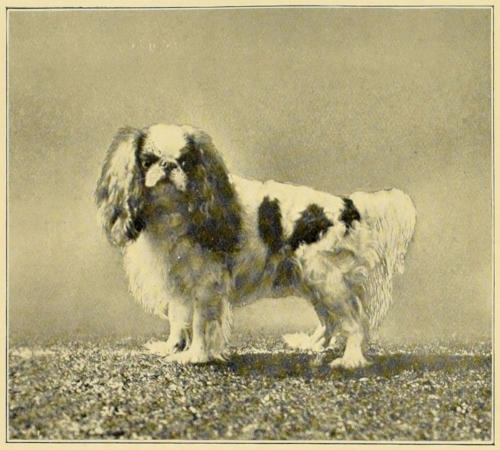
Japanese Chibi of Toddington (imported). The property of Mrs. Hugh Andrews, Toddington, Winchcombe, Glos.
Norman May & Co, photo.] [face p. 318.
Vagina (Injuries to):
Symptoms: Occurs sometimes during the birth of a puppy, even when being naturally expelled, and it is often caused by instruments carelessly used to extract a puppy. Injuries to the passage at this time are always dangerous, as blood-poisoning often follows. The vagina may also be injured by dragging apart a dog and bitch when “locked” together. This is quite an unnecessary procedure, as they will quickly separate if the dog’s testicles be gently but firmly pressed.
The vagina is also frequently injured by the passage of some foreign substance into it, as a peg or stick, as I have seen done in cases of prolapsus of this part. In these cases there is generally a mattery discharge, and when the injury has occurred during the birth of a puppy it may be very offensive, and in these cases there are symptoms of blood-poisoning, as a high temperature, loss of appetite, vomiting, etc.
Treatment: In the latter mentioned cases—that is, when the injury occurs during parturition, the passage should be first thoroughly washed out with a tepid solution of perchloride of mercury, one in three thousand, using from two to twenty tablespoonfuls,[1] and about two minutes afterwards all traces of this should be removed by again syringing the passage with water that has recently been boiled, used just warm. Afterwards repeat the injections night and morning, now using a saturated solution of boracic acid. If temperature is high, give from one to five grains[1] of salicylate of quinine in a cachet, and if temperature is not reduced in six hours, repeat the dose.
In ordinary cases of injury, simply washing the passage out night and morning with a saturated solution of boracic acid or with a solution of permanganate of potash—one grain to every ounce of warm water—is sufficient.
Vagina (Polypus of):
Symptoms: A pear-shaped growth with the narrow end attached to the membrane of the vagina. In these cases the bitch is frequently straining to pass water, and she is constantly licking the parts; and there is generally some mucus discharge. After a time, especially when she comes in season, the growth may show itself externally.
Treatment: It consists in drawing the growth gently out as far as it will come, and placing a ligature of strong silk or catgut tightly round the neck or narrow part, then severing the polypus by cutting through the neck between the ligature and growth a full half-inch away from the ligature. Afterwards syringe the passage out night and morning with a warm solution of boracic acid.
Vagina (Prolapsus of):
Symptoms: A condition that only occurs during the “heat” or œstrum of a bitch. It is more common amongst large and bull-bitches than other and smaller ones.
It shows itself as a pinkish, glistening body at the entrance to the vagina (vulva). As the parts become more relaxed during the “heat” the protrusion increases in size and prominence, and in a large bitch may be as big as an orange. As the result of exposure, and being rubbed along the ground when the bitch sits, the parts become sore and inflamed. The protruding part is merely a fold of thickened and relaxed membrane of the vagina, arising just forward of the passage to the bladder. The swelling, which has a broad base (and in this respect is unlike a polypus, which has a narrow constricted base), can be usually easily returned, but it comes out again almost immediately. Once a bitch has suffered from prolapsus of the vagina it generally occurs afterwards at each period of heat unless removed by operation, though sometimes when a bitch has been bred from, it does not occur again.
Treatment: The swelling disappears of itself as the “heat” passes, and when the prolapsus is small and does not cause much discomfort it is just as well to leave it alone, especially in cases where it is not intended to breed from the bitch, and even when one does wish to breed, the swelling can be returned just immediately before service and then there is no difficulty, and under ordinary circumstances she will prove in pup.
When the prolapsus is very large and there is a difficulty, or it is impossible to return it, it should be removed by operation, which is not dangerous if ordinary aseptic care is taken, especially if an ecraseur is used. When the prolapsus is removed by ligature, as recommended by some, blood-poisoning and death sometimes occur.
After removal, all that is necessary is to syringe the vagina out night and morning with a warm solution of boracic acid for a few days, and keep the bitch on a light diet.
Vagina (Stricture of):
Symptoms: This frequently occurs with bitches, more particularly with griffons and bulls. It does not cause any inconvenience, and it is seldom found out until it is wished to breed from her, and then proper service is not possible in consequence of the passage being constricted with a sort of fibrous ring.
Treatment: It consists in forcibly dilating the passage either with dilating forceps, or if these are not at hand it can easily be done with a well-greased finger. It is best to pass the point of the small finger first, and then afterwards the forefinger. Care must be taken not to use too much force to injure the parts. There is no objection to the bitch being served immediately after the dilatation has taken place.
Vagina (Tumour of):
Symptoms: The vagina is subject to a variety of tumours, as cancer, sarcoma, and particularly to a form of growth of a malignant and contagious nature to which bull-bitches seem especially liable. They are red, with broad base, and have the appearance of a ripe raspberry, but often larger. They vary in size from a raspberry to a Tangerine orange. They are particularly vascular, bleeding at the slightest touch. The growths extend inwards and outwards, often eating the vulva away. There is always more or less of a blood-like discharge.
Treatment: There is no cure for cancer or sarcoma when once established: the bitch should be mercifully destroyed. With regard to the other form of tumour described, with treatment the disease can be checked and the bitch may breed, but it is seldom or ever radically cured, and it is a question whether it would not be the soundest policy to destroy all bitches affected with this disease in consequence of its contagious nature, for although one bitch does not contract it from another, a bitch going to a dog when affected in this way is certain to infect the dog, and it may be some time before it is found out with him, and in the meantime he may, if a popular stud dog, have infected many bitches. If treatment is decided upon, the affected parts should be thoroughly curetted or scraped, and when the bleeding has ceased the raw surface from where the growths have been removed should, with the aid of a speculum, be dressed with chromic acid mixed with equal parts of water. The caustic must be repeated once or twice a week, and the scraping occasionally, if there are signs of the tumours growing again. The treatment is often a long and tedious one.
Varicocele:
Symptoms: A swelling, varying in extent in the scrotum and along the spermatic cord, feeling not unlike a bag of worms. It generally occurs on the left side. The affected testicle of the same side generally gets smaller and soft, and the complaint is sometimes accompanied by a good deal of pain.
Treatment: Attend to general health, keep bowels well open, give regular exercise, and avoid much meat. The local application of cold water often does good. When no improvement takes place, and the condition causes the dog much discomfort, it is advisable to have the testicle of the affected side removed by operation. Such treatment does not interfere with stud work.
Vertigo:
Symptoms: Old dogs suffering from chronic asthma, accompanied by a weak heart, often turn giddy and fall after a severe attack of coughing. The attack seldom lasts for more than a few moments, and the dog jumps up again looking rather vacant, but is soon himself.
Treatment: Give a good dose of purgative medicine, as from two to twelve[1] grains of jalapin, as the liver is often engorged with blood in cases of chronic asthma or chronic bronchitis. Afterwards, a course of the following mixture is advised:—
Recipe:
Tincture Nux Vomica, 1 drachm.
Tincture Digitalis, 2 drachms.
Water to 6 ounces.
Doses: From one to four[1] teaspoonfuls three times a day after food.
For small dogs a quarter or half the above quantity of mixture may be made.
Diet: Raw meat.
Voice (Loss of):
Symptoms: Dogs sent away from home or confined anywhere, and are constantly barking one hour after another as they will do, often lose their voice, and after a time, when attempting to bark, they simply make a husky noise.
Treatment: The condition soon rights itself when the cause is removed and the dog leaves off trying to bark. A teaspoonful of glycerine and water, or a little vaseline, soothes the throat in these cases.
Vomiting:
Symptoms: Vomiting is a symptom of disease, as indigestion, gastritis, gastric catarrh, kidney trouble, peritonitis, enteritis, stoppage of the bowels, biliousness, poisoning, etc.
Treatment: This must depend on the cause, and the case treated accordingly.
Many cases of simple vomiting may be checked by giving iced Vichy water to drink, also allowing the dog to lick ice, and in severe cases the following mixture will often be found useful:—
Recipe:
Diluted Hydrocyanic Acid, 24 drops.
Liq. Bismuth, 3 drachms.
Water to 3 ounces.
From half to two[1] teaspoonfuls to be given every three or four hours.
Small quantities of Brand’s beef or chicken essence, or Benger’s peptonised beef-tea, may be given in jelly form.
When the sickness is very obstinate the stomach should be given absolute rest for six hours or longer, and if there is great weakness nourishment should be given by rectum, as just warm peptonised milk from one[1] to six tablespoonfuls every four hours alternately with peptonised beef suppositories.
Warts:
Symptoms: Excessive growth of the papillæ of the skin, resulting in the formation of small nodules of a roughened and scaly nature. They grow or develop in all parts, and old dogs, especially dachshunds, are very subject to them.
Treatment: When the wart has a narrow neck it is best removed by tying a ligature of silk tightly round it, but when it has a broad base this treatment is not practical; then some mild caustic should be applied, as acetic acid, tincture of iodine, or a twenty-five per cent. solution of chromic acid. It is only necessary just to touch the wart with the caustic on the end of a wooden match once a day. When the wart is very large, it is best removed by being cut out and the skin wound brought together by a few stitches, and then treated as an ordinary wound. Warts on the eyelids must never be cauterised, but always removed by ligature, unless there is a broad base, when they should be cut out with the points of a pair of probe-pointed scissors. Warts on very old dogs are best left alone unless they are troublesome and are frequently bleeding, when they should be removed in the ordinary way.
Water on the Brain:
See Hydrocephalus.
Weaning:
Puppies must not be weaned suddenly, but by degrees, as the milk continues to be secreted, and if not drawn off by the puppies or artificially, it collects in large quantities, causing much pain and often abscesses to form. When there is a large litter, and the mother is not very strong, the youngsters may be taught to lap, when three or four weeks old, artificially prepared bitches’ milk made as follows:—
Recipe:
Cow’s Milk, 15 ounces.
Casein or Plasmon, 2¼ ”
Cream, 2¼ ”
Water, 5 ”
Mix the casein into a paste with the water, then add the milk, thoroughly stirring. Put in an enamel saucepan and bring gradually to a boil, and boil for two minutes. Set aside to cool, and when cold, add the cream, and well stir again.
For a change, Sanatogen may be given with milk or Spratt’s invalid food.
Cows’ milk diluted with water should never be given as is often done, and the puppy’s digestion ruined by over-dilating the stomach, for the puppy has to take such a quantity to get sufficient nourishment, whereas dogs have only a small stomach and require concentrated food.
Puppies should commence to be weaned when about six weeks old. The bitch at first should be kept away from her offspring during the day, say for three or four days; afterwards she should be allowed to visit them night and morning, say for about an hour each time, so long as there are any signs of milk being secreted.
To help to disperse the milk, a dose of castor oil, from one teaspoonful to three[1] tablespoonfuls, may be given the bitch occasionally.
If anything is rubbed on the milk glands, like methylated spirits and water, or spirits of camphor, etc., it must be carefully washed off before the bitch is allowed to return to the puppies. If the glands become hard and knotted they must be kneaded with camphorated oil until soft, and then the contents drawn off with the fingers or a proper breast-pump.
For hints how to feed young puppies, see article on Feeding in the Appendix.
Wen:
Symptoms: A small roundish or oval tumour of smooth surface situated just under the skin, and one that moves freely about, it being unattached. It is a simple growth and quite painless.
Treatment: The only thing to be done in these cases is removal by operation, which is quite a simple matter, for when the skin covering the wen is cut through the little tumour is easily squeezed out. The wound should be afterwards sewed up, some carbolic gauze applied, which should be kept in its place with a bandage or jacket.
Wind in the Stomach:
Symptoms: Dogs, especially big ones, occasionally suffer from a very bad form of “wind or gas in the stomach”, which is a very serious illness, often terminating fatally in a few hours, due to rupture of the stomach, the result of over-distension. The gas is formed by a germ generally present in all dogs’ stomachs and bowels, and called “Bacillus Communis Colli”, and sometimes without any apparent reason or cause they take on an active form with the result as above mentioned. The attack usually comes on shortly after eating. The dog becomes restless and breathes quickly, the abdomen is full and tense, the dog has an anxious look, the eyes are congested, and the pulse very quick and small. The distension continues to increase, the abdomen often assuming an enormous size and hard as a drum, and the pain is acute. Unless relief is quickly obtained the dog suddenly collapses, the stomach having ruptured and the contents escaped into the abdominal cavity. Acute peritonitis sets in, and the dog dies in a few hours as much from shock as the disease.
Treatment: It is generally unsatisfactory, as the symptoms are so acute that there is little time to do anything before the dog becomes collapsed; however, now and then benefit is derived by giving a strong dose of antiseptic medicine, as cyllin, from two to six[1] minims, which can be obtained in gelatine capsules; the dose may be repeated in a couple of hours. If cyllin cannot be obtained give from two to fifteen[1] grains of Naphthol Beta in a cachet; this also may be repeated in a couple of hours. Failing this medicine, then give from five to forty[1] drops of Pearson’s Antiseptic Fluid in a gelatine capsule or cachet, and this too may be repeated in a couple of hours if necessary.
Sometimes benefit is derived by washing the stomach out with a solution of the fluid just mentioned diluted two hundred times with tepid water, using from one ounce to half a pint of the solution.[1] This must be done with a stomach pump. When everything else fails, it is advisable to submit the dog to an operation, which consists of opening the abdomen, and then puncturing the stomach to allow the gas to escape, but care must be taken not to let any of the contents of the stomach escape into the abdominal cavity. The wound made in the stomach must be afterwards carefully closed by Lembert’s sutures.
Womb (Inflammation of):
See Uterus (Inflammation of).
Worms in the Heart (Filaria Immitis):
Symptoms: A common disease in China and not uncommon in Japan, but I believe there has never been a case in England when the dog has been born here, though some few dogs that have been imported from the countries named show symptoms of suffering from these parasites soon after arriving in this country by frequently suffering from convulsions, weakness in the back legs, and in some cases paralysis. A dog’s heart is often irregular in action, but in these cases it is particularly so, and after some great exertion the dog dies suddenly, the result of the worm interfering with the action of the heart.
In making post-mortem examinations of dogs having died from the effect of these parasites, I have found as many as sixty worms in the heart, many of them measuring seven inches long.
Treatment: There is no known treatment that is likely to be of any service.
Worms in the Stomach and Bowels:
Symptoms: Round worms are more frequently found in young puppies than tapeworm, but occasionally the latter are found in puppies six or seven weeks old, whilst the round kind, called Ascaris Marginata, are present in puppies ten days old, when they look like pieces of cotton about an inch to an inch and a half long, and pointed at both ends. When present in such very young puppies they generally cause enteritis and death. A puppy suffering badly from worms does not thrive and grow, he generally eats voraciously. The stomach is distended sometimes to a very great extent, causing difficulty in breathing, the muscles waste, the legs and neck becoming quite thin. The action of the bowels is irregular, but as a rule, there is diarrhœa to a more or less extent, and sometimes vomiting, when the worms have passed into the stomach, and, if the worms are not got rid of, rickets is often the result.
With tapeworms the symptoms vary considerably. Some dogs may be infested with worms and yet not lose flesh, but as the result suffer from eczema, which disappears when the worms have been expelled; but as a rule, a dog eats well but does not put on flesh, and has a tucked-up appearance. The bowels are often irregular, the breath offensive, the coat dull and staring, and the dog is listless. The most positive symptoms of worms is when segments looking like small pieces of dried rice are found about the underneath parts of the tail and on the dog’s bed.
Worms occasionally cause paralysis of the hind legs. People often wonder how dogs get worms, especially pet dogs, who seldom leave their mistresses’ side, but it is easily accounted for, first, when it is taken into consideration how susceptible they are to these parasites; a dog, for instance, fed on raw meat or uncooked milk, or if he eats grass where there are sheep or rabbits, or if he drinks out of a pool which drains from land on which sheep are grazing, he is almost certain to get tapeworm, for sheep and rabbits are the intermediate host of some of the most common kind. Lice, again, act as the intermediate host of other sorts. I may here mention that tapeworms do not breed in a dog, but the eggs or larvæ must pass out of him and be swallowed by some other living creature, who is called the intermediate host. Here they develop into cysts or bladder-worms, and if these in their turn are swallowed by a dog they develop into a tapeworm, and so the cycle is completed.
Treatment: It is most important that house dogs should be kept free of worms, for if by chance or accident a person swallows an egg or larva from a tapeworm there is the danger of a cyst or bladder-worm forming in one’s liver, which is a most serious and often fatal disease. As to the treatment of worms in young puppies, unless the case is serious it is not advisable to commence dosing before the puppy is five weeks old, and then a dose of the following medicine may be given three times a week, half an hour before food:—
Recipe: Worm Mixture:
Santonine, 1 scruple.
Liquor Senna Dulc., 1 ounce.
Glycerine, ½ ounce.
Syrup Aniseed, 3½ ounces.
Well mix.
Doses: For small puppies like griffons, etc., when five or six weeks old, a quarter of a teaspoonful; fox-terrier puppies, same age, half a teaspoonful; retriever puppies, etc., same age, three-quarters of a teaspoonful; St. Bernard puppies, one teaspoonful—to be given half an hour before the first morning meal. Repeat twice a week. The doses may be gradually increased, according to age and size of puppies. The bottle must be well shaken before pouring out the dose.
If the mixture is not retained, from an eighth[1] to half a grain of santonine, with from half[1] to two grains of jalapin, may be given, made into a pill, twice a week half an hour before food. When six weeks old, fox-terriers and other breeds of similar size and strength, and also, of course, bigger ones, may be dosed with powdered areca nut and santonine. Give one grain of the former to every pound the dog weighs, and to the dose of this medicine add from the eighth[1] to half a grain of santonine. This may be given in a cachet, and about half an hour afterwards give the puppy a drink of warm milk. Should the bowel not operate freely in the course of an hour, from half[1] to two teaspoonfuls of castor oil is recommended. Repeat the vermifuge in the course of a few days. “Ruby” is also an excellent remedy for worms in young dogs.
It is a good plan to dose puppies regularly from time to time, say once a month, for worms.
With regard to the treatment of tapeworms in adult dogs, there is nothing better than the old-fashioned remedy, freshly powdered areca nut. The dose is one grain to every pound the dog weighs, but more than two drachms should never be given at a time to the biggest dog. Unfortunately this medicine often induces vomiting, but if it is given in cachets it is less likely to do so. About half an hour after the medicine has been administered some warm milk or clean soup may be given the dog to drink, and a couple of hours after the dose from a dessertspoonful[1] to two tablespoonfuls of castor oil should be given.
Another good remedy for tapeworm is the oil of male fern, and the doses are the same as for areca nut. This medicine may be bought in gelatine capsules, but castor oil must be given afterwards, as recommended after the previously mentioned remedy.
It is advisable to dose all adult dogs for worms, whether they exhibit any symptoms of having these parasites or not, about three or four times a year.
Worm (Maw):
Symptoms: A dog is said to have maw worms when pieces or segment of tapeworm are found adhering to the back parts. These are not distinct worms, but segments of tapeworm, which come away naturally when a worm is breaking up in the bowels, due to natural causes and changes.
Treatment: The same as for tapeworms.
Wounds:
Symptoms: There are five kinds. An incised wound is a clean cut with a sharp instrument; a lacerated wound is when the skin and other parts are torn; contused when the skin, etc., is torn and the edges are bruised, as when caused by a blow by some blunt instrument or a fall. A punctured wound is one made by some sharp-pointed instrument. A wound of this kind is also often caused by the bite of a dog, one of the tusks penetrating the skin and underneath tissues. Then there is another kind of wound called a fistulous wound, which generally externally is small, but runs deep into the tissues as in fistula of the anus; but the most common seat of a fistulous wound in the dog is in the face, just under the eye, caused generally by some external injury which may not break the skin, but injure the ridge of bone called the zygomatic ridge, resulting in the formation of an abscess which will not heal until the large molar tooth (which is situated underneath the fistula) is removed, and then it heals of itself quickly even though it may have been running for months.
Fistulous wounds may form anywhere when an accident has happened to a part and a bone has been injured, and as the result of the inflammation the bone dies, and the wound will not heal until the dead bone comes away either naturally or by operation.
Another example of a fistulous wound is found when a dog has swallowed something sharp, such as a pin, needle, bone, or a corn sheck, which may pierce that part of the gullet situated in the neck; as the result, a large abscess often forms, and until the foreign body has come away the wound, the result of the bursting or lancing of the abscess, will not heal. These cases are often very troublesome, as the foreign body causing the mischief may be buried very deeply in the tissues, and when small is difficult to find even with the assistance of the X-rays.
Treatment: The first and principal thing to do in the treatment of all wounds is to clean them; but sometimes if the bleeding is very severe it may not be possible to do it thoroughly at once, for the dog may bleed to death, so when there is severe hæmorrhage this must be stopped as soon as possible. As a rule, a thick pad of medicated wool or antiseptic gauze, or failing either of these, a clean sponge wrung out in some hot water and bandaged firmly over the wound, will generally answer. This is cleaner and better than applying a stringent, as the tincture of iron or Friar’s Balsam, though in some cases it may be necessary, and the pressure afterwards applied. Four or five hours afterwards the temporary dressing may be removed, and after cutting off the hair from the edges of the wound it should be thoroughly cleaned with a solution of Pearson’s Disinfectant Fluid, 1 in 120 of warm water, or with a teaspoonful of boracic acid in half a pint of warm water. All dirt, clots of blood, hairs, etc., must be removed, and if it is an incised wound the edges should be brought together with stitches of strong silk, catgut, or silver wire; failing any of these, pin sutures may be used in the following way: A pin should be run through the skin on either side of the wound about a quarter of an inch from the edge, and the severed edges brought close together and kept there by winding a piece of cotton, figure-eight fashion, round the pin. Each pin should be placed about the third or half an inch apart, and after applying the cotton the point and head should be cut off. Afterwards cover the wound over with a few layers of dry antiseptic gauze, and bandage. Two days afterwards the gauze may be changed, but the wound need not be interfered with so long as it is dry and there is no swelling. If there is much swelling, one suture should be removed and the fluid gently squeezed out, afterwards apply the dry dressing as before. When there is much discharge the dressing must be repeated once or twice daily, the surface of the wound being cleaned with a solution of Pearson’s Fluid or boracic acid. On the sixth or seventh day the sutures may be removed, but the dressing should be continued for another day or two or until the parts are quite sound.
Lacerated and Contused Wounds require practically the same treatment; they must be thoroughly cleansed with a warm solution of some disinfectant, all shreds or loose and hanging bits of skin removed with scissors, then dust over the wound a powder made with powdered iodoform one part, powdered boracic acid eight parts, mixed together, a few layers of antiseptic gauze applied and the parts bandaged. When there is much discharge the dressing should be repeated twice a day, otherwise once a day is sufficient. Do not continue the compound iodoform powder for more than three or four days. After a week or so, if the wound is healing very slowly, apply instead of the gauze some boracic ointment on lint, which may be occasionally changed for the following lotion:—
Recipe:
Sulphate of Zinc, 1 scruple.
Tincture Calendula, 2 drachms.
Water to 8 ounces.
This should be applied on a piece of lint doubled once and just big enough to cover the wound, which should be covered over with oil-silk and then bandaged. Repeat the dressing twice a day. When proud-flesh, or excessive granulations—that is, the newly-formed tissue to fill up the wound—forms and grows above the surface of the surrounding skin, nitrate of silver in the form of a stitch should be applied by just wiping it once across the surface of the parts. These wounds often take a long time to heal.
In treating punctured wounds the principal thing to do is not to let the skin heal before the parts underneath have, otherwise an abscess is sure to form, and there is a danger of blood-poisoning. A puncture wound may be cleaned by being syringed out with a solution of some disinfectant, then a small strip of disinfectant gauze should be placed in the wound to prevent its healing. This is to be covered over with a few layers of gauze and a bandage applied. Repeat the dressing twice a day, and so long as there is any discharge the wound on the skin must not be allowed to heal.
Fistulous Wounds are sometimes very difficult to heal, and often require operating upon before they will do so—especially in cases of a fistulous wound in the anus which may extend to and open into the bowel. However, before submitting the patient to an operation try the following lotion:—
Recipe:
Chloride of Zinc, 6 grains.
Tincture Calendula, 1 drachm.
Water to 1 ounce.
A little to be gently syringed into the wound once every other day.
In cases of fistulous wounds the result of diseased bone, time must be given for the dead bone to come away. The application of hot linseed-meal poultices dusted over with powdered charcoal do good, but it is often a matter of weeks, sometimes months, before the dead bone separates from the healthy bone. When the case is very obstinate the services of a veterinary surgeon should be obtained.
Wounds the result of the bite of a dog suffering from rabies should be immediately and freely cauterised with fuming nitric acid or a saturated solution of chromic acid, but unless the dog is a very valuable one, he should be destroyed, as it is running a great risk to keep a dog that has been bitten by one suffering from this disease. Besides cauterising the wound, the bitten dog should be very securely isolated for three months so that he cannot possibly come in contact with either man or other animal.