CHAP. III. FOREIGN MODES OF CULTIVATING THE PINE APPLE.
Reading edition
Culture of the Pine Apple in Holland,—France,—Germany,—Italy, &c.
The horticulture of the continent is, in general, copied from that of Holland, as was our culture, and that of every other country two centuries ago. Excepting in Holland, therefore, the English gardener will find very little to learn in other countries; but it is worth while to know how little is to be known in one quarter, that we may be the more assiduous in our attention to such quarters as are likely to furnish us with information.
For this purpose, we shall take a short view of the culture of the Pine Apple in the principal parts of the Continent.
Whether Le Cour was the first who imported Pine plants from the West Indies, is less certain than that he was the first to attempt their culture with success. Professor Bradley, in his General Treatise of Husbandry and Gardening for July 1724, p. 206. gives a description of the Pine Apple, and the introduction of it into Holland by Mr. Le Cour. He says, that there were in the Amsterdam gardens about two hundred plants, chiefly from Surinam and Curaçao, but some from the Dutch factories in the East Indies, which were in good health; but the art of bringing them to fruit was not known till Mr. Le Cour took them in hand. Miller says, that after a great many trials, with little or no success, Mr. Le Cour did at length hit upon a proper degree of heat and management, so as to produce fruit equally good (though not so large), as that which is produced in the West Indies. About the year 1737, the year before his death, Mr. Le Cour published a quarto volume in Dutch, containing the result of his observations on gardens, trees, and flowers; with explanatory descriptions of his stoves.
From this work, and from the statements of Professor Bradley, (Treatise on Husbandry and Gardening, for June 1724, p. 161.) we learn that Le Cour’s mode of treating the Pine plant was very similar to that adopted at Sir Matthew Decker’s garden at Richmond, to be afterwards described; but we shall give this gentleman’s practice, as related by himself.
Sect. I. Culture of the Pine Apple by Mr. Le Cour in the beginning of the 18th century, at Drieoeck, near Leyden.
I distinguish, he says, three different species of Pine Apple; the first and best has green leaves, garnished with fine prickles, fruit of which I have had seven inches high, and thirteen inches in circumference; this sort, if it is kept cool before it shows fruit, and then advances slowly by somewhat more heat, grows larger and more pointed than that which has been kept warmer and in a growing state during winter. The leaves of the second sort are larger and broader, of a darker green mixed with red; it does not produce fruit of so large a size, but its knobs are broader and larger, yet flatter; the unripe fruit being of a reddish brown, and when ripe of a deep yellow, with brownish yellow spots on the knobs; this sort has not so pleasant a taste as the first, which, when unripe, is of a darker green, and when ripe, with lighter yellow knobs, on which account I cultivate chiefly the following sort.
This is called the Smooth Ananas, on account of its being without prickles, but the ends of the leaves grow longer, narrower, and more upright: the fruit is smaller. The Ananas cannot bear the cold of our winter, and must have in summer a more permanent warmth and less change in the winter than we commonly have in our climate; and must therefore not only be put during the winter into stoves, but even during the summer under glass frames, and the pots placed in a hot-bed of tan. However, it is with these plants, as it is with all others from a warmer climate; when they by degrees have been accustomed to our colder climate, they become more hardy, and can bear more cold and change of weather, and therefore produce better fruit than those which are sent to us from abroad and have been reared in a warmer country more congenial to their nature. It is therefore necessary that we should try to get plants that have already been accustomed to our country, by propagation from suckers for a number of years, for in that case they may be reared with very little trouble.
The most convenient time to take away the suckers is from the middle of June to the end of the month. Both suckers and crowns must be put in sandy earth in little pots, as in this manner they strike their roots best; but when the plants have grown larger, they must be transplanted in the following year in richer and less sandy earth, and in larger pots, care being taken that the earth is not loosened from the roots in shifting them. The most convenient time for transplanting them is in March, when the plants must be taken from the hot-house and put in a bed of earth under a frame. Care must be taken in shifting them into other pots, to make the earth adhere well to the roots, and to water them well afterwards, and not to use too large pots, as they take up more room, are not so easily handled, and are less proper for growing large fruit than those of a moderate size; the most convenient pots for transplanting are ten inches in diameter within the rim, seven inches at bottom, and ten and a half inches deep.
The plants, when growing, commonly require a great deal of water, and more when they set their fruit. They should then be watered frequently all over their leaves. Afterwards they must be treated with more caution, and be less watered; for too much water would be injurious about the time of the ripening of the fruit, which would get watery, and of a transparent greenish yellow, and be of inferior taste and smell. Too little water dries them up, and makes the marrow perish in the leaves, the first signs of which are, when you hold the green leaves towards the light, you will perceive them speckled with yellowish spots. To produce proper fruit, the plant of a sucker or crown must have grown well and bulky, at least for three years; the first sign of setting fruit is, that its leaves spread a little, and the plant opens a little in the heart where the fruit soon shews itself like the head of a large nail. As the fruit and stalk grow higher, the fruit grows rounder, with pointed little leaves like thistles, on some reddish, and on others whitish spreading leaves. After the fruit has grown about a month, and is of the size of a walnut, there appears out of each knob a three-leaved pointed little flower, which, in the Common Ananas, is of a pale blue colour; on the Red Ananas, deep blue; and on the third sort, the Smooth Ananas, almost violet. This flower does not fall off with the increase of the fruit, but shrivels up, and leaves some visible remains behind when the fruit has attained its full maturity.
The time, from the beginning of the fruit to its perfect maturity, cannot be limited to a certain number of days and weeks, since it depends very much on the weather of two summers following. During the spring, when the plants are in the hot-house, a very natural growth may be obtained by heating the stove, and by the sun shining at right angles on the glass, which growth may be continued during the summer. In autumn this cannot be the case, because the sun has less power, and the rains common to that season diminish it still more; therefore, from December at latest, more and more artificial heat must be given to the plants, until they begin in the middle of February, or at farthest in the beginning of March, to show their fruit, which then, with good summer weather and proper treatment, will attain to maturity in the beginning of July, and thus are five months ripening; the fruit, which shows itself in the beginning of March, wants at least a fortnight more to ripen; that which appears in the middle of March wants a month more, and consequently is six months coming to maturity; that which shows itself in April wants still more, and seldom becomes so ripe as to obtain its proper taste and smell. The agreeable smell which the ripe Ananas emits on lifting up the sashes, is the surest proof of maturity: it is then of a deep yellow, and the knobs have brownish yellow spots.
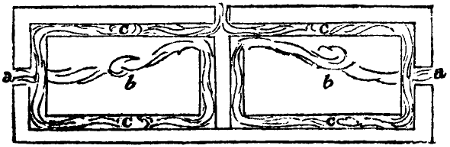
The time for removing the plants from the bark bed into the flued pit, and hence again into the bark bed, cannot be fixed, as this depends on the weather, and on the length of summer or winter. In some years I have been obliged to put them in a hot-house in September, and keep them there until April; but in common years they are moved into the hot-house on the 10th or 12th of October, and from thence again into the hot-bed of tan in the middle of March. The flues must be dried by heating them before the plants are brought into the hot-house, not only to remove the damp which, on the first heating, is powerful and injurious, but also to discover whether there are any openings by which the smoke may escape into the hot-house, for they must be carefully stopped up. This pit or wintering house may be of any convenient length or breadth; supposing two joined together, then the fire flues (fig. 1. a. a.) may be formed at the extreme ends; the smoke may first enter and fill a vault of the whole width and length of the pit (b.); it may afterwards enter a flue (c. c.) and pass round the pit, and then out by a chimney in the back wall.
1
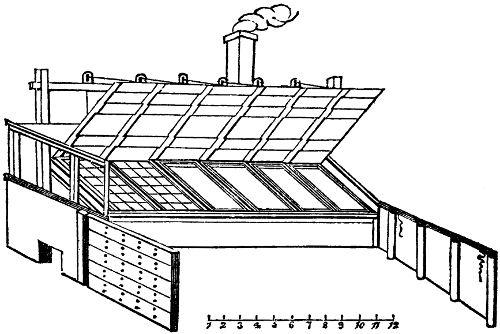
The sashes of the pits at Drieoeck are six feet wide, and three and a-half feet broad, and each has a cover of boards which are raised up and let down by means of cords and pullies, the better to retain the heat in the winter months (fig. 2.) Their slope forms an angle, with the horizon of about twenty degrees.
2
In these pits a boarded stage is formed, on which the plants are set, so as to be almost touching the glass during winter; during summer a bed of tan is substituted for the boarded stage, and no fire-heat is applied, but the plants plunged in the tan.
The following is the general course of temperature aimed at:—
Temperature during the first fourteen days in October, when the plants are removed from the hot-beds of bark to the stages in the flued pits, 87° Fah.
Temperature from this time till the 20th of the January following, from 55° to 64°.
Temperature from January to March not under 55°. Lowest degree admissible during winter 42°. Highest summer heat 105°.
Temperature of the bark hot-beds, in which the plants are placed to fruit when air is given, 103°.
Ordinary summer heat for the fruiting plants 96°.
In Holland and Flanders, at the present day, the Pine Apple is never grown in any other manner than in pits and hot-beds. The crowns and suckers are struck and forwarded, from three to six, or nine months, in hot-beds, and afterwards removed to pits. These pits differ from ours in being rather steeper in the roof, and generally the fruiting pits have a passage at the back, with a flue against the back wall, and an entrance door to the passage at one end. In some the passage and flue are in front, and in others a passage and flue are conducted round the house, leaving the pit in the middle; but this is rather an uncommon form, and chiefly to be met with in pits or stoves for ornamental plants. The fuel in general use is peat, and the glass is well covered with boards and matting or canvas or thatch every night after sun-set, excepting in the warmest part of the season.
The soil used by the Dutch is good garden earth, mixed with a third part of well-rotten hot-bed dung, or cow dung, and a sufficient quantity of sand to render it free and pervious to moisture. The gardeners there are by no means so particular in the article of soil, as many are in this country; their object seems to be to make it rich and free; without being very anxious as to employing virgin soil only, or any particular kind of dung. They generally, however, keep the mixture some time in heaps, and turn it over once or twice before using it. At the same time we have seen them shifting Pines, and using a black rich earth newly dug out of an adjoining plot of turnips; only mixing it with a little rotten dung and white sand.
They shift their plants in spring, and refresh the surfaces of the pots in autumn, and they seem on the whole to fruit them in larger pots than we do; but they leave off shifting them nine or ten months before the fruit is expected to appear, wishing to have the pots filled with roots at this crisis. They seldom fruit a crown plant under two years, and more generally three, from the time it is taken from the fruit; large suckers they fruit earlier, according to their size when taken off the mother plant; some which come out from near the bottom of the stem they earth up, and do not take off at all. These come early into fruit, but it is not large.
Sect. II. Culture of the Pine Apple in Germany.
The Germans took their horticulture from the Dutch, as they did their landscape gardening from the French. They seem to have tried the culture of the Pine Apple almost immediately after its introduction to Holland; for, according to Beckmann, it was ripened by Dr. Kaltschmidt at Breslaw in 1702, who sent some fruit to the Imperial Court; but he states also that its culture was first attempted by Baron Munchausen, a great encourager of gardening, and a botanist who had a fine demesne and garden at Schwobber, near Hamelin, in Westphalia. From the account of these gardens in the Neuremberg Hesperides, they appear to have been grown both in pits, and on stages in larger houses.
The king of Prussia grew the Pine Apple extensively at Potsdam; he followed the Dutch manner in every thing, and had a gardener from that country who attended exclusively to the forcing department at Sans Souci. The quantity of glass there was greater than any where else in Germany: the whole was kept in high order and good culture for many years; but after the king’s death, in 1786, it soon fell into neglect; the glass of most of the peach-houses and vineries was removed or destroyed; the Pine plants were neglected and diminished in numbers, from time to time. In 1813 the royal gardens at Sans Souci contained only about two dozen of Pine plants, which were kept in a lofty opaque roofed conservatory, and these, as may be easily imagined, were by no means in a thriving condition.
Before the French Revolution, the Pine Apple was cultivated at most of the court gardens in Germany; but in the year 1814, there were very few in the empire.
Sect. III. Culture of the Pine Apple in Russia.
The Pine Apple is extensively cultivated in the imperial gardens in the neighbourhood of Petersburg and Moscow, and also in those of a few of the greatest nobility and mercantile men adjoining those cities. Nothing can be more wonderful than to contemplate the resources by which this plant, requiring not less than from 50 to 70 degrees of heat at all times of the year, is preserved in existence through a winter of seven months, during the whole of which the ground is covered with snow, and Fahrenheit’s thermometer, often for weeks together, at 20° below Zero.
The head gardeners of the emperor, and the great nobles of Russia, are, for the greater part, Britons; and the sort of houses they erect, and the mode of culture they follow, is as nearly as circumstances will admit, those of Speechly or Nicol.
The culture of the grape is, to a certain extent, combined with that of the Pine Apple; the former is trained on the rafters, and the latter grown in a pit, surrounded by flues and a path. In addition to the flues, many of the fruiting-houses have stoves built in them, on the German construction, which are used in the most severe weather. Sometimes there is a double roof of glass; but more generally the roof, ends, and fronts, are covered with boards; which not only prevents the weight of sudden falls of snow from breaking the glass, but by admitting of a coating of snow over them, prevents, in a considerable degree, the internal heat from escaping. This covering, or a covering of mats or canvass, as practised near Moscow, and from which the snow is raked off as fast as it falls, is sometimes kept on night and day for three months together. The plants being all the while in a dormant state, it is remarkable how little they suffer.
The best ranges of hot-houses in the neighbourhood of Petersburg, have been imported there from Leith, or London. At Moscow, where the same facility of importation is not afforded, they are constructed on the spot, in a very rude manner; in the best of them, the interstices between the sashes and rafters are so large, that they have to be stuffed with moss. Still it is astonishing how well the Pine Apple is preserved in them through a long winter, and what excellent peaches and grapes they produce during summer. The cause seems to be owing to the great care and skill of the gardeners, in keeping the plants in a dormant state, when there is but little light; and in applying powerfully all the agents of growth and culture, during the short, but warm Russian summer.
There are some German gardeners in Russia, who cultivate the Pine Apple in pits as in Holland; and crowns and suckers are forwarded in this way by them, and also by the British gardeners settled in that country.
Sect. IV. Culture of the Pine Apple in France.
The culture of the Pine Apple does not appear to have been commenced in France till after the middle of the eighteenth century, and then only in the royal gardens at Versailles, in those of the Duke of Orleans at Mousseaux, and one or two others. It has never been cultivated by above a dozen persons in that country; nor is it grown by so great a number at the present time. The best are in the garden of M. Boursault, within the boundary of Paris; and the next those of the king at Trianon and Versailles, and of the banker Lafitte, at his country-seat, a few leagues from the capital.
M. Boursault grows them in low houses, which may be termed pits, being without glass in the front or ends; the plants are plunged in tan, and kept as near the glass as possible; and the soil used is good garden earth, or free soil (terre-franche), with about half its bulk of poudrette, or desiccated nightsoil. M. Boursault tried them formerly in the poudrette alone, but found they did not succeed so well as when a smaller quantity was used. He produces fruit from half a pound to two pounds in weight, and it is said of a good flavour.
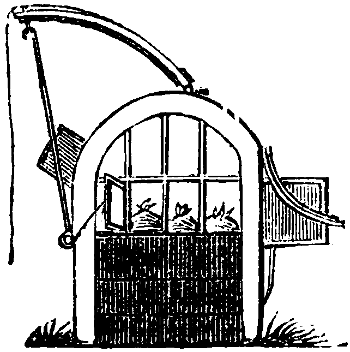
Rosier states, that M. Mallet, a curious horticulturist, grew ananas in a peculiarly constructed frame of his own invention (fig. 3.); but we could see none of these frames in use in any way, and were informed by different persons, that they were too expensive in their first cost to succeed.
3
The Pine plants in the royal gardens, did not appear to us so well cultivated as those of M. Boursault; they were very much drawn, and seemed too sparingly watered. All the Pine plants which we have seen in France, and also in Italy, had this yellow sickly appearance; and the fruit produced was universally of small size; one of three pips is thought worth presenting to table. It is certainly a very singular fact, and not hitherto explained, that the Pine plant in a climate where it gets more light than in Germany, Britain, or Russia, should yet be less green than in those countries. Had the reverse been the case, the circumstance would not have been surprising; but that more green should be produced in the northern hemisphere, and under the torrid zone, than under what might be considered as a happy medium between two extremes, is astonishing, and leads to a suspicion of deficiency of management. The cause seems referable to deficiency of water, and too great heat during night; for during day they have the precaution to shade them from the sun’s direct influence.
Sect. V. Culture of the Pine Apple in Italy.
The Pine Apple was grown in Italy before the revolution, by the Pope, at Naples, and by the king of Sardinia, at Turin. The late king of Sardinia sent his gardener to England, to study the culture of this fruit; and he returned and published in 1777, a pamphlet on the subject. He recommends it to be grown in pits, much the same as those of the Dutch, but without flues, which is still the general practice in Italy. After the possession of Piedmont by the French, the royal palaces and gardens were neglected, and in 1819, when we saw them, they were not restored.
At the royal gardens, and those of Prince Leopold, at Portici, near Naples, a few Pines are grown in pits, by two German gardeners, that of Prince Leopold, an intelligent man and a good botanist; but the plants, notwithstanding the fine climate, are etiolated, slender, and pale, with very small fruit. The pits were entirely sunk in the ground, narrow, and without flues, and they were shaded in the day-time with a net. It appeared to us, that they were much too tenderly treated; if uncovered in the night-time, or planted in the open garden, and left exposed all the summer, and covered with double glass frames during winter, without any fire heat; but, if occasion required, surrounded by linings of dung, we have no doubt they would succeed much better.
At Caserta, a royal palace about eighteen miles from Naples, the Pine Apple is grown in a style much superior. The gardens and grounds there, were laid out by M. Græffer, a German gardener, who was formerly a partner in the firm of Gordon, Thomson, & Co. London nurserymen. The hot-houses are built exactly in the English style; the Pines raised and forwarded in pits, and fruited in broad low houses, with vines trained under the rafters, in Speechly’s manner. M. Græffer died in 1816, and his son has still the care of the royal gardens, and in 1819 had the Pines, in what would be considered in this country, middling good order. They were certainly of a much less vivid green than those of England or Holland, and the fruit was smaller; M. Græffer, jun. never having been out of Italy, was not aware of the difference; but on enquiring into his mode of treatment, we were led to suspect a deficiency of water and of moisture, by watering the flues and paths of the house, and too great a heat kept up during the night. The air of Italy is, at most periods of the year, much drier than that of the north of Europe; that of France and Germany is also drier than the air of Holland, Britain, and Russia; and perhaps this difference in atmospheric moisture, and the overheating at night, may, in some measure, account for the difference in the colour of the foliage of the Pine and other plants kept under glass in France and Italy.
There are some Pines grown at Rome, Florence, and Genoa; but they are not much better than those of Portici. The greatest number, and the finest plants and fruit which we saw in Italy, was in the Vice-regal gardens at Monza, near Milan, under the management of a most intelligent Italian gardener, a pupil of Professor Thouin of Paris, Signior Luigi Vilaresi. The treatment is in all respects that of the Dutch; the plants are forwarded in frames, and sometimes in the open air for a month or two during summer; they are fruited in large pits, with a walk behind, and when more plants come into fruit than are wanted, they are retarded, or preserved, by being placed in a division of the pit without bark, and where they receive abundance of air in the day-time, but no water. The plants here were large and long-leaved, but still not so green and stocky as those of England, and the fruit did not appear to be above one and a half, or two pounds in weight. On enquiry, we found no air was ever left to the pits in the night-time.
Sect. VI. Culture of the Pine Apple in other parts of Europe.
The Pine Apple has been fruited at Stockholm, and in one or two places besides in Sweden; and also in the Court gardens at Copenhagen, and by De Conninck, and some of the rich merchants of Denmark; but we could hear of none being grown in either of these countries, when we visited them in 1813 and 1814.
It is said to be cultivated in Spain, near the sea coast; and also at Lisbon. We know it was grown by the late M. De Vismes, near the latter city; and we believe it is now grown by some English merchants at Seville; but this is all we know. It does not appear to be grown in European Turkey.