PART II. Greek Dualism.
Reading edition
CHAP. II. THE NEO-PLATONIC ARISTOTELIANS OF PERSIA.
With the Arab conquest of Persia, a new era begins in the history of Persian thought. But the warlike sons of sandy Arabia whose swords terminated, at Nahāwand, the political independence of this ancient people, could hardly touch the intellectual freedom of the converted Zoroastrian.
The political revolution brought about by the Arab conquest marks the beginning of interaction between the Aryan and the Semitic, and we find that the Persian, though he lets the surface of his life become largely semitised, quietly converts Islām to his own Aryan habits of thought. In the west the sober Hellenic intellect interpreted another Semitic religion—Christianity; and the results of interpretation in both cases are strikingly similar. In each case the aim of the interpreting intellect is to soften the extreme rigidity of an absolute law imposed on the individual from without; in one word it is an endeavour to internalise the external. This process of transformation began with the study of Greek thought which, though combined with other causes, hindered the growth of native speculation, yet marked a transition from the purely objective attitude of Pre-Islamic Persian Philosophy to the subjective attitude of later thinkers. It is, I believe, largely due to the influence of foreign thought that the old monistic tendency when it reasserted itself about the end of the 8th century, assumed a much more spiritual aspect; and, in its later development, revivified and spiritualised the old Iranian dualism of Light and Darkness. The fact, therefore, that Greek thought roused into fresh life the subtle Persian intellect, and largely contributed to, and was finally assimilated by the general course of intellectual evolution in Persia, justifies us in briefly running over, even though at the risk of repetition, the systems of the Persian Neo-Platonists who, as such, deserve very little attention in a history of purely Persian thought.
It must, however, be remembered that Greek wisdom flowed towards the Moslem east through Ḥarrān and Syria. The Syrians took up the latest Greek speculation i.e. Neo-Platonism and transmitted to the Moslem what they believed to be the real philosophy of Aristotle. It is surprising that Mohammedan Philosophers, Arabs as well as Persians, continued wrangling over what they believed to be the real teaching of Aristotle and Plato, and it never occurred to them that for a thorough comprehension of their Philosophies, the knowledge of Greek language was absolutely necessary. So great was their ignorance that an epitomised translation of the Enneads of Plotinus was accepted as "Theology of Aristotle". It took them centuries to arrive at a clear conception of the two great masters of Greek thought; and it is doubtful whether they ever completely understood them. Avicenna is certainly clearer and more original than Al-Fārābī and Ibn Maskawaih; and the Andelusian Averroes, though he is nearer to Aristotle than any of his predecessors, is yet far from a complete grasp of Aristotle's Philosophy. It would, however, be unjust to accuse them of servile imitation. The history of their speculation is one continuous attempt to wade through a hopeless mass of absurdities that careless translators of Greek Philosophy had introduced. They had largely to rethink the Philosophies of Aristotle and Plato. Their commentaries constitute, so to speak, an effort at discovery, not exposition. The very circumstances which left them no time to think out independent systems of thought, point to a subtle mind, unfortunately cabined and cribbed by a heap of obstructing nonsense that patient industry had gradually to eliminate, and thus to winnow out truth from falsehood. With these preliminary remarks we proceed to consider Persian students of Greek Philosophy individually.
§ I. Ibn Maskawaih[26:1] (d. 1030).
Passing over the names of Sarakhsī[26:2], Fārābī who was a Turk, and the Physician Rāzī (d. 932 A.D.) who, true to his Persian habits of thought, looked upon light as the first creation, and admitted the eternity of matter, space and time, we come to the illustrious name of Abu ‘Alī Muhammad ibn Muhammad ibn Ya‘qūb, commonly known as Ibn Maskawaih—the treasurer of the Buwaihid Sultān ‘Ad̤aduddaula—one of the most eminent theistic thinkers, physicians, moralists and historians of Persia. I give below a brief account of his system from his well known work Al-Fauz al-Aṣghar, published in Beirūt.
1. The existence of the ultimate principle.
Here Ibn Maskawaih follows Aristotle, and reproduces his argument based on the fact of physical motion. All bodies have the inseparable property of motion which covers all forms of change, and does not proceed from the nature of bodies themselves. Motion, therefore, demands an external source or prime mover. The supposition that motion may constitute the very essence of bodies, is contradicted by experience. Man, for instance, has the power of free movement; but, on the supposition, different parts of his body must continue to move even after they are severed from one another. The series of moving causes, therefore, must stop at a cause which, itself immovable, moves everything else. The immobility of the Primal cause is essential; for the supposition of motion in the Primal cause would necessitate infinite regress, which is absurd.
The immovable mover is one. A multiplicity of original movers must imply something common in their nature, so that they might be brought under the same category. It must also imply some point of difference in order to distinguish them from each other. But this partial identity and difference necessitate composition in their respective essences; and composition, being a form of motion, cannot, as we have shown, exist in the first cause of motion. The prime mover again is eternal and immaterial. Since transition from non-existence to existence is a form of motion; and since matter is always subject to some kind of motion, it follows that a thing which is not eternal, or is, in any way, associated with matter, must be in motion.
2. The Knowledge of the Ultimate.
All human knowledge begins from sensations which are gradually transformed into perceptions. The earlier stages of intellection are completely conditioned by the presence of external reality. But the progress of knowledge means to be able to think without being conditioned by matter. Thought begins with matter, but its object is to gradually free itself from the primary condition of its own possibility. A higher stage, therefore, is reached in imagination—the power to reproduce and retain in the mind the copy or image of a thing without reference to the external objectivity of the thing itself. In the formation of concepts thought reaches a still higher stage in point of freedom from materiality; though the concept, in so far as it is the result of comparison and assimilation of percepts, cannot be regarded as having completely freed itself from the gross cause of sensations. But the fact that conception is based on perception, should not lead us to ignore the great difference between the nature of the concept and the percept. The individual (percept) is undergoing constant change which affects the character of the knowledge founded on mere perception. The knowledge of individuals, therefore, lacks the element of permanence. The universal (concept), on the other hand, is not affected by the law of change. Individuals change; the universal remains intact. It is the essence of matter to submit to the law of change: the freer a thing is from matter, the less liable it is to change. God, therefore, being absolutely free from matter, is absolutely changeless; and it is His complete freedom from materiality that makes our conception of Him difficult or impossible. The object of all philosophical training is to develop the power of "ideation" or contemplation on pure concepts, in order that constant practice might make possible the conception of the absolutely immaterial.
3. How the one creates the many.
In this connection it is necessary, for the sake of clearness, to divide Ibn Maskawaih's investigations into two parts:—
(a) That the ultimate agent or cause created the Universe out of nothing. Materialists, he says, hold the eternity of matter, and attribute form to the creative activity of God. It is, however, admitted that when matter passes from one form into another form, the previous form becomes absolutely non-existent. For if it does not become absolutely non-existent, it must either pass off into some other body, or continue to exist in the same body. The first alternative is contradicted by every day experience. If we transform a ball of wax into a solid square, the original rotundity of the ball does not pass off into some other body. The second alternative is also impossible; for it would necessitate the conclusion that two contradictory forms e.g. circularity and length, can exist in the same body. It, therefore, follows that the original form passes into absolute non-existence, when the new form comes into being. This argument proves conclusively that attributes i.e., form, color, etc., come into being from pure nothing. In order to understand that the substance is also non-eternal like the attribute, we should grasp the truth of the following propositions:—
1. The analysis of matter results in a number of different elements, the diversity of which is reduced to one simple element.
2. Form and matter are inseparable: no change in matter can annihilate form.
From these two propositions, Ibn Maskawaih concludes that the substance had a beginning in time. Matter like form must have begun to exist; since the eternity of matter necessitates the eternity of form which, as we have seen, cannot be regarded as eternal.
(b) The process of creation. What is the cause of this immense diversity which meets us on all sides? How could the many be created by one? When, says the Philosopher, one cause produces a number of different effects, their multiplicity may depend on any of the following reasons:—
1. The cause may have various powers. Man, for instance, being a combination of various elements and powers, may be the cause of various actions.
2. The cause may use various means to produce a variety of effects.
3. The cause may work upon a variety of material.
None of these propositions can be true of the nature of the ultimate cause—God. That he possesses various powers, distinct from one another, is manifestly absurd; since his nature does not admit of composition. If he is supposed to have employed different means to produce diversity, who is the creator of these means? If these means are due to the creative agency of some cause other than the ultimate cause, there would be a plurality of ultimate causes. If, on the other hand, the Ultimate Cause himself created these means, he must have required other means to create these means. The third proposition is also inadmissible as a conception of the creative act. The many cannot flow from the causal action of one agent. It, therefore, follows that we have only one way out of the difficulty—that the ultimate cause created only one thing which led to the creation of another. Ibn Maskawaih here enumerates the usual Neo-Platonic emanations gradually growing grosser and grosser until we reach the primordial elements, which combine and recombine to evolve higher and higher forms of life. Shiblī thus sums up Ibn Maskawaih's theory of evolution[33:1]:—
"The combination of primary substances produced the mineral kingdom, the lowest form of life. A higher stage of evolution is reached in the vegetable kingdom. The first to appear is spontaneous grass; then plants and various kinds of trees, some of which touch the border-land of animal kingdom, in so far as they manifest certain animal characteristics. Intermediary between the vegetable kingdom and the animal kingdom there is a certain form of life which is neither animal nor vegetable, but shares the characteristics of both (e.g. coral). The first step beyond this intermediary stage of life, is the development of the power of movement, and the sense of touch in tiny worms which crawl upon the earth. The sense of touch, owing to the process of differentiation, develops other forms of sense, until we reach the plane of higher animals in which intelligence begins to manifest itself in an ascending scale. Humanity is touched in the ape which undergoes further development, and gradually develops erect stature and power of understanding similar to man. Here animality ends and humanity begins".
4. The soul.
In order to understand whether the soul has an independent existence, we should examine the nature of human knowledge. It is the essential property of matter that it cannot assume two different forms simultaneously. To transform a silver spoon into a silver glass, it is necessary that the spoon-form as such, should cease to exist. This property is common to all bodies, and a body that lacks it cannot be regarded as a body. Now when we examine the nature of perception, we see that there is a principle in man which, in so far as it is able to know more than one thing at a time, can assume, so to say, many different forms simultaneously. This principle cannot be matter, since it lacks the fundamental property of matter. The essence of the soul consists in the power of perceiving a number of objects at one and the same moment of time. But it may be objected that the soul-principle may be either material in its essence, or a function of matter. There are, however, reasons to show that the soul cannot be a function of matter.
(a). A thing which assumes different forms and states, cannot itself be one of those forms and states. A body which receives different colors should be, in its own nature, colorless. The soul, in its perception of external objects, assumes, as it were, various forms and states; it, therefore, cannot be regarded as one of those forms. Ibn Maskawaih seems to give no countenance to the contemporary Faculty-Psychology; to him different mental states are various transformations of the soul itself.
(b). The attributes are constantly changing; there must be beyond the sphere of change, some permanent substratum which is the foundation of personal identity.
Having shown that the soul cannot be regarded as a function of matter, Ibn Maskawaih proceeds to prove that it is essentially immaterial. Some of his arguments may be noticed:—
1. The senses, after they have perceived a strong stimulus, cannot, for a certain amount of time, perceive a weaker stimulus. It is, however, quite different with the mental act of cognition.
2. When we reflect on an abstruse subject, we endeavour to completely shut our eyes to the objects around us, which we regard as so many hindrances in the way of spiritual activity. If the soul is material in its essence, it need not, in order to secure unimpeded activity, escape from the world of matter.
3. The perception of a strong stimulus weakens and sometimes injures the sense. The intellect, on the other hand, grows in strength with the knowledge of ideas and general notions.
4. Physical weakness due to old age, does not affect mental vigour.
5. The soul can conceive certain propositions which have no connection with the sense-data. The senses, for instance, cannot perceive that two contradictories cannot exist together.
6. There is a certain power in us which rules over physical organs, corrects sense-errors, and unifies all knowledge. This unifying principle which reflects over the material brought before it through the sense-channel, and, weighing the evidence of each sense, decides the character of rival statements, must itself stand above the sphere of matter.
The combined force of these considerations, says Ibn Maskawaih, conclusively establishes the truth of the proposition—that the soul is essentially immaterial. The immateriality of the soul signifies its immortality; since mortality is a characteristic of the material.
§ II. Avicenna (d. 1037).
Among the early Persian Philosophers, Avicenna alone attempted to construct his own system of thought. His work, called "Eastern Philosophy" is still extant; and there has also come down to us a fragment[38:1] in which the Philosopher has expressed his views on the universal operation of the force of love in nature. It is something like the contour of a system, and it is quite probable that ideas expressed therein were afterwards fully worked out.
Avicenna defines "Love" as the appreciation of Beauty; and from the standpoint of this definition he explains that there are three categories of being:—
1. Things that are at the highest point of perfection.
2. Things that are at the lowest point of perfection.
3. Things that stand between the two poles of perfection. But the third category has no real existence; since there are things that have already attained the acme of perfection, and there are others still progressing towards perfection. This striving for the ideal is love's movement towards beauty which, according to Avicenna, is identical with perfection. Beneath the visible evolution of forms is the force of love which actualises all striving, movement, progress. Things are so constituted that they hate non-existence, and love the joy of individuality in various forms. The indeterminate matter, dead in itself, assumes, or more properly, is made to assume by the inner force of love, various forms, and rises higher and higher in the scale of beauty. The operation of this ultimate force, in the physical plane, can be thus indicated:—
1. Inanimate objects are combinations of form, matter and quality. Owing to the working of this mysterious power, quality sticks to its subject or substance; and form embraces indeterminate matter which, impelled by the mighty force of love, rises from form to form.
2. The tendency of the force of love is to centralise itself. In the vegetable kingdom it attains a higher degree of unity or centralisation; though the soul still lacks that unity of action which it attains afterwards. The processes of the vegetative soul are:—
(a) Assimilation.
(b) Growth.
(c) Reproduction.
These processes, however, are nothing more than so many manifestations of love. Assimilation indicates attraction and transformation of what is external into what is internal. Growth is love of achieving more and more harmony of parts; and reproduction means perpetuation of the kind, which is only another phase of love.
3. In the animal kingdom, the various operations of the force of love are still more unified. It does preserve the vegetable instinct of acting in different directions; but there is also the development of temperament which is a step towards more unified activity. In man this tendency towards unification manifests itself in self-consciousness. The same force of "natural or constitutional love", is working in the life of beings higher than man. All things are moving towards the first Beloved—the Eternal Beauty. The worth of a thing is decided by its nearness to or distance from, this ultimate principle.
As a physician, however, Avicenna is especially interested in the nature of the Soul. In his times, moreover, the doctrine of metempsychosis was getting more and more popular. He, therefore, discusses the nature of the soul, with a view to show the falsity of this doctrine. It is difficult, he says, to define the soul; since it manifests different powers and tendencies in different planes of being. His view of the various powers of the soul can be thus represented:—
1. Manifestation as unconscious activity—
(a). Working in different directions (Vegetative soul) 1. Assimilation.
2. Growth.
3. Reproduction.
(b). Working in one direction and securing uniformity of action—growth of temperament.
2. Manifestation as conscious activity—
(a). As directed to more than one object —
(b). As directed to one object—The soul of the spheres which continue in one uniform motion.
"Image of table titled Animal soul."
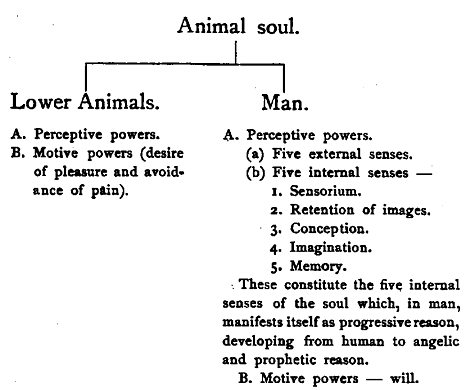
Animal soul. Lower Animals. A. Perceptive powers.
B. Motive powers (desire of pleasure and avoidance of pain).
Man. A. Perceptive powers. (a) Five external senses.
(b) Five internal senses— 1. Sensorium. These constitute the five internal senses of the soul which, in man, manifests itself as progressive reason, developing from human to angelic and prophetic reason.
2. Retention of images.
3. Conception.
4. Imagination.
5. Memory.
B. Motive powers—will.
In his fragment on "Nafs" (soul) Avicenna endeavours to show that a material accompaniment is not necessary to the soul. It is not through the instrumentality of the body, or some power of the body, that the soul conceives or imagines; since if the soul necessarily requires a physical medium in conceiving other things, it must require a different body in order to conceive the body attached to itself. Moreover, the fact that the soul is immediately self conscious—conscious of itself through itself—conclusively shows that in its essence the soul is quite independent of any physical accompaniment. The doctrine of metempsychosis implies, also, individual pre-existence. But supposing that the soul did exist before the body, it must have existed either as one or as many. The multiplicity of bodies is due to the multiplicity of material forms, and does not indicate the multiplicity of souls. On the other hand, if it existed as one, the ignorance or knowledge of A must mean the ignorance or knowledge of B; since the soul is one in both. These categories, therefore, cannot be applied to the soul. The truth is, says Avicenna, that body and soul are contiguous to each other, but quite opposite in their respective essences. The disintegration of the body does not necessitate the annihilation of the soul. Dissolution or decay is a property of compounds, and not of simple, indivisible, ideal substances. Avicenna, then denies pre-existence, and endeavours to show the possibility of disembodied conscious life beyond the grave.
We have run over the work of the early Persian Neo-Platonists among whom, as we have seen, Avicenna alone learned to think for himself. Of the generations of his disciples—Behmenyār, Ab u’l-Ma’mūm of Isfahān, Ma‘ṣūmī, Ab u’l-‘Abbās, Ibn Tāhir[44:1]—who carried on their master's Philosophy, we need not speak. So powerful was the spell of Avicenna's personality that, even long after it had been removed, any amplification or modification of his views was considered to be an unpardonable crime. The old Iranian idea of the dualism of Light and Darkness, does not act as a determining factor in the progress of Neo-Platonic ideas in Persia, which borrowed independent life for a time, and eventually merged their separate existence in the general current of Persian speculation. They are, therefore, connected with the course of indigenous thought only in so far as they contributed to the strength and expansion of that monistic tendency, which manifested itself early in the Church of Zoroaster; and, though for a time hindered by the Theological controversies of Islām, burst out with redoubled force in later times, to extend its titanic grasp to all the previous intellectual achievements of the land of its birth.
FOOTNOTES:
CHAP. III. THE RISE AND FALL OF RATIONALISM IN ISLĀM.
§ I. The Metaphysics of Rationalism—Materialism.
The Persian mind, having adjusted itself to the new political environment, soon reasserts its innate freedom, and begins to retire from the field of objectivity, in order that it may come back to itself, and reflect upon the material achieved in its journey out of its own inwardness. With the study of Greek thought, the spirit which was almost lost in the concrete, begins to reflect and realise itself as the arbiter of truth. Subjectivity asserts itself, and endeavours to supplant all outward authority. Such a period, in the intellectual history of a people, must be the epoch of rationalism, scepticism, mysticism, heresy—forms in which the human mind, swayed by the growing force of subjectivity, rejects all external standards of truth. And so we find the epoch under consideration.
The period of Umayyad dominance is taken up with the process of co-mingling and adjustment to new conditions of life; but with the rise of the ‘Abbāsid Dynasty and the study of Greek Philosophy, the pent-up intellectual force of Persia bursts out again, and exhibits wonderful activity in all the departments of thought and action. The fresh intellectual vigour imparted by the assimilation of Greek Philosophy which was studied with great avidity, led immediately to a critical examination of Islamic Monotheism. Theology, enlivened by religious fervour, learned to talk the language of Philosophy earlier than cold reason began to seek a retired corner, away from the noise of controversy, in order to construct a consistent theory of things. In the first half of the 8th century we find Wāṣil Ibn ‘Atā—a Persian disciple of the famous theologian Ḥasan of Baṣra—starting Mu‘tazilaism (Rationalism)—that most interesting movement which engaged some of the subtlest minds of Persia, and finally exhausted its force in the keen metaphysical controversies of Baghdād and Baṣra. The famous city of Baṣra had become, owing to its commercial situation, the playground of various forces—Greek Philosophy, Scepticism, Christianity, Buddhistic ideas, Manichaeism[47:1]—which furnished ample spiritual food to the inquiring mind of the time, and formed the intellectual environment of Islamic Rationalism. What Spitta calls the Syrian period of Muhammadan History is not characterised with metaphysical subtleties. With the advent of the Persian Period, however, Muhammadan students of Greek Philosophy began properly to reflect on their religion; and the Mu‘tazila thinkers[47:2], gradually drifted into metaphysics with which alone we are concerned here. It is not our object to trace the history of the Mu‘tazila Kalām; for present purposes it will be sufficient if we briefly reveal the metaphysical implications of the Mu‘tazila view of Islām. The conception of God, and the theory of matter, therefore, are the only aspects of Rationalism which we propose to discuss here.
His conception of the unity of God at which the Mu‘tazila eventually arrived by a subtle dialectic is one of the fundamental points in which he differs from the Orthodox Muhammadan. God's attributes, according to his view, cannot be said to inhere in him; they form the very essence of His nature. The Mu‘tazila, therefore, denies the separate reality of divine attributes, and declares their absolute identity with the abstract divine Principle. "God", says Abu’l-Hudhail, "is knowing, all-powerful, living; and his knowledge, power and life constitute His very essence (dhāt)"[49:1]. In order to explain the pure unity of God Joseph Al-Baṣīr[49:2] lays down the following five principles:—
(1). The necessary supposition of atom and accident.
(2). The necessary supposition of a creator.
(3). The necessary supposition of the conditions (Aḥwāl) of God.
(4). The rejection of those attributes which do not befit God.
(5). The unity of God in spite of the plurality of His attributes.
This conception of unity underwent further modifications; until in the hands of Mu‘ammar and Abu Hāshim it became a mere abstract possibility about which nothing could be predicated. We cannot, he says, predicate knowledge of God[50:1], for His knowledge must be of something in Himself. The first necessitates the identity of subject and object which is absurd; the second implicates duality in the nature of God which is equally impossible. Aḥmad and Faḍl[50:2]—disciples of Nazzām, however, recognised this duality in holding that the original creators are two—God—the eternal principle; and the word of God—Jesus Christ—the contingent principle. But more fully to bring out the element of truth in the second alternative suggested by Mu‘ammar, was reserved, as we shall see, for later Ṣūfī thinkers of Persia. It is, therefore, clear that some of the rationalists almost unconsciously touched the outer fringe of later pantheism for which, in a sense, they prepared the way, not only by their definition of God, but also by their common effort to internalise the rigid externality of an absolute law.
But the most important contribution of the advocates of Rationalism to purely metaphysical speculation, is their explanation of matter, which their opponents—the Ash‘arite—afterwards modified to fit in with their own views of the nature of God. The interest of Nazzām chiefly consisted in the exclusion of all arbitrariness from the orderly course of nature[51:1]. The same interest in naturalism led Al-Jāḥiẓ to define Will in a purely negative manner[51:2]. Though the Rationalist thinkers did not want to abandon the idea of a Personal Will, yet they endeavoured to find a deeper ground for the independence of individual natural phenomena. And this ground they found in matter itself. Nazzām taught the infinite divisibility of matter, and obliterated the distinction between substance and accident[51:3]. Existence was regarded as a quality superimposed by God on the pre-existing material atoms which would have been incapable of perception without this quality. Muḥammad Ibn ‘Uthmān, one of the Mu‘tazila Shaikhs, says Ibn Ḥazm,[51:4] maintained that the non-existent (atom in its pre-existential state) is a body in that state; only that in its pre-existential condition it is neither in motion, nor at rest, nor is it said to be created. Substance, then, is a collection of qualities—taste, odour, colour—which, in themselves, are nothing more than material potentialities. The soul, too, is a finer kind of matter; and the processes of knowledge are mere mental motions. Creation is only the actualisation of pre-existing potentialities[52:1] (Ṭafra). The individuality of a thing which is defined as "that of which something can be predicated"[52:2] is not an essential factor in its notion. The collection of things we call the Universe, is externalised or perceptible reality which could, so to speak, exist independent of all perceptibility. The object of these metaphysical subtleties is purely theological. God, to the Rationalist, is an absolute unity which can, in no sense, admit of plurality, and could thus exist without the perceptible plurality—the Universe.
The activity of God, then, consists only in making the atom perceptible. The properties of the atom flow from its own nature. A stone thrown up falls down on account of its own indwelling property[53:1]. God, says Al-‘Aṭṭār of Baṣra and Bishr ibn al Mu‘tamir, did not create colour, length, breadth, taste or smell—all these are activities of bodies themselves[53:2]. Even the number of things in the Universe is not known to God[53:3]. Bishr ibn al-Mu‘tamir further explained the properties of bodies by what he called "Tawallud"—interaction of bodies[53:4]. Thus it is clear that the Rationalists were philosophically materialists, and theologically deists.
To them substance and atom are identical, and they define substance as a space-filling atom which, besides the quality of filling space, has a certain direction, force and existence forming its very essence as an actuality. In shape it is squarelike; for if it is supposed to be circular, combination of different atoms would not be possible[53:5]. There is, however, great difference of opinion among the exponents of atomism in regard to the nature of the atom. Some hold that atoms are all similar to each other; while Abu’l-Qāsim of Balkh regards them as similar as well as dissimilar. When we say that two things are similar to each other, we do not necessarily mean that they are similar in all their attributes. Abu’l-Qāsim further differs from Nazzām in advocating the indestructibility of the atom. He holds that the atom had a beginning in time; but that it cannot be completely annihilated. The attribute of "Baqā" (continued existence), he says, does not give to its subject a new attribute other than existence; and the continuity of existence is not an additional attribute at all. The divine activity created the atom as well as its continued existence. Abu’l-Qāsim, however, admits that some atoms may not have been created for continued existence. He denies also the existence of any intervening space between different atoms, and holds, unlike other representatives of the school, that the essence or atom (Māhiyyat) could not remain essence in a state of non-existence. To advocate the opposite is a contradiction in terms. To say that the essence (which is essence because of the attribute of existence) could remain essence in a state of non-existence, is to say that the existent could remain existent in a state of non-existence. It is obvious that Abu’l-Qāsim here approaches the Ash‘arite theory of knowledge which dealt a serious blow to the Rationalist theory of matter.
§ II. Contemporary Movements of Thought.
Side by side with the development of Mu‘tazilaism we see, as is natural in a period of great intellectual activity, many other tendencies of thought manifesting themselves in the philosophical and religious circles of Islam. Let us notice them briefly:—
1. Scepticism. The tendency towards scepticism was the natural consequence of the purely dialectic method of Rationalism. Men such as Ibn Ashras and Al-Jāhiz who apparently belonged to the Rationalist camp, were really sceptics. The standpoint of Al-Jāhiz who inclined to deistic naturalism[55:1], is that of a cultured man of the time, and not of a professional theologian. In him is noticeable also a reaction against the metaphysical hairsplitting of his predecessors, and a desire to widen the pale of theology for the sake of the illiterate who are incapable of reflecting on articles of faith.
2. Ṣūfīism—an appeal to a higher source of knowledge which was first systematised by Dhu’l-Nūn, and became more and more deepened and antischolastic in contrast to the dry intellectualism of the Ash‘arite. We shall consider this interesting movement in the following chapter.
3. The revival of authority—Ismā‘īlianism—a movement characteristically Persian which, instead of repudiating freethought, endeavours to come to an understanding with it. Though this movement seems to have no connection with the theological controversies of the time, yet its connection with freethought is fundamental. The similarity between the methods practised by the Ismā‘īlian missionaries and those of the partisans of the association called Ikhwān al-Safā—Brethren of Purity—suggests some sort of secret relation between the two institutions. Whatever may be the motive of those who started this movement, its significance as an intellectual phenomenon should not be lost sight of. The multiplicity of philosophical and religious views—a necessary consequence of speculative activity—is apt to invoke forces which operate against this, religiously speaking, dangerous multiplicity. In the 18th century history of European thought we see Fichte, starting with a sceptical inquiry concerning the nature of matter, and finding its last word in Pantheism. Schleiermacher appeals to Faith as opposed to Reason, Jacobi points to a source of knowledge higher than reason, while Comte abandons all metaphysical inquiry, and limits all knowledge to sensuous perception. De Maistre and Schlegel, on the other hand, find a resting place in the authority of an absolutely infallible Pope. The advocates of the doctrine of Imāmat think in the same strain as De Maistre; but it is curious that the Ismā‘īlians, while making this doctrine the basis of their Church, permitted free play to all sorts of thinking.
The Ismā‘īlia movement then is one aspect of the persistent battle[57:1] which the intellectually independent Persian waged against the religious and political ideals of Islam. Originally a branch of the Shī‘ite religion, the Ismā‘īlia sect assumed quite a cosmopolitan character with ‘Abdulla ibn Maimūn—the probable progenitor of the Fātimid Caliphs of Egypt—who died about the same time when Al-Ash‘arī, the great opponent of Freethought, was born. This curious man imagined a vast scheme in which he weaved together innumerable threads of various hues, resulting in a cleverly constructed equivocation, charming to the Persian mind for its mysterious character and misty Pythagorean Philosophy. Like the Association of the Brethren of Purity, he made an attempt, under the pious cloak of the doctrine of Imāmat (Authority), to synthesise all the dominating ideas of the time. Greek Philosophy, Christianity, Rationalism, Sūfīism, Manichaeism, Persian heresies, and above all the idea of reincarnation, all came forward to contribute their respective shares to the boldly conceived Ismā‘īlian whole, the various aspects of which were to be gradually revealed to the initiated, by the "Leader"—the ever Incarnating Universal Reason—according to the intellectual development of the age in which he incarnated himself. In the Ismā‘īlian movement, Freethought, apprehending the collapse of its ever widening structure, seeks to rest upon a stable basis, and, by a strange irony of fate, is led to find it in the very idea which is revolting to its whole being. Barren authority, though still apt to reassert herself at times, adopts this unclaimed child, and thus permits herself to assimilate all knowledge past, present and future.
The unfortunate connection, however, of this movement with the politics of the time, has misled many a scholar. They see in it (Macdonald, for instance) nothing more than a powerful conspiracy to uproot the political power of the Arab from Persia. They have denounced the Ismā‘īlian Church which counted among its followers some of the best heads and sincerest hearts, as a mere clique of dark murderers who were ever watching for a possible victim. We must always remember, while estimating the character of these people, the most barbarous persecutions which drove them to pay red-handed fanaticism in the same coin. Assassinations for religious purposes were considered unobjectionable, and even perhaps lawful, among the whole Semite race. As late as the latter half of the 16th century, the Pope of Rome could approve such a dreadful slaughter as the massacre of St. Bartholomew. That assassination, even though actuated by religious zeal, is still a crime, is a purely modern idea; and justice demands that we should not judge older generations with our own standards of right and wrong. A great religious movement which shook to its very foundations the structure of a vast empire, and, having successfully passed through the varied ordeals of moral reproach, calumny and persecution, stood up for centuries as a champion of Science and Philosophy, could not have entirely rested on the frail basis of a political conspiracy of a mere local and temporary character. Ismā‘īlianism, in spite of its almost entire loss of original vitality, still dominates the ethical ideal of not an insignificant number in India, Persia, Central Asia, Syria and Africa; while the last expression of Persian thought—Bābism—is essentially Ismā‘īlian in its character.
To return, however, to the Philosophy of the sect. From the later Rationalists they borrowed their conception of Divinity. God, or the ultimate principle of existence, they teach, has no attribute. His nature admits of no predication. When we predicate the attribute of power to him, we only mean that He is the giver of power; when we predicate eternity, we indicate the eternity of what the Qur’ān calls "Amr" (word of God) as distinguished from the "Khalq" (creation of God) which is contingent. In His nature all contradictions melt away, and from Him flow all opposites. Thus they considered themselves to have solved the problem which had troubled the mind of Zoroaster and his followers.
In order to find an answer to the question, "What is plurality?" the Ismā‘īlia refer to what they consider a metaphysical axiom—"that from one only one can proceed". But the one which proceeds, is not something completely different from which it proceeds. It is really the Primal one transformed. The Primal Unity, therefore, transformed itself into the First Intellect (Universal Reason); and then, by means of this transformation of itself, created the Universal soul which, impelled by its nature to perfectly identify itself with the original source, felt the necessity of motion, and consequently of a body possessing the power of motion. In order to achieve its end, the soul created the heavens moving in circular motion according to its direction. It also created the elements which mixed together, and formed the visible Universe—the scene of plurality through which it endeavours to pass with a view to come back to the original source. The individual soul is an epitome of the whole Universe which exists only for its progressive education. The Universal Reason incarnates itself from time to time, in the personality of the "Leader" who illuminates the soul in proportion to its experience and understanding, and gradually guides it through the scene of plurality to the world of eternal unity. When the Universal soul reaches its goal, or rather returns to its own deep being, the process of disintegration ensues. "Particles constituting the Universe fall off from each other—those of goodness go to truth (God) which symbolises unity; those of evil go to untruth (Devil) which symbolises diversity"[63:1]. This is but briefly the Ismā‘īlian Philosophy—a mixture, as Sharastānī remarks, of Philosophical and Manichaean ideas—which, by gradually arousing the slumbering spirit of scepticism, they administered, as it were, in doses to the initiated, and finally brought them to that stage of spiritual emancipation where solemn ritual drops off, and dogmatic religion appears to be nothing more than a systematic arrangement of useful falsehoods.
The Ismā‘īlian doctrine is the first attempt to amalgamate contemporary Philosophy with a really Persian view of the Universe, and to restate Islam, in reference to this synthesis, by allegorical interpretation of the Qur’ān—a method which was afterwards adopted by Ṣūfīism. With them the Zoroastrian Ahriman (Devil) is not the malignant creator of evil things but it is a principle which violates the eternal unity, and breaks it up into visible diversity. The idea that some principle of difference in the nature of the ultimate existence must be postulated in order to account for empirical diversity, underwent further modifications; until in the Ḥurūfī sect (an offshoot of the Ismā‘īlia), in the fourteenth century, it touched contemporary Ṣūfīism on the one hand, and Christian Trinity on the other. The "Be", maintained the Ḥurūfīs, is the eternal word of God, which, itself uncreated, leads to further creation—the word externalised. "But for the 'word' the recognition of the essence of Divinity would have been impossible; since Divinity is beyond the reach of sense—perception"[64:1]. The 'word', therefore, became flesh in the womb of Mary[64:2] in order to manifest the Father. The whole Universe is the manifestation of God's 'word', in which He is immanent[64:3]. Every sound in the Universe is within God; every atom is singing the song of eternity[64:4]; all is life. Those who want to discover the ultimate reality of things, let them seek "the named" through the Name[65:1], which at once conceals and reveals its subject.
§ III. Reaction against Rationalism.
The Ash‘arite.
Patronised by the early Caliphs of the House of ‘Abbās, Rationalism continued to flourish in the intellectual centres of the Islamic world; until, in the first half of the 9th century, it met the powerful orthodox reaction which found a very energetic leader in Al-Ash‘arī (b, 873 A.D.) who studied under Rationalist teachers only to demolish, by their own methods, the edifice they had so laboriously built. He was a pupil of Al-Jubbā’ī[65:2]—the representative of the younger school of Mu‘tazilaism in Baṣra—with whom he had many controversies[65:3] which eventually terminated their friendly relations, and led the pupil to bid farewell to the Mu‘tazila camp. "The fact", says Spitta, "that Al-Ash‘arī was so thoroughly a child of his time with the successive currents of which he let himself go, makes him, in another relation, an important figure to us. In him, as in any other, are clearly reflected the various tendencies of this politically as well as religiously interesting period; and we seldom find ourselves in a position to weigh the power of the orthodox confession and the Mu‘tazilite speculation, the child-like helpless manner of the one, the immaturity and imperfection of the other, so completely as in the life of this man who was orthodox as a boy and a Mu‘tazila as a young man"[66:1]. The Mu‘tazila speculation (e.g. Al-Jāḥiz) tended to be absolutely unfettered, and in some cases led to a merely negative attitude of thought. The movement initiated by Al-Ash‘arī was an attempt not only to purge Islām of all non-Islamic elements which had quietly crept into it, but also to harmonize the religious consciousness with the religious thought of Islam. Rationalism was an attempt to measure reality by reason alone; it implied the identity of the spheres of religion and philosophy, and strove to express faith in the form of concepts or terms of pure thought. It ignored the facts of human nature, and tended to disintegrate the solidarity of the Islamic Church. Hence the reaction.
The orthodox reaction led by the Ash‘arite then was, in reality, nothing more than the transfer of dialectic method to the defence of the authority of Divine Revelation. In opposition to the Rationalists, they maintained the doctrine of the Attributes of God; and, as regards the Free Will controversy, they adopted a course lying midway between the extreme fatalism of the old school, and the extreme libertarianism of the Rationalists. They teach that the power of choice as well as all human actions are created by God; and that man has been given the power of acquiring[67:1] the different modes of activity. But Fakhral-Dīn Rāzī, who in his violent attack on philosophy was strenuously opposed by Tūsī and Qutbal-Dīn, does away with the idea of "acquisition", and openly maintains the doctrine of necessity in his commentary on the Qur’ān. The Mātarīdiyya—another school of anti-rationalist theology, founded by Abu Manṣūr Mātarīdī a native of Mātarīd in the environs of Samarqand—went back to the old rationalist position, and taught in opposition to the Ash‘arite, that man has absolute control over his activity; and that his power affects the very nature of his actions. Al-Ash‘arī's interest was purely theological; but it was impossible to harmonise reason and revelation without making reference to the ultimate nature of reality. Bāqilānī[68:1] therefore, made use of some purely metaphysical propositions (that substance is an individual unity; that quality cannot exist in quality; that perfect vacuum is possible.) in his Theological investigation, and thus gave the school a metaphysical foundation which it is our main object to bring out. We shall not, therefore, dwell upon their defence of orthodox beliefs (e.g. that the Qur’ān is uncreated; that the visibility of God is possible etc.); but we shall endeavour to pick up the elements of metaphysical thought in their theological controversies. In order to meet contemporary philosophers on their own ground, they could not dispense with philosophising; hence willingly or unwillingly they had to develop a theory of knowledge peculiar to themselves.
God, according to the Ash‘arite, is the ultimate necessary existence which "carries its attributes in its own being"[69:1]; and whose existence (wujūd) and essence (Māhiyyat) are identical. Besides the argument from the contingent character of motion they used the following arguments to prove the existence of this ultimate principle:—
(1). All bodies, they argue, are one in so far as the phenomenal fact of their existence is concerned. But in spite of this unity, their qualities are different and even opposed to each other. We are, therefore, driven to postulate an ultimate cause in order to account for their empirical divergence.
(2). Every contingent being needs a cause to account for its existence. The Universe is contingent; therefore it must have a cause; and that cause is God. That the Universe is contingent, they proved in the following manner. All that exists in the Universe, is either substance or quality. The contingence of quality is evident, and the contingence of substance follows from the fact that no substance could exist apart from qualities. The contingence of quality necessitates the contingence of substance; otherwise the eternity of substance would necessitate the eternity of quality. In order fully to appreciate the value of this argument, it is necessary to understand the Ash‘arite theory of knowledge. To answer the question, "What is a thing?" they subjected to a searching criticism the Aristotelian categories of thought, and arrived at the conclusion that bodies have no properties in themselves[70:1]. They made no distinction of secondary and primary qualities of a body, and reduced all of them to purely subjective relations. Quality too became with them a mere accident without which the substance could not exist. They used the word substance or atom with a vague implication of externality; but their criticism, actuated by a pious desire to defend the idea of divine creation, reduced the Universe to a mere show of ordered subjectivities which, as they maintained like Berkeley, found their ultimate explanation in the Will of God. In his examination of human knowledge regarded as a product and not merely a process, Kant stopped at the idea of "Ding an sich", but the Ash‘arite endeavoured to penetrate further, and maintained, against the contemporary Agnostic-Realism, that the so called underlying essence existed only in so far as it was brought in relation to the knowing subject. Their atomism, therefore, approaches that of Lotze[71:1] who, in spite of his desire to save external reality, ended in its complete reduction to ideality. But like Lotze they could not believe their atoms to be the inner working of the Infinite Primal Being. The interest of pure monotheism was too strong for them. The necessary consequence of their analysis of matter is a thorough going idealism like that of Berkeley; but perhaps their instinctive realism combined with the force of atomistic tradition, still compels them to use the word "atom" by which they endeavour to give something like a realistic coloring to their idealism. The interest of dogmatic theology drove them to maintain towards pure Philosophy an attitude of criticism which taught her unwilling advocates how to philosophise and build a metaphysics of their own.
But a more important and philosophically more significant aspect of the Ash‘arite Metaphysics, is their attitude towards the Law of Causation[72:1]. Just as they repudiated all the principles of optics[72:2] in order to show, in opposition to the Rationalists, that God could be visible in spite of His being unextended, so with a view to defend the possibility of miracles, they rejected the idea of causation altogether. The orthodox believed in miracles as well as in the Universal Law of Causation; but they maintained that, at the time of manifesting a miracle, God suspended the operation of this law. The Ash‘arite, however, starting with the supposition that cause and effect must be similar, could not share the orthodox view, and taught that the idea of power is meaningless, and that we know nothing but floating impressions, the phenomenal order of which is determined by God.
Any account of the Ash‘arite metaphysics would be incomplete without a notice of the work of Al-Ghazālī (d. 1111 A.D.) who though misunderstood by many orthodox theologians, will always be looked upon as one of the greatest personalities of Islam. This sceptic of powerful ability anticipated Descartes[73:1] in his philosophical method; and, "seven hundred years before Hume cut the bond of causality with the edge of his dialectic"[73:2]. He was the first to write a systematic refutation of philosophy, and completely to annihilate that dread of intellectualism which had characterised the orthodox. It was chiefly his influence that made men study dogma and metaphysics together, and eventually led to a system of education which produced such men as Shahrastānī, Al-Rāzī and Al-Ishrāqī. The following passage indicates his attitude as a thinker:—
"From my childhood I was inclined to think out things for myself. The result of this attitude was that I revolted against authority; and all the beliefs that had fixed themselves in my mind from childhood lost their original importance. I thought that such beliefs based on mere authority were equally entertained by Jews, Christians, and followers of other religions. Real knowledge must eradicate all doubt. For instance, it is self-evident that ten is greater than three. If a person, however, endeavours to prove the contrary by an appeal to his power of turning a stick into a snake, the performance would indeed be wonderful, though it cannot touch the certainty of the proposition in question"[75:1]. He examined afterwards, all the various claimants of "Certain Knowledge" and finally found it in Ṣūfīism.
With their view of the nature of substance, the Ash‘arite, rigid monotheists as they were, could not safely discuss the nature of the human soul. Al-Ghazālī alone seriously took up the problem, and to this day it is difficult to define, with accuracy, his view of the nature of God. In him, like Borger and Solger in Germany, Ṣūfī pantheism and the Ash‘arite dogma of personality appear to harmonise together, a reconciliation which makes it difficult to say whether he was a Pantheist, or a Personal Pantheist of the type of Lotze. The soul, according to Al-Ghazālī, perceives things. But perception as an attribute can exist only in a substance or essence which is absolutely free from all the attributes of body. In his Al-Madnūn[75:2], he explains why the prophet declined to reveal the nature of the soul. There are, he says, two kinds of men; ordinary men and thinkers. The former who look upon materiality as a condition of existence, cannot conceive an immaterial substance. The latter are led, by their logic, to a conception of the soul which sweeps away all difference between God and the individual soul. Al-Ghazālī, therefore, realised the Pantheistic drift of his own inquiry, and preferred silence as to the ultimate nature of the soul.
He is generally included among the Ash‘arite. But strictly speaking he is not an Ash‘arite; though he admitted that the Ash‘arite mode of thought was excellent for the masses. "He held", says Shiblī (‘Ilmal-Kalām, p. 66.), "that the secret of faith could not be revealed; for this reason he encouraged exposition of the Ash‘arite theology, and took good care in persuading his immediate disciples not to publish the results of his private reflection". Such an attitude towards the Ash‘arite theology, combined with his constant use of philosophical language, could not but lead to suspicion. Ibn Jauzī, Qāḍī ‘Iyāḍ, and other famous theologians of the orthodox school, publicly denounced him as one of the "misguided"; and ‘Iyāḍ went even so far as to order the destruction of all his philosophical and theological writings that existed in Spain.
It is, therefore, clear that while the dialectic of Rationalism destroyed the personality of God, and reduced divinity to a bare indefinable universality, the antirationalist movement, though it preserved the dogma of personality, destroyed the external reality of nature. In spite of Nazzām's theory of "Atomic objectification"[77:1], the atom of the Rationalist possesses an independent objective reality; that of the Ash‘arite is a fleeting moment of Divine Will. The one saves nature, and tends to do away with the God of Theology; the other sacrifices nature to save God as conceived by the orthodox. The God-intoxicated Ṣūfī who stands aloof from the Theological controversies of the age, saves and spiritualises both the aspects of existence, and looks upon the whole Universe as the self-revelation of God—a higher notion which synthesises the opposite extremes of his predecessors. "Wooden-legged" Rationalism, as the Ṣūfī called it, speaks its last word in the sceptic Al-Ghazālī, whose restless soul, after long and hopeless wanderings in the desolate sands of dry intellectualism, found its final halting place in the still deep of human emotion. His scepticism is directed more to substantiate the necessity of a higher source of knowledge than merely to defend the dogma of Islamic Theology, and, therefore, marks the quiet victory of Ṣūfīism over all the rival speculative tendencies of the time.
Al-Ghazālī's positive contribution to the Philosophy of his country, however, is found in his little book—Mishkātal-Anwār—where he starts with the Quranic verse, "God is the light of heavens and earth", and instinctively returns to the Iranian idea, which was soon to find a vigorous expounder in Al-Ishrāqī. Light, he teaches in this book, is the only real existence; and there is no darkness greater than non-existence. But the essence of Light is manifestation: "it is attributed to manifestation which is a relation"[78:1]. The Universe was created out of darkness on which God sprinkled[79:1] his own light, and made its different parts more or less visible according as they received more or less light. As bodies differ from one another in being dark, obscure, illuminated or illuminating, so men are differentiated from one another. There are some who illuminate other human beings; and, for this reason, the Prophet is named "The Burning Lamp" in the Qur’ān.
The physical eye sees only the external manifestation of the Absolute or Real Light. There is an internal eye in the heart of man which, unlike the physical eye, sees itself as other things, an eye which goes beyond the finite, and pierces the veil of manifestation. These thoughts are merely germs, which developed and fructified in Al-Ishrāqī's "Philosophy of Illumination"—Ḥikmatal-Ishrāq.
Such is the Ash‘arite philosophy.
One great theological result of this reaction was that it checked the growth of freethought which tended to dissolve the solidarity of the Church. We are, however, concerned more with the purely intellectual results of the Ash‘arite mode of thought, and these are mainly two:—
(1). It led to an independent criticism of Greek philosophy as we shall see presently.
(2). In the beginning of the 10th century when the Ash‘arite had almost completely demolished the stronghold of Rationalism, we see a tendency towards what may be called Persian Positivism. Al-Birūnī[80:1] (d. 1048) and Ibn Haitham[80:2] (d. 1038) who anticipated modern empirical Psychology in recognising what is called reaction-time, gave up all inquiry concerning the nature of the supersensual, and maintained a prudent silence about religious matters. Such a state of things could have existed, but could not have been logically justified before Al-Ash‘arī.
FOOTNOTES:
CHAP. IV. CONTROVERSY BETWEEN IDEALISM AND REALISM.
The Ash‘arite denial of Aristotle's Prima Materia, and their views concerning the nature of space, time and causation, awakened that irrepressible spirit of controversy which, for centuries, divided the camp of Muhammedan thinkers, and eventually exhausted its vigor in the merely verbal subtleties of schools. The publication of Najm al-Dīn Al-Kātibī's (a follower of Aristotle whose disciples were called Philosophers as distinguished from scholastic theologians) Ḥikmat al-‘Ain—"Philosophy of Essence", greatly intensified the intellectual conflict, and invoked keen criticism from a host of Ash‘arite as well as other idealist thinkers. I shall consider in order the principal points on which the two schools differed from each other.
A. The Nature of the Essence.
We have seen that the Ash‘arite theory of knowledge drove them to hold that individual essences of various things are quite different from each other, and are determined in each case by the ultimate cause—God. They denied the existence of an everchanging primary stuff common to all things, and maintained against the Rationalists that existence constitutes the very being of the essence. To them, therefore, essence and existence are identical. They argued that the Judgment, "Man is animal", is possible only on the ground of a fundamental difference between the subject and the predicate; since their identity would make the Judgment nugatory, and complete difference would make the predication false. It is, therefore, necessary to postulate an external cause to determine the various forms of existence. Their opponents, however, admit the determination or limitation of existence, but they maintain that all the various forms of existence, in so far as their essence is concerned, are identical—all being limitations of one Primary substance. The followers of Aristotle met the difficulty suggested by the possibility of synthetic predication, by advocating the possibility of compound essences. Such a judgment as "Man is animal", they maintained, is true; because man is an essence composed of two essences, animality and humanity. This, retorted the Ash‘arite, cannot stand criticism. If you say that the essence of man and animal is the same, you in other words hold that the essence of the whole is the same as that of the part. But this proposition is absurd; since if the essence of the compound is the same as that of its constituents, the compound will have to be regarded as one being having two essences or existences.
It is obvious that the whole controversy turns on the question whether existence is a mere idea or something objectively real. When we say that a certain thing exists, do we mean that it exists only in relation to us (Ash‘arite position); or that it is an essence existing quite independently of us (Realist position)? We shall briefly indicate the arguments of either side. The Realist argued as follows:—
(1). The conception of my existence is something immediate or intuitive. The thought "I exist" is a "concept", and my body being an element of this "concept", it follows that my body is intuitively known as something real. If the knowledge of the existent is not immediate, the fact of its perception would require a process of thought which, as we know, it does not. The Ash‘arite Al-Rāzī admits that the concept of existence is immediate; but he regards the judgment—"The concept of existence is immediate"—as merely a matter of acquisition. Muḥammad ibn Mubārak Bukhārī, on the other hand, says that the whole argument of the realist proceeds on the assumption that the concept of my existence is something immediate—a position which can be controverted.[84:1] If, says he, we admit that the concept of my existence is immediate, abstract existence cannot be regarded as a constitutive element of this conception. And if the realist maintains that the perception of a particular object is immediate, we admit the truth of what he says; but it would not follow, as he is anxious to establish, that the so called underlying essence is immediately known as objectively real. The realist argument, moreover, demands that the mind ought not to be able to conceive the predication of qualities to things. We cannot conceive, "snow is white", because whiteness, being a part of this immediate judgment, must also be immediately known without any predication. Mulla Muḥammad Hāshim Ḥusainī remarks[85:1] that this reasoning is erroneous. The mind in the act of predicating whiteness of snow is working on a purely ideal existence—the quality of whiteness—and not on an objectively real essence of which the qualities are mere facets or aspects. Ḥusainī, moreover, anticipates Hamilton, and differs from other realists in holding that the so-called unknowable essence of the object is also immediately known. The object, he says, is immediately perceived as one.[85:2] We do not successively perceive the various aspects of what happens to be the objects of our perception.
(2) The idealist, says the realist, reduces all quality to mere subjective relations. His argument leads him to deny the underlying essence of things, and to look upon them as entirely heterogeneous collections of qualities, the essence of which consists merely in the phenomenal fact of their perception. In spite of his belief in the complete heterogeneity of things, he applies the word existence to all things—a tacit admission that there is some essence common to all the various forms of existence. Abu’l-Ḥasan al-Ash‘arī replies that this application is only a verbal convenience, and is not meant to indicate the so-called internal homogeneity of things. But the universal application of the word existence by the idealist, must mean, according to the realist, that the existence of a thing either constitutes its very essence, or it is something superadded to the underlying essence of the thing. The first supposition is a virtual admission as to the homogeneity of things; since we cannot maintain that existence peculiar to one thing is fundamentally different from existence peculiar to another. The supposition that existence is something superadded to the essence of a thing leads to an absurdity; since in this case the essence will have to be regarded as something distinct from existence; and the denial of essence (with the Ash‘arite) would blot out the distinction between existence and non-existence. Moreover, what was the essence before existence was superadded to it? We must not say that the essence was ready to receive existence before it actually did receive it; since this statement would imply that the essence was non-existence before it received existence. Likewise the statement that the essence has the power of receiving the quality of non-existence, implies the absurdity that it does already exist. Existence, therefore, must be regarded as forming a part of the essence. But if it forms a part of the essence, the latter will have to be regarded as a compound. If, on the other hand, existence is external to the essence, it must be something contingent because of its dependence on something other than itself. Now everything contingent must have a cause. If this cause is the essence itself, it would follow that the essence existed before it existed; since the cause must precede the effect in the fact of existence. If, however, the cause of existence is something other than the essence, it follows that the existence of God also must be explained by some cause other than the essence of God—an absurd conclusion which turns the necessary into the contingent.[88:1] This argument of the realist is based on a complete misunderstanding of the idealist position. He does not see that the idealist never regarded the fact of existence as something superadded to the essence of a thing; but always held it to be identical with the essence. The essence, says ibn Mubārak,[88:2] is the cause of existence without being chronologically before it. The existence of the essence constitutes its very being; it is not dependent for it on something other than itself.
The truth is that both sides are far from a true theory of knowledge. The agnostic realist who holds that behind the phenomenal qualities of a thing, there is an essence operating as their cause, is guilty of a glaring contradiction. He holds that underlying the thing there is an unknowable essence or substratum which is known to exist. The Ash‘arite idealist, on the other hand, misunderstands the process of knowledge. He ignores the mental activity involved in the act of knowledge; and looks upon perceptions as mere presentations which are determined, as he says, by God. But if the order of presentations requires a cause to account for it, why should not that cause be sought in the original constitution of matter as Locke did? Moreover, the theory that knowledge is a mere passive perception or awareness of what is presented, leads to certain inadmissible conclusions which the Ash‘arite never thought of:—
(a). They did not see that their purely subjective conception of knowledge swept away all possibility of error. If the existence of a thing is merely the fact of its being presented, there is no reason why it should be cognised as different from what it actually is.
(b). They did not see that on their theory of knowledge, our fellow-beings like other elements of the physical order, would have no higher reality than mere states of my consciousness.
(c). If knowledge is a mere receptivity of presentations, God who, as cause of presentations, is active in regard to the act of our knowledge, must not be aware of our presentations. From the Ash‘arite point of view this conclusion is fatal to their whole position. They cannot say that presentations on their ceasing to be my presentations, continue to be presentations to God's consciousness.
Another question connected with the nature of the essence is, whether it is caused or uncaused. The followers of Aristotle, or philosophers as they are generally called by their opponents, hold that the underlying essence of things is uncaused. The Ash‘arite hold the opposite view. Essence, says the Aristotelian, cannot be acted upon by any external agent.[90:1] Al-Kātibī argues that if, for instance, the essence of humanity had resulted from the operation of an external activity, doubt as to its being the real essence of humanity would have been possible. As a matter of fact we never entertain such a doubt; it follows, therefore, that the essence is not due to the activity of an agency external to itself. The idealist starts with the realist distinction of essence and existence, and argues that the realist line of argument would lead to the absurd proposition—that man is uncaused; since he must be regarded, according to the realist, as a combination of two uncaused essences—existence and humanity.
B. The Nature of Knowledge.
The followers of Aristotle, true to their position as to the independent objective reality of the essence, define knowledge as "receiving images of external things".[91:1] It is possible to conceive, they argue, an object which is externally unreal, and to which other qualities can be attributed. But when we attribute to it the quality of existence, actual existence is necessitated; since the affirmation of the quality of a thing is a part of the affirmation of that thing. If, therefore, the predication of existence does not necessitate actual objective existence of the thing, we are driven to deny externality altogether, and to hold that the thing exists in the mind as a mere idea. But the affirmation of a thing, says Ibn Mubārak, constitutes the very existence of the thing. The idealist makes no such distinction as affirmation and existence. To infer from the above argument that the thing must be regarded as existing in the mind, is unjustifiable. "Ideal" existence follows only from the denial of externality which the Ash‘arite do not deny; since they hold that knowledge is a relation between the knower and the known which is known as external. Al-Kātibī's proposition that if the thing does not exist as external existence, it must exist as ideal or mental existence, is self-contradictory; since, on his principles, everything that exists in idea exists in externality.[92:1]
C. The Nature of Non-existence.
Al-Kātibī explains and criticises the proposition, maintained by contemporary philosophers generally—"That the existent is good, and the non-existent is evil".[92:2] The fact of murder, he says, is not evil because the murderer had the power of committing such a thing; or because the instrument of murder had the power of cutting; or because the neck of the murdered had the capacity of being cut asunder. It is evil because it signifies the negation of life—a condition which is non-existential, and not existential like the conditions indicated above. But in order to show that evil is non-existence, we should make an inductive inquiry, and examine all the various cases of evil. A perfect induction, however, is impossible, and an incomplete induction cannot prove the point. Al-Kātibī, therefore, rejects this proposition, and holds that "non-existence is absolute nothing".[93:1] The possible 'essences', according to him, are not lying fixed in space waiting for the attribute of existence; otherwise fixity in space would have to be regarded as possessing no existence. But his critics hold that this argument is true only on the supposition that fixity in space and existence are identical. Fixity in externality, says Ibn Mubārak, is a conception wider than existence. All existence is external, but all that is external is not necessarily existent.
The interest of the Ash‘arite in the dogma of the Resurrection—the possibility of the reappearance of the non-existent as existent—led them to advocate the apparently absurd proposition that "non-existence or nothing is something". They argued that, since we make judgments about the non-existent, it is, therefore, known; and the fact of its knowability indicates that "the nothing" is not absolutely nothing. The knowable is a case of affirmation and the non-existent being knowable, is a case of affirmation.[94:1] Al-Kātibī denies the truth of the Major. Impossible things, he says, are known, yet they do not externally exist. Al-Rāzī criticises this argument accusing Al-Kātibī of the ignorance of the fact that the 'essence' exists in the mind, and yet is known as external. Al-Kātibī supposes that the knowledge of a thing necessitates its existence as an independent objective reality. Moreover it should be remembered that the Ash‘arite discriminate between positive and existent on the one hand, and non-existent and negative on the other. They say that all existent is positive, but the converse of this proposition is not true. There is certainly a relation between the existent and the non-existent, but there is absolutely no relation between the positive and the negative. We do not say, as Al-Kātibī holds, that the impossible is non-existent; we say that the impossible is only negative. Substances which do exist are something positive. As regards the attribute which cannot be conceived as existing apart from the substance, it is neither existent nor non-existent, but something between the two. Briefly the Ash‘arite position is as follows:—
"A thing has a proof of its existence or not. If not, it is called negative. If it has a proof of its existence, it is either substance or attribute. If it is substance and has the attribute of existence or non-existence, (i.e. it is perceived or not) it is existent or non-existent accordingly. If it is attribute, it is neither existent nor non-existent".[95:1]
FOOTNOTES:
CHAP. V. ṢŪFĪISM.
§ I. The origin and Qurānic Justification of Ṣūfīism.
It has become quite a fashion with modern oriental scholarship to trace the chain of influences. Such a procedure has certainly great historical value, provided it does not make us ignore the fundamental fact, that the human mind possesses an independent individuality, and, acting on its own initiative, can gradually evolve out of itself, truths which may have been anticipated by other minds ages ago. No idea can seize a people's soul unless, in some sense, it is the people's own. External influences may wake it up from its deep unconscious slumber; but they cannot, so to speak, create it out of nothing.
Much has been written about the origin of Persian Ṣūfīism; and, in almost all cases, explorers of this most interesting field of research have exercised their ingenuity in discovering the various channels through which the basic ideas of Ṣūfīism might have travelled from one place to another. They seem completely to have ignored the principle, that the full significance of a phenomenon in the intellectual evolution of a people, can only be comprehended in the light of those pre-existing intellectual, political, and social conditions which alone make its existence inevitable. Von Kremer and Dozy derive Persian Ṣūfīism from the Indian Vedanta; Merx and Mr. Nicholson derive it from Neo-Platonism; while Professor Browne once regarded it as Aryan reaction against an unemotional semitic religion. It appears to me, however, that these theories have been worked out under the influence of a notion of causation which is essentially false. That a fixed quantity A is the cause of, or produces another fixed quantity B, is a proposition which, though convenient for scientific purposes, is apt to damage all inquiry, in so far as it leads us completely to ignore the innumerable conditions lying at the back of a phenomenon. It would, for instance, be an historical error to say that the dissolution of the Roman Empire was due to the barbarian invasions. The statement completely ignores other forces of a different character that tended to split up the political unity of the Empire. To describe the advent of barbarian invasions as the cause of the dissolution of the Roman Empire which could have assimilated, as it actually did to a certain extent, the so-called cause, is a procedure that no logic would justify. Let us, therefore, in the light of a truer theory of causation, enumerate the principal political, social, and intellectual conditions of Islamic life about the end of the 8th and the first half of the 9th century when, properly speaking, the Ṣūfī ideal of life came into existence, to be soon followed by a philosophical justification of that ideal.—
(1). When we study the history of the time, we find it to be a time of more or less political unrest. The latter half of the 8th century presents, besides the political revolution which resulted in the overthrow of the Umayyads (749 A.D.), persecutions of Zendīks, and revolts of Persian heretics (Sindbāh 755–6; Ustādhīs 766–8; the veiled prophet of Khurāsān 777–80) who, working on the credulity of the people, cloaked, like Lamennais in our own times, political projects under the guise of religious ideas. Later on in the beginning of the 9th century we find the sons of Hārūn (Ma’mūn and Amīn) engaged in a terrible conflict for political supremacy; and still later, we see the Golden Age of Islamic literature seriously disturbed by the persistent revolt of the Mazdakite Bābak (816:838). The early years of Ma’mun's reign present another social phenomenon of great political significance—the Shu‘ūbiyya controversy (815), which progresses with the rise and establishment of independent Persian families, the Tāhirīd (820), the Ṣaffārīd (868), and the Sāmānīd Dynasty (874). It is, therefore, the combined force of these and other conditions of a similar nature that contributed to drive away spirits of devotional character from the scene of continual unrest to the blissful peace of an ever-deepening contemplative life. The semitic character of the life and thought of these early Muhammadan ascetics is gradually followed by a large hearted pantheism of a more or less Aryan stamp, the development of which, in fact, runs parallel to the slowly progressing political independence of Persia.
(2). The Sceptical tendencies of Islamic Rationalism which found an early expression in the poems of Bashshār ibn Burd—the blind Persian Sceptic who deified fire, and scoffed at all non-Persian modes of thought. The germs of Scepticism latent in Rationalism ultimately necessitated an appeal to a super-intellectual source of knowledge which asserted itself in the Risāla of Al-Qushairī (986). In our own times the negative results of Kant's Critique of Pure Reason drove Jacobi and Schleiermacher to base faith on the feeling of the reality of the ideal; and to the 19th century sceptic Wordsworth uncovered that mysterious state of mind "in which we grow all spirit and see into the life of things".
(3). The unemotional piety of the various schools of Islam—the Ḥanafite (Abu Ḥanīfa d. 767), the Shāfiite (Al-Shāfi‘ī d. 820), the Mālikite (Al-Mālik d. 795), and the anthropomorphic Ḥambalite (Ibn Ḥambal d. 855)—the bitterest enemy of independent thought—which ruled the masses after the death of Al-Ma’mūn.
(4). The religious discussions among the representatives of various creeds encouraged by Al-Ma’mūn, and especially the bitter theological controversy between the Ash‘arites, and the advocates of Rationalism which tended not only to confine religion within the narrow limits of schools, but also stirred up the spirit to rise above all petty sectarian wrangling.
(5). The gradual softening of religious fervency due to the rationalistic tendency of the early ‘Abbāsid period, and the rapid growth of wealth which tended to produce moral laxity and indifference to religious life in the upper circles of Islam.
(6). The presence of Christianity as a working ideal of life. It was, however, principally the actual life of the Christian hermit rather than his religious ideas, that exercised the greatest fascination over the minds of early Islamic Saints whose complete unworldliness, though extremely charming in itself, is, I believe, quite contrary to the spirit of Islam.
Such was principally the environment of Ṣūfīism, and it is to the combined action of the above conditions that we should look for the origin and development of Ṣūfīistic ideas. Given these conditions and the Persian mind with an almost innate tendency towards monism, the whole phenomenon of the birth and growth of Ṣūfīism is explained. If we now study the principal pre-existing conditions of Neo-Platonism, we find that similar conditions produced similar results. The barbarian raids which were soon to reduce Emperors of the Palace to Emperors of the Camp, assumed a more serious aspect about the middle of the third century. Plotinus himself speaks of the political unrest of his time in one of his letters to Flaccus.[102:1] When he looked round himself in Alexandria, his birth place, he noticed signs of growing toleration and indifferentism towards religious life. Later on in Rome which had become, so to say, a pantheon of different nations, he found a similar want of seriousness in life, a similar laxity of character in the upper classes of society. In more learned circles philosophy was studied as a branch of literature rather than for its own sake; and Sextus Empiricus, provoked by Antiochus's tendency to fuse scepticism and Stoicism was teaching the old unmixed scepticism of Pyrrho—that intellectual despair which drove Plotinus to find truth in a revelation above thought itself. Above all, the hard unsentimental character of Stoic morality, and the loving piety of the followers of Christ who, undaunted by long and fierce persecutions, were preaching the message of peace and love to the whole Roman world, necessitated a restatement of Pagan thought in a way that might revivify the older ideals of life, and suit the new spiritual requirements of the people. But the ethical force of Christianity was too great for Neo-Platonism which, on account of its more metaphysical[103:1] character, had no message for the people at large, and was consequently inaccessible to the rude barbarian who, being influenced by the actual life of the persecuted Christian adopted Christianity, and settled down to construct new empires out of the ruins of the old. In Persia the influence of culture-contacts and cross-fertilisation of ideas created in certain minds a vague desire to realise a similar restatement of Islam, which gradually assimilated Christian ideals as well as Christian Gnostic speculation, and found a firm foundation in the Qur’ān. The flower of Greek Thought faded away before the breath of Christianity; but the burning simoon of Ibn Taimiyya's invective could not touch the freshness of the Persian rose. The one was completely swept away by the flood of barbarian invasions; the other, unaffected by the Tartar revolution, still holds its own.
This extraordinary vitality of the Ṣūfī restatement of Islam, however, is explained when we reflect on the all-embracing structure of Ṣūfīism. The semitic formula of salvation can be briefly stated in the words, "Transform your will",—which signifies that the Semite looks upon will as the essence of the human soul. The Indian Vedantist, on the other hand, teaches that all pain is due to our mistaken attitude towards the Universe. He, therefore, commands us to transform our understanding—implying thereby that the essential nature of man consists in thought, not activity or will. But the Ṣūfī holds that the mere transformation of will or understanding will not bring peace; we should bring about the transformation of both by a complete transformation of feeling, of which will and understanding are only specialised forms. His message to the individual is—"Love all, and forget your own individuality in doing good to others." Says Rūmī:—"To win other people's hearts is the greatest pilgrimage; and one heart is worth more than a thousand Ka‘bahs. Ka‘bah is a mere cottage of Abraham; but the heart is the very home of God." But this formula demands a why and a how—a metaphysical justification of the ideal in order to satisfy the understanding; and rules of action in order to guide the will. Ṣūfīism furnishes both. Semitic religion is a code of strict rules of conduct; the Indian Vedanta, on the other hand, is a cold system of thought. Ṣūfīism avoids their incomplete Psychology, and attempts to synthesise both the Semitic and the Aryan formulas in the higher category of Love. On the one hand it assimilates the Buddhistic idea of Nirwāna (Fanā-Annihilation), and seeks to build a metaphysical system in the light of this idea; on the other hand it does not disconnect itself from Islam, and finds the justification of its view of the Universe in the Qur’ān. Like the geographical position of its home, it stands midway between the Semitic and the Aryan, assimilating ideas from both sides, and giving them the stamp of its own individuality which, on the whole, is more Aryan than Semitic in character. It would, therefore, be evident that the secret of the vitality of Ṣūfīism is the complete view of human nature upon which it is based. It has survived orthodox persecutions and political revolutions, because it appeals to human nature in its entirety; and, while it concentrates its interest chiefly in a life of self-denial, it allows free play to the speculative tendency as well.
I will now briefly indicate how Ṣūfī writers justify their views from the Quranic standpoint. There is no historical evidence to show that the Prophet of Arabia actually communicated certain esoteric doctrines to ‘Alī or Abū Bakr. The Ṣūfī, however, contends that the Prophet had an esoteric teaching—"wisdom"—as distinguished from the teaching contained in the Book, and he brings forward the following verse to substantiate his case:—"As we have sent a prophet to you from among yourselves who reads our verses to you, purifies you, teaches you the Book and the Wisdom, and teaches you what you did not know before."[107:1] He holds that "the wisdom" spoken of in the verse, is something not incorporated in the teaching of the Book which, as the Prophet repeatedly declared, had been taught by several prophets before him. If, he says, the wisdom is included in the Book, the word "Wisdom" in the verse would be redundant. It can, I think, be easily shown that in the Qur’ān as well as in the authenticated traditions, there are germs of Ṣūfī doctrine which, owing to the thoroughly practical genius of the Arabs, could not develop and fructify in Arabia, but which grew up into a distinct doctrine when they found favourable circumstances in alien soils. The Qur’ān thus defines the Muslims:—"Those who believe in the Unseen, establish daily prayer, and spend out of what We have given them."[108:1] But the question arises as to the what and the where of the Unseen. The Qur’ān replies that the Unseen is in your own soul—"And in the earth there are signs to those who believe, and in yourself,—what! do you not then see!"[108:2] And again—"We are nigher to him (man) than his own jugular vein."[108:3] Similarly the Holy Book teaches that the essential nature of the Unseen is pure light—"God is the light of heavens and earth."[108:4] As regards the question whether this Primal Light is personal, the Qur’ān, in spite of many expressions signifying personality, declares in a few words—"There is nothing like him."[108:5]
These are some of the chief verses out of which the various Ṣūfī commentators develop pantheistic views of the Universe. They enumerate the following four stages of spiritual training through which the soul—the order or reason of the Primal Light—("Say that the soul is the order or reason of God.")[109:1] has to pass, if it desires to rise above the common herd, and realise its union or identity with the ultimate source of all things:—
(1). Belief in the Unseen.
(2). Search after the Unseen. The spirit of inquiry leaves its slumber by observing the marvellous phenomena of nature. "Look at the camel how it is created; the skies how they are exalted; the mountains how they are unshakeably fixed."[109:2]
(3). The knowledge of the Unseen. This comes, as we have indicated above, by looking into the depths of our own soul.
(4). The Realisation—This results, according to the higher Ṣūfīism from the constant practice of Justice and Charity—"Verily God bids you do justice and good, and give to kindred (their due), and He forbids you to sin, and do wrong, and oppress".[110:1]
It must, however, be remembered that some later Ṣūfī fraternities (e.g. Naqshbandī) devised, or rather borrowed[110:2] from the Indian Vedantist, other means of bringing about this Realisation. They taught, imitating the Hindu doctrine of Kundalīnī, that there are six great centres of light of various colours in the body of man. It is the object of the Ṣūfī to make them move, or to use the technical word, "current" by certain methods of meditation, and eventually to realise, amidst the apparent diversity of colours, the fundamental colourless light which makes everything visible, and is itself invisible. The continual movement of these centres of light through the body, and the final realisation of their identity, which results from putting the atoms of the body into definite courses of motion by slow repetition of the various names of God and other mysterious expressions, illuminates the whole body of the Ṣūfī; and the perception of the same illumination in the external world completely extinguishes the sense of "otherness." The fact that these methods were known to the Persian Ṣūfīs misled Von Kremer who ascribed the whole phenomenon of Ṣūfīism to the influence of Vedantic ideas. Such methods of contemplation are quite unislamic in character, and the higher Ṣūfīs do not attach any importance to them.
§ II. Aspects of Ṣūfī-Metaphysics.
Let us now return to the various schools or rather the various aspects of Ṣūfī Metaphysics. A careful investigation of Ṣūfī literature shows that Ṣūfīism has looked at the Ultimate Reality from three standpoints which, in fact, do not exclude but complement each other. Some Ṣūfīs conceive the essential nature of reality as self-conscious will, others beauty; others again hold that Reality is essentially Thought, Light or Knowledge. There are, therefore, three aspects of Ṣūfī thought:—
A. Reality as Self-conscious Will.
The first in historical order is that represented by Shaqīq Balkhī, Ibrāhim Adham, Rābi‘a, and others. This school conceives the ultimate reality as "Will", and the Universe a finite activity of that will. It is essentially monotheistic and consequently more semitic in character. It is not the desire of Knowledge which dominates the ideal of the Ṣūfīs of this school, but the characteristic features of their life are piety, unworldliness, and an intense longing for God due to the consciousness of sin. Their object is not to philosophise, but principally to work out a certain ideal of life. From our standpoint, therefore, they are not of much importance.
B. Reality as Beauty.
In the beginning of the 9th century Ma‘rūf Karkhī defined Ṣūfīism as "Apprehension of Divine realities"[113:1]—a definition which marks the movement from Faith to Knowledge. But the method of apprehending the ultimate reality was formally stated by Al-Qushairī about the end of the 10th century. The teachers of this school adopted the Neo-Platonic idea of creation by intermediary agencies; and though this idea lingered in the minds of Ṣūfī writers for a long time, yet their Pantheism led them to abandon the Emanation theory altogether. Like Avicenna they looked upon the ultimate Reality as "Eternal Beauty" whose very nature consists in seeing its own "face" reflected in the Universe-mirror. The Universe, therefore, became to them a reflected image of the "Eternal Beauty", and not an emanation as the Neo-Platonists had taught. The cause of creation, says Mīr Sayyid Sharīf, is the manifestation of Beauty, and the first creation is Love. The realisation of this Beauty, is brought about by universal love, which the innate Zoroastrian instinct of the Persian Ṣūfī loved to define as "the Sacred Fire which burns up everything other than God." Says Rūmī:—
"O thou pleasant madness, Love! Thou Physician of all our ills! Thou healer of pride, Thou Plato and Galen of our souls!"[114:1]
As a direct consequence of such a view of the Universe, we have the idea of impersonal absorption which first appears in Bāyazīd of Bistām, and which constitutes the characteristic feature of the later development of this school. The growth of this idea may have been influenced by Hindu pilgrims travelling through Persia to the Buddhistic temple still existing at Bāku.[114:2] The school became wildly pantheistic in Ḥusain Manṣūr who, in the true spirit of the Indian Vedantist, cried out, "I am God"—Aham Brahma asmi.
The ultimate Reality or Eternal Beauty, according to the Ṣūfīs of this school, is infinite in the sense that "it is absolutely free from the limitations of beginning, end, right, left, above, and below."[115:1] The distinction of essence and attribute does not exist in the Infinite—"Substance and quality are really identical."[115:2] We have indicated above that nature is the mirror of the Absolute Existence. But according to Nasafī, there are two kinds of mirrors[115:3]—
(a). That which shows merely a reflected image—this is external nature.
(b). That which shows the real Essence—this is man who is a limitation of the Absolute, and erroneously thinks himself to be an independent entity.
"O Derwish!" says Nasafī "dost thou think that thy existence is independent of God? This is a great error."[116:1] Nasafī explains his meaning by a beautiful parable.[116:2] The fishes in a certain tank realised that they lived, moved, and had their being in water, but felt that they were quite ignorant of the real nature of what constituted the very source of their life. They resorted to a wiser fish in a great river, and the Philosopher-fish addressed them thus:—
"O you who endeavour to untie the knot (of being)! You are born in union, yet die in the thought of an unreal separation. Thirsty on the sea-shore! Dying penniless while master of the treasure!"
All feeling of separation, therefore, is ignorance; and all "otherness" is a mere appearance, a dream, a shadow—a differentiation born of relation essential to the self-recognition of the Absolute. The great prophet of this school is "The excellent Rūmī" as Hegel calls him. He took up the old Neo-Platonic idea of the Universal soul working through the various spheres of being, and expressed it in a way so modern in spirit that Clodd introduces the passage in his "Story of Creation". I venture to quote this famous passage in order to show how successfully the poet anticipates the modern concept of evolution, which he regarded as the realistic side of his Idealism.
First man appeared in the clan of inorganic things, Next he passed therefrom into that of plants. For years he lived as one of the plants, Remembering nought of his inorganic state so different; And when he passed from the vegetive to the animal state, He had no remembrance of his state as a plant, Except the inclination he felt to the world of plants, Especially at the time of spring and sweet flowers; Like the inclination of infants towards their mothers, Which know not the cause of their inclination to the breast. Again the great creator as you know, Drew man out of the animal into the human state. Thus man passed from one order of nature to another, Till he became wise and knowing and strong as he is now. Of his first soul he has now no remembrance, And he will be again changed from his present soul. (Mathnawī Book IV).
It would now be instructive if we compare this aspect of Ṣūfī thought with the fundamental ideas of Neo-Platonism. The God of Neo-Platonism is immanent as well as transcendant. "As being the cause of all things, it is everywhere. As being other than all things, it is nowhere. If it were only "everywhere", and not also "nowhere", it would be all things."[118:1] The Ṣūfī, however, tersely says that God is all things. The Neo-Platonist allows a certain permanence or fixity to matter;[118:2] but the Ṣūfīs of the school in question, regard all empirical experience as a kind of dreaming. Life in limitation, they say, is sleep; death brings the awakening. It is, however, the doctrine of Impersonal immortality—"genuinely eastern in spirit"—which distinguishes this school from Neo-Platonism. "Its (Arabian Philosophy) distinctive doctrine", says Whittaker, "of an Impersonal immortality of the general human intellect is, however, as contrasted with Aristotelianism and Neo-Platonism, essentially original."
The above brief exposition shows that there are three basic ideas of this mode of thought:—
(a). That the ultimate Reality is knowable through a supersensual state of consciousness.
(b). That the ultimate Reality is impersonal.
(c). That the ultimate Reality is one.
Corresponding to these ideas we have:
(I). The Agnostic reaction as manifested in the Poet ‘Umar Khayyām (12th century) who cried out in his intellectual despair:—
The joyous souls who quaff potations deep, And saints who in the mosque sad vigils keep, Are lost at sea alike, and find no shore, One only wakes, all others are asleep.
(II). The monotheistic reaction of Ibn Taimiyya and his followers in the 13th century.
(III). The Pluralistic reaction of Wāḥid Maḥmūd[119:1] in the 13th century.
Speaking from a purely philosophical standpoint, the last movement is most interesting. The history of Thought illustrates the operation of certain general laws of progress which are true of the intellectual annals of different peoples. The German systems of monistic thought invoked the pluralism of Herbart; while the pantheism of Spinoza called forth the monadism of Leibniz. The operation of the same law led Wāḥid Maḥmūd to deny the truth of contemporary monism, and declare that Reality is not one but many. Long before Leibniz he taught that the Universe is a combination of what he called "Afrād"—essential units, or simple atoms which have existed from all eternity, and are endowed with life. The law of the Universe is an ascending perfection of elemental matter, continually passing from lower to higher forms determined by the kind of food which the fundamental units assimilate. Each period of his cosmogony comprises 8,000 years, and after eight such periods the world is decomposed, and the units re-combine to construct a new universe. Wāḥid Maḥmūd succeeded in founding a sect which was cruelly persecuted, and finally stamped out of existence by Shāh ‘Abbās. It is said that the poet Ḥāfiz of Shīrāz believed in the tenets of this sect.