PART II. Greek Dualism. (continued 2)
Reading edition
C. Reality as Light or Thought.
The third great school of Ṣūfīism conceives Reality as essentially Light or Thought, the very nature of which demands something to be thought or illuminated. While the preceding school abandoned Neo-Platonism, this school transformed it into new systems. There are, however, two aspects of the metaphysics of this school. The one is genuinely Persian in spirit, the other is chiefly influenced by Christian modes of thought. Both agree in holding that the fact of empirical diversity necessitates a principle of difference in the nature of the ultimate Reality. I now proceed to consider them in their historical order.
I. Reality as Light—Al-Ishrāqī.
Return to Persian Dualism.
The application of Greek dialectic to Islamic Theology aroused that spirit of critical examination which began with Al-Ash‘arī, and found its completest expression in the scepticism of Al-Ghazālī. Even among the Rationalists there were some more critical minds—such as Nazzām—whose attitude towards Greek Philosophy was not one of servile submission, but of independent criticism. The defenders of dogma—Al-Ghazālī, Al-Rāzī, Abul Barakāt, and Al-Āmidī, carried on a persistent attack on the whole fabric of Greek Philosophy; while Abu Sa‘īd Ṣairāfī, Qaḍī ‘Abdal Jabbār, Abul Ma‘ālī, Abul Qāsim, and finally the acute Ibn Taimiyya, actuated by similar theological motives, continued to expose the inherent weakness of Greek Logic. In their criticism of Greek Philosophy, these thinkers were supplemented by some of the more learned Ṣūfīs, such as Shahābal Dīn Suhrawardī, who endeavoured to substantiate the helplessness of pure reason by his refutation of Greek thought in a work entitled, "The unveiling of Greek absurdities". The Ash‘arite reaction against Rationalism resulted not only in the development of a system of metaphysics most modern in some of its aspects, but also in completely breaking asunder the worn out fetters of intellectual thraldom. Erdmann[122:1] seems to think that the speculative spirit among the Muslims exhausted itself with Al-Fārābī and Avicenna, and that after them Philosophy became bankrupt in passing over into scepticism and mysticism. Evidently he ignores the Muslim criticism of Greek Philosophy which led to the Ash‘arite Idealism on the one hand, and a genuine Persian reconstruction on the other. That a system of thoroughly Persian character might be possible, the destruction of foreign thought, or rather the weakening of its hold on the mind, was indispensable. The Ash‘arite and other defenders of Islamic Dogma completed the destruction; Al-Ishrāqī—the child of emancipation—came forward to build a new edifice of thought; though, in his process of reconstruction, he did not entirely repudiate the older material. His is the genuine Persian brain which, undaunted by the threats of narrow minded authority, asserts its right of free independent speculation. In his philosophy the old Iranian tradition, which had found only a partial expression in the writings of the Physician Al-Rāzī, Al-Ghazālī, and the Ismā‘īlia sect, endeavours to come to a final understanding with the philosophy of his predecessors and the theology of Islam.
Shaikh Shahābal Dīn Suhrawardī, known as Shaikhal Ishrāq Maqtūl was born about the middle of the 12th century. He studied philosophy with Majd Jīlī—the teacher of the commentator Al-Rāzī—and, while still a youth, stood unrivalled as a thinker in the whole Islamic world. His great admirer Al-Malik-al-Zāhir—the son of Sultan Ṣalāḥ-al Dīn—invited him to Aleppo, where the youthful philosopher expounded his independent opinions in a way that aroused the bitter jealousy of contemporary theologians. These hired slaves of bloodthirsty Dogmatism which, conscious of its inherent weakness, has always managed to keep brute force behind its back, wrote to Sultan Ṣalāḥ-al Dīn, that the Shaikh's teaching was a danger to Islam, and that it was necessary, in the interest of the Faith, to nip the evil in the bud. The Sultan consented; and there, at the early age of 36, the young Persian thinker calmly met the blow which made him a martyr of truth, and immortalised his name for ever. Murderers have passed away, but the philosophy, the price of which was paid in blood, still lives, and attracts many an earnest seeker after truth.
The principal features of the founder of the Ishrāqī Philosophy are his intellectual independence, the skill with which he weaves his materials into a systematic whole, and above all his faithfulness to the philosophic traditions of his country. In many fundamental points he differs from Plato, and freely criticises Aristotle whose philosophy he looks upon as a mere preparation for his own system of thought. Nothing escapes his criticism. Even the logic of Aristotle, he subjects to a searching examination, and shows the hollowness of some of its doctrines. Definition, for instance, is genus plus differentia, according to Aristotle. But Al-Ishrāqī holds that the distinctive attribute of the thing defined, which cannot be predicated of any other thing, will bring us no knowledge of the thing. We define "horse" as a neighing animal. Now we understand animality, because we know many animals in which this attribute exists; but it is impossible to understand the attribute "neighing", since it is found nowhere except in the thing defined. The ordinary definition of horse, therefore, would be meaningless to a man who has never seen a horse. Aristotelian definition, as a scientific principle is quite useless. This criticism leads the Shaikh, to a standpoint very similar to that of Bosanquet who defines definition, as "Summation of qualities". The Shaikh holds that a true definition would enumerate all the essential attributes which, taken collectively, exist nowhere except the thing defined, though they may individually exist in other things.
But let us turn to his system of metaphysics, and estimate the worth of his contribution to the thought of his country. In order fully to comprehend the purely intellectual side of Transcendental philosophy, the student, says the Shaikh, must be thoroughly acquainted with Aristotelian philosophy, Logic, Mathematics, and Ṣūfīism. His mind should be completely free from the taint of prejudice and sin, so that he may gradually develop that inner sense, which verifies and corrects what intellect understands only as theory. Unaided reason is untrustworthy; it must always be supplemented by "Dhauq"—the mysterious perception of the essence of things—which brings knowledge and peace to the restless soul, and disarms Scepticism for ever. We are, however, concerned with the purely speculative side of this spiritual experience—the results of the inner perception as formulated and systematised by discursive thought. Let us, therefore, examine the various aspects of the Ishrāqī Philosophy—Ontology, Cosmology, and Psychology.
Ontology.
The ultimate principle of all existence is "Nūr-i-Qāhir"—the Primal Absolute Light whose essential nature consists in perpetual illumination. "Nothing is more visible than light, and visibility does not stand in need of any definition."[127:1] The essence of Light, therefore, is manifestation. For if manifestation is an attribute superadded to light, it would follow that in itself light possesses no visibility, and becomes visible only through something else visible in itself; and from this again follows the absurd consequence, that something other than light is more visible than light. The Primal Light, therefore, has no reason of its existence beyond itself. All that is other than this original principle is dependent, contingent, possible. The "not-light" (darkness) is not something distinct proceeding from an independent source. It is an error of the representatives of the Magian religion to suppose that Light and Darkness are two distinct realities created by two distinct creative agencies. The ancient Philosophers of Persia were not dualists like the Zoroastrian priests who, on the ground of the principle that the one cannot cause to emanate from itself more than one, assigned two independent sources to Light and Darkness. The relation between them is not that of contrariety, but of existence and non-existence. The affirmation of Light necessarily posits its own negation—Darkness which it must illuminate in order to be itself. This Primordial Light is the source of all motion. But its motion is not change of place; it is due to the love of illumination which constitutes its very essence, and stirs it up, as it were, to quicken all things into life, by pouring out its own rays into their being. The number of illuminations which proceed from it is infinite. Illuminations of intenser brightness become, in their turn, the sources of other illuminations; and the scale of brightness gradually descends to illuminations too faint to beget other illuminations. All these illuminations are mediums, or in the language of Theology, angels through whom the infinite varieties of being receive life and sustenance from the Primal Light. The followers of Aristotle erroneously restricted the number of original Intellects to ten. They likewise erred in enumerating the categories of thought. The possibilities of the Primal Light are infinite; and the Universe, with all its variety, is only a partial expression of the infinitude behind it. The categories of Aristotle, therefore, are only relatively true. It is impossible for human thought to comprehend within its tiny grasp, all the infinite variety of ideas according to which the Primal Light does or may illuminate that which is not light. We can, however, discriminate between the following two illuminations of the original Light:—
(1). The Abstract Light (e.g. Intellect Universal as well as individual). It has no form, and never becomes the attribute of anything other than itself (Substance). From it proceed all the various forms of partly-conscious, conscious, or self-conscious light, differing from one another in the amount of lustre, which is determined by their comparative nearness or distance from the ultimate source of their being. The individual intellect or soul is only a fainter copy, or a more distant reflection of the Primal Light. The Abstract Light knows itself through itself, and does not stand in need of a non-ego to reveal its own existence to itself. Consciousness or self-knowledge, therefore, is the very essense of Abstract light, as distinguished from the negation of light.
(2). The Accidental light (Attribute)—the light that has a form, and is capable of becoming an attribute of something other than itself (e.g. the light of the stars, or the visibility of other bodies). The Accidental light, or more properly sensible light, is a distant reflection of the Abstract light, which, because of its distance, has lost the intensity, or substance-character of its parent. The process of continuous reflection is really a softening process; successive illuminations gradually lose their intensity until, in the chain of reflections, we reach certain less intense illuminations which entirely lose their independent character, and cannot exist except in association with something else. These illuminations form the Accidental light—the attribute which has no independent existence. The relation, therefore, between the Accidental and the Abstract light is that of cause and effect. The effect, however, is not something quite distinct from its cause; it is a transformation, or a weaker form of the supposed cause itself. Anything other than the Abstract light (e.g. the nature of the illuminated body itself) cannot be the cause of the Accidental light; since the latter, being merely contingent and consequently capable of being negatived, can be taken away from bodies, without affecting their character. If the essence or nature of the illuminated body, had been the cause of the Accidental light, such a process of disillumination could not have been possible. We cannot conceive an inactive cause.[131:1]
It is now obvious that the Shaikh al-Ishrāq agrees with the Ash‘arite thinkers in holding that there is no such thing as the Prima Materia of Aristotle; though he recognises the existence of a necessary negation of Light—darkness, the object of illumination. He further agrees with them in teaching the relativity of all categories except Substance and Quality. But he corrects their theory of knowledge, in so far as he recognises an active element in human knowledge. Our relation with the objects of our knowledge is not merely a passive relation; the individual soul, being itself an illumination, illuminates the object in the act of knowledge. The Universe to him is one great process of active illumination; but, from a purely intellectual standpoint, this illumination is only a partial expression of the infinitude of the Primal Light, which may illuminate according to other laws not known to us. The categories of thought are infinite; our intellect works with a few only. The Shaikh, therefore, from the standpoint of discursive thought, is not far from modern Humanism.
Cosmology.
All that is "not-light" is, what the Ishrāqī thinkers call, "Absolute quantity", or "Absolute matter". It is only another aspect of the affirmation of light, and not an independent principle, as the followers of Aristotle erroneously hold. The experimental fact of the transformation of the primary elements into one another, points to this fundamental Absolute matter which, with its various degrees of grossness, constitutes the various spheres of material being. The absolute ground of all things, then, is divided into two kinds:—
(1). That which is beyond space—the obscure substance or atoms (essences of the Ash‘arite).
(2). That which is necessarily in space—forms of darkness, e.g. weight, smell, taste, etc.
The combination of these two particularises the Absolute matter. A material body is forms of darkness plus obscure substance, made visible or illuminated by the Abstract light. But what is the cause of the various forms of darkness? These, like the forms of light, owe their existence to the Abstract light, the different illuminations of which cause diversity in the spheres of being. The forms which make bodies differ from one another, do not exist in the nature of the Absolute matter. The Absolute quantity and the Absolute matter being identical, if these forms do exist in the essence of the Absolute matter, all bodies would be identical in regard to the forms of darkness. This, however, is contradicted by daily experience. The cause of the forms of darkness, therefore, is not the Absolute matter. And as the difference of forms cannot be assigned to any other cause, it follows that they are due to the various illuminations of the Abstract light. Forms of light and darkness both owe their existence to the Abstract Light. The third element of a material body—the obscure atom or essence—is nothing but a necessary aspect of the affirmation of light. The body as a whole, therefore, is completely dependent on the Primal Light. The whole Universe is really a continuous series of circles of existence, all depending on the original Light. Those nearer to the source receive more illumination than those more distant. All varieties of existence in each circle, and the circles themselves, are illuminated through an infinite number of medium-illuminations, which preserve some forms of existence by the help of "conscious light" (as in the case of man, animal and plant), and some without it (as in the case of minerals and primary elements). The immense panorama of diversity which we call the Universe, is, therefore, a vast shadow of the infinite variety in intensity of direct or indirect illuminations and rays of the Primary Light. Things are, so to speak, fed by their respective illuminations to which they constantly move, with a lover's passion, in order to drink more and more of the original fountain of Light. The world is an eternal drama of love. The different planes of being are as follow:—
"Image of table titled The Plane of Primal Light."
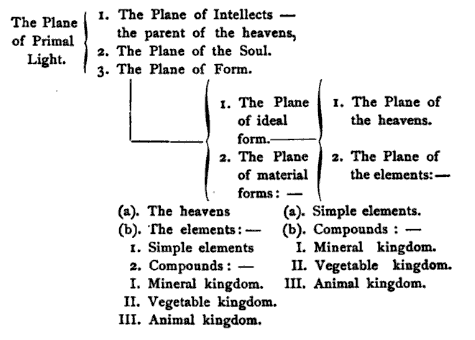
The Plane of Primal Light. 1. The Plane of Intellects—the parent of the heavens,
2. The Plane of the Soul.
3. The Plane of Form. 1. The Plane of ideal form. 1. The Plane of the heavens.
2. The Plane of the elements:— (a). Simple elements.
(b). Compounds:— I. Mineral kingdom.
II. Vegetable kingdom.
III. Animal kingdom.
2. The Plane of material forms:— (a). The heavens
(b). The elements:— 1. Simple elements
2. Compounds:— I. Mineral kingdom.
II. Vegetable kingdom.
III. Animal kingdom.
Having briefly indicated the general nature of Being, we now proceed to a more detailed examination of the world-process. All that is not-light is divided into:—
(1). Eternal e.g., Intellects, Souls of heavenly bodies, heavens, simple elements, time, motion.
(2). Contingent e.g., Compounds of various elements. The motion of the heavens is eternal, and makes up the various cycles of the Universe. It is due to the intense longing of the heaven-soul to receive illumination from the source of all light. The matter of which the heavens are constructed, is completely free from the operation of chemical processes, incidental to the grosser forms of the not-light. Every heaven has its own matter peculiar to it alone. Likewise the heavens differ from one another in the direction of their motion; and the difference is explained by the fact that the beloved, or the sustaining illumination, is different in each case. Motion is only an aspect of time. It is the summing up of the elements of time, which, as externalised, is motion. The distinction of past, present, and future is made only for the sake of convenience, and does not exist in the nature of time.[137:1] We cannot conceive the beginning of time; for the supposed beginning would be a point of time itself. Time and motion, therefore, are both eternal.
There are three primordial elements—water, earth, and wind. Fire, according to the Ishrāqīs, is only burning wind. The combinations of these elements, under various heavenly influences, assume various forms—fluidity, gaseousness, solidity. This transformation of the original elements, constitutes the process of "making and unmaking" which pervades the entire sphere of the not-light, raising the different forms of existence higher and higher, and bringing them nearer and nearer to the illuminating forces. All the phenomena of nature—rain, clouds, thunder, meteor—are the various workings of this immanent principle of motion, and are explained by the direct or indirect operation of the Primal Light on things, which differ from one another in their capacity of receiving more or less illumination. The Universe, in one word, is a petrified desire; a crystallised longing after light.
But is it eternal? The Universe is a manifestation of the illuminative Power which constitutes the essential nature of the Primal Light. In so far, therefore, as it is a manifestation, it is only a dependent being, and consequently not eternal. But in another sense it is eternal. All the different spheres of being exist by the illuminations and rays of the Eternal light. There are some illuminations which are directly eternal; while there are other fainter ones, the appearance of which depends on the combination of other illuminations and rays. The existence of these is not eternal in the same sense as the existence of the pre-existing parent illuminations. The existence of colour, for instance, is contingent in comparison to that of the ray, which manifests colour when a dark body is brought before an illuminating body. The Universe, therefore, though contingent as manifestation, is eternal by the eternal character of its source. Those who hold the non-eternity of the Universe argue on the assumption of the possibility of a complete induction. Their argument proceeds in the following manner:—
(1). Everyone of the Abyssinians is black.
⁂ All Abyssinians are black.
(2). Every motion began at a definite moment.
⁂ All motion must begin so.
But this mode of argumentation is vicious. It is quite impossible to state the major. One cannot collect all the Abyssinians past, present, and future, at one particular moment of time. Such a Universal, therefore, is impossible. Hence from the examination of individual Abyssinians, or particular instances of motion which fall within the pale of our experience, it is rash to infer, that all Abyssinians are black, or all motion had a beginning in time.
Psychology.
Motion and light are not concomitant in the case of bodies of a lower order. A piece of stone, for instance, though illuminated and hence visible, is not endowed with self-initiated movement. As we rise, however, in the scale of being, we find higher bodies, or organisms in which motion and light are associated together. The abstract illumination finds its best dwelling place in man. But the question arises whether the individual abstract illumination which we call the human soul, did or did not exist before its physical accompaniment. The founder of Ishrāqī Philosophy follows Avicenna in connection with this question, and uses the same arguments to show, that the individual abstract illuminations cannot be held to have pre-existed, as so many units of light. The material categories of one and many cannot be applied to the abstract illumination which, in its essential nature, is neither one nor many; though it appears as many owing to the various degrees of illuminational receptivity in its material accompaniments. The relation between the abstract illumination, or soul and body, is not that of cause and effect; the bond of union between them is love. The body which longs for illumination, receives it through the soul; since its nature does not permit a direct communication between the source of light and itself. But the soul cannot transmit the directly received light to the dark solid body which, considering its attributes, stands on the opposite pole of being. In order to be related to each other, they require a medium between them, something standing midway between light and darkness. This medium is the animal soul—a hot, fine, transparent vapour which has its principal seat in the left cavity of the heart, but also circulates in all parts of the body. It is because of the partial identity of the animal soul with light that, in dark nights, land-animals run towards the burning fire; while sea-animals leave their aquatic abodes in order to enjoy the beautiful sight of the moon. The ideal of man, therefore, is to rise higher and higher in the scale of being, and to receive more and more illumination which gradually brings complete freedom from the world of forms. But how is this ideal to be realised? By knowledge and action. It is the transformation of both understanding and will, the union of action and contemplation, that actualizes the highest ideal of man. Change your attitude towards the Universe, and adopt the line of conduct necessitated by the change. Let us briefly consider these means of realisation:—
A. Knowledge. When the Abstract illumination associates itself with a higher organism, it works out its development by the operation of certain faculties—the powers of light, and the powers of darkness. The former are the five external senses, and the five internal senses—sensorium, conception, imagination, understanding, and memory; the latter are the powers of growth, digestion, etc. But such a division of faculties is only convenient. "One faculty can be the source of all operations."[142:1] There is only one power in the middle of the brain, though it receives different names from different standpoints. The mind is a unity which, for the sake of convenience, is regarded as multiplicity. The power residing in the middle of the brain must be distinguished from the abstract illumination which constitutes the real essence of man. The Philosopher of illumination appears to draw a distinction between the active mind and the essentially inactive soul; yet he teaches that in some mysterious way, all the various faculties are connected with the soul.
The most original point in his psychology of intellection, however, is his theory of vision. [142:2] The ray of light which is supposed to come out of the eye must be either substance or quality. If quality, it cannot be transmitted from one substance (eye) to another substance (visible body). If, on the other hand, it is a substance, it moves either consciously, or impelled by its inherent nature. Conscious movement would make it an animal perceiving other things. The perceiver in this case would be the ray, not man. If the movement of the ray is an attribute of its nature, there is no reason why its movement should be peculiar to one direction, and not to all. The ray of light, therefore, cannot be regarded as coming out of the eye. The followers of Aristotle hold that in the process of vision images of objects are printed on the eye. This view is also erroneous; since images of big things cannot be printed on a small space. The truth is that when a thing comes before the eye, an illumination takes place, and the mind sees the object through that illumination. When there is no veil between the object and the normal sight, and the mind is ready to perceive, the act of vision must take place; since this is the law of things. "All vision is illumination; and we see things in God". Berkley explained the relativity of our sight-perceptions with a view to show that the ultimate ground of all ideas is God. The Ishrāqī Philosopher has the same object in view, though his theory of vision is not so much an explanation of the sight-process as a new way of looking at the fact of vision.
Besides sense and reason, however, there is another source of knowledge called "Dhauq"—the inner perception which reveals non-temporal and non-spatial planes of being. The study of philosophy, or the habit of reflecting on pure concepts, combined with the practice of virtue, leads to the upbringing of this mysterious sense, which corroborates and corrects the conclusions of intellect.
B. Action. Man as an active being has the following motive powers:
(a). Reason or the Angelic soul—the source of intelligence, discrimination, and love of knowledge.
(b). The beast-soul which is the source of anger, courage, dominance, and ambition.
(c). The animal soul which is the source of lust, hunger, and sexual passion.
The first leads to wisdom; the second and third, if controlled by reason, lead respectively to bravery and chastity. The harmonious use of all results in the virtue of justice. The possibility of spiritual progress by virtue, shows that this world is the best possible world. Things as existent are neither good nor bad. It is misuse or limited standpoint that makes them so. Still the fact of evil cannot be denied. Evil does exist; but it is far less in amount than good. It is peculiar only to a part of the world of darkness; while there are other parts of the Universe which are quite free from the taint of evil. The sceptic who attributes the existence of evil to the creative agency of God, presupposes resemblance between human and divine action, and does not see that nothing existent is free in his sense of the word. Divine activity cannot be regarded as the creator of evil in the same sense as we regard some forms of human activity as the cause of evil.[145:1]
It is, then, by the union of knowledge and virtue that the soul frees itself from the world of darkness. As we know more and more of the nature of things, we are brought closer and closer to the world of light; and the love of that world becomes more and more intense. The stages of spiritual development are infinite, since the degrees of love are infinite. The principal stages, however, are as follows:—
(1). The stage of "I". In this stage the feeling of personality is most predominant, and the spring of human action is generally selfishness.
(2). The stage of "Thou art not". Complete absorption in one's own deep self to the entire forgetfulness of everything external.
(3). The stage of "I am not". This stage is the necessary result of the second.
(4). The stage of "Thou art". The absolute negation of "I", and the affirmation of "Thou", which means complete resignation to the will of God.
(5). The stage of "I am not; and thou art not". The complete negation of both the terms of thought—the state of cosmic consciousness.
Each stage is marked by more or less intense illuminations, which are accompanied by some indescribable sounds. Death does not put an end to the spiritual progress of the soul. The individual souls, after death, are not unified into one soul, but continue different from each other in proportion to the illumination they received during their companionship with physical organisms. The Philosopher of illumination anticipates Leibniz's doctrine of the Identity of Indiscernibles, and holds that no two souls can be completely similar to each other.[147:1] When the material machinery which it adopts for the purpose of acquiring gradual illumination, is exhausted, the soul probably takes up another body determined by the experiences of the previous life; and rises higher and higher in the different spheres of being, adopting forms peculiar to those spheres, until it reaches its destination—the state of absolute negation. Some souls probably come back to this world in order to make up their deficiencies.[147:2] The doctrine of trans-migration cannot be proved or disproved from a purely logical standpoint; though it is a probable hypothesis to account for the future destiny of the soul. All souls are thus constantly journeying towards their common source, which calls back the whole Universe when this journey is over, and starts another cycle of being to reproduce, in almost all respects, the history of the preceding cycles.
Such is the philosophy of the great Persian martyr. He is, properly speaking, the first Persian systematiser who recognises the elements of truth in all the aspects of Persian speculation, and skilfully synthesises them in his own system. He is a pantheist in so far as he defines God as the sum total of all sensible and ideal existence.[148:1] To him, unlike some of his Ṣūfī predecessors, the world is something real, and the human soul a distinct individuality. With the orthodox theologian, he maintains that the ultimate cause of every phenomenon, is the absolute light whose illumination forms the very essence of the Universe. In his psychology he follows Avicenna, but his treatment of this branch of study is more systematic and more empirical. As an ethical philosopher, he is a follower of Aristotle whose doctrine of the mean he explains and illustrates with great thoroughness. Above all he modifies and transforms the traditional Neo-Platonism, into a thoroughly Persian system of thought which, not only approaches Plato, but also spiritualises the old Persian Dualism. No Persian thinker is more alive to the necessity of explaining all the aspects of objective existence in reference to his fundamental principles. He constantly appeals to experience, and endeavours to explain even the physical phenomena in the light of his theory of illumination. In his system objectivity, which was completely swallowed up by the exceedingly subjective character of extreme pantheism, claims its due again, and, having been subjected to a detailed examination, finds a comprehensive explanation. No wonder then that this acute thinker succeeded in founding a system of thought, which has always exercised the greatest fascination over minds—uniting speculation and emotion in perfect harmony. The narrow-mindedness of his contemporaries gave him the title of "Maqtūl" (the killed one), signifying that he was not to be regarded as "Shahīd" (Martyr); but succeeding generations of Ṣūfīs and philosophers have always given him the profoundest veneration.
I may here notice a less spiritual form of the Ishrāqī mode of thought. Nasafī[150:1] describes a phase of Ṣūfī thought which reverted to the old materialistic dualism of Mānī. The advocates of this view hold, that light and darkness are essential to each other. They are, in reality, two rivers which mix with each other like oil and milk,[150:2] out of which arises the diversity of things. The ideal of human action is freedom from the taint of darkness; and the freedom of light from darkness means the self-consciousness of light as light.
II. Reality as Thought—Al-Jīlī.
Al-Jīlī was born in 767 A.H., as he himself says in one of his verses, and died in 811 A.H. He was not a prolific writer like Shaikh Muḥy al-Dīn ibn ‘Arabī whose mode of thought seems to have greatly influenced his teaching. He combined in himself poetical imagination and philosophical genius, but his poetry is no more than a vehicle for his mystical and metaphysical doctrines. Among other books he wrote a commentary on Shaikh Muḥy al-Dīn ibn ‘Arabī's al-Futūḥāt al-Makkiya, a commentary on Bismillāh, and the famous work Insān al-Kāmil (printed in Cairo).
Essence pure and simple, he says, is the thing to which names and attributes are given, whether it is existent actually or ideally. The existent is of two species:—
(1). The Existent in Absoluteness or Pure existence—Pure Being—God.
(2). The existence joined with non-existence—Creation—Nature.
The Essence of God or Pure Thought cannot be understood; no words can express it, for it is beyond all relation and knowledge is relation. The intellect flying through the fathomless empty space pierces through the veil of names and attributes, traverses the vasty sphere of time, enters the domain of the non-existent and finds the Essence of Pure Thought to be an existence which is non-existence—a sum of contradictions.[152:1] It has two (accidents); eternal life in all past time and eternal life in all future time. It has two (qualities), God and creation. It has two (definitions), uncreatableness and creatableness. It has two names, God and man. It has two faces, the manifested (this world) and the unmanifested (the next world). It has two effects, necessity and possibility. It has two points of view; from the first it is non-existent for itself but existent for what is not itself; from the second it is existent for itself and non-existent for what is not itself.
Name, he says, fixes the named in the understanding, pictures it in the mind, presents it in the imagination and keeps it in the memory. It is the outside or the husk, as it were, of the named; while the named is the inside or the pith. Some names do not exist in reality but exist in name only as "‘Anqā" (a fabulous bird). It is a name the object of which does not exist in reality. Just as "‘Anqā" is absolutely non-existent, so God is absolutely present, although He cannot be touched and seen. The "‘Anqā" exists only in idea while the object of the name "Allāh" exists in reality and can be known like "‘Anqā" only through its names and attributes. The name is a mirror which reveals all the secrets of the Absolute Being; it is a light through the agency of which God sees Himself. Al-Jīlī here approaches the Isma‘īlia view that we should seek the Named through the Name.
In order to understand this passage we should bear in mind the three stages of the development of Pure Being, enumerated by him. He holds that the Absolute existence or Pure Being when it leaves its absoluteness undergoes three stages:—(1) Oneness. (2) He-ness. (3) I-ness. In the first stage there is an absence of all attributes and relations, yet it is called one, and therefore oneness marks one step away from the absoluteness. In the second stage Pure Being is yet free from all manifestation, while the third stage, I-ness, is nothing but an external manifestation of the He-ness; or, as Hegel would say, it is the self-diremption of God. This third stage is the sphere of the name Allāh; here the darkness of Pure Being is illuminated, nature comes to the front, the Absolute Being has become conscious. He says further that the name Allāh is the stuff of all the perfections of the different phases of Divinity, and in the second stage of the progress of Pure Being, all that is the result of Divine self-diremption was potentially contained within the titanic grasp of this name which, in the third stage of the development, objectified itself, became a mirror in which God reflected Himself, and thus by its crystallisation dispelled all the gloom of the Absolute Being.
In correspondence with these three stages of the absolute development, the perfect man has three stages of spiritual training. But in his case the process of development must be the reverse; because his is the process of ascent, while the Absolute Being had undergone essentially a process of descent. In the first stage of his spiritual progress he meditates on the name, studies nature on which it is sealed; in the second stage he steps into the sphere of the Attribute, and in the third stage enters the sphere of the Essence. It is here that he becomes the Perfect Man; his eye becomes the eye of God, his word the word of God and his life the life of God—participates in the general life of Nature and "sees into the life of things".
To turn now to the nature of the attribute. His views on this most interesting question are very important, because it is here that his doctrine fundamentally differs from Hindu Idealism. He defines attribute as an agency which gives us a knowledge of the state of things.[155:1] Elsewhere he says that this distinction of attribute from the underlying reality is tenable only in the sphere of the manifested, because here every attribute is regarded as the other of the reality in which it is supposed to inhere. This otherness is due to the existence of combination and disintegration in the sphere of the manifested. But the distinction is untenable in the domain of the unmanifested, because there is no combination or disintegration there. It should be observed how widely he differs from the advocates of the Doctrine of "Māyā". He believes that the material world has real existence; it is the outward husk of the real being, no doubt, but this outward husk is not the less real. The cause of the phenomenal world, according to him, is not a real entity hidden behind the sum of attributes, but it is a conception furnished by the mind so that there may be no difficulty in understanding the material world. Berkeley and Fichte will so far agree with our author, but his view leads him to the most characteristically Hegelian doctrine—identity of thought and being. In the 37th chapter of the 2nd volume of Insān al-Kāmil, he clearly says that idea is the stuff of which this universe is made; thought, idea, notion is the material of the structure of nature. While laying stress on this doctrine he says, "Dost thou not look to thine own belief? Where is the reality in which the so-called Divine attributes inhere? It is but the idea."[157:1] Hence nature is nothing but a crystallised idea. He gives his hearty assent to the results of Kant's Critique of Pure Reason; but, unlike him, he makes this very idea the essence of the Universe. Kant's Ding an sich to him is a pure nonentity; there is nothing behind the collection of attributes. The attributes are the real things, the material world is but the objectification of the Absolute Being; it is the other self of the Absolute—another which owes its existence to the principle of difference in the nature of the Absolute itself. Nature is the idea of God, a something necessary for His knowledge of Himself. While Hegel calls his doctrine the identity of thought and being, Al-Jīlī calls it the identity of attribute and reality. It should be noted that the author's phrase, "world of attributes", which he uses for the material world is slightly misleading. What he really holds is that the distinction of attribute and reality is merely phenomenal, and does not at all exist in the nature of things. It is useful, because it facilitates our understanding of the world around us, but it is not at all real. It will be understood that Al-Jīlī recognises the truth of Empirical Idealism only tentatively, and does not admit the absoluteness of the distinction. These remarks should not lead us to understand that Al-Jīlī does not believe in the objective reality of the thing in itself. He does believe in it, but then he advocates its unity, and says that the material world is the thing in itself; it is the "other", the external expression of the thing in itself. The Ding an sich and its external expression or the production of its self-diremption, are really identical, though we discriminate between them in order to facilitate our understanding of the universe. If they are not identical, he says, how could one manifest the other? In one word, he means by Ding an sich, the Pure, the Absolute Being, and seeks it through its manifestation or external expression. He says that as long as we do not realise the identity of attribute and reality, the material world or the world of attributes seems to be a veil; but when the doctrine is brought home to us the veil is removed; we see the Essence itself everywhere, and find that all the attributes are but ourselves. Nature then appears in her true light; all otherness is removed and we are one with her. The aching prick of curiosity ceases, and the inquisitive attitude of our minds is replaced by a state of philosophic calm. To the person who has realised this identity, discoveries of science bring no new information, and religion with her role of supernatural authority has nothing to say. This is the spiritual emancipation.
Let us now see how he classifies the different divine names and attributes which have received expression in nature or crystallised Divinity. His classification is as follows:—
(1). The names and attributes of God as He is in Himself (Allāh, The One, The Odd, The Light, The Truth, The Pure, The Living.)
(2). The names and attributes of God as the source of all glory (The Great and High, The All-powerful).
(3). The names and attributes of God as all Perfection (The Creator, The Benefactor, The First, The Last).
(4). The names and attributes of God as all Beauty (The Uncreatable, The Painter, The Merciful, The Origin of all). Each of these names and attributes has its own particular effect by which it illuminates the soul of the perfect man and Nature. How these illuminations take place, and how they reach the soul is not explained by Al-Jīlī. His silence about these matters throws into more relief the mystical portion of his views and implies the necessity of spiritual Directorship.
Before considering Al-Jīlī's views of particular Divine Names and Attributes, we should note that his conception of God, implied in the above classification, is very similar to that of Schleiermacher. While the German theologian reduces all the divine attributes to one single attribute of Power, our author sees the danger of advancing a God free from all attributes, yet recognises with Schleiermacher that in Himself God is an unchangeable unity, and that His attributes "are nothing more than views of Him from different human standpoints, the various appearances which the one changeless cause presents to our finite intelligence according as we look at it from different sides of the spiritual landscape."[161:1] In His absolute existence He is beyond the limitation of names and attributes, but when He externalises Himself, when He leaves His absoluteness, when nature is born, names and attributes appear sealed on her very fabric.
We now proceed to consider what he teaches about particular Divine Names and Attributes. The first Essential Name is Allāh (Divinity) which means the sum of all the realities of existence with their respective order in that sum. This name is applied to God as the only necessary existence. Divinity being the highest manifestation of Pure Being, the difference between them is that the latter is visible to the eye, but its where is invisible; while the traces of the former are visible, itself is invisible. By the very fact of her being crystallised divinity, Nature is not the real divinity; hence Divinity is invisible, and its traces in the form of Nature are visible to the eye. Divinity, as the author illustrates, is water; nature is crystallised water or ice; but ice is not water. The Essence is visible to the eye, (another proof of our author's Natural Realism or Absolute Idealism) although all its attributes are not known to us. Even its attributes are not known as they are in themselves, their shadows or effects only are known. For instance, charity itself is unknown, only its effect or the fact of giving to the poor, is known and seen. This is due to the attributes being incorporated in the very nature of the Essence. If the expression of the attributes in its real nature had been possible, its separation from the Essence would have been possible also. But there are some other Essential Names of God—The Absolute Oneness and Simple Oneness. The Absolute Oneness marks the first step of Pure Thought from the darkness of Cecity (the internal or the original Māyā of the Vedānta) to the light of manifestation. Although this movement is not attended with any external manifestations, yet it sums up all of them under its hollow universality. Look at a wall, says the author, you see the whole wall; but you cannot see the individual pieces of the material that contribute to its formation. The wall is a unity—but a unity which comprehends diversity, so Pure Being is a unity but a unity which is the soul of diversity.
The third movement of the Absolute Being is Simple Oneness—a step attended with external manifestation. The Absolute Oneness is free from all particular names and attributes. The Oneness Simple takes on names and attributes, but there is no distinction between these attributes, one is the essence of the other. Divinity is similar to Simple Oneness, but its names and attributes are distinguished from one another and even contradictory, as generous is contradictory to revengeful.[163:1] The third step, or as Hegel would say, Voyage of the Being, has another appellation (Mercy). The First Mercy, the author says, is the evolution of the Universe from Himself and the manifestation of His own Self in every atom of the result of His own self-diremption. Al-Jīlī makes this point clearer by an instance. He says that nature is frozen water and God is water. The real name of nature is God (Allāh); ice or condensed water is merely a borrowed appellation. Elsewhere he calls water the origin of knowledge, intellect, understanding, thought and idea. This instance leads him to guard against the error of looking upon God as immanent in nature, or running through the sphere of material existence. He says that immanence implies disparity of being; God is not immanent because He is Himself the existence. Eternal existence is the other self of God, it is the light through which He sees Himself. As the originator of an idea is existent in that idea, so God is present in nature. The difference between God and man, as one may say, is that His ideas materialise themselves, ours do not. It will be remembered here that Hegel would use the same line of argument in freeing himself from the accusation of Pantheism.
The attribute of Mercy is closely connected with the attribute of Providence. He defines it as the sum of all that existence stands in need of. Plants are supplied with water through the force of this name. The natural philosopher would express the same thing differently; he would speak of the same phenomena as resulting from the activity of a certain force of nature; Al-Jīlī would call it a manifestation of Providence; but, unlike the natural philosopher, he would not advocate the unknowability of that force. He would say that there is nothing behind it, it is the Absolute Being itself.
We have now finished all the essential names and attributes of God, and proceed to examine the nature of what existed before all things. The Arabian Prophet, says Al-Jīlī, was once questioned about the place of God before creation. He said that God, before the creation, existed in "‘Amā" (Blindness). It is the nature of this Blindness or primal darkness which we now proceed to examine. The investigation is particularly interesting, because the word translated into modern phraseology would be "The Unconsciousness". This single word impresses upon us the foresightedness with which he anticipates metaphysical doctrines of modern Germany. He says that the Unconsciousness is the reality of all realities; it is the Pure Being without any descending movement; it is free from the attributes of God and creation; it does not stand in need of any name or quality, because it is beyond the sphere of relation. It is distinguished from the Absolute Oneness because the latter name is applied to the Pure Being in its process of coming down towards manifestation. It should, however, be remembered that when we speak of the priority of God and posteriority of creation, our words must not be understood as implying time; for there can be no duration of time or separateness between God and His creation. Time, continuity in space and time, are themselves creations, and how can piece of creation intervene between God and His creation. Hence our words before, after, where, whence, etc., in this sphere of thought, should not be construed to imply time or space. The real thing is beyond the grasp of human conceptions; no category of material existence can be applicable to it; because, as Kant would say, the laws of phenomena cannot be spoken of as obtaining in the sphere of noumena.
We have already noticed that man in his progress towards perfection has three stages: the first is the meditation of the name which the author calls the illumination of names. He remarks that "When God illuminates a certain man by the light of His names, the man is destroyed under the dazzling splendour of that name; and "when thou calleth God, the call is responded to by the man". The effect of this illumination would be, in Schopenhauer's language, the destruction of the individual will, yet it must not be confounded with physical death; because the individual goes on living and moving like the spinning wheel, as Kapila would say, after he has become one with Prakriti. It is here that the individual cries out in pantheistic mood:—She was I and I was she and there was none to separate us."[167:1]
The second stage of the spiritual training is what he calls the illumination of the Attribute. This illumination makes the perfect man receive the attributes of God in their real nature in proportion to the power of receptivity possessed by him—a fact which classifies men according to the magnitude of this light resulting from the illumination. Some men receive illumination from the divine attribute of Life, and thus participate in the soul of the Universe. The effect of this light is soaring in the air, walking on water, changing the magnitude of things (as Christ so often did). In this wise the perfect man receives illumination from all the Divine attributes, crosses the sphere of the name and the attribute, and steps into the domain of the Essence—Absolute Existence.
As we have already seen, the Absolute Being, when it leaves its absoluteness, has three voyages to undergo, each voyage being a process of particularisation of the bare universality of the Absolute Essence. Each of these three movements appears under a new Essential Name which has its own peculiar illuminating effect upon the human soul. Here is the end of our author's spiritual ethics; man has become perfect, he has amalgamated himself with the Absolute Being, or has learnt what Hegel calls The Absolute Philosophy. "He becomes the paragon of perfection, the object of worship, the preserver of the Universe".[169:1] He is the point where Man-ness and God-ness become one, and result in the birth of the god-man.
How the perfect man reaches this height of spiritual development, the author does not tell us; but he says that at every stage he has a peculiar experience in which there is not even a trace of doubt or agitation. The instrument of this experience is what he calls the Qalb (heart), a word very difficult of definition. He gives a very mystical diagram of the Qalb, and explains it by saying that it is the eye which sees the names, the attributes and the Absolute Being successively. It owes its existence to a mysterious combination of soul and mind; and becomes by its very nature the organ for the recognition of the ultimate realities of existence. All that the "heart", or the source of what the Vedānta calls the Higher Knowledge, reveals is not seen by the individual as something separate from and heterogeneous to himself; what is shown to him through this agency is his own reality, his own deep being. This characteristic of the agency differentiates it from the intellect, the object of which is always different and separate from the individual exercising that faculty. But the spiritual experience, according to the Ṣūfīs of this school, is not permanent; moments of spiritual vision, says Matthew Arnold,[170:1] cannot be at our command. The god-man is he who has known the mystery of his own being, who has realised himself as god-man; but when that particular spiritual realisation is over man is man and God is God. Had the experience been permanent, a great moral force would have been lost and society overturned.
Let us now sum up Al-Jīlī's Doctrine of the Trinity. We have seen the three movements of the Absolute Being, or the first three categories of Pure Being; we have also seen that the third movement is attended with external manifestation, which is the self-diremption of the Essence into God and man. This separation makes a gap which is filled by the perfect man, who shares in both the Divine and the human attributes. He holds that the perfect man is the preserver of the Universe; hence in his view, the appearance of the perfect man is a necessary condition for the continuation of nature. It is easy, therefore, to understand that in the god-man, the Absolute Being which has left its absoluteness, returns into itself; and, but for the god-man, it could not have done so; for then there would have been no nature, and consequently no light through which God could have seen Himself. The light through the agency of which God sees Himself is due to the principle of difference in the nature of the Absolute Being itself. He recognises this principle in the following verses:—
If you say that God is one, you are right; but if you say that He is two, this is also true. If you say no, but He is three, you are right, for this is the real nature of man. [171:1]
The perfect man, then, is the joining link. On the one hand he receives illumination from all the Essential names, on the other hand all Divine attributes reappear in him. These attributes are:—
1. Independent life or existence.
2. Knowledge which is a form of life, as he proves from a verse from the Qur’an.
3. Will—the principle of particularisation, or the manifestation of Being. He defines it as the illumination of the knowledge of God according to the requirements of the Essence; hence it is a particular form of knowledge. It has nine manifestations, all of which are different names for love; the last is the love in which the lover and the beloved, the knower and the known merge into each other, and become identical. This form of love, he says, is the Absolute Essence; as Christianity teaches, God is love. He guards, here, against the error of looking upon the individual act of will as uncaused. Only the act of the universal will is uncaused; hence he implies the Hegelian Doctrine of Freedom, and holds that the acts of man are both free and determined.
4. Power, which expresses itself in self-diremption i.e. creation. He controverts Shaikh Muḥy al-Dīn ibn ‘Arabī's position that the Universe existed before the creation in the knowledge of God. He says, this would imply that God did not create it out of nothing, and holds that the Universe, before its existence as an idea, existed in the self of God.
5. The word or the reflected being. Every possibility is the word of God; hence nature is the materialisation of the word of God. It has different names—The tangible word, The sum of the realities of man, The arrangement of the Divinity, The spread of Oneness, The expression of the Unknown, The phases of Beauty, The trace of names and attributes, and the object of God's knowledge.
6. The Power of hearing the inaudible.
7. The Power of seeing the invisible.
8. Beauty—that which seems least beautiful in nature (the reflected beauty) is in its real existence, beauty. Evil is only relative, it has no real existence; sin is merely a relative deformity.
9. Glory or beauty in its intensity.
10. Perfection, which is the unknowable essence of God and therefore Unlimited and Infinite.
FOOTNOTES:
CHAP. VI. LATER PERSIAN THOUGHT.
Under the rude Tartar invaders of Persia, who could have no sympathy with independent thought, there could be no progress of ideas. Ṣūfīism, owing to its association with religion, went on systematising old and evolving new ideas. But philosophy proper was distasteful to the Tartar. Even the development of Islamic law suffered a check; since the Ḥanafite law was the acme of human reason to the Tartar, and further subtleties of legal interpretation were disagreeable to his brain. Old schools of thought lost their solidarity, and many thinkers left their native country to find more favourable conditions elsewhere. In the 16th century we find Persian Aristotelians—Dastūr Isfahānī, Hīr Bud, Munīr, and Kāmrān—travelling in India, where the Emperor Akbar was drawing upon Zoroastrianism to form a new faith for himself and his courtiers, who were mostly Persians. No great thinker, however, appeared in Persia until the 17th century, when the acute Mulla Ṣadra of Shīrāz upheld his philosophical system with all the vigour of his powerful logic. With Mulla Ṣadra Reality is all things yet is none of them, and true knowledge consists in the identity of the subject and the object. De Gobineau thinks that the philosophy of Ṣadra is a mere revival of Avicennaism. He, however, ignores the fact that Mulla Ṣadra's doctrine of the identity of subject and object constitutes the final step which the Persian intellect took towards complete monism. It is moreover the Philosophy of Ṣadra which is the source of the metaphysics of early Bābism.
But the movement towards Platonism is best illustrated in Mulla Hādī of Sabzwār who flourished in the 18th century, and is believed by his countrymen to be the greatest of modern Persian thinkers. As a specimen of comparatively recent Persian speculation, I may briefly notice here the views of this great thinker, as set forth in his Asrār al-Ḥikam (published in Persia). A glance at his philosophical teaching reveals three fundamental conceptions which are indissolubly associated with the Post-Islamic Persian thought:—
1. The idea of the Absolute Unity of the Real which is described as "Light".
2. The idea of evolution which is dimly visible in Zoroaster's doctrine of the destiny of the human soul, and receives further expansion and systematisation by Persian Neo-Platonists and Ṣūfī thinkers.
3. The idea of a medium between the Absolute Real and the Not-real.
It is highly interesting to note how the Persian mind gradually got rid of the Emanation theory of Neo-Platonism, and reached a purer notion of Plato's Philosophy. The Arab Muhammadans of Spain, by a similar process of elimination reached, through the same medium (Neo-Platonism) a truer conception of the Philosophy of Aristotle—a fact which illustrates the genius of the two races. Lewes in his Biographical History of Philosophy remarks that the Arabs eagerly took up the study of Aristotle simply because Plato was not presented to them. I am, however, inclined to think that the Arab genius was thoroughly practical; hence Plato's philosophy would have been distasteful to them even if it had been presented in its true light. Of the systems of Greek philosophy Neo-Platonism, I believe, was the only one which was presented in its completeness to the Muslim world; yet patient critical research led the Arab from Plotinus to Aristotle, and the Persian to Plato. This is singularly illustrated in the Philosophy of Mulla Hādī, who recognises no Emanations, and approaches the Platonic conception of the Real. He illustrates, moreover, how philosophical speculation in Persia, as in all countries where Physical science either does not exist or is not studied, is finally absorbed by religion. The "Essence", i.e. the metaphysical cause as distinguished from the scientific cause, which means the sum of antecedent conditions, must gradually be transformed into "Personal Will" (cause, in a religious sense) in the absence of any other notion of cause. And this is perhaps the deeper reason why Persian philosophies have always ended in religion.
Let us now turn to Mulla Hādī's system of thought. He teaches that Reason has two aspects:—(a) Theoretical, the object of which is Philosophy and Mathematics, (b) Practical, the object of which is Domestic Economy, Politics, etc. Philosophy proper comprises the knowledge of the beginning of things, the end of things, and the knowledge of the Self. It also includes the knowledge of the law of God—which is identical with religion. In order to understand the origin of things, we should subject to a searching analysis the various phenomena of the Universe. Such an analysis reveals that there are three original principles.[178:1]
(1). The Real—Light.
(2). The Shadow.
(3). The not-Real—Darkness.
The Real is absolute, and necessary as distinguished from the "Shadow", which is relative and contingent. In its nature it is absolutely good; and the proposition that it is good, is self-evident.[178:2] All forms of potential existence, before they are actualised by the Real, are open to both existence or non-existence, and the possibilities of their existence or non-existence are exactly equal. It, therefore, follows that the Real which actualises the potential is not itself non-existence; since non-existence operating on non-existence cannot produce actuality.[179:1] Mulla Hādī, in his conception of the Real as the operator, modifies Plato's statical conception of the Universe, and, following Aristotle, looks upon his Real as the immovable source and the object of all motion. "All things in the Universe," he says, "love perfection, and are moving towards their final ends—minerals towards vegetables, vegetables towards animals, and animals towards man. And observe how man passes through all these stages in the mother's womb."[179:2] The mover as mover is either the source or the object of motion or both. In any case the mover must be either movable or immovable. The proposition that all movers must be themselves movable, leads to infinite regress—which must stop at the immovable mover, the source and the final object of all motion. The Real, moreover, is a pure unity; for if there is a plurality of Reals, one would limit the other. The Real as creator also cannot be conceived as more than one; since a plurality of creators would mean a plurality of worlds which must be circular touching one another, and this again implies vacuum which is impossible.[180:1] Regarded as an essence, therefore, the Real is one. But it is also many, from a different standpoint. It is life, power, love; though we cannot say that these qualities inhere in it—they are it, and it is them. Unity does not mean oneness, its essence consists in the "dropping of all relations." Unlike the Ṣūfīs and other thinkers, Mulla Hādī holds and tries to show that belief in multiplicity is not inconsistent with belief in unity; since the visible "many" is nothing more than a manifestation of the names and attributes of the Real. These attributes are the various forms of a "Knowledge" which constitutes the very essence of the Real. To speak, however, of the attributes of the Real is only a verbal convenience; since "defining the Real is applying the category of number to it"—an absurd process which endeavours to bring the unrelated into the sphere of the related. The Universe, with all its variety, is the shadow of the various names and attributes of the Real or the Absolute Light. It is Reality unfolded, the "Be", or the word of Light.[181:1] Visible multiplicity is the illumination of Darkness, or the actualisation of Nothing. Things are different because we see them, as it were, through glasses of different colours—the Ideas. In this connection Hādī approvingly quotes the poet Jāmī who has given the most beautiful poetic expression to Plato's Doctrine of Ideas in verses which can be thus translated:—
"The ideas are glasses of various colours in which the Sun of Reality reflects itself, and makes itself visible through them according as they are red, yellow or blue."[181:2]
In his Psychology he mostly follows Avicenna, but his treatment of the subject is more thorough and systematic. He classifies the soul in the following manner:—
The Soul
HeavenlyEarthly
HumanAnimalVegetative
Powers:—
1. Preserving the individual.
2. Perfecting the individual.
3. Perpetuating the species.
The animal soul has three powers:—
1. External senses Perception.
2. Internal senses
3. Power of motion which includes.
(a) Voluntary motion.
(b) Involuntary motion.
The external senses are taste, touch, smell, hearing and sight. The sound exists outside the ear, and not inside as some thinkers have held. For if it does not exist outside the ear, it is not possible to perceive its direction and distance. Hearing and sight are superior to other senses, and sight is superior to hearing; since: —
I. The eye can perceive distant things.
II. Its perception is light, which is the best of all attributes.
III. The construction of the eye is more complicated and delicate than that of the ear.
IV. The perceptions of sight are things which actually exist, while those of hearing resemble non-existence.
The internal senses are as follow:—
(1). The Common Sense—the tablet of the mind. It is like the Prime Minister of the mind sending out five spies (external senses) to bring in news from the external world. When we say "this white thing is sweet", we perceive whiteness and sweetness by sight and taste respectively, but that both the attributes exist in the same thing is decided by the Common Sense. The line made by a falling drop, so far as the eye is concerned, is nothing but the drop. But what is the line which we see? To account for such a phenomenon, says Hādī, it is necessary to postulate another sense which perceives the lengthening of the falling drop into a line.
(2). The faculty which preserves the perceptions of the Common Sense—images and not ideas like the memory. The judgment that whiteness and sweetness exist in the same thing is completed by this faculty; since, if it does not preserve the image of the subject, Common Sense cannot perceive the predicate.
(3). The power which perceives individual ideas. The sheep thinks of the enmity of the wolf, and runs away from him. Some forms of life lack this power, e.g. the moth which hurls itself against the candle-flame.
(4). Memory—the preserver of ideas.
(5). The power of combining images and ideas, e.g. the winged man. When this faculty works under the guidance of the power which perceives individual ideas, it is called Imagination; when it works under the control of Intellect, it is called Conception.
But it is the spirit which distinguishes man from other animals. This essence of humanity is a "unity", not oneness. It perceives the Universal by itself, and the particular through the external and the internal senses. It is the shadow of the Absolute Light, and like it manifests itself in various ways—comprehending multiplicity in its unity. There is no necessary relation between the spirit and the body. The former is non-temporal and non-spatial; hence it is changeless, and has the power of judging the visible multiplicity. In sleep the spirit uses the "ideal body" which functions like the physical body; in waking life it uses the ordinary physical body. It follows, therefore, that the spirit stands in need of neither, and uses both at will. Hādī does not follow Plato in his doctrine of transmigration, the different forms of which he refutes at length. The spirit to him is immortal, and reaches its original home—Absolute Light—by the gradual perfection of its faculties. The various stages of the development of reason are as follows:—
A. Theoretical or Pure Reason— 1st Potential Reason. 2nd Perception of self-evident propositions. 3rd Actual Reason. 4th Perception of Universal concepts. B. Practical Reason— 1st External Purification. 2nd Internal Purification. 3rd Formation of virtuous habits. 4th Union with God.
Thus the spirit rises higher and higher in the scale of being, and finally shares in the eternity of the Absolute Light by losing itself in its universality. "In itself non-existent, but existent in the eternal Friend: how wonderful that it is and is not at the same time". But is the spirit free to choose its course? Hādī criticises the Rationalists for their setting up man as an independent creator of evil, and accuses them of what he calls "veiled dualism". He holds that every object has two sides—"bright" side, and "dark" side. Things are combinations of light and darkness. All good flows from the side of light; evil proceeds from darkness. Man, therefore, is both free and determined.
But all the various lines of Persian thought once more find a synthesis in that great religious movement of Modern Persia—Bābism or Bahāism, which began as a Shī‘ah sect, with Mirzā ‘Alī Muḥammad Bāb of Shīrāz (b. 1820), and became less and less Islamic in character with the progress of orthodox persecutions. The origin of the philosophy of this wonderful sect must be sought in the Shī‘ah sect of the Shaikhīs, the founder of which, Shaikh Aḥmad, was an enthusiastic student of Mulla Ṣadrā's Philosophy, on which he had written several commentaries. This sect differed from the ordinary Shī‘ahs in holding that belief in an ever present Medium between the absent Imām (the 12th Head of the Church, whose manifestation is anxiously expected by the Shī‘ahs), and the church is a fundamental principle of the Shī‘ah religion. Shaikh Aḥmad claimed to be such a Medium; and when, after the death of the second Shaikhī Medium—Ḥājī Kāzim, the Shaikhīs were anxiously expecting the manifestation of the new Medium, Mirzā ‘Alī Muḥammad Bāb, who had attended the lectures of Ḥājī Kāzim at Karbalā, proclaimed himself the expected Medium, and many Shaikhīs accepted him.
The young Persian seer looks upon Reality as an essence which brooks no distinction of substance and attribute. The first bounty or self-expansion of the Ultimate Essence, he says, is Existence. "Existence" is the "known", the "known" is the essence of "knowledge"; "knowledge" is "will"; and "will" is "love". Thus from Mulla Ṣadrā's identity of the known and the knower, he passes to his conception of the Real as Will and Love. This Primal Love, which he regards as the essence of the Real, is the cause of the manifestation of the Universe which is nothing more than the self-expansion of Love. The word creation, with him, does not mean creation out of nothing; since, as the Shaikhīs maintain, the word creator is not peculiarly applicable to God alone. The Quranic verse, that "God is the best of creators",[188:1] implies that there are other self-manifesting beings like God.
After the execution of ‘Alī Muḥammad Bāb, Bahāullāh, one of his principal disciples who were collectively called "The First Unity", took up the mission, and proclaimed himself the originator of the new dispensation, the absent Imām whose manifestation the Bāb had foretold. He freed the doctrine of his master from its literalistic mysticism, and presented it in a more perfected and systematised form. The Absolute Reality, according to him, is not a person; it is an eternal living Essence, to which we apply the epithets Truth and Love only because these are the highest conceptions known to us. The Living Essence manifests itself through the Univere with the object of creating in itself atoms or centres of consciousness, which as Dr. McTaggart would say, constitute a further determination of the Hegelian Absolute. In each of these undifferentiated, simple centres of consciousness, there is hidden a ray of the Absolute Light itself, and the perfection of the spirit consists in gradually actualising, by contact with the individualising principle—matter, its emotional and intellectual possibilities, and thus discovering its own deep being—the ray of eternal Love which is concealed by its union with consciousness. The essence of man, therefore, is not reason or consciousness; it is this ray of Love—the source of all impulse to noble and unselfish action, which constitutes the real man. The influence of Mulla Ṣadrā's doctrine of the incorporeality of Imagination is here apparent. Reason, which stands higher than Imagination in the scale of evolution, is not a necessary condition, according to Mulla Ṣadrā, of immortality. In all forms of life there is an immortal spiritual part, the ray of Eternal Love, which has no necessary connection with self-consciousness or reason, and survives after the death of the body. Salvation, then, which to Buddha consists in the starving out of the mind-atoms by extinguishing desire, to Bahāullāh lies in the discovery of the essence of love which is hidden in the atoms of consciousness themselves.[190:1] Both, however, agree that after death thoughts and characters of men remain, subject to other forces of a similar character, in the spiritual world, waiting for another opportunity to find a suitable physical accompaniment in order to continue the process of discovery (Bahāullāh) or destruction (Buddha). To Bahāullāh the conception of Love is higher than the conception of Will. Schopenhauer conceived reality as Will which was driven to objectification by a sinful bent eternally existing in its nature. Love or Will, according to both, is present in every atom of life; but the cause of its being there is the joy of self-expansion in the one case, and the inexplicable evil inclination in the other. But Schopenhauer postulates certain temporal ideas in order to account for the objectification of the Primordial Will; Bahāullāh, as far as I can see, does not explain the principle according to which the self-manifestation of the Eternal Love is realised in the Universe.
FOOTNOTES:
CONCLUSION.
Let us now briefly sum up the results of our survey. We have seen that the Persian mind had to struggle against two different kinds of Dualism—pre-Islamic Magian Dualism, and post-Islamic Greek Dualism, though the fundamental problem of the diversity of things remains essentially the same. The attitude of the pre-Islamic Persian thinkers is thoroughly objective, and hence the results of their intellectual efforts are more or less materialistic. The Pre-Islamic thinkers, however, clearly perceived that the original Principle must be dynamically conceived. With Zoroaster both the primary spirits are "active", with Mānī the principle of Light is passive, and the principle of Darkness is aggressive. But their analysis of the various elements which constitute the Universe is ridiculously meagre; their conception of the Universe is most defective on its statical side. There are, therefore, two weak points in their systems:—
1. Naked Dualism.
2. Lack of analysis.
The first was remedied by Islām; the second by the introduction of Greek Philosophy. The advent of Islām and the study of Greek philosophy, however, checked the indigenous tendency towards monistic thought; but these two forces contributed to change the objective attitude characteristic of early thinkers, and aroused the slumbering subjectivity, which eventually reached its climax in the extreme Pantheism of some of the Ṣūfī schools. Al-Fārābī endeavoured to get rid of the dualism between God and matter, by reducing matter to a mere confused perception of the spirit; the Ash‘arite denied it altogether, and maintained a thoroughgoing Idealism. The followers of Aristotle continued to stick to their master's Prima Materia; the Ṣūfīs looked upon the material universe as a mere illusion, or a necessary "other," for the self-knowledge of God. It can, however, be safely stated that with the Ash‘arite Idealism, the Persian mind got over the foreign dualism of God and matter, and, fortified with new philosophical ideas, returned to the old dualism of light and darkness. The Shaikh-al-Ishrāq combines the objective attitude of Pre-Islamic Persian thinkers with the subjective attitude of his immediate predecessors, and restates the Dualism of Zoroaster in a much more philosophical and spiritualised form. His system recognises the claims of both the subject and the object. But all these monistic systems of thought were met by the Pluralism of Wāḥid Maḥmūd, who taught that reality is not one, but many—primary living units which combine in various ways, and gradually rise to perfection by passing through an ascending scale of forms. The reaction of Wāḥid Maḥmūd was, however, an ephemeral phenomenon. The later Sūfīs as well as philosophers proper gradually transformed or abandoned the Neo-Platonic theory of Emanation, and in later thinkers we see a movement through Neo-Platonism towards real Platonism which is approached by Mulla Hādī's Philosophy. But pure speculation and dreamy mysticism undergo a powerful check in Bābism which, unmindful of persecution, synthesises all the inherited philosophical and religious tendencies, and rouses the spirit to a consciousness of the stern reality of things. Though extremely cosmopolitan and hence quite unpatriotic in character, it has yet had a great influence over the Persian mind. The unmystic character and the practical tone of Bābism may have been a remote cause of the progress of recent political reform in Persia.
ERRATA
P. 4, Note 4, l. 1, read Buudahish for Buudadisḥ. P. 9, l. 10, read environment for environments. P. 56, l. 1, read reaction for reation. P. 61, l. 18, read considered for consided. P. 73, l. 21, read full stop after dialectic. P. 102, l. 1, read conditions for condition. P. 123, l. 19, read predecessors for precessor. P. 153, l. 21, read He-ness for an He-ness. P. 166, l. 21, read a piece for pieee.
Transcriber's Notes:
Many words appear in the text with different transcription or mark-up. They have been left as in the original.
All occurrences of e. g., i. e., B. C., A. D. and A. H. have been replaced with e.g., i.e., B.C., A.D. and A.H., without note. Other initials have been left as in the original.
Errata (printed on unnumbered page, pasted before page 1) has been moved to the end of the text.
The following corrections have been made to the text:
Errors noted in the Errata list have been fixed
page IX—due perhaps to semitic[original has samitic] influences,
page CONTENTS—Reality as[original has as as] Beauty
page 9—social environments[original has evironments]
page 25—introduced[original has intruduced]
page 33—Maulānā[original has Maulāna]
page 54—necessarily[original has necssarily]
page 54—Nazzām[original has Nazzān]
page 56—reaction[original has reation]
page 57—Ismā‘īlians[original has Ismā‘īliams]
page 61—considered[original has consided]
page 61—metaphysical[original has netaphysical]
page 63—which,[original has period] by gradually
page 65—Ash‘arite.[original has Ash‘arīte]
page 69—philosophising[original has plilosophising]
page 74—Shahrastānī[original has Shahrastānī]
page 75—Ash‘arite[original has Ash’arite]
page 76—Ash‘arite[original has Ash‘ārite]
page 81—seem to[original has the letter t missing] be
page 68, footnote 68:1—Ash‘aritenthums[original has Ash’aritenthums]
page 69, footnote 69:1—Ash‘aritenthums[original has As‘aritenthums]
page 81—Ḥikmat al-‘Ain—[original has -]"Philosophy of Essence",
page 85—objectively[original has objectivily]
page 95, footnote 95:1—Commentary[original has Comentary]
page 104—restatement[original has restatemet]
page 105—Ka‘bahs[original has Ka‘bāhs]
page 111—self-conscious[original has self-consious]
page 123—predecessors[original has precessors]
page 124—the son of Sultan Ṣalāḥ[original has Ṣalā-Ṣalāḥ]-al Dīn
page 127—visible[original has visibile]
page 136—is motion.[original has comma] The distinction of past,
page 142—theory of[original has theoryof]
page 148—maintains[original has mantains]
page 158—identical[original has indentical]
page 162—marks the[original has the the] first step
page 152, footnote 152:1—Insān al-Kāmil[original has Insānul Kāmul]
page 163, footnote 163:1—Notwithstanding[original has Nowithstanding]
page 171, footnote 171:1—Insān al-Kāmil[original has Insānul Kāmil]
page 180—standpoint[original has staindpoint]
page 187—Shī‘ahs[original has Shī’ahs]